Affiliation with the failing Carnegie Trust Company and related disturbances from Joseph G. Robin's operations prompted depositors to withdraw funds.
Measures
J. P. Morgan & Co. (and other big bankers) sent large amounts of cash (packed in suitcases/tin box) and displayed it on the counters to reassure depositors; prompt payment of presented checks.
Newspaper Excerpt
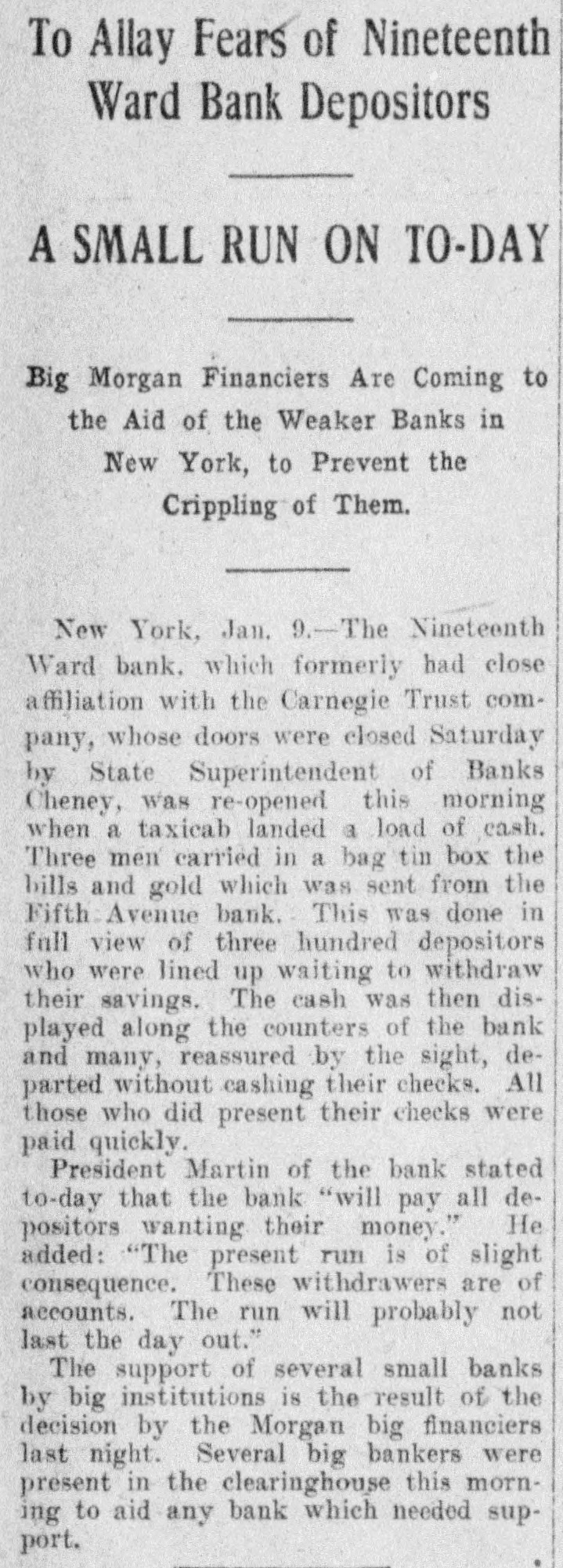
The Nineteenth Ward bank ... was re-opened this morning when a taxicab landed a load of cash.
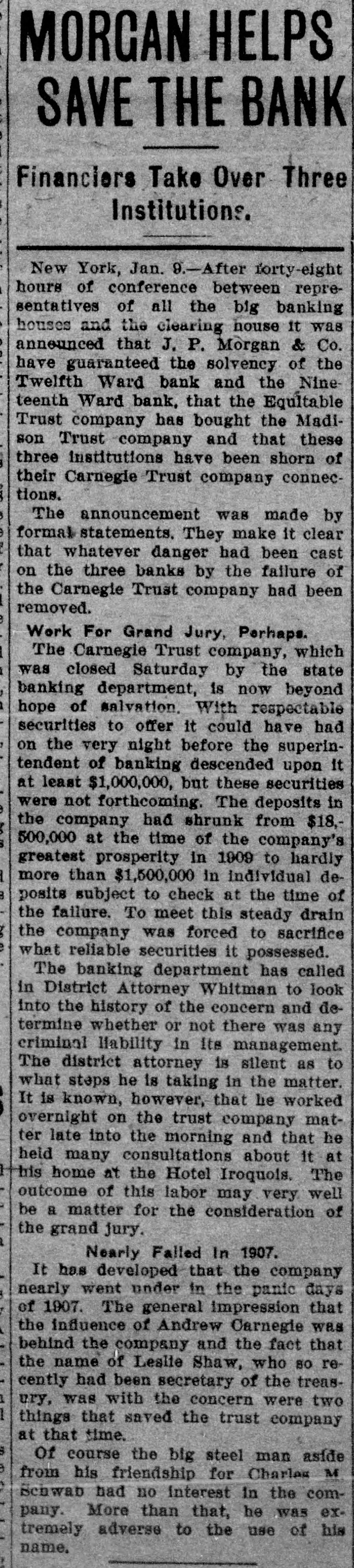
MORGAN HELPS SAVE THE BANK Financiers Take Over Three Institutions. New York, Jan. 9.-After forty-eight hours of conference between representatives of all the big banking houses and the clearing house It was announced that J. P. Morgan & Co. have guaranteed the solvency of the Twelfth Ward bank and the Nineteenth Ward bank, that the Equitable Trust company has bought the Madison Trust company and that these three institutions have been shorn of their Carnegie Trust company connections. The announcement was made by formal statements. They make it clear that whatever danger had been cast on the three banks by the failure of the Carnegie Trust company had been removed. Work For Grand Jury, Perhaps. The Carnegie Trust company, which was closed Saturday by the state banking department, is now beyond hope of salvation. With respectable securities to offer it could have had on the very night before the superintendent of banking descended upon it at least $1,000,000, but these securities were not forthcoming. The deposits in the company had shrunk from $18,500,000 at the time of the company's greatest prosperity in 1909 to hardly more than $1,500,000 in individual deposits subject to check at the time of the failure. To meet this steady drain the company was forced to sacrifice what reliable securities it possessed. The banking department has called in District Attorney Whitman to look into the history of the concern and determine whether or not there was any criminal liability in its management. The district attorney is silent as to what steps he is taking in the matter. It is known, however, that he worked overnight on the trust company matter late into the morning and that he held many consultations about it at his home at the Hotel Iroquois. The outcome of this labor may very well be a matter for the consideration of the grand jury. Nearly Falled In 1907. It has developed that the company nearly went under in the panic days of 1907. The general impression that the influence of Andrew Carnegie was behind the company and the fact that the name of Leslie Shaw, who 80 recently had been secretary of the treasury, was with the concern were two things that saved the trust company at that time. Of course the big steel man asíde from his friendship for Charles M Schwab had no interest In the company. More than that, he was extremely adverse to the use of his name.
2.January 9, 1911The Barre Daily TimesBarre, VT
Click image to open full size in new tab
Article Text
To Allay Fears of Nineteenth Ward Bank Depositors A SMALL RUN ON TO-DAY Big Morgan Financiers Are Coming to the Aid of the Weaker Banks in New York, to Prevent the Crippling of Them. New York, Jan. 9.-The Nineteenth Ward bank. which formerly had close affiliation with the Carnegie Trust company, whose doors were closed Saturday by State Superintendent of Banks Cheney, was re-opened this morning when a taxicab landed a load of cash. Three men carried in a bag tin box the bills and gold which was sent from the Fifth Avenue bank. This was done in fall view of three hundred depositors who were lined up waiting to withdraw their savings. The cash was then displayed along the counters of the bank and many, reassured by the sight, departed without cashing their checks. All those who did present their checks were paid quickly. President Martin of the bank stated to-day that the bank "will pay all depositors wanting their money." He added: "The present run is of slight consequence. These withdrawers are of accounts. The run will probably not last the day out." The support of several small banks by big institutions is the result of the decision by the Morgan big financiers last night. Several big bankers were present in the clearinghouse this morning to aid any bank which needed support.
3.January 9, 1911The Daytona Daily NewsDaytona Beach, FL
Click image to open full size in new tab
Article Text
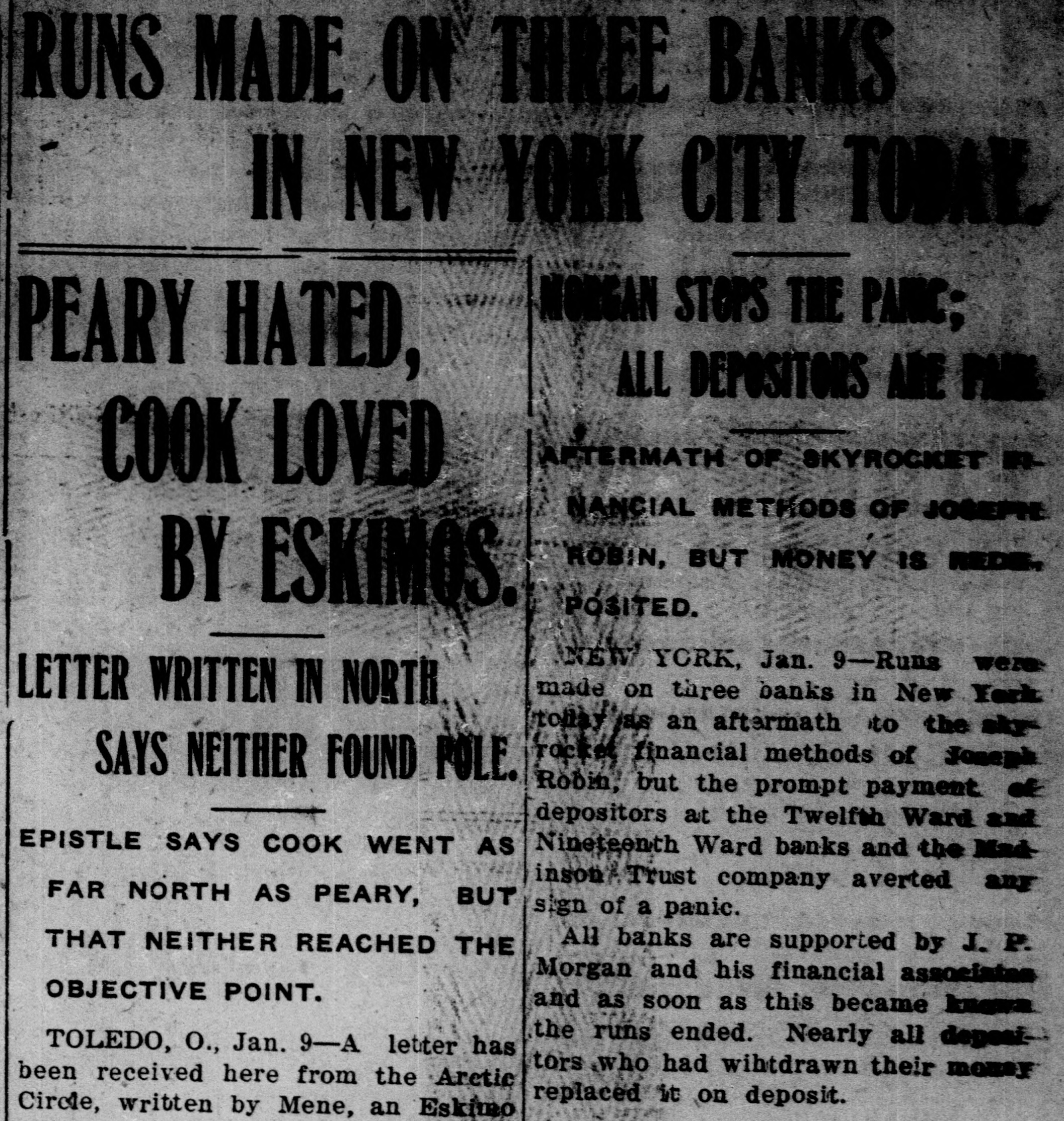
RUNS MADE ON THREE BANKS IN NEW CITY TOME STOPS THE PANIC; PEARY HATED, ALL DEPOSITORS ARE PN AFTERMATH OF OKYROCKET COOK LOVED NANCIAL METHODS OF JOSEPH ROBIN, BUT MONEY IS BY ESKI PO3ITED. NEW YORK, Jan. 9-Runs were made on three banks in New York LETTER WRITTEN IN NORTH tonay/da an aftermath to sky rocket financial methods of Joneya SAYS NEITHER FOUND POLE. Robin, but the prompt payment depositors at the Twelfth Ward EPISTLE SAYS COOK WENT AS Made Nineteenth Ward banks and the inson Trust company averted FAR NORTH AS PEARY, BUT sign of a panic. All banks are supported by J. P. THAT NEITHER REACHED THE Morgan and his financial associates OBJECTIVE POINT. and as soon as this became the runs ended. Nearly all deposiTOLEDO, O., Jan. 9-A letter has tors who had wibtdrawn their money been received here from the Arctic replaced it on deposit. Circle, written by Mene, an Eskimo
4.January 9, 1911Daily Capital JournalSalem, OR
Click image to open full size in new tab
Article Text
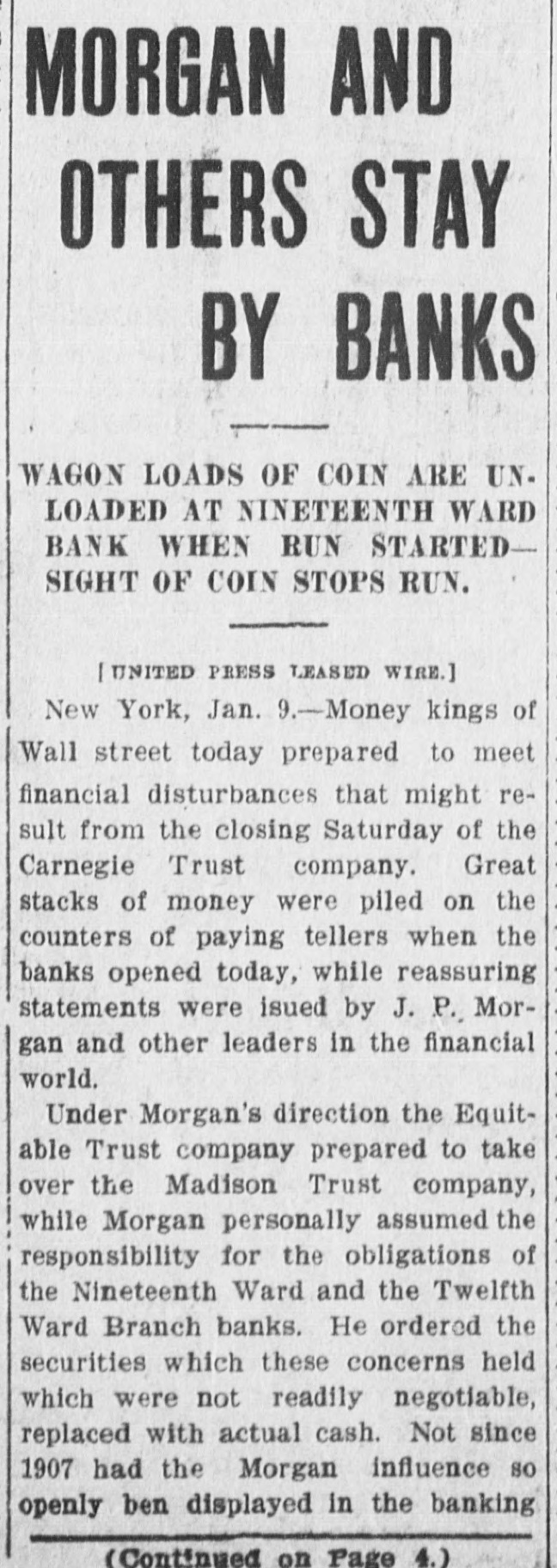
MORGAN AND OTHERS STAY BY BANKS WAGON LOADS OF COIN ARE UNLOADED AT NINETEENTH WARD BANK WHEN RUN STARTEDSIGHT OF COIN STOPS RUN. I UNITED PRESS LEASED WIRE.] New York, Jan. 9.-Money kings of Wall street today prepared to meet financial disturbances that might result from the closing Saturday of the Carnegie Trust company. Great stacks of money were piled on the counters of paying tellers when the banks opened today, while reassuring statements were isued by J. P. Morgan and other leaders in the financial world. Under Morgan's direction the Equitable Trust company prepared to take over the Madison Trust company, while Morgan personally assumed the responsibility for the obligations of the Nineteenth Ward and the Twelfth Ward Branch banks. He ordered the securities which these concerns held which were not readily negotiable, replaced with actual cash. Not since 1907 had the Morgan influence so openly ben displayed in the banking (Continued on Page 4.)
5.January 9, 1911Alexandria GazetteAlexandria, VA
Click image to open full size in new tab
Article Text
Ready for Runs on Banks
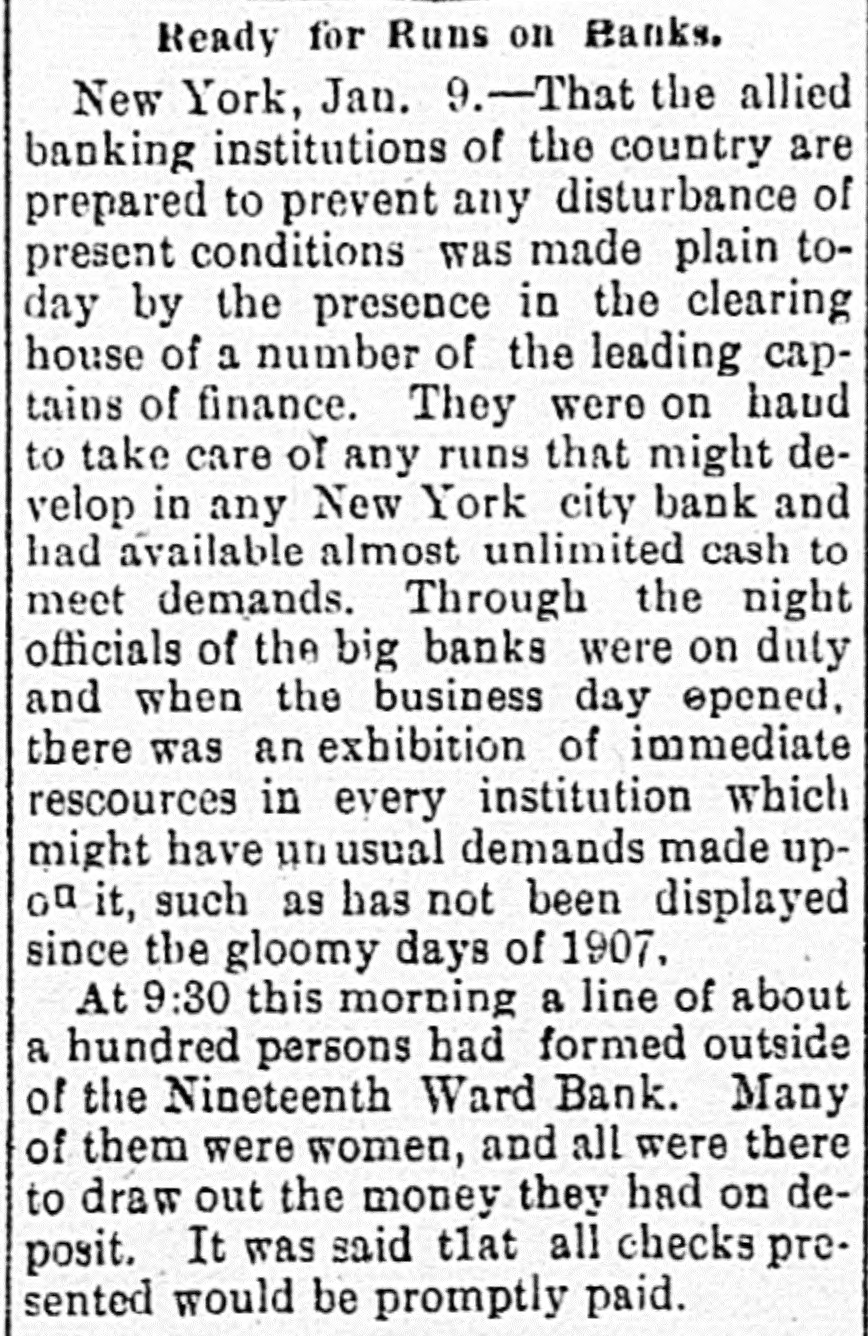
New York, Jan. 9.-That the allied banking institutions of the country are prepared to prevent any disturbance of present conditions was made plain today by the presence in the clearing house of a number of the leading captains of finance. They were on hand to take care of any runs that might develop in any New York city bank and had available almost unlimited cash to meet demands. Through the night officials of the big banks were on duty and when the business day opened, there was an exhibition of immediate rescources in every institution which might have un usual demands made upoa it, such as has not been displayed since the gloomy days of 1907. At 9:30 this morning a line of about a hundred persons had formed outside of the Nineteenth Ward Bank. Many of them were women, and all were there to draw out the money they had on deposit. It was said tlat all checks presented would be promptly paid.
6.January 9, 1911The Tacoma TimesTacoma, WA
Click image to open full size in new tab
Article Text
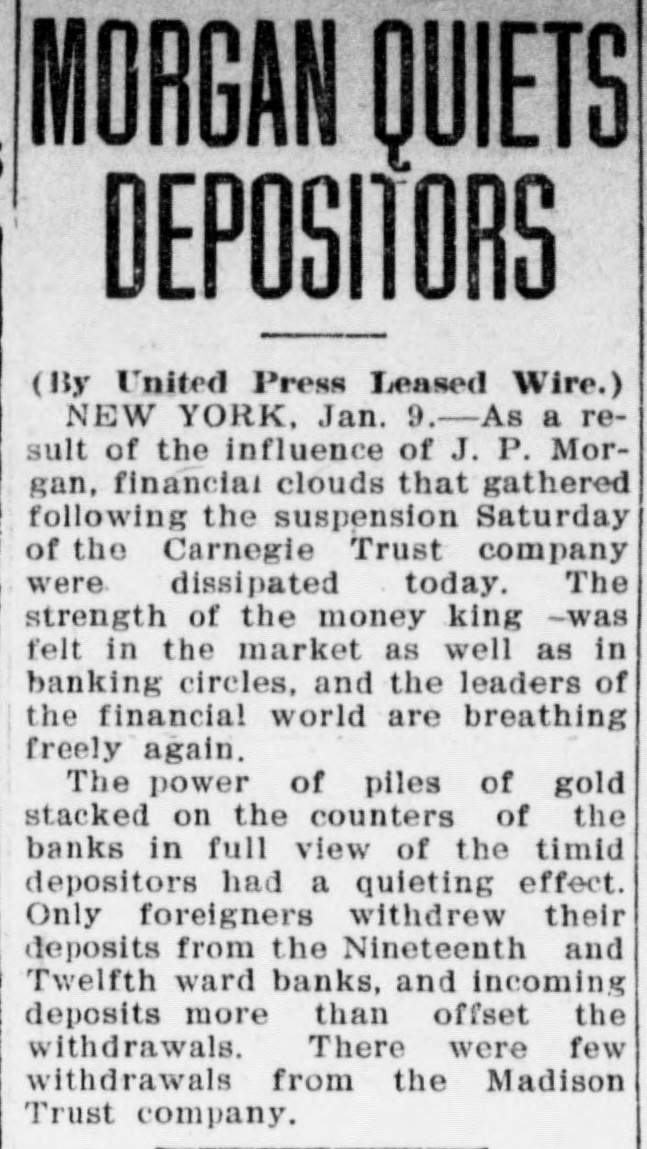
MORGAN QUIETS DEPOSITORS (By United Press Leased Wire.) NEW YORK, Jan. 9.-As a result of the influence of J. P. Morgan, financial clouds that gathered following the suspension Saturday of the Carnegie Trust company were dissipated today. The strength of the money king -was felt in the market as well as in banking circles, and the leaders of the financial world are breathing freely again. The power of piles of gold stacked on the counters of the banks in full view of the timid depositors had a quieting effect. Only foreigners withdrew their deposits from the Nineteenth and Twelfth ward banks, and incoming deposits more than offset the withdrawals. There were few withdrawals from the Madison Trust company.
7.January 10, 1911The Washington TimesWashington, DC
Click image to open full size in new tab
Article Text
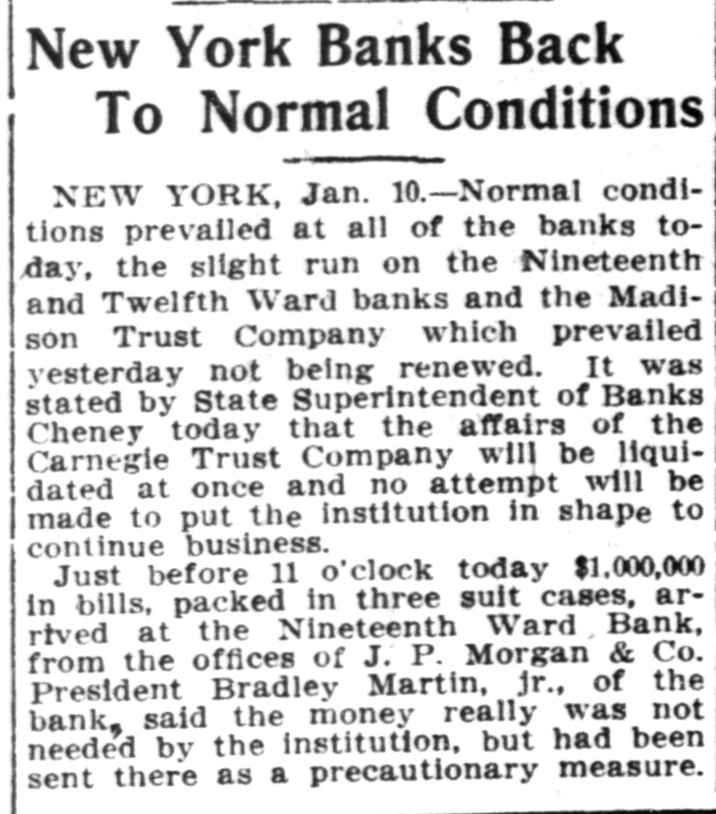
New York Banks Back To Normal Conditions NEW YORK, Jan. 10.-Normal conditions prevailed at all of the banks today, the slight run on the Nineteenth and Twelfth Ward banks and the Madison Trust Company which prevailed yesterday not being renewed. It was stated by State Superintendent of Banks Cheney today that the affairs of the Carnegie Trust Company will be liquidated at once and no attempt will be made to put the institution in shape to continue business. Just before 11 o'clock today $1,000,000 in bills, packed in three suit cases, arrived at the Nineteenth Ward Bank, from the offices of J. P. Morgan & Co. President Bradley Martin, jr., of the bank, said the money really was not needed by the institution, but had been sent there as a precautionary measure.
8.January 10, 1911The Ocala Evening StarOcala, FL
Click image to open full size in new tab
Article Text
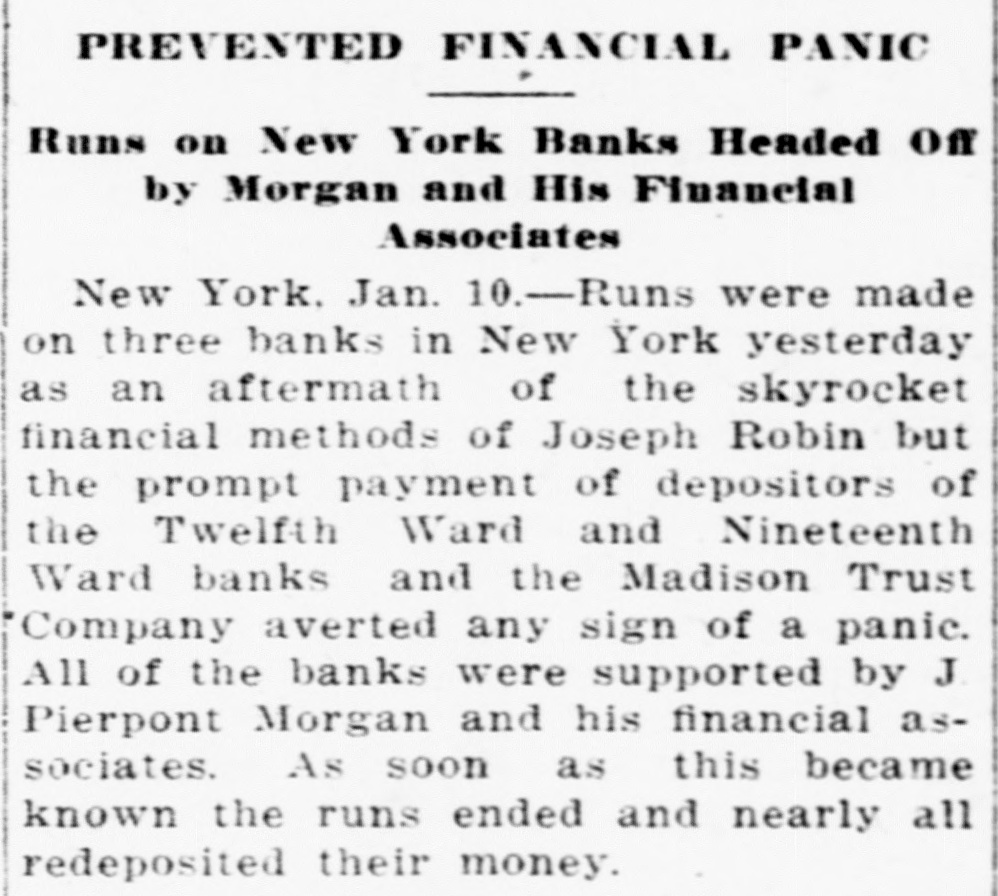
PREVENTED FINANCIAL PANIC Runs on New York Banks Headed Off by Morgan and His Financial Associates New York. Jan. 10.-Runs were made on three banks in New York yesterday as an aftermath of the skyrocket financial methods of Joseph Robin but the prompt payment of depositors of the Twelfth Ward and Nineteenth Ward banks and the Madison Trust Company averted any sign of a panic. All of the banks were supported by J Pierpont Morgan and his financial associates. As soon as this became known the runs ended and nearly all redeposited their money.
9.January 10, 1911The Cairo BulletinCairo, IL
Click image to open full size in new tab
Article Text
SITUATION IS AGAIN NORMAL GOOD WORK ACCOMPLISHED IN BANKING SITUATION IN NEW YORK CITY. DEPOSITORS REASSURED Stock Market is Optimistic, and Joseph G. Robin, the Indicted Banker, Remains in the Tombs Prison. New York, Jan. 9.-Aside from progressive work of reorganization and reconstruction in affected institu tions, which will necessary extend over the first few weeks of the new year, the banking situation is normal tonight. Timid depositors are reassured, the stock market is optimistic and Joseph G. Robin, whose operations caused the flurry, remains in the Tombs. With powerful interests behind the Tweltf Ward Bank and the Nineteen th Ward Bank and with the absorp ilon of the Madison Trust Company by the Equity Trust Company, two institutions whose integrity had been questioned because of alleged affiliations with the Caruegle Trust Company, closed as the result of Robin's operations, weathered today, not only successfully, but with suggestiveness that there were no runs and almost normal deposits. Last night's consultation between financiers had laid a strong ground work which proved adequate to avert any serious complications. Another member of the Robin family entered the Tomos today. Dr. Louise Robinovitch, sister of Robin was indicted for perjury and remanded in default of $3,000 bail. She had sworn in an effort to have Robin conmitted to an asylum and his estate taken over by a committee, that she and her brother, Edward, known as Edward Robinson, were his only heirs at law. But Investigation dis closed an aged couple which the prosecution contends are the parents of Robin On this discovery the indictment is based. After Dr. Robinovitch has been indicted she was arraigned in the court of general sessions where she entered a plea of not guilty. Chas. Hyde, the city chamberlain, who was sought as a witness by the legislative graft committee and who is now sought by the city off!cials to look after the city's interests in view of funds deposited in some of the banks involved in the trouble, was still missing tonight. Controller Pendergast sent a spec ial message to the mayor today ask ing for a meeting of the banking commission to consider the matter. In the course of the day Andrew Carnegie issued a statement denying any connection with the Carnegie Trust Company, and reissuing a letter published in 1906 objecting to the use of his name.
10.January 10, 1911Evening JournalWilmington, DE
Click image to open full size in new tab
Article Text
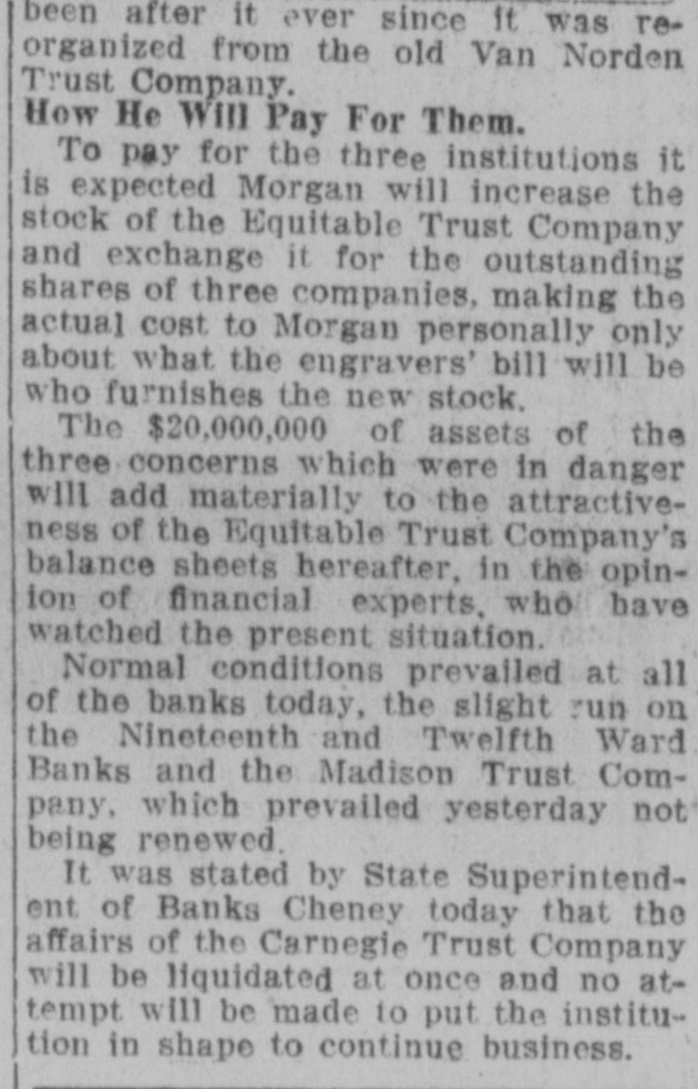
been after it ever since it was reorganized from the old Van Norden Trust Company. How He Will Pay For Them. To pay for the three institutions it is expected Morgan will increase the stock of the Equitable Trust Company and exchange it for the outstanding shares of three companies, making the actual cost to Morgan personally only about what the engravers' bill will be who furnishes the new stock. The $20,000,000 of assets of the three concerns which were in danger will add materially to the attractiveness of the Equitable Trust Company's balance sheets hereafter, in the opinion of financial experts, who have watched the present situation. Normal conditions prevailed at all of the banks today, the slight run on the Nineteenth and Twelfth Ward Banks and the Madison Trust Company, which prevailed yesterday not being renewed. It was stated by State Superintendent of Banks Cheney today that the affairs of the Carnegie Trust Company will be liquidated at once and no attempt will be made to put the institution in shape to continue business.
11.January 10, 1911The Birmingham Age-HeraldBirmingham, AL
Click image to open full size in new tab
Article Text
BANK SITUATION IN NEW YORK IS BETTER Financiers Come to Rescue of Carnegie Trust ROBIN IS NOW IN PRISON Another Dramatic Scene Is Enacted in Court When Members of Robin's Family Meet Face to Face New York, January 9.-Aside from progressive work of reorganization and reconstruction in affected institutions which will necessarily extend over the week, New York's banking situation is normal tonight; timid depositors are reassured, the stock market is optimistic and Joseph G. Robin, whose operations caused the flurry, is still in the Tombs. With powerful financial interests behind the Twelfth Ward bank and the Nineteenth Ward bank and with absorption of the Madison Trust company by the Equitable Trust company, these three institutions whose integrity had been questioned because of affiliations, direct or indirect with the Carnegie Trust company, which was closed as a result of Robin's operations, weathered the day not only successfully but with such aggressiveness that there were no runs and almost normal deposits. Some uneasy depositors were out early to get their money but last night's consultation between financiers had laid a strong groundwork which proved adequate to avert any serious complications. Another member of the Robin family entered the Tombs today. Dr. Louise Robinovitch, sister of Robin, was indicted for perjury and remanded in default of $3000 bail. She had sworn, in an effort to have Robin committed to an asylum and his estate taken over by a committee, that she and her brother Edward, known as Edward Robinson, were his only heirs at law. But investigation disclosed an aged couple which the prosecution contends are the parents. On this discovery the indictment is based. There was enacted, as the grand jury filed forthwith the indictment against Dr. Robinovitch, a scene similar in dramatic aspect to the recent repudiation of the old pair by Robin. Both old persons had been witnesses before the jury as had the alleged son, Edward Robinson. When they met face to face, in the court room, the elderly woman attempted to throw her arms around Robinson's neck, but he drew back and repulsed her. "Is that your father and mother?" Robinson was-asked. "I am not sure," replied Robinson. "I know these people and have known them for a number of years. We caine to this country with them, and as a youngster I always thought that they were my parents. But of late something has happened which leads my brother and myself to the belief that they are not our parents. We have the evidence which proves it." "Have you seen them lately?" was the next question put to Robinson. "Yes, I have seen them about once a month for many years. My brother and myself looked after their wants. That is all I can say.' After Dr. Robinovitch had been indicted she was arraigned and entered a plea of not guilty. Justice Page in the supreme court today appointed Maurice Deiches, a lawyer, receiver for the property of the Aetna Indemnity company in the state of New York with a bond of $50,000. The company collapsed after the Robin exposures and a court in Hartford appointed Theodore McDonald receiver for its property in Connecticut. The company is a Connecticut corporation with a capital stock of $350,000.
12.January 12, 1911The Dillon HeraldDillon, SC
Click image to open full size in new tab
Article Text
MORGAN A BUCCANEER
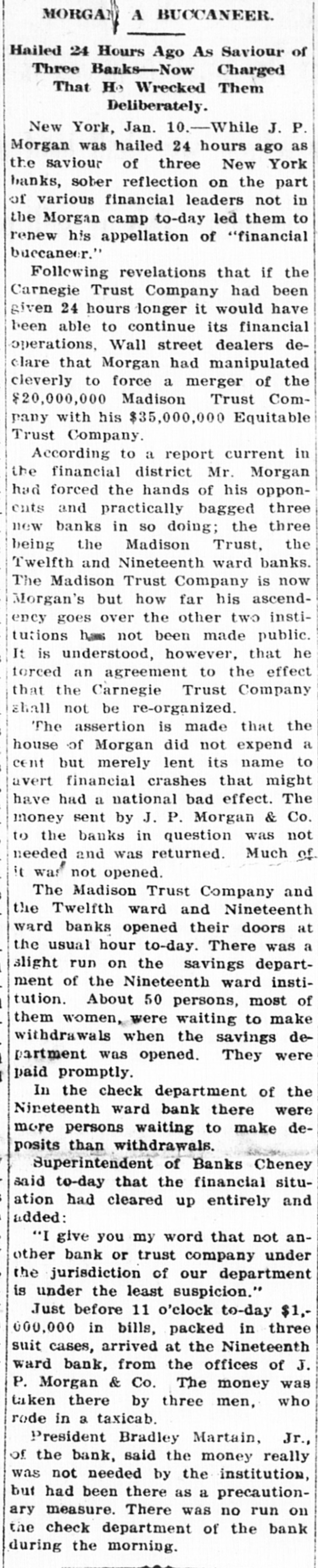
Hailed 24 Hours Ago As Saviour of Three Banks-Now Charged That He Wrecked Them Deliberately. New York, Jan. 10.-While J. P. Morgan was hailed 24 hours ago as the saviour of three New York banks, sober reflection on the part of various financial leaders not in the Morgan camp to-day led them to renew his appellation of "financial buccaneer." Following revelations that if the Carnegie Trust Company had been given 24 hours longer it would have been able to continue its financial operations, Wall street dealers declare that Morgan had manipulated cleverly to force a merger of the $20,000,000 Madison Trust Company with his $35,000,000 Equitable Trust Company. According to a report current in the financial district Mr. Morgan had forced the hands of his opponcuts and practically bagged three new banks in so doing; the three being the Madison Trust, the Twelfth and Nineteenth ward banks. The Madison Trust Company is now Morgan's but how far his ascendency goes over the other two institutions has not been made public. It is understood, however, that he torced an agreement to the effect that the Carnegie Trust Company shall not be re-organized. The assertion is made that the house of Morgan did not expend a cent but merely lent its name to avert financial crashes that might have had a national bad effect. The money sent by J. P. Morgan & Co. to the banks in question was not needed and was returned. Much of it war not opened. The Madison Trust Company and the Twelfth ward and Nineteenth ward banks opened their doors at the usual hour to-day. There was a slight run on the savings department of the Nineteenth ward institution. About 50 persons, most of them women, were waiting to make withdrawals when the savings department was opened. They were paid promptly. I In the check department of the Nineteenth ward bank there were more persons waiting to make deposits than withdrawals. , Superintendent of Banks Cheney said to-day that the financial situ: ation had cleared up entirely and added: "I give you my word that not another bank or trust company under the jurisdiction of our department is under the least suspicion." Just before 11 o'clock to-day $1,000.000 in bills, packed in three suit cases, arrived at the Nineteenth ward bank, from the offices of J. P. Morgan & Co. The money was taken there by three men, who rode in a taxicab. President Bradley Martain, Jr., of the bank, said the money really was not needed by the institution, but had been there as a precautionary measure. There was no run on the check department of the bank during the morning. AAA
13.January 12, 1911The Guthrie Daily LeaderGuthrie, OK
Click image to open full size in new tab
Article Text
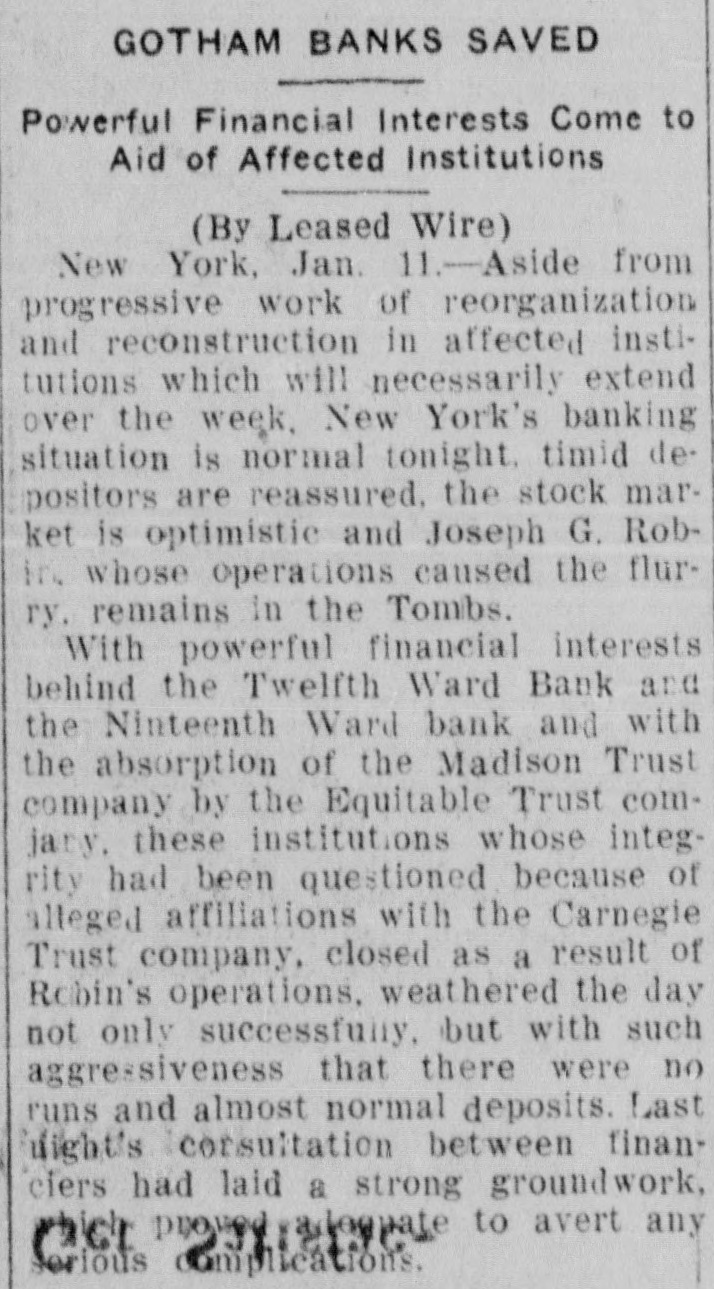
GOTHAM BANKS SAVED Powerful Financial Interests Come to Aid of Affected Institutions (By Leased Wire) New York, Jan. 11.-Aside from progressive work of reorganization and reconstruction in affected institutions which will necessarily extend over the week, New York's banking situation is normal tonight, timid depositors are reassured. the stock market is optimistic and Joseph G. Robir. whose operations caused the flurry. remains in the Tombs. With powerful financial interests behind the Twelfth Ward Bank and the Ninteenth Ward bank and with the absorption of the Madison Trust company by the Equitable Trust comjary. these institutions whose integrity had been questioned because of alleged affiliations with the Carnegie Trust company, closed as a result of Robin's operations, weathered the day not only successfully, but with such aggressiveness that there were no runs and almost normal deposits. Last uight's consultation between financiers had laid a strong groundwork, not proved adoguate to avert any serious complications.
14.January 13, 1911Watertown LeaderWatertown, WI
Click image to open full size in new tab
Article Text
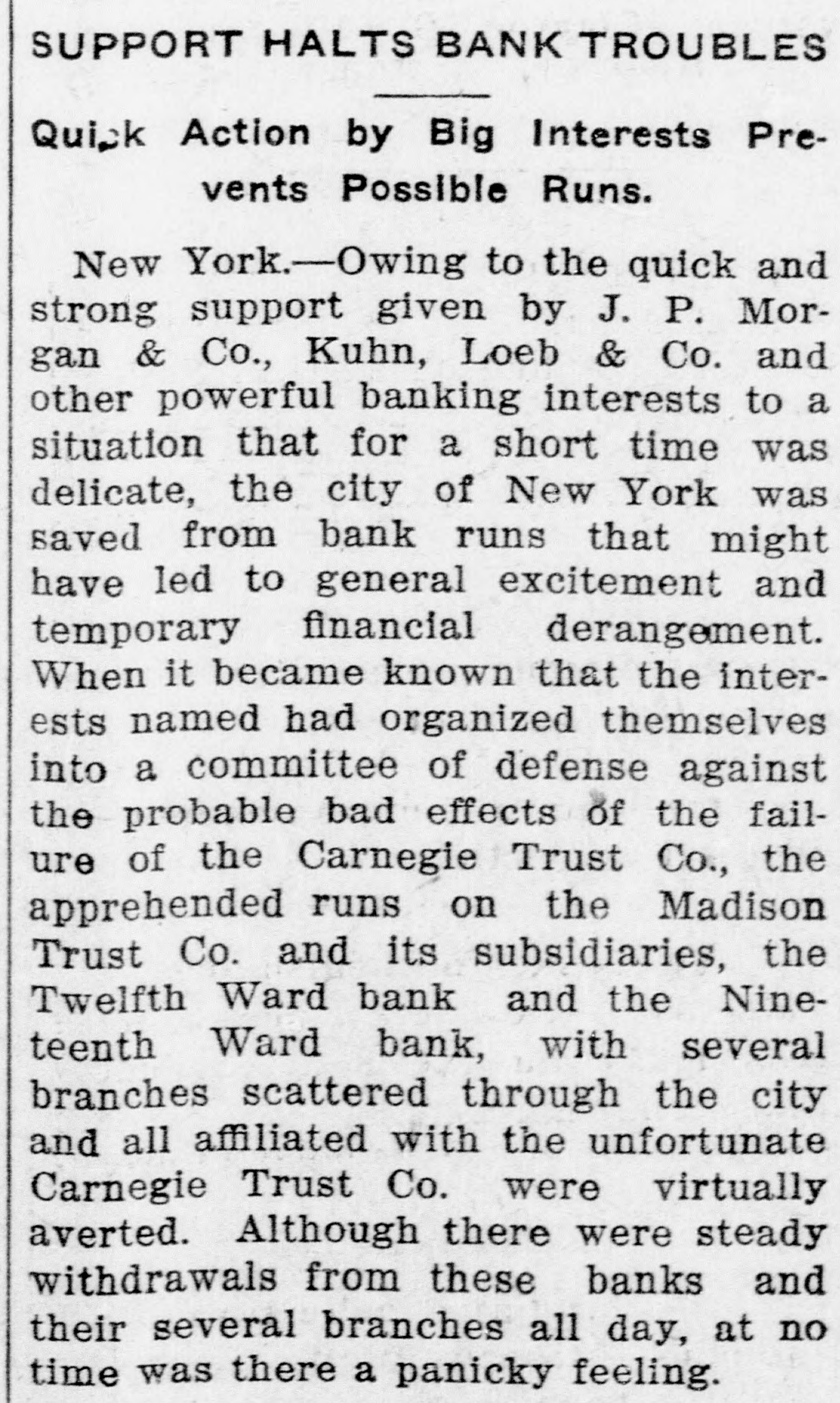
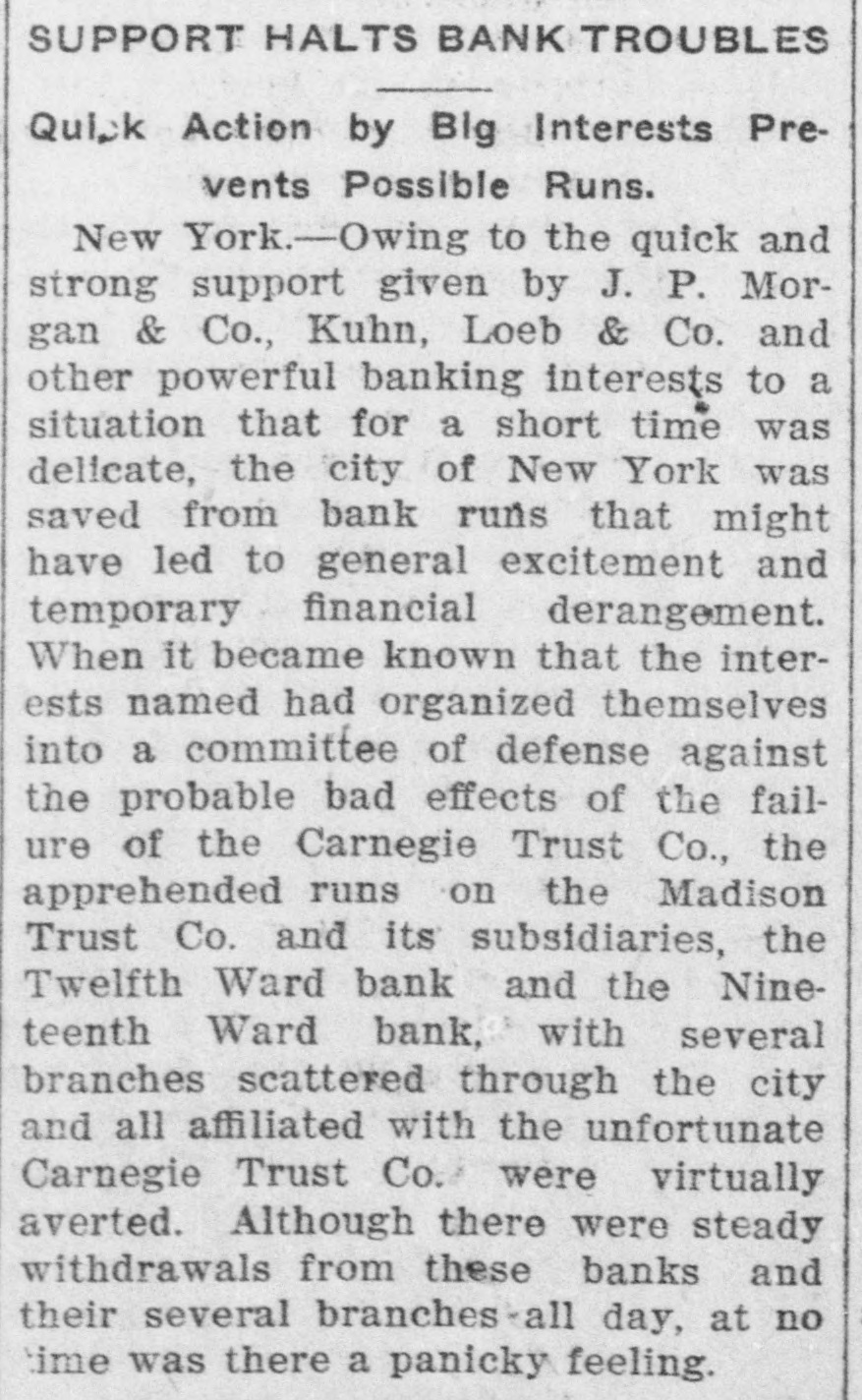
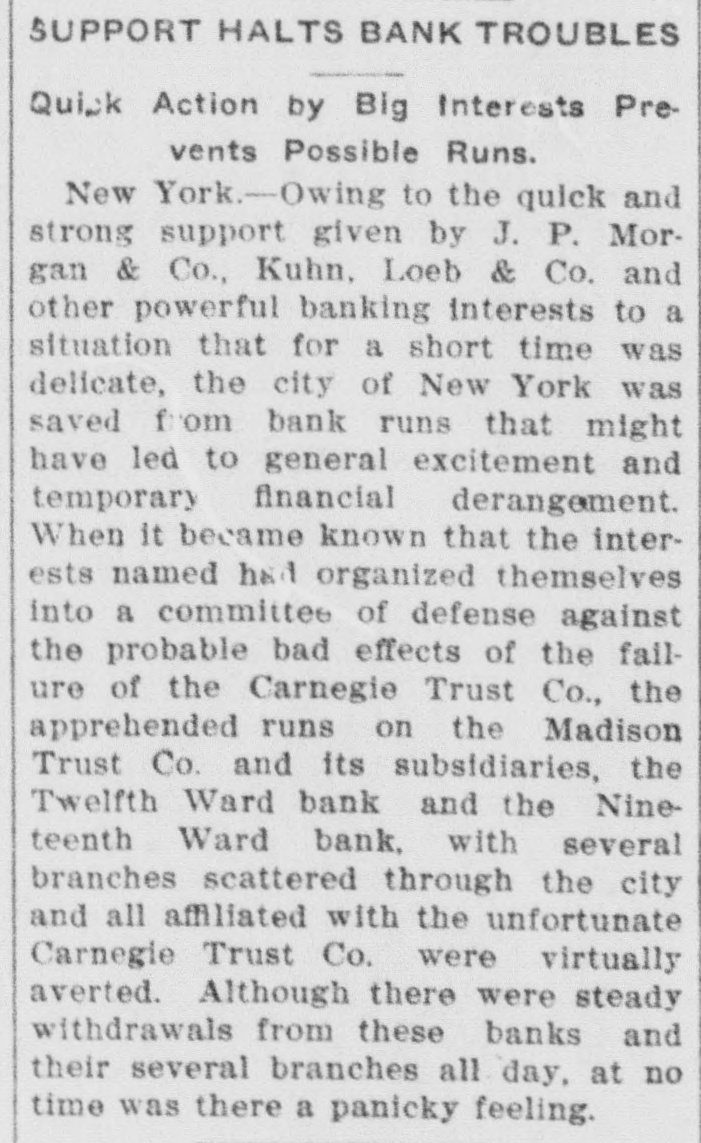
SUPPORT HALTS BANK TROUBLES Quick Action by Big Interests Prevents Possible Runs. New York.-Owing to the quick and strong support given by J. P. Morgan & Co., Kuhn, Loeb & Co. and other powerful banking interests to a situation that for a short time was delicate, the city of New York was saved from bank runs that might have led to general excitement and temporary financial derangement. When it became known that the interests named had organized themselves into a committee of defense against the probable bad effects of the failure of the Carnegie Trust Co., the apprehended runs on the Madison Trust Co. and its subsidiaries, the Twelfth Ward bank and the Nineteenth Ward bank, with several branches scattered through the city and all affiliated with the unfortunate Carnegie Trust Co. were virtually averted. Although there were steady withdrawals from these banks and their several branches all day, at no time was there a panicky feeling.
15.January 18, 1911Vilas County NewsEagle River, WI
Click image to open full size in new tab
Article Text
SUPPORT HALTS BANK TROUBLES Quick Action by Big Interests Prevents Possible Runs. New York.-Owing to the quick and strong support given by J. P. Morgan & Co., Kuhn, Loeb & Co. and other powerful banking interests to a situation that for a short time was delicate, the city of New York was saved from bank runs that might have led to general excitement and temporary financial derangement. When it became known that the interests named had organized themselves into a committee of defense against the probable bad effects of the failure of the Carnegie Trust Co., the apprehended runs on the Madison Trust Co. and its subsidiaries, the Twelfth Ward bank and the Nineteenth Ward bank, with several branches scattered through the city and all affiliated with the unfortunate Carnegie Trust Co. were virtually averted. Although there were steady withdrawals from these banks and their several branches all day, at no time was there a panicky feeling.
16.January 18, 1911Vernon County CensorViroqua, WI
Click image to open full size in new tab
Article Text
SUPPORT HALTS BANK TROUBLES Quick Action by Big Interests Prevents Possible Runs. New York.-Owing to the quick and strong support given by J. P. Morgan & Co., Kuhn, Loeb & Co. and other powerful banking interests to a situation that for a short time was delicate, the city of New York was saved from bank runs that might have led to general excitement and temporary financial derangement. When it became known that the interests named had organized themselves into a committee of defense against the probable bad effects of the failure of the Carnegie Trust Co., the apprehended runs on the Madison Trust Co. and its subsidiaries, the Twelfth Ward bank and the Nineteenth Ward bank, with several branches scattered through the city and all affiliated with the unfortunate Carnegie Trust Co. were virtually averted. Although there were steady withdrawals from these banks and their several branches all day, at no time was there a panicky feeling.
Bank runs are almost always and everywhere a deterioration of bank fundamentals.
But not for you.
You are the measure-zero exception: great fundamentals, solid bank, and yet the Diamond Dybvig fairy spread its rumor. Depositors woke up. Your collateral was not prepositioned. The Clearinghouse had it for you.
Do not pass Go. Do not collect $200. Go directly to jail… or worse.