10062. First National Bank (Helena, MT)

Bank Information

Episode Type
Run → Suspension → Closure
Bank Type
national
Bank ID
1649
Charter Number
1649
Start Date
January 22, 1894
Location
Helena, Montana (46.593, -112.036)

Metadata

Model
gpt-5-mini
Short Digest
90330fcae59b859c

Response Measures

Accommodated withdrawals, Public signal of financial health, Capital injected, Partial suspension, Full suspension, Books examined

Receivership Details

Depositor recovery rate
39.0%
Date receivership started
1896-09-11
Date receivership terminated
1903-06-17
OCC cause of failure
Losses
Share of assets assessed as good
49.5%
Share of assets assessed as doubtful
39.3%
Share of assets assessed as worthless
11.1%

Description

The First National Bank of Helena reopened after the 1893 panic in January 1894 (suspension then reopening). Later, on 1896-09-04 it failed to open because of heavy withdrawals; a notice was posted and an examiner/receiver was appointed, indicating suspension followed by receivership/closure. Cause of the 1896 run/suspension appears to be inability to realize assets to meet demands of eastern creditors (bank-specific adverse information and large withdrawal demands).

Events (7)

1. April 5, 1866 Chartered
Source
historical_nic
2. January 22, 1894 Other
Newspaper Excerpt
The First National bank of Helena will resume business this morning after being closed since the financial panic of last summer.
Source
newspapers
3. January 22, 1894 Reopening
Newspaper Excerpt
The First National bank of Helena will resume business this morning ... the bank opens with more than $500,000 cash on hand ... the doors will swing open at ten o'clock.
Source
newspapers
4. September 4, 1896 Run
Cause
Bank Specific Adverse Info
Cause Details
Heavy withdrawals and inability to realize on assets to cover demands of eastern creditors; officials had tried to suppress rumors but heavy eastern demands precipitated the run.
Measures
Posted notice promising depositors would be paid in full; managers communicated that creditors would be paid; Comptroller notified examiner en route.
Newspaper Excerpt
A notice posted on the door said that heavy withdrawals had caused the suspension, and that the depositors would be paid in full.
Source
newspapers
5. September 4, 1896 Suspension
Cause
Bank Specific Adverse Info
Cause Details
Suspension due to heavy withdrawals and inability to realize assets to meet demands of eastern creditors.
Newspaper Excerpt
The First National Bank of this city failed to open to-day. A notice posted on the door said that heavy withdrawals had caused the suspension.
Source
newspapers
6. September 11, 1896 Receivership
Source
historical_nic
7. September 12, 1896 Receivership
Newspaper Excerpt
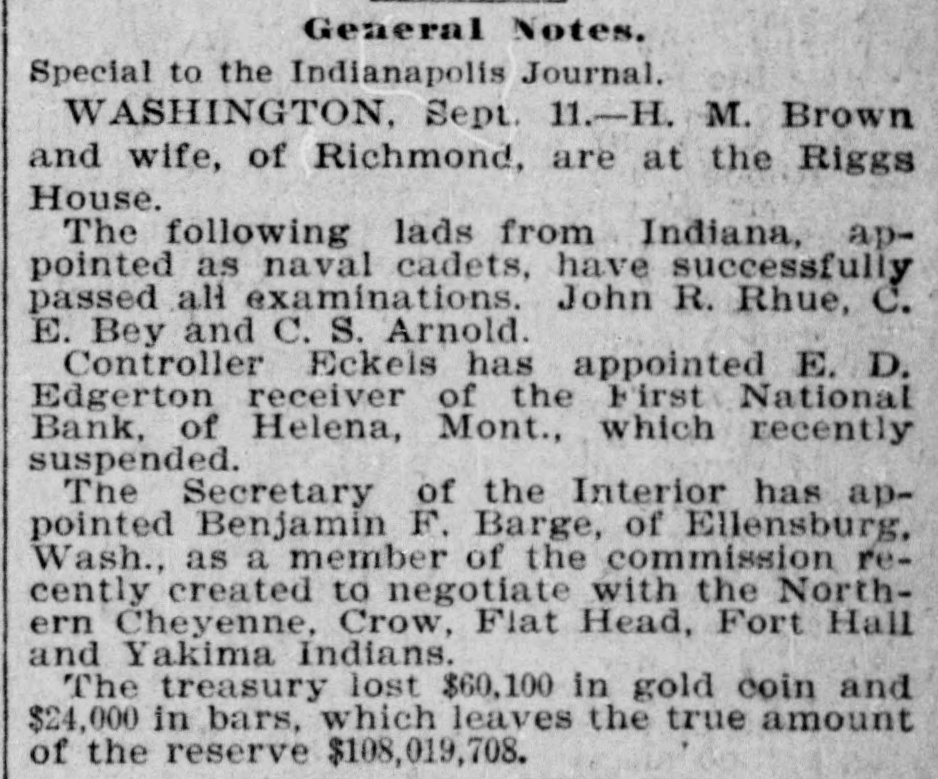
Controller Eckels has appointed E. D. Edgerton receiver of the First National Bank, of Helena, Mont., which recently suspended.
Source
newspapers

Newspaper Articles (23)

Article from The Helena Independent, January 22, 1894

Click image to open full size in new tab

Article Text

FIRST NATIONAL OPENS. The Pioneer Bank of Montana Again Doing Business. As previously announced the First National bank of Helena will resume business this morning after being closed since the financial panic of last summer. All the preparations have been made and the doors will swing open at ten o'clock. The bank is all in order to do business with all its functions, including the United States depository and other privileges restored by the comptroller. As Special Examiner Lynch officially stated a few days ago the bank opens with more than $500,000 cash on hand and in other banks, a sum many times in excess of 1.3 demand liabilities. The opening of this old institution will be hailed with delight by our citizens. The last vestiges of the summe.'s panic have now departed.


Article from The Helena Independent, January 23, 1894

Click image to open full size in new tab

Article Text

WITH cash on band to an amount many times equal to its demand habilities, with its directory strengthened, and in every way in position to resume its former high position among the financial institutions of the country. the First National bank of Helena opened its doors Monday morning. The resumption of this pioneer bank is a source of congratulation all over the state, in the development of whose industries it had been such an important factor; it also makes again complete the strong chain of Helena banks and gives great encourage m ant and renewed confidence to our own people. Deposits on the opening day aggregated $236,000, and the withdrawals were $16,000, showing that a very large number of former patrons at once returned to their favorite bank, and also that those with money in the First consider it as safe there as in any other bank. The First National open and strong as ever in the confidence of the people,-good news, indeed. Enlarged usefulness and increased prosperity to the First National.


Article from Shenandoah Herald, February 2, 1894

Click image to open full size in new tab

Article Text

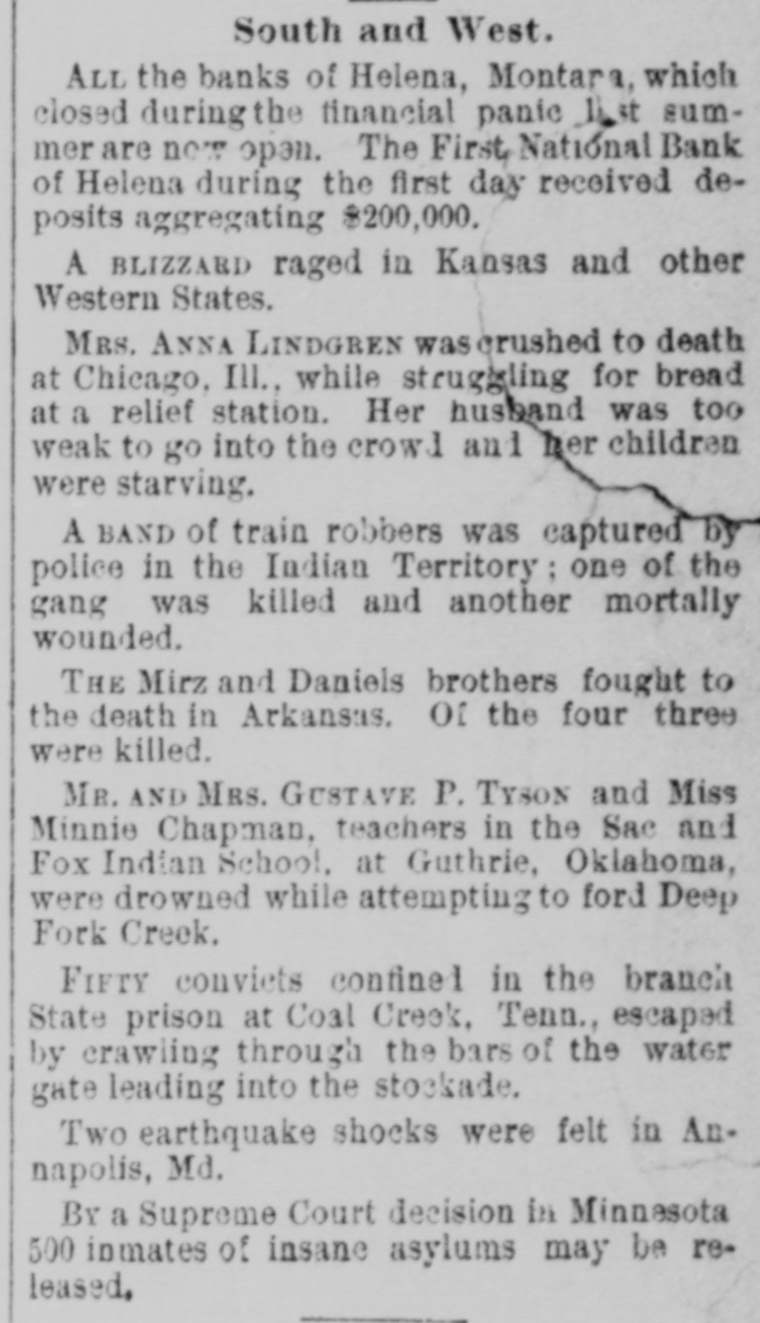
South and West. ALL the banks of Helena, Montara, which closed during the financial panic 11st summer are new open. The First National Bank of Helena during the first day received deposits aggregating $200,000. A BLIZZARD raged in Kansas and other Western States. MRS. ANNA LINDGREN was crushed to death at Chicago, Ill., while struggling for bread at a relief station. Her husband was too weak to go into the crowd and her children were starving. A BAND of train robbers was captured by police in the Indian Territory ; one of the gang was killed and another mortally wounded. THE Mirz and Daniels brothers fought to the death in Arkansas. of the four three were killed. MR. AND MRS. GUSTAVE P. TYSON and Miss Minnie Chapman, teachers in the Sac and Fox Indian School. at Guthrie, Oklahoma, were drowned while attempting to ford Deep Fork Creek. FIFTY conviets confined in the branch State prison at Coal Creek. Tenn., escaped by crawling through the bars of the water gate leading into the stockade. Two earthquake shocks were felt in Annapolis, Md. By a Supreme Court decision in Minnesota 500 inmates of insane asylums may be released,


Article from The Record-Union, December 7, 1894

Click image to open full size in new tab

Article Text

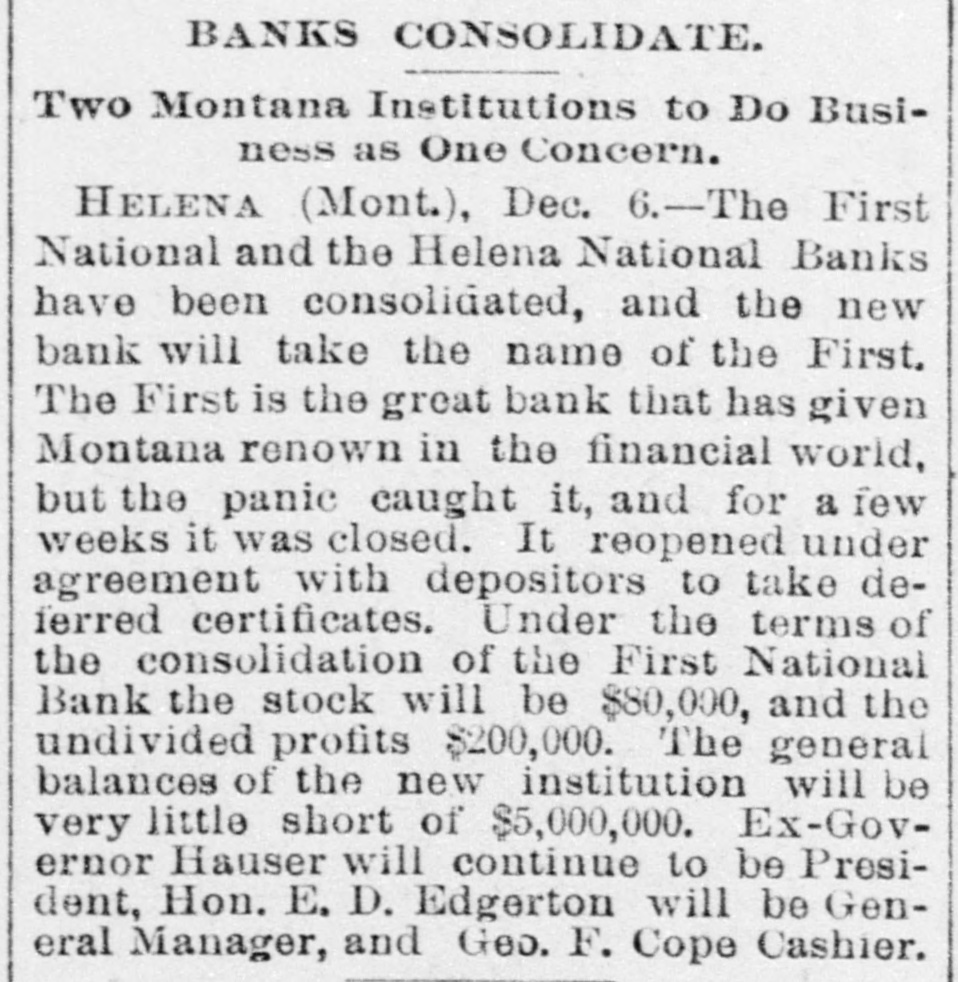
BANKS CONSOLIDATE. Two Montana Institutions to Do Business as One Concern. HELENA (Mont.), Dec. 6.-The First National and the Helena National Banks have been consolidated, and the new bank will take the name of the First, The First is the great bank that has given Montana renown in the financial world, but the panic caught it, and for a few weeks it was closed. It reopened under agreement with depositors to take deferred certificates. Under the terms of the consolidation of the First National Bank the stock will be $80,000, and the undivided profits $200,000. The general balances of the new institution will be very little short of $5,000,000. Ex-Governor Hauser will continue to be President, Hon. E. D. Edgerton will be General Manager, and Goo. F. Cope Cashier.


Article from The Morning Call, December 7, 1894

Click image to open full size in new tab

Article Text

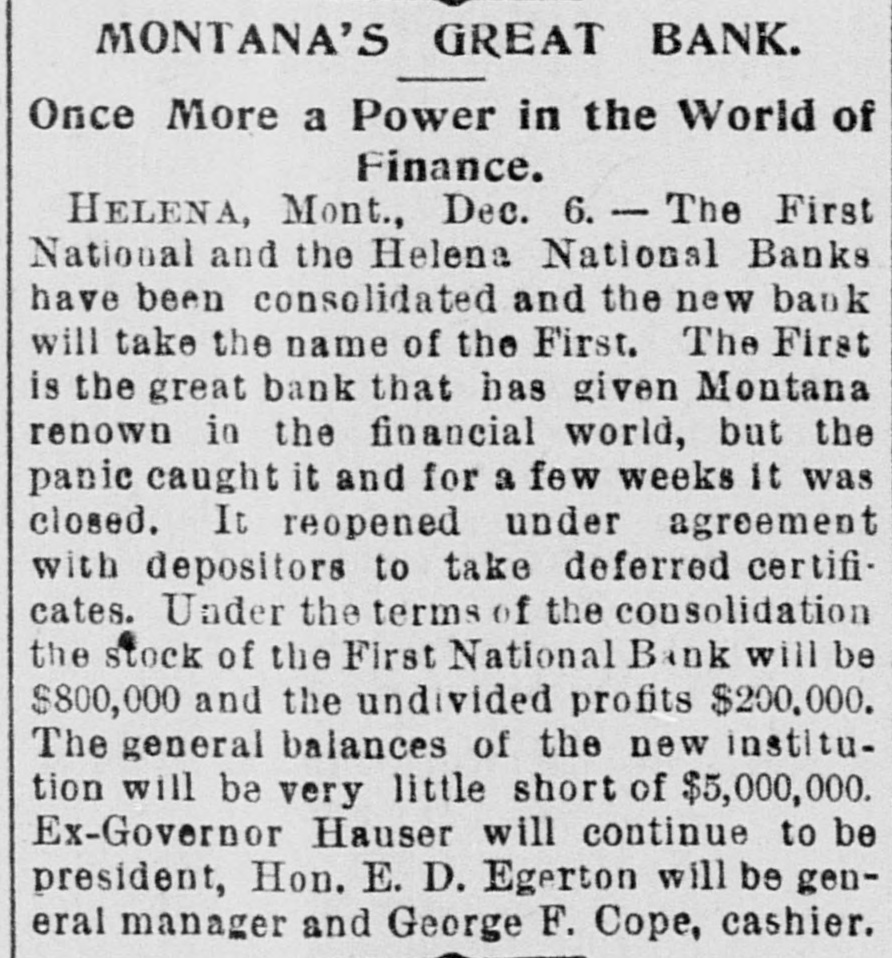
MONTANA'S GREAT BANK. — Once More a Power in the World of Finance. HELENA, Mont., Dec. 6. - The First National and the Helena National Banks have been consolidated and the new bank will take the name of the First. The First is the great bank that has given Montana renown in the financial world, but the panie caught it and for a few weeks it was closed. It reopened under agreement with depositors to take deferred certificates. Under the terms of the consolidation the stock of the First National Bank will be $800,000 and the undivided profits $200,000. The general balances of the new institution will be very little short of $5,000,000. Ex-Governor Hauser will continue to be president, Hon. E. D. Egerton will be general manager and George F. Cope, cashier.


Article from The Morning News, September 5, 1896

Click image to open full size in new tab

Article Text

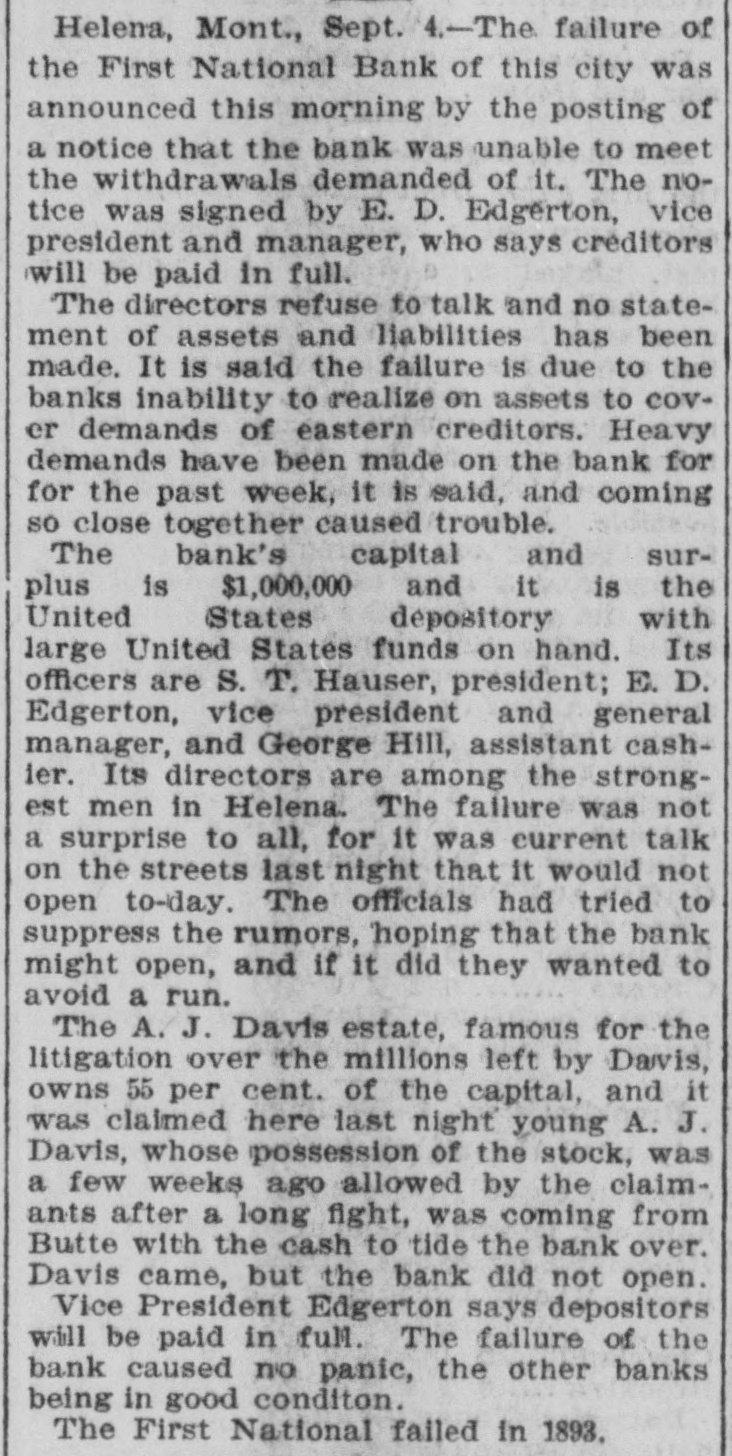
Helena, Mont., Sept. 4.-The failure of the First National Bank of this city was announced this morning by the posting of a notice that the bank was unable to meet the withdrawals demanded of it. The notice was signed by E. D. Edgerton, vice president and manager, who says creditors will be paid in full. The directors refuse to talk and no statement of assets and liabilities has been made. It is said the failure is due to the banks inability to realize on assets to cover demands of eastern creditors. Heavy demands have been made on the bank for for the past week, it is said, and coming so close together caused trouble. The bank's capital and surplus is $1,000,000 and it is the United States depository with large United States funds on hand. Its officers are S. T. Hauser, president; E. D. Edgerton, vice president and general manager, and George Hill, assistant cashier. Its directors are among the strongest men in Helena. The failure was not a surprise to all, for it was current talk on the streets last night that it would not open to-day. The officials had tried to suppress the rumors, hoping that the bank might open, and if it did they wanted to avoid a run. The A. J. Davis estate, famous for the litigation over the millions left by Davis, owns 55 per cent. of the capital, and it was claimed here last night young A. J. Davis, whose possession of the stock, was a few weeks ago allowed by the claimants after a long fight, was coming from Butte with the cash to tide the bank over. Davis came, but the bank did not open. Vice President Edgerton says depositors will be paid in full. The failure of the bank caused no panic, the other banks being in good conditon. The First National failed in 1893.


Article from The San Francisco Call, September 5, 1896

Click image to open full size in new tab

Article Text

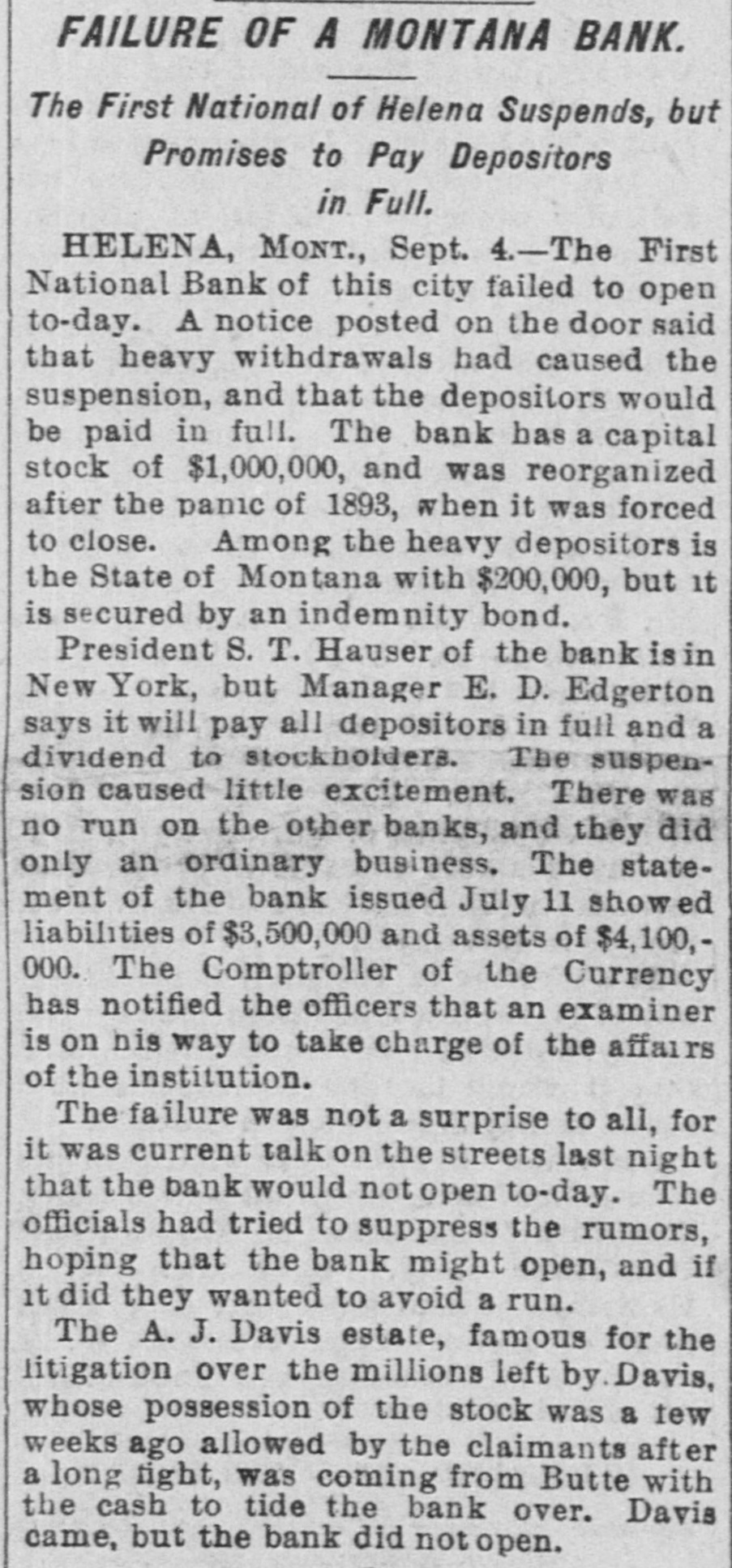
FAILURE OF A MONTANA BANK. The First National of Helena Suspends, but Promises to Pay Depositors in Full. HELENA, MONT., Sept. 4.-The First National Bank of this city failed to open to-day. A notice posted on the door said that heavy withdrawals had caused the suspension, and that the depositors would be paid in full. The bank has a capital stock of $1,000,000, and was reorganized after the panic of 1893, when it was forced to close. Among the heavy depositors is the State of Montana with $200,000, but it is secured by an indemnity bond. President S. T. Hauser of the bank is in New York, but Manager E. D. Edgerton says it will pay all depositors in full and a dividend to stockholders. The suspension caused little excitement. There was no run on the other banks, and they did only an ordinary business. The statement of the bank issued July 11 showed liabilities of $3,500,000 and assets of $4,100,000. The Comptroller of the Currency has notified the officers that an examiner is on his way to take charge of the affairs of the institution. The failure was not a surprise to all, for it was current talk on the streets last night that the bank would not open to-day. The officials had tried to suppress the rumors, hoping that the bank might open, and if it did they wanted to avoid a run. The A. J. Davis estate, famous for the litigation over the millions left by Davis, whose possession of the stock was a few weeks ago allowed by the claimants after a long fight, was coming from Butte with the cash to tide the bank over. Davis came, but the bank did open.


Article from The Salt Lake Herald, September 5, 1896

Click image to open full size in new tab

Article Text

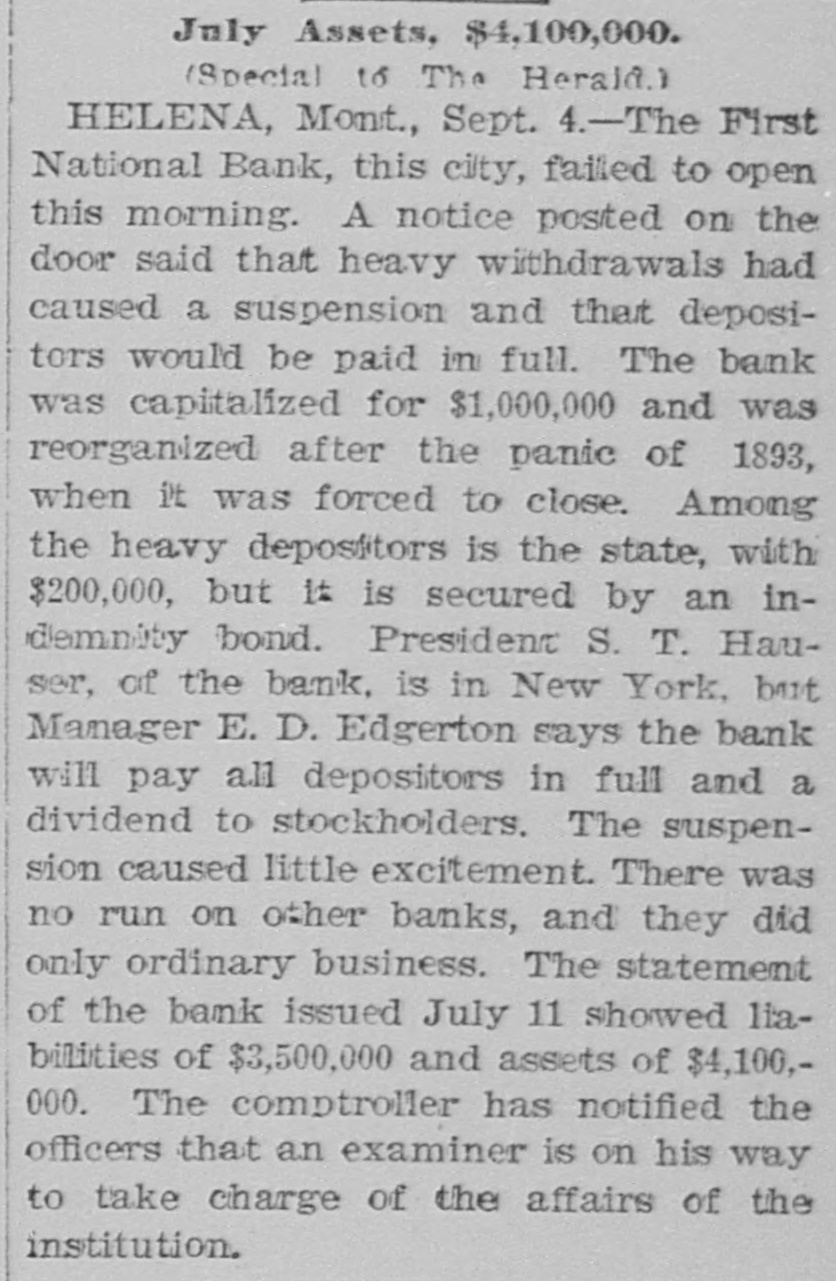
July Assets, $4,100,000. (Special to The Herald.) HELENA, Mont., Sept. 4.-The First National Bank, this city, failed to open this morning. A notice posted on the door said that heavy withdrawals had caused a suspension and that depositors would be paid in full. The bank was capitalized for $1,000,000 and was reorganized after the panic of 1893, when it was forced to close. Among the heavy depositors is the state, with $200,000, but it is secured by an indemnity bond. President S. T. Hauser, of the bank, is in New York, but Manager E. D. Edgerton says the bank will pay all depositors in full and a dividend to stockholders. The suspension caused little excitement. There was no run on other banks, and they did only ordinary business. The statement of the bank issued July 11 showed liabilities of $3,500,000 and assets of $4,100,000. The comptroller has notified the officers that an examiner is on his way to take charge of the affairs of the institution.


Article from The Madison Daily Leader, September 5, 1896

Click image to open full size in new tab

Article Text

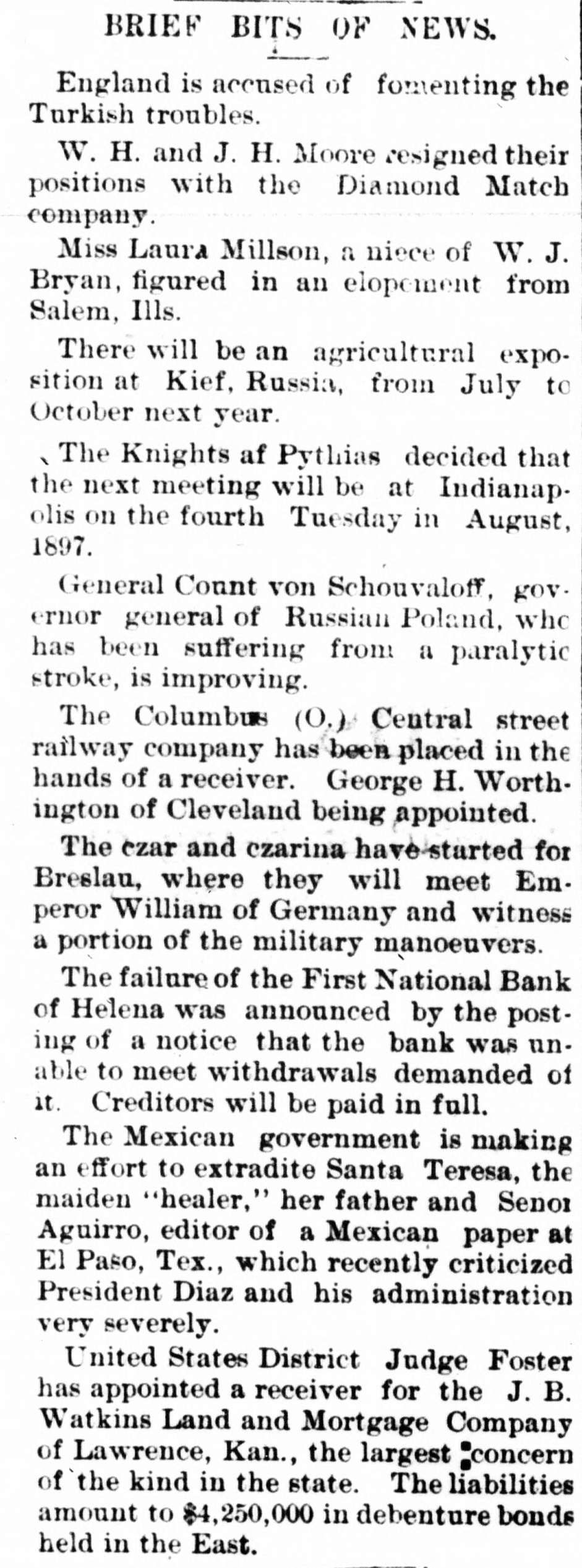
BRIEF BITS OF NEWS. England is accused of fomenting the Turkish troubles. W. H. and J. H. Moore resigned their positions with the Diamond Match company. Miss Laura Millson, a niece of W. J. Bryan, figured in an elopement from Salem, Ills. There will be an agricultural exposition at Kief, Russia, from July to October next year. The Knights af Pythias decided that the next meeting will be at Indianapolis on the fourth Tuesday in August, 1897. General Count von Schouvaloff, gov. ernor general of Russian Poland, who has been suffering from a paralytic stroke, is improving. The Columbus (O.) Central street railway company has been placed in the hands of a receiver. George H. Worthington of Cleveland being appointed. The ezar and czarina have started for Breslau, where they will meet Emperor William of Germany and witness a portion of the military manoeuvers. The failure of the First National Bank of Helena was announced by the posting of a notice that the bank was unable to meet withdrawals demanded of it. Creditors will be paid in full. The Mexican government is making an effort to extradite Santa Teresa, the maiden "healer," her father and Senor Aguirro, editor of a Mexican paper at El Paso, Tex., which recently criticized President Diaz and his administration very severely. United States District Judge Foster has appointed a receiver for the J. B. Watkins Land and Mortgage Company of Lawrence, Kan., the largest :concern of the kind in the state. The liabilities amount to $4,250,000 in debenture bonds held in the East.


Article from Birmingham State Herald, September 5, 1896

Click image to open full size in new tab

Article Text

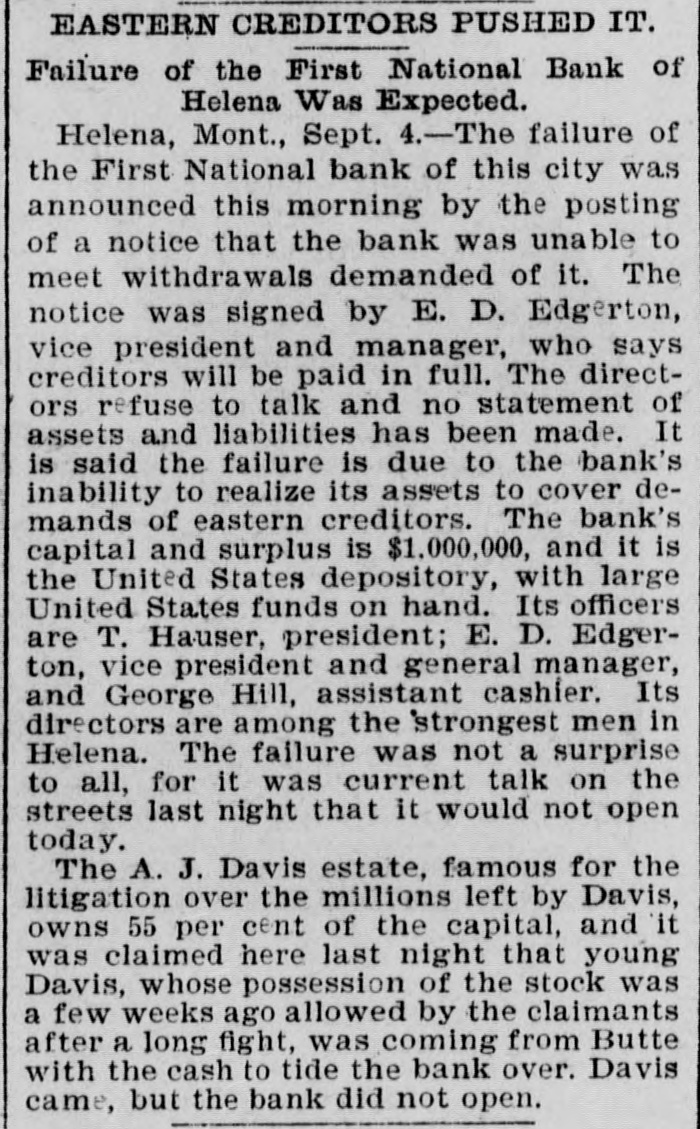
EASTERN CREDITORS PUSHED IT. Failure of the First National Bank of Helena Was Expected. Helena, Mont., Sept. 4.-The failure of the First National bank of this city was announced this morning by the posting of a notice that the bank was unable to meet withdrawals demanded of it. The notice was signed by E. D. Edgerton, vice president and manager, who says creditors will be paid in full. The directors refuse to talk and no statement of assets and liabilities has been made. It is said the failure is due to the bank's inability to realize its assets to cover demands of eastern creditors. The bank's capital and surplus is $1.000,000, and it is the United States depository, with large United States funds on hand. Its officers are T. Hauser, president; E. D. Edgerton, vice president and general manager, and George Hill, assistant cashier. Its directors are among the strongest men in Helena. The failure was not a surprise to all, for it was current talk on the streets last night that it would not open today. The A. J. Davis estate, famous for the litigation over the millions left by Davis, owns 55 per cent of the capital, and it was claimed here last night that young Davis, whose possession of the stock was a few weeks ago allowed by the claimants after a long fight, was coming from Butte with the cash to tide the bank over. Davis came, but the bank did not open.


Article from San Antonio Daily Light, September 5, 1896

Click image to open full size in new tab

Article Text

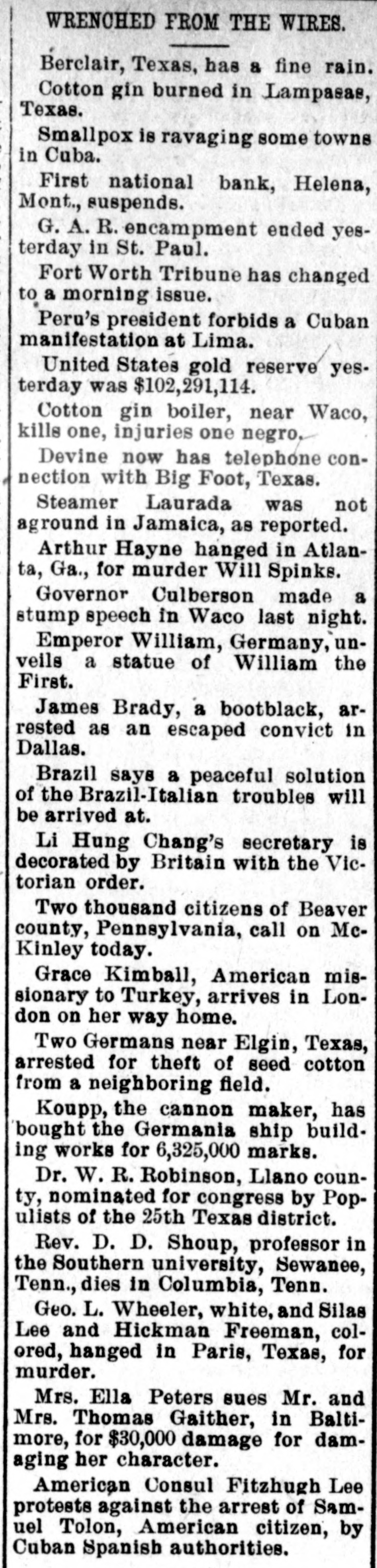
WRENCHED FROM THE WIRES. Berclair, Texas, has a fine rain. Cotton gin burned in Lampasas, Texas. Smallpox is ravaging some towns in Cuba. First national bank, Helena, Mont., suspends. G. A. R. encampment ended yesterday in St. Paul. Fort Worth Tribune has changed to a morning issue. Peru's president forbids a Cuban manifestation at Lima. United States gold reserve yesterday was $102,291,114. Cotton gin boiler, near Waco, kills one, injuries one negro Devine now has telephone connection with Big Foot, Texas. Steamer Laurada was not aground in Jamaica, as reported. Arthur Hayne hanged in Atlanta, Ga., for murder Will Spinks. Governor Culberson made a stump speech in Waco last night. Emperor William, Germany, unveils a statue of William the First. James Brady, a bootblack, arrested as an escaped convict in Dallas. Brazil says a peaceful solution of the Brazil-Italian troubles will be arrived at. Li Hung Chang's secretary is decorated by Britain with the Victorian order. Two thousand citizens of Beaver county, Pennsylvania, call on McKinley today. Grace Kimball, American missionary to Turkey, arrives in London on her way home. Two Germans near Elgin, Texas, arrested for theft of seed cotton from a neighboring field. Koupp, the cannon maker, has bought the Germania ship building works for 6,325,000 marks. Dr. W. R. Robinson, Llano county, nominated for congress by Populists of the 25th Texas district. Rev. D. D. Shoup, professor in the Southern university, Sewanee, Tenn., dies in Columbia, Tenn. Geo. L. Wheeler, white, and Silas Lee and Hickman Freeman, colored, hanged in Paris, Texas, for murder. Mrs. Ella Peters sues Mr. and Mrs. Thomas Gaither, in Baltimore, for $30,000 damage for damaging her character. American Consul Fitzhugh Lee protests against the arrest of Samuel Tolon, American citizen, by Cuban Spanish authorities.


Article from The Indianapolis Journal, September 12, 1896

Click image to open full size in new tab

Article Text

General Notes. Special to the Indianapolis Journal. WASHINGTON, Sept. 11.-H. M. Brown and wife, of Richmond, are at the Riggs House. The following lads from Indiana, appointed as naval cadets, have successfully passed all examinations. John R. Rhue, C. E. Bey and C. S. Arnold. Controller Eckels has appointed E. D. Edgerton receiver of the First National Bank, of Helena, Mont., which recently suspended. The Secretary of the Interior has appointed Benjamin F. Barge, of Ellensburg, Wash., as a member of the commission recently created to negotiate with the Northern Cheyenne, Crow, Flat Head, Fort Hall and Yakima Indians. The treasury lost $60,100 in gold coin and $24,000 in bars, which leaves the true amount of the reserve $108,019,708.


Article from The San Francisco Call, September 15, 1896

Click image to open full size in new tab

Article Text

RECEIPTS OF PRODUCE. FOR 24 HOURS. Flour, gr sks Butter. ctls 139 28,982 Oregon 6 3,552 Cheese, ctls Wheat, etls 157,413 Eggs: doz 14,520 Oregon 619 Hides, no 1,380 Barley, ctls 565 Pelts, bdis 18,562 Beans. sks 1.418 35,400 Wine, gals Oats, ctls 180 1,320 Wool, bis Oregon 585 444 Sugar, bbls Corn, Neb, ctls 20 1,510 Lumber, M feet. Potatoes. sks 116 5,554 Quicksilver, fisks Onions, sks 19 970 Leather, rolls Bran. sks 120 85 Lime, bbls Middlings, sks. 196 841 Alfalfa Seed, sks Hay, tons 1,000 2,000 Paper, reams PACIFIC COAST BONDS. The assessment against the stock of the Merchants' National Bank of Seattle has been canceled under a ruling of Judge Langley, in the Superior Court, and the county officers are restrained from attempting to collect it. The case is entitled Charles H. Baker, as receiver, against the County of Kings. From the complaint it appears that the Assessor added together the amount of the capital stock at its par value, the amount of the nominal surplus and undivided profit, making $227,000 in all, and then deducted from that amount real estate valued at $111,400, leaving a balance of $115,600. Following out this system of fixing valuations the Assessor finally assessed the bank for $69,360, against which the bank has been fighting. The Board of Equalization upheld the asessment on appeal, and the bank thereupon appealed to the Superior Court and won its case. L. P. Mathews, a citizen of Nebraska, has begun suit against Philip Tillinghast, as receiver of the Columbia National Bank, to restrain him from beginning any suit against the stockholders of the increased capital stock of the Columbia National Bank; also to require him to expunge the credit of the city of Tacoma to the amount $112,000. An injunction has been granted by Judge Gilbert, which holds good until to-day (the 15th inst.), on the representation that the receiver was about to declare a dividend, to the injury of the p. aintiff. Concerning the claim of the city of Tacoma, it is alleged that it is not valid or legal as against the banking association. which is in no manner indebted to the city, but that, on the contrary, the city is indebted to the bank in the sum of about $8000. This claim involves the history of the defalcation of G. W. Boggs, formerly Treasurer of the city of Tacoma, who deposited in the bank unpaid warrants of said city, supposedly, but which it was afterward demonstrated were worthless, they having actually been paid. The bank shows a credit of $104,000 in favor of the city, which if expunged would leave a balance of $800 in favor of the bank. The Tacoma savings Bank and Trust Company, the State Savings Bank and the German-American Bank have also filed suits of similar tenor against THiinghast as receiver. City Attorney Judson is of opinion that the Mathews suit will determine the validity of the outstanding warrants of the city, which it is now proposed to refund. The Helena (Mont.) Independent furnishes many particulars concerning the failure of the First National Bank of Helena, and says it was not wholly unexpected. Heavy withdrawals by
Article from The Ravalli Republican, September 16, 1896

Click image to open full size in new tab

Article Text

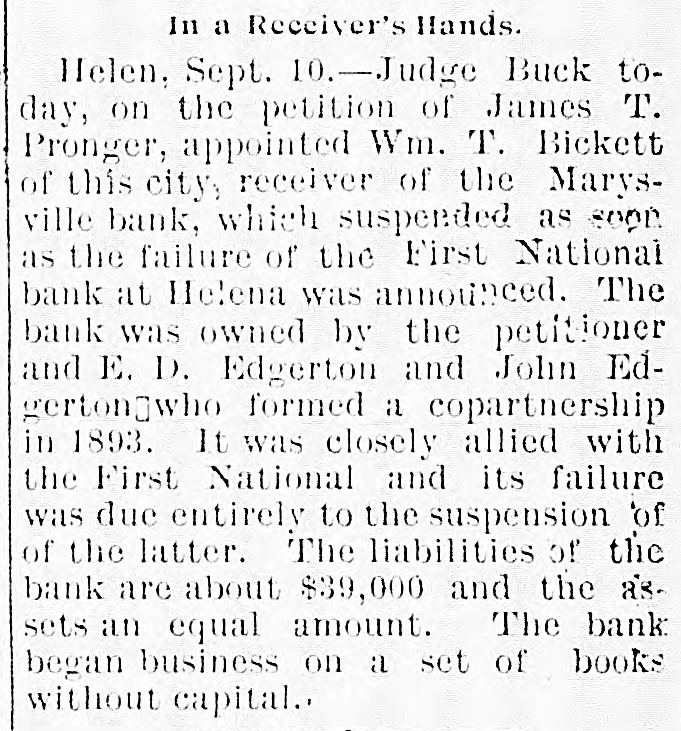
In a Receiver's Hands. Helen, Sept. 10.-Judge Buck today, on the petition of James T. Pronger, appointed Wm. T. Bickett of this city receiver of the Marvsville bank, which suspended as soon as the failure of the First National bank at Helena was announced. The bank was owned by the petitioner and E. 1). Edgerton and John Edgerton@who formed a copartnership in 1893. It was closely allied with the First National and its failure was due entirely to the suspension of of the latter. The liabilities of the bank are about $39,000 and the asThe bank sets an equal amount. began business on a set of books without capital..


Article from The Pioche Weekly Record, September 24, 1896

Click image to open full size in new tab

Article Text

TELEGRAPHIC RESUME Things That Have Happened all Over the Country. SPOKEN OF IN THIS COLUMN. Selections,That-Will_Greaily,Interest our Readers Beth Old and Young. A New York man has been cured of lockjaw by the use of anti-toxine. The Cabinet has decided to send two battalions of marines to the Philippine Islands. Herron, Taylor & Co., wholesale grocers of Memphis, assigned; assets, $124,000; liabilities, $90,000. It is expected that the Orange and Santa Ana motor line will be extended to the railroad depots at Santa Ana. The Candee Company, one of the largest members of the United States Rubber Company, resumed operations the other day. A New York dispatch says W. L. Poll & Co., diamond dealers, have failed. The liabilities are $125,000, assets known. The Mutual National Bank of New Orleans has closed its doors. Henry Maspero is its president and James J. Tarleton cashier. The President has pardoned Oscar E. Hill, a Utah man sentenced to ten years for making false entries in the books of a national bank. Charles Bryan, cashier of the Detroit Custom-house, was arrested last week for embezzlement. His shortage, to which he has confessed, 18 about $3600. Maj. Thaddeus S. Clarkson, of Omaha, was elected Commander-inchief of the G. A. R. at the thirtieth annual encampment held in St. Paul. About $25,000 worth of express matter and the United States mail, bound for Chicago via the Lake Shore road, from New York, has been destroyed by fire. General Miles has written a book entitled "Personal Recollections and Observations of General Nelson A. Miles, Embracing a Brief Review of the Civil War.' Senator Tillman is accused of having appropriated to his own use, while Governor of South Carolina, the rebate allowed by liquor dealers on liquor furnished the State dispensary. Five hundred mechanics of various trades have a strike at the large store building of Siegel, Cooper & Co., of New York, on account of the employment of non-union marble-workers. North American Review, published in New York, has been changed. David Monroe, who has been connected with the publication for the past seven years, is the president and treasurer of the new company. Chauncey M. Depew has denied a report that there was friction between himself and W. K. Vanderbilt, and that in the event of Mr. McKinley's election he would resign the presidency of the New York Central to accept a Cabinet or diplomatic position. A Columbus (0.) dispatch says the Columbus Central Street Railroad Company was thrown into the hands of a receiver, George H. Worthington being appointed. The trouble was precipitated by Michael Degnot, who built the road. Business was light. The road is new and occupies new territory, the old line having the best streets. A Kingston, N.Y., dispatch says the consecration of the new altars of St. Mary's Church in that city recently was a notable event in the history of that important Roman Catholic parish. Archbishop Corrigan celebrated high mass at the early service, and officiated at the consecration ceremony later. The sermon was by Bishop John Shanley of North Dakota. Hundreds were unable to get into the building. A dispatch from Helena, Mont. says the failure of the First National Bank was announced the other morning by posting a notice in the window that the bank is unable to meet withdrawal demands made on it. The notice was signed by E. D. Edgerton, vice-president and manager, who says the creditors will be paid in full. The directors refuse to talk and no statement of assets and liabilities was made. It is said the failure was due to the bank's inability to realize on the assets to cover the demands of eastern creditors. Heavy demands have been made on the bank in the past week, and all coming SO close together caused the trouble. The Smithsonian Institute has just celebrated fifty years of existence. While there will be no public demonstration, the regents have ordered an issue of a valuable work containing the achievements and history of the great seat of science. They will also erect tablets in honor of its founder, who was an Englishman, who bequeathed his property to the United States to found at Washington, under the name of the Smithsonian Institution, an establishment for the increase and diffusion of knowledge among men. James Lewis, who afterward assumed the name of Smithson, son of the first Duke of Northumberland, was the founder of the institution, and by his


Article from The Salt Lake Herald, October 27, 1896

Click image to open full size in new tab

Article Text

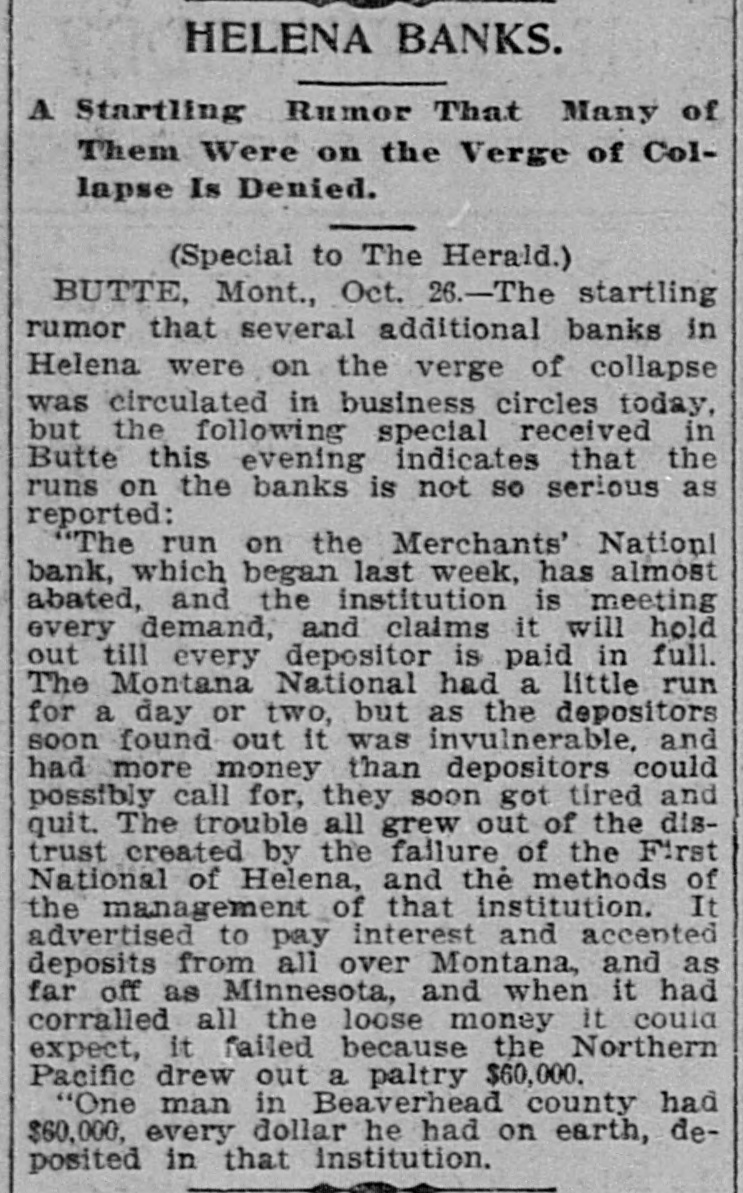
HELENA BANKS. A Startling Rumor That Many of Them Were on the Verge of Collapse Is Denied. (Special to The Herald.) BUTTE, Mont., Oct. 26.-The startling rumor that several additional banks in Helena were on the verge of collapse was circulated in business circles today, but the following special received in Butte this evening indicates that the runs on the banks is not so serious as reported: "The run on the Merchants' Nationl bank, which began last week, has almost abated, and the institution is meeting every demand, and claims it will hold out till every depositor is paid in full. The Montana National had a little run for a day or two, but as the depositors soon found out it was invulnerable, and had more money than depositors could possibly call for, they soon got tired and quit. The trouble all grew out of the distrust created by the failure of the First National of Helena, and the methods of the management of that institution. It advertised to pay interest and accented deposits from all over Montana, and as far off as Minnesota, and when it had corralled all the loose money it could expect, it failed because the Northern Pacific drew out a paltry $60,000. "One man in Beaverhead county had $60,000, every dollar he had on earth, deposited in that institution.


Article from The Anaconda Standard, January 12, 1897

Click image to open full size in new tab

Article Text

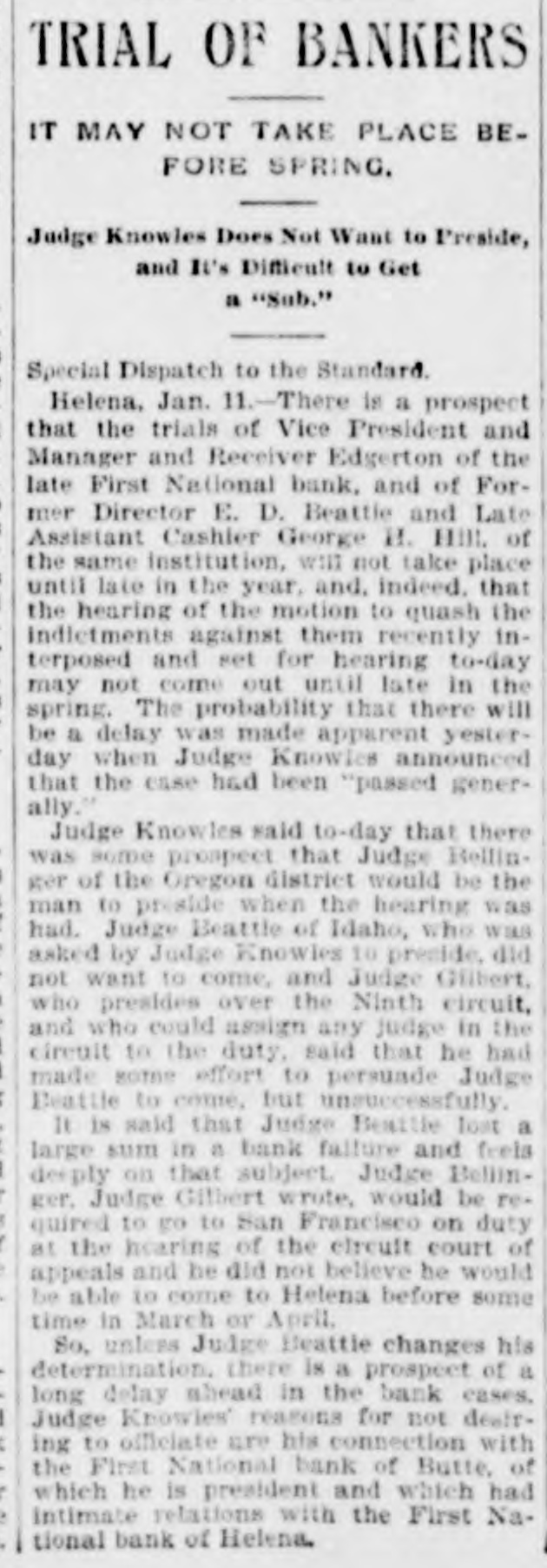
TRIAL OF BANKERS IT MAY NOT TAKE PLACE BEFORE SPRING. Judge Knowles Does Not Want to Preside, and It's Difficult to Get "Sub." Special Dispatch to the Standard Helena, Jan. 11.-There is a prospect that the trials of Vice President and Manager and Receiver Edgerton of the late First National bank, and of Former Director E. D. Beattle and Late Assistant Cashier George H. Hill of the same Institution, will not take place until late in the year. and, indeed. that the hearing of the motion to quash the indictments against them recently interposed and set for hearing to-day may not come out until late in the spring. The probability that there will be a delay was made apparent yesterday when Judge Knowles announced that the case had been "passed generally. Judge Knowles said to-day that there was some prospect that Judge Bellinger of the Oregon district would be the man to proside when the hearing was had. Judge Beattle of Idaho, who was asked by Judge Knowies to preside, did not want to come, and Judge Gilbert, who presides over the Ninth circuit, and who could assign any judge in the circuit to the duty, said that he had made gome effort to persuade Judge Beattle to come. but unsuccessfully. It is said that Judge Beattle lost a large sum in a bank failure and feels deeply on that subject Judge Beliinger. Judge Gilbert wrote, would be required to go to San Francisco on duty at the hearing of the circuit court of appeals and be did not believe be would be able to come to Helena before some time in March or April So. unless Judge Beattle changes his determination there is a prospect of a long delay ahead in the bank eases. Judge Knowles' reasons for not dealting to officiate are his connection with the First National bank of Butte, of which he is president and which had intimate relations with the First National bank of Helena.


Article from Shoshone Journal, February 19, 1897

Click image to open full size in new tab

Article Text

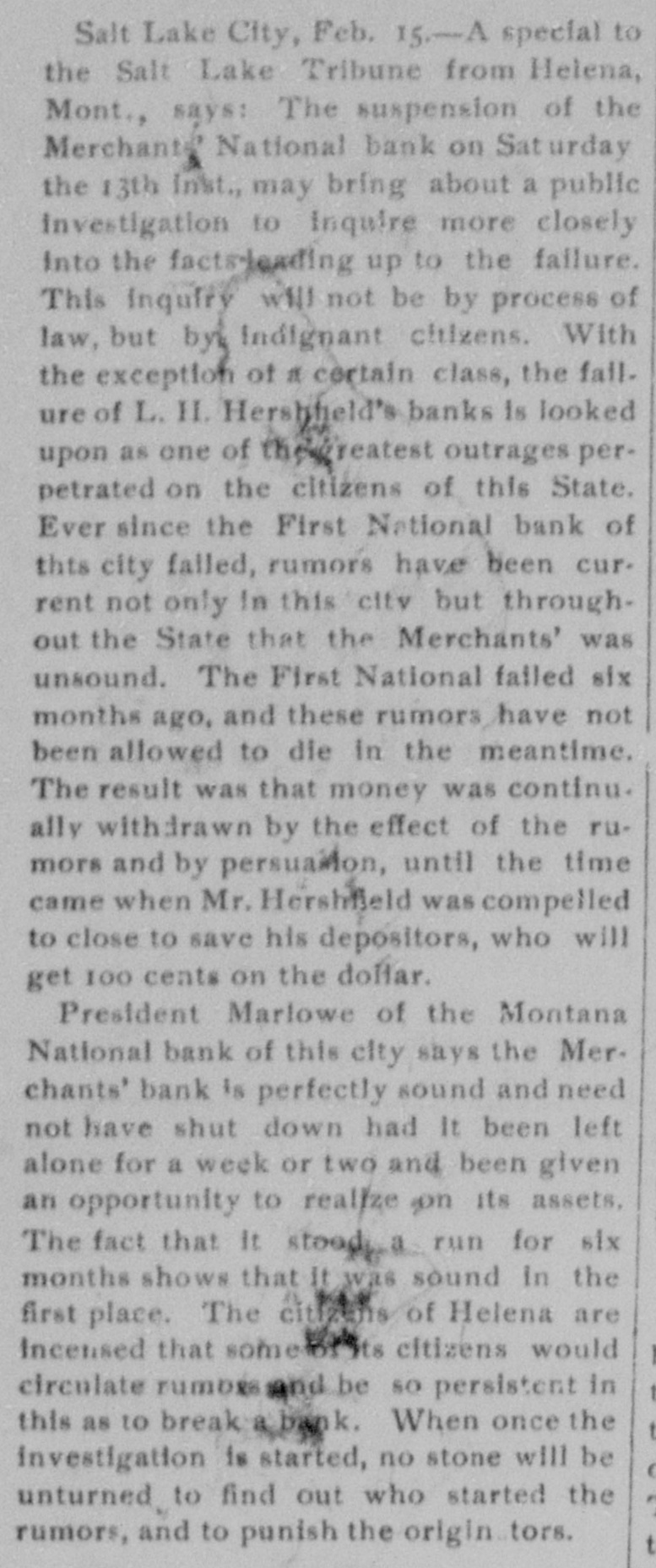
Salt Lake City, Feb. 15.-A special to the Salt Lake Tribune from Helena, Mont., says: The suspension of the Merchants National bank on Saturday the 13th Inst., may bring about a public Investigation to Inquire more closely Into the factsleading up to the failure. This Inquiry will not be by process of law, but by Indignant citizens. With the exception of a certain class, the fallure of L. H. Hershheld banks is looked upon as one of the reatest outrages perpetrated on the citizens of this State. Ever since the First National bank of this city falled, rumors have been current not only In this city but throughout the State that the Merchants' was unsound. The First National failed six months ago, and these rumors have not been allowed to die in the meantime. The result was that money was continu. ally withdrawn by the effect of the rumors and by persuamon, until the time came when Mr. Hershneld was compelled to close to save his depositors, who will get 100 cents on the dollar. President Marlowe of the Montana National bank of this city says the Merchants' bank is perfectly sound and need not have shut down had It been left alone for a week or two and been given an opportunity to realize on its assets, The fact that It stood a run for six months shows that It was sound In the first place. The citizens of Helena are Incensed that some of its citizens would circulate rumbers and be so persistent in this as to break a bank. When once the t investigation is started, no stone will be unturned to find out who started the rumors, and to punish the origin tors. t


Article from Deseret Evening News, May 27, 1897

Click image to open full size in new tab

Article Text

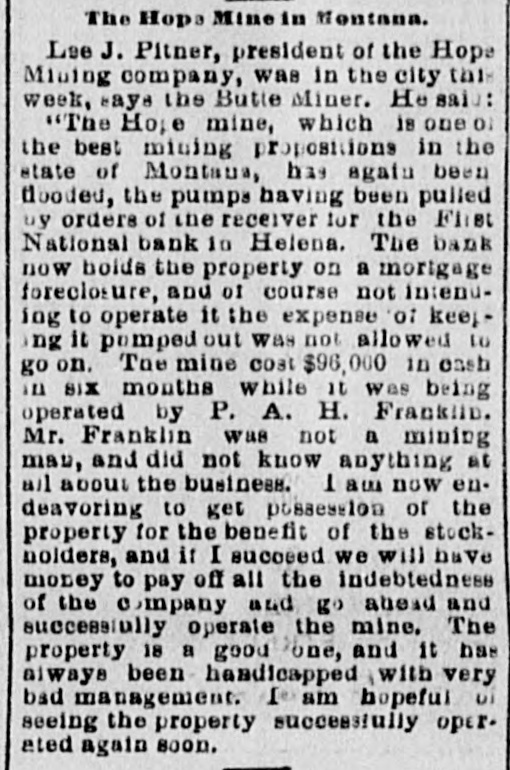
# The Hope Mine in Montana. Lee J. Pitner, president of the Hope Mining company, was in the city this week, says the Butte Miner. He said: "The Hope mine, which is one of the best mining propositions in the state of Montana, has again been flooded, the pumps having been pulled by orders of the receiver for the First National bank in Helena. The bank now holds the property on a mortgage foreclosure, and of course not intending to operate it the expense of keeping it pumped out was not allowed to go on. The mine cost $96,000 in cash in six months while it was being operated by P. A. H. Franklin. Mr. Franklin was not a mining man, and did not know anything at all about the business. I am now endeavoring to get possession of the property for the benefit of the stockholders, and if I succeed we will have money to pay off all the indebtedness of the company and go ahead and successfully operate the mine. The property is a good one, and it has always been handicapped with very bad management. I am hopeful of seeing the property successfully operated again soon.


Article from The Salt Lake Herald, June 25, 1897

Click image to open full size in new tab

Article Text

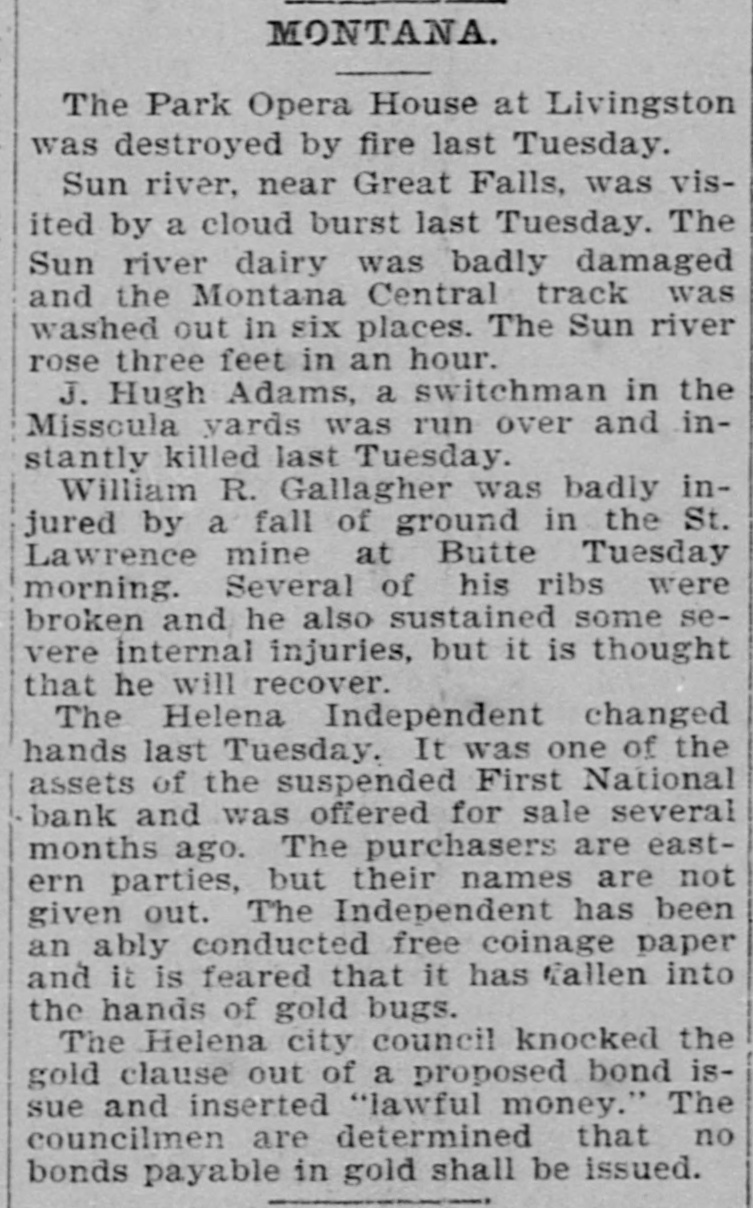
# MONTANA. The Park Opera House at Livingston was destroyed by fire last Tuesday. Sun river, near Great Falls, was visited by a cloud burst last Tuesday. The Sun river dairy was badly damaged and the Montana Central track was washed out in six places. The Sun river rose three feet in an hour. J. Hugh Adams, a switchman in the Misscula yards was run over and instantly killed last Tuesday. William R. Gallagher was badly injured by a fall of ground in the St. Lawrence mine at Butte Tuesday morning. Several of his ribs were broken and he also sustained some severe internal injuries, but it is thought that he will recover. The Helena Independent changed hands last Tuesday. It was one of the assets of the suspended First National bank and was offered for sale several months ago. The purchasers are eastern parties, but their names are not given out. The Independent has been an ably conducted free coinage paper and it is feared that it has fallen into the hands of gold bugs. The Helena city council knocked the gold clause out of a proposed bond issue and inserted "lawful money." The councilmen are determined that no bonds payable in gold shall be issued.


Article from The Salt Lake Herald, July 5, 1897

Click image to open full size in new tab

Article Text

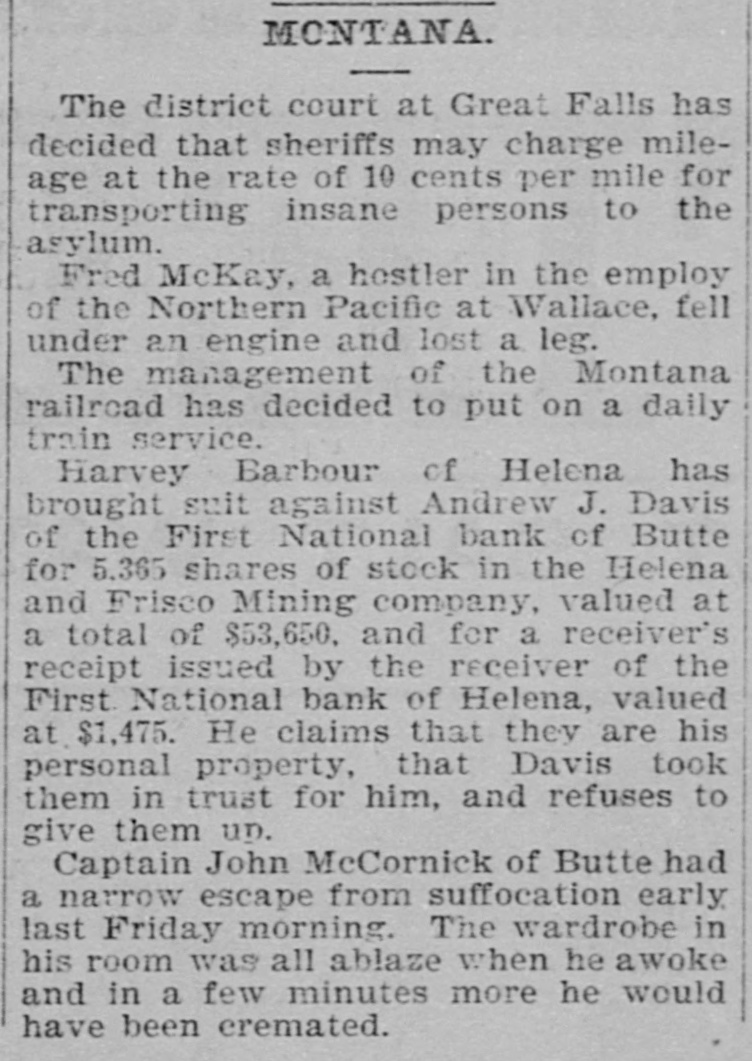
MONTANA. The district court at Great Falls has decided that sheriffs may charge mileage at the rate of 10 cents per mile for transporting insane persons to the asylum. Fred McKay, a hostler in the employ of the Northern Pacific at Wallace, fell under an engine and lost a leg. The management of the Montana railroad has decided to put on a daily train service. Harvey Barbour of Helena has brought suit against Andrew J. Davis of the First National bank of Butte for 5,365 shares of stock in the Helena and Frisco Mining company, valued at a total of $53,650, and for a receiver's receipt issued by the receiver of the First National bank of Helena, valued at $1,475. He claims that they are his personal property, that Davis took them in trust for him, and refuses to give them up. Captain John McCornick of Butte had a narrow escape from suffocation early last Friday morning. The wardrobe in his room was all ablaze when he awoke and in a few minutes more he would have been cremated.


Article from Shoshone Journal, July 9, 1897

Click image to open full size in new tab

Article Text

# NORTHWEST NOTES. Pioneer B. F. Leete, of Reno, Nevada is dead. William J. McConnell of Idaho has been nominated for Indian inspector. The management of the Montana railroad has decided to put on a daily train service. The Helena Water company threatens to shut off the city's water unless back accounts are settled up. Fred McKay, a hostler in the employ of the Northern Pacific at Wallace, fell under an ergine and lost a leg. Vaso Bielich, a miner employed at the Oriental mine at Butte was caught betwen the cage and timber and instantly killed. Cattlemen say there will not be the increase of stock this year that was expected. The continued spring rains killed many of the young calves. Santos Lugo, the notorious horse-thief, who has stolen over 1,000 horses during his career of outlawry, has been captured in California, and taken to Hanford. The district court at Great Falls, Mont., has decided that sheriffs may charge mileage at the rate of 10 cents a mile for transporting insane persons to the asylum. Frank Benton, one of the most prominent cattlemen of Wyoming, recently bought 9,000 head of cattle, 6,500 of which will be fattened on Wyoming ranges. Judge Allen at Denver has granted an order permitting Frank C. Young, assignee of Maxey Tabor, to join with the co-owners in leasing the Montgomery mine at Leadville. The assignee was also authorized to pay the delinquent taxes of 1894-5-6. The discovery of coal about four miles southeast of Garlock, Nevada, is raising an excitement in that region. The discoveror has bonded a mine for $15,000. The coal is bituminous, and of good quality. Plans are being consummated for the erection of a smelter in which the coal is to be used. The tide of immigration which set in early in the spring towards Big Horn county, Wyoming, is increasing in volume as the summer months advance. Every day in the week at present sees several prairie schooners wending their way throug the valleys hauling home-seekers, most of whom are well equipped for making a good start in a new country. Through the carelessness of herders four bands of sheep belonging to the Platte Valley Sheep company, Patterson & Stanley and McDermott & Moran, became mixed on the range near Douglass, Wyoming. The sheep number about 10,000, are unmarked and about half of them are lambs, making the mix-up a very serious matter for the owners. The United States land office at Helena is after a number of prominent persons in Flathead county on the charge of making fraudulent proofs on land. Already it is said that three citations, which are practically warrants, have been issued, and parties have been summoned to Helena to explain. The charges, it is said, include that of perjury and will be filed, in all, against about fifteen persons. Harvey Barbour of Helena has brought suit against Andrew J. Davis of the First National bank of Butte for 5.365 shares of stock in the Helena and Frisco mining company, valued at a total of $53,650, and for a receiver's receipt issued by the receiver of the First National bank of Helena, valued at $1,475. He claims that they are his personal property, that Davis took them in trust for him, and refuses to give them up. Mrs. W. D. Coppernall, wife of a prominent attorney at Belt, Mont., arrived at Great Falls the other night and solicited aid to get to Helena before her husband should overtake her. She came into the city on a coal train and was endeavoeing to hide until she could raise the money to get away. Mrs. Coppernall tells a story of abject cruelty and stated that she was compelled to flee from her home to escape bodily harm. She was furnished aid to continue her journey. Achille F. Migeon and Franklin Farrell have filed a suit in the United


Article from The San Francisco Call, February 15, 1898

Click image to open full size in new tab

Article Text

# Circuit Court of Appeals. The United States Circuit Court of Appeals yesterday handed down opinions as follows: Isaac S. Moreland, appellant, vs. J. Sam Brown, as receiver of the First National Bank of Helena, Mont., appellee—Judgment reversed and case remanded. Thames and Mersey Marine Insurance Company vs. Mary O'Connell. administratrix—Judgment reversed and cause remanded. The Farmers' Loan and Trust Company and Northern Pacific Railroad Company et al, vs. Fidelity Trust Company—Judgment reversed. William Grossett vs. H. C. Townsend—Decree reversed. D. Albert Hiller and Sarah Hiller vs. Caroline A. Ladd et al.—Decree affirmed, with costs to appellees.