Suspension was effected by the State Banking Department after related private bankers (Knapp Bros.) failed.
Events (2)
1.April 9, 1909Suspension
Cause
Government Action
Cause Details
Board placed company in hands of the State Banking Department following meeting; action prompted by prospective suspension of Knapp Brothers (private bankers) in which the trust was financially involved.
Newspaper Excerpt
The Binghamton Trust Company ... suspended today. ... it was decided to place the institution in the hands of the State banking department. Chief Examiner M W. Hutchins took charge of the company.
Source
newspapers
same day
2.April 9, 1909Receivership
Newspaper Excerpt
Chief Examiner M W. Hutchins took charge of the company. ... the Banking Department took control the Binghamton Trust Company ... and is now being liquidated under the provisions of ... law passed by the Legislature in 1908.
Source
newspapers
Newspaper Articles (22)
1.April 9, 1909The Newark Star and Newark AdvertiserNewark, NJ
Click image to open full size in new tab
Article Text
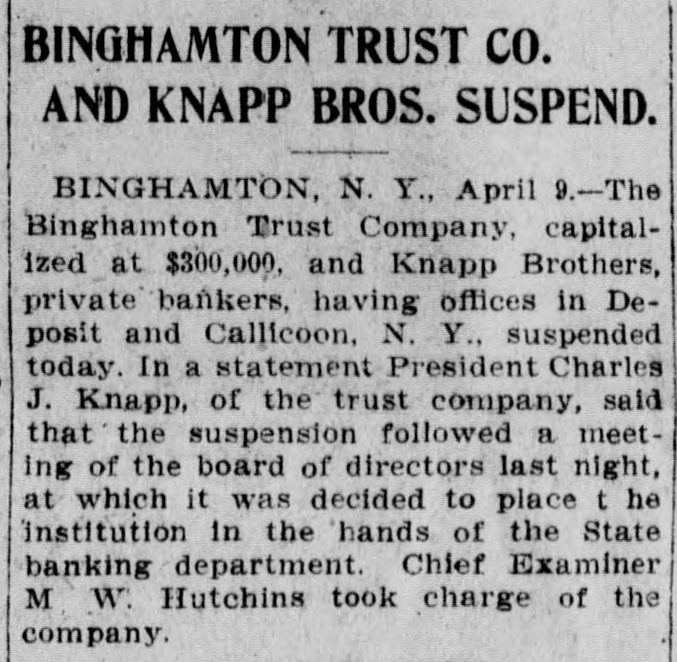
BINGHAMTON TRUST co
AND KNAPP BROS. SUSPEND. BINGHAMTON, N. Y., April 9.-The Binghamton Trust Company, capitalized at $300,000, and Knapp Brothers, private bañkers, having offices in Deposit and Callicoon, N. Y., suspended today. In a statement President Charles J. Knapp, of the trust company, said that the suspension followed a meeting of the board of directors last night, at which it was decided to place t he institution in the hands of the State banking department. Chief Examiner M W. Hutchins took charge of the company.
2.April 9, 1909The Topeka State JournalTopeka, KS
Click image to open full size in new tab
Article Text
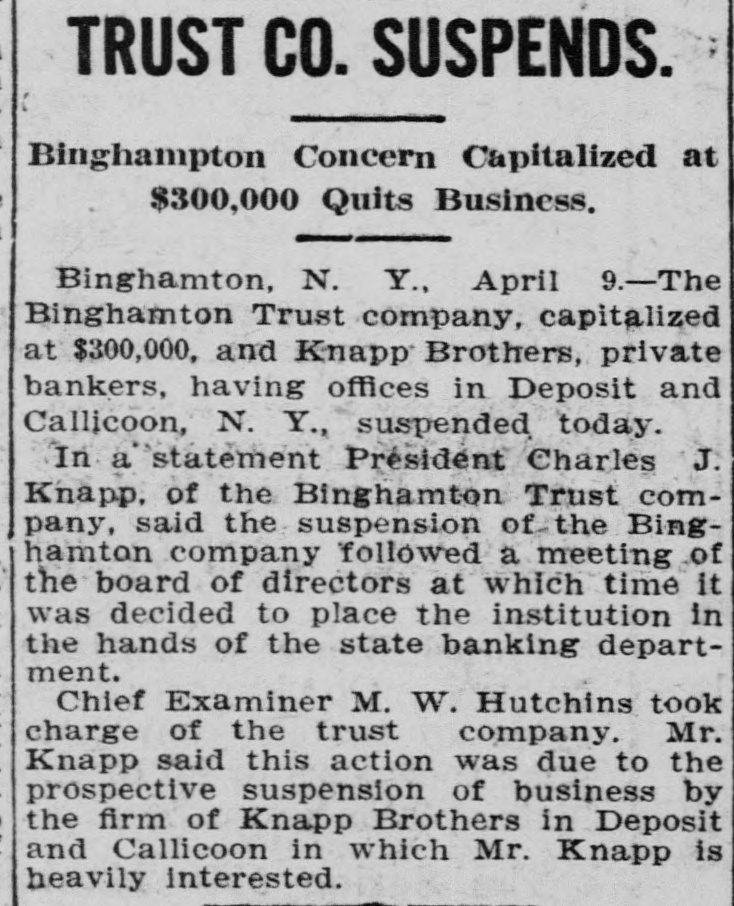
TRUST CO
SUSPENDS. Binghampton Concern Capitalized at $300,000 Quits Business, Binghamton, N. Y., April 9.-The Binghamton Trust company, capitalized at $300,000, and Knapp Brothers, private bankers, having offices in Deposit and Callicoon, N. Y., suspended today. In a statement President Charles J. Knapp, of the Binghamton Trust company, said the suspension of the Binghamton company followed a meeting of the board of directors at which time it was decided to place the institution in the hands of the state banking department. Chief Examiner M. W. Hutchins took charge of the trust company. Mr. Knapp said this action was due to the prospective suspension of business by the firm of Knapp Brothers in Deposit and Callicoon in which Mr. Knapp is heavily interested.
3.April 10, 1909The Ocala Evening StarOcala, FL
Click image to open full size in new tab
Article Text
BINGHAMTON BANKS BREAK Binghampton, N. Y., April 10.-The Binghamton Trust Company, a concern capitalized at $300,000, and Knapp Bros., private bankers, suspended here yesterday morning.
4.April 10, 1909Omaha Daily BeeOmaha, NE
Click image to open full size in new tab
Article Text
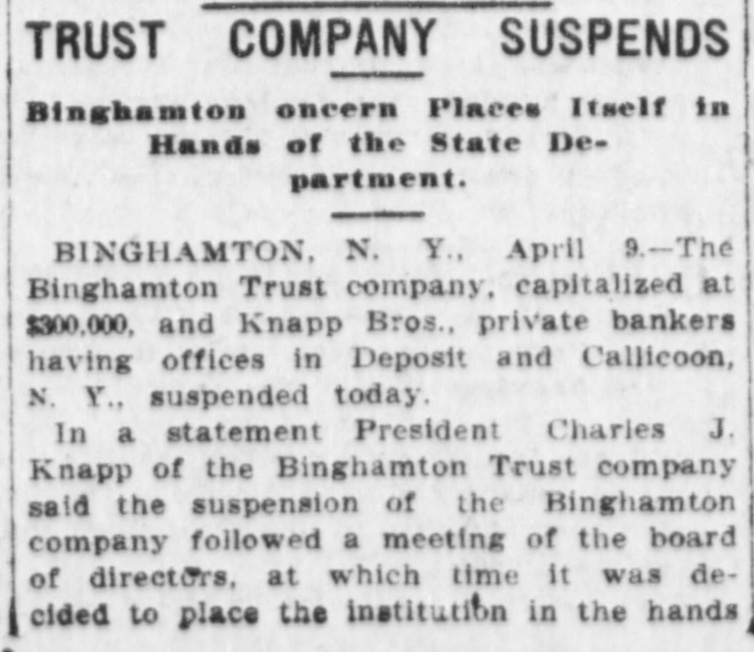
TRUST COMPANY SUSPENDS Binghamton oncern Places Itself in Hands of the State Department. BINGHAMTON, N. Y., April 9.-The Binghamton Trust company, capitalized at $300,000, and Knapp Bros., private bankers having offices in Deposit and Callicoon, N. Y., suspended today. In a statement President Charles J. Knapp of the Binghamton Trust company said the suspension of the Binghamton company followed a meeting of the board of directors, at which time it was decided to place the institution in the hands
5.April 10, 1909Los Angeles HeraldLos Angeles, CA
Click image to open full size in new tab
Article Text
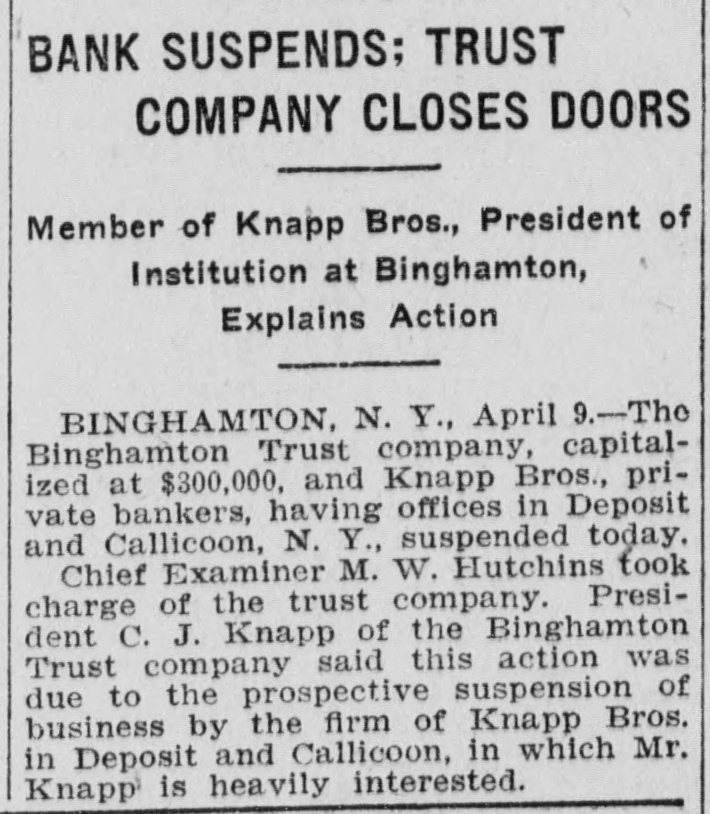
BANK SUSPENDS; TRUST COMPANY CLOSES DOORS Member of Knapp Bros., President of Institution at Binghamton, Explains Action BINGHAMTON, N. Y., April 9.-The Binghamton Trust company, capitalized at $300,000, and Knapp Bros., private bankers, having offices in Deposit and Callicoon, N. Y., suspended today. Chief Examiner M. W. Hutchins took charge of the trust company. President C. J. Knapp of the Binghamton Trust company said this action was due to the prospective suspension of business by the firm of Knapp Bros. in Deposit and Callicoon, in which Mr. Knapp is heavily interested.
6.April 10, 1909The Montgomery AdvertiserMontgomery, AL
Click image to open full size in new tab
Article Text
TWO BANK FAILURES
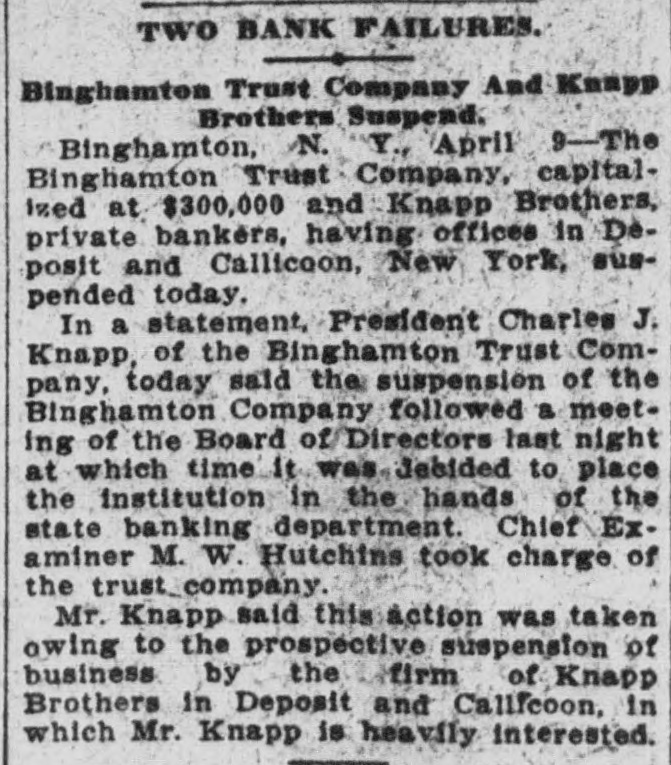
Binghamton Trust Company And Knapp Brothers Suspend. Binghamton, N. Y., April 9 -The Binghamton Trust Company, capitalIzed at $300,000 and Knapp Brothers, private bankers, having offices in Dèposit and Callicoon, New York, suspended today. In a statement, President Charles J. Knapp, of the Binghamton Trust Company, today said the suspension of the Binghamton Company followed a meeting of the Board of Directors last night at which time it was decided to place the institution in the hands of the state banking department. Chief Examiner M. W. Hutchins took charge of the trust company. Mr. Knapp said this action was taken owing to the prospective suspension of business by the firm of Knapp Brothers in Deposit and Callfoon, in which Mr. Knapp is heavily interested.
7.April 10, 1909The Salt Lake HeraldSalt Lake City, UT
Click image to open full size in new tab
Article Text
TWO SMALL FAILURES
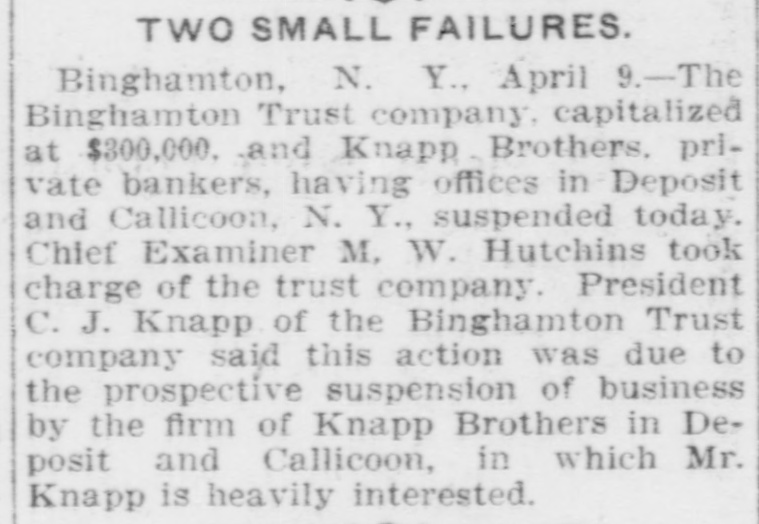
Binghamton, N. Y., April 9.-The Binghamton Trust company, capitalized at $300,000. and Knapp Brothers. private bankers, having offices in Deposit and Callicoon, N. Y., suspended today. Chief Examiner M, W. Hutchins took charge of the trust company. President C. J. Knapp of the Binghamton Trust company said this action was due to the prospective suspension of business by the firm of Knapp Brothers in Deposit and Callicoon, in which Mr. Knapp is heavily interested.
8.April 15, 1909The Manitowoc PilotManitowoc, WI
Click image to open full size in new tab
Article Text
Trust Company Suspends
BINGHAMTON, N. Y., April 9.-The Binghamton Trust company, capitalized at $300,000, and Knapp Bros., private bankers, having offices in Deposit and Callicoon, N. Y., suspended today.
9.April 16, 1909The Black Hills Union and Western Stock ReviewRapid City, SD
Click image to open full size in new tab
Article Text
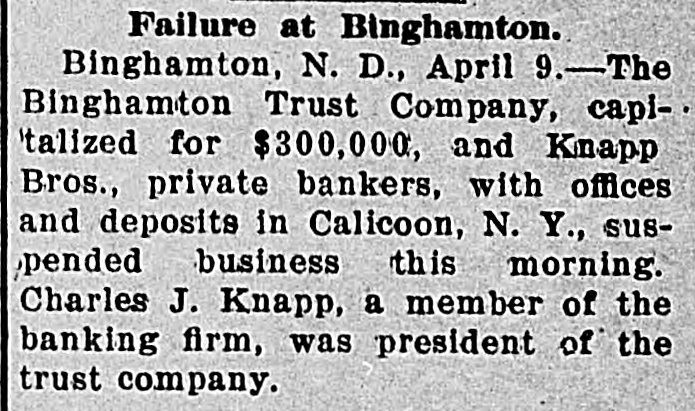
Failure at Binghamton
Binghamton, N. D., April 9.-The Binghamton Trust Company, capitalized for $300,000, and Knapp Bros., private bankers, with offices and deposits in Calicoon, N. Y., suspended business this morning. Charles J. Knapp, a member of the banking firm, was president of the trust company.
10.May 18, 1909New-York TribuneNew York, NY
Click image to open full size in new tab
Article Text
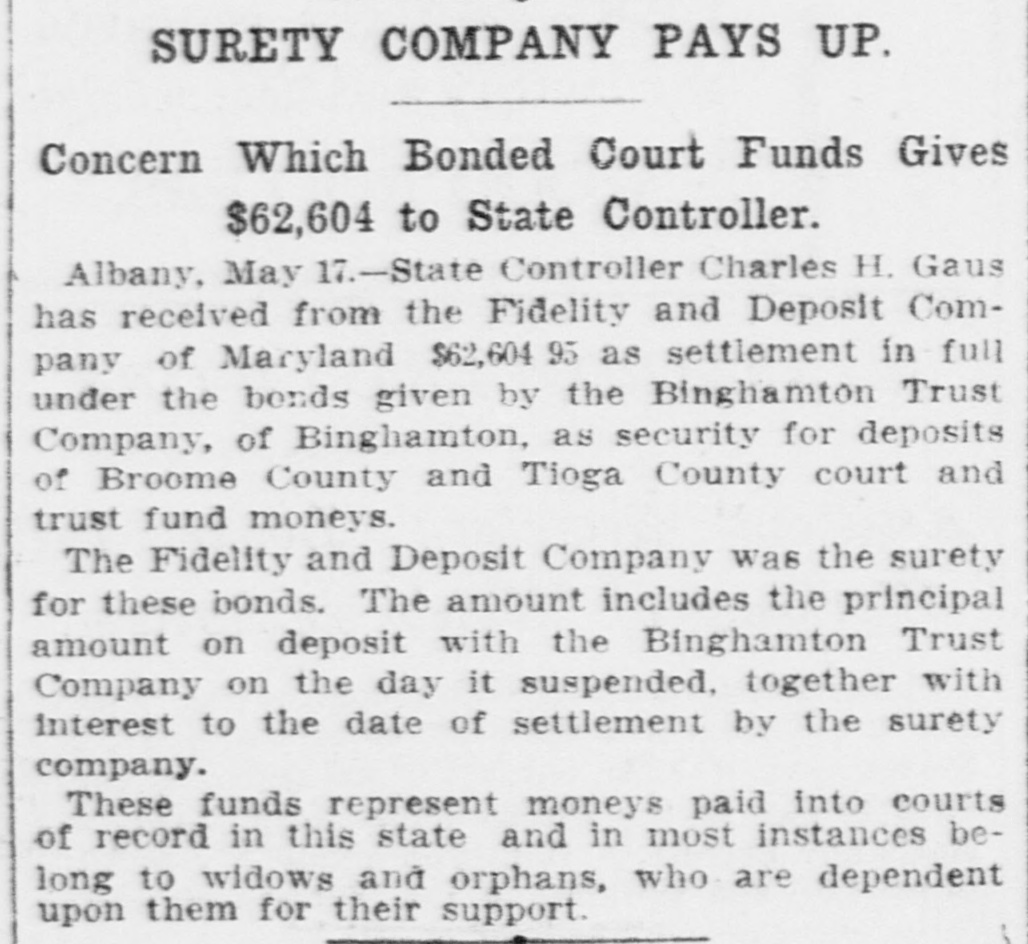
SURETY COMPANY PAYS UP
Concern Which Bonded Court Funds Gives $62,604 to State Controller. Albany, May 17.-State Controller Charles H. Gaus has received from the Fidelity and Deposit Company of Maryland $62,604 95 as settlement in full under the bonds given by the Binghamton Trust Company, of Binghamton, as security for deposits of Broome County and Tioga County court and trust fund moneys. The Fidelity and Deposit Company was the surety for these bonds. The amount includes the principal amount on deposit with the Binghamton Trust Company on the day it suspended, together with interest to the date of settlement by the surety company. These funds represent moneys paid into courts of record in this state and in most instances belong to widows and orphans, who are dependent upon them for their support.
11.June 6, 1909New-York TribuneNew York, NY
Click image to open full size in new tab
Article Text
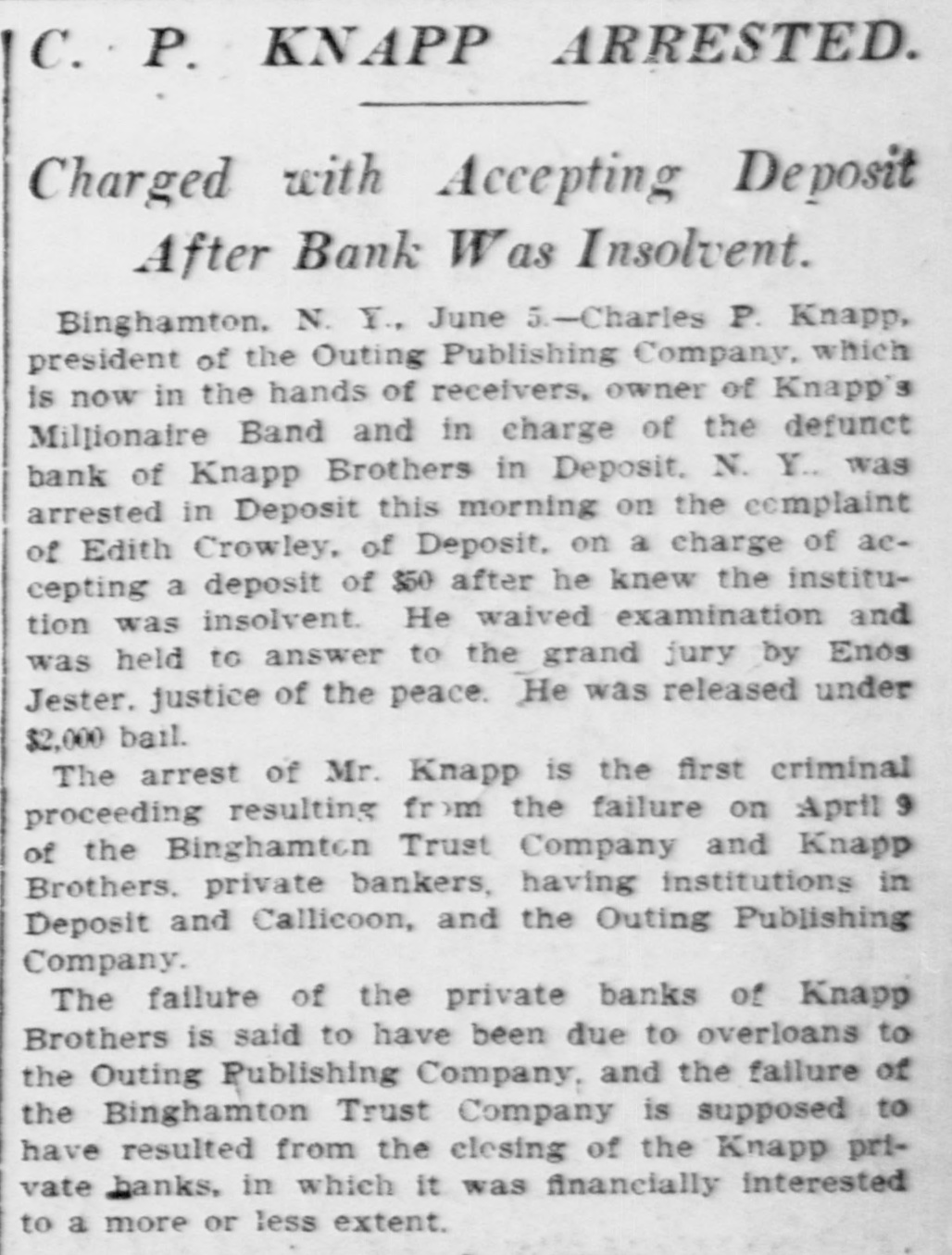
C. P. KNAPP ARRESTED. Charged with Accepting Deposit After Bank Was Insolvent. Binghamton. N. Y., June 5.-Charles P. Knapp, president of the Outing Publishing Company, which is now in the hands of receivers, owner of Knapp's Millionaire Band and in charge of the defunct bank of Knapp Brothers in Deposit. N. Y.. was arrested in Deposit this morning on the complaint of Edith Crowley, of Deposit. on a charge of accepting a deposit of $50 after he knew the institution was insolvent. He waived examination and was held to answer to the grand jury by Enós Jester. justice of the peace. He was released under $2,000 bail. The arrest of Mr. Knapp is the first criminal proceeding resulting from the failure on April 9 of the Binghamton Trust Company and Knapp Brothers. private bankers, having institutions in Deposit and Callicoon, and the Outing Publishing Company. The failure of the private banks of Knapp Brothers is said to have been due to overloans to the Outing Publishing Company, and the failure of the Binghamton Trust Company is supposed to have resulted from the elesing of the Knapp private banks, in which it was financially interested to a more or less extent.
12.June 6, 1909The SunNew York, NY
Click image to open full size in new tab
Article Text
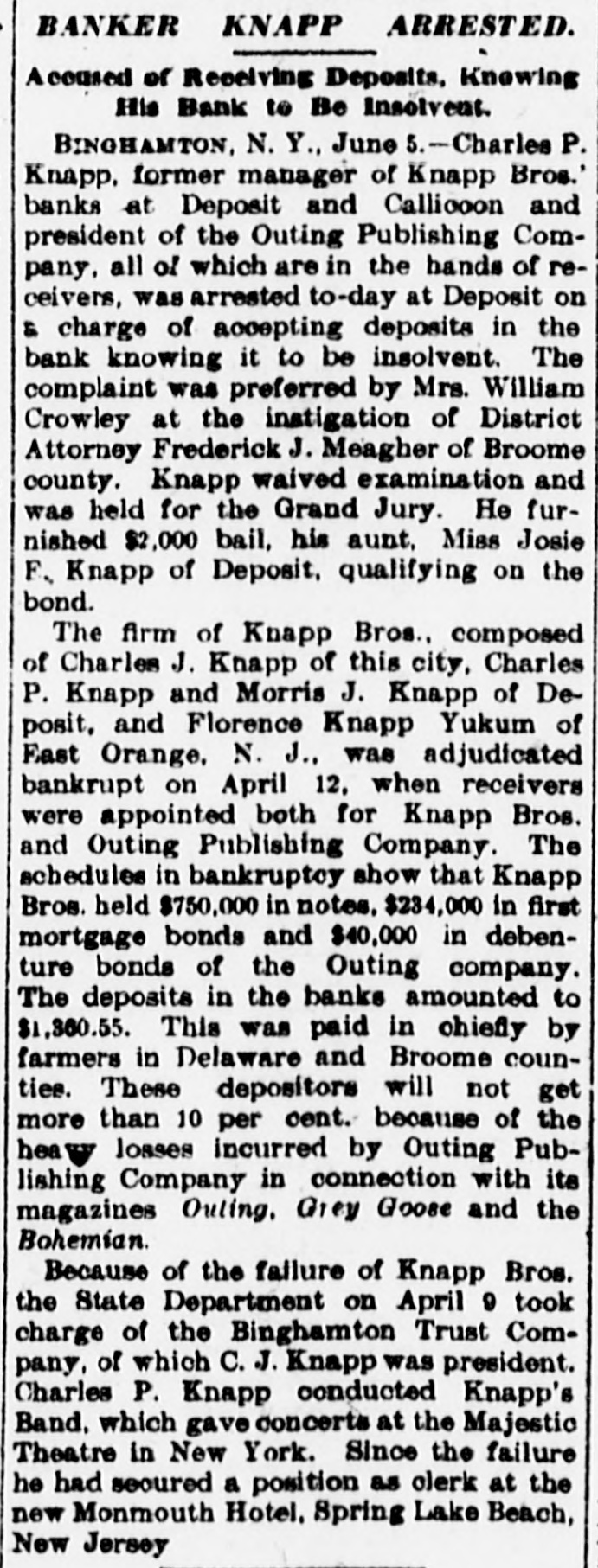
BANKER KNAPP ARRESTED
Accused of Receiving Deposits, Knowing His Bank to Be Insolvent. BINGHAMTON, N. Y., June 5.-Charles P. Knapp. former manager of Knapp Bros.' banks at Deposit and Calliooon and president of the Outing Publishing Company, all of which are in the hands of receivers, was arrested to-day at Deposit on & charge of accepting deposits in the bank knowing it to be insolvent. The complaint was preferred by Mrs. William Crowley at the instigation of District Attorney Frederick J. Meagher of Broome county. Knapp waived examination and was held for the Grand Jury. He furnished $2,000 bail, his aunt, Miss Josie F., Knapp of Deposit, qualifying on the bond. The firm of Knapp Bros., composed of Charles J. Knapp of this city, Charles P. Knapp and Morris J. Knapp of Deposit, and Florence Knapp Yukum of East Orange. N. J., was adjudicated bankrupt on April 12, when receivers were appointed both for Knapp Bros. and Outing Publishing Company. The schedules in bankruptcy show that Knapp Bros. held $750,000 in notes. $234,000 in first mortgage bonds and $40,000 in debenture bonds of the Outing company. The deposits in the banks amounted to $1,360.55. This was paid in chiefly by farmers in Delaware and Broome counties. These depositors will not get more than 10 per cent. because of the heavy losses incurred by Outing Publishing Company in connection with its magazines Outing, Grey Goose and the Bohemian. Because of the failure of Knapp Bros. the State Department on April 9 took charge of the Binghamton Trust Company, of which C. J. Knapp was president. Charles P. Knapp conducted Knapp's Band, which gave concerts at the Majestic Theatre in New York. Since the failure he had secured a position as clerk at the new Monmouth Hotel, Spring Lake Beach, New Jersey
13.June 9, 1909The CitizenHonesdale, PA
Click image to open full size in new tab
Article Text
200 chickens
Large silo. Wayne county. Situated one-half mile fro village. Inquire at THE CITIZEN office. LOCAL MENTION. -Sixteen excursions have been book for the month of June, at Lake Lodo -Four promotions from Co. M, 17 Cavalry (162d Reg. P. v.) while in t three years service, to positions amo the field and staff officers, were made follows: Capt. Coe Durland to Liet Col. ; James Brannon, private, to S Major; Henry J. Tarble, private Hospital Steward, and Wm. C. Walk private, to Saddler. --On Thursday night the famo play, "The Burglar," will be given the Lyric Theatre for the benent the Eagles of this place. You shou not miss it. The cast of characte will be as follows: William Lewis Eugene LaR (Lately with Gardner-Vincent Co Leo Osbor Edward Bainbridge Joe Bodie, . Paul Benton W. W. Wo John Hamilton Clarence Gre James Edna Doolit Alice Ruth Lo Fannie Lizzie Denhar Martha and Editha Mary Wenig -By agreement between the co missioners of Susquehanna a Wayne counties and the Erie ra road, about $50,000 will be expen ed for public improvements. T Erie will build a bridge across tracks at Forest City. The counti will bridge the Susquehanna, a bridges will be built by the Ontar and Western Company at sever places. The improvement will cc nect Forest City in Susquehan county and Clinton in this county . -On Saturday evening William M loy was taken into custody by office John Canivan. On Wednesday a co mission in lunacy was appointed whi reported that Malloy was insane. 1 court thereupon issued an order that be taken to the Insane Hospital at Da ville. Detective N. B. Spencer and ( ficer Canivan went to East Honesda but could not find their man. Th searched the entire neighborhood, k met with no success. He was sub quently captured, however, and Monday was taken to Danville, by N. Spencer and John Burcher. -Charles P. Knapp, President the Outing Publishing Compar which is in the hands of receive owner of Knapp's Millionaire Bar and in charge of the defunct ba of Knapp Brothers, in Deposit, Y., was arrested in Deposit on Si urday morning on the complaint Edith Crowley on a charge of a cepting a deposit of $60 after knew the institution was insolve He waived examination and w held for the Grand Jury under $ 000 bail. The arrest of Knapp the first criminal proceeding resu ms from the failure of the Bir hamton Trust Company, Kna Brothers, private bankers, and t Outing Publishing Company. has been announced that Mr. Kna had secured a position as ch clerk of the New Monmouth Ho at Spring Lake Beach, N. J., whi opens on Saturday next, June 12 F. F. Shute, the proprietor, is personal friend of Mr. Knapp, a
14.August 31, 1909The Topeka State JournalTopeka, KS
Click image to open full size in new tab
Article Text
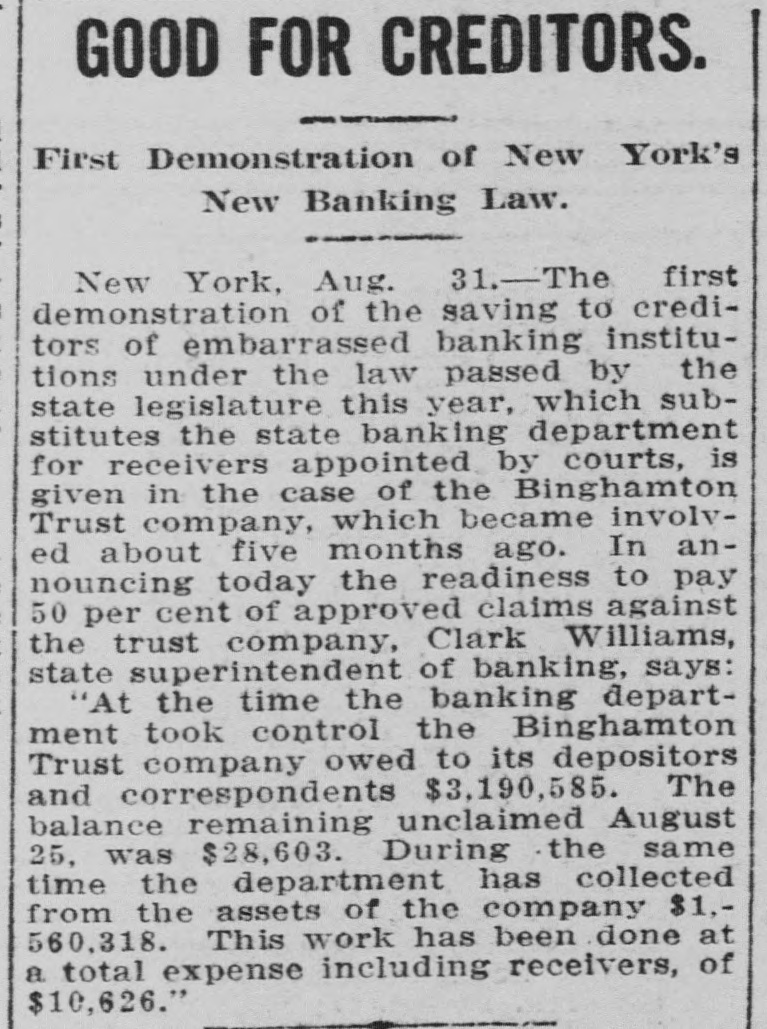
GOOD FOR CREDITORS
First Demonstration of New York's New Banking Law. New York, Aug. 31.-The first demonstration of the saving to creditors of embarrassed banking institutions under the law passed by the state legislature this year, which substitutes the state banking department for receivers appointed by courts, is given in the case of the Binghamton Trust company, which became involved about five months ago. In announcing today the readiness to pay 50 per cent of approved claims against the trust company, Clark Williams, state superintendent of banking, says: "At the time the banking department took control the Binghamton Trust company owed to its depositors and correspondents $3,190,585. The balance remaining unclaimed August 25, was $28,603. During the same time the department has collected from the assets of the company $1,560,318. This work has been done at a total expense including receivers, of $10,626."
15.September 1, 1909The Montgomery AdvertiserMontgomery, AL
Click image to open full size in new tab
Article Text
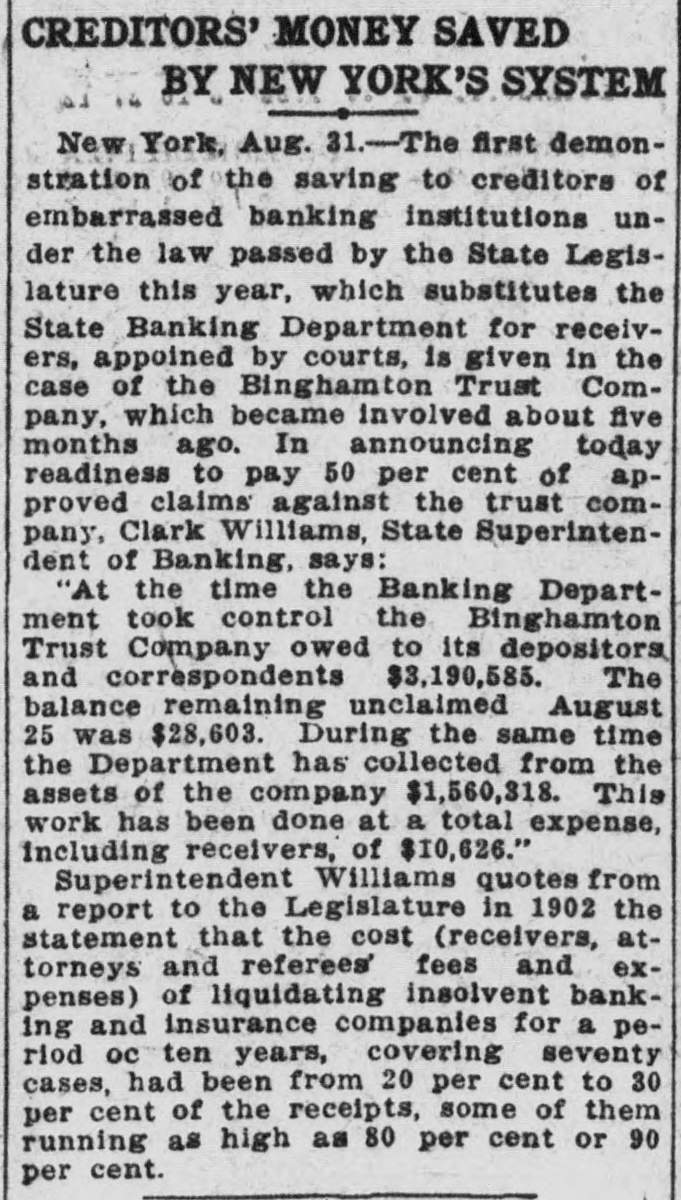
CREDITORS' MONEY SAVED BY NEW YORK'S SYSTEM New York, Aug. 31.-The first demonstration of the saving to creditors of embarrassed banking institutions under the law passed by the State Legislature this year, which substitutes the State Banking Department for receivers, appoined by courts, is given in the case of the Binghamton Trust Company, which became involved about five months ago. In announcing today readiness to pay 50 per cent of approved claims against the trust company, Clark Williams, State Superintendent of Banking, says: "At the time the Banking Department took control the Binghamton Trust Company owed to its depositors and correspondents $3,190,585. The balance remaining unclaimed August 25 was $28,603. During the same time the Department has collected from the assets of the company $1,560,318. This work has been done at a total expense, including receivers, of $10,626." Superintendent Williams quotes from a report to the Legislature in 1902 the statement that the cost (receivers, attorneys and referees' fees and expenses) of liquidating insolvent banking and insurance companies for a period oc ten years, covering seventy cases, had been from 20 per cent to 30 per cent of the receipts, some of them running as high as 80 per cent or 90 per cent.
16.September 1, 1909New-York TribuneNew York, NY
Click image to open full size in new tab
Article Text
BANK LAW VINDICATED
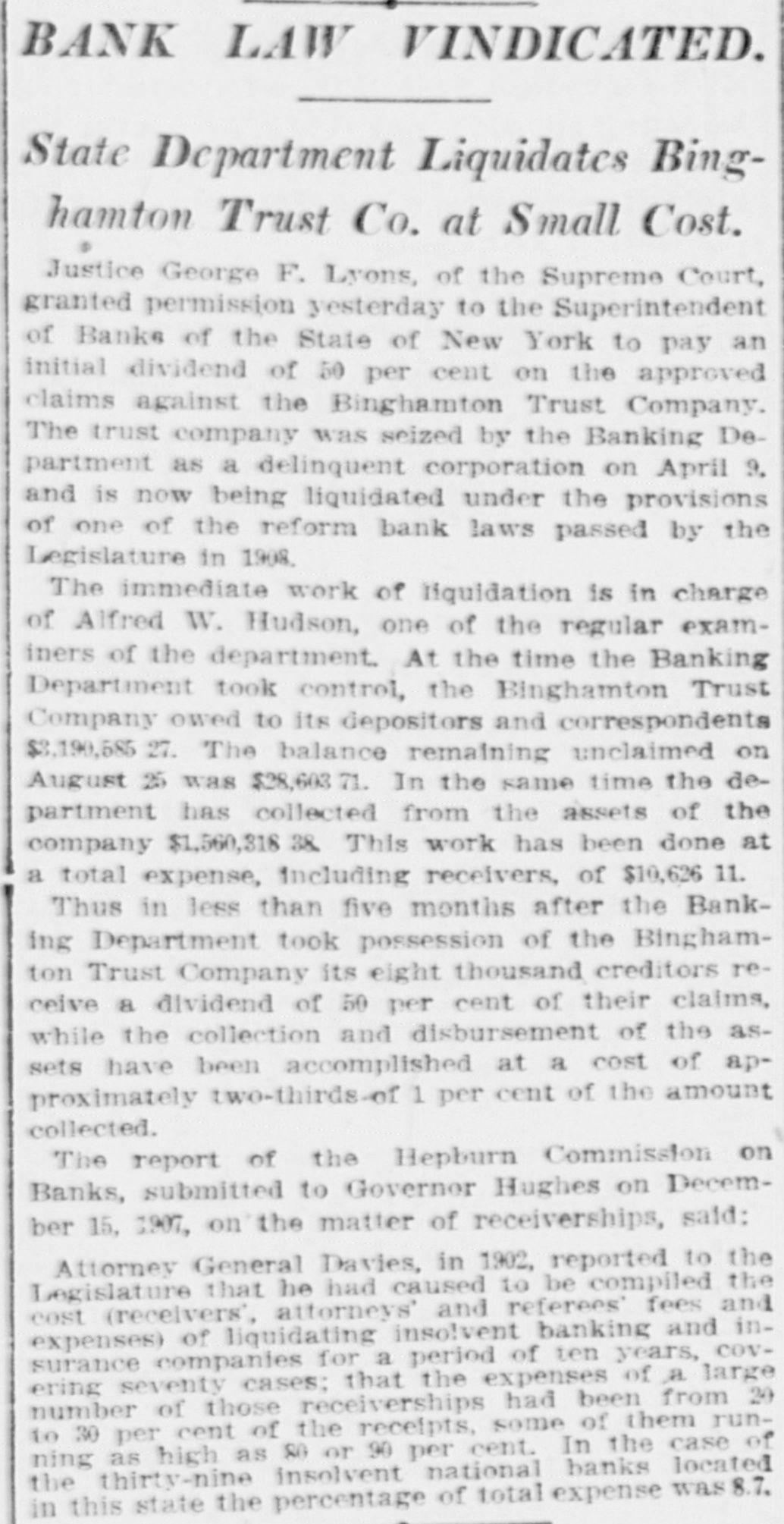
State Department Liquidates Binghamton Trust Co. at Small Cost. Justice George F. Lyons, of the Supreme Court, granted permission yesterday to the Superintendent of Banks of the State of New York to pay an initial dividend of 50 per cent on the approved claims against the Binghamton Trust Company. The trust company was seized by the Banking Department as a delinquent corporation on April 9. and is now being liquidated under the provisions of one of the reform bank laws passed by the Legislature in 1908. The immediate work of liquidation is in charge of Alfred W. Hudson, one of the regular examiners of the department. At the time the Banking Department took control, the Binghamton Trust Company owed to its depositors and correspondents $3,190,685 27. The balance remaining unclaimed on August 25 was $28,603 71. In the same time the department has collected from the assets of the company $1,560,318.38 This work has been done at a total expense, including receivers, of $10,626 11. Thus in less than five months after the Banking Department took possession of the Binghamton Trust Company its eight thousand creditors receive a dividend of 50 per cent of their claims, while the collection and disbursement of the assets have been accomplished at a cost of approximately two-thirds-of 1 per cent of the amount collected. The report of the Hepburn Commission on Banks, submitted to Governor Hughes on December 15, 1907, on the matter of receiverships, said: Attorney General Davies, in 1902, reported to the Legislature that he had caused to be compiled the cost (receivers', attorneys' and referees fees and expenses) of liquidating insolvent banking and insurance companies for a period of ten years, COVering seventy cases: that the expenses of a large number of those receiverships had been from 20 to 30 per cent of the receipts, some of them running as high as 80 or 90 per cent. In the case of the thirty-nine insolvent national banks located in this state the percentage of total expense was 8.7.
17.September 1, 1909Los Angeles HeraldLos Angeles, CA
Click image to open full size in new tab
Article Text
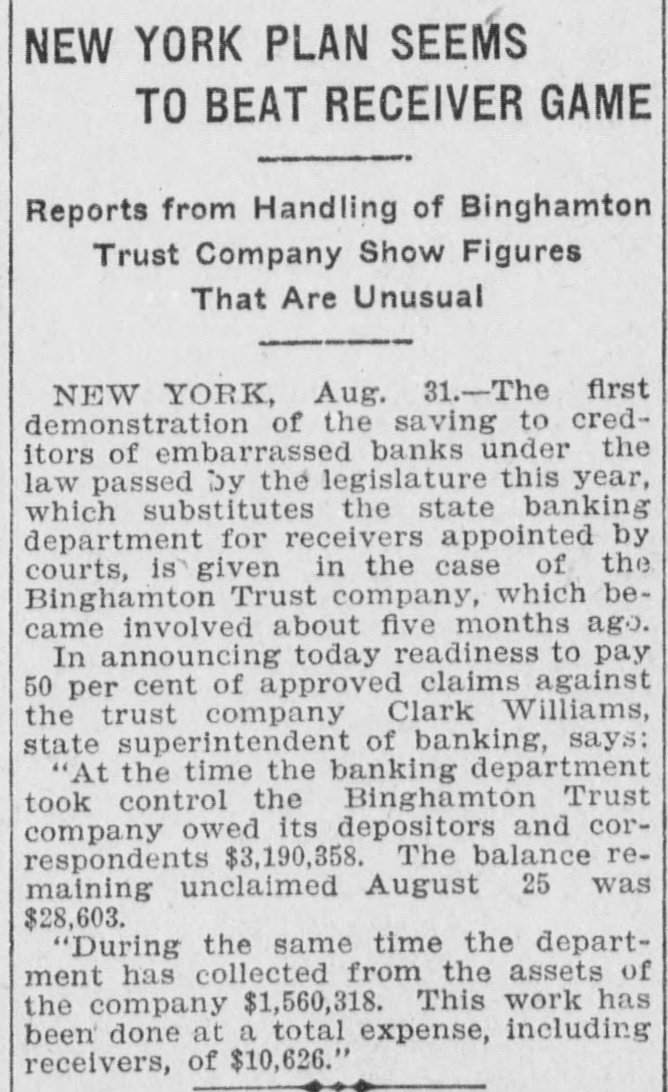
NEW YORK PLAN SEEMS TO BEAT RECEIVER GAME Reports from Handling of Binghamton Trust Company Show Figures That Are Unusual NEW YORK, Aug. 31.-The first demonstration of the saving to creditors of embarrassed banks under the law passed by the legislature this year, which substitutes the state banking department for receivers appointed by courts, is given in the case of the Binghamton Trust company, which became involved about five months ago. In announcing today readiness to pay 50 per cent of approved claims against the trust company Clark Williams, state superintendent of banking, says: "At the time the banking department took control the Binghamton Trust company owed its depositors and correspondents $3,190,358. The balance remaining unclaimed August 25 was $28,603. "During the same time the department has collected from the assets of the company $1,560,318. This work has been done at a total expense, including receivers, of $10,626."
18.October 23, 1909The San Mateo ItemSan Mateo, FL
Click image to open full size in new tab
Article Text
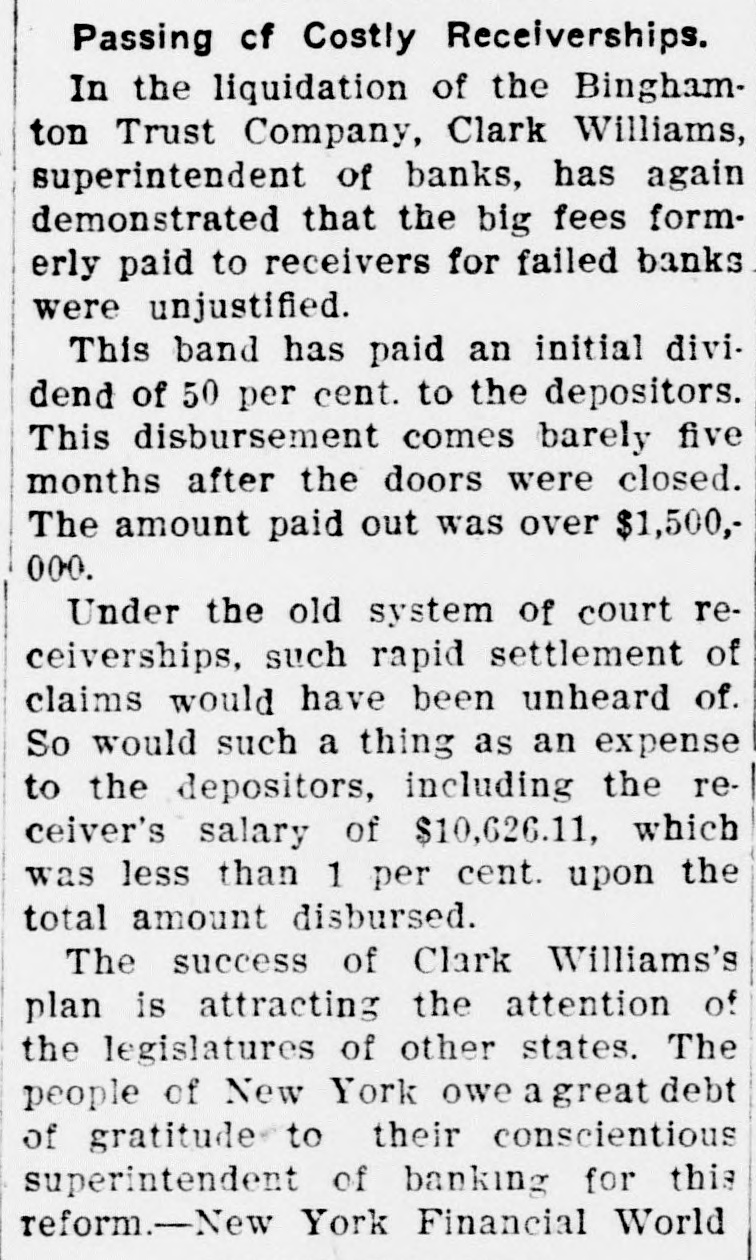
Passing of Costly Receiverships
In the liquidation of the Binghamton Trust Company, Clark Williams, superintendent of banks, has again demonstrated that the big fees formerly paid to receivers for failed banks were unjustified. This band has paid an initial dividend of 50 per cent. to the depositers. This disbursement comes barely five months after the doors were closed. The amount paid out was over $1,500,000. Under the old system of court receiverships, such rapid settlement of claims would have been unheard of So would such a thing as an expense to the depositors, including the receiver's salary of $10,626.11, which was less than 1 per cent. upon the total amount disbursed. The success of Clark Williams's plan is attracting the attention of the legislatures of other states. The people of New York owe a great debt of gratitude to their conscientious superintendent of banking for this reform.-New York Financial World.
19.November 3, 1909Manchester DemocratManchester, IA
Click image to open full size in new tab
Article Text
Passing of Costly Receiverships
In the liquidation of the Binghamton Trust Company, Clark Williams, superintendent of banks, has again demonstrated that the big fees formerly paid to receivers for failed banks were unjustified.
This band has paid an initial dividend of 50 per cent. to the depositors. This disbursement comes barely five months after the doors were closed. The amount paid out was over $1,500,000.
Under the old system of court receiverships, such rapid settlement of claims would have been unheard of. So would such a thing as an expense to the depositors, including the receiver's salary of $10,626.11, which was less than 1 per cent upon the total amount disbursed.
The success of Clark Williams's plan is attracting the attention of the legislatures of other states. The people of New York owe a great debt of gratitude to their conscientious superintendent of banking for this reform.—New York Financial World.
20.April 6, 1910New-York TribuneNew York, NY
Click image to open full size in new tab
Article Text
at 6 per cent interest, without commission. This credit, it is understood, has been repaid.
Whether or not the bank will be reopened it is still too early to predict. Some of the larger interests, it is understood, are desirous of putting more money into it, but other important interests are said to consider that policy inadvisable. The wishes of the body of the stockholders have yet to be ascertained, and if they are willing to submit to a considerable assessment the institution may be reopened. Another possibility is that some other bank may make an offer for the Union and take it over.
The Union Bank will benefit by having its affairs placed in the hands of the State Superintendent of Banks instead of a receiver. The first case of the sort was that of the Home Bank of Brooklyn, a small institution, which was reopened for business on June 4, 1908, after having been in charge of the Banking Department for forty-two days, at a total cost of only $1,200. Under the new system, it was said at the time, the cost of liquidating the Williamsburg Trust Company would have been not more than $4,200, compared with the $40,000 allowed the receivers and their counsel, which fee did not include the cost of administering the trust.
The report of Superintendent Cheney last month noted that the creditors of the Lafayette Trust Company up to date had received 30 per cent and those of the Binghamton Trust Company 50 per cent, the costs of liquidation having been, respectively, 1 per cent and two-thirds of 1 per cent.
21.June 24, 1910Newark Evening Star and Newark AdvertiserNewark, NJ
Click image to open full size in new tab
Article Text
BANKER KNAPP GETS TWO YEARS IN AUBURN. BINGHAMTON, N. Y., June 24 Charles P. Knapp, one of the firm of Knapp Brothers, private bankers, of Deposit, N. Y., which failed over a year ago, at the time the Binghamton Trust Company's doors were closed, was today convicted of receiving a deposit in his bank on the day before It closed, knowing at the time that the bank was insolvent. He was sentenced to Auburn prison for not less than fifteen months nor more than two years. The failure of Knapp Brothers was due to excessive and unsecured loans to the Outing Magazine's publishers, and it was the crash of the banking firm that caused the suspension and subsequent liquidation of the Binghamton Trust Company. Charles Knapp, an uncle of the man just convicted, and a member of Knapp Brothers, as well as president of the Binghamton Trust Company, is indicted on a similar charge, and his trial also is scheduled to be held in Otsego county.
22.August 27, 1910The St. Mary BannerFranklin, LA
Click image to open full size in new tab
Article Text
Passing of Costly Receiverships.
In the liquidation of the Binghamton Trust Company, Clark Williams, superintendent of banks, has again demonstrated that the big fees formerly paid to receivers for failed banks were unjustified.
This band has paid an initial dividend of 50 per cent. to the depositors. This disbursement comes barely five months after the doors were closed. The amount paid out was over $1,500,000.
Under the old system of court receiverships, such rapid settlement of claims would have been unheard of. So would such a thing as an expense to the depositors, including the receiver's salary of $10,626.11, which was less than 1 per cent. upon the total amount disbursed.
The success of Clark Williams's plan is attracting the attention of the legislatures of other states. The people of New York owe a great debt of gratitude to their conscientious superintendent of banking for this reform.—New York Financial World
Bank runs are almost always and everywhere a deterioration of bank fundamentals.
But not for you.
You are the measure-zero exception: great fundamentals, solid bank, and yet the Diamond Dybvig fairy spread its rumor. Depositors woke up. Your collateral was not prepositioned. The Clearinghouse had it for you.
Do not pass Go. Do not collect $200. Go directly to jail… or worse.
Flag Article for Review
Flag Episode for Review
Binghamton Trust Company · Episode ID 9988592991312