Article Text
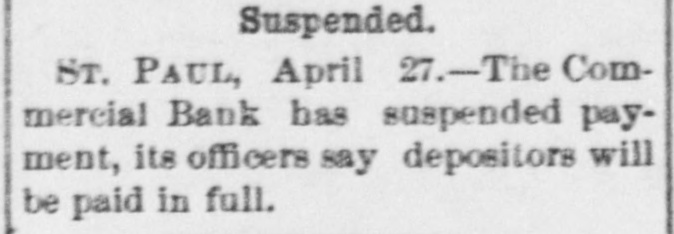
Suspended. ST. PAUL, April 27.-The Commercial Bank has suspended payment, its officers say depositors will be paid in full.
afd96597Capital injected, Full suspension, Books examined
Click image to open full size in new tab
Suspended. ST. PAUL, April 27.-The Commercial Bank has suspended payment, its officers say depositors will be paid in full.

Click image to open full size in new tab
mercial, and they drawing their funds. This in itself was not a matter of sufficient moment to Cause Any Trouble, but it speedily became known in the city and was whispered around among the many depositors, and the run was started. The Commercial bank on March 1 last had nearly $1,000,000 of deposits, belonging to over 1,400 different people. It has been a popular bank and an especial favorite with the smaller merchants, as will be seen from the number of the depositors, which is nearly twice as great as most banks with double the amount of deposits. On account of the great number of depositors the run was perhaps made a great deal worse than it would have been otherwise. The report furnished the papers last evening by the cashier, Herman Scheffer, shows that since the run commenced over $300,000 have been drawn out, the amount due depositors at the present time being $699,419.44, against which the bank shows assets in notes, real estate, bonds, etc., of $1,559,815.35. This apparent surplus is reduced, however, by rediscounts amounting to $276,912.60. The full statement of Herman Scheffer, the cashier of the suspended bank, follows: "It IS well known that banking business is largely founded on confidence. The fact that the German Insurance company, which lately closed its doors. has been generally supposed to be closely allied to the Commercial bank, Albert Scheffer being president of both institutions, has, without reason, caused the opinion to become prevalent among the depositors that the future of the one Involved the Other. "This has caused a feeling of uncertainty among depositors, which has resulted in their withdrawing from the deposits over $300,000 in cash within the last few days. Today the run became so strong that the officers considered that justice to all depositors required them to suspend payment temporarily. The assets are ample for the protection of all depositors, and an effort is bring made to effect an arrangement by which the bank will be enabled to pay off its depositors speedily." Mr. Scheffer furnished the following statement of assets and liabilities: Liabilities$699,419 44 Due depositors Rediscounts 276,912 60 Total $976,332 04 Assets $1,559,815 25 Notes, real estate, etc At the commencement of business yesterday morning the bank officials had no idea that they would be obliged to close up. Aid from other banks had been promised and a considerable amount advanced. The clearing house association met yesterday morning, and after looking over the situation suspended the bank before the clearing hour. This was with the assent of Cashier Herman Scheffer, and was made necessary by the fact that the bank did not have the funds with which to meet the heavy drafts. When this news reached the bank the payment of all demands was continued for a time, several of the other banks having volunteered the funds. Some of this money was furnished, but several of the volunteers desired time to consult with their fellow officers, and this delay was fatal to the success of the plan. At 2 o'clock the members of the clearing house committee, which is made up of President W. B. Merriam, of the Merchants' National; E. H. Bailey, cashier of the First National, and WillJam Dawson Jr., cashier of the Bank of Minnesota, met in Gov. Merriam's private office and made an examination of the assets of the suspended bank. A good part of the afternoon was spent at this task, and when it was completed it was agreed that the board of directors of the Commercial bank should be advised that, under the circumstances, the clearing house committee is under the Impression that it will be best to allow the courts to Appoint a Receiver to wind up the business of the bank. The committee estimated that it would
Click image to open full size in new tab
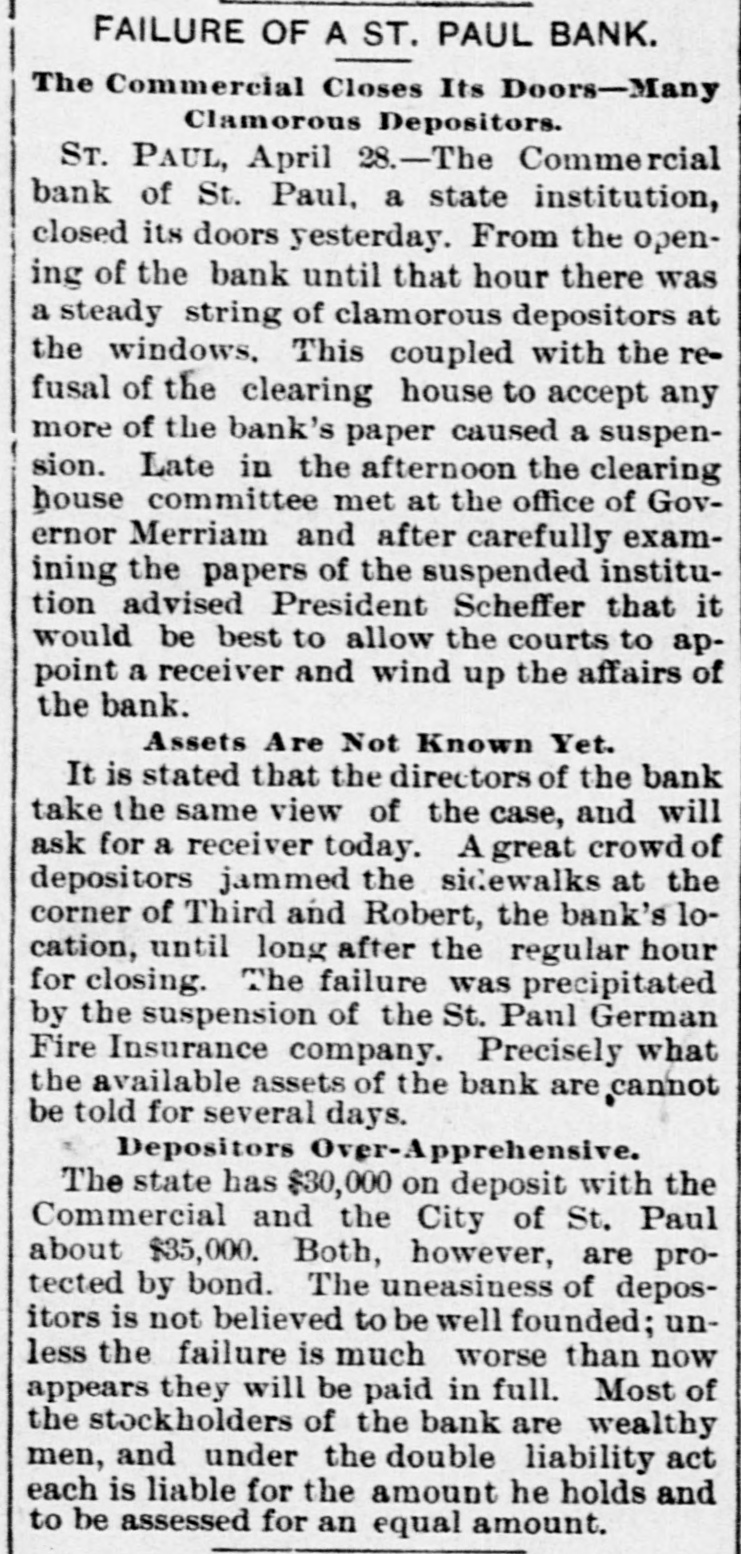
FAILURE OF A ST. PAUL BANK. The Commercial Closes Its ors-Many Clamorous Depositors. ST. PAUL, April 28.-The Commercial bank of St. Paul, a state institution, closed its doors yesterday. From the opening of the bank until that hour there was a steady string of clamorous depositors at the windows. This coupled with the refusal of the clearing house to accept any more of the bank's paper caused a suspension. Late in the afternoon the clearing house committee met at the office of Governor Merriam and after carefully examining the papers of the suspended institution advised President Scheffer that it would be best to allow the courts to appoint a receiver and wind up the affairs of the bank. Assets Are Not Known Yet. It is stated that the directors of the bank take the same view of the case, and will ask for a receiver today. A great crowd of depositors jammed the sidewalks at the corner of Third and Robert, the bank's location, until long after the regular hour for closing. The failure was precipitated by the suspension of the St. Paul German Fire Insurance company. Precisely what the available assets of the bank are cannot be told for several days. Depositors Over-Apprehensive. The state has $30,000 on deposit with the Commercial and the City of St. Paul about $35,000. Both, however, are protected by bond. The uneasiness of depositors is not believed to be well founded; unless the failure is much worse than now appears they will be paid in full. Most of the stockholders of the bank are wealthy men, and under the double liability act each is liable for the amount he holds and to be assessed for an equal amount.

Click image to open full size in new tab
office of president in the insurance company, as well as the bank, alarmed some of the local banks throughout the Northwest having accounts with the Commercial, and they commenced withdrawing their funds. This in itself was not a matter of sufficient moment to Cause Any Trouble, but it speedily became known in the city and was whispered around among the many depositors, and the run was started. The Commercial bank on March 1 last had nearly $1,000,000 of deposits, belonging to over 1,400 different people. It has been a popular bank and an especial favorite with the smaller merchants, as will be seen from the number of the depositors, which is nearly twice as great as most banks with double the amount of deposits. On account of the great number of depositors the run was perhaps made a great deal worse than it would have been otherwise. The report furnished the papers last evening by the cashier, Herman Scheffer, shows that since the run commenced over $300,000 have been drawn out, the amount due depositors at the present time being $699,419.44, against which the bank shows assets in notes, real estate, bonds, etc., of $1,559,815.35. This apparent surplus is reduced, however, by rediscounts amounting to $276,912.60. The full statement of Herman Scheffer, the cashier of the suspended bank, follows: "It IS well known that banking business is largely founded on confidence. The fact that the German Insurance company, which lately closed its doors, has been generally supposed to be closely allied to the Commercial bank, Albert Scheffer being president of both Institutions, has, without reason, caused the opinion to become prevalent among the depositors that the future of the one Involved the Other. "This has caused a feeling of uncertainty among depositors, which has resulted in their withdrawing from the deposits over $300,000 in cash within the last few days. Today the run became so strong that the officers considered that justice to all depositors required them to suspend payment temporarily. The assets are ample for the protection of all depositors, and an effort is bring made to effect an arrangement by which the bank will be enabled to pay off its depositors speedily. Mr. Scheifer furnished the following statement of assets and liabilities: Liabilities $699,419 4 Due depositors Rediscounts 276,912 60 Total $976,352 Assets $1,559,815 Notes, real estate, etc At the commencement of business yesterday morning the bank officials had no idea that they would be obliged to close up. Aid from other banks had been promised and a considerable amount advanced. The clearing house association met yesterday morning, and after looking over the situation suspended the bank before the clearing hour. This was with the assent of Cashier Herman Scheffer, and was made necessary by the fact that the bank did not have the funds with which to meet the heavy drafts. When this news reached the bank the payment of all demands was continued for a time, several of the other banks having volunteered the funds. Some of this money was furnished, but several of the volunteers desired time to consult with their fellow officers, and this delay was fatal to the success of the plan. At 2 o'clock the members of the clearing house committee, which is made up of President W. B. Merriam, of the Merchants' National: E. H. Bailey, cashier of the First National, and WillJam Dawson Jr., cashier of the Bank of Minnesota, met in Gov. Merriam's private office and made an examination of the assets of the suspended bank. A good part of the afternoon was spent at this task, and when it was completed it was agreed that the board of directors of the Commercial bank should be advised that, under the circumstances, the clearing house committee is under the Impression that it will be best to allow the courts to Appoint a Receiver to wind up the business of the bank. The committee estimated that it would require $500,000 to help the bank through as the opening would precipitate another rush. The clearing house was willing to furnish $200,000, but not $500,000. While this decision of the clearing house does not settle the fate of the bank, it means that if it IS reopened the aid will have to be furnished from outside the members of the association. According to the vice president of the Commercial bank, E. A. Hendrickson, this adverse report of the clearing house is largely due to the idea given by the
Click image to open full size in new tab
NEWS NUGGETS. Brought by the Wires from North. East. West and South. The 26th annual meeting of the National Grange of the Patrons of Husbandry will be held at Concord. N. H.. beginning Wednesday. November 16. The British ship Theophane from New Castle. N. S., which sailed December 1st for Mollendo. has been given up as lost. She had a crew of 25 persons all told. The reports that disturbances occurred at Rome on Sunday and that the authorities had begun barricading the house of the government officers are entirely without foundation. A dispatch from Pueto Cabello. Venezuela. savs Generals Ybarra and Casanas, two leading government officers. have been cut off from Palacio's main forces and are in imminent peril. Col. Richard B. Erwin. one of the Tribuneeditorial staff. died Wednesday morning. He was a great-grandson of Benjamin Franklin. his mother being Franklin's granddaughter. Col. Erwin was born in Pittsburg in 1839. The Commercial bank of St. Paul, Minn., closed doors Wednesday and suspended payment. The officers say the depositors will be paid in full. The suspension was mainly caused by a scare created by the failure of the St. Paul Germain Fire Insurance Company. The Brazilian government has ordered the Brazilian consuls in foreign countries to refuse to dispatch vessels to Matteo Grosso. Further troops are en route to suppress the revolt in that state, Five thousand infantry and artillery in all have been sent to the scene of the rebellion. At Lowell. Mass., Wednesday. the jury gave $3000 to Dora J. Irwin. who sued Alley Brothers & Place. tanners of Arer. Mass., as damages for the death of her husband in the tannery in November. 1890. The jury said the man exercised due care. but was not sufficiently protected. Judge Lothrop of the Massachusetts Supreme court, Wednerday, granted a preliminary injuction restraining the directors of the New York & New England Raiiroad from paying a dividend on preferred stock on May 7th. The petition for the injuction was not opposed by the counsel for the railroad. The British steamer Philadelphian. for Liverpool while proceeding to sea from Boston. Wednesday. collided with and sunk a fishing schoner in the channel just above the upper middle. The schooner's masts are about half out of water with all sails set. A fisherman picked up three or four of the schooner's crew and the tug Vim the remainder. The steamer apparrently was uninjured and will probably proceed. Two belated items of interest from the Paris horse show have just come across the water. One is to the effect that the prettiest woman there was a Baltimorian, name not given. and the other relates that a famous French society beauty was greeted with a storm of hisses when made her appearance, because her really beautiful complexion was plastered thickly over with white paint and cosmetics. The body of Henry A. Reynolds of Milford. Mass., was found at Vernon Grove cemetery Wednesday morning. On the door of a receiving tomb was a business card on which was written: "Find me in the little summer house." His body was suspended from a rope and there was a bullet wound through the mouth. Reynolds was a builder at 1166 Harrison avenue. Boston. Despondency is supposed to have caused the act. Henry Irving is very ill. He has partially lost his voice, and since Thursday last has not appeared on the stage of the Lyceum Theatre He has gane to Hastings for
Click image to open full size in new tab
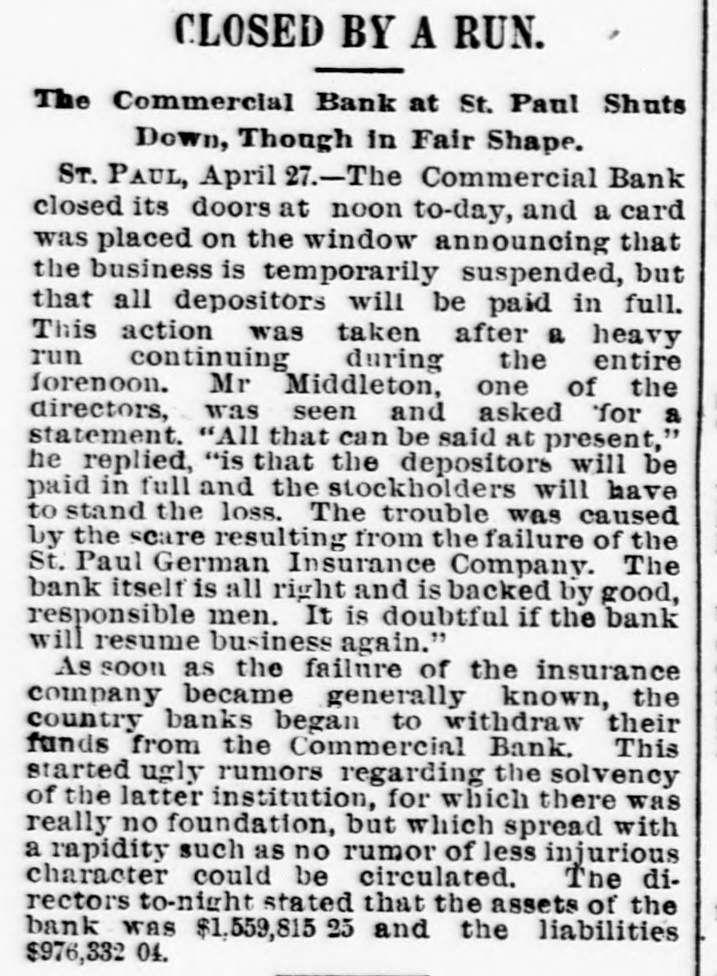
CLOSED BY A RUN. The Commercial Bank at St. Paul Shuts Down, Though in Fair Shape. ST. PAUL, April 27.-The Commercial Bank closed its doors at noon to-day, and a card was placed on the window announcing that the business is temporarily suspended, but that all depositors will be paid in full. This action was taken after a heavy run continuing during the entire forenoon. Mr Middleton, one of the directors, was seen and asked 'for a statement. "All that can be said at present," he replied, "is that the depositors will be paid in full and the stockholders will have to stand the loss. The trouble was caused by the scare resulting from the failure of the St. Paul German Insurance Company. The bank itself is all right and is backed by good, responsible men. It is doubtful if the bank will resume business again." As soon as the failure of the insurance company became generally known, the country banks began to withdraw their funds from the Commercial Bank. This started ugly rumors regarding the solvency of the latter institution, for which there was really no foundation, but which spread with a rapidity such as no rumor of less injurious character could be circulated. The directors to-night stated that the assets of the bank was $1,559,815 25 and the liabilities $976,332 04.
Click image to open full size in new tab
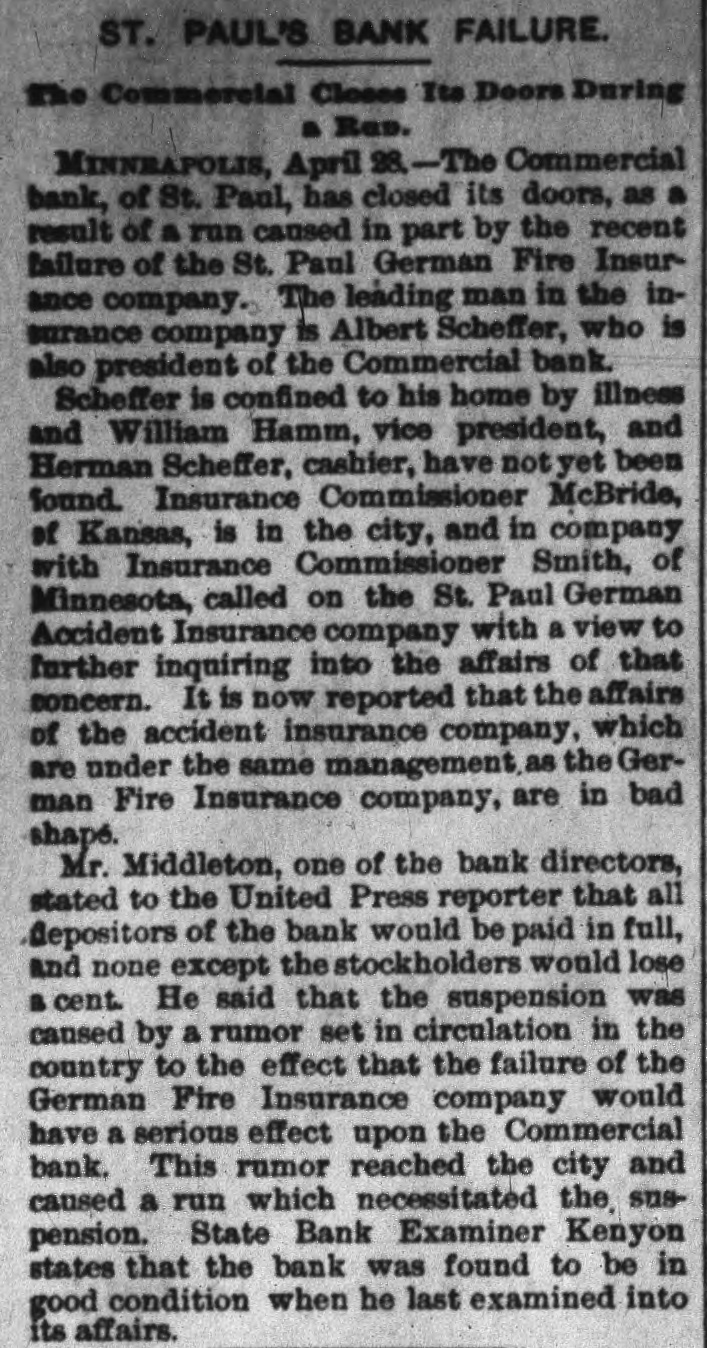
ST. PAUL'S BANK FAILURE. the Commercial Closes Its Doors During a ReD. MINNEAPOLIS, April 28-The Commercial bank, of St. Paul, has closed its doors, as a result of a run caused in part by the recent failure of the St. Paul German Fire Insurance company. The leading man in the insurance company is Albert Scheffer, who is also president of the Commercial bank. Scheffer is confined to his home by illness and William Hamm, vice president, and Herman Scheffer, cashier, have not yet been found. Insurance Commissioner McBride, of Kansas, is in the city, and in company with Insurance Commissioner Smith, of Minnesota, called on the St. Paul German Accident Insurance company with a view to further inquiring into the affairs of that soncern. It is now reported that the affairs of the accident insurance company, which are under the same management, as the German Fire Insurance company, are in bad shape. Mr. Middleton, one of the bank directors, stated to the United Press reporter that all depositors of the bank would be paid in full, and none except the stockholders would lose a cent. He said that the suspension was caused by a rumor set in circulation in the country to the effect that the failure of the German Fire Insurance company would have a serious effect upon the Commercial bank. This rumor reached the city and caused a run which necessitated the suspension. State Bank Examiner Kenyon states that the bank was found to be in good condition when he last examined into its affairs.

Click image to open full size in new tab
CONDENSED DISPATCHES. The reported robbery of the sub-treasury in New York city of $125,000 on Friday night is not true. The Anglo-Scotia mills and lace factories near Nottingham, England, have been burned. Loss, $500,000. For the week ending April 29 there were seventeen failures in the Pacific coast states and territories. The Bremerhaven board of inquiry into the loss of the steamer Eider attach the blame to the navigating officer. General Floros, who retires from the presidency of Ecuador in June next, will be sent as minister to the United States. Sherman Williamson, a hostler, shot and killed his wife's paramour, Edward Andrews, also a hostler, at Fisher's stable in St. Louis. By a score of 46 to 43 Elliott defeated Fulford at Kansas City on Saturday for the American Field eup. The wind was blowing a gale. The cruiser Charleston has returned to San Francisco from San Diego. The cruisers Boston and Baltimore left the latter porton Saturday. Justice V. Montgomery, of Michigan, appointed to the supreme bench of the District of Columbia by President Cleveland. has resigned. In the Deeming trial the defense is endeavoring to prove their client's insanity by the character of the wounds upon the bodies of his victims. Emory J. Mills, a Chicago architect, who planned the Pearce street building which recently collapsed, has been indicted for manslaughter. Boodler Jaeger, the defaulting cashier of the Frankfort branch of the Rothschilds bank, is living in Brussels with his mistress, who lured him to his ruin. Special Agent Murphy, who was sent by the United States to Germany to introduce the use of cornmeal, is establishing a cornmeal plant at Madgeburg. Little and George, alleged rustlers, have been held in $2,000 bail by Commissioner O'Connor at Rapid City, S. D., for stealing cattle from the Rosebud agency. Governor Flower, of New York, has signed the bill concerning appointment of election inspectors in New York city, the excise and the reapportionment bills. The missing schooner Glenora, reported lost in Thursday's storm on Lake Superior, turned up safe, having gone aground on the Ontario shore. The crew are safe. A warrant has been issued by the governor of Oregon on a requisition from California for the arrest of John Sinenton, of Heppner, wanted at Marysville, Cal., for a murderous assault. A mooted question is the running of German steamers in passenger and freight service between New York and Paramaribo, Dutch Guiana, in competition with Dutch and English lines. The Commercial bank, of St. Paul, has assigned to F. A. Seymour, cashier of the Merchants' National bank, who is putting the assets in shape for realization. Depositors will lose nothing. By the explosion of a mill boiler near Rocky Comfort, Ark., on Saturday W. Pallen, the owner of the mill, the engineer and fireman were killed, and three men and a woman were fatally wounded. The United States has invited various South American republics, including Argentine, to establish & commercial league. The discussion of the proposal is about to take place in the Argentine congress. The sole survivor of the German bark Thalia, Captain Mayer, which sailed for Adelaide from Hamburg on February 23, has been landed at Biythe, England, by the rescuing vessel. The Thalia foundered at sea. George H. Painter, murderer of his mistress, Alice Martin, in Chicago, who on Saturday was sentenced to be hung on June 24, in an interview with the judge, said the police had manufactured evidence against him. At the inquiry of the House and Senate committees on immigration and naturalization, in New York city, evidence was taken showing that the recent importation of typhus cases could not be blamed on anybody. The dreibund treaty stipulates nothing concerning the number of the Italian army, therefore the reports of the object of King Humbert's coming visit to Berlin to secure a relaxation of the treaty in that direction is unfounded. The great safe-manufacturing houses of the country, Herring and Hall & Marvin have combined. The new company has been incorporated as the Herring, Hall & Marvin Company, and will begin business on June 1. The capital is $8,300,000. Weldon Sanders, son of President Newell Sanders, of the Chattanooga, Tenn., Plow Company, Miss Blanche Barr, daughter of & prominent attorney, and Miss Bettie Cheny, all high school scholars of Chattanooga, were drowned in Chickamauga creek on Saturday while boating. The cattlemen's congress at Ogden, Utah, visited Salt Lake on Saturday, inspected the Mormon temple, and in the afternoon adopted appropriate resolutions, decided to meet at Ogden on the 1st of May, 1893, and chose Orlando North, of Nevada, president, and R. L Armstrong, of Ogden, secretary.
Click image to open full size in new tab
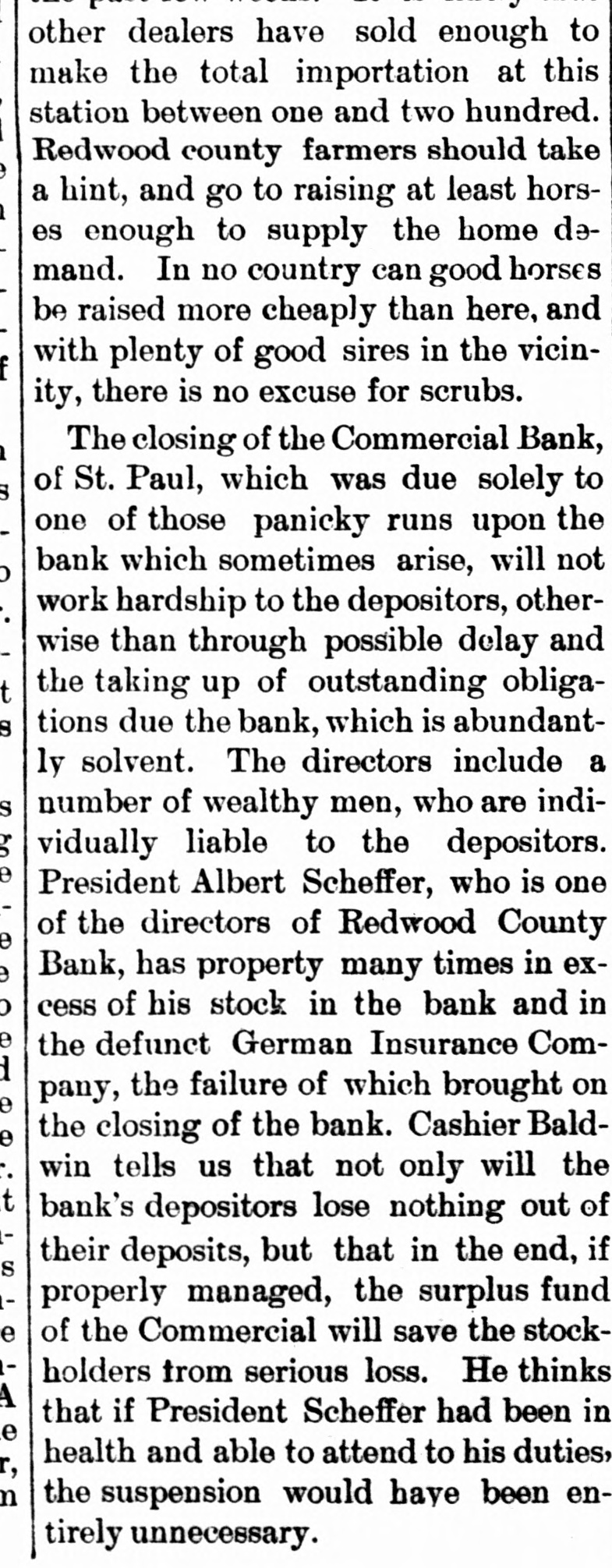
other dealers have sold enough to make the total importation at this station between one and two hundred. Redwood county farmers should take a hint, and go to raising at least horses enough to supply the home demand. In no country can good horses be raised more cheaply than here, and with plenty of good sires in the vicinity, there is no excuse for scrubs. The closing of the Commercial Bank, of St. Paul, which was due solely to one of those panicky runs upon the bank which sometimes arise, will not work hardship to the depositors, otherwise than through possible delay and the taking up of outstanding obligations due the bank, which is abundantly solvent. The directors include a number of wealthy men, who are individually liable to the depositors. President Albert Scheffer, who is one of the directors of Redwood County Bank, has property many times in excess of his stock in the bank and in the defunct German Insurance Company, the failure of which brought on the closing of the bank. Cashier Baldwin tells us that not only will the bank's depositors lose nothing out of their deposits, but that in the end, if S properly managed, the surplus fund of the Commercial will save the stockholders from serious loss. He thinks that if President Scheffer had been in health and able to attend to his duties, the suspension would haye been entirely unnecessary.
Click image to open full size in new tab
From Friday's Daily. The Illinois democrats favor Palmer for president. Work has been commenced on the Grant monument in New York. Ssventy-five indictments have been found ragainst Union Pacific officials for violations of the inter-state commerce law. A bill is pending before congress to have the free delivery system extended to all cities having over 5,000 population. Philadelphia had a million dollar fire on Wednesday. The fire started in a variety theater and before it was subdued had burned almost an entire square. Over fifty people were injured. Sprando returned from Galena yesterday. To a UNION reporter he said that the mines were all flooded with water from the recent heavy snows and that the snow was a foot deep in many places yet. The Colorado state convention decided to support no man for president unless he favors the free coinage of silver. This action of the convention will result in the loss of the state to the republicans. A terrible blizzard has been raging at Winnipeg, Manitoba for several days past. Wm. C. Wight of Hot Springs, made an original homestead filing at the land office today. Circuit court adjourned today until May 23. Meantime Judge Gardner will hold court in Custer county. One of the World's fair buildings was blown down Wednesday, causing a loss of $75,000 and injuring two men. Miss Irma Heilbron, a jewish belle of Milwaukee, Wisconsin, has sued a wealthy young stock broker for $25,000 for breach of promise of marriage. The Commercial bank at St. Paul has suspended payment. The failure of the St. Paul German Insurance company caused a run on the hank which compelled it to close its doors. Scandinavian Lutheran services on Sunday next, morning and evening, at usual time in the old Presbyterian church. All are invited. G. I. Breivik, pastor. E. S. Bowdish a traveling man from Minneapolis will preach in the M. E. church on Sunday evening next. The gentleman belongs to the famous Bowl dish family that sent five sons into the ministry. The Maine republican state conven tion held on Wednesday, warmly en dorsed Blaine and Reed for the services they had rendered the party, expressed their approval of the administration and favored Harrison's renomination. Albert R. Bower, who obtained $200 under false pretense from the Lakota bank in Rapid, was the other day sen
Click image to open full size in new tab
Henry M. Stanley's proposal to run for parliament is not well received in Eng. land. George William Curtis was re-elected president of the National Civil Service Reform league. Fall River (Mass.) mill men view the passage of the fifty-eight-hour billl with varied emotions. The Commercial bank of St. Paul has made an assignment of assets for the benefit of depositors. The citizens of Corpus Christi, Tex., have sent relief to the starving Mexicans at Rio Grande City. Rumors of impending trouble between granite manufacturers and workmen are rife at Concord, N. H. Sir Edward Arnold is charged with plagiarism, misstatements, and attempts to curry favor in Japan. The governor of Wyoming refuses to deliver the captured cattlemen to the Johnson county officials. Rev. W. B. King, rector of St. I uke's cathedral, Halifax, has been called to the rectorship of Christ church, Cambridge, Mass., and will probably accept. Mrs. President Harrison, who was honorary president of the National League of Mineral Painters. has withdrawn entirely from membership in that organization.
Click image to open full size in new tab
THE REORGANIZATION PROJECT. These reflections concern the past in as tar as they relate to what it is now too late to repair, but they concern the future also. A plan is under consideration by which the Commercial bank shall be reorganized and enabled to open its doors again. It may appear before the time of consummation arrives that this is not feasible, and that it is not worth while to attempt the institution's salvation because the institution has nothing to save. But the GLOBE once more urges our business men's organizations to take the subject under advisement and to co-operate in the project of restoration, provided it is found to be at all practicable. It will be better for the present stockholders to pay in their assessments according to their statutory liability, in the shape of contributions to the capital of a living concern where they may earn dividends, than to hand them to a receiver for distribution among the creditors. It will be better for depositors to grant extensions to a living concern rather than to wait for their money until the bankrupt court has worked out the present confusion to a solution. It will be better for our local unions to subscribe a hundred thousand dollars to this insolvent bank than to a new manufacturing company which may be asking their help. Additions to our W ealth are welcome, but they are not as important as the preservation of our present possessions. We want strangers to settle here and to increase the number and variety of our industries. But there is a more urgent call on us to guard the credit which we already have, and to uphold our citizens who are endangered by this unexpected misfortune, for which they are in no way responsible. The reorganization project deserves to succeed if success for it is possible.

Click image to open full size in new tab
NOTES. Our best bow is due to Judge Conroy, the newly-elected justice of the peace for the east Tom, beg pardon, Judge Conroy, is entitled and fully merits the honors bestowed upon him. James Burns, Tim Kelliher and Chas. McDermott, of this city, in company with John McCarthy and John O'Shaughnessy, of Stillwater, left for New Orleans last Friday to attend the national convention of the A. O. H. St. Lnke's Literary society held their second post lenten social at the residence of Hon. Judge McDonald last Thursday evening. Despite the inclemency of the weather the gathering was of large proportions and the entertainment par +xcellent. Among those who took part in the same were the Misses Egan, Miss Franklyn, Miss Campbell and Messrs. Donnelly, Cole and McCarthy. Bishop McGolrick, of Duluth, was in the city last Sunday, the occasion being the blessing of St. Vincent's church, of which Rev. Father Cosgrove is the esteemed and beloved pastor. Bishop McGolrick preached an eloquent and instructive sermon relative to the occasion at High Mass, and in the afternoon confered confirmation on about one hundred children. At 7:80 in the evening vespers were sung, after which a sermon on Total Abstinence Was delivered by the Rt. Rev. Bishop. This prodigions success, "Spider and Fly," will be presented at the Grand Opera House week commencing May 15, with manifold novelties and a company numbering forty-six who were mostry recruited abroad. The play has been entirely rewritten and reconstructed. The costumes which are said to be very handsome were made especially for this production by Chas. Alias, Costumer for the Drury Lane Theatre, London. The "Spider and Fly" in its new dress has proved one of the strongest novelties and most successful production of the present season. The failure of the Commercial Bank of this city, in some measure, created a panic here last Monday. It was given out that a run would be made on the Seven-corners Bank, of which Billy Banholzer is the esteemed president. The run started, but the complacent air with which Billy sat in the front office of the bank smoking a cigar and paying all who demanded their money, the amount due them had a tendency to quiet the nerves of the depositors. All who want their money can have it, said Mr. Banholzer. we are prepared to meet any kind of a run. But it did not come and Tuesday found everything all serene at the Seven Corners Bank. Not the least of the regrets to be offered by Democrats and Republicans alike is the loss of the present head of the city detective force, John J. O'Connor. To attempt to eulogize him for a past record that is without a stain during his nine years as chief of that department would be superfluous. John O'Connor leaves that office with a consciouspess of having well and truly performed his duties. He has instilled into the minds of the thieving fraternity the one lesson, that St. Paul is a good place for them to keep away from. Socially Mr. O'Connor is one man in a thousand. To see him is to know him, to know him is to respect him and not soon forget him; but to be missed he always will be. The election is over and the question which is now agitating the mind of spoil hunters is the filling of the office of the Chief of Police. Had the late Capt. John Bresette lived to see the result of this late election the question of the selection of chief of police would soon be settled. Bat aspirants for the office are besinging Mayor-elect Wright and a Kilkenny cat fight is now going on among the Republican office seekers. Prominent among them is the present Sheriff, Ed. S. Bean, and the mantle could not fall on better or worthier shoulders. He is eminently qualified to fill the porition and would hold it with the same becoming grace and dignity with which he fills the present office. But his chief opponent is one of his deputies, John Harris. and Harris has a "pull" of no small quantity. The friends of Harris are not few nor isolated, but Bean has a monopoly in that direction and if he really desires the plum will undoubtedly be wearing the star of Chief of Police soon after making his

Click image to open full size in new tab
COURT CHIPS. M Frankel & Co. have sued Jacob Schuenborn to recover $98.55 for merchandise Judge Kerr has ordered judgment $518.30 in favor of C. Gotzian & Co. against Joseph Steinkamp. John H. Meyer & Son have sued Joseph Schmitz to recover a balance of $682.70 on merchandise sold. Today is the last chance for filing notes issue in cases intended to go on the June calendar of the district court. George E. Bullock has entered suit against the Babcock Transfer and Storage company to recover $225.93 due for wages. The case of James G. Ryan was yesterday continued to the June term. He is indicted fordssaulting Policeman McGuiggan. Joseph A. Schmitz. a cigarmake. who cently made an assignment, has filed dules showing assets to be $2,912.59: liabili ties, $2,888.69. Judge Otis and a jury are trying to adjus the dispute between John rfeifer and Fritz growing out of a promissory note giver to the former by the fatter. The action of The St. Paul Title Insurance & Trust Company, as receiver against th Commercial Bank of St. Paul, is in course trial in Judge Kelly's court. Robert T. Black, who was indicted with Howard and McCann for stealing harness turned state's evidence. Yesterdav he pleade guilty of larceny and was sentenced Judge Kerr to six months in the workhouse William Dimmerman has begun an action against the of St. Paul to recover $2,00 damage to his frame house on, McMenemy street, by reason of the earth being remove in grading the street SO that the lateral port was taken away. A verdict was brought in shortly before o'clock last evening in favor of Herman Meyer against William Berlandi for $2,030.60 The case has been on trial before Judge Keily and a jury, and was brought to recove for extras in erecting a building. County Assessor Smith and his deputie are busy receiving and entering returns property that are coming in from person who are making returns of property liable for taxes. The number coming in amounts to a rush. John F. O'Brien was awarded a verdict $50 against the St. Paul City Railway compa ny. This was another case of refusing to cept a transfer slip. O'Brien paid fare after the slip was refused. The gave him his nickel back and damages being humiliated in the sum of $49.95. John A. Stees has begun an action agains August Van Glahn, George L. Becker, Eller R. Hollinshead, as administratrix of the tate of William Hollinshead, Eilen R. !inshead in her own right and other heirs William Hollinshead to quiet title to a piece of land located in what is known as Partition Plat of the city. Henry T. Sattler has begun an action against Sheriff Bean to recover possession of two kilns of brick containing 10,000 valued at $2.850. The property has
Click image to open full size in new tab
IN A MONTH The Commercial Bank Will ReOpen Its Doors. The indications are that the Commercial bank will be able to again throw open its doors to the public in a month. Such is the belief expressed by Herman Scheffer to a GLOBE reporter yesterday. The plan that was evolved at the meeting of the depositors of the bank two weeks ago is working to perfection, and it proves that the officers and directors enjoy still a full meed of confidence among the business men of St. Paul. This plan was, it will be recalled, for the depositors to do their pittance, so to speak, towards re-establishing the house as one of St. Paul's solid institutions. The system decided upon, and under which this end will be worked out. will be for the depositors to leave their money-the money that was in the concern when the unfortunate run bauk to close its forced the doors-still on deposit. If not all of it, then all that individual depositors can spare from immediate business demands. Not only this, but the depositors agreed with a spirit of unanimity to also subscribe to the stock of the newly organized institution. The depositors are keeping their trust. Mr. Scheffer reports that 225 depositors have already called at the bank and subscribed to an agreement whereby they will continue their banking relations with the Commercial. Some wish to draw out a part of their money to meet immediate needs, but the great majority will leave the bulk of their deposits, if not the whole. In addition to this encouraging movement, the depositors have subscribed to $20,000 of the stock, and new capitalists promise to come to the aid of the others, for they appreciate the fact that it will be a perfectly safe investment. When the raid was made on the bank it had 1,600 customers on its books, and 375 of them drew out $300,000 during the run.
Click image to open full size in new tab
IF CREDITORS AGREE, Judge Kelly Will Dismiss the Commercial Bank Insolvency, Discharge the Assignee and Permit the Doors to Be Reopened. Weihe Accepts, and Erwin May Defend Homestead Strikers. Sixth Annual Convention of Brotherhood of Machine Moulders. An application was made to Judge William Louis Kelly in chambers yesterday which has for its object the rehabilitating of the Commercial bank with the necessary rights to again open its doors for the purpose of carrying on a general banking business. The application is in the nature of a petition, signed by Albert Scheffer as president of the bank. The legal papers were drawn up by the law firm of C. D. and Thomas D. O'Brien. The petition makes a gratifying showing of the financial condition of the institution which closed its doors a few months ago. After reading the petition and hearing the statements made by interested parties, Judge Kelly issued an order as a preliminary step to reinstating the bank. This order, among other things, recites the following facts: Whereas, It appears, upon examination of the affairs of the bank and on consideration of them by the directors, the stockholders and a large majority of the creditors in both number and amount, it was discovered that it was for the benefit of all parties that the insolvency proceedings should be dismissed and the assets returned to the Commercial bank, and that it should resume the business of banking; it also appearing that the liabilities at the time of the assignment were about $945,514, consisting of sums due depositors on open account of cerificates on deposits, moneys due other banks, cashier's checks and rediscounts. The value of the assets of the bank then amounted to about $1,235,815. An agreement was reached. which has been carried out. by which there has been $250,000 subscribed to the stock It has been agreed by about 700 of the creditors owning $380,000 in claims to allow the bank to carry this indebtedness. Under the arrangements mentioned above' the indebtedness has been reduced from $949,514 to $460,574, the assignee now having about $170,000 in money, making $420,000 in the hands of the bank. In addition to the above funds, the assets are about $830,000, making a total capital of $1,220,000, leaving the total indebtedness about $630,000 and the assets over the liabilities amount to $590,000. It also appearing that the bank can manage the affairs to a better advantage than the assignee, and thus avoid loss to the bank, the stockhoiders and creditors: it is therefore ordered that FrankiA. Seymour, the assignee, and all the creditors of the Commercial bank who have filed the claims and all other parties in interest, appear before Judge illiam Louis Kelly, judge of the district court,at his chambers in the court house, Aug. 23, at 10 a. m., and show cause why the petition of the bank to be allowed to resume should not be granted and the insolvency proceedings dismissed. and the accounts of the receiver settled and allowed, and his compensation and expenses
Click image to open full size in new tab
ELECTRICAL ECHOES. Matters of More or Less Moment Briefly Mentioned. Judge Kelly has decided that the Commercial bank, of St. Paul, may resume business. The custom collections at St. Paul for August amounted to $20,000 and the revenue to $224,000. The President has appointed as postmasters Gus A. Schultz at Two Harbors, Minn., and Mrs. Nettie J. Van Inwegen at Ortonville, Minn. Twenty-one of the Jersey City, N. J. ballot box stuffers have been sentenced. Their sentences ranged from six to fifteen months. The prisoners were at once sent to jail. Up to and including the 31st of August the treasury department has shipped to various points in the United States $7,000,000 in small notes to facilitate the moving of the crops. The survivors of the battle of Birch Coolie, fought against the Indians i 1862, held a reunion at the Merchants hotel, St. Paul, to celebrate its thirtieth anniversary of that event. The London and General bank (limited) has suspended payment. The bank was founded in 1882 with a capitial of 1,000,000 pounds. To Sept. 10, 1891, 417,770 pounds had been subscribed to the capital. The Kent and Surrey Building society of Woolwich, England, has collapsed. It has been discovered that the secretary, George B. Bryceson, has been falsifying the books for years and has embezzed at least 50,000 pounds. There may shortly be another cabinet crisis in Germany in which Baron von Schelling, minister of justice, will chiefly be concerned. This minister has identified himself so closely with the Progressist party that his position is not considered tenable. The Spanish government now seems disposed to satisfy the demands recently made by the United States for the revision of the new Cuba tariff on the ground that it does not contain those concessions for American imports which were agreed on in the convention of 1891.
Click image to open full size in new tab
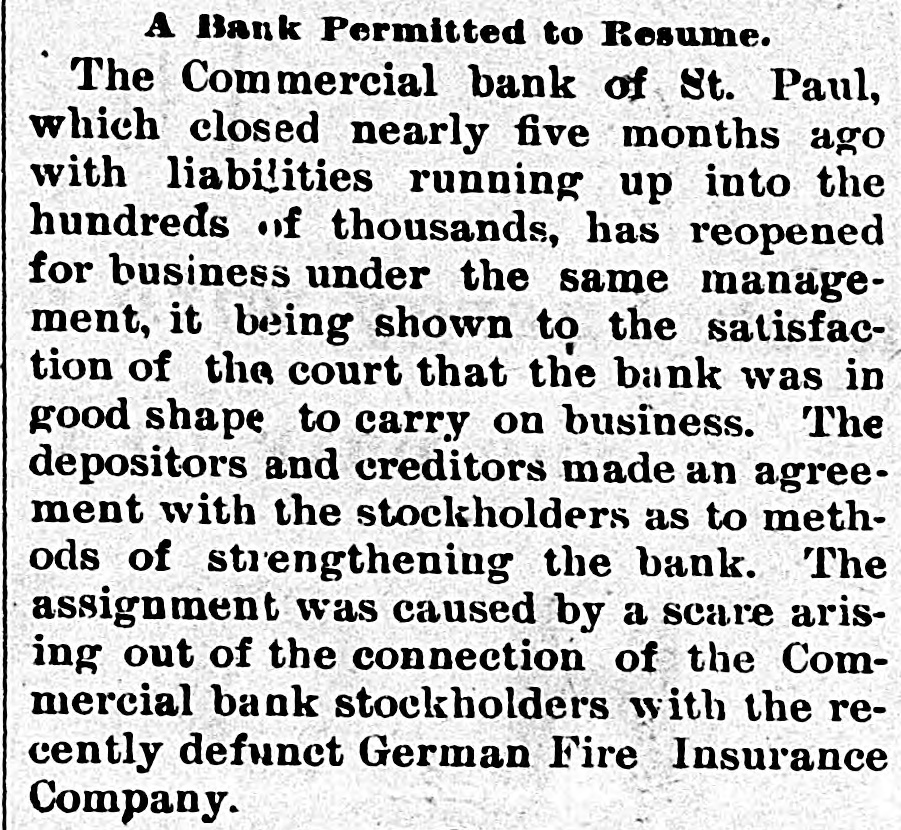
A Bank Permitted to Resume. The Commercial bank of St. Paul, which closed nearly five months ago with liabilities running up into the hundreds of thousands, has reopened for business under the same management, it being shown to the satisfaction of the court that the bank was in good shape to carry on business. The depositors and creditors made an agreement with the stockholders as to methods of strengthening the bank. The assignment was caused by a scare arising out of the connection of the Commercial bank stockholders with the recently defunct German Fire Insurance Company.
Click image to open full size in new tab
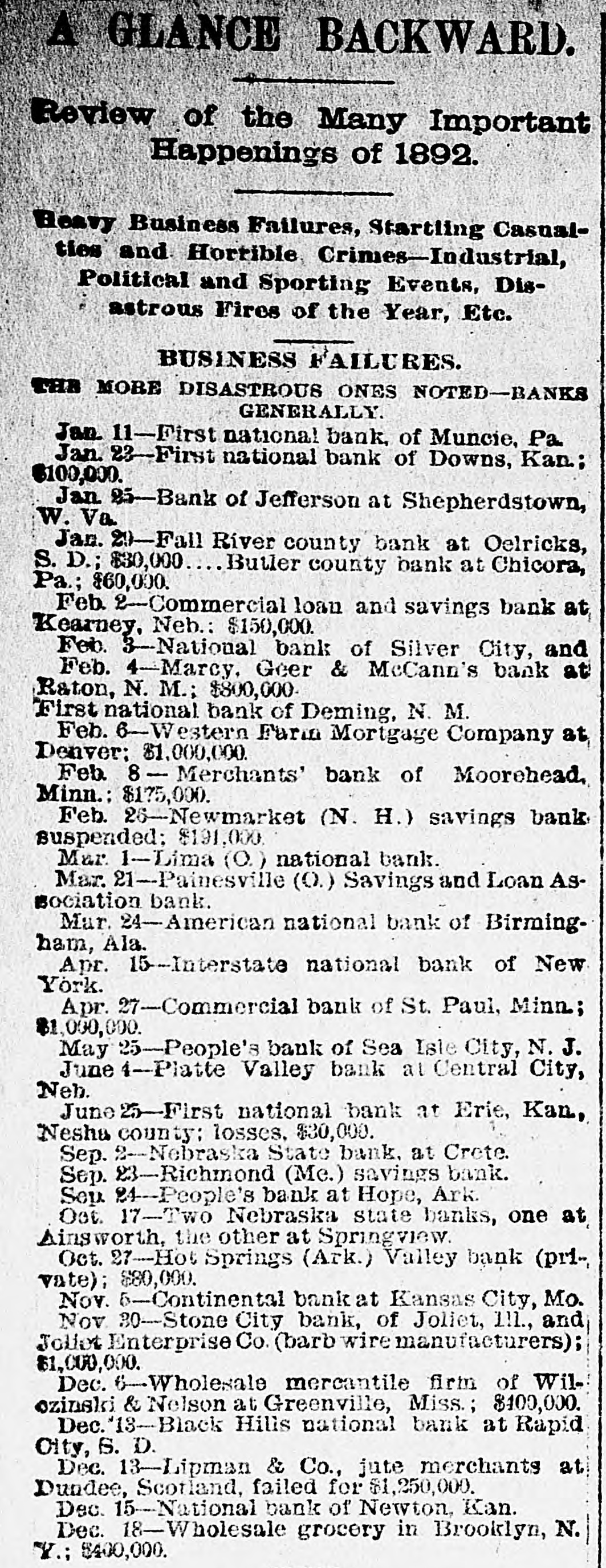
GLANCE BACKWARD. Review of the Many Important Happenings of 1892. Heavy Business Failures, Startling Casualties and Horrible Crines-Industrial, Political and Sporting Events, Disastrous Fires of the Year, Etc. BUSINESS FAILURES. MORE DISASTROUS ONES NOTED-BANKS GENERALLY. Jan. 11-First national bank. of Muncie, Pa. Jan. 23-First national bank of Downs, Kan; $100,000. Jan 85-Bank of Jefferson at Shepherdstown, W. Va Jan. 29-Fall River county bank at Oelricks, S. D.; $30,000 Butler county bank at Chicora, Pa.; $60,000. Feb. 2-Commercial loan and savings bank at Kearney, Neb.: $150,000. Feb. 3-National bank of Silver City, and Feb. 4-Marcy, Geer & McCann's bank at Raton, N. M.; $800,000 First national bank of Deming, N. M. Feb. 6-Western Farm Mortgage Company at Denver; $1,000,000. Feb. 8 - Merchants' bank of Moorehead, Minn.: $175,000. Feb. 26-Newmarket (N. H.) savings bank suspended; $191.000. Mar 1-Lima (O.) national bank. Mar. 21-Painesville (O.) Savings and Loan Association bank. Mar. 24-American national bank of Birmingham, Ala. Apr. 15--Interstate national bank of New York. Apr. 27-Commercial bank of St. Paul, Minn.; $1,000,000. May 25-People's bank of Sea Isle City, N. J. June 4-Platte Valley bank at Central City, Neb. June 25-First national bank at Erie, Kan, Nesha county: losses, $30,000. Sep. 2--Nebraska State bank. at Crete. Sep. 23-Richmond (Me.) savings bank. Seu 21-People's bank at Hope, Ark Oct. 17-Two Nebraska state banks, one at Ainsworth, the other at Springview. Oct. 27-Hot Springs (Ark.) Valley bank (pri-, vate); $80,000. Nov. 5-Continental bankat Kansas City, Mo. Nov 30-Stone City bank, of Joliet, 111., and Jollet Enterprise Co. (barb wire manufacturers); $1,000,000. Dec. 6-Wholesale mercantile firm of Wilozinski & Nelson at Greenville, Miss.; $400,000. Dec. .11-Black Hills national bank at Rapid City, S. D. Dec. 13-Lipman & Co., jute merchants at Dundee, Scotland, failed for $1,250,000. Dec. 15-National bank of Newton, Kan. Dec. 18-Wholesale grocery in Brooklyn, N. Y.; $400,000.