Article Text
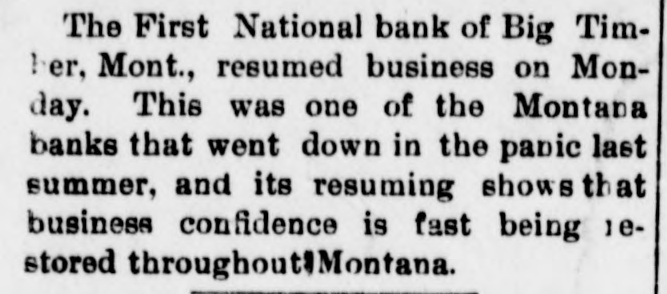
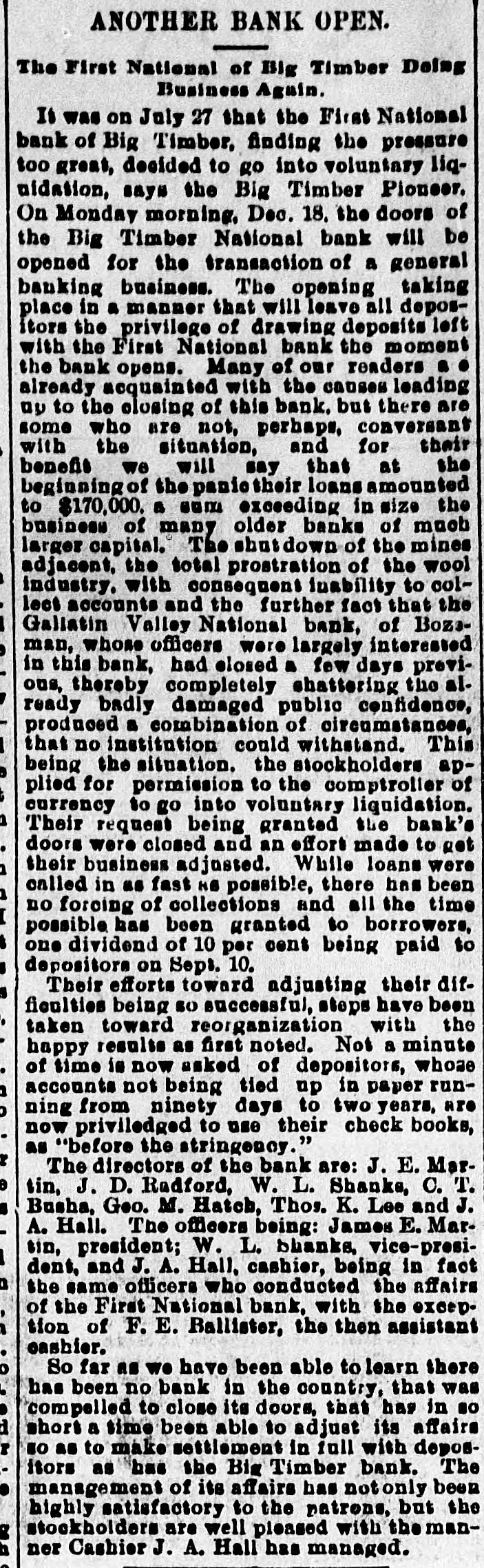
ANOTHER BANK OPEN. The First National of Big Timber Doing Business Aguin. It was on July 27 that the First National bank of Big Timber, finding the pressure too great, decided to go into voluntary liquidation, sayu the Big Timber Pioneer. On Monday morning, Dec. 18. the doors of the Big Timber National bank will be opened for the transaction of a general business. The opening taking a manner that of drawing banking place itors the in privilege will leave deposits all depos- left with the First National bank the moment the bank opens. Many of our readers a . already acquainted with the causes leading up to the closing of this bank. but there are some who are not, perhaps, conversant with the situation, and for their benefit we will say that at she of older to beginning business $170,000. of a the many sum panic exceeding their banks loans amounted in of mize much the larger capital. The shutdown of the mines adjacent, the total prostration of the wool industry. with consequent luability to collect accounts and the further fact that the Galiatin Valley National bank, of Bozsman, whose officers were largely intercased in this bank, had closed a few days previous, thereby completely shattering the al. ready badly damaged public confidence, produced a combination of circumstances, that no institution could withstand. This being the situation. the stockholders applied for permission to the comptroller of currency to go into voluntary liquidation. Their request being granted the bank's doors were closed and an effort made to get their business ad djusted. While loans were called in as fast HS possible, there has been no forcing of collections and all the time possible has been granted to borrowers, one dividend of 10 per cent being paid to depositors on Seps. 10. Their efforts toward adjusting their diffioulties being so successful, steps have been taken toward reorganization with the happy results as first noted. Not a minute of time is now asked of depositors, whoae accounts not being tied up in paper running from ninety days to two years, are now priviledged to use their check books, as "before the stringency." The directors of the bank are: J. E. Mare tin, J. D. Radford, W. L. Shanks, C. T. Busha, Goo. M. Hatch, Thos. K. Lee and J. A. Hall. The officers being: James E. Marsin, president; W. L. bhanks, vice-president, and J. A. Hall, cashier, being in fact the same officers who conducted the affairs of the First National bank, with the exception of F. E. Ballister, the then assistant eashier. So far as we have been able to learn there has been no bank in the country, that was compelled to close its doors, that has in so short a time been able to adjust its affairs NO as to make settlement in full with depositors as has the Big Timber bank. The management of its affairs has notonly been highly satisfactory to the patrons, but the stockholders are well pleased with the manner Cashier J. A. Hall has managed.