gpt-5-mini (chosen from majority vote of a three-model LLM ensemble)
Short Digest
7adc1f2d0152ae1d
Response Measures
None
Description
Caldwell & Co. (investment banking house) was placed in federal receivership; related subsidiary banks subsequently failed.
Events (2)
1.November 14, 1930Receivership
Newspaper Excerpt
The investment banking house of Caldwell & Co., for years prominently identified with the financial development of the South, was in the hands of a Federal receiver today. Lee Douglas...was appointed receiver last night by Federal District Judge John J. Gore.
Source
newspapers
2.*Other
Newspaper Excerpt
Two days later the Bank of Tennessee of Nashville, a Caldwell subsidiary, went to the wall, followed four days later by the Holston-Union bank of Knoxville, connected with the Caldwell organization.
Source
newspapers
Newspaper Articles (19)
1.November 14, 1930Evening StarWashington, DC
Click image to open full size in new tab
Article Text
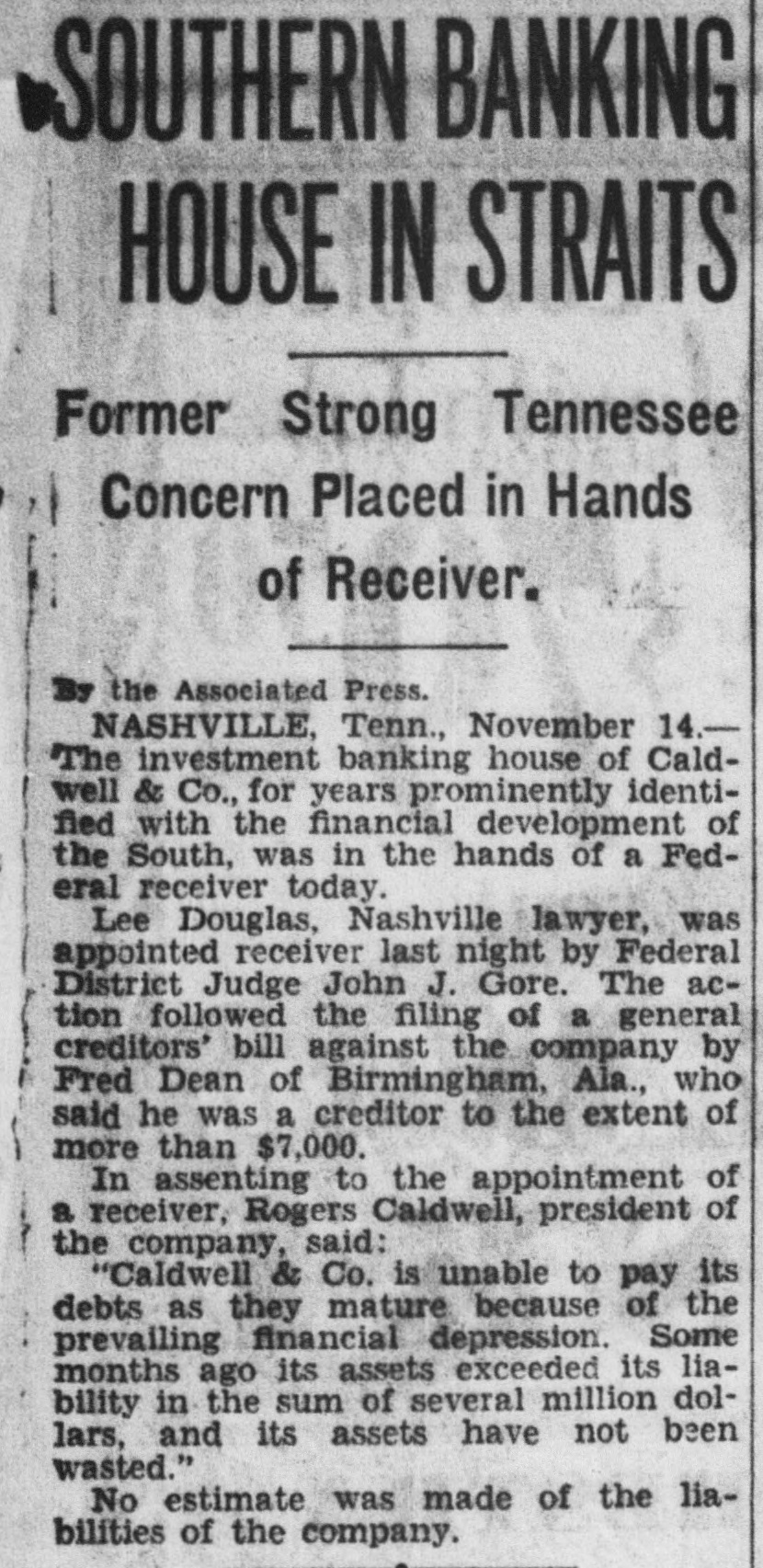
SOUTHERN BANKING HOUSE IN STRAITS Former Strong Tennessee Concern Placed in Hands of Receiver. By the Associated Press. NASHVILLE, Tenn., November 14.The investment banking house of Caldwell & Co., for years prominently identified with the financial development of the South, was in the hands of a Federal receiver today. Lee Douglas, Nashville lawyer, was appointed receiver last night by Federal District Judge John J. Gore. The action followed the filing of a general creditors' bill against the company by Fred Dean of Birmingham, Ala., who said he was a creditor to the extent of more than $7,000. In assenting to the appointment of a receiver, Rogers Caldwell, president of the company, said: "Caldwell & Co. is unable to pay its debts as they mature because of the prevailing financial depression. Some months ago its assets exceeded its liability in the sum of several million dollars, and its assets have not been wasted." No estimate was made of the liabilities of the company.
2.November 18, 1930The Vicksburg PostVicksburg, MS
Click image to open full size in new tab
Article Text
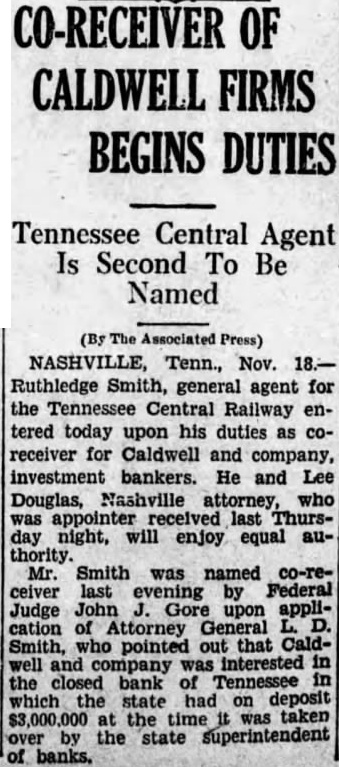
CO-RECEIVER OF CALDWELL FIRMS BEGINS DUTIES
Tennessee Central Agent Is Second To Be Named
The Press) NASHVILLE, Tenn., Nov. 18.Ruthledge Smith, general agent for the Tennessee Central Railway entered today upon his duties as coreceiver for Caldwell and company, investment bankers. He and Lee Douglas, Nashville attorney, who appointer Thursday night, will enjoy equal authority. Mr. Smith was named co-receiver last evening by Federal Judge John Gore upon application Attorney Smith, who pointed out that Caldand the closed bank Tennessee which state had on deposit at the was taken by the state superintendent banks.
3.November 20, 1930The Indianapolis TimesIndianapolis, IN
Click image to open full size in new tab
Article Text
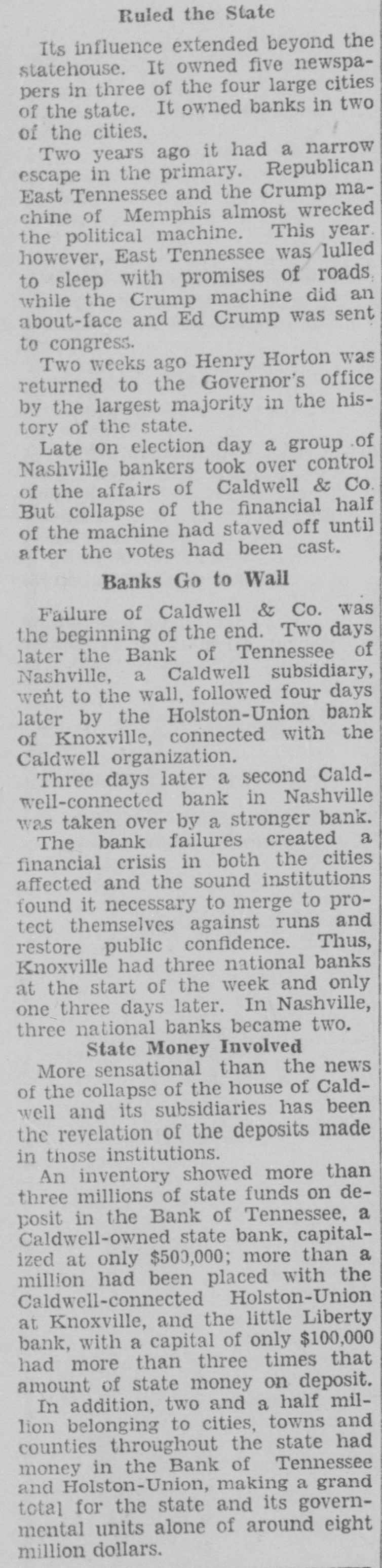
Ruled the State Its influence extended beyond the statehouse. It owned five newspapers in three of the four large cities of the state. It owned banks in two of the cities. Two years ago it had a narrow escape in the primary. Republican East Tennessee and the Crump machine of Memphis almost wrecked the political machine. This year. however, East Tennessee was lulled to sleep with promises of roads while the Crump machine did an about-face and Ed Crump was sent to congress. Two weeks ago Henry Horton was returned to the Governor's office by the largest majority in the history of the state. Late on election day a group of Nashville bankers took over control of the affairs of Caldwell & Co. But collapse of the financial half of the machine had staved off until after the votes had been cast. Banks Go to Wall Failure of Caldwell & Co. was the beginning of the end. Two days later the Bank of Tennessee of Nashville, a Caldwell subsidiary, went to the wall, followed four days later by the Holston-Union bank of Knoxville, connected with the Caldwell organization. Three days later a second Caldwell-connected bank in Nashville was taken over by a stronger bank. The bank failures created a financial crisis in both the cities affected and the sound institutions found it necessary to merge to protect themselves against runs and restore public confidence. Thus, Knoxville had three national banks at the start of the week and only one three days later. In Nashville, three national banks became two. State Money Involved More sensational than the news of the collapse of the house of Caldwell and its subsidiaries has been the revelation of the deposits made in those institutions. An inventory showed more than three millions of state funds on deposit in the Bank of Tennessee, a Caldwell-owned state bank, capitalized at only $500,000; more than a million had been placed with the Caldwell-connected Holston-Union at Knoxville, and the little Liberty bank, with a capital of only $100,000 had more than three times that amount of state money on deposit. In addition, two and a half million belonging to cities, towns and counties throughout the state had money in the Bank of Tennessee and Holston-Union, making a grand total for the state and its governmental units alone of around eight million dollars.
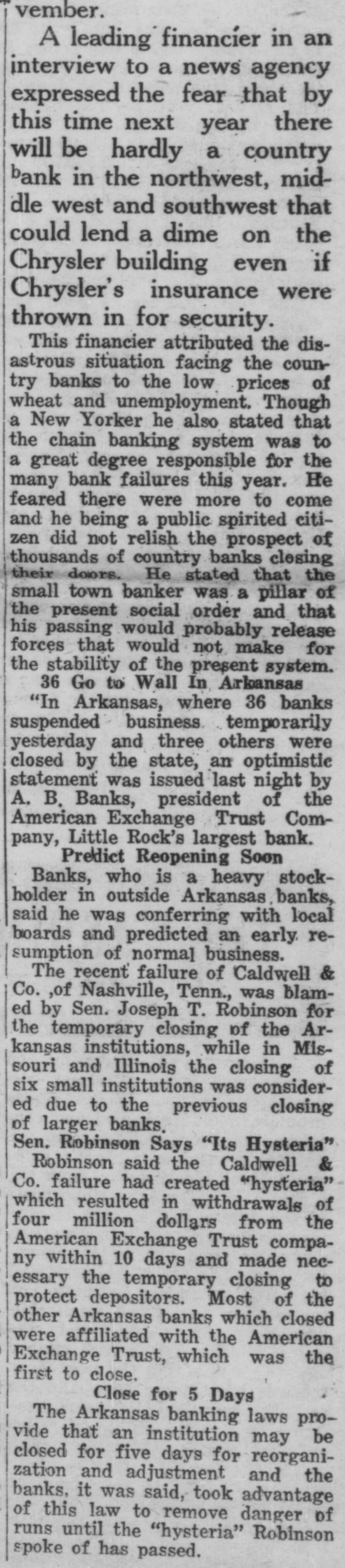
A leading financier in an interview to a news agency expressed the fear that by this time next year there will be hardly a country bank in the northwest, middle west and southwest that could lend a dime on the Chrysler building even if Chrysler's insurance were thrown in for security.
This financier attributed the disastrous situation facing the country banks to the low prices of wheat and unemployment. Though a New Yorker he also stated that the chain banking system was to a great degree responsible for the many bank failures this year. He feared there were more to come and he being a public spirited citizen did not relish the prospect of thousands of country banks closing their doors. He stated that the small town banker was a pillar of the present social order and that his passing would probably release forces that would not make for the stability of the present system.
36 Go to Wall In Arkansas
"In Arkansas, where 36 banks suspended business temporarily yesterday and three others were closed by the state, an optimistic statement was issued last night by A. B. Banks, president of the American Exchange Trust Company, Little Rock's largest bank.
Predict Reopening Soon
Banks, who is a heavy stockholder in outside Arkansas banks, said he was conferring with local boards and predicted an early resumption of normal business.
The recent failure of Caldwell & Co., of Nashville, Tenn., was blamed by Sen. Joseph T. Robinson for the temporary closing of the Arkansas institutions, while in Missouri and Illinois the closing of six small institutions was considered due to the previous closing of larger banks.
Sen. Robinson Says "Its Hysteria"
Robinson said the Caldwell & Co. failure had created "hysteria" which resulted in withdrawals of four million dollars from the American Exchange Trust company within 10 days and made necessary the temporary closing to protect depositors. Most of the other Arkansas banks which closed were affiliated with the American Exchange Trust, which was the first to close.
Close for 5 Days
The Arkansas banking laws provide that an institution may be closed for five days for reorganization and adjustment and the banks, it was said, took advantage of this law to remove danger of runs until the "hysteria" Robinson spoke of has passed.
5.November 21, 1930Nashville BannerNashville, TN
Click image to open full size in new tab
Article Text
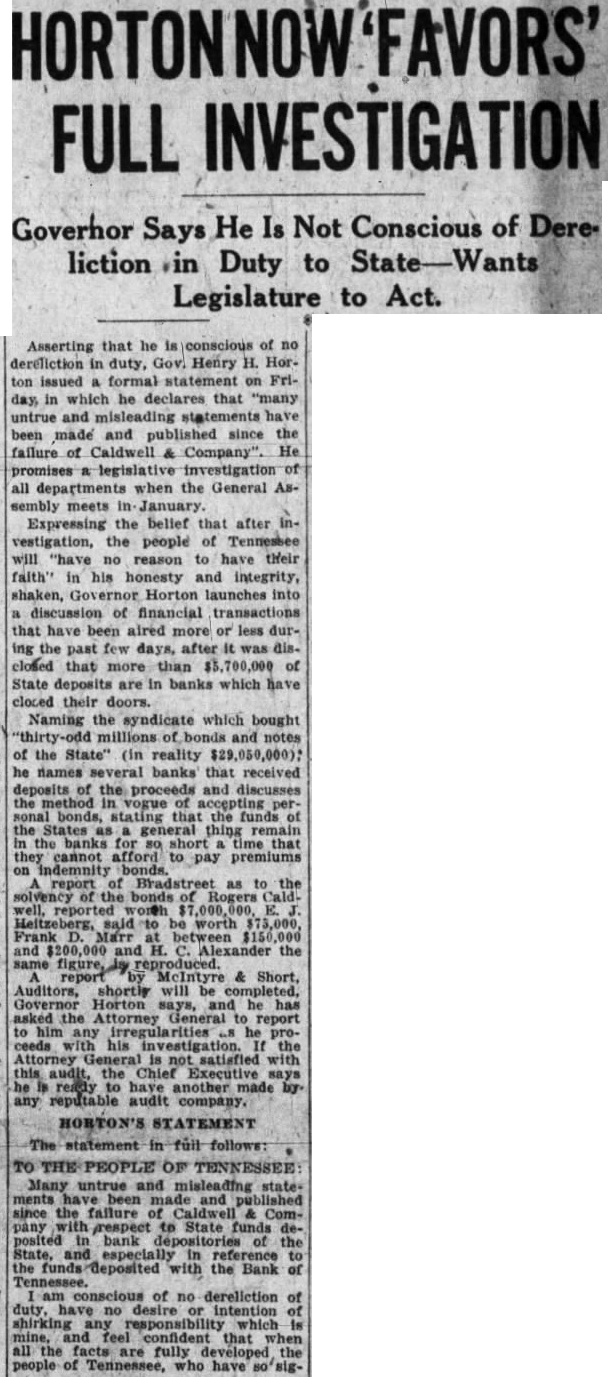
HORTON NOW FAVORS' FULL INVESTIGATION
Goverhor Says He Is Not Conscious of Dereliction in Duty to State-Wants Legislature to Act.
Asserting conscious of no Henry H. ton statement on Friday, which he that "many and have been made and published since the failure of Caldwell & legislative all when the General Asmeets the belief that after the people will no reason their faith" in his honesty and integrity, Horton launches into financial that been aired more or less ing the past few was closed that more of State deposits are in banks which have cloced their Naming the which bought millions bonds and the reality he names several that of and the thod bonds States general the banks that they cannot to pay premiums well, and H. the same report Auditors, will be asked Attorney to to any he ceeds satisfied have another any audit ATEMENT The follows: TO OF Many untrue and the failure State in the funds with the am of no duty, no desire any and confident that all the facts are the of have sig-
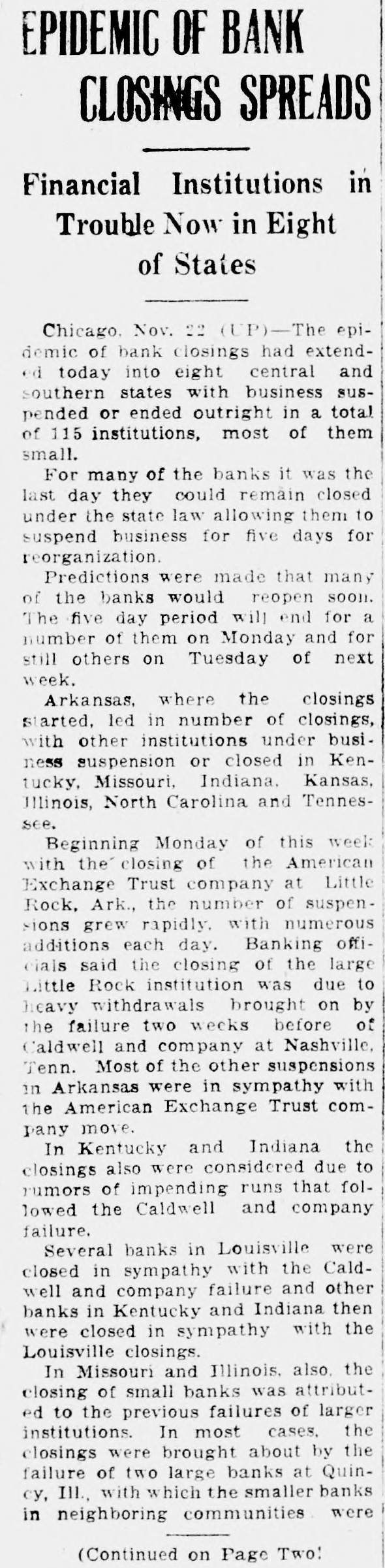
EPIDEMIC OF BANK CLOSINGS SPREADS Financial Institutions in Trouble Now in Eight of States Chicago. Nov. 22 (UP)-The epidemic of bank closings had extended today into eight central and southern states with business suspended or ended outright in a total of 115 institutions, most of them small. For many of the banks it was the last day they could remain closed under the state law allowing them to suspend business for five days for reorganization. Predictions were made that many of the banks would reopen soon. The five day period will end for a number of them on Monday and for still others on Tuesday of next week. Arkansas, where the closings started, led in number of closings, with other institutions under business suspension or closed in Kentucky, Missouri, Indiana. Kansas. Illinois, North Carolina and Tennessee. Beginning Monday of this week with the closing of the American Exchange Trust company at Little Rock, Ark., the number of suspensions grew rapidly. with numerous additions each day. Banking officials said the closing of the large Little Rock institution was due to heavy withdrawals brought on by the failure two weeks before of Caldwell and company at Nashville, Tenn. Most of the other suspensions in Arkansas were in sympathy with the American Exchange Trust company move. In Kentucky and Indiana the closings also were considered due to rumors of impending runs that followed the Caldwell and company failure. Several banks in Louisville were closed in sympathy with the Caldwell and company failure and other banks in Kentucky and Indiana then were closed in sympathy with the Louisville closings. In Missouri and Illinois, also. the closing of small banks was attributed to the previous failures of larger most cases. were about institutions. closings In brought by the the failure of two large banks at Quincy, III., with which the smaller banks in neighboring communities were (Continued on Page Two:
7.November 22, 1930The Montgomery AdvertiserMontgomery, AL
Click image to open full size in new tab
Article Text
City Lose May Heavy Sum In Caldwell Crash
$250,000 Remainder Of Montgomery Bonds Is Tied Up By Court Officials Hopeful
Gunter Declares Loss Is Prevented By Compact With Bank As Trustee
The taxpayers of Montgomery may result the collapse of Caldwell NashMayor believes that the city protected by collateral protect the point where there First and Fourth National Bank Nashville responsible to the City Montgomery, the trustee of the City of Montgomery, for any bonds Caldand Company may their possession sold for the City Mayor Gunter Friday night in the Caldwell and Company failure the that Montgomery might lose money from that failure. 'Montgomery,' continued Mayor Gunter, not listed having any deposits Caldwell Company's bank Nashville which failed. securities which the First and Fourth Bank trustee are not of equal with Montgomery city bonds, the First Fourth We will not cent. We the and Company that their own was acceptable chose Fourth Nashville Bank as our trustee under legal have no intimate the kind collateral our trustee accepted but know that must of equal value Montgomery bonds that the which was merged, will be liable are fully protected. When the City Montgomery sold the city limits, it sold to Caldwell which Caldwell and pay the money was needed. The authorized bond for the purpose of giving fire proTection the newly the city and for building sewers and extending the waterworks mains to these sections. To protect itself. the City, after accepting Caldwell and Company's for the bonds, required Caldwell and Company to the bond the which and and offered the city signed by institutions controlled by Caldwell and Company but the city refused that bond and Fourth and First National Bank its trustee, fiduciary agent with the understanding that Caldwell and Company must put up with that institution collateral of equal value with the bonds of the of Montgomery before these could be withdrawn for sale. Caldwell and this this collateral up federal the City the nor the City of know the real value of the collateral that was put up Caldwell and Company with its agent, the First Fourth National trustee, Bank Nashville. That bank has already with other Nashville banks been merged result the Caldwell and Company crash and the collateral had trusthe City of has tee order of the federal distied up by the City Montgomery and terest five and All fire bonds been sold and the city has spent the money and there can there. The the city, loss occurs, will exany bonds and possibly some sewer tension extension bonds. The First and Fourth National Bank of Nashville was merged recently with avert bank panic in Nashville result of fact that was owned and controlled by the Gunter confident that the collateral the City Montgomery eventually found amply protect city. the matter await the long litigainvolving the failure of Caldwell and Company.
8.December 3, 1930The Washington TimesWashington, DC
Click image to open full size in new tab
Article Text
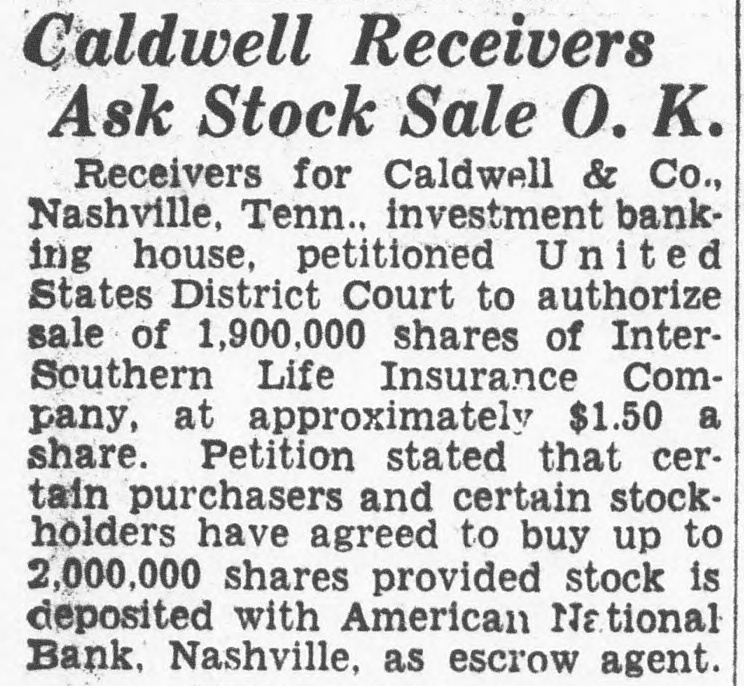
Caldwell Receivers Ask Stock Sale O.K. Receivers for Caldwell & Co., Nashville, Tenn.. investment banking house, petitioned United States District Court to authorize sale of 1,900,000 shares of InterSouthern Life Insurance Company, at approximately $1.50 a share. Petition stated that certain purchasers and certain stockholders have agreed to buy up to 2,000,000 shares provided stock is deposited with American National Bank. Nashville, as escrow agent.
9.December 8, 1930Evening StarWashington, DC
Click image to open full size in new tab
Article Text
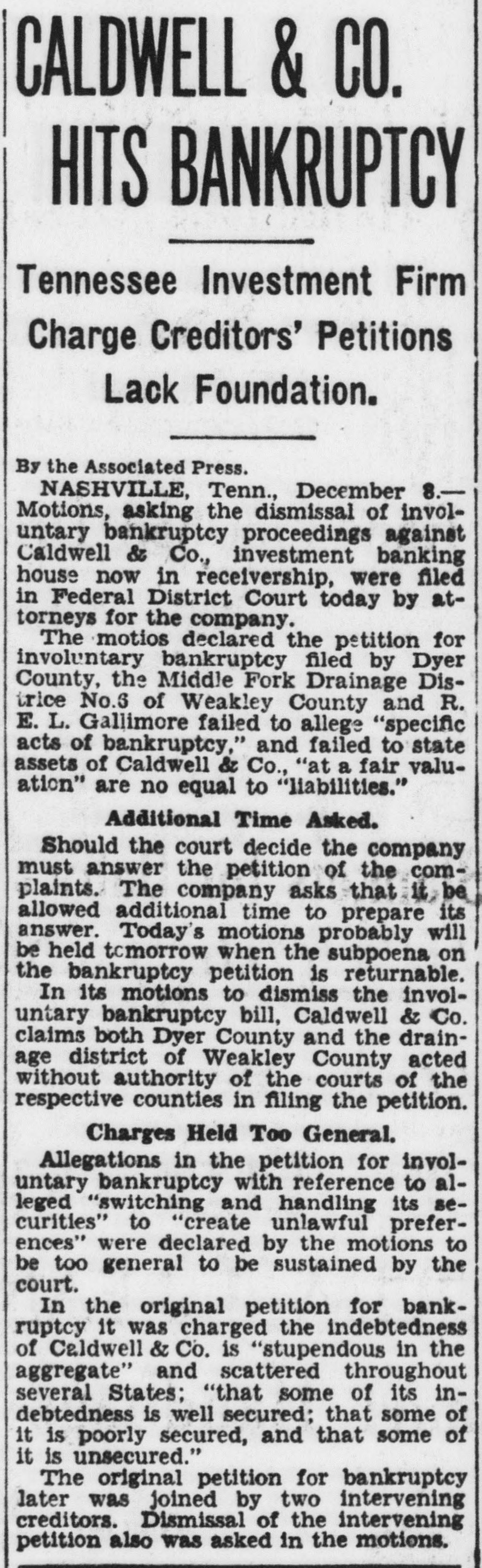
CALDWELL & CO. HITS BANKRUPTCY Tennessee Investment Firm Charge Creditors' Petitions Lack Foundation. By the Associated Press. NASHVILLE, Tenn., December 8.Motions, asking the dismissal of involuntary bankruptcy proceedings against Caldwell & Co., investment banking house now in receivership, were filed in Federal District Court today by attorneys for the company. The motios declared the petition for involuntary bankruptcy filed by Dyer County, the Middle Fork Drainage Districe No.6 of Weakley County and R. E. L. Gallimore failed to allege "specific acts of bankruptcy." and failed to state assets of Caldwell & Co., "at a fair valuation" are no equal to "liabilities." Additional Time Asked. Should the court decide the company must answer the petition of the complaints. The company asks that it, be allowed additional time to prepare its answer. Today's motions probably will be held tcmorrow when the subpoena on the bankruptcy petition is returnable. In its motions to dismiss the involuntary bankruptcy bill, Caldwell & Co. claims both Dyer County and the drainage district of Weakley County acted without authority of the courts of the respective counties in filing the petition. Charges Held Too General. Allegations in the petition for involuntary bankruptcy with reference to alleged "switching and handling its securities" to "create unlawful preferences" were declared by the motions to be too general to be sustained by the court. In the original petition for bankruptcy it was charged the indebtedness of Caldwell & Co. is "stupendous in the aggregate" and scattered throughout several States: "that some of its indebtedness is well secured; that some of it is poorly secured, and that some of it is unsecured." The original petition for bankruptcy later was joined by two intervening creditors. Dismissal of the intervening petition also was asked in the motions.
10.December 15, 1930The Springfield PressSpringfield, MO
Click image to open full size in new tab
Article Text
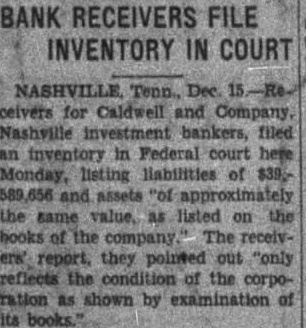
BANK RECEIVERS FILE INVENTORY IN COURT
NASHVILLE Tenn., Dec. ceivers for Caldwell and Company Nashville bankers, filed inventory in Federal court here Monday, listing liabilities of $39,589,656 and assets "of the same value, as listed on the hooks of the company. The receivreport, they pointed out "only reflects condition of the corporation as shown by examination of its books."
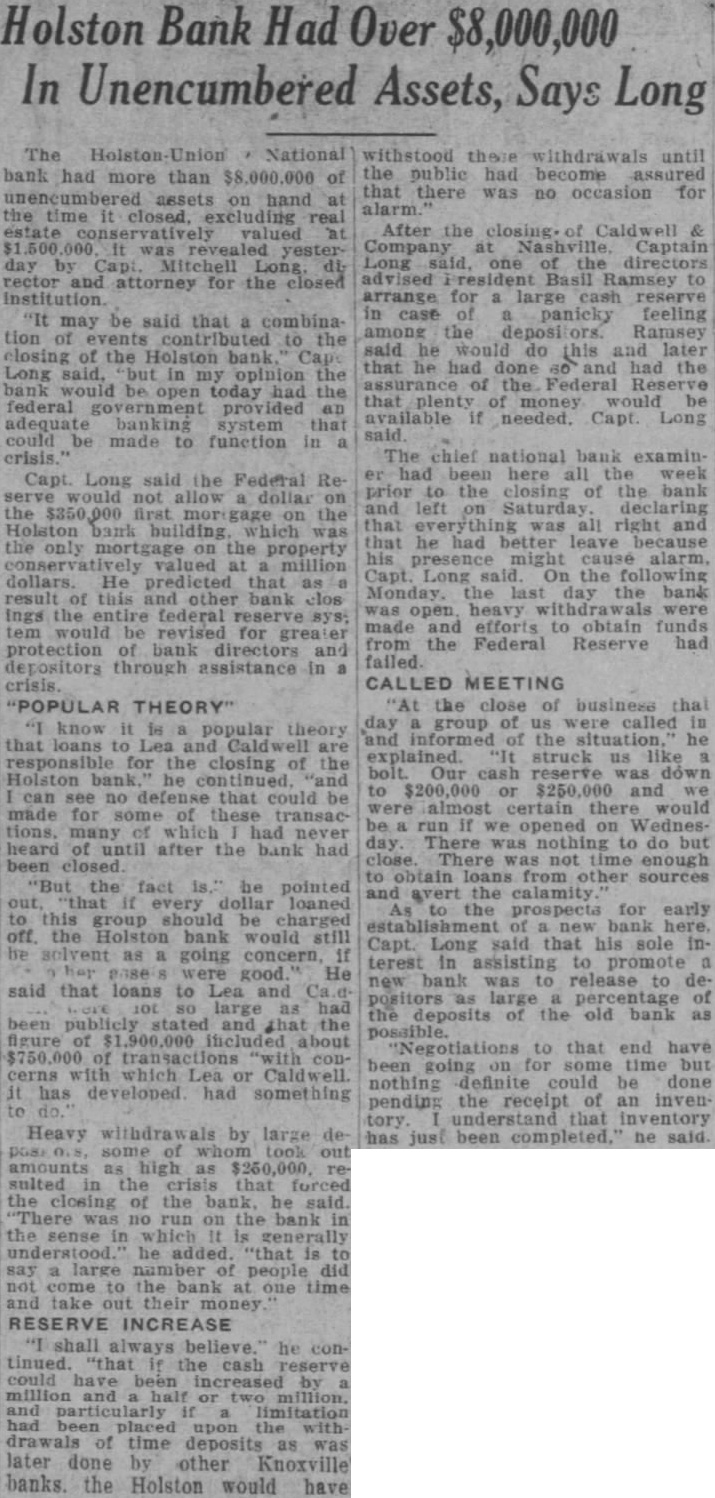
Holston Bank Had Over $8,000,000 In Unencumbered Assets, Says Long
The Holston Union National bank had more than $8,000,000 of unencumbered assets on hand at the time it closed, excluding real estate conservatively valued at 500 000 It was revealed yesterday by Capt Mitchell Long. dig rector and attorney for the closed 'It may be said that a combina tion of to the closing of the Holston bank. Cap Long said, in my opinion the bank would be today had the federal government provided an adequate banking system that could be made to function in crisis. Capt. Long said the Federal Reserve would not allow dollar on the $350,000 first on the Holston bank building which was the only on the property at million dollars. He predicted that as result of this and other bank clos ings the entire federal reserve tem would be revised for greater protection of bank directors and depositors through assistance in a crisis. "POPULAR THEORY" know popular theory that loans to Lea and Caldwell are responsible for the closing of the can see no defense that could be made for some of these transactions. many had never heard of after the bank had been closed. "But the fact is. be pointed "that every dollar loaned to this group should be charged off the Holston bank would still be solvent as a going concern, were good He said that loans to Lea and Ca.d. large as had been and that the figure of $1,900,000 included about cerns with which or Caldwell. it has developed had something to
Heavy withdrawals by large desome of out amounts as high as $250,000 resulted the crisis that forced the closing of the bank, he said. There was no run on the bank in the sense in which It is generally understood. he added. "that is to say large of people did not come to the at one time and take out their money RESERVE INCREASE "I shall always believe. he continued "that the cash reserve could have been increased by million and half or two million. and particularly limitation had been placed upon the with drawals of time deposits as was later done by other Knoxville' banks. the Holston would have withstood there withdrawals until the public had become assured that there was no occasion for alarm. After the closing of Caldwell & Company at Nashville, Captain Long one of the directors advised President Basil Ramsey to arrange for large cash reserve in case of panicky feeling among the depositors. Ramsey said he would do this and later that he had done 30 and had the assurance of the Federal Reserve that plenty of money would be available if needed. Capt. Long said. The chief national bank examiner had been here all the week prior to the closing of the bank and left Saturday declaring that everything was all right and that he had better leave because his presence might cause alarm. Capt. Long said On the following Monday the last day the bank was open heavy withdrawals were made and efforts to obtain funds from the Federal Reserve had failed. CALLED MEETING "At the close of business that day group of us were called in and informed of the situation, he explained. "It struck us like bolt. Our cash reserve was down to $200,000 or $250,000 and we were almost certain there would run if we opened on Wednesday. There was nothing to do but close. There was not time enough to obtain loans from other sources and avert the calamity to the prospects for early establishment of new bank here, Capt. Long said that his sole interest in assisting to promote new bank was to release to depositors large percentage of the deposits of the old bank as possible. 'Negotiations to that end have been going on for some time but nothing definite could be done pending the receipt of an inventory understand that inventory has just been completed,' he said.
12.December 30, 1930Evening StarWashington, DC
Click image to open full size in new tab
Article Text
STATE ASKS CALDWELL SUITS BE CONSOLIDATED By the Associated Press. NASHVILLE, Tenn., December 30.Consolidation of suits pending against Robert Caldwell, president of Caldwell & Co., investment banking house, now in receivership, was asked in a petition filed in Chancery Court today by the State of Tennessee. It was further asked that a single action arising from the consolidation of suits be sustained as a general creditors' bill. The petition was filed by Attorney General Nat Tipton.
13.March 19, 1931Evening StarWashington, DC
Click image to open full size in new tab
Article Text
BANKER CALDWELL'S CASE TO BE PROSECUTED Nashville Judge Authorizes Action on Charges of Receiving Deposits Illegally. By the Associated Press. NASHVILLE, Tenn., March 19.Judge Chester K. Hart today authorized Attorney General Richard M. Atkinson to prosecute Rogers Caldwell, president of Caldwell & Co., investment banking house now in receivership on two charges of receiving deposits in an insolvent bank. The bank was not named. The bank of Tennessee, which failed last Fall, was a subsidiary of Caldwell & Co. Numerous witnesses, meanwhile, were filing into the waiting room as grand jury witnesses. They included former officials of Caldwell & Co. and State officials. Attorney General Atkinson explained that in cases where the attorney general wishes to prosecute, but finds no one willing to be listed as prosecutor the procedure is for the attorney general to ask authority of the court to prosecute ex-officio.
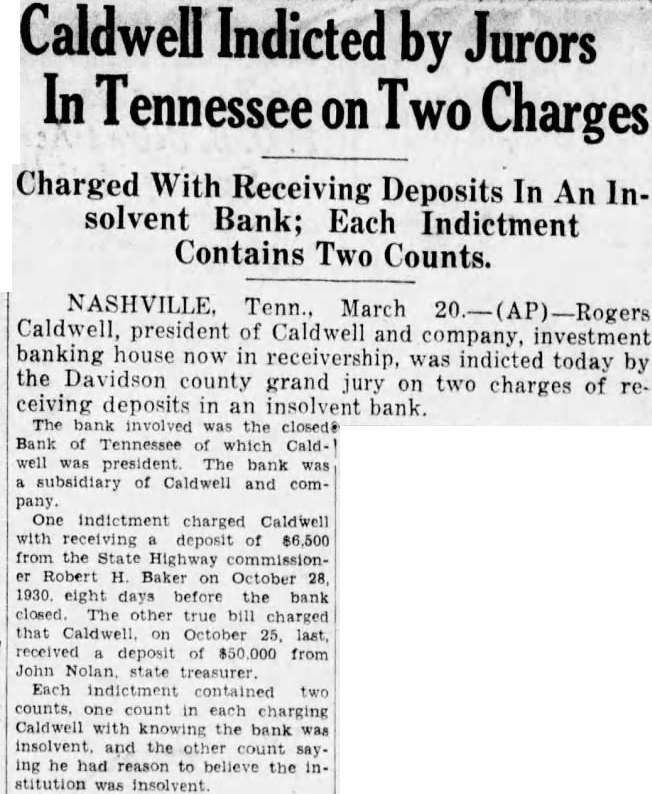
Caldwell Indicted by Jurors In Tennessee on Two Charges
Charged With Receiving Deposits In An Insolvent Bank; Each Indictment Contains Two Counts.
NASHVILLE. Tenn., March Caldwell, president of Caldwell and company, investment banking house now in receivership, was indicted today by the Davidson county grand jury on two charges of receiving deposits in an insolvent bank.
Bank of Tennessee which Caldwell president The bank was subsidiary of Caldwell and company. One indictment charged Caldwell with receiving deposit of $6,500 from the State Highway Robert Baker October 28 1930. eight before the bank closed The true bill charged that Caldwell. October 25, last received deposit of $50,000 from John Nolan state treasurer. Each indictment contained two counts, count in each charging Caldwell with the bank was insolvent. the other count say. ing he had reason to believe the stitution was insolvent
15.March 21, 1931The News and ObserverRaleigh, NC
Click image to open full size in new tab
Article Text
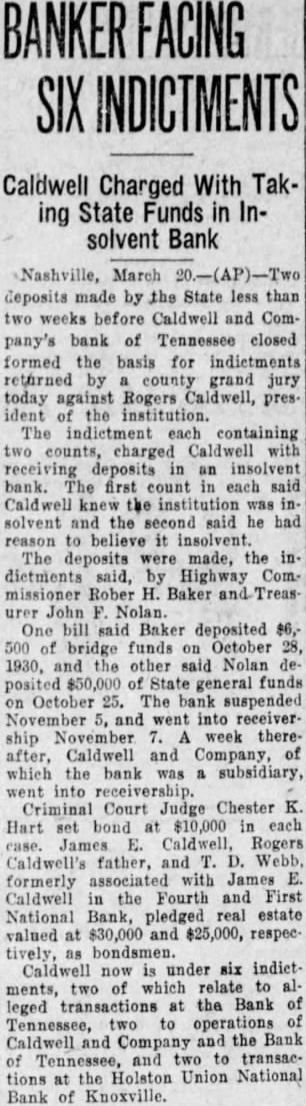
BANKER FACING SIX
Caldwell Charged With Taking State Funds in Insolvent Bank
Nashville, March 20.-(AP)-Two deposits made by the State less than two weeks before Caldwell and Company's bank of Tennessee closed formed the basis for indictments returned by county grand jury today against Rogers Caldwell, president institution. The indictment each containing two counts, charged Caldwell with in an insolvent bank. The first count each said Caldwell the was solvent and the second said he had reason to believe it The deposits were made, the in dictments said, by Highway Commissioner Rober H. Baker and Treas urer John F. Nolan One bill said Baker deposited $6,500 of bridge funds October 28, 1930, and the other said Nolan deposited funds on October 25. The bank suspended November and into receivership November week thereafter, Caldwell and Company, of which the bank subsidiary, into receivership. Criminal Court Judge Chester K. Hart set bond at $10,000 each James Caldwell, Rogers Caldwell's father, and T. D. Webb. formerly with James Caldwell the Fourth and First National Bank, pledged real estate valued at $30,000 and $25,000, respec tively, Caldwell now under six indict ments, two which relate leged transactions at the Bank of Tennessee, to operations of Caldwell Company and the Bank of Tennessee, and to transactions at the Holston Union National Bank of Knoxville.
16.April 5, 1931Evening StarWashington, DC
Click image to open full size in new tab
Article Text
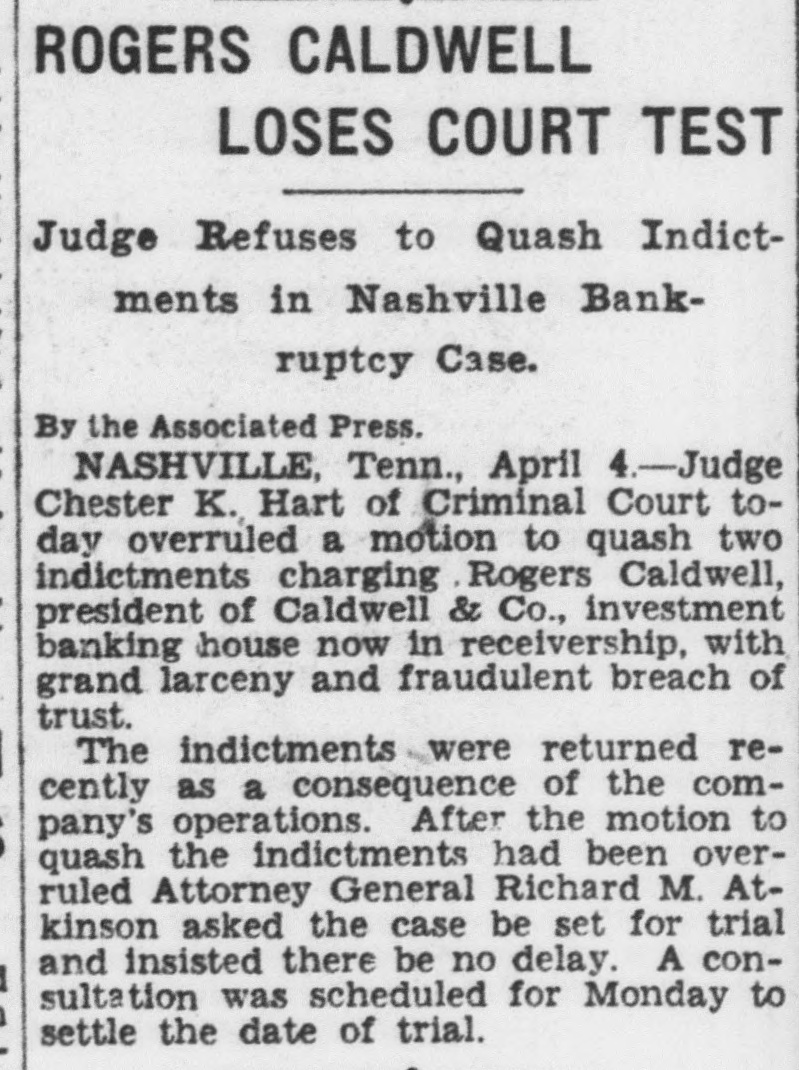
ROGERS CALDWELL LOSES COURT TEST Judge Refuses to Quash Indictments in Nashville Bankruptcy Case. By the Associated Press. NASHVILLE, Tenn., April 4.-Judge Chester K. Hart of Criminal Court today overruled a motion to quash two indictments charging Rogers Caldwell, president of Caldwell & Co., investment banking house now in receivership, with grand larceny and fraudulent breach of trust. The indictments were returned recently as a consequence of the company's operations. After the motion to quash the indictments had been overruled Attorney General Richard M. Atkinson asked the case be set for trial and insisted there be no delay. A consultation was scheduled for Monday to settle the date of trial.
17.June 17, 1931The Bushnell RecordBushnell, NE
Click image to open full size in new tab
Article Text
New York Day By Day McINTYRE
New Nov. Wonder finger Gerard's short neck. newsboy gyps Movie off Vincent Lopez has grown becomingly mumble. Frank Saratoga Springs, made good the secret hope bushes Those mean cops pop on grass. Edgar Saltu's park Mund. staging night feature from coast. perpetual glumness. for growing on Broadway orchestra called: Katz and interesting pictures Pirie like Peggy Hugh O'Connell, actor Ben Richard Gallienne from Paris. Prim ladies gazing travel posters wistfully banner "Forty Torrid Never purple velvet pajamas. Can't find nickel town. blonde Clifton pants. Nobody "succintly" conversation. writers run The ple-cheeked eaten for 20 Money the beauty parlor Look their establishments Who'll the for the bird who perpebuy trates those French quotations cigarette One Warner think. The shafts grey Few an train windows. They straight
Kelcey impassioned nighter and dramatic critic Women's salvaged his writing name of Broadway's panorama One night saw the names of Herbert lights. Kelcey Viola voila!
Suggestion for modern Broadway novel: Knifing dealing with White Way life And new be called "Monkeys Maggots.
Central Park may have Rotten Row. like that London's Hyde the famous the world. busiest path nothing canter but not Rotton which Row The park side the outlay and been the mixture that gives such noiseespecially
Central riders are middle aged. On Most Park Rotton there innumerable herded watchful and riding superbly. by grooms, been despite inBook publishers to bring out book precautions, free grammatical and typographical tirely tome will present 150 The average totaled more than 400 and an One Conrad's Wells had 150 emparrassearly volume are by three Some books mistakes creep in. different experts due many only perfect book typographically. about
Our efficient colored servant Harry this mornwaiting didn't catch inquired replied, he not the wall flower are "You with lady writes the other dance where you every claimed off (Copyright, 1930, McNaught Syndicate,
TENNESSEE'S FINANCIAL STORM. financial storm which The effects the Tennessee, centering chiefly in swept Knoxville, will Nashville and much in the political consequences pects, the losses depositors and committee bankers storm started when The affairs Caldwell and Comhad to over large Nashville bank which was centered investment in subsidiary the that smaller bank quick banks the followed largest and still another bank heavily city after run and ultimately deposits persistent taken yet bank. had over known heavy deKnoxville three banks there posits sustained runs but stood merged others heavy banks closed and In the two three counting handful merged, country banks. sums scores millions dollars. Since hysteria fected appears banks not likely lose at But large loss seems effects of such storm are severe openly Tenenough. nessee effects. For one thing. extraordicharged published off the Caldwell and until after the Company the was election. feared such would the camclosely allied paign the The conservative given reckless that "since Governor and the succession Henry Horton the chief has ruled the State's worst the that bound politically and
HE WILL. The saddest thing Heflin's fate the that wipes the talk his worth empty bottle Free
DESCRIBES HIS FIGHT TO SAVE CENTRAL BANK
Sought Funds To Protect Institution Through Mergers, Purchases.
'BAD BREAKS' COME FAST
Declares Decision To Close Bank Came 15 Minutes Before Opening Hour.
Wallace B. Davis central figure in cases growing out of the financial In western North Carolina last fall, denied today there was any to deceive in Central actions president of the and Trust and its affiliate Central Securities Company of Asheville The short stubby banker described fashion fruitless twoyear fight to prevent conditions wrecking his financial in his own behalf in U. 8. district court the former Asheville financier said he sought through mergers, purchases And affiliations to prevent the failure of the Central and resulting collapse of other He his efforts to effect mergers with WashingTennessee and Kentucky only have washed away by "one bad break them after kept in working all the time to get hope that business Davis condi- said. 'We faced bilities. but could work out. We never made statement or did anything to Enemies Started Rumors declared the doom of Central early when Caldwell and company. Nashville banking lapsed. clared With its failure. Davis col- dehis rumors led to on the bank Desperate measures were the the closing days to raise resorted but continued to pile finally defeating vember when the bank them failed on to Davis It was not until 15 before the opening the bank decision directors decided not that the board That spelled his personal financial offered offered mortgage my raise enable open. other defendant banks to aid us." the Williams completed his direct examination of Mr. Davis at o'clock this afternoon. for Mr Harris, Zeb Curtis. attorney cross-examined briefly, requiring only about the 2:30 o'clock cross ed States district began examination on behalf of government
Takes Stand president the Central curities Company of are alleged have sold of the bonds by means of false company's financial prospective statements and circulars mailed to Davis was also president of the Trust concern, the Central Bank and company which last after closed operat- its Asheville western North Carolina's largest institution. Smaller banks in and other lina closed sections of western North in sympathy result indictments were returned and in state and 26 and federal against Davis terday Davis the witness stand yes. and resumed day defend against charges of the defraud It was story of boy who went work for week to support the this family who climbed help presidency of banking institu(Continued on Page
19.November 26, 1932The Philadelphia InquirerPhiladelphia, PA
Click image to open full size in new tab
Article Text
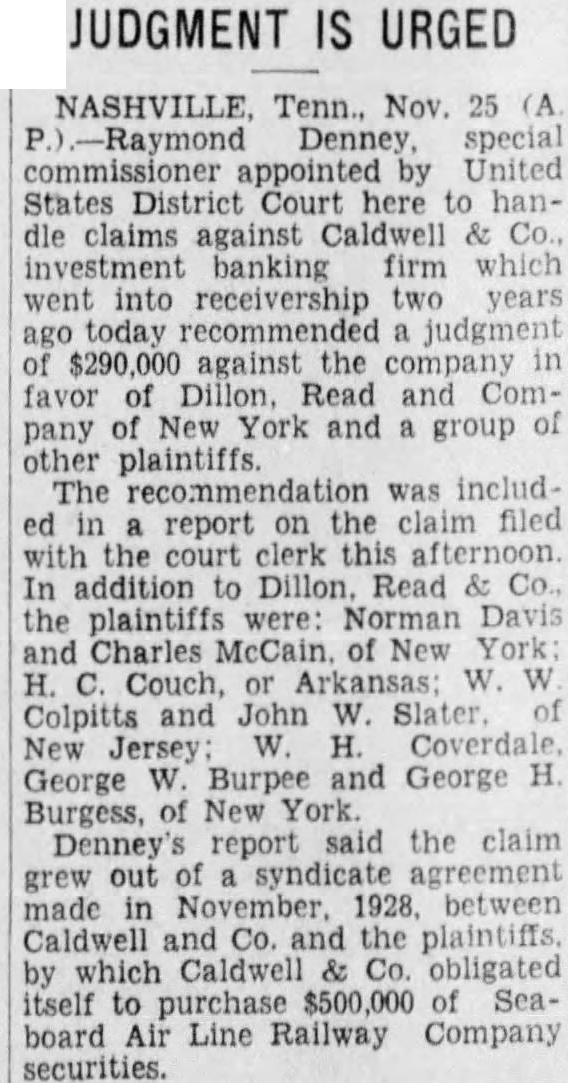
JUDGMENT IS URGED
NASHVILLE Tenn., Nov. 25 Raymond Denney special appointed by United States District Court handle claims against Caldwell banking went into receivership years today judgment against the company favor Dillon, Read pany of New York and group of The was includ report filed the clerk this addition Dillon Read Co. the plaintiffs Norman Charles McCain New York Couch, Colpitts Slater Jersey Coverdale George W. Burpee George Burgess, Denney's the claim grew out November, 1928 between Caldwell and and the plaintiffs which Caldwell Co. obligated itself to purchase $500,000 of board Line Railway Company securities.
Bank runs are almost always and everywhere a deterioration of bank fundamentals.
But not for you.
You are the measure-zero exception: great fundamentals, solid bank, and yet the Diamond Dybvig fairy spread its rumor. Depositors woke up. Your collateral was not prepositioned. The Clearinghouse had it for you.
Do not pass Go. Do not collect $200. Go directly to jail… or worse.