
9877. Commercial & Railroad Bank (Vicksburg, MS)

Bank Information

Episode Type
Suspension โ†’ Reopening
Bank Type
state
Start Date
January 1, 1838*
Location
Vicksburg, Mississippi (32.353, -90.878)

Metadata

Model
gpt-5-mini
Short Digest
b4ba13d10acdbe61

Response Measures

None

Description

OCR corrected MORERCIAL โ†’ Commercial. Articles (Dec 1838) report the bank had suspended specie payments earlier and directors resolved to resume specie payments on the first Monday in January (1839). A later 1844 article references assignees/receiver activity at the Commercial Railroad Bank, Vicksburg, indicating a separate later failure; that later receivership is outside the December 1838 resumption episode described here.

Events (3)

1. January 1, 1838* Suspension
Cause
Macro News
Cause Details
Suspension of specie payments in the wake of the broader banking difficulties of the period (collective suspensions among Mississippi banks following 1837-era distress).
Newspaper Excerpt
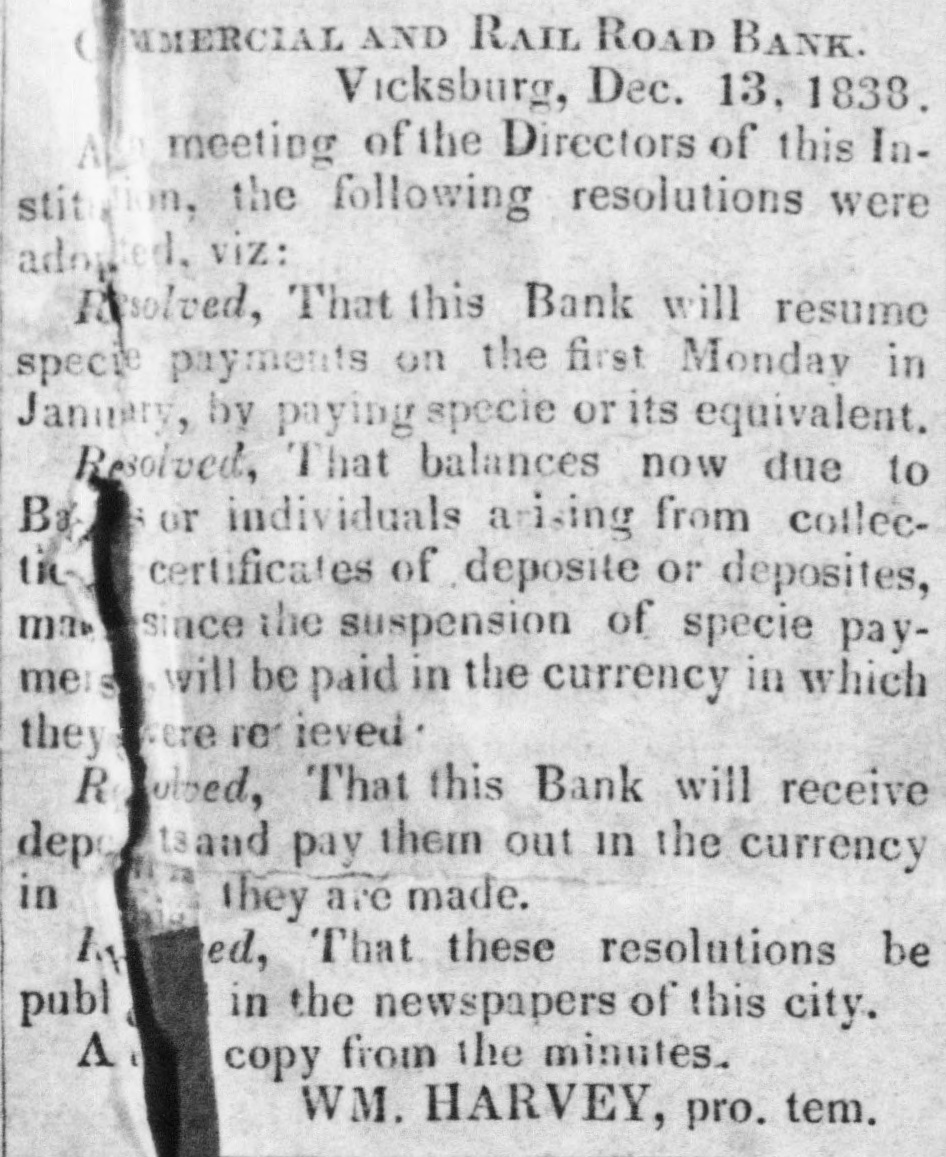
since the suspension of specie paymers
Source
newspapers
2. January 7, 1839 Reopening
Newspaper Excerpt
Resolved, That this Bank will resume specie payments on the first Monday in January, by paying specie or its equivalent.
Source
newspapers
3. February 9, 1844 Other
Newspaper Excerpt
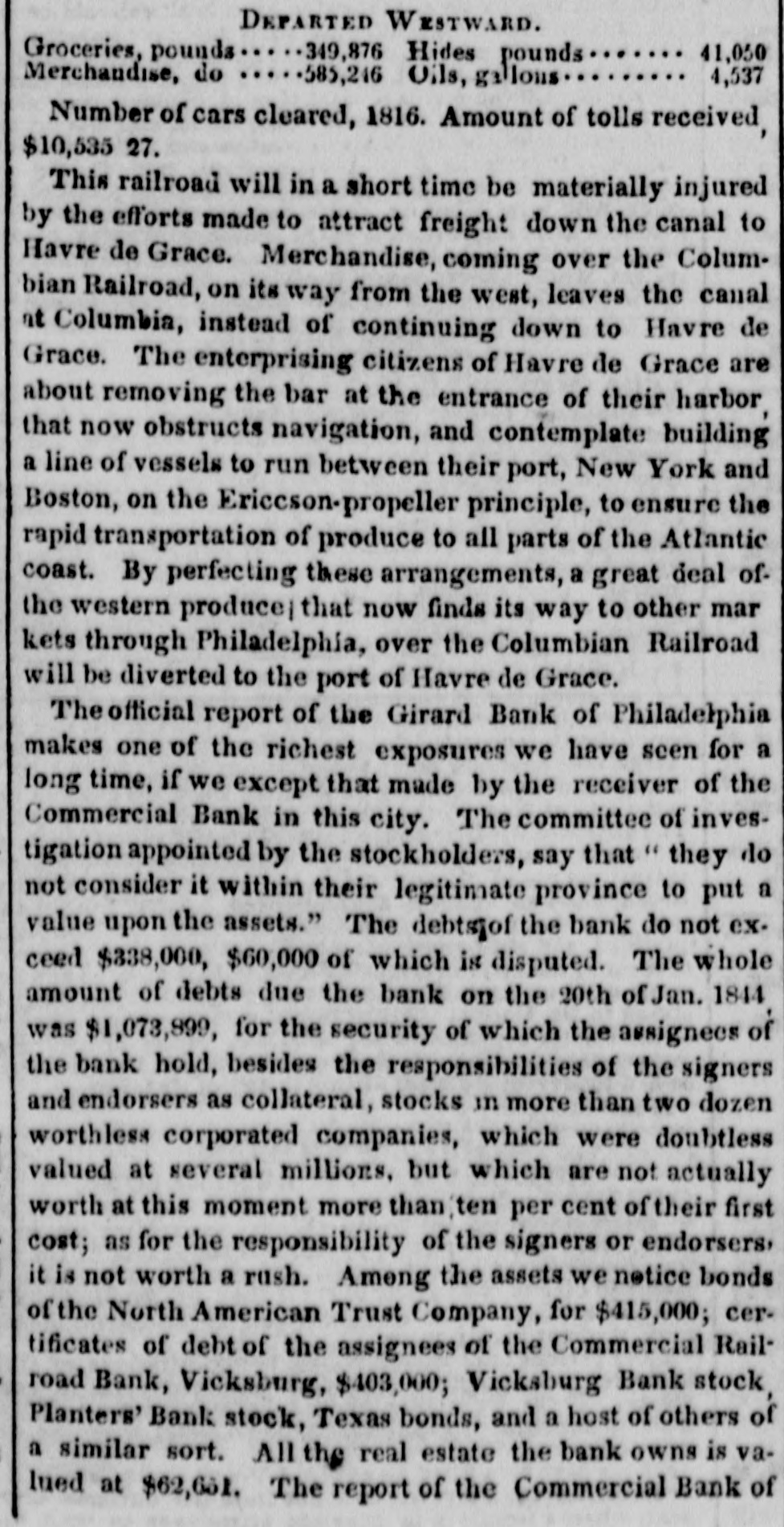
certificates of debt of the assignees of the Commercial Railroad Bank, Vicksburg, $403,000; Vicksburg Bank stock ... All the real estate the bank owns is valued at $62,601.
Source
newspapers

Newspaper Articles (3)

Article from Southern Marksman, December 18, 1838

Click image to open full size in new tab

Article Text

MORERCIAL AND RAIL ROAD BANK. Vicksburg, Dec. 13. 1838. meeting of the Directors of this Instit the following resolutions were adopted. viz. Resolved, That this Bank will resume specie payments on the first Monday in January, by paying specie or its equivalent. Resolved, That balances now due to B or individuals arising from collecIR certificates of deposite or deposites, ma since the suspension of specie paymers will be paid in the currency in which they cere re ieved R viloed, That this Bank will receive dep its and pay them out in the currency in they are made. ed, That these resolutions be publ in the newspapers of this city. A copy from the minutes. WM. HARVEY, pro. tem.


Article from Lexington Union, December 22, 1838

Click image to open full size in new tab

Article Text

# BANK CONVENTION. At meeting of the delegates from the Banks of Mississippi and Tennessee, convened at the Commercial & Rail Road Bank of Vicksburg, the following Banks were represented, viz: Farmers & Mechanics Bank of Memphis; Planters Bank, Natchez; Agricultural Bank, Commercial & Rail Road Bank of Vicksburg, West Feliciana Rad Road & Banking Company, Commercial Bank of Natchez, Commercial Bank of Manchester, Commercial Bank of Rodney, Bank of Lexington, Vicksburg Waterworks & Banking Company, Mississippi Rail Road Company, Citizens Bank of Madison County, Mississippi Union Bank, Real Estate Banking Company of Hinds County, Bank of Vicksburg. On motion, H G Runnels was called to the Chair, and J J Chewning was appointed Secretary. On motion, Resolved, That Messers. J Wood and George G Skipwith of Nashville, be invited to take a seat in this Convention. The following resolutions was offered by Stephen Duncan: Resolved, That the first monday in January next be the period fixed on for a resumption of specie payments by the Banks represented in this Convention; provided the delegates from the Union Bank of Mississippi will give assurance that the post notes of that Bank will be redeemed with specie, or its equivalent, when presented at her counter. On motion to strike out all after the word "provided," the yeas and nays being called, the vote stood thus; Ayes. E Montgon.ery, of Planters Bank; M B Irmer, Commercial Bank of Manchester; J C Bole, Lexington Bank; S P Webster, Vicksburg W W & Banking Co; J A Quitman, Miss. R R Co; W Hardeman, Citizens Bank of Madison county; H G Runnels and R M Williamson, Mississippi Union Bank. Nays-E W Lucas, of Famers and Mechanics Bank, Memphis; S Duncan, Agricultural Bank, J J Chewning, Com. & R R Bank of Vicksburg; G H Gordon, West Feliciana R R & Banking Co; L R Marshall, Com. Bank of Natchez; Thos. Freeland, Com, Bank of Rodney; A M Paxton, Bank of Vicksburg. This being a tie, the motion was lost. S P Webster proposed to strike out all the above resolutions, after the word "resolved," and proposed the following as a substitute: Whereas, in the opinion of this Convention, a resumption of specie payments by the Banks of Mississippi on the first day of January next, would be prejudicial to the interest of the community, for the following, among other reasons: 1. Because the month of January is the middle of the business season, and the period of the year when both planter and merchant stand in most need of all the bank facilities which can be afforded them. 2. Because it is the season of the year at which the largest amount of engagements have usually been made to fall due, and causes the months of January and February, in ordinary times, to be seasons of peculiar pressure in the money market. 3. Because the engagements maturing in January and February have, to a considerable extent, been passed to foreign creditors, and would immediately be demanded in specie or Eastern exchange. 4. Because of the present high rate of exchange against this state, in which condition a resumption of specie payments is unprecedented in any state of nation. The recent resumption in New York not being made until exchange had been for a period of two months in their favor, and in Philadelphia not until five months after that condition of things existed and at a time when the importation of specie by the banks of those places was a business of profit. 5. Because a resumption in January would cause the whole bank note circulation of the State to come in upon the banks, and leave the state without a circulating medium at all, to the great detriment of trade, and to the utter ruin of all who have money to pay at our spring courts, or provisions to purchase for the coming season. 6. Because it would be a burden of from 2 to 5 percent. of their whole circulation, upon the resuming banks without corresponding benefit to any class of persons, other than the Northen holders of our circulation, who have purchased it on speculation at from 15 to 40 percent discount.
Article from The New York Herald, February 9, 1844

Click image to open full size in new tab

Article Text

DEPARTED WESTWARD. Groceries, pounds.349,876 Hides pounds. 41,050 Merchandise, do .585,246 Oils, gallons... 4,537 Number of cars cleared, 1816. Amount of tolls received, $10,535 27. This railroad will in a short time be materially injured by the efforts made to attract freight down the canal to Havre de Grace. Merchandise, coming over the Columbian Railroad, on its way from the west, leaves the canal at Columbia, instead of continuing down to Havre de Grace. The enterprising citizens of Havre de Grace are about removing the bar at the entrance of their harbor, that now obstructs navigation, and contemplate building a line of vessels to run between their port, New York and Boston, on the Ericcson-propeller principle, to ensure the rapid transportation of produce to all parts of the Atlantic coast. By perfecting these arrangements, a great deal of the western produce that now finds its way to other markets through Philadelphia, over the Columbian Railroad will be diverted to the port of Havre de Grace. The official report of the Girard Bank of Philadelphia makes one of the richest exposures we have seen for a long time, if we except that made by the receiver of the Commercial Bank in this city. The committee of investigation appointed by the stockholders, say that "they do not consider it within their legitimate province to put a value upon the assets." The debts of the bank do not exceed $338,000, $60,000 of which is disputed. The whole amount of debts due the bank on the 20th of Jan. 1844, was $1,073,999, for the security of which the assignees of the bank hold, besides the responsibilities of the signers and endorsers as collateral, stocks in more than two dozen worthless corporated companies, which were doubtless valued at several millions, but which are not actually worth at this moment more than ten per cent of their first cost; as for the responsibility of the signers or endorsers, it is not worth a rush. Among the assets we notice bonds of the North American Trust Company, for $415,000; certificates of debt of the assignees of the Commercial Railroad Bank, Vicksburg, $403,000; Vicksburg Bank stock, Planters' Bank stock, Texas bonds, and a host of others of a similar sort. All the real estate the bank owns is valued at $62,601. The report of the Commercial Bank of