Click image to open full size in new tab
Article Text
dry goods clerk, grocery clerk, hotel clerk, farmer, country school teacher, with two willing hands and a stalwart heart betwixt himself and starvation. Too poor to go to law school, he borrowed his books and mastered them. Commencing the practice of law at Austin, in Tunica County, in 1869 he moved to Bolivar, with one dollar and a half and plenty of grit Since that time he has probably done more than any other man for the upbuilding of the Delta. More than any other man, perhaps, he has known the shifting lights and shadows of failure and success. He has devoted his great talents and unexampled industry to every cause of improvement, always declining reward for himself.
He inspired and directed the movement nearest the Delta farmer's heart, that of a safe and permanent levee system, being the first and only president of the association.
It is not in high places alone that he has served. A laboring man recently told this writer of an occasion when being waked in the middle of the night to help sack a threatened levee, he worked all night, waist deep in water, to save his home. When morning dawned he saw that the man next to him, muddy and unrecognizable, was Charley Scott.
"Yes," laughed Mr. Scott, "I think we white men had better work at night; negroes do very well in day time."
He has always taken an active interest in politics, for his country and for his friends, never for himself. He was a Democrat in those days when Democracy needed men, not politicians, when argument and artillery, patience and pistols, steady nerve and patriotism were required to redeem the South.
During all the years when he wielded a paramount influence in Bolivar county and the Delta generally, he never accepted any private emolument or benefit. He refused to be county attorney, refused to be attorney for the levee board, and refused to receive a dollar for any public service. Four years ago he served on this levee board at the earnest solicitation of his people and at a personal loss to himself of from $3,500 to $5,000 annually, because he could accept no retainers against the board.
He never made use of his power for private gain, and never distributed patronage to win political support. For this reason the men who were his open and determined enemies for years—the Anti-Scott faction—united in a pledge to support him for the governorship, using this remarkable language:
"Your integrity commands the confidence of all who know you, and even your enemies rely on your word in business, personal, or political matters as they would on the bond of many men. ... Knowing that you will make an ideal governor in whom the whole state will take pride, we write this open letter to tender you our active support."
This singular tribute was signed by thirty-seven of the men most prominently and violently antagonistic to Mr. Scott in his own county. Such is the expression of his generous and fair-minded enemies. He is square and straight and truthful. That's why his open and honorable enemies can support him.
And that's why the strikers, The bosses and pikers,
Ain't got no use for Scott,
When the people of Rosedale built their water works system they selected a valuable lot belonging to Mr. Scott. He set a high price upon it, which they finally consented to pay. Then he astonished them by saying it was all a joke, and making a free gift of the property.
For these and many other reasons his friends and neighbors have implicit confidence in the man. But, queerly enough, these same qualities have made him an object of distrust to another class of men who cannot comprehend patriotic motives.
For the feller that's after
The dough and the grafter,
Ain't got no use for Scott.
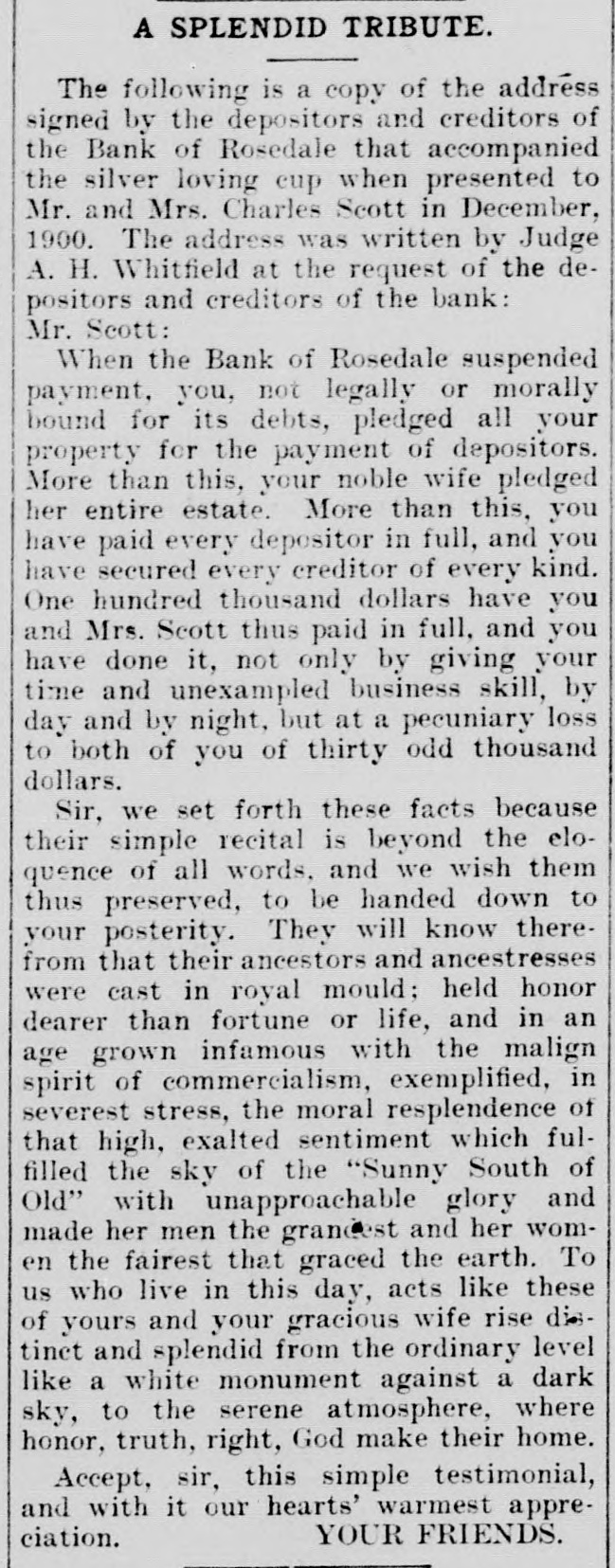
Mr. Scott has experienced his full share of reverses. Bad planting years have crippled him, levees have broken and swept his crops away, and financial panics have made his ruin more splendidly complete. In the most hopeless of these situations came the failure of the Bank of Rosedale.
Mr. Scott was neither legally nor morally bound for its debts, but he paid them to the last farthing, at a personal loss to himself of $40,000.
"And we also know," so certified his political antagonists, "that the poor people, white and