984. Page, Bacon & Company (San Francisco, CA)

Bank Information

Episode Type
Run → Suspension → Closure
Bank Type
private
Start Date
February 17, 1855
Location
San Francisco, California (37.780, -122.419)

Metadata

Model
gpt-5-mini
Short Digest
ec37f35d7e17685f

Response Measures

None

Description

Contemporary papers report a run after news of the suspension of the St. Louis house of Page & Bacon (steamer news ca. Feb 17, 1855), heavy withdrawals (~$300k–$500k), the San Francisco house closing/announcing suspension on Feb 22, 1855, a brief attempt to resume (open to special depositors / issue of time certificates) in late March, and ultimately an assignment/placement into liquidation by May 1855. Cause of the initial run was news of the correspondent (St. Louis) failure and tight Atlantic money; suspension followed when specie reserves were nearly exhausted. Dates are taken from the articles and may be approximate when only month/day were reported.

Events (4)

1. February 17, 1855 Run
Cause
Correspondent
Cause Details
News (steamer Oregon/other Pacific steamer) that Page & Bacon of St. Louis had suspended/failure triggered depositor panic and heavy withdrawals from the San Francisco house.
Measures
Paid out large sums to depositors (reports of $300k–$500k paid); later creditors/merchants provided guarantees and depositors were offered time certificates bearing interest to permit resumption.
Newspaper Excerpt
As soon as the Oregon's news became distributed ... a run commenced on the house of Page, Bacon & Co., of San Francisco ... some three hundred thousand dollars were paid out.
Source
newspapers
2. February 22, 1855 Suspension
Cause
Correspondent
Cause Details
After continued heavy withdrawals during the run specie in vaults fell (reports say reduced to less than $100,000) and the house closed its doors and announced suspension on Feb 22, 1855.
Newspaper Excerpt
The morning of the 22d, when their bank was not opened at the usual hour, and shortly after handbills were sent all over town, announcing that they must suspend.
Source
newspapers
3. March 24, 1855 Other
Newspaper Excerpt
The banking house of Messrs. Page, Bacon & Co., was open yesterday to special depositors ... The bank will be open again to-day. ... issue certificates of deposit, bearing interest at one per cent per month ... guaranteed by some of our first men to the 100 dollars. (March reports).
Source
newspapers
4. May 2, 1855 Receivership
Newspaper Excerpt
Page, Bacon & Co., again suspended payment on the 2d inst. ... Early on the morning of the 2d inst., attachments to the amount of about $200,000 were made upon the house ... An assignment has been made by P., B. & Co., to secure the merchants ... Of course, its affairs will now go into liquidation. (May reports).
Source
newspapers

Newspaper Articles (21)

Article from The Trinity Times, February 24, 1855

Click image to open full size in new tab

Article Text

Editorial Correspondence STRAMER ANTELOPE. Feb. '55, S En Route for Sac. City. The adjournment of the Legislature on Saturday until Tuesday gave 118 an opportunity of visiting San Francisco, which is a re. creation enjoyed weekly by those 80 disposed, after their various labors in a legislative way. Our trip has been, so far. one of pleasure and excitement. Pleasant, because associated with the gentlemanly officers of the boat, whom none excel-the clerk in particular.-The excitement has been sympathetic from too close a connection with San Francisco circumstances. The arrival of the Oregon on Saturday morning probably produced more excitement by her news, than any steamer since the setment of this country. The European war news and Atlantic political intelligence was all over looked in the all absorbing topicthe failure of the great house of Page & Bacon, of St Louis. This subject occupies the attention of all classes and circles. As soon as the Oregon's news became distributed throughout the city, a run commenced on the house of Page, Bacon & Co., of San Francisco, unparalleled in the history of Banks. The excitement was universal, but the fears for their solvency was confined to the poorer classes of the community, who were generally depositors. The scene at the Banking House beggars all description.Hundreds were crowding in with certificates and anxious faces, and out with hats and pockets full of slugs, and almost as much disposed to o and re-deposit after they had drawn their money out, as they were previously to draw it out. Although the run lasted till four o'clock, and some three hundred thousand dollars were paid out, there was enough left for all those who have any demands. The house has probably sustained an irreparable injury, yet no one will lose a dollar by them. They are fully able to pay all demands agrinst them, and have a surplus left. The cause of this failure or suspension has been occasioned by the tightness of the monetary affairs of the Atlantic States and Europe. This (Monday) morning the excitement was somewhat allayed. The merchants feeling every confidence in the house, and none but the poorer classes continuing to draw their deposits, During the heaviest of the exeitement on Saturday, every assistance was offered* by their friends in San Francisco among Merchants and Bankers, but was all declined as unneeded by them, they having sufficient funds to meet all demands. The political news of the week has not been much beyond the final adjournment of the Senatorial question, which has satisfied some and disappointed others. We consider it the best thing that could be done under the existing circumstances. No election could be accomplished, and as it was going on, the expense was too great to be tolerated any longer. The Gwin faction were the only ones opposed to the adjournment. The peo. ple at large will be well satisfied with this disposition of the question. It has delayed necessary legislation too long and it can now be disposed of by the people. Our Supervisor Bill will probabiy be passed in the course of & week or so, also the Census and Fee E.A.R. Bills.


Article from Butte Record, February 24, 1855

Click image to open full size in new tab

Article Text

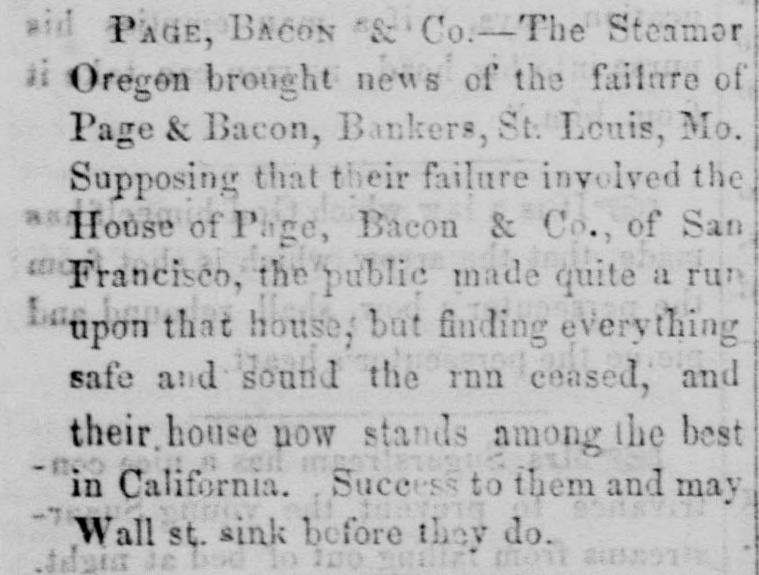
aid PAGE, BACON $& Co.--The Steamer ai Oregon brought news of the failure of Page & Bacon, Bankers, St: Louis, Mo. Supposing that their failure involved the House of Page, Bacon & Co., of San Francisco, the public made quite a run bas upon that house, but finding everything safe and sound the rnn ceased, and their house now stands among the best in California. Success to them and may Wall st. sink before they do.


Article from Butte Record, March 3, 1855

Click image to open full size in new tab

Article Text

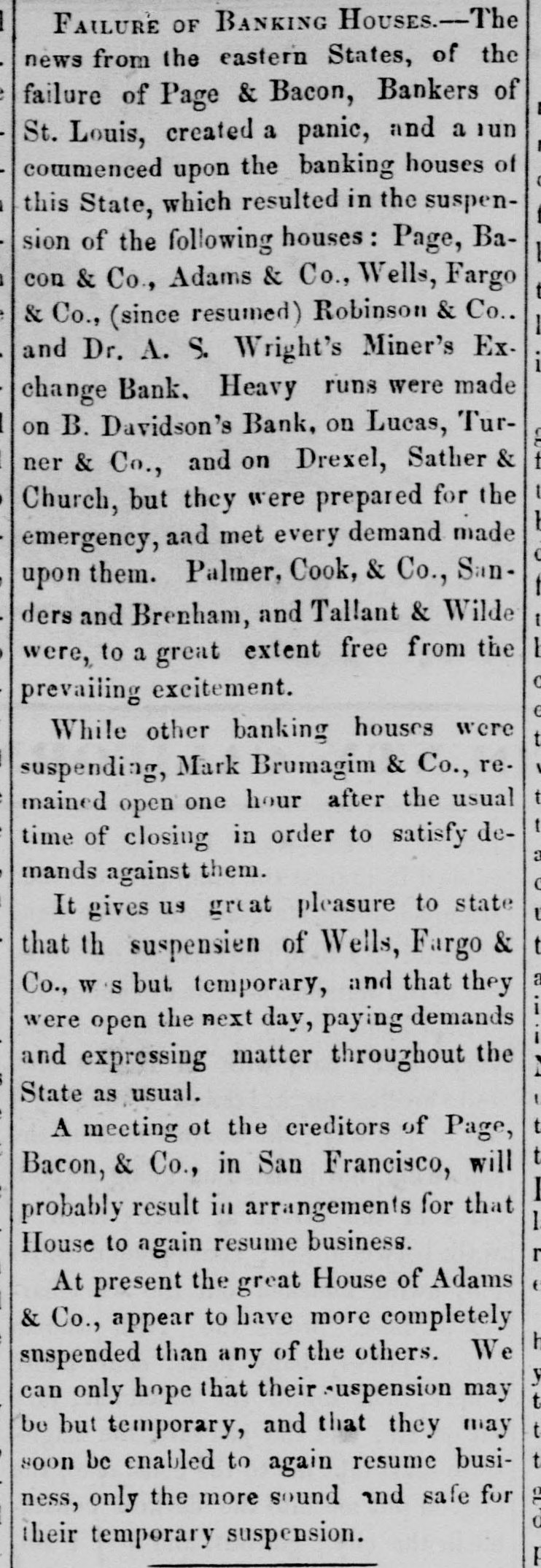
# FAILURE OF BANKING HOUSES.--The news from the eastern States, of the failure of Page & Bacon, Bankers of St. Louis, created a panic, and a run commenced upon the banking houses of this State, which resulted in the suspension of the following houses: Page, Bacon & Co., Adams & Co., Wells, Fargo & Co., (since resumed) Robinson & Co., and Dr. A. S. Wright's Miner's Exchange Bank. Heavy runs were made on B. Davidson's Bank, on Lucas, Turner & Co., and on Drexel, Sather & Church, but they were prepared for the emergency, and met every demand made upon them. Palmer, Cook, & Co., Sanders and Brenham, and Tallant & Wilde were, to a great extent free from the prevailing excitement. While other banking houses were suspending, Mark Brumagim & Co., remained open one hour after the usual time of closing in order to satisfy demands against them. It gives us great pleasure to state that the suspension of Wells, Fargo & Co., was but temporary, and that they were open the next day, paying demands and expressing matter throughout the State as usual. A meeting of the creditors of Page, Bacon, & Co., in San Francisco, will probably result in arrangements for that House to again resume business. At present the great House of Adams & Co., appear to have more completely suspended than any of the others. We can only hope that their suspension may be but temporary, and that they may soon be enabled to again resume business, only the more sound and safe for their temporary suspension.


Article from Pioneer and Democrat, March 17, 1855

Click image to open full size in new tab

Article Text

# THE NEWS. We cheerfully surrender most of the inside of today's paper, to give place to the news-Earopean, Congressional. and general, which has been afforded us for the benefit of our readers-not through the agency of the mail, but, as will elsewhere be seen, by private favor, and means of the express. And we would here beg leave to acknowledge our sincere thanks to numerous friends, for the privilege of a second hand, side glance, at the late papers, kindly intended for us, by which we are enabled to make a compilation of the most important news items, for the edification of our readers abroad in the territory. From Oregon, there is no news of importance, other than general complaint of business being dull, money scarce, &c. The friends of the respective prominent democratic candidates for the nomination of delegate to congress, are waxing somewhat warm, and afford evidence that the contest in the convention will ripen into heat and bitterness. General Lane, the present delegate, it is said, took his departure from New York for San Francisco, on the steamer of the 20th of February. If this be so, it is supposed he will reach home on the next trip of the Columbia, from that city to Oregon. We hope that such a nomination will be made as will prove satisfactory to the party generally one whom they can not only unite upon, but elect. The California papers of March 1st, bring us intelligence of an unprecedented panic in the exchange and money circles in San Francisco and Sacramento, in consequence of the suspension of the well-known house of Page, Bacon & Co., followed by Adams & Co., Wells, Fargo & Co., and other banking houses. When the news first came of the failure of Page & Bacon, of St. Louis, a run commenced at once on Page, Bacon & Co., which was kept up all that day, and over four hundred thousand was withdrawn from the bank. The next day the run ceased, and matters apparently were moving on as usual, till the morning of the 22d. when their bank was not opened at the usual hour, and shortly after handbills were sent all over town, announcing that they must suspend. It seems that quite a deep run had been going on all day, till their specie was reduced to less than one hundred thousand dollars, and they feared to keep open any longer. Owing to the fact that it was a holiday, but little business was done that day; yet it seems that over two hundred thousand dollars was drawn out during the day from Adams & Co. That evening the steamer arrived with the news that Page, Bacon & Co.'s drafts had all been paid, and it was then supposed that the excitement and trouble was over. But the next morning Adams & Co. announced that they too must suspend, and shortly after Wells, Fargo & Co. followed suit. Robinson's Savings Bank, and Dr. Wright's Miner's Bank, did the same, and then came a general run on all that remained open. The greatest run was upon Drexel, Sather & Church, B. Davidson, and Lucas, Turner & Co. Tallant & Wilde and Sanders & Brenham suffered little from the panic, and paid off their depositors. Palmer, Cook & Co. were not affected by the run in the least, but paid every claim as presented. The creditors of Page, Bacon & Co. held a meeting on Sunday last, and considered a plan by which that house may be enabled to resume payment. The bank exhibits assets, over and above liabilities, of $368,868; but it is proper to state that upwards of $1,300,000 is in New York and St. Louis, whereas the liabilities of the concern are mostly due in California. It was proposed that depositors to the amount of four hundred thousand dollars should receive evidences of indebtedness, bearing interest at the rate of one per cent. per month, and payable in two, four, six and eight months; and it was thought that if depositers accepted this proposition, the house would be enabled to go on. Merchants and others affixed their names to a bond in the sum of about one million of dollars, guaranteeing the payment of these deposits, and it is now believed that the house will be enabled to resume business in the course of five or six days. Messrs. Wells, Fargo & Co. resumed payment on Tuesday, and so far all demands have been promptly paid. Adams & Co. have filed a petition for insolvency. and their schedule of assets and liabilities show a balance on the right side of about $100,000; assets, $1,814,285; liabilities, $1,636,717. Mr. Woods has given all his private property, estimated at $250,000, and this goes to make up the total of the assets. We understand that the express business of Adams & Co. will be carried on without any interruption. The joint convention of the California legislature for the election of a United States Senator, had been dissolved, and there will probably be no Senator elected by the present legislature. The first announcement of the failure or suspension of Page, Bacon & Co., was made known by their house in St. Louis, on the 13th of January, and, as has been the case in San Francisco and elsewhere in California, a general run has been commenced on other banking houses in most of the cities of the Atlantic states. In New York, New Orleans, Louisville, Cincinnati, and St. Louis, many of the banking houses had suspended, and public meetings have been held for the purpose of devising measures to avert a feared impending general bankruptcy, and restore the credit of Page, Bacon & Co., and other houses seriously effected by the suspension. A tremendous excitement had prevailed in some of the cities, and a general smash-up had been feared, not only in the banking, but large mercantile houses also. The latest dates, however, indicate more quietude, and a resumption of confidence and business anticipated. The general character of the news from the states, is anything but flattering to general prosperity, in a business point of view. Bank expansion, and consequent bankruptcy, through speculation and overtrading, is the common talk in the commercial circles, whilst destitution, lack of labor, and want of the means of procuring the necessaries of life, is being felt to an alarming and humiliating extent by the masses of the great commercial emporiums. Politically, the news from the states is of the most cheering character to the democracy-as it is ruinous to the hopes of whiggery, and its mongrel, "klonas" allies. The New York HERALD, having assumed the leadership of the know nothing movement, as directed against the re-election of Seward to the United States Senate from the state of New York, and against Wise for the Governorship of Virginia, and which paper has for months past, vauntingly trumpeted forth in advance, the certain defeat of both those gentlemen, has now cooled down in temperature almost to the freezing point, in consequence of the legislative caucus at Albany having, after the first ballot, made the nomination of Seward unanimous. The caucus numbered just one-half of each house, making their nomination equal to an election. The result has thrown the know nothing line into the utmost confusion, and the Herald pitches into the administration as having connived at their defeat, and charges blindly around, with the impeachment of treason in the know nothing.

Article from New-York Daily Tribune, March 19, 1855

Click image to open full size in new tab

Article Text

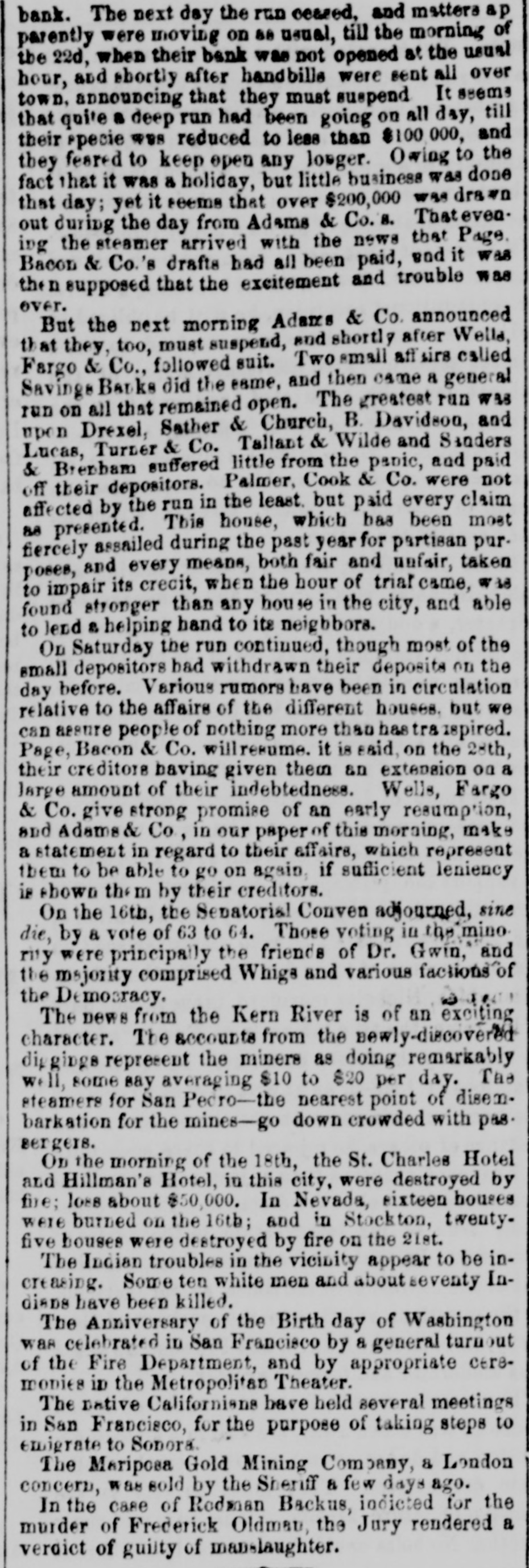
bank. The next day the run ceased, and matters ap parently were moving on 88 usual, till the morning of the 22d, when their bank was not opened at the usual hour, and shortly after handbills were sent all over town, announcing that they must suspend It ssems that quite a deep run had been going on all day, till their specie was reduced to less than $100,000, and they feared to keep open any longer. Owing to the fact that it was a holiday, but little business was done that day; yet it seems that over $200,000 was dra wn out during the day from Adams & Co. Thateven. ing the steamer arrived with the news that Page, Bacon & Co.'s drafts had all been paid, and it was the n supposed that the excitement and trouble was over. But the next morning Adams & Co. announced that they, too, must suspend, and shortly after Wells, Fargo & Co., followed suit. Two small aff sirs called Savings Banks did the same, and then came 8 general run on all that remained open. The greatest run was upon Drexel, Sather & Church, B. Davidson, and Lucas, Turner & Co. Tallant & Wilde and Sanders & Brenham suffered little from the panic, and paid off their depositors. Palmer, Cook & Co. were not affected by the run in the least. but paid every claim as presented. This house, which bas been most fiercely assailed during the past year for partisan purposes, and every means, both fair and unfair, taken to impair its crecit, when the hour of trial came, 18 found stronger than any house in the city, and able to lend & helping hand to its neigbbors. On Saturday the run continued, though most of the small depositors bad withdrawn their deposits on the day before. Various rumors have been in circulation relative to the affairs of the different houses. but we can assure people of nothing more than has tra uspired. Page, Bacon & Co. willresume. it is said, on the 28th, their creditors having given them an extension on a large amount of their indebtedness. Wells, Fargo & Co. give strong promise of an early resumption, and Adams& Co, in our paper of this morning, make a statement in regard to their affairs, which represent them to be able to go on again, if sufficient leniency is shown the m by their creditors. On the 16th, the Senatorial Conven adjourned, sine die, by a vote of 63 to 64. Those voting in the mino. ruy were principally the friends of Dr. Gwin, and the majority comprised Whigs and various factions of the Democracy. The news from the Kern River is of an exciting character. The accounts from the newly-discovered gings represent the miners as doing remarkably well, some say averaging $10 to $20 per day. The steamers for San Pedro-the nearest point of disembarkation for the mines-go down crowded with pas. sergers. On the morning of the 18th, the St. Charles Hotel and Hillman's Hotel, in this city, were destroyed by fire; loss about $50,000. In Nevada, sixteen houses were burned on the 16tb; and in Stockton, twentyfive houses were destroyed by fire on the 21st. The Indian troubles in the vicinity appear to be increasing. Some ten white men and about seventy Indisns have been killed. The Anniversary of the Birth day of Washington was celebrated in San Francisco by a general turnout of the Fire Department, and by appropriate ceremonies in the Metropolitan Theater. The native Californians have held several meetings in San Francisco, for the purpose of taking steps to emigrate to Sonora. The Mariposa Gold Mining Company, 8 London concern, was sold by the Sheriff a few days ago. In the case of Rodman Backus, indicted for the murder of Frederick Oldman, the Jury rendered a verdict of guilty of manslaughter.


Article from The New York Herald, March 21, 1855

Click image to open full size in new tab

Article Text

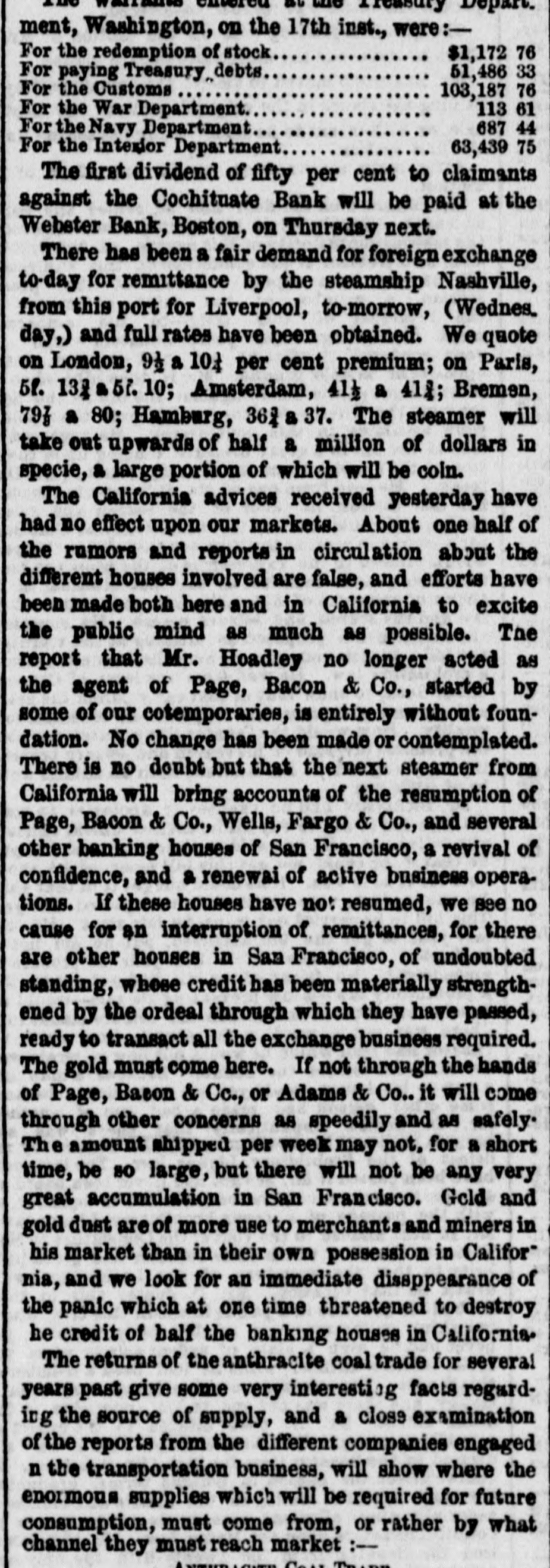
ment, Washington, on the 17th inst., were:For the redemption of stock $1,172 76 For paying Treasury, debts 51,486 33 For the Customs 103,187 76 113 61 For the War Department. 687 44 For the Navy Department For the Interior Department 63,439 75 The first dividend of fifty per cent to claimants against the Cochituate Bank will be paid at the Webster Bank, Boston, on Thursday next. There has been a fair demand for foreign exchange to-day for remittance by the steamship Nashville, from this port for Liverpool, to-morrow, (Wednes. day,) and full rates have been obtained. We quote on London, 91 a 104 per cent premium; on Paris, 58. 132 a 57. 10; Amsterdam, 41½ a 411; Bremen, 79₫ a 80; Hamburg, 362 a 37. The steamer will take out upwards of half a million of dollars in specie, a large portion of which will be coin. The California advices received yesterday have had no effect upon our markets. About one half of the rumors and reports in circulation about the different houses involved are false, and efforts have been made both here and in California to excite the public mind as much as possible. The report that Mr. Hoadley no longer acted as the agent of Page, Bacon & Co., started by some of our cotemporaries, is entirely without foundation. No change has been made or contemplated. There is no doubt but that the next steamer from California will bring accounts of the resumption of Page, Bacon & Co., Wells, Fargo & Co., and several other banking houses of San Francisco, a revival of confidence, and a renewai of active business operations. If these houses have not resumed, we see no cause for an interruption of remittances, for there are other houses in San Francisco, of undoubted standing, whose credit has been materially strengthened by the ordeal through which they have passed, ready to transact all the exchange business required. The gold must come here. If not through the hands of Page, Bacon & Cc., or Adams & Co.. it will come through other concerns as speedily and as safely. The amount shipped per week may not, for a short time, be so large, but there will not be any very great accumulation in San Francisco. Gold and gold dust are of more use to merchants and miners in his market than in their own possession in Califor" nia, and we look for an immediate dissppearance of the panic which at one time threatened to destroy he credit of half the banking houses in California. The returns of the anthracite coal trade for severai years past give some very interesting facts regarding the source of supply, and a close examination of the reports from the different companies engaged n the transportation business, will show where the enormous supplies which will be required for future consumption, must come from, or rather by what channel they must reach market :Cost TRADE


Article from Daily Davenport Gazette, March 22, 1855

Click image to open full size in new tab

Article Text

ele Sim. She brings 262 passengers and $92.000 in gold dust. The news is highly important. Business was entirely prostrated by the suspensi n of five banking houses. The news of Page & Bacon's fficulties was received at San Francisco on the 17th, causing a great run in that house. They met the runand paid half a million of dollars. A meeting of merchants and bankers who declared the house sound, restored coufidence and afterwards matters seemed to wear a better as pect. On the 22d, however, Page, B con & Co. suspended, followed on the 23d by Adams & Co., Wells, Fargo, & Co. Robinson & Co. and Wright's Miners' Deposits. The excitement was intense. Adams & Co. closed all their branches without paying & dollar except in San Francisco, where on the 22d they stood a run of $200.000. Owing to the scareity of water, but little gold had beed taken from the mines, But heavy rains commenced falling on the 25th, and still continued when the steamer left. No election of a United States Senator had taken plice yet, the nvention having adj-urned sine die on the 16th by a vote of 60 to 44-those voting in the minority were principally the frien Is or Mr. Gwin. Wells. Fargo & Co. closed, but their country branches paid as long as their coin lasted, and were still paying as fast as coin could be obtained in exchange for dust and bars. The house announces that they would resume in San Francisco on the 26th. Note:-John Butterfield, Vice President and Superinten lent of the American Express Co., assures us that the suspension of Wells, Fargo & Co. in California, does not effect the American Express Company in any way. It was feared that Adams & Co. could not resume under 60 days, if at all. Page, Bacon & Co. would probably resume in a few days, depositors having granted them time on $400,000. Their assets werelage. go. The heavy failures caused the detention of the 26th. Rumors were current of heavy failures smong the merclants. but we have nothing authentic on this le d. The news from Kerr River is of an exciting character. The miners are said to average twenty dollars per day. Steamers for Peoro the nearest point for disembarka. ton for the mines were g ing crowded with passengers. On the 18th the St. Charles Hotel and Hillman's Hotel in San FrancisCO were di stroyed by fire-loss 800,000In Nevada 16 houses were destroyed by fire on the 16th and in Stockton 25 houses, al1000 the 21st. Indian troubles appear to be on the increase. Some 10 White men and about 40 Indians have been killed The Maraposa gold mining concern had b en sued by the Sheriti. Rodmán Backus


Article from Evening Star, March 22, 1855

Click image to open full size in new tab

Article Text

The Monetary State of California -The news of the very general smash up" in Cal. ifornia over which the Atlantic-side newspapers are now speculating, took few well informed men in this city by surprise. It has long been known here, that extravagance and speculation are the two leading characteristics of the business habits of our brethren in that far western quarter. Characteristics incident to the fact that they are Americans, and, therefore, by constitutional habit, reckless in business operations, and exist among circumstances, more likely to superinduce heedlessness in expenditures than any others to be conceived of. We do not remember ever to have known an individual whose business was nearly allied to gambling, who failed to be extravagant in his personal expenditures-to trust to luck. All the world are aware that nothing can be more common in California than extreme proverty yesterday, and full pockets to-morrow. The newspaper accounts of business affairs there in the last five years have been little more than the jotting down of instances in which men have either suddenly made or lost large sums. In any country in which manual labor may by accident pay, daily, a hundred times as much as will support the laborer, recklessness and an absence of real thrift must be marked characteristics of those who depend on manual labor for their bread; resulting, eventually, in a heavier ag. gregate of lcsses-privations-than of gainswealth. Gold mining in California, up to this period, has been little more than gambling; for it has been carried on, for the most part, without system on the part of those engaged in it, and with little aid from science, which will come into play 80 soon as the gold shall be in a measure exhausted. Then, few will continue to follow-each man or half dozen men without capital-a business in which the changes are that one lucky day will be succeeded by a dozen without success. The surface gold set the community of Cal. ifornia to gambling, and put up everything to gambling rates or prices-money to from three to five per centum a month, to be used in what is termed out there, legitimate business. The immediate cause of the failure of Page, Bacon & Co, Adams & Co., and Wells, Fargo & Co nominally houses engaged in the express bus. iness, but really the great banking houses of the new State-was the fact that they had loaned out their funds to parties in trade at from three to five per centum per month. If their borrowers are good, and some of the California papers 80 insist, they will pay every dollar. We anticipate no such agreeable termination of the general smash-up there how ever. It is impossible that the three largest and most active banks, and half a dozen with less means, in a city of the population and business of San Francisco, can suspend with out thus producing a general crash among their depositors whose money they have loaned out to parties, a large per centage of whom stand ready, of course, to pay up, if at all, in depreciated obligations of the lenders. We question, however, whether these failures will not, in the end, benefit the new State. Her true interest requires that her business habits (system) shall undergo radical and sweeping changes-shall become assimilated to the business system prevaling in older and (commercially) more prudent communities This crash will go far toward bringing about the change we indicate, which cannot fail in turn greatly to benefit the future of those in California who live by the sweat of the brow. Our sympathy is almost wholly with that class, as when they are doing well, all others are prosperous. This axiom holds good everywhere in our country, and its prevalence is really at the foundation of all we are or may hope to be as a signally happy and prosperous people. Liability of Contractors for Transportation, &c.-A case was disposed of a few days ago at the Treasury Department, wherein a contractor, who had bound himself by written agreement to transport certain army supplies from Fort Leavenworth to El Paso, was retarded on his route and


Article from Washington Sentinel, March 22, 1855

Click image to open full size in new tab

Article Text

Total, $1,050,000 The guarantee was then drawn up in due form and signed, and depositors representing about $400,000 of the indebtedness of the house then signed a stipulation granting. the required extension of the terms proposed. Page, Bacon & Co. would, therefore, resume in a few days, having, as they write to New York, made every arrangement. Proposition of Adams & Co. In the Alta California of the 26th we find a long statement of Adams & Co.'s resident partner, in which, after referring to the unexpected run of the 22d, he says: Immediately, and all that night, we made every effort which men could, everywhere in town, to procure coin. Gold dust we had ; I had my own private property and the property of our friends, which, with unparalleled generosity, they had placed at our disposal. We offered a million and a quarter of dollars in the best securities in the world to raise one-fifth of the sum in coin. Every effort and every sacrifice were in vain; it could not be done. The rest is known. These being the facts of our suspension, I desire to make the creditors of the house throughout the State the following proposition That within thirty days from the date the receiver shall pay them 25 per cent. in cash upon all our claims. That the creditors shall receive the balance of their claims from the receiver as fast as he can declare the dividends, and for this purpose he shall be allowed to administer the assets, notes, real estate, &c., of the house, and realize them as fast as possible, without hindrance, and to the best advantage for the creditors, and for the greater security of the creditors that his present bonds, which are for one million of dollars, shall be increased, if deemed necessary. That Adams & Co. shall be allowed to resume their business as heretofore, with such aid as they can obtain from their friends and customers; and in this connection I am deeply gratified to state, that the whole body of our clerks, with the devotion to the house which they have done 80 much to build up, for which no words can thank them, have volunteered, each and all, their services for an entire year, without hire or reward, beyond a bare subsistence." A letter says the creditors have accepted these propositions, and that the house would resume in about two weeks. Wells, Fargo & Co. =George C. Bates, attorney for this house, also issued a card, assuring the people of California that this suspension is merely a temporary one, that no man need lose a dollar by it, and that the resumption of the house, and a continuation of its hitherto prosperous business, may be considered as morally certain." Wells, Fargo & Co. are a Joint Stock Company, with upwards of one hundred and twenty shareholders, many of whom are men of large wealth. Other Matters. We have given above as complete a detail of the circumstances attending the several failures as our limits would admit, confining ourselves to events in San Francisco. The various branches of the houses in the interior of course have also suspended. Bank Excitement in the Interior. The panic extended to the interior of the State; and the branches of Adams & Co. suspended at Sacramento, Marysville, Sonora, Columbia, Stockton, Placerville, Grass Valley, Aubrn, and Coloma. At several of these towns there was much excitement. At Auburn an armed crowd compelled them to open their safes and pay as long as their funds lasted. At Mokelumne they held out at last accounts. Wells, Fargo & Co., suspended at Sacra mento, Marysville, and Nevado, but they held out at Sonora, Mokelumne, Stockton, Placerville, Grass Valley, Auburn, and Coloma. At Sacramento, Page, Bacon & Co., and Read & Co. closed, but the run on other houses had ceased, after a terrible excitement. At Nevada, the banking house of Hamlet Davis had also closed, as had the house of Plume & Co., at Marysville. J. H. Richardson, a banker at Jamestown, disappeared during the excitement, when the miners broke open his safe, and found only twenty dollars. The Merchants. The San Francisco Price Current of the evening of the 24th, denies that there has been any failures of purely mercantile houses. It says: "We have taken especial pains to inform ourselves in regard to this whole matter, and are happy to be able to inform our readers abroad that not a single case of the kind has occurred. The only suspension we hear of at all is that of a prominent Stockton milling house, formerly engaged in the commission business in this city, which has been obliged to stop operations. The liabilities are stated at $160,000, but their assets are heavy, and are all in the country and available." Unsuccesssul Attempt to Free Slaves in


Article from The Union and Eastern Journal, March 23, 1855

Click image to open full size in new tab

Article Text

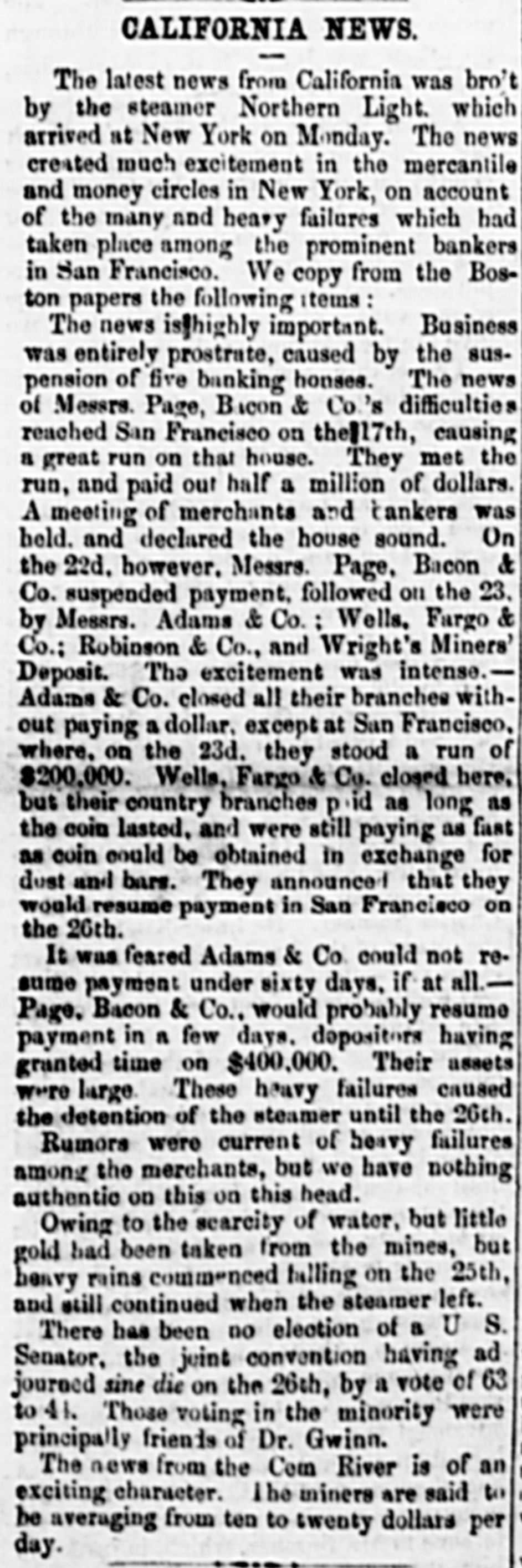
CALIFORNIA NEWS. I The latest news from California was bro't by the steamer Northern Light. which arrived at New York on Monday. The news created much excitement in the mercantile and money circles in New York, on account of the many and heavy failures which had taken place among the prominent bankers in San Francisco. We copy from the Boston papers the following items: The news islhighly important. Business was entirely prostrute, caused by the suspension of five banking honses. The news of Messrs. Page, Bacon & Co.'s difficulties reached San Francisco on the]17th, causing a great run on that house. They met the run, and paid out half a million of dollars. A meeting of merchants and bankers was held. and declared the house sound. On the 22d. however. Messrs. Page, Bacon & Co. suspended payment, followed on the 23. by Messrs. Adams & Co. Wells, Fargo & Co.; Robinson & Co., and Wright's Miners' Deposit. The excitement was intense.Adams & Co. closed all their branches without paying a dollar, except at San Francisco, where. on the 23d. they stood a run of $200,000. Wells, Fargo & Co. closed here, but their country branches paid as long as the coin lasted, and were still paying as fast as coin could be obtained in exchange for dust and bars. They announced that they would resume payment in San Francisco on the 26th. It was feared Adams & Co. could not resume payment under sixty days, if at all.Page. Bacon & Co., would probably resume payment in n few days. depositors having granted time on $400,000. Their assets were large. These heavy failures caused the detention of the steamer until the 26th. Rumors were current of heavy failures among the merchants, but we have nothing authentic on this on this head. Owing to the searcity of water, but little gold bad been taken from the mines, but heavy rains commenced falling on the 25th, and still continued when the steamer left. There has been no election of a U S. Senator, the juint convention having ad journed sine die on the 26th, by a vote of 63 to 41. Those voting in the minority were principally friends of Dr. Gwinn. The news from the Com River is of an exciting character. The miners are said to be averaging from ten to twenty dollars per day.


Article from New-York Daily Tribune, March 26, 1855

Click image to open full size in new tab

Article Text

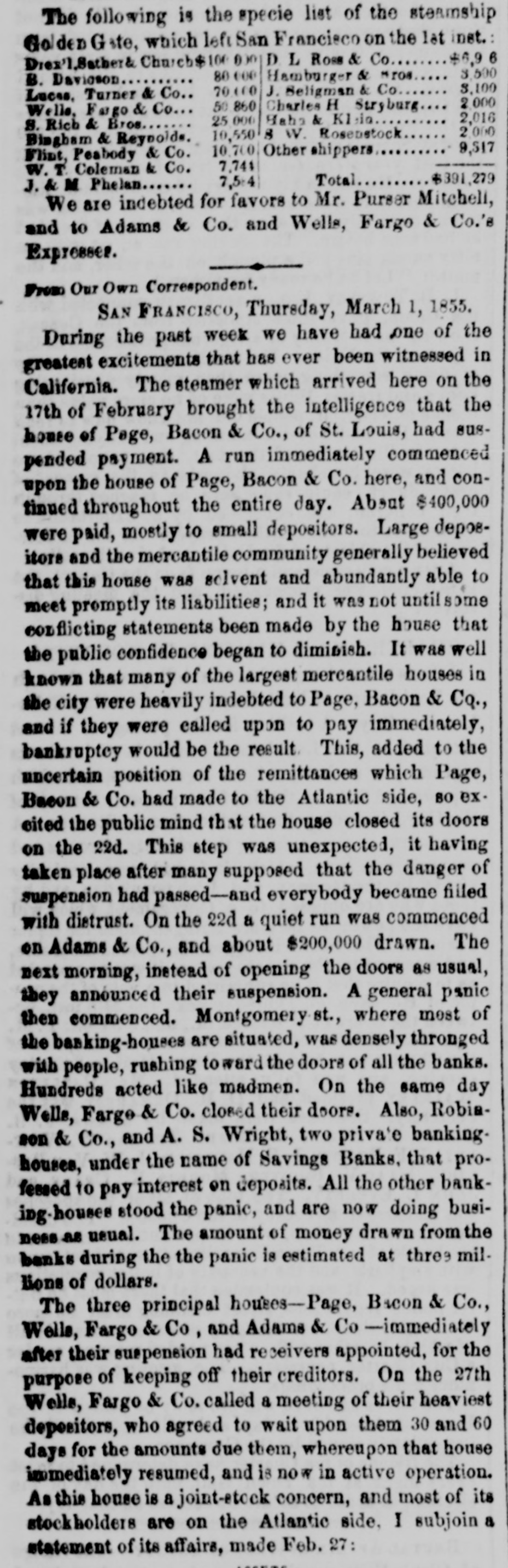
The following is the specie list of the steamship Golden Gste, which left San Francisco on the let inst. D L Ross & Co $6,96 Diex'l.Sather& Church$ 3,500 000 Hamburger & Mros B. Davieson $,100 70,000 J. Seligman & Co Lucas, Turner & Co.. 2,000 50.860 Charles H Stryburg Wells, Fago & Co... 2,016 Haba & Klin 25,000 S. Rich & Bros 2,000 8 W. Rosenstock 10,550 Bingham & Reynolds. 9,517 10,700 Other shippers Flint, Peabody & Co. 7.741 W. T Coleman k Co. $391,279 Total 7,5 4 J. & M Phelan We are indebted for favors to Mr. Purser Mitchell, and to Adams & Co. and Wells, Fargo & Co.'s Expresses. From Our Own Correspondent. SAN FRANCISCO, Thursday, March 1, 1855. During the past week we have had one of the greatest excitements that has ever been witnessed in California. The steamer which arrived here on the 17th of February brought the intelligence that the house of Page, Bacon & Co., of St. Louis, had suspended payment. A run immediately commenced upon the house of Page, Bacon & Co. here, and continued throughout the entire day. About $400,000 were paid, mostly to small depositors. Large depositore and the mercantile community generally believed that this house was solvent and abundantly able to meet promptly its liabilities; and it was not untilsome conflicting statements been made by the house that the public confidence began to diminish. It was well known that many of the largest mercantile houses in the city were heavily indebted to Page, Bacon & Cq., and if they were called upon to pay immediately, bankruptcy would be the result. This, added to the uncertain position of the remittances which Page, Bacon & Co. had made to the Atlantic side, so ex. eited the public mind that the house closed its doors on the 22d. This step was unexpected, it having taken place after many supposed that the danger of suspension had passed-and everybody became filled with distrust. On the 22d a quiet run was commenced on Adams & Co., and about $200,000 drawn. The next morning, instead of opening the doors as usual, they announced their suspension. A general panic then commenced. Montgomery st., where most of the banking-houses are situated, was densely thronged with people, rushing to ward the doors of all the banks. Hundreds acted like madmen. On the same day Wells, Farge & Co. closed their doors. Also, Robiason & Co., and A. S. Wright, two private bankinghouses, under the name of Savings Banks, that professed to pay interest on deposits. All the other banking-houses stood the panic, and are now doing business as usual. The amount of money drawn from the banks during the the panic is estimated at three millions of dollars. The three principal houses-Page, Bacon & Co., Wells, Fargo & Co, and Adams & Co -immediately after their suspension had receivers appointed, for the purpose of keeping off their creditors. On the 27th Wells, Fargo & Co. called a meeting of their heaviest depositors, who agreed to wait upon them 30 and 60 days for the amounts due them, whereupon that house immediately resumed, and is now in active operation. As this house is a joint-stock concern, and most of its stockholders are on the Atlantic side, I subjoin a statement of its affairs, made Feb. 27:


Article from Washington Sentinel, March 27, 1855

Click image to open full size in new tab

Article Text

GRONGE HERVELS THE ao THE LAW. Three DayS Later from California. The Financial Panic Subsided-Resumption of Wells, Fargo & Co.-The House of Page, Bacon & Co. open to special Depositorsplication of Adams & Co. for the benefit of the Insolvent Laws-The House Threatened -yung sburang D fo D fiq Shipments of Gold Excitement at ShastaRain at fast-The Mines, dec. The steamer George Law arrived at New York on Saturday with dates from San Francisco to the 1st instant, only three days later. She brought 234 passengers, among them Colonel Fremont, and $317,800 in gold. The following are the principle consignees: Messrs. Drexel & Co., $100,000: Metropolitan Bank, $70,000; Rich & Brothers, $25,000; Wells, Fargo & Co., $50,000; Adams & Co., $10,000, with other smaller amounts, reaching in all $317,800. The steamship "Golden Gate," Allan McLane, commander, left San Francisco at 10.30 p. m., on the 1st, and made the run to Panama in 11 days and 4 hours, (running time,) the quickest time ever make by any steamer on the Pacific. The outward passengers by the "George Law" were landed at Aspinwall on the morning of the 15th, and left Panama on the "Golden Age" the same day. From the San Francisco Herald, March 1st. The Bank Excitement. The excitement of the past few days seems to have, in some degree, subsided, and as the public became informed of the true position of banking affairs, a disposition is manifest to await the result rather than risk a serious loss by pressing immediate liquidation. of . "II M We take great pleasure in announcing that Wells, Fargo & Co. resumed business yesterday, and everything connected with their estab. lishment went on as usual. The suit of Washburn and others against Pordee, commenced in the Fourth District Court, in which the injunetion was granted, has been discontinued, and an order was entered vacating the appointment jo suairs the jo statement V Receiver. B jo the house shows the assets to be $743,499, and the liabilities $354,394. Nearly all their offices in the interior were able to stand the run upon them without being compelled to shut their doors. Page, Bacon & Co. The banking house of Messrs. Page, Bacon & Co., was open yesterday to special depositors, and parties having property placed in the custody of this house for safe-keeping were afforded an opportunity to withdraw the same. The bank will be open again to-day. Messrs. Page, Bacon & Co. promise, in their new arrangement for resuming their business, to issue certificates of deposit, bearing interest at one per cent per month, which certificates are guaranteed by some of our first men to the 199 dollars. Jo million B JOAO Jo funous bond guaranteeing the certificates has been uoos se puu puu executed as the amount required by the firm is made up, which will, doubtless, be done shortly, the certificates will be issued and the house placed basis. pood B uodn of TP swepv This firm have confessed themselves insolvent, and applied for the benefit of the insolvent act. A stay of all proceedings on the part of the creditors of the firm, and of I. C. Woods is ordered by Judge Lake, and notice is given that the creditors appear on the 31st of March, to show cause why the prayer of the insolvent to be discharged from his debts should not be granted. Application of Adams & Co. for the benefit JO U--AUT Instruction the 10 their affairs. A petition in insolvency was filed in the Fourth District Court by Mr. Isaiah C. Woods, of the firm of Adams & Co., praying to make a cession of his estate and that of his copartnership, to his creditors, and to be released from his debts. The petitioner recites that "in consequence of the general panic which took possession of the people throughout the State, the said firm have recently been called upon to pay an unusual large proportion of the moneys and debts which they owe, and not having on hand sufficient money to meet said demands, within the true meaning of the act," &c., &c. In submitting the schedule of his assets, the : BABS pettion "I entered into the co-partnership of Adams & Co. on the 12th day of May, 1854. I was then perfectly solvent, and possessed property and means over and above all my debts and engagements of the value of two hundred and fifty thousand dollars. I have individually sustained no losses of any considerable amount, nor has the firm of Adams & Co. since I into said co-partnership, except in the preciation of the market value of the erty owned by me and them. The cause of the failure of said firm is only the fact of being called upon to redeem all its liabilities in cash at once, which, from the nature of the business, and the well recognized implied understanding between depositors and banks, is not expected." The following is a statement of the affairs of the House, and of Mr. Woods, individually, made up from the schedules on file: Balance of bank accounts against the house, say $275,000 Balance of certificates 705'167 Bills of exchange on Adams & Co. N., York. 100,000 Liabilities of the country offices, established at 000'00S Total $1,582,19 Individual debts of C. Wood, on which judgments have been confessed. 000'19 Grand total of liabilities. The following is the account of the assets of House the Debts due by depositors, who haveoverdrawn their accounts, say $200000 Negotiable notes and bills 2735796 Notes in suit and over due, say 000'94


Article from The New York Herald, April 3, 1855

Click image to open full size in new tab

Article Text

THE LATEST NEWS. BY MAGNETIC AND PRIN TING TELEGRAPHS. One Week Later from California. arrival OF THE DANIF WEBSTER AT NEW ORLEANS -PAGE, BACON & C' ABOUT TO RESUME PAYMENT -MORE BUSINESS FAILURES-THE DANIEL WEBSTER FIRED INT' BY A SPANISH ORUISER-DEATH OF GEN. CHAMO are CONFIRMED, ETC., ETC. NEW ORLEANS, March 31, 1855. By the ster .mship Daniel Webster, at this port last night, we r are dates from San Francisco to the 9th ultimo. None the suspended bankers had resumed payment, but tb excitement had subsided. It was thought probabl that none of the bankers would resume payment, ex sept Messrs. Page, Bacom & Co. Since the previous steamer sailed, two new failures wre-reported-Messra Chappin, Sawyer & Co., and J. B. Comery. The Supreme Court had decided that persons enclosing land in the mining region, could not hold it against miners. From Oregon we learn that a conventional arrangement had been entered into for the extinguishment of the Indian titles to all lands in Willamette Valley. Our correspondent at Sen? Juan (Nicaragua), writes that General Chamorro. chief of the revolutionary party, is dead, and that the revolution was considered at an end. The captain of the Daniel Webster reports that on his outward passage to San Juan, he was brought to by shots from a Spanish sloop of war, an officer from which boarded the steamer, and after examining her papers, permitted her to proceed on her voyage. The Star of the West left San Juan for New York on Saturday, the 24th ult., with three hundred ihousand dollars in specie. on freight. The clipper ship Fiyaway arrived at San Francisco on the 2d ult., the Cairo on the 3d, and the Electric, Cleopatra and Humbeldt on the 4th-all from New York.


Article from New-York Daily Tribune, April 9, 1855

Click image to open full size in new tab

Article Text

The Union for Havre will take, we believe, but a an. amount of gold; at present we can hear of but about $120,000. It is generally anticipated that the Bank Statement on Monday will show 8 decline of a million in the specie line-the result of the large shipment by the Atlantic. Some parties estimate the loss at even & higher figure. The Sub-Treasury and Assay Offices have paid out during the week about $250,000 more than was received. We received to-day $710,000 in gold by the Illinois, which will fully supply the amount wanted for the Bosto steamer of Wednesday next. The Illinois brings considerably more gold than was aticipated, and her arrival assisted the buoyar feeling in the street to-day. By & reference to the list of consignees, it will be seen to be much more general than formerly. The amount shipped from San Francisco was $921,519, of which $710,167 came to this port. Business in San Francisco continued dull. None of the suspended banking-houses had resumed, although Page, Bacon & Co. proposed to do so on the 26th March. That house has unfortunately complicated their matters by drawing on New-York in favor of their depositors. As an assignment has been made by Mr. Bacon, of course the drafts cannot be paid, and must go back again, and cause new trouble and a new suspension. Several of these drafts on Mr. Hoadley were presented to-day. The rains continued, and the miners were doing well,


Article from Weekly North Carolina Standard, April 11, 1855

Click image to open full size in new tab

Article Text

ONE WEEK LATER FROM CALIFORNIA. Arrival of the Daniel Webster at New OrleansPage, Bacon & Co., about to resume paymentMore Business Failures-The Daniel Webster Fired into by a Spanish Cruiser. NEW ORLEANS, March 31.-By the steamship Daniel Webster, at this port last night, we have dates from San Francisco to the 9th ultimo. None of the suspended bankers had resumed payment, but the excitement had subsided. It was thought probable that none of the bankers would resume payment, except Messrs. Page, Bacon & Co. Since the previous steamer sailed, two new failures are reported-Messrs. Chappin, Sawyer & Co., and J. B. Comery. The Supreme Court had decided that persons enclosing land in the mining region, could not hold it against miners. From Oregon we learn that a conventional arrangement had been entered into for the extinguishment of the Indian titles to all lands in Willamette Valley. Our correspondent at San Juan (Nicaragua) writes that General Chamorro, chief of the revolutionary party, is dead, and that the revolution was considered at an end. The captain of the Daniel Webster reports that on his outward passage to San Juan, he was brought to by shots from a Spanish sloop of war, an officer from which boarded the steamer, and after examining her papers, permitted her to proceed on her voyage. The Star of the West left San Juan for New York on Saturday, the 24th ult., with three hundred thousand dollars in specie on freight. THE CINCINNATI SLAVE CASE. Imprisonment of the United States Marshal-Disappearance of the Slave. CINCINNATI, April - -The United States Marshal has, been committed to jail for contempt of court, in refusing to produce the slave Rosetta, before Judge Parker. It has been found that Rosetta is secreted from the authorities, having been taken from the jail. A report has reached here that a large number of armed men are coming down to-night from Maysville, to take the girl by force to Kentucky, but it is not generally believed. The absence of the girl from jail is causing much excitement. LATER NEWS FROM HAYTI. The Coffee Market-Our Relations with St. Do mingo. BOSTON, April 2.-An arrival at this port bring dates from Hayti to the 14th of March. The coffee crop is reported short, and is selling at $115 per 100 lbs., Haytien currency. The impression in Hayu was, that the proposed treaty between the United States and St. Domingo would never, in its present form, receive the sanc tion® OF the


Article from The Daily Dispatch, May 1, 1855

Click image to open full size in new tab

Article Text

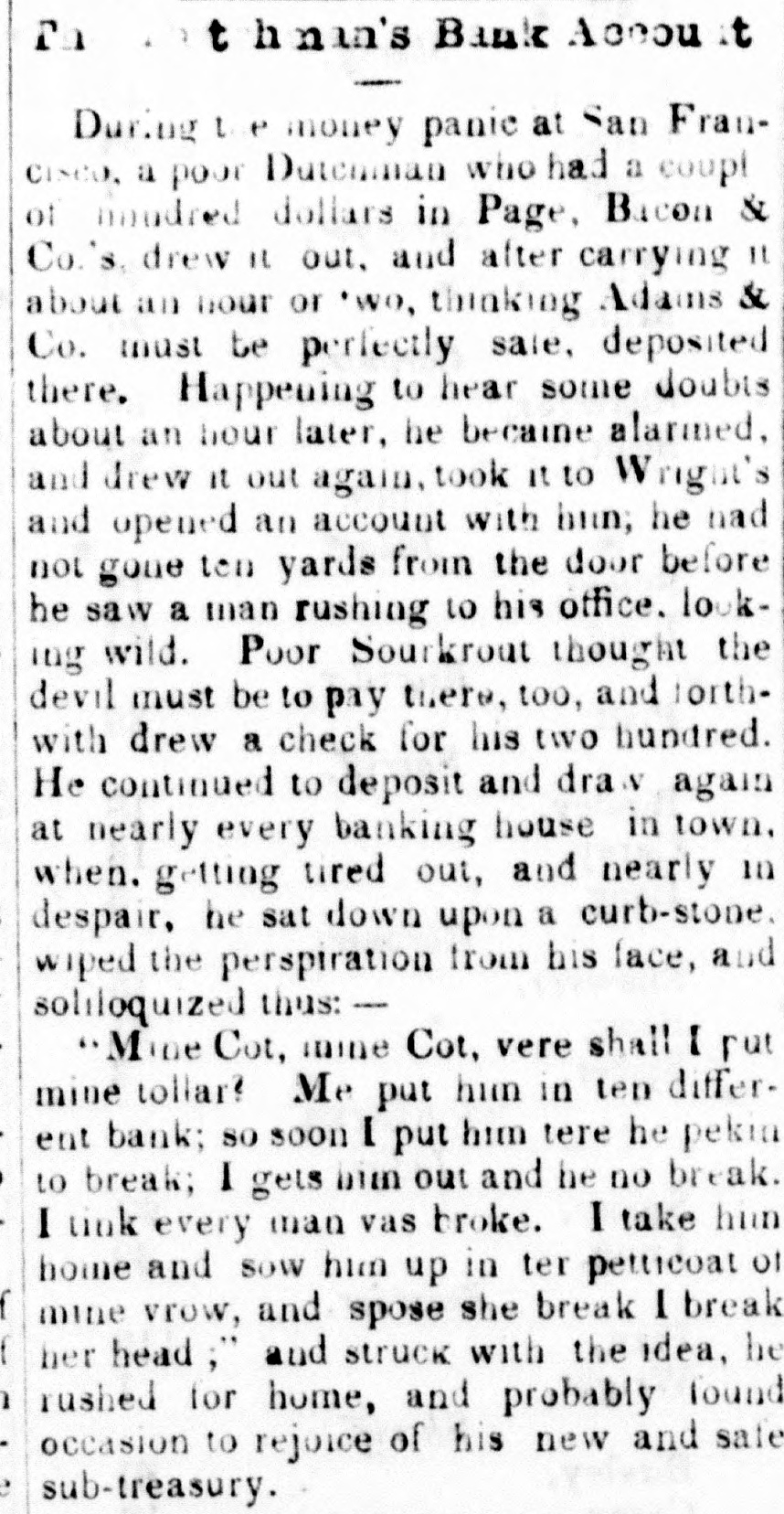
CALIFORNIA FINANCIAL PANIC.-A San Francis^ CO correspondent of the New York Daily Times thus makes light over the perplexities of a email capitalist in that city. who was in trouble for a safe place of investment: "A Dutchman who had a couple of hundred dollars in Page, Bacon & Co.'s drew it out, and after carrying it about an hour or two, thinking Adams & Co. must be perfectly safe, deposited there, Happening to hear some doubts expressed about them an hour later he became alarmed and drew it out again, took it to Wright's and opened an ac. count with him. He had not got ten rods from the door before he saw a man rushing to his office looking wild. Poor Sourkrout thought the devil must be to pay theretoo and rthwith drew a check for his two hundred. He continued to deposit and draw again at nearly every banking house in town, when, tired out and thoroughly in despair, he sat down upon a curbstone, wiped the perspiration from his face, and soliloquised thus: 'Mine Got, mine Got, where shall I put mine dollars I Me put 'em in ten different panks; 80 soon I put 'em tere he bekin to prake I gets him out and he no proke! I take my monis home and BOWS him up in ter petticoat of mine vrow, and spose she prakes I prakes her head.' And struck with the idea he rushed for home, and probably has rejoiced over his plan, which more might have followed and been better off."


Article from Washington Sentinel, June 7, 1855

Click image to open full size in new tab

Article Text

From the San Francisco Herald, May 13, Suspension of Page, Bacon & Co. As might naturally be expected from the news brought by the steamer, a run on Page, Bacon & Co. was commenced yesterday, as soon as the Banking House was opened. A large force of police was stationed inside, and every exertion was made to preserve order. The depositors were admitted one by one, entering at one door, and going out at another. We were informed that before commencing business, Page, Bacon, & Co. had $317,000 in their vaults; which was all paid to the depositors, and those who had procured attachments against the firm on the preceding night. In the morning, Page, Bacon & Co. confessed judgment for the sum of $400,000 in favor of the guarantors of the time certificates issued after the first suspension. In pursuance of this confession of judgment, an execution was issued, and placed in the hands of Sheriff Gorham, who a few minutes before 12 o'clock effected an entrance, and levied upon the remaining property of the firm. The doors were immediately closed. It was in the Herald of yesterday that among other attachments one had been issued for the sum of $75,000. The complaint was, however, afterward withdrawn, as the money had been on special deposite, and under the circumstances no process of law was necessary for its recovery. We were informed that on the closing of the house there was nothing in the vault but some $6,000 or $7,000 in gold dust, which had been placed there on special deposite, and could not therefore be touched. A judgment was also confessed yesterday by Page, Bacon & Co., in favor of F. M. Haight, for the sum of $2,000 on a promissory note, payable in sixty days. hat the assets are, we have at present no means of ascertaining; but it is thought that both here and at St. Louis they will be more than sufficient to cover the liabilities. Considerable anxiety was felt yesterday in regard to the $200,000 sent home by Page, Bacon & Co. by the Golden Gate, but it is thought that in accordance with the ruling of the Posmaster General on a former occasion, the gold dust sent home can be secured for the payment of the drafts, and that no loss will be sustained. Some time after the bank had closed, a poor woman contrived to gain admittance and presented a check for $700. There was not a dollar in the vault which could be made available. The poor woman appeared very much distressed, and Mr. Page handed to her his watch, valued at $350, and $25-all the change he had in his poeket, and also informed her that he would be personally responsible for the remainder. By telegraph last night, we learn that the house of Page, Bacon & Co., at Sacramento, paid all demands presented at the counter yesterday, and published a notice stating that there was sufficient funds in their vaults to meet all demands. It was expected that the bank would resume business this morning. PAGE, BACON & Co., IN SACRAMENTO.-The news of the failure of Page & Bacon, says the State Journal, received last evening, caused consternation almost equal to that of a month or two since. Depositors were alarmed, and a grand rush was made toward the offices of the sheriff and county elerk. A deputy sheriff is on duty watching the banking house of Page, Bacon & Co., to see that no treasure is abstracted. The Shipping List says: The failure of the two largest banking-houses in California-that of Page, Bacon & Co., and Adams & Co., now complete and irrevocablemay well call attention to the way in which the banking business has been conducted in this country. We find that the heaviest business has been done here by establishments connected with large concerns in the East, and in the cases of the houses mentioned above, that connection proved their ruin. There can be no doubt that Page, Bacon & Co., in California, were solvent until they commenced to assist the St. Louis house. Adams & Co. were failed by the mismånagement of the old partners, who, attempting to regulate in New York affairs in San Francisco, involved the concern in bad debts, from which the new partnership could not extricate itself before it was overtaken by the crash produced by the suspension of Page, Bacon & Co. That other houses did not go down with them is owing to the fact that some of them did too small a business to fail on, and that others received extraneous aid of an extraordinary character. The system of banking here wants immediate and strict supervision. We can have no confidence in establishments which are not of us and among us. A house which can be failed by parties thousands of miles away, over whom it can exercise no control, is not to be trusted here. We want local banks-ones which are secured here and managed here; to such only can we trust. Since the above was written, we learn by the arrival of the Nicaragua steamer that by an assignment to D. Hoadley, Messrs. Page, Bacon & Co. have protected as far as they could the parties who took par exchange by sacrificing those who purchased from them after their resumption! This is doing a banking business in a new styleone never heard of before, to our knowledge, and one not likely to be followed by any respectable house hereafter. It is also stated at the close, that Mr. Page has made over four hundred acres of his St. Louis property to protect his bondsmen. The value of it is yet to be determined. From the San Francisco Union of March 24. The Resources of the Gadsden Purchase. We translate, from the German Journal, the following notice of the resources of the Gadsden purchase. written after personal observation by


Article from American Lancaster Gazette, June 14, 1855

Click image to open full size in new tab

Article Text

# Affairs in California. We find the following interesting letter in the New York Tribune: SAN FRANCISCo, Cal., May 9, 1855. Page, Bacon & Co., again suspended payment on the 2d inst. The steamer for Panama left here on the morning of the 1st, and the steamer from Panama did not arrive until the evening of the same day, she having probably been purposely detained so that the interference on this side would be made with shipments of specie on the 1st inst. Early on the morning of the 2d inst., attachments to the amount of about $200,000 were made upon the house and paid to the Sheriff. The doors of the Bank were partly opend to a large crowd and closed finally at noon, greatly to the disappointment of hundreds of persons. The whole sum paid by the house was about $400,000. An assignment has been made by P., B. & Co., to secure the merchants who on a former occasion had become sureties for the payment of drafts which had been sold to enable the house to resume. Of course, its affairs will now go into liquidation. During the past six months three of the most prominent banking houses in this city have failed-Page, Bacon & Co., Adams & Co., and Burgoyne & Co. These large failures, or suspensions as they are called, and rightly called when you consider the poor fellows from whom they have taken all they had to stand upon, have had a depressing effect upon trade and the fictitious prices of real estate. But the chief causes of these failures are now very apparent, even to a large portion of this community. Page, Bacon & Co. have been popular bankers and largely accommodated their customers. Pay-day here is on what is called steamer-day, the day prior to the sailing of each mail steamer, which is on the 1st and 16th of each month. On these days merchants and others without funds have been in the habit of giving checks on the banks-I mean overdrawing their accounts to the amount of $5,000, $10,000 or $15,000 each on a single day. It was generally understood that these overdrawn checks were to be paid on or before the next steamer day, and interest computed for the time the bank held them unpaid. It will be readily seen that this has been, as is now proved; a very unsafe mode of business. Most of the banks have had large sums of money on deposit, which they have been anxious to loan at our high rates of interest. Three per cent per month have been the current rates. But this money has been loaned to persons who have taken all the risks and uncertainties of this fluctuating market, where the most sagacious and thorough business man never knows whether or not he has purchased an article cheap or dear until it has been sold and he has got the procceds of the sale in his pocket. These bankers therefore have been nothing more nor less than speculators pretending to loan their own money for interest, but in fact hazarding the money of their depositors in all sorts of wild and reckless ventures. This is plainly seen in the case of Adams & Co., who have thousands of dollars of assets that are not now and never were worth a farthing. Much of Page, Bacon & Co.'s assets will turn out the same way. Many of the merchants who volunteered to sustain the credit of the house by their indorsement were favorites of P., B. & Co and flourished from bank accommodations. Burgoyne & Co. had less of this management than the others, but it is said that they were too credulous to prosper in this latitude. A banker to be successful here needs a decided character with a sufficient knowledge of men and things to say yes or no as circumstances may require. A man of different stamp will soon go to the wall. Now these bankers have "caved," what do the shrewd people of the East think of the costly service of plate in Broadway to be presented to Mr. H. of the firm of P. B. & Co.? Who pays $15,000 for this plate? It is said the merchants of San Francisco, as a testimony of respect, &c. But is any person so shallow as to suppose that the merchants of this city would give $15,000 to a banker because he had loaned them money at three per cent per month? Nonsense. These men are pets of P. B. & Co., who have had large accommodations and expect more. They will pay for the plate whenever P. B.& Co. will give the money to do it. And P. B. & Co., will pay poor depositors when these plate-men pay their notes, which will not be the case with all of them, I venture to say, in the year 1855. Of a similar character are all "plate" operations. California is no doubt a rich country; but people here are not so cursed rich as to be constantly trying to give away all they have for nothing. What is the motive to present the Agent of the Nicaragua Steamship Company with a service of gold plate valued at $7,000? Steamboatagents are not generally supposed to be the most intellectual men in the world, or to be possessed of the most generous impulses or the broadest philanthropy. Who are the hombres that are moved by some mysterious power to fork out $7,000 for such a purpose? Who furnish supplies to, receive round salaries and have choice pickings from this Company? Of course they don't subscribe anything for this plate. Oh, no! They can't be suspected of doing anything of this sort. The whole matter is simply a "testimony of respect." The present low prices of provisions in this city, compared with the New-York prices, is a most singular and unlooked-for contrast. Superfine flour is sold for $6 bbl., potatoes for 20 cents the bushel, and the meats and vegetables at New-York rates. Green peas, new potatoes and strawberries.


Article from The Cedar County Advertiser, August 15, 1855

Click image to open full size in new tab

Article Text

h Bank Accou t Pa During t e money panie at an FranCISCO, a poor Dutenman who had a coupt of hundred dollars in Page, Bacon & Co.'s drew 11 out, and after carrying 11 about an hour or wo, thinking Adams & Co. must be perfectly sale, deposited there. Happening to hear some doubts about an hour later, he became alarmed. and drew it out again. took it to Wright's and opened an account with bun; he had not gone ten yards from the door before he saw a man rushing to his office. looking wild. Poor Sourkrout thought the devil must be to pay there, too, and forthwith drew a check for his two hundred. He continued to deposit and draw again at nearly every banking house in town, when. getting tired out, and nearly 10 despair, be sat down upon a curb-stone. wiped the perspiration from his face, and soliloquized thus: *Mine Cot, mine Cot, vere shall I rut mine tollar? Me put him in ten differ. ent bank; so soon [ put him tere he pekia to break; I gets unn out and he no break. I link every man vas broke. I take hin home and sow him up in ter petticoat of mine vrow, and spose she break 1 break her head ," and struck with the idea, he rushed for home, and probably found occasion to rejoice of his new and sale sub-treasury.


Article from The Nevada Democrat, February 10, 1858

Click image to open full size in new tab

Article Text

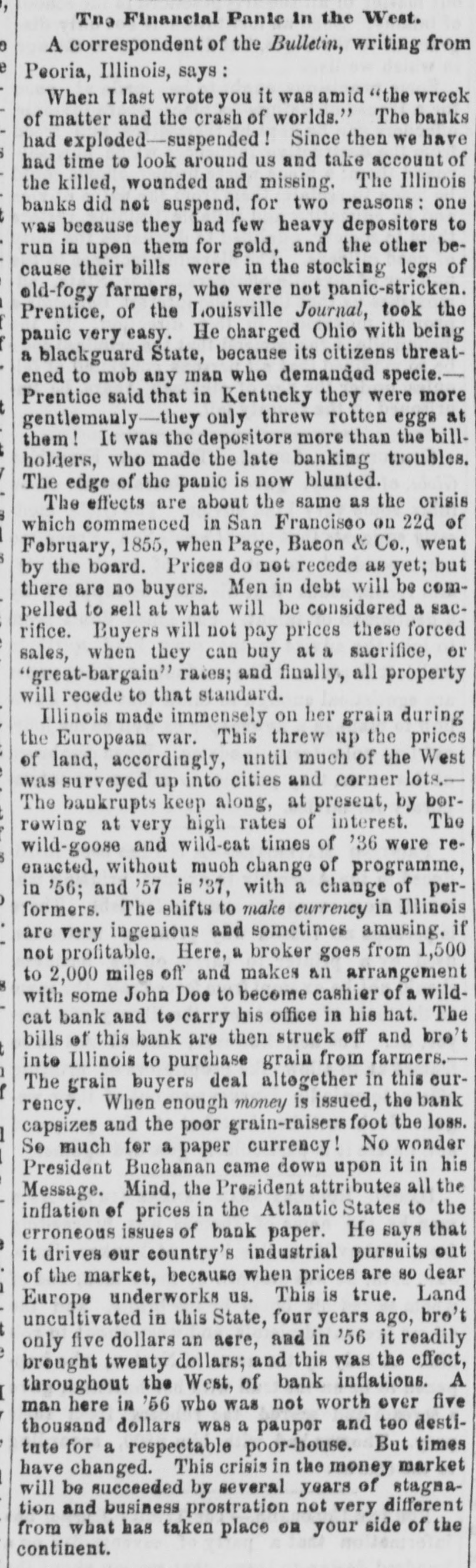
, Tne Financial Panic in the West. 0 A correspondent of the Bulletin, writing from Peoria, Illinois, says: When I last wrote you it was amid "the wreck of matter and the crash of worlds." The banks had exploded-suspended Since then we have had time to look around us and take account of the killed, wounded and missing. The Illinois banks did not suspend. for two reasons: one was because they had few heavy depositors to run in upon them for gold, and the other because their bills were in the stocking legs of old-fogy farmers, who were not panic-stricken. Prentice, of the Louisville Journal, took the panic very easy. He charged Ohio with being a blackguard State, because its citizens threatened to mob any man who demanded specie.Prentice said that in Kentucky they were more gentlemaaly-they only threw rotten eggs at them! It was the depositors more than the billholders, who made the late banking troubles. The edge of the panic is now blunted. The effects are about the same as the crisis which commenced in San Francisco on 22d of February, 1855, when Page, Bacon & Co., went by the board. Prices do not recede as yet; but there are no buyers. Men in debt will be comto sell at what a sacwill not pay rifice. pelled Buyers will be prices at considered sacrifice, these forced or sales, when they can buy a "great-bargain" rates; and finally, all property will recede to that standard. Illinois made immensely on her grain during the European war. This threw up the prices of land, accordingly, until much of the West was surveyed up into cities and corner lots.The bankrupts keep along, at present, by borrowing at very high rates of interest. The wild-goose and wild-cat times of '36 were rewithout much change of programme, in and '57 is a perenacted, '56; '37, with change of formers. The shifts to make currency in Illinois are very ingenious and sometimes amusing. if not profitable. Here, a broker goes from 1,500 to 2,000 miles off and makes an arrangement with some John Doc to become cashier of a wildcat bank and to carry his office in his hat. The bills of this bank are then struck off and bre't into Illinois to purchase grain from farmers.The grain buyers deal altogether in this eurWhen enough money is issued, the bank and the for a currency! So rency. capsizes much paper poor grain-raisers foot No the wonder loss. came down upon the of in the inflation Message. President Mind, Buchanan prices President Atlantic attributes States it all to in the the his erroneous issues of bank paper. He says that it drives our country's industrial pursuits out of the market, because when prices are 80 dear Europe underworks us. This is true. Land uncultivated in this State, four years ago, bro't only five dollars an aere, and in '56 it readily dollars; was the West, of throughout brought twenty and bank this worth inflations. the effect, five A man here in '56 who was not over thousand dollars was a pauper and teo destitute for a respectable poor-house. But times have changed. This crisis in the money market will be succeeded by several years of stagnation and business prostration not very different from what has taken place on your side of the continent.


Article from The Sun, February 11, 1870

Click image to open full size in new tab

Article Text

TUTC Correspondence of The Sun. SAN FRANCISCO, Jan. 30 Our Constitution pro hibits banking. but permits individuals or corporations to establish places of deposit" for the safe keeping of money. The consequence of this clause In the organic law of the St has been the encouragement of some of the grossest impositions on the people. The houses of Adams & Co., Page, Bacon & Co., Palmer Cook & Co. and several others were such places of deposit, in which up ward of $8,000,000 of the people's money was deposited, but not a dollar of which was ever recovered These firms all broke and not one ever paid dollar to its creditors So notorious had become the dishonesty of California bankers' that from 1834 to 1858 many millions in coin and dust burled, in preference to crusting them to the banks. July, 1857, and loan society was es tablished in San Francisco. Since then nine others have been established in that city, and as many more in various parts of the State, the combined capital of the whole number not exceeding $1,000. THE BANK OF CALIFORNIA was organized with a capital-on paper- of $2,000, 000: but the city assessment roll proves that its man agers swore to having a capital of only $600,000 The growth of these savings banks and expansion of the power of the Bank of California have been the nost disastrous circumstances in the financial and general history of the Pacific coast. The power of the Bank Ring," thus created, has enabled it to control the Legislatures and press of nearly the whole coast. and compelled both to serve its purpose of inflating the value of real es. tate and speculative stocks. Capital by this means has been exempted from taxation (the Tax Colector's report for 1869 shows that $12,039,763 loaned on mortgages paid no taxes). while THE BURDEN OF TAXATION presses 80 heavily OD every department of trade and productive industry that manufacturer have never flourished-coul not have existed for 3 year but for the cheap labor of the Chinese-and business has been cut off to great extent since the completion of the Pacific Railroad, by merchants in the Atlantic States being able to undersell the local merchants. through using cheaper money and paying less taxes. It is one of the most noterious facts connected with this vicious system that the Executive Com. mittee of the Board of Directors of the Bank of California are more fully REPRESENTED IN THE NATION L COUNCILS this at Washington than hare the people of coast. No aspirant for Congressional or Senatoria honors can hope for success in any State on this side the Rocky Mountains, unless he makes friends and gives pledges to the Bank of California. It is no secret in Nevada that Senators Stewart and Nye of that State had their seats in the United States Sen ate purchased with money provided by the bank. Tom Fitch, the Congre sman from that State belor Mr Sharon, the manager of the Bank's branch office in Virginia City Senators lliams and Corbett, of Oregon, are in the service of the bank Senator Casserly, of California was the bank attorney for many years prior to his election to the Senate and stili retains the same position This gentleman election was obtained solely by the FREE USE OF THE BANK'S GOLD. The Democracy never trusted him. and the Re ublicans despise him. Senator Cole of this State, has gained the hostilitv of this bank power I fusing to serve its purposes. This gentleman persisting in demanding the rem oral of certain off. cers in the Branch Mint San Francisco was an unpard offence because broke up arrange ments betw the mint and the bank which were very advanta us the latter. It is only necessary to call single fact to demonstrate the chara this connection. The bank bad "responsib rty. acted as bookkeeper for the Sub-T: rer and for the mint at the same which time, EXCEEDINGLY CONVENIENT when it was necessary to balance the accounts of the of the public service. The been would had have two for the salary M these book the mint It was the system. to the make lossee on much very bullion they the refinery. To carry out this NICE LITTLE ARRANGEMENT. certain grains of gold. ranging in value from one dollar retained by the melter, but under the new regune returned to the depositor to whom they belong refin the aim of the bank being monopolize the ing business or this coast. and thus to be dietate terms to the gold bulls and hears tion New to York. Three different bills have been Cofe to beat managed sented Congress carry out this nice little game, into To details Mr of the injuries inflicted on the enter of this State the Bank Ring. crea people financial system. would ture of ar permicious tend this letter beyond reasonable Hunte Its crown ing infamy was its HOSTILITY TO THE NATIONAL CURRENCY the This one circumstance so clearly illustrates power and machinery of the Bank Ring, some effects of our financial system, that I shall refer at length. to tha the people of California gave more The fact the soldiers and money to the fund for the relief of the Union during the late than any in mailors of the nation. is a proof of the loyalt people when they were their hearts. Yet the time of of thousands of dollars. their mone by tens the Bank LIVING the service of the press of the State in were stigmatizing as dirty rags. trash," the promises to which the heroes of the Union and the rency officers with of the Federal Government were for their services. The Legislature, UNDER THE CONTROL OF THE LOBBY, the service of the Bank. the leader of of which in Gorbam. now Secretary was George Senate, passed laws to United States national currency in Call This currency the cir ulation of the by ti.is preaching, teachfornia publishing against it, became HO odious that any one ing, and attempting to one lege cons dered guilty of the The soldier discharged from received the money here which he and the the importe money his goods New York or Bor ston for which to the be sold and goods here brought attempted to nso it, had their names publisted in the papers as persons GUILTY OF AN INFAMOUS OUTRAGE. the could survive impt politician the favoring No paper or adoption of the national tation Whoever had the temerity to say a currency despised currency. ran the same favor of this as an abolitionist before of personal violence utterar to have done by giving war would subject slavery any of the South The opinions on the Assistant Federal Treasurer. ern States. 1862, barely escaped with his life the ado) Cheese inan, in currency in public speaking the city of San Francisco, of Bank the to California, vened by that of act to e odium clings his urged against reappoint he position filled for entieman, and is now eight years of the Federal Government. This molding of public opinion by ALL OPPOSITION to the gains immense has been the them Bank Rink, goods less long than time, fins the and dollar on cents goods no among 500,000 prosperous, r gold. With people like these 1000,000 annuThe California, importer were fully fifty the cent This source of the California extravagan without liberality, vulcar,