982. Pacific Bank (San Francisco, CA)

Bank Information

Episode Type
Suspension β†’ Closure
Bank Type
state
Start Date
June 23, 1893
Location
San Francisco, California (37.780, -122.419)

Metadata

Model
gpt-5-mini
Short Digest
d5c85988bd682b09

Response Measures

None

Description

The Pacific Bank of San Francisco suspended operations and did not successfully resume as an ongoing concern. Initial press in June 1893 noted the bank 'decided not to open the doors' (suspension) and later articles document examination by state bank commissioners, appointment of receivers and winding up (October–November 1893). The immediate cause was bank-specific insolvency/peculation and misappropriation by insiders rather than a rumor-driven run. Early hopes of reorganization/reopening were overtaken by findings of massive bad loans and alleged looting, leading to receivership and legal actions. Dates are taken from newspaper reports; OCR errors in some articles corrected (e.g., acific -> Pacific).

Events (6)

1. June 23, 1893 Suspension
Cause
Bank Specific Adverse Info
Cause Details
Clearing-house refused the bank's paper; heavy call liabilities, large loans on poor/speculative securities and inability to meet obligations led directors to close to realize on the assets and prevent a run.
Newspaper Excerpt
In consequence of the notice from the clearing house ... the directors of the Pacific bank decided not to open the doors in the morning.
Source
newspapers
2. June 30, 1893 Other
Newspaper Excerpt
Both Suspended Banks Expect to Reopen, The Pacific as a New Incorporation ... Mr. Bowen said arrangements were under way for a reorganization and that the bank would soon probably start up under a new management as a new corporation.
Source
newspapers
3. August 6, 1893 Other
Newspaper Excerpt
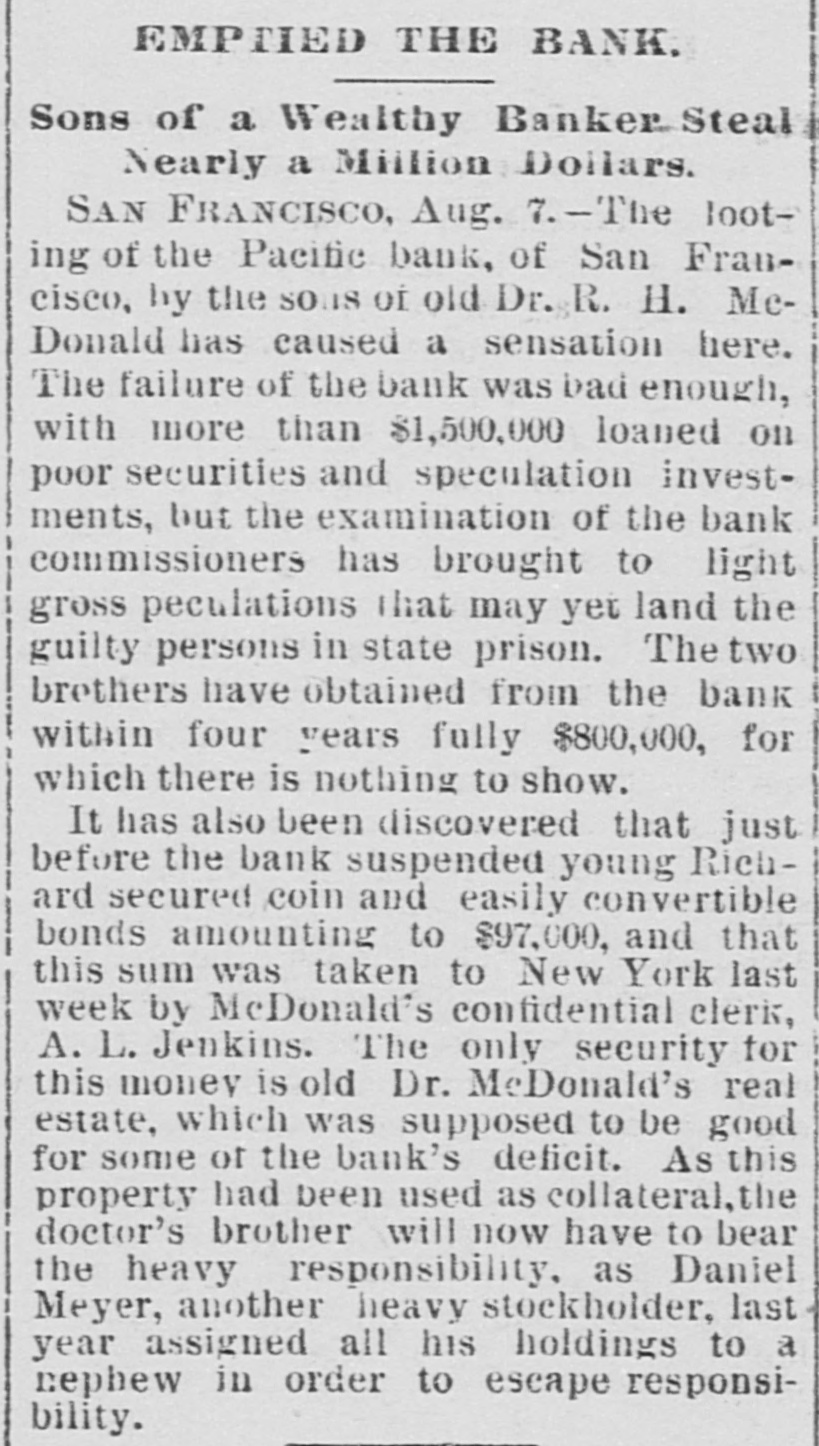
The looting of the Pacific Bank ... the two brothers have obtained from the bank within four years fully $800,000 for which there is nothing to show (peculations/embezzlement revealed).
Source
newspapers
4. October 22, 1893 Receivership
Newspaper Excerpt
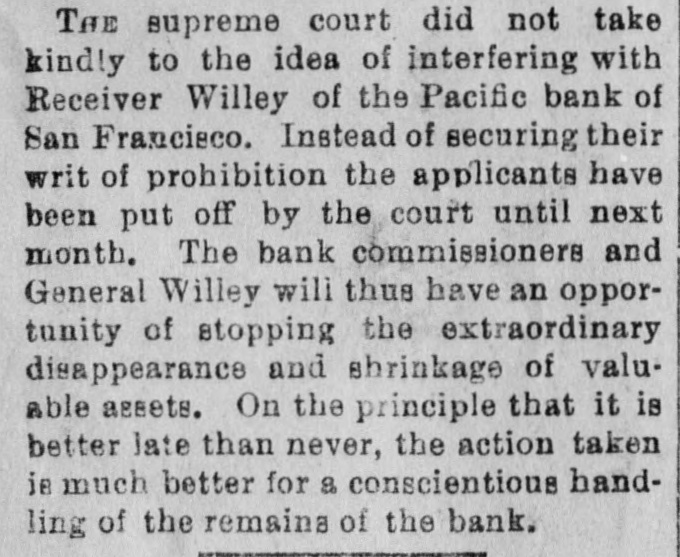
The supreme court did not take kindly to the idea of interfering with Receiver Willey of the Pacific bank of San Francisco ... the action taken is much better for a conscientious handling of the remains of the bank.
Source
newspapers
5. November 5, 1893 Other
Newspaper Excerpt
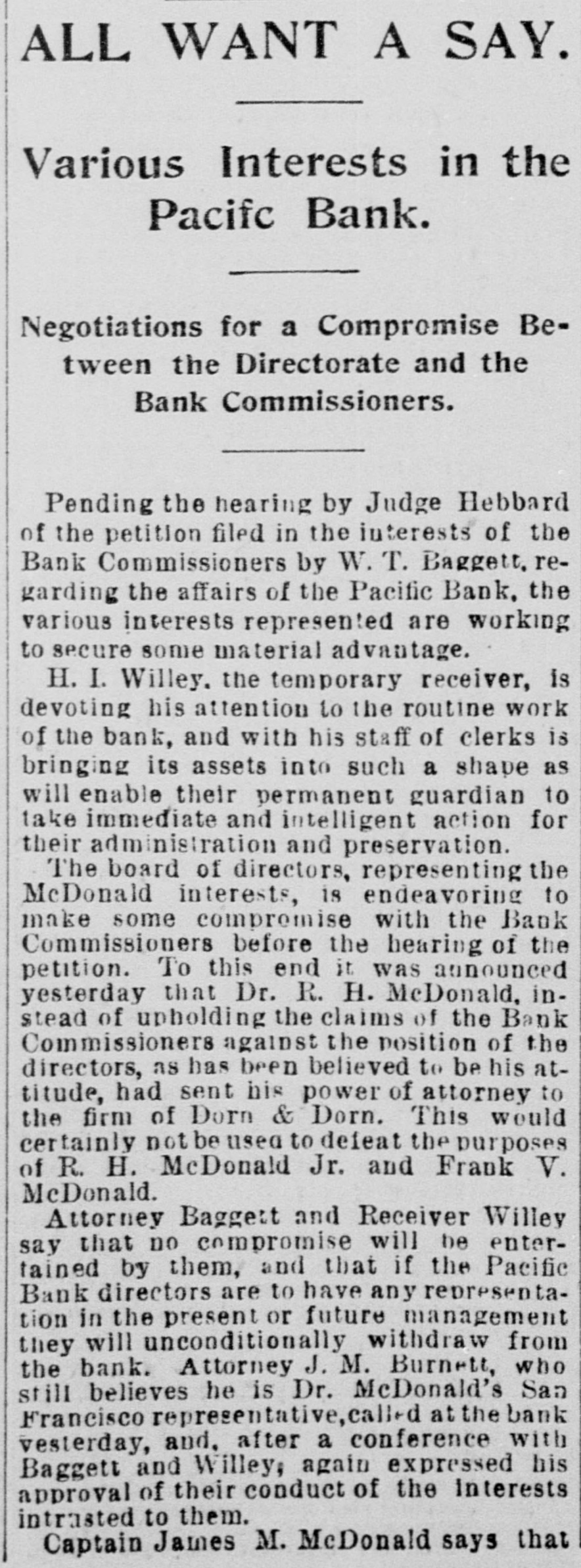
The New Receivers in the Pacific Bank. JUDGE HEBBARD'S DECREE. ... Farnum and Willey took charge ... bringing its assets into such a shape as will enable their permanent guardian to take immediate and intelligent action for their administration and preservation.
Source
newspapers
6. May 11, 1894 Other
Newspaper Excerpt
Bank Wreckers Indicted. ... indictment for grand larceny against directors of the People's Home Savings bank ... an indictment for grand larceny was also found against Frank V. McDonald, late assistant cashier of the Pacific bank.
Source
newspapers

Newspaper Articles (25)

Article from The Morning Call, June 23, 1893

Click image to open full size in new tab

Article Text

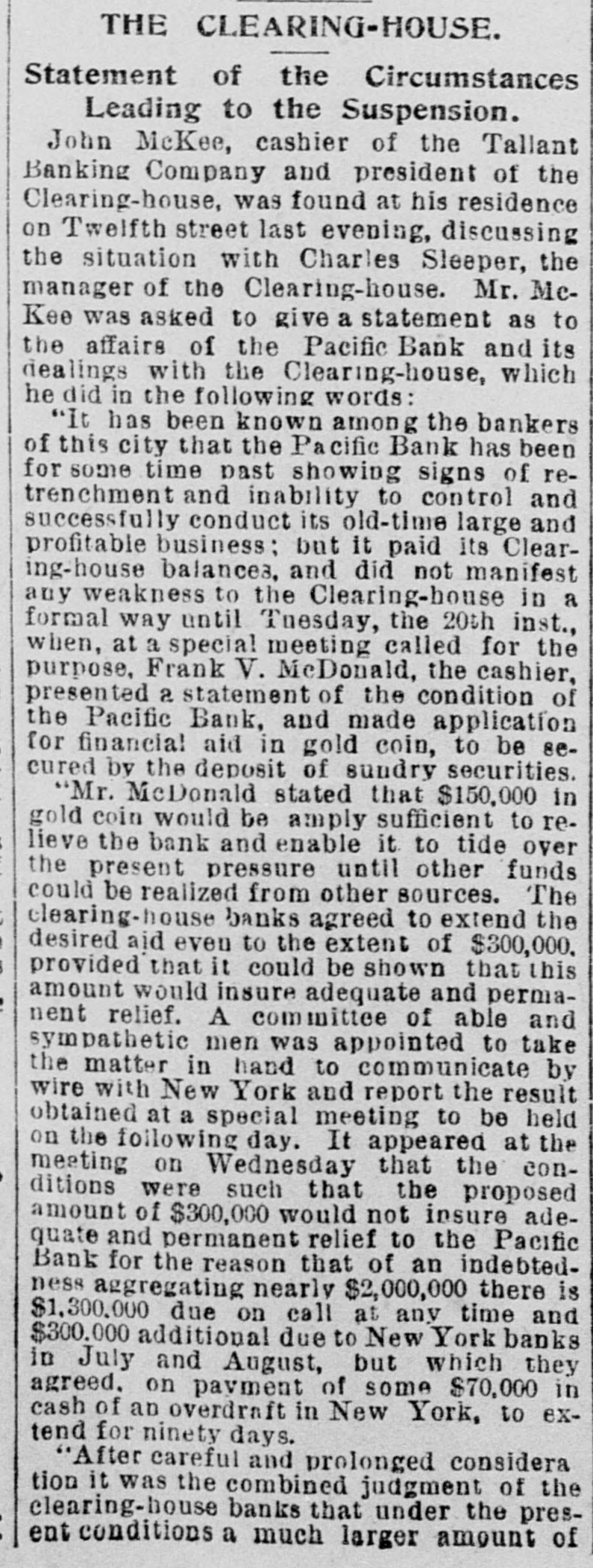
THE CLEARING-HOUSE. Statement of the Circumstances Leading to the Suspension. John McKee, cashier of the Tallant Banking Company and president of the Clearing-house, was found at his residence on Twelfth street last evening, discussing the situation with Charles Sleeper, the manager of the Clearing-house. Mr. McKee was asked to give a statement as to the affairs of the Pacific Bank and its dealings with the Clearing-house, which he did in the following words: "It has been known among the bankers of this city that the acific Bank has been for some time past showing signs of retrenchment and inability to control and successfully conduct its old-time large and profitable business; but it paid its Clearing-house balancea, and did not manifest any weakness to the Clearing-house in a formal way until Tuesday, the 20th inst., when, at a special meeting called for the purpose, Frank V. McDonald, the cashier, presented 2 statement of the condition of the Pacific Bank, and made application for financial aid in gold coin, to be secured by the deposit of sundry securities. "Mr. McDonald stated that $150,000 in gold coin would be amply sufficient to relieve the bank and enable it to tide over the present pressure until other funds could be realized from other sources. The clearing-house banks agreed to extend the desired aid even to the extent of $300,000. provided that it could be shown that this amount would insure adequate and permanent relief. A committee of able and sympathetic men was appointed to take the matter in hand to communicate by wire with New York and report the result obtained at a special meeting to be held on the following day. It appeared at the meeting on Wednesday that the conditions were such that the proposed amount of $300,000 would not insure adequate and permanent relief to the Pacific Bank for the reason that of an indebtedness aggregating nearly $2,000,000 there is $1,300,000 due on call at any time and $300.000 additional due to New York banks in July and August, but which they agreed. on payment of some $70,000 in cash of an overdraft in New York, to extend for ninety days. "After careful and prolonged considera tion it was the combined judgment of the clearing-house banks that under the present conditions a much larger amount of
Article from The Salt Lake Herald, June 24, 1893

Click image to open full size in new tab

Article Text

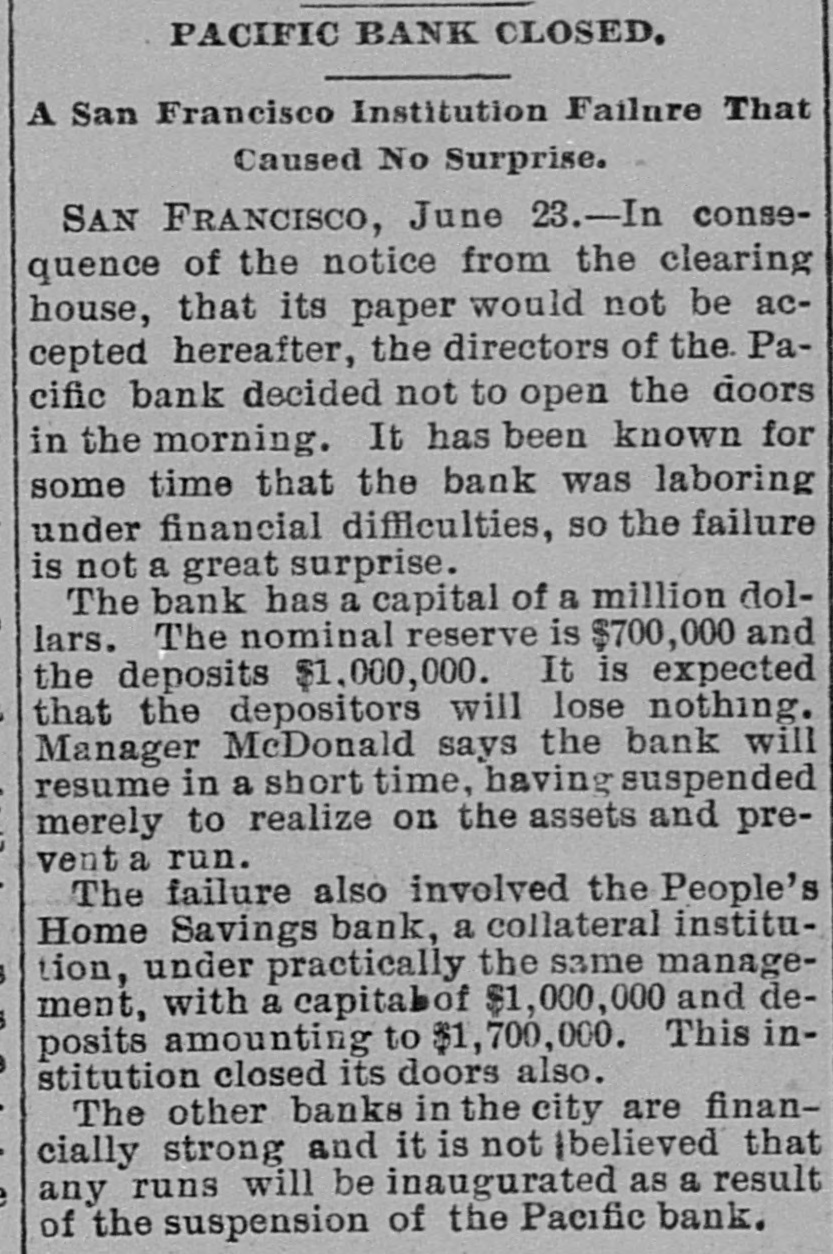
PACIFIC BANK CLOSED. A San Francisco Institution Failure That Caused No Surprise. SAN FRANCISCO, June 23.-In consequence of the notice from the clearing house, that its paper would not be accepted hereafter, the directors of the. Pacific bank decided not to open the doors in the morning. It has been known for some time that the bank was laboring under financial difficulties, so the failure is not a great surprise. The bank has a capital of a million dollars. The nominal reserve is $700,000 and the deposits $1,000,000. It is expected that the depositors will lose nothing. Manager McDonald says the bank will resume in a short time, having suspended merely to realize on the assets and prevent a run. The failure also involved the People's Home Savings bank, a collateral institution, under practically the same management, with a capital of $1,000,000 and deposits amounting to $1,700,000. This institution closed its doors also. The other banks in the city are financially strong and it is not |believed that any runs will be inaugurated as a result of the suspension of the Pacific bank.


Article from The Seattle Post-Intelligencer, June 25, 1893

Click image to open full size in new tab

Article Text

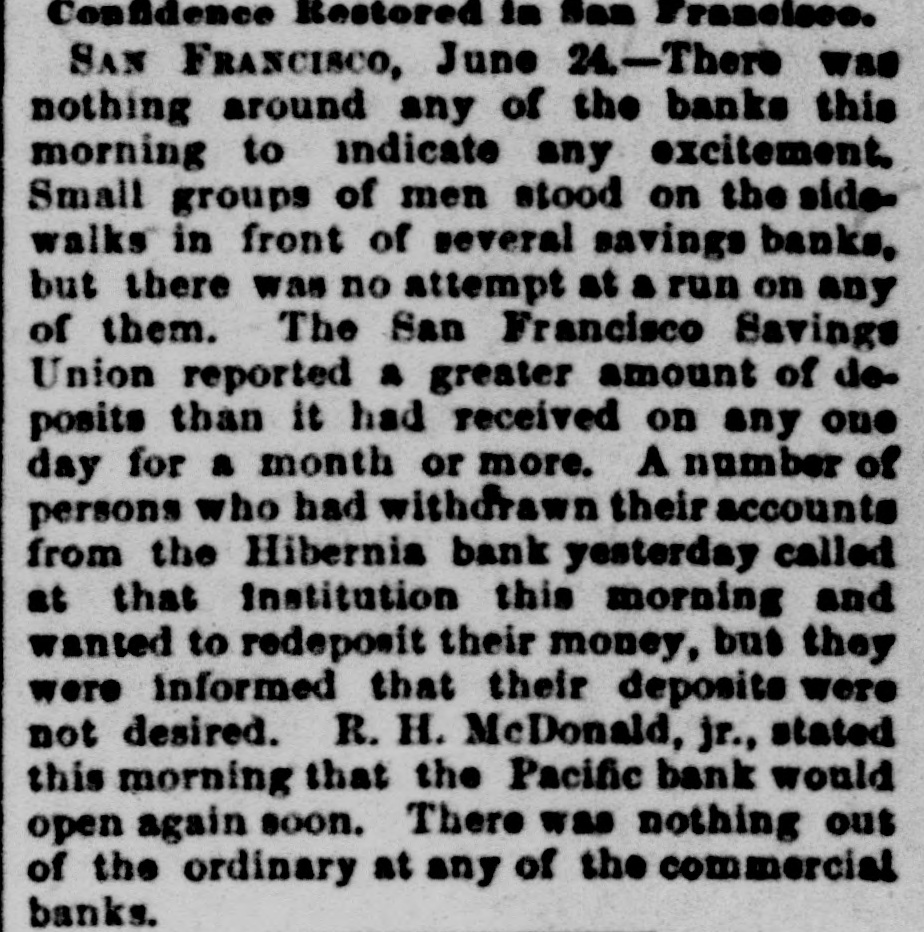
Confidence Restored in was Francisco. SAN FRANCISCO, June 24.-There was nothing around any of the banks this morning to indicate any excitement. Small groups of men stood on the sidewalks in front of several savings banks, but there was no attempt at a run on any of them. The San Francisco Savings Union reported a greater amount of de. posits than it had received on any one day for a month or more. A number of persons who had withdrawn their accounts from the Hibernia bank yesterday called at that Institution this morning and wanted to redeposit their money, bus they were informed that their deposits were not desired. R. H. McDonald, jr., stated this morning that the Pacific bank would open again soon. There was nothing out of the ordinary at any of the commercial banks.


Article from The Herald, June 29, 1893

Click image to open full size in new tab

Article Text

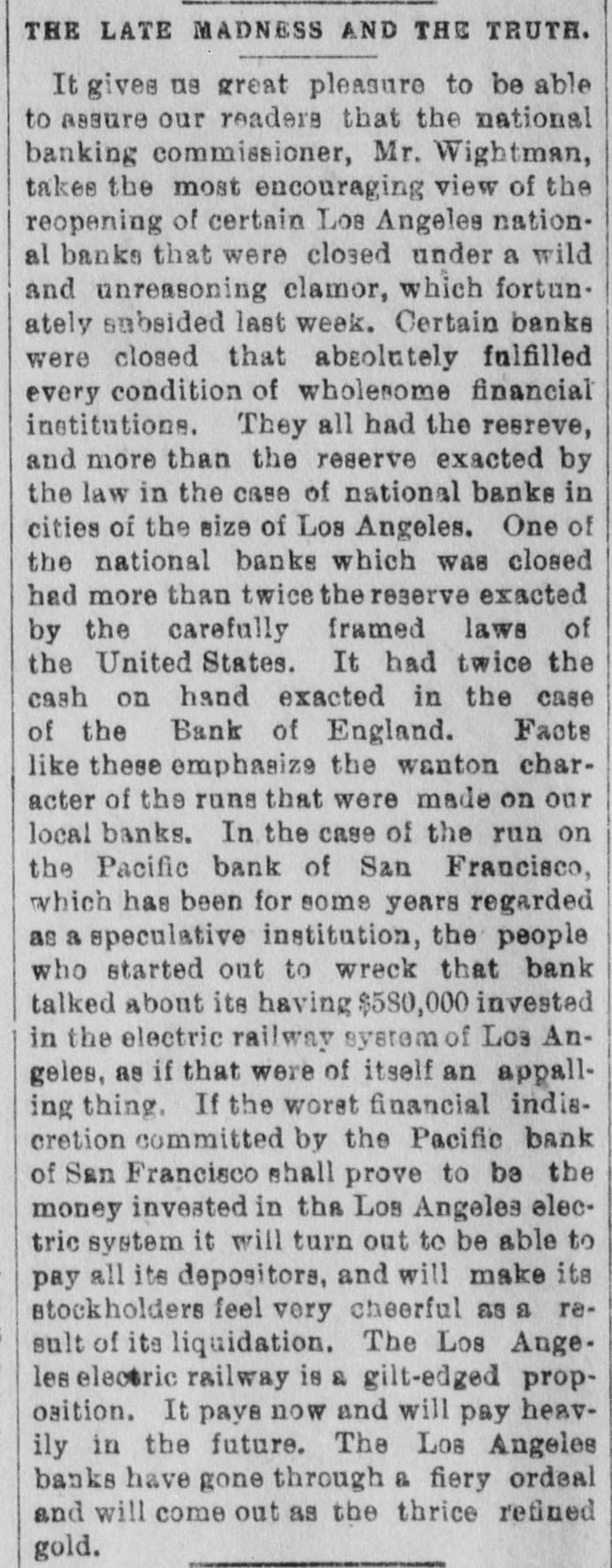
THE LATE MADNESS AND THE TRUTH. It gives us great pleasure to be able to assure our readers that the national banking commissioner, Mr. Wightman, takes the most encouraging view of the reopening of certain Los Angeles national banks that were closed under a wild and unreasoning clamor, which fortunately subsided last week. Certain banks were closed that absolutely fulfilled every condition of wholesome financial institutions. They all had the resreve, and more than the reserve exacted by the law in the case of national banks in cities of the size of Los Angeles. One of the national banks which was closed had more than twice the reserve exacted by the carefully framed laws of the United States. It had twice the cash on hand exacted in the case of the Bank of England. Facts like these emphasize the wanton character of the runs that were made on our local banks. In the case of the run on the Pacific bank of San Francisco, which has been for some years regarded as a speculative institution, the people who started out to wreck that bank talked about its having $580,000 invested in the electric railway system of Los Angeles, as if that were of itself an appalling thing. If the woret financial indiacretion committed by the Pacific bank of San Francisco shall prove to be the money inveated in the Los Angeles electric system it will turn out to be able to pay all its depositors, and will make its stockholders feel very cheerful as a result of its liquidation. The Los Angeles electric railway is & gilt-edged proposition. It paye now and will pay heavily in the future. The Los Angeles banks have gone through a fiery ordeal and will come out as the thrice refined gold.


Article from The Morning Call, June 30, 1893

Click image to open full size in new tab

Article Text

A HOPEFUL VIEW. Both Suspended Banks Expect to Reopen, The Pacific as a New Incorporation and the People's Home With More Money. Just what will be the next step for the Pacific Bank is still a matter of some doubt. Cashier Frank V. McDonald is now in Chicago, said Vice-President R.H. McDonald Jr. at the bank yesterday afternoon, being on his way to New York, where their father now is. Mr. McDonald had not much to say, but both he and Director Bowen, who was also in the bank, took a hopeful view of the future. The latter said that arrangements were under way for a reorganization and that the bank would soon probably start up under a new management as a new eorporation. New capital, he said, would likely be put into it. Mr. Bowen also communicated what re said was a private intimation from Bank Commissioner Knight, who has been examining the bank's condirion, that the bank was solvent. Mr. McDonald was also of the opinion that the result of the official investigation would show the institution to be solvent. Whatever will be done in the future. however, depends largely upon Captain James McDonald. Mr. Knight is practically through with the most laborious part of his work. He has done nothing vet with the People's Home Savings Bank, other than to count the coin on hand, with the result, he says, that the amount of cash found in the vaults did not differ materially from Manager Farnum's statement. As to the Pacific Bank he did not find $53,000 in actual cash in its possession. There were a great many tags and checks, but not that amount in hard coin. The Sheriff taking possession of the Pacific Bank under the Ferdinand Smith claim of $21,000 has interfered with Mr. Knight considerably, says that official. It was hoped that the injunction question would be heard to-day. but Attorney-General Hart has sent word that he cannot be present, so a continuance of the hearing will doubtless be necessitated. He will be here on Monday, though, and so will Bank Commissioners Gerberding and Dunsmoor. They are now at Los Angeles. The Riverside Bank, so Mr. Knight asserts, has also contributed toward the complication of the Pacific Bank, owing to the transactions between the two institutions. The commissioners will devote Monday to the affairs of the Pacific Bank, and then they will look into the condition of the People's Home Savings Bank. One of the commissioners cannot alone make a report; it takes a majority of the board. Speaking of the People's Home Savings Bank, Mr. IcDonald says the utmost efforts are being put forth toward getting all the collections possible, and that when it does start up again it will be with more of a cash capital, and he, as a director, will 80 vote.


Article from The Morning Call, July 6, 1893

Click image to open full size in new tab

Article Text

BANKING SCHEME. Plan to Reorganize the Pacific. DANIEL MEYER IN THE DEAL. Favorable Reports Concerning Home the Condition of the People's Savings Bank. the The natural anxiety existing investigation with regard of the to the result of the of Pacific Bank increased, by the rather Bank affairs has been reCommissioners by report in circulation the bank than allayed. the reorganization of garding under different management. credited Meyer, the banker, is reorganizaDaniel fathering the scheme for reputation with has won considerable but hithtion. He in this kind of work, received n the past insurance companies have of action. erto the his attention in this line supposed to most of the present instance of 1600 He is in in behalf of the owners number shares of be acting the capital stock and to of get a control of moneyed Pacific men Bank who on desire satisfactory, which There of the means profitable, terms. which the of course shares in the bank, of Captain are McDonald 10,000 family proper personal own 5011, friends 3389 McDonald and his shares. New and J. the Meyer faction at 1600 present in Dr. McDonald purpose is of submitting and to can- an York for the He is 73 years of age active part expected operation. to take very That duty in not be straightening out affairs. the SOD, Frank V., falls principally New upon York. How the he regards Meyer who overtures is alsoin being made by Mr. Meyer. the is not known. but the deal yessyndicate asked regarding passing beupon being said "Telegrams are but so far terday tween here and New been arranged. York, Yes," nothing definite has to query, "some he added in response for the rehabilitation of arrangement cards. the such Pacific Bank is on the obviate the plan would of While such for a the appointment interests a to re- be necessity would be many the present ceiver there One stockholder, resist in and gain the condition placated. of affairs, courts could if the bank's wishes. assets relief disposed from off contrary to be his quieted by in full a is are True, a few "kickers' for their might stock. or at the that rather precarious who objects. payment rate of $145 way, per share. as it really but offers a premium to the man who is the only repre- just sentative to find inclined R.H. McDonald, of the family at the bank in brightness even affairs. now, present is uncertain state said, of "as well as the surprised.' he people-mer gratified have been at the number and of not in the orbusiness acquaintances of the term friends- when dinary come acceptation in every day and again say that they will our who doors are to opened assist in helping us it out. 18 do all they will can be found all right absence and of any The bank think that in the presto relieve that brought US of sure absurd means the to same the cause recent closed financial the doors to grief might institutions. have I know of that one other similar bank in Boston large and influential disaster. For an hour was on the verge of discussed the advisability of the directors the doors. The assistance clearing-house. and closing to their perfectly however, came averted. That bank is cannot crisis was so is this, but you securities solvent ways realize and immediately on without heavy the loss." Bank Commissioners and will con- not be to able form tinue Meantime to probe into any the books clear idea of the for several days. assets and liabilities Gerberding upon being the atti- interrogated Commissioner yesterday regarding toward any to of the commissioner formed new tude syndicate that might the bank be said: "In take over control of would have to be such case many interests might be difficult to adconsidered differences: and it but we of course planth could to the tended benefit have just nothing to say against of all those any directly concerned. to the People's Bank. better I believe "With it will regard come out a long way even than Pacific the Pacific. Bank filed a demurrer Ferdinaud yes. The to the complaint of attach the terday who was the first to bank insolSmith, and pronounce the premises demorrer was based on purely the vent. The simply stating that of facts statutory implicated grounds, do not constitute cause action. the demurrer is Jr., an affi- the Accompanying to by R. H. McDonald McDonof the of the bank at $2,000,000. davit sworn manager ald sets the assets bank. In the this capital Mr. which stock in addition $1,000,000 to and there is reserve bank amounts of $800,000. The debts which of Ferdinand the amount fund to $1,800,000, to of the extent of $21,183. Smith is a creditor also been filed that extension Judge Notice has granted the bank an motion Coffey time has in which to amend the attachment the of made to dismiss that the heretofore It is gratify to know carried on satisColumbus People's Bank has been Waterhouse. presifactorily. the bank. in conversation "I with a don't dent CALL reporter yesterday, said: word against think any one can say one one may, of Dr. McDonald, differ from although him in matters business. of detail If be course, in the carrying us on a of majority the of the stock be will only I think give public confidence Bank will rethen and the People's of it strengthened business with every promise sume most prosperous future. having "The a secretary and I, from assured our that investi- the feel perfectly condigations. solvent to-day and in people good were bank is but the Pacific Bank the seven tion, by four out of dietated the represented and naturally they contrary to directors, followed, in some cases The Pacific policy of the minority. Eastern the wishes on 115 heavily to settle secured us accounts, Bank drew but in every instance with good regard property. to the older outlined organization. until With future destiny cannot be made their the its Bank Commissioners will be some have time at the end report, week. which While it is generally full, believed the of that the the depositors will be paid in stockholders may suffer.


Article from The Salt Lake Herald, July 7, 1893

Click image to open full size in new tab

Article Text

THE PACIFIC BANK. It Will Be Reorganized and Resume Business. SAN FRANCISCO, July 6.- The state bank commissioners this afternoon completed an examination of the financial condition of the Pacific bank which recently suspended. They find that the total resources of the bank estimated at a fair marketable value are $2,100,000; total liabilities $1,868,000. No account was taken of the capital stock or surplus. The commissioners regard the bank as solvent so far as ability to pay depositors is concerned. The bank will practically be reorganized and resume business.


Article from The Morning Call, July 12, 1893

Click image to open full size in new tab

Article Text

HAS FIVE PLANS. Dr. McDonald's Views on the Pacific Bank. He Sends Several Proposals for Resuming Business or Winding Up the Concern's Affairs. The Bank Commissioners were still figuring yesterday ou the resources and liabilities of the suspended People's Home Savings Bank. A report will probably be completed to-day or to-morrow. Dr. R. H. McDonald has sent from New York to his son, R. H. McDonald Jr., vicepresident of the Pacific Bank, a number of plans for reopening or reorganizing that concern. The senior McDonald holds 5011 of the 10,000 shares of the capital stock of the Pacific Bank and he is willing to submit to any rational plan for the resumption of business. He agrees to pay an assessment of $100 per share on his stock on condition that the heavy stockholders will pay a similar assessment on the stock they hold. This, the doctor says, would immediately restore the capital stock, and the business of the bank could be resumed at once. More than this, he agrees to loan the coin requisite for the holders of small blocks of stock to pay the assessment. If this plan be accepted R. H. McDonald Jr. is willing to retire from the vice-presidency, but he will insist upon retaining a seat in the directory. If the proposal is not acceptable Dr. McDonald agrees to retire from the bank, exchanging his shares for the assets listed as bad and doubtful by the Bank Commissioners, provided that the John Brown Colony and Mohawk canal securities are listed under that nead. The third proposal is that Dr. McDonald to sell all his stock, other stockin the at agrees holders joining sale, whatever sum shall be named by two or more disinterested arbitrators, the price to be based on a fair appraisement of the assets of the bank. Dr. McDonald is also willing to meet the other stockholders half way and to for an immediate provide payment of all debts due depositors and bankers. putting up his pro rata of the sum required if the others will do the same. The directors of the bank have discussed these proposals. but have not yet arrived at a definite conclusion. A meeting of the stockholders will be called some time next week, when Dr. McDonald's plans will be further considered. Director J. J. Bowen suggests that the easiest way to settle the difficuley would be for all the stockholders to put their stock in trust, giving the trustees power to liquidate. After depositors and bankers had been paid in full the remaining assets could be distributed among the original stockholders. The proposition has been submitted to Dr. McDonald and the directors are awaiting his views in reference to it.


Article from New-York Tribune, August 7, 1893

Click image to open full size in new tab

Article Text

LOCTED THE PACIFIC BANK. THE SONS OF OLD DR. M'DONALD GET AWAY WITH $800,000. SENSATIONAL DEVELOPMENTS RESULT FROM THE EXAMINATION OF THE BANK'S AFFAIRS -COSTLY POLITICAL ASPIRATIONS. [BY TELEGRAPH TO THE TRIBUNE.] San Francisco, Aug. 6.-The looting of the Pacific Bank of San Francisco by the sons of old Dr. R. H. McDonald has caused a sensation here. The failure of the bank was bad enough, with more than a million and a half dollars loaned on poor securities and speculative investments, but the examination of the Bank Commissioners has brought to light gross peculations that may yet land the guilty persons in State prison. The two brothers have obtained from the bank within four years rally $800,000. for which there is nothing to show. Young Richard McDenald had an ambition to be Governor of California, and he put up coin for "The California Illustrated Magazine," in the hope that his contributions to this periodical would help his political aspirations. He spent about $50,000 on the magazine, but on the books of the bank he has charged the periodical with $317,000. The Los Angeles cable road cost young McDonald $380,000. Yet he floated bonds for $580,000, and doubtless pocketed the difference. On the John Brown colony the difference between what was actually spent and what is charged on the bank's books is $196,000. In other ventures discrepancies have been discovered which bring the total up to $800,000. It has also been discovered that just before the bank suspended young Richard secured coin and easily convertible bonds amounting to $97,000, and that this sum was taken to NewfYork last week by McDonald's confidential clerk, A. L. Jenkins. The only security for this money is old Dr. McDonald's real estate, which was supposed to be good for some of the bank's deficit. As this property has been used as collateral, the doctor's brother will now have to bear the heavy burden of responsibility, as Daniel Meyer, another heavy stockholder. last year assigned all his holdings to a nephew in order to escape liability.


Article from Daily Kennebec Journal, August 8, 1893

Click image to open full size in new tab

Article Text

NEWS NUGGETS. Brought by the Wires From the North. East South and West. C.A. Brockway & Co., retail dealers in furniture, New York, assigned. Monday. d The Calcutta correspondent of the LonTimes says that currency matters confi- are don slowly but surely settling down and dence is returning. The factory of the Pacific Nail Works esti- at Cal., burned Sunday It is Oakland, mated that the loss is over $250,000 and the insurance $175,000. The Massachusetts Prohibition state comMonday issued a call for a state hall, convention mittee to be held in Mechanics Worcester, September 6th. A dilapidated old building at Main and Plum streets, St. Louis, collapsed Sunday the The whole structure fell into be cellar. night. Three persons are supposed to in the ruins. hail storm passed over East Wilton, A Monday morning doing considerable filH to crops. Stones as large as berts damage to the amount of a bushel were seen in one place. Max Schiff, doing business under trim- the of Max Schiff & Co. dealer in name 388 Broadway New York. assigned as mings, Monday. Liabilities. $45,000; nominal sets, $50,000. M. Pavie has cabled to Foreign Minister as Develle, the receipt of Siam's official of the French ultimatum. This confirms ceptance everything effected through Paris. Prince Vadhana, the Siamese minister at Schooner Cora Green of Bangor. Capt. Philbrook, from Newburg for Boston with # end of coal. ran ashore on the west Suncargo Naushon island, Vineyard Sound, her of day night, and has five feet of water in hold. loss to Lynn, Mass. tradesmen and the manufacturers The from the flooding of $75 premises by Sunday's storm will reach sole One shoe manufacturer had the leather 000. stock in the basement of his factory damaged $10,000. The working time of the New York Cenemployer in the round house at hours Mott haven, tral N. Y., has been reduced three in with a corresponding decrease will be wages. a day It is said similar action taken all along the road. Between noon Friday and noon Sunday ocnew cases of cholera and 13 deaths and 20 curred in Naples. Three new cases death occurred in Rome. A Buchareat out dispatch one says that cholers has broken in the garrison at Soolina. efforts to bring the southeastern Kan strike to an end do sas for the reason that fruitless All miners have the operators men proven who propose to employ any of trouble have not participated in the present from Sunday a r inforcement of negroes Alabama reached Pitteburg. attached to a carriage in which A horse ladies and a child, became were three Sunday. and dashed on The the frightened. railroad track near Dellwood. Minn. freight carriage was struck by a passing exceptrain, and the occupants, with the tion of the child, all instantly killed. The destruction of timber fences near Dakland, III., by fire last week amounted been thousands of dollars. There has to rain in Eastern Illinois for some time Unno of all kinds are suffering. and crops falls at once there will not be half less a rain of corn in that section of the state crop wreck occurred Sunday night on the A Central division near White River Junction. Vermont A special freight, bound north, train into a land slide and a passenger demolcrashed ran into the freight, completely enSIX freight cars and leaving the No ishing gine of the passenger a total wreck. one was much injured. Allen a widow, 70 years of found age, Mary her son William, aged 51, were street. and at their home on Chestnut dead Mass. Monday. A medicalex Lawrence. attributes the death of Mrs. Alien at aminer failure and that of William to of to heart William Allen was a member coholism. the old Sixth Massachusetts Regiment. Mrs. Nellie Grant Sartoris, who has come her her biennial visit to America with on Algernon Sartoria, and her two young New daughters, son, Rose and Vivien. arrived at Jr York, Saturday Ulysses S. Grant, After the pier to welcome them. was at the customs examination they met undergoing rail to West Point. where they Mrs. went U. by S. Grant at Cranston's hotel. States Mrs will remain in the United time for Sartoris two or three months. during which she intends visiting Chicago. special to the New York Tribune of A San Frannisco says The looting the from Pacific Bank of San Francisco by has the old Dr. R. H. McDonald of sons of sensation here. The failure caused bank . was enough, with more than a the and a half dollars loaned on poor but million and speculative investments, securities examination by the bank commissioners that the to light gross speculation state has brought land the guilty persons in may yet The two brothers have obtained fully prison. the bank within four years to from 8800 000. for which there is nothing show meeting of the directors of the Man. Peo At Fire Insurance Company at ple's N. H. Monday. Commissioner condiLinehan chester. presented a report on the the the company's affairs. He $390,899 says tion of assets show a deficit of gross and that the late treasurer af managed the the corporation in and last fairs December, president of direct financial stockholders violation He says the of its the capital to have and property been impaired by laws robbed, amounting of the that commillions haira pany imperilled, and urges the no


Article from St. Paul Daily Globe, August 8, 1893

Click image to open full size in new tab

Article Text

EMPIIED THE BANK. Sons of a Wealthy Banker Steal Nearly a Million Dollars. SAN FRANCISCO, Aug. 7.-The looting of the Pacific bank, of San Francisco, by the sons of old Dr. R. H. McDonald has caused a sensation here. The failure of the bank was bad enough, with more than $1,500,000 loaned on poor securities and speculation investments, but the examination of the bank commissioners has brought to light gross peculations that may yet land the guilty persons in state prison. The two brothers have obtained from the bank within four years fully $800,000, for which there is nothing to show. It has also been discovered that just before the bank suspended young Richard secured coin and easily convertible bonds amounting to $97,000, and that this sum was taken to New York last week by McDonald's confidential clerk, A. L. Jenkins. The only security for this money is old Dr. McDonald's real estate, which was supposed to be good for some of the bank's deficit. As this property had been used as collateral, the doctor's brother will now have to bear the heavy responsibility, as Daniel Meyer, another heavy stockholder, last year assigned all his holdings to a nephew in order to escape responsibility.


Article from Middlebury Register, August 11, 1893

Click image to open full size in new tab

Article Text

by the Chicago Illuminating com was electrocuted Tuesday night. shutting off a valve on the engine cidentally took hold of a namo with the other hand. The hole fo the current passed through his body ing him instantly. The citizens of Denver, Col., last organized a camp on one of the city for destitute men who had been th out of employment and came to th for relief. Over 1000 were fed and 1 in tents for several days. Many dreds have been shipped east by rai railroads having made specially low The great reservoir of the Por (Me.) Water Co. burst Sunday, 1 loose its 20,000,000 gallons of water space of 15 minutes. The immense of water thus suddenly loosed d with mighty power upon the two h built under the embankment and pied by the families of Michael La and Dennis Conley. The buildings crushed as if they had been ma cardboard, and four persons lost lives. The looting of the Pacific bank i Francisco by the sons of old Dr. McDonald has caused a sensation. failure of the bank was bad en with more than $1,500,000 loan poor securities and speculative I ment, but the examination of the commissioners has brought to gross peculations that may yet lai guilty persons in State prison. Th brothers have obtained from the within four years fully $800,00 which there is nothing to show. Dun's commercial agency in i view of the business situation fo week ended Saturday said: Failure ing the week number 436 in the I States, against 160 last year, and Canada against 24 last year. The contributed most largely to the ni of failures, 237 being reported that section. In the East there 153 and in the South 46. There three failures of $1,000,000 or more at Chicago, due to the break in the deal, and one in New York city. It is learned that a large share gold now coming to this countryably $6,000,000 or $7,000,000-wil its way directly into the savings I The latter have sold bonds to de who paid more than the national offered. The dealers in turn hav the bonds at an advance to country which will issue circulating notes a them. The dealers have agreed t for the bonds in gold, having boug small premium much of the gold afloat to fulfil this part of the contr The New Hampshire insurance missioner finds the People's Fire ance Co. of Manchester, the treasu which is missing, in bad condition says the gross assets show a defi $360.898 since last December, and the late treasurer and president ma the financial affairs of the corporat direct violation of its by-laws. He the stockholders have been robbe capital of the company impaired property amounting to millions o lars imperiled, and urges that no be left unturned to bring the gui speedy judgment. The west-bound Pacific express Lake Shore road was wrecked Sat night at Lindsay, O. It was fille people, many of them on the w Chicago. At Lindsay the train pa local frieght which had been side-tra The express was running at full and passed safely until the sleepers ed the switch close to the freight. the first three jumped the track at into the engine of the freight. engine was wrecked and the sle were crushed like eggshells. people were killed outright. while 25 were more or less badly injured. The exodus of Colorado miner tinues through Kansas, proving a burden to the Western rmers source of great annovance to the


Article from The Seattle Post-Intelligencer, September 11, 1893

Click image to open full size in new tab

Article Text

# THE PASSING THRONG. "I am a great believer in this country," said Hon. James S. Clarkson, yesterday, "and all over the country there has been noticed with much pleasure the financial solidity of Seattle during the storm. The banks and people have made a splendid record by standing loyally by each other and thus showing that Seattle is on a solid basis in every business way and is one of the soundest cities, financially and commercially, in the whole nation. This is a fine record, and great credit is due to your people and your banks. The banks of the country ought to be supported strongly and earnestly by every good citizen, both because it is right to do so in a time of panic and because the banks are every-where making a resolute endeavor to protect the country from any further injury. Whatever Eastern banks may have done at the start in opposition to silver, it is to be said that they are now doing all in their power to clear up the situation, remove doubt and bring back prosperity. If the mass of the people shall support them and those who have taken out money to hoard shall return it to the banks, they will make it possible for the banking interests to do all it is possible for them to bring back prosperity." M. E. Ryan, agent of the Travelers' and Recreation Journal, of San Francisco, is a guest at the Occidental, having come here in the course of a business tour of the Coast. "I found people much depressed in Portland, and high rates of interest are being paid for money there," said he. "The town does not look nearly as well as this, for it is not built up as solidly. Seattle looks to me to be better built than Los Angeles or any other city in California outside of San Francisco. I was over at Virginia City, Nev., last month, and stopped at the National hotel, a big seven-story building which cost $250,000. There was hardly anybody there, and the proprietor told me he would be glad to get $20,000 for the building, but he could not get even $10,000. California is in good shape, for the only failure in San Francisco was that of the Pacific bank, and everybody knew that would go, so it was discounted. The fruit growers are getting the money to gather and pack the crop, so that they will come out all right." On Wednesday evening, August 30, at the home of Mr. and Mrs. John R. Bigham, in Chatsworth, Ill., Miss M. Catherine Bigham was married to Prof. Howard P. Brode, of Champaign, Ill. Mrs. Brode, as Miss Bigham, will be remembered by a host of friends in Seattle, where, during the past three years, her faithful work in the public schools won for her a place in the front rank of our teachers. She was also an active and thorough worker in the First and Second Presbyterian churches. Prof. Brode, of the chair of zoology of the Illinois state university, though a young man, has already achieved a prominent place in his profession. Immediately after the marriage ceremony, which was performed by Rev. W. W. Coe, formerly pastor of the Second Presbyterian church of Seattle, Mr. and Mrs. Brode left for Mackinac and the lakes of Northern Michigan.


Article from The Herald, October 22, 1893

Click image to open full size in new tab

Article Text

THE supreme court did not take kindly to the idea of interfering with Receiver Willey of the Pacific bank of San Francisco. Instead of securing their writ of prohibition the applicants have been put off by the court until next month. The bank commissioners and General Willey will thus have an opportunity of stopping the extraordinary disappearance and shrinkage of valuable ageets. On the principle that it is better late than never, the action taken ie much better for a conscientious handling of the remains of the bank.


Article from The Morning Call, October 28, 1893

Click image to open full size in new tab

Article Text

ALL WANT A SAY. Various Interests in the Pacifc Bank. Negotiations for a Compromise Between the Directorate and the Bank Commissioners. Pending the hearing by Judge Hebbard of the petition filed in the interests of the Bank Commissioners by W. T. Baggett. regarding the affairs of the Pacific Bank. the various interests represented are working to secure some material advantage. H. I. Willey. the temporary receiver, is devoting his attention to the routine work of the bank, and with his staff of clerks is bringing its assets into such a shape as will enable their permanent guardian to take immediate and intelligent action for their administration and preservation. The board of directors, representing the McDonald interests, is endeavoring to make some compremise with the Bank Commissioners before the hearing of the petition. To this end it was announced yesterday that Dr. R. H. McDonald, instead of upholding the claims of the Bank Commissioners against the position of the directors, as has been believed to be his attitude, had sent his power of attorney to the firm of Dorn & Dorn. This would certainly not be used to defeat the purposes of R. H. McDonald Jr. and Frank V. McDonald. Attorney Baggett and Receiver Willey say that no compromise will be entertained by them, and that if the Pacific Bank directors are to have any representation in the present or future management they will unconditionally withdraw from the bank. Attorney J. M. Burnett, who still believes he is Dr. McDonald's San Francisco representative, called at the bank vesterday, and, after a conference with Baggett and Willey, again expressed his approval of their conduct of the Interests intrasted to them. Captain James M. McDonald says that


Article from The Morning Call, November 5, 1893

Click image to open full size in new tab

Article Text

e e TO WIND The New Receivers in the Pacific Bank. JUDGE HEBBARD'S DECREE. Are the Bank Commissioners Court Creatures AN APPEAL WILL BE TAKEN. Be to Asked Court The Supreme Bank Directors Whether the Voice. Shall Have No Bank. J E. Farnum in charge of morning yesterday of the salaried em practically He took hold without employe legal status, of the Board are the he Bank is Commissioners Bank other receiver Superior Whether acting as any Court. or as nether propointed by serving the in statutes, have they are California Court. vided decided by the by the hour Supreme yesterd the Judge full to be the opening the decree of relieving At acting under took charge. cash, board. formally counted the se. Hebbard Willey. They and other Receiver the bonds, notes the same corre as examined and found were the same of curities, is to say Willey -they took charge. the head That Receiver placed at The when Farnum was Comm issioners. o. F. Mr. for the retained book Minor, affairs, acting employes were W. Morse. and Some following note-t Cote-teller: Mrs. Graham, one stenograph to serve keeper. riter. yet be He and type- and messenge altogether Bank as th the service janito Mr Farnum is not the Pacific Novem ber. 1874, entered its teller from the D. C teller, having served the Bank that time he Trust Com Company, Oak land Bank Since Bar and Bank, the Pasadena he Gold Exchange Savings, where was ne chants the Home months Bank four years of People's two board of its and part Commission and the manager up was on the of the time the to paid that laries presidentierstood small very employes be the the made an bank management is and to the work estimate asked of Mr. in proportion Have of Farnum the propwhat would its assets probable porter CALL I not estimate. made but was the twice anerly be $750,000, are holders about will have swer sum. deficiency. charge of the Superior the ban Bank in Comm you placed had affairs of the lawyers both. but have been the bank Bank here mall stay better wind up ask at the the placed pleasure me bank her direcor tors with ager, regard who the the former the man af1 of be will Comin Mr. McDona to winding up conthem think sulted of Judge Lebbard, decree published in CALL bar. the much many one table than More The in member lawyer had act looked and preBank Board scribing to and reads in this act may asked view the did Judge contents bare dinary the Bank their Pacific right Bankation and director the the by are they statute this lawyer to this appearter the it, Judge paper he fact of the Bank the right of emp to act court be should Bank nmber the and their the of action take fix Bank as the of the sation of In the being event action bank Commission to time time, for the bring be to bring the Bank occasion to permission as to what legal the bank any. Henry Danne for the Bank, say attyrou the bring case action be will Court, Supreme or the decide decree the the that in the sta any vother the whether the ban directhe defune of the the placed of Judga be time to Bank gather the Bank ers company that the and ordinary the be under must be the the bank the cooded that on the in the such


Article from The Morning Call, November 8, 1893

Click image to open full size in new tab

Article Text

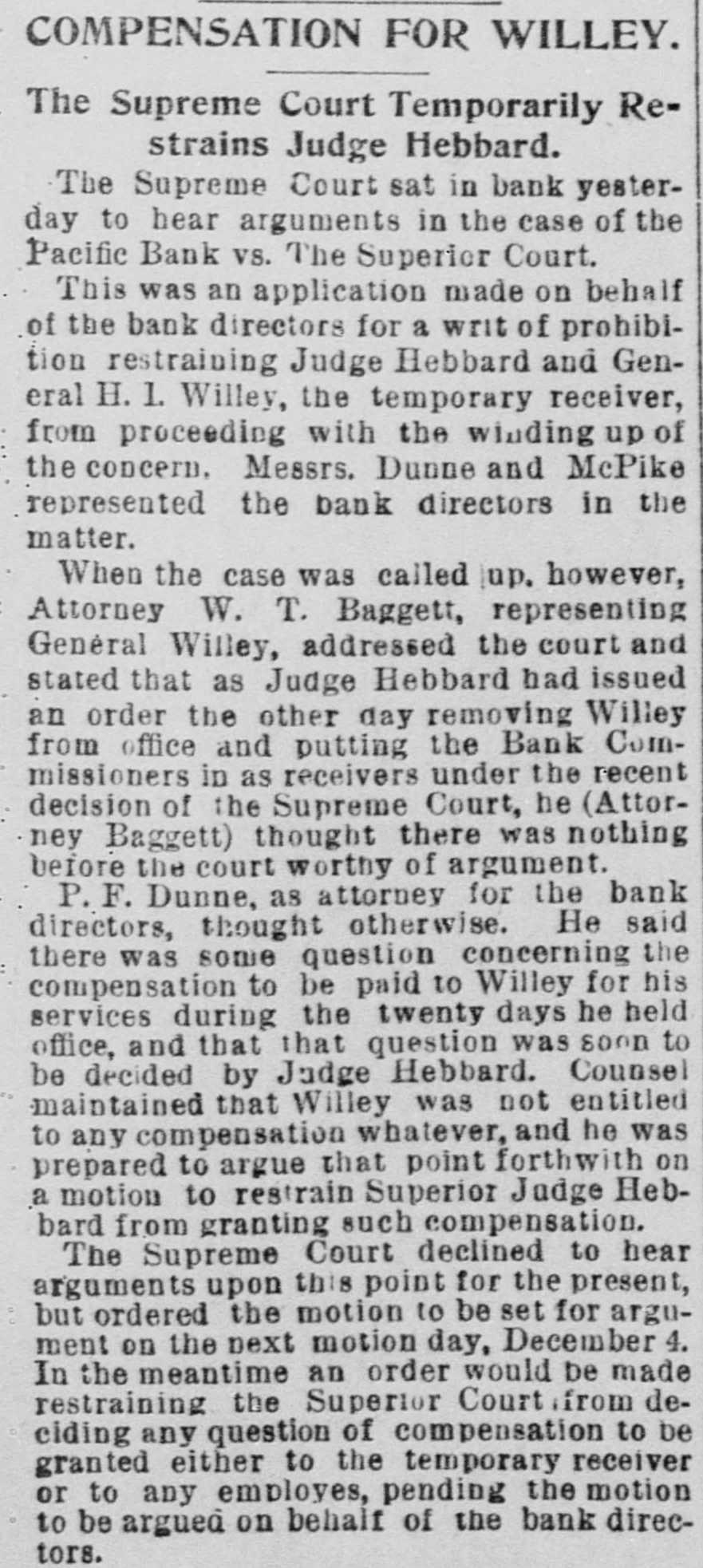
COMPENSATION FOR WILLEY. The Supreme Court Temporarily Restrains Judge Hebbard. The Supreme Court sat in bank yesterday to hear arguments in the case of the Pacific Bank VS. The Superior Court. This was an application made on behalf of the bank directors for a writ of prohibition restraining Judge Hebbard and General H. 1. Willey, the temporary receiver, from proceeding with the winding up of the concern. Messrs. Dunne and McPike represented the bank directors in the matter. When the case was called up. however, Attorney W. T. Baggett, representing General Willey, addressed the court and stated that as Judge Hebbard had issued an order the other day removing Willey from office and putting the Bank Commissioners in as receivers under the recent decision of the Supreme Court, he (Attorney Baggett) thought there was nothing before the court worthy of argument. P. F. Dunne, as attorney for the bank directors, thought otherwise. He said there was some question concerning the compensation to be paid to Willey for his services during the twenty days he held office, and that that question was soon to be decided by Judge Hebbard. Counsel maintained that Willey was not entitled to any compensation whatever, and he was prepared to argue that point forthwith on a motion to restrain Superior Judge Hebbard from granting such compensation. The Supreme Court declined to hear arguments upon this point for the present, but ordered the motion to be set for argument on the next motion day, December 4. In the meantime an order would be made restraining the Superior Court from deciding any question of compensation to be granted either to the temporary receiver or to any employes, pending the motion to be argued on behalf of the bank directors.


Article from Deseret Evening News, May 12, 1894

Click image to open full size in new tab

Article Text

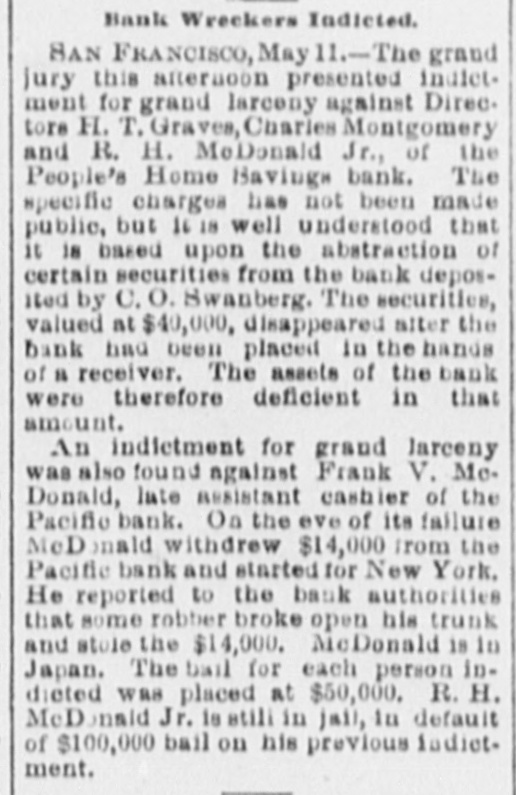
Bank Wreckers Indicted. SAN FRANCISCO, May 11.-The grand jury this amernoon presented indictment for grand larceny against Direc. tore H. T. Graves, Charles Montgomery and R. H. McDonald Jr., of the People's Home Bavings bank. The specific charges has not been made public, but 16 18 well understood that it is based upon the abstraction of certain securities from the bank deposited by C.O. Swanberg. The securities, valued at $40,000, disappeared alter the bank had been placed in the hands of a receiver. The assets of the bank were therefore deficient in that amount. An indictment for grand larceny was also found against Frank V. McDonald, late assistant cashier of the Pacific bank. On the eve of its failure McD inald withdrew $14,000 from the Pacific bank and started for New York, He reported to the bank authorities that some robber broke open his trunk and stole the $14,000. McDonald is in Japan. The bail for each person indieted was placed at $50,000. R. H. McDonald Jr. is still in jmil, In default of $100,000 bail on his previous indictment.


Article from The Morning Call, September 5, 1894

Click image to open full size in new tab

Article Text

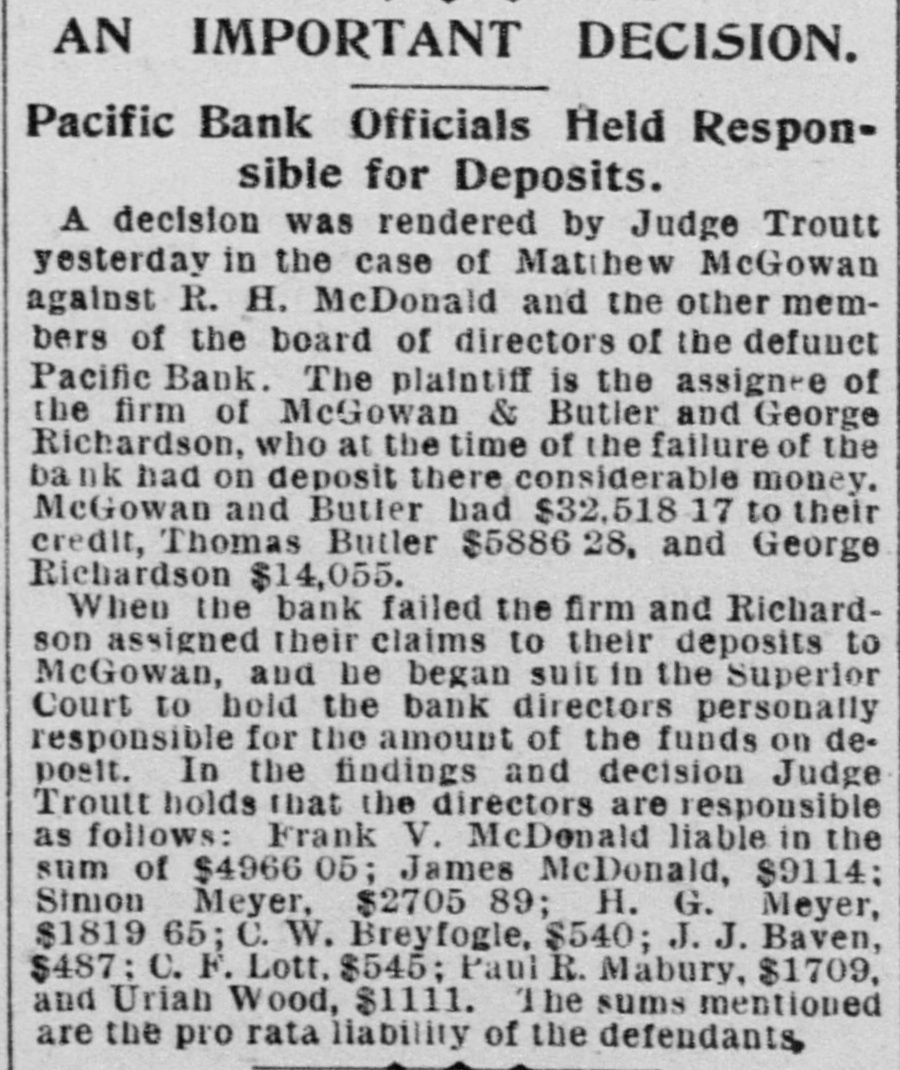
AN IMPORTANT DECISION. Pacific Bank Officials Held Responsible for Deposits. A decision was rendered by Judge Troutt yesterday in the case of Mathew McGowan against R. H. McDonald and the other members of the board of directors of the defunct Pacific Bank. The plaintiff is the assignee of the firm of McGowan & Butler and George Richardson, who at the time of the failure of the ba nk had on deposit there considerable money. McGowan and Butter bad $32,518 17 to their credit, Thomas Butler $5886 28, and George Richardson $14,055. When the bank failed the firm and Richardson assigned their claims to their deposits to McGowan, and he began suit in the Superior Court to hold the bank directors personally responsible for the amount of the funds on deposit. In the findings and decision Judge Troutt holds that the directors are responsible as follows: Frank V. McDonald liable in the sum of $4966 05; James McDonald, $9114: Sinion Meyer, $2705 89; H. G. Meyer, $1819 65; C. W. Breyfogle, $540; J. J. Baven, $487; C. F. Lott, $545; Paul R. Mabury, $1709, and Uriah Wood, $1111. The sums mentioned are the pro rata liability of the defendants,


Article from The Salt Lake Herald, February 9, 1895

Click image to open full size in new tab

Article Text

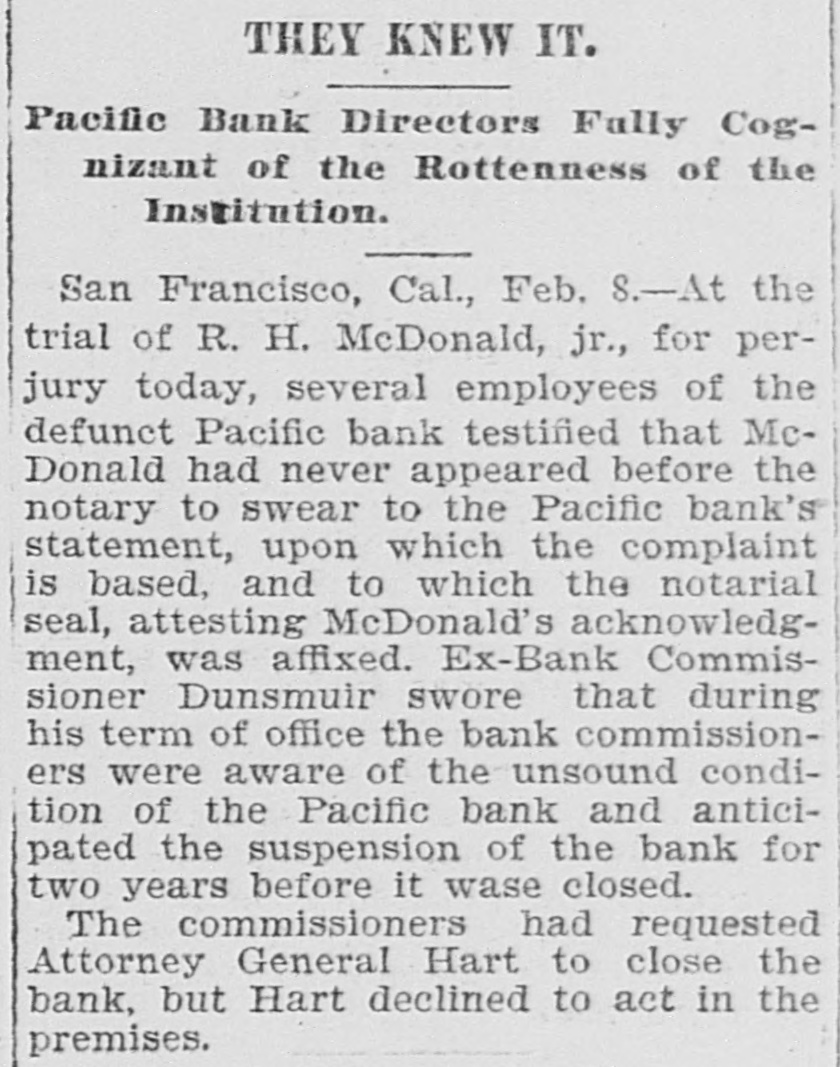
# THEY KNEW IT. Pacific Bank Directors Fully Cognizant of the Rottenness of the Institution. San Francisco, Cal., Feb. 8.β€”At the trial of R. H. McDonald, jr., for perjury today, several employees of the defunct Pacific bank testified that McDonald had never appeared before the notary to swear to the Pacific bank's statement, upon which the complaint is based, and to which the notarial seal, attesting McDonald's acknowledgment, was affixed. Ex-Bank Commissioner Dunsmuir swore that during his term of office the bank commissioners were aware of the unsound condition of the Pacific bank and anticipated the suspension of the bank for two years before it was closed. The commissioners had requested Attorney General Hart to close the bank, but Hart declined to act in the premises.


Article from Cottonwood Report, February 15, 1895

Click image to open full size in new tab

Article Text

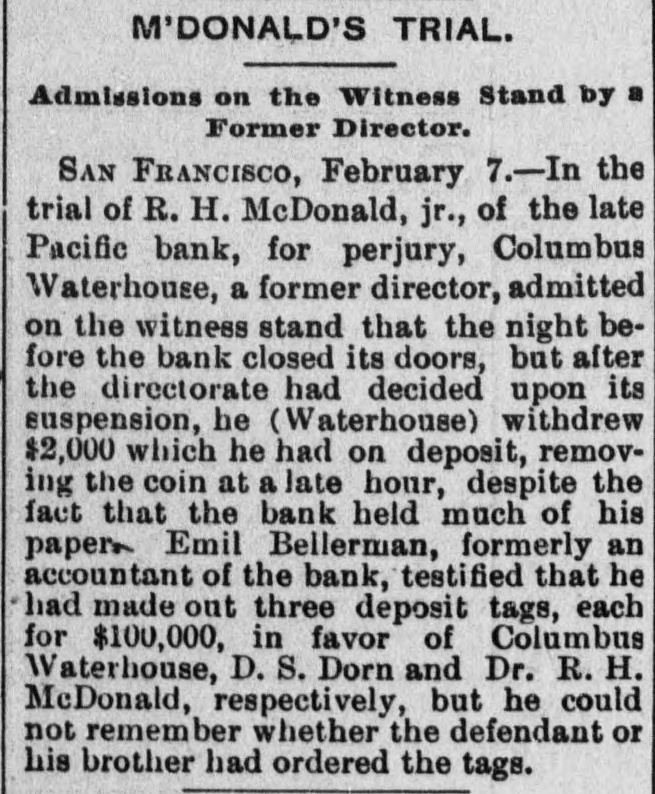
M'DONALD'S TRIAL. Admissions on the Witness Stand by a Former Director. SAN FRANCISCO, February 7.-In the trial of R. H. McDonald, jr., of the late Pacific bank, for perjury, Columbus Waterhouse, a former director, admitted on the witness stand that the night before the bank closed its doors, but after the directorate had decided upon its suspension, he (Waterhouse) withdrew $2,000 which he had on deposit, removing the coin at a late hour, despite the fact that the bank held much of his papers Emil Bellerman, formerly an accountant of the bank, testified that he had made out three deposit tags, each for $100,000, in favor of Columbus Waterhouse, D. S. Dorn and Dr. R. H. McDonald, respectively, but he could not remember whether the defendant or his brother had ordered the tags.


Article from Evening Star, February 18, 1895

Click image to open full size in new tab

Article Text

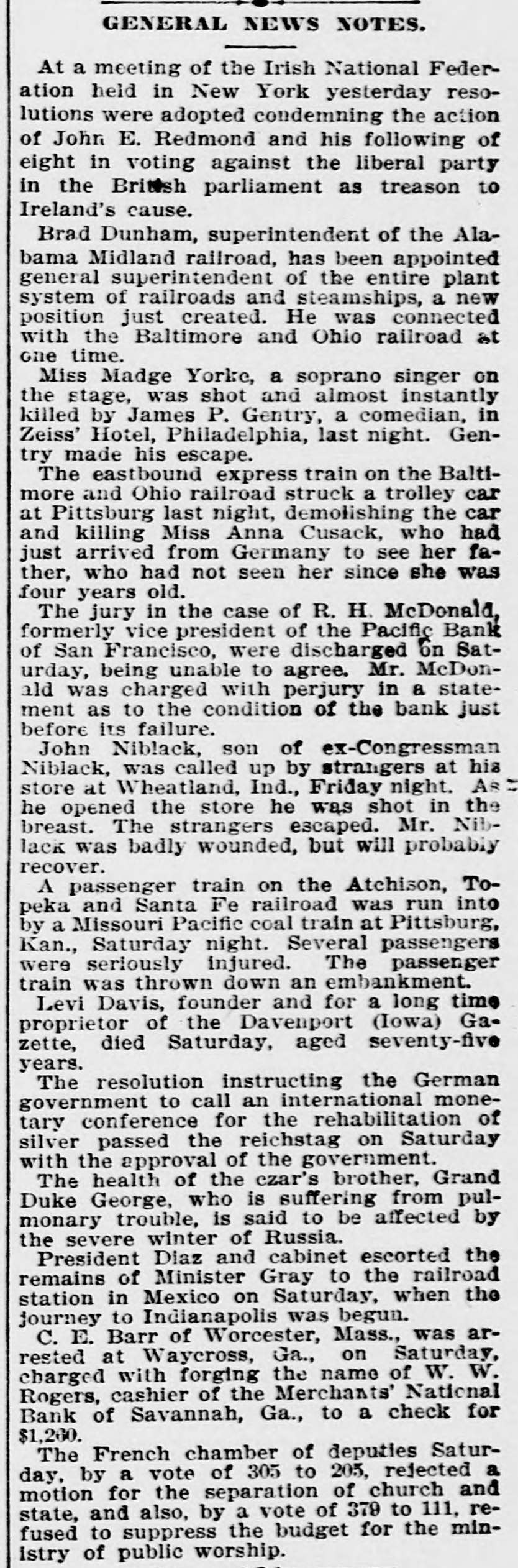
# GENERAL NEWS NOTES. At a meeting of the Irish National Federation held in New York yesterday resolutions were adopted condemning the action of John E. Redmond and his following of eight in voting against the liberal party in the British parliament as treason to Ireland's cause. Brad Dunham, superintendent of the Alabama Midland railroad, has been appointed general superintendent of the entire plant system of railroads and steamships, a new position just created. He was connected with the Baltimore and Ohio railroad at one time. Miss Madge Yorke, a soprano singer on the stage, was shot and almost instantly killed by James P. Gentry, a comedian, in Zeiss' Hotel, Philadelphia, last night. Gentry made his escape. The eastbound express train on the Baltimore and Ohio railroad struck a trolley car at Pittsburg last night, demolishing the car and killing Miss Anna Cusack, who had just arrived from Germany to see her father, who had not seen her since she was four years old. The jury in the case of R. H. McDonald, formerly vice president of the Pacific Bank of San Francisco, were discharged on Saturday, being unable to agree. Mr. McDonald was charged with perjury in a statement as to the condition of the bank just before its failure. John Niblack, son of ex-Congressman Niblack, was called up by strangers at his store at Wheatland, Ind., Friday night. As he opened the store he was shot in the breast. The strangers escaped. Mr. Niblack was badly wounded, but will probably recover. A passenger train on the Atchison, Topeka and Santa Fe railroad was run into by a Missouri Pacific coal train at Pittsburg, Kan., Saturday night. Several passengers were seriously injured. The passenger train was thrown down an embankment. Levi Davis, founder and for a long time proprietor of the Davenport (Iowa) Gazette, died Saturday, aged seventy-five years. The resolution instructing the German government to call an international monetary conference for the rehabilitation of silver passed the reichstag on Saturday with the approval of the government. The health of the czar's brother, Grand Duke George, who is suffering from pulmonary trouble, is said to be affected by the severe winter of Russia. President Diaz and cabinet escorted the remains of Minister Gray to the railroad station in Mexico on Saturday, when the journey to Indianapolis was begun. C. E. Barr of Worcester, Mass., was arrested at Waycross, Ga., on Saturday, charged with forging the name of W. W. Rogers, cashier of the Merchants' National Bank of Savannah, Ga., to a check for $1,260. The French chamber of deputies Saturday, by a vote of 305 to 205, rejected a motion for the separation of church and state, and also, by a vote of 379 to 111, refused to suppress the budget for the ministry of public worship.


Article from The San Francisco Call, March 21, 1895

Click image to open full size in new tab

Article Text

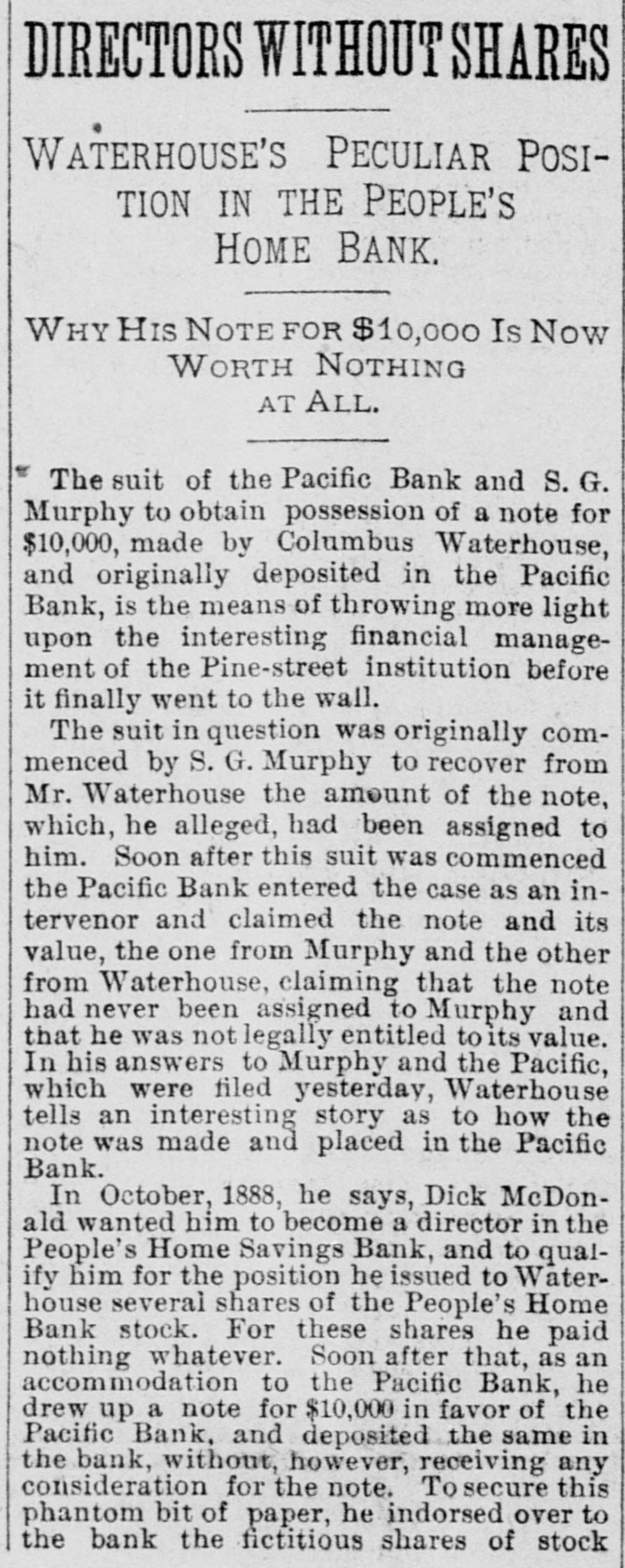
# DIRECTORS WITHOUT SHARES WATERHOUSE'S PECULIAR POSITION IN THE PEOPLE'S HOME BANK. WHY HIS NOTE FOR $10,000 Is Now WORTH NOTHING AT ALL. The suit of the Pacific Bank and S. G. Murphy to obtain possession of a note for $10,000, made by Columbus Waterhouse, and originally deposited in the Pacific Bank, is the means of throwing more light upon the interesting financial management of the Pine-street institution before it finally went to the wall. The suit in question was originally commenced by S. G. Murphy to recover from Mr. Waterhouse the amount of the note, which, he alleged, had been assigned to him. Soon after this suit was commenced the Pacific Bank entered the case as an intervenor and claimed the note and its value, the one from Murphy and the other from Waterhouse, claiming that the note had never been assigned to Murphy and that he was not legally entitled to its value. In his answers to Murphy and the Pacific, which were filed yesterday, Waterhouse tells an interesting story as to how the note was made and placed in the Pacific Bank. In October, 1888, he says, Dick McDonald wanted him to become a director in the People's Home Savings Bank, and to qualify him for the position he issued to Waterhouse several shares of the People's Home Bank stock. For these shares he paid nothing whatever. Soon after that, as an accommodation to the Pacific Bank, he drew up a note for $10,000 in favor of the Pacific Bank, and deposited the same in the bank, without, however, receiving any consideration for the note. To secure this phantom bit of paper, he indorsed over to the bank the fictitious shares of stock


Article from The Arizona Sentinel, May 25, 1895

Click image to open full size in new tab

Article Text

prises in Yuma county, is that which led to the construction of the Mohawk canal, by means of which that portion of the Gila valley known as the Mohawk valley is watered. The length of the canal from headgate to terminus, is 21 miles, but, at a point 71 miles below its head, the canal forks into two branches, and, counting the mileage along both branches, we have 33 miles of main water-ways. The area of land tributary to this canal, embraces 40,000 acres of rich bottom lands. The head of the canal, by wagon road, is distant about sixty miles east from Yuma, and the lower end of the valley about thirty-five miles. The width of the valley varies from half a mile, at its narrowest point, to five miles at its widest. The soil is a rich sandy loam varying in depth from seven to over twenty feet, and stratas and resting upon of These gravel sand lying underneath. conditions ensure perfect drainage, and prevent "souring." The construction of the canal was begun some ten years ago, but owing to lack of means of the projectors, the work dragged along slowly until finally the property fell into the hands of the Pacific bank of San Francisco and the canal was speedily completed. Then followed an era of bad management, a good deal of it being on the freeze-out plan, but, in spite of all drawbacks, a large acreage was put under cultivation. At last the failure of the Pacific bank occured and the enterprise was left without a head but the holders of lands took matters into their own hands and kept the canal in sufficient repair to keep alive that portion of the valley under cultivation. The company has recently been reorganized and affairs look brighter than ever. The canal is running full of water, and new farms are being started. Like nearly all the systems followed by irrigation enterprises, water rights of the Mohawk company perpetually attach to the land irrigated and cannot be separated by change of ownership. Holders of water-rights pay a very moderate annual rental for the use of water, in accordance with the number of acres placed under cultivation, at a fixed sum per acre. The Mohawk valley.is very desirably situated, in reference to getting its products to market, and lands can be had comparatively very cheap* The Southern Pacific railroad parallels the valley east and west, at a aistance varying from three to eight miles. Products are transported over the best kind of wagon roads, and 'cattle and hogs are placed on the cars in perfect condition, owing to the shortness of the drive. A large area of land is now under cultivation in fruuts, alfalfa, Egyptain corn, grapes, figs, wheat, barley, sorghum, beans, cabbages, artichokes, asparagus, lettuce, radishes, peas and all kinds of vegetables. Watermelons; musk-melons, squash, pumpkins are planted in the spring. Vege tables are grown in all seasons of the year. Two and three crops of Egyp tian corn, two crops of patatoes, and two crops of corn are raised annually. Sweet potatoes and peanuts thrive remarkably well. Strawberries and blackberries are grown in great abund ance. The Mohawk valley presents rare facilities and opportanities for immigrants. The climate cannot be surpassed, the soil needs no fertilization and will not for centuries as the waters of the Gila river, which sup the canal, is a silt that renews plies constantly charged the with soil, and the land can be cheaply cleared and cultivated. This tract of country is especially suitable for settlement by small colonies. Land to which are attached paid up water-rights if purchased in 1,000 acre tracts can be had, including water-rights, for ten dollars


Article from Elmore Bulletin, July 17, 1895

Click image to open full size in new tab

Article Text

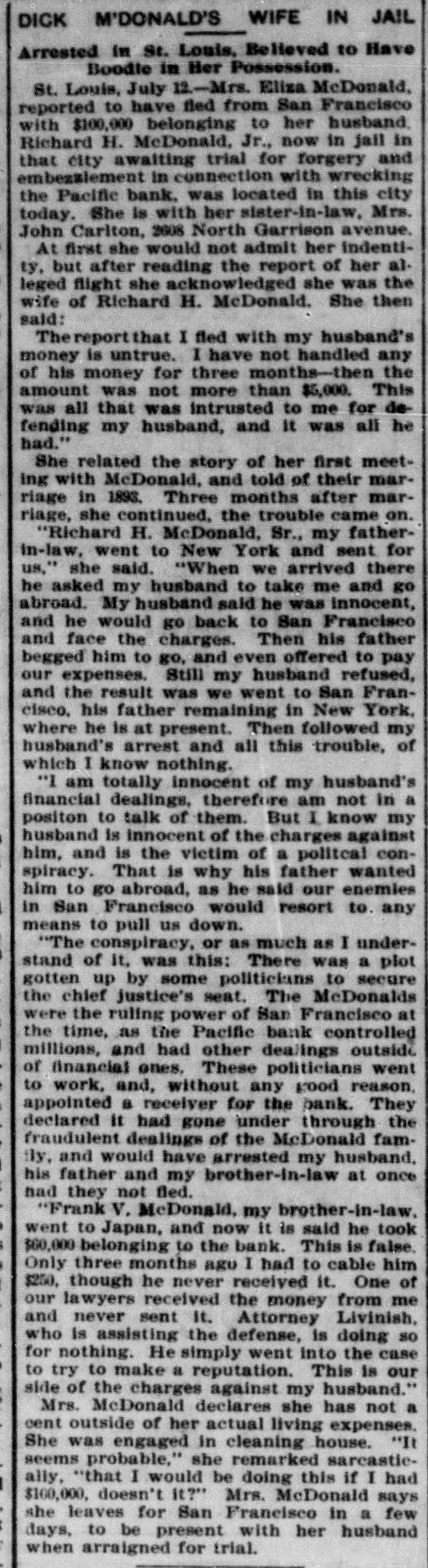
DICK M'DONALD'S WIFE IN JAIL Arrested in St. Louis, Believed to Have Boodle in Her Possession. St. Louis, July 12.Mrs. Eliza McDonald, reported to have fled from San Francisco with $100,000 belonging to her husband, Richard H. McDonald, Jr., now in jail in that city awaiting trial for forgery and embezalement in connection with wrecking the Pacific bank. was located in this city today. She is with her sister-in-law, Mrs. John Carlton, 2608 North Garrison avenue. At first she would not admit her indentity, but after reading the report of her al. leged flight she acknowledged she was the wife of Richard H. McDonald. She then said: The report that I fled with my husband's money is untrue. I have not handled any of his money for three months-then the amount was not more than $5,000. This was all that was intrusted to me for defending my husband, and It was all he had." She related the story of her first meeting with McDonald, and told of their marriage in 1893. Three months after marriage, she continued. the trouble came on. "Richard H. McDonald, Sr., my fatherin-law. went to New York and sent for us," she said. "When we arrived there he asked my husband to take me and go abroad. My husband said he was innocent, and he would go back to San Francisco and face the charges. Then his father begged him to go, and even offered to pay our expenses. Still my husband refused, and the result was we went to San Francisco. his father remaining in New York, where he is at present. Then followed my husband's arrest and all this trouble, of which I know nothing. "I am totally innocent of my husband's financial dealings, therefore am not in a positon to talk of them. But I know my husband is innocent of the charges against him, and is the victim of a political conspiracy. That is why his father wanted him to go abroad, as he said our enemies in San Francisco would resort to. any means to pull us down. "The conspiracy, or as much as I understand of it, was this: There was a plot gotten up by some politicians to secure the chief justice's seat. The McDonalds were the ruling power of San Francisco at the time, as the Pacific bank controlled millions, and had other dealings outside of financial ones. These politicians went to work, and, without any good reason, appointed a receiver for the bank. They declared it had gone under through the fraudulent dealings of the McDonald famly, and would have arrested my husband, his father and my brother-in-law at once had they not fled. "Frank V. McDonald, my brother-in-law. went to Japan, and now it is said he took $60,000 belonging to the bank. This is false. Only three months agu I had to cable him $250, though he never received it. One of our lawyers received the money from me and never sent it. Attorney Livinish, who is assisting the defense, is doing so for nothing. He simply went into the case to try to make a reputation. This is our side of the charges against my husband." Mrs. McDonald declares she has not a cent outside of her actual living expenses. She was engaged in cleaning house. "It seems probable," she remarked sarcastically, "that I would be doing this if I had $100,000, doesn't it?" Mrs. McDonald says she leaves for San Francisco in a few days, to be present with her husband when arraigned for trial.