9817. Merchants & Farmers Bank (Newton, MS)

Bank Information

Episode Type
Suspension β†’ Closure
Bank Type
state
Start Date
June 1, 1912*
Location
Newton, Mississippi (32.321, -89.163)

Metadata

Model
gpt-5-mini
Short Digest
bc4e5b608656e890

Response Measures

None

Description

The articles consistently report that the Merchants & Farmers Bank of Newton went into the hands of a receiver in mid-1912 and is described as a defunct/failed institution with officers arrested for embezzlement and negligence. There is no mention of a depositor run prior to suspension; the cause of failure is insolvency from bad loans, embezzlement, and negligent management. Dates are drawn from July 1912 coverage indicating the failure occurred in late June/early July 1912.

Events (2)

1. June 1, 1912* Receivership
Newspaper Excerpt
Merchants and Farmers bank of Newton ... went into the hands of a receiver; receiver to proceed with adjudication of affairs; creditors to present claims for registration within three months.
Source
newspapers
2. June 1, 1912* Suspension
Cause
Bank Specific Adverse Info
Cause Details
Bank insolvent due to carelessness/neglect in management, bad loans, alleged embezzlement by cashier H. F. Sively and payment of unearned dividends.
Newspaper Excerpt
Merchants and Farmers bank of Newton, which went into the hands of a receiver last week.
Source
newspapers

Newspaper Articles (10)

Article from Atlanta Georgian, July 1, 1912

Click image to open full size in new tab

Article Text

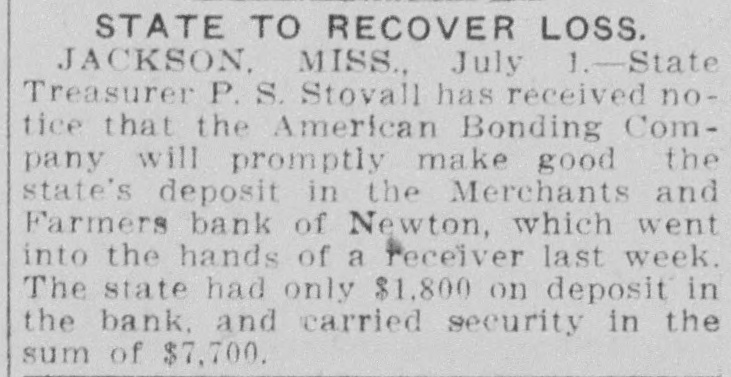
STATE TO RECOVER LOSS. JACKSON, MISS., July 1.-State Treasurer P.S. Stovall has received notice that the American Bonding Company will promptly make good the state's deposit in the Merchants and Farmers bank of Newton, which went into the hands of a receiver last week. The state had only $1,800 on deposit in the bank. and carried security in the sum of $7,700.


Article from The Grenada Sentinel, July 5, 1912

Click image to open full size in new tab

Article Text

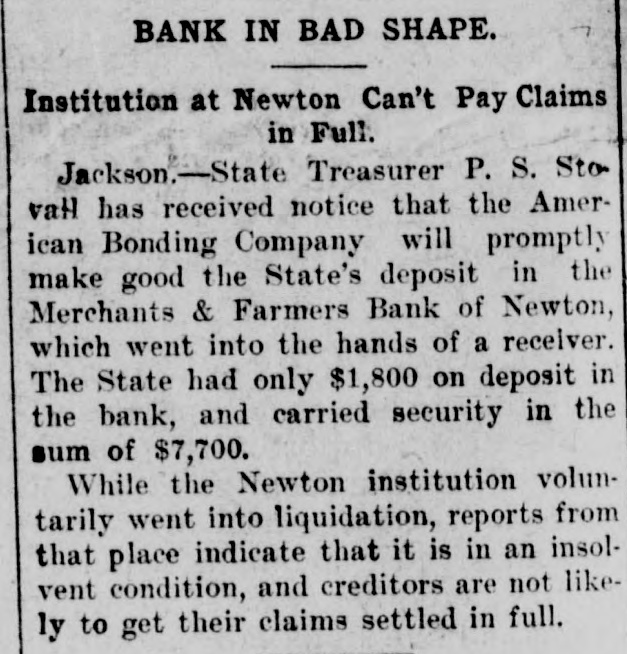
# BANK IN BAD SHAPE. Institution at Newton Can't Pay Claims in Full. Jackson. State Treasurer P. S. Stovall has received notice that the American Bonding Company will promptly make good the State's deposit in the Merchants & Farmers Bank of Newton, which went into the hands of a receiver. The State had only $1,800 on deposit in the bank, and carried security in the sum of $7,700. While the Newton institution voluntarily went into liquidation, reports from that place indicate that it is in an insolvent condition, and creditors are not likely to get their claims settled in full.


Article from The Hattiesburg News, July 15, 1912

Click image to open full size in new tab

Article Text

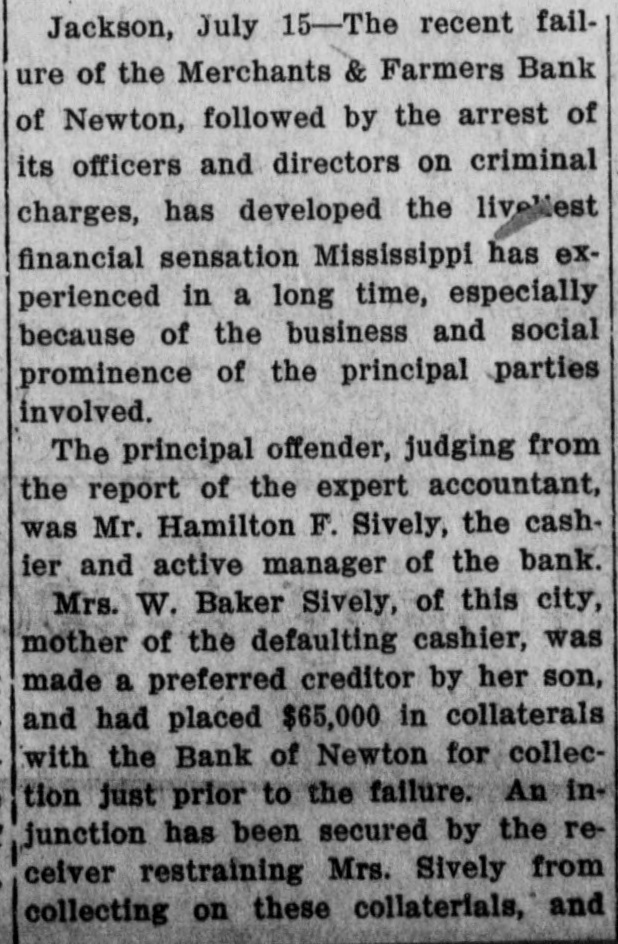
Jackson, July -The recent failure of the Merchants & Farmers Bank of Newton, followed by the arrest of its officers and directors on criminal charges, has developed the liveMest financial sensation Mississippi has experienced in a long time, especially because of the business and social prominence of the principal parties involved. The principal offender, judging from the report of the expert accountant, was Mr. Hamilton F. Sively, the cashier and active manager of the bank. Mrs. W. Baker Sively, of this city, mother of the defaulting cashier, was made a preferred creditor by her son, and had placed $65,000 in collaterals with the Bank of Newton for collection just prior to the failure. An injunction has been secured by the receiver restraining Mrs. Sively from collecting on these collaterials, and


Article from The Pascagoula Democrat-Star, July 19, 1912

Click image to open full size in new tab

Article Text

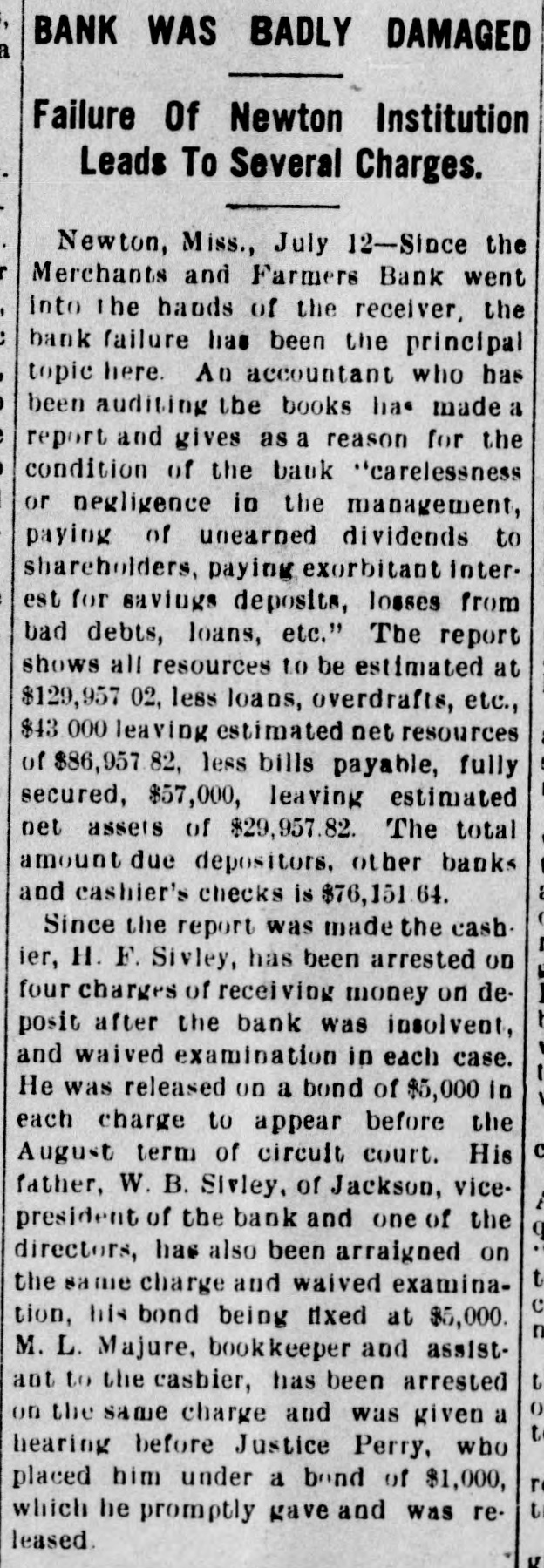
BANK WAS BADLY DAMAGED Failure Of Newton Institution Leads To Several Charges. Newton, Miss., July 12-Since the Merchants and Farmers Bank went into the hands of the receiver, the bank failure has been the principal topic here. An accountant who has been auditing the books has made a report and gives as a reason for the condition of the bauk "carelessness or negligence in the management, paying of unearned dividends to shareholders, paying exorbitant Interest for savings deposits, losses from bad debts, loans, etc." The report shows all resources to be estimated at $129,957 02, less loans, overdrafts, etc., $43.000 leaving estimated net resources of $86,957.82, less bills payable, fully secured, $57,000, leaving estimated net assets of $29,957.82. The total amount due depositors, other bank< and cashier's checks is $76,151.64. Since the report was made the cashier, H. F. Sivley, has been arrested on four charges of receiving money on deposit after the bank was insolvent, and waived examination in each case. He was released on a bond of $5,000 in each charge to appear before the August term of circuit court. His father, W. B. Sivley, of Jackson, vicepresident of the bank and one of the directors, has also been arraigned on the same charge and waived examination, his bond being fixed at $5,000. M. L. Majure, bookkeeper and assistant to the casbier, has been arrested on the same charge and was given a hearing before Justice Perry, who placed him under a bond of $1,000, which he promptly gave and was released.
Article from The Hattiesburg News, July 27, 1912

Click image to open full size in new tab

Article Text

DIRECTORS OF BANK WANT CASHIER INDICTED DEFUNCT NEWTON INSTITUTION'S OFFICIALS CHARGE SIVELY WITH FORGERY. Jackson, July 27-Chancellor Samuel Whitman, Jr., of the second district, has denied the application for the displacement of H. W. Hoye as receiver of the defunct Merchants and Farmers Bank of Newton, and orders have been issued for the receiver to proceed with the adjudication of the affairs of the institution. Creditors must present their claims for registration within the next three months. Public interest is still centered in the criminal phases of the bank failure. Advices from Newton state that President Doolittle and several of the directors, who are under bond in the sum of $5,000 each for appearance at the circuit term next month, are determined to have Hamilton F. Livley, the cashier, presented to the grand jury for forgery and perjury based on the statement of the financial condition of the bank filed with the state auditor in April, to which their names are attached, claiming that they did not sign the statement, and had never seen it until they came to Jackson to inspect the original copy on file at the auditor's office. A comprehensive statement of the affairs of the bank is now being prepared by L. E. Cook, expert accountant, and it is reported that the records will reveal some fresh sensations


Article from The Hattiesburg News, August 3, 1912

Click image to open full size in new tab

Article Text

DEPOSITORS OF DEFUNCT BANK MEET TODAY Jackson, Aug., 3-A meeting of the depositors of the defunct Merchants & Farmers Bank of Newton, which went into the hands of a receiver several days since, is being held this afternoon at Newton for the purpose of adopting a plan of action. One of the plans on foot is to employ counsel to see that the interests of depositors are properly protected, and also to wage criminal prosecution of the officers of the defunct bank. The regular term of the Newton county circuit court will be convened at Decatur on August 12th, and the grand jury will go fully into the criminal changes preferred. All of the officers and directors are under bond . for appearance at this term Much bitterness was engendered by the failure of the bank, and this feeling is being intensified as the court term approaches, many of the depositors declaring that they will not quit fighting until the officials are landed behind the pentitentiary bars.


Article from The Hattiesburg News, January 28, 1913

Click image to open full size in new tab

Article Text

BANK'S FAILURE CAUSED A PROFOUND SURPRISE Cashier Who Was Member of Prominent Family Convicted of Embezzlement of $21,000-Brother, Under Similar Indictment, Will Be Tried Soon. Special to The News. Jackson, Miss., Jan. 28.-The mandate of the supreme court affirming the seven-year penitentiary sentence of Woodson Atkinson, defaulting cashier of the defunct People's bank of Summit, was sent to the sheriff of Pike county today, and it is expected that the prisoner will be delivered at the Rankin convict farm within the next day or so, the supreme court decision being clear cut and equivocal. The affirmation of Atkinson's sentence gives the penitentiary two bank cashiers, R. S. Jones, embezzling cashier of the Bank of Woodville, having been received several weeks ago to serve a two-year sentence. The Atkinson family has been for many years one of the most prominent in South Mississippi, enjoying high standing both in social and financial circles, and the failure of the People's bank at Summit, and the exposures that afterwards followed showing how it had been systematically pilfered for several years, created a profound surprise. E.S. Atkinson, president of the bank and a brother of Woodson Atkinson, was also indicted on the charge of embezzlement, and is now at liberty .under a $20,000 bond, awaiting the next term of circuit court in Pike county. He has been living in Jackson since the closing of the bank, His case will come up for trial at the term of court to be convened in Magnolia on the second Monday in February. The indictments against the two brothers were almost identical in wording, and the prosecution claims that the conviction of E. S. Atkinson will be as easily accomplished as that of Woodson Atkinson, it having been shown in the latter's case that he embezzled the sum of $21,871.22. Incidentally, the supreme court decision cuts off a favorite form of defense offered by defaulting bank officials. Atkinson admitted that he was due the bank the amount claimed, but sought to justify himself by showing that he had given notes and due bills for the sum, charging it against himself on the books. The supreme court specifically holds that this is not a valid defense or exoneration; that Atkinson unlawfully took advantage of his position of responsibility in the bank, and was guilty of embezzlement. Notable among the bank failures soon to be aired in the criminal courts is that of the Merchants & Farmers' bank of Newton, which went to the wall last summer, and receivers of which have not yet succeeded in straightening out the financial tangle. Several of the officers are socially prominent, among them being Vice President W. B. Sively and son, Hamilton Sively, of this city, who are under bond to answer to several indictments. All of the directors are also held to answer criminal charges, and when the cases are called for hearing on the third Monday in March the trial will attract state-wide attention.


Article from The Grenada Sentinel, March 7, 1913

Click image to open full size in new tab

Article Text

# WILL TRY BANK WRECKERS. Notable Cases to Come Up for Hearing at Decatur. Jackson. β€”At the current term of the Newton county circuit court which convened at Decatur the indictments against the officers and directors of the defunct Merchants & Farmers Bank of Newton will be called for hearing. This was one of the most notable of the too-numerous bank failures in Mississippi within the past year, and much interest centers in the outcome of the case, owing to the unusual features of the failure, the prominence of the officers under indictment, and the bitter feeling that has prevailed among creditors and stockholders of the defunct institution. W. Baker Sively, of this city, vice president and a member of the board of directors of the bank, who was among the officials indicted, left for Decatur, accompanied by his attorney, Hon. R. N. Milter. His son, Hamilton F. Sively, was cashier of the bank, and, according to allegations made by directors, largely responsible for its failure. The indictments were based chiefly on the report filed by the expert accountant, Lewis E. Crook, of Meridian, who audited the books for the receiver, and this report will figure largely in the trials of the officers.


Article from The Hattiesburg News, March 19, 1913

Click image to open full size in new tab

Article Text

OFFER TO TURN OVER SECURITIES PROPOSITION TO GIVE RECEIVERS OF NEWTON BANK $65,000 HELD, BY MRS. SIVLEY. Special to The News. Jackson, March 19.-Coincident with the continuance of the cases against President W. I. Doolittle, Vice President W. Baker Sively, and other directors of the defunct Merchants & Farmers' bank at Newton, now under indictment in the circuit court of Newton county, comes the announcement that a proposition has been made to turn over to the receivers of the bank the $65,000 in securities now held by Mrs. W. Baker Sively, of this city, wife of the indicted vice president. When the bank went to the wall the startling discovery was made that Mrs. Sively was a preferred creditor in the sum of $65,000. While the receiver was inclined to doubt the character of the transaction, and suit was contemplated to recover the amount, the


Article from The Semi-Weekly Leader, May 13, 1914

Click image to open full size in new tab

Article Text

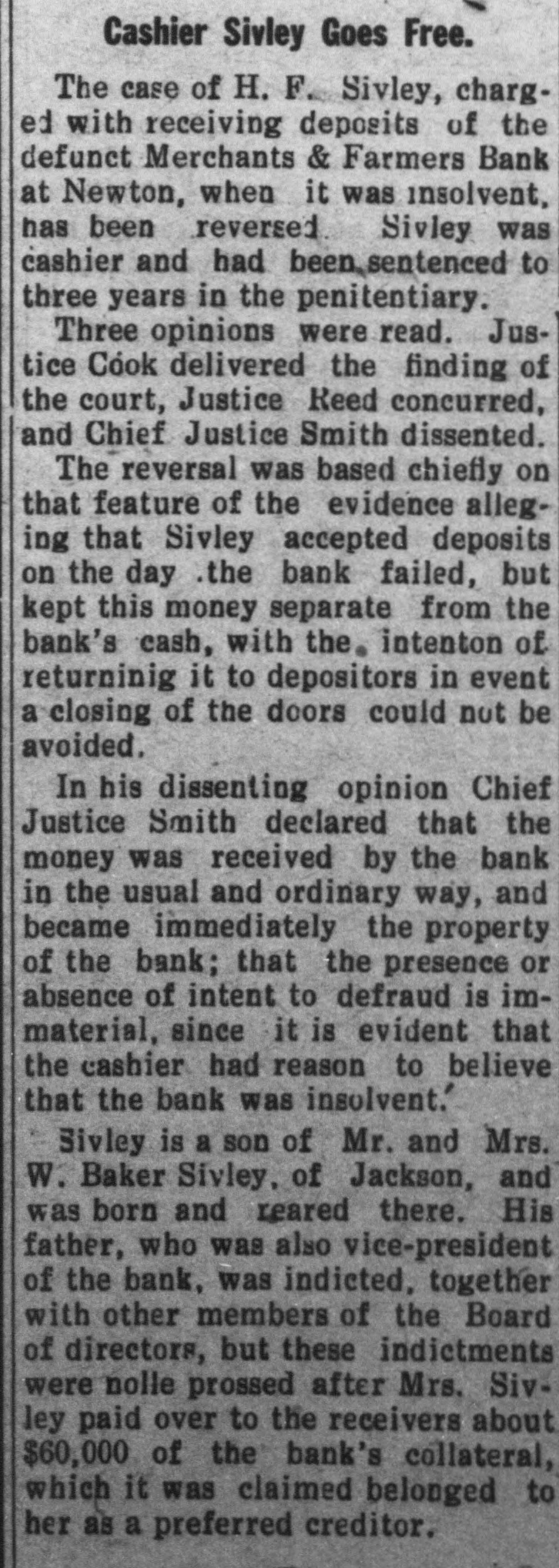
Cashier Sivley Goes Free. The case of H. F. Sivley, charged with receiving deposits of the defunct Merchants & Farmers Bank at Newton, when it was insolvent, has been reversed Sivley was cashier and had been, sentenced to three years in the penitentiary. Three opinions were read. Justice Cook delivered the finding of the court, Justice Reed concurred, and Chief Justice Smith dissented. The reversal was based chiefly on that feature of the evidence alleging that Sivley accepted deposits on the day .the bank failed, but kept this money separate from the bank's cash, with the. intenton of returning it to depositors in event a closing of the doors could not be avoided. In his dissenting opinion Chief Justice Smith declared that the money was received by the bank in the usual and ordinary way, and became immediately the property of the bank; that the presence or absence of intent to defraud is immaterial, since it is evident that the cashier had reason to believe that the bank was insolvent." Sivley is a son of Mr. and Mrs. W. Baker Sivley, of Jackson, and was born and reared there. His father, who was also vice-president of the bank, was indicted, together with other members of the Board of directors, but these indictments were nolle prossed after Mrs. Sivley paid over to the receivers about $60,000 of the bank's collateral, which it was claimed belonged to her as a preferred creditor.