Contemporary reports show an initial plan to return the bank to officers, but later filings seek a federal receiver and the bank is described as failed/defunct.
Events (4)
1.September 29, 1909Suspension
Cause
Government Action
Cause Details
Taken over by the State Banking Board/Bank Commissioner after insolvency concerns and heavy withdrawals.
Newspaper Excerpt
the suspended Columbia Bank and Trust company ... was taken over by the state Tuesday night
Source
newspapers
+1 day
2.September 30, 1909Run
Cause
Bank Specific Adverse Info
Cause Details
Heavy withdrawals tied to the bank's insolvency/large amount of paper and alleged reckless banking practices.
Measures
Depositors being paid out from state guarantee funds; paying tellers disbursing funds under bank examiner supervision.
Newspaper Excerpt
a steady stream of depositors was making its way to the paying tellers' windows of the suspended Columbia Bank and Trust Company, withdrawing savings and closing accounts.
Source
newspapers
+4 days
3.October 4, 1909Other
Newspaper Excerpt
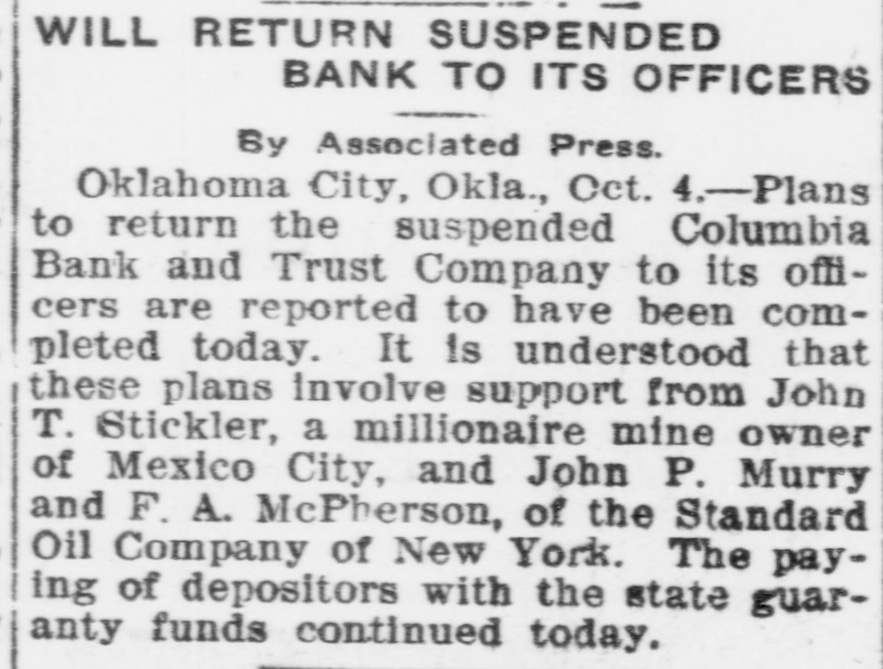
Plans to return the suspended Columbia Bank and Trust Company to its officers are reported to have been completed today. ... The paying of depositors with the state guaranty funds continued today.
Source
newspapers
+29 days
4.November 2, 1909Receivership
Newspaper Excerpt
Suit asking the appointment of a receiver for the Columbia Bank and Trust Company, of Oklahoma City, which failed last month, has been filed in the Federal Court
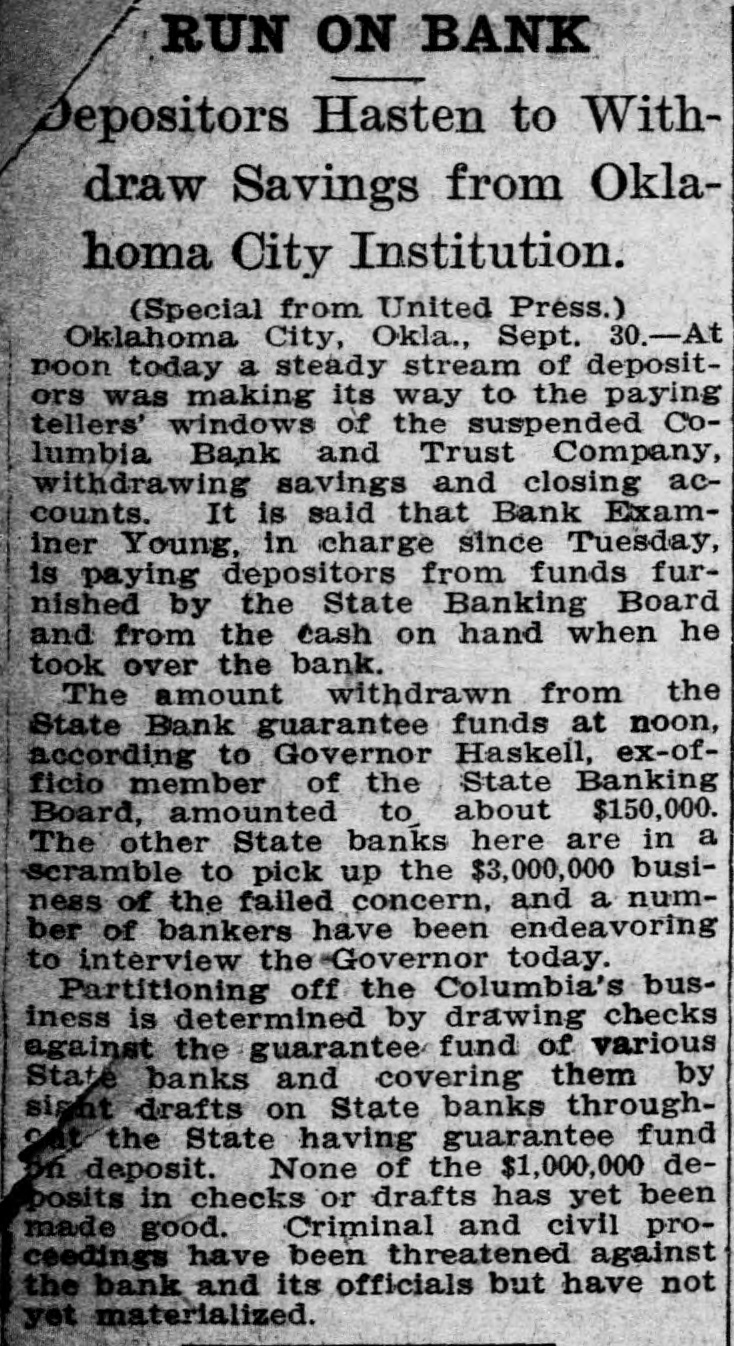
RUN ON BANK Depositors Hasten to Withdraw Savings from Oklahoma City Institution. (Special from United Press.) Oklahoma City, Okla., Sept. 30.-At Doon today a steady stream of depositors was making its way to the paying tellers' windows of the suspended Columbia Bank and Trust Company, withdrawing savings and closing accounts. It is said that Bank Examiner Young, in charge since Tuesday, is paying depositors from funds furnished by the State Banking Board and from the cash on hand when he took over the bank. The amount withdrawn from the State Bank guarantee funds at noon, according to Governor Haskell, ex-officio member of the State Banking Board, amounted to about $150,000. The other State banks here are in a scramble to pick up the $3,000,000 business of the failed concern, and a number of bankers have been endeavoring to interview the Governor today. Partitioning off the Columbia's business is determined by drawing checks against the guarantee fund of various State banks and covering them by sight drafts on State banks throughCat the State having guarantee fund ton deposit. None of the $1,000,000 deposits in checks or drafts has yet been made good. Criminal and civil proceedings have been threatened against the bank and its officials but have not yet materialized.
2.October 1, 1909Evening JournalWilmington, DE
Click image to open full size in new tab
Article Text
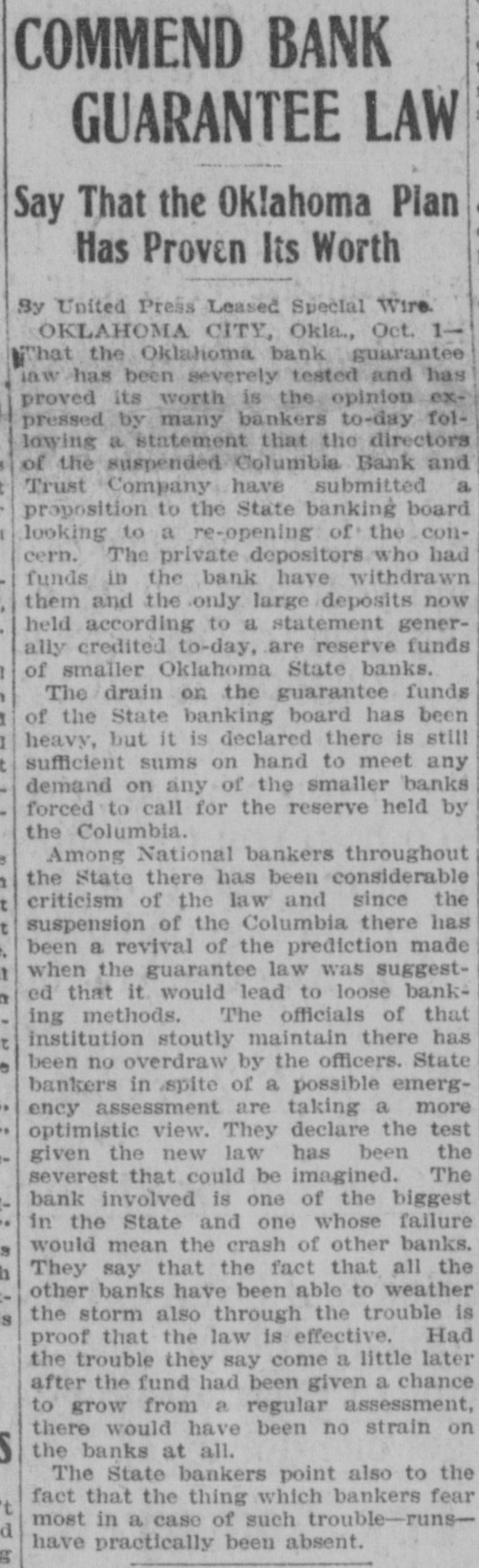
COMMEND BANK GUARANTEE LAW Say That the Oklahoma Plan Has Proven Its Worth By United Press Leased Special Wire. OKLAHOMA CITY, Okla., Oct. 1Chat the Oklahoma bank guarantee law has been severely tested and has proved its worth is the opinion expressed by many bankers to-day following a statement that the directors of the suspended Columbia Bank and Trust Company have submitted a proposition to the State banking board looking to a re-opening of the concern. The private depositors who had funds in the bank have withdra wn them and the only large deposits now held according to a statement generally credited to-day, are reserve funds of smaller Oklahoma State banks. The drain on the guarantee funds of the State banking board has been heavy, but it is declared there is still sufficient sums on hand to meet any demand on any of the smaller banks forced to call for the reserve held by the Columbia. Among National bankers throughout the State there has been considerable criticism of the law and since the suspension of the Columbia there has been a revival of the prediction made when the guarantee law was suggested that it would lead to loose banking methods. The officials of that institution stoutly maintain there has been no overdraw by the officers. State bankers in spite of a possible emergency assessment are taking a more optimistic view. They declare the test given the new law has been the severest that could be imagined. The bank involved is one of the biggest in the State and one whose failure would mean the crash of other banks. They say that the fact that all the other banks have been able to weather S the storm also through the trouble is proof that the law is effective. Had the trouble they say come a little later after the fund had been given a chance to grow from a regular assessment, there would have been no strain on the banks at all. The State bankers point also to the fact that the thing which bankers fear most in a case of such trouble-runshave practically been absent.
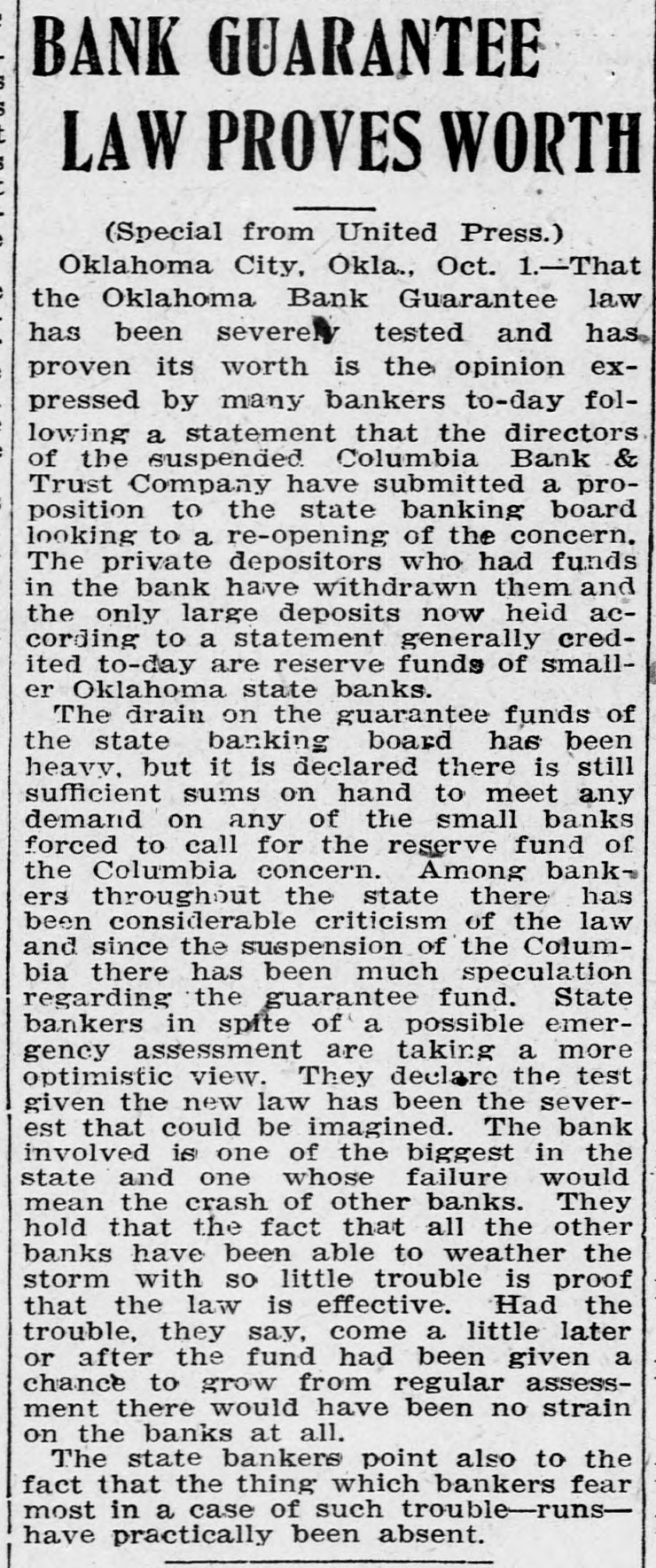
BANK GUARANTEE LAW PROVES WORTH (Special from United Press.) Oklahoma City, Okla., Oct. 1.-That the Oklahoma Bank Guarantee law has been severell tested and has proven its worth is the opinion expressed by many bankers to-day following a statement that the directors of the suspended Columbia Bank & Trust Company have submitted a proposition to the state banking board looking to a re-opening of the concern. The private depositors who had funds in the bank have withdrawn them and the only large deposits now held according to a statement generally credited to-day are reserve funds of smaller Oklahoma state banks. The drain on the guarantee funds of the state banking board has been heavy, but it is declared there is still sufficient sums on hand to meet any demand on any of the small banks forced to call for the reserve fund of the Columbia concern. Among bankers throughout the state there has been considerable criticism of the law and since the suspension of the Columbia there has been much speculation regarding the guarantee fund. State bankers in spite of a possible emergency assessment are taking a more optimistic view. They declare the test given the new law has been the severest that could be imagined. The bank involved is one of the biggest in the state and one whose failure would mean the crash of other banks. They hold that the fact that all the other banks have been able to weather the storm with so little trouble is proof that the law is effective. Had the trouble, they say, come a little later or after the fund had been given a chance to grow from regular assessment there would have been no strain on the banks at all. The state bankers point also to the fact that the thing which bankers fear most in a case of such trouble-runshave practically been absent.
4.October 2, 1909The Vinita Daily ChieftainVinita, OK
Click image to open full size in new tab
Article Text
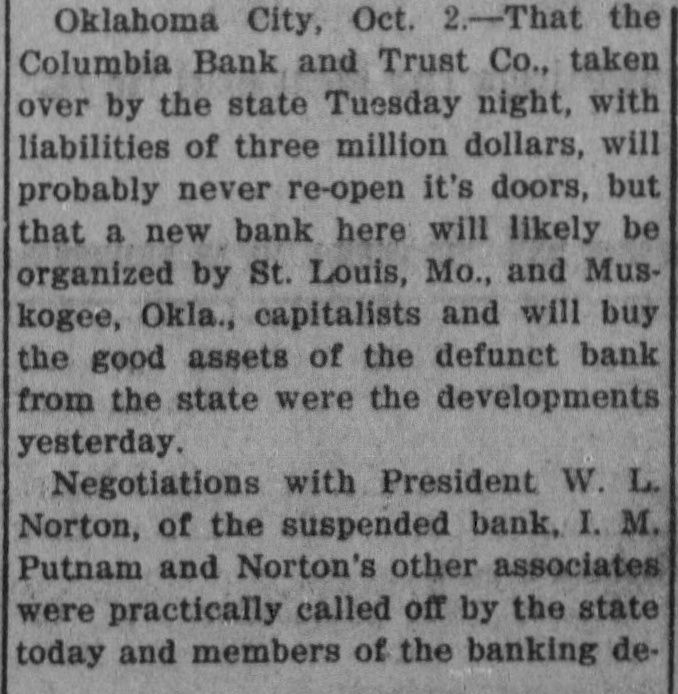
Oklahoma City, Oct. 2.-That the Columbia Bank and Trust Co., taken over by the state Tuesday night, with liabilities of three million dollars, will probably never re-open it's doors, but that a new bank here will likely be organized by St. Louis, Mo., and Muskogee, Okla., capitalists and will buy the good assets of the defunct bank from the state were the developments yesterday. Negotiations with President W. L. Norton, of the suspended bank, I. M. Putnam and Norton's other associates were practically called off by the state today and members of the banking de-
5.October 2, 1909Pine Bluff Daily GraphicPine Bluff, AR
Click image to open full size in new tab
Article Text
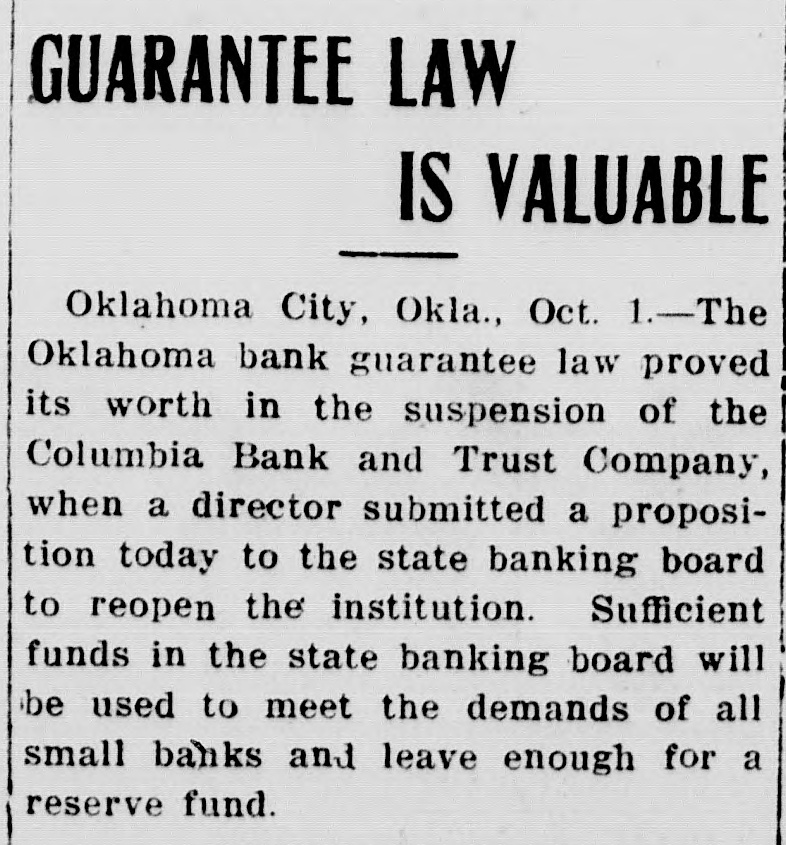
GUARANTEE LAW IS VALUABLE Oklahoma City, Okla., Oct. 1.-The Oklahoma bank guarantee law proved its worth in the suspension of the Columbia Bank and Trust Company, when a director submitted a proposition today to the state banking board to reopen the institution. Sufficient funds in the state banking board will be used to meet the demands of all small banks and leave enough for a reserve fund.
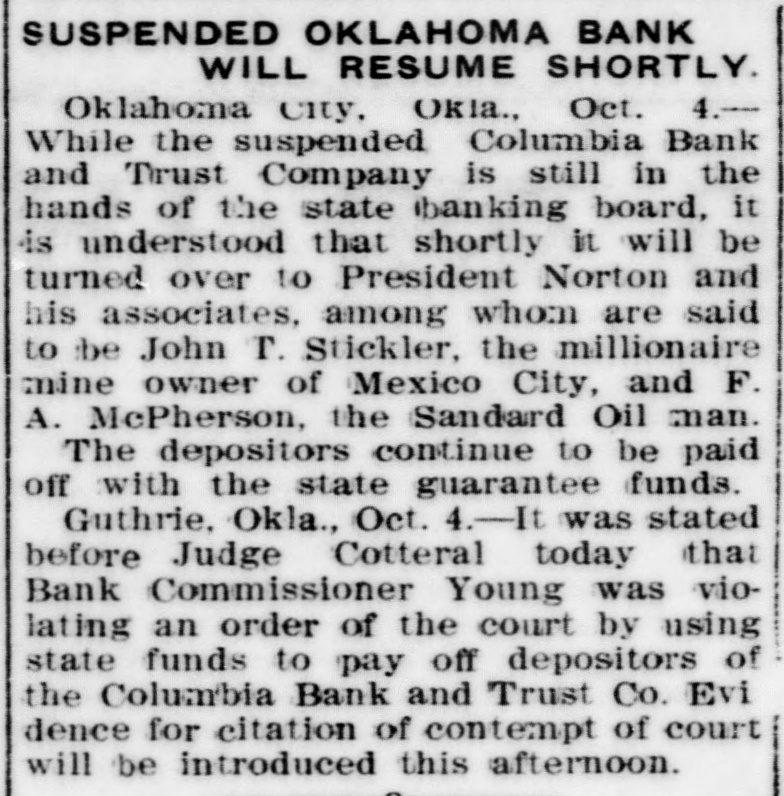
Oklahoma City, Okla., Oct. 4.While the suspended Columbia Bank and Trust Company is still in the hands of the state banking board, it is understood that shortly it will be turned over to President Norton and his associates, among whom are said to be John T. Stickler, the millionaire mine owner of Mexico City, and F. A. McPherson, the Sandard Oil man. The depositors continue to be paid off with the state guarantee funds. Guthrie, Okla., Oct. 4.-It was stated before Judge Cotteral today that Bank Commissioner Young was violating an order of the court by using state funds to pay off depositors of the Columbia Bank and Trust Co. Evi dence for citation of contempt of court will be introduced this afternoon.
7.October 4, 1909The Ogden StandardOgden, UT
Click image to open full size in new tab
Article Text
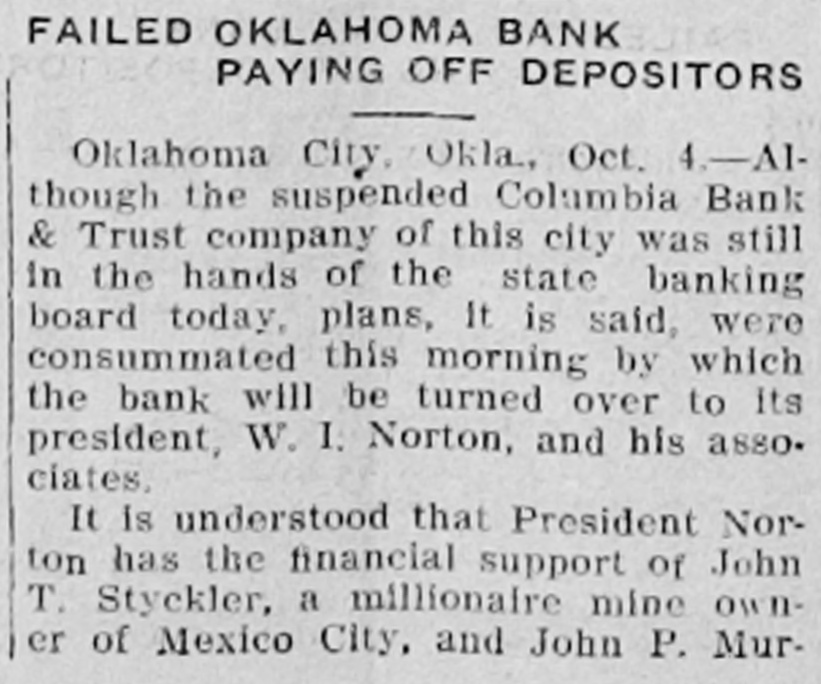
FAILED OKLAHOMA BANK PAYING OFF DEPOSITORS Oklahoma City, Okla., Oct. 4.-AIthough the suspended Columbia Bank & Trust company of this city was still in the hands of the state banking board today, plans, It is said, were consummated this morning by which the bank will be turned over to Its president, W. I. Norton, and his asso. clates. It is understood that President Norton has the financial support of John T. Styckler, a millionaire mine owner of Mexico City, and John P. Mur-
WILL RETURN SUSPENDED BANK TO ITS OFFICERS By Associated Press. Oklahoma City, Okla., Oct. 4.-Plans to return the suspended Columbia Bank and Trust Company to its officers are reported to have been completed today. It is understood that these plans involve support from John T. Stickler, a millionaire mine owner of Mexico City, and John P. Murry and F. A. McPherson, of the Standard Oil Company of New York. The paying of depositors with the state guaranty funds continued today.
9.October 6, 1909The Birmingham Age-HeraldBirmingham, AL
Click image to open full size in new tab
Article Text
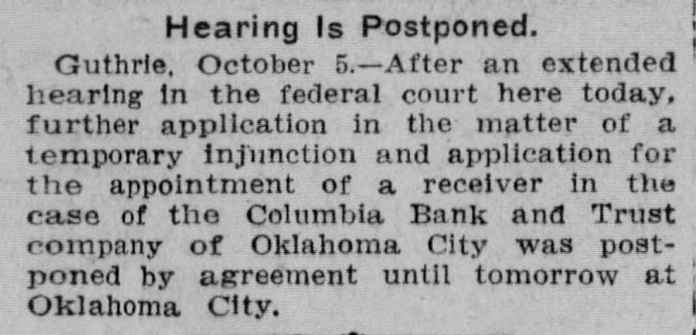
Hearing Is Postponed
Guthrie, October 5.-After an extended hearing in the federal court here today, further application in the matter of a temporary injunction and application for the appointment of a receiver in the case of the Columbia Bank and Trust company of Oklahoma City was postponed by agreement until tomorrow at Oklahoma City.
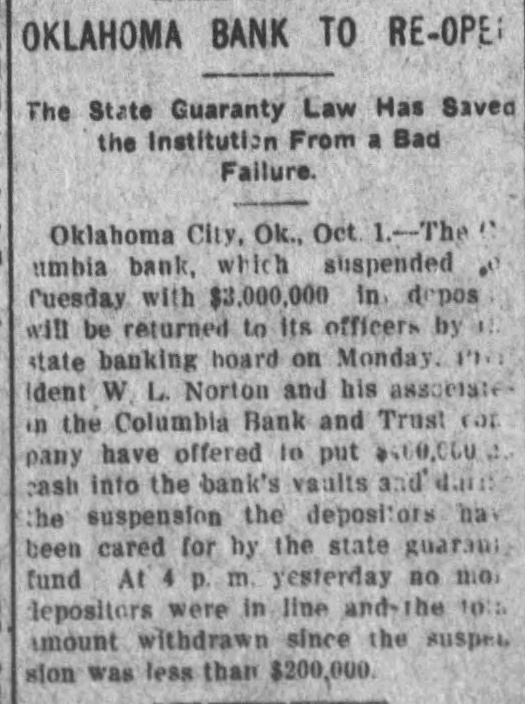
The State Guaranty Law Has Saved the Institution From a Bad Failure. Oklahoma City, Ok., Oct. 1.-The umbia bank, which suspended Cuesday with $3,000,000 in. depos will be returned to its officers by state banking hoard on Monday. PM Ident W L. Norton and his associatein the Columbia Bank and Trust for pany have offered to put $400,000 2 cash into the bank's vaults and dan: the suspension the depositors hav been cared for by the state guarant fund At 4 p. m. yesterday no mo. depositors were in line and-the 10:5 amount withdrawn since the suspet. sion was less than $200,000.
11.October 7, 1909New-York TribuneNew York, NY
Click image to open full size in new tab
Article Text
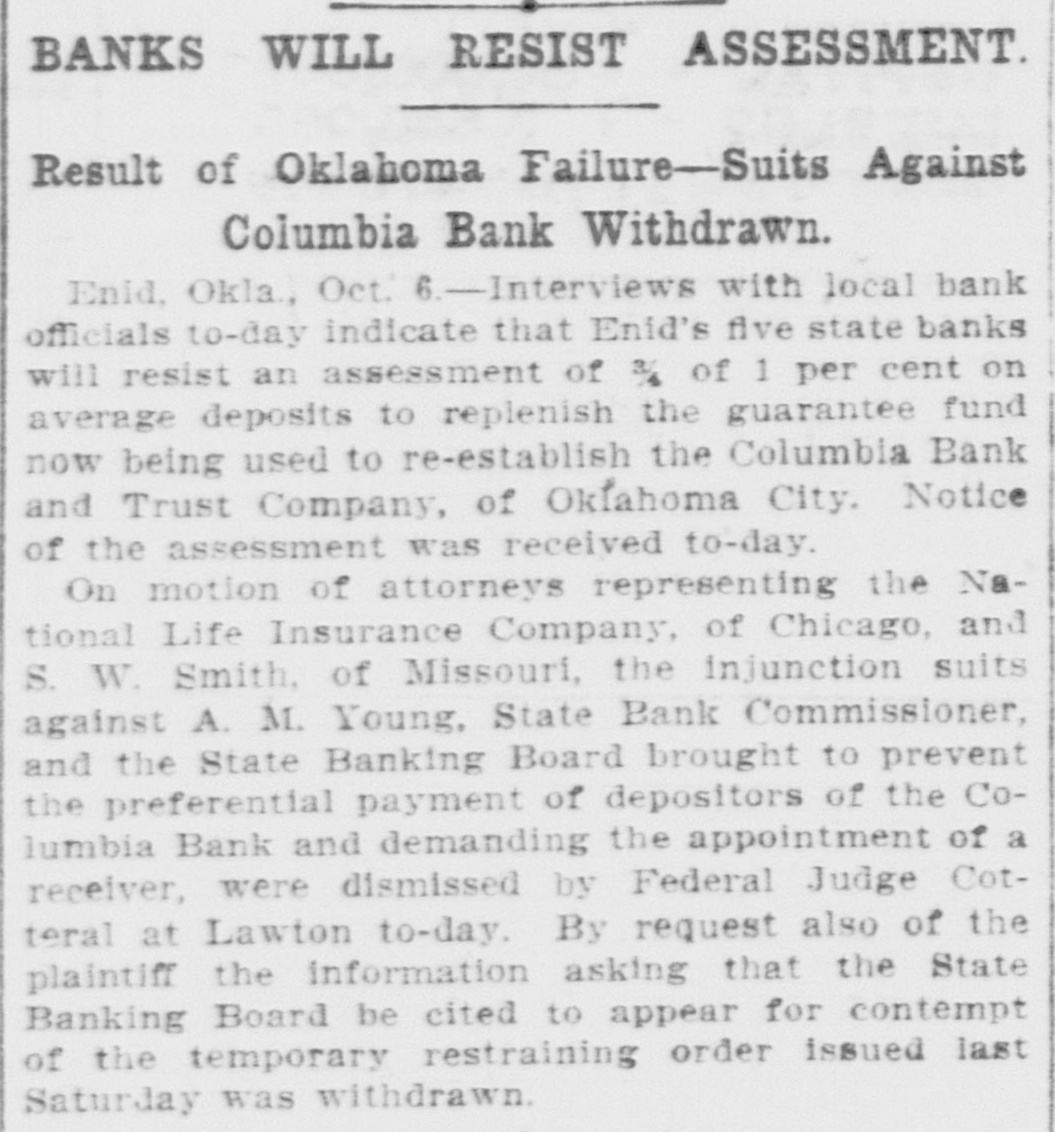
BANKS WILL RESIST ASSESSMENT
Result of Oklahoma Failure-Suits Against Columbia Bank Withdrawn. Enid. Okla., Oct. 6.-Interviews with local bank officials to-day indicate that Enid's five state banks will resist an assessment of 3/4 of 1 per cent on average deposits to replenish the guarantee fund now being used to re-establish the Columbia Bank and Trust Company, of Oklahoma City. Notice of the assessment was received to-day. On motion of attorneys representing the National Life Insurance Company, of Chicago, and S. W. Smith. of Missouri, the injunction suits against A. M. Young, State Bank Commissioner, and the State Banking Board brought to prevent the preferential payment of depositors of the Columbia Bank and demanding the appointment of a receiver, were dismissed by Federal Judge Cotteral at Lawton to-day. By request also of the plaintiff the information asking that the State Banking Board be cited to appear for contempt of the temporary restraining order issued last Saturday was withdrawn.
12.October 7, 1909The Butler Weekly TimesButler, MO
Click image to open full size in new tab
Article Text
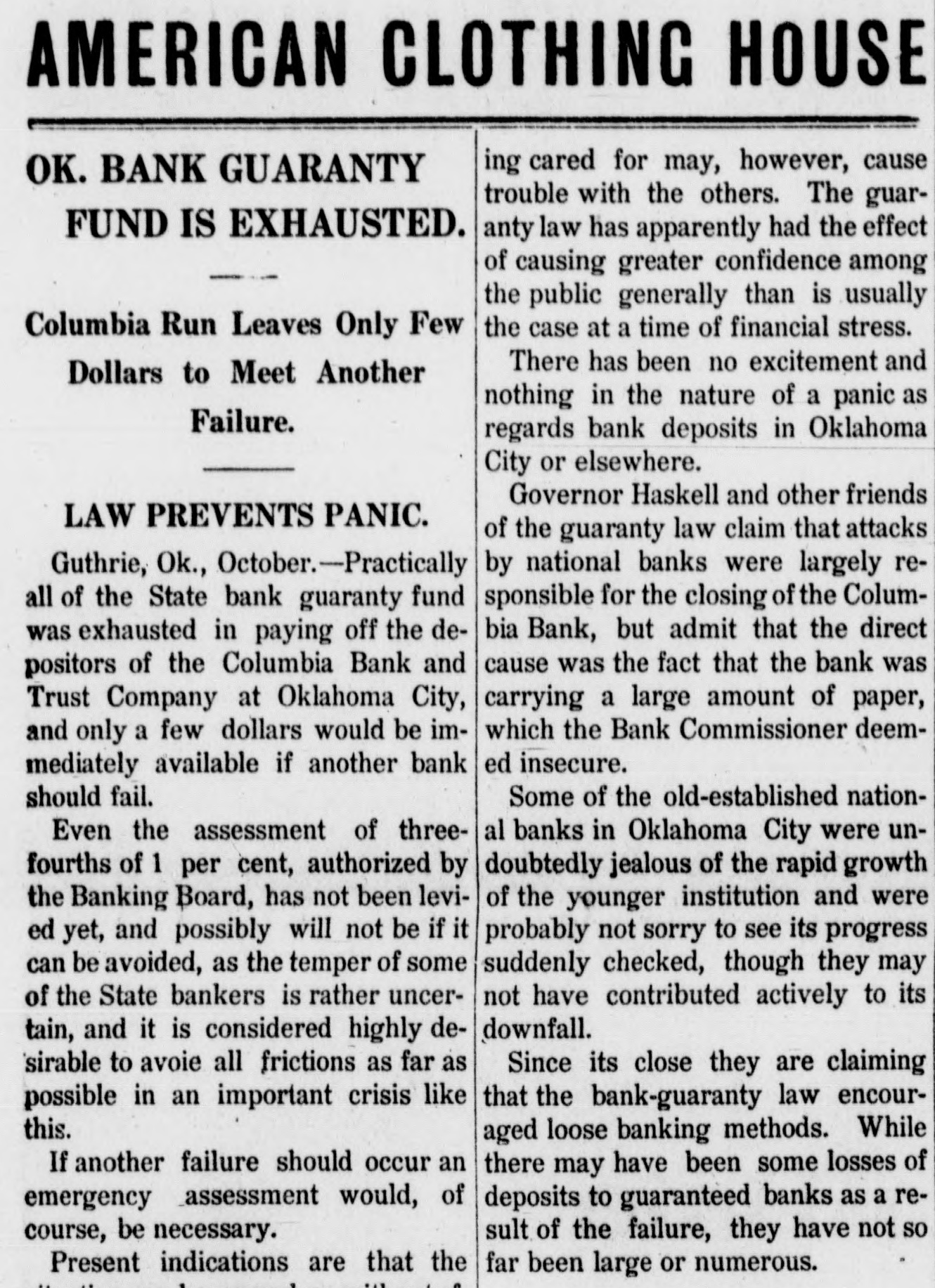
AMERICAN CLOTHING HOUSE ing cared for may, however, cause OK. BANK GUARANTY trouble with the others. The guarFUND IS EXHAUSTED. anty law has apparently had the effect of causing greater confidence among the public generally than is usually the case at a time of financial stress. Columbia Run Leaves Only Few There has been no excitement and Dollars to Meet Another nothing in the nature of a panic as Failure. regards bank deposits in Oklahoma City or elsewhere. Governor Haskell and other friends LAW PREVENTS PANIC. of the guaranty law claim that attacks by national banks were largely reGuthrie, Ok., October.-Practically sponsible for the closing of the Columall of the State bank guaranty fund bia Bank, but admit that the direct was exhausted in paying off the decause was the fact that the bank was positors of the Columbia Bank and carrying a large amount of paper, Trust Company at Oklahoma City, which the Bank Commissioner deemand only a few dollars would be imed insecure. mediately available if another bank Some of the old-established nationshould fail. Even the assessment of threeal banks in Oklahoma City were undoubtedly jealous of the rapid growth fourths of 1 per cent, authorized by the Banking Board, has not been leviof the younger institution and were probably not sorry to see its progress ed yet, and possibly will not be if it suddenly checked, though they may can be avoided, as the temper of some of the State bankers is rather uncernot have contributed actively to its downfall. tain, and it is considered highly desirable to avoie all frictions as far as Since its close they are claiming possible in an important crisis like that the bank-guaranty law encourthis. aged loose banking methods. While If another failure should occur an there may have been some losses of emergency assessment would, of deposits to guaranteed banks as a result of the failure, they have not so course, be necessary. Present indications are that the far been large or numerous.
13.October 7, 1909The Mena Weekly StarMena, AR
Click image to open full size in new tab
Article Text
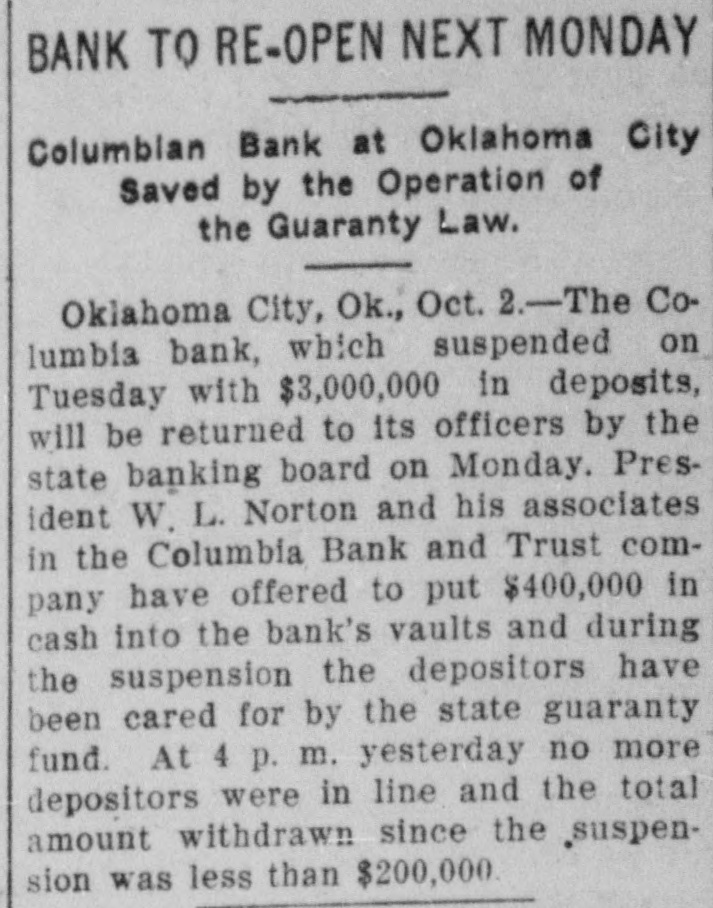
BANK TO RE-OPEN NEXT MONDAY Columbian Bank at Oklahoma City Saved by the Operation of the Guaranty Law. Oklahoma City, Ok., Oct. 3.-The Columbia bank, which suspended on Tuesday with $3,000,000 in deposits, will be returned to its officers by the state banking board on Monday. President W. L. Norton and his associates in the Columbia Bank and Trust company have offered to put $400,000 in cash into the bank's vaults and during the suspension the depositors have been cared for by the state guaranty fund. At 4 p. m. yesterday no more depositors were in line and the total amount withdrawn since the suspension was less than $200,000.
14.October 9, 1909The Hays Free PressHays, KS
Click image to open full size in new tab
Article Text
PLANS FOR SUSPENDED BANK
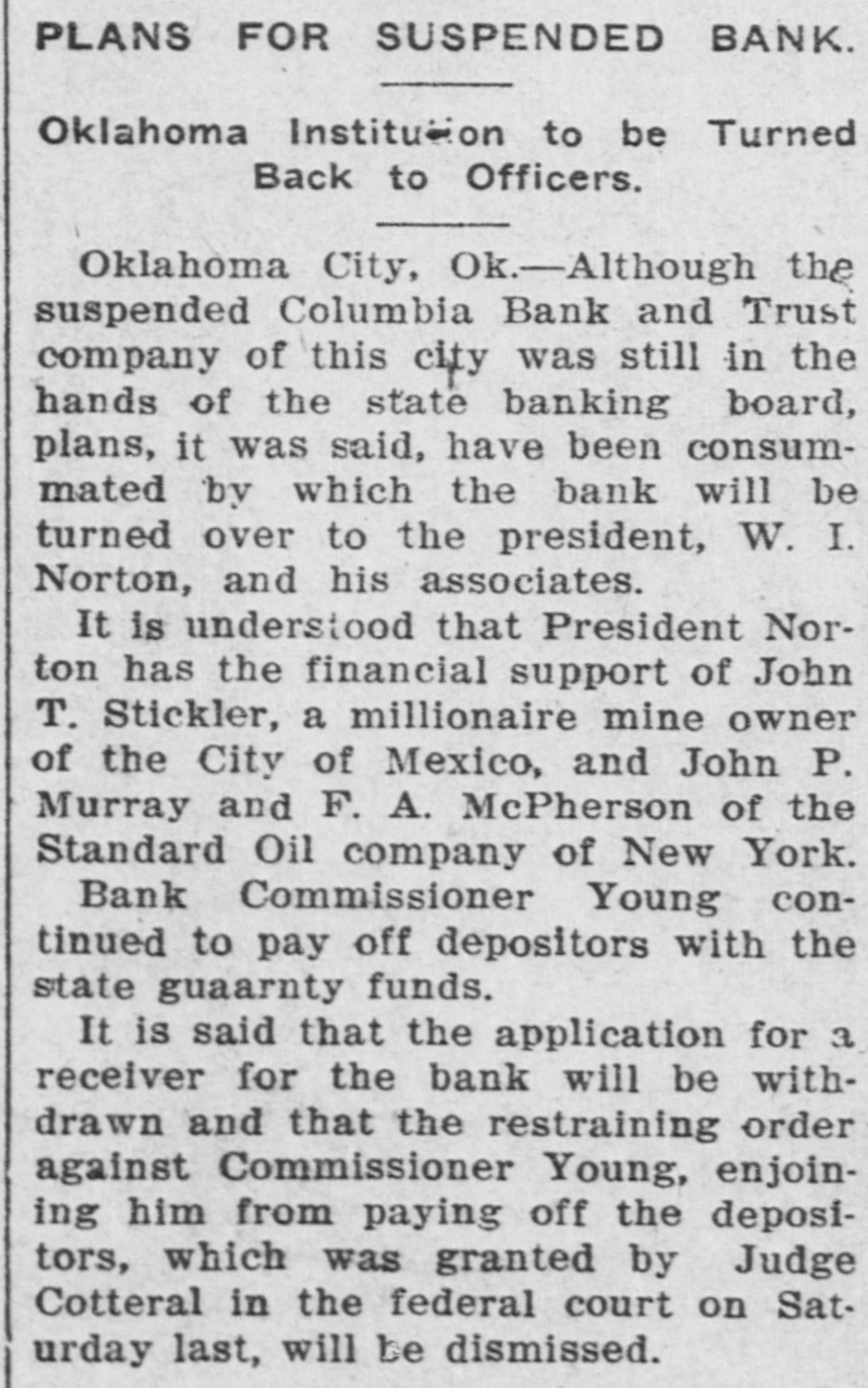
Oklahoma Institution to be Turned Back to Officers. Oklahoma City, Ok.-Although the suspended Columbia Bank and Trust company of this city was still in the hands of the state banking board, plans, it was said, have been consummated by which the bank will be turned over to the president, W. I. Norton, and his associates. It is understood that President Norton has the financial support of John T. Stickler, a millionaire mine owner of the City of Mexico, and John P. Murray and F. A. McPherson of the Standard Oil company of New York. Bank Commissioner Young continued to pay off depositors with the state guaarnty funds. It is said that the application for a receiver for the bank will be withdrawn and that the restraining order against Commissioner Young, enjoining him from paying off the depositors, which was granted by Judge Cotteral in the federal court on Saturday last, will be dismissed.
15.October 14, 1909The Topeka State JournalTopeka, KS
Click image to open full size in new tab
Article Text
KANSAS COMMENT
ORGANIZATION NEEDED. The automobile enthusiasts of Kansas, as in other states, are forming clubs and associations, the chief end and aim of which is to win zinc loving cups which are frequently offered as prizes to the winners of pathfinding tours and endurance runs, but it never seems to occur to anybody that an organization for the purpose of detecting and punishing speed maniacs and others who bring motoring into disrepute, would be a good thing.
When horse stealing became such a properous industry in the west that the sheriffs and other officers of the law couldn't cope with it, the farmers formed an organization for the special purpose of dealing with the thieves, and the latter became so discouraged that they practically went out of business. The Anti-Horsethief association is said to have lost some of its efficiency in recent years because the members devoted too much attention to its picnic features, but whenever the association does show signs of activity, the thieves take to the woods.
The auto owners should have some organization for their own protection. Every accident that occurs increases the prejudice against the gasoline wagon, and emphasizes the demand for legislation that will make motoring seem like riding on a hearse.
The other day a young man was run down in Emporia, and it was merely a bit of good luck that he wasn't killed. The man who was running the machine had important engagements somewhere else, and didn't wait to see what happened to the victim. He kept in the middle of the road, and is possibly making fast time yet. All efforts to discover his identity failed, and unless he dies of a guilty conscience, he will never be punished. If the autoists had the sort of an organization suggested, that man would be apprehended somewhere, and brought to punishment, regardless of expense. When they demonstrate that they have as little use as anybody for the reckless chauffeur, they will have accomplished something that will lessen the growing prejudice against the whole automobile business. And such work is surely as important as winning tin cups for running a machine a thousand miles through a swamp.—Emporia Gazette.
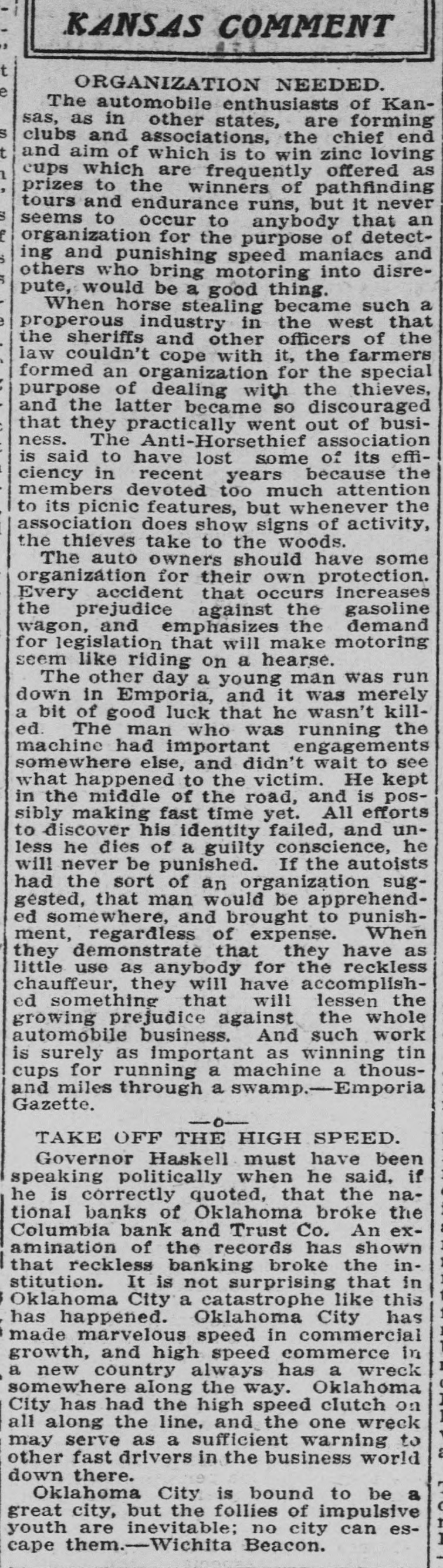
TAKE OFF THE HIGH SPEED. Governor Haskell must have been speaking politically when he said, if he is correctly quoted, that the national banks of Oklahoma broke the Columbia bank and Trust Co. An examination of the records has shown that reckless banking broke the institution. It is not surprising that in Oklahoma City a catastrophe like this has happened. Oklahoma City has made marvelous speed in commercial growth, and high speed commerce in a new country always has a wreck somewhere along the way. Oklahoma City has had the high speed clutch on all along the line, and the one wreck may serve as a sufficient warning to other fast drivers in the business world down there.
Oklahoma City is bound to be a great city, but the follies of impulsive youth are inevitable; no city can escape them.—Wichita Beacon.
16.November 2, 1909The Newark Star and Newark AdvertiserNewark, NJ
Click image to open full size in new tab
Article Text
ASKS RECEIVER FOR BANK
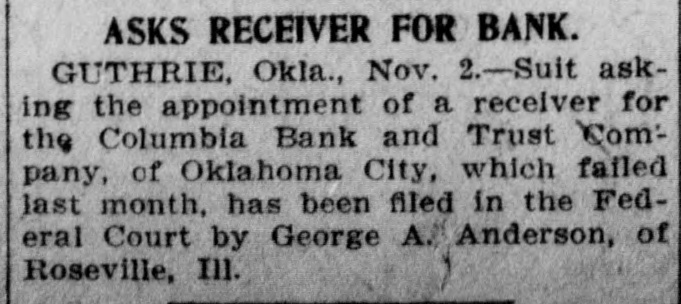
GUTHRIE, Okla., Nov. 2.-Suit asking the appointment of a receiver for the Columbia Bank and Trust Company, of Oklahoma City, which failed last month, has been filed in the Federal Court by George A. Anderson, of Roseville, Ill.
17.November 2, 1909The Birmingham Age-HeraldBirmingham, AL
Click image to open full size in new tab
Article Text
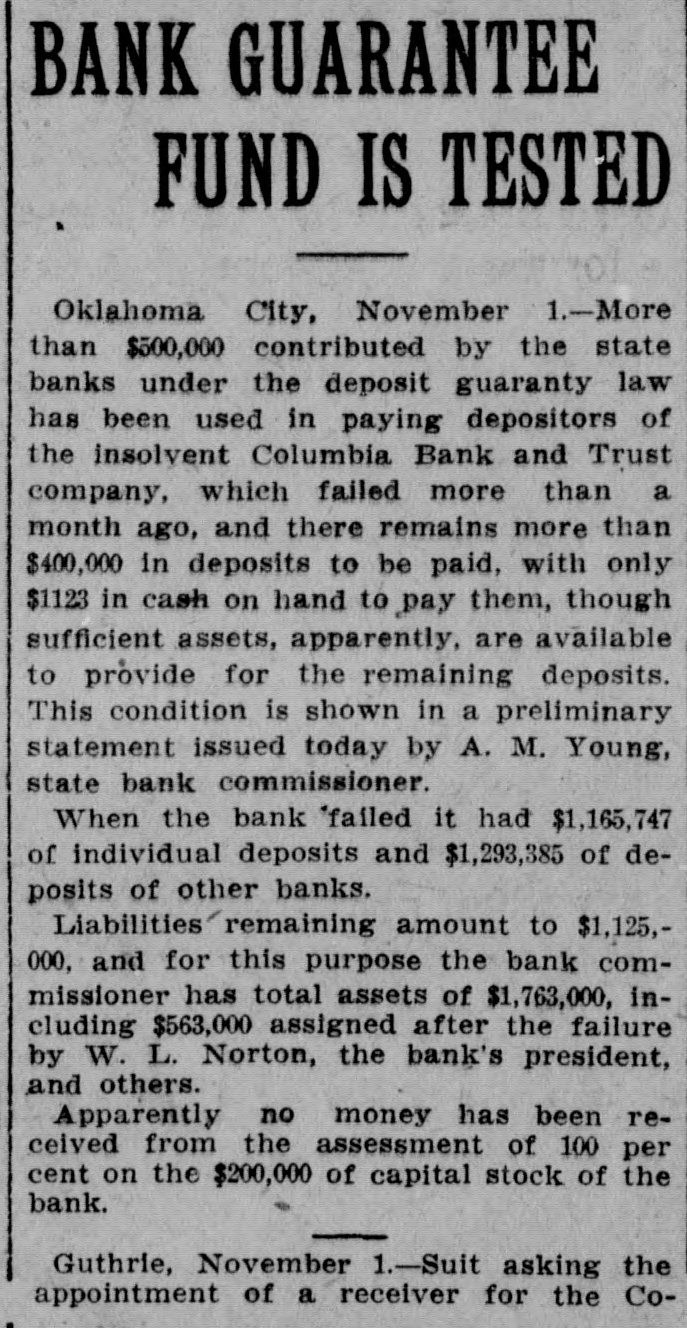
BANK GUARANTEE FUND IS TESTED Oklahoma City, November 1.-More than $500,000 contributed by the state banks under the deposit guaranty law has been used in paying depositors of the insolvent Columbia Bank and Trust company, which failed more than a month ago, and there remains more than $400,000 in deposits to be paid, with only $1123 in cash on hand to pay them, though sufficient assets, apparently, are available to provide for the remaining deposits. This condition is shown in a preliminary statement issued today by A. M. Young, state bank commissioner. When the bank 'failed it had $1,165,747 of individual deposits and $1,293,385 of deposits of other banks. Liabilities remaining amount to $1,125,000, and for this purpose the bank commissioner has total assets of $1,763,000, including $563,000 assigned after the failure by W. L. Norton, the bank's president, and others. Apparently no money has been received from the assessment of 100 per cent on the $200,000 of capital stock of the bank. Guthrie, November 1.-Suit asking the appointment of a receiver for the Co-
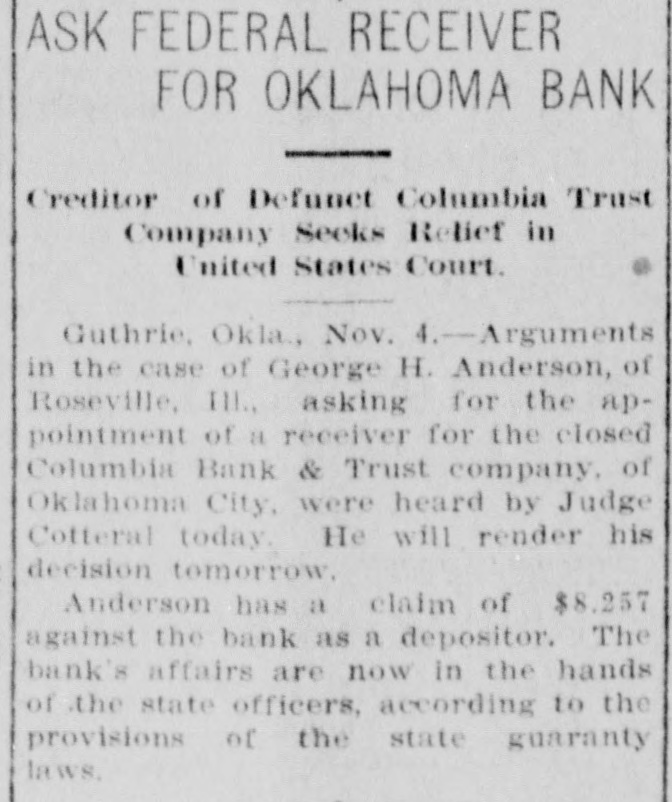
ASK FEDERAL RECEIVER FOR OKLAHOMA BANK Creditor of Defunct Columbia Trust Company Seeks Relief in United States Court. Guthrie, Okla., Nov. 4.-Arguments in the case of George H. Anderson, of Roseville, III., asking for the appointment of a receiver for the closed Columbia Bank & Trust company, of Oklahoma City, were heard by Judge Cotteral today. He will render his decision tomorrow. Anderson has a claim of $8.257 against the bank as a depositor. The bank's affairs are now in the hands of the state officers, according to the provisions of the state guaranty laws.
19.November 12, 1909The Chickasha Daily ExpressChickasha, OK
Click image to open full size in new tab
Article Text
Surety Company and Land Board Test Suit
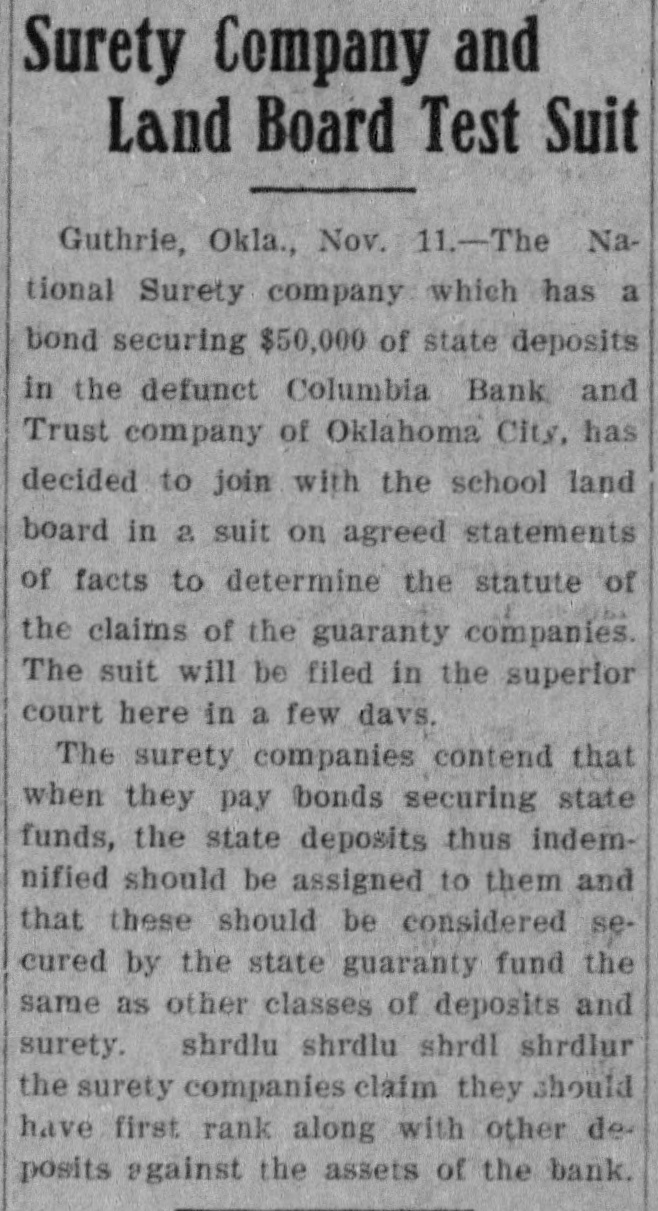
Guthrie, Okla., Nov. 11.-The National Surety company which has a bond securing $50,000 of state deposits in the defunct Columbia Bank and Trust company of Oklahoma City, has decided to join with the school land board in a suit on agreed statements of facts to determine the statute of the claims of the guaranty companies. The suit will be filed in the superior court here in a few days.
The surety companies contend that when they pay bonds securing state funds, the state deposits thus indemnified should be assigned to them and that these should be considered secured by the state guaranty fund the same as other classes of deposits and surety. shrdlu shrdlu shrdl shrdlur the surety companies claim they should have first rank along with other deposits against the assets of the bank.
20.December 8, 1909The Vinita Daily ChieftainVinita, OK
Click image to open full size in new tab
Article Text
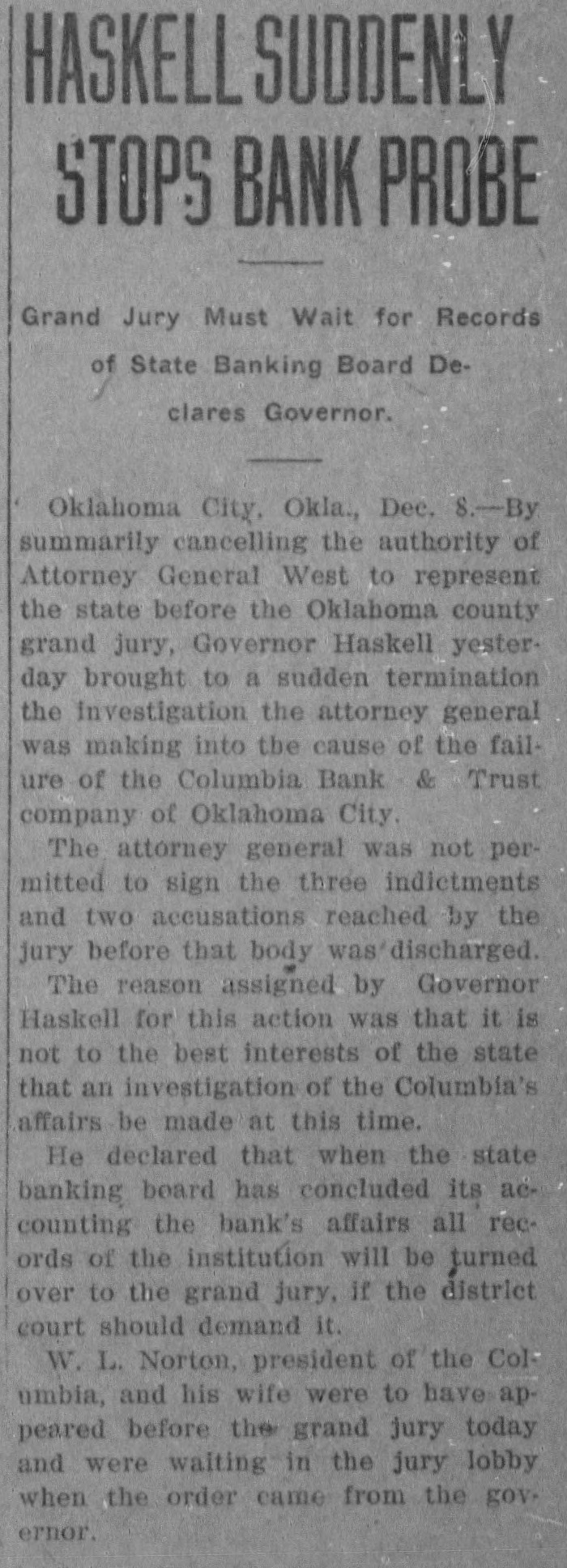
HASKELLSUDDENLY STOPS BANK PROBE Grand Jury Must Wait for Records of State Banking Board Declares Governor. Oklahoma City, Okla., Dec. 8.-By summarily cancelling the authority of Attorney General West to represent the state before the Oklahoma county grand jury, Governor Haskell yesterday brought to a sudden termination the investigation the attorney general was making into the cause of the failure of the Columbia Bank & Trust company of Oklahoma City, The attorney general was not permitted to sign the three indictments and two accusations reached by the jury before that body was'discharged. The reason assigned by Governor Haskell for this action was that it is not to the best interests of the state that an investigation of the Columbia's affairs be made at this time. He declared that when the state banking board has concluded its accounting the bank's affairs all records of the institution will be turned over to the grand jury, if the district court should demand it. W. L. Norton, president of the Columbia, and his wife were to have-appeared before the grand jury today and were waiting in the jury lobby when the order came from the gov ernor.
21.December 8, 1909The Salt Lake Herald-RepublicanSalt Lake City, UT
Click image to open full size in new tab
Article Text
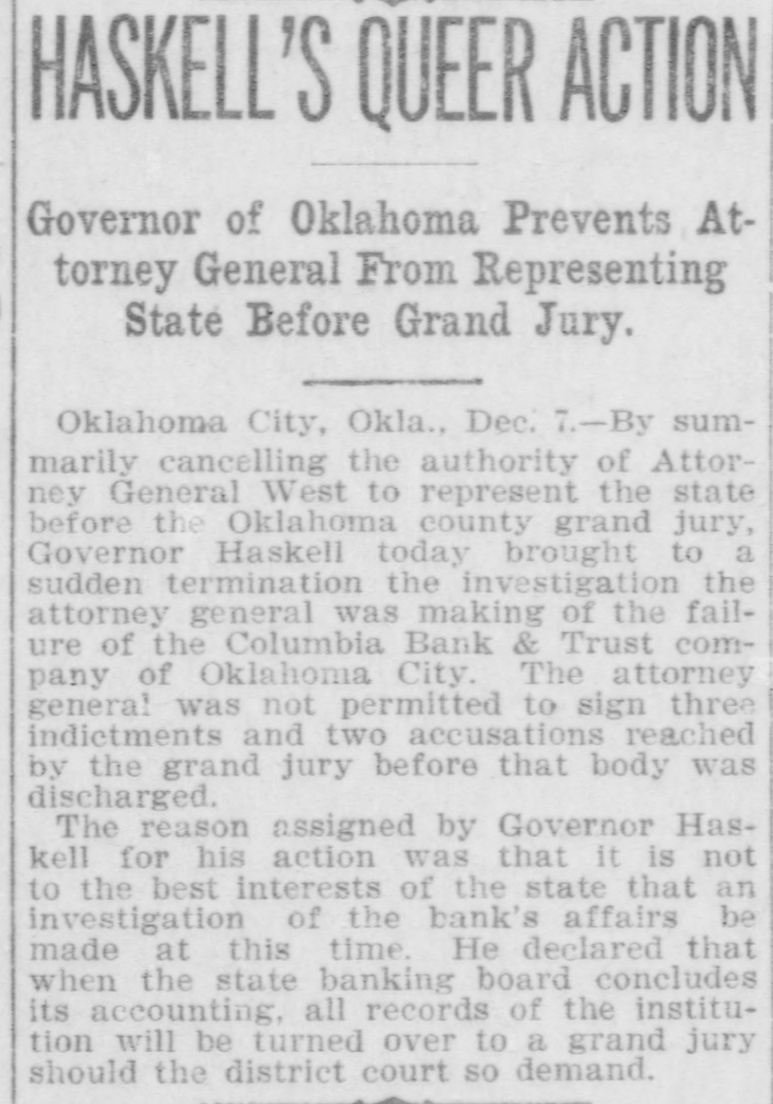
HASKELL'S QUEER ACTION Governor of Oklahoma Prevents Attorney General From Representing State Before Grand Jury. Oklahoma City, Okla., Dec. 7.-By summarily cancelling the authority of Attorney General West to represent the state before the Oklahoma county grand jury, Governor Haskell today brought to a sudden termination the investigation the attorney general was making of the failure of the Columbia Bank & Trust company of Oklahoma City. The attorney general was not permitted to sign three indictments and two accusations reached by the grand jury before that body was discharged. The reason assigned by Governor Haskell for his action was that it is not to the best interests of the state that an investigation of the bank's affairs be made at this time. He declared that when the state banking board concludes its accounting, all records of the institution will be turned over to a grand jury should the district court SO demand.
22.December 14, 1909The Detroit TimesDetroit, MI
Click image to open full size in new tab
Article Text
Oklahoma Bank Closes
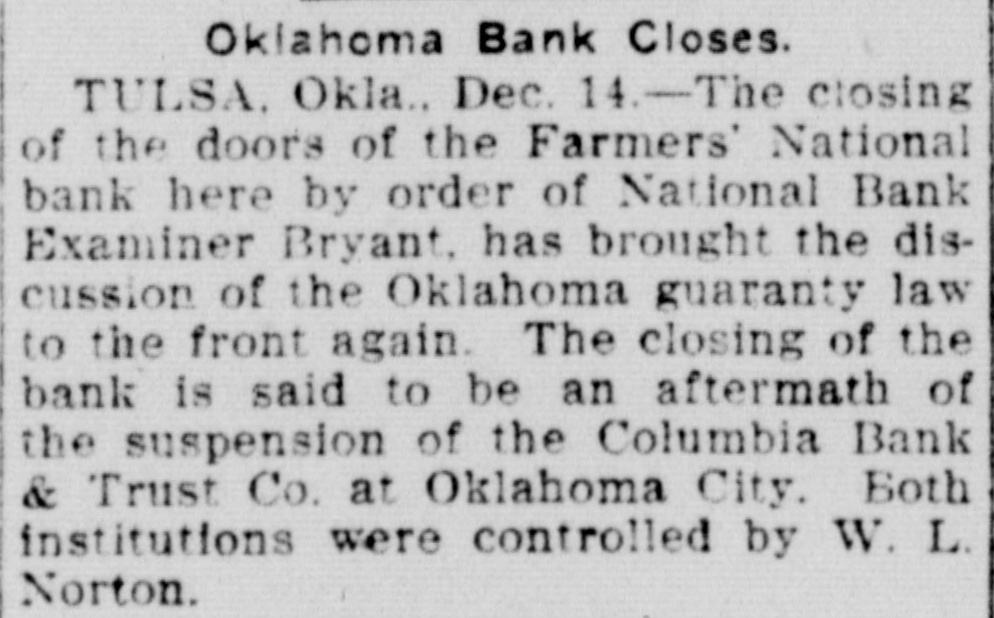
TULSA. Okla.. Dec. 14.-The closing of the doors of the Farmers' National bank here by order of National Bank Examiner Bryant, has brought the discussion of the Oklahoma guaranty law to the front again. The closing of the bank is said to be an aftermath of the suspension of the Columbia Bank & Trust Co. at Oklahoma City. Both institutions were controlled by W. L. Norton.
23.April 28, 1911Tulsa Daily WorldTulsa, OK
Click image to open full size in new tab
Article Text
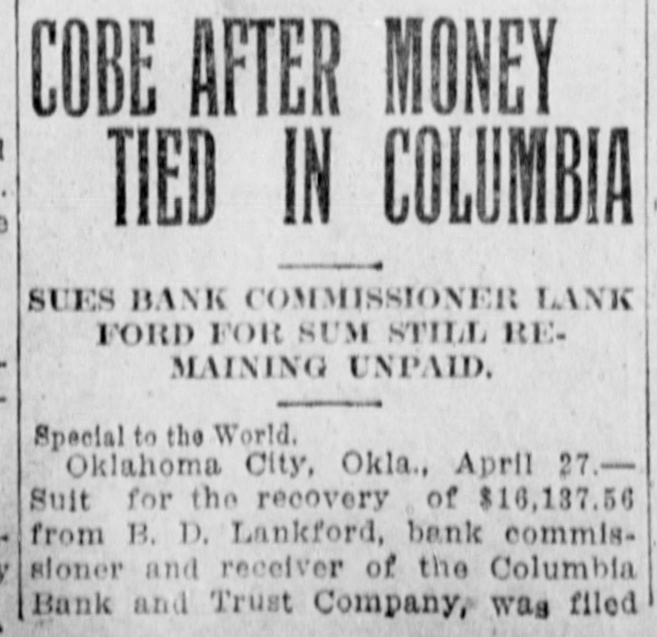
COBE AFTER MONEY TIED IN COLUMBIA SUES BANK COMMUSSIONER LANK FORD FOR SUM STILL REMAINING UNPAID. Special to the World. Oklahoma City, Okla., April 27.Suit for the recovery of $16,187.56 from B. D. Lankford, bank commissioner and receiver of the Columbia Bank and Trust Company, was filed
Bank runs are almost always and everywhere a deterioration of bank fundamentals.
But not for you.
You are the measure-zero exception: great fundamentals, solid bank, and yet the Diamond Dybvig fairy spread its rumor. Depositors woke up. Your collateral was not prepositioned. The Clearinghouse had it for you.
Do not pass Go. Do not collect $200. Go directly to jail… or worse.
Flag Article for Review
Flag Episode for Review
Columbia Bank & Trust Company · Episode ID 9806986191317