Bank of the United States (New York, NY)

Episode Information

Episode UID
9717153891572
Episode Type
Run β†’ Suspension β†’ Closure
Bank Type
state
Bank ID
971715389 hash
Start Date
December 10, 1930
Location
New York, New York (40.714, -74.006)

Metadata

Model
gpt-5-mini (chosen from majority vote of a three-model LLM ensemble)
Short Digest
8e76a0ea7aa7a02e

Response Measures

None

Events (3)

1. December 10, 1930 Run
Cause
Rumor Or Misinformation
Cause Details
Circulated rumors caused abnormal withdrawals and crowds at branches leading to heavy withdrawals.
Measures
Clearing house member banks agreed to lend depositors up to 50% of authenticated claims to provide liquidity.
Newspaper Excerpt
rumors have been circulated which have caused abnormal of deposits and it is feared that if the bank is opened Thursday may continue
Source
newspapers
2. December 11, 1930 Suspension
Cause
Government Action
Cause Details
State superintendent of banks took possession following runs and heavy withdrawals; bank closed effective at opening.
Newspaper Excerpt
Broderick, state superintendent of banks, today took possession of the Bank of the United States
Source
newspapers
3. February 12, 1931 Receivership
Newspaper Excerpt
Irving Trust company, receivers. The closed bank has no connection with the government.
Source
newspapers

Newspaper Articles (22)

Article from The Winchester Sun, December 11, 1930

Click image to open full size in new tab

Article Text

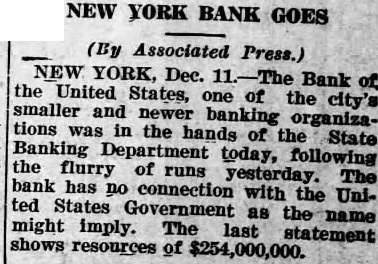
NEW YORK BANK (By Associated YORK, Dec. Bank the United States, of the and banking organizations was in the hands of State Banking today, following the flurry of runs yesterday. The has no connection with the United States Government as might imply. The last shows resources of


Article from The Republican, December 11, 1930

Click image to open full size in new tab

Article Text

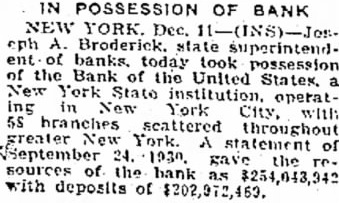
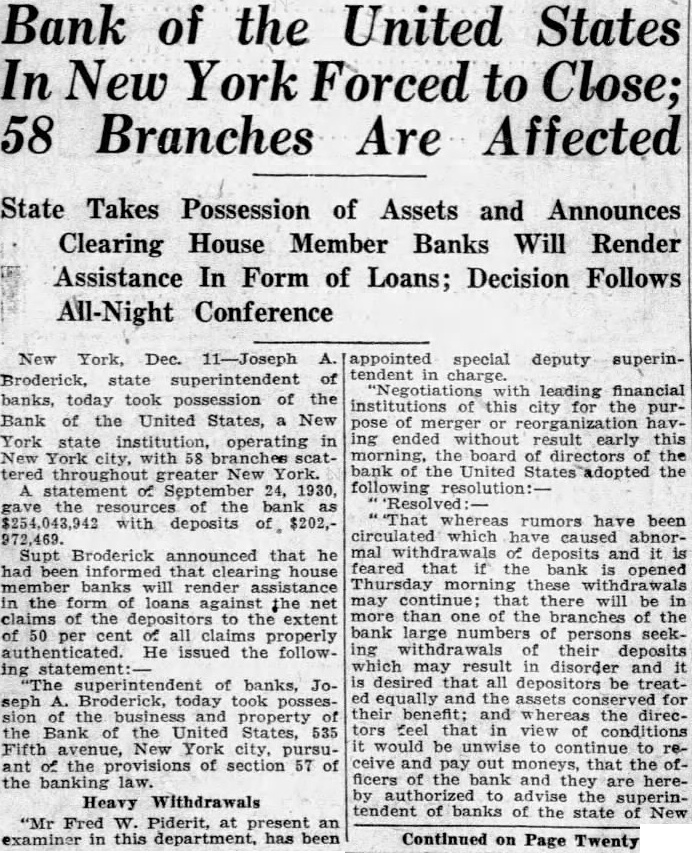
Bank of the United States In New York Forced to Close; 58 Branches Are Affected State Takes Possession of Assets and Announces Clearing House Member Banks Will Render Assistance In Form of Loans; Decision Follows All-Night Conference Broderick, state superintendent of banks, today took possession of the Bank of the United States, a New York state institution, operating in New York city, with 58 branches scat tered throughout greater New York. A. statement of September 24, 1930, gave the resources of the bank as $254,043,942 with deposits of. $202,972,469. Supt Broderick announced that he had been informed that clearing house member banks will render in the form of loans against the net claims of the depositors to the extent of 50 per cent of all claims properly authenticated. He issued the following statement:"The superintendent of banks, Joseph A. Broderick, today took possession of the business and property the Bank of the United States, 535 Fifth avenue, New York city, pursuant of the provisions of section 57 of the banking law. Heavy Withdrawals "Mr Fred W. Piderit, at present an examiner in this department, has been tendent in charge. "Negotiations with leading financial institutions of this city for the purpose of or having ended without result early this morning, the board of directors of the bank of the United adopted the following resolution:Resolved "That whereas rumors have been circulated which have caused abnormal of deposits and it is feared that if the bank is opened Thursday may continue; that there will be in more than one of the branches of the bank large numbers of persons seeking withdrawals of their deposits which may result in disorder and it is desired that all depositors be treated equally and the assets conserved for their benefit; and whereas the directors feel that in view of conditions it would be to continue to receive and pay out moneys, that the officers of the bank and they are hereby authorized to advise the superintendent of banks of the state of New Continued on Page Twenty


Article from The Republican, December 11, 1930

Click image to open full size in new tab

Article Text

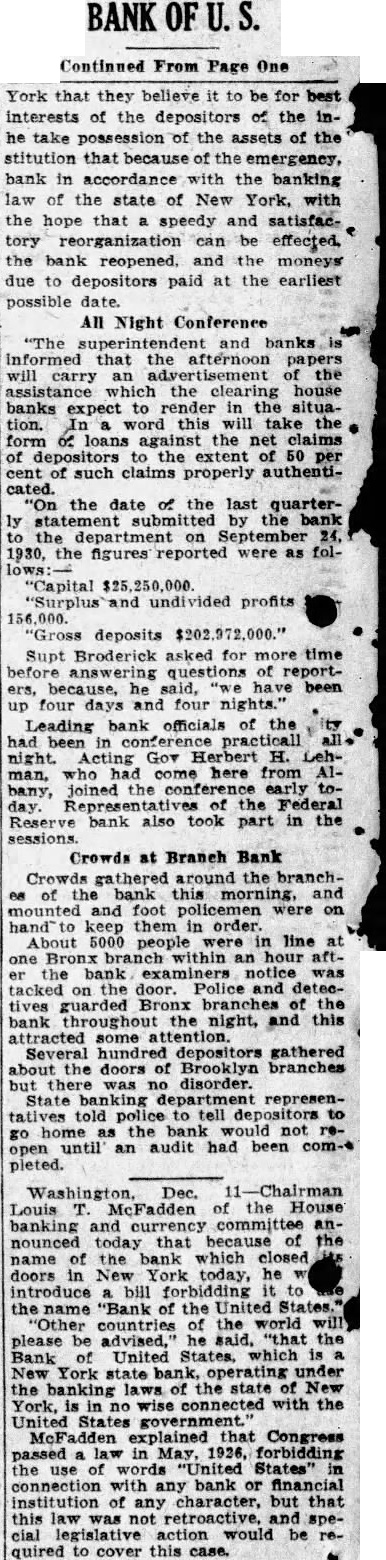
Continued From Page One York that they believe it to be for best interests of the depositors of the he take possession of the assets of the stitution that because the emergency, bank in accordance the banking of the state of New York, the hope speedy and satisfacreorganization effected. the reopened. the moneys due to paid at the earliest possible date. All Night Conference "The that the will which the house banks expect render the situation. will take the form loans against the net claims depositors extent such claims properly authenticated. the date the last quarteron 1930, the figures were as "Capital undivided profits Gross deposits Supt Broderick asked for more time before answering questions reporthe up four four nights. Leading officials of the night. H. from joined the conference early the Federal bank took part the sessions. Crowds at Branch Bank Crowds gathered around the branchbank and foot policemen were them in order. About people line Police and detecnight, and this attracted Several hundred depositors gathered about doors Brooklyn branches there disorder. tell home the bank not open until an audit had been pleted. Dec. Louis the House banking committee nounced that because name of the bank which doors New today, he introduce forbidding the "Bank of the United countries the world please be Bank States, which York the the state York, with the explained Congress passed words "United connection bank financial character, but that this not would be quired cover this case.


Article from Daily News, December 11, 1930

Click image to open full size in new tab

Article Text

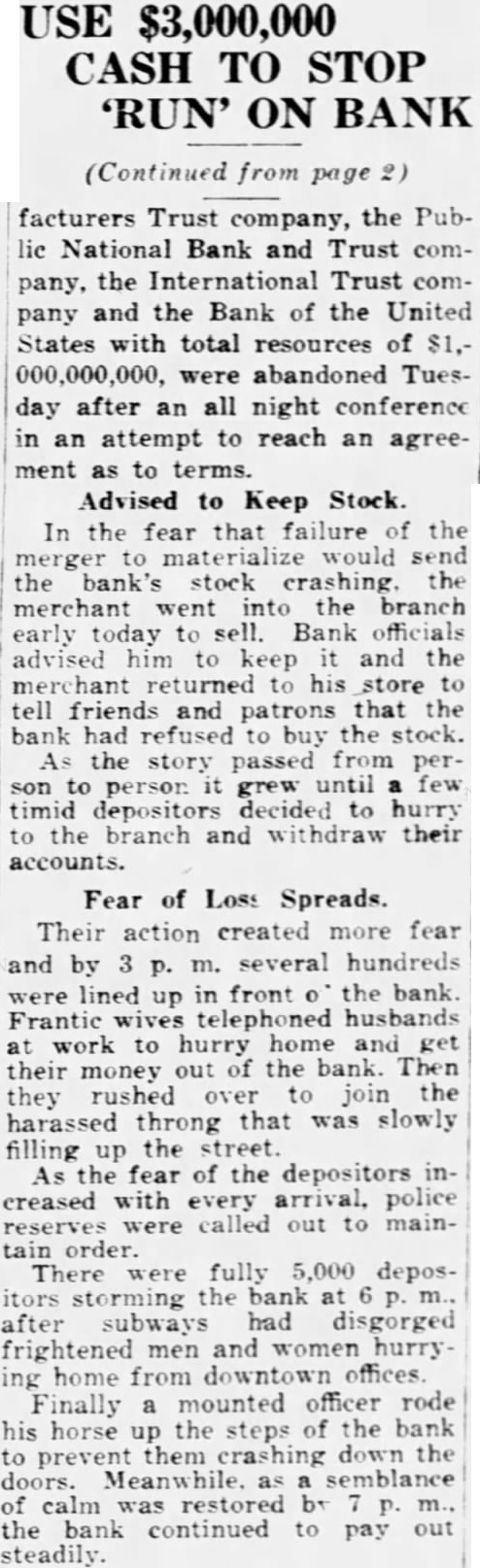
USE $3,000,000 CASH TO STOP 'RUN' ON BANK (Continued from page 2) facturers Trust company, the Public National Bank and Trust company, the International Trust company and the Bank of the United States with total resources of $1,000,000,000, were abandoned Tuesday after an all night conference in an attempt to reach an agreement as to terms. Advised to Keep Stock. In the fear that failure of the merger to materialize would send the bank's stock crashing. the merchant went into the branch early today to sell. Bank officials advised him to keep it and the merchant returned to his store to tell friends and patrons that the bank had refused to buy the stock. As the story passed from person to person it grew until a few timid depositors decided to hurry to the branch and withdraw their accounts. Fear of Loss Spreads. Their action created more fear and by 3 p. m. several hundreds were lined up in front o' the bank. Frantic wives telephoned husbands at work to hurry home and get their money out of the bank. Then they rushed over to join the harassed throng that was slowly filling up the street. As the fear of the depositors increased with every arrival, police reserves were called out to maintain order. There were fully 5,000 depositors storming the bank at 6 p. m., after subways had disgorged frightened men and women hurrying home from downtown offices. Finally a mounted officer rode his horse up the steps of the bank to prevent them crashing down the doors. Meanwhile. as a semblance of calm was restored by 7 p. m., the bank continued to pay out steadily.


Article from Delaware County Daily Times, December 11, 1930

Click image to open full size in new tab

Article Text

IN POSSESSION OF BANK NEW YORK. Dec. of banks. today took possession of the Bank of the United States. a New Ing York in State institution. operatYork 5S branches seattered City, throughout September greater York. statement of 24. gave of the bank $254,043,342 the rewith deposits of $202,972,460.


Article from The Berkshire Eagle, December 11, 1930

Click image to open full size in new tab

Article Text

OVERNIGHT NEWS BY THE ASSOCIATED PRESS DOMESTIC. CHICAGO-Mary Garden sings title role in premiere of jazz opera, "Camille." FOREIGN. killed, several hurt in rioting as students clash with police. found crawling among audience in theater showing American war film. LONDON-Dally Mail says disgruntled huge conspiracy to overthrow Stalin. arrested for plotting death of President Ibanez. NEW ENGLAND. W. Ricker, Haverhill, and Russell S. Gately, Wellesley, appointed deputy income tax assessors. CAMBRIDGE, Turtado convicted of first degree murder of his wife. BOSTON-John Foley, South Boston, wanted in Newark, N. in with $6900 jewelry store robbery, captured. LAWRENCE, than 400 public school teachers vote part of their income the unemployed. PORTSMOUTH, H.-States of Maine and New win $5000 suit against the Martin Barge company of Philadelphia and the New Gas and Electric company for damage to bridge. R. Thompson, New London, Conn., skipper of the fishing schooner Harold washed overboard and drowned off Point Judith. MONT VERNON, N. H.-Mrs. William L. Robinson, 50, severely injured by power driven saw while helping her husband. AMESBURY Mass.-Mrs. Doris Gray, 25, goes suddenly insane and throws three-weeks old baby in blazing furnace. HAVERHILL Mass. Close of Chance of Twins One in 87 HONOLULU mathematical chances for twins being born are one in 87; for triplets, one in 7,103; for quadruplets, one in 757,000; and for quintuplets, one in 41,600,000. The figures were computed by Dr. O. Lee Schattenburg. The commissioners appointed by President Washington to provide for capitol offered $500 in cash and building lot in the new city for the best design. three days' voting finds seven out of eight shoe crafts rejecting cut in wages asked by shoe manufacturers because of business depression. Shackett, prisoner at Chittenden county jail, starts fire in cell as two other prisoners attempt escape. Cote, 12. critically wounded playing with loaded revolver. Bolan, 36, fatally burned, Maurice Dailey, 32, dying, and third man seriously injured when automobile goes over embankment. CLINTON, Lancaster mills, one of the largest gingham mills in New England and valued at $3,000,000 fails to draw bidder at auction. priest sought give spiritual solace to Chokoo Miam, seaman from northern India dying here. Royce coach and body works to be moved here from Long Island City, N. gangster associates of Chicago's Bugs Moran named in effort to convict him of FOREIGN ROME, to take air portfolio while Minister Balbo is on South American flight. Pratt says navy does not plan build up to London treaty limit before 1936. WASHINGTON-Pight on con- not like work from in the firmation of McNinch to federal at night and expower gains ground: pect to work the next day Under ten of nineteen members these the quality of oppose him. the election officers tends to de- NEW indicted for it harder yet to get good officers raids on pocketbook industry: mur- to serve. der manufacturer laid to same racket. Village houses in Bulgaria are so and har- scape, result of Turkish rule when bors congress calls railway execuwas desirable for Bulgarians to tives' attack on inland program unlive as unobtrusively as possible. warranted. NEW YORK Commissioner Thayer starts inquiry of runaway THAT inmates' charges of brutality and STOP poor food. Woodcock tells dry proExpert Auto hibition is being successfully enforced. BOSTON-Farm bureau federation asks operation Muscle Shoals by co-operative organization Geo. E. Shippey of farmers. NEW YORK Police disperse 224 West Housatonic St. crowd in on Bank of the United Phone 1760 States. Officials say all will be paid.


Article from The North Adams Transcript, December 11, 1930

Click image to open full size in new tab

Article Text

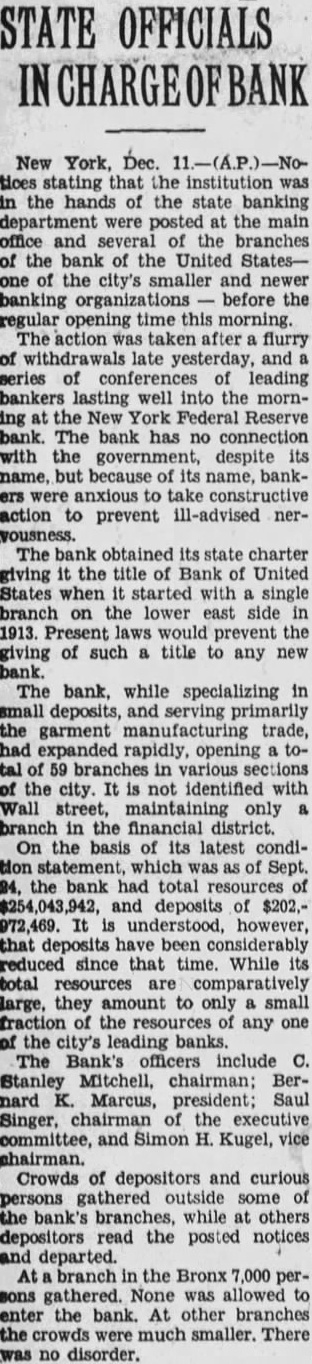
OFFICIALS New York, Dec. stating that the institution hands of the state banking department were posted the main several of the branches the bank of the United Statesthe smaller newer banking organizations before the opening time this morning. action late yesterday, and conferences leading bankers well into the mornNew York Federal Reserve bank. The bank has no connection with the government, despite name, because name, bankanxious constructive action prevent ill-advised obtained its state charter giving of United when started single branch on the lower 1913. would prevent the of such title any new The bank. while specializing deposits, and serving primarily garment trade, expanded rapidly, opening 59 in various the city. street, maintaining branch in the On the basis of its latest condistatement, the bank had total and deposits however, deposits reduced since time. While large, amount to only small fraction the any one the The Bank's include Stanley Mitchell. chairman; Marcus, president; Saul Singer, chairman the committee, and Simon H. Kugel, vice shairman. Crowds of depositors and curious persons gathered bank's branches, while others depositors read the posted notices departed. the gathered. None the bank. other branches smaller. There disorder.


Article from The Knoxville Journal, December 12, 1930

Click image to open full size in new tab

Article Text

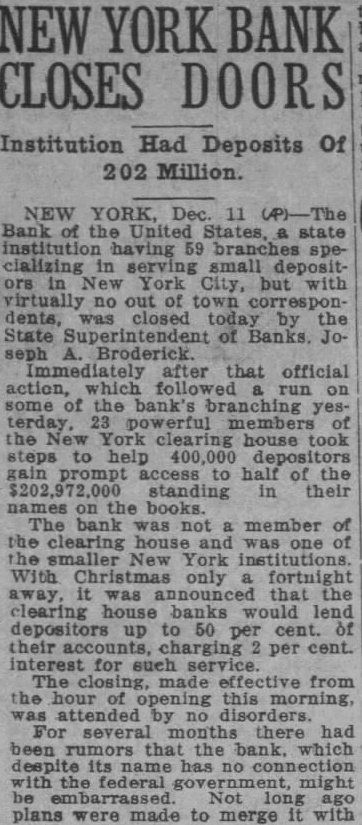
NEW YORK BANK CLOSES DOORS Institution Had Deposits Of 202 Million. NEW YORK, Dec. 11 (4P)-The Bank of the United States, state institution having 59 branches specializing in serving small depositors in New York City, but with virtually no out of town correspondents, was closed today by the State Superintendent of Banks. Joseph A. Broderick. Immediately after that official action, which followed a run on some of the bank's branching yesterday, 23 powerful members of the New York clearing house took steps to help 400,000 depositors gain prompt access to half of the $202,972,000 standing in their names on the books. The bank was not a member of the clearing house and was one of the smaller New York institutions. With Christmas only a fortnight away, it was announced that the clearing house banks would lend depositors up to 50 per cent. of their accounts, charging per cent. interest for such service. The closing, made effective from the hour of opening this morning, was attended by no disorders. For several months there had been rumors that the bank. which despite its name has no connection with the federal government, might be embarrassed. Not long ago plans were made to merge it with


Article from The Daily Worker, December 17, 1930

Click image to open full size in new tab

Article Text

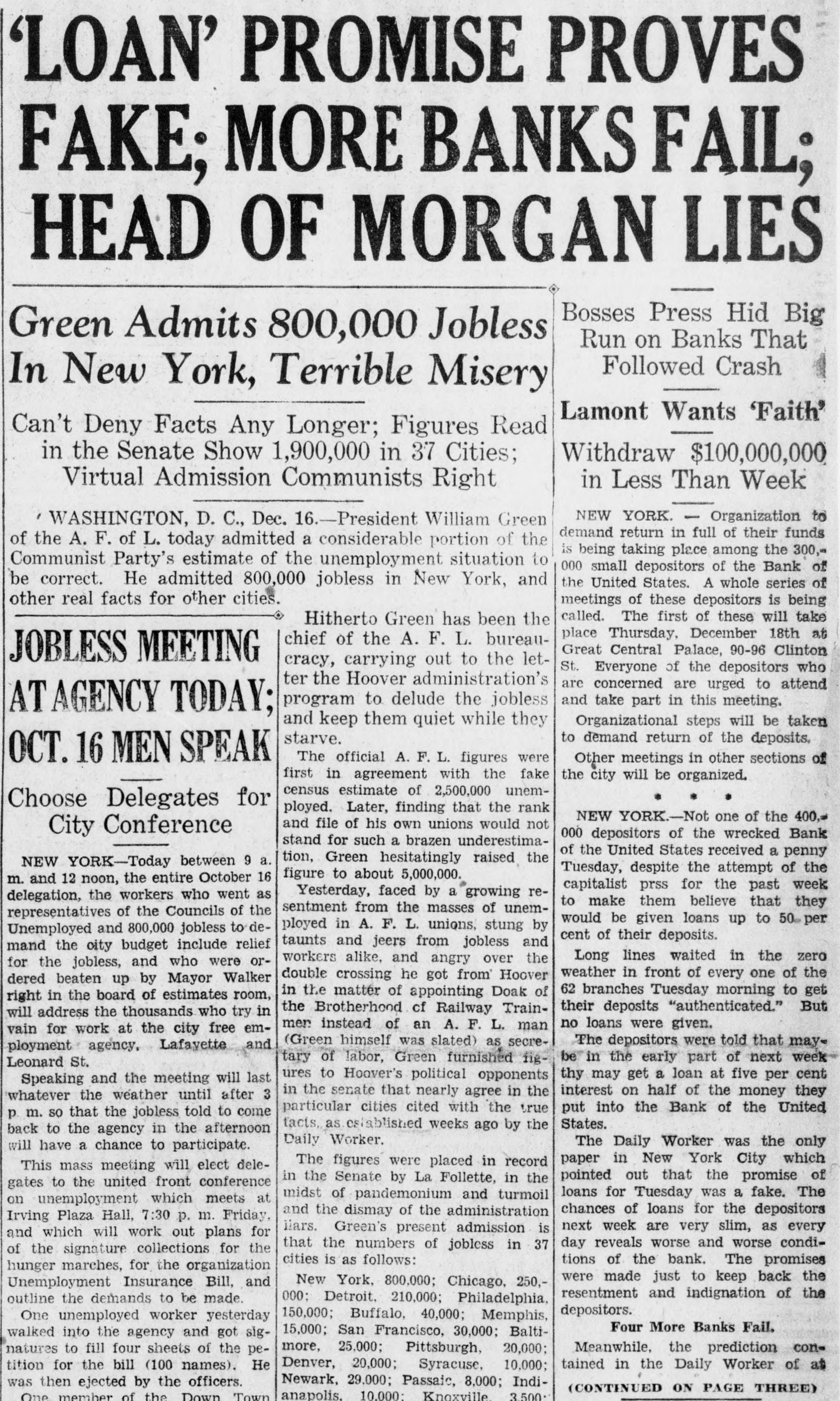
'LOAN' PROMISE PROVES FAKE; MORE BANKS FAIL; HEAD OF MORGAN LIES Bosses Press Hid Big Green Admits 800,000 Jobless Run on Banks That Followed Crash In New York, Terrible Misery Lamont Wants 'Faith' Can't Deny Facts Any Longer; Figures Read in the Senate Show 1,900,000 in 37 Cities; Withdraw $100,000,000 in Less Than Week Virtual Admission Communists Right NEW YORK. Organization to WASHINGTON, D. C., Dec. 16.-President William Green demand return in full of their funds of the A. F. of L. today admitted a considerable portion of the is being taking place among the 300,Communist Party's estimate of the unemployment situation to 000 small depositors of the Bank of be correct. He admitted 800,000 jobless in New York, and the United States. A whole series of other real facts for other cities. meetings of these depositors is being called. The first of these will take Hitherto Green has been the place Thursday, December 18th at chief of the A. F. L. bureauGreat Central Palace, 90-96 Clinton JOBLESS MEETING cracy, carrying out to the letSt. Everyone of the depositors who ter the Hoover administration's are concerned are urged to attend program to delude the jobless and take part in this meeting. AT AGENCY TODAY; and keep them quiet while they Organizational steps will be taken starve. to demand return of the deposits. OCT. 16 MEN SPEAK The official A. F. L. figures were Other meetings in other sections of first in agreement with the fake the city will be organized. census estimate of 2,500,000 unemChoose Delegates for ployed. Later, finding that the rank NEW YORK.-Not one of the 400,= and file of his own unions would not City Conference 000 depositors of the wrecked Bank stand for such a brazen underestimaof the United States received a penny tion, Green hesitatingly raised the NEW YORK-Today between 9 a. Tuesday, despite the attempt of the figure to about 5,000,000. m. and 12 noon, the entire October 16 capitalist prss for the past week Yesterday, faced by a growing redelegation, the workers who went as to make them believe that they sentment from the masses of unemrepresentatives of the Councils of the would be given loans up to 50th per ployed in A. F. L. unions, stung by Unemployed and 800,000 jobless to decent of their deposits. taunts and jeers from jobless and mand the city budget include relief Long lines waited in the zero workers alike, and angry over the for the jobless, and who were orweather in front of every one of the double crossing he got from Hoover dered beaten up by Mayor Walker 62 branches Tuesday morning to get in the matter of appointing Doak of right in the board of estimates room, their deposits "authenticated." But the Brotherhood cf Railway Trainwill address the thousands who try in no loans were given. men instead of an A. F. L. man vain for work at the city free em(Green himself was slated) as secreThe depositors were told that mayployment agency, Lafayette and be in the early part of next week tary of labor, Green furnished figLeonard St. thy may get a loan at five per cent ures to Hoover's political opponents Speaking and the meeting will last interest on half of the money they in the senate that nearly agree in the whatever the wΓ©ather until after 3 particular cities cited with the true put into the Bank of the United p. m. so that the jobless told to come States. facts, as established weeks ago by the back to the agency in the afternoon Daily Worker. The Daily Worker was the only will have a chance to participate. paper in New York City which The figures were placed in record This mass meeting will elect delepointed out that the promise of in the Senate by La Follette, in the gates to the united front conference loans for Tuesday was a fake. The midst of pandemonium and turmoil on unemployment which meets at chances of loans for the depositors and the dismay of the administration Irving Plaza Hall, 7:30 p. m. Friday, next week are very slim, as every Hars. Green's present admission is and which will work out plans for day reveals worse and worse condithat the numbers of jobless in 37 of the signature collections for the cities is as follows: tions of the bank. The promises hunger marches, for the organization were made just to keep back the New York, 800,000; Chicago, 250,Unemployment Insurance Bill, and resentment and indignation of the outline the demands to be made. 000; Detroit. 210,000; Philadelphia, depositors. One unemployed worker yesterday 150,000; Buffalo, 40,000; Memphis, Four More Banks Fail, 15,000; San Francisco, 30,000; Baltiwalked into the agency and got sigMeanwhile, the prediction conmore, 25,000; Pittsburgh, 20,000; natures to fill four sheets of the petition for the bill (100 names). He tained in the Daily Worker of at Denver, 20,000; Syracuse, 10,000; Newark, 29,000; Passaic, 8,000; Indiwas then ejected by the officers. (CONTINUED ON PAGE THREE) anapolis, 10.000: Knoxville 3.500 One member of the Down Town
Article from The Daily Worker, December 17, 1930

Click image to open full size in new tab

Article Text

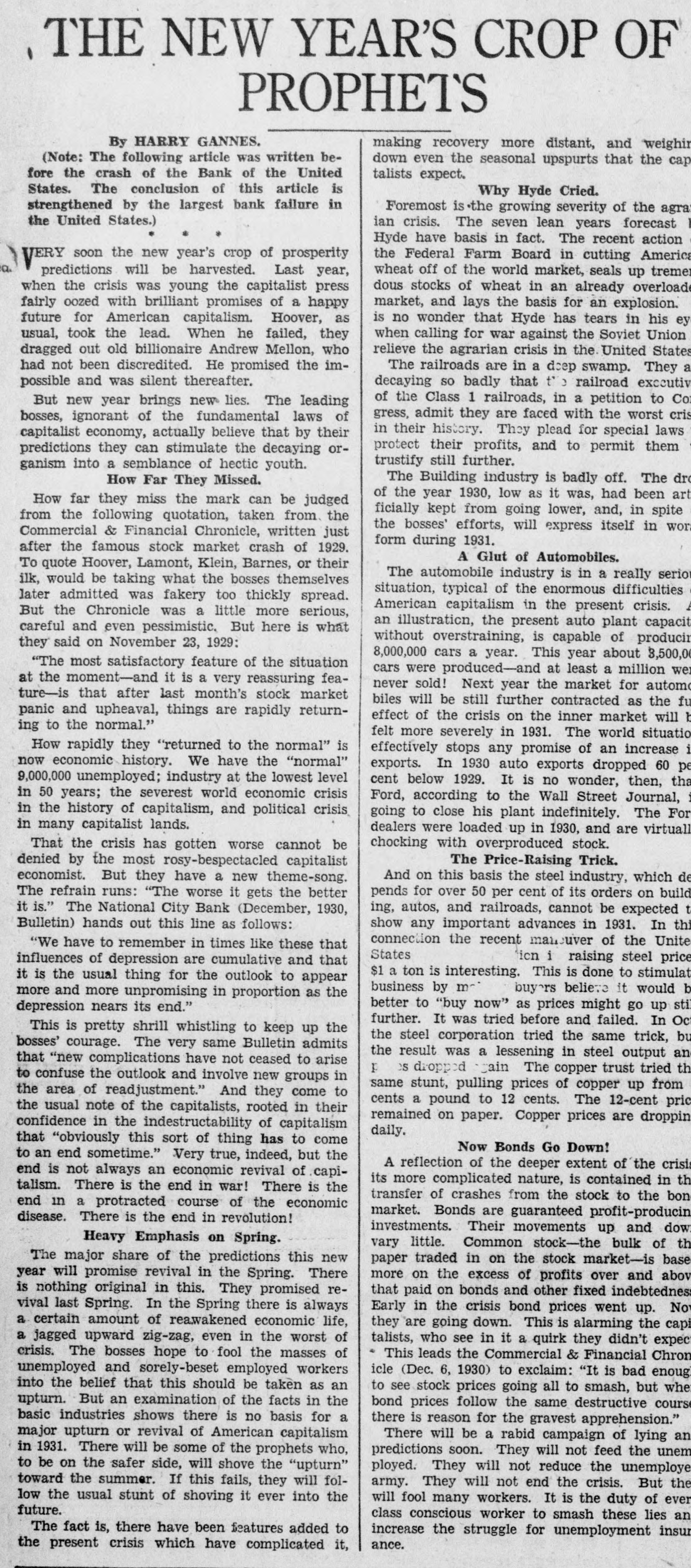
THE NEW YEAR'S CROP OF PROPHETS By HARRY GANNES. making recovery more distant, and weighir (Note: The following article was written bedown even the seasonal upspurts that the cap fore the crash of the Bank of the United talists expect. States. The conclusion of this article is Why Hyde Cried. strengthened by the largest bank failure in Foremost is the growing severity of the agra the United States.) ian crisis. The seven lean years forecast 1 Hyde have basis in fact. The recent action VERY soon the new year's crop of prosperity the Federal Farm Board in cutting America predictions will be harvested. Last year, wheat off of the world market, seals up tremer when the crisis was young the capitalist press dous stocks of wheat in an already overloade fairly oozed with brilliant promises of a happy market, and lays the basis for an explosion. future for American capitalism. Hoover, as is no wonder that Hyde has tears in his ey usual, took the lead. When he failed, they when calling for war against the Soviet Union dragged out old billionaire Andrew Mellon, who relieve the agrarian crisis in the United States had not been discredited. He promised the imThe railroads are in a deep swamp. They a possible and was silent thereafter. decaying SO badly that the railroad exccutiv of the Class 1 railroads, in a petition to Co But new year brings new lies. The leading gress, admit they are faced with the worst cris bosses, ignorant of the fundamental laws of in their history. They plead for special laws capitalist economy, actually believe that by their protect their profits, and to permit them predictions they can stimulate the decaying ortrustify still further. ganism into a semblance of hectic youth. The Building industry is badly off. The dro How Far They Missed. of the year 1930, low as it was, had been art How far they miss the mark can be judged ficially kept from going lower, and, in spite from the following quotation, taken from. the the bosses' efforts, will express itself in word Commercial & Financial Chronicle, written just form during 1931. after the famous stock market crash of 1929. A Glut of Automobiles. To quote Hoover, Lamont, Klein, Barnes, or their The automobile industry is in a really serior ilk, would be taking what the bosses themselves situation, typical of the enormous difficulties later admitted was fakery too thickly spread. American capitalism in the present crisis. b But the Chronicle was a little more serious, an illustration, the present auto plant capacit careful and even pessimistic, But here is what without overstraining, is capable of producir they said on November 23, 1929: 8,000,000 cars a year. This year about 3,500,00 "The most satisfactory feature of the situation cars were produced-and at least a million wer at the moment-and it is a very reassuring feanever sold! Next year the market for automo ture-is that after last month's stock market biles will be still further contracted as the fu panic and upheaval, things are rapidly returneffect of the crisis on the inner market will b ing to the normal." felt more severely in 1931. The world situatio How rapidly they "returned to the normal" is effectively stops any promise of an increase i now economic history. We have the "normal" exports. In 1930 auto exports dropped 60 pe 9,000,000 unemployed; industry at the lowest level cent below 1929. It is no wonder, then, tha in 50 years; the severest world economic crisis Ford, according to the Wall Street Journal, 5 in the history of capitalism, and political crisis going to close his plant indefinitely. The For in many capitalist lands. dealers were loaded up in 1930, and are virtuall chocking with overproduced stock. That the crisis has gotten worse cannot be The Price-Raising Trick. denied by the most rosy-bespectacled capitalist And on this basis the steel industry, which de economist. But they have a new theme-song. pends for over 50 per cent of its orders on build The refrain runs: "The worse it gets the better it is." The National City Bank (December, 1930, ing, autos, and railroads, cannot be expected t Bulletin) hands out this line as follows: show any important advances in 1931. In thi connection the recent maneuver of the Unite "We have to remember in times like these that States icn i raising steel price influences of depression are cumulative and that $1 a ton is interesting. This is done to stimulat it is the usual thing for the outlook to appear business by m~ buyers believe it would b more and more unpromising in proportion as the better to "buy now" as prices might go up stil depression nears its end." further. It was tried before and failed. In Oct This is pretty shrill whistling to keep up the the steel corporation tried the same trick, bu bosses' courage. The very same Bulletin admits the result was a lessening in steel output an that "new complications have not ceased to arise p S dropped tain The copper trust tried th to confuse the outlook and involve new groups in same stunt, pulling prices of copper up from the area of readjustment." And they come to cents a pound to 12 cents. The 12-cent pric the usual note of the capitalists, rooted in their remained on paper. Copper prices are droppin confidence in the indestructability of capitalism daily. that "obviously this sort of thing has to come Now Bonds Go Down! to an end sometime." Very true, indeed, but the A reflection of the deeper extent of the crisis end is not always an economic revival of capiits more complicated nature, is contained in th talism. There is the end in war! There is the transfer of crashes from the stock to the bon end in a protracted course of the economic market. Bonds are guaranteed profit-producin disease. There is the end in revolution! investments. Their movements up and dow Heavy Emphasis on Spring. vary little. Common stock-the bulk of th The major share of the predictions this new paper traded in on the stock market-is base year will promise revival in the Spring. There more on the excess of profits over and abov is nothing original in this. They promised rethat paid on bonds and other fixed indebtedness vival last Spring. In the Spring there is always Early in the crisis bond prices went up. No a certain amount of reawakened economic life, they are going down. This is alarming the capi a jagged upward zig-zag, even in the worst of talists, who see in it a quirk they didn't expect crisis. The bosses hope to fool the masses of This leads the Commercial & Financial Chron unemployed and sorely-beset employed workers icle (Dec. 6, 1930) to exclaim: "It is bad enoug into the belief that this should be taken as an to see stock prices going all to smash, but whe upturn. But an examination of the facts in the bond prices follow the same destructive course basic industries shows there is no basis for a there is reason for the gravest apprehension." major upturn or revival of American capitalism There will be a rabid campaign of lying an in 1931. There will be some of the prophets who, predictions soon. They will not feed the unem to be on the safer side, will shove the "upturn" ployed. They will not reduce the unemploye toward the summer. If this fails, they will folarmy. They will not end the crisis. But the low the usual stunt of shoving it ever into the will fool many workers. It is the duty of ever future. class conscious worker to smash these lies an The fact is, there have been features added to increase the struggle for unemployment insur ance. the present crisis which have complicated it,


Article from Times Union, January 9, 1931

Click image to open full size in new tab

Article Text

LEADERS PREDICT GRADUAL UPTURN (Continued from page 13) pected that these unfavorable earning reports will have any material or lasting effect or industry or on the stock market, the latter being the more susceptible to such events. In that connection it is interesting to note that stocks have been advancing in recent sessions, notwithstanding many adverse factors, such as bank failures, suspension of dividends. reduction of dividends, business receiverships and defaults in interest payments on funded indebtedness. FIRST QUARTER OUTLOOK In this first quarter of the New Year there should be considerable stepping up of industrial activity, including greater activity and higher prices in the steel business, greater automobile production and sales, and seasonal gains in other lines of endeavor. Later in the spring expansion in construction work may be expected. Just how far this improvement will go remains to be seen. But with ample credit at low rates, low inventories by manufacturers, and a plentiful supply of labor there is no good reason for not expecting a sharp gain all around. BANK FAILURES Much ado has been made by the over-pessimistic in respect to bank failures, which have been spread from one end of the country to the other. These have been great in number, but the total liabilities have been comparatively small, In one section of the South and Southwest some one hundred banks closed their doors in a relatively short time, but the total deposits and resources of all of these institutions would not measure up to what is considered a fair sized bank in one of the larger cities. Of course, the closing of the Bank of the United States was a serious affair. But even here the end may justify the means. Depositors may receive 100 per cent. of their savings and its passing removed a "sore spot" in the banking community. Incidentally it is said that the banking condition in this section is now 100 per cent. sound. After careful survey of the entire business situation it is found that despite all of the apparent handicaps, are showing no sign of discouragemen They are not expecting an early and sharp recovery in trade, but a gain that will be consistent with permanency. An intensified period of competition is just ahead, but it should stimulate business to greater efforts and is considered a healthy development. STEEL PRICES HIGHER Purchases of steel products in the first quarter of this year will be at rates higher than those prevailing in the last quarter of last year Then producers announced higher schedule of prices, effective with first quarter business. That was accepted by consumers and it is likely that steel production and orders for future delivery will show a pronounced gain in the first three months of his year. That is based on the fact that railroads have been buyers of rails and other products and the additional fact that greater automobile production will call for \greater consumption of steel. RAILROADS SUFFERED Probably no industry suffered as much as the railroads. In addition to being affected by general depression in business, the great transportation lines were forced to meet competitive transportation methods, including trucks, passenger buses, pipe lines, private automobiles and airplanes. So serious was the decline in traffic and in earnings


Article from The Patriot-News, February 10, 1931

Click image to open full size in new tab

Article Text

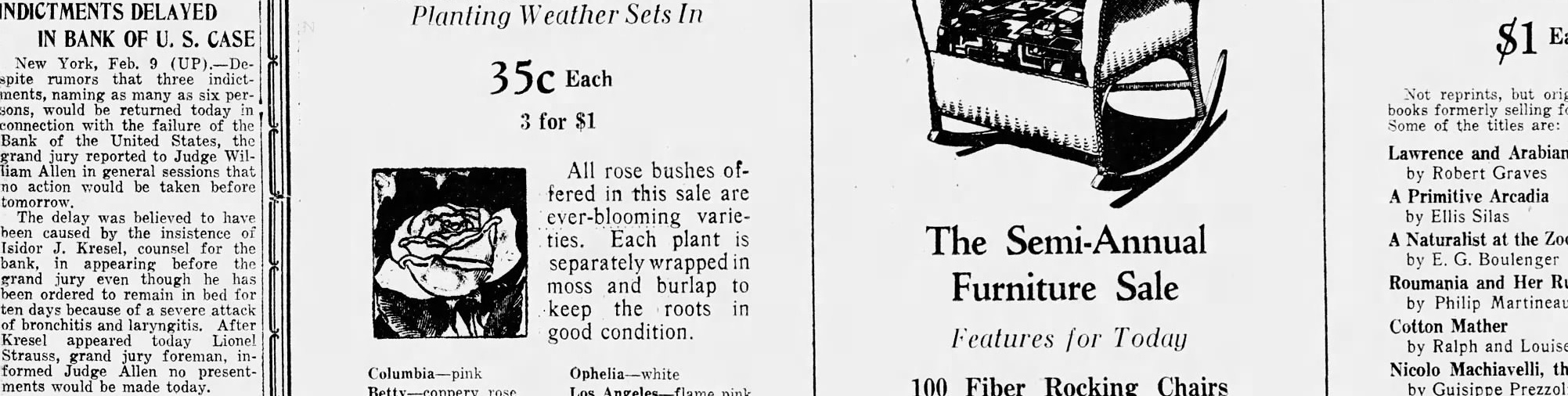
INDICTMENTS DELAYED IN BANK OF U. S. CASE New York, Feb. 9 (UP) spite rumors that three indict- 35c Each ments, naming as many as six persons, would be returned today in 3 for $1 connection with the failure of the Some of the titles are: Bank of the United States, the grand jury reported to Judge William Allen in general sessions that All rose bushes ofby Robert Graves no action would be taken before fered in this sale are A Primitive Arcadia tomorrow. The delay was believed to have ever-blooming varie- by Ellis Silas been caused by the insistence of ties. Each plant is The Semi-Annual A Naturalist at the Zoo Isidor J. Kresel, counsel for the by E. G. Boulenger bank, in appearing before the separately wrapped in grand jury even though he has Roumania and Her Rulers moss and burlap to Furniture Sale been ordered to remain in bed for by Philip Martineau ten days because of severe attack keep the roots in of bronchitis and laryngitis. After Cotton Mather good condition. Kresel appeared today Lionel Features for Today by Ralph and Louise Boas Strauss, grand jury foreman, informed Judge Allen no present- Columbia-pink Ophelia-white ments would be made today. 100 Fiber Rocking Chairs by Guisippe Prezzolini Betty-coppery rose Los Angeles-flame pink


Article from Danville Register and Bee, February 12, 1931

Click image to open full size in new tab

Article Text

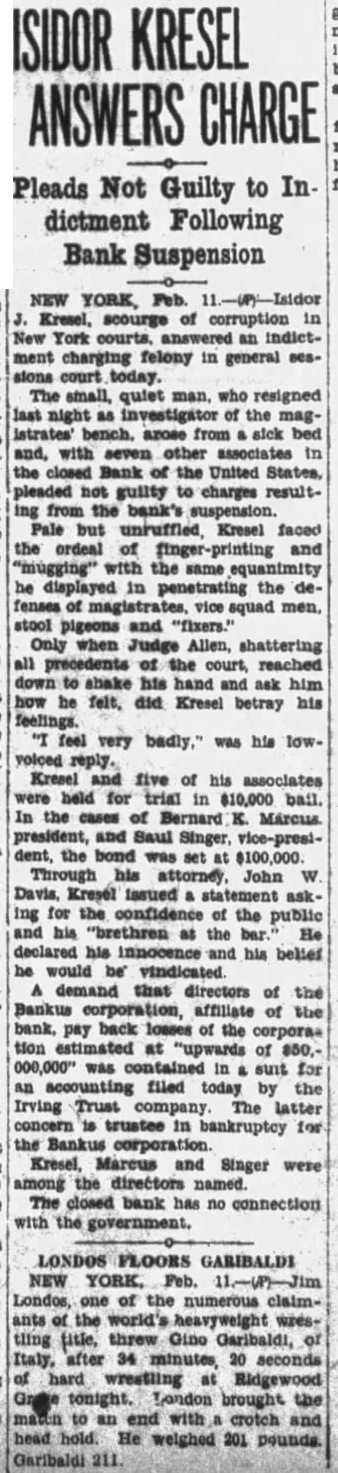
ISIDOR KRESEL ANSWERS CHARGE Pleads Not Guilty to Indictment Following Bank Suspension NEW YORK, Feb. Kresel, scourge of corruption in New York courts. an indictment charging felony in general sescourt today. The small, quiet man. who resigned last night as investigator of the magistrates' bench. arose from sick bed and, with seven other the closed Bank of the United States, pleaded not guilty to charges resulting from the bank's Pale but Kresel faced the ordeal of and "mugging" with the same he displayed in the defenses of magistrates, vice squad men, stool pigeons and "fixers." Only when Judge Allen, shattering all precedents of the court, reached down to his hand ask him how he did Kresel betray his feelings. feel very was his reply. Kresel and five of his associates were held for trial in $10,000 In the cases of Bernard K. president, and Saul Singer, dent, the bond was set at Through his attorney. John Davis, Kresel issued statement askfor the confidence of the public and his "brethren the bar. He declared his and his belief he would be vindicated demand that directors of the Bankus affiliate bank, pay back losses the corpora= tion estimated at "upwards of 000,000" was suit for # accounting filed today by the Irving Trust company The latter trustee in bankruptcy for the Bankus Marcus and Singer were among the directors The closed bank has no connection with the government. LONDOS FLOORS GARIBALDI NEW YORK, Feb. Londos, one of the claimants of the world's wresthing title, threw Gino Garibaldi, of Italy, after 34 minutes, 20 seconds hard wrestling Ridgewood tonight. London brought the to an end with crotch and hold. He weighed 201 Garibaldi


Article from The Washington Times, February 12, 1931

Click image to open full size in new tab

Article Text

LAWYERS PLAN DEFENSE OF 8 BANKERS Expect Gov. Roosevelt May Be Asked to Authorize Special Session by Supreme Court NEW YORK, Feb. 12 (I.N.S.). Six New York lawyers today plan to attack .indictments under which Attorney Isidor J. Kresel, C. Stanley Mitchell, Bernard K. Marcus, Saul Singer and four others are charged with participation in improper transactions in the business of the closed Bank of the United States. Governor Roosevelt, it was intimated, may be asked to authorize a special term of the supreme court for an early trial. $50,000,000 Suit Filed At the same time, suit for $50,000,000 against seven of the men indicted, together with 21 others, officers and directors of the Bankus Corporation, had been instituted in supreme court by the Irving Trust Company, receivers. The seven named are Kresel, Mitchell, Marcus, Saul Singer, Simon H. Kugel, Henry W. Pollock and Alexander S. White. The defendant omitted is Herbert Singer, son of Saul Singer, law clerk in Kresel's office and titular head of the "Bolivar Development Corporation." which played a major role in the Bank of United States alleged repayment of an $8,000,000 loan to "itself." Plead "Not Guilty" All plead "not guilty" when arraigned before Judge William Allen in General Sessions. They are represented by a battery of defense counsel composed of some of the foremost lawyers in New York. One of the first moves by the defense, it was indicated, will consist of motions to quash the indictments, individually and collectively.


Article from The Houston Chronicle, March 3, 1931

Click image to open full size in new tab

Article Text

Probers Told Bank Sought Depositors After State Report By Associated Press. New York, March 3.-Testimony that the Bank of the United States marshaled more than 60,000 new depositors shortly after the state banking department issued an unfavorable report on its condition stirred the Steuer investigation to- Morris White. a director, testified yesterday that high officials had instituted drive for more depositors in February, 1930, and that he himself had recruited 1400 from among his employes in another venture. "This is the most startling testimony yet given, said Deputy Attorney General Max D. Steuer, who is into the reasons for the bank's Attorney General John H. Bennett, Jr., announced that several directors had started an independent movement to recompense depositors 100 cents on the dollar, either by constructive liquidation or by eorganization and reopening of the bank.


Article from The Times-Tribune, March 3, 1931

Click image to open full size in new tab

Article Text

START MOVEMENT PAY U. S. BANK VICTIMS IN FULL SEVERAL DIRECTORS SEEK RE ORGANIZATION OR STRUCTIVE LIQUIDATION OF INSTITUTION. March (AP) Bank of the United more than 000 shortly after the department Issued an on its the to director that high drive for more 1930 and that recruited 400 from Deputy At Max the reasons for the John H. Benan depositors 100 dollar either by by organization and reopening of the Banking he felt for han official should to house before deciding the be closed Goethe has been dead as the living writer in Ger" his popularity Vare Leader Holds Pinchot Insulted Senators and That He Is Playing Politics At Expense of Legislation. to fire in both house and senate for his the of the by the of and the point It floor leader from charges of this and governors years in the senate, was accusing the governor of staging he on as to before probe Cowardly Exhibition. today the governor the tee got complained unless get be around and trousers should be the to reply of "If the politics and keep and the been


Article from The American Guardian, March 6, 1931

Click image to open full size in new tab

Article Text

"BUY NOW" In America, grave professors and mists" said that the depression "purely psychological;" that people timid and afraid Campaigns urging bankrupt consumers Now" were started. Alexander Legge of the Federal Farm Board charged that the buying of few million bushels short by Russia caused wheat price despite the fact that the farm possession of 60,000,000 bushels had failed to steady the market. Politicians blamed the failure of the Bank the United States (New York) rumors culated by Communists. For nearly year after the Stock Market crash, President Hoover ignored the panie, frequently asserting that sound and the "temporary depression" would be at end


Article from Evening Star, June 29, 1931

Click image to open full size in new tab

Article Text

# An Uncomfortable Seat. Uneasy sits the Governor of a great State if he aspires to the presidency of the United States. He is under surveillance of the political opposition constantly. His every act is observed and weighed in the balance by the members of his own party, to determine whether he has helped or hurt himself in the eyes not only of the voters of his own State but of the voters of the entire country. The Governor of New York, when he happens to be a Democrat and also an aspirant for the presidential nomination, occupies a peculiar position in this respect. Tammany, which controls New York City, where the great bulk of the Democratic vote in the State is concentrated, may or may not "behave." If the Republicans are to be credited, Tammany never behaves as it should. But if the dominating political organization of the Democratic party in New York is under fire, then the Governor of New York is placed in a position where he must suffer with Tammany or must suffer without it. This, in a measure, is the year of trial for Gov. Franklin D. Roosevelt. Much depends upon what is "turned up" by the legislative committee investigating the government of New York City, and upon the attitude assumed by the Governor. So far Gov. Roosevelt appears to have ridden successfully the several waves which have rolled up against the New York Democratic organization. In his campaign last year he was assailed because he did not throw wide open the inquiry into the conduct of judges and magistrates in New York City. But he was re-elected by a huge vote. More recently came the demand for the removal of Mayor "Jimmie" Walker by the City Affairs Committee, a demand to which Gov. Roosevelt refused to accede, after he had given Mayor Walker opportunity to reply to the charges. Within a few days has come a demand for the removal of an official, Joseph A. Broderick, superintendent of banks. W. Kingsland Macy, chairman of the Republican State Committee, made the demand, basing it on a charge that Broderick had failed to observe the State banking law and to act promptly in the case of the Bank of the United States. Gov. Roosevelt, replying to Mr. Macy, called attention to the fact that Mr. Macy's letter asking the removal of Mr. Broderick had been written on the stationery of the Republican State Committee. The implication which the Governor apparently sought to make was that the demand was merely a political move on the part of his opponents. He did not say, however, that he assumed Mr. Macy was writing as an individual and not as State chairman of the Republican committee. Having gone that far, the Governor refused to remove Broderick. Mr. Macy has followed up his first letter with another, attacking Gov. Roosevelt for his "flippancy." Mr. Macy insists that in the case of a bank failure, affecting 440,000 depositors, it is no time to be flippant or to talk about the stationery upon which a letter is written, if an official of the State government has failed to protect these depositors by observing the law. Mr. Macy's second letter was written on his personal stationery. He complains, too, of the curt refusal of the Governor to act in this matter, and urges him to look further into the charges made against Broderick. And so it goes, and will continue to go until the national campaign and the gubernatorial election in New York are over next year. The city government of New York is under investigation now by a legislative committee, an investigation that is likely to run through many months. There is in the offing a proposal that the banking department, headed by Broderick, be investigated, too. Broderick is an appointee of Gov. Roosevelt. Perhaps the opposition is reserving that inquiry until next year. Such is the friendly way in which the great game of politics is played.


Article from The Daily Worker, September 7, 1931

Click image to open full size in new tab

Article Text

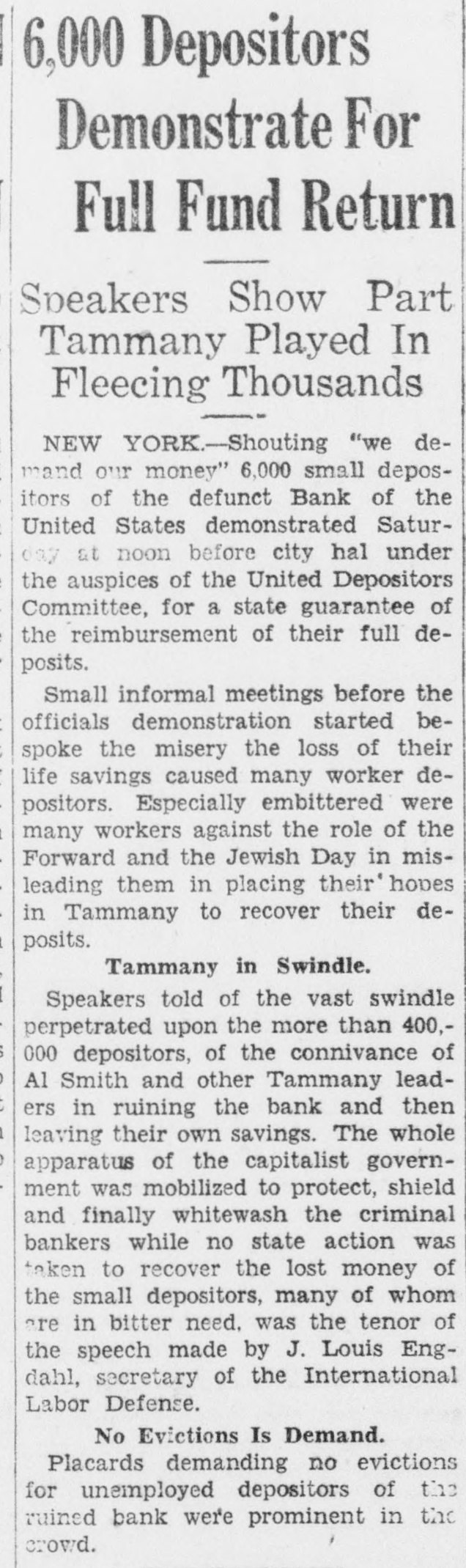
# 6,000 Depositors Demonstrate For Full Fund Return # Speakers Show Part Tammany Played In Fleecing Thousands NEW YORK.--Shouting "we demand our money" 6,000 small depositors of the defunct Bank of the United States demonstrated Saturday at noon before city hal under the auspices of the United Depositors Committee, for a state guarantee of the reimbursement of their full deposits. Small informal meetings before the officials demonstration started be-spoke the misery the loss of their life savings caused many worker depositors. Especially embittered were many workers against the role of the Forward and the Jewish Day in misleading them in placing their hopes in Tammany to recover their deposits. Tammany in Swindle. Speakers told of the vast swindle perpetrated upon the more than 400,000 depositors, of the connivance of Al Smith and other Tammany leaders in ruining the bank and then leaving their own savings. The whole apparatus of the capitalist government was mobilized to protect, shield and finally whitewash the criminal bankers while no state action was taken to recover the lost money of the small depositors, many of whom are in bitter need, was the tenor of the speech made by J. Louis Engdahl, secretary of the International Labor Defense. # No Evictions Is Demand. Placards demanding no evictions for unemployed depositors of the ruined bank were prominent in the crowd.


Article from Evening star, October 10, 1931

Click image to open full size in new tab

Article Text

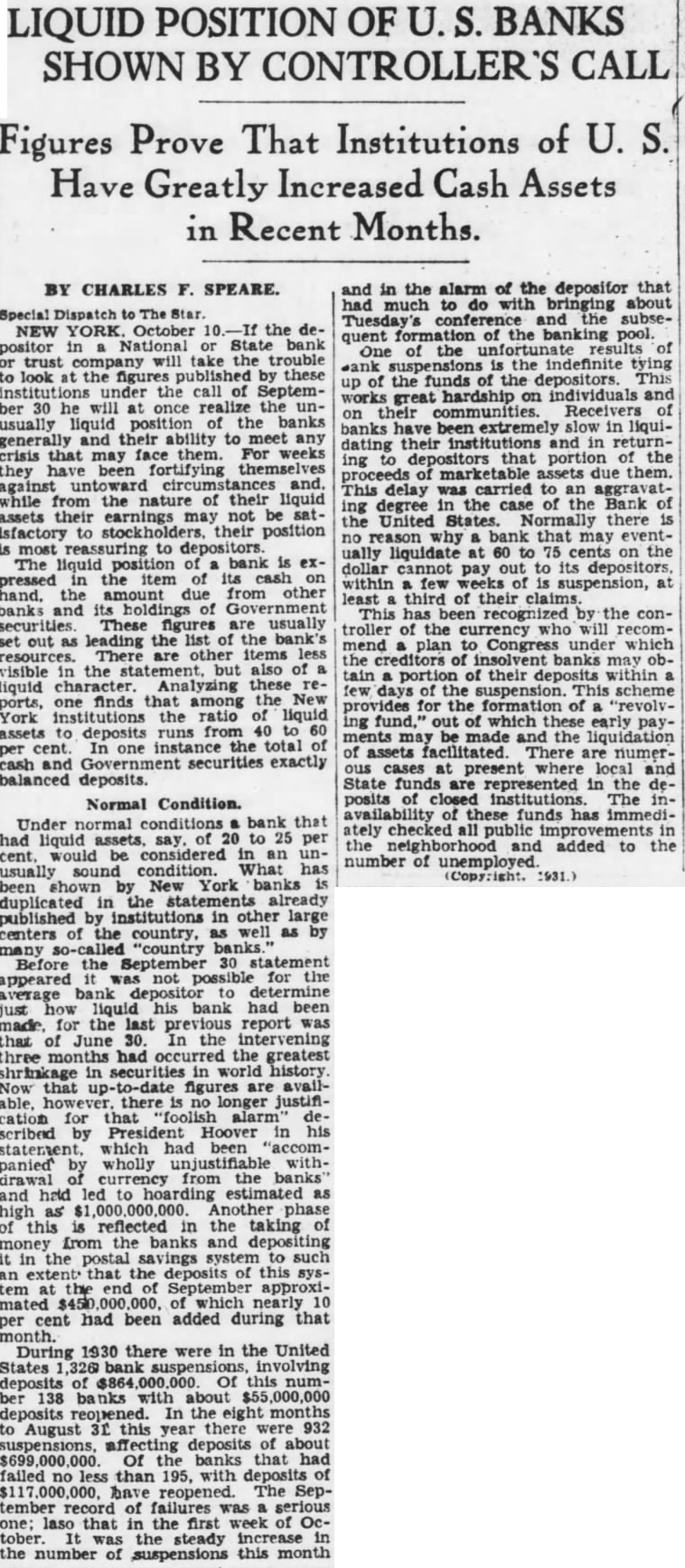
LIQUID POSITION OF BANKS SHOWN BY CONTROLLER'S CALL Figures Prove That Institutions of S. Have Greatly Increased Cash Assets in Recent Months. BY CHARLES F. SPEARE. Dispatch NEW October If the depositor in National or State or trust will take the trouble to look by these institutions under the call of September 30 he will once realize unusually liquid banks and their ability to any crisis that may them. For weeks they been fortifying themselves untoward while from the nature of their liquid assets their earnings not be sat isfactory to stockholders their position is most The liquid position of bank is expressed item of its on hand. the amount due from banks and its holdings securities These are usually set out leading the list the bank's resources. There are other items less visible in the statement. but also of liquid these reports, one finds that among the New York institutions the ratio of liquid assets deposits runs from 40 to 60 per cent. In the total cash securities exactly balanced deposits. Normal Condition. Under conditions bank that had liquid say. of 20 to 25 per cent. be considered unusually condition. has been by New York banks duplicated in the statements already published by institutions in other large centers of the country, well as by "country Before the September 30 statement appeared was not possible average to just how liquid his had been made, for the last report that of June 30. In the intervening three months had the greatest shrinkage in securities in world history Now that up-to-date figures are available, no justification for scribed President Hoover statement. which been "accompanied by wholly unjustifiable withfrom the banks and hald led to estimated as high as Another phase of is reflected in the taking of this from banks and depositing it in postal savings to such that deposits of this tem approximated 000, which per cent had been added during that During 1930 there were in the United States nvolving deposits $864,000,000. Of this number 138 banks with about deposits In the eight months to August 31. there 932 deposits of about $699 Of the banks that had failed than 195, with $117 have The September record of failures was serious one: laso that in the first week of Ocwas steady in the number of suspensions this month and in the alarm of the depositor that had much do with about and the subsequent formation of the pool. One of the unfortunate of the tying up of the funds of the depositors. This works hardship on individuals and on their communities. Receivers banks have been extremely slow in liquidating their institutions and in returning that the marketable them. This delay was carried an aggravatdegree in the case of the Bank of ing the United States. Normally there is no a bank that event ually liquidate at 60 75 cents on the dollar cannot pay out to its depositors, within few weeks of suspension, at third of their claims. has recognized by the conof the urrency who recomto Congress which the of banks may obtain portion of their deposits within few days of the suspension. This scheme for the formation of "revolving fund," out of which these early paybe made and the of assets facilitated. There are numercases at present where local and State funds are represented the deposits closed institutions The inavailability of these funds has immediately checked all public neighborhood and added to the number unemployed.


Article from Dunkirk Evening Observer, February 23, 1932

Click image to open full size in new tab

Article Text

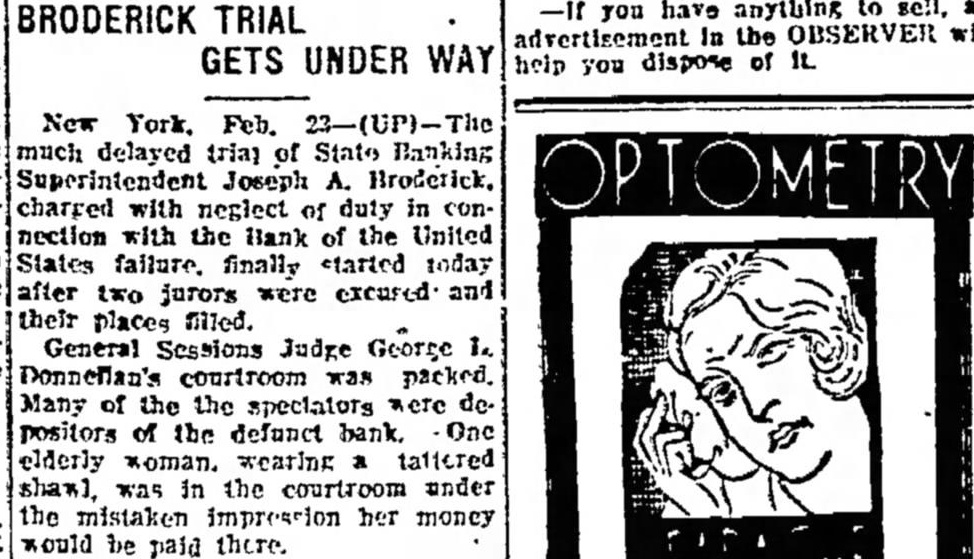
-If you have anything to sell, an BRODERICK TRIAL advertisement In the OBSERVER will GETS UNDER WAY help you dispose of It. New York. Feb. 23-(UP)-The much delayed tria) of State Banking OPTOMETRY Superintendent Joseph A. Broderick, charged with neglect of duty in connection with the Bank of the United States failure. finally started today after two jurors were excused and their places filled. General Sessions Judge George 1. Donnellan's courtroom was packed. Many of the the speciators **** de. positors of the defunct bank. One shawl. was in the courtroom under the mistaken impression her money would be paid there.


Article from The Daily Times, October 29, 1932

Click image to open full size in new tab

Article Text

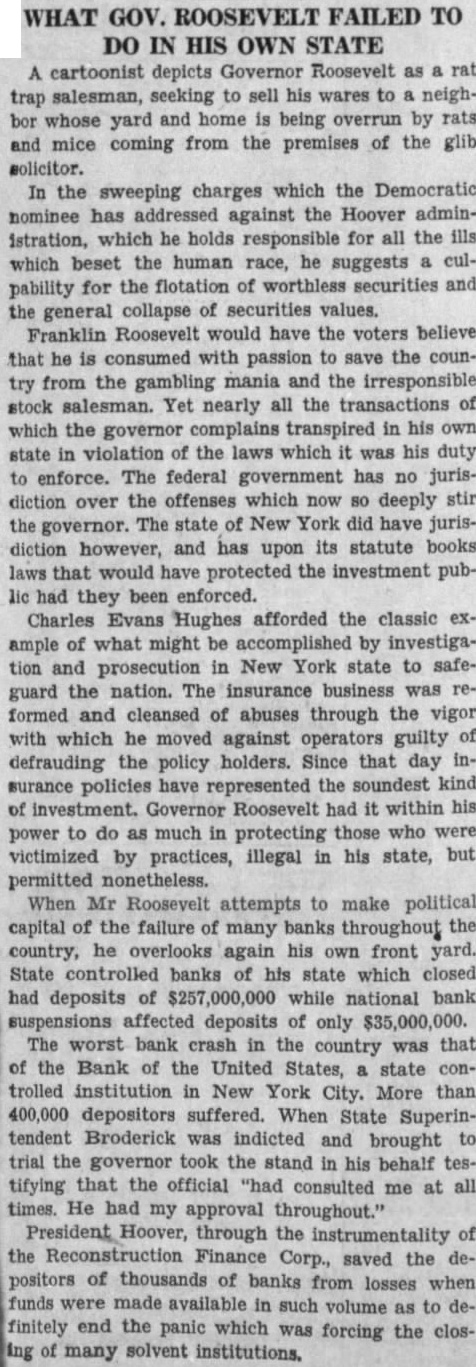
WHAT GOV. ROOSEVELT FAILED TO DO IN HIS OWN STATE cartoonist depicts Governor Roosevelt rat salesman, seeking sell his wares to neightrap bor whose and home is being overrun by rats yard and mice coming from the premises of the glib solicitor. In the sweeping charges which the Democratic nominee has addressed against the Hoover adminwhich he holds for all the ills istration, responsible which beset human race, he suggests the flotation of worthless securities and pability for the general collapse securities values. Franklin Roosevelt would have the voters believe that he is consumed with passion to save the country from the gambling mania and the irresponsible stock salesman. Yet nearly all the transactions which the governor complains transpired in his own state in violation of the laws which was his duty enforce. The federal government has no jurisdiction over the offenses which now SO deeply stir the The state of New York did have jurisgovernor. however, and has its statute books diction upon laws that would have protected the investment pubhad they been enforced. Charles Evans Hughes afforded the classic ample of what might be accomplished by tion and prosecution New York state to safeguard the nation. The insurance business was formed and cleansed of abuses through the vigor with which he moved of against operators guilty defrauding the policy holders. Since that day inhave the soundest kind surance policies represented investment. Governor Roosevelt had within his power to do as much in protecting those who victimized by practices, illegal in his state, but permitted nonetheless. When Mr Roosevelt to make political attempts capital of the failure many banks throughout the country, he overlooks again his own front yard. State controlled banks of his state which closed had deposits of while national bank suspensions affected deposits of only The worst bank crash in the country was that of the Bank of the United States, state trolled institution in New York City. More than depositors suffered. When State Superintendent Broderick was indicted and brought trial the governor took the stand in his behalf testifying that the official "had consulted at all times. He had my approval throughout." Hoover, through the of instrumentality the Finance Corp., saved the positors thousands of banks from losses when funds were made available in such volume as to finitely end the which panic forcing the closmany solvent institutions.