National Bank (Fishkill, NY)

Episode Information

Episode UID
97100885
Episode Type
Suspension โ†’ Closure
Bank Type
national
Bank ID
9710 national
Charter Number
971
Start Date
September 24, 1873
Location
Fishkill, New York (41.536, -73.899)

Metadata

Model
gpt-5-mini (chosen from majority vote of a three-model LLM ensemble)
Short Digest
8eb0def4dac1c08f

Response Measures

None

Receivership Details

Depositor recovery rate
100.0%
Date receivership started
1877-01-27
Date receivership terminated
1884-08-11
OCC cause of failure
Fraud
Share of assets assessed as good
38.2%
Share of assets assessed as doubtful
51.7%
Share of assets assessed as worthless
10.1%

Description

Article 2 explicitly references a receiver for the ruined National Bank of Fishkill due to cashier defalcations; exact failure date not given.

Events (4)

1. April 1, 1865 Chartered
Source
historical_nic
2. September 24, 1873 Suspension
Cause
Government Action
Cause Details
Statewide suspension/embargo on payments by New York banks following the financial crash of Sept. 26-27, 1873; banks in New York suspended on Sept. 24.
Newspaper Excerpt
The New York banks suspended on Thursday, the 24th inst., and their fourteen days' limit under the act will terminate on the 8th of October.
Source
newspapers
3. January 27, 1877 Receivership
Source
historical_nic
4. * Suspension
Cause
Bank Specific Adverse Info
Cause Details
Massive cashier defalcations by Alexander Bartow leading to insolvency and appointment of a receiver.
Newspaper Excerpt
FISHKILL'S RUINED BANK. MORE LIGHT ON CASHIER ALEXANDER BARTOW'S DEFALCATIONS. ... suits against the receiver of the ruined National Bank of Fishkill
Source
newspapers

Newspaper Articles (2)

Article from National Republican, October 4, 1873

Click image to open full size in new tab

Article Text

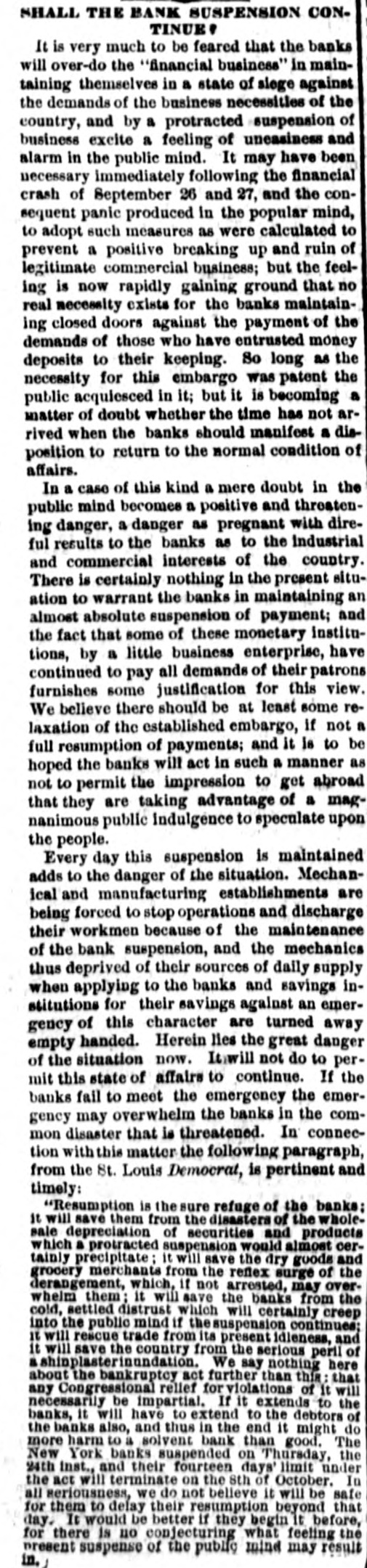
# SHALL THE BANK SUSPENSION CONTINUE It is very much to be feared that the banks will over-do the "financial business" in main-taining themselves in a state of slege against the demands of the business necessities of the country, and by a protracted suspension of business excite a feeling of uneasiness and alarm in the public mind. It may have been necessary immediately following the financial crash of September 26 and 27, and the con-sequent panic produced in the popular mind, to adopt such measures as were calculated to prevent a positive breaking up and ruin of legitimate commercial business; but the feel-ing is now rapidly gaining ground that no real necessity exists for the banks maintain-ing closed doors against the payment of the demands of those who have entrusted money deposits to their keeping. So long as the necessity for this embargo was patent the public acquiesced in it; but it is becoming a matter of doubt whether the time has not ar-rived when the banks should manifest a dis-position to return to the normal condition of affairs. In a case of this kind a mere doubt in the public mind becomes a positive and threaten-ing danger, a danger as pregnant with dire-ful results to the banks as to the industrial and commercial interests of the country. There is certainly nothing in the present situ-ation to warrant the banks in maintaining an almost absolute suspension of payment; and the fact that some of these monetary institu-tions, by a little business enterprise, have continued to pay all demands of their patrons furnishes some justification for this view. We believe there should be at least some re-laxation of the established embargo, if not a full resumption of payments; and it is to be hoped the banks will act in such a manner as not to permit the impression to get abroad that they are taking advantage of a mag-nanimous public indulgence to speculate upon the people. Every day this suspension is maintained adds to the danger of the situation. Mechan-ical and manufacturing establishments are being forced to stop operations and discharge their workmen because of the maintenance of the bank suspension, and the mechanics thus deprived of their sources of daily supply when applying to the banks and savings in-stitutions for their savings against an emer-gency of this character are turned away empty handed. Herein lies the great danger of the situation now. It will not do to per-mit this state of affairs to continue. If the banks fail to meet the emergency the emer-gency may overwhelm the banks in the com-mon disaster that is threatened. In connec-tion with this matter the following paragraph, from the St. Louis Democrat, is pertinent and timely: "Resumption is the sure refuge of the banks; it will save them from the disasters of the whole-sale depreciation of securities and products which a protracted suspension would almost cer-tainly precipitate; it will save the dry goods and grocery merchants from the reflex surge of the derangement, which, if not arrested, may over-whelm them; it will save the banks from the cold, settled distrust which will certainly creep into the public mind if the suspension continues; it will rescue trade from its present idleness, and it will save the country from the serious peril of a shinplasterinundation. We say nothing here about the bankruptcy act further than this: that any Congressional relief for violations of it will necessarily be impartial. If it extends to the banks, it will have to extend to the debtors of the banks also, and thus in the end it might do more harm to a solvent bank than good. The New York banks suspended on Thursday, the 24th inst., and their fourteen days' limit under the act will terminate on the 8th of October. In all seriousness, we do not believe it will be safe for them to delay their resumption beyond that day. It would be better if they begin it before, for there is no conjecturing what feeling the present suspense of the public mind may result in."

Article from The Sun, February 10, 1879

Click image to open full size in new tab

Article Text

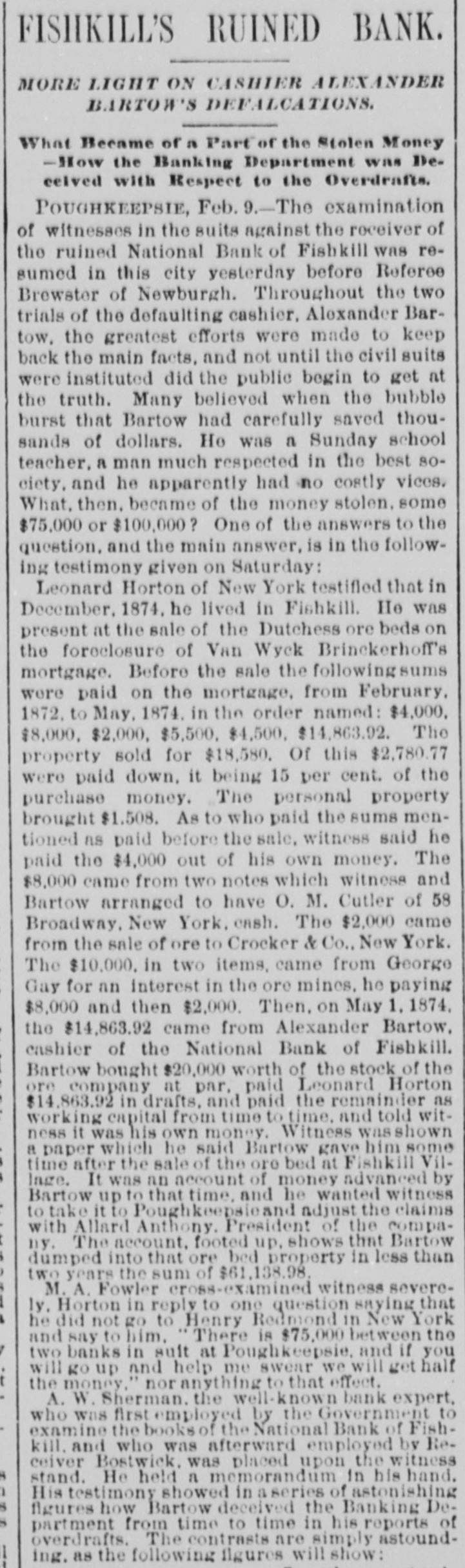
FISHKILL'S RUINED BANK. MORE LIGHT ON CASHIER ALEXANDER BARTOW'S DEFALCATIONS. What Became of a Part of the Stolen Money -How the Banking Department was Decelved with Respect to the Overdrafts. POUGHKEEPSIE, Feb. -The examination of witnesses in the suits against the receiver of the ruined National Bank of Fishkill was resumed in this city yesterday before Referee Browster of Newburgh. Throughout the two trials of the defaulting cashier. Aloxander Bartow. the greatest efforts were made to keep back the main facts, and not until the civil suits were instituted did the public begin to get at the truth. Many believed when the bubble burst that Bartow had carefully saved thousands of dollars. Ho was a Sunday school teacher. a man much respected in the best society. and he apparently had no costly vices. What, then. became of the money stolen. some $75,000 or $100,000? One of the answers to the question. and the main answer, is in the following testimony given on Saturday: Leonard Horton of New York testifled that in December, 1874, he lived in Fishkill. He was present at the sale of the Dutchess ore beds on the foreclosure of Van Wyck Brinckerhoff's mortgage. Before the sale the followingsums were paid on the mortgage, from February. 1872. to May, 1874. in the order named: $4,000. $8,000. $2,000, $5,500. $4,500, $14,863.92. The property sold for $18,580. Of this $2,780.77 were paid down. it being 15 per cent. of the purchase money. The personal property brought $1.508. As to who paid the sums mentioned as paid before the sale. witness said he paid the $4,000 out of his own money. The $8,000 came from two notes which witness and Bartow arranged to have O. M. Cutler of 58 Broadway. New York, cash. The $2,000 came from the sale of ore to Crocker & Co., New York. The $10,000. in two items. came from George Gay for an interest in the ore mines. he paying $8,000 and then $2,000. Then, on May 1. 1874, the $14,863.92 came from Alexander Bartow. cashier of the National Bank of Fishkill. Bartow bought $20,000 worth of the stock of the ore company at par, paid Leonard Horton $14,863.92 in drafts. and paid the remainder as working capital from time to time. and told witness it was his own money. Witness was shown a paper which he said Bartow gave him some time after the sale of the ore bed at Fishkill VilInge. It was an account of money advanced by Bartow up to that time, and he wanted witness to take it to Poughkeepsleand adjust the claims with Allard Anthony. President of the company. The account, footed up. shows that Bartow dumped into that ore bed property in less than two years the sum of $61,138.98. M. A. Fowler cross examined witness severely. Horton in reply to one question saying that he did not go to Henry Redmond in New York and say to him. There is $75,000 between the two banks in suit at Poughkeepsie, and if you will go up and help me swear we will get half the money," nor anything to that effect. A. W. Sherman. the well-known bank expert. who was first employed by the Government to examine the books of the National Bank of Fishkill. and who was afterward employed by Receiver Bostwick. was placed upon the witness stand. He held a memorandum in his hand. His testimony showed in aseries of astonishing figures how Bartow deceived the Banking Department from time to time in his reports of overdrafts. The contrasts are simply astounding. as the following figures will show: