9706. Bank of New England (Minneapolis, MN)

Bank Information

Episode Type
Suspension → Reopening
Bank Type
state
Start Date
June 26, 1893
Location
Minneapolis, Minnesota (44.980, -93.264)

Metadata

Model
gpt-5-mini
Short Digest
a9a65f2b

Response Measures

None

Description

The Bank of New England suspended payment on 1893-06-26 after steady withdrawals tied to other bank failures (a nearby State bank and Chicago failures). It was assigned/turned over to an assignee on 1893-07-07 but subsequently resumed business on 1893-08-28–29. Later legal/receivership proceedings continued in November 1893 and beyond, but the bank did reopen in August 1893, so the episode is classified as a suspension with reopening. Bank type not specified in articles.

Events (4)

1. June 26, 1893 Suspension
Cause
Local Banks
Cause Details
Steady withdrawals since the failure of the State bank and weakened by the Chicago bank failures; steady withdrawal of deposits since Friday prior to suspension.
Newspaper Excerpt
The Bank of New England suspended payment Monday morning.
Source
newspapers
2. July 7, 1893 Receivership
Newspaper Excerpt
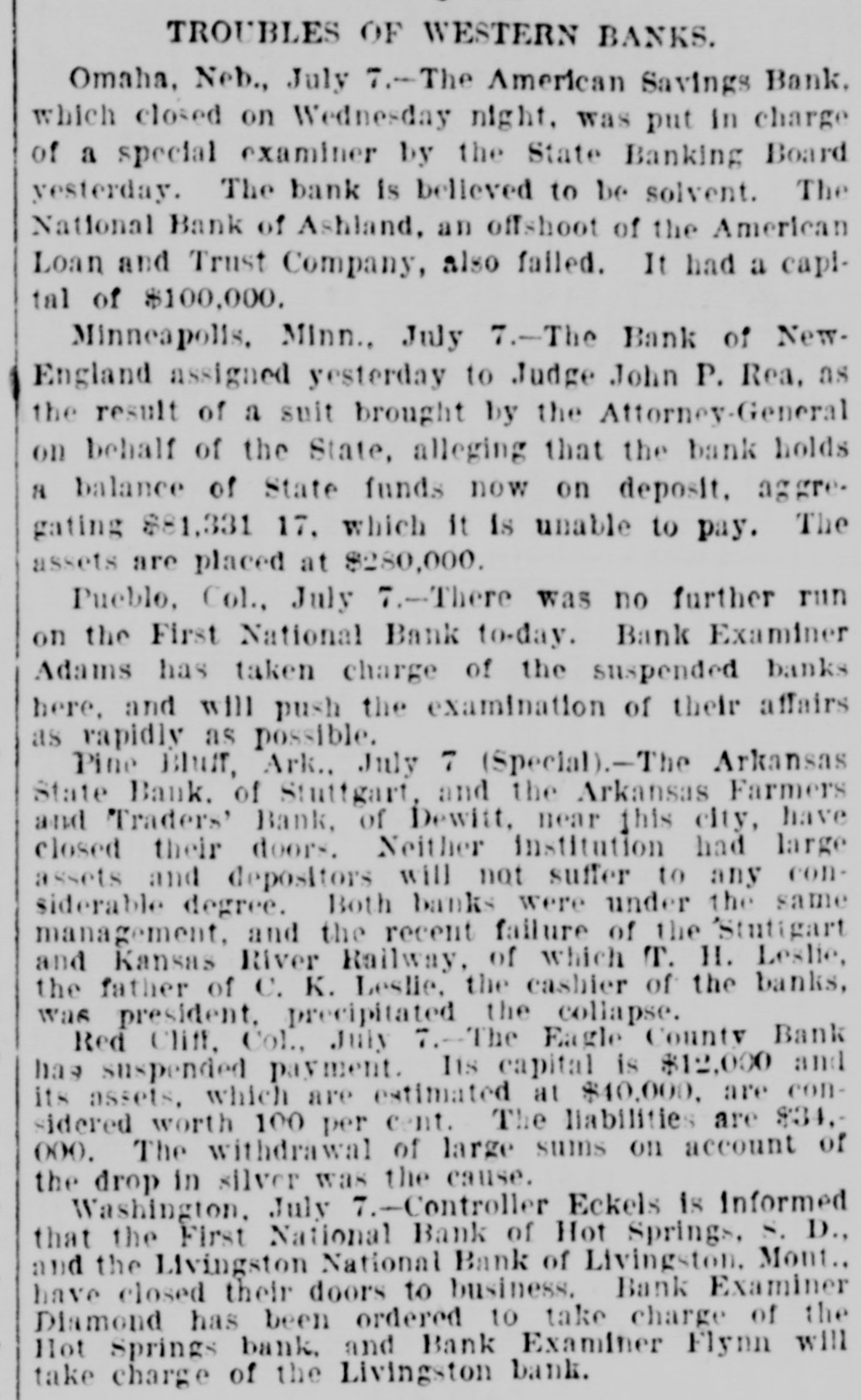
The Bank of New England assigned yesterday to Judge John P. Rea ... asserting that the bank holds a balance of the state funds now on deposit aggregating $81,331.17, which it is unable to pay. The assets are placed at $280,000.
Source
newspapers
3. August 28, 1893 Reopening
Newspaper Excerpt
The Bank of New England, which suspended recently, will resume Saturday.
Source
newspapers
4. November 12, 1893 Other
Newspaper Excerpt
In the receivership case of the Bank of New England ... an affidavit had been filed charging State Treasurer Joseph Bobleter with having received 21/2 per cent personal interest on state moneys deposited with the bank besides the 3 per cent allowed by law. It has since developed that the affidavit was made by J. W. Arelander ...
Source
newspapers

Newspaper Articles (23)

Article from The World, June 27, 1893

Click image to open full size in new tab

Article Text

Minneapolis Bank Suspends. MINNEAPOLIS. Minn., June 26.-The Bank of New England suspended payment Monday morning. The bank is the youngest in the city, its president, A. J. Blethen, having been a newspaper proprietor before he went into bank. ing. Mr. Blethen issued a card Monday morning, stating that the bank had withstood a run at the time of the run on the Farmers' and Mechanics' Savings bank six weeks ago and that it had been further weakened by the Chiango bank failures.


Article from The Morning News, June 27, 1893

Click image to open full size in new tab

Article Text

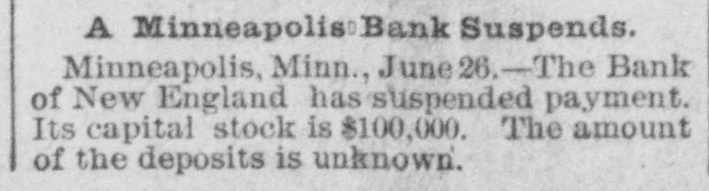
A Minneapolis Bank Suspends. Minneapolis, Minn., June 26.-The - Bank of New England has suspended payment. Its capital stock is $100,000. The amount of the deposits is unknown.


Article from The Madison Daily Leader, June 27, 1893

Click image to open full size in new tab

Article Text

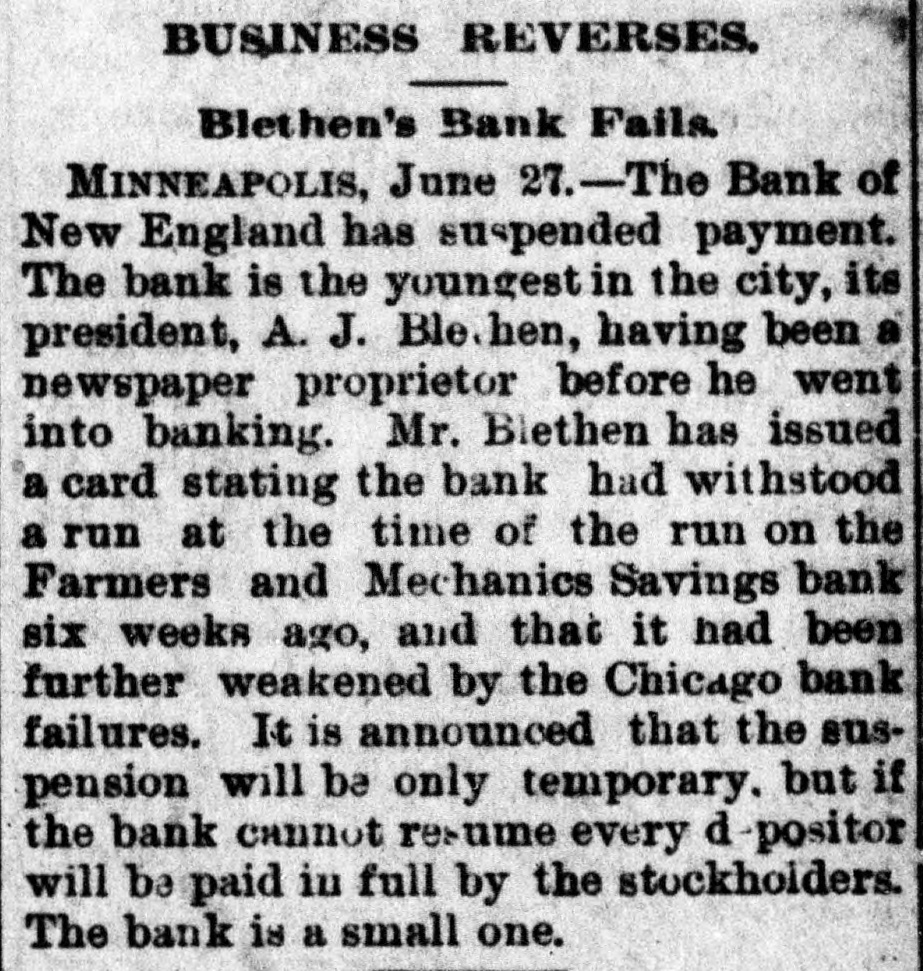
BUSINESS REVERSES. Blethen's Bank Fails. MINNEAPOLIS, June 27.-The Bank of New England has suspended payment. The bank is the youngest in the city, its president, A. J. Ble. hen, having been a newspaper proprietor before he went into banking. Mr. Blethen has issued a card stating the bank had withstood a run at the time of the run on the Farmers and Mechanics Savings bank six weeks ago, and that it had been further weakened by the Chicago bank failures. It is announced that the suspension will be only temporary. but if the bank cannot resume every d positor will be paid in full by the stockholders. The bank is a small one.


Article from The Herald, June 27, 1893

Click image to open full size in new tab

Article Text

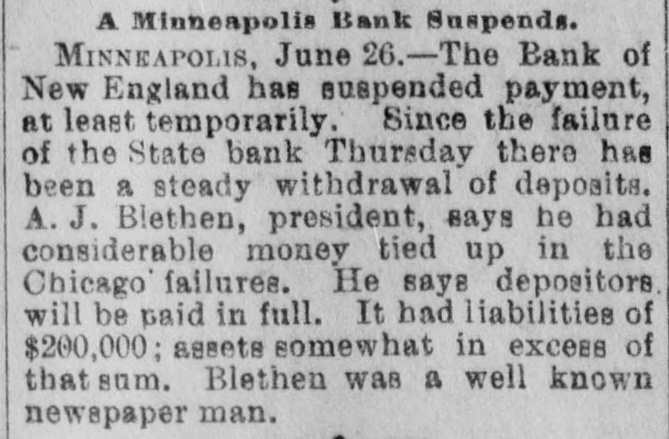
A Minneapolis Bank Suspends. MINNEAPOLIS, June 26.-The Bank of New England has suspended payment, at least temporarily. Since the failure of the State bank Thursday there has been a steady withdrawal of deposits. A. J. Blethen, president, says he had considerable money tied up in the Chicago failures. He says depositore. will be paid in full. It had liabilities of $200,000; assets somewhat in excees of thatsum. Blethen was a well known newspaper man.


Article from Richmond Dispatch, June 27, 1893

Click image to open full size in new tab

Article Text

Bank of New Registed Suspends. . MINNEAPOLIS,MENN., June 26.-The Bank of New England has suspended payment. Capital stock, $100,000. Deposits unknown.


Article from Fort Worth Gazette, June 27, 1893

Click image to open full size in new tab

Article Text

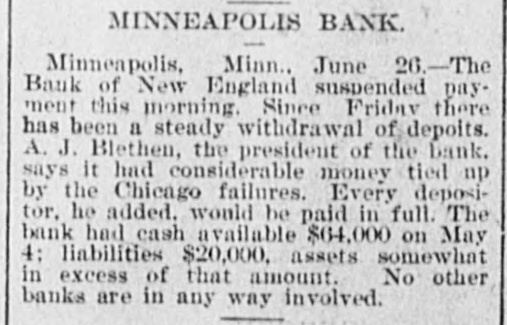
MINNEAPOLIS BANK Minneapolis, Minn., June 26.-The Bank of New England suspended payment this morning. Since Friday there has been a steady withdrawal of depoits. A. J. Blethen, the president of the bank. says it had considerable money tied up by the Chicago failures. Every depositor, he added. would be paid in full. The bank had cash available $64,000 on May 4: liabilities $20,000. assets somewhat in excess of that amount. No other banks are in any way involved.


Article from Watertown Republican, June 28, 1893

Click image to open full size in new tab

Article Text

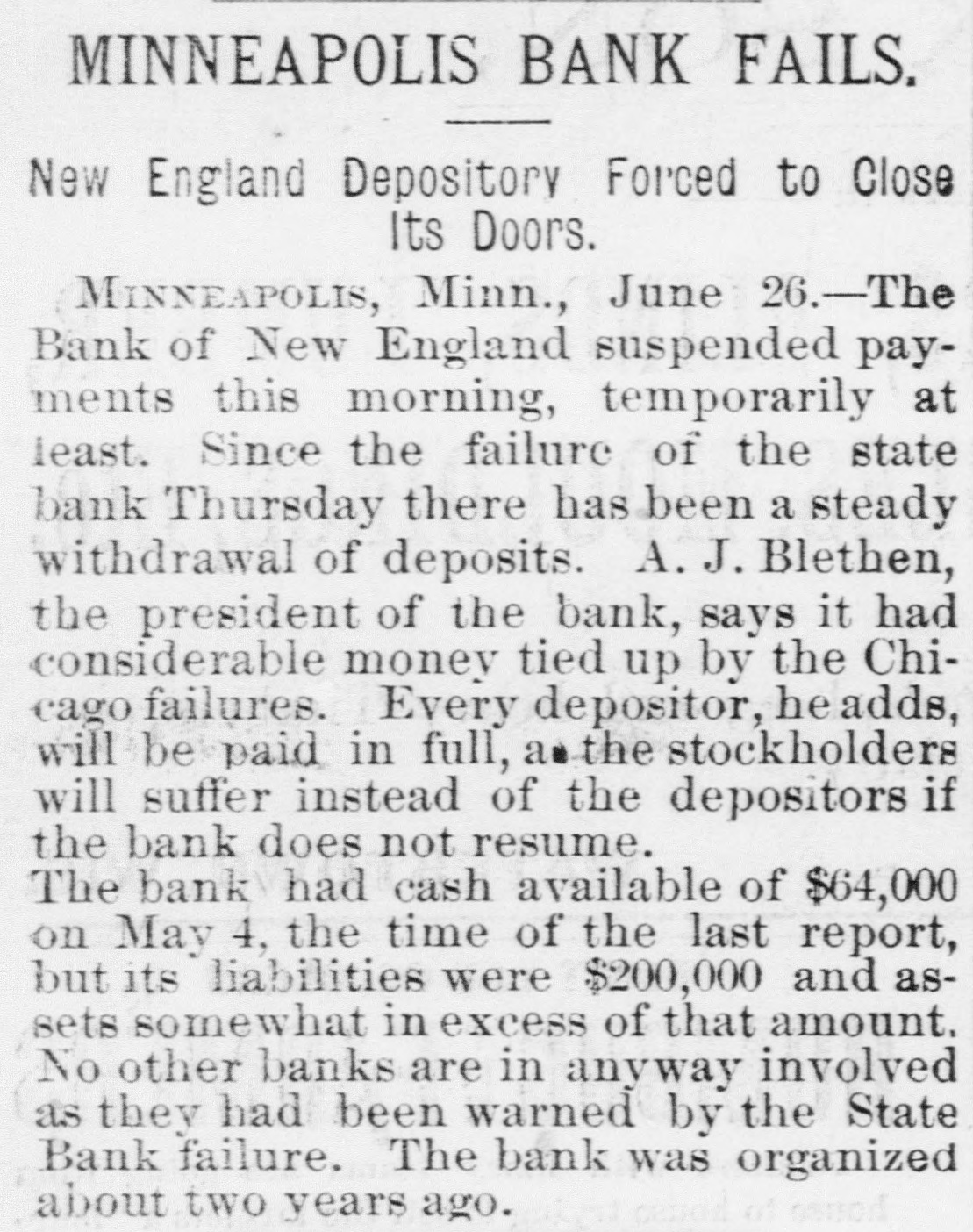
MINNEAPOLIS BANK FAILS. New England Depository Forced to Close Its Doors. MINNEAPOLIS, Minn., June 26.-The Bank of New England suspended payments this morning, temporarily at least. Since the failure of the state bank Thursday there has been a steady withdrawal of deposits. A. J. Blethen, the president of the bank, says it had considerable money tied up by the Chicago failures. Every depositor, headds, will be paid in full, as the stockholders will suffer instead of the depositors if the bank does not resume. The bank had cash available of $64,000 on May 4, the time of the last report, but its liabilities were $200,000 and assets somewhat in excess of that amount. No other banks are in anyway involved as they had been warned by the State Bank failure. The bank was organized about two years ago.


Article from The Roanoke Times, June 28, 1893

Click image to open full size in new tab

Article Text

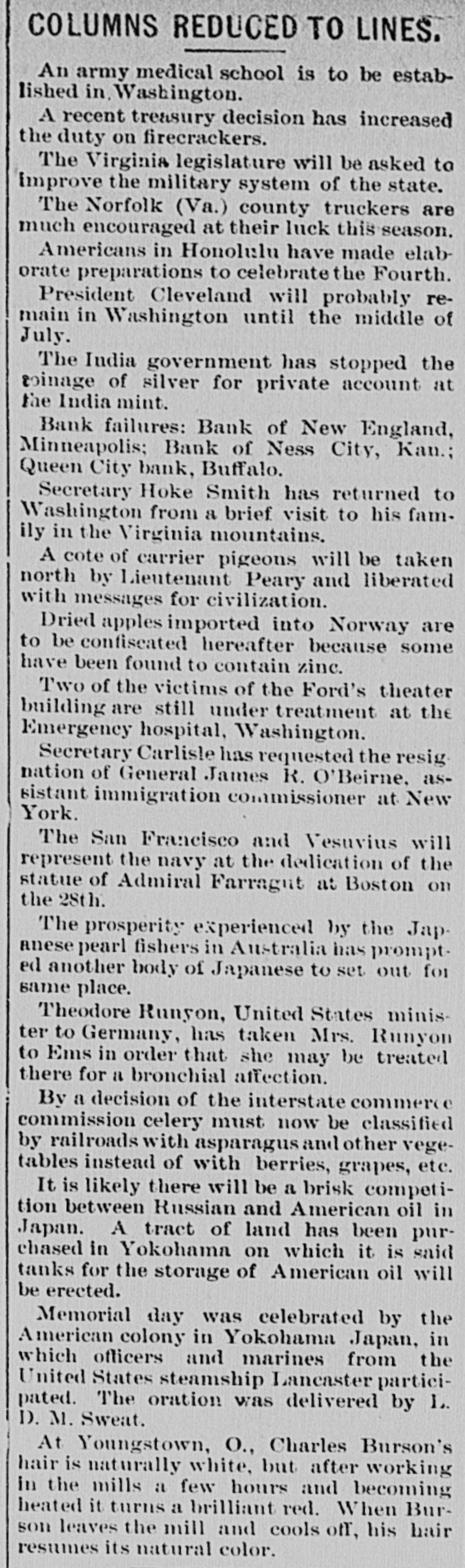
COLUMNS REDUCED TO LINES. An army medical school is to be established in. Washington. A recent treasury decision has increased the duty on firecrackers. The Virginia legislature will be asked to Improve the military system of the state. The Norfolk (Va.) county truckers are much encouraged at their luck this season. Americans in Honolulu have made elaborate preparations to celebrate the Fourth. President Cleveland will probably remain in Washington until the middle of July. The India government has stopped the coinage of silver for private account at the India mint. Bank failures: Bank of New England, Minneapolis; Bank of Ness City, Kan.; Queen City bank, Buffalo. Secretary Hoke Smith has returned to Washington from a brief visit to his family in the Virginia mountains. A cote of carrier pigeous will be taken north by Lieutenant Peary and liberated with messages for civilization. Dried apples imported into Norway are to be confiscated hereafter because some have been found to contain zinc. Two of the victims of the Ford's theater building are still under treatment at the Emergency hospital, Washington. Secretary Carlisle has requested the resig nation of General James R. O'Beirne, assistant immigration commissioner at New York. The San Francisco and Vesuvius will represent the navy at the dedication of the statue of Admiral Farragut at Boston on the 28th. The prosperity experienced by the Japanese pearl fishers in Australia has prompted another body of Japanese to set out for same place. Theodore Runyon, United States minister to Germany, has taken Mrs. Runyon to Ems in order that she may be treated there for a bronchial affection. By a decision of the interstate commerce commission celery must now be classified by railroads with asparagus and other vegetables instead of with berries, grapes, etc. It is likely there will be a brisk competition between Russian and American oil in Japan. A tract of land has been purchased in Yokohama on which it is said tanks for the storage of American oil will be erected. Memorial day was celebrated by the American colony in Yokohama Japan, in which officers and marines from the United States steamship Lancaster participated. The oration was delivered by 1. D. M. Sweat. At Youngstown, O., Charles Burson's hair is naturally white, but after working in the mills a few hours and becoming heated it turns a brilliant red. When Burson leaves the mill and cools off, his hair restimes its natural color.


Article from Echo De L'ouest, June 29, 1893

Click image to open full size in new tab

Article Text

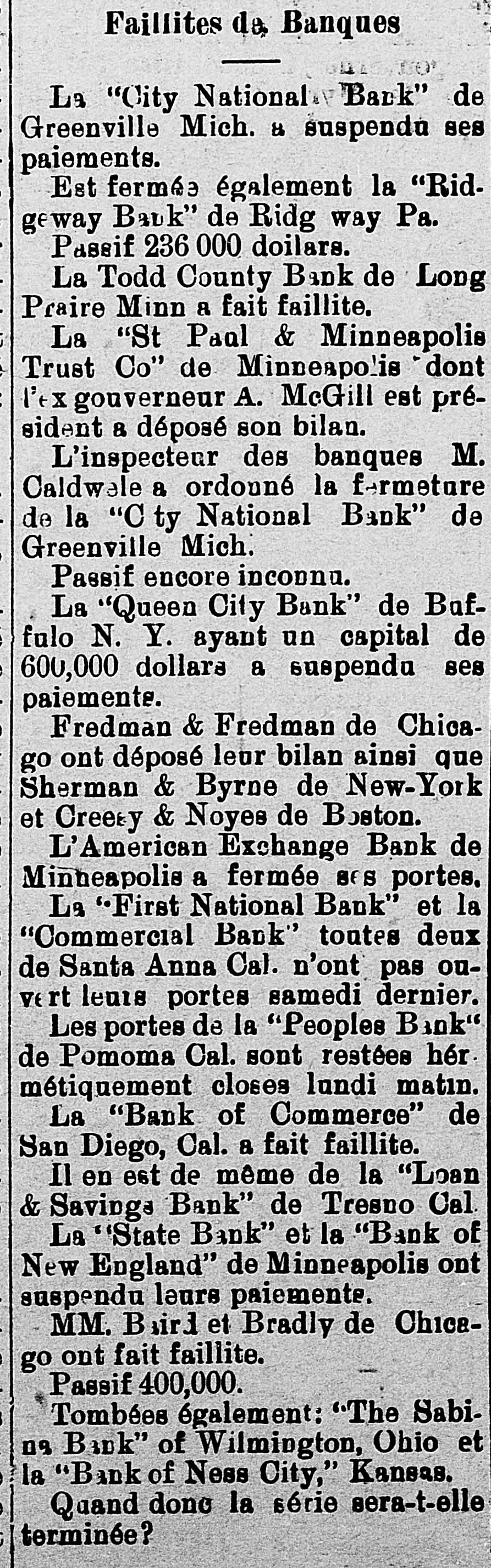
Faillites da Banques La "City National Bank" de Greenville Mich. 8 suspendu ses paiements. Est fermée également la "Ridgeway Bank" de Ridg way Pa. Passif 236000 doilars. La Todd County Bank de Long Praire Minn a fait faillite. La "St Paul & Minneapolis Trust Co" de Minnespo'is dont l'ex gouverneur A. McGill est président a déposé son bilan. L'inspecteur des banques M. Caldwele a ordonné la fermeture de la "Cty National Bank" de Greenville Mich. Passif encore inconnu. La "Queen City Bank" de Buffulo N. Y. ayant un capital de 600,000 dollars a suspendu ses paiemente. Fredman & Fredman de Chicago ont déposé leur bilan ainsi que Sherman & Byrne de New-York et Creety & Noyes de Boston. L'American Exchange Bank de Minheapolis a fermée BES portes. La "First National Bank" et la Commercial Bank" toutes deux de Santa Anna Cal. n'ont pas ouvert leuis portes samedi dernier. Les portes de la "Peoples Bink" de Pomoma Cal. sont restées her métiquement closes lundi matin. La "Bank of Commerce" de San Diego, Cal. a fait faillite. Il en est de même de la "Loan & Savinga Bank" de Tresno Cal La "State Bank" et la "Bank of New England" de Minneapolis ont suspendu leurs paiemente. MM. B iri et Bradly de Chicago ont fait faillite. Passif 400,000. Tombées également: "The Sabina Bank" of Wilmington, Ohio et la "Bank of Ness City," Kansas. Quand donc la serie sera-t-elle terminée?


Article from The Clarksburg Telegram, June 30, 1893

Click image to open full size in new tab

Article Text

goes down in the vortex of financial disaster Already the number of failures are appalling enough to alarm the strongest hearts. The end is not yet. Still they come The Queen City bank, of Buff. alo. has failed. The bank of New England, at Minneapolis, has closed its doors. The Sabina, O., bank has made an assignment. The Jeffersonville, O., bank has quit. The big Carl Coal Works, of Carlton, O., has gone to smash. Only a part of this week's rec. ord Every day the list grows larger. It now records the downfall of hundreds of similar concerns. If any man,on the 8th of last November. had predicted that the West Virginia farmer would, in seven months, be forced to sell his wool at 15 and 16 cents cash, or else keep it, he would have been put down as a fool. "If any one had predicted on the 8th of last November, when Grover Cleveland was elected President, that within seven months there would be a shrinkage in the actual value of stocks and bonds sold on the New York Stock exchange of nearly one billion dollars he would have been deemed a madman. "If any one had predicted that within seven months after the election day and the return of a Democratic House, Senate and President to power for the first time since 1856, a panic would ensue which would exceed in the aggregate of losses the world-famous panic of 1857, when the same party obtained bsolute.control of the Government for the last time until 1892, the prophecy would probably have excited derision." But, sad as it is to say it, these three calamities have come upon the American people. The TELEGRAM, when seven months ago it announced the result of the election, advised all Republicans to be of good cheer. It said "The Republican party will live because it upholds principles that are immortal. will continue to be the party of progress, protection and education." It will return to power in '96 and the people, familiar with its past, its aims and its purposes, will again have confidence in its principles. It will lead, us as it did in 1857, from darkness to light-from a great need to a towering hope. Not even the most avowed enemies of Democracy looked for such a and sweeping taking of our prossudden away commercial perity. The appalling cost to this country of Democratic success was not comprehended and cannot yet be estimated. One Billion and a Half! Such a loss can hardly be conceived by the individual, because, the figures are so far beyond any personal experience or single commercial transaction. It exceeds the entire sum of actual money in the United States-gold, silver and paper, national bank notes and treasury notes! In this fact lies the secret of the colossal losses, the financial stringency and the daily long list of commercial and banking failures. It is want of confidence. About 93 per cent. of all the business of the country is transacted on credit and about 7 per cent. only on the basis of cash. When credit is impaired; when confidence is lacking, more than in nine-tenths of all the business hand is affected. That is the situ- will ation to-day. Four years


Article from The Worthington Advance, July 6, 1893

Click image to open full size in new tab

Article Text

WEST AND SOUTH. THE firm of S. & G. Gump, dealers in art goods at Nan Francisco, made an assignment with liabilities of $140,000. THE death of Rev. W. W, Kone, aged 90 years, occurred at Denison, Tex. He was the oldest Baptist minister in the United States, having entered the ministry at the àge of 18, THE Bank of New England at Minneapolis, Minn, the Sabina (O.) bank and the bank of Ness City, Kan., closed their doors. The governor of Illinois has pardoned Michael Schwab, Samuel Fielden and Oscar Neebe, the anarchists sentenced to state's prison on the charge of complicity In the Haymarket massacre in Chicago May 4, 1886. Fielden and Schawb were sentenced to prison for life and Neebe for fifteen years. IN Detroit Frank Hayes, aged 20 years. was found guilty of murder and sentenced to imprisonment for life. THE Merchants' national bank at Moorhead, Minn., was entered by a masked man who covered the teller with a revolver and secured $2,600. T wo INDIANS, Kozine and Moneypenmy, were found guilty at Madison, Wis, of the murder of Boneash and his squaw last fall. At Lebanon, Ind., William Ransdell was bitten by a tarantula while handling bananas. In the bunch of bananas a bunch of 200 young tarantulas was found. Ransdell may recover, THE state liquor dispensary of South Carolina has begun business and all saloons would soon be closed. THE Savings bank at Fresno, Cal., and the Bank of Commerce at San Diego, Cal., which suspended recently, have resumed business. ON a bicycle H. H. Wyllie made the 1,000 miles from New York to Chicago in ten days and four hours. BERRY won the cowboy race to CHP began at Chadron, Neb., June 13. making the 1,040 miles in 13,days, 15 hours and 35 minutes-an average of 77 miles daily. Wine attempting to escape from the prison at Folsom, Cal., three convicts were shot dead by guards. AT Edinburg, Ill., G. P. Harrington, bankers failed for $200,000. American exchange bank of Minneapolis, Minn., and the Second national bank of Ashland, Ky., closed their doors. THE failure was reported of the Bedford (Ind.) Stone Quarries company, the largest producers of politic lime stone the world
Article from Evening Journal, July 7, 1893

Click image to open full size in new tab

Article Text

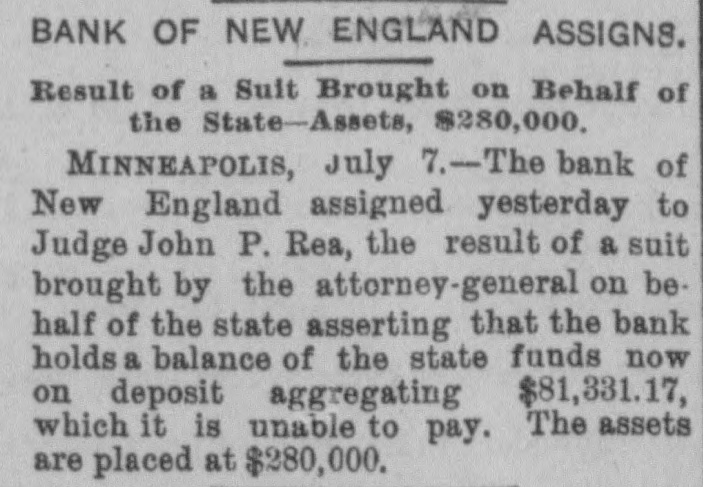
BANK OF NEW ENGLAND ASSIGNS. Result of a Suit Brought on Behalf of the State-Assets, $280,000. MINNEAPOLIS, July 7.-The bank of New England assigned yesterday to Judge John P. Rea, the result of a suit brought by the attorney-general on be. half of the state asserting that the bank holds a balance of the state funds now on deposit aggregating $81,331.17, which it is unable to pay. The assets are placed at $280,000.


Article from The Sun, July 8, 1893

Click image to open full size in new tab

Article Text

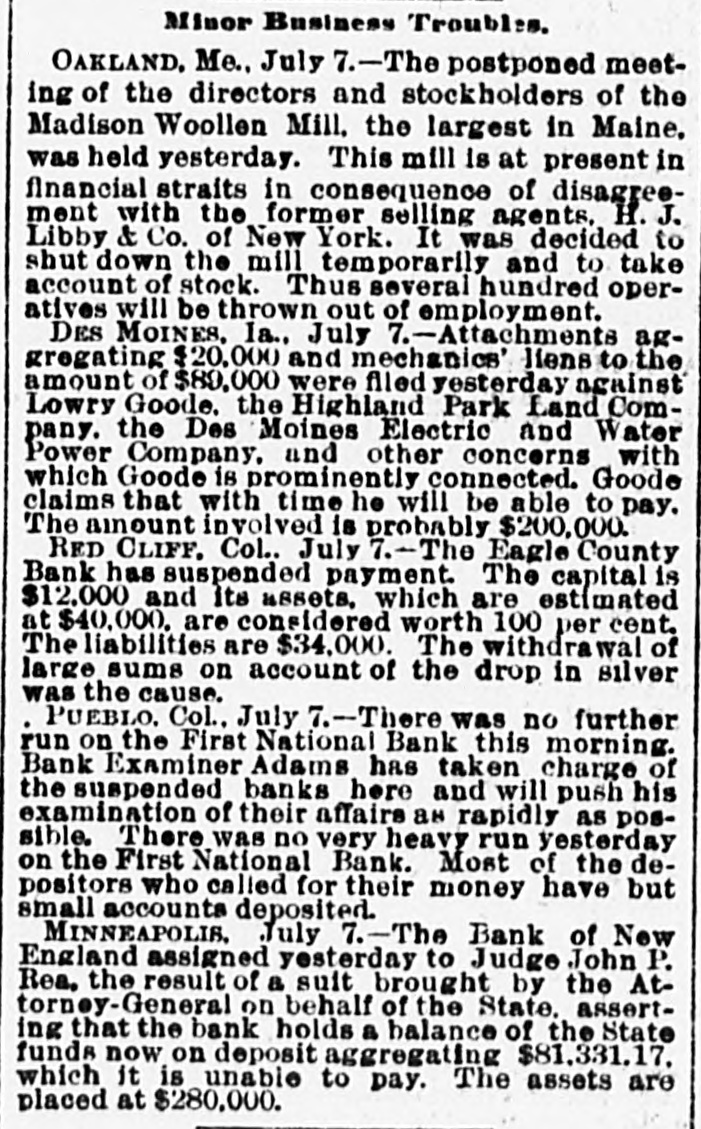
Minor Business Troubles. OAKLAND. Me., July 7.-The postponed meeting of the directors and stockholders of the Madison Woollen Mill. the largest in Maine. was held yesterday. This mill is at present in financial straits in consequence of disagreement with the former selling agents, H.J. Libby & Co. of New York. It was decided to shut down the mill temporarily and to take account of stock. Thus several hundred operatives will be thrown out of employment. DES MOINES, Ia., July 7.-Attachments aggregating $20.000 and mechanics' liens to the amount of $89,000 were filed yesterday against Lowry Goode. the Highland Park Land Company. the Des Moines Electric and Water Power Company. and other concerns with which Goode is prominently connected. Goode claims that with time he will be able to pay. The amount involved is probably $200,000. RED CLIFF. Col.. July i.-The Eagle County Bank has suspended payment. The capital is $12,000 and its assets. which are estimated at $40,000. are considered worth 100 per cent. The liabilities are $34,000. The withdrawal of large sums on account of the drop in silver was the cause. PUEBLO. Col., July 7.--There was no further run on the First National Bank this morning. Bank Examiner Adams has taken charge of the suspended banks here and will push his examination of their affairs an rapidly as possible. There was no very heavy run yesterday on the First National Bank. Most of the depositors who called for their money have but small accounts deposited. MINNEAPOLIS, July 7.-The Bank of New England assigned yesterday to Judge John P. Rea. the result of a suit brought by the Attorney-General on behalf of the State. asserting that the bank holds a balance of the State funds now on deposit aggregating $81,331.17. which it is unable to pay. The assets are placed at $280,000.


Article from New-York Tribune, July 8, 1893

Click image to open full size in new tab

Article Text

TROUBLES OF WESTERN BANKS. Omaha, Neb., July 7.-The American Savings Bank. which closed on Wednesday night. was put in charge of a special examiner by the State Banking Board yesterday. The bank is believed to be solvent. The National Bank of Ashland, an offshoot of the American Loan and Trust Company, also failed. It had a capital of $100,000. Minneapolis, Minn., July 7.-The Bank of NewEngland assigned yesterday to Judge John P. Rea. as the result of a suit brought by the Attorney-General on behalf of the State, alleging that the bank holds a balance of State funds now on deposit. aggregating $81,331 17. which it is unable to pay. The assets are placed at $280,000. Pueblo, Col., July 7.-There was no further run on the First National Bank to-day. Bank Examiner Adams has taken charge of the suspended banks here. and will push the examination of their affairs as rapidly as possible. Pine Bluif, Ark., July 7 (Special).-The Arkansas State Bank. of Stuttgart, and the Arkansas Farmers and Traders' Bank, of Dewitt. near this city, have closed their doors. Neither institution had large assets and depositors will not suffer to any considerable degree. Both banks were under the same management, and the recent failure of the Stutigart and Kansas River Railway, of which T. H. Leslie, the father of C. K. Leslie, the cashier of the banks, was president, precipitated the collapse. Red Cliff, Col., July 7.-The Eagle County Bank has suspended payment. Its capital is $12,000 and its assets, which are estimated at $40,000, are considered worth 100 per cent. The liabilities are $34, 000. The withdrawal of large sums on account of the drop in silver was the cause. Washington, July 7.-Controller Eckels is informed that the First National Bank of Hot Springs, S. D., and the Livingston National Bank of Livingston, Mont.. have closed their doors to business. Bank Examiner Diamond has been ordered to take charge of the Hot Springs bank. and Bank Examiner Flynn will take charge of the Livingston bank.


Article from Burlington Weekly Free Press, July 13, 1893

Click image to open full size in new tab

Article Text

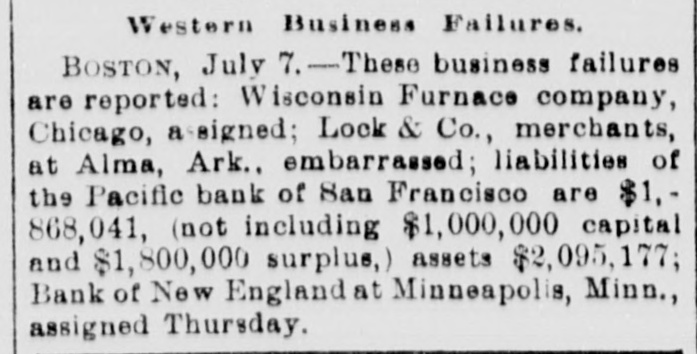
Western Business Failures. BOSTON, July 7.-These business failures are reported: Wisconsin Furnace company, Chicago, a seigned; Lock & Co., merchants, at Alma, Ark., embarrassed; liabilities of the Pacific bank of San Francisco are $1,868,041, (not including $1,000,000 capital and $1,800,000 surplus, assets $2,095,177; Bank of New England at Minneapolis, Minn., assigned Thursday.


Article from Fort Worth Gazette, August 29, 1893

Click image to open full size in new tab

Article Text

WILL RESUME. I MINNEAPOLIS, Minn., Aug. 28.-The Bank of New England. which suspended recently, will resume Saturday.


Article from The Globe-Republican, September 1, 1893

Click image to open full size in new tab

Article Text

Another Bank Resuming. MINNEAPOLIS, Minn., Aug. 29.-The Bank of New England which suspended a month ago will resume business Saturday next. President Blethen says the bank has better backing than ever.


Article from The Star, September 6, 1893

Click image to open full size in new tab

Article Text

# BANK RESUMPTIONS. Many Reported From Different Parts of the Country. A telegram from Washington says: The following national banks, which recently suspended payment, have been permitted to reopen their doors for business: The State national bank of Denver, Col.; the Louisville city national bank, of Louisville, Ky.; the Merchants' bank of Louisville; Ky.; the First national bank of Ashland, Wis., and the First national bank of Platteville, Wis.; the German national bank of Denver, Col.; the First national bank of Canon City, Col. At Minneapolis, the Bank of New England, which suspended about a month ago, has resumed business. At San Francisco the People's home savings bank, which closed its doors June 23, opened for business. A statement issued by the national banks of Kansas City shows that since the height of the financial flurry, which was reached on June 19, the deposits have increased $2,000,000. The First national bank of Dubuque, Ia.; the First National bank of Grand Rapids, Col. The American national bank of Omaha, Neb.; the American national bank of Nashville, Tenn. The First national bank of Mankato, the National Citizens' bank of Mankota the Mankato national bank, all of Mankato, Minn.


Article from Grand Rapids Herald, November 13, 1893

Click image to open full size in new tab

Article Text

HEAVY LITIGATION PROMISED. Suits to Be Started to Compel Minnesota Treasurers to Disgorge. MINNEAPOLIS, Nov. 12. - Minnesota may have a back interest litigation soon that will be second to the famous cases which were brought against the ex state treasurers of Wisconsin whereby they were compelled to pay back to the state some hundreds of thousands of dollars which they had appropriated. The matter came out in the receivership case of the Bank of New England which came up before Judge Russell yesterday morning. Assistant Attorney General Edgerton made the sensational state. ment that an affidavit had been filed charging State Treasurer Joseph Bobleter with having received 21/2 per cent personal interest on state moneys de posited with the bank besides the 3 per cent allowed by law. It has since developed that the affi. davit was made by J. W. Arelander, a prominent attorhey. who says that certain banks in order to get the deposits had entered into an agreement to pay the state treasurer 3 per cent for the regular interest on deposits and 21/6 per ceat directly to him. This last was not to be used by the state, nor was it the intention of either party to the deal that the money should ever reach the coffers of the state treasury, but it was distinctly understood that it would go into the pocket of the state treasurer. In other words it was nothing more nor less than an emolument for the placing of deposits of state money with them rather than with some other banks In the case of the state banks Mr. Arclan der charges that the state treasurer has received some $12,000 and from $40,000 to $50,000 from other banks in the same way.


Article from St. Paul Daily Globe, November 19, 1893

Click image to open full size in new tab

Article Text

CAPITOL CULLINGS. The state historical library yesterday received a copy of Crisp's new "Visitation of England and Wales." Articles of incorporation of the East Grand Forks Fair and Driving association, with a capital stock of $10,000. were filed yesterday with the secretary of state. State Treasurer Bobleter has been elected cashier of the Columbia National Bank of Minneapolis, but he will not take an active part in the management. Articles or incorporation of the "Delong Abdominal Bandage Manufacturing company." of St. Paul. with a capital stock of $5,000, were filed yesterday with the secretary of state. Attorney General Childs and Assistant Attorney General Edgerton were in Minneapolis yesterday to attend the hearing of the application of the state for a receiver for the Bank of New England. Ole Gunderson, sheriff of Norman county, yesterday collected $80.27 from the state for taking two prisoners to Stillwater. Sheriff J., C. Thorn, of Nobies county, also collected $57 for bringing two from his county.


Article from Reporter and Farmer, November 23, 1893

Click image to open full size in new tab

Article Text

WILL REA REMAIN? Minneapolis, Nov. 20.-The appointment of a receiver for the Bank of New England, whose affairs have been under the management of Judge Rea, as assignee, has been taken under advisement by Judge Russell, who will consult the other members of the bench before making the appointment. In the matter of the appointment, Mr. Cohen, attorney for Judge Rea, stated to the court that more than one-half the creditors had petitioned that Judge Rea be retained. Mr. Cohen also stated the liabilities under Judge Rea's administration had been largely reduced and that he did not want the proceedings to go on, under the impression that Judge Rea had been derelect. Judge Rea then made a brief statement concerning his occupancy of the assigneeship and its management.


Article from The Herald-Advance, November 24, 1893

Click image to open full size in new tab

Article Text

WILL REA REMAIN? Minneapolis, Nov. 20.-The appointment of a receiver for the Bank of New England, whose affairs have been under the management of Judge Rea, as assignee, has been taken under advisement by Judge Russell, who will consult the other members of the bench before making the appointment. In the matter of the appointment. Mr. Cohen, attorney for Judge Rea. stated to the court that more than one-half the creditors had petitioned that Judge Rea be retained. Mr. Cohen also stated the liabilities under Judge Rea's administration had been largely reduced and that he did not want the proceedings to go on, under the impression that Judge Rea had been derelect. Judge Rea then made a brief statement concerning his occupancy of the assigneeship and its management.


Article from The Saint Paul Globe, May 7, 1897

Click image to open full size in new tab

Article Text

# BLETHEN'S BANK. # Judge Belden's Decision on Liability Shows Its Queer Workings. A decision of immense interest to the stock- holders of the insolvent Bank of New En- gland was filed yesterday in the district court by Judge Belden. It is a voluminous docu- ment, covering many pages of typewritten matter, and is filled with various tables show- ing the holdings of the stockholders, as well as their liability under the law, the amount due the creditors separately stated, and the primary and secondary liability on stock tranferred within the statutory year prior to the insolvency. The findings of fact connected with the de- cision determine the exact amount of the in- debtedness to the creditors to have been on June 26, 1893, $93.319.30. Clarence H. Childs is appointed by the court receiver to collect these various sums from the stockholders, but by the terms of the order the execution of the same is stayed till June 30, 1897, by which time it is expected that the entire real estate and other assets of the bank will have been converted into cash, and the pro- ceeds, if any after paying for the expenses of the receivership, the costs and so forth, will be deducted from the amount of the judgment against the stockholders pro rata. In case those primarily liable fail to respond or do so in part only, a second assessment is to be made against those secondarily liable. In the finding of fact the court finds that of the original shares of stock issued but $48,300 out of the $50,000 were issued, while of the second $50,000 increase but $38,700 worth of the stock was issued. There is no evidence, says the court, that the public examiner had actual knowledge of the orig- inal and increased stock issued or payments thereon. Nevertheless, although the full amount of the stock was never paid in cash, the president of the bank, Alden J. Blethen, filed his sworn certificate with the bank ex- aminer that the stock had been all paid in, and the same day the examiner, without knowing anything further than what the cer- tificate stated, issued his certificate to that effect.