George William Ballou & Company (Boston, MA)

Episode Information

Episode UID
9682742091004
Episode Type
Suspension โ†’ Closure
Bank Type
private
Bank ID
968274209 hash
Start Date
August 14, 1883
Location
Boston, Massachusetts (42.358, -71.060)

Metadata

Model
gpt-5-mini (chosen from majority vote of a three-model LLM ensemble)
Short Digest
6fb92f759d5afe92

Response Measures

None

Description

Assignment to Theo. M. Nevins indicates an official suspension/receivership rather than a temporary liquidity run.

Events (3)

1. August 14, 1883 Other
Newspaper Excerpt
assignment had been made to Theo. M. Nevins, a clerk in the New York house; the assi gnment was due to the failure of their numerous customers to advance the margins needed to carry their stocks.
Source
newspapers
2. August 14, 1883 Receivership
Newspaper Excerpt
dispatch from Ballou stating that an assignment had been made to Theo. M. Nevins
Source
newspapers
3. August 14, 1883 Suspension
Cause
Bank Specific Adverse Info
Cause Details
Assignment by the New York house after customers failed to advance margins and heavy losses from securities/railroad enterprises.
Newspaper Excerpt
The announcement that George William Ballou & Co. had suspended caused an excitement on the street...
Source
newspapers

Newspaper Articles (2)

Article from Daily Globe, August 15, 1883

Click image to open full size in new tab

Article Text

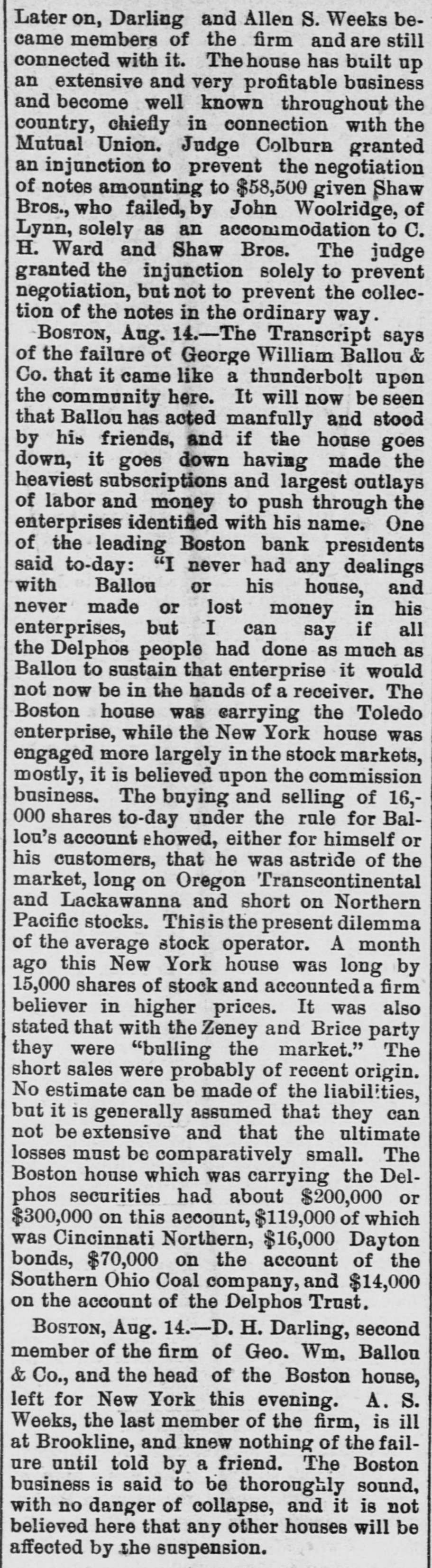
Later on, Darling and Allen S. Weeks became members of the firm and are still connected with it. The house has built up an extensive and very profitable business and become well known throughout the country, chiefly in connection with the Mutual Union. Judge Colburn granted an injunction to prevent the negotiation of notes amounting to $58,500 given Shaw Bros., who failed, by John Woolridge, of Lynn, solely as an accommodation to C. H. Ward and Shaw Bros. The judge granted the injunction solely to prevent negotiation, but not to prevent the collection of the notes in the ordinary way. BOSTON, Aug. 14.-The Transcript says of the failure of George William Ballou & Co. that it came like a thunderbolt upon the community here. It will now be seen that Ballou has acted manfully and stood by his friends, and if the house goes down, it goes down having made the heaviest subscriptions and largest outlays of labor and money to push through the enterprises identified with his name. One of the leading Boston bank presidents said to-day: "I never had any dealings with Ballou or his house, and never made or lost money in his enterprises, but I can say if all the Delphos people had done as much as Ballou to sustain that enterprise it would not now be in the hands of a receiver. The Boston house was carrying the Toledo enterprise, while the New York house was engaged more largely in the stock markets, mostly, it is believed upon the commission business. The buying and selling of 16,000 shares to-day under the rule for Ballou's account ehowed, either for himself or his customers, that he was astride of the market, long on Oregon Transcontinental and Lackawanna and short on Northern Pacific stocks. Thisis the present dilemma of the average stock operator. A month ago this New York house was long by 15,000 shares of stock and accounted a firm believer in higher prices. It was also stated that with the Zeney and Brice party they were "bulling the market." The short sales were probably of recent origin. No estimate can be made of the liabilities, but it is generally assumed that they can not be extensive and that the ultimate losses must be comparatively small. The Boston house which was carrying the Delphos securities had about $200,000 or $300,000 on this account, $119,000 of which was Cincinnati Northern, $16,000 Dayton bonds, $70,000 on the account of the Southern Ohio Coal company, and $14,000 on the account of the Delphos Trust. BOSTON, Aug. 14.-D. H. Darling, second member of the firm of Geo. Wm, Ballou & Co., and the head of the Boston house, left for New York this evening. A. S. Weeks, the last member of the firm, is ill at Brookline, and knew nothing of the failure until told by a friend. The Boston business is said to be thoroughly sound, with no danger of collapse, and it is not believed here that any other houses will be affected by the suspension.

Article from The Indianapolis Journal, August 15, 1883

Click image to open full size in new tab

Article Text

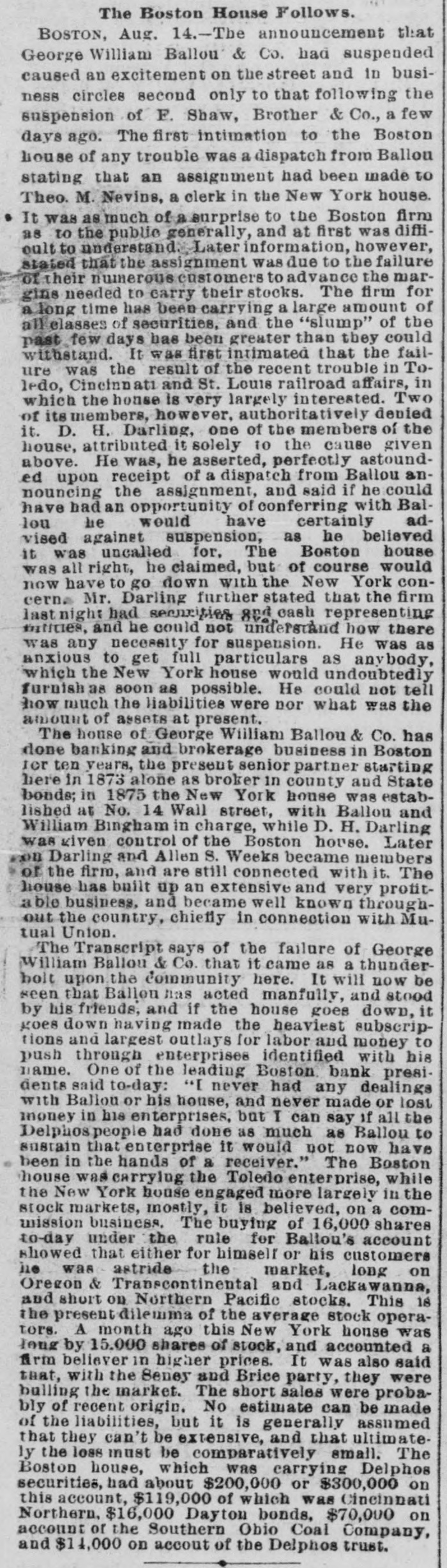
The Boston House Follows. BOSTON, Aug. 14.-The announcement that George William Ballou & Co. had suspended caused an excitement on the street and in business circles second only to that following the suspension of F. Shaw, Brother & Co., a few days ago. The first intimation to the Boston house of any trouble was a dispatch from Ballou stating that an assignment had been made to Theo. M. Nevins, a clerk in the New York house. It was as much of a surprise to the Boston firm as to the public generally, and at first was difficult to understand Later information, however, stated that the assi gnment was due to the failure of their numerous customers to advance the margins needed to carry their stocks. The firm for a long time has been carrying a large amount of all elasses of securities, and the "slump" of the past few days has been greater than they could withstand. It was first intimated that the failure was the result of the recent trouble in Toledo, Cincinnati and St. Louis railroad affairs, in which the house is very largely interested. Two of its members, however, authoritatively devied it. D. H. Darling, one of the members of the house, attributed it solely to the cause given above. He was, he asserted, perfectly astounded upon receipt of a dispatch from Ballou announcing the assignment, and said if he could have had an opportunity of conferring with Ballou he would have certainly advised againet suspension, as he believed it was uncalled for, The Boston house was all right, he claimed, but of course would now have to go down with the New York concerna Mr. Darling further stated that the firm last night had securities and cash representing entities, and he could not understand how there was any necessity for suspension. He was as anxious to get full particulars as anybody, which the New York house would undoubtedly furnish as soon as possible. He could not tell how much the liabilities were nor what was the amount of assets at present. The house of George William Ballou & Co. has done banking and brokerage business in Boston for ten years, the present senior partner starting here in 1873 alone as broker in county and State bonds; in 1875 the New York house was established at No. 14 Wall street, with Ballon and William Bingham in charge, while D. H. Darling given control of the Boston house. Later Darling and Allen S. Weeks became members or the firm, and are still connected with it. The house has built up an extensive and very profitble business. and became well known throughout the country, chiefly in connection with Mutual Union. The Transcript says of the failure of George William Ballou & Co. that it came as a thunderholt upon the community here. It will now be seen that Ballou has acted manfully, and stood by his friends, and if the house goes down, it goes down having made the heaviest subscriptions and largest outlays for labor and money to push through enterprises identified with his name. One of the leading Boston bank presidents said to-day: "I never had any dealings with Ballou or his house, and never made or lost money in his enterprises, but T can say if all the Delphos people had done as much as Ballou to sustain that enterprise it would not now have been in the hands of a receiver." The Boston house was carrying the Toledo enterprise, while the New York house engaged more largely in the stock markets, mostly, it is believed, on a commission business. The buying of 16,000 shares to-day under the rule for Ballou's account showed that either for himself or his customers ine was astride the market, long on Oregon & Transcontinental and Lackawanna, and short on Northern Pacific stocks. This 18 the present dilemma of the average stock operators. A month ago this New York house was long by 15.000 shares of stock, and accounted a firm believer in higher prices. It was also said that, with the Beney and Brice party, they were bulling the market. The short sales were probably of recent origin. No estimate can be made of the liabilities, but it is generally assumed that they can't be extensive, and that ultimately the loss must be comparatively small. The Boston house, which was carrying Delphos securities, had about $200,000 or $300,000 on this account, $119,000 of which was Cincinnati Northern, $16,000 Dayton bonds, $70,000 on account of the Southern Obio Coal Company, and $14,000 on accout of the Delphos trust.