Traders National Bank (Chicago, IL)

Episode Information

Episode UID
96600885
Episode Type
Suspension β†’ Closure
Bank Type
national
Bank ID
9660 national
Charter Number
966
Start Date
September 22, 1873
Location
Chicago, Illinois (41.850, -87.650)

Metadata

Model
gpt-5-mini (chosen from majority vote of a three-model LLM ensemble)
Short Digest
0612bdb0bdd35353

Response Measures

None

Description

Articles span multiple crises (1873 coordinated suspensions and 1888 failure); primary permanent outcome is the 1888 failure and receivership.

Events (7)

1. April 1, 1865 Chartered
Source
historical_nic
2. September 22, 1873 Suspension
Cause
Macro News
Cause Details
National/financial panic (September 1873) prompted Chicago clearing house and banks to adopt 30/60 day rule and suspend specie payments.
Newspaper Excerpt
There is considerable of a run upon some of the banks here to-day... they are adhering to the thirty and sixty day rule.
Source
newspapers
3. September 25, 1873 Suspension
Cause
Macro News
Cause Details
Coordinated suspension by Chicago banks amid the nationwide panic following New York financial failures.
Newspaper Excerpt
Telegrams... announce that all the Chicago banks have suspended.
Source
newspapers
4. September 4, 1878 Voluntary Liquidation
Source
historical_nic
5. October 2, 1888 Receivership
Newspaper Excerpt
Hiram McChesney was appointed receiver of the Traders' bank... McChesney gave bond for $500,000 and was ordered to take charge of the bank effects. The liabilities are said to be $1,000,000; assets at present unknown.
Source
newspapers
6. October 2, 1888 Suspension
Cause
Bank Specific Adverse Info
Cause Details
Bank failure/insolvency leading to closing and appointment of a receiver.
Newspaper Excerpt
Hiram McChesney was appointed receiver of the Traders' bank, corner Madison and Lasalle streets...
Source
newspapers
7. June 5, 1889 Other
Newspaper Excerpt
The books of the Traders' bank, of Chicago, were brought into the court room by order of Judge Shepard. Byron Q. Smith, receiver of the bank, was present to explain their bearing on the case.
Source
newspapers

Newspaper Articles (25)

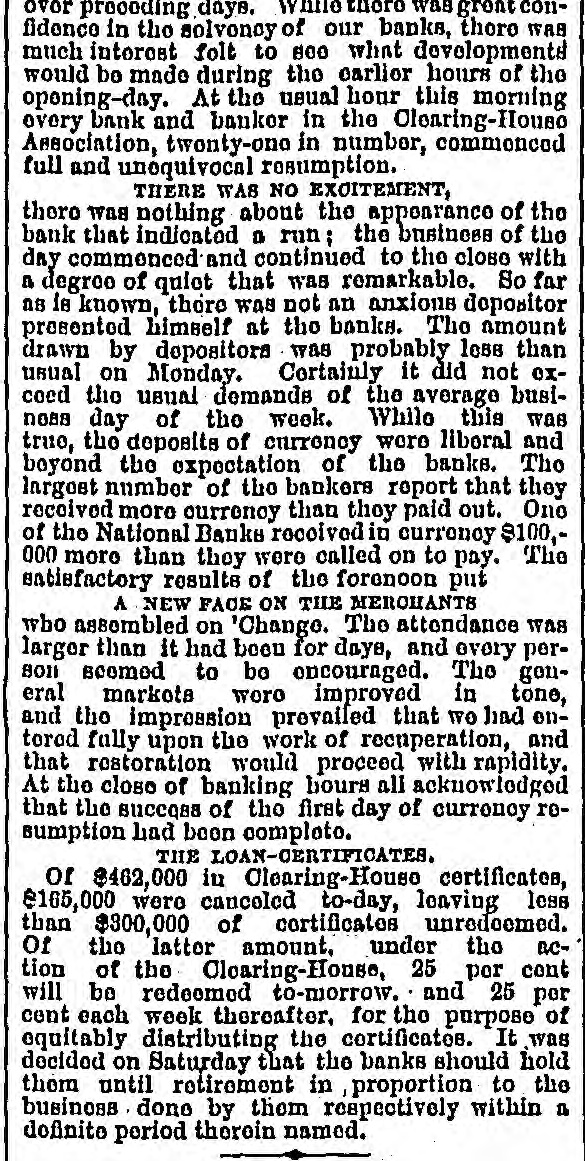
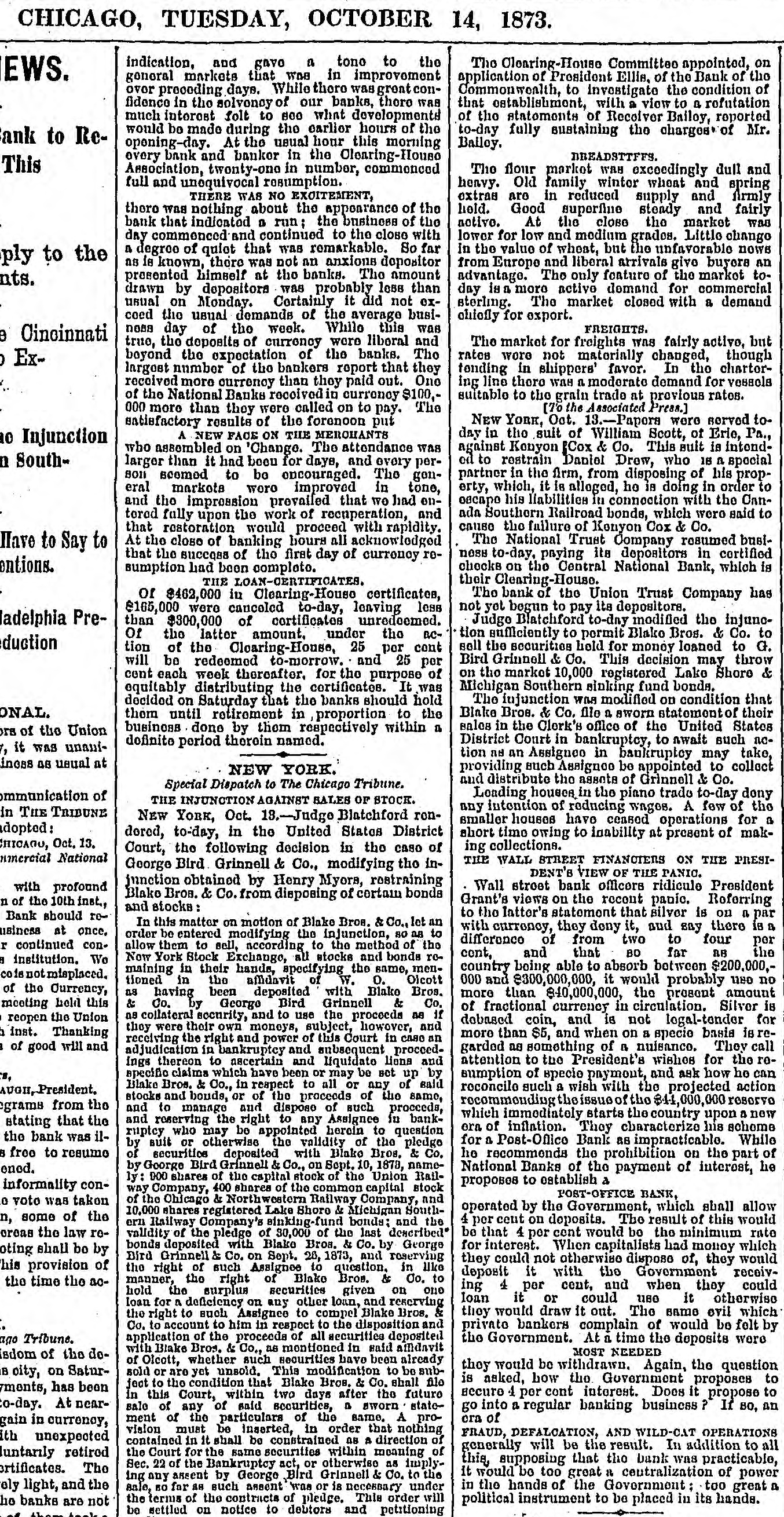
Article from The Wheeling Daily Intelligencer, October 18, 1871

Click image to open full size in new tab

Article Text

CHICAGO. by Lumber Attempted The Resumption.org Rebuilding the on Banks--The Work of attempt was Oct. 17.-An lumber dealers, lummade by a up the price but this yesterday, CHICAGO, to number carry per of thousand, larger of and at from $3 to $4 of the the was ber, was resisted respectable by many dealers, deteated. and Lumis selling at the old and filty millions tempted more ber extortion hundred prices. There the Italian sup- are of fully feet in two the continue yards in to this be abundant. city, and the will captured police have Peteri, who on keeper, week, in a Monday night stabbed two saloon ply The of Gregorio last saloon men on of to Buren street, at the Van He was found west of village this city. on death. about five miles dead bodies total held up inquests Of course Austin, which The number have been of when removed, to last the night, is ninety-two. burnt dietrict is debris in the be disovered. more will been made to-day the special removal of by many Aarrangements for the agent have of avenue the the Postoffice Church, PostDepartment the Wabash and Harrison office avenue for corner to Wabash will be occupied build that streets, and it the government Church can edifice purpose until building. This burned district, suitable the south line of the was considerably scorched, south is on division. but suffered It little or no of Trade injury inside. The directors this of morning, the Board for of the location. purhad a meeting settling the question it was deAfter to appoint a near the old cided a suitable lot, the Chamber pose to select of considerable and committee discussion on a rooms, Board tem- of of Trade rooms, and to erect thereon transaction of business. Sheridan to-day the porory their Commerce, General building, he for announces the issued contin- an There ad dress, peace in which and quiet violence of the city. since the disaster has uous been of Sunday no case night of and Monday morn- reing. The banks, national to-day. and The savings, calls settle- from sumed business were light for immediate to ascertain ment, as many what extent they depositors and to sought Many deposits could their or draw was no safely balance made. There hereafter. drafts on excitement the Savings were whatever. The and in many rush Bank were very light, made. There deposits were at the considerable many checks were confidence stances and excitement the thrown closing out. was the in- to hour, illustration of banks, we refer placed in Third public to-day's As an work: checked At the the out, and National, bank $72,000 pre$45,000 State dedeposited were rush, The but only Savings money, some forty the aghave gregate pared positors for of called a which for was their greatly exceeded been by deposits. contracts for building those who Many to-day. Among are William F. Wheeler, propose consummated to rebuild H. G. Powers, at once Armour, C.T. John Pot- B. Coolbaugh, George Walker, Mathew K. Drake, Boin Bros., of Drake Block, Laflin, J.C. C. H. Tuttle, Beck une ter Gregstin with, Palmer, Company, Edwin & Mackin, Hunt, &c. House Frederick Jas. The square H. entire Reese, from block Trib the on Court from Randolph streets, will Dr. Fowler, J. C. and John Drs. Union Depot land and street is to be east, by fronting Washington E. Goodell, Messrs. and others. of running Lake Charles Walker, The great be rebuilt scale. at at Quin- once once R. rebuilt at the toot and on a greatly were enlarged issued to-day thousand for A persons number leaving of passes the city. The number was The one action the of postoffice the postoflice on one-third authorities the South of the Side, in locating population where there surprise of the is less city and than and a good no gas, to deal have has of indignation, created great for the less accommodation regard seeming should of a mahad of the citizens than to-day, In number of of been jority lected. been. Brooklyn A various small $1,200 parts contributions was have New col- at from Committee State. telegraphed that in money ought to give Various New Chicago York are reported The $1,000,000 Boston England Massachusetts towns and for supplies. are reported $10,000 as a portion The registration for this the morning; election to-day Michigan. commenced registered 23,200. Germans November total was number of the leading for the purA meeting Hall to-night, element one pose held at of uniting the A German committee, was ap. organization. Apollo prominent Germans, Democ- includ. into ing many with the reform pointed racy for to the conter purpose of an alliance against


Article from The Daily State Journal, October 18, 1871

Click image to open full size in new tab

Article Text

# THE WRIT OF HABEAS CORPUS SUSPENDED IN SOUTH CAROLINA, &C. Washington, October 17.--The President to-day, after reciting the causes and quoting the laws under which he acts, issued a proclamation in which he suspends the writ of habeas corpus in Spartanburg, York, Marion, Chester, Laurens, Newberry, Fairfield, Lancaster, and Chesterfield counties, of South Carolina. The suspension extends to the arrest by the United States marshal, his deputies, any military officer of the United States, or any soldier or citizen acting under the orders of said marshal, deputy, or such military officer within said counties, of persons charged with any violation of the Ku-Klux act of Congress during the continuance of the "rebellion" in said counties. The Attorney-General has a dispatch from North Mississippi that five Ku-Klux with disguises complete have been captured. Seven hundred and fifty thousand dollars in revenue stamps were found safe in the government vault in Chicago. Secretary Boutwell has received the following dispatch from Chicago: "The Chicago banks are saved, and are paying every dollar on demand. A good feeling prevails. [Signed] H. R. Hurlbut, Comptroller of Currency." Mexican Affairs. Havana, October 17.-A steamer just arrived from Vera Cruz brings late dates from the Mexican capital. Juarez had been re-elected President by Congress, receiving 108 votes-all that were cast. The opposition abstained from voting. Everything was quiet in the city. The telegraph wire between the capital and Matamoras had been cut by Trevina. Telegraphic Summary. Eighty Catholic children have arrived at Cincinnati from Chicago, and have been committed to the care of the bishop. The cholera has again appeared in an epidemie form in Constantinople. Sixty deaths have occurred in two days, nine of whom are Englishmen. Hon. James McNab, Governor of Nova Scotia, is dead. The preparations for the exposition of the Industrial Association of Georgia, to be held in Savannah on the 21st of November, are nearly complete. A suit has been instituted in the Federal Court at Memphis, Tenn., against Gen. Forrest and others, by Capt. Houston, of the steamer Hester, for arms destroyed some years ago by disguised men. A dispatch from Raleigh states that the exhibition of the North Carolina State Fair at that place is unsurpassed in every respect. The sub-Ku-Klux Committee has been investigating at Montgomery, Ala., whence they go to Demopolis, in the same State, and thence return to Washington. Four deaths from yellow fever have occurred in Charleston during the past two days. The Security Insurance Company has suspended. Fires are raging in Deer and Harrison Creek Valley; extending to Jefferson county, Nebraska. The loss is estimated at $50,000. A later dispatch from Glocester, Canada, says an American fleet of four vessels is outside, and that any attempt to seize the "Horton" will meat with disastrious defeat. The vessels spoke the "Horton," but did not see the British gunboats.


Article from The Tipton Advertiser, October 19, 1871

Click image to open full size in new tab

Article Text

# THE CHICAGO FIRE considered a sufficiently large figure to cover all the losses. The number of acres actually burned over is about 2,500-comprising the most compact and thickly inhabited part of the city, and the great bulk of its business and substance. About 20,000 buildings were burned, one-fourth of which were of stone or brick. The actual loss of life was undoubtedly over 300. Concerning the situation and prospects, on Friday, the Journal said: "Chicago is not hopelessly down. Her capitalists and merchants are 'up and doing'-preparing for reorganization and reconstruction upon the old foundations -and it is very apparent to all intelligent observers, that all will soon be well, and that Chicago will, before long, be in rapid process of rebuilding, and that before many years she will in all respects be herself again. The fact, now positively stated, that the heaviest insurance companies at the East will promptly adjust and pay in full their losses by our Great Conflagration, is the most cheering news we have yet received since the Calamity. This will go far towards helping many of our people out of their troubles and setting them on their feet again." On Monday, it speaks yet more cheerfully, speaking of the announcement that the banks would resume business on the 17th, which is strengthened by a certificate from the United States Comptroller of Currency that the National banks of Chicago are solvent institutions, as follows: "The decision of the banks to abandon their fifteen per cent. installment policy, and resume business as usual to-morrow, has restored confidence in Chicago. The universal opinion now is that the grain business will soon be running as usual. At present the derangement in insurance is a hindrance to shipments. There is no speculative business attempted. It is believed that the permanent increase in the price of grain will be slight. We hear of scores of cases where merchants or capitalists are already fully determined to rebuild in the most substantial style on the old sites, and it is already very evident that the South Side will before many months be 'reconstructed' even more substantially than is was built originally." The peace of the city has been restored and is maintained. The papers deprecate the statements which are finding place in newspapers signifying a different state of things, and say that General Sheridan and the city authorities report no cases of outrage or serious disturbance.


Article from Daily Kennebec Journal, December 4, 1872

Click image to open full size in new tab

Article Text

# THE CURRENCY. The Report of the Comptroller of the Currency is an elaborate document. The topic of most interest referred to is that of a proposed increase of the national bank notes. The Comptroller recommends the repeal of the act of Congress which calls for the redistribution of twenty-five millions of national bank currency, by withdrawing that amount from the Middle and Eastern States and giving it to the South and West, and in lieu thereof to issue five millions a year additional circulation for the next five years, to meet the wants of those States which have not had their full proportion. It is a commonly received but somewhat erroneous opinion that the amount of currency in the hands of each individual member of the community has been on the average largely increased by the National Bank system; but this report only gives it now as, for the whole United States, $9,18 per capita, against $7,59 before National Banks existed; but the circulation of United States Treasury notes should be added before any conclusion is reached from these figures. The State of Rhode Island has the largest per capita circulation: $61,56; Missippi the least: one centβ€”except Florida and California, which have none. New York has but $14,08. The National banks have paid in the last eight years some $40,000,000 taxes to the United States; their State and national taxes for four specified years together amount to $71,000,000. The bank dividends are not so large on the average as is generally supposed; they do not exceed in the aggregate those of the old State banks; for the whole Union they but slightly exceed five per cent on invested capital. The great question of the proper reserve to be held by the National Banks is discussed in this report, and the conclusion reached that it is only the smaller and weaker banks that want to go below the present limit. Their necessities arise from putting out their funds at interest on deposit with Eastern banksβ€”a condition which has more than once given rise to the most serious financial convulsions, as in 1857β€”and a remedy proposed by the Controller is the issue of a new security by a Government which will afford these banks the needful investment at interest. Not the least interesting feature of this report is the announcement that the Chicago banks, so far from being crippled as was anticipated after the fire by losses on discounted paper and the withdrawal of their balances, in point of fact steadily increased in business and profit, after resuming without embarrassment as soon as their safes were cool. There is a similar prospect in Boston, where the aggregate losses since the fire on bills receivable are estimated at less than three millions of dollars, which the bank surpluses will cover without touching capital or reserve. The question of usury is discussed. It appears that the penalty for its practice by National Banks is not clearly defined, and the


Article from Memphis Daily Appeal, September 22, 1873

Click image to open full size in new tab

Article Text

NEWS OF THE DAY. The Wisconsin State fair begins at Milwaukee to-day. The Texas editorial excursionists left Cincinnati last night for Louisville. The financial panic is reported to have seriously affected the narrow-gauge interests in Utah. The Chicago banks have taken advantage of the sixty-day privilege on their depositors. McClure's military academy, at Oakland, California, was entirely destroyed by fire Saturday night. Immediately after the cortes adjourns the Spanish government at Madrid will declare Spain in a state of seige. Thomas Tarwater, a brakeman, was run over and killed by a freight-train at Columbia, Tennessee, on the nineteenth instant. Pat Garnley, an insane man, set fire to a building in Jeffersonville, Indiana, yesterday, remained in it and was burned to death. Business generally will be suspended in Cincinnati to-day. it being proclaimed by the mayor. a holiday in the interest of the exposition. A strange and fatal disease at Kelter, in Utah, is very prevalent, producing great consternation. The patients die in a few hours. It resembles fever. Satisfactory arrangements have bee n perfected with the Ute and other tribes of Indians, hitherto in discontent, so that they will be settled upon their reservations. A Milwaukee dispatch says the financial panic of New York produces no disturbance there as yet, but the banks are preparing for any emergency that may occur the coming week. At Carbondale, Illinois, yesterday two negroes, Bill Smith and Frank Collins, remembered the Sabbath by playing cards, "fell out," resulting in the latter shooting the former through the heart. He's dead.


Article from The New York Herald, September 23, 1873

Click image to open full size in new tab

Article Text

Run on the Chicago Banks. CHICAGO, Sept. 22, 1873. There is considerable of a run upon some of the banks here to-day, but they are adhering to the resolution adopted yesterday to fall back upon the thirty and sixty day rule, and are only paying on sums of less than $100. The largest assemblage appears to be gathered at the States Savings Institution, but so far the crowd has been very quiet and orderly. The latest reports, public and private, from New York, appear to have had the effect to lessen the anxiety which was manifested this morning among many bankers and business men.


Article from Knoxville Weekly Chronicle, September 24, 1873

Click image to open full size in new tab

Article Text

Georgia, to Hopkins, Dwight & Trowbridge; Deposit Savings Institution, Mobile, to Metropolitan National Bank The Brooklyn Banks. The Brooklyu bank presidents to resolved te sell $1,000,000 of U. S. securities in case of emergency. The majority were, however, of the opinion that there would be no run upon them. The Evening Post says: The day closed with an established improvement in general feeling; one day more with the Stock Exchange closed, will, it is thought, put everybody in such a condition, SO far as the exercise of reason is concerned, that it will be prudent for the brokers to again resume business. This afternoon money lent on the streets at : per cent., that rate having been paid by distressed brokers. President Rail, of the Bank of Commerce, said this afternoon that confidence had been very greatly improved and he Thought the action of the Government in buying 5-20s had been highly beneficial in loosening greenbacks. NEW York, Sept. 22.-When the doors of the Irving Savings Bank, 96 Warren street, were opened this morning, a crowd of depositors rushed in, clamoring for their money. The paying teller immediately set to work to satisfy their demands. When the majority, however, saw how willingly money was being paid out, they became quieted and left. Up to 2 o' clock the bank had paid out above $10,000, and had received a considerale amount in deposits. Feeling of Relief in New York. NEW YORK, Sept. 20.-The feeling among all classes is one of great relief. No runs on any of the national or state banks and the crowds on Wall street are mainly curious spectators. There are considerable inquirry for stocks on Wall street. Investors with greenbacks in hand are seeking to purchase, but the prohibition of Stock Ex: change drohibits transactions. The Chicago Banks. CHICAGO, Sept. 22.-There was a considerable run upon some of the banks here today, but they areadhering to the resolution adopted yesterday to fall back upon thirty and sixty days notice, and only paying sums of less than one hundred dollars. The largest assemblage appears to be gathered at the Statee Savings Institution, but so far the crowd has been very quiet and orderly. The latest reports, public and private from New York appear to have had the effect to lessen the anxiety. Chicago Savings Bank. CHICAGO, Sept. 22.-The Savings Banks give notice of the enforcement of thesixty days' notice. MEMPHIS, Sept. 22.-There were eight cases of yellow fever on Sunday. Philadelphia Banks. PHILADELPHIA, Sept. 22.-The run on the Savings] Banks has subsided. PHILADELPHIA, Sept. 2.-There is a much better feeling on the street to-day. The Stock Board is firmer. Pennsylvanias are holding ground at 40 to 50. A bank statement wili be out as usual to-day and will show a gratifying exhibit. The Situation in London. LONDON, Sept. 22-5 P. M.-Much excitement is manifested on all sides to hear further news from New York. Jay Cooke, McCulloch & Co. continue to pay cash in the usual manner over their counter. Among the rumors current in Stock Exchange is one that the Bank of England holds $400,000 of Jay Cooke Co.'s acceptances and that Rothschilds have $100,000 of the same paper. LONDON, Sept. 22-6:30 P. M. - dispatch announcing the closing of the New York Gold Exchanged has just been bulletined. This news is aceepted as an indication of the gravity of the financial situation and the market for American securities is again depressed.


Article from Evening Star, September 25, 1873

Click image to open full size in new tab

Article Text

LATER. More Good News! CONFIDENCE FULLY RESTORED. YORK, Sept. 25-1.10 p. m -A tour among New the banking firms and Sroker's offices, shows and a visit to the sub-treasury this p. m., Constill further improvement in feeling. fidence a is much restored, and the belief is that matters will soon assume a decided improvement. There is considerable activity in stocks, the and they are bought and sold now for first time in four days on certified checks. The following are the quotations at this hour: Union Pacific, 19a20; Western Union 58; Paci York Mail, 29a30; Wabash, 40%a42 New fic Central, 89a90; Ohio and Mississippi, 28 bid, North Western, 39a40; Lake Shore, offered at 75: Rock Island, 85a86; Harlem, 108 bid; St. Paul, offered at 32. Everything is quiet up town. The runonthe savings banks is subsiding. A Better Feeling in Philadelphia. PHILADELPHIA, Sept. 25 -There is a more the hopeful feeling among merchants, and Third prices of goods continue very steady. street is quiet. All the national banks, savings banks, and such of the state banks as did not suspend pursue business in the usual manner. and The board of brokers continue in session adopted the following resolution: Resolved, That until otherwise ordered certified checks or due bills on any of the associated banks will be received in settlement of contracts between the members of the board. Precautionary Measures in the West IN CINCINNATI. CINCINNATI, Sept. 25. The Cincinnati clearing house association has just adopted the following resolution: Resolved, That for the protection of our commercial interests and for the purpose of preventing a drain of currency from the banks and bankers of this city, we do hereby agree New to adopt substantially the plan adopted in York, viz. They will not pay out currency on the checks except for small sums to be optional with the banks upon whom they are drawn, but they will certify checks drawn on balance in their hands payable through the clearing house only. IN CHICAGO. CHICAGO, Sept. The Clearing House Association held an important meeting last night an to consider the financial situation. After animated discussion, which lasted till near one o'clock this morning, the following resolution was Resolved, adopted: That until further action, and in in view of the disturbed condition of affairs New York and other cities, and the difficulty in converting balances into currency, and on allvice of the bank examiner, our members be recommended and authorized to suspend made currency payments on any large demands over upon their, either from country banks or their OWE counters. Salt Lake City Out of the Storm. SALT LAKE, Sept. 24.-The financial crisis in New York has not affected the situation here; but, in view of possibilities, several English companies have offered assistance. The Situation Abroad. LONDON, Sept. 25,3.30 p. m.-The bullion in the Bank of England has decreased €376,000 during the past week. The amount gone Erie into the bank on balance to-day is Β£12,000. railway shares active. Last sales at 44% LONDON, CLOSING Sept. 25, RATES 5 p. IN m.-The LONDON. rate of discount in open market for three months' bills is 4 per cent. The rate for money at the Stock Exchange on government securities is 21/6 per cent. Consols, 92% for both; bonds of 1865,old, 95%; 1865,95 10-40's, 90%; new fives, 91% THE PANIC THE ROAD TO SPECIE PAYMENT. LONDON, Sept.25.-The Daily News believes that the financial panic in New York will lead to the resumption of specie payment. THE MEETING CALLED BY MR. WATSON to consider the affairs of the Erie railroad company, took place to-day, and was attended by one thousand persons. The meeting was described as stormy. A resolution of thanks to Mr. Watson was unanimously adopted. The names of Bischoflshein & Henry were greeted with a storm of mingled hisses and cheers. Mr. Watson, in the explanation of the affairs of the company, said there was some apparent dubiousness about accounts, but he believed they were correct. They wanted $30,000,000 immediately to finish improvements already commenced, and to lay a third rall. The meeting was attended by many Americans. MORE SPECIE FOR NEW YORK. LONDON, Sept. 25--185,000 pounds of bullion was shipped from Liverpool for New York today. The steamship City of Brussels took 15,000 pounds, the Adriatic 35,000. Another Ocean steamer Wrecked. OFFER Sant with The


Article from The Rock Island Daily Argus, September 25, 1873

Click image to open full size in new tab

Article Text

# Banks In Chicago all Suspended. Telegrams received here this afternoon, announce that all the Chicago banks have suspended. This is probably by a united agreement to suspend until some plan of action can be agreed on. Things look blue, and there is great probability that the panic will become general and extend all over the country.


Article from The True Northerner, September 26, 1873

Click image to open full size in new tab

Article Text

# True Northerner. PAW PAW, MICHIGAN, Sept. 26, 1873. # Local Department. Hon. Wilder D. Foster, Representative in Congress from the Fifth District of Michigan, died in Grand Rapids Sept. 20. H. P. McFarlin will hold an Auction Sale at the residence of Fdward Stowman, two miles north-west of Glendale P. O., Oct. 11. We advise every young man or lady who wish to qualify for business to attend the Kalamazoo Business College. The Ann Arbor Courier says the seating capactity of the new University Hall is 3,000, and by the use of temporary seats 4,000 can be accommodated. Charles Smolk has removed his Sewing Machine Depot to the new building on the corner of Main and Niles streets, adjoining the residence of T. A. Granger. The Fair of the Paw Paw Valley Agricultural Society commenced last Wednesday and closed to-day. We will give a more extended notice of it in our next issue. REV. R. C. WELCH, who has been assigned by the Michigan Conference to the charge of the M. E. Church in this place for the ensuing year. preached his first sermon on Sunday morning last. All the Banks of Chicago entered into an arrangement by which they closed their doors yesterday morning, and take thirty days in which to pay depositors. A genral derangement of business must be the result. The South Haven Sentinel says: "The condition of religion is good." That is just as we had supposed, and we are right glad to see that fact verified in so public a manner, for the past season has been unusually sickly. The Government Printing office in the City of Washington, in the Territory of Columbia, is one of the largest printing offices in the world. Six colored compositors are employed at the case in that concern. The Lapeer Clarion wants the fat men to stand back in future and give the lean men of the State a chance to hold a convention and get a good, square meal out of East Saginaw or some other philanthropic city. At a public gathering lately one of the gentlemen present was called upon for a speech, and this is how he responded: "Gentlemen and women, I ain't no speecher. More'n 20 years ago I came here a poor idiot boy, and now what are I?" On Saturday last, Miss Emma Pugsley left for Ann Arbor to enter the State University. She is a graduate of the school here, and is an excellent scholar. There are now two young ladies attending the University from this village, the other being Mies Emma Andrews. who has been there for the past two years. The Circuit Court has been in session during the past week. On Monday the Matteson case came up on a motion for change of venue, which motion, after a hearing and the reading of affidavits in support of the motion and counter affidavits opposed to it, was denied. The time for the trial will probably be set down for the next term of the Court. The most important other matter before the Court was a case between A. M. Merrifield and Philo Reed. LAWRENCE, Sept. 16, 1873. TRUE NORTHERNER: DEAR. SIR, I have been away all summer, and have but just returned. The first newspaper I saw after getting home was yourself going "Up in a Balloon." If a little money will save you, the enclosed Two Dollars will help. Keep the thing flying till they all respond, and keep the paper coming. Can't keep house without it. Yours Truly, The State Fair, held at Grand Rapids last week, was a success as regards the magnitude of the exhibition in all its departmentst-he Lumber of people who attended and financially. We learn that the receipts exceeded thirty thousand dollars. Our own Van Buren County maintained the ascendency she had heretofore attained. She bore off the highest prize for her County Collection of Fruit; the township of South Haven took the first prize for her Township collection of Fruit; and the Williams' process for evaporating fruit was pronounced superior to the Alden process. Mr. Williams. the inventor, is a resident and fruit grower of South Haven, in this countv. Our worthy and honored friend. Judge Monroe. met with a very serious mishap on Saturday night last, by which he is now lying in a critical condition. He had arrived here on the nine o'clock train on his way home from Grand Rapids, where he had been attending the State Fair. He started for his home, aboat eight miles from town, on foot and leading a ball by a cord attached to a ring in his nose. When about one-half mile from town the bull became somewhat refractory and refused to go. the Judge meanwhile pulling him along by the cord, when the animal suddenly attacked nim, throwing him to the ground and trampling him under his feet, bruising and lacerating him very seriously about the chest, side and bowels. fter becoming released the Judge crawled to the house of Mr. Clancy and aroused the inmates. who took him in and cared for him until he was taken home, Sunday morning. Ir not unfrequently happens that a party political convention is moved to deliberately falsify history in their platforms, declarations and resolves, as was the case of the Ohio in ther recant numatform adopted by


Article from Chicago Daily Tribune, September 30, 1873

Click image to open full size in new tab

Article Text

LAWRENCE, KS. Special Dispatch to The Chicago Tribune. LAWRENCE, Ks., Sept. 20.-Financial matters are looking brighter. The news of resumption by the Chicago banks is hailed with delight. Our banks have paid without suspension through the panic.


Article from Chicago Daily Tribune, September 30, 1873

Click image to open full size in new tab

Article Text

SAN FRANCISCO. Special Dispatch to The Chicago Tribune. SAN FRANCISCO, Sept. 20.-To-day was devoted almost exclusively to collections and legitimate channels, and the result inspirod confidence. Tho resumption of business by the Chicago banks was the subject of much congratulation, showing the panic had no serious effects on Western finance and stability. This, with the promptness with which to-day's matured obliga- tions were mot, has reopened the current of exchange, which resumed with some briskness. Coin drafts on New York sold at ΒΎ to 1 por cent; telegraphic transfers at 2 por cent. The panic has fully demonstrated the unadvisability of stock speculations. Capitalists are more unwilling than ever to invest in outside real estate, preferring legitimate enter- prises and staple products. The panic is charged


Article from Ottumwa Weekly Courier, October 2, 1873

Click image to open full size in new tab

Article Text

On Monday evening last the following action was had by Chicago bankers : The Chicago Clearing House association of banks and bankers resolve that until further action, and in view of the disturbed condition of affairs in New York and other cities, and the difficulty of converting balances into currency, its members be recommended and authorized to suspend currency payments on any large demands made upon them, either from country banks or over their counters. Dispatches of last night show that this action of the Chicago bankers is commended in Keokuk and Des Moines, Iowa,"also by those of Quincy and Peoria, III. The excitement throughout the whole country is great, and yet everybody expresses the utmost confidence in the banks, except such as have been dealing in railroad stock. The opinion prevails that banks generally must suspend until the people settle quietly down. Our produce which had commenced moving, is about totally checked. Eastern banks refuse to send currency west, and as a consequence no produce can be bought. This certainly cannot last long, for the starving must have bread and the currency depot must be unlocked in the East.


Article from Burlington Weekly Free Press, October 3, 1873

Click image to open full size in new tab

Article Text

SUSPENSION OF THE CHICAGO BANKS. - A A telegram received Saturday from Chicago announces that all the banks in that city have suspended.


Article from The Hickman Courier, August 1, 1874

Click image to open full size in new tab

Article Text

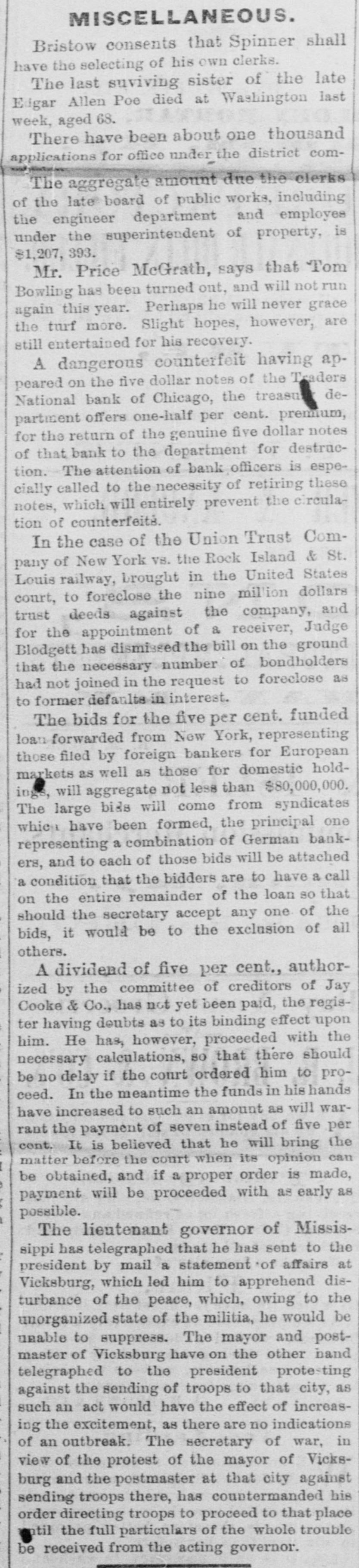
MISCELLANEOUS. Bristow consents that Spinner shall have the selecting of his own clerks. The last suviving sister of the late Edgar Allen Poe died at Washington last week, aged 68. There have been about one thousand applications for office under the district comThe aggregate amount due the clerks of the late board of public works, including the engineer department and employes under the superintendent of property, is $1,207, 393. Mr. Price McGrath, says that Tom Bowling has been turned out, and will not run again this year. Perhaps he will never grace the turf more. Slight hopes, however, are still entertained for his recovery. A dangerous counterfeit having appeared on the five dollar notes of the Traders deNational bank of Chicago, the treasu partment offers one-half per cent. premium, for the return of the genuine five dollar notes of that bank to the department for destruction. The attention of bank officers is especially called to the necessity of retiring these notes, which will entirely prevent the circulation of counterfeitΓ . In the case of the Union Trust Company of New York vs. the Rock Island & St. Louis railway, brought in the United States court, to foreclose the nine million dollars trust deeds against the company, and for the appointment of a receiver, Judge Blodgett has dismissed the bill on the ground that the necessary number of bondholders had not joined in the request to foreclose as to former defaults in interest. The bids for the five per cent. funded loan forwarded from New York, representing those filed by foreign bankers for European markets as well as those for domestic holdings, will aggregate not less than $80,000,000. The large bids will come from syndicates which have been formed, the principal one representing a combination of German bankers, and to each of those bids will be attached a condition that the bidders are to have a call on the entire remainder of the loan so that should the secretary accept any one of the bids, it would be to the exclusion of all others. A dividend of five per cent., authorized by the committee of creditors of Jay Cooke & Co., has not yet been paid, the register having deubts as to its binding effect upon him. He has, however, proceeded with the necessary calculations, so that there should be no delay if the court ordered him to proceed. In the meantime the funds in his hands have increased to such an amount as will warrant the payment of seven instead of five per cont. It is believed that he will bring the matter before the court when its opinion can be obtained, and if a proper order is made, payment will be proceeded with as early as possible. The lieutenant governor of Mississippi has telegraphed that he has sent to the president by mail a statement 'of affairs at Vicksburg, which led him to apprehend disturbance of the peace, which, owing to the unorganized state of the militia, he would be unable to suppress. The mayor and postmaster of Vicksburg have on the other hand telegraphed to the president protesting against the sending of troops to that city, as such an act would have the effect of increasing the excitement, as there are no indications of an outbreak. The secretary of war, in view of the protest of the mayor of Vicksburg and the postmaster at that city against sending troops there, has countermanded his order directing troops to proceed to that place ntil the full particulars of the whole trouble be received from the acting governor.


Article from New-York Tribune, August 30, 1877

Click image to open full size in new tab

Article Text

EFFECT UPON BUSINESS IN THIS CITY. The failure of the State Savings Bank of Chicago had no perceptible effect here, and bankers generally regarded it as a temporary matter, not likely to create a panic or disturb the standing of other Chicago banking institutions. A private dispatch received yesterday afternoon stated that the run on the banks was not heavy, that the larger institutions were promptly meeting all demands, and that savings banks were insisting on the rule that for the withdrawal of larger amounts than $10, thirty days notice must be given. It is not believed by the officers of the leading banks in this city that there is any immediate danger of a serious time with the Chicago Banks, and in no case could it much affect banks 111 this city. The State Savings Bank of Chicago is reported to have total resources of $2,724,000, with liabilities of $2,988,339. This is believed to be a low estimate of the deficiency, which, it is thought, will be increased somewhat on account of the shrinkage in values of real estate, of which the bank holds $1,435,315. A Wall-st. banker stated that the financial embarrassment of the State Savings Bank has been a matter of discussion for a long time, and gross mismanagement has been charged against its executive officers. He stated further that D. D. Spencer, the president, was reported to have been a heavy operator in grain, and had by the decline lost the money of the depositors with which he had been operating. Mr. Spencer 18 reported as having left Chicagoon Saturday for this city, but up to last night he had not been seen or heard of, and the presumption among bankers is that he laid over in Canada, or went in a westerly direction. The members of the Produce Exchange were somewhat anxious yesterday morning to obtain full intelligence. Advices were received throughout the day, and they all tended to show that the market, as yet, had not been affected to any extent in Chicago, and there were, therefore, no fears to be entertained of trouble here. A prominent member of the Exchange stated to a TRIBUNE reporter that unless there was a very heavy run on the Chicago banks, causing a money panic, there would be no trouble 111 the produce market here. The Exchange in this city was governed almost entirely by the news from London, and not by the Chicago market, which was too speculative. If, he said, there were any heavy failures there, it would then probably have a disastrous effect on New-York merchants.


Article from Press and Daily Dakotaian, October 3, 1888

Click image to open full size in new tab

Article Text

A CHICAGO BANK SUSPENDS. The Traders' Bank Closes Its Doors and a Receiver Appointed. CHICAGO, Oct. 2.-Hiram McChesney was appointed receiver of the Traders' bank, corner Madison and Lasalle streets, by Judge Shepard, under a petition filed by Thomas T.I Tollman, cashier. McChesney gave bond for $500,000 and was ordered to take charge of the bank effeets. The liabilities are said to be $1,000,000; assets at present unknown.


Article from The Washington Critic, October 5, 1888

Click image to open full size in new tab

Article Text

number of clever imitations of the toms stamps used on imported ciga On the original are the words " Man facturers of imported tobacco," and the counterfeit " Manufactured of i ported tobacco." The bogus stamps : made by a New York house and are I used to evade payment of duty, but a put upon boxes containing inferior ( mestic goods in order to delude the pi chaser into the belief that he is buyi a genuine Havana weed. The firm w be prosecuted. It is officially stated that the Frer Government was much surprised by impression produced abroad by Pr dent Carnot's decree in regard to 1 eigners intending to reside in Fran It is pointed out that former cabin have examined the question and co to a favorable conclusion in regard to No foreign power has offered any obs vation to the government in relat to the decree, the legality of which based upon article 471 of the pe code. Jubilee Juggins," the young Engl plunger, whose real name is Benson, reached the end of his money and is n living on an allowance of $20 a we He got rid of $2,000,000 in two yes His horses are being sold, and one them, Hazelmere, brought $10,000 Tatterall's a few days ago. Bens manages to look like a prosperous m as the vast wardrobe that he purcha in the days of his prosperity is still from exhausted. The New York Star says: The na of Fred May has been stricken from list of members of the Manhattan C by the discipline committee. The H cific charge against Mr. May was n payment of dues, although it is g crally understood that the unenvia notoriety which he has gained was real cause of his dismissal." Gov. Foraker, of Ohio, delivered " bloody-shirt" speech at Bridgep Conn., Wednesday evening. The vi lence of the speaker induced P. T. B num to leave the platform as one of vice-presidents. Dr. Warner, who president of the Young Men's Christ Association, was also made uncomf able by the speaker's vituperative tir against tariff reform. The steamer State of Georgia, f New York September 20, about wl some fears were beginning to be fel consequence of the length of her age, arrived at Glasgow yesterday me ing. James B. Curtis, 55 years old, of S amanca, N. Y., a guest at the Gra Central Hotel, New York City, shot h self through the head yesterday, bl ing out his brains. He left a letter his son in which he stated that he crazy. The commissioners to examine claims against the estate of Wm. G of Boston. the defaulting mill treasu who killed himself. have filed their The claims amount to nea port. $750,000, Governor Hill's enemies are mal desperate efforts to defeat him. T many will hold its convention toto nominate a candidate for ma The County Democracy will hold t convention on Saturday. George Leblanche, the marine, several other gentlemen" of the r were each sentenced yesterday to sl terms in the penitentiary in New Y for aiding and abetting the recent fen prize fight. Sarah Crutcher. of Bardstown. ] widow of James Crutcher. a revolut ary soldier, and who had drawn a sion since 1853. is dead, at the age eighty-eight years. Harry Cox, a landed proprietor Somerset and a noted foot-ball pla was lost while traveling in the Caue Mountains. A party of guides is missing. The monument over the grave of ( George E. Pickett, in Hollywood Co tery, Richmond, will be unveiled v imposing ceremonies to-day. Col. F. T. Warburton. British V Consul at Newport News. has institu a suit for $20,000 damages against teen prominent citizens of that place Shanklin & Austin's banking ho at Trenton. Mo., has closed its doors, ing forced to suspend by the failure the Traders' Bank, of Chicago. G. Anson Belcher, an aged crip yesterday attempted to commit sui at his home in Saratoga, N. Y., by ting an artery in his wrist. The Hotel Elmwood, at Glen's F N. Y., formerly known as the Elmw Seminary for Young Ladies, was yes day destroyed by fire. The British royal yacht Victoria Albert will arrive at Flushing on Em Fine


Article from The Iowa Plain Dealer, October 11, 1888

Click image to open full size in new tab

Article Text

WEST AND SOUTH. WHILE intoxicated on tue2d Jacob Kafer committed suicide by hanging at Fort Wayne, Ind. He was a wealthy bachelor, and no cause could be assigned. ON the 2d William H. Smith and Caper Westdorfer were struck by lightning and killed near Evansville, Ind. ON the 3d Gold Leaf beat the world's one mile pacing record for three-year-olds on the Napa (Cal.) track, making 2: 15. THE doors of the banking house of Shanklin & Austen. of Trenton, the oldest bank in Northern Missouri, were closed on the 3d, owing to the failure of the Traders' Bank, of Chicago. THERE was intense excitement again on the Chicago Board of Trade on the 3d, December wheat reaching $1.18. THE Virginia State exposition opened at Richmond on the 3d with twenty thousand visitors. ON the 3d the American Bakers' Association met in annual session at Cincinnati. GOVERNOR GORDON and other Democratic State officials of Goorgia were re-elected on the 3d without opposition. ON the: counterfeitforeign cigar stamps were discovered in Chicago, and counterfeit bills were also being circulated. THE Executive Committee of the Amorican partv on the 3d selected P. D. Wigginton, of California. to fill the vacancy occasioned by Judge Greer's declination of the Vice-Presidential nomination coach w stage ##########


Article from Crawford Avalanche, October 11, 1888

Click image to open full size in new tab

Article Text

The Traders' Bank Failure. Receiver Smith, of the Traders' Bank, of Chicago, pronounces it a bad failure. Joseph O. Rutter, the bank's late President, is dead. It is supposed that the determination of the bank's condition will now be speedy, as the money affairs of the late Traders' President were so closely connected with the bank that a settlement of the complications of the latter could not be made without an examination of Mr. Rutter's estate.


Article from The United Opinion, October 12, 1888

Click image to open full size in new tab

Article Text

Wednesday, Oct. 10. Schleyer, the inventor of Volapuk, is dead. Two New York newsboys were burned to death. The two chief street car systems of Chicago are tied up. Four German war ships have been ordered to Zanzibar. Three lines restored rates from St. Louis to New York. The collapsed Traders' bank of Chicago makes a poor showing of assets. King Otho of Bavaria is sinking deeper and deeper in his religious mania. Ex-Queen Isabella of Spain has returned to Paris. She will give receptions during the winter. Emporer William has summoned Co nt Herbert Bismarck from Pesth to Styria by telegraph. The proposition that Emperor Francis Joseph crown himself King of Bohemia causes a sensation. It has been decided to greatly increase the strength of the German expedition for the relief of Emin Bey. The senate has passed a bill correcting the error in connection with the time of meeting of presidential electors. Superintendent Fry is made general manager of the Missouri, Kansas and Texas railroad under the receivers. The senate tariff bill will not be passed this session. Practically the session of the senate will end in about ten days. Premier Floquet has decided that foreign-


Article from Connecticut Western News, October 17, 1888

Click image to open full size in new tab

Article Text

-A large crack in the sternpost of the steel cruiser Baltimore will delay the completion of that vessel several months. -Mr. Justice Matthews, of the United States Supreme Court, is dangerously ill. -Latest reports of the Mud Run disaster place the number of dead at sixty-three, and other deaths are likely to occur among those injured. The number of the latter run up into the hundreds. -The cattle steamer Robert B. Carson sank near Evansville, Indiana. Fifty head of cattle perished. The crew reached shore in safety. -James F. Farley, of Philadelphia, who killed a half breed Indian at Petersboro, Ont., in self defence, last summer, was found guilty of murder and sentenced to be hanged. -Lumber rafting by sea is to be tried on the Pacific coast. It should be safer business there than in the treacherous weather of the East, and the scheme of rafting from Puget Sound to Chilean ports looks feasible enough. -The Bay Valley Bank at Woodbine and the Caldwell Bank at Logan, Iowa, closed their doors, and Judge King was appointed receiver. Both banks were operated |by the same firm. The total deposits will exceed $50,000. -Judge Sawyer of the United States Circuit Court has issued two writs of habeas corpus to test tho validity of the Chinese Excinsion act. -President Adams of the Union Pacific railroad declares that the Interstate Commerce law is responsible for the demoralization in railroad affairs. -The Southern Homeopathic Association, in session at Louisville, protests against the efforts of the allopaths to license all physicians by a State board, and asks that all schools be given an equal repr sentation. -Toronio nas quarantined against Buffalo, owing to the small pox there. -A negro named McCondon was shot and killed at Birmingham, Ala., by a party of four negroes, who took him to the woods and made away with him. -The steamer Cainbro from Skeena River, ran ashore in Granville Channel River. She was loaded with 3,500 cases of salmon. The passengers and crew were got off safely. -John Fitzgerald, 2 boatman of Staten Island, N. Y., and a Swedish woman named Anna, the cook at Hoffman Island in New York harbor, in attempting to go to the island in a small boat, were blown out to sea by the strong northwest wind, and have not been seen since. -Mrs. Mary E. Lieff, of Newburg, N. Y., gave her 10-weeks'-old child a teaspoonful of a soothing syrup to quiet it while she did her housework. During the day it died. The Coroner's jury found a verdict that it died from opiates in the syrup. -John Cunningham, mate of the schooner Carrie M. Bailey, dreamed that his vessel was in a storm and he was trying to reach the deck. In his dream he jumped from a three story window and received fatal injuries. -Harvey Wolff, a depositor in the Trader's Bank, Chicago, which recently failed, has applied to the court for an immediate examination into the affairs of the bank. He alleges the deposits were fraudulently misappropriabd. His deposit amounted to $34,000. -Frederick Lincoln, of Boston. tired of life, Hospital a Come of all of bemlock, and onfor: manual


Article from Telegram-Herald, May 31, 1889

Click image to open full size in new tab

Article Text

named He denied knowing Coughlin intimately. He continued: "I don't see how any one can suspect me of having been sent to take Dr. Cronin away from home. Cronin knew me, and had told me that he had heard I was sent out here to assas. sinate him. It isn't likely that he would have taken a lonely ride with mei thought that.' "When did he tell you that you had been sent to :ill him? "It was ope night in the latter part of February-February 25, I think. I had been in Curry's kaleon and left there with Tom Conway. We met Dr Crosin and Mortimer Scanlau ex Clark and Randolph streets and stopped to talk. Cronin touched me on the shoulder and said: 'McGeehan, I understand you have been saying some pretty hard things about me. I said, 'I don't think I have.' Then he said: 'I understand you have been sent out here to assassinate me.' I said to him: 'You must be a fool. Hereafter, when you see me on the street, don't speak to me; I want nothing more to to with you. And then I walked away from him. "Did you have any quarrel with him in front of the Chicago Opera-House block?" "Never; I never met him there." "What is your opinion of the murder of Dr. Cronin?" Well, I think it's a case of personal spitework, Do you think it was the work of an Irish organization? "I do not. I know something about the inside workings of the Irish society and I know that expulsion is the severest penalty that be executed against a member. State's-Attorney Longenecker had a long chat Wednesday afternoon with Byron I. Smith, receiver of the Traders' Bank: Mortimer Scanlan, the criminal court bailiff, and Patrick Cavanaugh The object of the conference was to lay before the State's Attorney certain facts about the individual accounts with the defunct Traders' Bank The State's Attorney was requested to seize the bank's books and submit them to the grand jury forthwith It was asserted that he would find in them evidence proving what Dr. Cronin had been claiming for years before death-viz that Alexander Sullivan had been guilty of a huge embezzlement of funds while he was a member of the Clanna-Gael triumvirate. The substance of the stories of Scanlan and Cavanaugh is that Sullivan went and demanded from Patrick who was then an $100,000 to to French Egan, Paris capital, exile carry in men out the the aims of the physical force in America He demanded the money to meet certain expenditures which had been planned in a convention of representative members of the ClanMr. Scanlan to over the money, fused na-Gael pay Egan, and asserts, then Irish Sul- rethreatened to disrupt every in America unless his was complied society livan speedily with demand He to the fact that and growing pointed large there element was disamong a righ-Americans which was satisfied with the management of National affairs and was ready to revolt as soon leader appeared to direct them. A whole week was consumed in discussing the Mr. demand of Sullivan, and in the end Egan was convinced that it would be be wise to consult with his colleagues told fore making his final decision. He his visitor plainly that he was op- of posed to granting 80 large a sum but for any purpose he to abide by the money was willing whatever, knowledge decision of men who had as close a as of the needs of the order other himself submit at home the and abroad He offered to proposition to Bheridan, the famous No. 1" of the Pheenix Park Invincibles force and the leader of the physical to men in Ireland Sullivan agreed called this offer. and Sheridan was Within to Paris from Ireland by telegraph bea week after all the facts had been laid defore him be decided that the money manded had better be paid in order to con- in ciliate all factions of the Clan-na-Gael Egan America Scanian asserts that that paid Sullivan $100,000 in cash. and Chihe the full amount to be. cago. Instead, however, of paid brought the of the money society, ing to the local treasury turned Sestian says that only $18,000 was over, the other $82,000 being account deposited fn Sullivan's personal Bank Scanian months ago when to fact the several Traders' discovered receiver. the concern this and into the bands of the pasted by permission he made a thorough of when examination of the hooks in the interest Dr. Crouts and other prominent Irishmen Mr Smith confirmed the story about the of the $89. to 8 be was unable to deposit account, but Sallivan tell personal tea how money was disposed of except a general the way that ft had been drawn out by means of checks He offered to submit the books to the grand jury and also to assist in the examination of them for the purpose as of clearing up any mystery that might tach to the transaction Judge Longemecker listened attentively asking numerous questions and when Bonnian hai concluded he promised to give the request his serious and immediate conderation


Article from Omaha Daily Bee, June 6, 1889

Click image to open full size in new tab

Article Text

# CRONIN'S FOREBODINGS. Several Witnesses Testify to His Fear of Alexander Sullivan. CHICAGO, June 5. - Just before the inquest over Dr. Cronin was ended for the day, the books of the Traders' bank, of Chicago, were brought into the court room by order of Judge Shepard. Byron Q. Smith, receiver of the bank, was present to explain their bearing on the case. By checks on file and ledger entries it was shown that in the summer of 1882 Alexander had altogether $100,000 in the bank. Of this money $10,000 and more was an individual account. The rest was credited to "Alexander Sullivan, agent." By September, 1882, this money had been drawn out on checks made payable to J. T. Lester & Co., brokers. It is the intention of the coroner to summon a member of the firm to probe the matter further. Patrick McGarry, Michael Barry, Maurice Morris and Joseph O'Byrne, members of the Clan-na-Gael, and friends of Dr. Cronin, gave testimony to the general effect that Dr. Cronin had said to them at different times that he expected Alexander Sullivan to instigate some one to kill him. All were asked if they had ever heard of threats against the doctor's life by Mr. Sullivan, and each replied in the negative. Thomas J. Conway, a Clan-na-Gael man, says he had come west under orders from the executive committee of the Clan-na-Gael. At a meeting of Camp 24, Conway continued, resolutions regretting Cronin's death were opposed because perhaps the executive committee had proof to show that Cronin was a British spy. Alexander Sullivan's attention was called to the testimony of Receiver Smith this afternoon at the inquest. Mr. Sullivan said there was nothing whatever in the Trader bank account which could not and would not be satisfactorily explained whenever any proper judicial proceeding required it. At any time during the past six years he could have obtained and destroyed the checks if he so desired, but as there was nothing to conceal anybody having any right to an explanation could have it, and he will explain at the proper time.


Article from The True Northerner, June 12, 1889

Click image to open full size in new tab

Article Text

# WERE THEY IRISH FUNDS? Alexander Sullivan Paid $100,000 to a Commission Firm. At the Coroner's inquest on the body of Dr. Cronin, murdered at Chicago, Byron L, Smith, receiver of the defunct Traders' Bank of Chicago, was present to explain Alexander Sullivan's bank accounts in 1882. He came into the court-room with three ponderous ledgers and a package of checks. He read several checks which had been drawn by Alexander Sullivan as agent, and cashed by the bank in 1832. The total amount of these checks signed by Alexander Sullivan as agent, and payable to T. J. Lester & Co.' the brokers, was $90,000. It was made evident from these proofs that this large amount had been invested by Mr. Sullivan on 'Change. Mr. Smith then proceeded to show that John Monroe & Co., bankers, New York City, had turned over to "Windes & Co.," which in this instance means Alexander Sullivan. Clan-na-Gael funds to the amount of $100,000. In one of the ledgers extracts were read