Merchants Bank (St Louis, MO)

Episode Information

Episode Type
Suspension โ†’ Reopening
Start Date
November 28, 1860
Location
St Louis, Missouri (38.627, -90.198)
Registered Place
St. Louis
Bank Type
state

Metadata

Notes

Merchants' Bank is named as opposing suspension initially but later consenting; exact reopening date not fully specified in provided clippings.

Events (3)

1. November 28, 1860 Suspension
Cause
Macro News
Cause Details
Collective suspension in response to the 1860 financial crisis and fears of the coming Civil War that led St. Louis banks to suspend specie payments.
Newspaper Excerpt
reaching an abrupt climax in this State on November 28, when all St. Louis banks but one suspended specie payment.
Source
newspapers
2. March 18, 1861 Other
Newspaper Excerpt
semi-suspension law went into effect. removing ... suspension of the state banks ... providing for the payment ... April, 1861, Louis in one anothers agreed to support but the whole war period was marked by varying periods of suspension and change of payment. (clippings indicate legal change March 18, 1861).
Source
newspapers
3. October 24, 1861 Reopening
Newspaper Excerpt
we are glad to know that it is the intention of the Mechanics' Bank to resume specie payment at the earliest practicable moment, and the same is said of the Merchants' Bank; (New-York Daily Tribune, Oct 24, 1861).
Source
newspapers

Newspaper Articles (6)

Article from The New York Herald, December 4, 1860

Click image to open full size in new tab

Article Text

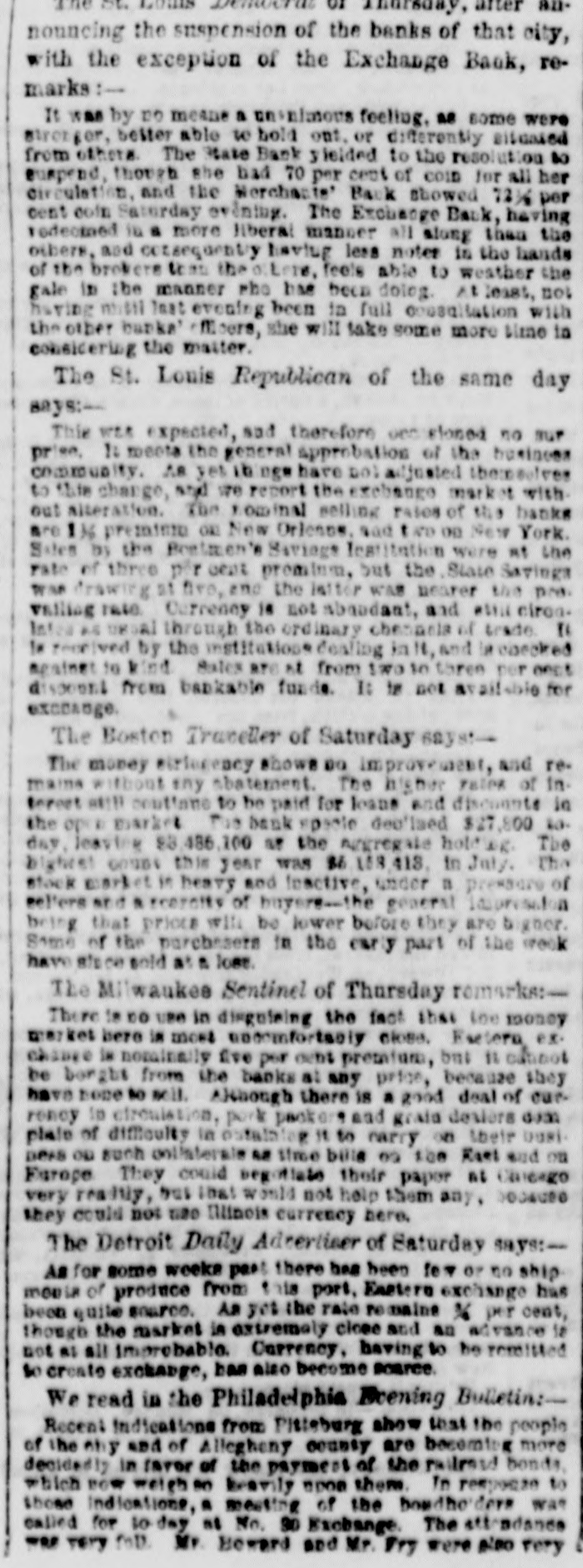
an'ARDSJOUT nouncing the suspension of the banks of that city, ith the exception of the Exchange Bank, remarks:It was by no meane a uninimous feeling, as some were stronger, better able to hold out, or differently situated from others. The State Back yielded to the resolution to suspend, though she had 70 per cent of COID for all her circulation, and the Werchants' Back showed 72% per cent coin Saturday ovening. The Exchange Back, having redected is a more liberal manner all along than the others, and consequently having less notes in the hands of the brokers team the Rters, feels able to weather the gale in the manner who has been dolog. At least, not having missi last evening been in full consultation with the other banks' fffloors, she will take some more time in considering the matter. The St. Louis Republican of the same day says:-This was expected, sad therefore oen stoned no sur prise, 1: meets the general approbation of the business community. As yet 1b nge have not adjusted themselves to this change, and we report the exchange market with. out alteration. The nominal selling rates of the banks are 116 premium ORL New Orlenne, sad two on New York. Sales by the Bostmen's Savings Institution were at the rate of three pรซr dent premium, but the State Savinga was drawing st Gro, are the latter WAS nearer the peo. valling rate Currency 18 not abandant, and with cireaInter as usual through the ordinary chemacia of trade. " 1a received by the institutions dealing in 18, and mgainst to kind Sales are nt from two to three per onct discount from bankable funds. I: to not available for exchange. The Boston Traceller of Saturday says:The money stringency shows DO improvement, and remains without any abatement. The higher FRIOR of In. tereet HIP continue to be paid for loans and discounts in the open market Tue bank specie declared $27,800 soday, leaving $3,486,100 M the Aggregate holding. The bighret GOUBS this year was $6 168,418, in July. the Stock market in heavy and inactive, under a pressure of eel'ers and . sceraity of buyers-the general inspression being that priors with be lower before they are bigner. Same of the purchasers in the early part of the week have since sold at a loss. The Milwaukee Sentinel of Thursday remarks:-There 18 no use in disguising the fact that the money market bero in most close. Esstern exchange is nominally five per ount premium, but " cannot be borght from the banks at any price, because they have hone to scil. Although there is a good deal of ourrenoy to circulation, pork packers and grain desiers duan plate of difficulty in ostableg it to narry on their Dusi. Deas ou such onlisterale M time bills 63 100 Rast and on Europe They could begitiate their paper at Chicago very realtly, trus that world not help them any, 0004000 they could not use Illinois currency here. The Detroit Daily Adcertiser of Saturday says:-As for some weeks past there bas been few or no ship modia of produce from this port, Eastero exchange has been quite source. As yet the rate regmine % per cent, though the market in extremely close and an advance 18 not at all improbable. Currency, having to be remitted so create exchange, has also become scarce. We read in the Philadelphia Doening Bulletin:Recent indications from Pittsburg show that the people of the ony and of Alleghony county are becoming more decidedly in (nvor of the payment of the reilrous bonds, which now weigh an leavily SPOR them. In response to those indications, a meating of the bondholders was called for to-day at No. 90 Exchange. The attradance was very foll. Mr. Howard and Mr. Fry were also very
Article from Chicago Daily Tribune, October 14, 1861

Click image to open full size in new tab

Article Text

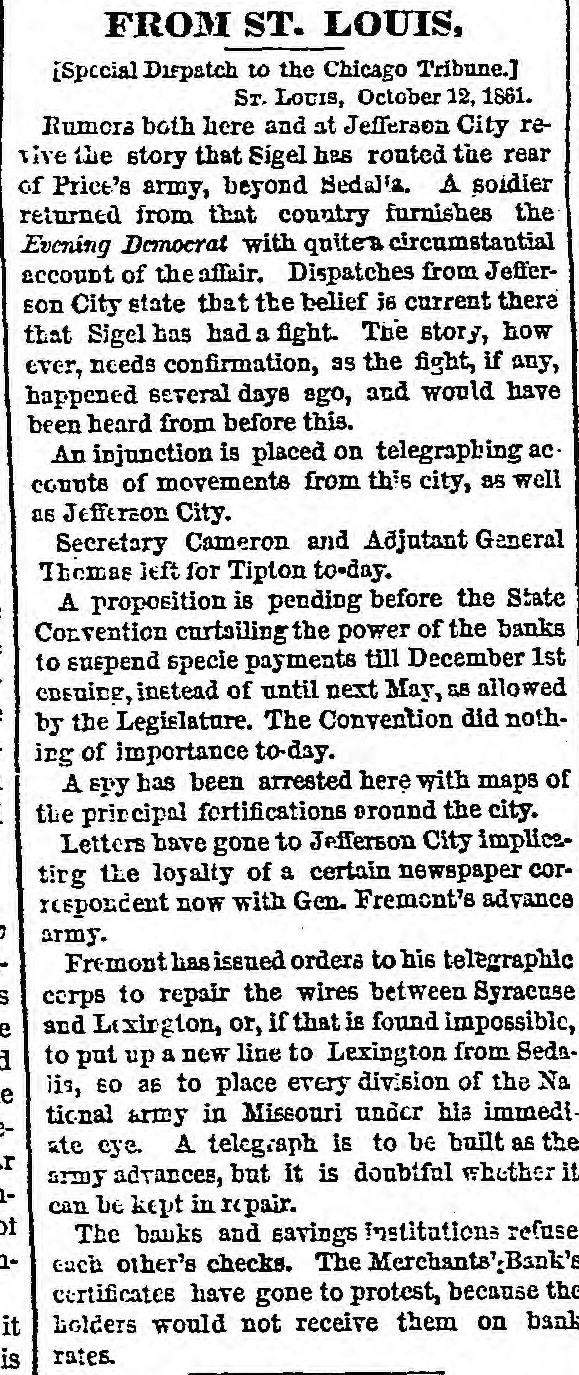
FROM ST. LOUIS, [Special Dispatch to the Chicago Tribune.] Sr. Louis, October 12, 1861. Rumera both here and at Jefferson City revive the story that Sigel has routed the rear of Price's army, beyond Sedal'2. A soidier returned from that country furnishes the Evening Democrat with quite's circumstantial account of the affair. Dispatches from Jefferson City state that the belief j6 current there that Sigel has had a fight. The story, how ever, needs confirmation, as the fight, if any, happened several days ago, and would have been heard from before this. An injunction is placed on telegraphing ac. counts of movements from this city, as well as Jefferson City. Secretary Cameron and Adjutant General Themas left for Tipton to-day. A proposition is pending before the State Convention curtailing the power of the banks to suspend specie payments till December 1st crsuing, instead of until next May, as allowed by the Legislature. The Convention did nothing of importance to-day. A spy has been arrested here with maps of the principal fertifications around the city. Letters have gone to Jefferson City implicetirg the loyalty of a certain newspaper correspondent now with Gen. Frement's advance army. Fremont has issued orders to his telegraphic corps to repair the wires between Syracuse and Lexington, or, if that is found impossible, to put up a new line to Lexington from Sedaiis, EO as to place every division of the Na e tional army in Missouri under his immedi ate eye. A telegraph is to be built as the r army advances, but it is doubtful whether it can be kept in repair. of The banks and savings Institutions refuse each other's checks. The Merchants' Bank's certificates have gone to protest, because the holders would not receive them on bank it rates. is


Article from New-York Daily Tribune, October 24, 1861

Click image to open full size in new tab

Article Text

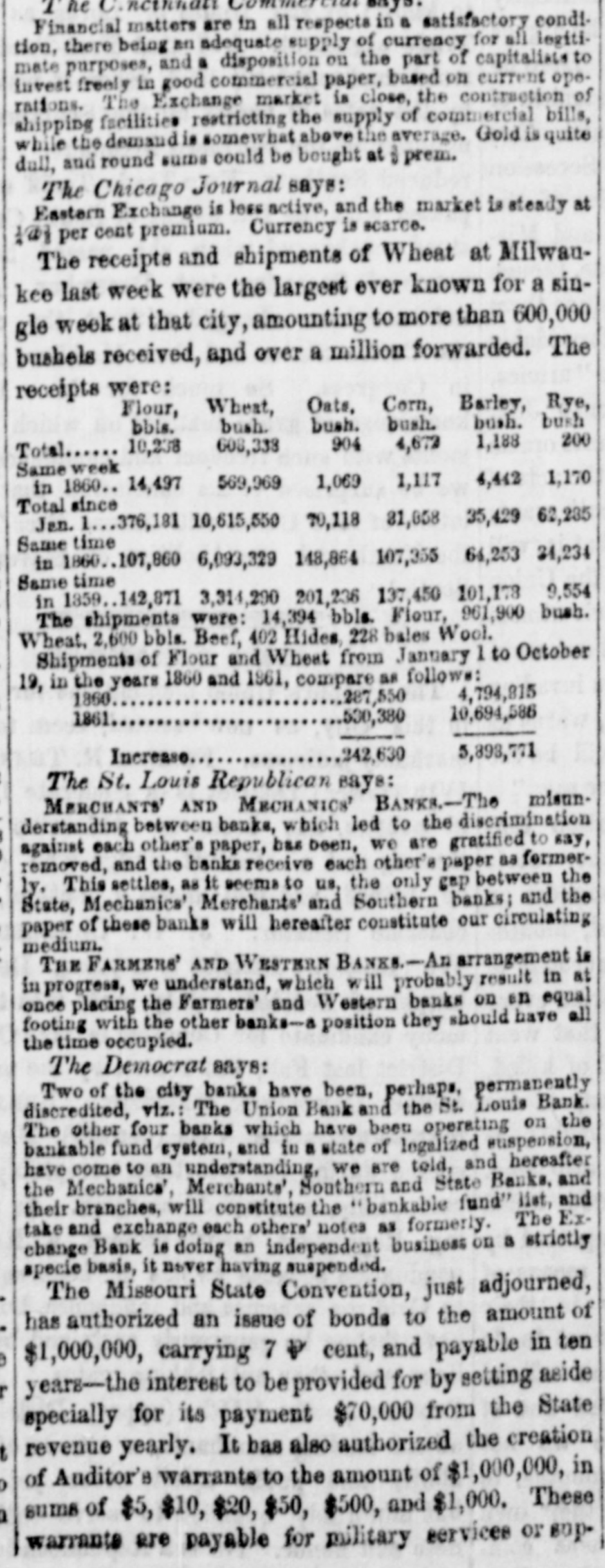
Bays Financial matters are in all respects in a satisfactory condition, there being an adequate supply of currency for all legitimate purposes, and a disposition ou the part of capitaliate to invest freely in good commercial paper, based on current ope. rations. The Exchange market is close, the contraction of shipping facilities restricting the supply of commercial bills, while the demand is somewhat above the average. Gold is quite dull, and round sums could be bought at s prem. The Chicago Journal says: Eastern Exchange is less active, and the market is steady at @ per cent premium. Currency is scarce. The receipts and shipments of Wheat at Milwaukee last week were the largest ever known for a single week at that city, amounting to more than 600,000 bushels received, and over a million forwarded. The receipts were: Barley, Rye, Corn, Oats, Wheat, Flour, bush bush. bush. bush. bush. bbis. 200 1,188 904 4,672 608,338 10,238 Total Same week 1,170 4,442 1,117 1,069 569,969 14,497 in 1860 Total since Jan. 1 376,181 10,615,550 70,118 81,858 35,429 62,235 Same time in 1860..107,860 6,093,329 148,864 107,355 64,253 24,234 Same time in 1359 1.142,871 3,314,290 201,236 137,450 101,178 9,554 The shipments were: 14,394 bbls. Flour, 961,900 bush. Wheat, 2,600 bbls. Beef, 402 Hides, 228 bales Wool. Shipments of Flour and Wheat from January 1 to October 19, in the years 1860 and 1861, compare as follows: 4,794,815 287,550 1860 10,694,586 530,380 1861 5,893,771 242,630 Increase The St. Louis Republican says: MERCHANTS' AND MECHANICS' BANKS.-The misunderstanding between banks, which led to the discrimination against each other's paper, has been, we are gratified to say, removed, and the banks receive each other's paper as formerly, This settles, as it seems to us, the only gap between the State, Mechanics', Merchants' and Southern banks; and the paper of these banks will hereafter constitute our circulating medium. THE FARMERS' AND WESTERN BANKS-Ar arrangement is in progress, we understand, which will probably result in at once placing the Farmers' and Western banks on on equal footing with the other banks- position they should have all the time occupied. The Democrat says: Two of the city banks have been, perhaps, permanently discredited, viz.: The Union Bank and the St. Louis Bank. The other four banks which have been operating on the bankable fund system, and in a state of legalized suspension, have come to an understanding, we are teld, and hereafter the Mechanica', Merchants', Southern and State Banks, and their branches, will constitute the "bankable fund" list, and take and exchange each others' notes as formerly. The Exchange Bank is doing an independent business on a strictly specie basis, it never having suspended. The Missouri State Convention, just adjourned, has authorized an issue of bonds to the amount of $1,000,000, carrying 7 cent, and payable in ten years-the interest to be provided for by setting aside specially for its payment $70,000 from the State revenue yearly. It bas also authorized the creation of Auditor's warrants to the amount of $1,000,000, in sums of $5, $10, $20, $50, $500, and $1,000. These warrants are payable for military services or sup-


Article from The New York Herald, October 24, 1861

Click image to open full size in new tab

Article Text

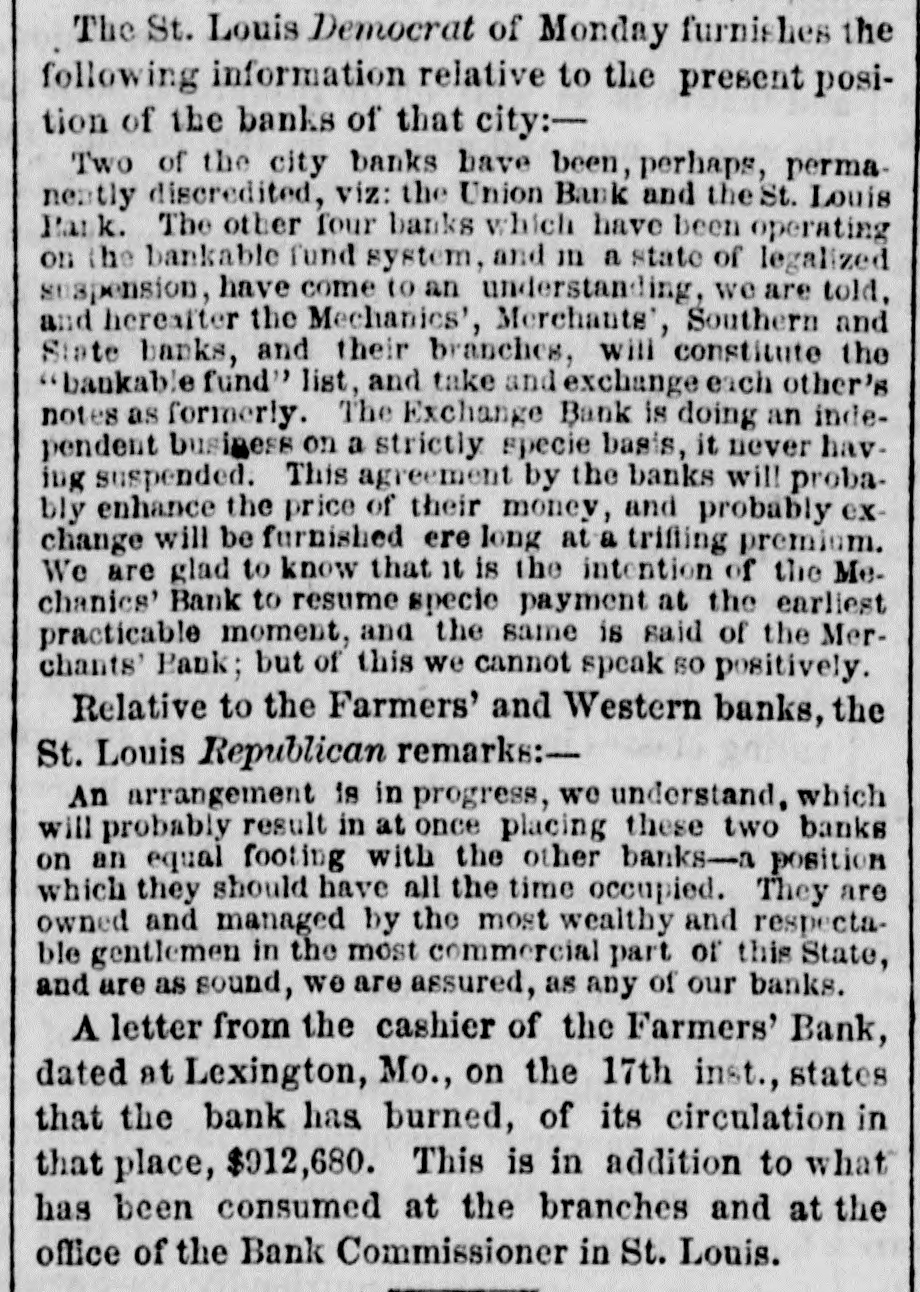
The St. Louis Democrat of Monday furnishes the following information relative to the present position of the banks of that city:Two of the city banks have been, perhaps, permanextly discredited, viz: the Union Bank and the St. Louis Bank. The other four banks which have been operating on the bankable fund system, and in a state of legalized suspension, have come to an understanding, we are told, and hereafter the Mechanics', Merchants', Southern and State banks, and their branches, will constitute the "bankable fund" list, and take and exchange each other's notes as formerly. The Exchange Bank is doing an independent business on a strictly specie basis, it never having suspended. This agreement by the banks will probably enhance the price of their money, and probably exchange will be furnished ere long at a trifting premium. We are glad to know that it is the intention of the Me. chanics' Bank to resume specie payment at the earliest practicable moment, and the same is said of the Merchants' Pank; but of this we cannot speak so positively. Relative to the Farmers' and Western banks, the St. Louis Republican remarks:An arrangement is in progress, we understand, which will probably result in at once placing these two banks on an equal footing with the other banks-- position which they should have all the time occupied. They are owned and managed by the most wealthy and respectable gentlemen in the most commercial part of this State, and are as sound, we are assured, as any of our banks. A letter from the cashier of the Farmers' Bank, dated at Lexington, Mo., on the 17th inst., states that the bank has burned, of its circulation in that place, $912,680. This is in addition to what has been consumed at the branches and at the office of the Bank Commissioner in St. Louis.


Article Text

FINANCIAL CRISIS OF 1860 on Shadows of civil war cast gloom financial conditions of over souri and the United States in the fall of 1860. reaching an abrupt eliSt. max in this state on November 28, when all St. Louis banks but one suspended specie payment. Paradoxically, the financial erisis had come at time when business conditions seemed favorable. But of after the presidential election of early November, fears of the com. of ing war drove the country into financial crisis. by St. Louis November At on officials of all banks met to consider suspension of specie payments, The decision was against suspension, but two days later at another conference, the first action was reversed. The Bank of the State of Missouri, the official state bank, together with the Merchants Bank, had opposed suspension, but finally they consent. insistence of the other ed to the The exchange bank having very small circulation outstanding, the conference, and fused to attend bank in the state which was the only continued specie payment after November 28, Branch banks throughout the state followed the action of the main banks in St Louis, United States had The whole perienced crisis in 1857. but covery comparatively rapid, that was called From the darkest business history had evolved that the country into omparative prosperity. ies of good and had traffic. transportation ly completed a restoration ity The spectre of civil war, the face of good even conditions, so frightened capital that by 1860 another crisis inpended in Missouri of money decreased 000 from alone Even July 1859 to August of the the bank great bank of the State of Missouri always redeem its could lation Financial conditions changing financial condition better than her neighbors, but this unstable condition Missouri's difficulwhere added to banks 1860. ties. Arkansas had no thirteen There and Iowa had but were seventy two in Illinios, but the of that state was currency In Missouri there than chartered banks were forty-three in and thirty two private bank houses, seventeen of which were in St. Louis, specie payments Suspension the busi seemed to approved by editors of the and ness It was generally conceded that the suspension was wise, and would pre vent unnecessary depletion of specie, The Columbia Missouri Statesman said the general opinion was that the financial crisis was caused by political factors, and not by nancial errors or excesses." made on the Demands were soon relieve the banks and legislature to March 18, 1861, semi-suspension law went into effect. removing for and the penalties suspension of the providing for the payment state The July interest on the banks April, 1861, Louis in one anothers agreed to support but the whole war period was notes, periods of susmarked by varying The Expensions and Bank continued its policy change payment. feature Louis One financial in the was the issuing of war Although forbidden tional of St. Louis, in law, the Bank 1861, issued small notes August banks As small and other was scarce, the currency change passed banks, as MisThough Missouri divided by the souri people, were war. they were able to render considerable war service despite their weakness. The close division of shown in report issued timent 1861, showing the sympathies Three were Un the St. Louis Southern, but the ion and four were of the three Union banks ierculation was several dollars han that of the Southern banks. THIEF GETS SURPRISE GAS thief pursuing his gasoline at the Phil Hackarisky business home at 4:30 m. Monday, mack from the tank of drained the gas sedan and them Mr. the back seat of the reached into tool he car to get for further looting of the needed car. his hand came in contact Instead, of Dale Baskett who with the person work by Mr is empolyed in farm Hackamack and was spending part the nights napping of in the car. It's hard to say which suffered Dale was unable the greater lift his voice in protest or to the thief departed in such er, while left behind him the haste he had taken from the of gasoline he car The can, Mr. Hackamack discovwhich had disappearered, was one ed from his place in LaGrange Indicator.


Article Text

THIS WEEK IN MISSOURI HISTORY (Compiled by The State Historical Societies of Missouri, Columbia Floyd C. Shoemaker, Sec.) Financial Crisis of 1860. Shadows of civil war cast a gloom over financial conditions of Missouri and the United States in the fall of 1860, reaching an abrupt climax in this State on November 28. when all St. Louis banks but one suspended specie payment. Paradoxically, the financial crisis had come at a time when business seemed favorable. But the presidential election of November. fears of the coming war drove the country At St. Louis on November of all banks met to consider suspension of specie payments. The was against but two days later at the first action The Bank of the State State Bank the Merchant's Bank but finally had suspension, they consented to the insistence The Bank, having fused attend the onference, bank in the continued spe payment November 28. Branch banks throughout the State followed banks The United ex a in From condition that = darkest in business history that time the country had prosperity A of river and had transportation completed a restoration of The spectre of civil war, pended by 1860, Circulation in the face of good business conditions, so frightened capital that another im Missouri alone had in $4,000,000 from July 1859 August 1860 Even the bank of the West. the Bank of the State of Missouri, not always redeem its circulation Financial conditions changing rapidly Missouri's financial condition than her neighbors' but this unstable added to Missouri's Arkansas had no banks and had but There in of that In the the to law went bank 1861 to support one The Ex Bank continued its Louis of the War fractional currency Although forbidden by law. the Bank of St Louis, in August of 1861 issued small notes and other banks ed. As small change was scaree. the currency passed freely Though Missouri banks, as Missouri people, were divided by the War, they were able to render