First State & Savings Bank (Klamath Falls, OR)

Episode Information

Episode UID
96006671453
Episode Type
Run โ†’ Suspension โ†’ Closure
Bank Type
state
Bank ID
9600667 routing
Routing Number
96-0066
Start Date
January 12, 1921
Location
Klamath Falls, Oregon (42.225, -121.782)

Metadata

Model
gpt-5-mini (chosen from majority vote of a three-model LLM ensemble)
Short Digest
29a7bf31b360f9d8

Response Measures

None

Description

Bank suffered a run and was closed Jan 12, 1921, reopened by March 1921, then closed again Jan 28, 1922 with a receiver and liquidation planned.

Events (4)

1. January 12, 1921 Run
Cause
Rumor Or Misinformation
Cause Details
Shaken confidence and rumors precipitated a run that depleted reserves to a danger point.
Measures
Closed doors on orders of state superintendent to protect depositors; examination ordered.
Newspaper Excerpt
closing of the First State & Savings bank yesterday on orders of the state superintendent of banking...it is an extraordinary thing to close the doors of a solvent bank to protect its loyal depositors from the result of a shaken confidence on the part of the timid minority who participated in the run that lowered the reserves to the danger point.
Source
newspapers
2. March 19, 1921 Reopening
Newspaper Excerpt
The First State and Savings Bank of Klamath Falls, Ore., is doing business as usual again, after having closed its doors on Jan. 12. The reopening...was preceded by a civic celebration...
Source
newspapers
3. January 28, 1922 Suspension
Cause
Macro News
Cause Details
General economic conditions, depletion of reserves and recent steady withdrawals led to inability to continue and appointment of a receiver.
Newspaper Excerpt
at 10:20 this morning the sign, This bank is in the hands of the State Superintendent of Banks, was posted on the door...S. E. Walles, of the state banking department, has been appointed receiver.
Source
newspapers
4. February 1, 1922 Other
Newspaper Excerpt
Aid reaches bank five minutes too late...One hundred and forty thousand dollars had been promised from Portland...S. E. Walles...appointed receiver...He said no effort would be made to reopen the institution.
Source
newspapers

Newspaper Articles (9)

Article from The Evening Herald, January 13, 1921

Click image to open full size in new tab

Article Text

CONFIDENCE IN SIEMENS UNIQUE No new developments were reported today in connection with the closing of the First State & Savings bank yesterday on orders of the state superintendent of banking, Marshall Hooper, assistant state superintendent, said that an examination of the bank's records is under way, but the investigation may take several weeks to complete. In the meantime there is no information other than already given in the notice posted on the bank doorsThere is every indication that this bank is solvent." Rumors are rife on every hand, as usual in such situations, but they add nothing to the story. Levelheaded business men, depositors of the institution. are apparently not worrying. There is general confidence that the bank will reorganize and reopen. Capt. J. W. Siemens, president of the bank is expected to return tonight from Portland. The situation contains many unique features. Primarily, it is an extraordinary thing to close the doors of a solvent bank to protect its loyal depositors from the result of a shaken confidence on the part of the timid minority who participated in the run that lowered the reserves to the danger point. But more unique than that is the attitude of the community toward


Article from The Evening Herald, January 14, 1921

Click image to open full size in new tab

Article Text

No Panic Among Depositors of the Malin State Bank (Special to The Herald) MALIN, Jan. 14. -News of the run on the First State and Savings bank was received here calmly. Stockmen and other residents of this valley have not become panic stricken over the financial situation and there has been no run on the Malin State bank, according to Louis Boldischar, cashier. The tendency rather has been to denounce those panicky depositors whose lack of confidence was responsible for the closing of the Klamath Falls bank. No run on the local bank is anticipated by Mr. Boldischar but he nas gathered in as much cash as possible and called in loans in preparation for any emergency. He believes the depositors in this section are sane enough not to lose confidence in their bank and thereby cripple it in a critical period. Reports from Merrill indicate a small run on the bank there, but it checked, itself before it became serious.


Article from The Colorado Statesman, March 19, 1921

Click image to open full size in new tab

Article Text

CAUGHT FROM THE NETWORK OF WIRES ROUND ABOUT THE WORLD. DURING THE PAST WEEK RECORD OF IMPORTANT EVENTS CONDENSED FOR BUSY PEOPLE. (Western Newspaper Union News Service.) WESTERN Because the verses of George Redman of San Francisco aroused naught but laughter and ridicule, he drank poison and leaped into the Pacific ocean, the San Francisco police declared. The body of Woo Gow, Chinese, bearing nine bullet wounds and numerous knife cuts, was found beside a road three miles east of Guadalupe, according to advices received at the sheriff's office in Santa Barbara, Calif. Woo was believed by officers to have been a tong war victim, The Nevada State Assembly at Carson City adopted a concurrent resolution providing for the removal of District Judge Frank P. Langan for alleged failure to render decisions within the legally specified time and to demand periodical returns in a banking receivership case. Approximately 6,000 Mexicans will be returned home from Texas, according to the estimate of Immigration Inspector O. H. Smith at Fort Worth, Texas. He said he had received orders from Washington directing that all Mexicans in the United States under special permit, such as agricultural or industrial, return home. George S. Ackerman, a traveling salesman, died at a hospital in Twin Falls, Idaho, as a result of a knife wound inflicted on him by Francisco Sanchez, a Mexican. The Mexican, who is thought t have been crazy, walked up to Ackerman on the street and plunged his knife into Ackerman's left eye. The First State and Savings Bank of Klamath Falls, Ore., is doing business as usual again, after having closed its doors on Jan. 12. The reopening, which was declared to have saved over half the sheepmen and cattlemen of Klamath county from ruin, was preceded by a civic celebration, second only to that of Armistice day. Indications are that all but two of the commercial coal mines of Washington would be closed when a wage reduction, approximating 20 per cent will be put into effect by operators. About 2,500 miners will leave their jobs, according to the present outlook. About 2,000 will stay in the mines that are scheduled to remain open at the old scale.


Article from The Saratoga Sun, March 24, 1921

Click image to open full size in new tab

Article Text

# THE WORLD IN PARAGRAPHS A BRIEF RECORD OF PASSING EVENTS IN THIS AND FOR- EIGN COUNTRIES # IN LATE DISPATCHES DOINGS AND HAPPENINGS THAT MARK THE PROGRESS OF THE AGE. (Western Newspaper Union News Service.) WESTERN Four indictments charging misappro- priation of a total of $255,000 have been served on persons figuring in the collapse of the bond house of Morris Brothers, Incorporated, of Portland, Ore. The body of Woo Gow, Chinese, bearing nine bullet wounds and numer- ous knife cuts, was found beside a road three miles east of Guadalupe, according to advices received at the sheriff's office in Santa Barbara, Calif. Woo was believed by officers to have been a tong war victim. Governor Boyle has announced it was his intention to sign the bill pro- viding that all persons condemned to death in Nevada should be executed with lethal gas. He said he would not sign immediately in order to al- low any persons who might object to present their reasons. George S. Ackerman, a traveling salesman, died at a hospital in Twin Falls, Idaho, as a result of a knife wound inflicted on him by Francisco Sanchez, a Mexican. The Mexican, who is thought to have been crazy, walked up to Ackerman on the street and plunged his knife into Ackerman's left eye. The First State and Savings Bank of Klamath Falls, Ore., is doing busi- ness as usual again, after having closed its doors on Jan. 12. The re- opening, which was declared to have saved over half the sheepmen and cat- tlemen of Klamath county from ruin, was preceded by a civic celebration, second only to that of Armistice day. Richard Dunkle held three aces in a poker game and thought that was enough to win the pot. Ross Wicker- sham, however, laid down a pat flush and raked in the winnings. Dunkle was so enraged, a witness at Fremont, Neb., testified at the trial of Dunkle for the slaying of Wickersham, that he started an argument which resulted in the fatal shooting of the winner. The Utah Association of Life Under- writers has filed a protest with the State Insurance Commission at Salt Lake against the relicensing of the Mountain States Life Insurance Com- pany of Denver. The association al- leges that the company is doing busi- ness in violation of the statutes of Utah, which prohibit discriminations, rebates and stock schemes. WASHINGTON The Interstate Commerce Commis- sion has suspended until July 14 pro- posed cancellation of rates on grain and grain products from shipping points in Colorado, Idaho, New Mexico, Utah and Wyoming to Texas and Louisiana gulf ports when routed by way of Denver. April 11 was selected for the special session of the Sixty-seventh Congress, the first under President Harding's administration. The announcement was received with general satisfaction by Senate leaders. Senator Lodge of Massachusetts, Republican leader, no- tifled the Senate of the President's de- cision. The ban prohibiting withdrawals of whisky from bonded warehouses, in so far as it effects retail druggists, will be lifted April 1, under an order is- sued by Prohibition Commissioner Kramer. Modification of the order stopping withdrawals was not ex- tended to wholesale liquor dealers. An urgent demand that the govern- ment of Panama immediately settle its boundary dispute with Costa Rica is made by the United States in a note dispatched to Panama and made pub- lic by the State Department. The note insists that Panama abide by the boundary decision of Chief Justice White. The special session of the Senate, which convened March 4 to confirm important appointments, adjourned sine die without receiving nominations for diplomatic posts or for member- ship on the shipping board. The delay in shipping board selections was at- tributed to a technicality of the mer- chant marine act, requiring all seven members of the new board must be named before any could assume his du- ties. President Harding is understood to have been prepared to nominate two or three, but was not ready for all. A recess appointment as commis- sioner of the general land office has been given by President Harding to William S. Spry, former governor of Utah. Edward C. Finney of Kansas was given a recess appointment by President Harding as first assistant secretary of the Interior. In the first open airplane design competition to be conducted by the Navy Department five designs for a new type of naval plane have been ac- cepted on preliminary examination out of forty designs submitted by thirty corporations and individuals.


Article from The Ordway New Era, March 25, 1921

Click image to open full size in new tab

Article Text

the premium served on persons figuring of Morris in been of the bond house Portland, Brothers, collapse Incorporated, of Ore. The body of Woo Gow, Chinese, numernine bullet wounds and beside a bearing knife cuts, was found ous three miles east of Guadalupe, the road to advices received at Calif. sheriff's according office in Santa Barbara, have Woo was believed by officers to been a tong war victim. Governor Boyle has announced pro- it his intention to sign the bill to viding was that all persons condemned executed death in Nevada should be would with lethal gas. He said he alsign immediately in order to to low not any persons who might object present their reasons. George S. Ackerman, a traveling Twin satesman, died at a hospital in knife Falls, Idaho, as a result of a wound inflicted on him by Francisco Mexican. Sanchez, a Mexican. The who is thought t have been crazy, walked up to Ackerman on the street and plunged his knife into Ackerman's left eye. The First State and Savings Bank busiKlamath Falls, Ore., is doing having of as usual again, after reclosed ness its doors on Jan. 12. The have opening, which was declared to catsaved over half the sheepmen and ruin, tlemen of Klamath county from preceded by a civic celebration, day second was only to that of Armistice Richard Dunkle held three aces in poker game and thought that Wicker- was enough a to win the pot. Ross flush sham, however, Jaid down a pat Dunkle and raked in the winnings. so enraged, a witness at Fremont, Dunkle was Neb., testified at the trial of that for the slaying of Wickersham, he started an argument which resulted in the fatal shooting of the winner. The Utah Association of Life Under- the writers has filed a protest with Salt State Insurance Commission at the Lake against the relicensing of ComMountain States Life Insurance of Denver. The association busi- alpany leges that the company is doing of in violation of the statutes ness Utah, which prohibit discriminations, rebates and stock schemes. WASHINGTON The Interstate Commerce Commission has suspended until July 14 grain proposed cancellation of rates on and grain products from shipping points in Colorado, Idaho, New Mexico, and Utah and Wyoming to Texas by Louisiana gulf ports when routed way of Denver. April 11 was selected for the special session of the Sixty-seventh Congress, the first under President Harding's administration. The announcement was received with general satisfaction of by Senate leaders. Senator Lodge Massachusetts, Republican leader, no- detified the Senate of the President's cision. The ban prohibiting withdrawals of whisky from bonded warehouses, in will so far as it effects retail druggists, isbe lifted April 1, under an order sued by Prohibition Commissioner Modification of order withdrawals was stopping Kramer. dealers. the not extended to wholesale liquor An urgent demand that the government of Panama immediately settle its dispute with Costa Rica is the United States a made boundary by made in note pubdispatched to Panama and lic the State that Panama note by insists Department. abide by The the boundary decision of Chief Justice White. The special session of the Senate, which convened March 4 to confirm important appointments, adjourned without receiving nominations posts or sine for diplomatic die for The member- delay on the shipping board. in board was atship shipping selections the to a technicality of marine act, requiring of the new board must his before any could assume tributed enant members named all seven mer- du- be President Harding is been prepared to to ties. have nominate two but was not as 4 or recess three, appointment ready understood office commis- for has all. sioner of the general land been given by President Harding of to William S. Spry, former governor Utah. Edward C. Finney of Kansas was given a recess appointment by President Harding as first assistant secretary of the interior. In the first open airplane design competition to be conducted by the a five of naval plane sc Nevy new type Department designs have been for cepted on preliminary imination out of forty designs rubmitted by thirty corporations and individuals.


Article from The Evening Herald, January 28, 1922

Click image to open full size in new tab

Article Text

CREDITORS OF (Continued from Page 1) at 10:20 thi smorning the sign, "This bank in in the hands of the State Superintendent of Banks," was posted on the door, the curtains drawn and the doors locked. No Disturbance to Result That there will be no serious business disturbance in the community is certain. for the effects of the closing discounted for It been known that the had hng been sometime. bank was having a hard struggle and this brought about many readjustments 80 that aside from the inconvenience to those who had money on deposit, the closing will pass almost unnotic ed. The most reassuring thing about the closing is the appointment of C. E. Wailes as receiver. He was apthis morning by SuperintenBanks, Bramwell, dent pointed of when that he he announced to that official was unable to longer keep the institution open. Mr. Walles never gave up hope until closing time yesterday. When he opened the bank this mornwas with the expectation that assistance that aring financial it had been ranged for would come in time to keep things going. but he was disappointed. although shortly after the doorg were closed the anticipated help came. but too late to enable a resumption of business. That there will be no effort made to reopen the institution and that it will be liquidated was the statement Mr. Wailes his made by assurance morning. This carries with it the that the liquidation will be carried through in a manner that will not disturb business conditions, which in a literal sense means that he does not intend to force the collection of noteg to a point where it will distress the borrower. Yet, at the same time. sufficient expedition will be used to insure the payment to the depositors of their money within a reasonable time. Other Banks are Strong Another cheering feature of the atdifference city as compared fair now, is the existing with last in year. the Then the closing same as something of a surprise and the banks barely had time to prepare for it. Now they are ready with the largest reserves in their history. Both the First National American National are in to pay every and position the depositor stands on demand. since back of them the Federal Reserve, the strongest institution in the world. Aside from this they have cash on hand and in approved depositories three times larger than ever before However, there will be no occasion to call on it, for it is generally understood throughout the community that both banks are ready to meet any contingeney. . The same is true of the other banks in the county. The First National at Merrill, the Bank of Bonanza and the Malin State Bank to are anul- all in splendid condition. all due tra conservative poiley controlling their affairs during the past year. There is no connection between the Malin State bank and the First State and Savings bank, that bond having been severed when the bank closed the first time. Ag a whole the situation is far bet-


Article from Ashland Weekly Tidings, February 1, 1922

Click image to open full size in new tab

Article Text

AID REACHES BANK FIVE MINUTES TOO LATE TO DO GOOD KLAMATH FALLS, Jan. 28.Five minutes after the First State and Savings bank closed its doors here Saturday morning, assurance of financial assistance was received from Portland, which would have permitted the bank to stay open. This information was given out by bank officials. The bank opened at 10 and closed at 10:20 o'clock, when it seemed improbable that the awaited word would be forthcoming. One hundred and forty thousand dollars had been promised from Portland, $5000 from San Francisco, and $30,000 from other sources, it was said, bringing the total `up to $175,000. General economic conditions which prevented loans being called withour forcing business houses to the wall, depletion of reserves, together with recent steady withdrawals were the reasons given for the close. S. E. Walles, of the state banking department, has been appointed receiver. The closing was a crushing blow to officials of the bank, who believed the steps they had taken would prevent such action. The bank closed its doors January 12, 1912, but reopened at the end of 90 days, after the whole county had given evidence of its faith in Captain J. W. Siemens, the founder, by offering every dollar that could be raised. The reopening was marked by a demonstration said never to have equaled in the history of banking. "The affairs of the First State & Savings bank will be liquidated in a manner that will safeguard the in terests of the depositors and stockholders and without causing distress to those who owe the bank, or without disturbing the business of the community. This was the statement made by C. E. Wailes, receiver. He said no effort would be made to reopen the institution.


Article from The Evening Herald, February 7, 1922

Click image to open full size in new tab

Article Text

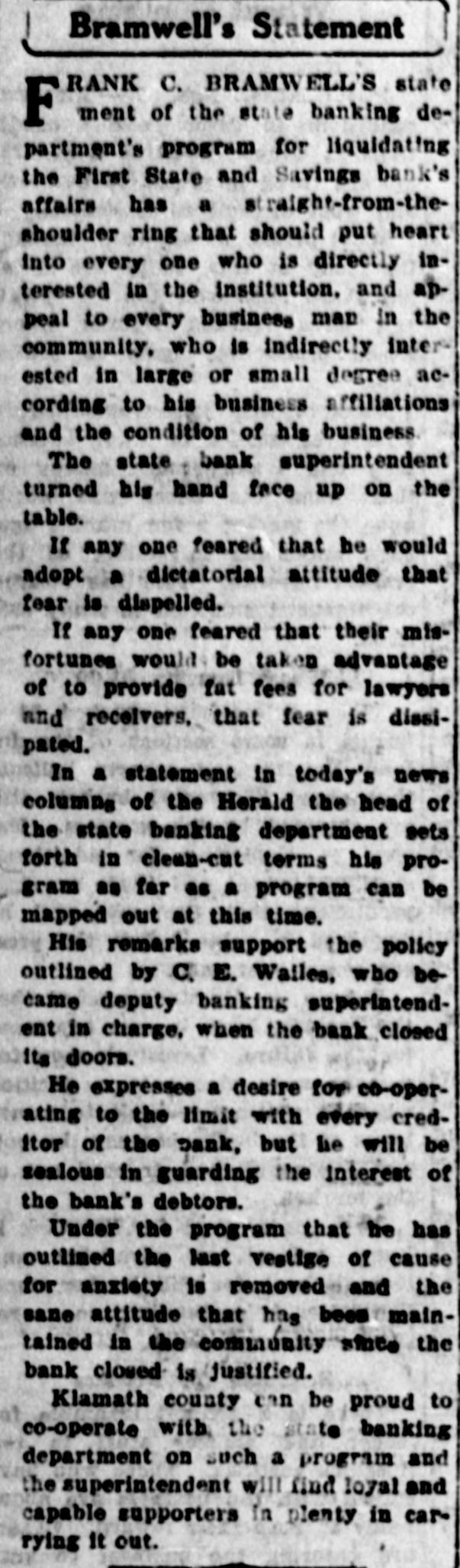
Bramwell's Statement RANK c. BRAMWELL'S state ment of the state banking deF partment's program for liquidating the First State and Savings bank's affairs has a straight-from-theshoulder ring that should put heart into every one who is directly interested in the Institution. and appeal to every business man in the community. who is indirectly inter ested in large or small degree according to his business affiliations and the condition of his business The state bank superintendent turned his hand face up on the table. If any one feared that he would adopt a dictatorial attitude that fear is dispelled. If any one feared that their misfortunes would be taken advantage of to provide fat fees for lawyers and receivers, that fear is dissipated. In a statement in today's news columns of the Herald the head of the state banking department sets forth in clean-cut terms his program as for as a program can be mapped out at this time. His remarks support the policy outlined by c. E. Walles. who became deputy banking superintendent in charge, when the bank closed its doors. He expresses a desire for co-operating to the limit with every credItor of the Dank, but he will be sealous in guarding the interest of the bank's debtors. Under the program that he has outlined the last vestige of cause for anxiety is removed and the sane attitude that has been maintained in the community state the bank closed is justified. Klamath county can be proud to co-operate with the state banking department on such a program and the superintendent will find loyal and capable supporters In plenty in carrying It out. P


Article from The Evening Herald, June 17, 1922

Click image to open full size in new tab

Article Text

An election will be held on the 19th inst. (next Monday), for the purpose of electing a county school board of five members to represent the school interests of all of Klamath county. This means a great deal to every taxpayer and men of families, and it behooves every voter of this class to go to their polling places and vote, and to pick the very best man for the place, one who will make a study of the school laws and what is required of him in this capacity. As a voter and tax payer of the section now known as School District No. 52. in which the town of Chiloquin is located, I wish to say that I am against the election of Chas. R. Bowman, who is a candidate as a director. My reasons for opposing this gentleman are not personal, but strictly upon the grounds that he is unfitted and not competent to fill the place. Mr. Rowman was a member of the school board up to the change made recently by the people, whereby the old method of school control was given to a board of five members, representative of the five districts. # TWO ARCHITECTS RETAINED While he served upon the old board in the Chiloquin district this is what occurred: First, from a bonded school fund of $35,000, which was voted more than two years ago to erect a school house at Chiloquin. The architect, G. R. Wright of Klamath Falls, who had a legal contract for drawing plans for the construction, was let out, or ignored, and another architect, a Mr. Coseboom, wag employed. Wright was to receive something like $1,600, so I am informed, for his services upon completion of said building, plans of which had been accepted. Wright has received $900 of his compensation, and in view of the fact of his asking full settlement as per contract, he has agreed to accept $225 more in settlement in full of his claim. I am informed that Coseboom has received $400 upon his contract as second architect, and will get a fee when the building is complete of about $1.200 or $1.500. Why was Wright fired? Why was the paid the money herein mentioned if he is incompetent? Why was Coseboom employed? Why are twice the architectural fees to be paid for this school plant that are necessary? Did Chas. R. Bowman do this? I am not saying, but he was one of the board, and the only one running for office of the old board. # $15,000 IN DEFUNCT BANK Second, of the school fund of $30,000 that was in two of the banks, the First National bank and the American National bank of Klamath Falls, $15,000 in each bank, the $16,000 that was in the First National bank was withdrawn and deposited in the First State and Savings bank just a short time before said bank went into insolvency. Why this move, and where does the school board see in the change a benefit; taking the people's money from a safe institution and putting it into one that was indeed not safe in the eyes of most business people who were on the cutside, looking in? Third, why was this money deposited in the banks to the credit of the school board and school clerk and withdrawn by a joint check? I am informed the county treasurer is the legal care-taker of school funds, and it should have been in his care and be responsible under his bond. But he, the treasurer, states that he at no time ever had this money in his possession, nor was it ever tendered him by the school board, therefore disclaims any legat or other responsibility. # ONLY PART OF FUND AVAILABLE Was the money expended and otherwise disposed of in a legal manner, and by the properly authorized persons? Out of this bonded fund, I think I can safely say not to exceed $11,500, or less, 18 now available. For the $23,500 we have the following to show: