Union Banking Company (Philadelphia, PA)

Episode Information

Episode Type
Run → Suspension → Reopening
Start Date
September 19, 1873
Location
Philadelphia, Pennsylvania (39.952, -75.164)
Bank Type
private

Metadata

Notes

Contemporaneous reports identify it as a state-chartered institution; later resumption reported with increased capital.

Events (3)

1. September 19, 1873 Run
Cause
Macro News
Cause Details
Panic following Jay Cooke & Co. suspension and wider Wall Street crisis produced heavy withdrawals.
Measures
Paid out large sums to depositors to meet demands; public statements of soundness by other banks referenced.
Newspaper Excerpt
The Union Banking Company was run upon up to the hour of closing ... about $500,000 had been paid out.
Source
newspapers
2. September 20, 1873 Suspension
Cause
Macro News
Cause Details
Heavy withdrawals during the financial panic (Jay Cooke collapse) forced the bank to suspend payment to depositors.
Newspaper Excerpt
A placard on the door states that owing to the heavy demand a suspension of a few days had been resolved upon.
Source
newspapers
3. November 28, 1873 Reopening
Newspaper Excerpt
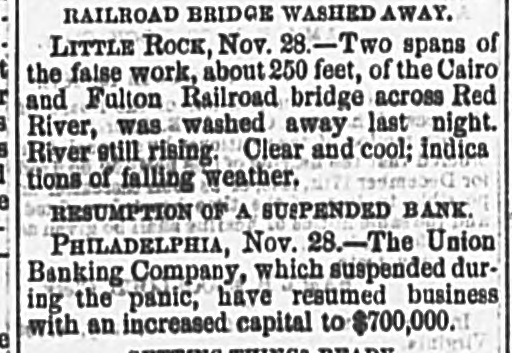
The Union Banking Company, which suspended during the panic, have resumed business with an increased capital to $700,000.
Source
newspapers

Newspaper Articles (24)

Article from The New York Herald, September 20, 1873

Click image to open full size in new tab

Article Text

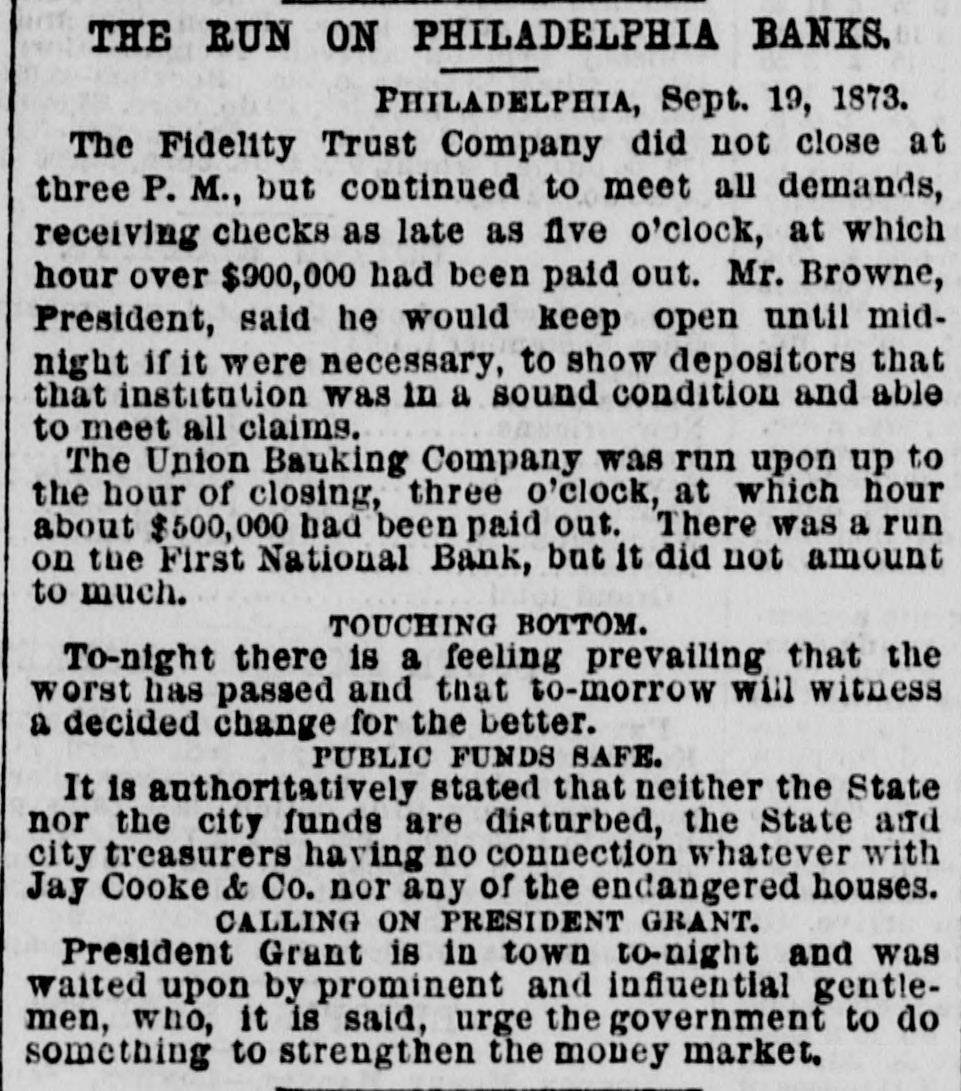
THE RUN ON PHILADELPHIA BANKS. PHILADELPHIA, Sept. 19, 1873. The Fidelity Trust Company did not close at three P. M., but continued to meet all demands, receiving checks as late as five o'clock, at which hour over $900,000 had been paid out. Mr. Browne, President, said he would keep open until midnight if it were necessary, to show depositors that that institution was in a sound condition and able to meet all claims. The Union Bauking Company was run upon up to the hour of closing, three o'clock, at which hour about $500,000 had been paid out. There was a run on the First National Bank, but it did not amount to much. TOUCHING BOTTOM. To-night there is a feeling prevailing that the worst has passed and that to-morrow will witness a decided change for the better. PUBLIC FUNDS SAFE. It is authoritatively stated that neither the State nor the city funds are disturbed, the State and city treasurers having no connection whatever with Jay Cooke & Co. nor any of the endangered houses. CALLING ON PRESIDENT GRANT. President Grant is in town to-night and was waited upon by prominent and influential gentlemen, who, it is said, urge the government to do something to strengthen the money market.


Article from The Daily State Journal, September 20, 1873

Click image to open full size in new tab

Article Text

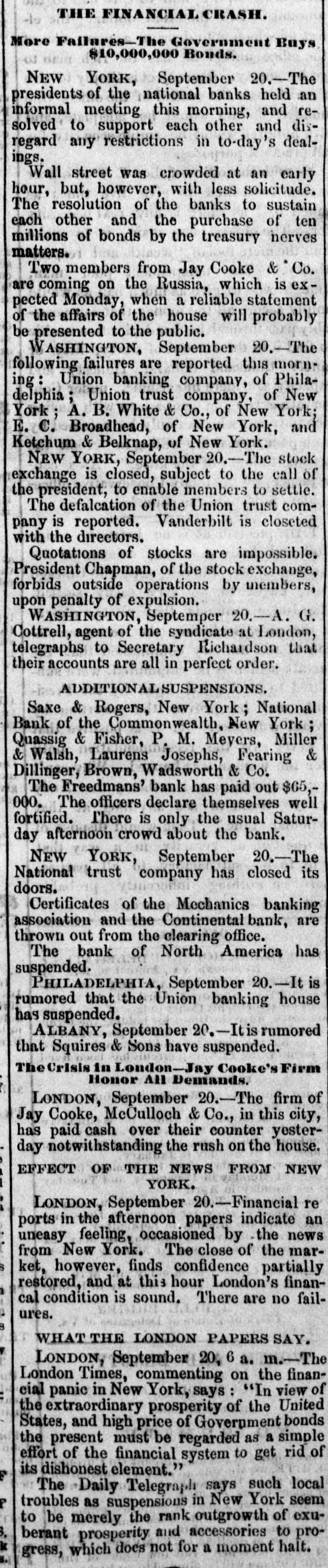
THE FINANCIAL CRASH. More Failares-The Government Buys $10,000,000 Bonds. NEW YORK, September 20.-The presidents of the national banks held an informal meeting this morning, and resolved to support each other and disregard any restrictions in to-day's dealings. Wall street was crowded at an early hour, but, however, with less solicitude. The resolution of the banks to sustain each other and the purchase of ten millions of bonds by the treasury nerves matters. Two members from Jay Cooke & Co. are coming on the Russia, which is expected Monday, when a reliable statement of the affairs of the house will probably be presented to the public. WASHINGTON, September 20.-The following failures are reported this morning: Union banking company, of Philadelphia ; Union trust company, of New York ; A. B. White & Co., of New York; E. C. Broadhead, of New York, and Ketchum & Belknap, of New York. NEW YORK, September 20.-The stock exchange is closed, subject to the call of the president, to enable members to settle. The defalcation of the Union trust company is reported. Vanderbilt is closeted with the directors. Quotations of stocks are impossible. President Chapman, of the stock exchange, forbids outside operations by members, upon penalty of expulsion. WASHINGTON, Septemper 20.-A. G. Cottrell, agent of the syndicate at London, telegraphs to Secretary Richardson that their accounts are all in perfect order. ADDITIONALSUSPENSIONS. Saxe & Rogers, New York; National Bank of the Commonwealth, New York Quassig & Fisher, P. M. Meyers, Miller & Walsh, Laurens Josephs, Fearing & Dillinger, Brown, Wadsworth & Co. The Freedmans' bank has paid out $65,000. The officers declare themselves well fortified. There is only the usual Saturday afternoon crowd about the bank. NEW YORK, September 20.-The National trust company has closed its doors. Certificates of the Mechanics banking association and the Continental bank, are thrown out from the clearing office. The bank of North America has suspended. PHILADELPHIA, September 20.-It rumored that the Union banking house has suspended. ALBANY, September 20.-Itis rumored that Squires & Sons have suspended. The Crisis in London-Jay Cooke's Firm Honor All Demands. LONDON, September 20.-The firm of Jay Cooke, McCulloch & Co., in this city, has paid cash over their counter yesterday notwithstanding the rush on the house. EFFECT OF THE NEWS FROM NEW YORK. LONDON, September 20.-Financial re ports in the afternoon papers indicate an uneasy feeling, occasioned by the news from New York. The close of the marS ket, however, finds confidence partially restored, and at this hour London's financal condition is sound. There are no failures. WHAT THE LONDON PAPERS SAY. LONDON, September 20, 6 a. m.-The London Times, commenting on the financial panic in New York, says : "In view of : the extraordinary prosperity of the United States, and high price of Government bonds the present must be regarded as a simple effort of the financial system to get rid of its dishonest element." The Daily Telegraph says such local P troubles as suspensions in New York seem to be merely the rank outgrowth of exu3. berant prosperity and accessories to progress, which does not for a moment halt.


Article from The Dallas Daily Herald, September 21, 1873

Click image to open full size in new tab

Article Text

TELEGRAPH BY NEWS SUMMARY. NEW YORK, September 20.-The Presidents of the National Banks, held an informal meeting to-day, and resolved to support each other and to disregard reserve instructions in their dealings to-day. Wall street was crowded at an early hour; there is less solleitude, however, than yesterday. The resolution of the banks to sustain each other, and the sale of ten millions of bonds by the Treasurer, nerves matters. Two members of the firm of Jay Cooke & Co., are coming from Europe, in the Russia, which is expected on Monday, when a reliable statement of the affairs of the house will be presented to the public. Additional suspensions-Saxe & Rogers, National Bank of Commerce, Quossig & Fisber, P. M. Meyers, Miller & Walshe, It is rumored that the Union Banking House, of Philadelphia and Squires & Sons, of Albany, have suspended. The Stock Exchange is closed, subjeet to the call of the President, to enable members to settle defalcations in the Union Trust Company. It is reported that Vanderbilt is closeted with the Directors. Quotations of stocks impossible. President Chapman, of the Stock Exchange, forbids outside operations qy members under penalty of expulslon. The Bank of North America has suspended. HARTFORD, September 20.-In the Mobilier case, Attorney General Williams said that the Union Pacific Railroad were not only the agents of the government, which had provided the money for a public good, but their road was a highway, and as the trust assumed by the company has been violated, he looked for a decision that would do more good in railroad matters than all legislative enactments. was who the He defendants, followed by holds Judge that Carter the bill for was too multifarious to be brought in. READING, Pa., September, of the State Grange Patrons of 20.-The Industry, organized here to-day. Twentytwo delegates were present, representing twenty-five Granges. WASHINGTON, D. C., September 20.Trust Failures: Philadelphia-Union Union Banking Company Company New York- A. B. White & Co. ; E. & agent of the Broadhead; A. London, G. Cattel, Ketchum Belknap. Syndicate, at telegraphs to Secretary Richardson that their accounts are all in perfect order


Article from The Daily Phoenix, September 21, 1873

Click image to open full size in new tab

Article Text

Bank were thrown out from the office Continental clearing The Bank of North America has suspended. The Stock Exchange in closed, subject to call. The President will enable\the members to settle the defalcation of the Union Trnat Company, It is reported that Vanderbilt is closeted with the di rectors. Quotations of stocks impossible. President Chapman, of the Stock Exchange, forbide outside operations by the members, upon penalty of expulsion. A.G. Cattell, agent of the syndicate at London, telegraphs Secretary Richardson that their accounts are in perfect order. 4P. M.-Alluding to the suspension of operations by members of the Stock Exchange, the Evening Express says: 'Too much praise cannot be awarded to the men who conceived and carried out this master stroke of policy. Bedlam was running loose, and the craze was rapidly communicating itself to the outside multitude. Nothing remained but to shut the door, and try and bring back the bulls and bears alike to their senses." The defalcation of the Union Trust Company is $500,000. The Bank of North America has not suspended. Western Union stock 57. The clearing house announces its inability to make H general clearance, on account of dealers' inability to obtain properly certified checks. The bank presidents, at their meeting this afternoon, passed a resolation to issue immediately $10,000,000 in loau certificates. TORONTO, September 20.-H. J. Morse & Co., bankers, have soapended. is PHILADELPHIA, September 20.-It rumored the Union Banking House suspended. ALBANY, September 20.- It is rumored Squires & Sons have suspended. WASHINGTON, September 20.--The following failures are announced Uniou Banking Company, of Philadelubia; Union Trust Company. A. B. White & Co., E. C. Broadhead, Ketchum & Belknap. New York. NEW YORK, September 20-Noon.Cotton quiet and nomiual-uplands 183/; Orleans 191/2, new crop; futures opened as follows: September 18 1-16, 181/6; October 175; November 17 7-16 Flour dull and heavy. Wheat nominally 2@3c. lower. Corn nominally 1@2o. lower. Pork dull and nominalnew mess 17.75@17.87% Lard dull and in buyers' favor-old Steam 11-16 @834. Freights quiet. No stock quotations to-day. 7 P. M.-Cotton-net receipts 217 bales; gross 2,481. Futures closed firm; sales 5,100 bales, as follows: September 181/6; October 175, 11-16; November 17%, 17 7-16; December 17% 17 7.16. Cotton dull and nominal; sales 236 bales, at 183/@191/2 The monetary panic unsettled the market for breadstuffs generally, and prices for all desoriptions are nominally lower, with not enough doing to fairly establish the market. Flour sold in small lots to local trade at 7.00@8 20 for common to fair extra Southern; 8 25@11.00 for good to choice ditto. Wheat dull, and 2@4c. lower, owing to difficulty in negotiating exchange; shippers not in market to any material extent-1.46@ 1.49 for Iowa spring; 1.45@1.72 for Chicago; 1.67 for winter red Western; 1.70 for white. Pork quiet and easier, at 17.75@17.871/2 for new mess. Lard lower-81/@85 Groceries quiet. Freights quiet. No regular money market. Gold closed at 1/@ 12. Governments and States, nothing doing. The Western markets show a general halt in transactions, without any change in values. AUGUSTA, September 20.-Cotton dull and nominal-middling 161/2; ceipts 250 bales; sales 225. GALVESTON, September Cotton in DO demand-good ordinary 161/4; net receipts 353 bales; stock 5,950. BOSTON, September 20.-Cotton quiet -middling 203/; net receipts 25 bales; sales 96; stock 290. CHARLESTON, September 20.-Cotton dull and nominal-middling low middling 17; strict ordinary 16; net receipts 67 bales; exports 912; sales 100; stock 4,748. WILMINGTON, September 20.-Cotton steady-middling 19; net receipts 1 bales; sales22; stock 388. New ORLEANS, September 20.-Cotton very quiet-middling 19; net re. ceipts 375 bales: gross 618; exports to Great Britain 1,119; coastwise 2,986; sales 100; stock 8,110. SAVANNAH, September 20.-Cotton quiet-middling 171/; net receipts 119 bales; sales 307; stock 6,127. LONDON, September 20-Noon.-The news from New York causes better feeling in American securities. 5s 911/. LIVERPOOL, September 20-Noon.Cotton dull and unchanged; sales for


Article from Chicago Daily Tribune, September 21, 1873

Click image to open full size in new tab

Article Text

ally dosires 118 a asy that he has not cent thoro, publicly or privately, nor line he any monoy anywhere that dia danger. Gov. Hartrauft arrived to-day, but has no special mission. Thoscono In THE STOCK BOARD to-day WAR very exciting, there being many brokers present, and all were greatly excited. The aceno was almost indescribable, Mon were flying around the room shouting themselves hoarse, throwing their hata up, yelling, thrusting up their hands, bidding, selling, etc., requiring B constant use of the gavel by the President to maintain what did not even approach order. Tho First Board opened with & very buoyant feeling, with largo sales of Reading and Pennsylvania, the latter be ing in great demand. Presently the boars got control and began & heavy movement, which the bulls resiated tenaciously. Thon, however, disastrous news came from Now York of heavy falls in stocks, and the bulls gave way to the bears, allowing the latter full control for a while. When the pressure ceased the bulls went in again and hold the market steadily. The firm of Carlyle, on Third street, small operators, failed early in the day. The Stock Exchange has not closed. Until further orders from the President, all operations in the street are prohibited on a penalty of expulsion. INCIDENTALS OF THE DAY. Yesterday afternoon & rumor obtained currency that the night broker of No. 136 South Third street, and a member of the Board, had been obliged to suspond, and in the hurry and excitoment it obtained a place in somo of the evening papers, Wo are happy to state that there was no foundation whatover for the report. Mr. Knight weathered the atorm of yesterday successfully, and WAS thon, as ho is now, as sound as A week ago. The great house of Drexel & Co., No 36 South Third street, remains as stable as a rock. All the morning their office has been crowded, but the run has been for the purpose of getting rid of monoy, and not to clamor for it. Persons wishing to make an investment of their currency have been obliged to take their places in a long lino and wait their turn for a chance to pass their money over the counter. Pennsylvania appears to have been the favorito stock sought, and the operations of the Drexols in it have been very largo. The Cashier of the Union in Now York gave the fol lowing statement: 'We have a large number of depositors to whom we allow 4 per cent, and, in addition, wo havo n very largo country correspondonce. Universal distrust, which the events of tho past fow days has caused, Beized the holders of our paper in the interior and brought them down upon US. The result was that we were drained. We expected this, but not to the degree that was realized. Wo have a long lino of call loans, and from this wo hoped to realize enough to carry us through. We are now engaged upon a formal statement, but probably will not have it finished before Monday about noon." This statement is all very good, but it is my decided opinion, formed from conversation with somo of the most eminent financiers in this city, that the firm will NEVER RECOVER. At present, I can state on good substantial authority that they cannot pay 40 per cent. AN INTERVIEW WITH A BANK PRESIDENT, Immediately upon the reception of the news of the promised action of the Secretary of the Treasury, a reliable friend of mino called on the President of the Bank of North America, and gleaned the following Mr. F.-The Secretary of the Treasury has announce ed that if the $10,000,000 which he line set afloat will not rollevo the community ho will issuo $40,000,000 of groonbacks, which will be the end of that proceduro. Mr. Smith-That is as you look nt it. If the Secretary of the Treasury intends to place the $10,000,000 in our depositorios for the use of the banks the relief will undoubtedly be foll, and with the anticipated result, but if he morely intends to buy up that amount of five-twenty bonds, it is doubtful whether that result will be achieved. Mr. F.-Why Mr. Smith-Because, in the present distrossed condition of the community the people loze confidence in corporations and securities, and hold on to their bonds as the surest Investment they have. Those it is doubtful they will part with to an amount sufficient to have the offect that is desired, as the Government will only buy these bonds. It will be Been that the Secretary cannot get A large quantity of them. A large amount of greenbacks cannot in this way be released. If he intends to place the money so that the banks can have the ueo of it, then the rellef will certainly come. FEARS. It is feared that the excitement will bengain renowed on Monday. Many of my commercial frieuds in Wilmington and elsewhere havo been in town today. Some drew their funds, and others concluded to wait. I hear that n number are coming here on Monday from Reading, Pottsville, Chester, etc. Restdonta of Camden, N. J., are fearfully excited, and I firmly believo that not twenty of its residents have failed to draw their accounts. [To the Associated Press.] FAILURES. PHILADELPHIA, Sept. 20,-The Union Banking Company has failed. This bank has n State charter, and bore a heavy run yesterday. t Jay Cooke's the clerks are preparing a statement to be laid before the members of the from on the arrival of the Prussia, on board of which are two of the partners.


Article from Memphis Daily Appeal, September 22, 1873

Click image to open full size in new tab

Article Text

PHILADELPHIA, September 20 - The excitement over the failures has abated, and matters are beginning to assume a right shape. Although the stock market was somewhat feverish to-day, yet affairs on the street were more settled, owing no doubt to the promises of the secretary of the treasury to make use of the forty-four million reserve fund If desired. The failure of the Union banking company, of this city, had but little effect on the public mind, as it was a small concern, and its failure cannot possibly affect other institutions. The Fidelity trust and safe company met all its obligations to-day. The run was not as heavy as yesterday, only about four hundredthousand dollars being paid out.


Article from The Wheeling Daily Intelligencer, September 22, 1873

Click image to open full size in new tab

Article Text

Conference with Bankers Yester day The Treasury to Buy all Bonds Offered The $44,000,000 Reserve to be Drawn on If Needed. Prospect for Improvement To-Day. Saturday's Report. REPORT ON THE WARKHOUSE AND BECURITX COMPANY w-York, Sept. 20-The Examining Committee on the condition of the Ware. house & Security Company, reports the total assets of the loans on stocks, bonds, cash on hands and bonds, stocks and real estate owned by the company at $2,946,421; total liabilities including capital at $2,827,400; excess of assets over liabilities $619,020. Estimating at the minimum value the collateral pledged for loans and property owned by the company, there remains a surplus of $1,124,884. Excluding the capital stock, the company believe this will guarantee the payment of their indebtedness and recommend an extension of twelve months from October first; that the Directors convert the assets into cash as fast as practicable, and declare a dividend when the cash on hands amounts to 10 per cent of the liabilities, and four of the present directors be replaced by four elected by the creditors. HOBOKEN SAVINGS BANK IN ROUBLE. The suspension of Fisk & Hatch is said to make probable the embarassment of the Hoboken Bank for Savings. A defalcation of nearly $70,000 was discovered in the bank lately, securities and the to directors make disposed of some up the deficiency, depositing with Fisk & Hatch $94,000 of the amount realized. The suspension of the firm makes this amount unavailable at present. EFFORT TO RECOVER LETTERS SENT TO JAY COOKE & 00. A number of telegrams were received at the Postoffice yesterday, requesting the postmaster to withhold from delivering letters bearing the stamp of the firms send ing the messages, and which were ad. dressed to Jay Cooke & Co. The postmaster could not comply with the request as the postal regulations provide that after a letter has passed from the mailing office, the delivery of it cannot be prevented or delayed by the alleged writer. The Court of General Sessions adjourned early yesterday to give the jurors and court officers an opportunity to look after their bank accounts and securities. SUSPENSION OF THE UNION TRUST CO. NEW YORK, Sept. 20.-The Union Trust Company suspended at half-past ten. THE TREASURY ROND PURCHASE. NEW YORK, Sept. 20.-The sub-T'reasurer has posted a notice stating that has beer instructed by the Secretary of the Treasury to purchase ten millions dollars of bonds to-day, This prompt response of the government to the request made for relief by brokers yesterday gives apparently additional strength to the strong and encouragement to the weak, and it looks now as though the worst was over. The stock market shows an improvement of five per cent. The Union Trust company announces that it will re's some Monday morning. FAILURE OF PHILADELPHIA UNION BANKING CO. 88 PHILADELPHIA, Sept. 20.-The Union es Banking Company has failed. This bank 10 has a State charter and bore a heavy IND n. yesterday. es STOCKS ON THE SEE-SAW. at st NEW YORK, Sept. 20.-Stocks are going a up and down lively and several sales have been made under rules which would imply that other failures have taken place, ed although the only one made known yet is ay that of the firm of C. G. White & Co. Western Union has touched 60. The susd pension of the Union Trust Company it


Article from The Wheeling Daily Register, September 22, 1873

Click image to open full size in new tab

Article Text

PHILADELPHIA. The Financial Position. PHILADELPHIA, September 20. .-The Fidelity Trust Company, did not close at three o'clock yesterday afternoon. but continued to meet all demands, re= ceiving ohecks as late as five, at which time over nine hundred thousand had been paid out. Mr. Brown, the President, said be would keep open until midnight if it was necessary to show depositors that that institution was in a sound condition, and able to meet all claims. The Union Banking Company was run upon up to the hour of closing, at which time about five hundred thousand dollars had been paid out. There was a run on the First National Bauk, but it did not amount to much. It is said that neither the State nor the city funds are disturbed, the State and City Treasurers having no connection weatever with Jay Cooke & Co., or any of the endangered houses Thurd street is comparatively quiet this morning. The run on the Fidelity Trust Co, has almost entirely subsided. The Union Banking Company did not open to-day. A placard on the door states that owing to the heavy demand a suspension of a few days had been resolved upon. It sustained a heavy run yesterday, paying out about seven hundred thousand dollars. It is stated that the institution is issuing no notes, and the suspension only affects depositors. At Jay Cooke & Co's the clerks are preparing a statement to be laid before the meeting of the members of the firm on the arrival of the steamship Russia, on board of which are two of the partners.


Article from Daily Kennebec Journal, September 22, 1873

Click image to open full size in new tab

Article Text

In General. FAILURE. Philadelphia, 20. The Union Banking Co. has failed. This bank is a State chartered affair, and bore the heavy run yesterday.


Article from The Portland Daily Press, September 22, 1873

Click image to open full size in new tab

Article Text

Philadelphia Bank Smashed. PHILADELPHIA. Se pt. 20.-The Uvion Banking Company is Lot open to-day. A placard on the door states that owing to the heavy demands a suspension of a few days has been resolved upon. It sustained a heavy run yesterday, paying about $700,000 It states that the institution is issuing no notes, and the suspension only affects the depositors. At Jay Cooke's matters are progressing quietly. The clerks are busy preparing a statem nt to be laid before the meeting of the members of the firm, which cannot take piace until after the arrival of the steamer Russia, as two partners are passengers.


Article from The Rutland Daily Globe, September 22, 1873

Click image to open full size in new tab

Article Text

nancial crisis formed the subject of general conversation. ### RUN ON BANKS. A slight run on several of the east side savings banks yesterday is reported. ### PRESIDENT GRANT DECLINES TO INTERFERE. President Grant and Secretary Richard- son have been in consultation at the Fifth Avenue Hotel since noon to-day, with pro- minent capitalists and merchants, includ- ing Commodore Vanderbilt. The follow- ing is the result as far as known at 8 o'clock to night: President Grant positively declines to in- terfere with Wall street as any action of his would be unconstitutional. ### PROPOSITION OF COMMITTEE. The committee of bankers and merchants have come down to a final proposition for the government to issue $30,000,000 of le- gal reserve. ### OPINIONS OF REVEEDY JOHNSON. Reverdy Johnson is said to have given his opinion to the effect that to use the le- gal reserve for this purpose is unconstitu- tional, but that if he (Johnson) was Presi- dent he would be disposed in an emergency like the present to make the utmost efforts to avert the impending disasters. PHILADELPHI, Sept. 21. ### EXCITEMET ABATED IN PHILADELPHIA. The excitement over the failures has abated and matters are beginning to assume a right shape although the stock market was somewhat feverish yesterday yet af- fairs on the street were more settled owing no doubt to the reported promise of the Secretary Treasurer to make use of forty- four million of the reserve fund if desired. The failure of the Union Banking Co. in this city had little effect on the public as it was a small concern and its failure can- not possibly affect other institutions. ### FIFTH AVENUE HOTEL CONFERENCE. NEW YORK, Sept. 21-9 г. м. The conference at the Fifth Avenue Hotel to-day in relation to the best means of overcoming the difficulty resulting from the receut financial disasters in Wall street absorbed public interest to an almost un- paralled degree. The fact that President Grant, Secretary Richardson and other high officials of the government had come here to deliberate on the best means for preventing further disasters to the mercan- tile community and consequently to the country at large, was generally known. Early this morning, in consequence, not only the leading bankers, brokers and mer- chants were in attendance at the hotel. The general public flocked thither in won- der and listened to the views of Wall street men, and gathered in knots discussing the situation. President Grant, Secretary Richardson, Senator Morton of Indiana, and General Babcock were ready before noon to hear the views and suggestions of prominent merchants and financiers. A large num- ber of these had previously held a confer- ence in one of the parlors of the hotel to re- duce their plans to a definite shape. ### DOINGS OF THE COMMITTEE. The committee first made a general pro- position that the present financial difficul- ties should be relieved by drawing on legal tender reserve. The committee had not agreed at this time as to the amonnt of such reserve which would be probably required. Grant and Richardson sent for many mem- bers of the committee in turn, and secured their views on the subject. ### SECRETARY RICHARDSON OPPOSES THE IS-SUANCE OF LEGAL RESERVE. After hours spent in this way, and after listening to the reading of written views of several leading members of the committee, President Grant and Secretary Richardson informed the committee that nothing could be done until precise propositions had been submitted to the majority of the commit- tee, prepared verbally, that the govern- mont should if necessary place the whole legal reserve, $44,000,000 in the New York city banks. Secretary Richardson opposed this suggestion in the strongest terms and said he was utterly and inflexibly opposed to issuing any considerable portion of the legal reserve for the use of city banks.


Article from The Rutland Daily Globe, September 22, 1873

Click image to open full size in new tab

Article Text

THE MORNING PRESS ON THE SITUATION-THE GREATEST PANIC SINCE '57-JAY GOULD TO THE RESCUE. The papers generally agree that this has been the greatest panic since 1857, far exceeding the black Friday and Chicago crash. The Times says the person who finally sustained the market and kept it from breaking to a point where half the street would have been inevitably ruined was Jay Gould. He bought during the low price several hundred thousand shares of railroad stocks, principally Vanderbilt, thus a check was put on the decline. Gold opened at 111¼. The sub-treasurer has just posted a notice stating that he has been instructed by the secretary of the treasury to purchase $10,000,000 bonds today. Horace Coun & Co., leather dealers, Woburn, Mass., suspended payment. Liabilities $100,000; assets $59,000. Since the suspension Horace Conn, the senior partner, has disappeared, causing great anxiety to his friends. Search has been made in all directions. The Union Trust company has just closed its doors, and announces that it will resume on Monday morning. The stock market opened a little better, but the failure of White & Co. was announced, and stocks again declined under tremendous excitement, apparently as great as yesterday. The following notice is posted on the Union Trust company's doors: "In consequence of the large amount due the company on call loans not having been paid this morning, the company have been obliged to suspend payment until Monday morning at 10 o'clock." A. G. White, is the name of the firm failed. The failure of E. C. Broadhead and Ketchum & Belknap is announced. Stocks are feverish. Most of the sales are for cash, which is two or three cents below the regular transactions, In governments nothing doing. NEW SUSPENSIONS. Tamsig & Fisher, P M Meyers, Miller & Walsh, Lorrens Joseps, Fearing & Dellinger, Williams & Westurck. That a defalcation exists in the Union Trust company is now certain; cannot say to what extent. The Bank of Commonwealth says the run on the Fourth National Bank precipitated a run on us, and one of our customers Edward Haight & Co., overdrew their account to the amount of $200,000, and did not make it good to the extent of $170,000. Under these circumstances we thought it better to suspend. Stocks opened with an advance of 4 to 6 on government, on which announced that it would buy bonds, but 2 to 5 on the failures of the Union Trust company and Bank of Commonwealth. STOCK EXCHANGE CLOSED. The stock exchange is closed, subject to the call of the president to enable members to settle accounts, etc. IN COUNCIL. Vanderbilt was closeted with Augustus Schell in the Union Trust company's office immediately after the suspension. ANOTHER SUSPENSION. The large firm of Brown, Wadsworth & Co, have suspended. Saxe & Rogers have suspended. The advertised meeting of Jay Cook's creditors has been postponed till Monday to allow a'l to get here. The National Bank Commonwealth has just suspended. There are rumors of a heavy defalcation discovered in the Union Trust company. Edward Haight & Co. have suspended. PROPOSAL TO ISSUE PART OF THE CURRENCY RESERVE. A special from Washington says it may be stated on the highest authority that should the order to purchase ten millions of bonds fail to check the financial excitement it has been decided by Secretary Richardson to issue any part of the forty-four million reserve necessary to restore confidence. The National Trust company have just closed their doors Certifications of Mechanics banking association and Continental bank have been thrown out of the clearing house. The stock exchange closed to enable members to settle accounts, which will help them as many can settle outside without suspending The exchange had so many stocks to sell under the rule that it was impossible to do it and keep up with current business. IN PHILADELPHIA. PHILADELPHIA, Sept. 20. The Union banking company has failed. Third street is comparatively quiet this morning. The run on the Fidelity Trust company is almost entirely subsided. The Union banking company did not open today. A placard on the door says, "Owing to heavy demands, a suspension of a few days is resolved upon." It sustained a heavy run yesterday, paying out about $700,000. It is a state institution, issuing no notes, and the suspension only effects depositors. At Jay Cooke's matters are progressing quietly. The clerks are busy preparing a statement to be laid before the meeting of the members of the firm, which cannot take place until after the arrival of steamer Russia, as two of the partners are passengers on board of the steamer. The Russia is expected in New York on Monday. THE UNION BANKING COMPANY FAILURE. The failure of the Union Banking company was caused by the heavy run yesterday. EFFECT OF EHE PANIC IN EUROPE.


Article from The Toledo Chronicle, September 25, 1873

Click image to open full size in new tab

Article Text

Panic in Wall Street. The financial world was shocked last Thursday by the announcement that the heavy firm of Jay Cook & Co,, of New York, had suspended payment This firm, as is well known was one of the heaviest banking houses in the world, having advanced immense sums of money w the gov erument during the war when the national credit was gone, and being now one of the leading members o! the syndicate, besides having advance ed millions of dollars to Railroad companies. Th bank suffere a run on Thursday morning. an was com pelled quate early 1a the day to clust The phuosophy of this future, which led to many other suspensions, must be sought in the fact that, instead of attending to a. legitim t banking bu-mess, speculative enterprises were entered into. Immense loads of railroad bonds, in which capitalists are now slow to invest, were taken and the result we see in a financial crisis, whose extent will never 1, known, because of the heavy loss on tailed upon holders of railroad stock responded of at a she " after 1. panic occurred. Among the new vailures we notice the following: Fish & Hatch, N " Y ik; the Fax National Bank of Washington, the New Your Unen Trust Company; he National Bank of in Common wealth, N.W York the National Trust Company. New York; the Bank of America, Non York; the Union Banking Company. 01 Philadelphia. These froms," of them at least. were intimatey associated with Couke & Co 111 their business trans actions, and the financial distress will be more of less wile-spread in proportion to the permanency of the failures. If the alone soff l' ed from the panic, the financial dis turbance would excite little sympto thy, but as it entailed losses upon many who had their all invested in radroal securities, which they sold at he ay loss, the panic is J. plorable. The effect produced upon the floor 01 the Stock Exchange may be intere red from the fact that last Saturday the extreme factuations on some clocks were as follows: Harlem 30 per cam; Panama, 18; Rook Island 91; Western Union. 9; Hammbal & St. Joseph, 9, with other stocks flue tuating from 2 to 8 points. The government came to the relief of the money market by purchasing U. Bonds. By this meaus, togeth. er with the action of Bank Presi dems, through the Clearing House loan certificates, many millions of greerbacks were released, with III touching any portion of the $44,000. 000 reserve now In the National Treasury.


Article from Helena Semi-Weekly Herald, September 25, 1873

Click image to open full size in new tab

Article Text

TELEGRAMS REPORTED SPECIALLY FOR THE HERALD BY WESTERN UNION TELEGRAPH COMPANY. UNITED STATES. The Conference at the Fifth Avenue Hotel. NEW YORK, September 21.—The conference at the Fifth Avenue Hotel to-day with President Grant and Secretary Richardson, in relation to the best means of averting financial disasters in Wall street, has absorbed the public interest. At the conference, and conspicuous, were Commodore Vanderbilt, H. Clews, Isaac Bailey, Seligman Bros., George H. Opdyke, Wm. Orton, President of W. U. T. Co., Prospect H. Sharpe, Jas. H. Burke, Wm. L. Scott, of the Erie (Pa.) Bank, Robt. Lenox Kennedy, Horace B. Claflin, General E. S. Sanford, President of Adams Express Company, Mr. Vail, of the Bank of Commerce, Senator West, and John Hoey, Vice President of Adams Express Company. A committee was appointed to agree upon some proposition to be submitted to the President and Secretary Richardson. After the committee had retired, Vanderbilt entered the parlor in which the President and Secretary were. The rooms and corridors adjoining the audience chamber were quickly thronged with crowds awaiting impatiently the exit of the railroad king, and nervously anxious to glean even the faintest idea of the result of his visit to the President. Commodore Vanderbilt made the proposition, that the President authorize the Secretary of the Treasury to place $30,000,000 of the legal reserve in the banks of this city, and on that condition he (Vanderbilt) would add $10,000,000. President Grant replied that he was anxious to do all in his power to relieve the present financial embarrassment and to prevent disaster, but that he must, however, conform to the Constitution. Mr. Opdyke and others represented to President Grant and Secretary Richardson the necessity for immediate action, but they were informed that the Constitution could not be violated. The bank Presidents and capitalists were endeavoring to agree upon a proposition to be submitted, but, although they had been conferring up to six o'clock they could not arrive at any conclusion, and no paper was presented to the President. The President and Secretary were not diverse in sentiment, it appears, for it was agreed between them to instruct the Assistant Treasurer to buy all government bonds offered for sale to any amount. The savings banks hold many millions of government bonds, and it is probable that they will sell them and deposit the proceeds in the National banks, which will give them relief. The Action of the Stock Exchange. NEW YORK, September 20.—Shortly before noon, in the midst of the panic, the governing committee of the Stock Exchange determined to close the Exchange. Immediately afterward a committee of the associated banks met at the New York Clearing House and it was voted by all the Associated Banks that they would issue certificates pledging the Association as a whole. These certificates are to be issued by the manager of the Clearing House to any Associated bank against the deposit of the bank's securities or assets. The effect of this action is to enable all the solvent part of the financial community to convert their assets into money, apparently, and without any sacrifice to themselves. The Stock Exchange ordinarily is simply a medium for converting securities into cash in a prevailing panic. The scarcity of money prevented this from being accomplished, securities being constantly offered for sale at constantly decreasing prices without finding buyers unless at an enormous loss to the sellers. By the issue of the bank certificates any bank can realize money upon its assets, and be able to extend to its customers all the accommodation for which they can find security, without compelling the sale or sacrifice of the assets offered. The whole machinery, therefore, of conversion is once more set in operation and is likely to run smoothly, and all concerns which have assets will find no difficulty in converting them into money. This action of the banks at the Clearing House meeting gave rise to a feeling of confidence on the street that no additional failures were likely to occur, and the impression obtained was that the panic was over. Exciting Scene on Closing the New York Stock Exchange. NEW YORK, September 20.—The excitement and panic which followed the announcement in the Stock Exchange of the suspension of the Union Trust Company and the Bank of the Commonwealth were beyond description. The Stock Exchange resembled a mad house, and the streets were blocked with people, all laboring under great excitement and frenzy. Prices tumbled from 2 to 16 per cent., and stocks were slaughtered without any apparent regard to values. Amid the surging of the excited crowd in the Stock Exchange and the continued destruction of values, there were few cool and level heads. These men conceived the idea of imitating the Vienna plan of closing the Exchange, and immediately the governing committee was convened to take action thereon. In a few moments the Board was called to order and the announcement was made that the Exchange would be closed until further orders from the President. This was received with great joy, the Exchange resounded with cheers, the gong sounded, and in less time than it takes to record the fact the wild excitement was over, the surging crowd of frantic brokers disappeared, and the Stock Exchange was closed. Additional Failures Announced. NEW YORK, September 20.—The following failures have been announced: The Union Trust Company; Bank of Commonwealth; Ketchum & Belknap; E. C. Brodhead; Saxe & Rogers; Edward Haight & Co.; Brown, Wadsworth & Co.; C. G. White. CHICAGO, September 21.—The Franklin Savings Bank, a small concern, was unable to meet the demands at the clearing house to-day, and closed its doors. As the concern has no connection, so far as known, with any of the suspended New York banks or bankers, it is supposed that it will soon resume business. ST. LOUIS, September 20.—Toussing, Gemp & Co., of this city, closed its doors this afternoon, after the announcement of the failure of their New York house, Toussing, Fischer & Co. They are confident of being able to resume in a few days, and state that no one will lose a dollar by them. The house dealt pretty extensively in railroad securities on their own account. TORONTO, Canada, September 20.—H. J. Morse & Co., bankers and brokers in this city, have suspended, in consequence of the failure of Jay Cooke & Co., and other prominent houses in New York. ALBANY, N. Y., September 20.—T. C. Squire & Co., bankers, announce their suspension until further advices from New York. PHILADELPHIA, September 20.—The Union Banking Company has failed. This bank has a State charter. BURLINGTON, Iowa, September 20.—The Orchard City Savings Bank closed its doors to-day. BUFFALO, September 22.—H. W. Bart & Co., private bankers and brokers, closed this afternoon. ST. CATHARINES, Ontario, September 22.—Owing to the financial crisis in New York the Canada Southern Railroad Company have been obliged to cancel all their contracts for the present, and have ordered the discharge of all their workmen not employed. No regular train is running over the road. The cause of this is reported to be owing to complications in Daniel Drew's affairs, he being a large stockholder in the company. New York News. NEW YORK, September 20.—Two million eight hundred and sixty-three thousand dollars in bonds were accepted to-day at from 9 to 11 1/4. All offers of bonds under 11 1/4 are accepted by the government. There were thirteen proposals to sell bonds to the government at the Sub-Treasury to-day aggregating $3,672,650, at from 10-9 to 11-2. Five hundred Mormons, who arrived in this city yesterday, left to-day for Utah. Two hundred of them are Scandinavians and the remainder English, Irish and Welch. NEW YORK, September 21.—Jay Cooke & Co. say there is no truth whatever in the story published here to-day that the London house of Jay Cooke, McCulloch & Co. failed. They say their London business continues uninterrupted. The Effect in Chicago. CHICAGO, September 21.—While the panic in New York has had the effect to temporarily unsettle values and grain and caused dullness on 'Change, it has caused comparatively little excitement. It appears to be the general opinion of the merchants and grain dealers that thus far the trouble has been outside of the commercial interests, and that unless it should spread it is not likely to involve those interests. The banks, however, are taking the usual precautions at a time of monetary excitement, in order to be prepared should the storm reach them. Financial Condition in Philadelphia. PHILADELPHIA, September 22.—The financial flurry has subsided. The run on the savings banks has ceased, and the National banks experience no unusual demand for capital. The Situation. NEW YORK, September 22.—The day has closed quiet, and it is believed the panic is now over. The Clearing House statement shows that all the banks here made their clearings satisfactorily, and the general feeling is decidedly better. There is considerable inquiry in a quiet way for stocks. The following cash bids for stocks were made on the street: Central, 95; Wabash, 50; Rock Island, 88; Toledo, 90; Western Union Telegraph, 72. All the foreign markets are strong, with a better feeling. The announcement of the Commercial Advertiser that the certificates of the Continental Bank were thrown out of the Clearing House on Saturday was a mistake. The Continental is paying all liabilities on demand. The Fourth National Bank had certified to $6,000,000 on Saturday, about six times as much as they ordinarily do. Isaac H. Bailey has been appointed Receiver of the Bank of the Commonwealth. Hugh McCulloch and Pitt Cooke, of Jay Cooke & Co., arrived from Europe to-day, and learned for the first time of the suspension of their United States firm. The Clearing House Transactions. NEW YORK, September 22.—The banks of discount were all open, some certifying to checks good through the Clearing House, and others paying in greenbacks. The Clearing House to-day issued about $5,000,000 of loan certificates in settlement of balances. This was a great assistance to the banks. The Gold Exchange. NEW YORK, September 22.—There was, of course, no regular business in either stocks or gold, and brokers were doing nothing beyond trying to effect a settlement of old transactions. The bankers who had not suspended were transacting no business beyond paying such depositors as called for their money. Those engaged in foreign exchange were entirely idle, as the closing of the Gold Room stopped business in exchange on London and the continent. The gold brokers to-day cleared all the business of Friday and Saturday through the Gold Exchange Bank by united action, which, under the circumstances, was certainly a great result. Every man settled promptly by certified checks, and the Gold Room is now perfectly clear of all unfinished business. This is important in view of the situation, and will greatly facilitate matters when the room is again opened for business. The gold clearings were $92,000,000. There is no price for money and very little is said about it. This afternoon $100,000 of 1881 bonds were sold 115 cash, and the brokers had orders for 5-20's at prices above the government standard. The Union Trust Company. NEW YORK, September 22.—The suspension of the Union Trust Company is generally attributed to the defalcating Secretary and the neglect to call in the $3,000,000 in loans, as ordered on Thursday. According to general reports he completely lost his mental balance, and showed no disposition to submit the affairs of the company to inspection. His whereabouts are still unknown. It is currently reported that the company will be ready to resume business in a few days. It is a little remarkable that only one trustee of the Union Co. has any money on deposit in the institution, and with the exception of two or three own but little stock. This may account for the bad management of the concern. The Savings Banks. NEW YORK, 22.—There was a moderate run on the Seamens' Savings Bank, corner of Wall and Pearl streets. The Trustees held a meeting and resolved to pay all sums under $100, but on larger sums to demand the thirty days' notice granted in the charter. This action is in accordance with an agreement made among the savings bank managers last evening. Some few of the banks can delay payment for ninety days, and all for thirty and on to sixty. Thus it will be seen that no

Article from The Fremont Weekly Journal, September 26, 1873

Click image to open full size in new tab

Article Text

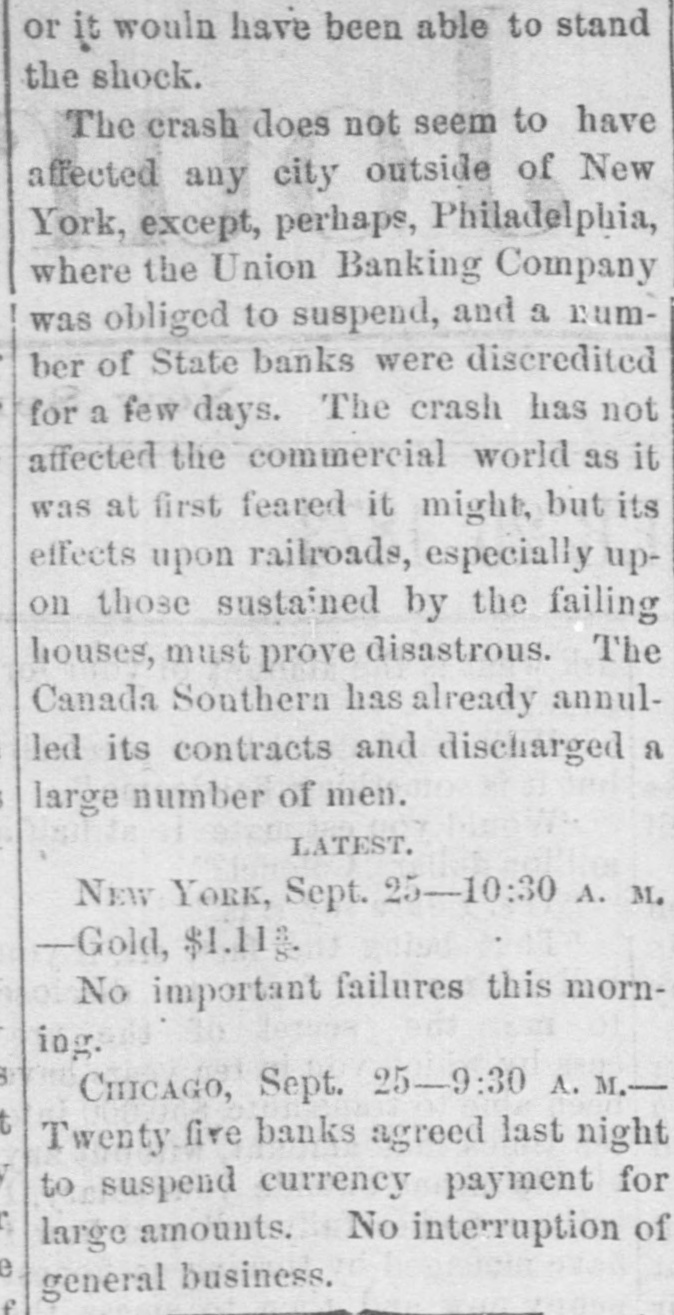
or it wouln have been able to stand the shock. The crash does not seem to have affected any city outside of New York, except, perhaps, Philadelphia, where the Union Banking Company was obliged to suspend, and a number of State banks were discredited for a few days. The crash has not affected the commercial world as it was at first feared it might, but its effects upon railroads, especially upon those sustained by the failing houses, must prove disastrous. The Canada Southern has already annulled its contracts and discharged a large number of men. LATEST. NEW YORK, Sept. 25-10:30 A. M. -Gold, $1.11 ⅛. No important failures this morning. CHICAGO, Sept. 25-9:30 A. M.- Twenty five banks agreed last night to suspend currency payment for large amounts. No interruption of general business.


Article from Daily Kennebec Journal, October 1, 1873

Click image to open full size in new tab

Article Text

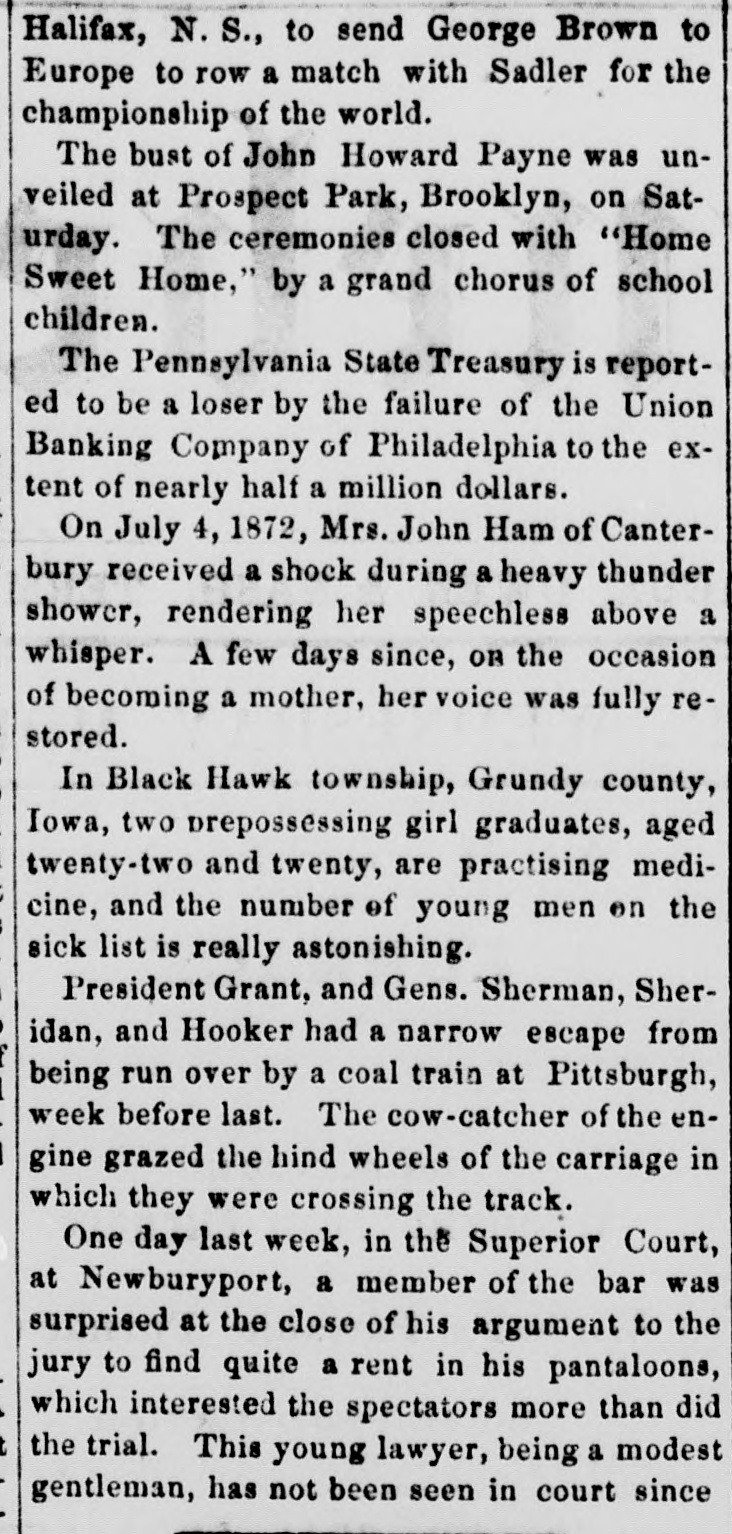
Halifax, N. S., to send George Brown to Europe to row a match with Sadler for the championship of the world. The bust of John Howard Payne was unveiled at Prospect Park, Brooklyn, on Saturday. The ceremonies closed with "Home Sweet Home," by a grand chorus of school children. The Pennsylvania State Treasury is reported to be a loser by the failure of the Union Banking Company of Philadelphia to the extent of nearly half a million dollars. On July 4, 1872, Mrs. John Ham of Canterbury received a shock during a heavy thunder shower, rendering her speechless above a whisper. A few days since, on the occasion of becoming a mother, her voice was fully restored. In Black Hawk township, Grundy county, Iowa, two prepossessing girl graduates, aged twenty-two and twenty, are practising medicine, and the number of young men on the sick list is really astonishing. President Grant, and Gens. Sherman, Sheridan, and Hooker had a narrow escape from being run over by a coal train at Pittsburgh, week before last. The cow-catcher of the engine grazed the hind wheels of the carriage in which they were crossing the track. One day last week, in the Superior Court, at Newburyport, a member of the bar was surprised at the close of his argument to the jury to find quite a rent in his pantaloons, which interested the spectators more than did the trial. This young lawyer, being a modest gentleman, has not been seen in court since


Article from The Jasper Weekly Courier, October 3, 1873

Click image to open full size in new tab

Article Text

failures reported were the Union Trust Company (the cashier of which was said to be a defaulter to the amount of $600,000), the National Trust Company, and the National Bank of the Commonwealth. The excitement and panic which followed the announcement in the Stock Exchange of the suspension of these institutions were beyond description. The Stock Exchange resembled a mad-house, and the streets were blocked with people, all laboring under great excitement and frenzy. Prices tumbled from two to sixteen per cent., and stocks were slaughtered without any apparent regard to values. President Grant and Secretary Richardson proceeded to New York on Saturday night, and on Sunday a conference was held with some of the leading financiers at the Fifth Avenue Hotel, to endeavor to arrange some plan for governmental relief. A proposition was made that the President authorize the Secretary of the Treasury to place $30,000,000 of legal reserve in the city banks, and Commodore Vanderbilt offered to add $10,000,000 more. This proposition was declined, the President stating his belief that he had no constitutional power to afford the relief asked for in this manner. It was finally determined that the Assistant Treasurer be instructed to purchase all the government bonds offered for sale to any amount, and as the savings banks hold many millions of these bonds, it was thought probable they would sell them and deposit the proceeds in the national banks, which would give them relief. At Washington, on Saturday, there were continued runs upon the Freedmen's and City Savings Banks, but both held out. In Philadelphia the Union Banking Company suspended; in Chicago, the Franklin Bank, and at a meeting of the officers of the different savings banks, it was unanimously resolved to notify their depositors, that they will avail themselves of the privilege given them by their charter of giving sixty days' notice before paying their depositors. The managers of the Eastern railroads have come to a determination to issue return passes to stock drovers on and after October 1st. The Assistant Treasurer at New York continued purchasing all the 5-20 bonds that were offered by the banks on Monday, for the purpose of easing the money market. Both the Stock Exchange and Gold Exchange continued closed during the day. A run was commenced on the savings banks in the early part of the day, but later a feeling of greater security prevailed, and the crowds of depositors dispersed. The day closed with a general confidence that the crisis was entirely over. On Tuesday, 23d, the New York Stock Exchange continued closed, but the Gold Exchange was open and regular transactions resumed. Up to 2 o'clock p. m. the monetary situation might have been summed up in a sentence, "Confidence is restored, the banks are conducting business as usual," but just as the street was beginning to feel that the end of the panic had been reached, the painful rumor started that the house of Henry Clews & Co. had suspended payment. As soon as the announcement was made that the doors of this banking house had closed, the most intense excitement again prevailed, only equaled by the first announcement of Jay Cooke & Co.'s failure. The run on the savings banks was continued moderately throughout the day, but the time rule allowing the banks to require thirty days' notice on all sums over one hundred dollars, was generally enforced. A London telegram announced that Jay Cooke, McCulloch & Co. were throwing out drafts drawn by the American house and which have come to hand since the news of their suspension was received. A Petersburg dispatch announces that the Merchants' National Bank, Planters' and Mechanics' Bank, People's Bank, and First National Bank, all of that city, had suspended. The Citizens' Bank, although not suspended, declines payment. Rumors of heavy commercial failures were also rife in that city. It is stated that the Pennsylvania Railroad Company have reduced the hours of work for laborers and road men to eight hours per day, and the pay rolls will be reduced accordingly. The laborers, it is said, will strike against the new rule. Up to noon on Wednesday, the Government had purchased about $12,000,000 of bonds in New York City, but the financial crisis was apparently not yet over. The principal failures announced were the London house of Clews, Habecht & Co., and that of Howes & Macy, New York-both brought about by the suspension of Henry Clews & Co. on the previous day. At Philadelphia, Sept. 24, Thomas B. Parker, a wealthy retired iron merchant, shot his wife and then killed himself with


Article from The Sun, October 7, 1873

Click image to open full size in new tab

Article Text

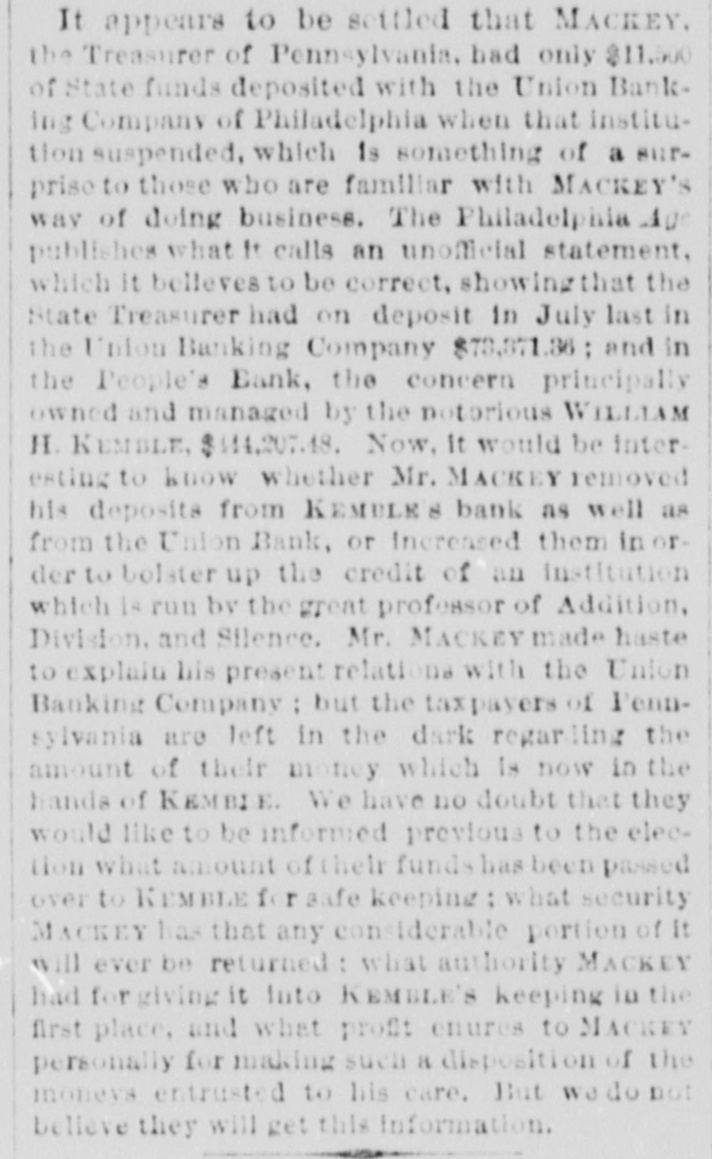
It appears to be settled that MACKEY, the Treasurer of Pennsylvania, had only $11,000 of State funds deposited with the Union Banking Company of Philadelphia when that institution suspended, which is something of a surprise to those who are familiar with MACKEY'S way of doing business. The Philadelphia Age publishes what it calls an unofficial statement, which it believes to be correct, showing that the State Treasurer had on deposit in July last in the Union Banking Company $73,871.36; and in the People's Bank, the concern principally owned and managed by the notorious WILLIAM H. KEMBLE, $114.207.48. Now, it would be interesting to know whether Mr. MACKEY removed his deposits from KEMBLE'S bank as well as from the Union Bank, or increased them in order to bolster up the credit of an institution which is run by the great professor of Addition, Division, and Silence. Mr. MACKEY made haste to explain his present relations with the Union Banking Company; but the taxpayers of Pennsylvania are left in the dark regarding the amount of their money which is now in the hands of KEMBLE. We have no doubt that they would like to be informed previous to the election what amount of their funds has been passed over to KEMBLE for safe keeping; what security MACKEY has that any considerable portion of it will ever be returned: what authority MACKEY had for giving it into KEMBLE'S keeping in the first place, and what profit enures to MACKEY personally for making such a disposition of the moneys entrusted to his care. But we do not believe they will get this information.


Article from Chicago Daily Tribune, October 20, 1873

Click image to open full size in new tab

Article Text

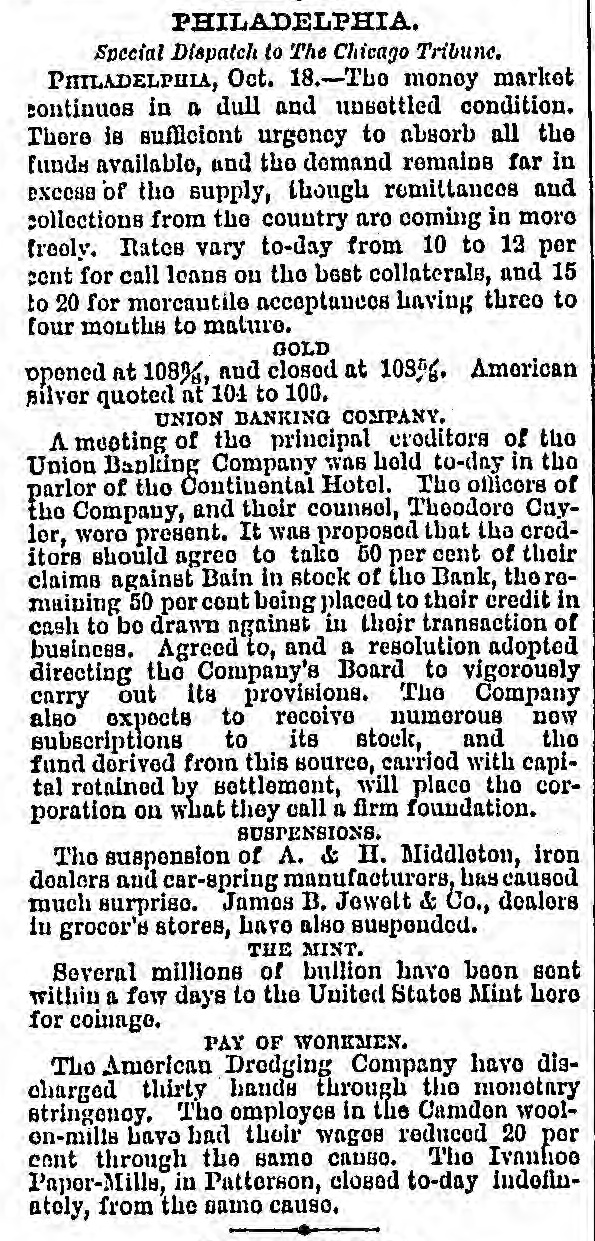
PHILADELPHIA. Special Dispatch to The Chicago Tribune. PHILADELPHIA, Oct. 18.-The money market continues in a dull and unsettled condition. There is sufficient urgency to absorb all the funds available, and the demand remains far in excess of the supply, though remittances and collections from the country are coming in more treely. Rates vary to-day from 10 to 12 per cent for call leans ou the best collaterals, and 15 to 20 for moreautile acceptances linving three to four mouths to mature. GOLD opened at 108% and closed at 103% American silver quoted at 101 to 100. UNION BANKING COMPANY. A meeting of the principal croditors of the Union Banking Company was hold to-day in the parlor of the Continental Hotel. The officors of the Company, and their counsel, Theodore Cuyler, were present. It was proposed that the creditors should agree to take 50 per cent of their claims against Bain in stock of the Bank, the remaining 50 por cont being placed to their credit in cash to be drawn against in their transaction of business. Agreed to, and a resolution adopted directing the Company's Board to vigorously carry out its provisions. The Company also expects to receive numerous now subscriptions to its stock, and the fund derived from this source, carriod with capital rotained by settlement, will placo the corporation on what they call a firm foundation. SUSPENSIONS. Tho suspension of A. & II. Middleton, iron doalers and car-spring manufacturers, has caused much surprise. Jamos B. Jewelt & Co., dealors in grocor's stores, have also suspended. THE MINT. Several millions of bullion have been sent within a few days to the United States Mint hore for coinage. PAY OF WORKMEN. The American Dredging Company have discharged thirty hands through the monetary stringency. Tho employee in the Camdon woolon-mills have had their wages reduced 20 per cent through the samo canso. The Ivanhoe Paper-Mills, in Patterson, closed to-day indofinatoly, from the gamo cause.


Article from The Wheeling Daily Intelligencer, November 29, 1873

Click image to open full size in new tab

Article Text

RAILROAD BRIDGE WASHED AWAY. LITTLE ROCK, Nov. 28.-Two spans of the false work, about 250 feet, of the Cairo and Fulton Railroad bridge across Red River, was washed away - last night. River still rising. Clear and cool; indica tions of falling weather. RESUMPTION OF A SUSPENDED BANK. PHILADELPHIA, Nov. 28.-The Union Banking Company, which suspended during the panic, have resumed business with an increased capital to $700,000.


Article from The Cairo Bulletin, November 29, 1873

Click image to open full size in new tab

Article Text

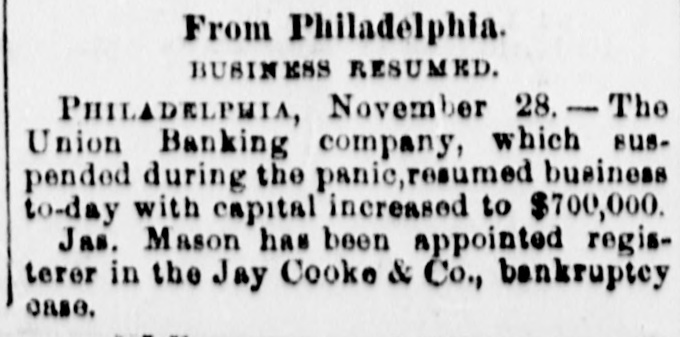
From Philadelphia. BUSINESS RESUMED. PHILADELPHIA, November 28. - The Union Banking company, which suspended during the panic, resumed business to-day with capital increased to $700,000. Jas. Mason has been appointed registerer in the Jay Cooke & Co., bankruptcy case.


Article from Daily Kennebec Journal, November 29, 1873

Click image to open full size in new tab

Article Text

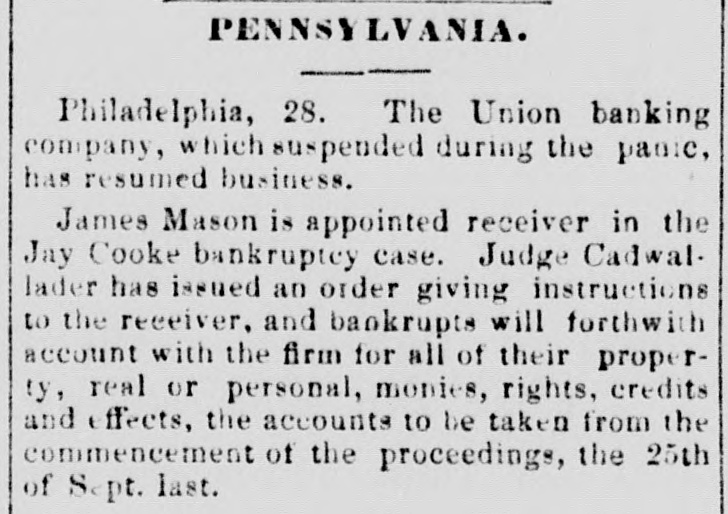
PENNSYLVANIA. Philadelphia, 28. The Union banking company, which suspended during the panic, has resumed business. James Mason is appointed receiver in the Jay Cooke bankruptcy case. Judge Cadwallader has issued an order giving instructions to the receiver, and baokrupts will forthwith account with the firm for all of their property, real or personal, monies, rights, credits and effects, the accounts to be taken from the commencement of the proceedings, the 25th of Sept. last.


Article from The Portland Daily Press, November 29, 1873

Click image to open full size in new tab

Article Text

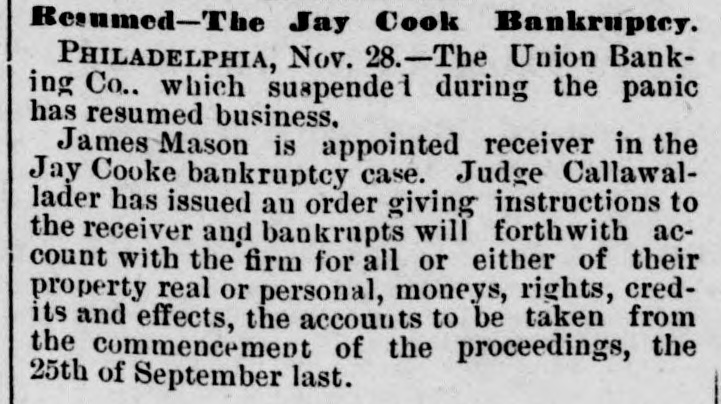
Resumed-The Jay Cook Bankruptcy. PHILADELPHIA, Nov. 28.-The Union Banking Co., which suspended during the panic has resumed business. James Mason is appointed receiver in the Jay Cooke bankruptcy case. Judge Callawallader has issued an order giving instructions to the receiver and bankrupts will forthwith account with the firm for all or either of their property real or personal, moneys, rights, credits and effects, the accounts to be taken from the commencement of the proceedings, the 25th of September last.


Article from Evening Star, December 1, 1873

Click image to open full size in new tab

Article Text

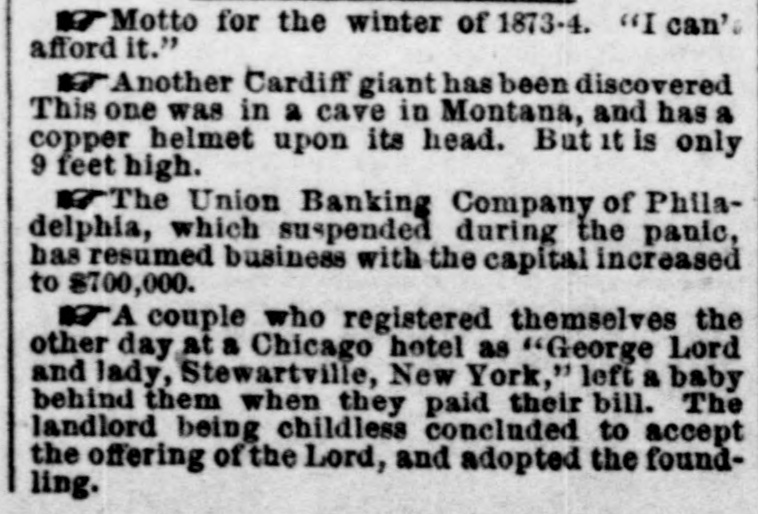
Motto for the winter of 1873-4. "I can' afford it." Another Cardiff giant has been discovered This one was in a cave in Montana, and has a copper helmet upon its head. But it is only 9 feet high. The Union Banking Company of Philadelphia, which suspended during the panic, has resumed business with the capital increased to $700,000. couple who registered themselves the other day at a Chicago hotel as "George Lord and lady, Stewartville, New York," left a baby behind them when they paid their bill. The landlord being childless concluded to accept the offering of the Lord, and adopted the foundling.