Article Text
First State Bank of Las Cruces at Las Cruces failed to open its doors foday, following a run by depositors. The bank was capitalized for $30,000 with
95-0098
Click image to open full size in new tab
First State Bank of Las Cruces at Las Cruces failed to open its doors foday, following a run by depositors. The bank was capitalized for $30,000 with
Click image to open full size in new tab
STATE COLLEGE HARD HIT BY FAILURE OF BANK Las Cruces, N, M., Dec. 9.-The New Mexico College of Agriculture and Mechanic Arts, which was by far the largest depositor in the First State bank, it was learned here today, had approximately $73,000 on deposit. This amount was divided between state and United States funds. It is not known whether or not the college's deposit was secured by bond or otherwise. Morgan Liewellyn, of Las Cruces, is treasurer of the board of regents of the institution, and deposited the funds. Rumors have been prevalent for several days that the bank was shaky, and these rumors caused a run to start yesterday, the small depositors coming in streams and demanding their money. Assistance was rendered by other financial institutions until it was seen that the matter could not be tided over, and today the bank did not open its doors. Negotiations are under way to obtain financial assistance from El Paso capital and hopes are entertained that the depositors may be saved harmless on account of the failure.
Click image to open full size in new tab
UN STATE BANK AT LAS CRUCES BEGAN TUESDHY Officers of Bank Taken Over by State Bank Examiner, Believe They Can Pay in Full: State College Funds Involved. Information from Las Cruces today advised that the First State bank of that town, which failed to open its doors yesterday morning, as reported in the Herald pesterday, had been taken over by State Bank Examiner Howell Earnest who went through A1. buquerque last night on his way to Las Cruces. Mr. Ernest said last night that he knew nothing of the affairs of the bank aside from brief Information that a run had started on It Tuesday which It could not stand. He said the State Agricultural college had considerable funds in the bank, he believed although he did not know what amount. The bank had a. capital of $30,000 and was established in 1911. The Las Cruces Republic of yesterday says of the bank and its affairs: For the past few days there have been rumors of financial difficulties Involving the First State bank, and on Tuesday what assumed the proportions of a serious "run" on the deposits in the bank occurred. The directors state that the First National bank of this city came generously to the rescue of the First State bank in its difficulty, and a large amount of money was drawn from the bank by depositors. All who applied for money on Tuesday were paid in full. but owing to the existing n.oney stringency and the difficulty in securing immedate cash in large amounts, It was decided by the officials of the bank to turn the institution over to the state bank examiner, and the doors were closed Tuesday night, pending an examination of the affairs of the bank by the state officials. It is stated by these gentlemen that the assets of the bank are believed to be ample to pay depositors in full, and that reorganization of the bank is a possibility, awaiting the findings of the state bank examiner. The other two banks of the city are in excellent condition, and have taken every precaution to meet all needs of the community in every way. The public, including the entire business circle of this valley, deplore the financial stress that has overtaken this institution and all hope it may resume operations under a reorganization, and also that none of our people may lose any funds through the closing of the bank. The state bank examiner is expected with-
Click image to open full size in new tab
STATE COLLEGE FUNDS PROTECTED BY BOND OF SURETY COMPANY Las Cruces, N. M., Dec. 11.-Funds of the New Mexico Agricultural college, deposited in the First State bank which closed its doors Wednesday following a run, are protected fully by surety company bonds, it is learned today. The college will suffer no loss. The bank's failure was due to excessive loans some of which it is said, were not considered good paper. The bank. it is stated. may possibly be able to re-open after a month.
Click image to open full size in new tab
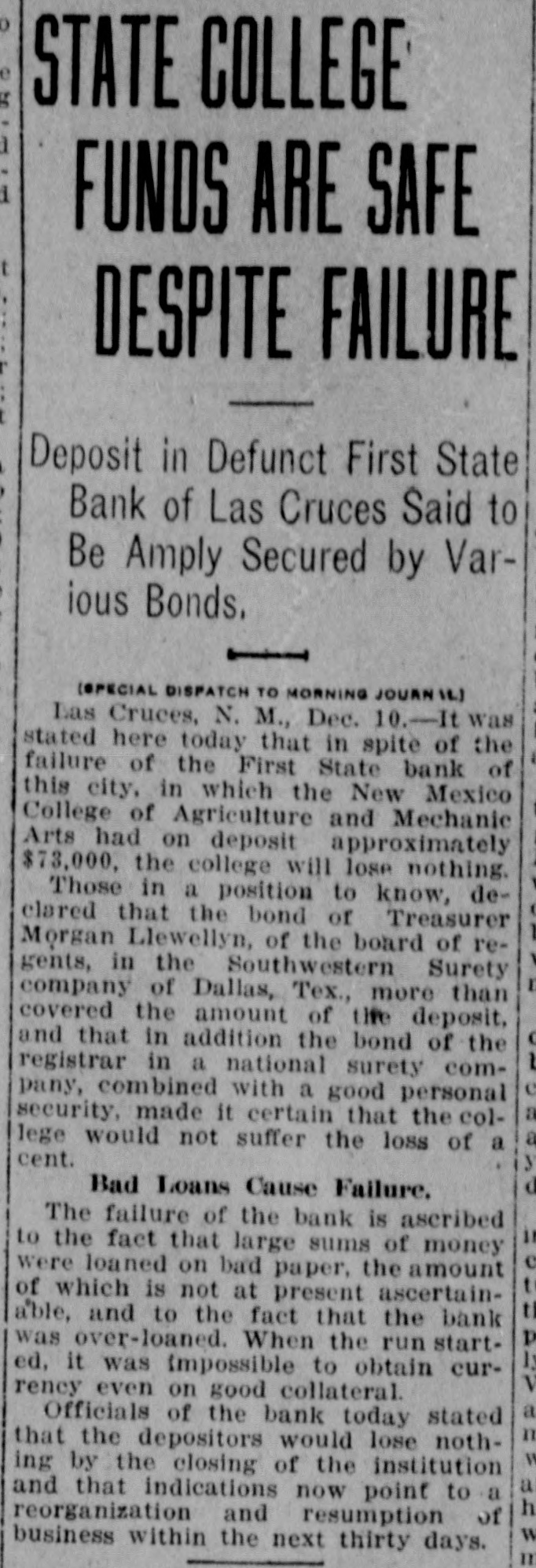
STATE COLLEGE FUNDS ARE SAFE DESPITE FAILURE Deposit in Defunct First State Bank of Las Cruces Said to Be Amply Secured by Various Bonds. (SPECIAL DISPATCH TO MORNING JOURN IL) Las Cruces, N. M., Dec. 10.-It was stated here today that in spite of the failure of the First State bank of this city, in which the New Mexico College of Agriculture and Mechanic Arts had on deposit approximately $73,000, the college will lose nothing. Those in a position to know, declared that the bond of Treasurer Morgan Llewellyn, of the board of regents, in the Southwestern Surety company of Dallas, Tex., more than covered the amount of time deposit, and that in addition the bond of the registrar in a national surety company, combined with a good personal security, made it certain that the college would not suffer the loss of a cent. Bad Loans Cause Failure. The failure of the bank is ascribed to the fact that large sums of money were loaned on bad paper, the amount of which is not at present ascertainable, and to the fact that the bank was over-loaned. When the run started, it was impossible to obtain currency even on good collateral. Officials of the bank today stated that the depositors would lose nothing by the closing of the institution and that indications now point to a reorganization and resumption of business within the next thirty days.
Click image to open full size in new tab
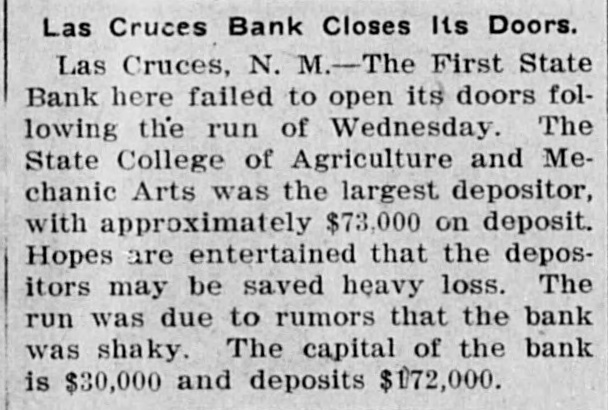
Las Cruces Bank Closes Its Doors. Las Cruces, N. M.-The First State Bank here failed to open its doors following the run of Wednesday. The State College of Agriculture and Mechanic Arts was the largest depositor, with approximately $73,000 on deposit. Hopes are entertained that the depositors may be saved heavy loss. The run was due to rumors that the bank was shaky. The capital of the bank is $30,000 and deposits $172,000.

Click image to open full size in new tab
1ST NATIONAL BANK ENABLES COLLEGE TO GO ON Abuquerque Institution Will Advance Money to Pay A. & M. Expenses Until Bond Is Collected. Plans for financing the New Mexico College of Agriculture and Mechanic Arts. pending the adjustment of the difficulties growing out of the failure of the First State bank of Las Cruces, in which the co.lege had nearly $80,000 on deposit. were completed in this city today. The First National bank will advance the money nee essary to carry the college on until the bond securing the deposit in the Las Cruces bank is collected. P. F. McCanna, who was elected secretary and treasurer of the college board of regents yesterday, at a meeting in Las Cruces made the final arrangements with the First National bank this morning. The First Na tiona was first approached Sunday night when Governor McDonald on his way to the meeting at Las Cru ces. stopped off here. With Mr. M Canna he went In conference with M. W Flournoy, president of the First National The situation was canvassed thoroughly and Mr. Flour. noy promptly recognized that the bank had an opportunity to do a great civic service Mr. McCanna and the governor went away from the conference with virtual assurance that the bank would see the State College through its dif. ficulty, and today the plan was brought to fruition The protection of the First National advances lies in the security bond which safeguarded the college deposit in the Las Cruces bank At torney General Frank V Claney and other lawyers have examined the bond with a legal microscope and they pronounce it absolutely unim peachable it is declared a binding obligation on the Oklahoma company that issued it. and the lawyers agree that the corporation cannot successfully defend a suit for the money Mr. McCanna announced today that immediate demand would be made on the bonding company for the surety money As soon as Mr. McCanna's own bond as treasurer is secured the First National bank will place funds at his dispopsal, and all bills against the college will be promptly met. Before the First National came to the rescue there was danger that lack of money for current expenses would force the college to suspend Absolutely no danger of that re mains The college will go on. and everything will work out all right said McCanna this morning Mr. McCanna was elected secretary and treasurer to succeed Morgan O. Llewellyn at yesterday's meeting The membership of the board remains unchanged and it is said that no resignations have been asked or offered Mr. Liewellyn resigned as sec. etary-treasurer E A Mossman of this city an expert accountant of the highest reputation. was elected registrar of the college. succeeding Otto C. Wettlunfor, resigned Mr. McCanna consent ed to take the position of secretary treasurer only on condition that Mr. Mossman become registrar The latter will give up his work as expert and consulting accountant in this city to devote his time and attention to the work at the college His partner. Mr. Guilfoil will take charge of their business in this city.
Click image to open full size in new tab
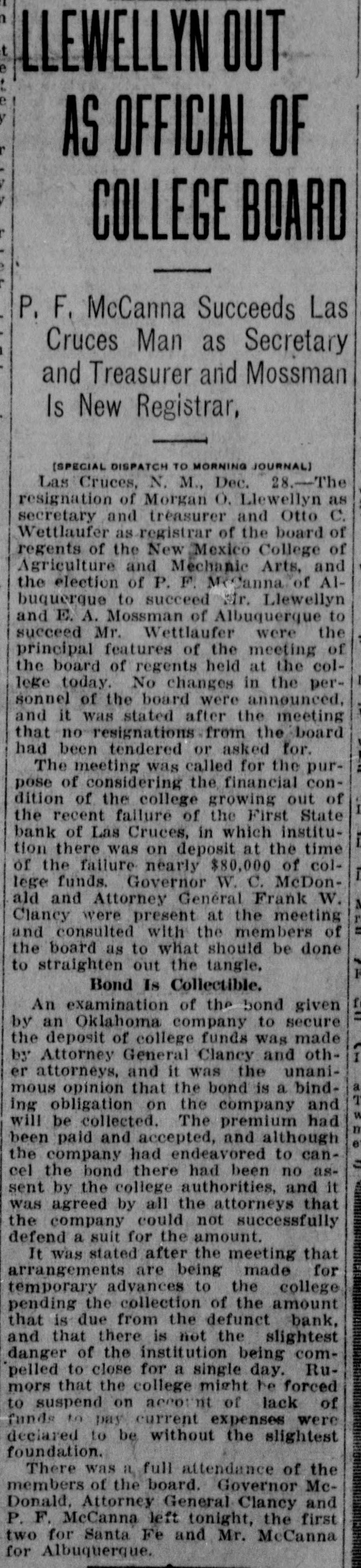
P. F. McCanna Succeeds Las Cruces Man as Secretary and Treasurer and Mossman Is New Registrar,
[SPECIAL DISPATCH TO MORNING JOURNAL] Las Cruces, N. M., Dec. 28. The resignation of Morgan O. Llewellyn as secretary and treasurer and Otto C. Wettlaufer as registrar of the board of regents of the New Mexico College of Agriculture and Mechanic Arts, and the election of P. F. McCanna of Albuquerque to succeed Mr. Llewellyn and E. A. Mossman of Albuquerque to succeed Mr. Wettlaufer were the principal features of the meeting of the board of regents held at the college today. No changes in the personnel of the board were announced, and it was stated after the meeting that no resignations from the board had been tendered or asked for.
The meeting was called for the purpose of considering the financial condition of the college growing out of the recent failure of the First State bank of Las Cruces, in which institution there was on deposit at the time of the failure nearly $80,000 of college funds. Governor W. C. McDonald and Attorney General Frank W. Clancy were present at the meeting and consulted with the members of the board as to what should be done to straighten out the tangle.
Bond Is Collectible.
An examination of the bond given by an Oklahoma company to secure the deposit of college funds was made by Attorney General Clancy and other attorneys, and it was the unanimous opinion that the bond is a binding obligation on the company and will be collected. The premium had been paid and accepted, and although the company had endeavored to cancel the bond there had been no assent by the college authorities, and it was agreed by all the attorneys that the company could not successfully defend a suit for the amount.
It was stated after the meeting that arrangements are being made for temporary advances to the college pending the collection of the amount that is due from the defunct bank, and that there is not the slightest danger of the institution being compelled to close for a single day. Rumors that the college might be forced to suspend on account of lack of funds to pay current expenses were declared to be without the slightest foundation.
There was a full attendance of the members of the board. Governor McDonald, Attorney General Clancy and P. F. McCanna left tonight, the first two for Santa Fe and Mr. McCanna for Albuquerque.
Click image to open full size in new tab
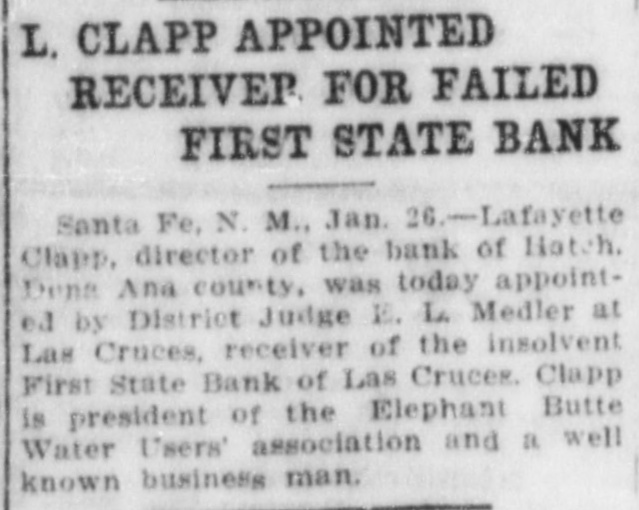
L. CLAPP APPOINTED RECEIVER FOR FAILED FIRST STATE BANK Santa Fe, N. M., Jan. 26.-Lafayette Clapp. director of the bank of Hotch. Dena Ana county, was today appointed by District Judge E. L. Medler at Las Cruces, receiver of the insolvent First State Bank of Las Cruces. Clapp is president of the Elephant Butte Water Users' association and a well known business man.
Click image to open full size in new tab
Santa Fe, N. M., Feb. 4.-That the Republican managers of the present legisature have determined upon an effort to make a political club of the failure of the First State bank of Las Cruces, the connection of Morgan O. Llewellyn, a regent of the state college, with that institution and the fact that state college funds were on deposit in the bank at the time of its failure was conclusively shown in the house this afternoon when Representative F. O. Blood of East Las Vegas introduced House Bill No. 158, providing for the appointment of five members of the legislature, three from the house and two from the senate, with extra-judicial powers, and an appropriation of $1,500, to investigate tht failure of the Las Cruces bank and the affairs of the state college in connection therewith. Mr. Blood prefaced the introduction of the bill by referring to the resolution calling on the governor for information and by reading a prepared statement which convicts the governor and the traveling auditor in advance of trial of carelessness in connection with the college affairs and the affairs of the bank; eonviets in advance a former registrar of the institution of being a defaulter and makes grave charges not only against Llewellyn, the former treasurer of the college board, but against J. H. Paxtoa, president of the board and chairman of the Democratic state committee, as well as T. J. Guilfoil and E. A. Mossman who have/been connected with the traveling anditor's office and who occupy a leading position among the xpert accountants of the southwest. Mr. Guilfoil, a former registrar of the college, is secretary of the Democratic state committee, while Mr. Mossman, of Albuquerque, is serving temporarily as registrar at the request of P. F. McCanna, of Albuquerque, the present treasurer of the college, while its affairs and accounts are being straightened out. There has been no secret almost from the day the legislature opened that the First State bank scandal was to be twisted into a political scandal and directed against the governor, and, through him, against the Democratic party, if it could be done, regardless of consequences. Governor McDonald has not yet replied to the resolution calling on him for information, which only reached him on Monday of this week. (It is known, however, that the governor is collecting all information available in all departments of the state for transmission to the house. When the bill had been introduced and Mr. Blood had read his statement, he moved that the bill be taken up out of its regular order for immediate passage. The motion was enthusiastically seconded by Judge John Y. Hewitt, the Democratic leader, who declared that such an investigation was demanded by the rumors which had been spread abread and should be carried forward without delay. "I suppose," said Judge Hewitt, "that this statement is intended as an indictment against the Democratic administration and the executive and while I believe this proceeding to be out of order at this time, I am in favor of a full fair investigation of the matter and will co-operate. If there n is blame to be attached to the governor, the traveling auditor or anyone else, I want all the facts to be known to the people of New Mexico and let the blame fall where it may." d k The bill was passed under suspension of the rules.
Click image to open full size in new tab
The Investigation into the falled First State bank at Las Cruces, the Agricultural college and their relations moved forward a pace when the senate late this afteronon passed House Bill No. 158, the Blood investigation bill, under suspension of the rules by unanimous vote and after the members of the minority expressed approval of the investigation while questioning the motive inspiring the majority to force it pending a reply by the governor to the request of the legislature for Information on the subject. Upon calling up the (bill out of its regular order from the table where it had been sent with a-favorable report from the finance committee Senator Holt delivered his promised address giving the reasons for the inquiry into the college affairs and for his refusal to transmit the memorial relating to the college business to which Senator Barth made reference in a speech last week. Mr. Holt explained that the memorlal was merely a statement of the fnancial conditions of the college at the time P. F. McCanna of Albuquerque took charge as treasurer In an effort to straighten out the situation. He said the memorial suggested the use of trust funds through the office of public lands, properly secured, for the purpose of relieving the situation and supplying the college with about $50,000 which It needed to complete the year. He quoted the enabling act and the constitution to show that use of such funds could not be so made and said that for that reason he had thought it best to withhold the memorial. Incidentally Mr. Holt not only completely absolved Mr. McCanna from any knowledge of the unfortunate condition existing at Las Cruces as a member of the board of regents but showed htat when the crisis acme it was Mr. McCanna who stepped into the breach to do the most effective work. Otherwise, Mr. Holt's address was a sweeping and detailed elaboration of the statements in the house by Mr. Bleed when introducting the bill. Mr. Holt charged specifically than Governor McDonald knew of the condition of the First State bank and that the traveling auditor knew it. He charged that Mr. Guilfoyl, as registrar of the college. was an absolute dictator of all affairs Including affairs belonging properly to the president. He charged that Wetlaufer, who succeed. ed Guilfoil, not only was a defaulten thut that he purchased supplies at prices fur in excess of the bid. He asserted that the bank had $30,000 in overdrafts and among its notes was one signed by fifteen or twenty Democrats of the Mesilla valley and made prior to the first state election. This note carried as credit, he said. $50 a month of interest paid by the bank on state college funds. He repeated the charge that on the last day the bank was open Paxton. Llewellyn, Guilfull and Mr. Mossman, the present registrar. reasoured those who came for their money that the bank was solvent and warned the college people not to withdraw their funds." The majority leader's statement was a terrific indictment or the banking

Click image to open full size in new tab
Former Regents of State College Speak Their Minds to Chief Executive on State College Affairs,
[SPECIAL CORRESPONDENCE TO MORNING JOURNAL] Santa Fe, Feb. 9. Among the papers transmitted by Governor McDonald to the state legislature in response to the house joint resolution calling for information relative to the failure of the First State bank of Las Cruces and the connection with that institution of the affairs of the New Mexico College of Agriculture and Mechanic Arts are letters from Morgan O. Llewellyn and F. E. Lester, former members of the board of regents of the state college which contain quite frank, if not sensational statements regarding the management of the college. The following letters are part of the correspondence on the subject:
Las Cruces, N. M., Dec. 22, 1914. Honorable William C. McDonald, Santa Fe, New Mexico. My Dear Governor:- This will acknowledge receipt of your telegram of even date herewith as follows: "I request that you forward to me immediately your resignation as a member of the board of regents of the New Mexico College of Agriculture and Mechanic Arts."
This request for my resignation undoubtedly grows out of the failure of the First State bank of this place, and the fact that the funds of the New Mexico College of Agriculture and Mechanic Arts were on deposit there in my name as secretary-treasurer. The effect of your action is to single me out of the board of regents of this institution as the scapegoat of real or fancied sins of omission or commission, which you apparently fear may be charged to your administration. The only other hypothesis upon which this action may be explained is that you have listened to the idle calumny of personal and political enemies of mine and those who seek their own salvation in my humiliation. The latter phase of the question may be taken up in its own good time and place.
As to the first, the facts either at your command or in your possession are as follows: You are the governor of New Mexico and the officers of the state banking department are creatures of your appointment and subject to your immediate direction and control, actually if not in law. You are ex-officio member of the board of regents of the New Mexico College of Agriculture and Mechanic Arts, and have acted in such capacity and are charged with knowledge of and have personally had full knowledge of all matters germane to the matters in issue. In February last your bank examiner, Howell Earnest, came to Las Cruces and examined the First State bank. At the conclusion of that examination he called together the directors of that institution and told them, that on account of events recently transpired that certain things should be done to make that institution whole from losses incurred and that certain other things should be remedied to conform to the state banking laws and regulations. Three months were given for the fulfillment of one of these conditions and six months for the fulfillment of the other.
The First State bank closed its doors on the 9th day of December, and from February until that date no representative either of yourself or banking department ever came to the town of Las Cruces or made any examination of the First State bank whatever to determine whether those absolute conditions had been fulfilled.
You were personally present when the conditions were made and gave your full assent to them, and you knew that no further step was ever taken. Neither you nor any officer of your banking department ever notified or intimated to me that the First State bank was insolvent or in a dangerous condition, although you knew it was the depository of the funds in my custody.
After the above referred to and after the time when you have lately stated that the bank should have been closed you stood by as an executive and permitted as a regent my depositing in that bank every dollar of the funds now endangered by the failure of that institution. You know or should know that the college will not lose a dollar of the money so deposited by me and this fact is due to my own action in procuring the bond now in my possession assuring that deposit. Therefore, until some definite reason be offered me, I decline to accede to your peremptory request. Very truly yours, (Signed.) M. O. LLEWELLYN.
Mesilla Park, N. M., Dec. 9, 1914. Hon. William C. McDonald, Governor, Santa Fe, N. M. Dear Governor McDonald: You have probably been advised by other persons that the First State bank, after experiencing a run, closed its doors this morning. I have been doing business with this bank myself for some time, personally also have some county road
Click image to open full size in new tab
Las Cruces.-Lafayette Clapp, a director of the Bank of Hatch and president of the Elephant Butte Water Users' Association, was appointed by District Judge E. L. Medler receiver of the insolvent First State Bank of Las Cruces, whose president, T. R. Smith, is under indictment on the charge of receiving moneys when he knew the bank could not meet its obligations.
Click image to open full size in new tab
Santa Fé. - The minute book of the defunct First State Bank of Las Cruces, containing all the formal legal records of the corporation, and regarded as invaluable evidence in the effort to substantiate charges against the president and directors now under bond, is missing. It was last seen in the room where the hearing was held at Las Cruces, just before the assault by President T. R. H. Smith of the bank on Attorney Reed Holioman. Receiver Clapp of the bank is conducting a thorough investigation. A fistic encounter occurred between President George H. Ladd of the college and Professor R. H. Hare of the faculty, the result, it is said, of the testimony adduced by both men at the hearing.

Click image to open full size in new tab
Allegation Made That Governor and State Officials Concealed Truth Regarding Condition of First State Bank.
[SPECIAL DISPATCH TO MORNING JOURNAL] Santa Fe, June 11. The answer of the Southwestern Surety company to the suit of the state of New Mexico seeking to recover on the bond of Morgan O. Llewellyn as treasurer of the board of regents of the College of Agriculture and Mechanic Arts or losses growing out of the failure several months ago of the First State bank of Las Cruces has been filed in the office of the clerk of the district court here. It covers seven typewritten pages and goes exhaustively into the matters of defense on which the company seeks to avoid liability on the bond.
The answer declares that while Llewellyn's bond purported to be an official bond, there is no law of the state of New Mexico requiring the execution of such a bond, and that the bond was an involuntary one in that Llewellyn was required by the board of regents to give it as a condition precedent to his entering on the duties of the office. It is alleged that Llewellyn executed the bond under the mistaken belief that it was required by the laws of New Mexico.
Cancellation Alleged, It is further alleged that in the application for the bond made by Llewellyn there was the following stipulation: "I further agree that the surety may decline to issue said bond hereby applied for, and in case it does issue said bond it shall have the right to withdraw or cancel the same whenever it shall so desire, and in no event shall the surety be required to disclose the reason upon which its action is based, and it shall not be liable for the loss or damage I may sustain by reason of such action."
The answer sets up that in accepting the application it acted under the mistaken belief that the laws of New Mexico required the execution of an official bond by Llewellyn, and that upon learning of its mistake it immediately issued notice of cancellation to the state of New Mexico: that this notice was delivered to and served upon the governor of New Mexico, and it is claimed that liability on the bond ceased at once.
Officials Charged With Fraud. The sensational part of the answer comes in its third defense, in which it is alleged that the bond was obtained by fraud on the part of the state of New Mexico, In regard to this the answer sets up "that at the time said purported bond was executed and delivered, the governor of the state of New Mexico and the officials of said state well knew that the said Morgan O. Llewellyn had designated as his depository of the funds of the said college the First State bank of Las Cruces, a corporation organized under the banking laws of the state of New Mexico and which said bank was under the surveillance of said state and under the banking department and the office of the traveling auditor and bank examiner of said state of New Mexico; that said bank, at the time said alleged bond was so procured to be signed by this defendant, was insolvent and was unable to pay to the said Morgan O. Llewellyn or to his successor in office, or to any person authorized by law to receive same, the money which had been deposited by the said Morgan O. Llewellyn in said bank, and that the governor of said state of New Mexico and the traveling auditor and bank examiner of said state well knew that said bank was insolvent and had been insolvent for several months prior to the date of said alleged bond, and said bank had been examined by the duly constituted authorities of said state and the said bank examiner had reported its condition to the governor of said state, and that its condition was to said state and said governor well known, but that the said state of New Mexico, in securing the signature of this defendant to said bond, concealed that fact from this defendant and fraudulently failed to apprise this defendant of the facts."
It is also alleged as a matter of defense that more than $21,000 of the amount sued for did not come into the hands of Llewellyn after the execution of the alleged bond, but long before the bond was executed and that this money had previously been deposited in the First State bank and never withdrawn therefrom. A similarly large portion of the sum sued for, according to the answer, was derived from the sale of lands granted to the territory of New Mexico under the enabling act, and should have been kept in the treasury of the state and not on deposit to the credit of Llewellyn as treasurer of the state college.
Click image to open full size in new tab
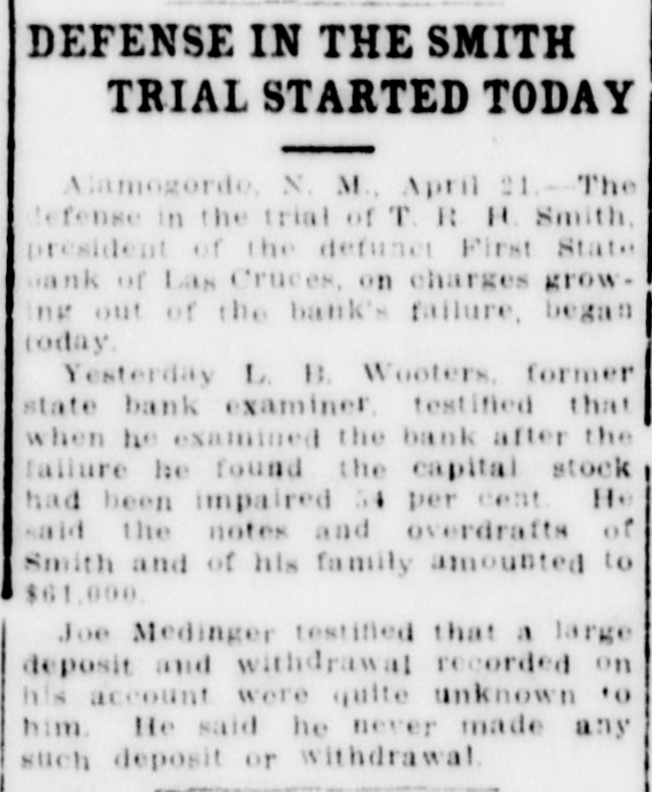
Alamogordo, N. M., April 21. The defense in the trial of T. R. H. Smith, president of the defunct First State Bank of Las Cruces, on charges growing out of the bank's failure, began today.
Yesterday L. B. Wooters, former state bank examiner, testified that when he examined the bank after the failure he found the capital stock had been impaired 54 per cent. He said the notes and overdrafts of Smith and of his family amounted to $61,000.
Joe Medinger testified that a large deposit and withdrawal recorded on his account were quite unknown to him. He said he never made any such deposit or withdrawal.
Click image to open full size in new tab
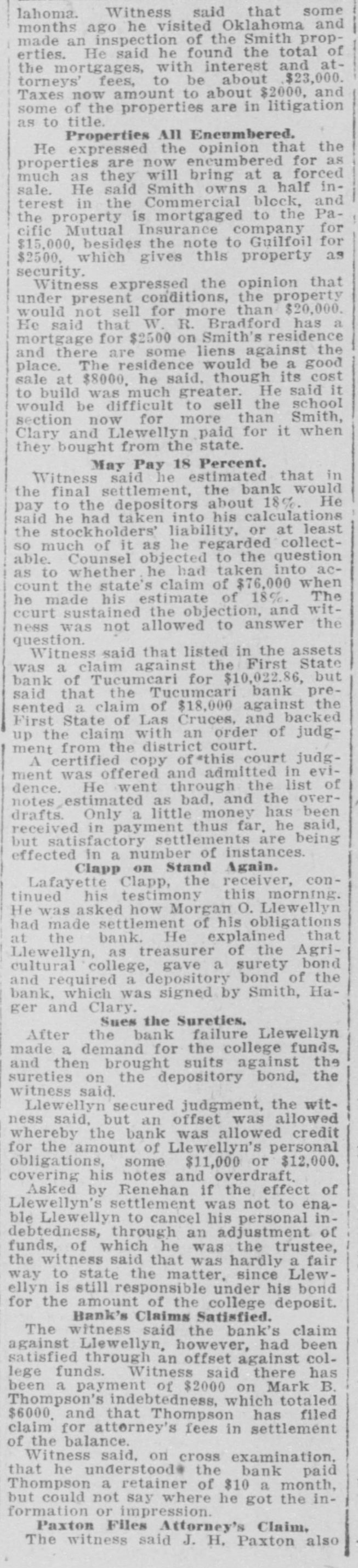
lahoma. Witness said that some months ago he visited Oklahoma and made an inspection of the Smith prop- erties. He said he found the total of the mortgages, with interest and at- torneys' fees, to be about $23,000. Taxes now amount to about $2000, and some of the properties are in litigation as to title.
He expressed the opinion that the properties are now encumbered for as much as they will bring at a forced sale. He said Smith owns a half in- terest in the Commercial block, and the property is mortgaged to the Pa- cific Mutual Insurance company for $15,000, besides the note to Guilfoil for $2500, which gives this property as security.
Witness expressed the opinion that under present conditions, the property would not sell for more than $20,000. He said that W. R. Bradford has a mortgage for $2500 on Smith's residence and there are some liens against the place. The residence would be a good sale at $8000, he said, though its cost to build was much greater. He said it would be difficult to sell the school section now for more than Smith, Clary and Llewellyn paid for it when they bought from the state.
Witness said he estimated that in the final settlement, the bank would pay to the depositors about 18%. He said he had taken into his calculations the stockholders' liability, or at least so much of it as he regarded collect- able. Counsel objected to the question as to whether, he had taken into ac- count the state's claim of $76,000 when he made his estimate of 18%. The ccurt sustained the objection, and wit- ness was not allowed to answer the question.
Witness said that listed in the assets was a claim against the First State bank of Tucumcari for $10,022.86, but said that the Tucumcari bank pre- sented a claim of $18,000 against the First State of Las Cruces, and backed up the claim with an order of judg- ment from the district court.
A certified copy of this court judg- ment was offered and admitted in evi- dence. He went through the list of notes estimated as bad, and the over- drafts. Only a little money has been received in payment thus far, he said, but satisfactory settlements are being effected in a number of instances.
Lafayette Clapp, the receiver, con- tinued his testimony this morning. He was asked how Morgan O. Llewellyn had made settlement of his obligations at the bank. He explained that Llewellyn, as treasurer of the Agri- cultural college, gave a surety bond and required a depository bond of the bank, which was signed by Smith, Ha- ger and Clary.
After the bank failure Llewellyn made a demand for the college funds. and then brought suits against the sureties on the depository bond, the witness said.
Llewellyn secured judgment, the wit- ness said, but an offset was allowed whereby the bank was allowed credit for the amount of Llewellyn's personal obligations, some $11,000 or $12,000. covering his notes and overdraft.
Asked by Renehan if the effect of Llewellyn's settlement was not to ena- ble Llewellyn to cancel his personal in- debtedness, through an adjustment of funds, of which he was the trustee, the witness said that was hardly a fair way to state the matter, since Llew- ellyn is still responsible under his bond for the amount of the college deposit.
The witness said the bank's claim against Llewellyn, however, had been satisfied through an offset against col- lege funds. Witness said there has been a payment of $2000 on Mark B. Thompson's indebtedness, which totaled $6000, and that Thompson has filed claim for attorney's fees in settlement of the balance.
Witness said, on cross examination. that he understood the bank paid Thompson a retainer of $10 a month, but could not say where he got the in- formation or impression.
The witness said J. H. Paxton also
Click image to open full size in new tab
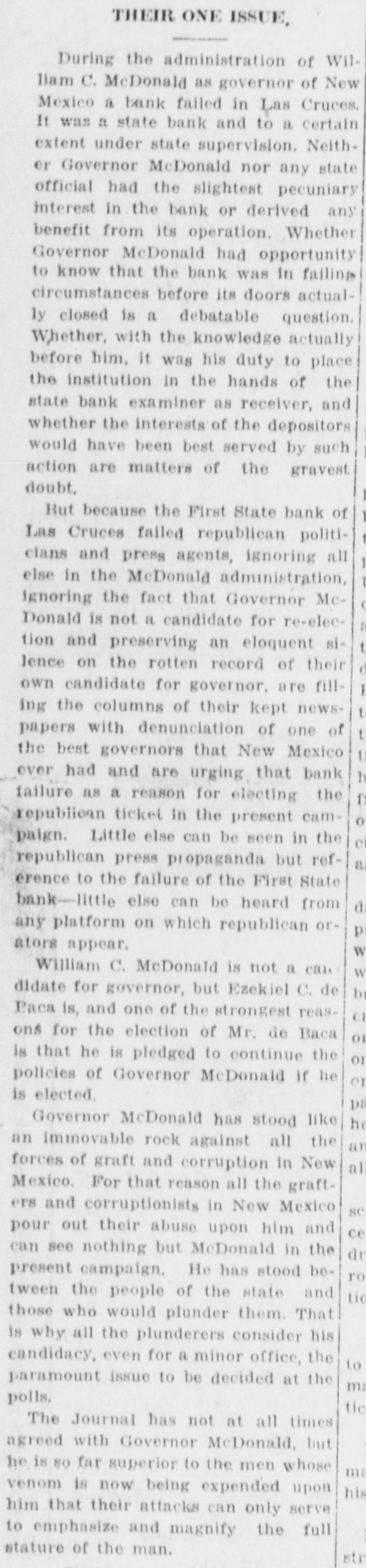
During the administration of William C. McDonald as governor of New Mexico a bank failed in Las Cruces. It was a state bank and to a certain extent under state supervision. Neither Governor McDonald nor any state official had the slightest pecuniary interest in the bank or derived any benefit from its operation. Whether Governor McDonald had opportunity to know that the bank was in failing circumstances before its doors actually closed is a debatable question. Whether, with the knowledge actually before him, it was his duty to place the institution in the hands of the state bank examiner as receiver, and whether the interests of the depositors would have been best served by such action are matters of the gravest doubt,
But because the First State bank of Las Cruces failed republican politicians and press agents, ignoring all else in the McDonald administration, ignoring the fact that Governor McDonald is not a candidate for re-election and preserving an eloquent silence on the rotten record of their own candidate for governor, are filling the columns of their kept newspapers with denunciation of one of the best governors that New Mexico ever had and are urging that bank failure as a reason for electing the republican ticket in the present campaign. Little else can be seen in the republican press propaganda but reference to the failure of the First State bank-little else can be heard from any platform on which republican orators appear.
William C. McDonald is not a candidate for governor, but Ezekiel C. de Paca is, and one of the strongest reasons for the election of Mr. de Baca is that he is pledged to continue the policies of Governor McDonald if he is elected.
Governor McDonald has stood like an immovable rock against all the forces of graft and corruption in New Mexico. For that reason all the grafters and corruptionists in New Mexico pour out their abuse upon him and can see nothing but McDonald in the present campaign. He has stood between the people of the state and those who would plunder them. That is why all the plunderers consider his candidacy, even for a minor office, the paramount issue to be decided at the polls.
The Journal has not at all times agreed with Governor McDonald, but he is so far superior to the men whose venom is now being expended upon him that their attacks can only serve to emphasize and magnify the full stature of the man.

Click image to open full size in new tab
They were even urged by state officlaim-the registrar of the State College for one-to put their money into the political bank. How long Governor McDonald would have abandoned the people of Bona Ana county and the State College fund to the exploitations of the plundering Smith no one knows, had he not been jolted into some sort of resognition of a nasty situation at Las Cruces by the activities of the receiver for the punctured First State Bank of Tucumcari. The Bank Wrecking at Tucumcari. That receiver employed Reed Holloman as attorney and the latter besought an investigation of those wierd transactions between the First State Bank of Tucumeari and the First State Bank of Las Cruces. Banker Smith had no stomach for letting an investigator from Tucumcari go through the records of his crooked institution. Finally the receiver for the Tucumcari bank had to get their investigator deputized as a special traveling auditor and bank examiner. Howell Ernest, the state traveling auditor and bank examiner, put stumbling blocks in the way of this. Governor McDonald's man, whose duty it was to see that state banks were properly run, actually refused to facHitate an examination into the affairs of Smith's bank. It was necessary for the District court judge at Tucumcari to make the request, by telegraph, before he would give the Tacumcari investigator the authority of a special duty. And Ernest knew about Smith's treachery, too. Finally, armed with the authority he had secured with so much difficulty, the special deputy made his examination of the First State Bank of Las Cruces in January, 1914. This investigator's name was J. W. McCarty and what he found wrong with T. R. H, Smith's bank amazed and alarmed the attorney for the Tucumcari bank, who sought a judgment against the Las Cruces concern. McCarty's report showed that Smith's bank was impaired 150 per cent. Governor McDonald had that report of McCarty's. Howell Ernest gave him one and Attorney Holloman sent him one. That was January, 1914, it will be remembered. From October, 1913. when they learned that the First State Bank was impaired 85 per cent, until January, 1914, Governor McDonaid and his traveling auditor force had not gone near Smith's bank nor had they done a single thing to compel Smith to repair the damage to the bank's capital, or stop issuance of his boodling notes. County Treasurer Cox Seeks Advice. Under date of October 15, 1913, W. W. Cox, treasurer and collector of Dona Ana county, wrote to Governor McDonald as follows (from page 276 of the public record): Las Cruces, N. M. Oct. 15, 1913. Hon, W. C. McDonald, Governor of New Mexico, Santa Fé, New Mexico, Dear Sir: Mr. T. R. H. Smith, President of the First State Bank of Las Cruces. N. M., has been indicted in connection with the Tucumcari, N. M., bank. When the hundred thousand dollar road bond issue was received by me the cash on hand exceeded the surety bonds of both the designated depositories, and since the First State bank had acted as agents for the male of the road bonds I deposited $25,000 in the First State Bank, and that Bank gave surety bond to cover the amount deposited which bond is now in force. I now have in that Bank $15,000 of county funds. The Bank Examiner was here and examined the Bank to question last week. You have means of knowing the condition of the bank; will you please advise whether or not I should withI draw the rest of the deposit. will consider your reply confidential and act on your advice. Yours truly. (Signed) W. W. COX, Treasurer & Collector, Dona Ana County, New Mexico. Governor McDonald replied to Mr. Cox's anxious inquiry on October 21,
Click image to open full size in new tab
so? ratives the regents of the State A putting the sacred funds of offic coilege into Smith's bank They in that the First State Bank had the fund fidence 0' the state who ties TI were even urged by state OTTIbone the registrar of the State Colurer for one to put their money into char political bank Gov long Governor McDonald pron have abandoned the people of had Ana county and the State ColDon: fund to the exploitations of the road adering Smith no one knows, had in th been jolted into some sort of It gnition of a nasty situation at Las suret by the activities of the reNew for the punctured First State The of Tucumeari. the Bank Wrecking at Tucumcari. have hat receiver employed Reed HolMc as attorney and the latter beQ an investigation of those wierd the sactions between the First State whic of Tucumeari and the First you Bank of Las Cruces Banker sugg had no stomach for letting an trave stigator from Tucumcari go regai the records of his crooked inbank Finally the receiver for the A umcari bank had to get their inNo igator deputized as a special The auditor and bank examiner Th Ernest. the state traveling at T and bank examiner. put stumGove blocks in the way of this Gov. 1914 McDonald's man. whose duty it tion to see that state banks were by run, actually refused to fa closi: an examination into the af. of Smith's bank. It was neces. ord) for the District court judge at gove umcari to make the request, by mani graph, before he would give the trans umcari investigator the authority how special duty. And Ernest knew chart Smith's treachery, too. acy inally. armed with the authority Las secured with SO much diffithing the special deputy made his excari nation of the First State Bank of the Cruces in January 1914 This desir estigator's name was J W Meabou and what he found wrong with H H Smith's bank amazed and SD the attorney for the Tueum bank bank. who sought a judgment bank the Las Cruces concern Mc. the report showed that Smith's and was impaired 150 per cent pren overnor McDonald had that report penn McCarty's Howell Ernest gave men one and Attorney Holloman sent and one. stop hat was January, 1914, it will be bank embered From October, 1913, colle they learned that the First ty W Bank was impaired 85 per cent. divid January, 1914. Governor McDonbank and his traveling auditor force TO not gone near Smith's bank nor fore they done a single thing to comthe Smith to repair the damage to the greet capital, or stop issuance of his victi notes M Treasurer Cox Seeke Advice. Sy nder date of October 15, 1913, W. and Cox, treasurer and collector of mitt Ana county. wrote to Governor bank Donald as follows (from page 276 1914 he public record) unco Las Cruces N M Oct 15. 1913. one W C McDonald "I Governor of New Mexico. Smit Santa Fe New Mexico be e Mr Sir T R H Smith President of ity First State Bank of Las that ruces N M has been indicted cred connection with the Tueumesri M bank When the hundred debt housand dollar road bond issue posi received by me the cast on VER and exceeded the suret bonds both the designated deposito. FAM and since the First State T1V had acted as agents for the THE of the road bonds 1 deposited 000 in the First State Bank BAN that Bank gave surety bond ABL cover the amount deposited his hich bond is now in force. I now $4.15 in that Bank $15,000 of counfunds The Bank Examiner own here and examined the Bank Th question last week You have M of knowing the condition adthe bank will you please bank whether or not I should itb I was the rest of the deposit "Cor 111 consider your reply confidenand act on your advice sugg Yours truly of (Signe¹) W W COX Treasurer & Collector levy Dona Ana County New Mexico cent overnor McDonald replied to Mr. SUR anxious inquiry on October 21, LOS saying "I think the bank will WIL out all right" and "if anything LOA NEC occur to inake it in any way I I will inform you as soon as DIR the necessary information my. Th but as say with the surety bond Go are all right anyway and I would cern disturb the deposit at present." Last the the public record (page 232) Cox to about the governor's promise ald a him if the bank was unsafe. This nest, the record: latte uestion "Did you let the money nest in the bank (First State Bank ning Cruces) from then on?" ord) Qui newer (by Mr. Cox) "I let the the stay there until July, about Las of June or the first of July. 1914."
Click image to open full size in new tab
Santa Fe, N. M., Aug. 10. The state supreme court has handed down an opinion in favor of the state in the case against the First State bank of Las Cruces. The district court had denied preference to the state in the suit brought by attorney general Frank W. Clancy on a claim of $76,413.52, the amount of State college funds that the treasurer of the college, Morgan O. Llewellyn, had deposited with the bank which went into receivers' hands. The opinion is by justice C. J. Roberts.
Click image to open full size in new tab
State Has No Preference The Supreme court has decided that the state has no preference right as against other creditors for the $76,000 deposited in/ the First State Bank of Las Cruces when it failed. The bank having passed into the hands of a receiver the state must show the same treatment and remineration accorded other creditors.