Click image to open full size in new tab
Article Text
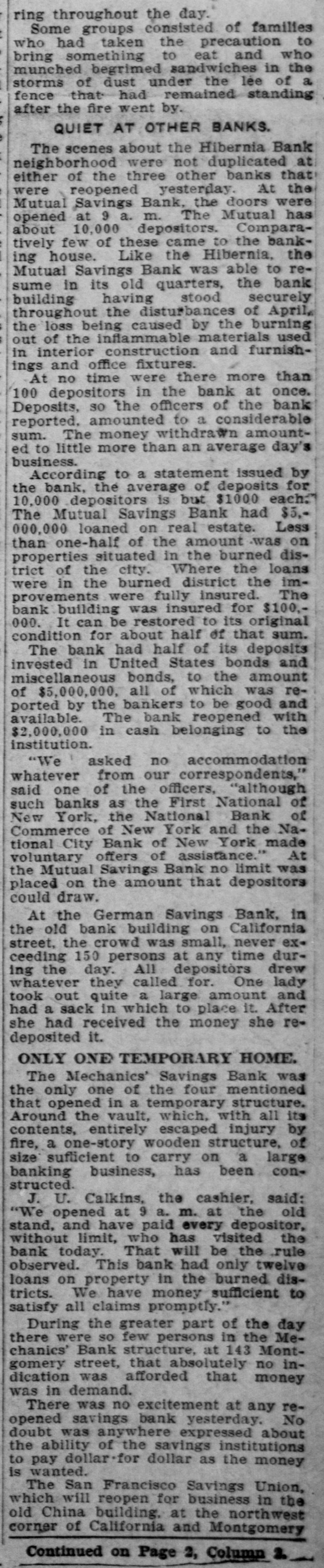
ring throughout the day. Some groups consisted of families who had taken the precaution to bring something to eat and who munched begrimed sandwiches in the a storms of dust under the lée of fence that had remained standing after the fire went by. QUIET AT OTHER BANKS. The scenes about the Hibernia Bank neighborhood were not duplicated at either of the three other banks that the were reopened yesterday. At Mutual Savings Bank, the doors were has opened at 9 a. m. The Mutual about 10,000 depositors. Comparafew of these came to the bank- the ing tively house. Like the Hibernia, Mutual Savings Bank was able to resume in its old quarters, the bank building having stood securely throughout the disturbances of April, loss being caused by the burning used the of the inflammable materials in out interior construction and furnishings and office fixtures. At no time were there more than depositors in the bank at once. 100 Deposits, so the officers of the bank reported. amounted to a considerable The money withdrawn amountsum. ed to little more than an average day's business. According to a statement issued for by bank, the average of deposits each." the 10,000 depositors is but $1000 The Mutual Savings Bank had $5.000,000 loaned on real estate. Less than one-half of the amount was dis- on properties situated in the burned loans of the city. Where the imtrict in the burned district the The were provements were fully insured. $100,building was insured for bank It can be restored to its original 000. condition for about half of that sum. The bank had half of its deposits invested in United States bonds and miscellaneous bonds, to the amount re$5,000,000, all of which was and of by the bankers to be good with ported available. The bank reopened the $2,000,000 in cash belonging to institution. "We asked no accommodation whatever from our correspondents." one of the officers, "although of said banks as the First National of such York, the National Bank NaNew of New York and the tional Commerce City Bank of New York made At voluntary offers of assistance." Mutual Savings Bank no limit was placed the on the amount that depositors could draw. the German Savings Bank, in At old bank building on California street, the the crowd was small, never dur- ex150 persons at any time drew ceeding the day. All depositors lady ing whatever they called for. One and out quite a large amount After had took a sack in which to place it. she had received the money she redeposited it. ONLY ONE TEMPORARY HOME. The Mechanics' Savings Bank was only one of the four mentioned the opened in a temporary structure. all its that the vault, which, with by contents, Around entirely escaped injury of fire, a one-story wooden structure, size suflicient to carry on a large banking business, has been constructed. U. Calkins, the cashier, said: old J. opened at 9 a. m. at the 'We and have paid every depositor, the stand, without limit, who has visited today. That will be the rule observed. bank This bank had only twelve on property in the burned dis- to loans tricts. We have money sufficient satisfy all claims promptly. During the greater part of the Me- day were so few persons in the there Bank structure, at 143 Mont- inchanics' street, that absolutely no dication gomery was afforded that money was in demand. There was no excitement at any re- No opened savings bank yesterday. about doubt was anywhere expressed ability of the savings institutions to the pay dollar+for dollar as the money is wanted. The San Francisco Savings Union, which will reopen for business in the China building. at the northwest old corner of California and Montgomery Continued on Page 2, Column 2.