Article Text
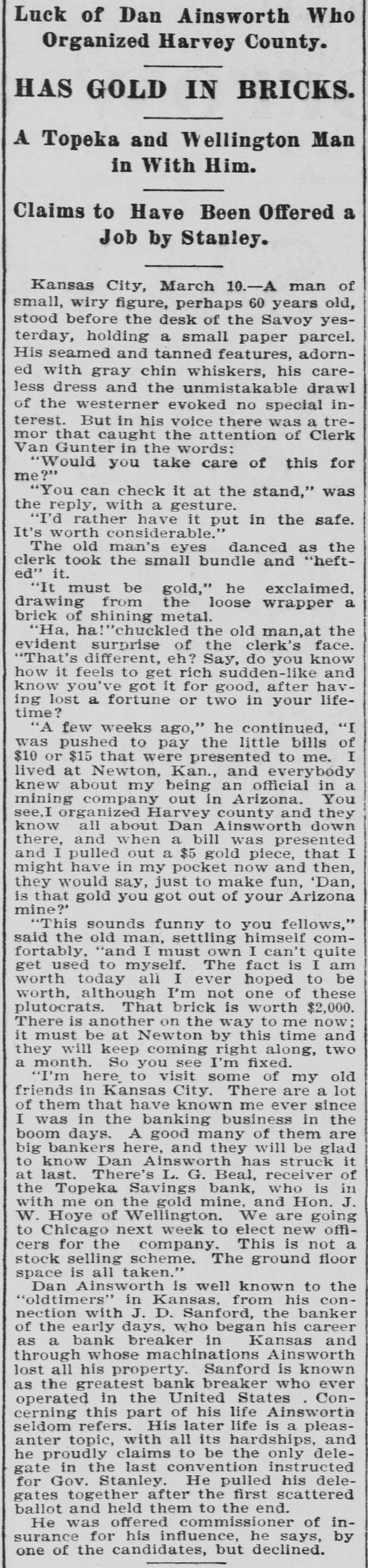
Luck of Dan Ainsworth Who Organized Harvey County. HAS GOLD IN BRICKS. A Topeka and Wellington Man in With Him. Claims to Have Been Offered a Job by Stanley. Kansas City, March 10.-A man of small, wiry figure, perhaps 60 years old, stood before the desk of the Savoy yesterday, holding a small paper parcel. His seamed and tanned features, adorned with gray chin whiskers, his careless dress and the unmistakable drawl of the westerner evoked no special interest. But in his voice there was a tremor that caught the attention of Clerk Van Gunter in the words: "Would you take care of this for me?" "You can check it at the stand," was the reply, with a gesture. "I'd rather have it put in the safe. It's worth considerable." The old man's eyes danced as the clerk took the small bundle and "hefted" it. "It must be gold," he exclaimed. drawing from the loose wrapper a brick of shining metal. "Ha, chuckled the old man,at the evident surprise of the clerk's face. "That's different, eh? Say, do you know how it feels to get rich sudden-like and know you've got it for good, after having lost a fortune or two in your lifetime? "A few weeks ago," he continued, "I was pushed to pay the little bills of $10 or $15 that were presented to me. I lived at Newton, Kan., and everybody knew about my being an official in a mining company out in Arizona. You see,I organized Harvey county and they know all about Dan Ainsworth down there, and when a bill was presented and I pulled out a $5 gold piece, that I might have in my pocket now and then, they would say, just to make fun, 'Dan, is that gold you got out of your Arizona mine?' "This sounds funny to you fellows," said the old man, settling himself comfortably, "and I must own I can't quite get used to myself. The fact is I am worth today all I ever hoped to be worth, although I'm not one of these plutocrats. That brick is worth $2,000. There is another on the way to me now: it must be at Newton by this time and they will keep coming right along, two a month. So you see I'm fixed. "I'm here to visit some of my old friends in Kansas City. There are a lot of them that have known me ever since I was in the banking business in the boom days. A good many of them are big bankers here, and they will be glad to know Dan Ainsworth has struck it at last. There's L. G. Beal, receiver of the Topeka Savings bank, who is in with me on the gold mine, and Hon. J. W. Hoye of Wellington. We are going to Chicago next week to elect new officers for the company. This is not a stock selling scheme. The ground floor space is all taken." Dan Ainsworth is well known to the "oldtimers" in Kansas, from his connection with J. D. Sanford, the banker of the early days, who began his career as a bank breaker in Kansas and through whose machinations Ainsworth lost all his property. Sanford is known as the greatest bank breaker who ever operated in the United States Concerning this part of his life Ainsworth seldom refers. His later life is a pleasanter topic, with all its hardships, and he proudly claims to be the only delegate in the last convention instructed for Gov. Stanley. He pulled his delegates together after the first scattered ballot and held them to the end. He was offered commissioner of insurance for his influence, he says, by one of the candidates, but declined.

