American Loan & Trust Company (New York, NY)

Episode Information

Episode UID
9496449991094
Episode Type
Run β†’ Suspension β†’ Closure
Bank Type
trust
Bank ID
949644999 hash
Start Date
February 17, 1891
Location
New York, New York (40.714, -74.006)

Metadata

Model
gpt-5-mini (chosen from majority vote of a three-model LLM ensemble)
Short Digest
52a51a4568d0693c

Response Measures

None

Description

Superintendent/examiner took possession and a receiver was appointed; assets deficiency reported in articles.

Events (3)

1. February 17, 1891 Run
Cause
Correspondent
Cause Details
Large unexpected demands by savings banks/correspondent banks (demands of $200,000–$360,000) triggered heavy withdrawals.
Measures
Paid smaller accounts on demand; persons presenting large checks were requested to wait a few hours.
Newspaper Excerpt
The run on the American Loan and Trust company was continued this morning.
Source
newspapers
2. February 18, 1891 Suspension
Cause
Government Action
Cause Details
Superintendent/examiner took possession after the company could not meet large demands; proceedings to appoint a receiver were begun.
Newspaper Excerpt
The American Loan and Trust company closed its doors this morning. ... the superintendent took possession.
Source
newspapers
3. March 8, 1891 Receivership
Newspaper Excerpt
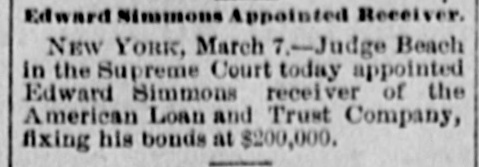
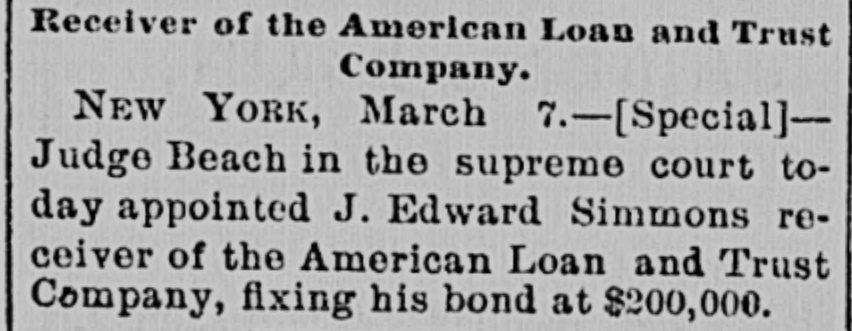
J. Edward Simmons has been appointed receiver of the American Loan and Trust Company of New York, with a bond of $200,000.
Source
newspapers

Newspaper Articles (23)

Article from Los Angeles Herald, February 18, 1891

Click image to open full size in new tab

Article Text

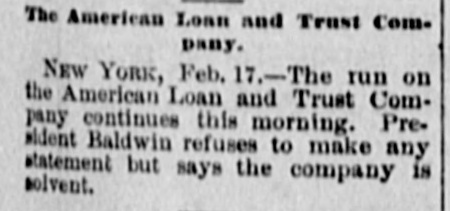
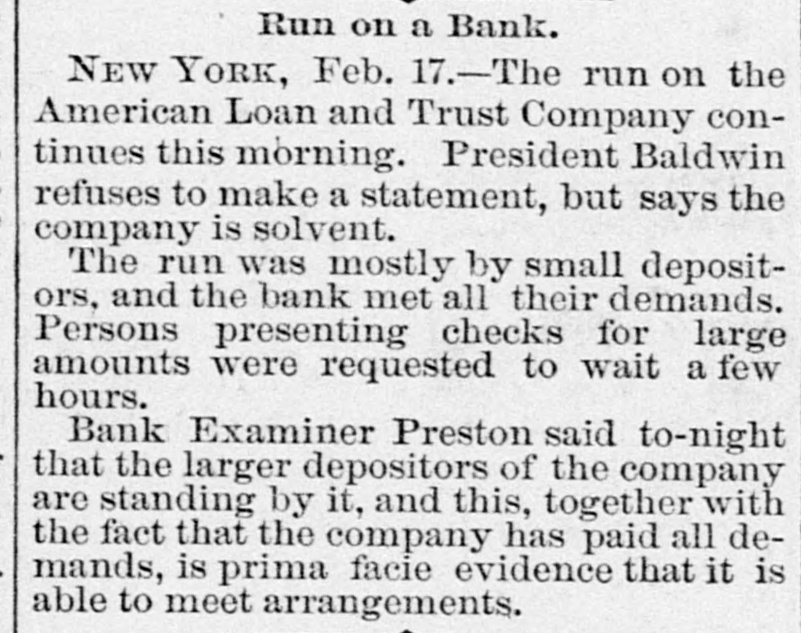
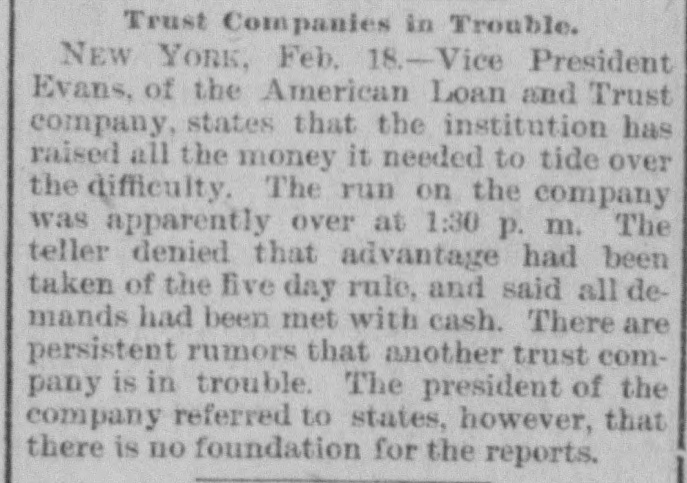
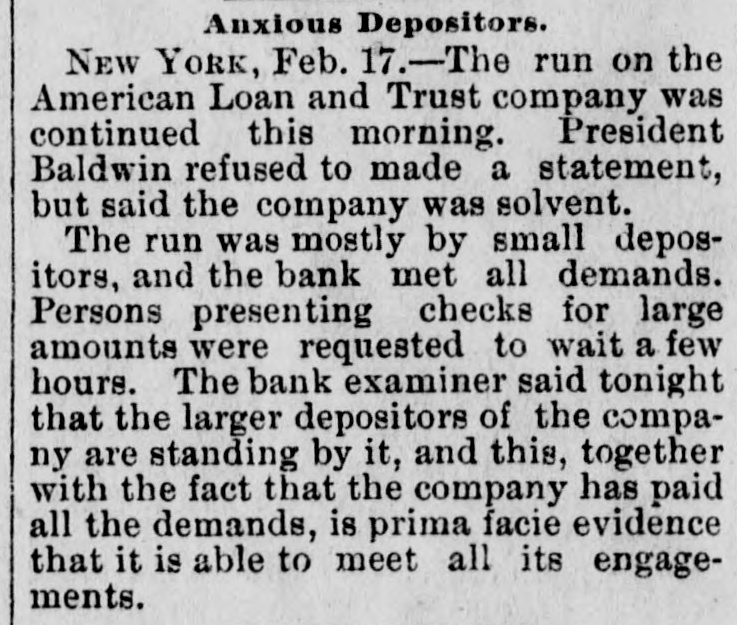
Anxious Depositors. NEW YORK, Feb. 17.-The run on the American Loan and Trust company was continued this morning. President Baldwin refused to made a statement, but said the company was solvent. The run was mostly by small depositors, and the bank met all demands. Persons presenting checks for large amounts were requested to wait a few hours. The bank examiner said tonight that the larger depositors of the company are standing by it, and this, together with the fact that the company has paid all the demands, is prima facie evidence that it is able to meet all its engagements.

Article from St. Paul Daily Globe, February 18, 1891

Click image to open full size in new tab

Article Text

ONE MILLION DUE. Run on the American Loan and Trust Company Diminished. NEW YORK, Feb: 17.-The run on the American Loan and Trust company was somewhat diminished to-day. There is still about $1,000,000 due depositors. The smaller accounts were paid upon demand, but persons presenting checks for large amounts were requested to wait a few hours. The company's contract with its depositors gives it the right to require a five days' notice of intended withdrawal of deposits. but this right has not been exercised as yet. State Bank Examiner Poston said tonight: It appears that the books and securities agree; that the books are well kept. and that the larger depositors of the company are standing by it. This fact, together with the fact that the company has paid all demands upon it, is prima facie evidence that it is able to meet all its engagements in full.


Article from New-York Tribune, February 19, 1891

Click image to open full size in new tab

Article Text

WHAT WAS DONE IN STOCKS. Wednesday, Feb. 18-p. m. Speculation in stocks was depressed to-day by several unfortunate circumstances. Public interest was not excited, however, and the character of the trading was not changed. The failure of the American Loan and Trust Company-the first of that kind since 1857-had only a sentimental influence, because it had been expected, and the renewal of gold shipments was admitted to be outside of exchange transactions. The closing of the trust company was magnified in some quarters, distant from Wall Street in time and spirit, and possibly the full effects of the suspension were not felt. Rumors of an advance .in the Bank of England rate of discount were not supported by higher rates for money in London or New-York, but a rally in the price of siler recalled the fact that the present Congress had not adjourned. The efforts in favor of a lower range of prices were zealous and persistent, but they met with indifferent success. Chicago, Burlington and Quincy stock was the chief point of interest, and following the same course that it did yesterday, it advanced in the early dealings only to lead the subsequent decline. It was reinforced by the fresh weakness of Rock Island, and naturally doubts about the next dividend on that stock were not permitted to slumber. The downward movement of prices was not arrested, in other words, but the resistance that was offered was remarkable. Excepting the principal Granger shares, which lost something less than 2 per cent, the final declines were not more than 1-2 per cent on an average. The Northern Pacific stocks were exceptionally strong throughout the day, and, with a few specialties, recorded small advances. The net results of the trading were hardly worth the candle. therefore, because the short interest in the active shares was undoubtedly increased. The manipulation of Burlington and Quiney may have been for the purpose of selling stock, but it certainly was ineffectual in producing lower figures in the rest of the list. While railway traffic is dwindling, and consequently questions about rates are springing up everywhere-in the East perhaps more than in the West-the general conditions affecting speculation are more than satisfactory. The closing was at about the lowest points, but it was neither active nor weak. The control of the market is still in the hands of small speculators, and consequently the movement of prices possesses little significance. THE DAY IN THE BOND MARKET There were no transactions in Government bonds, and bids for the 4 per cent issues were raised a fraction. The closing quotations were as follows:


Article from The Helena Independent, February 19, 1891

Click image to open full size in new tab

Article Text

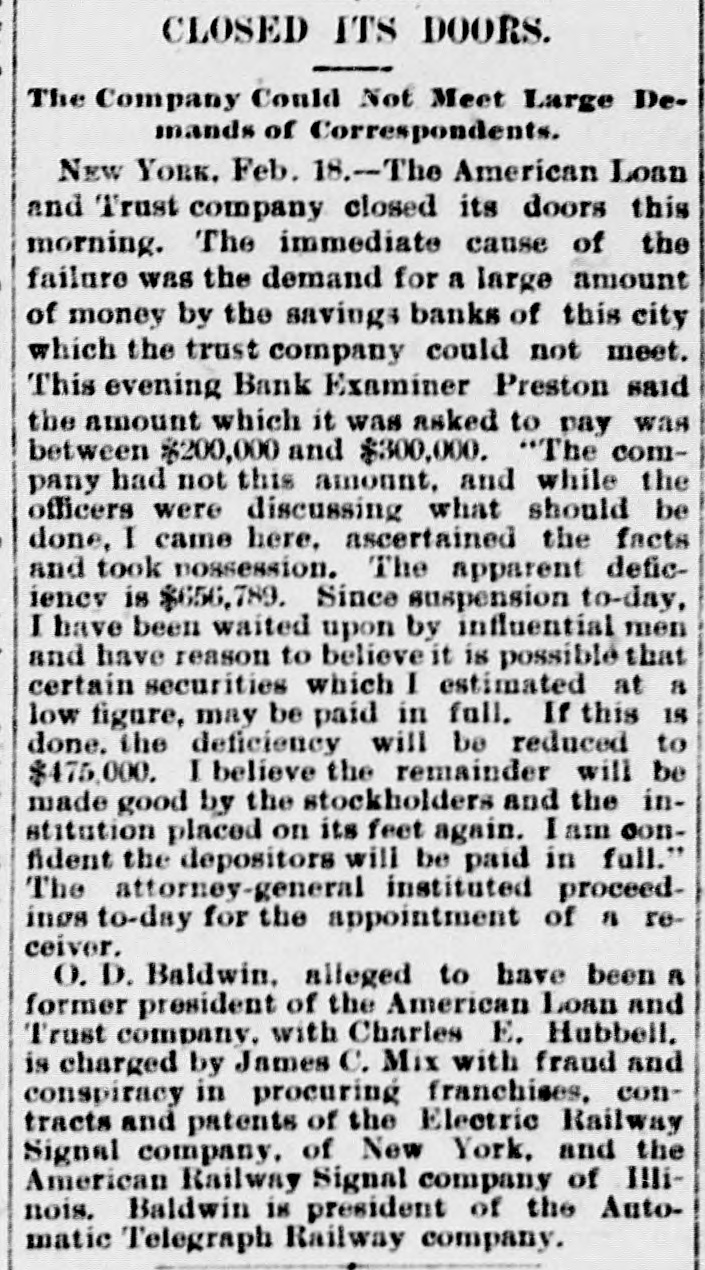
CLOSED ITS DOORS. The Company Could Not Meet Large Demands of Correspondents. NEW YORK. Feb. 18.-The American Loan and Trust company closed its doors this morning. The immediate cause of the failure was the demand for a large amount of money by the savings banks of this city which the trust company could not meet. This evening Bank Examiner Preston said the amount which it was asked to pay was between $200,000 and $300,000. "The company had not this amount. and while the officers were discussing what should be done, I came here. ascertained the facts and took possession. The apparent deficienev is $656,789. Since suspension to-day, I have been waited upon by influential men and have reason to believe it is possiblΓ© that certain securities which I estimated at a low figure, may be paid in full. If this 18 done. the deficiency will be reduced to $475,000. I believe the remainder will be made good by the stockholders and the institution placed on its feet again. I am confident the depositors will be paid in full." The attorney-general instituted proceedings to-day for the appointment of n receiver. O. D. Baldwin, alleged to have been A former president of the American Loan and Trust company. with Charles E. Hubbell. is charged by James C. Mix with fraud and conspiracy in procuring franchises. contracts and patents of the Electric Railway Signal company. of New York, and the American Railway Signal company of Illinois. Baldwin is president of the Automatic Telegraph Railway company.

Article from Evening Journal, February 19, 1891

Click image to open full size in new tab

Article Text

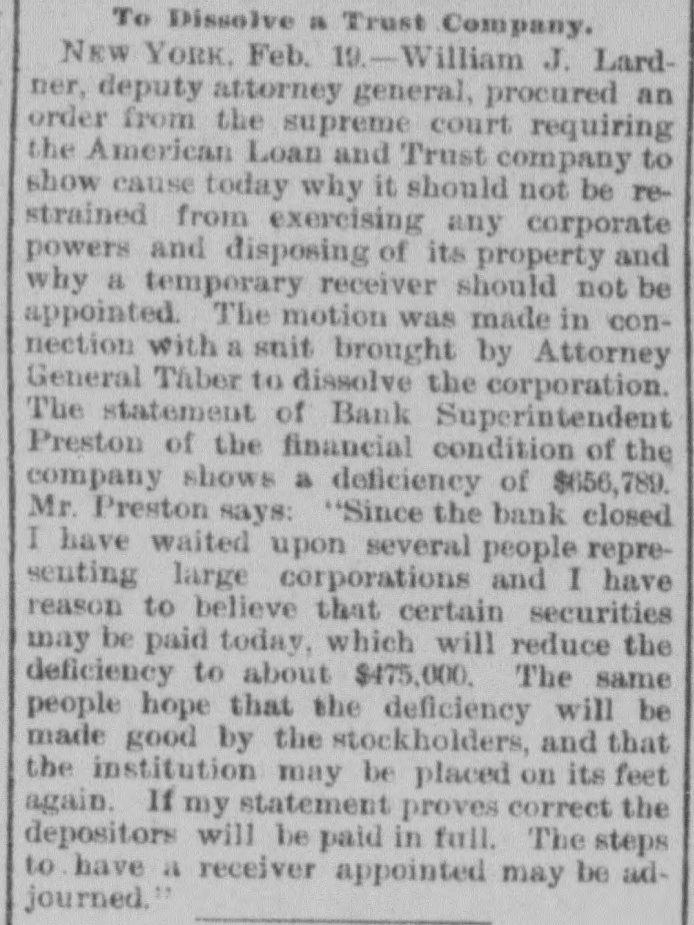
To Dissolve is Trust Company. NEW YORK, Feb. - William J. Lardner, deputy attorney general, procured an order from the supreme court requiring the American Loan and Trust company to show cause today why it should not be restrained from exercising any corporate powers and disposing of its property and why a temporary receiver should not be appointed. The motion was made in connection with a suit brought by Attorney General Thber to dissolve the corporation. The statement of Bank Superintendent Preston of the financial condition of the company shows a deficiency of $656,789. Mr. Preston says: "Since the bank closed I have waited upon several people representing large corporations and I have reason to believe that certain securities may be paid today, which will reduce the deficiency to about $475,000. The same people hope that the deficiency will be made good by the stockholders, and that the institution may be placed on its feet again. If my statement proves correct the depositors will be paid in full. The steps to have a receiver appointed may be adjourned.

Article from Waterbury Evening Democrat, February 19, 1891

Click image to open full size in new tab

Article Text

Savings Banks Demand Payment. NEW YORK, Feb. 19.-There is no excitement over the closing the doors of the American Loan and Trust Company. There were three savings banks, one in Syracuse, one in Rochester and an: outside bank, the name of which is not known, demanded payment of deposits amounting to $360,000. The institution could not pay, and at the request of one of the savings banks, the Superintendent took possession. The deposits of the company amounted to about $2,275,000, and of this amount over 60 per cent. has been paid out since the run commenced

Article from Deseret Evening News, February 19, 1891

Click image to open full size in new tab

Article Text

CAUSE OF THE FAILURE. Demand for Large Sums of Money by is New York Bank. NEW YORK, Feb. 18.-The immediate cause of the failure of the American Loan and Trust Company was a demand for " large amount of money made by a savings bank of this city which the company could not meet. The bank examiner states that he gave no order to close doors, and the general feeling seems to be that the company will pay the depositors in full, and have a balance left. Three savings banks, one In Syracuse, one in Rochester and another outside bank demanded payment of deposits amounting to $300,000. The Institution could not pay and, at the request of one of the savings banks, the superintendent took possession. Later he sent for Bank Examiner Cahill, who is now in charge. No statement can be had yet. This evening Bank Examiner Pres. ton said the closing of the bank was brought about by UNEXPECTED DEMANDS by certain savings banks. "The amount which it was asked to pay was between $200,000 and $300,000. The company had not this amount, and while the officers werediscussing what had better be done, I came here, ascertained the facts and took possession. When the business was figured up last Friday the assets were $2,168,036. The amount loaned on collaterals was $1,513,637. The liabilities amount to $2.824,826 and the apparent deficiency is $656,789." "Since the suspension today," said Mr. Preston, "I have been waited upon by influential men and have reason to believe it is possible that certain securities which I estimated at a low figure may be PAID IN FULL. If this is done the deficiency will be reduced to $475,000. I believe then the remainder will be made good by the stockholders, and the institution be placed on Its feet. I am confident the depositors will be paid in full." The Attorney-General instituted proceedings today for the appointment of a receiver. The indications tomorrow will decide whether the suit will be pressed. O. D. Baldwin, alleged to be the


Article from The Stark County Democrat, February 19, 1891

Click image to open full size in new tab

Article Text

Run on a Trust Co. NEW YORK, Feb. 17.-[Special.]-There was a big run on the American Loan and Trust company this morning. They are reported to have lost $3 4,000.

Article from Richmond Dispatch, February 19, 1891

Click image to open full size in new tab

Article Text

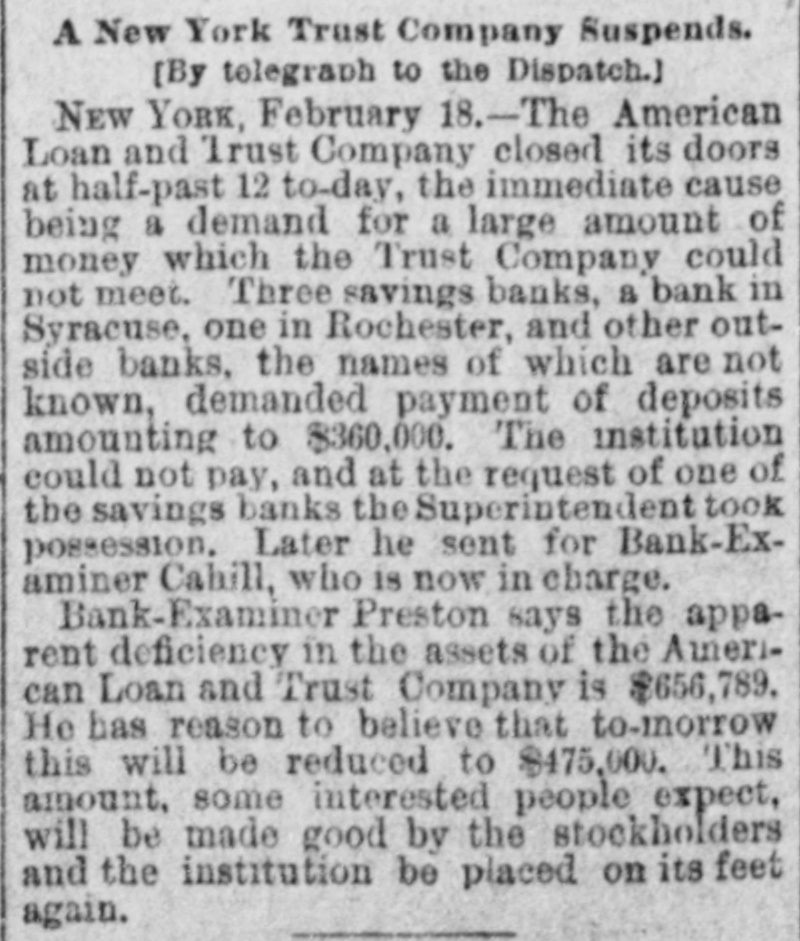
A New York Trust Company Suspends. [By telegraph to the Dispatch.] NEW YORK, February 18.-The American Loan and Trust Company closed its doors at half-past 12 to-day, the immediate cause being a demand for a large amount of money which the Trust Company could not meet. Three savings banks, a bank in Syracuse, one in Rochester, and other outside banks, the names of which are not known, demanded payment of deposits amounting to $360,000. The institution could not pay, and at the request of one of the savings banks the Superintendent took possession. Later he sent for Bank-Examiner Cahill, who is now in charge. Bank-Examiner Preston says the apparent deficiency in the assets of the Ainerican Loan and Trust Company is $656,789. He has reason to believe that to-morrow this will be reduced to $475,000. This amount, some interested people expect, will be made good by the stockholders and the institution be placed on its feet again.

Article from Deseret Evening News, February 19, 1891

Click image to open full size in new tab

Article Text

CAUSE OF THE FAILURE. Demand for Large Sums of Money by is New York Bank. NEW YORK, Feb, 18.-The immediate cause of the failure of the American Loan and Trust Company was a demand for a large amount of money made by a savings bank of this city which the company could not meet. The bank examiner states that he gave no order to close doors, and the general feeling seems to be that the company will pay the depositors in full, and have a balance left. Three savings banks, one In Syraeuse, one in Rochester and another outside bank demanded payment of deposits amounting to $800,000. The Institution could not pay and, at the request of one of the savings banks, the superintendent took possession. Later he sent for Bank Examiner Cahill, who is now in charge. No statement can be had yet. This evening Bank Examiner Preston said the closing of the bank was brought about by UNEXPECTED DEMANDS by cortain savings banks. "The amount which it was asked to pay was between $200,000 and $300,000. The company had not this amount, and while the officers were discussing what had better be done, I came here, ascertained the facts and took possession. When the business was figured up last Friday the assets were $2,168,036. The amount loaned on collaterals was $1,513,637. The liabilities amount to $2,S24,826 and the apparent deficiency is $656,789." "Since the suspension today," said Mr. Preston, "I have been waited upon by influential men and have reason to believe it is possible that certain securities which I estimated at a low figure may be PAID IN FULL. If this is done the deficiency will be reduced to $475,000. I believe then the remainder will be made good by the stockholders, and the institution be placed on its feet. I am confident the depositors will be paid in full." The Attorney-General instituted proceedings today for the appointment of a receiver. The indications tomorrow will decide whether the suit will be o pressed. O. D. Baldwin, alleged to be the


Article from The Madison Daily Leader, February 20, 1891

Click image to open full size in new tab

Article Text

BUSINESS REVERSES. A Large New York Concern Closen Its Doors. NEW YORK, Feb. 19.-The American Loan and Trust company has closed its doors. The immediate cause of the fallure was a demand for a large amount of money made by the Savings bank, of this city, which the trust company could not meet. Bank Examiner Preston said: The closing of the bank was brought about by unexpected demands by certain savings banks. The amount which It was asked to pay was beetween $200,000 and $300,000. The company had not this amount, and while the officers were discussing what had better be done, I came here. ascertained the facts, and took possession. When the business was figured up last Friday the assets were $2,168,038; the amount loaned on collaterals was $2,132,450. and the value of collaterals, as figured out, was $1,513,637. The liabilities amount to $2,824,897 and the apparent deficiency is $656,789. Since the suspension, I have been waited upon by influential men and have reason to believe It is possible that certain securities which I estimated at a low figure may be paid in full If this is done. the defielency will be" reduced to $475,000. I believe then the remainder will be made good by the stockholders and the institution may be placed on Its feet. I am confident the depositors will be paid in full. This is One at Kansas City. KANSAS CITY, Feb. 19.-The Union Invest. ment company assigned to-day for the beneft of creditors. The liabilities are about $1,000,000. and the assets. according to the officials of the company, about the same. It is Impossible, they say, to give an exact statement at present. The cause of the failure is given as a difficulty in calling western loans and negotiating paper in the east.


Article from Martinsburg Herald, February 21, 1891

Click image to open full size in new tab

Article Text

THE NEWS. James II. Kyle was elected United States Senator by the South Dakota legislature. Three men attempted to roba Chicago jew eler. The latter resisted, and two of the thieves were captured.-The convention of the Young People's Society of Christian En deavor will be held in Miuneapolis.-Teller Ritter, of the First National Bank of Evansville, Ind., has been arrested on a charge of misappropristing $77,000.-Ernest J. F. Barton, an artist, was found dead in his studio in Providence, R.I. He had committed suicide-At the village of Douglass, in Texas, Tom Robin, a notorious negro, was lynched -Near Petersboro', Tex.,S.C. Nicholas was shot and fatally wounded by his cousin, Marion Nicholas.-Judge Charles Hamilton, of Biddeford, will be impeached.-Miss Ara Saule Willing and John Jacob Astor were married in Philadelphia.-Isaae Fegley, a prominent resident of Pottstown, Pa., is dead.-Wm. Massey, head of the Wm. Massey Brewing Company of Philadelphia, is dead.-For stealing hens J. L. Sargent, of Waltham, Mass., was sent up for fourteen years.β€”The funeral of Admiral Porter was an imposing demonstration. The President and Cabinet attended, and the naval hero was interred with all the honors due his station. -Quite a number of important measures are yet to be disposed of by the present Congress-The schooner John W. Guskell, Captain Douglass, from Philadelphia to Savannah, went ashore on the Caroline coast. -The ammonia tank in an ice factory at Suffolk, Va., exploded, and the building was wrecked.--George E. Baker, sugar-sampler in the appraisers' office, Philadelphia, has been indicted by the grand jury for attempt. ing to defraud the government.-Snow thirty inches deep in Montana. John Spellman, who was arrested at St. Paul charged with robbing mails at Peoria, III., jumped from a train near Chicago, and escaped.-Brown Bros., dealers in crockery in Duluth, failed; assets $70,000, liabilities $53,000.-Small pox is doing great damage among the Mennonites in Marion county, Ks. -Several small railroad accidents occurred in and around Chicago to the dense fog. -Fire caused $75,000 damage at Minneapolis-Thestrike of weavers at the Cornell Mill, Fall river, Mass., has been settled. The weavers got what they asked for.-Fire bugs posted more notices about burning barns near Gettysburg.-Rumors in relation to the credit of the American Loan and Trust Company, of New York, circulated by H. R. R ch, a discharged employee, caused a run on the company and an investigation by the state examiner.-Grounding of an electric light wire caused a fire in the warehouse of Thompson & Coxe, carpet dealers, Philadelphia, which did $150,000 damage.-It is reported that a close alliance has been formed between the Louisville, New Albany and Chicago Railroad and the Richmond Terminal Company.-The general postoffice building in New York city was damaged $25,000 by fire and hundreds of bags of newspapers were burned. Jay Jewett, a museum wonder, died In Mason City, Iowa.-Cashier Spanlding, of the First National Bank of Ayer, Mass., says that he lost the money he took in speculation.The bottle handed-ever by Gibson, of the Chicago whiskey trust, who is charged ith attempted arson, was filled with all explosive fluid.-Owing to a strike, the work of grad. ing in Jackson Park, Chicago, in preparation for the World's Fair, in at a standstill.Seven workmen were hurt by the collapse of a platform in Jersey City.-The charges against State Comptroller McCall, of Texas, with misapplying State funds have been sustained.-W. Pullman, president of the Seaboard National Bank of New York, is dead.-Edward Niebert, who escaped from jail at Easton, Pa., was captured in Phillipsbury, N. C.-All the mill weavers at the Cornell Mills in Fall River, Mass, went out on strike.-J. B. Flatt, agent of the Northwestern Elevator at Casselton, N. D., was murdered and robbed. The murderer se. cured about $10,000 in money and Fleit's gold watch. In Easton, Pa., Edward Werkheiser and his two horses were killed by a cave-in on the road over an old mine.--Two men, giving the names of Rogers and Heft, were arrested in Sacramento, Cal., charged with the murder of Captain Greenwood and wife. -W. Wednell, the postmaster at Sheeps head Bay, has decamped.-A bold, but unsuccessful attempt was made to rob the Citizens' Bank in Minneapolis.-Natural gas exploded in Marietta, Ind., and fatally injured two men.-The National Miners' Convention adopted a resolution that all miners and mine workers demand the eighthour work-day May next.-The legislative committee appointed to investigate the accounts of the Arkansas state treasurer recommend that criminal proceedings be taken. out Rufe Kitrello, noted monushiner and


Article from Iowa County Democrat, February 27, 1891

Click image to open full size in new tab

Article Text

THE LATEST TELEGRAMS. NEWS IN BRIEF WORK on the world's fair site in Jack son Park was resumed Thursday. GENERAL HENRY H SIBLEY, Minnesota's first governor, is dying at St. Paul. ADOLPH HOFFMAN and Alfred E. Frommett, silk manufacturers, of Paterson, N.. J. have assigned. THE finest alabaster quarry in the world has been discovered near Canyon City, Col. THE only child of Rider Haggard is reported to have died at the city of Mexico. THE Ohio river is still rising at Cincinnati, and a disastrous flood at that point is feared. "DIAMOND Joe Reynolds, the wellknown capitalist and steamboat-owner of Iowa, died Saturday at Prescott. Iowa. THIRTY inches of snow has fallen in Bozeman, Mont. within the last two days, and it is still snowing. THE crippled American loan and trust company of New York will be reorganized and financially strengthened. THE John D. Knox & Co., banking house at Topeka. Kas., has failed. Estimated liabilities, $250,000. THE bill conferring the elective franchise on women passed Thursday by the Kensas house of representatives. THE body of Professor Bancroft, of Brown's University, Providence, R. I., was found in Dyer's Pond Monday. He disappeared on December 8. PROFESSOR ALEXANDER WINCHELL of the Michigan University, a geologist of world-wide reputation, died at Ann Arbor Thursday morning. A PECULIAR feature of a recent storm at Salt Lake was a large quantity of salt which fell with the snow, all mixed ready to place in the freezer. MASTER WORKMAN T. V. POWDERLY of the Knights of Labor was stricken with heart disease at Toveka, Kan., but his condition is not dangerous. GIBSON, ot the whisky trust, gave bail in the sum of $25,000 Wednesday for his appearance when the indictment found against him by the state grand jury shall come to trial. OVER $2,000,000 was divided among the four children of Chauncy B. Blair, by the will of the late banker which was filed for probate Tuesday. THE will of the late J. N. McCullough, Vice President of the Pennsylvania Company, has been filed for probrate. His estate is valued at from $7,000,000 to $10,000.

Article from Pittsburg Dispatch, March 8, 1891

Click image to open full size in new tab

Article Text

LATE NEWS IN BRIEF. -Prince Jerome Napoleon is still very ill, -Firebugs have made repeated efforts to burn Leavenworth, Kan. -Fifteen hundred Indianapolis carpenters are idle because of the strike. -Washington State has doubled its World's Fair appropriation to $100,000. -The Minnesota Farmers' Alliance is said to be scheming to unload Ignatius Donnelly. -Many Canadian residents in Chicago visited Canada and voted the Liberal ticket. -Two Texas towns have begun suit for a part of the La Prieta grant, valued at $1,000,000. -The new McCarthyite paper, The National Press, issued its first number at Dublin yesterday. -The Southern Pacific Railroad has won its suit against the Government in an important land case. -"The Gondoliers" was played before the royal family on a stage in Windsor Castle, Friday evening. -The Texas Farmers' Alliance is split into two warring factions on the Railroad Commissioner question. -The Argentine Government announces its intention to save the banks, even at the cost of widespread ruin. -Joseph Wilkinson, once a wealthy paper manufacturer, committed suicide at New York by taking morphine. -A Mexican woman and five children were drowned at Soloms, Ariz., while endeavoring to cross the Gila river on a raft. -J. Edward Simmons has been appointed receiver of the American Loan and Trust Company of New York, with a bond of $200,000. -The body of Prof. Steffen, of Louisville, will be cremated in Cincinnati and his ashes scattered in the Ohio river, as requested by the deceased. -William H. Crawford, who is to be hanged at Decatur, III., for the murder of Mathias. has prepared a confession for posthumous publication. -The Parnellites and the anti-Parnellites are united in support of a bill in Parliament to put all end to the police spy system known as shadowing. -The State of South Carolina and its licensees has been restrained by the Federal Court for mining phosphates. A private company claims the monopoly. -E.Q. Whistler, a Pittsburg commercial traveler, was held up and robbed of his watch and a roll of bills at Springfield, Mo. The highwaymen were arrested. -The first steel steamer built on Lake Michigan will be launched next Saturday afternoon. it is the property of the Minnesota Steamship Company, and is named Matoa. -A farm hand named Trent. at Springfield. Ky., who eloped with his aged employer's young wife, Mrs. L. R. Lovelace, is being prosecuted by the old man for horse stealing. -Government officials are investigating the case of a wholesale lumber firm of Omaha who are accused of attempting to secure by fraud, thousands of acres of land in Washington. -Frank Antsem.manager of a Chicago livery stable. was arrested Friday night, charged with attempting to dispose of $3,000 worth of diamonds which he had found. He confessed. -A colored bootblack at Boston, Tex., who had been put off a moving Texas and Pacific train, fell under the wheels and had his legs cut off. and has been awarded $10,000 damages. -Lena Cunningham, aged 34, threw a quantity of vitriol into the face of her sister, Matilda, aged 27, while the latter lay sleeping in bed at Rochester, N. Y., burning her terribly. -Russian Consuls in foreign countries are forbidden to affix in future their vise to passports of Hebrewish travelers of any country, leading merchants and manufacturers excepted. -A series of robberies of the wires of the New York and New Jersey Telephone Company has taken place in Union county, New Jersey. A gang of daring thieves is operating. They climb the poles, cut the wires and carry the latter off.


Article from The Sun, March 12, 1891

Click image to open full size in new tab

Article Text

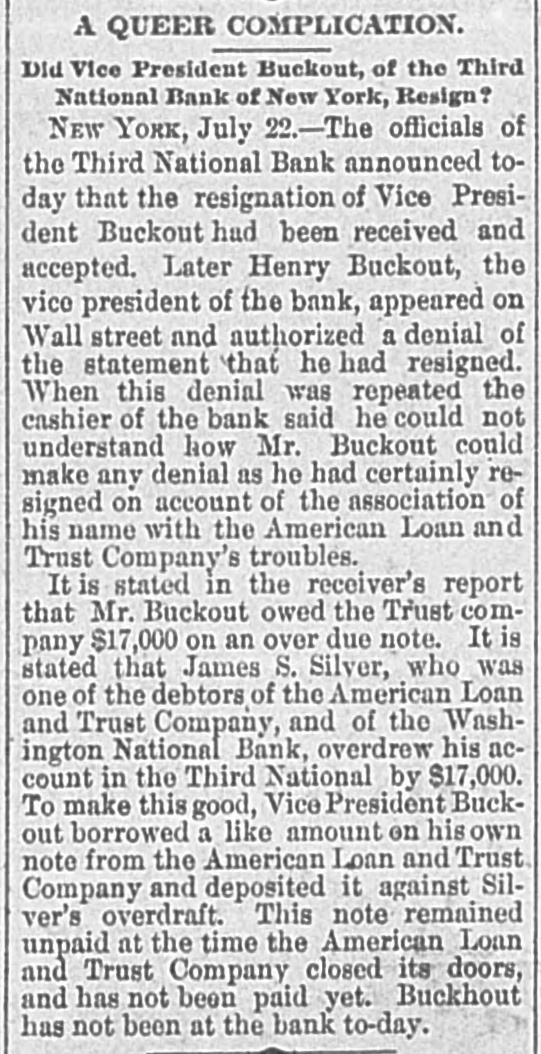
Receiver Simmons Takes Hold, J. Edward Simmons, receiver of the American Loan and Trust Company. took charge yesterday, and a full staff of clorks began work on the books and securities. Mr. Simmone 18 said that within a few days he would have some idea of what the stockholders would receive. It is almost certain that the depositors will be paid in full, The stock of the company is selling on the Real Estate Exchange and in Wall street at 14.


Article from The Jersey City News, July 22, 1891

Click image to open full size in new tab

Article Text

NEWS IN NOTES. Foreign, The Congregational International Council adjourned at London yesterday. A dispaten from Shaughal says that China is on the eve of another great rebellion. The Koloa-lfwei, or "Elder Brethred," the direct descendents and inheritors of the traditions of the Taipings, are convulsing the whole Empire by their uprisings along the valley of the Yangisze, from Chunking to Shanghai: Tue whole empire is in a ferment; Peking in a panic; foreign volunteers are drilling assiduously in Shaughai; war ships are burrying from ail parts of Chiuese and Japanese waters up the Yangtsze, and the yellow bosom of " The Eidest Son of the Ocean" is covered with the men-ofwar o: Great Britain, America, France and Germany. It is understood in England that a local government bill for Ireland, base I on the same lines as the English and Scotch acts, will Le introduced by the government at the next session of Parliament, and that the measure will become a leading part of the government programme for the next session. At the National Capital The movement for the continuance of four and one-half per cent bonds at two per cent is steadily growing in importauce. Papers covering about one-third of the $26,000,000 bonds held by national banks have been perfected, and the necessary withdrawal*, assignments and reissues are being made as rapidiy as possible. Instructions have been sent to the comndiug offices of the revenue steamer Woodbury, now in the vicinity of Eastport, Me., to proceed to St. Stephen, N. B., for the purpose of co-operating with United States Consul Nott in an investigation of the recent zure near Eastport of seven American fishing vessels for an alleged violation of the Dominion Fishery laws. New York City Doings. The Brooklyn ckbolders of the American Loan and Trust Company have asked the receiver, through conn-ei, to'sue the directors for neglect. Vice President Burkbart, of the Third National Bank, borrowed money of the trust company under curious circumstances. The health authorities removed Hop Sing, the Fifth street leper, to the Charity Hospital, Hector C, Havemeyer. of the well known sugar firm, who died in 1889, left $200,000 to be distributed among the charitable institutions. His mother has named the institutions and the amount to each. Charles W. Morrill, whose will has been filed, left $146,000 for charitable purposes. David Stewart's will bequeaths $10,000 to charities. $25,000 to his "faithful clerk" and $10,000 to his coachman. Stowaway Samuel Sherman Sicherman, alias Frank, the youthful American who was ordered nick to Europe on the steamship England, on which he came here as a stowaway, was released on his cousin's identification. The naval reserve drilled with the men of the white squadron in the North River, and Rear Admiral Walker declared that they had "good stuff" in them. Elsewhere. Alma Loeb, of Brooklyn, was married to Count Blucher, grandsen of Marshal Blucher, of Waterioo fame, but relatives of the bride separated the couple, because the husband had neither an income nor means of acquiring one. "Stonewall" Jackson's monument at Lexington, Va,, was dedicated, General Jubal A. Early delivering the oration. Major McKinley's chances of election as Governor of Ohio are believed to be endangered by the rivalry of Senator Sherman and ex-Governor Foraker, and by the anger of the wool growers over the operation of the new tariff law. The annual meeting of the New York State Hotel Men's Association was held at Siratega. A committee of the striking miners at Bricevile, Tenu., will confer with Governor Buchanan and try to settle the troubles over working convicts in the mines by arbitration. The miners pledge themselves to commit no violence. District Attorney Grabam and Attorney General Hensel of Philadelphia are getting ready to prosecute persons connected with the Bardsley rascality. Mayor Stuart expects that within the next two weeks the experts will make another report on their analysis of Bardsley's ac-


Article from New-York Tribune, July 22, 1891

Click image to open full size in new tab

Article Text

STOCKHOLDERS WILL SUE. DIRECTORS OF THE AMERICAN LOAN AND TRUST COMPANY BLAMED. HISTORY OF ONE OF THE COMPANY'S LOANSTHE RECEIVER GETS PERMISSION TO PAY A DIVIDEND. The publication of J. Edwards Simmons's report as receiver of the American Loan and Trust Company caused considerable stir in financial circles yesterday. Judge Barrett in the Supreme Court granted Mr. Simmous's application for permission to pay a dividend of 35 per cent to the preferred creditors. The same Judge substituted W. W. Flannagan in place of the American Loan and Trust Company as trustee under trust mortgage executed by the North and East River Railway Company upon its property to secure the payment of $250,000 of bonds which have been issued. One of the unpaid loans that attracted most attention was that of Henry Buckhout, the vice-president of the Third National Bank. In the receiver's report this appears as $17,762 50, due on June 1. Against It as collateral the company took $25,000 of East Shore Terminal Company first mortgage bonds at 6 per cent. Mr. Buckhout was formerly cashier of the Fourth National Bank, when o. D. Baldwin was its president. It is understood that the history of the loan is as follows: When James A. Simmons, John S. Silver, George H. Pell and others who had been connected with the Sixth National Bank began to be hard pushed, in September, 1890, Silver was permitted to overdraw his account at the Third National Bank for $17,500. On September 24 Mr. Buckbout secured a personal loan from the American Loan and Trust Company for $17,400. That same day be drew a check for the full amount to John S. Silver's order. Silver immediately \paid it over to the Third National Bank, thus making good his overdraft. The note given by Buckhout came due on January 27. It was renewed for four months, with interest added, making the total $17,762 50. This note was due on June 1. When the receiver took charge he found Mr. Buckhout's note among the assets. It is understood that Mr. Buckhout denied at first all knowledge of the note, but finally admitted having drawn it. It was not paid, however, when it fell due, and the receiver has now sued for the recovery of the amount. Mr. Buckhout was seen yesterday and had his attention drawn to the receiver's report. He said that the money was obtained in the course of legitimate business. The reporter called his attention to the story connected with the loan and Mr. Buckhout reasserted that it was a business transaction and remarked that he had nothing else to say. Asked with regard to the collateral, he said that negotiations were now in progress to take it up. He declared that the bonds were worth from 85 to 87 1-2, and that the company has always earned and paid dividends upon them. He also said that the company expected to make arrangements with the Clyde Steamship Company that would increase the value of the bonds. The bonds are not listed on the Stock Exchange and are difficult to sell in the market. John D. Silver, when asked about the loan, said that the money was not obtained for him, that his name did not appear on the check drawn against the Joan and that he did not receive the proceeds. He added that he was paying up his indebtedness to the American Loan and Trust Company and soon would not owe it a dollar. According to the receiver's report, the stock of the American Loan and Trust Company will be entirely (wiped out, but the Brooklyn stockholders do not propose to lose their money without a struggle. They hold about one-fourth of the stock. Under the leadership of John D. Jenkins and C. E. Staples they have taken active steps to protect their interests. They (believe that the directors left the management of Paffairs too much to the executive officers, and they propose to hold the directors personally responsible for their negligence. Mr. Jenkins said: In accordance with the advice of counsel, a committee of stockholders called on Mr. Simmons last Thursday and asked him to bring suit against the directors. He said he would be quite willing to do so of we would give definite information as to whom he should sue and precisely on what grounds. Our counsel is now engaged in getting up this informetion for him. I have no doubt he will act. In any event, the directors will be sued." The directors of the trust company elected at the last general election in May, 1890, were: John L. Macanley, George F. Hart. W. C. Andrews, J. R. Blair, W. P. Anderson, J. Aldrige, J. B. Kinney, Charles Farsons, G. A. Evans, G. P. Hawes, J. S. Thurston, B. F. Tracey, J. S. Silver, T. S. Goodrich, P. Merrill, H. Clark, T. C. Platt, O. D. Baldwin and G. P. Slade.


Article from The Sun, July 22, 1891

Click image to open full size in new tab

Article Text

BILL FOR DIRECTORS TO FOOT. $100KHOLDERS DON'T PROPOSE TO 'DNIHLLAURAS USOT Advised That the American Loan and Trust Company Was Nextigently ManagedThe Little Transaction of Silver and Backbout with the Help of Baldwin. Judge Barrett of the Supreme Court granted yesterday the application of Receiver J. Edwaid Simmons of the American Loan and Trust Company for leave to pay a dividend of 35 por cont. to the proferred creditors. Judge Marrett ist the same time substitoted W. W. Flanagan in place of the American Loan and Trust Company as trustee under a trust mortgage executed by the North and Fax: River Railway Company upon is property to secure $250.000 of bonds. Receiver Simmons is confident that the asROIS on hand will Day the preferred creditors in full. and that he can eventually pay 20cents on the delier to the unpreferred creditors. "If I can secure the claim for $360,050 against the Decatur and Nashville Improvement Com-un our And uco I.. p.ve 91. True preferred creditors in full. I tellove this claim against this company will eventually be good. but it will take some time to nd. ust it." Mr. Simmons spoke of the donbtful character of the other assets. He did not know what could be realized upon them. Ho was not conscious. however. that they would add materially to the roal assets on hand. Iio said very finily that the stockholders could not get penny. One of the most interesting cases arising Receiver 10 om @| 011 10 no Simmons against Henry Buckout for $17,762.50. Mr. Buckout was ashier of the Fourth Nati nal Bank when Octavius D. Baldwin was President of that bank. Mr. Baldwin became President of the American Loan and Trust Company and Mr. Buckout was made Vice-Prosident of the Third National Bank. The story is that Buckout. on -10A0 01 JOANS sugar P assured vast "17 3408 draw his account in the Third National Bank 100M Include pur in sud you PIP JAME WHIT 18011 puu un "I Americant on ;0 of protect 01 AQUOUI our pemorioq pue SUB mo,) himsel. making a time loan due Jan. 27 last. 1841 18 0104 our on exts you pino morean time. and 1: WAR extended with interest from -зипошС 11 USQA 7501 I ounr amp 01 our 81111 puno; suourding 100 n WOULDS 01 DE pau throry understand on 10 0.175 ey: "I of recorder open SUM on no M our 10 emperiment 11α΅—Κ° pepuep 1520 it inoxang em uo signature SIV po PP GRAD VII 0100 8 41111 SEM 04 1801 !" 1011 07 '0681 18 4008 no Insured A4 UMV 11. years the order " oun :. Silver. Esq.." for $17.400. -Π»Π΅Π»ΠΎ S,J9A11S pred =1 11 amount FINE drawn Recount n the Third National Bank 43 SHOWIS of MOUS THANK the money from Buckout has been unsuccess101. Mr. Simmons has. therefore brought suit. Buckout said yesterday that he did not PIP eH S141 mo " 5/01 ... one puu except 114 of you -tain HIV 4014A reserviΓ§Γ£o and 1941 on suppliens AND SHAL 11001 111 401 preup smout 10 MD 11 moe; 01 o; $25,000 of the East Shore Terminal Company first montinge. per cont. bonds. Mr. Buckout 98 require em 01 quote OWN 4000 1041 1420 41: 42.10M oToM sequire prus option on 10 309 "MOU poois required 011 SW 05 0: 04 more that they were forced for sale the price quaregup VIVA 00 Transacy 6141 inoqu porsu 110 wills : unter STAY 10 need BULL "II ruog no obtained or me. and my name does not MeTp Increase yours sq on uo 11:0 DIV 18811 pun THOM Americant on mon to FOR 041 AQUOU om T DIP sur mo.) 01 : : 0 chock. subjects ueas smill 10110001 sus SHE Mealis S uqof :0 Jopio off ino opena S| : SI chock SITE was An possopue pum company 10 spoug u; MOD The Brooklyn contingent of stockholders of -0.11 Amount THE punt QUOT employee on 011 up clints on 10 executive 1: the 0 esed sujuom NOS 38,1 " penonum service age. who oby all dire tors. either in Mr. Haz-


Article from The Sun, July 13, 1893

Click image to open full size in new tab

Article Text

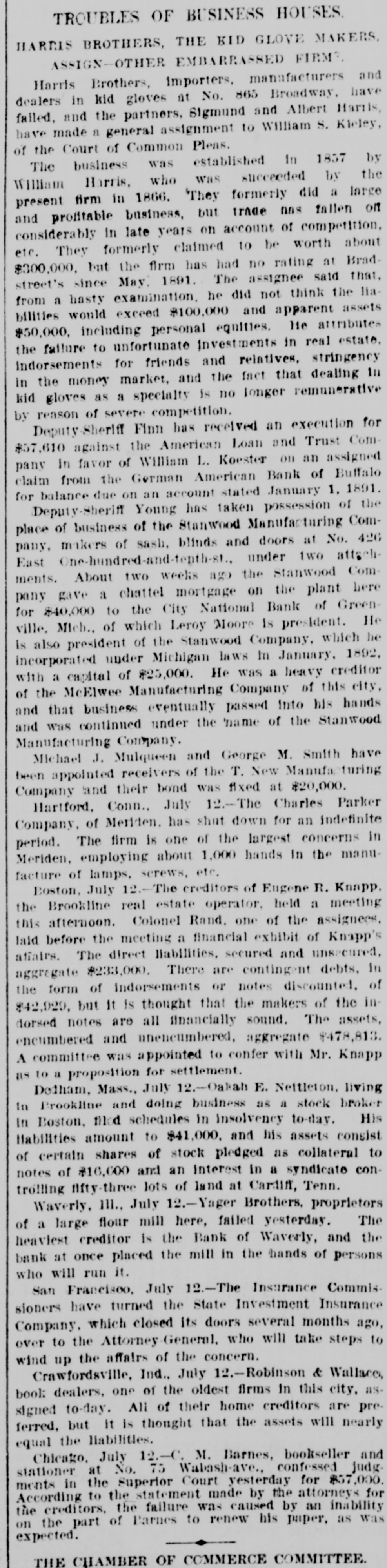
# KID GLOVE DEALERS FAIL Harris Brothers' Liabilities About $100, 000-Other Business Embarrassments. Harris Bros., importers, manufacturers and dealers in kid gloves at 865 Broadway, have failed and the partners, Sigmund and Albert Harris, made yesterday a general assignment to William S. Kieley of the Court of Common Pleas. They gave preferences for $16,252 as follows: Henry Manne of Brooklyn, $8,753 for money loaned; Charles S. Hirsch, $2,500 for money loaned; Charles L. Bucki, $4,999 to secure him for endorsing a note. The business was established in 1857 by William Harris, who was succeeded by the present firm in 1866. They formerly did a large and profitable business and reported themselves to be worth about $300,000, but the firm have had no rating at Bradstreet's since May, 1891. Assignee Kieley does not think the liabilities will exceed $100.000, with ap- parent assets of $50,000, including personal equities. The stringency in the money market pre- vented the firm from getting their usual ac- commodations. Their real estate venturos in- cluded unimproved lots at Sixth avenue and Fifty-eighth street, and the block of unim- proved lots between Eighth avenue and St. Nicholas avenue, 118th and 119th streets. All of this property was carried from fifteen to eighteen years, and when compelled to sell it to obtain money the net loss was nearly $200,000. Francis R. Elgar and Daniel F. Sheehan, composing the firm of Elgar & Sheehan, painters, at 333 Hudson street, have made an assignment to Henry Fredericks. They have been in business about twelve years. Deputy Sheriff Finn has received an execu- tion of $57,010 against the American Loan and Trust Company in favor of William 1. Koester on an assigned claim from the German-Ameri- can Bank of Buffalo for balance due on an ac- count stated Jan. 1, 1891. Deputy Sheriff Young has taken pos- session of the place of business of the Stanwood Manufacturing Company, sash, blinds, and doors, at 420 East 110th street, under two attachments, one for $956 obtained for Morris & Williams and the other for $509 in favor of the Nichols Lumber Com- pany. About two weeks ago the Stanwood Company gave a chattel mortgage on the plant here for $40.000 to the City National Bank of Greenville, Mich., of which Leroy Moore is President. He is also President of the Stan- wood Company, which he incorporated under Michigan laws in January, 1892, with capital of $25,000. Michael J. Mulqueen and George M. Smith have been appointed receivers of the T. New Manufacturing Company, roofing materials, and their bond has been fixed at $20,000. The Sheriff has received an attachment for $11,209 against Micaela F. de Quinn in favor of Elias A. de Lima and others, and has at- tached a life insurance policy. The Sheriff has received two executions for $3.524 against the Chemical Rubber Company, which has an office at 15. Park row, in favor of N. Chapman Mitchell.


Article from The Progressive Farmer, July 18, 1893

Click image to open full size in new tab

Article Text

Harris Bros., New York, importers, manufacturers and dealers in kid gloves, assigned on the 12th. Liabilities, $100,000. Elgar & Sheehan, painters, New York, assigned on the 12th. Richard Wooley's Sons, New York, were attached by the sheriff for a debt of $21,000 on the 12th. American Loan and Trust Company, New York, were attached by an execution for $57,610 on the 12th. Attachments were issued on the 12th against the Standard Manufacturing Co., John H. Queen, M. F. De Quin, C. W. Webb, all of New York, on the 12th, for large amounts. The New Jersey Sheep and Wool Co., Trenton, N. J., went into the hands of a receiver on the 12th. A freight train on the Findly, Fort Wayne and Western R. R., was seized by a sheriff for taxes due, on the 12th. R. M. Ollcott, exporter of grain and general merchandise, N. Y., assigned on the 12th. Liabilities over $50,000. SIOUX CITY, July 14 - -Baker & Birhall, hardware merchants, have failed. Liabilities $10.000. BUFFALO, N. Y., July 13 The safe in Ward's Bank at Forestville has been opened at last. Only $71 in cash was discovered, mostly in silver and pennies. Very few securities were found. Certificates representing several thousand shares of mining stock, which are considered valueless, are all the assets now known. The liabilities are unobtainable. The only ones known are the amounts due depositors, which together are somewhat over $100,000. It is doubtful if the depositors will ever receive over 10 or 15 per cent. TERRE HAUTE, Ind., July 13.-The Terre Haute Car Works Company, the largest in Indiana, employing more

Article from New-York Tribune, January 27, 1894

Click image to open full size in new tab

Article Text

LOCAL BUSINESS COMPLICATIONS. The United States Fire Insurance Company yesterday filed notice of suits to foreclose two mortgages for $18,500 each, made by DorΓ© Lyon on January 12, 1891, to run three years, on two apartment houses on the south side of One-hundred-and-sixteenth-st., between Madison and Fifth aves. Mr. Lyon is said to be living at Lakewood, N. J. Judgment for $14,060 was entered yesterday against Elder H. Patterson, of Knoxville, Tenn., in favor of Frederick Hughes, on notes made on May 15, 1891, for $11,100 to the order of Louis Edwards, and on September 1, 1891, for $1,000 to the order of Joseph Larocque. Mr. Patterson is at the Broadway Central Hotel, this city. Judgment for $15,048 was entered yesterday aga nst Willard F. and George B. Inman, composing the firm of Inman Brothers, waterworks contractors of No. 136 Liberty-st., in favor of J. Edward Simmons, as receiver of the American Loan and Trust Company.


Article from New-York Tribune, November 16, 1894

Click image to open full size in new tab

Article Text

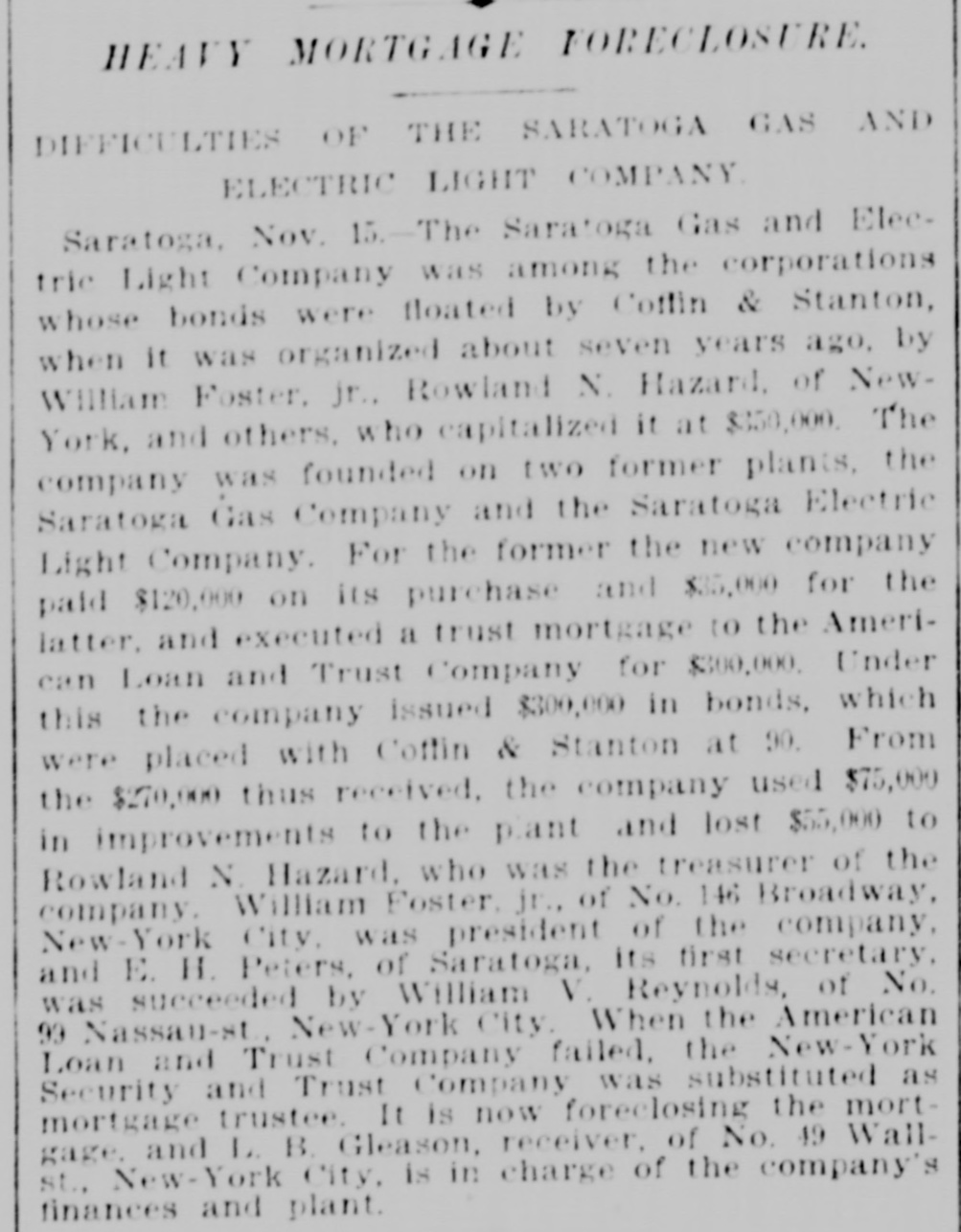
HEAVY MORTGAGE FORECLOSURE DIFFICULTIES OF THE SARATOGA GAS AND ELECTRIC LIGHT COMPANY Saratoga, Nov. 15.-The Saratoga Gas and Electrie Light Company was among the corporations whose bonds were floated by Coffin & Stanton, when it was organized about seven years ago, by William Foster, jr., Rowland N. Hazard of NewYork, and others, who capitalized it at $350,000. The company was founded on two former plants, the Saratoga Gas Company and the Saratoga Electric Light Company For the former the new company paid $120,000 on its purchase and $35,000 for the latter. and executed a trust mortgage to the American Loan and Trust Company for $300,000. Under this the company issued $300,000 in bonds, which were placed with Coffin & Stanton at 90. From the $270,000 thus received, the company used $75,000 in improvements to the plant and lost $55,000 to Rowland N Hazard, who was the treasurer of the company. William Foster jr., of No. 146 Broadway, New-York City, was president of the company, and E. H. Peters, of Saratoga, its first secretary, was succeeded by William V. Reynolds, of No. 93 Nassau-st. New-York City, When the American Loan and Trust Company failed. the New-York Security and Trust Company was substituted as mortgage trustee. It is now foreclosing the mortgage. and 1. B. Gleason, receiver, of No. 49 Wallst., New- York City, is in charge of the company's finances and plant.


Article from The Daily Morning Journal and Courier, November 30, 1894

Click image to open full size in new tab

Article Text

FINANCIAL A few years ago when, there was "money to burn" a neat financial trick was extensively played. In order to allay whatever little hesitation about burning their money some people might have a "guarantee" was given them that they could get their money back after they had burned it. This trick was especially efficient in the matter of western mortgages. Companies with gilt-edged names and gilt-edged directors made their appearance prepared to guarantee all creation If they were asked to. And between them they did guarantee most of the part of creation west of the Mississippi river in the United States of America. This generous and self-sacrificing action was greatly appreciated by thousands who had not taken the thirty-third degree in human nature and who had not lost faith in the ability of a company to do anything that its advertisements and its agents might say it could do. But alas for the hopes of men. It became plain after awhile that a "guarantee" when tested must have something to sustain it except wind. So there has been great trouble and loss. and though "doubtless the pleasure is as great of being cheated as to cheat," it will be some months before those who have been allowed to discover what a guarantee really is will want any more of the kind of pleasure they have found in the process. The pleasures and the usefulness of the guarantee are called to mind by an auction sale which took place in New York the other day. It was a sale of mortgages on properties in nine southern and eight northwestern and Pacific coast States, and somewhat more than $3,000,000 were realized, which was about 65 per cent. of their par value. There were 3,200 mortgages, and 175 parcels of land that had been obtained by foreclosures, sold. The loans on these properties had been made by the Equitable Mortgage company of Kansas, which had turned off all these mortgages to the American Loan and Trust company to secure the payment fo its debenture bonds. In 1890 the latter company failed, and the Supreme court of New York transferred the trusteeship to the New York Security and Trust company. In September, 1893, the Equitable Mortgage company failed, and its affairs were turned over to receivers. The debenture holders then called upon the New York Security company to sell those securities and in compliance with that demand the sale was ordered. So the holders of these debenture bonds may in the end get half the money they put into them back. And this will make them feel twice as well as they once expected to.