Article Text
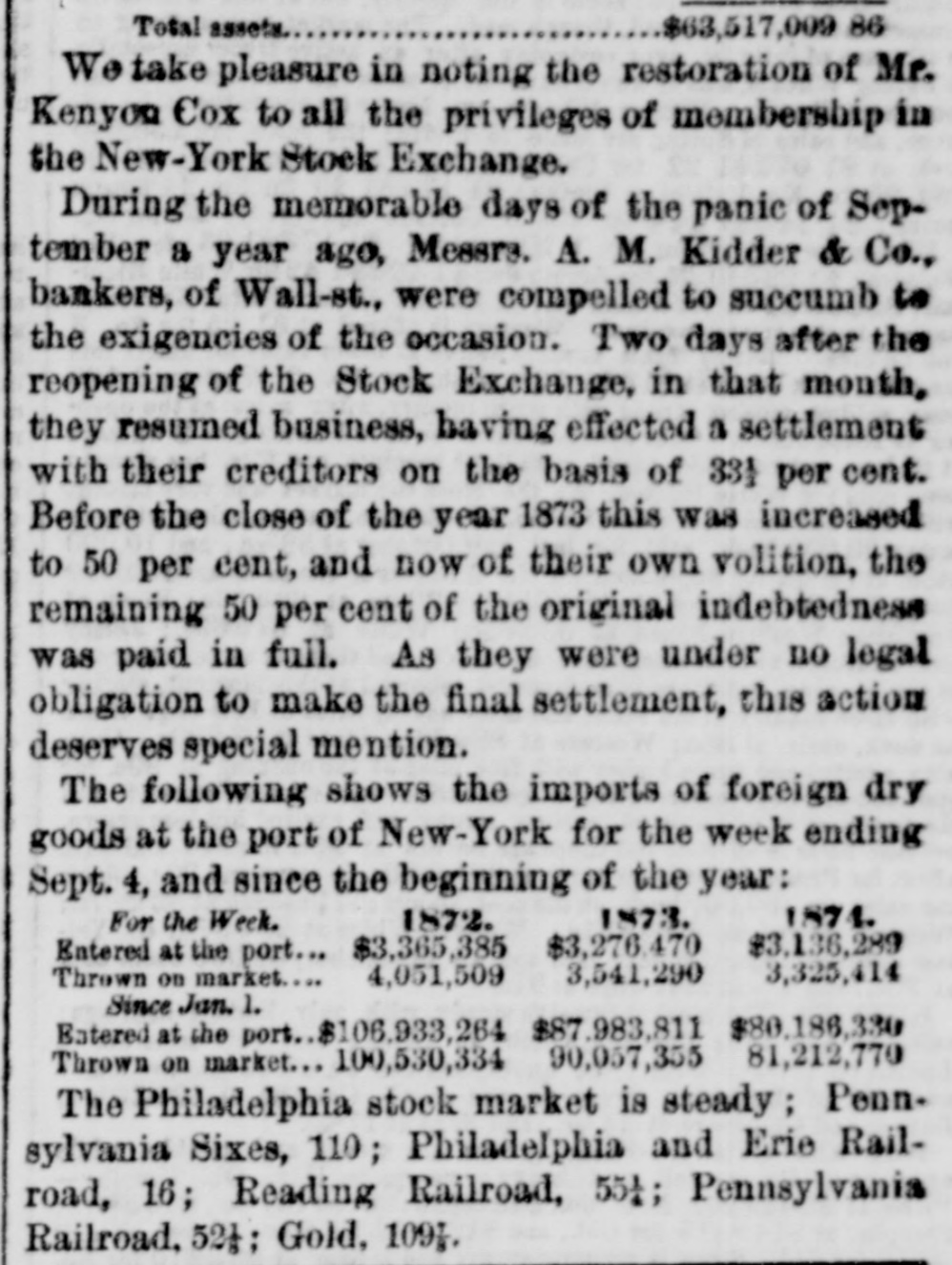
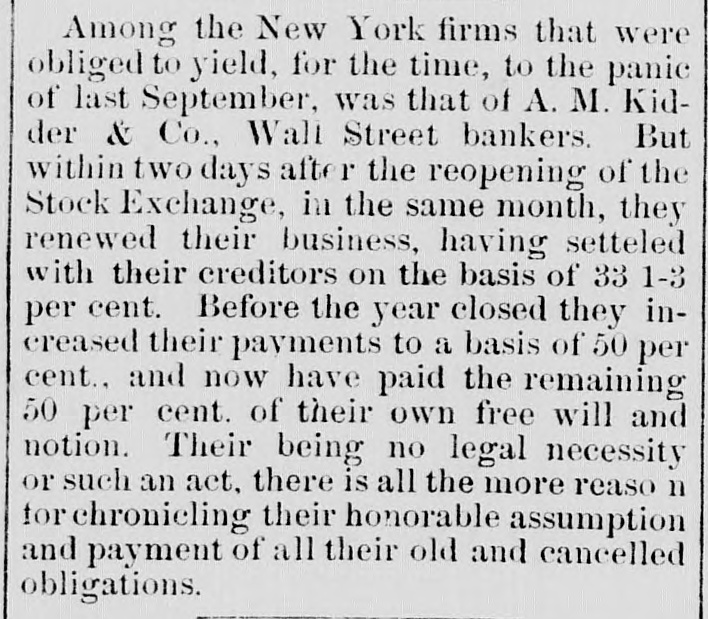
The Financial Crash ! Failture of Jay Cooke & Co., ANOTHER BLACK FRIDAY. The suspension of Jay Cooke& Co., which occurred on Thursday last has been the all absorbing topic in financial circles during the past week. There are three American houses belonging to this firm, one in New York one in Philadelphia, and one in Washington, all of which suspended. Mr. Cooke also connected with London House, which, is claimed will not be affected by the disaster. As may well supposed, the failure of this firm, which was supposed to possess abundant resources for all emergencies, produces a panic in financial circles throughout the country. In reference to the great excitement eccasioned by this great financial crash, we copy the following from the New York Sun, of Saturday Yesterday was the most disastrous day known in Wall street since 1857. Firms considered'among the soundest on the street suspended early in the day, and the panic consequent thereupon compelled the suspension of many smaller houses. The failure of the heavy concerns have nearly all, If not all, resulted from endorsements of new railway enterprises. The expansion of enterprise in this direction has been enormous within the past few years, more miles of railroad hav ing been constructed in the past six years than were built altogether before the war. Nearly all of this construction has been done on credit, houses in every other respect conservative having shouldered the enterprises, relying wholly upon the sale of railroad bonds to meet accruing obligations. Dull times must come occasionally, and such have been experionced by these houses in the past few months. The deposits of Western firms in New York banks and banking houses have of late been less than usual, and this, added to the fact that some currency has been locked up by speculators, has made money tight, and rendered the negotiations of all kinds of securities difficult, even when backed by the best houses. Prominent firms carrying railroad en terprises have consequently been forced to shoulder their load alone, and the drains upon them for interest and cost of construction have been enormous. Shrewd operators like Daniel Drew and Jay Gould foresaw the necessary result, and went short of stocksto a large amoun throwing all their influence to hasten the gener at catastrophe. The result is that they are said to have reaped a golden harvest amid extensive disaster Most of the smaller firms which have failed are mere stock brokersand speculators, who happened to be long of stocks and were unable to cover in time to save themselves from ruin.4 Many larger operators are believed to be seriously injured, and important suspentions to-day are expected. Nineteen concern suspended yesterday, of which the most important Fisk & Hatch, Greenleaf, Norris & Co. A M. Kidder & Uo., White, Defreitas & Rathborne, Hay & Warner, Jacob Little, and E. D. Randolph & Co. A run was made upon the Union Trust Company which continued up to 4 o'clock, the hour of closing. It how. ever, met all its obligations, paying out about a million of dollars, and claims to be able to do as well to-day and hereafter, until alibits creditors are entirely satisfied. One of the di rectors says that about noon some United States bonds were sent to the Manhattan Bank, where the Union Trust Company deposits, as collateral for a greenback loan, but the bank nefused to advance any money upon them. Possibly the Manhattan was not in a condition to lend on the best security, as the soundest institutions are just now earefully guarding against large withdrawals of funds by their depositors, bute such extreme caution justifiable only on the ground of absolute necessity. The failure of Fisk & Hatch surprised the best informed men of the street, as they were considered among the safestiof/tirms. Their trouble was however, owing to their interest in a railroad enterprise, viz: the Chesapeake and Ohio. It is understood that large amounta/of money are due them from the Central Pacific/Railroad and other responsible companies, and the general impression is that their suspension is merely temporary. Greenleaf, Norris & Conhave also been a considered eminently sound, and Mr. Norris was one of the ice-Presidents of the Stock Exchange. with WHO IS SAFE? AZ One of the worst features of this panic is that the suspension of firms heretofore believed to be pre-eminent ly safe and conservative impairs confidence in all firms. Jay Cooke has been looked upon as the Rothchild of America. He was the exponent of the national credit. Bonds which passed through his hands were held in every town and county throughout the Union. Fisk & Hatch were also large dealers in Government securities and people say, "When Jay Cooke, Fiske & Hatch, the New York Warehouse Company, and such firms fail, who is safe There is, however, no reason why this should extend beyond the immediate neighborhood of the Stock Exchange. With the exception of Jay Cooke & Co., the firms which have suspended did not hold large deposits from outside houses. Neither have the larger firms falled disastrously. Most of them are said to require only time to enable them to meet their obligations in full. Very few, If any, New England, Southern, or Western concerns will fail because of losses sustained by the failure of any New York institutions which have yet been reported, Besides, the present condition of the country at large is more