Article Text
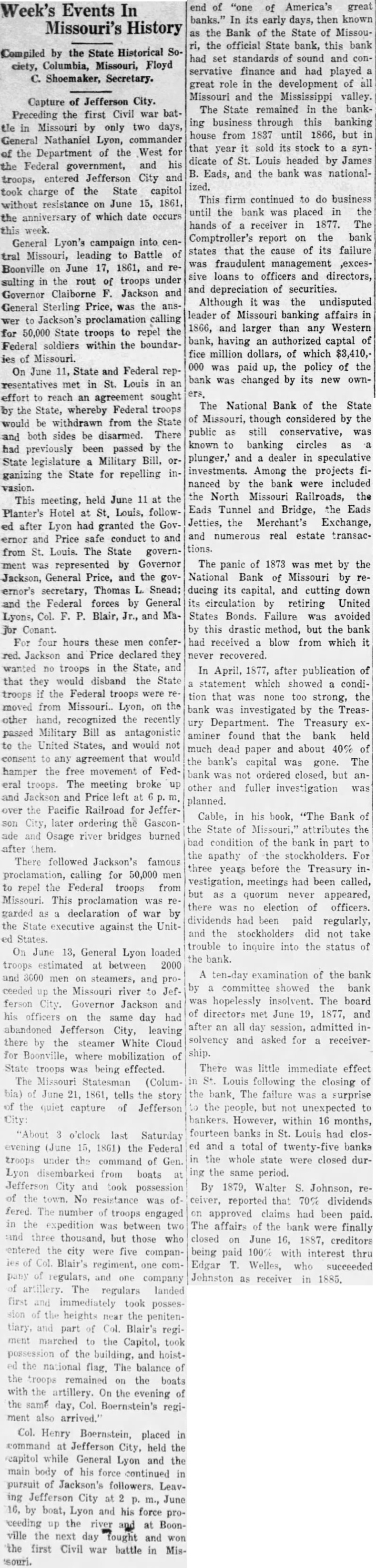
Week's Events In Missouri's History Compiled by the State Historical Society, Columbia, Missouri, Floyd C. Shoemaker, Secretary. Capture of Jefferson City. Preceding the first Civil war battle in Missouri by only two days, General Nathaniel Lyon, commander of the Department of the West for the Federal government, and his troops, entered Jefferson City and took charge of the State capitol without resistance on June 15, 1861, the anniversary of which date occurs this week. General Lyon's campaign into central Missouri, leading to Battle of Boonville on June 17, 1861, and resulting in the rout of troops under Governor Claiborne F. Jackson and General Sterling Price, was the answer to Jackson's proclamation calling for 50,000 State troops to repel the Federal soldiers within the boundaries of Missouri. On June 11, State and Federal representatives met in St. Louis in an effort to reach an agreement sought by the State, whereby Federal troops would be withdrawn from the State and both sides be disarmed. There had previously been passed by the State legislature a Military Bill, organizing the State for repelling invasion. This meeting, held June 11 at the Planter's Hotel at St. Louis, followed after Lyon had granted the Governor and Price safe conduct to and from St. Louis. The State government was represented by Governor Jackson, General Price, and the governor's secretary, Thomas L. Snead; and the Federal forces by General Lyons, Col. F. P. Blair, Jr., and MaFor four hours these men conferred. Jackson and Price declared they wanted no troops in the State, and that they would disband the State troops if the Federal troops were removed from Missouri.. Lyon, on the other hand, recognized the recently passed Military Bill as antagonistic to the United States, and would not consent to any agreement that would hamper the free movement of Federal troops. The meeting broke up and Jackson and Price left at m. over the Pacific Railroad for Jefferson City, later ordering the Gasconade and Osage river bridges burned after them. There followed Jackson's famous proclamation, calling for 50,000 men to repel the Federal troops from Missouri. This proclamation was regarded as declaration of war by the State executive against the United States. On June 13, General Lyon loaded troops estimated at between 2000 and 3000 men on steamers, and proceeded up the Missouri river to Jefferson City. Governor Jackson and his officers on the same day had abandoned Jefferson City, leaving there by the steamer White Cloud for Boonville, where mobilization of State troops was being effected. The Missouri Statesman (Columbia) of June 21, 1861, tells the story of the quiet capture of Jefferson City: "About 3 o'clock last Saturday evening (June 15, 1861) the Federal troops under the command of Gen. Lyon disembarked from boats at Jefferson City and took possession of the town. No resistance was offered. The number of troops engaged in the expedition was between two and three thousand, but those who entered the city were five companles of Col. Blair's regiment, one company of regulars, and one company of artillery. The regulars landed first and immediately took possession of the heights near the penitentiary, and part of Col. Blair's regiment marched to the Capitol, took possession of the building, and hoisted the national flag. The balance of the troops remained on the boats with the artillery. On the evening of the same day, Col. Boernstein's regiment also arrived." Col. Henry Boernstein, placed in command at Jefferson City, held the capitol while General Lyon and the main body of his force continued in pursuit of Jackson's followers. Leaving Jefferson City at 2 p. m., June 16, by boat, Lyon and his force proceeding up the river at Boonville the next day fought and won the first Civil war battle in Missouri. end of "one of America's great banks." In its early days, then known as the Bank of the State of Missouri, the official State bank, this bank had set standards of sound and conservative finance and had played great role in the development of all Missouri and the Mississippi valley. The State remained in the banking business through this banking house from 1837 until 1866, but in that year it sold its stock to a syndicate of St. Louis headed by James B. Eads, and the bank was nationalized. This firm continued to do business until the bank was placed in the hands of a receiver in 1877. The Comptroller's report on the bank states that the cause of its failure was fraudulent management ,excessive loans to officers and directors, and depreciation of securities. Although it was the undisputed leader of Missouri banking affairs in 1866, and larger than any Western bank, having an authorized captal of fice million dollars, of which $3,410,000 was paid up, the policy of the bank was changed by its new own- The National Bank of the State of Missouri, though considered by the public as still conservative, was known to banking circles as plunger,' and a dealer in speculative investments. Among the projects financed by the bank were included the North Missouri Railroads, the Eads Tunnel and Bridge, the Eads Jetties, the Merchant's Exchange, and numerous real estate transactions. The panic of 1873 was met by the National Bank of Missouri by reducing its capital, and cutting down its circulation by retiring United States Bonds. Failure was avoided by this drastic method, but the bank had received a blow from which it never recovered. In April, 1877, after publication of statement which showed a condition that was none too strong, the bank was investigated by the Treasury Department. The Treasury examiner found that the bank held much dead paper and about 40% of the bank's capital was gone. The bank was not ordered closed, but another and fuller investigation was planned. Cable, in his book, "The Bank of the State of Missouri," attributes the bad condition of the bank in part to the apathy of the stockholders. For three years before the Treasury investigation, meetings had been called, but as a quorum never appeared, there was no election of officers. dividends had been paid regularly, and the stockholders did not take trouble to inquire into the status of the bank. A ten-day examination of the bank by a committee showed the bank was hopelessly insolvent. The board of directors met June 19, 1877, and after an all day session, admitted insolvency and asked for a receivership. There was little immediate effect in St. Louis following the closing of the bank, The failure was a surprise the people, but not unexpected to bankers. However, within 16 months, fourteen banks in St. Louis had closed and a total of twenty-five banks in the whole state were closed during the same period. By 1879, Walter S. Johnson, receiver, reported that 70% dividends on approved claims had been paid. The affairs of the bank were finally closed on June 16, 1887, creditors being paid 100% with interest thru Edgar T. Welles, who succeeded Johnston as receiver in 1885.
