Click image to open full size in new tab
Article Text
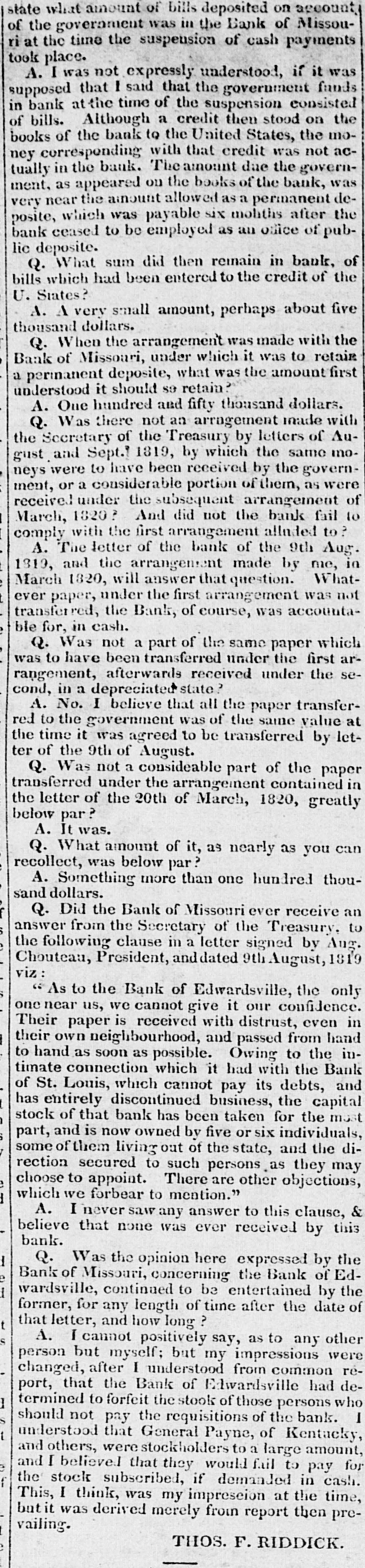
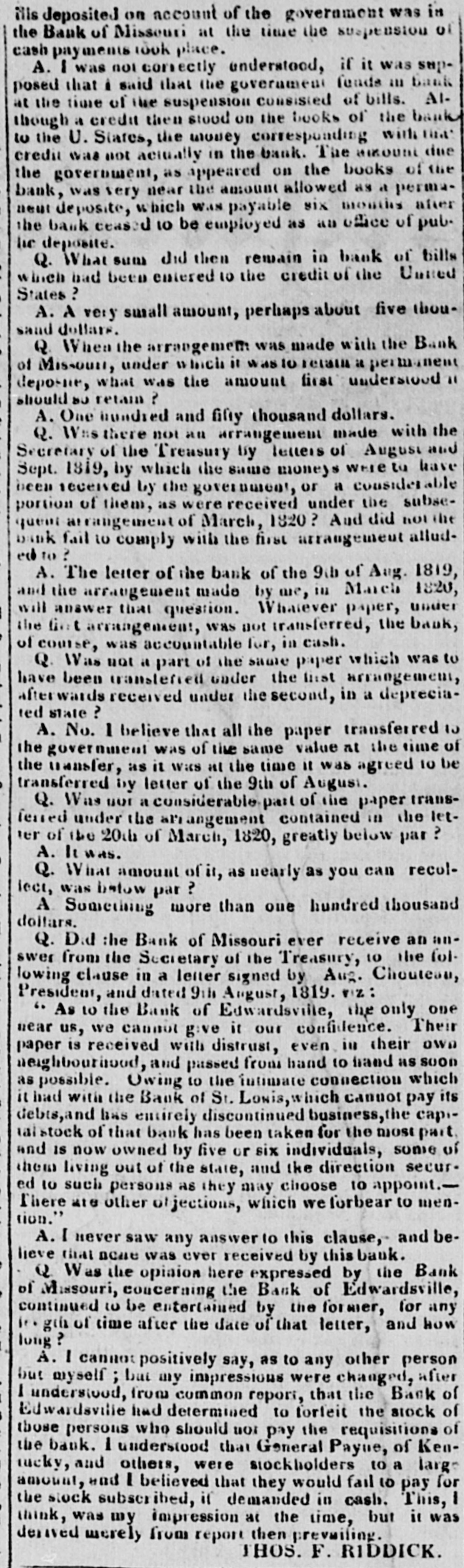
ilis deposited on account of the government was in the Bank of Missouri at the time the suspension of cash payments took place.
A. I was not correctly understood, if it was supposed that i said that the government funds in bank at the time of the suspension consisted of bills. Although a credit then stood on the books of the bank to the U. States, the money corresponding with that credit was not actually in the bank. The amount due the government, as appeared on the books of the bank, was very near the amount allowed as a permanent deposite, which was payable six months after the bank ceased to be employed as an office of public deposite.
Q. What sum did then remain in bank of bills winch had been entered to the credit of the United States?
A. A very small amount, perhaps about five thousand dollars.
Q. When the arrangement was made with the Bank of Missouri, under which it was to retain a permanent deposue, what was the amount first understood it should so retain?
A. One hundred and fifty thousand dollars.
Q. Was there not an arrangement made with the Secretary of the Treasury by letters of August and Sept. 1819, by which the same moneys were to have been received by the government, or a considerable portion of them, as were received under the subsequent arrangement of March, 1820? And did not the bank fail to comply with the first arrangement allud-ed to?
A. The letter of the bank of the 9th of Aug. 1819, and the arrangement made by me, in March 1820, will answer that question. Whatever paper, under the fist arrangentent, was not transferred, the bank, of course, was accountable for, in cash.
Q. Was not a part of the same paper which was to have been transtetted under the first arrangement, afterwards received under the second, in a depreciated state?
A. No. I believe that all the paper transferred to the government was of tite same value at the time of the transfer, as it was at the time it was agreed to be transferred by letter of the 9th of August.
Q. Was nor a considerable part of the paper trans-fened under the arrangement contained in the letter of the 20th of March, 1820, greatly below par?
A. It was.
Q. What amount of it, as nearly as you can recollect, was betow par ?
A. Sometinng more than one hundred thousand doitars.
Q. Did the Bank of Missouri ever receive an answer from the Secretary of the Treasury, to the following clause in a letter signed by Aug. Chouteau, President, and dated 9th August, 1819. voz:
"As to the Bank of Edwardsville, the only one near us, we cannot give it our confidence. Their paper is received with distrust, even in their owa neighbourhood, and passed from hand to hand as soon as possible. Owing to the intimate connection which it had with the Bank of St. Louis, which cannot pay its debts,and has entirely discontinued business, the cap-tai stock of that bank has been taken for the most part and is now owned by five or six individuals, some of them living out of the state, aud the direction secur-ed to such persons as they may choose to appoint.-There are other objections, which we forbear to men-tion."
A. I never saw any answer to this clause, and be-lieve that neae was ever received by this bauk.
QWas the opinion here expressed by the Bank of Missouri, concerning the Bank of Edwardsville, continued to be entertained by the former, for any ie gth of time after the date of that letter, and how long?
A. I cannot positively say, as to any other person but myself; bat my impressions were changed, after I understood, from common report, that the Back of Edwardsvilie had determined to forfeit the stock of those persons who should not pay the requisitions of the bank. I understood that General Payne, of Kentucky, and others, were stockholders to a large amount, and I believed that they would fail to pay for the stock subscribed, it demanded in cash. This, I think, was my impression at the time, but it was denved merely from report then prevailing.
THOS. F. RIDDICK.