Bank of Wells (Wells, NV)

Episode Information

Episode UID
94004871465
Episode Type
Suspension โ†’ Reopening
Bank Type
state
Bank ID
9400487 routing
Routing Number
94-0048
Start Date
January 14, 1922
Location
Wells, Nevada (41.112, -114.964)

Metadata

Model
gpt-5-mini (chosen from majority vote of a three-model LLM ensemble)
Short Digest
94dc8e4409b19c35

Response Measures

None

Description

Articles refer to the local 'Wells bank' being reorganized; assumed to be Bank of Wells.

Events (2)

1. January 14, 1922 Suspension
Cause
Government Action
Cause Details
Closed and being reorganized under direction/assistance of the state bank examiner; stockholders assigned interests
Newspaper Excerpt
reorganization of the Wells bank which closed its doors last week
Source
newspapers
2. January 21, 1922 Other
Newspaper Excerpt
already $25,000 has been subscribed by the Wells citizens...the new bank will be opened very shortly in the old bank building; new management entirely independent of the one that ruled the ... bank
Source
newspapers

Newspaper Articles (3)

Article from The Silver State, January 21, 1922

Click image to open full size in new tab

Article Text

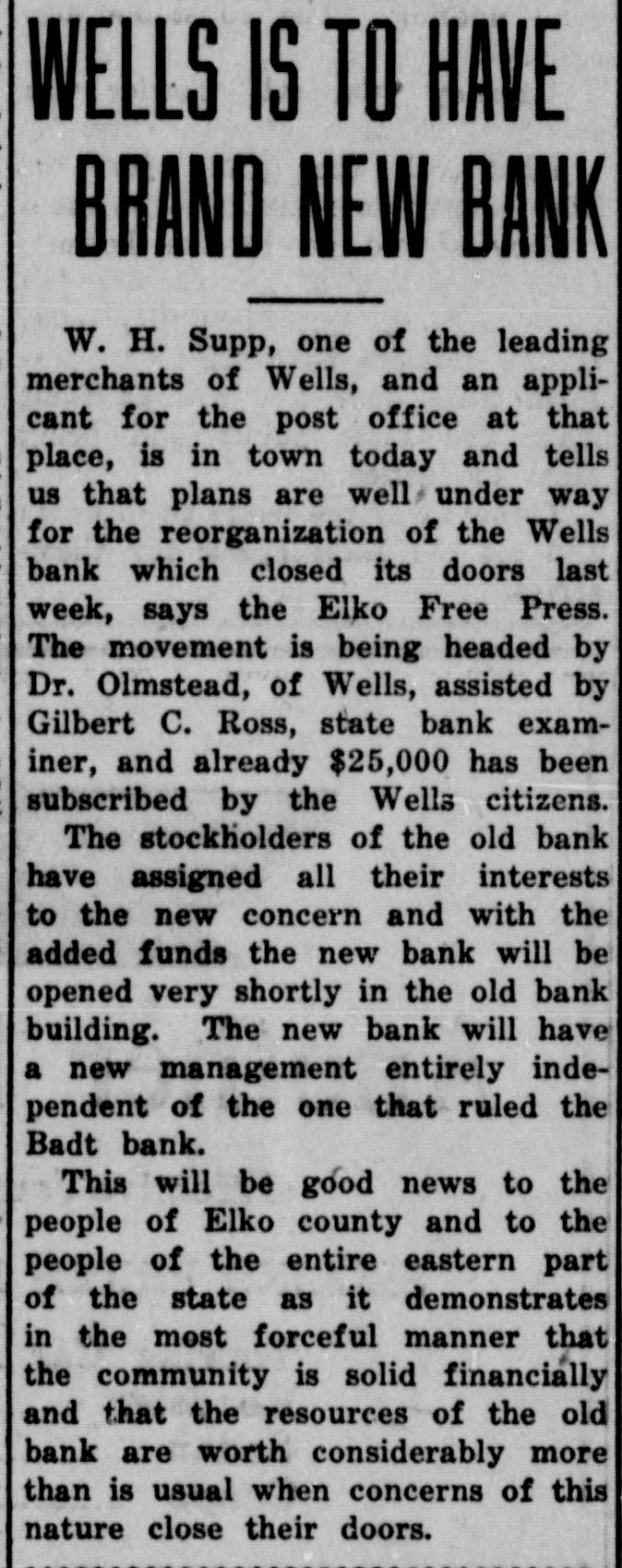
WELLS IS TO HAVE BRAND NEW BANK W. H. Supp, one of the leading merchants of Wells, and an applicant for the post office at that place, is in town today and tells us that plans are well under way for the reorganization of the Wells bank which closed its doors last week, says the Elko Free Press. The movement is being headed by Dr. Olmstead, of Wells, assisted by Gilbert C. Ross, state bank examiner, and already $25,000 has been subscribed by the Wells citizens. The stockholders of the old bank have assigned all their interests to the new concern and with the added funds the new bank will be opened very shortly in the old bank building. The new bank will have a new management entirely independent of the one that ruled the Badt bank. This will be good news to the people of Elko county and to the people of the entire eastern part of the state as it demonstrates in the most forceful manner that the community is solid financially and that the resources of the old bank are worth considerably more than is usual when concerns of this nature close their doors.

Article from Yerington Times, March 8, 1922

Click image to open full size in new tab

Article Text

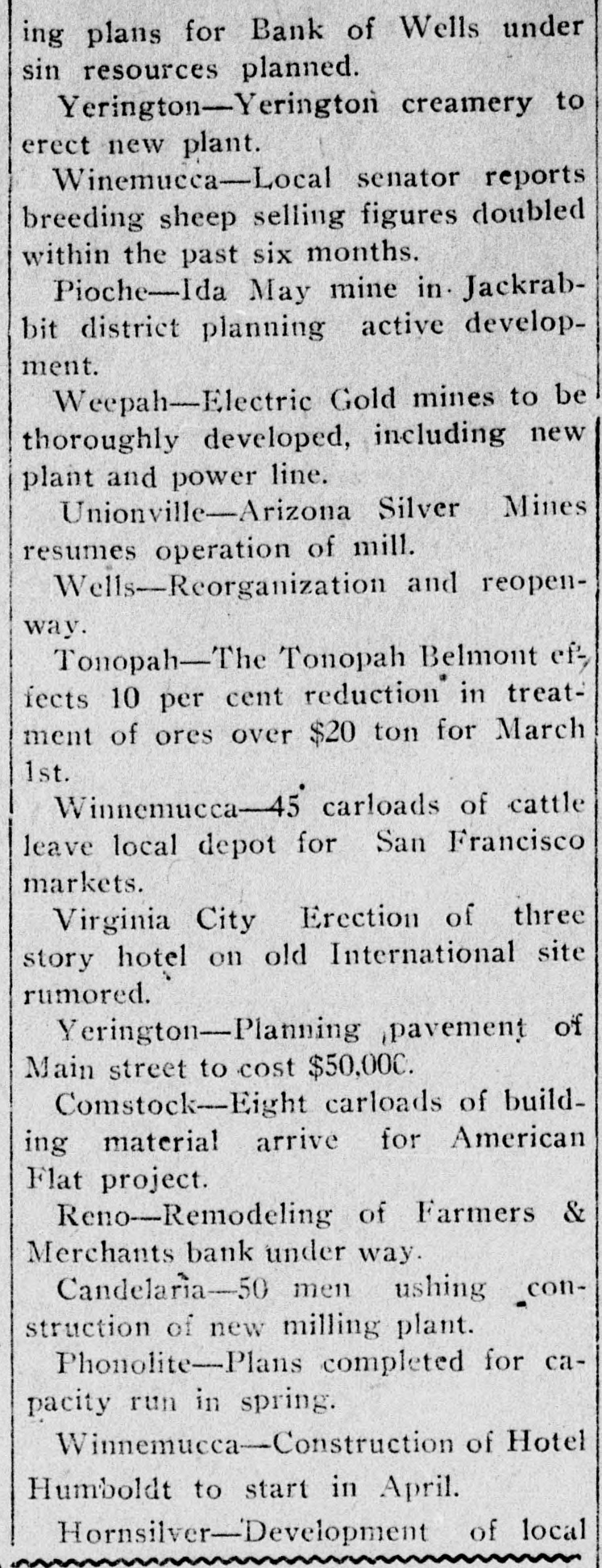
ing plans for Bank of Wells under sin resources planned. Yerington-Yerington creamery to erect new plant. Winemucca-Local senator reports breeding sheep selling figures doubled within the past six months. Pioche-Ida May mine in Jackrabbit district planning active development. Weepah-Electric Gold mines to be thoroughly developed, including new plant and power line. Unionville-Arizona Silver Mines resumes operation of mill. Wells-Reorganization and reopenway. Tonopah-The Tonopah Belmont ef-, fects 10 per cent reduction in treatment of ores over $20 ton for March 1st. Winnemucca-45 carloads of cattle leave local depot for San Francisco markets. Virginia City Erection of three story hotel on old International site rumored. Yerington-Planning ,pavement of Main street to cost $50,000. Comstock--Eight carloads of building material arrive for American Flat project. Reno-Remodeling of Farmers & Merchants bank under way. Candelaria-50 men ushing construction of new milling plant. Phonolite-Plans completed for capacity run in spring. Winnemucca-Construction of Hotel Humboldt to start in April. Hornsilver-Development of local


Article from Reno Gazette-Journal, July 5, 1929

Click image to open full size in new tab

Article Text

LET IT BE REORGANIZED THE ANNOUNCEMENT of the state bank examiner that his department will set itself immediately to the work of reorganizing the Washoe County Bank, which suspended its business yesterday because of the heavy withdrawals that were being made upon its cash reserve, discloses very clearly that he comprehends the proper step that should be taken in the situation. In the opinion of persons of the most conservative judgment the capital and surplus of the bank, amounting to been impaired by losses have very largely which it may take upon "frozen" ranch and livestock loans, but the impairment does not extend beyond the banl capital assets. If such is the situation, and such it is affirmed to be by numerous persons of the very best business judgment, it is entirely possible to reorganize and re-open it in perfectly solvent form without loss to the depositors. In carrying out such a plan the stockholders of the bank might lose very large part or even all of their stock holdings, but in other instances that have arisen within the state during the last dozen years reorganization plans similar to ones now being considered have been carried through in which even the stockholders' losses have not been heavy. One thing stands forth very people of this community and of the state for that matter, want no repetition of the methods by which the vast properties of the State Bank and Trust Company were administered following its suspension and that of its branches little more than twenty years ago. In that instance the incompetency displayed was a disgrace to the state and with proper firmness upon the part of those charged with protecting the depositors could have been avoided. At the present time the affairs of the bank are in charge of the state banking department of which E. Seaborn is the examiner. Seaborn took office only a few months ago but his fitness for the place is unquestioned and for the best interests of the depositors he should be given free hand in working out a solution. For several weeks he has been endeavoring to effect reorganization of the institution and there is no reason why this plan should be interrupted. By all means "liquidation," which means the sale of its great properties and assets, should be avoided. In the final analysis such procedure would mean a costly receivership, huge fees, the sacrifice sale, in some cases, of its magnificent assets, and eventual losses to its depositors. Because of the heavy losses to depositors which SO frequently occurred years ago in the case of bank suspensions, or "failures" as they were called, they were almost invariably followed by public fear of other banks and apprehensions of local business depression. Such is no longer the rule and it will not be so in the one at hand. The day has gone in which great losses to bank depositors may occur. Under present methods of supervision, bank losses, caused by frozen or bad loans, are no longer permitted to extend to degree that will seriously impair the funds of depositors. This rule of banking supervision is being enforced in the state of Nevada. Within the last ten years two of the state's banks, one at Wells and one at Gardnerville, have been suspended by orders of the examiner and both were successfully reorganized and continued in business. To have one's funds tied up in bank suspension is admittedly inconvenient. In isolated instances it may be seriously but in the present situation the total amounts that will be actually removed from daily use, or the amount that actually might be lost, should losses possibly occur, would be very small, indeed, compared to the total circulating wealth of the community. The calmness with which the whole community views the situation shows that it is not disturbed. And there is no reason why should be.