Bank of the Commonwealth (New York, NY)

Episode Information

Episode Type
Suspension → Closure
Start Date
September 20, 1873
Location
New York, New York (40.714, -74.006)
Bank Type
private

Metadata

Notes

Suspension caused by a large customer overdraft/over-certification; bank placed in receivership and wound up with dividends to depositors.

Events (4)

1. September 20, 1873 Suspension
Cause
Bank Specific Adverse Info
Cause Details
Over-certification/large overdraft by Edward Haight & Co. (reported ~$225,000–$400,000) precipitated the bank's inability to meet obligations.
Newspaper Excerpt
the suspension of the Union Trust Company was followed by that of the Bank of the Commonwealth, which closed its doors at an early hour.
Source
newspapers
2. September 22, 1873 Receivership
Newspaper Excerpt
Isaac H. Bailey has been appointed receiver of the Bank of the Commonwealth in New York city.
Source
newspapers
3. March 7, 1874 Other
Newspaper Excerpt
On Monday next a dividend of 50 per cent will be paid to depositors by the Receiver of the Bank of the Commonwealth.
Source
newspapers
4. November 20, 1874 Other
Newspaper Excerpt
the receiver of the Bank of the Commonwealth, New York ... announces the final payment of twenty per cent. to depositors and all other creditors
Source
newspapers

Newspaper Articles (21)

Article from The Daily Dispatch, September 21, 1873

Click image to open full size in new tab

Article Text

MEASURES FOR RELIEF.

NEW YORK.

UNPRECEDENTED PANIC AT THE OPENING OF THE STOCK EXCHANGE-GREAT TUMBLE IN VALUES-GENERAL DISASTER IMMINENT-THE EXCHANGE CLOSED -A STARTLING DEFALCATION-BETTER FEELING IN THE EVENING.

[Special telegram to the Dispatch.] NEW YORK, September 20.-To-day has witnessed one of the greatest panics that ever occurred on the Stock Exchange. At the opening there was an improvement of two to six per cent. in values, and great hopes were entertained that the end had been reached. But these hopes were soon destroyed when it was announced that the Union Trust Company had decided to stop until Monday. The suspension of the Trust Company was followed by that of the Bank of the Commonwealth, which closed its doors at an early hour. The excitement and panic which followed the suspension of these institutions were beyond description.

The Stock Exchange RESEMBLED A MAD-HOUSE, and the streets were blocked with people, all laboring under great excitement and frenzy. Prices tumbled from two to sixteen per cent., and stocks were slaughtered without any apparent regard to values. Amid the surging of an excited crowd in the Stock Exchange and continued destruction of values there were some few cool and level heads. These men conceived the idea of imitating the Vienna plan of

CLOSING THE EXCHANGE, and immediately the Governing Committee was convened to take action thereon. In a few moments the Board was called to order, and from the rostrum the announcement was made that the Exchange would be closed until further orders from the President. This was received with great joy, and the Exchange resounded with cheers. The gong was sounded, and in less time than it takes to record the fact the wild excitement was over, the surging crowd of frantic brokers disappeared, and the Stock Exchange was nothing but a deserted hall. All this happened in so short a time that it seems almost impossible, and only those on the spot can realize the remarkable change. All dealings on the street are strictly prohibited under penalty of expulsion, and therefore no business can be transacted.

MORE SUSPENSIONS. Soon after the suspension of the Union Trust Company was reported the suspension of the National Trust Company was announced, and this served, if possible, to intensify the excitement. The failures of brokers then began to be announced, and in a short time the following names were read out: C. G. White & Co.; Ketchumn & Belknap; W. G. Broadhead & Co.; Saxton & Rogers; Williams & Bostwick; Miller & Walsh; E. Haight & Co.; Laurens & Joseph; P. M. Myers & Co.; Taussig, Fisher & Co.; Feasing & Bellinger; S. B. White.

It is impossible to say where the list would have ended had not the Governing Committee of the Exchange decided to close the institution until the panic was over. About this time

UGLY RUMORS BEGUN TO GAIN CURRENC. on the street of irregularities in the Union Trust Company, and it is found that Carleton, the secretary, son of Rev. Dr. Carleton, of the Methodist Book House, was a defaulter, some fixing the amount at $250,000, others at $500,000. It was not known that Carleton was a defaulter until some time yesterday afternoon, when his absence begun to give rise to suspicions. He remained at his desk until 12 o'clock yesterday, conversing freely but exhibiting signs of excitement and trepidation. He left the Trust Company saying he was too unwell to remain, and desired some rest. When it was necessary to consult him in regard to certain matters, he was not to be found, and then it was that the trustees began to

SUSPECT HE WAS A DEFAULTER. Under a hurried examination into his affairs it soon became quite certain that he had


Article from Evening Star, September 22, 1873

Click image to open full size in new tab

Article Text

A RECEIVER APPOINTED-Isaac H

Bailey was to-day designated by Secretary Richardson as receiver of the Bank of the Commonwealth in New York city.


Article from Evening Star, September 22, 1873

Click image to open full size in new tab

Article Text

Lished action of the national banks ot New York to draw on their reserve if necessary and stand by each other in meeting any "run" that might be made on a particular bank, contributed to satisfy the public mind.

THE NORTHERN PACIFIC RAILROAD.

General Nettleton, the agent of the Northern Pacific raiload, gives this information in regard to the condition of that company: "The rail- road company loses nothing by the suspension of the banking-house of Jay Cooke & Co., as it is largely indebted to the latter. The railroad company has no floating debt of any conse- quence aside from what it owes Jay Cooke & Co,, and has few liabilities falling due before January next, when a year's interest is to be met. As this is three months off it is expected that the stockholders of the company will by that time have completed other financial ar- rangements which will provide for future needs."

LIST OF SUSPENDED FIRMS.

The following is a complete list of the names of firms that failed or suspended: New York Failures. Jay Cooke & Co., No. 5 Nassau street; Fisk & Hatch, White, Defreita & Rathborne. Beers & Edwards, Eugene J Jackson, Thomas Roed & Co., W. H. Warren. George Bolton, Alley & Co., Greenleaf, Norris & Co., Theodore Berdell, Amos M. Kidder, S. H. Smith & Seaver, Day Morse, Hay & War- ner, Vernam & Hoy, Fitch & Co., W. E. Con ner, Whittemore & Anderson, Jacob Little Co., E. D. Randolph & Co., C. G. White & Co., Ketchum & Belknap, W. G. Moorehead & Co., Saxton & Rogers, Williams & Bostwick, Miller & Walsh, E. Haight & Co., Lawrence Joseph, P. M. Myers & Co., Tansig, Fisher & Co., Fear- ing & Dunning, C. G. White, Marvin & Bros., Union Trust Company, National Trust Com pany, Bank of The Commonwealth, Bank of North America.

Philadelphia Fatures.-E. W. Clarke & Co.. De Haven & Bro., Gelbongh, Bond & Bro.. George H. North, J. S. & H. E. Yerkes, Charles P. Bayard, John P. Loyd, Henry H. Douglase H. H. Bull, T. C. Knight, Henry L. Fell, Union Bank Company.

Albany Failure. T. Squire & Co., bankers. Chicago Failure. Franklin Bank Company. Woburn, Mass., Failure.-Horace Conn, leather manufacturer.

Toronto, Canada.-H. J. Morse & Co., bankers Williamsport, Pa.--Powell & Co., bankers. St. Louis. Taussig, Gemp & 00.

Causes and Effects of the Crisis,

HOPEFUL VIEWS OF THE NEW YORK HERALD. In its money article of yesterday, the New York Herald says the panic started with the failure of one or two parties identified with incomplete railroads. "The stock market at the time was in a feverish condition, responsive to slight causes and tremulous in the extreme. Its strength consisted in two or three stocks, firmly upheld by great operators. They had come to be regarded as the key-note of the market. Even these, however, could not at last resist the pressure. They "broke," and in doing so naturally carried with them the entire list of speculative securities. Thus the weakness of a few railroads has extended through the entire network of our local finance. The pulling down of one or two great houses produced distrust Money, always timid, retreated into private re- cesses. Depositors commenced to run upon banks; the banks have been unable to afford their usual accommodations, have refused each other's checks, though certified, and at last, as a consequence of universal doubt, have been com- pelled in self defence to arrange with the clearing house for the issue by the latter of certain loan certificates based on acceptable assets, which are to be received in the settlement of all clear- ing house differences in the place of legal-ton- der notes. Practically this action means the expansion of the bank credits and the sens mixing of legal tenders. It aids the banks, but it is yet to be seen what facilities are thus ex- tended to depositors and business men. As re- gards the savings banks, there is no good rea- son why, if the officers of the same have rigidly done their duty, there should be any cause of alarm. Their investments are regulated by law, and they are not such as ordinarily fluctuate in value. Hence a run on them is both injudicious and unwarranted by events. The depositors should understand that thus far our financial troubles result only from local speculation. Crops are good; business is first-rate; our mer- chants have rarely done better than they are doing this season. They are not suffering from this temporary disturbance, and we can safely count on a large fall trade and handsome re- turns."


Article from Wilmington Daily Gazette, September 22, 1873

Click image to open full size in new tab

Article Text

careless Banking Operations

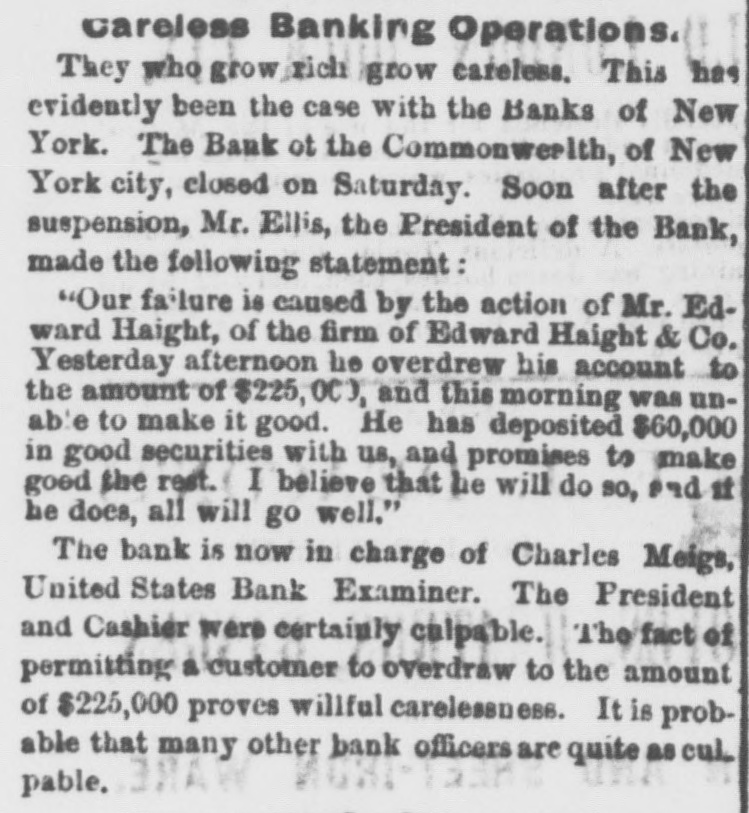
They who grow rich grow careless. This has evidently been the case with the Banks of New York. The Bank ot the Commonwerlth, of New York city, closed on Saturday. Soon after the suspension, Mr. Ellis, the President of the Bank, made the following statement: "Our failure is caused by the action of Mr. Edward Haight, of the firm of Edward Haight & Co. Yesterday afternoon he overdrew his account to the amount of $225,003, and this morning was unab'e to make it good. He has deposited $60,000 in good securities with us, and promises to make good the rest. I believe that be will do so, prd it be does, all will go well." The bank is now in charge of Charles Meigs, United States Bank Examiner. The President and Cashier were certainly calpable. The fact of permitting a customer to overdraw to the amount of $225,000 proves willful carelessness. It is probable that many other bank officers are quite as cul pable.


Article from New-York Tribune, September 22, 1873

Click image to open full size in new tab

Article Text

THE SATURDAY PANIC.

EFFECTS OF FRAUD, SPECULATION, AND DISTRUST.

HEAVY DEFALCATION IN THE UNION TRUST COMPANY FORCES IT TO SUSPEND—THE NATIONAL TRUST COMPANY UNABLE TO NEGOTIATE ITS SECURITIES—OVERDRAFTS ON THE BANK OF THE COMMONWEALTH COMPEL IT TO CLOSE — THE STOCK EXCHANGE ADJOURNED—SPECULATION AT AN END—THE CLEARING-HOUSE ISSUES $10,000,000 LOAN CERTIFICATES—THE GOVERNMENT THROWS $10,000,000 IN CURRENCY ON THE STREET.

Failures Officially Announced on Saturday. KETCHAM & BELKNAP, TAUSSIG, FISHER & Co., C. G. WHITE, WILLIAMS & BOSTWICK, PETER M. MYERS & Co., LAWRENCE JOSEPHS, FEARING & DILLINGER, SAXTON & ROGERS, BROWN, WADSWORTH & Co., MILLER & WALSH, EDWARD HAIGHT & Co.

Banks Suspended. UNION TRUST COMPANY, NATIONAL TRUST COMPANY, BANK OF THE COMMONWEALTH. NEW-YORK GOLD EXCHANGE BANK.

Exchange Closed. NEW-YORK STOCK EXCHANGE,

Failures on Thursday and Friday. JAY COOKE & Co., ROBINSON & SUYDAM, RICHARD SCHELL, FISK & HATCH, WHITE, DEFREITAS & RATHBORNE, BEERS & EDWARDS, EUGENE J. JACKSON, THOMAS REED & Co., W. H. WARREN, GEO. BOLTON ALLEY & Co., GREENLEAF, NORRIS & Co., THEODORE BERDELL, AMOS M. KIDDER, S. H. SMITH & SEAVER, DAY & MORSE, HAY & WARNER, VERNAM & HOY, FITCH & Co., W. E. CONNER, WHITTEMORE & ANDERSON, JACOB LITTLE & Co., E. D. RANDOLPH & Co.

The result of the financial panic may be summed up in a brief paragraph. It is a thunder-storm merely which will serve to clear the atmosphere. "The street is clean broke." Few brokers know where they stand. On Saturday the best securities went begging at the lowest rates; there was no fixing values on any stocks, and the Stock Exchange was wisely closed to give men time to recover from their distrust and gather their scattered senses. Eleven additional houses failed, and their suspension was announced in the Exchange before it was closed. A few more of the weakest will go down when the settlements are made; some of those who have been announced from the Board will recover and go on. Not a single mercantile house, savings bank, or other institution doing a legitimate trade has fallen. The excitement and distrust caused by the wild speculations extended the panic beyond the Stock Exchange, and three banks suffered from severe runs upon them. The Union Trust Company was weakened by the discovery of a large defalcation, aggregating $600,000, and the impossibility of realizing on heavy call loans to the Lake Shore Railroad Company, and it suspended. The Bank of the Commonwealth was weakened by the payment of an overdraft of $225,000 of a house which had suspended. The National Trust, with $800,000 Governments on hand, could not realize a dollar on them and wisely closed its doors until it could dispose of them. Runs on the Fourth National and Manhattan were laughed to scorn by those institutions. During the morning the banks went on the principle of Fisk—"Each man to drag out his own corpse"—and refused one another's checks, but later a meeting was held and concerted action agreed on, and subsequently there was no further trouble. The purchase of bonds by the Government also aided to break the force of the storm.


Article from The Portland Daily Press, September 23, 1873

Click image to open full size in new tab

Article Text

NEW YORK

/ Receiver Appointed. NEW YORK, Sept. 22.-Isaac H. Bailey has been appointed receiver of the Bank of the Commonwealth. WASHINGTON.


Article from The New York Herald, September 23, 1873

Click image to open full size in new tab

Article Text

The Union Trust Company in the Hands of a Receiver. Six Millions of Currency Disbursed by Sub-Treasury. Meeting of the Jay Cooke Firm To-Day. "E"CRISIS" IN THE COURTS The change in the aspect of Wall street from the turmoil and painful agitation of last week was strikingly noticeable yesterday. The closing of the Stock Exchange, the government declaration to buy an unlimited offer of five-twenties, the action of the banks in resolving to issue loan certificates, and the intervention of the Sabbath all contributed to calm the troubled waters and induce a better and clearer view of the situation. Friday and Saturday will long be remembered for the fierce and unprecedented excitement of the street. It was uncommon and at times feariul enough to make men tremble for the prospect ahead. A deep pall of impenetrable clouds hung over the monetary skies, and no where seemed to appear a solitary ray of light to illuminate the course of the future. Sunday evening the darkness broke, and Monday morning Wall street, with a few exceptional features wore its OLD-TIME APPEARANCE. There were no hurrying crowds, no pale and anxious groups, no heavy fringe of vacant eyed spectators on the sidewalks. In fact, had not the Stock Exchange been closed there was little to indicate that the street had so recently passed through a terrific financial nurricane. A tolerable calm settled down in the morning, and there was every appearance when the day ended that the period of panic was passed, and that with ordinary prudence the old state of things will in a few days prevail. THE ACTION OF THE PRESIDENT on Sunday night was very generally canvassed, but the preponderance of opinion was in favor of the course he selected. Had he yielded to the clamor of the big guns of the monetary world and stepped outside the law by loaning the currency reserve to the banks, those who, in the rash thought of the moment, implored him to commit the illegality might have been the first to condemn him. The feature of yesterday, in connection with the panic, was the unusual withdrawal of money by depositors from the savings banks. This is to be deplored, for of all other institutions the savings banks should be triply guarded from the disastrous innuence of a panic originating among speculators in Wall street. HERALD reporters visited yesterday THE SAVINGS INSTITUTIONS on the east and west side of town, and furnish accounts of what they saw in another column. The policy of keeping THE STOCK EXCHANGE closed until further notice met with general approval, as there is yet some time needed to arrange matters and allow the excitement of the hour to die out. When this is accomplished, and when the Exchange opens again, reasonable prices for settlement can be made. THE GOLD EXCHANGE voted to keep the Gold Room open, but to allow no dealings in gold on the penalty of loss of member ship. It was resolved to place the quotation of gold at 112 as the price and as a basis of clearance. There IS still a good deal of talk over THE PLAN DISCUSSED at the Fifth Avenue Hotel, Sunday, to meet the crisis. It appears the first proposition was that the Treasury should put anywhere from $20,000,000 to $40,000,000 legal tender in the banks as a deposit for which the associated banks should be responsible, Commodore Vanderbiit offering to deposit with the sub-Treasurer $10,000,000 as an additional guarantee. The proposition was declined because of no legal authority for the act, and for the reason that a few banks would reap the whole benefit and profit, to which the banks, not government depositories, would not assent. The plan that was finally agreed upon was that the Treasury should buy five-twenty bonds at fixed rate, privately, as shey were offered, until, if necessary, the legal tender reserve and the currency balance were exhausted. To this plan, which, it cannot be denied, works so far only ID milk and water way, the objections are that it obliges people to sacrifice the best securities in the market and which are sale to keep any time that the people who hold these bonds are not those who need the money, and that the institutions having these bonds, where they are savings banks, will probto use their reserved right of thirty to notice than ninety ably prefer days' from their depositors, bonds, and rather that accept a low price for institutions like insurance companies will consider it the most prudent thing to hold on to their bonds. The Treasury received offers for $3,339,150 PIVE-TWENTY BONDS YESTERDAY, being the issues to which purchases were these confined. Along with the amount taken in on Satbe about $6,000,000 currency will thrown urday, on the market, from which it be expected much relief will be may With the exception of the Bank experienced. North America, the Bank oi the Commonwealth of and the Fourth National Bank, there comparatively no run on the rest of the banks. The com- exhouses abstained from increasing the citement, mercial and few large amounts were withdrawn dein cases where business imperatively except manded. To-day will, in all likellhood, be squiet as yesterday. It will be devoted chiefly to consult tation, and the opinion prevails that the Stock Exchange will remain closed, and as consequence, stock there will be no quotation the volume of of transactions will be reduced. The condition THE TWO TRUST COMPANIES' affairs will be found narrated in another place, and be the statement of Jay Cooke & Co. cannot tail to read with interest. The HERALD reporters supply a mass of information, gathered from bankers and others. on the effect of the panic on American securities abroad, and the views of leading merchants on the situation are also given. The way in which the Brooklyn banks weather the storm is also told, and the reader 18 referred to the financial column for further statistical and speculative information. THE JAY COOKE FIRM. Messrs. Pitt Cooke & McCulloch arrived yesterday by the Egypt. To-day they will meet the other Cooke & affairs of the to in partners consuitation gentlemen in decline the on firm the or Jay speak firm. reference Co. Both and to hold these the a crisis. They LAT that were at sea when the storm


Article from The New York Herald, September 23, 1873

Click image to open full size in new tab

Article Text

Bank of the Commonwealth

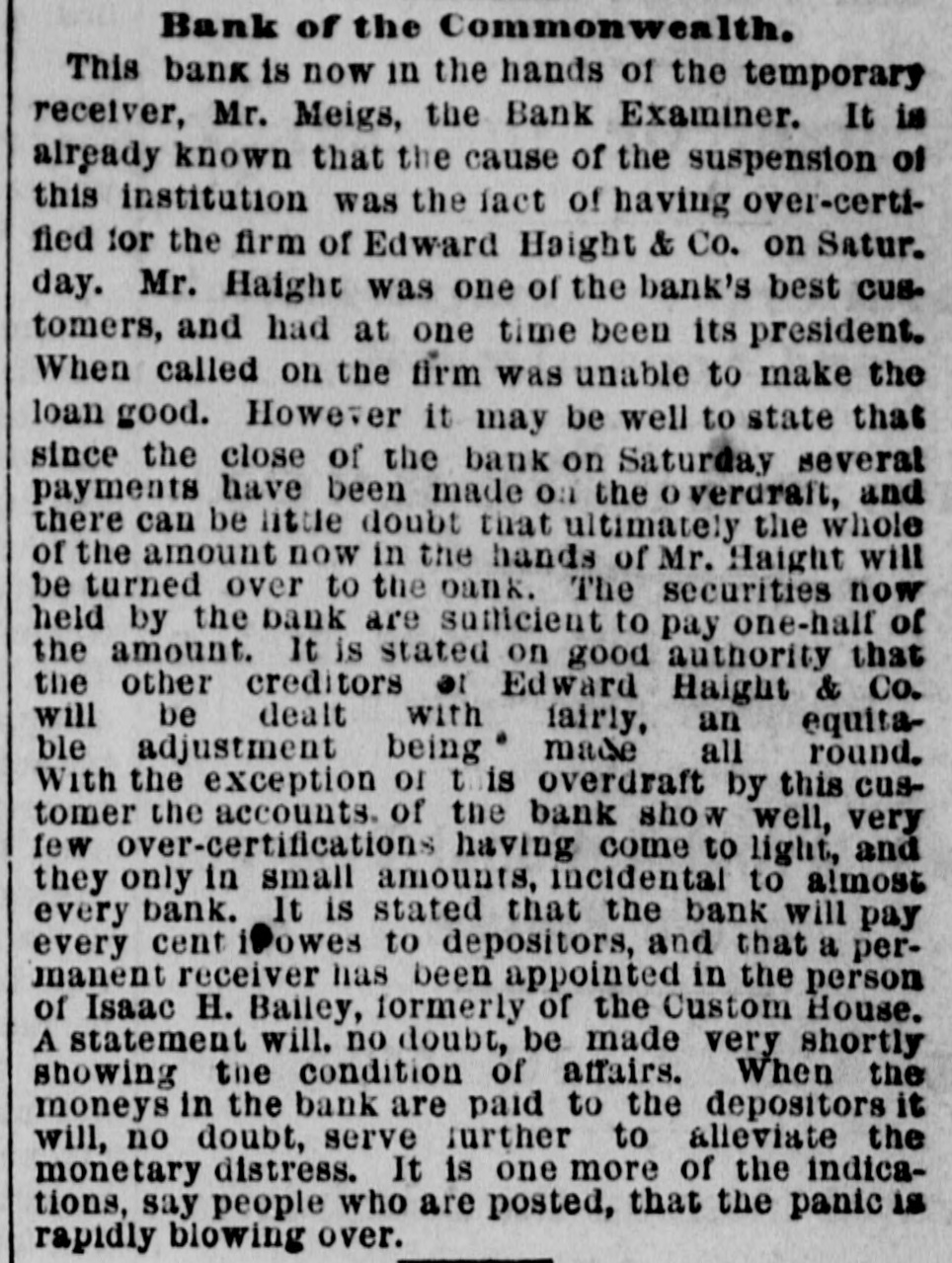
This bank is now in the hands of the temporary receiver, Mr. Meigs, the Bank Examiner. It is already known that the cause of the suspension of this institution was the fact of having over-certified for the firm of Edward Haight & Co. on Satur. day. Mr. Haight was one of the bank's best cus. tomers, and had at one time been its president. When called on the firm was unable to make the loan good. However it may be well to state that since the close of the bank on Saturday several payments have been made OR the o verdraft, and there can be little doubt that ultimately the whole of the amount now in the hands of Mr. Haight will be turned over to the bank. The securities now held by the bank are sufficient to pay one-half of the amount. It is stated on good authority that the other creditors at Edward Haight & Co. will be dealt with fairly, an equitable adjustment being made all round. With the exception of this overdraft by this customer the accounts. of the bank show well, very few over-certifications having come to light, and they only in small amounts, incidental to almost every bank. It is stated that the bank will pay every cent iPowes to depositors, and that a permanent receiver has been appointed in the person of Isaac H. Balley, formerly of the Custom House. A statement will. no doubt, be made very shortly showing the condition of affairs. When the moneys in the bank are paid to the depositors it will, no doubt, serve further to alleviate the monetary distress. It is one more of the indications, say people who are posted, that the panic is rapidly blowing over.


Article from The St. Cloud Journal, September 25, 1873

Click image to open full size in new tab

Article Text

A GREAT FINANCIAL CRASH

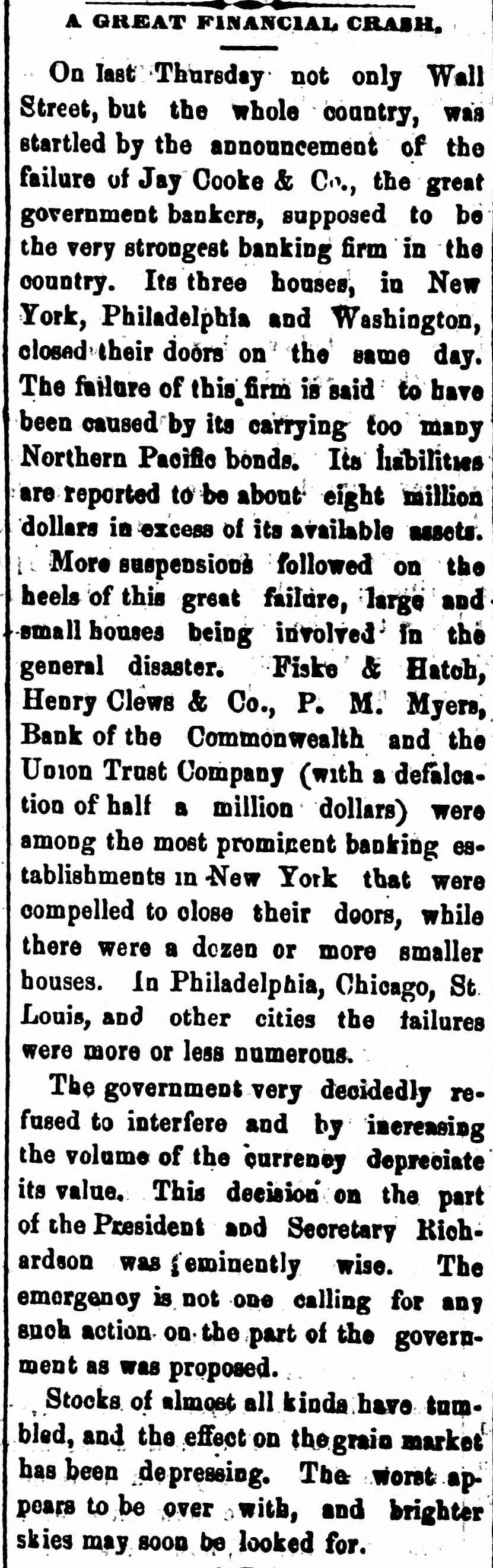
On last Thursday not only Wall Street, but the whole country, was startled by the announcement of the failure of Jay Cooke & Co., the great government bankers, supposed to be the very strongest banking firm in the country. Its three houses, in New York, Philadelphia and Washington, closed'their doors on the same day. The failure of this_firm is said to have been caused by its carrying too many Northern Pacific bonds. Its habilities are reported to be about eight million dollars in excess of its available assets. More suspensions followed on the heels of this great failure, large and small houses being involved in the general disaster. Fiske & Hatoh, Henry Clews & Co., P. M. Myers, Bank of the Commonwealth and the Union Trust Company (with a defalcation of half a million dollars) were among the most prominent banking establishments in New York that were compelled to close their doors, while there were a dozen or more smaller houses. In Philadelphia, Chicago, St. Louis, and other cities the failures were more or less numerous. The government very decidedly refused to interfere and by increasing the volume of the currency depreciate its value. This decision on the part of the President and Secretary Richardson was {eminently wise. The emergency is not one calling for any such action. on the part of the government as was proposed. Stocks of almost all kinda have tumbled, and the effect on thegrain market has been depressing. The worst appears to be over with, and brighter skies may soon be looked for.


Article from Helena Semi-Weekly Herald, September 25, 1873

Click image to open full size in new tab

Article Text

TELEGRAMS

REPORTED SPECIALLY FOR THE HERALD BY WESTERN UNION TELEGRAPH COMPANY.

UNITED STATES.

The Conference at the Fifth Avenue Hotel.

NEW YORK, September 21.—The conference at the Fifth Avenue Hotel to-day with President Grant and Secretary Richardson, in relation to the best means of averting financial disasters in Wall street, has absorbed the public interest. At the conference, and conspicuous, were Commodore Vanderbilt, H. Clews, Isaac Bailey, Seligman Bros., George H. Opdyke, Wm. Orton, President of W. U. T. Co., Prospect H. Sharpe, Jas. H. Burke, Wm. L. Scott, of the Erie (Pa.) Bank, Robt. Lenox Kennedy, Horace B. Claflin, General E. S. Sanford, President of Adams Express Company, Mr. Vail, of the Bank of Commerce, Senator West, and John Hoey, Vice President of Adams Express Company. A committee was appointed to agree upon some proposition to be submitted to the President and Secretary Richardson. After the committee had retired, Vanderbilt entered the parlor in which the President and Secretary were. The rooms and corridors adjoining the audience chamber were quickly thronged with crowds awaiting impatiently the exit of the railroad king, and nervously anxious to glean even the faintest idea of the result of his visit to the President. Commodore Vanderbilt made the proposition, that the President authorize the Secretary of the Treasury to place $30,000,000 of the legal reserve in the banks of this city, and on that condition he (Vanderbilt) would add $10,000,000. President Grant replied that he was anxious to do all in his power to relieve the present financial embarrassment and to prevent disaster, but that he must, however, conform to the Constitution. Mr. Opdyke and others represented to President Grant and Secretary Richardson the necessity for immediate action, but they were informed that the Constitution could not be violated.

The bank Presidents and capitalists were endeavoring to agree upon a proposition to be submitted, but, although they had been conferring up to six o'clock they could not arrive at any conclusion, and no paper was presented to the President.

The President and Secretary were not diverse in sentiment, it appears, for it was agreed between them to instruct the Assistant Treasurer to buy all government bonds offered for sale to any amount. The savings banks hold many millions of government bonds, and it is probable that they will sell them and deposit the proceeds in the National banks, which will give them relief.

The Action of the Stock Exchange.

NEW YORK, September 20.—Shortly before noon, in the midst of the panic, the governing committee of the Stock Exchange determined to close the Exchange. Immediately afterward a committee of the associated banks met at the New York Clearing House and it was voted by all the Associated Banks that they would issue certificates pledging the Association as a whole. These certificates are to be issued by the manager of the Clearing House to any Associated bank against the deposit of the bank's securities or assets. The effect of this action is to enable all the solvent part of the financial community to convert their assets into money, apparently, and without any sacrifice to themselves. The Stock Exchange ordinarily is simply a medium for converting securities into cash in a prevailing panic. The scarcity of money prevented this from being accomplished, securities being constantly offered for sale at constantly decreasing prices without finding buyers unless at an enormous loss to the sellers. By the issue of the bank certificates any bank can realize money upon its assets, and be able to extend to its customers all the accommodation for which they can find security, without compelling the sale or sacrifice of the assets offered. The whole machinery, therefore, of conversion is once more set in operation and is likely to run smoothly, and all concerns which have assets will find no difficulty in converting them into money. This action of the banks at the Clearing House meeting gave rise to a feeling of confidence on the street that no additional failures were likely to occur, and the impression obtained was that the panic was over.

Exciting Scene on Closing the New York Stock Exchange.

NEW YORK, September 20.—The excitement and panic which followed the announcement in the Stock Exchange of the suspension of the Union Trust Company and the Bank of the Commonwealth were beyond description. The Stock Exchange resembled a mad house, and the streets were blocked with people, all laboring under great excitement and frenzy. Prices tumbled from 2 to 16 per cent., and stocks were slaughtered without any apparent regard to values. Amid the surging of the excited crowd in the Stock Exchange and the continued destruction of values, there were few cool and level heads. These men conceived the idea of imitating the Vienna plan of closing the Exchange, and immediately the governing committee was convened to take action thereon. In a few moments the Board was called to order and the announcement was made that the Exchange would be closed until further orders from the President. This was received with great joy, the Exchange resounded with cheers, the gong sounded, and in less time than it takes to record the fact the wild excitement was over, the surging crowd of frantic brokers disappeared, and the Stock Exchange was closed.

Additional Failures Announced.

NEW YORK, September 20.—The following failures have been announced:

The Union Trust Company; Bank of Commonwealth; Ketchum & Belknap; E. C. Brodhead; Saxe & Rogers; Edward Haight & Co.; Brown, Wadsworth & Co.; C. G. White.

CHICAGO, September 21.—The Franklin Savings Bank, a small concern, was unable to meet the demands at the clearing house to-day, and closed its doors. As the concern has no connection, so far as known, with any of the suspended New York banks or bankers, it is supposed that it will soon resume business.

ST. LOUIS, September 20.—Toussing, Gemp & Co., of this city, closed its doors this afternoon, after the announcement of the failure of their New York house, Toussing, Fischer & Co. They are confident of being able to resume in a few days, and state that no one will lose a dollar by them. The house dealt pretty extensively in railroad securities on their own account.

TORONTO, Canada, September 20.—H. J. Morse & Co., bankers and brokers in this city, have suspended, in consequence of the failure of Jay Cooke & Co., and other prominent houses in New York.

ALBANY, N. Y., September 20.—T. C. Squire & Co., bankers, announce their suspension until further advices from New York.

PHILADELPHIA, September 20.—The Union Banking Company has failed. This bank has a State charter.

BURLINGTON, Iowa, September 20.—The Orchard City Savings Bank closed its doors to-day.

BUFFALO, September 22.—H. W. Bart & Co., private bankers and brokers, closed this afternoon.

ST. CATHARINES, Ontario, September 22.—Owing to the financial crisis in New York the Canada Southern Railroad Company have been obliged to cancel all their contracts for the present, and have ordered the discharge of all their workmen not employed. No regular train is running over the road. The cause of this is reported to be owing to complications in Daniel Drew's affairs, he being a large stockholder in the company.

New York News.

NEW YORK, September 20.—Two million eight hundred and sixty-three thousand dollars in bonds were accepted to-day at from 9 to 11 1/4. All offers of bonds under 11 1/4 are accepted by the government.

There were thirteen proposals to sell bonds to the government at the Sub-Treasury to-day aggregating $3,672,650, at from 10-9 to 11-2.

Five hundred Mormons, who arrived in this city yesterday, left to-day for Utah. Two hundred of them are Scandinavians and the remainder English, Irish and Welch.

NEW YORK, September 21.—Jay Cooke & Co. say there is no truth whatever in the story published here to-day that the London house of Jay Cooke, McCulloch & Co. failed. They say their London business continues uninterrupted.

The Effect in Chicago.

CHICAGO, September 21.—While the panic in New York has had the effect to temporarily unsettle values and grain and caused dullness on 'Change, it has caused comparatively little excitement. It appears to be the general opinion of the merchants and grain dealers that thus far the trouble has been outside of the commercial interests, and that unless it should spread it is not likely to involve those interests. The banks, however, are taking the usual precautions at a time of monetary excitement, in order to be prepared should the storm reach them.

Financial Condition in Philadelphia.

PHILADELPHIA, September 22.—The financial flurry has subsided. The run on the savings banks has ceased, and the National banks experience no unusual demand for capital.

The Situation.

NEW YORK, September 22.—The day has closed quiet, and it is believed the panic is now over. The Clearing House statement shows that all the banks here made their clearings satisfactorily, and the general feeling is decidedly better.

There is considerable inquiry in a quiet way for stocks. The following cash bids for stocks were made on the street: Central, 95; Wabash, 50; Rock Island, 88; Toledo, 90; Western Union Telegraph, 72.

All the foreign markets are strong, with a better feeling.

The announcement of the Commercial Advertiser that the certificates of the Continental Bank were thrown out of the Clearing House on Saturday was a mistake. The Continental is paying all liabilities on demand.

The Fourth National Bank had certified to $6,000,000 on Saturday, about six times as much as they ordinarily do.

Isaac H. Bailey has been appointed Receiver of the Bank of the Commonwealth.

Hugh McCulloch and Pitt Cooke, of Jay Cooke & Co., arrived from Europe to-day, and learned for the first time of the suspension of their United States firm.

The Clearing House Transactions.

NEW YORK, September 22.—The banks of discount were all open, some certifying to checks good through the Clearing House, and others paying in greenbacks. The Clearing House to-day issued about $5,000,000 of loan certificates in settlement of balances. This was a great assistance to the banks.

The Gold Exchange.

NEW YORK, September 22.—There was, of course, no regular business in either stocks or gold, and brokers were doing nothing beyond trying to effect a settlement of old transactions. The bankers who had not suspended were transacting no business beyond paying such depositors as called for their money. Those engaged in foreign exchange were entirely idle, as the closing of the Gold Room stopped business in exchange on London and the continent. The gold brokers to-day cleared all the business of Friday and Saturday through the Gold Exchange Bank by united action, which, under the circumstances, was certainly a great result. Every man settled promptly by certified checks, and the Gold Room is now perfectly clear of all unfinished business. This is important in view of the situation, and will greatly facilitate matters when the room is again opened for business. The gold clearings were $92,000,000. There is no price for money and very little is said about it. This afternoon $100,000 of 1881 bonds were sold 115 cash, and the brokers had orders for 5-20's at prices above the government standard.

The Union Trust Company.

NEW YORK, September 22.—The suspension of the Union Trust Company is generally attributed to the defalcating Secretary and the neglect to call in the $3,000,000 in loans, as ordered on Thursday. According to general reports he completely lost his mental balance, and showed no disposition to submit the affairs of the company to inspection. His whereabouts are still unknown. It is currently reported that the company will be ready to resume business in a few days. It is a little remarkable that only one trustee of the Union Co. has any money on deposit in the institution, and with the exception of two or three own but little stock. This may account for the bad management of the concern.

The Savings Banks.

NEW YORK, 22.—There was a moderate run on the Seamens' Savings Bank, corner of Wall and Pearl streets. The Trustees held a meeting and resolved to pay all sums under $100, but on larger sums to demand the thirty days' notice granted in the charter. This action is in accordance with an agreement made among the savings bank managers last evening. Some few of the banks can delay payment for ninety days, and all for thirty and on to sixty. Thus it will be seen that no


Article from Burlington Weekly Free Press, September 26, 1873

Click image to open full size in new tab

Article Text

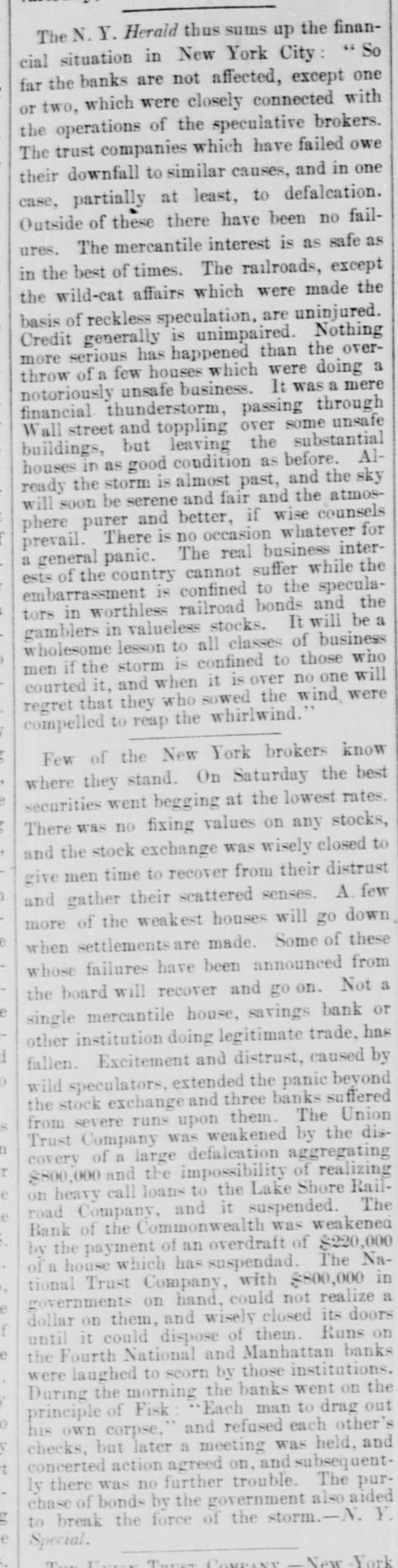
The N

Y. Herald thus sums up the financial situation in New York City : So far the banks are not affected, except one or two, which were closely connected with the operations of the speculative brokers. The trust companies which have failed owe their downfall to similar causes, and in one case, partially at least, to defalcation. Outside of these there have been no failures. The mercantile interest is as safe as in the best of times. The railroads, except the wild-cat affairs which were made the basis of reckless speculation. are uninjured. Credit generally is unimpaired. Nothing more serious has happened than the overthrow of a few houses which were doing a notoriously unsafe business. It was a mere financial thunderstorm, passing through Wall street and toppling over some unsafe buildings, but leaving the substantial houses in as good condition as before. Already the storm is almost past, and the sky will soon be serene and fair and the atmosphere purer and better, if wise counsels prevail. There is no occasion whatever for a general panic. The real business interests of the country cannot suffer while the embarrassment is confined to the speculators in worthless railroad bonds and the gamblers in valueless stocks. It will be a wholesome lesson to all classes of business men if the storm is confined to those who courted it, and when it is over no one will regret that they who sowed the wind were compelled to reap the whirlwind. Few of the New York brokers know where they stand. On Saturday the best securities went begging at the lowest rates. There was no fixing values on any stocks, and the stock exchange was wisely closed to give men time to recover from their distrust and gather their scattered senses. A. few more of the weakest houses will go down when settlements are made. Some of these whose failures have been announced from the board will recover and go on. Not a single mercantile house, savings bank or other institution doing legitimate trade, has fallen. Excitement and distrust, caused by wild speculators, extended the panic beyond the stock exchange and three banks suffered from severe runs upon them. The Union Trust Company was weakened by the discovery of a large defalcation aggregating $800,000 and the impossibility of realizing on heavy call loans to the Lake Shore Railroad Company, and it suspended. The Bank of the Commonwealth was weakened by the payment of an overdraft of $220,000 of a house which has suspendad. The National Trust Company, with $800,000 in governments on hand, could not realize a dollar on them, and wisely closed its doors until it could dispose of them. Runs on the Fourth National and Manhattan banks laughed to scorn by those institutions. the the went on During were morning banks the principle of Fisk "Each man to drag out his own corpse. and refused each other's checks, but later a meeting was held, and concerted action agreed on. and subsequentt ly there was no further trouble. The purchase of bonds by the government also aided to break the force of the storm.-N. Y. Special.


Article from Chicago Daily Tribune, September 29, 1873

Click image to open full size in new tab

Article Text

NEW YORK

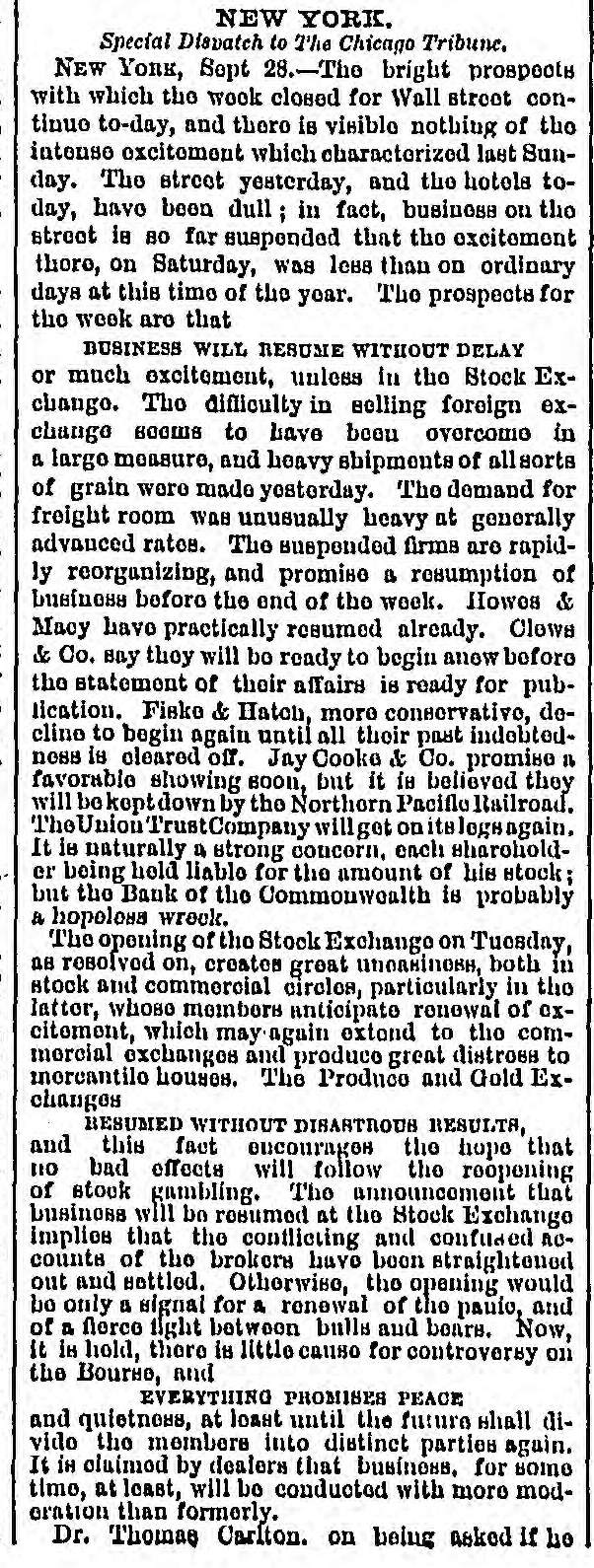
Special Disvatch to The Chicago Tribune, NEW YORK, Sept 28.-The bright prospects with which the wook closed for Wall street continuo to-day, and there is visible nothing of the intense excitement which characterized last Sunday. The street yesterday, and the hotels today, have been dull in fact, business on tho street le 80 far suspended that the excitement thore, on Saturday, was less than on ordinary days at this time of the year. The prospects for tho week are that BUSINESS WILL RESUME WITHOUT DELAY or much excitement, unless in the Stock Exchango. Tho difficulty in selling foreign exchange Becms to have been overcomo in a large measure, and heavy shipments of allsorts of grain were made yesterday. The demand for freight room WAS unusually heavy at generally advanced rates. The suspended firms are rapidly reorganizing, and promise a resumption of business before the end of the week. Howes & Macy have practically resumed already. Clows & Co. say they will bo ready to begin anow before the statement of their affairs is ready for publication. Fisko & Hatch, more conservativo, declino to begin again until all their past indebtedness is cleared off. Jay Cooke & Co. promise n favorable showing soon, but it is believed they will be kept down by the Northorn Paciflo Railroad. The Union Trust Company will get on italegengain. It is naturally a strong concern, each sharoholder being hold liablo for the amount of his stock; but the Bank of the Commonwoulth is probably a hopeless wreck. The opening of the Stock Exchange on Tuesday, BB resolved on, creates great unoasinoss, both in stock and commercial circles, particularly in the latter, whose members anticipate renowal of excitement, which may again extend to the commoreial exchanges and produce great distross to morcantilo houses. The Produce and Gold Exchanges RESUMED WITHOUT DISARTROUS RESULTA, and this fact encourages the hope that 110 bad effects will follow the roopening of stock gambling. The announcement that business will be resumed at the Stock Exchange implies that the conflicting and confused nocounts of the brokers have boon straightened out and settled. Otherwise, the opening would be only a signal for & renewal of the pauio, and of a fierce light between bulls and boars. Now, it is hold, there is little cause for controversy on the Bourne, and EVERYTHING PROMISES PEACE and quietness, at loast until the futuro shall divido the members into distinct parties again. It in claimod by dealers that business, for some time, at least, will be conducted with more modoration than formerly. Dr. Thomas Carlton. on being asked if he


Article from The Daily Dispatch, October 1, 1873

Click image to open full size in new tab

Article Text

New York Items

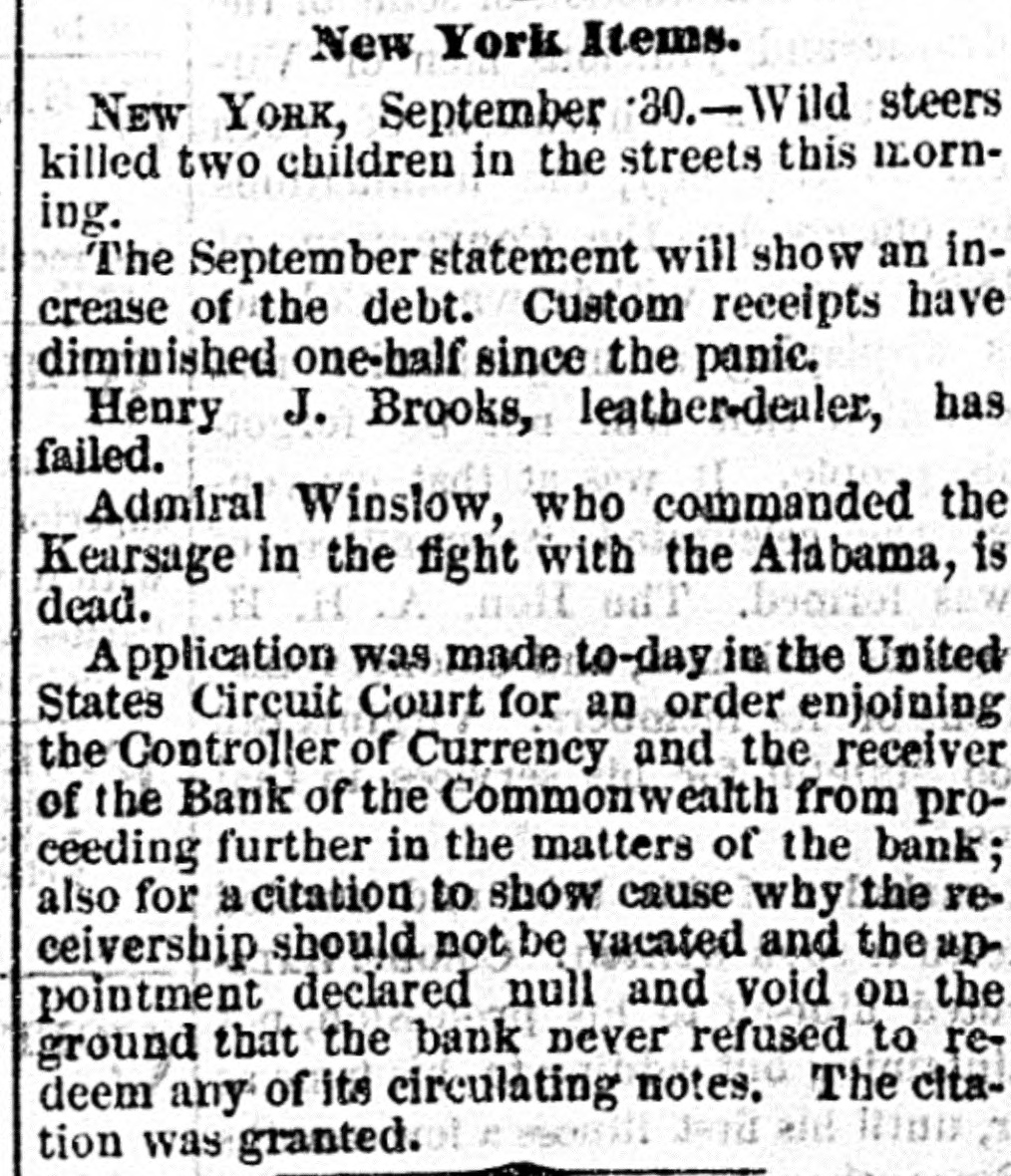
NEW YORK, September 30.-Wild steers killed two children in the streets this morning. The September statement will show an increase of the debt. Custom receipts have diminished one-half since the panic. Henry J. Brooks, leather-dealer, has failed. Admiral Winslow, who commanded the Kearsage in the fight with the Alabama, is dead. Application was made to-day in the United States Circuit Court for an order enjoining the Controller of Currency and the receiver of the Bank of the Commonwealth from proceeding further in the matters of the bank; also for a citation to show cause why the receivership should not be vacated and the uppointment declared null and void on the ground that the bank never refused to redeem any of its circulating notes. The citaand Ripo tion was granted.


Article from The Portland Daily Press, October 1, 1873

Click image to open full size in new tab

Article Text

NEW YORK

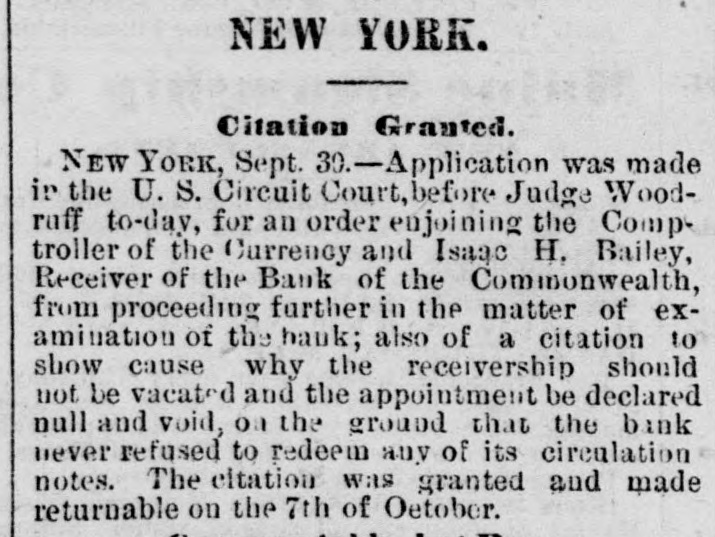
Citation Granted. NEW YORK, Sept. 30.-Application was made in the U. S. Circuit Court, before Judge Woodruff to-day, for an order enjoining the Comptroller of the Currency and Isage H. Bailey, Receiver of the Bank of the Commonwealth, from proceeding further in the matter of examination of the bank; also of a citation to show cause why the receivership should not be vacated and the appointment be declared null and void, on the ground that the bank never refused to redeem any of its circulation notes. The citation was granted and made returnable on the 7th of Oetober.


Article from The New York Herald, October 14, 1873

Click image to open full size in new tab

Article Text

MEMORANDA

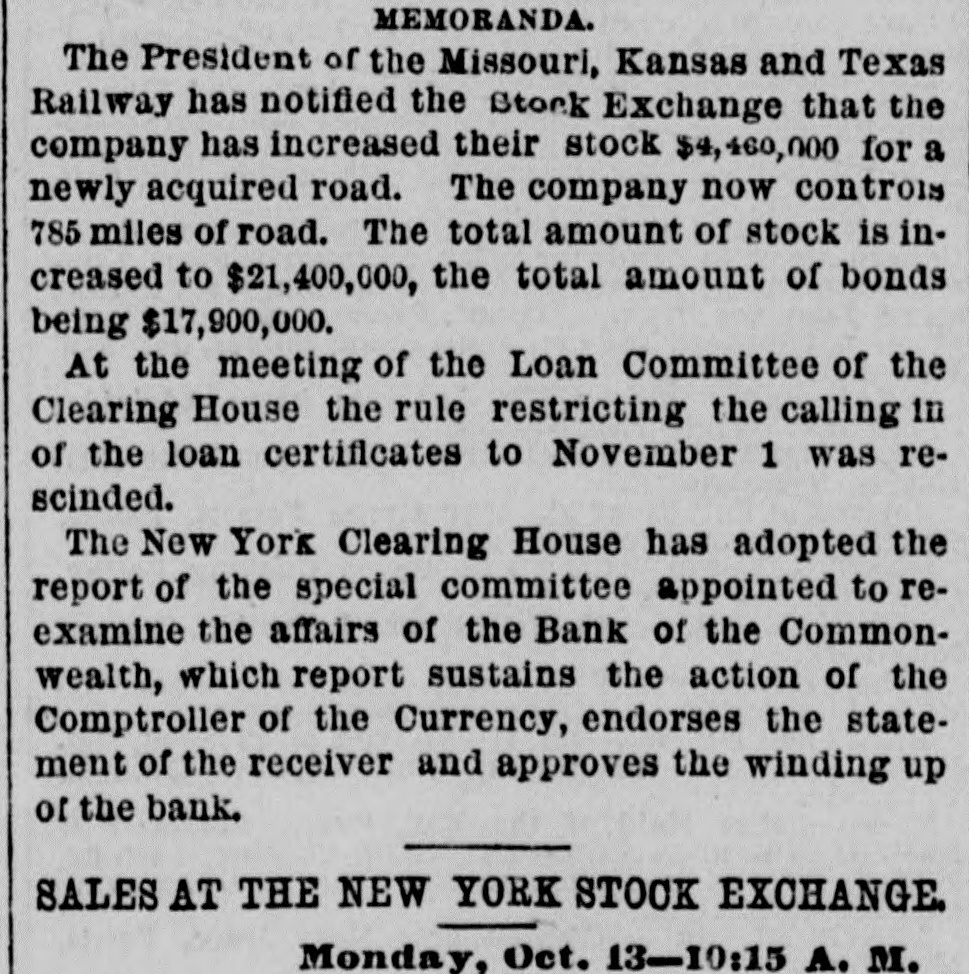
The President of the Missouri, Kansas and Texas Railway has notified the Stock Exchange that the company has increased their stock $4,460,000 for a newly acquired road. The company now controls 785 miles of road. The total amount of stock is increased to $21,400,000, the total amount of bonds being $17,900,000. At the meeting of the Loan Committee of the Clearing House the rule restricting the calling in of the loan certificates to November 1 was rescinded. The New York Clearing House has adopted the report of the special committee appointed to reexamine the affairs of the Bank of the Commonwealth, which report sustains the action of the Comptroller of the Currency, endorses the statement of the receiver and approves the winding up of the bank. SALES AT THE NEW YORK STOCK EXCHANGE M. Monday, Oct. 13-10:15 A.


Article from New-York Tribune, October 24, 1873

Click image to open full size in new tab

Article Text

FINANCIAL INCIDENTS.

EXPULSION OF EDWARD HAIGHT, JR., FROM THE STOCK EXCHANGE-PACIFIC MAIL SETTLEMENTS.

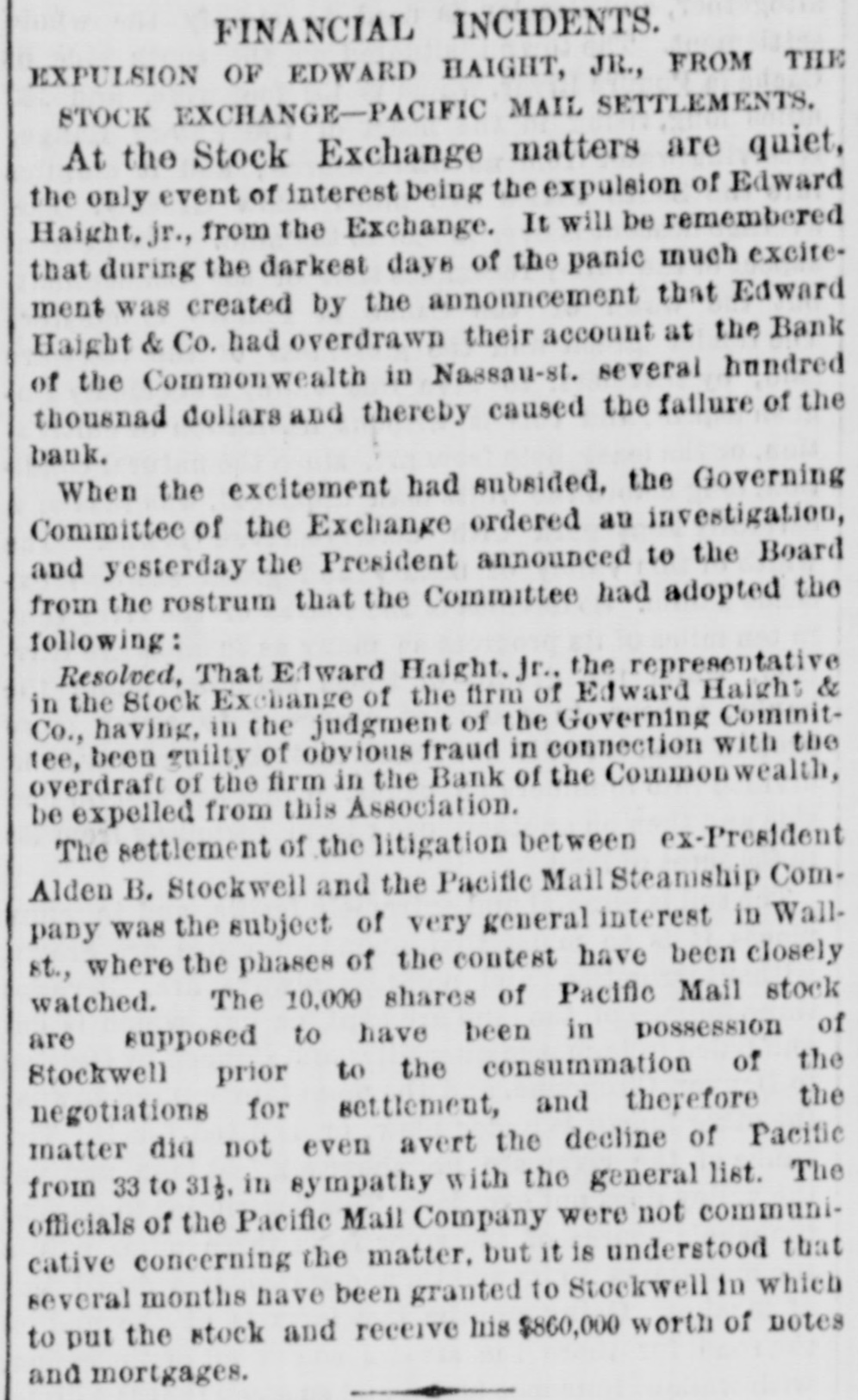
At the Stock Exchange matters are quiet, the only event of interest being the expulsion of Edward Haight, jr., from the Exchange. It will be remembered that during the darkest days of the panic much excitement was created by the announcement that Edward Haight & Co. had overdrawn their account at the Bank of the Commonwealth in Nassau-st. several hundred thousnad dollars and thereby caused the failure of the bank.

When the excitement had subsided, the Governing Committee of the Exchange ordered an investigation, and yesterday the President announced to the Board from the rostrum that the Committee had adopted the following:

Resolved, That Edward Haight, jr., the representative in the Stock Exchange of the firm of Edward Haight & Co., having, in the judgment of the Governing Committee, been guilty of obvious fraud in connection with the overdraft of the firm in the Bank of the Commonwealth, be expelled from this Association.

The settlement of the litigation between ex-President Alden B. Stockwell and the Pacific Mail Steamship Company was the subject of very general interest in Wall-st., where the phases of the contest have been closely watched. The 10,000 shares of Pacific Mail stock are supposed to have been in possession of Stockwell prior to the consummation of the negotiations for settlement, and therefore the matter did not even avert the decline of Pacific from 33 to 31½, in sympathy with the general list. The officials of the Pacific Mail Company were not communicative concerning the matter, but it is understood that several months have been granted to Stockwell in which to put the stock and receive his $860,000 worth of notes and mortgages.


Article from The Rutland Daily Globe, October 24, 1873

Click image to open full size in new tab

Article Text

TURNED OUT

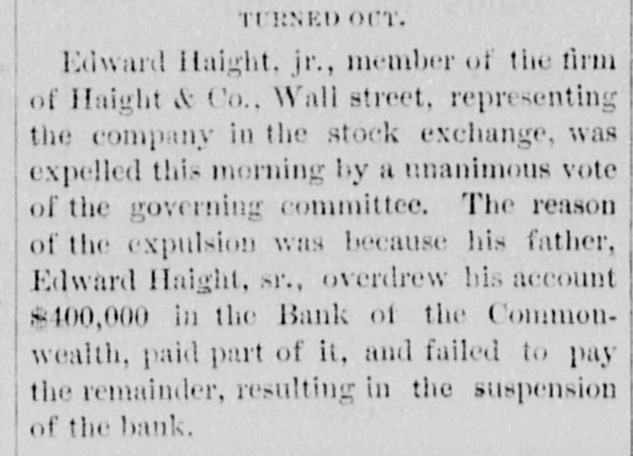
Edward Haight, jr., member of the firm of Haight & Co., Wall street, representing the company in the stock exchange, was expelled this morning by a unanimous vote of the governing committee. The reason of the expulsion was because his father, Edward Haight, SI., overdrew his account $400,000 in the Bank of the Commonwealth, paid part of it, and failed to pay the remainder, resulting in the suspension of the bank.


Article from New Orleans Republican, November 8, 1873

Click image to open full size in new tab

Article Text

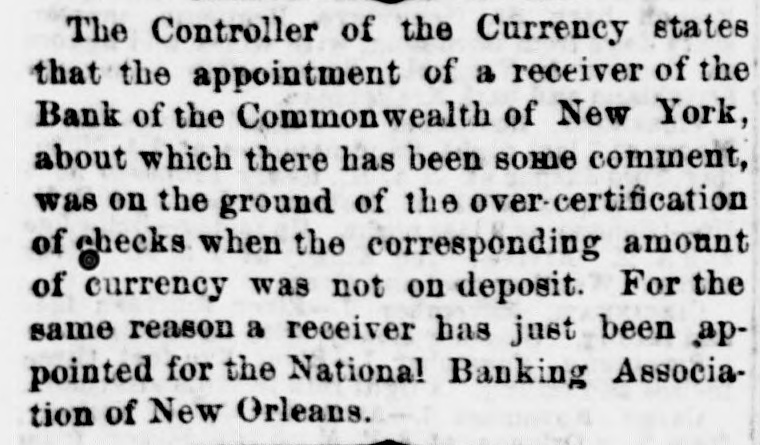
The Controller of the Currency states that the appointment of a receiver of the Bank of the Commonwealth of New York, about which there has been some comment, was on the ground of the over-certification of checks when the corresponding amount of currency was not on deposit. For the same reason a receiver has just been appointed for the National Banking Association of New Orleans.


Article from The Wheeling Daily Intelligencer, November 26, 1873

Click image to open full size in new tab

Article Text

How Not to Do Anything

NEW YORK, Nov. 25.-At a meeting of the associated banks this afternoon, a full representation being present, action on the late report of the committee of nine was postponed for sixty days, and the committee discharged. The whole subject is again to be referred to a new committee to be appointed. The suspended Bank of the Commonwealth will pay a dividend to its depositors of 30 per cent, in De. cember.


Article from Chicago Daily Tribune, March 9, 1874

Click image to open full size in new tab

Article Text

LATEST.

NEW YORK, March 7.-Money closed at 3 per cent on call. Exchange dull at $4.81½ for sixty days, and $4.88 for demand. Gold firmer in the late dealings, and closed at 111¾, the highest price made; lowest quotation, 111¼. Rates paid for carrying, 3, 2½, 2, 4, and 3½ per cent. Clearings, $66,000,000. Treasury operations for the week at the New York office included the disbursement of $3,500,000 gold for interest and in redemption of 5-20 bonds, and receipt of $2,438,400 for customs. General merchandise imports same time, including dry goods, $8,643.543. Produce exports, $3,934,686. Specie exports, $48,111. Governments closed dull and steady. State bonds quiet and nominal.

Washington rumors that the currency is to be contracted, rather than inflated, and the strikes existing and threatened, had their effect to-day in the stock market. Soon after the opening, a violent raid was made against the Northwestern and St. Paul Roads in particular, and Western roads in general, carrying down for the time most of these stocks; but after noon, and especially towards the closing hour, an advance took place, showing a recovery of ¼ to 2⅝ per cent from the lowest quotations. The advance was most decided in shares that led the downward movement early in the day. From 10 to 2 o'clock, 192,000 shares were sold.

On Monday next a dividend of 50 per cent will be paid to depositors by the Receiver of the Bank of the Commonwealth.


Article from The Elk County Advocate, November 26, 1874

Click image to open full size in new tab

Article Text

SAFETY OF THE NATIONAL BANK SYSTEM

-The receiver of the Bank of the Commonwealth, New York, which failed September 20th. of last year, announces the final payment of twenty per cent. to depositors and all other creditors, except shareholders, on the 20th inst., eighty per cent. having been previously paid. This is another proof of the safety to general creditors of the national bank system. There can scarcely be loss to others than the stockholders, a fact calculated to make them vigilant. THE State Contesting Board of Kentucky has decided that Thomas L Jones, Democrat. who was elected Clerk of the Court of Appeals by fifty thousand majority over his Republican competitor in August last, is ineligible, by reason of his having accepted a challenge to fight a duel five years, ago the State Constitution so providing. This is the first decision of the kind since the adoption of the Constitution, and was rendered by a board composed wholly of members of the same political party as Mr. Jones. The decision will necessitate a new election.-Pittsburgh Telegraph.