Stanton Trust & Savs. Bank (Great Falls, MT)

Episode Information

Episode Type
Suspension β†’ Closure
Start Date
July 10, 1923
Location
Great Falls, Montana (47.500, -111.301)
Bank Type
trust
Routing Number
93-0345
Canonical name
Stanton Trust & Savings Bank
Alt. names
Stanton Trust & Savs. Bank

Metadata

Notes

Bank entered voluntary liquidation and state examiner took charge the day it suspended.

Events (2)

1. July 10, 1923 Suspension
Cause
Voluntary Liquidation
Cause Details
Entered voluntary liquidation because it could not meet clearing house obligations despite being declared solvent; assets illiquid.
Newspaper Excerpt
Following suspension of business Monday morning by the Stanton Trust & Savings bank because of its inability to meet its obligations at the meeting of the Great Falls clearing house
Source
newspapers
2. July 10, 1923 Receivership
Newspaper Excerpt
L. Q. Shelton, state bank examiner, arrived in the evening ... his force would take charge of the bank today. . . . the bank would be liquidated by the state superintendent of banks.
Source
newspapers

Newspaper Articles (15)

Article from The Bismarck Tribune, July 10, 1923

Click image to open full size in new tab

Article Text

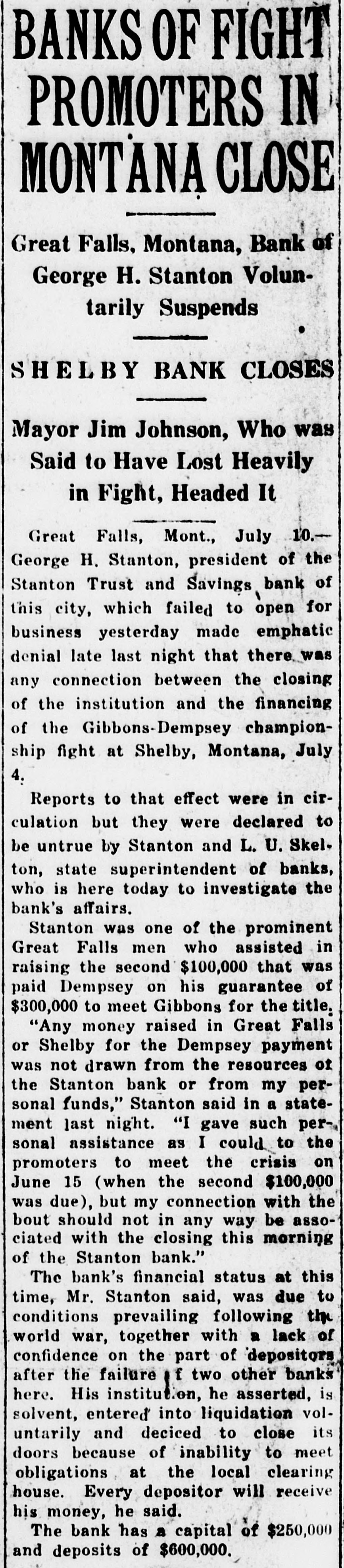
BANKS OF FIGHT PROMOTERS IN MONTANA CLOSE Great Falls, Montana, Bank of George H. Stanton Voluntarily Suspends SHELBY BANK CLOSES Mayor Jim Johnson, Who was Said to Have Lost Heavily in Fight, Headed It Great Falls, Mont., July 10.George H. Stanton, president of the Stanton Trust and Savings bank of this city, which failed to open for business yesterday made emphatic denial late last night that there was any connection between the closing of the institution and the financing of the Gibbons-Dempsey championship fight at Shelby, Montana, July 4. Reports to that effect were in circulation but they were declared to be untrue by Stanton and L. U. Skel. ton, state superintendent of banks, who is here today to investigate the bank's affairs. Stanton was one of the prominent Great Falls men who assisted in raising the second $100,000 that was paid Dempsey on his guarantee of $300,000 to meet Gibbons for the title, "Any money raised in Great Falls or Shelby for the Dempsey payment was not drawn from the resources of the Stanton bank or from my personal funds," Stanton said in a statement last night. "I gave such personal assistance as I could to the promoters to meet the crisis on June 15 (when the second $100,000 was due), but my connection with the bout should not in any way be associated with the closing this morning of the Stanton bank." The bank's financial status at this time, Mr. Stanton said, was due to conditions prevailing following the world war, together with a lack of confidence on the part of depositors after the failure f two other banks here. His institution, he asserted, is solvent, entered into liquidation voluntarily and deciced to close its doors because of inability to meet obligations at the local clearing house. Every depositor will receive his money, he said. The bank has a capital of $250,000 and deposits of $600,000.
Article from Great Falls Tribune, July 10, 1923

Click image to open full size in new tab

Article Text

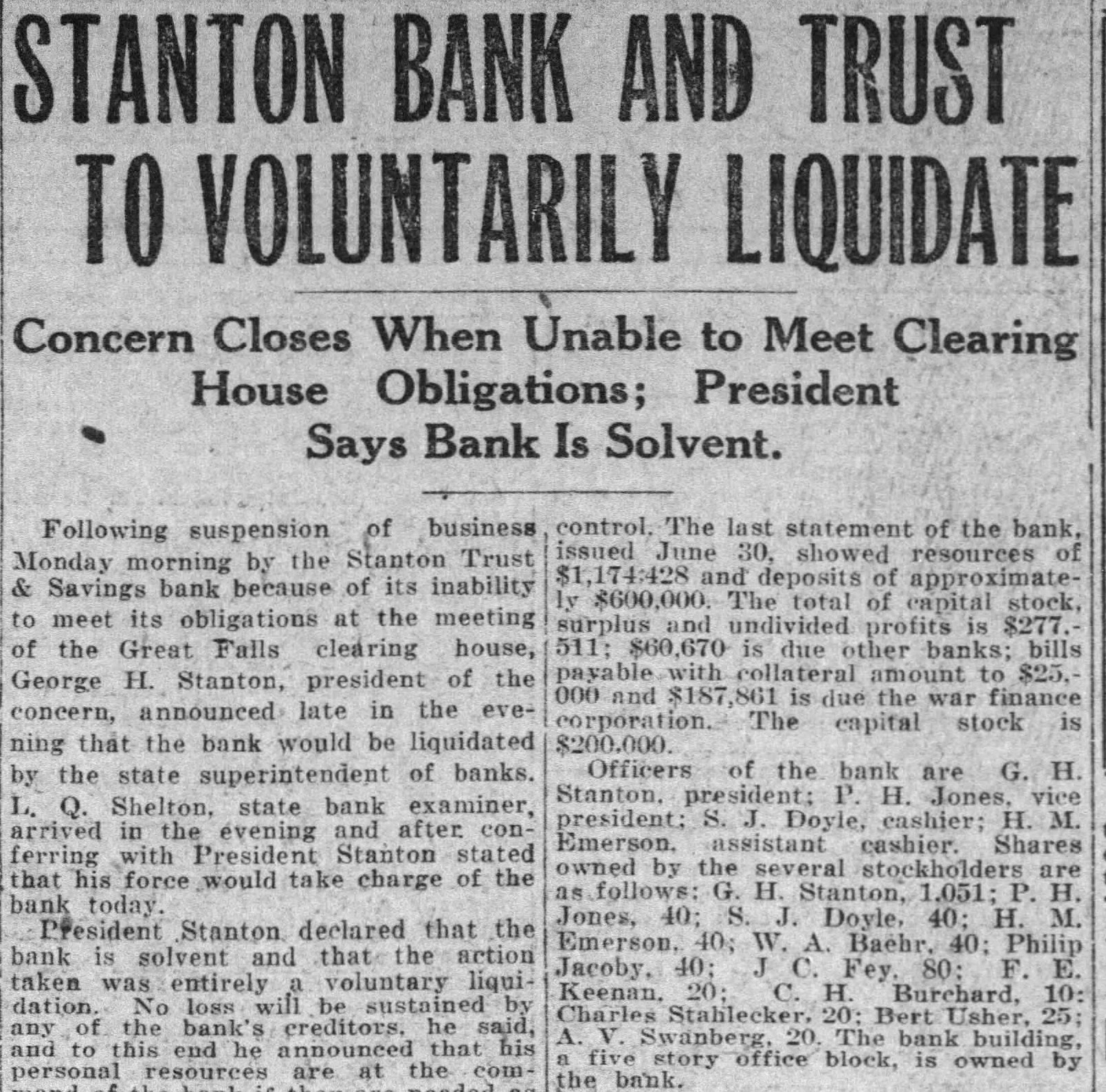
STANTON BANK AND TRUST TO VOLUNTARILY LIQUIDATE Concern Closes When Unable to Meet Clearing House Obligations; President Says Bank Is Solvent. Following suspension of business Monday morning by the Stanton Trust & Savings bank because of its inability to meet its obligations at the meeting of the Great Falls clearing house, George H. Stanton, president of the concern, announced late in the evening that the bank would be liquidated by the state superintendent of banks. L. Q. Shelton, state bank examiner, arrived in the evening and after conferring with President Stanton stated that his force would take charge of the bank today. President Stanton declared that the bank is solvent and that the action taken was entirely a voluntary liquidation. No loss will be sustained by any of the bank's creditors, he said, and to this end he announced that his personal resources are at the command of the bank if they are needed as additional security. He said that the bank's assets are in excellent condition, but that they are not liquid enough to meet the demands of the clearing house. The Stanton Trust & Savings bank was organized in 1912 and has been under the same management and control. The last statement of the bank, issued June 30, showed resources of $1,174,428 and deposits of approximately $600,000. The total of capital stock, surplus and undivided profits is $277,511; $60,670 is due other banks; bills payable with collateral amount to $25,000 and $187,861 is due the war finance corporation. The capital stock is $200,000. Officers of the bank are G. H. Stanton, president; P. H. Jones, vice president; S. J. Doyle, cashier; H. M. Emerson, assistant cashier. Shares owned by the several stockholders are as follows: G. H. Stanton, 1,051; P. H. Jones, 40; S. J. Doyle, 40; H. M. Emerson, 40; W. A. Baehr, 40; Philip Jacoby, 40; J C. Fey, 80; F. E. Keenan, 20; C. H. Burchard, 10; Charles Stahlecker, 20; Bert Usher, 25; A. V. Swanberg, 20. The bank building, a five story office block, is owned by the bank.


Article from Great Falls Tribune, July 10, 1923

Click image to open full size in new tab

Article Text

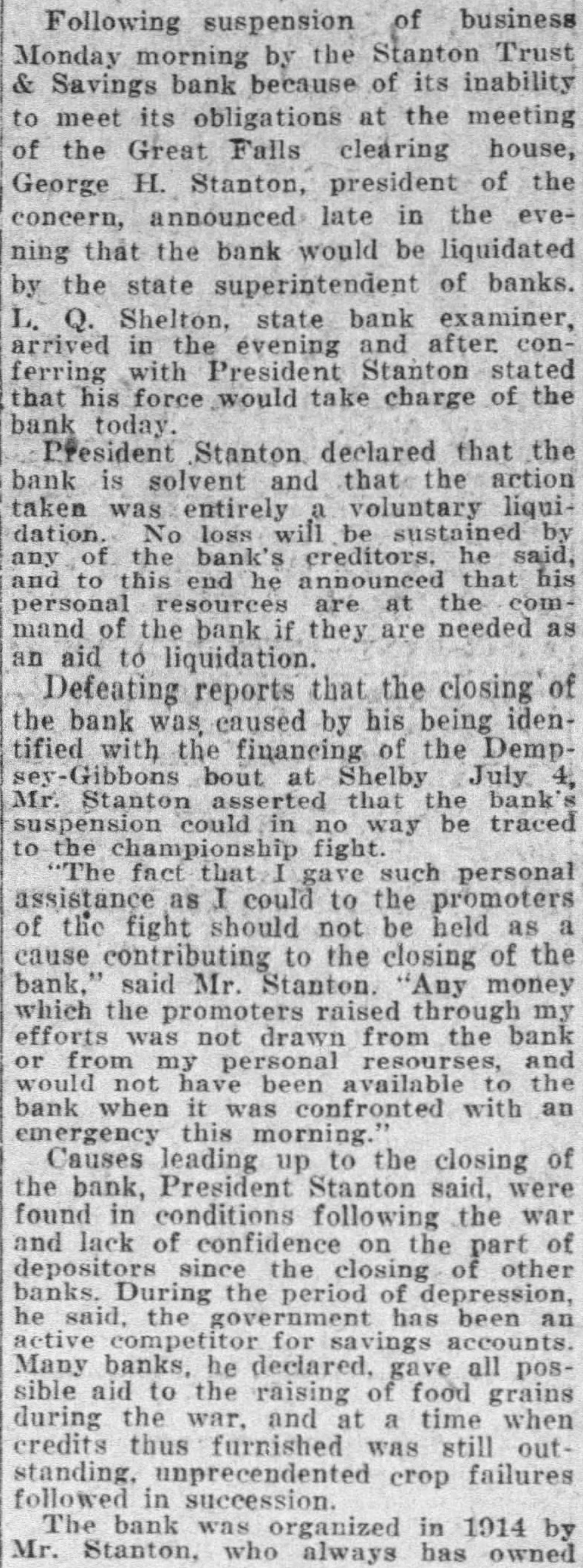
Following suspension of business Monday morning by the Stanton Trust & Savings bank because of its inability to meet its obligations at the meeting of the Great Falls clearing house, George H. Stanton, president of the concern, announced late in the evening that the bank would be liquidated by the state superintendent of banks. L. Q. Shelton, state bank examiner, arrived in the evening and after conferring with President Stanton stated that his force would take charge of the bank today. President Stanton declared that the bank is solvent and that the action taken was entirely a voluntary liquidation. No loss will be sustained by any of the bank's creditors, he said, and to this end he announced that his personal resources are at the command of the bank if they are needed as an aid to liquidation. Defeating reports that the closing of the bank was caused by his being identified with the financing of the Dempsey-Gibbons bout at Shelby July 4, Mr. Stanton asserted that the bank's suspension could in no way be traced to the championship fight. "The fact that I gave such personal assistance as I could to the promoters of the fight should not be held as a cause contributing to the closing of the bank," said Mr. Stanton. "Any money which the promoters raised through my efforts was not drawn from the bank or from my personal resources, and would not have been available to the bank when it was confronted with an emergency this morning." Causes leading up to the closing of the bank, President Stanton said, were found in conditions following the war and lack of confidence on the part of depositors since the closing of other banks. During the period of depression, he said, the government has been an active competitor for savings accounts. Many banks, he declared, gave all possible aid to the raising of food grains during the war, and at a time when credits thus furnished was still outstanding, unprecedented crop failures followed in succession. The bank was organized in 1914 by Mr. Stanton, who always has owned


Article from The Kansas City Post, July 11, 1923

Click image to open full size in new tab

Article Text

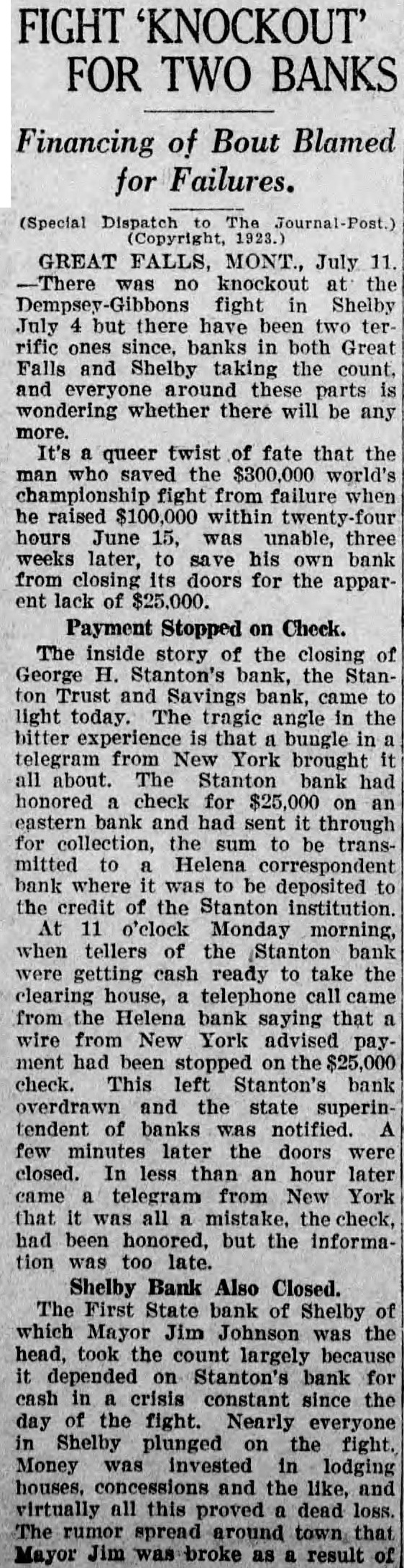
FIGHT 'KNOCKOUT' FOR TWO BANKS Financing of Bout Blamed for Failures. (Special Dispatch to The Journal-Post.) (Copyright, 1923.) GREAT FALLS, MONT., July 11.β€”There was no knockout at the Dempsey-Gibbons fight in Shelby July 4 but there have been two terrific ones since, banks in both Great Falls and Shelby taking the count, and everyone around these parts is wondering whether there will be any more. It's a queer twist of fate that the man who saved the $300,000 world's championship fight from failure when he raised $100,000 within twenty-four hours June 15, was unable, three weeks later, to save his own bank from closing its doors for the apparent lack of $25,000. Payment Stopped on Check. The inside story of the closing of George H. Stanton's bank, the Stanton Trust and Savings bank, came to light today. The tragic angle in the bitter experience is that a bungle in a telegram from New York brought it all about. The Stanton bank had honored a check for $25,000 on an eastern bank and had sent it through for collection, the sum to be transmitted to a Helena correspondent bank where it was to be deposited to the credit of the Stanton institution. At 11 o'clock Monday morning, when tellers of the Stanton bank were getting cash ready to take the clearing house, a telephone call came from the Helena bank saying that a wire from New York advised payment had been stopped on the $25,000 check. This left Stanton's bank overdrawn and the state superintendent of banks was notified. A few minutes later the doors were closed. In less than an hour later came a telegram from New York that it was all a mistake, the check had been honored, but the information was too late. Shelby Bank Also Closed. The First State bank of Shelby of which Mayor Jim Johnson was the head, took the count largely because it depended on Stanton's bank for cash in a crisis constant since the day of the fight. Nearly everyone in Shelby plunged on the fight. Money was invested in lodging houses, concessions and the like, and virtually all this proved a dead loss. The rumor spread around town that Mayor Jim was broke as a result of


Article from Wilkes-Barre Times Leader, the Evening News, July 11, 1923

Click image to open full size in new tab

Article Text

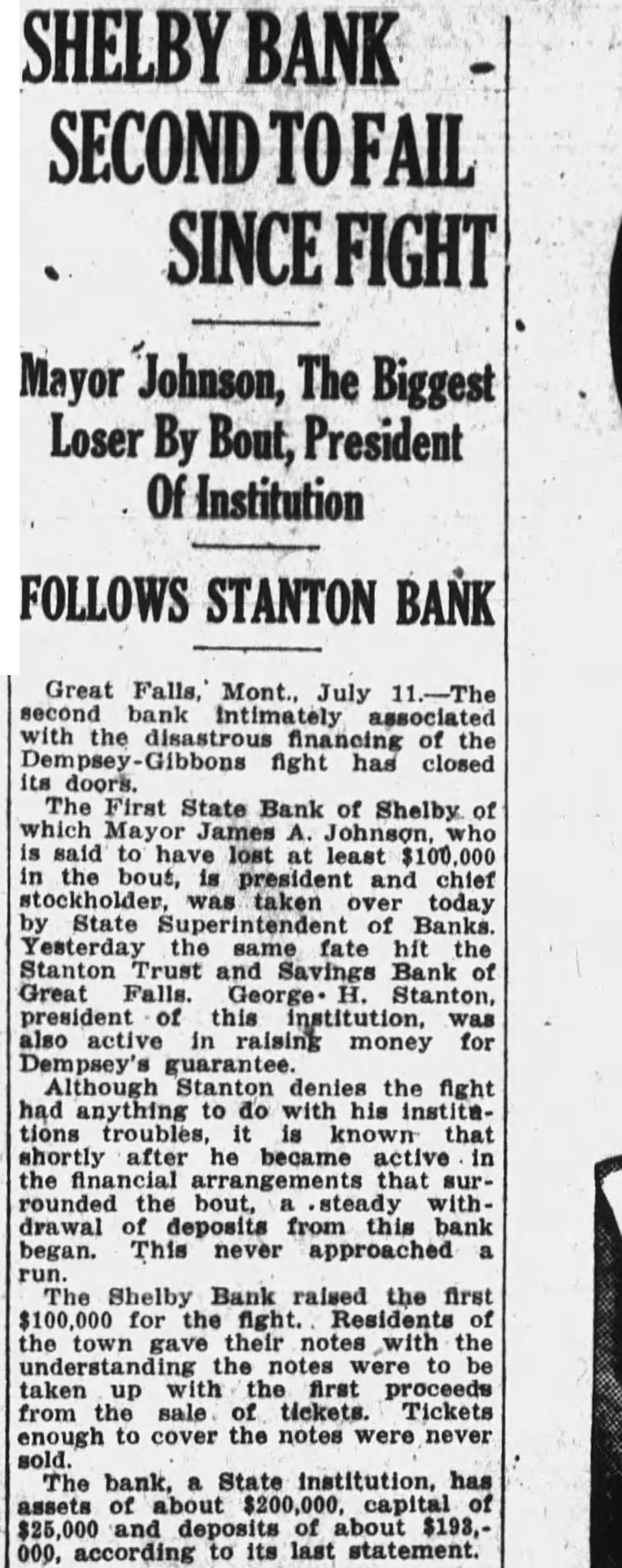
SHELBY BANK SECOND TO FAIL SINCE FIGHT Mayor Johnson, The Biggest Loser By Bout, President Of Institution FOLLOWS STANTON BANK Great Falls, Mont., July 11.β€”The second bank intimately associated with the disastrous financing of the Dempsey-Gibbons fight has closed its doors. The First State Bank of Shelby of which Mayor James A. Johnson, who is said to have lost at least $100,000 in the bout, is president and chief stockholder, was taken over today by State Superintendent of Banks. Yesterday the same fate hit the Stanton Trust and Savings Bank of Great Falls. George H. Stanton, president of this institution, was also active in raising money for Dempsey's guarantee. Although Stanton denies the fight had anything to do with his institutions troubles, it is known that shortly after he became active in the financial arrangements that surrounded the bout, a steady withdrawal of deposits from this bank began. This never approached a run. The Shelby Bank raised the first $100,000 for the fight. Residents of the town gave their notes with the understanding the notes were to be taken up with the first proceeds from the sale of tickets. Tickets enough to cover the notes were never sold. The bank, a State institution, has assets of about $200,000, capital of $25,000 and deposits of about $193,000, according to its last statement.


Article from The Omaha Morning Bee, July 11, 1923

Click image to open full size in new tab

Article Text

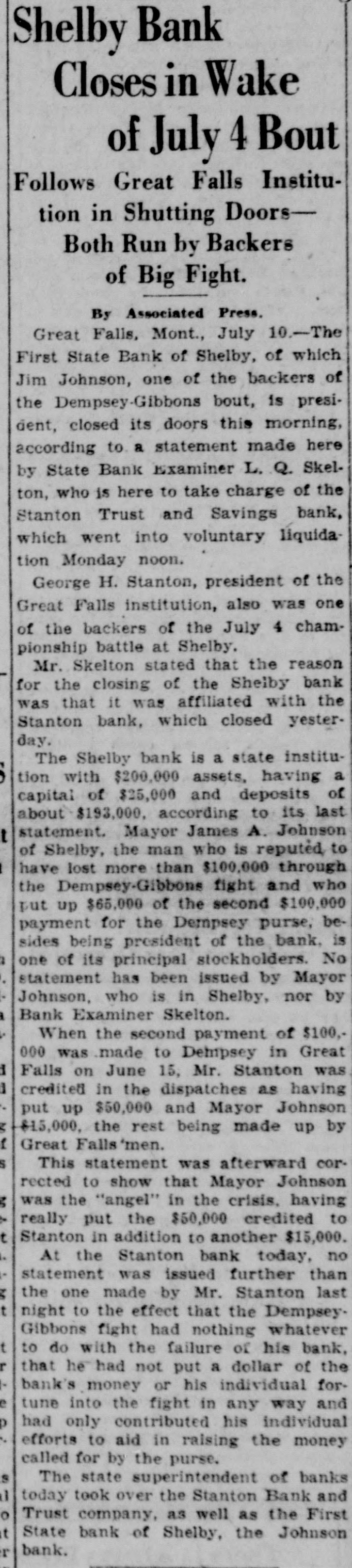
Shelby Bank Closes in Wake of July 4 Bout Follows Great Falls Institution in Shutting DoorsBoth Run by Backers of Big Fight. By Associated Press. Great Falls, Mont., July 10.-The First State Bank of Shelby, of which Jim Johnson, one of the backers of the Dempsey-Gibbons bout, is president, closed its doors this morning, according to a statement made here by State Bank Examiner L. Q. Skelton, who is here to take charge of the Stanton Trust and Savings bank, which went into voluntary liquidation Monday noon. George H. Stanton, president of the Great Falls institution, also was one of the backers of the July 4 championship battle at Shelby. Mr. Skelton stated that the reason for the closing of the Shelby bank was that it was affiliated with the Stanton bank, which closed yesterday. The Shelby bank is a state institution with $200,000 assets, having a capital of $25,000 and deposits of about $193,000. according to its last t statement. Mayor James A. Johnson of Shelby, the man who is reputed to have lost more than $100,000 through the Dempsey-Gibbons fight and who put up $65,000 of the second $100,000 payment for the Dempsey purse, besides being president of the bank. is 1 one of its principal stockholders. No statement has been issued by Mayor Johnson, who is in Shelby, nor by Bank Examiner Skelton. When the second payment of $100,000 was made to Dehipsey in Great I Falls on June 15, Mr. Stanton was I credited in the dispatches as having . put up $50,000 and Mayor Johnson < $15,000. the rest being made up by f Great Falls 'men. S This statement was afterward corrected to show that Mayor Johnson b was the "angel" in the crisis, having really put the $50,000 credited to t Stanton in addition to another $15,000. At the Stanton bank today, no statement was issued further than b the one made by Mr. Stanton last t night to the effect that the DempseyGibbons fight had nothing whatever t to do with the failure of his bank, r that he had not put a dollar of the bank's money or his individual fore tune into the fight in any way and p had only contributed his individual efforts to aid in raising the money called for by the purse. S The state superintendent of banks 1 today took over the Stanton Bank and o Trust company, as well as the First t State bank of Shelby, the Johnson bank. r


Article from Casper Daily Tribune, July 11, 1923

Click image to open full size in new tab

Article Text

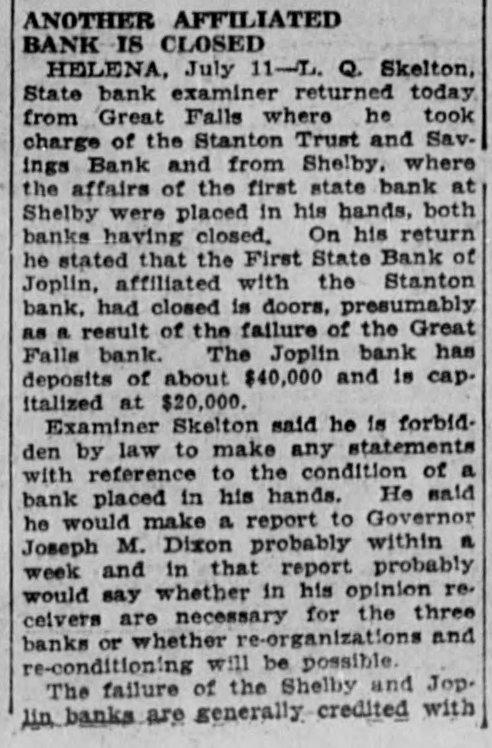
ANOTHER AFFILIATED BANK IS CLOSED HELENA, July 11-L. Q. Skelton, State bank examiner returned today from Great Falls where he took charge of the Stanton Trust and Savings Bank and from Shelby, where the affairs of the first state bank at Shelby were placed in his hands, both banks having closed. On his return he stated that the First State Bank of Joplin, affiliated with the Stanton bank, had closed is doors, presumably as a. result of the failure of the Great Falls bank. The Joplin bank has deposits of about $40,000 and is cap. italized at $20,000. Examiner Skelton said he is forbidden by law to make any statements with reference to the condition of a bank placed in his hands. He said he would make a report to Governor Joseph M. Dixon probably within n. week and in that report probably would say whether in his opinion re. ceivers are necessary for the three banks or whether re-organizations and re-conditioning will be possible. The failure of the Shelby and Jop. lin banks are generally credited with


Article from New Britain Herald, July 11, 1923

Click image to open full size in new tab

Article Text

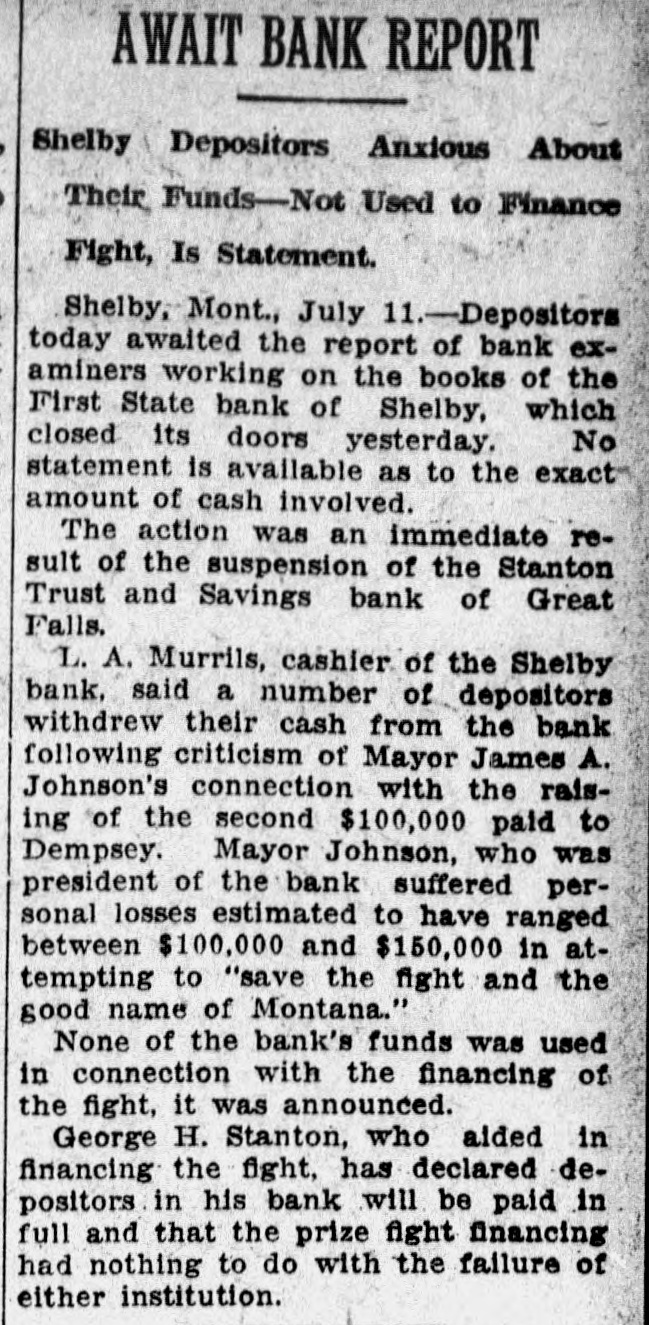
AWAIT BANK REPORT Shelby \ Depositors Anxious About Their Funds-Not Used to Finance Fight, Is Statement. Shelby, Mont., July 11.-Depositors today awaited the report of bank examiners working on the books of the First State bank of Shelby, which closed its doors yesterday. No statement is available as to the exact amount of cash involved. The action was an immediate result of the suspension of the Stanton Trust and Savings bank of Great Falls. L. A. Murrils, cashier of the Shelby bank. said a number of depositors withdrew their cash from the bank following criticism of Mayor James A. Johnson's connection with the raising of the second $100,000 paid to Dempsey. Mayor Johnson, who was president of the bank suffered personal losses estimated to have ranged between $100,000 and $150,000 in attempting to "save the fight and the good name of Montana." None of the bank's funds was used in connection with the financing of the fight, it was announced. George H. Stanton, who aided in financing the fight, has declared depositors in his bank will be paid in full and that the prize fight financing had nothing to do with the failure of either institution.


Article from Clarion-Ledger, July 11, 1923

Click image to open full size in new tab

Article Text

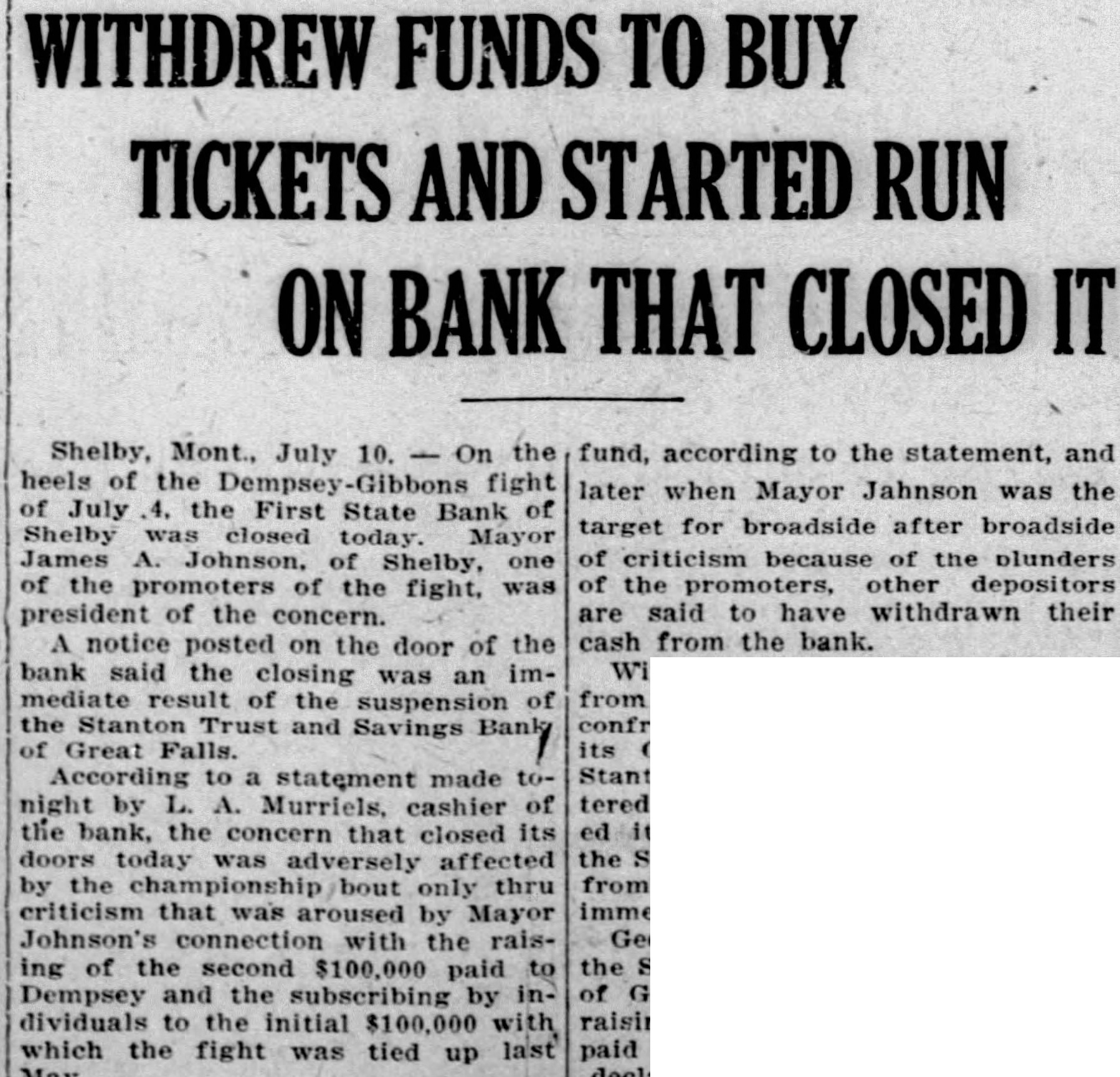
WITHDREW FUNDS TO BUY TICKETS AND STARTED RUN ON BANK THAT CLOSED IT Shelby, Mont., July 10. β€” On the heels of the Dempsey-Gibbons fight of July 4, the First State Bank of Shelby was closed today. Mayor James A. Johnson, of Shelby, one of the promoters of the fight, was president of the concern. A notice posted on the door of the bank said the closing was an immediate result of the suspension of the Stanton Trust and Savings Bank of Great Falls. According to a statement made tonight by L. A. Murriels, cashier of the bank, the concern that closed its doors today was adversely affected by the championship bout only thru criticism that was aroused by Mayor Johnson's connection with the raising of the second $100,000 paid to Dempsey and the subscribing by individuals to the initial $100,000 with which the fight was tied up last May. fund, according to the statement, and later when Mayor Johnson was the target for broadside after broadside of criticism because of the blunders of the promoters, other depositors are said to have withdrawn their cash from the bank.


Article from Clarion-Ledger, July 11, 1923

Click image to open full size in new tab

Article Text

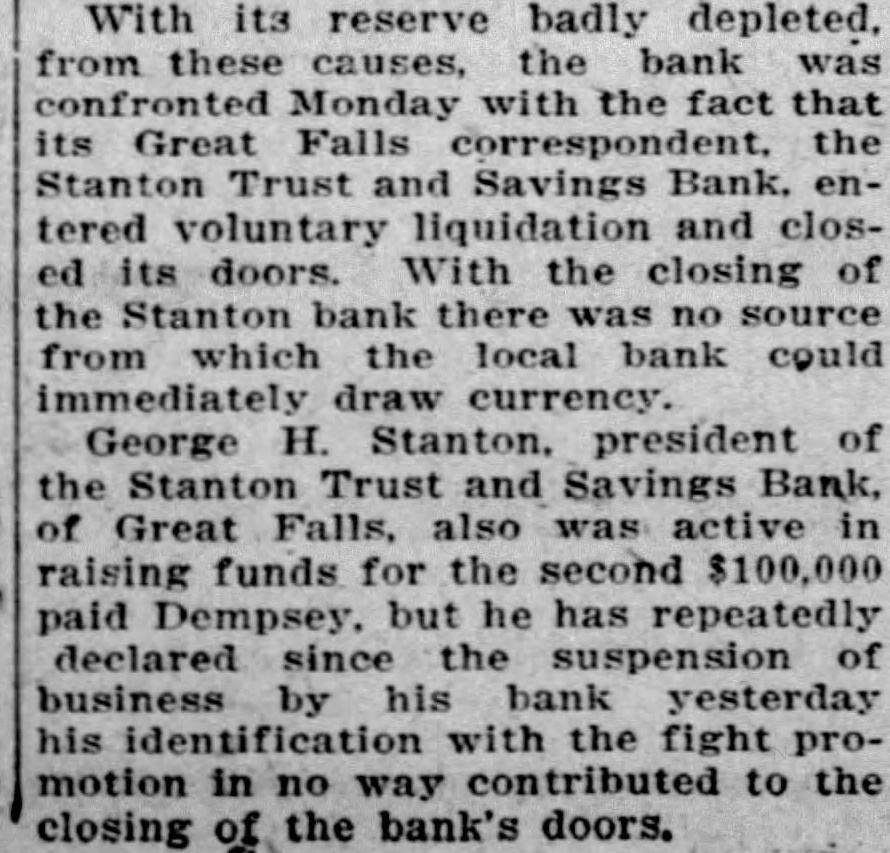
With its reserve badly depleted, from these causes, the bank was confronted Monday with the fact that its Great Falls correspondent, the Stanton Trust and Savings Bank, entered voluntary liquidation and closed its doors. With the closing of the Stanton bank there was no source from which the local bank could immediately draw currency. George H. Stanton, president of the Stanton Trust and Savings Bank, of Great Falls, also was active in raising funds for the second $100,000 paid Dempsey, but he has repeatedly declared since the suspension of business by his bank yesterday his identification with the fight promotion in no way contributed to the closing of the bank's doors.


Article from Evening star, July 11, 1923

Click image to open full size in new tab

Article Text

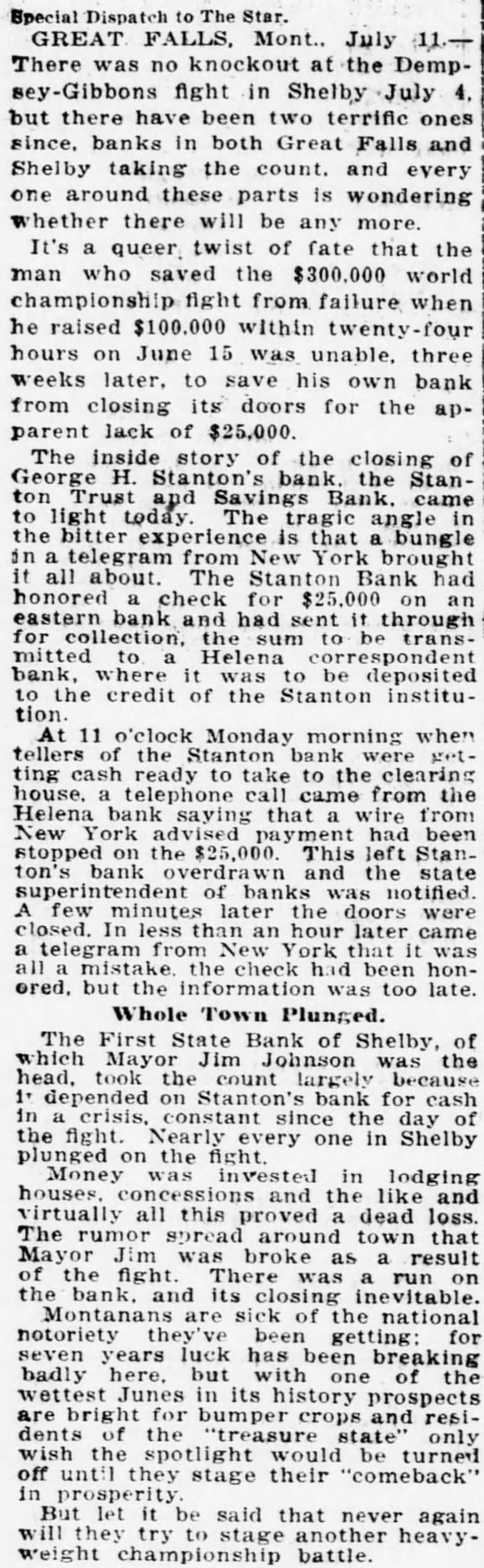
Special Dispatch to The Star. GREAT FALLS, Mont., July 11.β€”There was no knockout at the Dempsey-Gibbons fight in Shelby July 4, but there have been two terrific ones since, banks in both Great Falls and Shelby taking the count, and every one around these parts is wondering whether there will be any more. It's a queer twist of fate that the man who saved the $300,000 world championship fight from failure when he raised $100,000 within twenty-four hours on June 15 was unable, three weeks later, to save his own bank from closing its doors for the apparent lack of $25,000. The inside story of the closing of George H. Stanton's bank, the Stanton Trust and Savings Bank, came to light today. The tragic angle in the bitter experience is that a bungle in a telegram from New York brought it all about. The Stanton Bank had honored a check for $25,000 on an eastern bank and had sent it through for collection, the sum to be transmitted to a Helena correspondent bank, where it was to be deposited to the credit of the Stanton institution. At 11 o'clock Monday morning when tellers of the Stanton bank were getting cash ready to take to the clearing house, a telephone call came from the Helena bank saying that a wire from New York advised payment had been stopped on the $25,000. This left Stanton's bank overdrawn and the state superintendent of banks was notified. A few minutes later the doors were closed. In less than an hour later came a telegram from New York that it was all a mistake, the check had been honored, but the information was too late. Whole Town Plunged. The First State Bank of Shelby, of which Mayor Jim Johnson was the head, took the count largely because it depended on Stanton's bank for cash in a crisis, constant since the day of the fight. Nearly every one in Shelby plunged on the fight. Money was invested in lodging houses, concessions and the like and virtually all this proved a dead loss. The rumor spread around town that Mayor Jim was broke as a result of the fight. There was a run on the bank, and its closing inevitable. Montanans are sick of the national notoriety they've been getting; for seven years luck has been breaking badly here, but with one of the wettest Junes in its history prospects are bright for bumper crops and residents of the "treasure state" only wish the spotlight would be turned off until they stage their "comeback" in prosperity. But let it be said that never again will they try to stage another heavyweight championship battle.


Article from The Ely Miner, July 13, 1923

Click image to open full size in new tab

Article Text

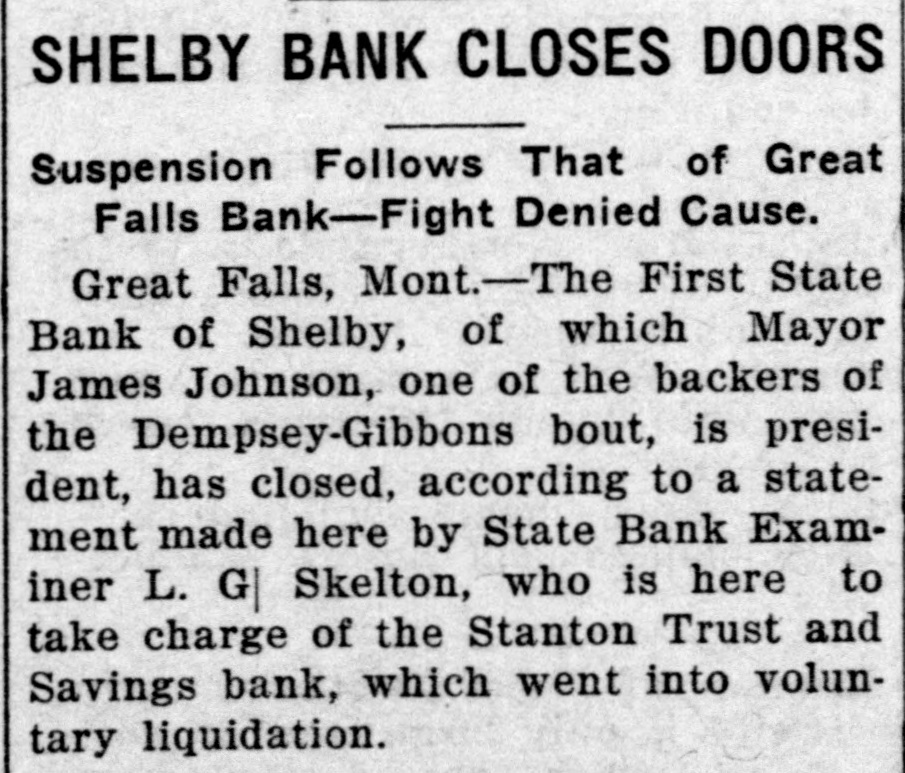
SHELBY BANK CLOSES DOORS Suspension Follows That of Great Falls Bank-Fight Denied Cause. Great Falls, Mont.-The First State Bank of Shelby, of which Mayor James Johnson, one of the backers of the Dempsey-Gibbons bout, is president, has closed, according to a statement made here by State Bank Examiner L. G| Skelton, who is here to take charge of the Stanton Trust and Savings bank, which went into voluntary liquidation.


Article from The South Bend Tribune, July 15, 1923

Click image to open full size in new tab

Article Text

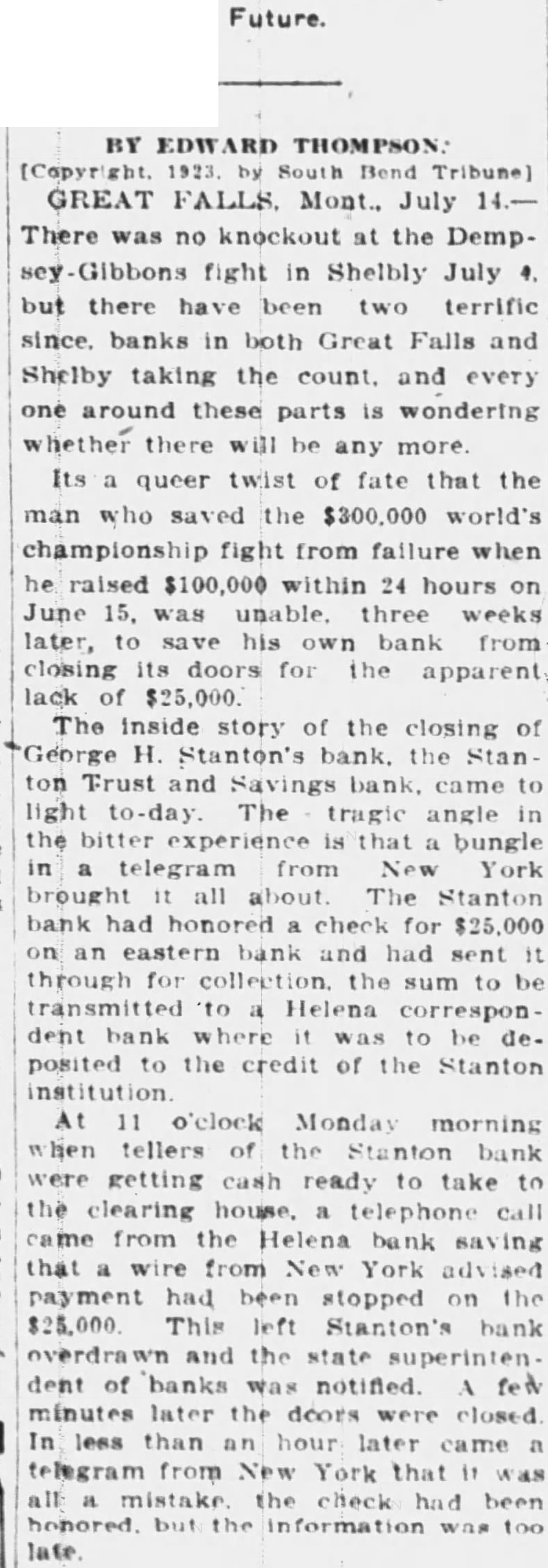
BY EDWARD THOMPSON: [Copyright, 1923, by South Bend Tribune] GREAT FALLS, Mont., July 14.β€”There was no knockout at the Dempsey-Gibbons fight in Shelby July 4, but there have been two terrific since, banks in both Great Falls and Shelby taking the count, and every one around these parts is wondering whether there will be any more. Its a queer twist of fate that the man who saved the $300,000 world's championship fight from failure when he raised $100,000 within 24 hours on June 15, was unable, three weeks later, to save his own bank from closing its doors for the apparent lack of $25,000. The inside story of the closing of George H. Stanton's bank, the Stanton Trust and Savings bank, came to light to-day. The tragic angle in the bitter experience is that a bungle in a telegram from New York brought it all about. The Stanton bank had honored a check for $25,000 on an eastern bank and had sent it through for collection, the sum to be transmitted to a Helena correspondent bank where it was to be deposited to the credit of the Stanton institution. At 11 o'clock Monday morning when tellers of the Stanton bank were getting cash ready to take to the clearing house, a telephone call came from the Helena bank saying that a wire from New York advised payment had been stopped on the $25,000. This left Stanton's bank overdrawn and the state superintendent of banks was notified. A few minutes later the doors were closed. In less than an hour later came a telegram from New York that it was all a mistake, the check had been honored, but the information was too late.


Article from The Billings Gazette, October 12, 1926

Click image to open full size in new tab

Article Text

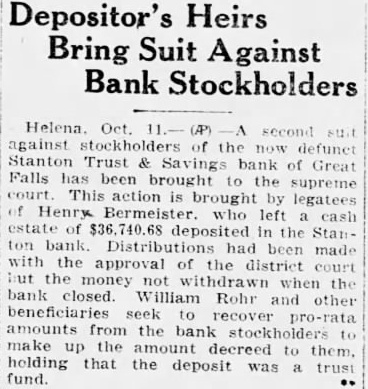
Depositor's Heirs Bring Suit Against Bank Stockholders Oct 11.- second against of the now defunet Stanton Trust of Great Falls has brought the supreme court This action brought by legatees Henry Bermeister. left cash estate of deposited in the ton Distributions had been made with the approval of the district court but the money withdrawn when the bank William


Article from The Bozeman Courier, October 29, 1926

Click image to open full size in new tab

Article Text

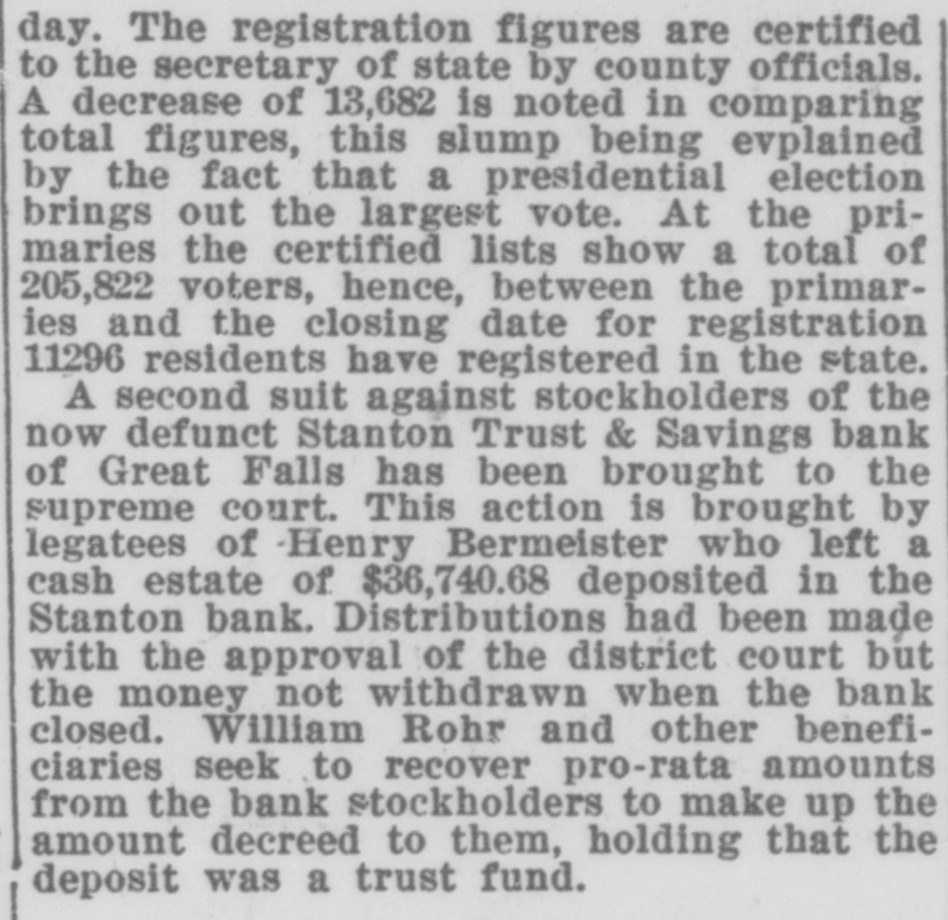
day. The registration figures are certified to the secretary of state by county officials. A decrease of 13,682 is noted in comparing total figures, this slump being explained by the fact that a presidential election brings out the largest vote. At the primaries the certified lists show a total of 205,822 voters, hence, between the primaries and the closing date for registration 11296 residents have registered in the state. A second suit against stockholders of the now defunct Stanton Trust & Savings bank of Great Falls has been brought to the supreme court. This action is brought by legatees of Henry Bermeister who left a cash estate of $36,740.68 deposited in the Stanton bank. Distributions had been made with the approval of the district court but the money not withdrawn when the bank closed. William Rohr and other beneficiaries seek to recover pro-rata amounts from the bank stockholders to make up the amount decreed to them, holding that the deposit was a trust fund.