Article Text
At the meeting of the State County Commissioners Association in Helena the work of the extension agent occupied most of the attention. Commissioners from some of the timber and mining counties were interested in the extension work although these agents were not so necessary in their counties, it was reported. From the farming counties, however, there was a great majority of favor for extension work.
D. N. Miles of Livingston, president. The action of the Montana county commissioners follows similar action in other states. In Oregon one county has made its extension work "permanent". The importance of the extension work nationally is shown in the report of Secretary Wallace where he says agricultural agents are employed in 2,100 counties, home demonstration agents in 800 counties and club agents in 200 counties. These agents come in contact with 2,500,000 farm homes annually.
The Farm Bureaus And Experiment Stations
"The Farm Bureau in its work has dealt with all the factors influencing farm life, including production, economics, education and social life," said Dean E. C. Johnson of the State College of Washington to a Farm Bureau gathering at the Walla Walla Chamber of Commerce recently.
"It has stressed the first three, and especially the economic side. The agricultural experiment stations of necessity have first of all stressed production, because without it there can be no permanent progress. Production is basic and will remain so always.
"The experiment stations have, however, done much work also in development of marketing and organization."
No Royal Road To Dry Land Wealth
Dry land farming in the famous "triangle" of north central Montana can be made a success with the right kind of farmers doing their farming in the right way, says M. L. Wilson of the State College Extension Service. Mr. Wilson has just finished a survey of typical dry farming areas of this section, getting records from farmers who have been "successful" enough to permit them to show a labor income in spite of recent years of drouth.
A summary of Mr. Wilson's findings was made before the Rotary Club of Great Falls and again before the State College advisory council at Bozeman. Some of his points, summarized, are as follows.
Enough diversification must be practiced to assure the family a living each year independent of the main grain crop.
Flood water irrigation should be utilized to its fullest extent, and most of the farms in this section have flood water possibilities.
The crop land will probably be one-third fallow, one-third crop on fallow and the other one-third crop on unfallowed land. Fallow provides a more uniform yield each year, while the crop on unfallowed grounds allows building up of surplus profits in the good years, at small expense.
Where cheap pasture land is available the tendency will be toward greater amount of livestock in the diversification.
The farm garden is perhaps the most important point in the diversification base on which all farming practice must be constructed.
All farming in this section must be built around control of the Russian thistle.
It is improbable that the section will experience soon again a succession of years of drouth such as have marked the past five years.
Speculative farming cannot succeed; the farmer must build with an idea towards a permanent home.
Greatest economy in man labor must be practiced. The use of eight, ten, or twelve-horse teams will grow in favor.
Soil blowing will become an increasingly difficult problem. Fallowing without plowing may be practiced more each year.
The double rod weeder and duck foot type of cultivator are the best types for control of Russian thistle in fallowing.
Sudden or easy wealth in this section should not be expected. It is a section for thrifty, careful farmers who will farm intelligently and who will farm with the idea of home building for permanency.
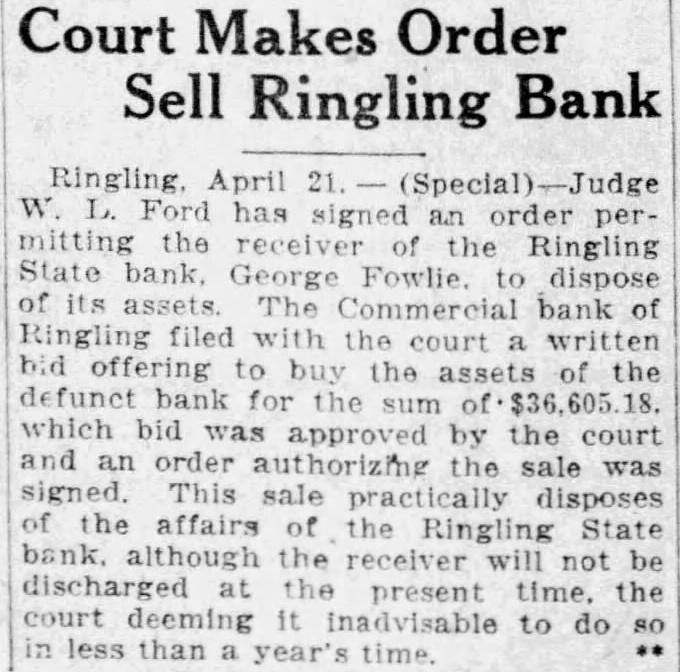
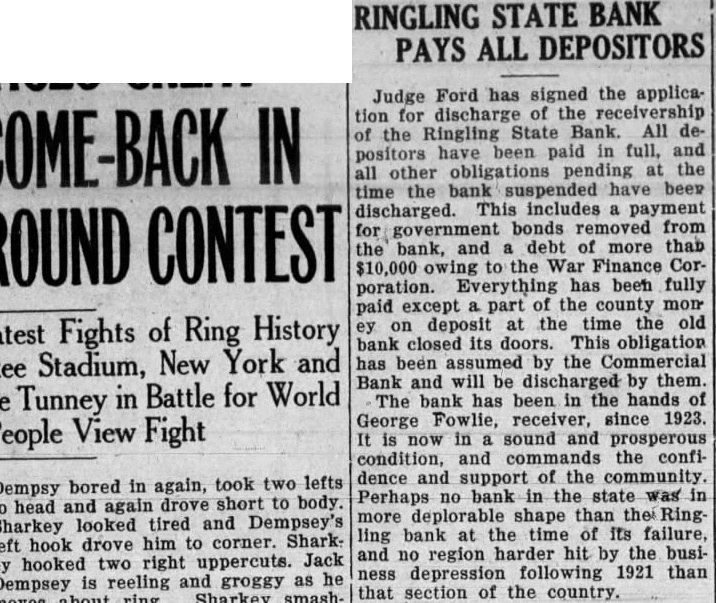
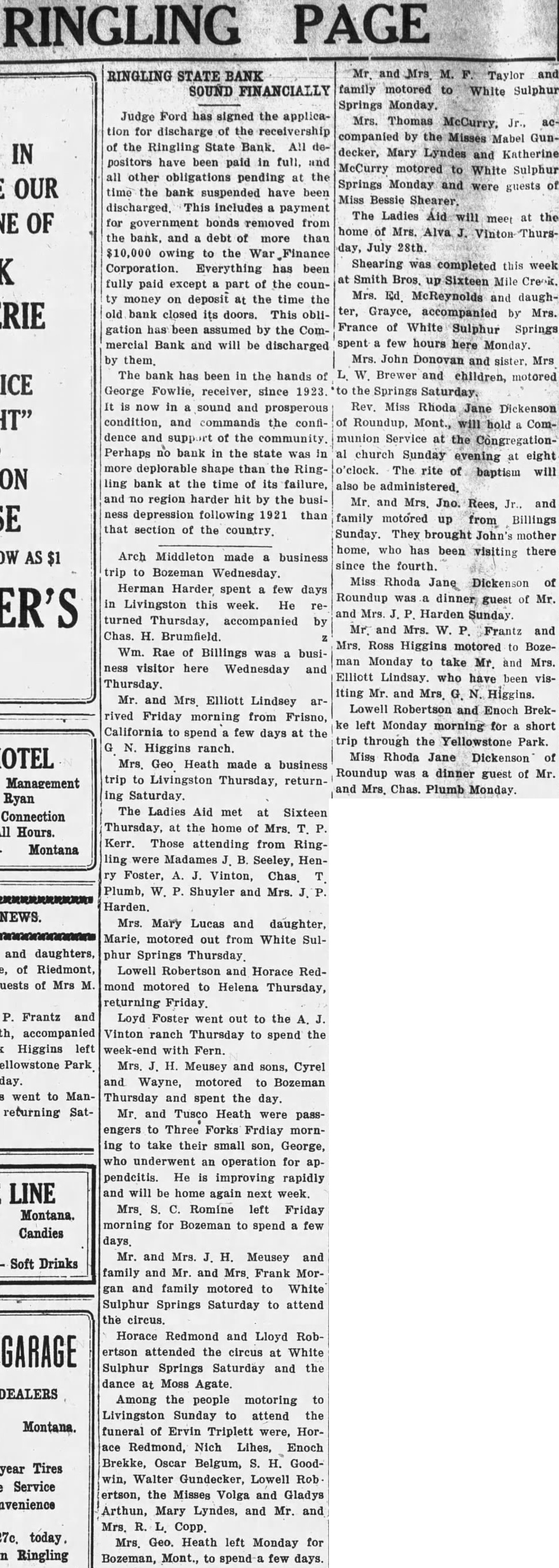
The State Bank of Martinsdale closed its doors Saturday, February 3, in the same week that the Ringling State Bank suspended, according to the Ringling Independent. It is stated that the closing of the Martinsdale bank was expected after the closing of the Ringling State Bank, owing to the close association of the two.