Article Text
Missouri, and Kansas, are crowded with advertisements of land brokers, anxious to sell for their clients. Every farmer, merchant and lawyer, every doctor and half the journeymen have been dealing in land warrants. And now, most of the lands are distributed, and their owners are looking round to sell. In time they will be needed, and rise; but the great body of land speculators must wait for time.
The centre of all this mania for speculation and gambling is the city of New York, and hence it is no way surprising that the first shock of reaction begins there. We apprehend no disasters from it to the Central West. The storms which rage along the Atlantic, or burst beyond the Mississippi, are little felt here, for in fact the most solid wealth, industry and resources of the nation may be found in the valley of the Ohio. Our golden harvests, our rich mines, our intelligent men, our hardy laborers are beyond the influence of the stock exchange, and without the atmosphere of wild speculation.
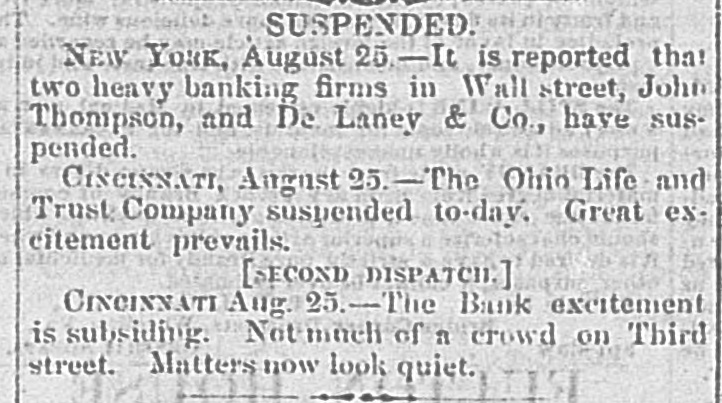
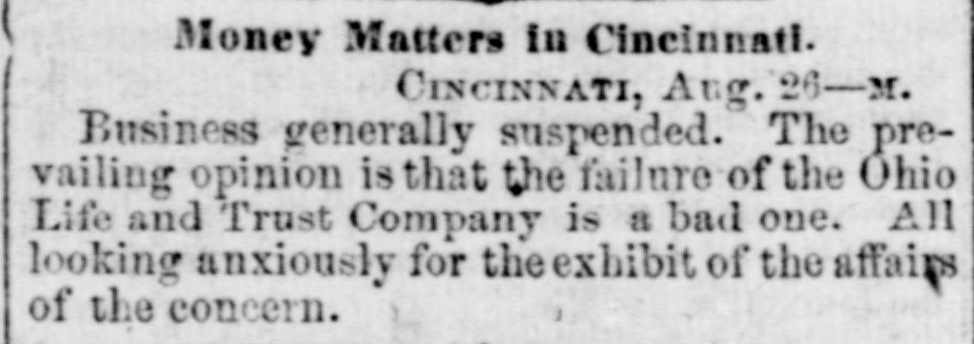
THE TRUST COMPANY BANK PANIC. [From the Cincinnati Commercial, August 28]
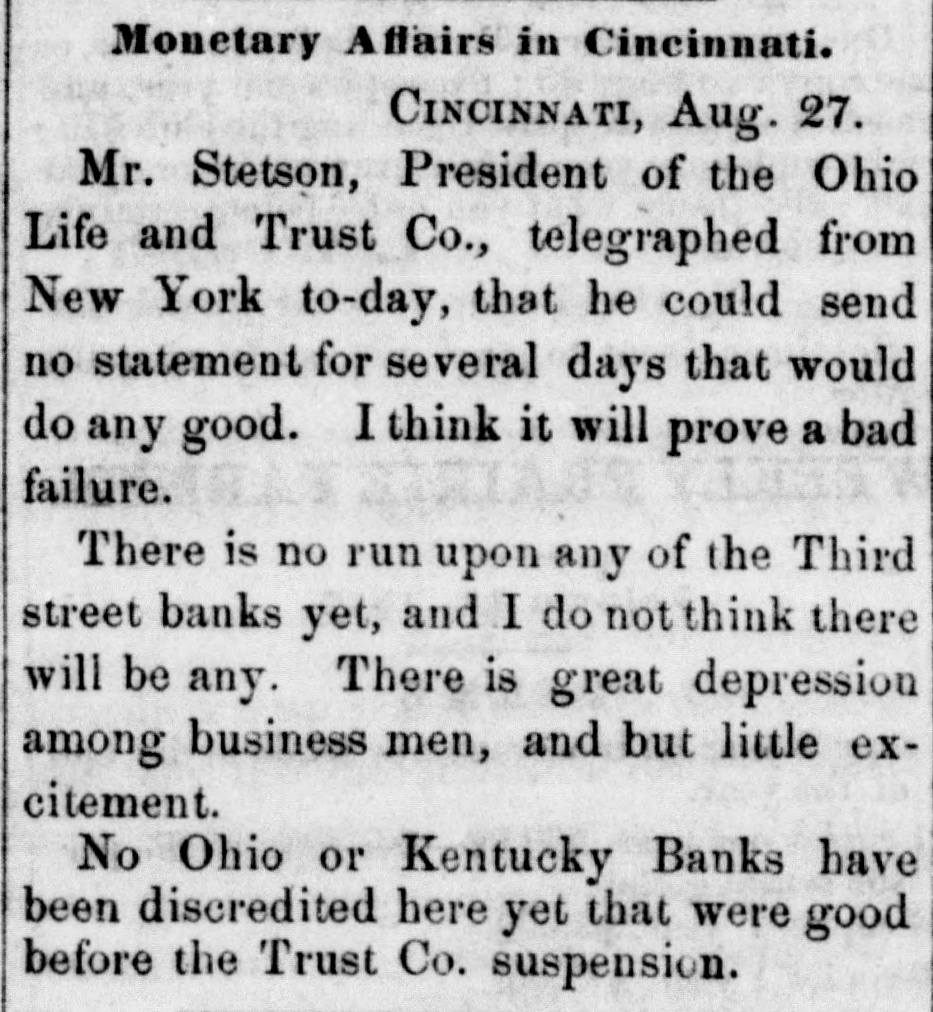
The suspension of the Trust Company Bank was again the absorbing theme of local consideration yesterday. No other topic seemed of sufficient importance to attract observation. Knots of interested and curious citizens, and people from the neighboring towns and cities, and the rural districts, assembled on Third street, in front of the Bank, long before bank hours, and hovered in that vicinity until after banks had closed their doors, indicating the suspension of active business for the day. The temper of the community was apparently moderate, but a very casual observer could discover the existence of intense gloom, mingled with a considerable degree of exasperation.
PAPER IN EXCHANGE FOR GOLD.
As the morning wore away the throng increased by the accession of laborers, and other poor people who had hoarded away a little store of bank notes against a day of misfortune, but who, becoming discouraged by flying rumors of suspensions in all parts of the country, came tramping in troops, men and women of all tongues and colors, seeking an exchange of paper for indestructible coin. They crowded the brokers' offices, rushed upon the bankers, and besought the speedy intercession of money changers to protect them at any price. Some had ten dollars, some had five hundred, but not one shirked the two per cent share, which was the current rate, and some were glad enough to get rid of their small amounts for a still more ruthless dig into their little all. So far, indeed, were any from demurring, that all clutched at the glittering gold with miserly avidity, as though their last hope of salvation depended upon immediate success in their efforts, and when the coveted prize was secured, they hugged it with a joyous vehemence that partook of the nature of frenzy.
INCIDENTS AT THE CITIZENS' BANK.
The most interesting incidents of the day were witnessed in the Citizens' Bank. This famous institution has always been popular with the smaller class of depositors, owing to the confidence inspired by the generosity of the manager, Mr. Smead, and to the fact that they have generally received more interest on their small deposits than is paid elsewhere. The rumor that the Citizens' Bank had enormous deposits in the Trust Company which the depositors could not withdraw, and which would inevitably crush the proprietors, had winged its flight to all points of the compass. Sturdy men came trooping to the door, pale and excited, to give "thirty days notice" of their intention to withdraw their deposits, and evidently fearful of a collapse before the expiration of the dreaded probationary period. Frightened needle women and sickly looking mothers flocked thither in trembling groups, and with tearful eyes presented their humble "notes" with trembling fingers and with stuttering speech.
"My poor child," said Mr. Smead, affectionately, to a poor woman who seemed almost sinking with terror, "what will you have?"
"My notice—thirty days' notice for—my—money."
"But, my child," rejoined the banker, compassionately, "wouldn't you prefer the money now? I would rather have your check."
"Now, now, now," she almost shrieked, "can I have it now? Mustn't I wait thirty days?"
"Oh, no, my child," again replied the banker, and turning to the teller requested him to pay the poor woman her $360; then accosting her again, he said, "We can give you gold if you prefer it, at two per cent discount."
"Oh, gold, gold, gold, give me gold," quoth she, vehemently, "that won't break; do give me gold!"
She was paid in gold and fairly danced out of the bank. Other women, however, were so assured by the confident demeanor of the firm, that they, like the Frenchman, didn't want the money if they could get it, but must have it if they couldn't. All the female depositors that would receive their money were paid off in full.
THE PUBLIC PULSE.
About noon the feverish excitement which had prevailed on Third street began to abate, notwithstanding it would occasionally blaze up intensely, under the influence of occasional telegraph despatches from the East, announcing the depression of sundry banks of issue East and West. The fact, however, was becoming known, that the Trust Company were freely exchanging mortgages for claims against them. A better feeling was thus inspired and the probability of their ultimate resumption was canvassed. At two o'clock it was announced that the Citizens' Bank had obtained security for their $95,000. This was greeted by a general rejoicing. The crowd was then thrown into a feverish condition by learning that attachments had been issued against assets of the Trust Company in Covington. Soon after another revolution was caused by the announcement that the Western Insurance Company had gotten mortgages for $80,000 it had deposited in the bank, and finally, about four o'clock, confidence was visibly restored, upon it becoming generally known that about $500,000 had been secured as above described.
KANAWHA MONEY.
One of the most serious, and, apparently, just causes of complaint on the streets, on 'change, everywhere, against the Trust Company Bank, is the fact that it had directly thrown so much Kanawha money into circulation. Every body seemed to have more or less of it, and in a majority of instances it was traced from second and third hands through first hands back to the paying tellers of the bank. Should the company ever restore itself to solvency, they will be called upon to explain the allegation pending against them in this behalf. In conclusion, we remark that the public has constantly feared an assignment. But as this step has not been taken, popular alarm is, in a considerable measure, allayed.
THE TRUST COMPANY BANK—THE BUILDING ATTACHED AND IN POSSESSION OF THE SHERIFF. [From the Cincinnati Times, August 28]
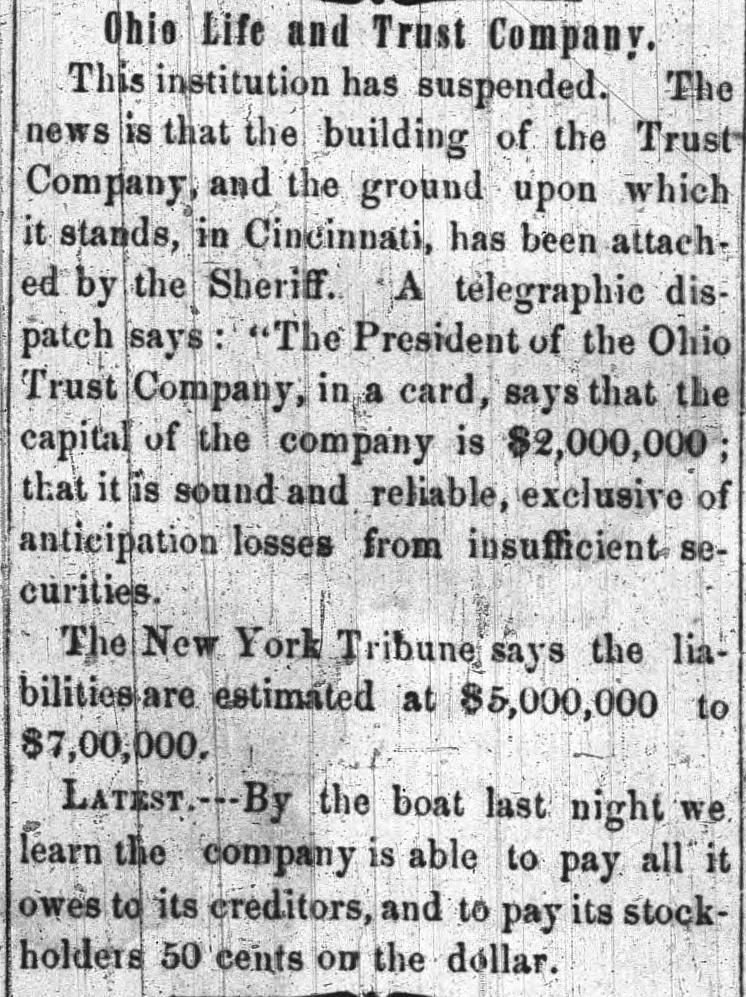
The Life and Trust Company building—including the ground on which it stands—has been attached by the Sheriff, who now has possession.
The attachment was upon an affidavit by a son-in-law of Alfred Kelly, (the father, as he is called, of the State Bank,) representing the claim of the Merchants' Branch Bank of Cleveland, and other branches, we presume, for $157,000. The property is valued at about $150,000.
The relative of Mr. Kelly must have done some rather "hard swearing," it is supposed, to get out the attachment, as it is necessary, before such attachment can be issued, to make oath to very illegitimate means of procedure.
The indebtedness of the Trust Company to the State Bank of Ohio is estimated at $500,000, or thereabout.
The opinion held by many is that the bank here, if it do not resume at an early day—which some think—will pay all its indebtedness eventually, without loss to the creditors.
The bank, we learn, has already reduced about $300,000 of its liabilities. The officers and directors of the bank seem inclined to do all in their power to relieve their depositors and patrons generally, and seem to be taking the most direct course to such an end.
Our opinion is that it is to the advantage of all parties concerned to permit the bank to settle its affairs without hindrance or molestation, as the gentlemen under whose control it is have, to the fullest degree, the financial esteem and confidence of the public.
CLOSING OF THE DOORS OF THE KANAWHA BANK.
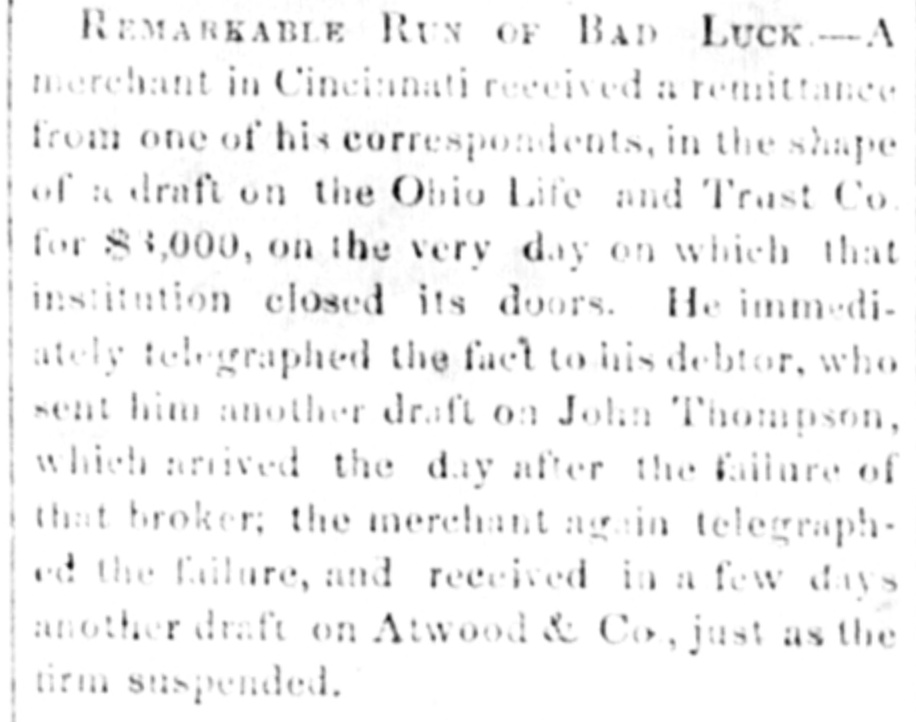
Telegraphs were received this morning that the Bank of Kanawha had closed its doors. Some $50,000 of the paper, we learn, were sent from this city, and the cashier not having coin enough on hand to redeem the notes, was compelled to close the doors.
ATTACHMENTS AGAINST THE BUILDING AND FURNITURE OF THE OHIO LIFE AND TRUST COMPANY. [From the Cincinnati Commercial, August 29]
Three attachments were yesterday placed in the hands of the Sheriff, who forthwith proceeded to take possession of the building, the ground upon which it stands, and the furniture of the bank. The first affidavit was on behalf of the Merchants' Bank of Cleveland, whose claim against the company amounts to the sum of $157,850.64.
Another by Charles J. Wood and William J. Powers, who claim an indebtedness on the part of the company of $7,500.
The third attachment was issued by the agents of the Norwalk Bank for $108,981. The plaintiffs in this last case have also attached the property in New York belonging to the company for the same claim.
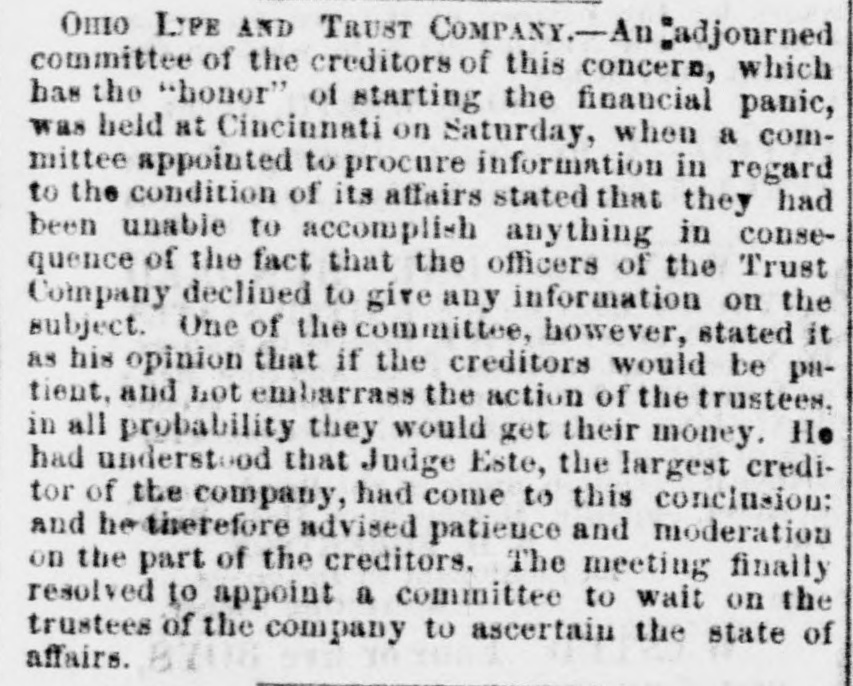
The company's attorney made a motion to discharge the attachments, the hearing of which is postponed until 10 o'clock Monday morning, at which time the case will be argued at a call court before Judges Gholson and Storer. Only one issue will be taken up—that of the claim of the Merchants' Bank of Cleveland, the decision upon which will govern the balance of the cases, as well as others which may accrue.
THE OHIO LIFE AND TRUST COMPANY. [From the Cincinnati Commercial, Aug. 29]
As every item pertaining to the Ohio Life Insurance and