First National Bank (New York, NY)

Episode Information

Episode Type
Run → Suspension → Reopening
Start Date
October 25, 1907
Location
New York, New York (40.714, -74.006)
Registered Place
Brooklyn
Bank Type
national
Charter Number
923

Metadata

Response Measures

Capital injected, Full suspension, Books examined

Other: The bank was closed by the Comptroller of the Currency to protect depositors from liabilities arising from its role as a clearing agent for other failed trust companies.

Clearinghouse involved: Yes (loan, examination, or other measures)

Receivership Details

Date receivership started
1907-10-25
Date receivership terminated
1908-02-10
OCC cause of failure
Losses

Notes

The bank is located in Brooklyn, NY (then a borough of NYC). It was part of the 'Jenkins string' of banks and suspended due to its clearing relationship with the failed Jenkins trust companies.

Events (8)

1. March 21, 1865 Chartered
Source
historical_nic
2. October 25, 1907 Run
Cause
Local Banks
Cause Details
Heavy withdrawals triggered by the suspension of affiliated institutions (Williamsburgh Trust and Jenkins Trust) for which the bank cleared.
Measures
The bank closed its doors to protect depositors from further clearing house liabilities.
Newspaper Excerpt
withdrawals from the First National were very heavy... It was rumored this afternoon around lower Broadway that the Brooklyn Rapid Transit Company withdrew a large sum from the bank, and that this was the cause.
Source
newspapers
3. October 25, 1907 Suspension
Cause
Government Action
Cause Details
Closed by the Comptroller of the Currency/National Bank Examiner due to lack of ready cash and clearing house liabilities from failed affiliates.
Newspaper Excerpt
First National Bank, at the foot of Broadway... followed suit... 'Closed by the Comptroller of the Currency. GEORGE F. CUTTS, Examiner.'
Source
newspapers
4. October 25, 1907 Receivership
Newspaper Excerpt
The First National Bank, of Brooklyn, N. Y., which suspended and was placed in the hands of Received John W. Schofield. October 25, 1907
Source
newspapers
5. October 25, 1907 Receivership
Source
historical_nic
6. February 10, 1908 Reopening
Newspaper Excerpt
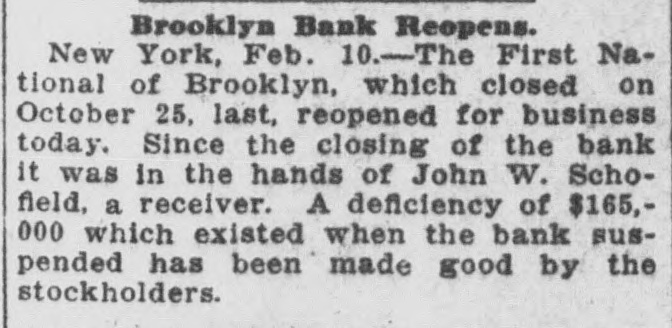
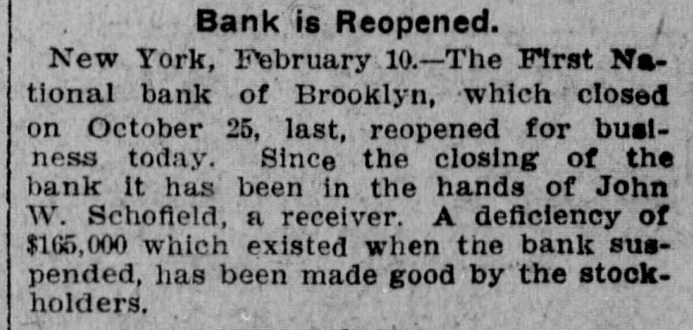
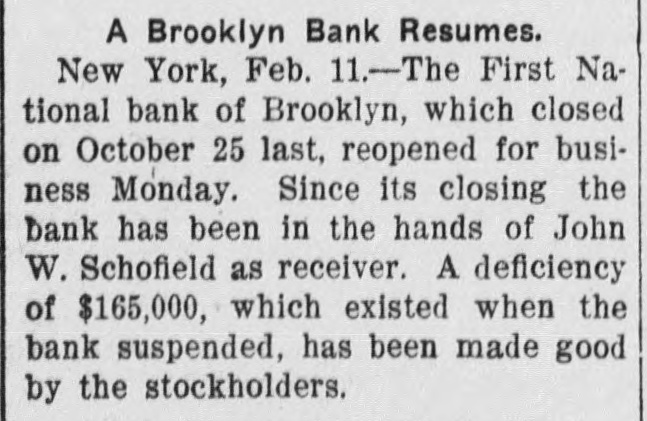
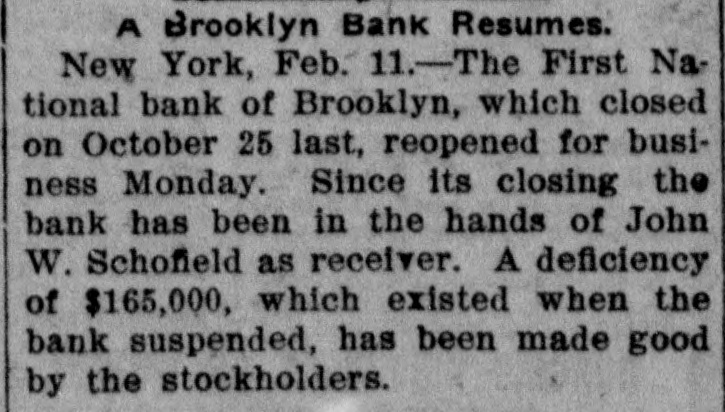
The First National Bank of Brooklyn which closed on October 25 last reopened for business today.
Source
newspapers
7. February 10, 1908 Restored To Solvency
Source
historical_nic
8. November 22, 1928 Voluntary Liquidation
Source
historical_nic

Newspaper Articles (24)

Article from The Brooklyn Daily Times, October 25, 1907

Click image to open full size in new tab

Article Text

ALL JENKINS BANKS CLOSE

Include First National, and Williamsburgh and Jenkins Trust Companies.

NO CASH FOR CHECKS

Surprise Came to Depositors Soon After One O'Clock.

WILL RESUME SAYS COUNSEL

People Affected Include Residents and Business Men All the Way from the Eastern District to Coney Island—Said That Heavy Withdrawals by Local Railroad Company Caused Some Trouble.

All of the trust companies and banks in the Eastern District with which John G. Jenkins and his sons have been so long identified closed their doors to-day.

First the Williamsburgh Trust Company hung out a sign indicating that because of a lack of ready cash it had been compelled to shut down.

Soon after the First National Bank, at the foot of Broadway, and one of the oldest national institutions in the country, followed suit.

On top of this the Jenkins Trust Company, with branches spread throughout the town, closed down, and then the chain was completed.

An effort was made to interview President Jenkins, and when he was called on the 'phone, he declined to make any statement except that a lack of ready cash was responsible for the suspension. He intimated that it was but temporary.

At the office of National Bank Examiner Hanna no information was obtainable this afternoon regarding the suspension of the First National Bank. Mr. Hanna, it was said, had left his office to go to Brooklyn.

As a result of the shutting down of the several trust companies and the First National Bank this afternoon many large concerns in the Eastern District will be unable to pay their help to-morrow. This fact was made apparent when several large manufacturers appeared in front of the bank buildings prepared to withdraw the amounts of their payrolls.

News of the suspension of the First National Bank soon spread. A small crowd gathered in front of the building at the foot of Broadway, soon after the doors were closed, and this was added to as the afternoon passed. Shortly before 3 o'clock the officials of the bank directed the following sign to be placed on the door:

"Closed by the Comptroller of the Currency.

"GEORGE F. CUTTS, Examiner."

A Times reporter endeavored to get into the bank building to see President Jenkins, but he was prevented by the special policeman on guard. One of the clerks who came out for his luncheon returned to the bank in a few minutes before 3 o'clock and had a great deal of difficulty in getting in.

First National Bank Will Resume Shortly, Says Counsel.

Samuel B. Coombs, speaking for the First National Bank, made the following statement to a Brooklyn Times reporter late this afternoon after having attended a conference at the bank building, Broadway and Kent avenue:

"There is very little to say. The situation is generally understood. We were compelled to shut our doors for lack of cash. We had a great deal of cash on hand, but owing to the fact that other concerns closed down, the withdrawals from the First National were very heavy."

"When do you expect to open again for business?" was asked.

"I can't answer that. We will get in communication as soon as possible with the officials of the Banking Department. They will probably visit the bank, look over the situation and then tell us to go ahead."

Closing of Williamsburgh Trust.

The Williamsburgh Trust Company, on the Brooklyn plaza of the Williamsburgh Bridge, closed its doors shortly after 1 o'clock this afternoon, President Frank Jenkins causing a sign reading as follows to be posted on the door:

"Closed temporarily for lack of cash."

Immediately a crowd collected. A man was stationed in front of the company's building and he refused to allow anyone to enter. A young man soon appeared and when he found that the bank was closed he broke down and cried.

"My God," he said, "all my money is in there."

Message to President Unanswered.

He was assured by several others that his money was safe. A Times reporter endeavored to get into the trust company's building, but was refused admission. He sent a message to President Jenkins asking for a brief statement, but the message was not delivered.

Nearly all of the directors of the company were in the building when it was decided to close down. They immediately went into executive session. The meeting was in progress at the hour of going to press.

Unable to Meet a $10,000 Check.

The bank suspended when unable to meet the check of a prominent resident of the Eastern District, who employs a large force of help, and who sent one of his employees to the bank for $10,000. The cashier of the bank looked at the man and declared, so the man said, that it was impossible to cash it at the present time. The man hastened back to his employer and immediately a report got in circulation that the company had closed its doors.

Sign on Down Town Branch.

We have temporarily stopped payments owing to the impossibility of securing currency. (Signed) WILLARD REID, Vice President.

This was the notice, posted upon the closed doors of the down-town branch of the Williamsburgh Trust Company at 1 o'clock this afternoon. One hour previous the officials of the institution declared that the company was in excellent shape and no intention of suspending payment was entertained. All efforts to secure an explanation from the directors proved fruitless. All inquiries were simply referred to the typewritten notice pasted on the door.

Crowds Kept Moving.

There were several clerks and subordinate officials at work in the office, but no admission was granted to anyone by the policeman and special officers who guarded the exits. No commotion occurred at any time during the afternoon, although there was a steady stream of depositors, all of whom, after being permitted to read the notice, were kept moving by the officers.

Organized Several Years Ago.

The Williamsburgh Trust Company was organized several years ago. It has branch offices at 949 Broadway, 391 Fulton street and on Broadway, near Myrtle avenue. According to the last statement, prepared by the Banking Department, the Williamsburgh Trust Company has loans on collateral amounting to $3,063,213, and cash on deposit amounting to $513,362. Its assets amount to $6,077,903. The reserve and liabilities amount to $9,676,484. It was capitalized at $700,000 and there is now due depositors $7,663,331. The surplus and undivided profits amount to $569,720, and other liabilities amount to $743,433.

First National Follows Trust Co.'s Lead.

Shortly after the Williamsburgh Trust Company closed its doors the First National Bank, at Broadway and Kent avenue, temporarily suspended business. The following notice was posted on the door:

To allay apprehension we have decided to close our doors temporarily for the lack of ready cash.

A B. R. T. Rumor.

No statement could be obtained from any of the officers of the institution, of which John G. Jenkins is the President. It was rumored this afternoon around lower Broadway that the Brooklyn Rapid Transit Company withdrew a large sum from the bank, and that this was the cause.

It was only a few days ago that the directors of the First National Bank closed a deal for the purchase of a piece of property at Broadway and Havemeyer street, on which site it was contemplated erecting a new building.

Bank Established in 1852.

The bank was established in 1852. The capital is $300,000, and deposits are estimated at $4,200,000. The bank is a member of the New York City Clearing House.

Jenkins Trust Companies Close.

The Jenkins Trust Company, whose principal office is at Nostrand and Gates avenues, and has branches at Surf avenue and West Twelfth street, Coney Island, Bay Twentieth street and Bath avenue, Bath Beach, Broadway and Myrtle avenue, and 1,745 Broadway, closed its doors this afternoon. John G. Jenkins, Jr., the President of the company, was communicated with by a Brooklyn Times reporter, but refused to make any statement, other than to say that it had been decided to close down temporarily for lack of cash.

No Trouble at the Offices.

There was no trouble whatever at any of the company's offices. Depositors residing in the neighborhood expressed their utmost confidence in the solvency of the institution. Some even went so far as to say that if they had any money on hand they would not hesitate to deposit it with the company.

Nassau Trust All Right.

The closing of the Williamsburgh Trust Company and the First National Bank caused a few of the depositors to visit the Nassau Trust Company, at Bedford avenue and Broadway, this afternoon. The line was only a small one, and no apprehension was felt. In fact, Andrew D. Baird, of the Board of Trustees, expressed great confidence. Speaking of the situation, he said:

"We have enough money to tide us over to-day. We will also have enough to see us over to-morrow. The situation at present looks a little bit gloomy, but I believe the institutions that will see themselves through to-morrow will be all right.

"The savings banks are benefitting by the condition. There is no cause for fear, however, for I believe everything will be straightened out in a few days."

Manufacturers' Bank in Good Shape.

Things were normal at the Manufacturers' National Bank, Broadway and Berry street, this afternoon. At no time was there any indication of a run. In fact there were a large number of deposits received. At no time were there more than two or three persons in front of the paying teller's cage.

Cashier Nightingate, speaking of the situation, said: "We are in just as good condition to-day as we have ever been. The actual scarcity of money has caused a scare, and is responsible for a number of persons losing their heads. I believe all the banks are solvent, and will eventually come out of this condition. We are accepting checks and paying out the money as usual, and as you will notice there is no sign of a run here."

At the time Mr. Nightingate spoke there were two depositors in the bank.


Article from The Evening World, October 25, 1907

Click image to open full size in new tab

Article Text

FIRST NATIONAL OF BROOKLYN AND SIX OTHER BANKS CLOSE

SITUATION AT A GLANCE.

Secretary Cortelyou said after the close of banking hours:

"The situation is good. This is the third day, and I see no setback of serious import. I shall probably remain in the city all day tomorrow, and if there is no critical development—which I see no sign of at this time and do not expect by any means—I shall return to Washington."

The First National Bank of Brooklyn, a Clearing-House institution; the Williamsburg Trust Company and the Jenkins Trust Company of Brooklyn, with numerous branches, suspended temporarily. The solvency of the institution has not been questioned.

President William A. Nash, of the Corn Exchange Bank, said:

"The outlook is decidedly better, and I think the crucial point has been passed. The failure of the smaller banks is not disturbing. They did not have much cash on hand and it was better for them to suspend than to stand a run. They are perfectly solvent and will be able to resume business when the present hysteria subsides."

The International Trust Company, of No. 206 Broadway; the Brooklyn Bank and the Borough Bank of Brooklyn failed to open their doors for business.

The Union Dime Savings Bank, Thirty-second street and Broadway, with deposits of over $27,000,000, has given notice that it will require thirty days' notice in writing of intent to withdraw. Other savings banks have adopted this course.

J. Pierpont Morgan and half a dozen bankers raised a pool of $10,000,000 late this afternoon which was loaned on call on the Stock Exchange to protect the market.

International banking houses have arranged to import between $10,000,000 and $15,000,000 in gold from Europe.

The Lincoln Trust Company, the Trust Company of America, the Colonial Trust Company and the Harlem Savings Bank safely weathered runs. The trust companies received substantial aid and the Harlem Savings Bank took advantage of the sixty-day clause.

Secretary of the Treasury Cortelyou placed about $8,000,000 in New York banks during the day, a total of $30,000,000 since last Friday.

Superintendent of Banks Clark Williams said that conditions have improved and will continue to improve if bank depositors are reasonable.

The stock market passed through a precarious, feverish day, closing in a skyrocket finish that sent the general range of prices away above yesterday's final quotations.

State Bank Examiner Leonard stated that the Lincoln Trust Company is in a solvent condition.

An officer of the Hanover National Bank suggested that Gov. Hughes proclaim special holidays enabling the banks to close next week to allow the arrival of gold from abroad. Gov. Hughes, over the long-distance telephone, said he had no power to order such holidays.

A shipment of $2,500,000 in small bills was received from the United States Treasury in Washington.

Ernst Thalman, Otto T. Bannard and Gen. Henry C. Ide were appointed temporary receivers of the Knickerbocker Trust Company.

Before the close of the stock market Halstead & Hodges and Van Emburgh & Atterbury, brokers, loaned on the floor of the Stock Exchange $10,000,000 of the syndicate money at 50 per cent.

The amount pledged by the Clearing House banks to the aid of the Stock Exchange will be between $12,000,000 and $15,000,000.

Williamsburg and Jenkins Concerns, Belonging to the Jenkins String of Banking Institutions, Temporarily Close Their Doors.

THERE WAS VERY LITTLE EXCITEMENT AT EITHER BANK

Borough and Brooklyn Banks and International Trust Company Had Been Forced to Suspend Earlier in the Day.

In rapid succession the Williamsburg Trust Company and its branch on Fulton street, Brooklyn, the Jenkins Trust Company and all its branches and the First National Bank of Brooklyn closed their doors this afternoon for lack of ready cash.

In each instance it was announced that the suspension was temporary and that all the institutions would reopen as soon as currency for carrying on business could be secured.

All the institutions that are affected belong in what is known as the Jenkins string of banking companies which enjoy the best of reputation. It is stated that they are absolutely solvent.


Article from The Evening World, October 25, 1907

Click image to open full size in new tab

Article Text

Williamsburg and Jenkins Concerns, Belonging to the Jenkins String of Banking Institutions, Temporarily Close Their Doors.

THERE WAS VERY LITTLE EXCITEMENT AT EITHER BANK

Borough and Brooklyn Banks and International Trust Company Had Been Forced to Suspend Earlier in the Day.

In rapid succession the Williamsburg Trust Company and its branch on Fulton street, Brooklyn, the Jenkins Trust Company and all its branches and the First National Bank of Brooklyn closed their doors this afternoon for lack of ready cash.

In each instance it was announced that the suspension was temporary and that all the institutions would reopen as soon as currency for carrying on business could be secured.

All the institutions that are affected belong in what is known as the Jenkins string of banking companies which enjoy the best of reputation. It is stated that they are absolutely solvent.

Except in one instance nothing approaching the dimensions of a run preceded the closing of the doors. Depositors seeking to withdraw simply came in heavier numbers than usual, and finding that in the present condition of money, cash could not be secured the two trust companies, the bank and the branches shut up for the time being. The main concerns are all located in Williamsburg, but the branches are scattered through a wide area of Long Island.

The First to Close.

The Williamsburg Trust Company, one of the largest trust companies in the Greater City, was the first to close. Five minutes later its Brooklyn branch also suspended.

On the door of the main building a clerk simply posted this notice: "Closed for Lack of Cash."

On the doors of the branch this notice appeared, after a short delay: "We have temporarily stopped payment owing to the impossibility of procuring currency." This notice was signed by Vice-President Reid.

Half an hour after these suspensions the First National Bank of Brooklyn, at Kent avenue and Broadway, Williamsburg, also shut its doors. The First National has been affiliated with the Williamsburg Trust and acting as its clearing-house. The bank's deposits are given as $1,200,000 and its capital as $300,000.

The Jenkins Trust Company, at No. 70 Broadway, Williamsburg, closed a little later. All the branches of the Jenkins Trust and the Williamsburg Trust in Long Island shut their doors.

At the branch of the Williamsburg Trust no demonstration occurred, but outside the main office about four hundred Hebrew merchants and manufacturers who had expected to draw out money for their Friday night pay rolls created a small riot. The clerks inside the building refused to pay any attention to the rapping at the windows.

The crowd grew frantic. Some of the men wept and cursed. A great multitude gathered. Police reserves managed by hard work to keep the streets clear.

Only Got a Check.

Hardly any warning preceded the series of suspensions. It was learned that Corse Payton, the actor-manager, tried to draw out of the Williamsburg Trust $10,000 which he had on deposit. He was given a check on the First National, which the First National would not cash.

Behind him came other patrons who wanted cash instead of checks. They could get no currency. These men were wrangling with the paying teller when watchmen put them out and closed the doors.

At the branch in Fulton street there were similar scenes. A few men were inside the building waiting to withdraw their funds. Others crowded the pavement. Suddenly a watchman drew shut the outer gates of iron. Those already inside were paid off. The others confronted a watchman who through the bars of the gate simply repeated the two words, "No cash" in answer to all questions.

No Statement Given Out.

It was impossible to obtain any statements from the officers of either the trust companies or the bank. Newspaper men vainly sought for a while to get in touch with some person in position to speak authoritatively.

As the news spread through Williamsburg, Brooklyn and East New York big crowds of men, mainly small merchants, flocked to the trust companies or to the bank.

The Williamsburg Trust Company proper occupies a magnificent new building on the Williamsburg Bridge plaza, at Broadway and Myrtle avenue. Its Brooklyn branch, at No. 391 Fulton street, is a handsome ten-story office building, which was erected by the company a few years ago.

The list of officers is as follows: President, Frank Jenkins; Vice-President, John H. Scheidt; Secretary, W. Addison Field, Assistant Secretaries, T. J. McFarland and William S. Irish; Trust Officer, Charles E. Covert; Directors, Anthony N. Brady, John J. Cooney, Charles M. Davidson, Gustav J. L. Doerschuck, John Doshe, Marshall S. Driggs, Charles Jerome Edwards, Charles Englert, Joseph Fallert, Frank Harvey Field, W. A. Field, Joseph Huber, Theodore F. Jackson, Frank Jenkins, John G. Jenkins, Frederick G. Lemmermann, Joseph Liebman, Moses May, Willard P. Reid, M. L. Reynolds, John H. Scheidt, David W. Stein, John W. Weber and Robert T. Whelen.

The main office of the Jenkins Trust Company is at Gates and Nostrand avenues, Brooklyn. The main branches are at Surf avenue and Twelfth street, Coney Island; Bay Twentieth street and Bath avenue, Bath Beach; Broadway and Myrtle avenue and No. 176 Broadway. There are other branches scattered through Brooklyn and Queens.

The First National Bank is the first member of the New York Clearing-House to suspend. Its president is J. G. Jenkins. It has five or six suburban branches, located at Seacliff, Hempstead, Glenwood and other Long Island towns.

At the First National and all the other places which suspended verbal statements were refused. A watchman


Article from Deseret Evening News, October 26, 1907

Click image to open full size in new tab

Article Text

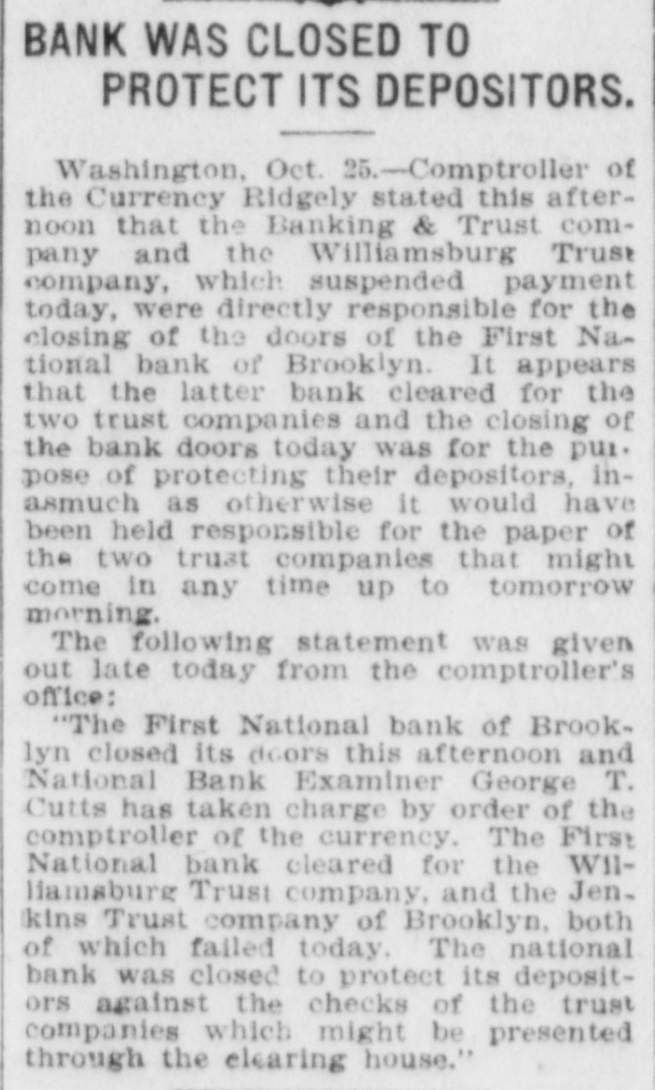
BANK WAS CLOSED TO PROTECT ITS DEPOSITORS. Washington, Oct. 25.-Comptroller of the Currency Ridgely stated this afternoon that the Banking & Trust company and the Williamsburg Trust company, which suspended payment today, were directly responsible for the closing of the doors of the First National bank of Brooklyn. It appears that the latter bank cleared for the two trust companies and the closing of the bank doors today was for the pui. pose of protecting their depositors, inasmuch as otherwise it would have been held responsible for the paper of the two trust companies that might come in any time up to tomorrow morning. The following statement was given out late today from the comptroller's office: "The First National bank of Brooklyn closed its doors this afternoon and National Bank Examiner George T. Cutts has taken charge by order of the comptroller of the currency. The First National bank cleared for the WilHamsburg Trust company, and the Jenkins Trust company of Brooklyn, both of which failed today. The national bank was closed to protect its depositors against the checks of the trust companies which might be presented through the elearing house."


Article from Daily Press, October 26, 1907

Click image to open full size in new tab

Article Text

THREE SMALL BANKS
CLOSE THEIR DOORS

New York Capitalists Say They Have No Bearing on Situation and Conditions Are Better.

YESTERDAY A NERVE-RACKING DAY

Savings Banks Compel Depositors to Give Thirty or Sixty Days Notice of Withdrawal of Accounts-Plenty of Money on the Stock Exchange- Clearing House Certificates.

(By Associated Press.) NEW YORK, Oct. 25.-Another nerve racking day has passed but the financial institutions of New York have shown extraordinary power of resistance to the pressure put upon them.

While it is true that several minor institutions have been forced to close their doors, yet two things should be said about them-first, that the amount involved was not so great as to exert any marked influence on the general situation as those banks were located in residential quarters and did not come into touch with the larger financial institutions of the metropolis, and second-that there are several rea- sons to believe that these banks and trust companies are entirely solvent and their difficulties will prove to be only temporary and due entirely to in- ability to secure ready cash on gilt- edged securities in their vaults.

In the light of the general excite- ment, the savings banks thought it wise to put into effect the rule re quiring thirty to sixty days notice for the withdrawal of deposits and this will prevent the withdrawal of money which would otherwise be put in safety deposit boxes. The savings banks, if they continued to make pay- ments, would be obliged to withdraw funds from the National banks, there- by causing an additional strain on the general banking situation. There was not the slightest hint that any of the savings institutions was in anything but in the soundest condition as it was pointed out that the savings banks of this state are so restricted by law in investing their money that there can be no question that all of the securities in their possession are of good value and readily salable in normal times.

The institutions which closed their doors today with the sums due de- positors, were: the United States Ex- change Bank, Harlem, $6,600,000. In- ternational Trust Company, Brooklyn, $7,500,000. The First National Bank of Brooklyn, $3,500,000.

The First National Bank of Brook- lyn the Williamsburg Trust Company and the International Trust Company, were allied institutions. None of these companies had important con- nections with the larger banks, which are representative of the city's finan- cial affairs.

On the other hand, a number of fa- vorable features marked the day. The Trust Company of American and the Lincoln Trust Company, the two or- ganizations which have suffered most from runs, have been slowly paying out their deposits and closed today with all demands having been met. In the case of the Trust Company of America, the run has well nigh spent its force as the bulk of the depositors have been paid off. At the close of business there were a good many in line at the Lincoln Trust Company, but also there was a marked reduction in the number of anxious depositors. Plenty of Money for Stock Exchange.

The most favorable incident of the day was that the Stock Exchange was provided with funds ample to meet its immediate necessities by a money pool headed by J. Pierpont Morgan, which sent about $15,000,000 to the Exchange during the afternoon. As all the loans made today hold over until Monday, the Stock Exchange situation will not be affected in the problems that bankers may be called upon to solve tomorrow.

A very encouraging feature of the afternoon's developments was a sign- ed statement by Clark Williams, the newly appointed state superintendent of banking, affirming the solvency of the local institutions.

A further encouraging development of the afternoon, the good effect of which can scarcely be over estimated, was the decision arrived at, unofficial- ly, to issue clearing house certificates, probably tomorrow. There will be a full meeting of the clearing houses a- ssociation tomorrow morning at 11 o'clock for the purpose of taking of- ficial action for the issuance of these certificates.

The immediate effect of this will be to enable the banks to settle the bal- ances between themselves with these certificates, and thereby release large sums of currency for the regular needs of business.

Clearing House Certificates. The decision to issue clearing house


Article from New-York Tribune, October 26, 1907

Click image to open full size in new tab

Article Text

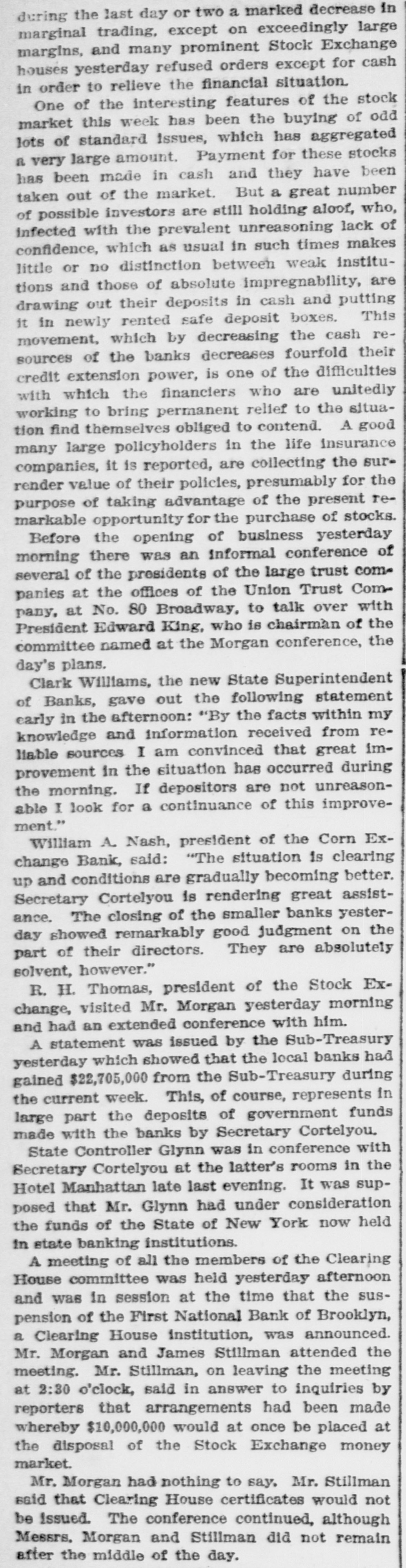
during the last day or two a marked decrease in marginal trading, except on exceedingly large margins, and many prominent Stock Exchange houses yesterday refused orders except for cash in order to relieve the financial situation. One of the interesting features of the stock market this week has been the buying of odd lots of standard issues, which has aggregated a very large amount. Payment for these stocks has been made in cash and they have been taken out of the market. But a great number of possible investors are still holding aloof, who, infected with the prevalent unreasoning lack of confidence, which as usual in such times makes little or no distinction between weak institutions and those of absolute impregnability, are drawing out their deposits in cash and putting it in newly rented safe deposit boxes. This movement, which by decreasing the cash resources of the banks decreases fourfold their credit extension power, is one of the difficulties with which the financiers who are unitedly working to bring permanent relief to the situation find themselves obliged to contend. A good many large policyholders in the life insurance companies, it is reported, are collecting the surrender value of their policies, presumably for the purpose of taking advantage of the present remarkable opportunity for the purchase of stocks. Before the opening of business yesterday morning there was an informal conference of several of the presidents of the large trust companies at the offices of the Union Trust Company, at No. 80 Broadway, to talk over with President Edward King, who is chairman of the committee named at the Morgan conference, the day's plans. Clark Williams, the new State Superintendent of Banks, gave out the following statement early in the afternoon: "By the facts within my knowledge and information received from reliable sources I am convinced that great improvement in the situation has occurred during the morning. If depositors are not unreasonable I look for a continuance of this improvement." William A. Nash, president of the Corn Exchange Bank, said: "The situation is clearing up and conditions are gradually becoming better. Secretary Cortelyou is rendering great assistance. The closing of the smaller banks yesterday showed remarkably good judgment on the part of their directors. They are absolutely solvent, however." R. H. Thomas, president of the Stock Exchange, visited Mr. Morgan yesterday morning and had an extended conference with him. A statement was issued by the Sub-Treasury yesterday which showed that the local banks had gained $22,705,000 from the Sub-Treasury during the current week. This, of course, represents in large part the deposits of government funds made with the banks by Secretary Cortelyou. State Controller Glynn was in conference with Secretary Cortelyou at the latter's rooms in the Hotel Manhattan late last evening. It was supposed that Mr. Glynn had under consideration the funds of the State of New York now held in state banking institutions. A meeting of all the members of the Clearing House committee was held yesterday afternoon and was in session at the time that the suspension of the First National Bank of Brooklyn, a Clearing House institution, was announced. Mr. Morgan and James Stillman attended the meeting. Mr. Stillman, on leaving the meeting at 2:30 o'clock, said in answer to inquiries by reporters that arrangements had been made whereby $10,000,000 would at once be placed at the disposal of the Stock Exchange money market. Mr. Morgan had nothing to say. Mr. Stillman said that Clearing House certificates would not be issued. The conference continued, although Messrs. Morgan and Stillman did not remain after the middle of the day.


Article from The Evening World, November 30, 1907

Click image to open full size in new tab

Article Text

$2,000,000 FROM NATIONAL BANK IN JENKINS LOANS Federal Examiners Unearth More Scandal in Brooklyn. BANK'S RECORDS GONE. Clarke District Attorney Traces Last Day Transactions to Save Insiders. Consational as the developments have stone the Kings County Grand Jury took up the investigation of the Berough Bank and the Jenkins Trust Company. more surprising revelations are looloed for in the Federal and county joint investigation of the looting of the First National Bank It is reported by men who have means of knowing what the prelimimary investigation of the National Back Examiners has revealed that the banking members of the Jenkins famBy obtained close to $2,000,000 from that institution while John G. Jenkine, sr., was Hs president. The money was as tained, 1t is alleged. through fake loans such as were made by the Williamsburg Trust Company and the Jenkins Trust Company to the brokerage firm of Frank. & J. G. Jenkins, Jr., & Co. "The First National Bank," said one of the men who knows about it to-day, "he the most hopelessly involved of any of the Brooklyn institutions that failed." Clarke Finds New Frauds. District-Attorney Clarke, with bank examiners and assistants. was busy today arranging his documentary evidence to be presented to the Grand Jury in the Brooklyn bank cases Monday. The betwork of fraud spreads hourly, and it may be days before the District-Attorney can reveal all who are enmeshed. It is known that on the day of the suspension of the bank the notes and forged papers which were used to cover up the crooked transactions of Gow. Maxwell and Campbell were destroyed. However, the District-Attorney. through the confession of Campbell and through the books which were secured from the wreck will be able to build up circumstantial cases. even with the papers absent. Through the evidence of clerks he hopes to be able to establish the identity of every "inside" depositor and director who withdrew his money on the day of the suspension, before and after the bank closed Some of these men are amenable to the law. According to a statement secured from a clerk a prominent city official withdrew $30,000 from the bank after the doors closed t and a false entry was made on the books to conceal the faot. Gow May Accuse Others. Martin W. Littleton. counsel for WillAsm Gow in & proceeding in the Kings h County Supreme Court to-day looking u to the removal of Gow's picture from the Rogues' Gallery, intimated that Gow 11 is not disposed to stand for everything p In his own defense he appears to be determined to drag in other directors F the bank. of 11 Mr. Littleton in his argument made t pointed references to "Honest Bill" Hurley. one of the directors, who has been working night and day since the close of the bank to make up the deg Sciency created by the crooked methods b employed by the officers of the institun tion. It is apparent that Gow will give G the lie to some of the directors who P have maintained that they knew nothing about the the crooked work that was going on. a The directors of the Jenkins Trust R Company are working valiantly to keep 11 the Institution from a permanent receivership. They assort that the directO a ors are willing to leave their money in K the bank for one year If the depositors will agree to limit their withdrawals to 10 per cent. of the total. should the bank be allowed to reopen. The depositors, however. are anxious to know what the Jenkins family in goins to do about repaying the great sums of money borrowed from the Jenkins Trust Company to further various schemes. /


Article from The Topeka State Journal, February 4, 1908

Click image to open full size in new tab

Article Text

Permits Bank to Reopen

Washington, Feb. 4.-The comptroller of the currency today granted permission to the First National bank of Brooklyn, N. Y., to resume business on February, 10. The bank suspended several months ago.


Article from Evening Times-Republican, February 4, 1908

Click image to open full size in new tab

Article Text

Brooklyn Bank to Resume

Washington, Feb. 4.-The comptroller of the currency today granted permission to the First National bank of Brooklyn, N. Y., to resume business February 10. The bank suspended several months ago.


Article from Rock Island Argus, February 4, 1908

Click image to open full size in new tab

Article Text

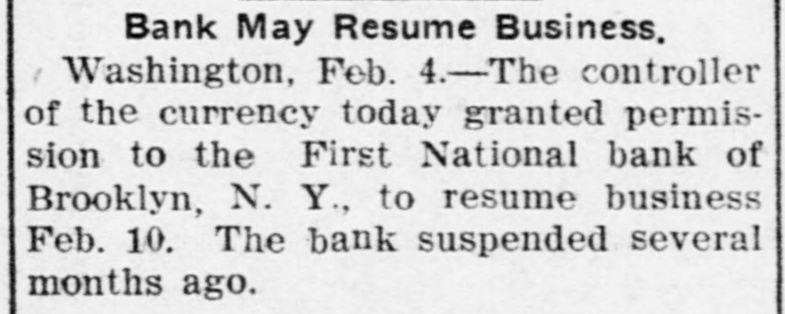
Bank May Resume Business, Washington, Feb. 4.-The controller of the currency today granted permission to the First National bank of Brooklyn, N. Y., to resume business Feb. 10. The bank suspended several months ago.


Article from The Star and Newark Advertiser, February 4, 1908

Click image to open full size in new tab

Article Text

BROOKLYN BANK REOPENS

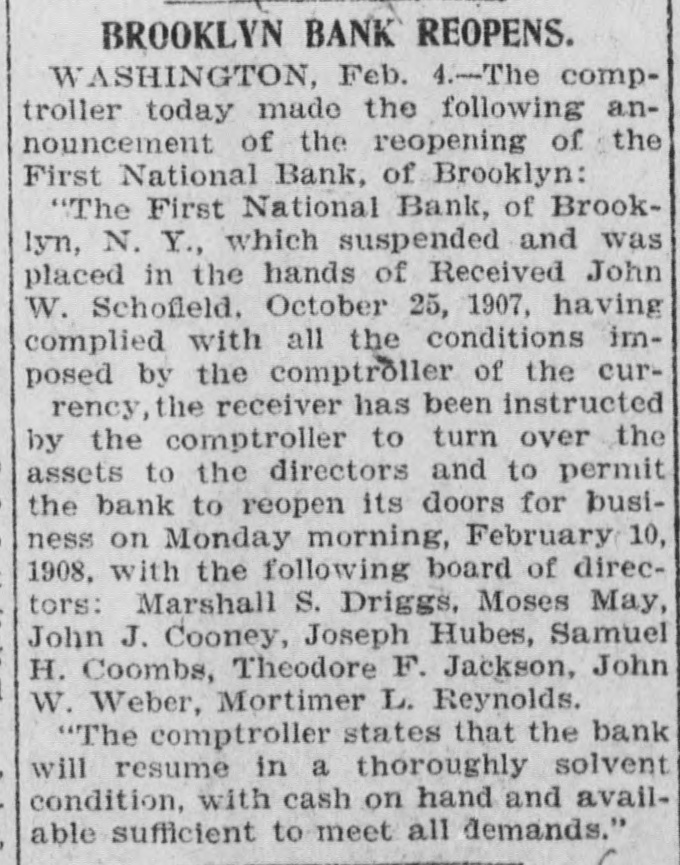
WASHINGTON, Feb. 4.-The comptroller today made the following announcement of the reopening of the First National Bank, of Brooklyn: "The First National Bank, of Brooklyn, N. Y., which suspended and was placed in the hands of Received John W. Schofield. October 25, 1907, having complied with all the conditions imposed by the comptroller of the currency, the receiver has been instructed by the comptroller to turn over the assets to the directors and to permit the bank to reopen its doors for business on Monday morning, February 10, 1908, with the following board of directors: Marshall S. Driggs, Moses May, John J. Cooney, Joseph Hubes, Samuel H. Coombs, Theodore F. Jackson, John W. Weber, Mortimer L. Reynolds. "The comptroller states that the bank will resume in a thoroughly solvent condition, with cash on hand and available sufficient to meet all demands."


Article from Los Angeles Herald, February 5, 1908

Click image to open full size in new tab

Article Text

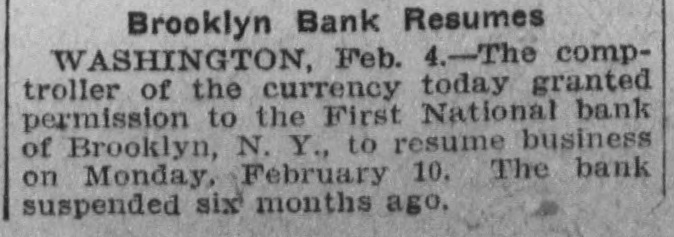
Brooklyn Bank Resumes WASHINGTON, Feb. 4.-The comptroller of the currency today granted permission to the First National bank of Brooklyn, N. Y., to resume business on Monday, February 10. The bank suspended six months ago,


Article from The Salt Lake Herald, February 5, 1908

Click image to open full size in new tab

Article Text

BANK TO RESUME

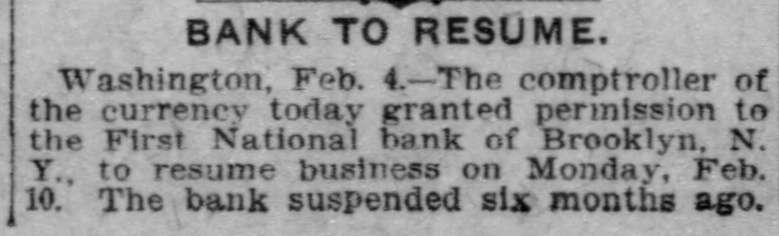
Washington, Feb. 4.-The comptroller of the currency today granted permission to the First National bank of Brooklyn, N. Y., to resume business on Monday, Feb. 10. The bank suspended six months ago.


Article from Albuquerque Citizen, February 6, 1908

Click image to open full size in new tab

Article Text

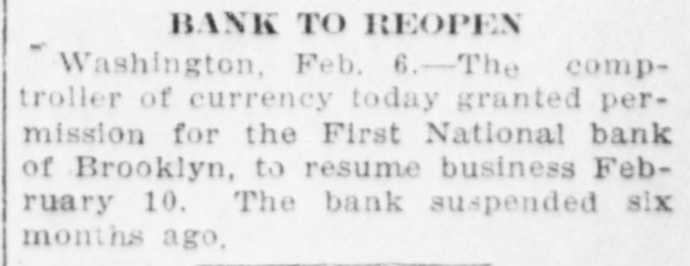
BANK TO REOPEN Washington Feb

6.-The comptroller of currency today granted permission for the First National bank of Brooklyn, to resume business February 10. The bank suspended six months ago.


Article from Ottumwa Tri-Weekly Courier, February 6, 1908

Click image to open full size in new tab

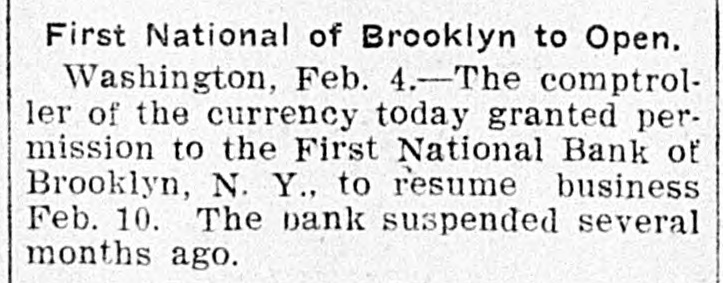
Article Text

First National of Brooklyn to Open. Washington, Feb. 4.-The comptroller of the currency today granted permission to the First National Bank of Brooklyn, N. Y., to resume business Feb. 10. The bank suspended several months ago.


Article from The Star and Newark Advertiser, February 10, 1908

Click image to open full size in new tab

Article Text

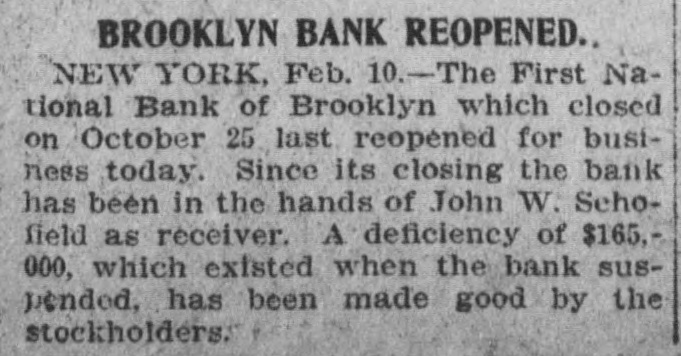
BROOKLYN BANK REOPENED

NEW YORK, Feb. 10.-The First National Bank of Brooklyn which closed on October 25 last reopened for business today. Since its closing the bank has been in the hands of John W. Schofield as receiver. A deficiency of $165,000, which existed when the bank suspendod, has been made good by the stockholders.


Article from Rock Island Argus, February 10, 1908

Click image to open full size in new tab

Article Text

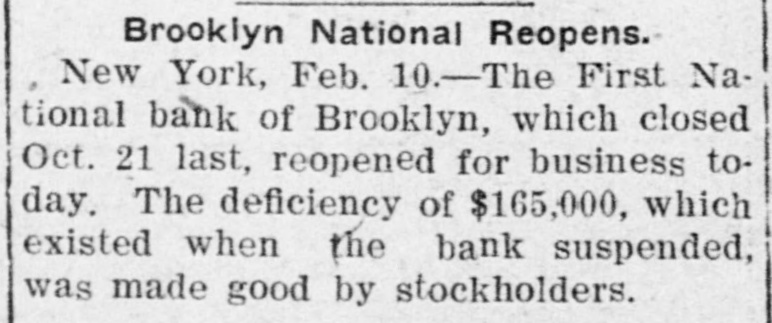
Brooklyn National Reopens

New York, Feb. 10.-The First National bank of Brooklyn, which closed Oct. 21 last, reopened for business today. The deficiency of $165,000, which existed when the bank suspended, was made good by stockholders.


Article from The Montgomery Advertiser, February 11, 1908

Click image to open full size in new tab

Article Text

Brooklyn Bank Reopens

New York, Feb. 10.-The First National of Brooklyn, which closed on October 25, last, reopened for business today. Since the closing of the bank it was in the hands of John W. Schofield, a receiver. A deficiency of $165,000 which existed when the bank suspended has been made good by the stockholders.


Article from The Birmingham Age-Herald, February 11, 1908

Click image to open full size in new tab

Article Text

Bank is Reopened

New York, February 10.-The First National bank of Brooklyn, which closed on October 25, last, reopened for business today. Since the closing of the bank it has been in the hands of John W. Schofield, a receiver. A deficiency of $165,000 which existed when the bank suspended, has been made good by the stockholders.


Article from The Globe-Republican, February 13, 1908

Click image to open full size in new tab

Article Text

A Brooklyn Bank Resumes

New York, Feb. 11.-The First National bank of Brooklyn, which closed on October 25 last, reopened for business Monday. Since its closing the bank has been in the hands of John W. Schofield as receiver. A deficiency of $165,000, which existed when the bank suspended, has been made good by the stockholders.


Article from The Mena Weekly Star, February 13, 1908

Click image to open full size in new tab

Article Text

A Brooklyn Bank Resumes

New York, Feb. 11.-The First National bank of Brooklyn, which closed on October 25 last, reopened for business Monday. Since its closing the bank has been in the hands of John W. Schofield as receiver. A deficiency of $165,000, which existed when the bank suspended, has been made good by the stockholders.


Article from Watertown Weekly Leader, February 14, 1908

Click image to open full size in new tab

Article Text

BANK IS OPEN AGAIN

First National of Brooklyn Resumes Business. NEW YORK, Feb. 10.-The First National Bank of Brooklyn, which closed on October 25, reopened for business today. A deficiency of $165,000, which existed when the bank suspended, has been made good by the stockholders.


Article from Goldsboro Weekly Argus, April 23, 1908

Click image to open full size in new tab

Article Text

PANIC-MAKING BANKS EXPELLED

Official announcement was made by the New York Clearing House Association last week that the banks which had failed because of mismanagement had been expelled from the association. This is the formal and official stigma which the clearing house association has put upon the financial institutions which brought about the panic of last fall, and it is an incontrovertible evidence as to what did cause the panic. Trust companies, like the Knickerbocker for instance, had never been admitted to membership in the association, so they, of course, could not be expelled. The president of the Knickerbocker confessed his pait in the disaster by committing suicide. Some others followed his example, and still others are under indictment. But the banks, properly speaking, were for the most part members of the clearing house association and came under its disciplinary jurisdiction. Such membership is a coveted asset and thepunishmenti is as severe as could be inflicted upon the institutions as such. So the official announcement goes out to the world that the following banks are no longer members of the New York Clearing House Association: National Bank of North America. Oriental bank. Mechanics' and Traders' bank. New Amsterdam National bank. First National Bank of Brooklyn. There is something pathetic in this announcement to those who are familiar with financial history in New York. More than one of these institutions long enjoyed an honored name. That is why they were able to catch so many thousand depositors when corrupt speculators got control of them and used the funds for their own unrighteous purposes. That is why confidence was shaken to its very foundations when the crash came and people began to clamor for their money. It is eloquent testimony as to the real causes of the panic, and it is idle for vicious partisanship and perverse selfinterest to seek to place the blame where it does not belong.


Article from The Washington Herald, April 26, 1908

Click image to open full size in new tab

Article Text

James C

Hallock, of Brooklyn, whose father originated the clearing house in America, and who has himself studied the subject of clearing houses for many years, said yesterday in an interview with a representative of The Washington Herald: "Thirty-two thousand depositors in Brooklyn, probably 100,000 in Greater New York, had accounts in failed banks last winter. of the "Millions have citizens distrust throughout Wall Union come to street as a stewpot of panics, which boils over unexpectedly. The American people would rejoice to see Congress enact a law which would protect the country against financial disturbance from that quarter. Favors Legislative Action. a few men in New York scream as If were to killed. would "Possibly they be than But even in battle many more are killed think they are going to be. However, it is true, I wish our Representatives would rise as one man and render harmless some New York/ bankers, who could be crushed as easily as a spider. "Understand that the principal banks in the city belong to a union; yet they let one of their number suspend and deserted five, forcing four to fail, so that for months there have been closed banks on whose dusty windows the passing throng have been reading a shameless advertisement of desertion in the soiled letters, 'Member of the New York Clearing House. "Cannot even its members be trusted? Now, though these broken banks suffered losses which their shareholders have had to bear, every one of the six will resume or pay depositors in full. "Their funds would have far exceeded their liabilities to depositors. if a little time had been allowed them to realize on their assets. Banking in New York Safe. in New York is conducted more safely than suppose. much "Banking since people National Not the Marine Bank failed, in 1884, with a net loss to depositors of $765,800, has a dollar been lost by depositors of failed national banks in the city of New York. The only other net loss that ever occurred was $25,612 by the failure of the Croton National Bank, 1867; that is to say, less than $800,000 years of of less than a year, in in an forty-five average national $18,000 banking, with no net loss at all for the past twenty-four years. "St. Louis has had only one net loss from the failure of a national bank, $38.428, in 1887, an annual average of less than $860. with no net loss at all for over twenty years. Chicago has had four small aggregating $462,453 since 1675. for of only $14,000 thirty-three years, no net net an the average losses, past annually with loss since 1893. "In short, the national banks of New York are so absolutely safe that they could guarantee each other's deposits without practically any risk. When the occurred on the Mercantile National runs Bank, First National Bank of Brooklyn, National Bank of North America, and New Amsterdam National Bank, all the other national banks in the city receive could without peril have offered to checks on them for deposit. What Existing Lew Requires, "National banks are required by law at par any and all notes or by other national to bills to receive issued banks. power Conunder its constitutional gress, promote the general welfare, should also compel the national banks of New York to accept checks on any of their number. "There can be no question that it would promote the general welfare. History shows that in this country no great panic anywhere but in New York, could not be one if at has and there started bank all there times checks on every national were accepted by all. "Bank notes are always received, bank that issued them may So, in New York, na- on banks should be though the national have though failed. the received bank checks drawn by on or bad, open or banks have lost nothing the tional were tional good banks, notes. closed. by And receiv- Nspar national bank would lose New on receiving national ing nothing at in banks the end of by York checks under other national banks in the city, all circumstances. Bank Assassinations. "Investigation would show that more New of the closed banks in banks than one assassinated by other York were The offense of bank assassination dethere. in its nature. To protect is criminal against the effects of bank of as- repositors the criminal character national sassination, accept checks on other recognized banks fusals' of to New York, should be the law of the land. New in refuse checks drawn temporarily on a "To bank. which, though meet York has sufficient funds to is a them by mischief embarrassed, any process of liquidation, which, if it form of malicious the bank, may annoy results in closing thousands of citizens, credi- with and their injure wives, children, parents, and of tors. "In New York thy it brother?" is the old And story he anCain. 'Where know is not. Am my What brother's hast swered: 'I the Lord said, keeper?' Then voice of thy brother's from the blood thou done? crieth to The me earth. York, Concern in New Mutual New York banks assert the since right "The their brother's keeper. following Ever the to be 1884, in the month the June 4. Marine National Bank, emfailure committee has for clearing of house the considered been it whenever it examine the interest of the powered, of the association, to and the any bank member from any member association, securities as to require amount and character for the committee might resulting the of protection such exchanges an of the of balances deem clearing sufficient house. bank from or the every non-member member same institution "Since 1890 submit clearing to through the members a examinahas had to of are as required tions