S. A. Fletcher & Company (Indianapolis, IN)

Episode Information

Episode UID
920090791034
Episode Type
Run Only
Bank Type
private
Bank ID
92009079 hash
Start Date
February 1, 1886
Location
Indianapolis, Indiana (39.768, -86.158)

Metadata

Model
gpt-5-mini (chosen from majority vote of a three-model LLM ensemble)
Short Digest
c75fedacf5cb8501

Response Measures

None

Events (1)

1. February 1, 1886 Run
Cause
Rumor Or Misinformation
Cause Details
Depositors feared a (nonexistent) connection between S. A. Fletcher & Co. and the failing Ritzinger Brothers bank, prompting withdrawals.
Measures
Bank met all demands with cash on hand and an express safe containing $100,000; police controlled crowd; other banks and the bank had prepared liquidity.
Newspaper Excerpt
A run has begun on S. A. Fletcher & Co.'s bank, but it is believed they will be able to weather the storm.
Source
newspapers

Newspaper Articles (5)

Article from Evening Star, February 1, 1886

Click image to open full size in new tab

Article Text

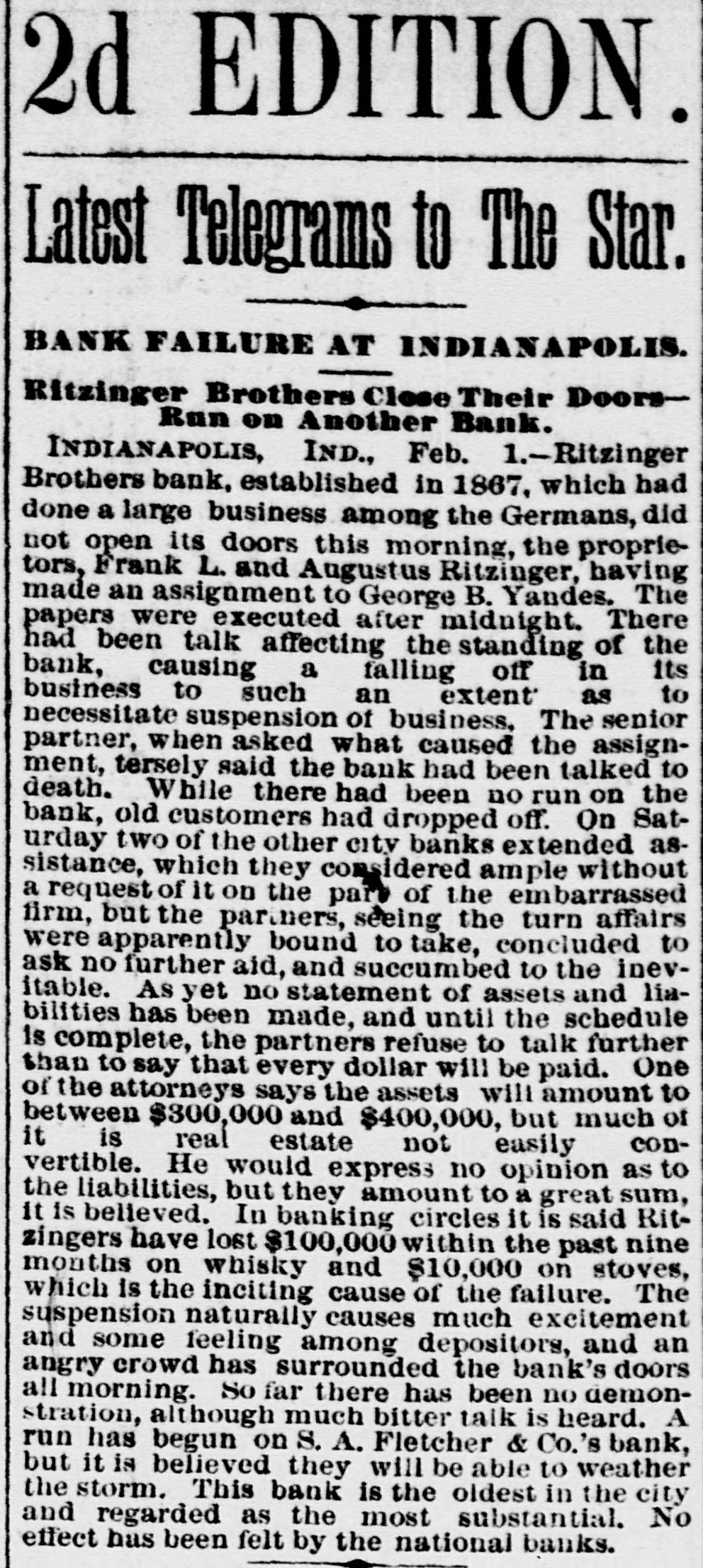
2d EDITION Latest Telegrams to The Star. BANK FAILURE AT INDIANAPOLIS. Ritzinger Brothers Close Their DoorsRun on Another Bank. INDIANAPOLIS, IND., Feb. 1.-Ritzinger Brothers bank, established in 1867, which had done a large business among the Germans, did not open its doors this morning, the proprietors, Frank L. and Augustus Ritzinger, having made an assignment to George B. Yandes. The papers were executed after midnight. There had been talk affecting the standing of the bank, causing a falling off in its business to such an extent as to necessitate suspension of business, The senior partner, when asked what caused the assignment, tersely said the bank had been talked to death. While there had been no run on the bank, old customers had dropped off. On Saturday two of the other city banks extended assistance, which they considered ample without a request of it on the part of the embarrassed firm, but the partners, seeing the turn affairs were apparently bound to take, concluded to ask no further aid, and succumbed to the inevitable. As yet no statement of assets and liabilities has been made, and until the schedule is complete, the partners refuse to talk further than to say that every dollar will be paid. One of the attorneys says the assets will amount to between $300,000 and $400,000, but much of it is real estate not easily convertible. He would express no opinion as to the liabilities, but they amount to a great sum, it is believed. In banking circles it is said Ritzingers have lost $100,000 within the past nine months on whisky and $10,000 on stoves, which is the inciting cause of the failure. The suspension naturally causes much excitement and some feeling among depositors, and an angry crowd has surrounded the bank's doors all morning. So far there has been no demonstration, although much bitter talk is heard. A run has begun on S. A. Fletcher & Co.'s bank, but it is believed they will be able to weather the storm. This bank is the oldest in the city and regarded as the most substantial. No effect has been felt by the national banks.


Article from Savannah Morning News, February 2, 1886

Click image to open full size in new tab

Article Text

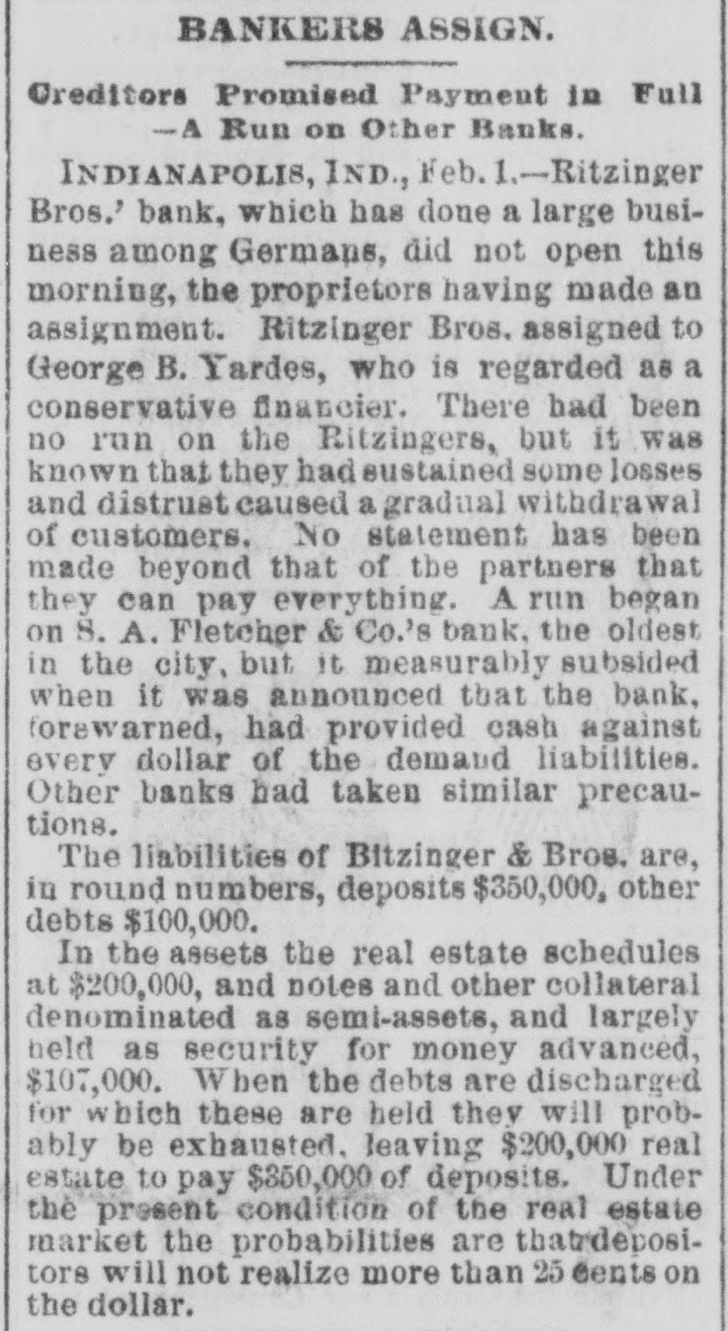
BANKERS ASSIGN. Creditors Promised Payment in Full -A Run on Other Banks. INDIANAPOLIS, IND., Feb. 1.-Ritzinger Bros.' bank, which has done a large business among Germans, did not open this morning, the proprietors having made an assignment. Ritzinger Bros. assigned to George B. Yardes, who is regarded as a conservative financier. There had been no run on the Ritzingers, but it was known that they had sustained some losses and distrust caused a gradual withdrawal of customers. No statement has been made beyond that of the partners that they can pay everything. A run began on S. A. Fletcher & โ‚ฌo.'s bank. the oldest in the city, but it measurably subsided when it was announced that the bank, forewarned, had provided cash against every dollar of the demand liabilities. Other banks had taken similar precautions. The liabilities of Bitzinger & Bros. are, in round numbers, deposits $350,000, other debts $100,000. In the assets the real estate schedules at $200,000, and notes and other collateral denominated as semi-assets, and largely held as security for money advanced, $107,000. When the debts are discharged for which these are held they will probably be exhausted, leaving $200,000 real estate to pay $350,000 of deposits. Under the present condition of the real estate market the probabilities are thatrdepositors will not realize more than 25 dents on the dollar.


Article from The Indianapolis Journal, February 2, 1886

Click image to open full size in new tab

Article Text

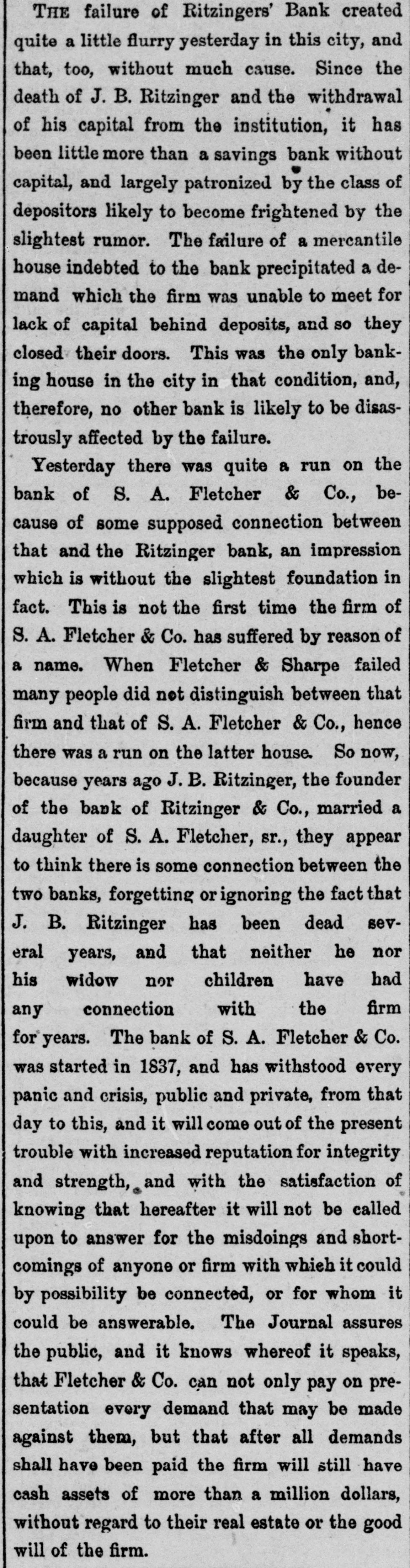
THE failure of Ritzingers' Bank created quite a little flurry yesterday in this city, and that, too, without much cause. Since the death of J. B. Ritzinger and the withdrawal of his capital from the institution, it has been little more than a savings bank without capital, and largely patronized by the class of depositors likely to become frightened by the slightest rumor. The failure of a mercantile house indebted to the bank precipitated a demand which the firm was unable to meet for lack of capital behind deposits, and so they closed their doors. This was the only banking house in the city in that condition, and, therefore, no other bank is likely to be disastrously affected by the failure. Yesterday there was quite a run on the bank of S. A. Fletcher & Co., because of some supposed connection between that and the Ritzinger bank, an impression which is without the slightest foundation in fact. This is not the first time the firm of S. A. Fletcher & Co. has suffered by reason of a name. When Fletcher & Sharpe failed many people did not distinguish between that firm and that of S. A. Fletcher & Co., hence there was a run on the latter house. So now, because years ago J. B. Ritzinger, the founder of the bank of Ritzinger & Co., married a daughter of S. A. Fletcher, sr., they appear to think there is some connection between the two banks, forgetting or ignoring the fact that J. B. Ritzinger has been dead several years, and that neither he nor his widow nor children have had firm the with connection any for years. The bank of S. A. Fletcher & Co. was started in 1837, and has withstood every panic and crisis, public and private, from that day to this, and it will come out of the present trouble with increased reputation for integrity and strength, and with the satisfaction of knowing that hereafter it will not be called upon to answer for the misdoings and shortcomings of anyone or firm with whieh it could by possibility be connected, or for whom it could be answerable. The Journal assures the public, and it knows whereof it speaks, that Fletcher & Co. can not only pay on presentation every demand that may be made against them, but that after all demands shall have been paid the firm will still have cash assets of more than a million dollars, without regard to their real estate or the good will of the firm.


Article from The Indianapolis Journal, February 2, 1886

Click image to open full size in new tab

Article Text

WHAT BANKERS AND MERCHANTS SAY. The View Taken by Prominent Gentlemen of the Situation of Affairs. A Journal reporter called at the S. A. Fletcher & Co. banking house yesterday afternoon about 3 o'clock. The crowd had greatly thinned out. There was no anxious waiting throng on the sidewalk, and within the bank there were few more than are usually found there at that hour upon any business day. The money was coming into the bank instead of going out. Business men were making their usual deposits with a complacency that had a soothing effect upon the few panic-stricken ones who still stood at the counters. Inquiry was made of Frank M. Churchman, senior partner, as to the situation. "You can say," said Mr. Churchman, "that this bank has not nor has it ever had any connection whatever with the Ritzinger bank-a matter that has been misunderstood by many. We knew this trouble was coming and fully prepared ourselves for it. We have the money and are ready to meet any and all demands that may come against us. In saying this I do not want to appear to boast, but merely want to assert the fact. We are ready to meetthe demand. Allen M. Fletcher, president of the Indianapolis Gas Company, was found by the reporter in the office of the bank. He said: "I have no connection with this bank. but any assistance these gentlemen desire that it is in my power to give they certainly will get to the full extent of my ability, although they have not asked for any. This institution is perfectly solvent in my judgment." Stoughton J. Fletcher: "We are in ourselves able to take care of ourselves. We have had more assistance proffered than we need." Theodore P. Haughey, president of the Indianapolis National: "It is my opinion that Fletch er & Churchman are amply able to take care of themselves, and will pay all demands without any trouble. They have had several flurries before, as senseless and as seriousas this, and have always come out of them. I do not anticipate any other of our banks will have trouble. The suspension of the Ritzinger bank was not unexpected. So far as we are concerned, we have been receiving larger deposits than usual. do not anticipate that this failure of the Ritzinger bank will affect the general business interests of our city, as the effect has been largely discounted: but many persons, chiefly small depositors. will suffer.' John H. Stewart, president of the Bank of Commerce: "I think the Ritzinger failure is the end of our bank troubles. So far as the run upon Fletcher & Churchman is concerned, it will not amount to much. They will undoubtedly pull through. They have been fortifying themselves for this for some time, and I have not the least doubt they are amply able to meet every demand. This run has been caused by the idea that the Fletcher bank was connected with Ritzingers'. Most of the excitement on the street to day is utterly without reason, and injurious to the interests of our city." W. P. Gallup. president of the Meridian National Bank: "We have had no run. and the excitement to day has made little difference to us. I do not think it has brought us much increase in deposits. i believe this run on Fletcher's bank to-day is all foolishness. They are amply able to meet everything. I have no doubt of it at all. I believe they could pay three times over. I am not speaking of their wealth, but I mean they can pay it now." V. T. Malott, president of the Indiana National Bank: "The excitement is certainly foolish. As far as Fletcher & Churchman are concerned there is no doubt of their ability to meet all demands that will come against them. Ithink this whole feeling has grown out of the failure of some of our merchants, which, while a surprise to the general public, was no surprise to bankers, but were long looked for. I have not the slightest doubt that matters will soon be better here. Everything points to an improvement in general business all over the country, and of course Indianapolis will share in this improvement. There will be no boom, but we will have our share. There is no reason for the gloomy view of things here that some are now taking. In fact, the condition of our merchants will compare favorably with the same number of business men anywhere in the country. Wm. H. English, president of the First National Bank: "I don't want to be interviewed. I think it is just that sort of sensational stuff going through the newspapers that makes trouble. The best thing to restore confidence here would be to take the official list of stockholders of the banks of this city, and publish them. That would be enough." Augustus Kiefer, wholesale druggist: "This will put another feather in the Fletcher & Churchman cap. They are not going to get away with that bank. The people of this city ought to keep cool. Everything here is all right. The business adversities are not unusual. There is nothing the matter with the country. I anticipate a better trade for the first six months of this year than I had during the same period last year We had a great corn crop last fail. That brought money and makes business." Eli Lilly, manufacturing pharmacist: "Your interview with Mr. Kiefer covers my view of the case. The farmer is well off. and that money is coming into the channels of trade now. Everybody's trade in the wholesale way is larger than it was last year. My trade is 25 per cent. greater now than at this time last year." Frederick Ostermeyer, wholesale grocer: "Fletcher & Churchman are all right-no sane business man doubts it. Many mechanics and the middle class of people had money in Ritzingers Bank, and their losses will burt, but there will not be any serious detriment to general business. The Ritzingers deserve sympathy. They have been economical and have been industrious. I understand that, with careful and economical management, they will be able to pay almost dollar for dollar. They have ex cellent business property on Washington street, and other valuable real estate Henry Severin, wholesale grocer: "I do not deposit with S. A. Fletcher & Co., but if I had $50,000 in that bank I wouldn't take 99 cents on the dollar for it. But I'm not to be interviewed." Daniel Stewart, wholesale druggist: "The Ritzinger assignment will not, I think, materially effect business. We never in twenty years have had such a January business as this year. The stability of the Fletcher & Churchman bank is above question. As to general business, notwithstanding the bank failure, Indianapolis is going to remain right here all the time." M. O'Connor, wholesale grocer: The Ritzinger failure was not unexpected to business men. They had a long and a hard tussle. It does not materially affect Meridian street. The business people of this street are in excellent condition-better than ever, I believe. Indianapolis has had fewer business failures than any
Article from The Indiana State Sentinel, February 3, 1886

Click image to open full size in new tab

Article Text

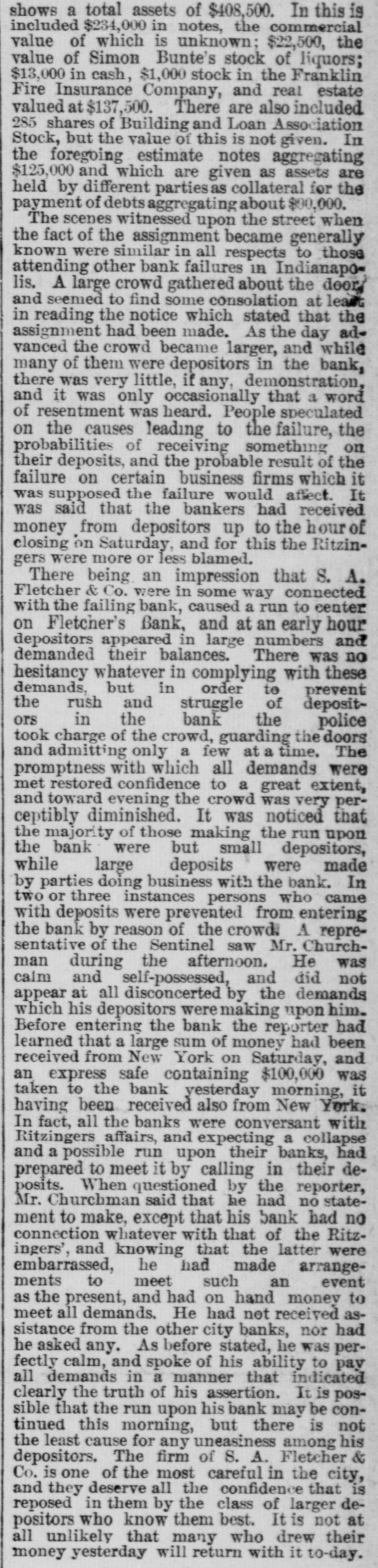
shows a total assets of $408,500. In this is included $234,000 in notes, the commercial value of which is unknown; $22,500, the value of Simon Bunte's stock of liquors; $13,000 in cash, $1,000 stock in the Franklin Fire Insurance Company, and real estate valued at $137,500. There are also included 285 shares of Building and Loan Association Stock, but the value of this is not given. In the foregbing estimate notes aggregating $125,000 and which are given as assets are held by different parties as collateral for the payment of debts aggregating about .000. The scenes witnessed upon the street when the fact of the assignment became generally known were similar in all respects to those attending other bank failures in Indianapo lis. A large crowd gathered about the door and seemed to find some consolation at least in reading the notice which stated that the assignment had been made. As the day advanced the crowd became larger, and while many of them were depositors in the bank, there was very little, if any, demonstration, and it was only occasionally that a word of resentment was heard. People speculated on the causes leading to the failure, the probabilities of receiving something on their deposits, and the probable result of the failure on certain business firms which it was supposed the failure would affect. It was said that the bankers had received money from depositors up to the hour of closing on Saturday, and for this the Ritzingers were more or less blamed. There being an impression that S. A. Fletcher & Co. were in some way connected with the failing bank, caused a run to center on Fletcher's Bank, and at an early hour depositors appeared in large numbers and demanded their balances. There was no hesitancy whatever in complying with these demands, but in order to prevent the rush and struggle of depositors in the bank the police took charge of the crowd, guarding the doors and admitting only a few at a time. The promptness with which all demands were met restored confidence to a great extent, and toward evening the crowd was very perceptibly diminished. It was noticed that the majority of those making the run upon the bank were but small depositors, while large deposits were made by parties doing business with the bank. In two or three instances persons who came with deposits were prevented from entering the bank by reason of the crowd. A representative of the Sentinel saw Mr. Churchman during the afternoon. He was calm and self-possessed, and did not appear at all disconcerted by the demands which his depositors were making upon him. Before entering the bank the reporter had learned that a large sum of money had been received from New York on Saturday, and an express safe containing $100,000 was taken to the bank yesterday morning, it having been received also from New York. In fact, all the banks were conversant with Ritzingers affairs, and expecting a collapse and a possible run upon their banks, had prepared to meet it by calling in their deposits. When questioned by the reporter, Mr. Churchman said that he had no statement to make, except that his bank had no connection whatever with that of the Ritzingers', and knowing that the latter were embarrassed, he had made arrangements to meet such an event as the present, and had on hand money to meet all demands. He had not received assistance from the other city banks, nor had he asked any. As before stated, he was perfectly calm, and spoke of his ability to pay all demands in a manner that indicated clearly the truth of his assertion. It is possible that the run upon his bank may be continued this morning, but there is not the least cause for any uneasiness among his depositors. The firm of S. A. Fletcher & Co. is one of the most careful in the city, and they deserve all the confidence that is in them by the class reposed best. of It larger is not de- at positors who know them all unlikely that many who drew their money yesterday will return with it to-day.