Keystone Bank (Philadelphia, PA)

Episode Information

Episode UID
9166653591092
Episode Type
Run โ†’ Suspension โ†’ Closure
Bank Type
state
Bank ID
916665359 hash
Start Date
December 2, 1890
Location
Philadelphia, Pennsylvania (39.952, -75.164)

Metadata

Model
gpt-5-mini (chosen from majority vote of a three-model LLM ensemble)
Short Digest
6ac076693f7f5761

Response Measures

None

Description

Comptroller ordered closing and a receiver was appointed; failure tied to large internal defalcations.

Events (3)

1. December 2, 1890 Run
Cause
Bank Specific Adverse Info
Cause Details
Depositor panic driven by concerns about the bank's condition (later revealed large deficits/defalcations by President Lucas and cashier Marsh).
Measures
Paid checks of $100 or less in currency; larger demands paid $100 cash plus clearing-house due bills for balance.
Newspaper Excerpt
The run on the Keystone Bank continues today ... a line of three or four hundred people was formed. All persons presenting checks for $100 or less were paid in currency
Source
newspapers
2. March 22, 1891 Suspension
Cause
Government Action
Cause Details
Comptroller of the Currency ordered the bank closed and a receiver appointed following discovery of large deficits and insolvency.
Newspaper Excerpt
Next morning he received instructions to close it. On the same day Drew telegraphed the comptroller urging the appointment of a receiver without delay
Source
newspapers
3. June 3, 1891 Receivership
Newspaper Excerpt
both the closing of the bank and the appointment of a receiver were ordered by the Comptroller ... the Keystone bank failure in Philadelphia; receiver Yardley is progressing with his administration of the affairs of the Keystone Bank, ... forwarded to the Comptroller the actual cash he found in the bank, which was $112,000, and forwarded him the amount.
Source
newspapers

Newspaper Articles (24)

Article from Evening Star, December 2, 1890

Click image to open full size in new tab

Article Text

EVERY APPLICANT PAID. The "Run" of the Depositors on the Philadelphia Keystone Bank Continues. PHILADELPHIA, Dec. 2.-The run on the Keystone Bank continues today with unabated vigor which began yesterday. The crowd began to collect shortly before 10 o'clock, and when the heavy iron door of the bank was raised they swarmed into the building and in a few minutes a line of three or four hundred people was formed. All persons presenting checks for $100 or less were paid in currency, but any whose demands exceeded that amount are paid only $100 in cash and are given clearing house due bills for the balance. By an arrangement with the clearing house banks these due bills will be honored at any bank. Toward 1 o'clock the run on the bank seemed to have been broken. The line of depositors that early in the day completely encircled the building, rapidly dwindled down and very few took the places of those who had received their money. Every check presented has been promptly paid, either in money or in clearing house due bills. President Marsh said: "I think the run is about over. We have paid every one presenting themselves and we are able to pay all. It is only our smaller depositors that have been making this run on us. The large business houses on our books have stuck to us, and over $40,000 has been deposited this morning." A number of directors of the bank have been in the building all the morning consulting with the officers of the institution. The regular meeting of the directors will be held later in the day.


Article from The Jersey City News, May 25, 1891

Click image to open full size in new tab

Article Text

NEWS AND NOTES. Foreign. Reports from government sources in Chili to the Chilian Legation in Paris claim the defeat of the insurgents at Iquique and Tattal. Lord Romilly was smothered in his house in London by a fire caused by a lamp. A French Armyofficer has been arrested in Paris for high treasou, having revealed the secret of making melinite to an English firm. To celebrate the visit of the Czarewitch to Siberia an imperial degree has been issued authorizing the Siberian Governors to remit two-thirds of the sentences and otherwise to ameliorate the condition of worthy convicts. The negotiations of France for a treaty of commerce with Spain have been suspended pending an explanation of the convention granting the United States a monopoly of trade with the Spanish Antilles. The vacht Sultana, Captain Curtis, Trenor Park of New York owner, which has been cruising in the Mediterranean, has arrived at Gibraltar. The trial at Pari, Italy, of 179 members of the Mala Vita Society has ended. Fourteen members are acquitted, while 165 members are sentenced to terms of imprisonment varying from six months to fifteen years. At the National Capital. The United States Government is in negotiation with San Domingo for the lease of Santa Barbara as a coaling place. A careful analysis of the late billion dollar Congress shows that nearly $5,000,000 was appropriated by that body in creating new offices. It is a record uparalleled oth in the number of offices and the sums appropriated. At the last session 597 new specific offices were created, fer which salaries aggregating $908,867 a year were provided. Besides this there was appropriated $1,495,851 for other new offices, the number of offices and the amount of each salary not being specified. # Reports continue to be published that the condition of Secretary Blaine's health is worrving his friends. They do not seem to fear any immediate danger to his life, but they have apparently settled down to the conviction that Mr. Blaine's days of activity are over. New York Doings. Dr. Heber Newton formulated his doctrinal opinions. Dr. Talmage delivered the sermon at the installation of Dr. Burreil. Dr. Parkhurst denounced Dr. Briggs' accusers and Dr. Bridgman was received into the Episcopal Church by Bishop Potter. Fair sized crowds went to Coney Island, but they found the weather too chilly for enjoyment. Ellen Conway, thirteen years old, who has been arrested in New York, confesses that she is the leader of a band of little girl thieves who operated in apartment houses. A New York gentleman, under the nom de plume of "Prima Facie," writes a letter implicating Dr. Robinson in the Tobin case. The east side Hebrew butchers of New York, have been endeavoring for several weeks past to organize a trust which they believe will make a millionnaire of every man who becomes a member of it. Elsewhere. Word has been received from Central America to the effect that on Wednesday last a coasting schooner sighted a vessel resembling the Itata. The schooner tried to get near her, but the other vessel, which was running south. sheered off her course. This Was thirty miles off shore. President Marsh, of the wrecked Keystone Bank, of Philadelphia, is believed to have sailed for Rio Janeiro on the steamer Advance. Senator Peffer, of Kansas, talks of the new people's party. He predicts big things in 1892, and thinks the new movement will defeat McKinley in Ohio. A duel with many features of romance was fought at Chicago between a nephew of Count Kalnoky and a Southern gentleman. The representative of nobility was seriously wounded by a thrust in the neck. Dr. Briggs' chances before the Presbyterian Assembly seem to be growing worse. James Jarrett. one of the most prominent farmers of North East, Ga., was poisoned by his pretty 16-year-old daughter Rosa yesterday because he whipped her for stealing away to a neighboring meadow and going to walk with Robert McRae, a suitor, whom her father opposed. She put rat poison in his soup.


Article from New-York Tribune, June 1, 1891

Click image to open full size in new tab

Article Text

A BUILDING ASSOOFATION GONE. The Totowa Order of Home Builders, a building and loan association of Paterson, N. J., has been compelled to suspend operations owing to the failure of the Keystone Bank of Philadelphia. The association kept all its funds in the latter institution. The president, W. B. Wood, and the treasurer, Gideon W. Marsh, of the Philadelphia bank, were directors in the Home Builders. The organization has 125 members, who are largely


Article from The Record-Union, June 4, 1891

Click image to open full size in new tab

Article Text

PHILADELPHIA'S EX-TREASURER. FURTHER TESTIMONY AS TO BARDSLEY'S TRANSACTIONS. Comptroller Lacoy Defends the Government's Action in Dealing with the Keystone Bank. Special to the RECORD-UNION. Philadelphia, June 3.-Before the Investigating Committee, Peter A. B. Widney emphatically denied that he had, as alleged, "unloaded" $400,000 worth of Chicago Traction stock on ex-City Treasurer Bardsley. He never sold Bardsley stock of any kind. The Presidents of several national banks denied ever having paid Bradsley a monetary consideration for deposits in their institutions. Mr. Hahn of the broker firm of Glendening & Co., resumed his testimony. He said that in the course of a single year the firm's stock operations with Bardsley aggregated $1,250,000, and in the same time they borrowed $910,000 from Bardsley and loaned him $250,000. Confidential Clerk Bean of Glendenning & Co. was plied with questions as to how he came to go to Bardsley to borrow money, etc., but to all questions he returned the stereotyped answer, "I don't remember." THE GOVERNMENT'S ACTION IN THE MATTER. WASHINGTON, June 3.-Referring to the criticisms of his bureau in connection with the Keystone Bank failure in Philadelphia, Comptroller Lacey said to-day "As a matter of fact, both the closing of the bank and the appointment of a receiver were ordered by the Comptroller against the wish of all who had sufficient interest to express an opinion. There were many reasons why it was desirable to avoid a receivership, notably on account of its assets being SO largely in real estate. "The Comptroller deemedit his duty to aid in several hopeful attempts made to reopen the bank by the contribution of new capital under a new and competent management. As a matter-of-fact it was officially reported to the Comptroller that $300,000 of new capital had been subscribed, and that Lucas' estate was expected to make good all amounts due. Recent developments have shown these plans could not have been carried out, but they were sufficiently promising at the time to warrant the delay asked for. Similar measures," Lacey said, "have caused the reopening for business within the past six months of at least four National Banks whose capital had been impaired, and two more will open soon."


Article from The Helena Independent, June 4, 1891

Click image to open full size in new tab

Article Text

OBLIGING COMPTROLLER. Ho Permits an Insolvent Bank to Do Business. WASHINGTON, June 3.-Referring to criticiams of his bureau in connection with the Keystone bank failure of Philadelphia, Comptroller Lacey said, to-day, as a matter of faet both the closing of the bank and the appointment of a receiver were ordered by the comptroller against the wish of all who had sufficient interest to express an opinion. There were many reasons it was to desirable why avoid R receivership, notably on account of its Assets being so largely in real estate. Hence the comptroller doomed it his duty to aid in several hopeful attempts to reepon the bank by the contribution of new capital, under new and competent management. As a matter of fact, it was officially reported to the comptroller that $800,000 of new capital had been subscribed and the Lucasestate was expected to make good all amounts due. Recont developments have shown that these plans could not have been carried out, but they wore sufficiently promising at the time to warrant the delay asked for. Similar measures, Lacey said, have caused the reopening for business within the past six months of at least four national banks whose capital had become impaired, and two more will open soon.


Article from Los Angeles Herald, June 4, 1891

Click image to open full size in new tab

Article Text

LACEY'S DEFENSE. THE COMPTROLLER OF CURRENCY JUSTIFIES HIS ACTS. He Tried to Save the Keystone Bank as Many Other Banks are Saved-The Bardsley Investigation, Etc. WASHINGTON, June 3.-Referring to the criticisms of his bureau in connection with the Keystone bank failure in Philadelphia, Comptroller Lacey said today, as a matter of fact both the closing of the bank and the appointment of a receiver were ordered by the comptroller against the wish of all who had sufficient interest to express an opinion. There were many reasons why it was desirable to avoid a receivership, notably on account of its assets being so largely in real estate. The comptroller deemed it his duty to aid in several hopeful attempts made to reopen the bank by the contribution of new capital under a new and competent management. As a matter of fact it was officially reported to the comptroller that $300,000 of new capital had been subscribed, and that the Lucas estate was expected to make good all amounts due. Recent developments have shown that these plans could not have been carried out, but they were sufficiently promising at the time to warrant the delay asked for. Similar measures, Lacey said, have caused the reopening for business within the past six months of at least four national banks whose capital had been impaired, and two more will open soon.


Article from Deseret Evening News, June 4, 1891

Click image to open full size in new tab

Article Text

Failures. WASHINGTON, June 3.-Referring to criticisms of his bureau in connection with the Keystone Bank of Philadelphia, Cemptroller Lacey said today: "As a matter of fact, both the closing of the bank and the appointment of 14 receiver was ordered by the comptroller against the wish of one who has sufficient interest to express his opinions. There were many reasons why it was desirable to avoid a receivership, notably on account of its assets being 80 largely in real estate, hence the comptroller deemed it his duty to aid in several hopeful attempts made to reopen the bank by the contribution of new capital under a new and competent management. As a matter of fact, It was officially reported to the comptroller that $300,000 of new capital had been subscribed


Article from Deseret Evening News, June 4, 1891

Click image to open full size in new tab

Article Text

# IMMIGRATION LAWS. The Plan Proposed By Assistant Secretary Nettleton Approved By the President. DOUBTFUL IMMIGRANTS SHOULD BE EXCLUDED. Return of Two Italians and One Swede Who Have Become Paupers. By Telegraph to the NEws.! WASHINGTON NOTES. A Plan for Restricting Immigration Approved. WASHINGTON, June 3.- The plan proposed by Assistant Secretary of the Treasury Nettieton for restricting immigration has been approved by the President, and was today embodied in a circular letter and sent to all the steamship companies bringing immigrants to this country. It says, in part: "The evident disposition of many steamship companies under the pressure of sharp competition is to gather up in Europe and bring to the United States all who, without the aid of others, can pay the cost of steerage passage, regardless of their character or condition. Our laws compel, on the part of this government, a closer scrutiny and adoption of more comprehensive measures. So far as possible, the sifting process should be applied at the beginning, not the end of the journey. Much of this wholesome prevention work can be effectively done by the transportation company directly and through their local inland agencies in Europe, and the companies must be aware that their own pecuniary interests, not less than the cause of humanity, will be best served this way." Attention is particularly called to the provision excluding persons likely to become public charges. Doubtful cases should be excluded, inasmuch as some steamship lines, in order to increase their carrying capacity, have recently disregarded the provisions of "the law requiring a certain allowance of cubic air space to each stoerage passenger. Notice is given that hereafter a more thorough inspection is to be made of all steamships and penalties for violations of this provision rigidly enforced. EMIGRANTS RETURNED. WASHINGTON, June 3.-Assistant Secretary Nettleton today directed the return to their countries of two Italians and one Swedish immigrant, who, since their arrival in January, have become paupers, and under the new law they can be returned at the expense of the company bringing them here. This is the first order of the kind issued by the treasury department and indicates the vigor with which the new law is to be enforced. PURCHASES OF SILVER. WASHINGTON, June 3.-The treasury department today purchased 320,000 ounces of silver at 94.2 to 97.9 per ounce. Offers of 944,000 ounces were made. THE KEYSTONE BOND FAILURE. WASHINGTON, June 3.-Referring to the criticisms of his bureau in connection with the Keystone bond failure of Philadelphia, Comptroller Lacey said, today, as a matter of fact, both the closing of the bond and appointment of a receiver were ordered by the comptroller against the wish of one who has sufficient interest to express his opinion; that there were many reasons why it was desirable to avoid a receivership, notably on account of its assets being so large in real estate, hence the comptroller deemed it his duty to aid in several hopeful attempts made to reopen the bank by contributions of new capital, under new management. As a matter of fact, it was officially reported to the comptroller that $300,000,000 of the new capital had been subscribed and that the Lucas estate was expected to make good all amounts due. Recent developments have shown these plans could not have been carried out, but they were sufficiently promising at the time to warrant the delay asked for. Similar measures, Lacey said, have caused the re-opening for business within the past six months of at least four national banks whose capital became impaired and two more will open soon. A TWELVE INCH GUN. WASHINGTON, June 3. The first twelve-inch gun ever made in the United States has been completed at Watervliet and shipped to Sandy Hook proving ground for testing. NEWS OF AN EXPLOSION. WASHINGTON, June 3.-News was received at the Navy Department today that an explosion occured yesterday on the new cruiser "Concord," which was on the way to Norfolk. The steam pipes burst, causing the death of the fireman and coalheaver.


Article from The Western Sentinel, June 4, 1891

Click image to open full size in new tab

Article Text

Affairs of the Eroken Keystone Under Control. A Philadelphia special says: Receiver Yardley is progressing with his administration of the affairs of the Keystone Bank, although he has not as yet signed the receipt which will release Bank Examiner Drew from all further responsibility in commection with the bank. Receiver Yardley has forwarded to the Comptroller of the Currency a statement of the actual cash he found in the bank, which was $112,000, and forwarded him the amount.


Article from Shenandoah Herald, June 19, 1891

Click image to open full size in new tab

Article Text

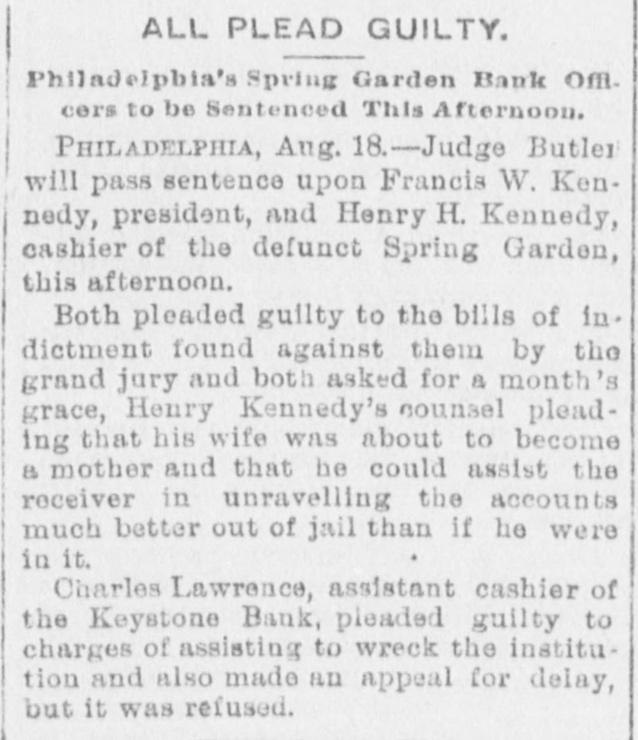
THE NEWS EPITOMIZED. Eastern and Middle States. Ex-CITY TREASURER JOHN BARDSLEY, of Philadelphia, was brought up from Moyamensing Prison in the common van and placed in the dock where he pled guilty to the eventeen indictments found against him for appropriating State and city funds, THE Treasury Department has designated Charlotte, N. Y., as a quarantine station for the entry of cattle, sheep and ewine from Canada. THE Reformed Presbyterian Synod at Pittsburg, Penn., expelled five ministers for non-conformity with principles of the Church. THE Cambridge (Mass.) Aldermen have refused to grant licenses to druggists, and the sale of liquor is now absolutely prohibited in that city. CHRISTOPHER LITTLE, of Pottsville, a lawver and insurance agent, committed suicide at Mauch Chunk, Penn. BANK FXAMINER DREW, of Philadelphia, Fonn., has teen suspended by Secretary Fostet for his connection with the Keystone Pank failure. THE Massachusetts Legislature adjourned sine die. AT Randoiph, N. Y., a fast train struck a carriage containing Mrs. Dow, wife of exState Senator A. G. Dow, and Mrs. George Fox. Mrs. Dow was instantly killed and Mrs. Fox fatally injured. Mrs. Dow was about sixty-five years old. Mrs. Fox's husland was killed by a train about four years ago. SECRETARY PROCTOR delivered their diplomas to the sixty-four members of the graduating class at West Point (N. Y.) Military Academy. C. MASON MOODY, who has been Treasurer of Franklin County, Mass. for fifteen years, has confessed to having used $16,168 belonging to the county in his private business, H. H. YARD, of Philadelpbia, was arrested, charged with conspiracy with ex-City Treasurer Bardsley to defraud the city of Phila. delphia; another deficit of over $400,000 was discovered in Bardsley's accounts. The Snpreme Court has handed down a decision that W Redweod White, appointed City Treasurer by Governor Pattison, is the proper appointee to succeed Bardsley. Rich ard G. Oeilers, appointed by the City Counc1/, is ousted.


Article from Perrysburg Journal, June 20, 1891

Click image to open full size in new tab

Article Text

LACEY'S STATEMENT Regarding the Course Pursued by Him with the Keystone Bank. Bank Examiner Drew's Conduct Explained and Commented Upon-Mr. Wanamaker Failed to Effect a Recognition of the Bank Although Very Anxious to Do So. WASHINGTON June 15.-The statement by Comptroller Lacey to Mayor Stuart of on the course pursued and sent prepared by him Philadel- with the bank of that was here last night. made phia Keystone public The Bank city state- Exincluded the letter of Drew of January 28 the aminer him ment of $600,000 defalcation notifying of In Lucas, this president of the bank. Mr. Drew explains how the letter late by of adroit the manipulation of the accounts of bank Lucas, with the assistance Marsh, the former cashier of the bank, abstracted large sums of money from real the bank to use in speculations in estate. Marsh, he reported, was ignorantly led into these transactions and promised Lucas when the latter was on his death-bed to continue the deception under representations that the money abstracted would soon be returned to bank from the result of Lucas' enterprises. the Drew also reported that there was no evidence that Marsh had profited by these irregularities. Later on January 27, Mr. Drew, Wash- in an with the comptroller at and interview stated that in his judgment house ington, the opinion of the clearing to committee, in the property conveyed bank by the Lucas estate was equal had the value to the indebtedness which event in concealed, and that in any entirely been creditors of the bank were connecthe also, that to sever Marsh's suspicsafe; with the bank would excite retion and that Marsh was thoroughly earnest ion, and was actuated by an assist pentent to do all in his power to which desire bank in recovering any sums it. Mr. the been improperly taken from the bank had says he did not close had no lawLacey for the reason that he the facts then authority to do SO upon reason ful submitted, and for the further bank examadvised by the the bank iner, that he Drew, was that the capital of was unimpaired and later reports from Bank Further Drew convinced the comptrol- were Examiner the board of directors satisfacler that putting matters in a he levied slow condition, in so on March 7th the tory of $250,000 upon the coman (assessment on the promise of that the mittee of be paid shareholders directors of the bank within a assessment would Drew comOn March 14th Mr. from the week. of little active support re-habitate the plained in the effort to on directors reached the comptroller closed the the bank. 16th This and three days later he bank. comptroller states never that Postmas- directly The General Wanamaker solicited any ter indirectly suggested the or bank, nor in or delay in the closing of of a receiver, except hereinafter the appointment by the telegram met him but as appears In fact. I have and that quoted. during the present year, day of March once was on the 21st the presence of meeting suggestion and in then acting secat the A. B. Nettleton, This interview Hon. of the treasury. Keystone bank was was retary the closed day and after the the failure was the fully indiscussed. substantially confirmed Mr. Marsh, he held as a "He I received from certifibank and in the them and cates formation stock said representing that Keystone about surrender 2,500,000 pledge shares that un- the of had declined to would pay him his of the he the Lucas estate urged him to use being his influence in, the bank. the He same night less amount made to reopen due. the aid matter I efforts promised I failed, in to enlist him to look his return into attempt Philadelphia. to commuon in my ended all however. and SO subject between bank's affairs, with the following: nication nected the enterprise, the of us on except- coning the receipt DEPARTMENT POST OFFICE OF ASHINGTON. April Mr. Marsh WASHIN Comptroller night to of HON the Keystone reported you you bank unless I believe someE. was S. LACEY, bank Keystone came down intend last to appoint say that for the done to day. them twenty thing a suffer from the end of more detithey presented a'on. nothing four receiver hours may would put longer. definite on paper at was to something you. giving well From which in would what securing time re he commend day. nite they to be are getting new stock desays subscriptions appo 10 n the ment until of he has ferred. to state say. something one more statement." Nir "In concluding **I deem the it my several duty reports to say Lacey says, opinion, the did not retrue The made that, in by my the bank condition examiner of degree the bank of flect the consideration. which properly ascertained. attaches if any, to be he has the under to blame, Mr. Drew, yet ho wever, examinationlusion until been reached." directed In the facts meantime, to are suspend submitted and a


Article from Daily Independent, June 22, 1891

Click image to open full size in new tab

Article Text

# THE PHILADELPHIA STEALING The more the looting of the treasury of the Quaker city is investigated the greater the rottenness exposed. John Bardsley, the City Treasurer, seems to have plunged into all sorts of speculations in the vain endeavor to extricate himself from the pit yawning beneath him. The loaning of the public money to insolvent banks and political swash-bucklers for the purpose of corrupting the ballot box of the city and State are not the least of his misdoings. So far as his office has been investigated he has gotten away with the enormous sum of $2,444,000 belonging to the city of Philadelphia and the State of Pennsylvania. That he got away with this amount of money without any assistance from other parties cannot for a moment be believed by any reasonable man. The pious, hypocritical Postmaster-General is just now on the anxious seat trembling lest Bardsley shall open his lips and tell how it was that John Wanamaker came into the possession of $100,000 worth of fraudulently issued stock of the defunct Keystone bank. Pennsylvania's incorruptible Governor is pushing the investigation into all the hidden recesses of crime that lie behind the failure of the bank with the determination to fix the responsibility where it belongs, though it be traced to the pious John and he be sent to keep company with his fellow thief, John Bardsley. It will be worth the time and attention of the American people to keep their eyes on the investigation now being conducted in the city of Philadelphia. It seems strange that such gigantic stealing as this can be carried on without detection for so many years; but when we remember that the politics of the city of Philadelphia has been run exclusively in the interest of the vilest set of political boodlers that ever disgraced any people our wonder ceases and we are lost in admiration of their bold schemes. All honor to the fearless, incorruptible Executive of the State of Pennsylvania for pushing this investigation! Let your motto be "No guilty man shall escape, though it be a pious cabinet officer."


Article from The Helena Independent, June 23, 1891

Click image to open full size in new tab

Article Text

COGNIZANT OF CROOKEDNESS. Correspondence Not Creditable to the Comptroller of Currency. PHILADELPHIA, June 22.-An official copy of all the correspondence between Comptroller Lacey, Bank Examiner Drew and others, with reference to the affairs of the Keystone bank, which WaH received from the treasury department last week, was made public to-night. It is very voluminous. and much of it has already been published in connection with the investigation. A letter from Drew to Lacey gives the result of his examination of Jan. 9, when he as informed of President Lucas' $600,000 deficit, and gives in detail the measures he took to recover from the Lucas estate. He Bays Marsh was ignorantly led into these transactions, while cashier, by Lucas, and the latter on his death-bed exacted a promise from Marsh to continue the deception under representation that the money abstracted would BOON return from Lucas enterprises. Following this, at frequent intervals, were letters and telegrams in reference to the condition of the bank and the reorganization efforts. On Feb. 16 Drew's mind was evidently changing in regard to Marsh, for he reported that developments made him BUSDIcious of that gentleman. On February 28 Comptroller Lacey wrote Drew urging prompt measures to rehabilitate the bank. and Haying that unless some 8 other way was found at once be would order the assessment of stock. After the assessment had been made there were many other communications and finally, March e 19, the comptroller telegraphed Drew to visit the bank in the morning. Next morning he received instructions to close it. On the same day, t Drew telegraphed the comptroller urging n theappointment of a receiver without de8 lay and suggested the name of Mr. Lynch. He added that there were strong probabilities that the bank would be reorganized by e wealthy men. The same day Comptroller Lacey sent Drew the following telegram, a marked confidential: "Call at southeast corner Eighteenth and Spruce streets, 0 eight o'clock this evening, and give Mr. W. a close estimate of of assets and liabilities. Encourage all efforts to reopen the bank and give out no e information except such as will conduce to that end. and then with great care." March 25 Drew wrote a private letter to Lacey, advising that no action be taken against Marsh as his services were indispensable toward the investigation. Prea vious to Marsh's arrest a number of letters passed in regard to re-organization-


Article from The Salt Lake Herald, June 23, 1891

Click image to open full size in new tab

Article Text

THE KEYSTONE BANK The Correspondence Between Lacey and Drew. AN APOLOGY FOR MR. MARSH By the Examiner, Who Afterwards Changed His Mind-The Comptroller's Queer Confidential Telegram. PHILADELPAIA, June22.-The official copy of all the correspondence between Comptroller Lacey, Bank Examiner Drew and othrs with reference to the affairs of the Keystcne bank, which was received from treasury department last week, was made public to night. It is very volumnous and much of it has already been published in connection with the investigation. In a letter from Drew to Lacey he gives the result of his examination of Jan. 9, when he was informed of President Lucas' $600,000 deficit and gives in detail the measures he took to recover from Lucas' estate. He says Marsh was ignorantly led into these transactions while Cashier by Lucas and the other on his death bed 1 exacted a promise from Marsh to continue the deception under representations that the money abstracted would soon be returned from Lucas' enterprises. Following this at frequent intervals were letters and telegrams in reference to the condition of the bank and reorganization efforts. On February 16 Drew's mind was evidently changing in regard to Marsh for he reported that developments made him suspicious of that gentleman. February 28 Comptroller Lacey wrote Drew urging prompt measures to rehabi1 tate the bank and saying unless some other way was found at once he would order an assessment of the stock. After the assessment had been made there were many t other communications and finally, March 8 19, the comptroller telegraphed Drew to visit the bank in the morning. Next morning he received instructions to close it. On the same day Drew telegraphed the comptroller urging the appointment of a re] ceiver without delayand suggested the name t Mr. Lynch. He added there were strong probabilities the bank would be re-organized by wealthy men. The same day Comptroller Lacey sent Drew the following telegram marked contidential: "Call at southwest corner Eighteenth and Sprucestreets. 1 8 o'clock this evening and give Mr. W. Close estimate of the assets and liabilities. Encourage all efforts to re-open the bank a and give out no information except such as 1 will conduce to that end, and then with S great care." h March 22 Drew wrote & orivate letter to 2 Lacey, advising that no action be taken against Marsh, as his services were indispensible toward the investigation. Previous to Marsh's arrest numerous letters passed in regard to reorganization.


Article from The Columbian, June 26, 1891

Click image to open full size in new tab

Article Text

Marsh is Still Missing. HUNDREDS OF MEN SCOURING THE WOODS AND SWAMPS TO FIND HIM. PHILADELPHIA, June 22.-District Attorney Graham returned from Spring Lake this morning, but would add very little to what is already known of the alleged presence of Marsh at that place, and the assault npon "Max Freeman," the mysterious Philadelphia detective. He, however, gave an encouraging report of "Freemans" condition, and said that it was now believed that he would recover from the effects of the terrible blow given him by his assailant. While it was at first feared that if the blow did not cause death the victim would lose the use of his lower limbs, his physician now thinks he will eventually recover. "Max Freeman" as the detective has chosen to be known, is one of the brightest and aplest of the Philadelphia newspaper men. His right name is Thomas Garside, and previous to his coming to this city and entering upon newspaper work he was, as Professor Garside, generally known as a labor agitator, and had a reputation which extended over two continents. He is the Professor Garside who took charge of the Jewish cloakmakers' strike in New York, and whose exploits at that time the New York papers devoted colums to recounting. He has lectured extensively both in Europe and this country on social and economic questions, and has been for years high up in the labor organizations of this country. A little less than a year ago he came to this city, and took a position on the local staff of the Times, where he soon won recognition as a bright and capable reporter. That the man he was after at Spring Lake was Marsh there seems to be no doubt. Garside, during the Keystone bank run, was at work on the story, and met Marsh frequently. Since that time, through all the interesting developements, he has been at work on the case. With his knowledge of the inside workings of the Keystone bank he had but little trouble in tracing Marsh to Spring Lake, led to this conclusion by his knowledge of the intimacy between Yard and the fugitive bank president. Garside by his friends is known to be a man brave and fearless to a fault, and his rash attempt to arrest the man he believes to have been Marsh, practically unaided, causes no surprise. Mr. Graham had as long an interview with Garside as his condition would allow, and the injured man told all he knew. The district attorney learned enough at once to send to this city for detectives, and three of Chief Wood's men are now at Spring Lake searching for the men who were at the lonely cottage at Como and from one of whom Garside received his injuries. One of these men the authorities are convinced is Marsh. Garside caught a glimpse of him as he was disappearing in the darkness, and is confident it was Marsh. It is now thought that Marsh has taken to the swamps or woods, and hundreds of men are scouring the country in search of him.


Article from The Kinsley Graphic, June 26, 1891

Click image to open full size in new tab

Article Text

BARDSLEY'S APPEAL. The Defaulter's Effort to Secure Clemency. EXPECTED SENSATIONS UNDEVELOPED He Defends His Conduct on the Ground That His Wrong ActsWere Not For His Personal Benefit-Drew Blamed For His Ruin. PHILADELPHIA, June 24.-John Bardsley, ex-city treasurer, who several days ago pleaded guilty of embezzlement of public funds, was brought from prison to court for sentence yesterday, but on motion of District Attorney Graham sentence was suspended indefinitely. The throng of regular attendants at the court of quarter sessions was supplemented by men prominent in every walk of life, who had gone into the hot court room to witness what they thought was to be the crowning degradation of the man whom a few months ago they gladly acknowledged as their friend-John Bardsley, the faithless treasurer of the city and self-confessed violator of the law. Two weeks when Bardsley pleaded guilty to the charges against him, the court fixed yesterdayยฎ as the time to pass sentence upon him and public expectation had been wrought up by a promise that when brought into court he would make a full and free confession of his malfeasance. By many it was thought that in his statement or "confession" he would implicate men high in business and official life, whose names had been hinted at but who were supposed to have been his confederates. Such expectations proved groundless. The confession was in a line of defense of his own conduct, giving in detail his various transactions. It bristled throughout with figures and showed where every dollar he had been accused of misappropriating had gone. The charges to which he had pleaded guilty. of loaning public funds at interest and to speculating with them, he frankly acknowledged, but he emphatically denied that he had benefited by his transactions to the extent of one dollar. National Bank Examiner Drew came in for severe scoring at the hands of Bardsley and he laid it to his door that he sunk his money in the Keystone bank. Bardsley said that it was due to Drew's plausible statements of the bank's condition that he had deposited his money there. He further charged Drew, through an acknowledgment by President Marsh, of the Keystone bank, that Drew knew of the condition; that Drew was under obligations to John C. Lucas, the dead president of the bank, for money loaned and for valuable favors received. Bardsley implicated Henry Yard in his transaction by stating that it was through him he had loaned money to banks. According to his statement his present plight may be accounted for by trusting too much in the statements of others and he epitomized in his own words in telling the history of his deposits in the Keystone bank: "I didn't get the money and I have never gotten any part of it and it is still in the bank, or should be there. I know that the closing of the bank meant loss to the city and state and personal destruction to myself. I therefore made every effort to sustain the bank, and its clos ing has resulted in my absolute ruin. "During the time I was in the offied of city treasurer I never had any trans actions with Postnaster-General Wana maker, nor have I any personal know ledge of his transactions with the Key stone bank. I have seen it stated prior to the run on the bank and between that time and March 20 that Mr Thomas B. Wanamaker, son of John Wanamaker, Mr. Marsh and myself were very frequently seen together This is absolutely false."


Article from The Morning News, June 27, 1891

Click image to open full size in new tab

Article Text

# Wanamaker and the Keystone Bank. Postmaster General Wanamaker is finding his connection with the wrecked Keystone bank in Philadelphia extremely troublesome. Immediately after he made his written statement with regard to it before the committee engaged in investigating the bank's affairs the public was quite generally disposed to believe that his transactions with the bank and its officers had been strictly honorable and straightforward, and that there was no ground for suspecting him of conduct unbecoming an honest man. Recent developments, however, seem to call for further explanation. The investigation has brought out some additional facts, which do not appear to agree with his statement. Among other things he asserted that he had never been a stockholder in the Keystone bank, and that the stock of the bank which he had held, and which turned out to be fraudulent, had been given to him as collateral by Mr. Lucas, who, at the time of the transaction, was president of the bank. The receiver of the bank has found out that a great many shares of the bank were issued to Mr. Wanamaker, and some of these shares Mr. Wanamaker transferred to others. It is true that the stock ledger does not show that he was ever a stockholder in the bank, but it would be interesting to know how shares came to be issued to him, and by what authority he transferred them if he did not own them. It is also asserted that Mr. Wanamaker was informed in 1888 that the shares he held from Mr. Lucas were fraudulent, and that notwithstanding this knowledge he attempted to dispose of them. The records also show that shares of stock were issued to Mr. Wanamaker after Mr. Lucas' death. It may be that Mr. Wanamaker can explain to the entire satisfaction of everybody these transactions, which now have so suspicious a look. It is certainly to be hoped that he can. Unless he does, however, it will be impossible to avoid the conclusion that he has had far more to do with the affairs of the wrecked bank than appeared from his written statement, or from anything he has said in interviews about the bank's affairs. There does not seem to be any desire in Philadelphia to do him an injustice. On the contrary, the disposition is to give him every chance to explain, and to place the most favorable construction upon his acts. The Philadelphia authorities, however, are determined to get at the bottom facts in the affairs of the wrecked bank, and there will be a feeling of satisfaction in that city if the Postmaster General is able to make it clear that all suspicions of dishonorable conduct on his part are unfounded. But in the light of the latest discoveries the conclusion can hardly be avoided that a further explanation from him is necessary.


Article from St. Paul Daily Globe, July 11, 1891

Click image to open full size in new tab

Article Text

Hugh Mullen, Bardsley said: "The mayer wanted Richard J. Lennon appointed to the same place. Afterwards Bardsley learned that Matt Quay was pushing Albert H. Crawford for the place, and [Crawford was the auditorgeneral's man for the place. Martin and Porter and all of Quay's people were working for Crawford, and the result was that overtures were made to Singerly to draw Lennon out of the fight. He was promised that if Lennon was taken out $100,000 of state money would be placed on deposit in the Chestnut Street bank. "This was done. Lennon was taken out of the fight and the $100,000 is in the bank now. Crawford got the place, and Mayor Fitler got angry at what he claimed to be a broken promise." Bardsley then paid Hugh Mullen $500 to redeem the promise to the mayor. H. H. Yard, he said, got a great deal of the Keystoue bank money. He was in the pool with Lucas and Marsh, and Marsh allowed him to overdraw his account $90,000, even when the run on the bank was going on. Widener and Elkins, the traction magnates, he said, never sold him any traction stock or had any dealings whatever with him. McWade also asked Bardsley if Judge Wilson had ever borrowed money from him as city treasurer. He said no: and on being asked what judges had borrowed money, he answered in a whisper, Finletter and Ashman. The money, he understood, was simply an advance on their salaries; they did not know whether he was lending the state moneys, city moneys, or his own money. The remainder of the statement was simply a long story of Bardsley's troubles given in his own words with numerous comments, all of which contained no new facts. H. H. Yard, who was then called, did not respond, and a communication was received from his counsel stating that his case had been appealed to the supreme court. The committee voted to instruct the city solicitor to take measures to compel Yard to obey the order of the lower court and appear before the committee.


Article from Daily Kennebec Journal, July 13, 1891

Click image to open full size in new tab

Article Text

Drew's Resignation Received. WASHINGTON, July 12-Bank Exeminer Drew's resignation only reached Comp. troller Lucey Saturday. The comptroller already has several applications for his place. He will not fill it immediately, however, Bank Examiners Shepard and Bette taking care of current work in Philadelphia backs. Comptroller Lacey has made an assessment of $500,000 on the shareholders of the Keyetone Bank. on account of their individual liability, being 100 per cent of the par value of the stock, payable Aug. 11, 1891, and has directed the receiver to take all necessary steps for its collection.


Article from The Southern Argus, July 16, 1891

Click image to open full size in new tab

Article Text

After Singerly left I learned that Matt Quay was pushing Al Crawford for the place and that the auditor-general, who was Quay's man, would support Crawford. "Strong pressure was brought to bear on me by Quay and his men-Porter, Martin and others-but I held to my promise. Quay, however, 'pulled' Singerly and got him to withdraw Lennon, promising him to keep $100,000 of the state funds continuously in the Chestnut street national bank. Singerly came to me twice about it and got me to say that I would see that Quay's pledge was kept. I did so, and Singerly has the money there now. The Inquirer has been very wild and ridiculous in some of the charges it has made. Elverson has no reason to attack me or to allow me to be attacked in this way by his people. In fact, he has every reason to be the other way, and I could stop it if I send him the word. But I do not want to commit myself on paper. The conduct of that paper has been abominable, outrageous in its treatment of my poor wife. And did you notice that he demands that the investigation should go on. He is a pretty fellow to talk about reform. If a strict investigation should strike in his direction his record would astound the community. But look at Bill Singerly. As I said before, he should be in jail along side of me. There are more men than one who got money out of the treasury." H. H. Yard, Bardsley said, got a great deal out of the Keystone bank money. He was in the pool with Lucas and Marsh and Marsh allowed him to overdraw his account $90,000, even when the run on the bank was going on. Widener & Elkins, the traction magnates, he said, never sold him any traction stock or had any dealings with him. McWade also asked Bardsley if Judge Wilson had ever borrowed money from him as city treasurer. He said no; and on being asked what judges had borrowed money, he answered in a whisper "Finletter and Ashman." The money, he understood, was simply an advance and he did not know whether he was lending the state money, city money or his own. The remainder of the statement was simply a long story of Bardsley's troubles given in his own words with numerous comments, all of which contained no new facts.


Article from The Seattle Post-Intelligencer, July 23, 1891

Click image to open full size in new tab

Article Text

# BANKS ROBBED FROM WITHIN. The receiver of the Keystone bank of Philadelphia finds that the assets equal $1,726,511, of which $996,992 are of doubtful value and $153,912 worthless. On the other hand, the liabilities are $1,735,577, not including the due bills for Bardsley's alleged loan of $925,000 of public money-or $2,660,000 with those thrown in. In other words, the bank has been robbed of about $1,500,000, not by burglars from without, but by embezzlers from within. The worst of it is that these national bank frauds not only reveal the existence of extraordinary opportunities for theft, but they establish a still more ominous fact, the utter inefficiency of the only means which it is possible for the government to employ to check or prevent fraud when once the bank official proves to be a scoundrel. During the nine years ending with 1886 there were 55 separate cases of defalcations in national banks, amounting in all to $9,959,741, divided as follows among the responsible officials of the banks: Fourteen presidents, total embezzlement, $5,184,569, average for each individual, $370,326; 21 cashiers, total, $3,798,000, average, $180,857; 9 tellers, $462,000, average, $51,000, and 11 sundry officers, $515,172, average, $46,833. These figures represented direct frauds. Of the 27 national bank failures that took place during the four years following 1886, twelve were due to frauds by bank officials, while eleven were attributable to excessive loans to bank officers, two to bad management and two to decay of trade. The record of the current year will raise this startling average. While the average losses from national banks is very small, since only a fraction over three per cent. of the national banks organized since 1863 has been placed in the hands of receivers, nevertheless one is startled by the absolute ruin of nearly all the banks that have been victimized by fraudulent officials; by the impunity with which such frauds are committed, and the seeming difficulty of devising any means to prevent them. It is a noteworthy fact that some of the banks esteemed to be safest have proved to be the most rotten and corrupt in their management. The national bank exam- iner is seldom a person who is likely to discover defalcations which presidents and directors fail to trace. His official func- tions are to see that the bank was properly organized and administered; that no law had been violated in respect to loans, re- serves, investments, bad debts, dividends; and that the assets were really worth the amounts representing them on the books of the bank. He comes but once a year, stays but a single day, and of course can not be relied upon to discover thefts or false entries that have escaped detection by the directors, who are always present, and are naturally spurred to vigilance, since they are personally sure to be the sufferers if the bank's money is stolen. No mode of official examination by the federal official, under the present bank system, can be expected to be an effective substitute for the interested vigilance and personal accountability of the president and directors of the bank. The English banking system is superior to our own, because instead of maintaining thousands of small banks it permits the establishment of large banks radiating in all directions from a central office within a limit of 500 miles. Under this system the examination is efficient and continuous, being, so far as the branches are concerned, conducted by the bank
Article from Alexandria Gazette, September 18, 1891

Click image to open full size in new tab

Article Text

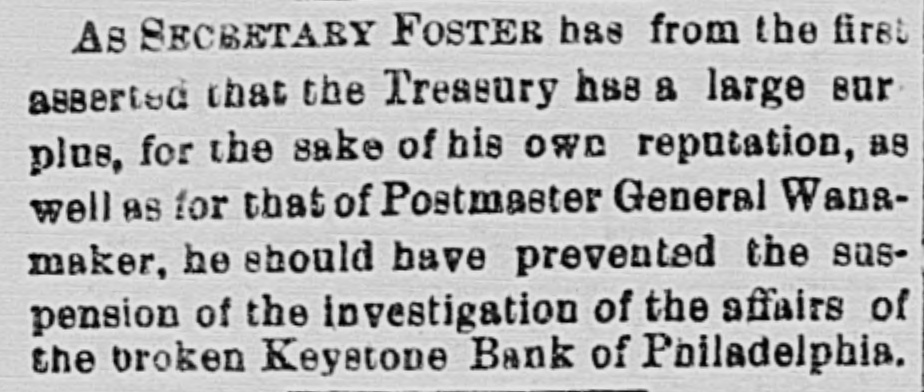
As SECRETARY FOSTER has from the first asserted that the Treasury has a large surplus, for the sake of his own reputation, as well as for that of Postmaster General Wanamaker, he should have prevented the suspension of the investigation of the affairs of the broken Keystone Bank of Philadelphia.


Article from Evening Star, August 3, 1892

Click image to open full size in new tab

Article Text

# THE IRON HALL SUIT. Supreme Justice Somerby Says the Philadelphia Funds Are All Right. Supreme Justice Freeman D. Somerby of the Order of the Iron Hall, who is in Indianapolis, says that he has been spending the last two weeks on an island above Detroit and did not hear of the application for a receiver for the order until Saturday night, when he arranged to go to Indianapolis at once. In regard to the charges made against him personally he said: "I propose to say nothing. The proper tribunal to try that case is the court and not the newspapers. I have not read the complaints and only know in a general way what the charges are; therefore I propose to say nothing. My accounts are all right and I am not afraid to have a thorough investigation of them." "Is it true that there is now $500,000 of Iron Hall money in an Indianapolis bank and $700,-000 which is supposed to be in your bank at Philadelphia that could not be obtained on demand?" Mr. Somerby smiled and reiterated that he did not wish to talk on that subject. "Is it true that the Philadelphia bank was rated at $157,000 January 1 by the United States Bankers' Guide and is not stated at all in the July edition?" Mr. Somerby made no answer to this. "At the time of the Keystone Bank failure in Philadelphia, Mr. Somerby, did you or any one by your authority draw from the banks in this city $500,000 and take it to Philadelphia for the benefit of the bank there?" Mr. Somerby replied: "I must again remark that on this subject the Philadelphia matter is an important factor in this suit, and it would not be proper to talk. I believe that the assets of the bank are more than sufficient to take care of any funds that the Iron Hall may have on deposit there. I am going to examine thoroughly before I talk to any one, and I have no fears for the result." Mr. Somerby positively declined to make any further statements. He attended a meeting of the executive committee yesterday afternoon. # IMPORTANT DEVELOPMENTS AWAITED. Important developments are looked for in the Iron Hall charges against Supreme Justice Somerby tonight. Mr. Somerby is in Indianapolis and this afternoon he will be given an opportunity to explain away the charges to the executive committee of the order. The executive committee consists of the supreme officers in different parts of the country. They are Messrs. Younghusband, Lamb, Hosmer, Baker, Sayer, Somerby, Davis and Walker. This committee meets once a year and was to have met next month, but owing to the charges against Supreme Justice Somerby and the applications for a receivership it was decided to secretly call the committee together today. The exact situation is now a matter of surmise. but in view of the hearing in the receivership matter the result of the meeting of the executive committee today will be waited with great interest by the 70,000 members of the Iron Hall order. The order started in 1881, with thirty charter members. The statement of the order issued last January showed a membership of 65,204. Following is the January statement of finances: Cash in banofit fund 9100T BOO 10


Article from The Hood River Glacier, January 28, 1893

Click image to open full size in new tab

Article Text

BEYOND THE ROCKIES Important Patent Decision Made by the Supreme Court. WAR ON SWEATERS IN BOSTON. The Number of Victims That Judge Lynch Has Executed During the Past Year-Other News. The authorities of North Dakota propose to enforce the prohibition law. The Carnegie milla at Homestead, Pa., are running full in every department. The New York theater ladies have taken to removing their hats during the performance. The boys in the State Reform School at Topeka have just finished putting up 350 tons of ice. Dr. McGlynn says he never ridiculed the Pope, although charged wish the ecclesiastical offense, A combination of manufacturers of goods and cut nails 18 being formed by large Western firms. George G. Slosson has challenged anybody in the world to a match game of billiards for $1,000 it side. The principal operators of silver mines in Colorado have practically agreed to shut down until silver advances. New Orieans is finding much difficulty in enforcing the Sunday law, owing to the apathy of the police officials. The Carnegie Company was a great financial loser by the recent strike, and ) it is economizing in its management. Gidon Marsh, the fugitive P esident of the wrecked Keystone Bank of Phila a delphia, is said to be in South-Africa, In Boston the bosses and the clothing e cutters have joined hands to compel the sweaters to grant the demands of their workmen. I The Comanche, Kiowa and Apache n agreement for the cession of 2,500,000 acres of land has been sent to the Sen ate by the President. It The train bearing the old liberty bell to the World's Fair will run only by day, in order to give people along the j route a chance to see it if The industrial and financial conditions n in South Carolina are reported as gratiof lying because of the improvement in the agricultural interest. d It is reported that unless prompt measures of protection are adopted in the y natural-gas district of Indiana the supply will soon be exhausted. is Chairman Hood of the New York is Board of Assessment estimates that h fully $400,000,000 of personal property 9 in the State escaped taxation. Philadelphia is entitled to be known as the city of sisterly love. According e0 to a recent police census the city boasts of 23,000 more women than men. A New York letter to the Philadelphia d e Press intimates that Baby Ruth 18 to have a rival, and there will likely be birth at the White House this spring. al President Harrison has received a cane cmade from the wood of a house on Porto Santo, one of the Madera Islands, re which Christopher Columbus once lived, kCongressman Dalzell is going to make y another attempt to get through Congress he the bill providing for a survey for ship 05 canal to connect Lake Erie and the Ohio er river, It is estimated that Judge Lynch has executed during the past year 230 people-an increase over 1891 of forty one. His victims were 231 men and five is women. The railroad construction in the to United States during 1891 does not reac et. high figures, being only 4,000 miles The total was the smaliest since 1878 except those of 1884 and 1885. in Major General Schofield does no ed think the massing of troops at th World's Fair for display would prove he good idea or that it would give an nbeneficial return for the expense in m. volved. of The Cotton Bureau of the National 18, Alliance at Memphis, Tenn has issued us. an address to planters, advising th ngplanting of a less acreage to cotton on This season's crop is largely reduced not and the planters have got better price Michigan's war Governor, Austi till Blair, received a certified check fo nal $4,125 as Christmas gift from prom nent residents of that State. The ngGovernor is writing his recollections the war, and the money will be used im getting out the book. St. the In the case of the Dr. Briggs heres the case the New York Presbytery, without 35, expressing approval of the critical D theological views embodied in ns. Briggs' address, or of the manner the which they have been expressed at larillustrated, pronounces Briggs fully who quitted of the offenses alleged again in him. The Mutual Life Benefit Insuran d has Company of Hartford, Conn., has of cided to go out of business, and h lent made arrangements with the Nation aid, Mutual Insurance Company of Ne is it York to take : all its members who app for transfer. sig The Supreme Court has denied inmotion to advance the case of Merri few ex rel. VS. Charles Foster, Secretary t her the Treasury, popularly known as Ca the silver brick case. This is the ntly wherein the plaintiff sought to com rnal the Secretary to coin into dollars silv vitabrick offered at the mint for that p pose.