9077. City National Bank (Kansas City, MO)

Bank Information

Episode Type
Suspension โ†’ Closure
Bank Type
national
Bank ID
5250
Charter Number
5250
Start Date
July 20, 1905
Location
Kansas City, Missouri (39.100, -94.579)

Metadata

Model
gpt-5-mini
Short Digest
ecddfa54bd29d728

Response Measures

None

Receivership Details

Depositor recovery rate
100.0%
Date receivership started
1905-07-20
Date receivership terminated
1906-06-30
OCC cause of failure
Losses
Share of assets assessed as good
57.7%
Share of assets assessed as doubtful
37.5%
Share of assets assessed as worthless
4.9%

Description

The City National Bank of Kansas City was closed by National Bank Examiner E. E. Ames under instructions from the Comptroller of the Currency on July 20, 1905 due to large holdings of bad Devlin paper and other unsound assets. Articles report gradual withdrawals but explicitly state there was no large public run; a receiver was later appointed (August 1905).

Events (4)

1. February 2, 1900 Chartered
Source
historical_nic
2. July 20, 1905 Receivership
Source
historical_nic
3. July 20, 1905 Suspension
Cause
Bank Specific Adverse Info
Cause Details
Heavy holdings of C. J. Devlin's tied-up paper (about $100,000) and other bad paper left the bank insolvent; comptroller demanded taking up $200,000 of bad paper or it would not be permitted to open.
Newspaper Excerpt
The City National bank failed to open its doors today ... The bank was closed by E. E. Ames, bank examiner, under instructions from the comptroller of the currency.
Source
newspapers
4. August 10, 1905 Receivership
Newspaper Excerpt
W. C. Pierce to be receiver ... will take charge of the City National Bank. The first report of the receiver ... shows classification of assets ... (receiver's report received Aug. 9).
Source
newspapers

Newspaper Articles (22)

Article from Evening Star, July 20, 1905

Click image to open full size in new tab

Article Text

Bank Examiner Takes Charge. The bank was closed by E. E. Ames, bank examiner, under instructions from the controler of the currency. The controler had yesterday, it is stated, informed the officers of the bank that it must take up $200,000 bad paper immediately or they would not be permitted to open today. The bank was examined last night by a committee of local bankers, who reported at a meeting early today that the affairs of the institution were in such shape that they would not feel justified in extending assistance. Although the City National Bank was not a member of the local clearing house association, that association, it was stated by one of its officers today, would have extended aid had they not found so much bad paper. Although the holding of Devlin paper upon which no immediate realization could be made was the prime cause of the failure, it is stated that the general knowledge that the bank held other bad paper and was in a weakened condition had led to a gradual withdrawal of deposits. At no time had a run of any big proportions been on, but it is stated withdrawals had been made quietly for several months, and that within sixty days $600,000 had been taken. From another source it was asserted that when the City National Bank was ordered to repair its capital several months ago the needed funds were burrowed, not from a local capitalist, but from certain New York banks, but what institutions it was not disclosed. Examiner Ames said today that it would be impossible for him to talk at this time either regarding this statement or other affairs of the bank. The bank officials likewise declined to issue a statement now. The majority of the bank's depositors are persons in medium circumstances, twothirds of whom live outside Kansas City. There was no excitement at the doors of the bank when the closing notice was posted today, less than a dozen depositors appearing to withdraw their money. Had Varied Experience. The posting of this second notice developed the fact that other Kansas City banks, knowing that the City National was to fail, wired certain of the latter's outside customers, principally small near-by banks, that they would pay certain drafts drawn on the City National. Later in the day other notices, from other Kansas City banks, designating different outside Institutions which they offered to protect on drafts drawn through the City National were posted. The City National Bank has had a varied experience. In its five years' existence it has had four sets of officers, and upon numerous occasions the controller of the currency has called upon its officers to repair its capital or to conform in other ways with the banking laws. It was organized in 1900, with a capital of $250,000. Last winter the capital was reduced to $200,000. Later the capital was increased $100,000, to $300,000, charging off all its surplus and $50,000 of Its original capital. It now develops that this did not take out all the bad paper. Aside from the notice placed on the bank door by Examiner Ames, which simply stated that the bank was in charge of the controller of the currency, the following unsigned notice was pasted up later: "Present all drafts drawn by the following banks on the City National Bank of Kansas City, Mo., to the National Bank of Commerce, Kansas City, Mo., for payment: "Bank of Greeley, Greeley, Kan. "Citizens' State Bank, Belle Plaine, Kan. "Citizens' State Bank, Osage City, Kan. "Citizens' State Bank, Edna, Kan. "Citizens' State Bank, Paola, Kan."
Article from Albuquerque Evening Citizen, July 20, 1905

Click image to open full size in new tab

Article Text

DEVLIN WRECKED KANSAS CITY BANK But Besides His Notes Bank Held Other Bad Paper. LARGE DEPOSITS ARE WITHDRAWN Kansas City, July 20.-The City National bank failed to open its doors today. The bank held checks of C. J. Devlin of Topeka for upwards of $100,000, and its failure is the direct result of that of the First National bank of Topeka, of which Devlin was the principal stockholder. The City National bank had a capital of $300,000 and deposits of nearly a million and a half. The bank was closed by E. E. Ames, bank examiner, under instructions from the comptroller of the currency. The comptroller yesterday, it is asserted, informed the officers of the bank that it must take up $200,000 of bad paper immediately or it would not be permitted to open today. The bank was examined last night by a committee of local bankers who reported at the meeting early today that the affairs of the bank were in such shape that they would not feel justified in extending assistance. Although the holding of Devlin paper, upon which no immediate realization could be made, was the prime cause of the failure, it was stated that a general knowledge that the bank held other bad paper and was in bad condition, had led to a gradual withdrawal of deposits during several months. These withdrawals in the last sixty days amount to $600,000.


Article from The Fargo Forum and Daily Republican, July 20, 1905

Click image to open full size in new tab

Article Text

KANSAS CITY BANK FAILED CITY NATIONAL DID NOT OPEN ITS DOORS It Held Some of the Devlin Paper and Was Forced to Close -It Carried a Large Line of Deposits. Kansas City, July 20.-The - City National Bank failed to open this morning. The bank held paper of C. J. Devlin of Topeka to the amount of $100,000, and the failure is the result of the closing of the First National of Topeka, of which Devlin was the principal stockholder. The deposits in the failed bank amounted to $1,476,648. One other Kansas City bank holds $200,000 of Devlin paper, but the other bankers say they will not allow it to fail. There is no run on the other banks.


Article from Bismarck Daily Tribune, July 20, 1905

Click image to open full size in new tab

Article Text

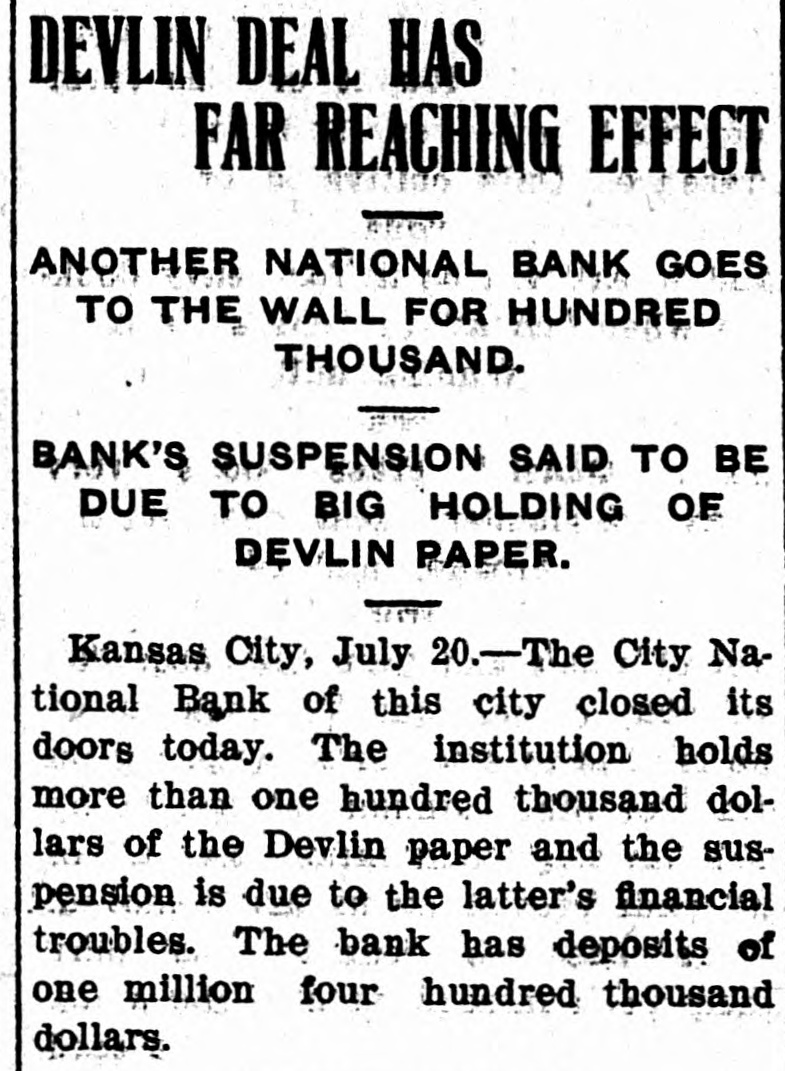
DEVLIN DEAL HAS FAR REACHING EFFECT ANOTHER NATIONAL BANK GOES TO THE WALL FOR HUNDRED THOUSAND. BANK'S SUSPENSION SAID TO BE DUE TO BIG HOLDING OF DEVLIN PAPER. Kansas City, July 20.-The City National Bank of this city closed its doors today. The institution holds more than one hundred thousand dollars of the Devlin paper and the suspension is due to the latter's financial troubles. The bank has deposits of one million four hundred thousand dollars.


Article from Evening Times-Republican, July 20, 1905

Click image to open full size in new tab

Article Text

Another Bank Goes Down Under the Weight of Devlin's Securities IS STATEMENT NO MADE Devlin Was Credited to Extent of $100,000 and the Bank is Said to Have Carried Other Bad Paper Many Depositors Outside of Kansas City-General News. Kansas City, July 20.-The City National bank failed to open its doors today. The bank held paper of C. J. Devlin, of Topeka, to the amount of upwards of $100,000, and the failure is the direct result of the closing of the First National Bank of Topeka, of which Devlin was the principal stockholder. Some time ago the comptroller of the currency at Washington instructed the officers of the City National bank to repair its capital. This was done by borrowing from a local capitalist. Following the failure of the First National a Kansas City capitalist became insistent upon the repayment of his loan and this demand caused the officers of the City National to decide upon closing their institution. From another source it was asserted that when the City National was ordered to repair its capital several months ago the needed funds were borrowed, not from a capitalist, but from certain New York banks, but what institutions it was not disclosed. Examiner Ames said today it would be impossible for him to talk at this time, either regarding this statement or other affairs of the bank. The bank's officials likewise have declined to issue a statement now. The only other bank in Kansas City which was caught in the failure of the First National Bank of Topeka was the American National Bank of Kansas City, which is said to hold upwards of $2,000 of Devlin paper. It was stated positively today by a leading banker that other Kansas City institutions would not permit this bank to fail. There was no appearance. of a run on the other banks at the opening hour. today. The City National Bank was organized in 1900. Its capital was $300,000, and it has deposits of $1,476,648. Edward Crebo is president; James G. Strean, cashier. Although the holding of Deviin paper, upon which no immediate reallzation could be made, was the prime cause of the failure, it is stated the general knowledge that the bank had other bad paper and was in a weakened condition, had led to gradual withdrawal of deposits. The majority of the bank's depositors are persons in medium circumstances, two-thirds of whom live outside of Kansas City. There was no excitement at the bank and less than a dozen depositors appeared to withdraw their money. The bank was closed under instructions from the comptroller of the currency. The comptroller had yesterday, it is stated, informed the officers of the bank that it must take up $200,000 of bad paper immediately or they would not be permitted to open today. The bank was examined last night by a committee of local bankers who reported, at a meeting early today, the affairs of the institution were in such shape they would not feel justified in extending assistance.


Article from Arizona Republican, July 21, 1905

Click image to open full size in new tab

Article Text

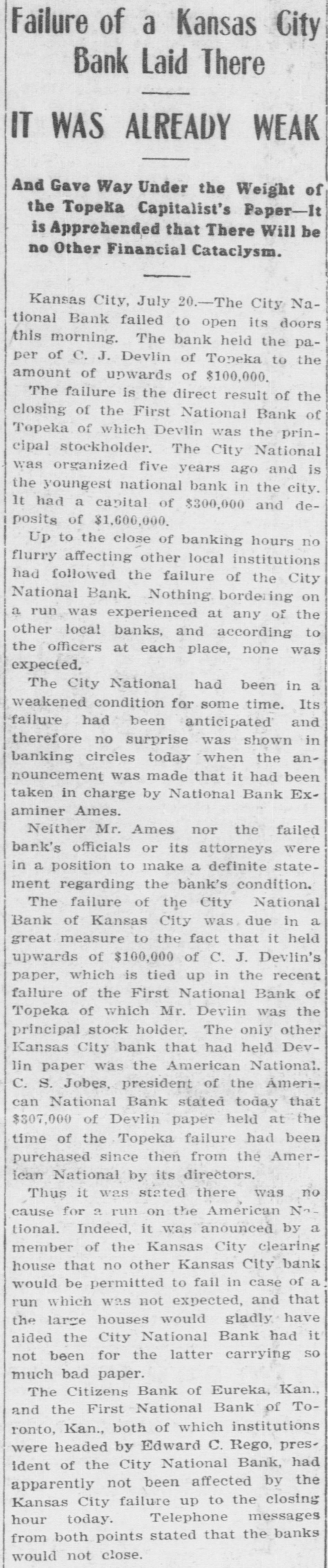
Failure of a Kansas City s Bank Laid There IT WAS ALREADY WEAK And Gave Way Under the Weight of the Topeka Capitalist's Paper-It is Apprehended that There Will be no Other Financial Cataclysm. Kansas City, July 20.-The City National Bank failed to open its doors this morning. The bank held the paper of C. J. Devlin of Topeka to the amount of upwards of $100,000. The failure is the direct result of the closing of the First National Bank of Topeka of which Devlin was the principal stockholder. The City National was organized five years ago and is the youngest national bank in the city. It had a capital of $300,000 and deposits of $1,600,000. Up to the close of banking hours no flurry affecting other local institutions had followed the failure of the City National Bank. Nothing bordering on a run was experienced at any of the other local banks, and according to the officers at each place, none was expected. The City National had been in a weakened condition for some time. Its failure had been anticipated and therefore no surprise was shown in banking circles today when the announcement was made that it had been taken in charge by National Bank Examiner Ames. Neither Mr. Ames nor the failed bank's officials or its attorneys were in a position to make a definite statement regarding the bank's condition. The failure of the City National Bank of Kansas City was due in a great measure to the fact that it held upwards of $100,000 of C. J. Devlin's paper, which is tied up in the recent failure of the First National Bank of Topeka of which Mr. Devlin was the principal stock holder. The only other Kansas City bank that had held Devlin paper was the American National. C. S. Jobes, president of the American National Bank stated today that $307,000 of Devlin paper held at the time of the Topeka failure had been purchased since then from the American National by its directors. Thus it was stated there was no cause for 2 run on the American Notional. Indeed, it was anounced by a member of the Kansas City clearing house that no other Kansas City bank would be permitted to fail in case of a run which was not expected, and that the large houses would gladly have aided the City National Bank had it not been for the latter carrying so much bad paper. The Citizens Bank of Eureka, Kan.. and the First National Bank of Toronto, Kan., both of which institutions were headed by Edward C. Rego, president of the City National Bank, had apparently not been affected by the Kansas City failure up to the closing hour today. Telephone messages from both points stated that the banks would not close.


Article from The Birmingham Age-Herald, July 21, 1905

Click image to open full size in new tab

Article Text

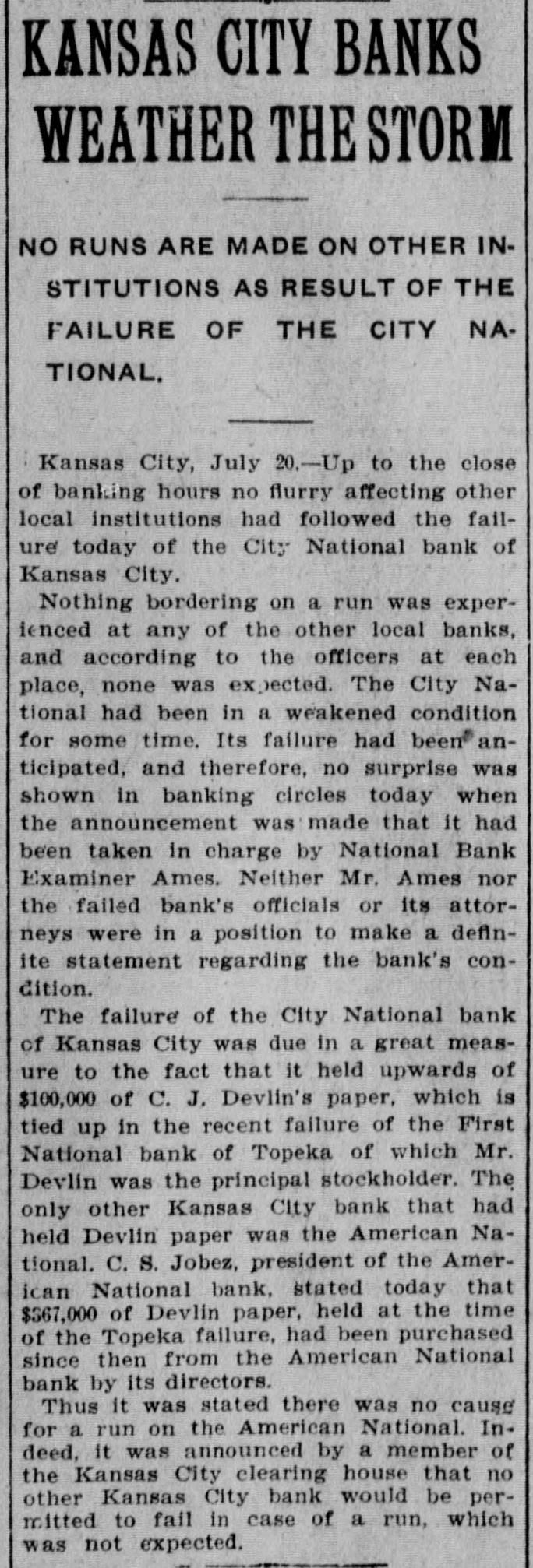
KANSAS CITY BANKS WEATHER THE STORM NO RUNS ARE MADE ON OTHER INSTITUTIONS AS RESULT OF THE FAILURE OF THE CITY NATIONAL. Kansas City, July 20.-Up to the close of banking hours no flurry affecting other local institutions had followed the failure today of the City National bank of Kansas City. Nothing bordering on a run was experienced at any of the other local banks, and according to the officers at each place, none was ex pected. The City National had been in a weakened condition for some time. Its failure had been anticipated, and therefore, no surprise was shown in banking circles today when the announcement was made that it had been taken in charge by National Bank Examiner Ames. Neither Mr. Ames nor the failed bank's officials or its attorneys were in a position to make a definite statement regarding the bank's condition. The failure of the City National bank of Kansas City was due in a great measure to the fact that it held upwards of $100,000 of C. J. Devlin's paper, which is tied up in the recent failure of the First National bank of Topeka of which Mr. Devlin was the principal stockholder. The only other Kansas City bank that had held Devlin paper was the American National. C. S. Jobez, president of the American National bank, stated today that $367,000 of Devlin paper, held at the time of the Topeka failure, had been purchased since then from the American National bank by its directors. Thus it was stated there was no cause for a run on the American National. Indeed, it was announced by a member of the Kansas City clearing house that no other Kansas City bank would be permitted to fail in case of a run, which was not expected.


Article from The Morning Astorian, July 21, 1905

Click image to open full size in new tab

Article Text

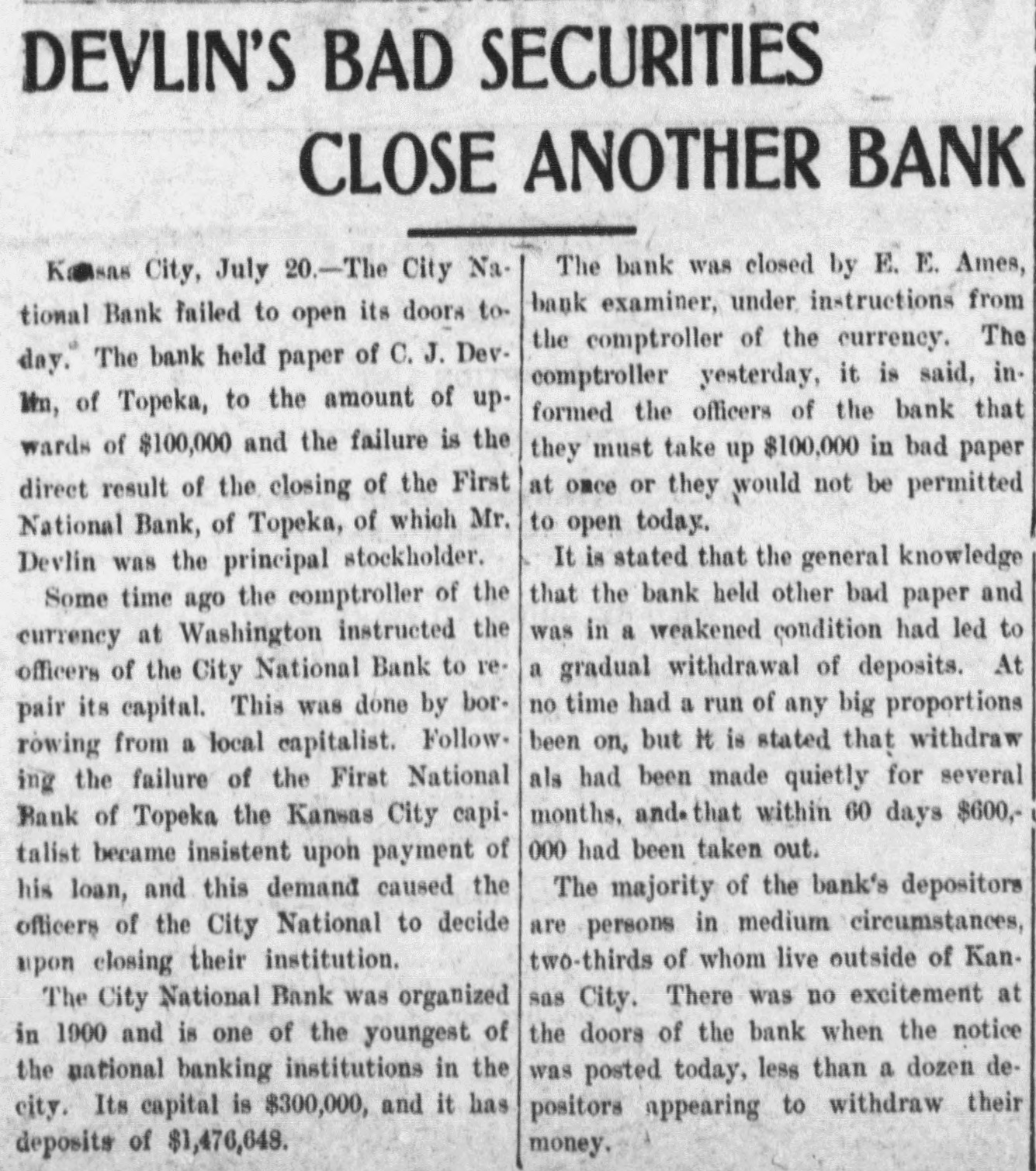
DEVLIN'S BAD SECURITIES CLOSE ANOTHER BANK The bank was closed by E. E. Ames, Kasas City, July 20.-The City Nabank examiner, under instructions from tional Bank failed to open its doors tothe comptroller of the currency. The day. The bank held paper of C. J. Devcomptroller yesterday, it is said, inMn, of Topeka, to the amount of upformed the officers of the bank that wards of $100,000 and the failure is the they must take up $100,000 in bad paper at once or they would not be permitted direct result of the closing of the First to open today. National Bank, of Topeka, of which Mr. It is stated that the general knowledge Devlin was the principal stockholder. that the bank held other bad paper and Some time ago the comptroller of the was in a weakened condition had led to currency at Washington instructed the a gradual withdrawal of deposits. At officers of the City National Bank to reno time had a run of any big proportions pair its capital. This was done by borbeen on, but it is stated that withdraw rowing from a local capitalist. Followals had been made quietly for several ing the failure of the First National months, and. that within 60 days $600,Bank of Topeka the Kansas City capi000 had been taken out. talist became insistent upon payment of The majority of the bank's depositors his loan, and this demand caused the are persons in medium circumstances, officers of the City National to decide two-thirds of whom live outside of Kanupon closing their institution. The City National Bank was organized sas City. There was no excitement at the doors of the bank when the notice in 1900 and is one of the youngest of the national banking institutions in the was posted today, less than a dozen decity. Its capital is $300,000, and it has positors appearing to withdraw their money. deposits of $1,476,648.


Article from Los Angeles Herald, July 21, 1905

Click image to open full size in new tab

Article Text

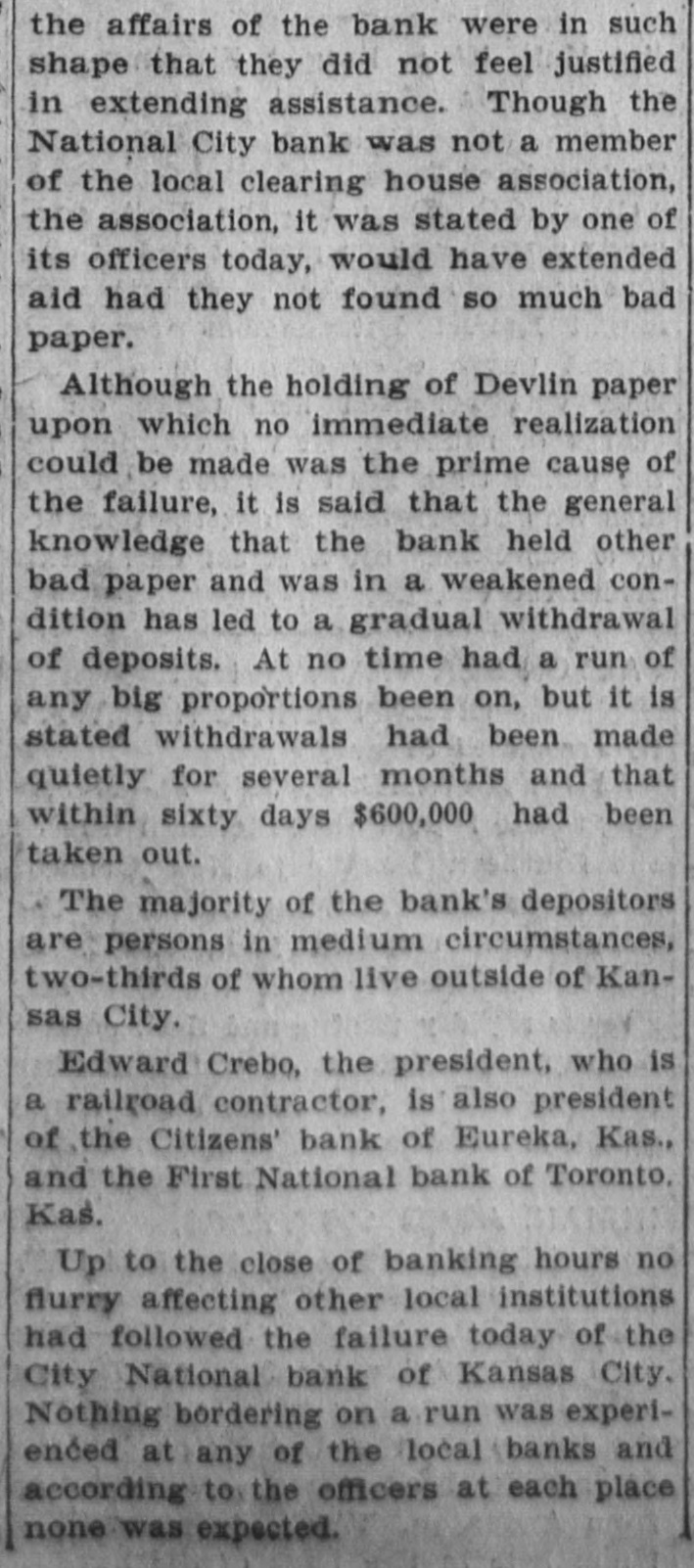
the affairs of the bank were in such shape that they did not feel justified in extending assistance. Though the National City bank was not a member of the local clearing house association, the association, it was stated by one of its officers today, would have extended aid had they not found so much bad paper. Although the holding of Devlin paper upon which no immediate realization could be made was the prime cause of the failure, it is said that the general knowledge that the bank held other bad paper and was in a weakened condition has led to a gradual withdrawal of deposits. At no time had a run of any big proportions been on, but it is stated withdrawals had been made quietly for several months and that within sixty days $600,000 had been taken out. The majority of the bank's depositors are persons in medium circumstances, two-thirds of whom live outside of Kansas City. Edward Crebo, the president, who is a railroad contractor, is also president of the Citizens' bank of Eureka, Kas., and the First National bank of Toronto, Kas. Up to the close of banking hours no flurry affecting other local institutions had followed the failure today of the City National bank of Kansas City. Nothing bordering on a run was experienced at any of the local banks and according to the officers at each place none was expected.


Article from Americus Times-Recorder, July 21, 1905

Click image to open full size in new tab

Article Text

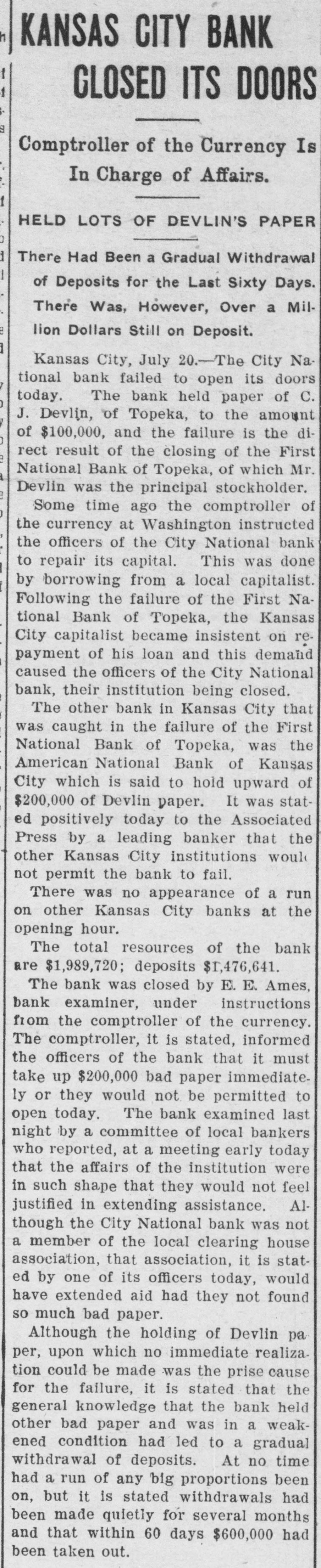
KANSAS CITY BANK f 1 GLOSED ITS DOORS : S Comptroller of the Currency Is : In Charge of Affairs. . I . HELD LOTS OF DEVLIN'S PAPER 0 d There Had Been a Gradual Withdrawal I of Deposits for the Last Sixty Days. There Was, However, Over a Mil. e lion Dollars Still on Deposit. I Kansas City, July 20.-The City National bank failed to open its doors 7 today. The bank held paper of C. J. Devlin, of Topeka, to the amount of $100,000, and the failure is the di) rect result of the closing of the First e National Bank of Topeka, of which Mr. I Devlin was the principal stockholder. e Some time ago the comptroller of ) the currency at Washington instructed : the officers of the City National bank to repair its capital. This was done by borrowing from a local capitalist. Following the failure of the First National Bank of Topeka, the Kansas City capitalist became insistent on repayment of his loan and this demand caused the officers of the City National bank, their institution being closed. The other bank in Kansas City that was caught in the failure of the First National Bank of Topeka, was the American National Bank of Kansas City which is said to hold upward of $200,000 of Devlin paper. It was stated positively today to the Associated Press by a leading banker that the other Kansas City institutions would not permit the bank to fail. There was no appearance of a run on other Kansas City banks at the opening hour. The total resources of the bank are $1,989,720; deposits $1,476,641. The bank was closed by E.E.Ames, bank examiner, under instructions from the comptroller of the currency. The comptroller, it is stated, informed the officers of the bank that it must take up $200,000 bad paper immediate. ly or they would not be permitted to open today. The bank examined last night by a committee of local bankers who reported, at a meeting early today that the affairs of the institution were in such shape that they would not feel justified in extending assistance, Although the City National bank was not a member of the local clearing house association, that association, it is stated by one of its officers today, would have extended aid had they not found so much bad paper. Although the holding of Devlin pa per, upon which no immediate realization could be made was the prise cause for the failure, it is stated that the general knowledge that the bank held other bad paper and was in a weakened condition had led to a gradual withdrawal of deposits. At no time had a run of any big proportions been on, but it is stated withdrawals had been made quietly for several months and that within 60 days $600,000 had been taken out.


Article from Omaha Daily Bee, July 21, 1905

Click image to open full size in new tab

Article Text

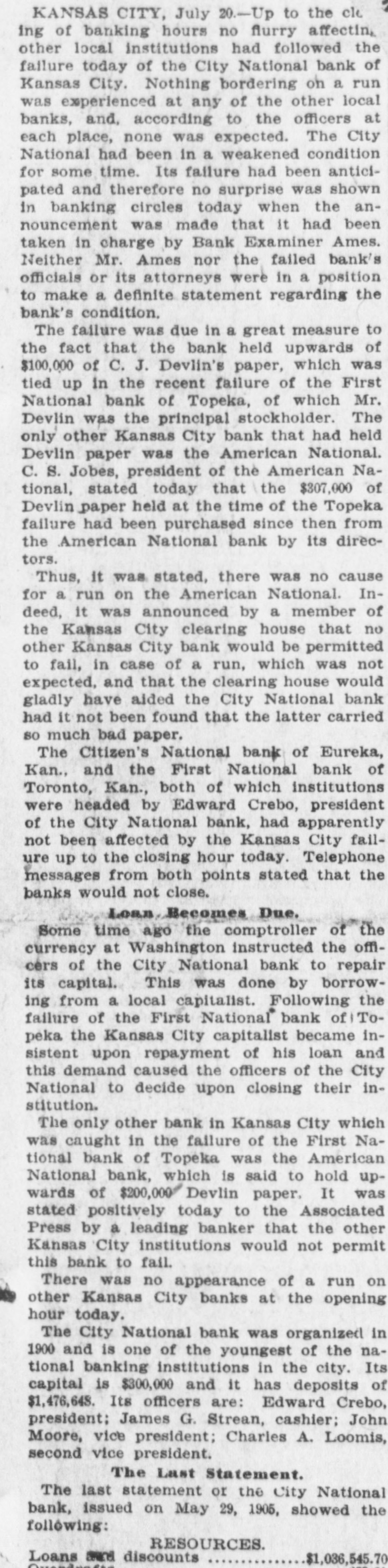
KANSAS CITY, July 20.-Up to the cle ing of banking hours no flurry affecting other local institutions had followed the failure today of the City National bank of Kansas City. Nothing bordering on a run was experienced at any of the other local banks, and, according to the officers at each place, none was expected. The City National had been in a weakened condition for some time. Its failure had been anticipated and therefore no surprise was shown in banking circles today when the announcement was made that it had been taken in charge by Bank Examiner Ames. Neither Mr. Ames nor the failed bank's officials or its attorneys were in a position to make a definite statement regarding the bank's condition. The failure was due in a great measure to the fact that the bank held upwards of $100,000 of C. J. Devlin's paper, which was tied up in the recent failure of the First National bank of Topeka, of which Mr. Devlin was the principal stockholder. The only other Kansas City bank that had held Devlin paper was the American National. C. S. Jobes, president of the American National, stated today that the $307,000 of Devlin paper held at the time of the Topeka failure had been purchased since then from the American National bank by its directors. Thus, it was stated, there was no cause for a run on the American National. Indeed, it was announced by a member of the Kansas City clearing house that no other Kansas City bank would be permitted to fail, in case of a run, which was not expected, and that the clearing house would gladly have aided the City National bank had it not been found that the latter carried so much bad paper. The Citizen's National bank of Eureka, Kan., and the First National bank of Toronto, Kan., both of which institutions were headed by Edward Crebo, president of the City National bank, had apparently not been affected by the Kansas City failure up to the closing hour today. Telephone messages from both points stated that the banks would not close. Loan Becomes Due. Some time ago the comptroller of the currency at Washington instructed the officers of the City National bank to repair its capital. This was done by borrowing from a local capitalist. Following the failure of the First National bank of Topeka the Kansas City capitalist became insistent upon repayment of his loan and this demand caused the officers of the City National to decide upon closing their institution. The only other bank in Kansas City which was caught in the failure of the First National bank of Topeka was the American National bank, which is said to hold upwards of $200,000 Devlin paper, It was stated positively today to the Associated Press by a leading banker that the other Kansas City institutions would not permit this bank to fail. There was no appearance of a run on other Kansas City banks at the opening hour today. The City National bank was organized in 1900 and is one of the youngest of the national banking institutions in the city. Its capital is $300,000 and it has deposits of $1,476,648. Its officers are: Edward Crebo, president: James G. Strean, cashier: John Moore, vice president; Charles A. Loomis, second vice president. The Last Statement. The last statement or the City National bank, issued on May 29, 1905, showed the following: RESOURCES. Loans and discounts $1,036,545.70


Article from The Salt Lake Herald, July 21, 1905

Click image to open full size in new tab

Article Text

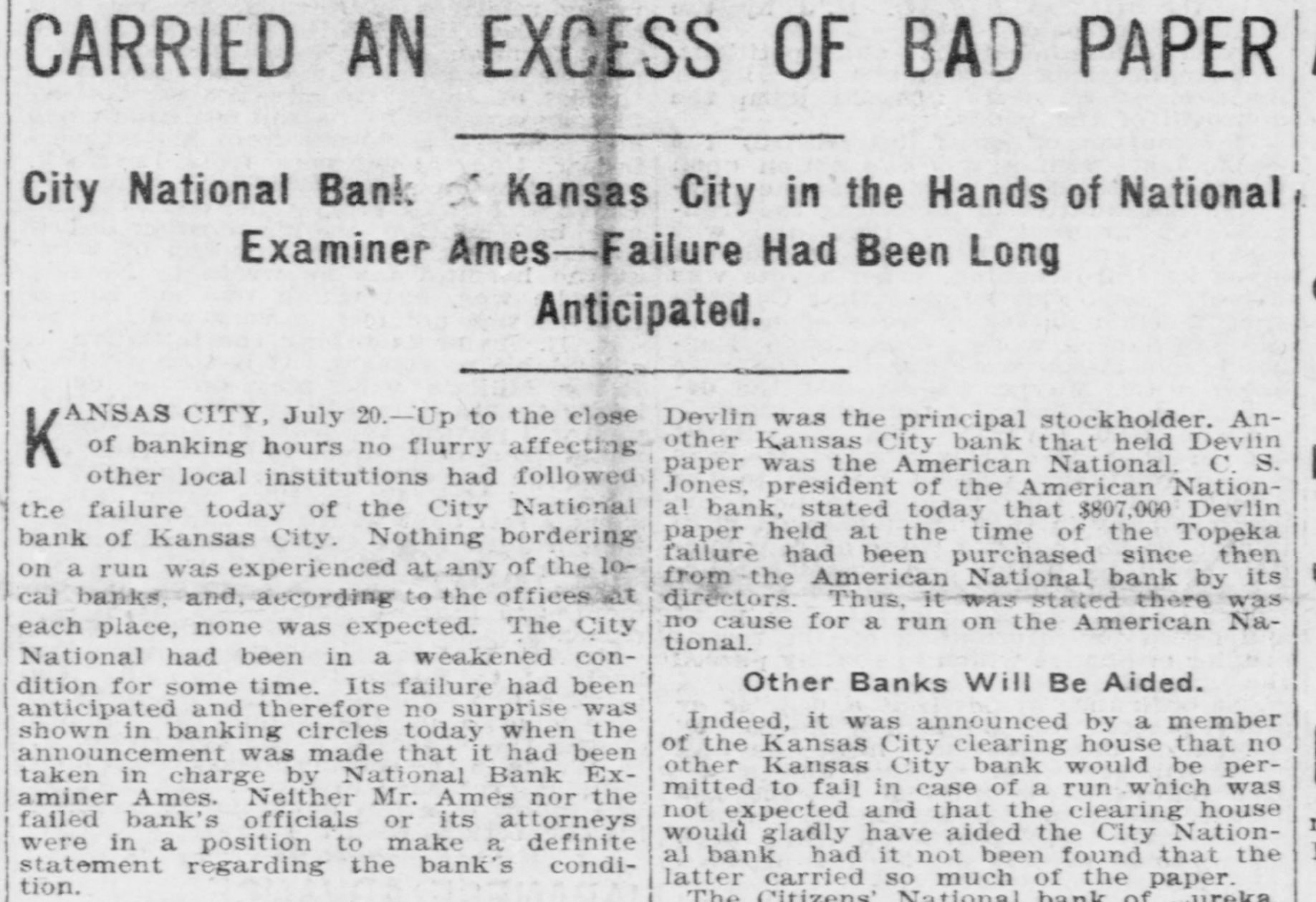
CARRIED AN EXCESS OF BAD PAPER City National Bank Kansas City in the Hands of National Examiner Ames-Failure Had Been Long Anticipated. ANSAS CITY, July 20.-Up to the close Devlin was the principal stockholder. Another Kansas City bank that held Devlin of banking hours no flurry affecting K paper was the American National. C. S. other local institutions had followed Jones, president of the American Nationa! bank, stated today that $807,000 Devlin the failure today of the City National paper held at the time of the Topeka bank of Kansas City. Nothing bordering failure had been purchased since then on a run was experienced at any of the lofrom the American National bank by its cal banks, and, according to the offices at directors. Thus, it was stated there was no cause for a run on the American Naeach place, none was expected. The City tional. National had been in a weakened conOther Banks Will Be Aided. dition for some time. Its failure had been anticipated and therefore no surprise was Indeed, it was announced by a member shown in banking circles today when the of the Kansas City clearing house that no announcement was made that it had been other Kansas City bank would be pertaken in charge by National Bank Exmitted to fail in case of a run which was aminer Ames. Neither Mr. Ames nor the not expected and that the clearing house failed bank's officials or its attorneys would gladly have aided the City Nationwere in a position to make a definite al bank had it not been found that the statement regarding the bank's condilatter carried so much of the paper. tion. The Citizens' National hank of ureka


Article from The Pensacola Journal, July 21, 1905

Click image to open full size in new tab

Article Text

BANK IN BAD SHAPE Committee of Bankers Refused to Extend Assistance. HAD $200,000 WORTH OF BAD PA PER OUTSTANDING WHICH IT WAS UNABLE TO TAKE UP-IMMENSE WITHDRAWALS OF DEPOSITS RECENTLY. By Associated Press. Kansas City,, Mo., July 20.-The City National Bank failed to open its doors to-day. The bank held the paper of C. J. Devlin, of Topeka, for upwards of $100,000 and the failure is a direct result of the closing of the First National Bank of Topeka of which Devlin was the principal stockholder. The City National Bank was organized in 1900. and is one of the youngest of the national banking institutions in the city. Its capital is $30,000 and it has deposits of $1,430,648. Its officers are: Edward Crebo, president; James G. Stean, cashier; John Moore, vice president; Charles A. Loomis, second vice president, The last statement of the City National Bank, issued on May 29, 1905, shows the following: Resources. Loans and discounts, $1,036,546. Overdrafts, $640. United States bonds and premiums, $266,937. Cash and sight exchange, $685,597. Total, $1,989,720. Liabilities. Capital stock, $300,000. Undivided profits, $3,071. Circulation, $210,000. Deposits, $1,476,041. Total, $1,989,720. The bank was closed by E. E. Ames, bank examiner. under instruction from the comptroller of currency. The comptroller it is stated, informed the officers of the bank that it must take up $200,000 bad paper immediately or they would not be permitted to open to-day. The bank was visited last night by a committee of local bankers who examined the books and reported ata meeting early to-day that the affairs of the institution were in such shape that they would not feel justified in extending assistance. Although the City National Bank was not a member of the local clearing house association. that assicioation, it was stated by one of the officers today, would have extended aid had they not found so much bad paper. Although the holding of Devlin paper upon which no immediate realization could be made, was the prime cause of the failure, it is stated that the general knowledge that the bank held other bad paper and was in a weakened condition led to a gradual withdrawa] of deposits. At no time had a run of any big proportions been on, but it is stated, withdrawals had ben made quietly for several months and that within sixty days $600,000 had been taken out. The majority of the bank's depositors are in medium circumstances, two-thirds of whom live outside of Kansas City. There was no excitement at the doors of the bank when the closing notice was posted to-day, less than a dozen depositors appearing to withdraw their money.


Article from Gainesville Daily Sun, July 22, 1905

Click image to open full size in new tab

Article Text

KANSAS CITY BANK CLOSED ITS DOORS Comptroller of the Currency Is In Charge of Affairs. HELD LOTS OF DEVLIN'S PAPER There Had Been a Gradual Withdrawal of Deposits for the Last Sixty Days. There Was, However, Over a Million Dollars Still on Deposit. Kansas City, July 21.-The City National bank failed to open its doors today. The bank held paper of C. J. Devlin, of Topeka, to the amount of $100,000, and the failure is the direct result of the closing of the First National Bank of Topeka, of which Mr. Devlin was the principal stockholder. Some time ago the comptroller of the currency at Washington instructed the officers of the City National bank to repair its capital. This was done by borrowing from a local capitalist. Following the failure of the First National Bank of Topeka, the Kansas City capitalist became insistent on repayment of his loan and this demand caused the officers of the City National bank. their institution being closed. The other bank in Kansas City that was caught in the failure of the First National Bank of Topeka, was the American National Bank of Kansas City which is said to hold upward of $200,000 of Devlin paper. It was stated positively today to the Associated Press by a leading banker that the other Kansas City institutions wou. not permit the bank to fail. There was no appearance of a run on other Kansas City banks at the opening hour. The total resources of the bank are $1,989,720; deposits $1,476,641. The bank was closed by E. E. Ames, bank examiner, under instructions from the comptroller of the currency. The comptroller, it is stated, informed the officers of the bank that it must take up $200.000 bad paper immediate. ly or they would not be permitted to open today. The bank examined last night by a committee of local bankers who reported. at a meeting early today that the affairs of the institution were in such shape that they would not feel justified in extending assistance. A!though the City National bank was not a member of the local clearing house association. that association. It is stated by one of its officers today. would have extended aid had they not found so much bad paper. Although the holding of Devlin paper. upon which no immediate realiza. tion could be made was the prise cause for the failure. It is stated that the general knowledge that the bank held other bad paper and was in a weakened condition had led to a gradual withdrawal of deposits. At no time had a run of any big proportions been on. but it is stated withdrawals had been made quietly for several months and that within 60 days $600,000 had been taken out.


Article from Gainesville Daily Sun, July 23, 1905

Click image to open full size in new tab

Article Text

Bank Officials Keep Quiet. Kansas City, July 22.-A statement of the affairs of the City National Bank of Kansas City, which closed its doors yesterday was still unobtainable today. either from Receiver Ames, the bank officials or their attorneys. The condition at the other banks, apparently. were normal and there was no appearance of a run on any of them. Only a fe wpersons stood about the doors of the failed bank.


Article from The Monticellonian, July 27, 1905

Click image to open full size in new tab

Article Text

tion for connecwith alleged land frauds and were set for immediate agree was Daniel discharged. re-trial The failed case to Kelly, accused of wife murder was found guilty by a jury at Gann Valley, S. D. and life imprisonment recommended One hundred and fifteen thousand acres of land in the Tucson (Ariz.) land district have been withdrawn from entry for forest reserve purposes. Meat in Germany has risen to almost prohibitive prices. Consumers are now to pay for fillet of per pound; boiling beef 27 cents required beef. cents; pork, 31 1/2 cents: veal. 31 1/2 press, at least the is engaged in task official The French portion cents the semiof impressing upon Japan the futility of imposing extreme conditions upon Russia tions in the coming peace negotiaThe recent hot wave left a record in its wake of 826 reported prostrations and 294 deaths throughout the teamsters' thing The of Chicago strike country is the past, the strikers having a made conditions a complete surrender without any China's official notification to the powers that she will not regarding cerning arrangement Manchuria recognize con- any which she has not been consulted beforehand, has reached Washington and been forwarded to the president The police of New York have withdrawn all charges against Dr. Edward Park, who was arrested in Norway, York. on a charge of stealing jewelry in New A young Russian calling himself has arrived New with $25,000 in his the York Prince Potemkine possession, in proceeds of the sale of in dividing his tenants, Russia after $10,000 his among estates and says he has left Russia for all time He will buy a farm in the west Two German scientists announce the discovery of a new which call Allypine,'' and they claim has anasthetic. which they all the virtues of cocaine without the latter's secondary ill effects A cloudburst in Jasper county, Missouri, sent a wall of water 18 feet high the Spring river, everything down carrying before it. At least one life was lost and property to the extent of $150.000 destroyed On account of the necessity for haste Washington, the in reaching Duluth proposed trip down the lakes. from to Buffalo, by Baron Komura and his party, was abandoned The City national bank of Kansas City, Mo., has been closed by order of of the was precipitated by too the failure comptroller currency carrying The much Devlin Komura the anese Baron paper principal Jappeace plenipotentlary and suite arrived at Seattle, Wash. on board the steamship Minnesota The entire Fourth infantry one of the Twelfth 28 and 92 of the at San Companies tillery squadron arrived Francisco cavalry coast and ar- on board the transport Sherman. from Manila. An attempt was made on the life of Petrovitch Poliedonostseff chief procurator of the as Constantine holy synod, he was alighting from a train in St. Petersburg. The would-be assassin was arrested The state department has been inof the institution of a goods at against formed American Shanghai, boycott Canton, Tien Tsin, Hankow and New Paul Morton of the Assurance Chwang, Chairman China summarily EquitaComptroller T.D. be cause refusal of the ble removed Life of the society latter Jordon to furnish certain information called A. Day assistant was general William of the United States, attorney given for the position The British house of commons passed the aliens bill, placing certain restrictions on immigration by a majority of 90 John Q. Cannon, who was secretary of Louisiana fair has at the commission, Lethbridge, the Utah Alberta, been Canada, Purchase arrested on charge of forgery and uttering fraudulent papers An attempt was made to assassinate Vice-Governor Deutrich at Helsingfors, Finland, by a bomb thrower. who escaped. The bomb fell short and the governor escaped with some cuts and bruises Windows were shattered for hundreds of yards around Samuel Brooks. a smart aleck who rocked a boat at Audubon Beach N.Y until he capsized it and tumbled three young women into the water narrowly escaped lynching at the hands of hundreds of people who had witnessed his criminal foolishness Mrs. John A. Logan has tendered to the state of Illinois the valuable historical collection which is closely connected with the life of Gen. John A Logan. now in Memorial hall at the Logan residence in Washington The zemstvo congress in Moscow is exciting keen interest in St. Petersburg, but the newspapers have received strict orders not to mention it. Receiver Bradley of the First national (Devlin's) bank at Topeka. Kas has informed the depositors' committee that a dividend will not be declared sooner than three months Ernest M. Pollard, republican. was elected to congress in the First Nebraska district, to succeed E. J. Burkett. who resigned to become United States senator


Article from Highland Recorder, July 28, 1905

Click image to open full size in new tab

Article Text

NEWS IN SHORT ORDER. The Latest Happenings Condensed for Rapid Reading. Domestic Veterans, Sons of Veterans, members of Woman's Relief Corps and other patriotic societies attended the funeral in Boston of General Blackmar, commander-in-chief of the Grand Army of the Republic. Three laborers drank a can of beer and laid down on the Burlington tracks, at Omaha. One was killed, another fatally injured, and the third was injured and not awakened by his shaking up. A collection of $25,000 was taken up at the closing session of the Missionary and Christian Alliance of the Eastern District of the United States at Lancaster, Pa. A New York woman who is the mother of six children has passed the examination for admission to the New York bar. She was at the head of 1,000 candidates. Anthracite coal operators are reported to be storing immense quantities of coal with a view to resisting the demands of the miners when again made. Delamore Place, the historic home of the Bayard family, in Wilmington, will be sold in the settlement of the estate of the late Thomas F. Bayard. Six passengers on the steamer Finance arrived in New York from Panama, having abandoned their positions on the canal. The New York Legislation Committee will not be hampered by restrictions in its investigation of the Equitable Life Assurance Society. A Polish merchant of Pittston, Pa., is dead as the result of fright because of receipt of several "Black Hand" letters. Miss Florence Everett, of South Amboy, had a thrilling experience by being lost in a coal mine at Wilkesbarre, Pa. Miss Frances Schroeder, daughter of a former mayor of Brooklyn, New York, will wed Alfred J. Boulton, a mechanic. William Holroyd, a machinest, 23 years old, killed his 17-year-old wife in Philadelphia and then committed suicide. It is reported that the grave of the mother of Abraham Lincoln, near Lincoln City, Ill., is neglected. At a prayer-meeting in a Cleveland Baptist Church John D. Rockefeller said he never tasted rum. A serious riot occurred at the celebration of a Polish wedding near Latrobe, Pa. Charles M. Schwab denies that he gave $25,000 for a copy of "Fads and Fancies," but admits that he paid $1,500 for a subscription. In order to avert a disaster like that of the General Slocum, the steamer Sirius, with 1,000 Sunday School excursionists on board, was run ashore after she had struck a rock, which knocked a hole in the bottom. A Lockport (N. Y.) women left $5,000 to her only child and $40,000 for a home for houseless dogs and cats. Mary I. Nelson, who sued Frederick Gebhardt for $65,000, got judgment by default. The rate war between New York and Chicago may lead to a reduction of the fare to $1. J. H. Patterson gave a dinner to 10,000 persons in Ohio. The City National Bank of Kansas City, which held some of the Devlin paper, besides considerable other bad paper, was closed by order of the Comptroller of the Currency. J. B. Gregory, an escaped convict and expert counterfeiter, was arrested in Los Angeles, Cal. He has an unexpired term of seven years to serve in Detroit. Governor Higgins sent a message to the New York legislature recommending a legislative investigation of the insurance laws of the state. D. T. Terry, former president of the Howard County Bank, at Nashville, Ark., was arrested on the charge of embezzlement. The coroner's jury found four negro men and one woman implicated in the death of Mrs. S. J. Smith, in Sededen, Ala. Fred Montgomery, of Sandwich, Ontario, died from a wound caused by his being stabbed in the breast with a hatpin. Captain Hobson's bride became ill while traveling through Iowa and was taken to a hospital in Des Moines. The Cuban government has made permanent the suspension of Mayor O'Farrell, of Havana.


Article from Evening Star, August 9, 1905

Click image to open full size in new tab

Article Text

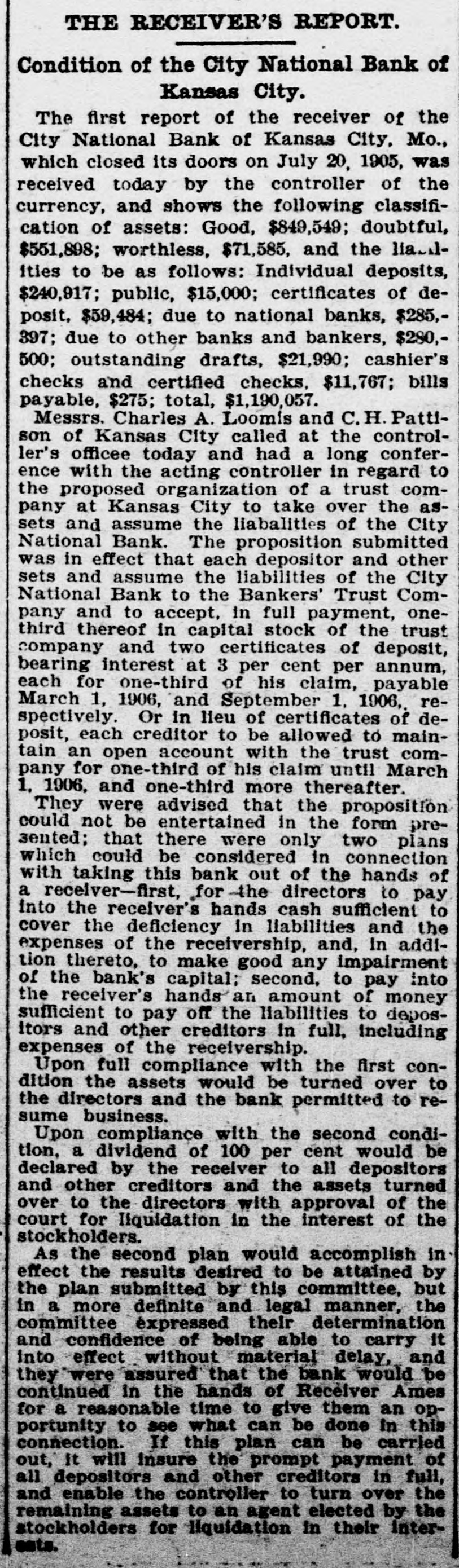
THE RECEIVER'S REPORT. Condition of the City National Bank of Kansas City. The first report of the receiver of the City National Bank of Kansas City, Mo., which closed its doors on July 20, 1905, was received today by the controller of the currency, and shows the following classification of assets: Good, $849,549; doubtful, $551,898; worthless, $71,585, and the liabilitles to be as follows: Individual deposits, $240,917; public, $15,000; certificates of deposit, $59,484; due to national banks, $285,397; due to other banks and bankers, $280,500; outstanding drafts, $21,990; cashier's checks and certified checks, $11,767; bills payable, $275; total, $1,190,057. Messrs. Charles A. Loomis and C.H. Pattison of Kansas City called at the controller's officee today and had a long conference with the acting controller in regard to the proposed organization of a trust company at Kansas City to take over the assets and assume the liabalities of the City National Bank. The proposition submitted was in effect that each depositor and other sets and assume the liabilities of the City National Bank to the Bankers' Trust Company and to accept, in full payment, onethird thereof in capital stock of the trust company and two certificates of deposit, bearing interest at 3 per cent per annum, each for one-third of his claim, payable March 1, 1906, and September 1, 1906, respectively. Or in lieu of certificates of deposit, each creditor to be allowed to maintain an open account with the trust company for one-third of his claim until March 1, 1906, and one-third more thereafter. They were advised that the proposition could not be entertained in the form presented; that there were only two plans which could be considered in connection with taking this bank out of the hands of a receiver-first, for -the directors to pay into the receiver's hands cash sufficient to cover the deficiency in liabilities and the expenses of the receivership, and, in addition thereto, to make good any impairment of the bank's capital; second, to pay into the receiver's hands an amount of money sufficient to pay off the liabilities to depositors and other creditors in full, including expenses of the receivership. Upon full compliance with the first condition the assets would be turned over to the directors and the bank permitted to resume business. Upon compliance with the second condition, a dividend of 100 per cent would be declared by the receiver to all depositors and other creditors and the assets turned over to the directors with approval of the court for liquidation in the interest of the stockholders. As the second plan would accomplish in effect the results desired to be attained by the plan submitted by this committee, but in a more definite and legal manner, the committee expressed their determination and confidence of being able to carry it into effect without material delay, and they were assured that the bank would be continued in the hands of Receiver Ames for a reasonable time to give them an opportunity to see what can be done in this connection. If this plan can be carried out, It will insure the prompt payment of all depositors and other creditors in full, and enable the controller to turn over the remaining assets to an agent elected by the stockholders for liquidation in their intereats.


Article from The Rich Hill Tribune, August 10, 1905

Click image to open full size in new tab

Article Text

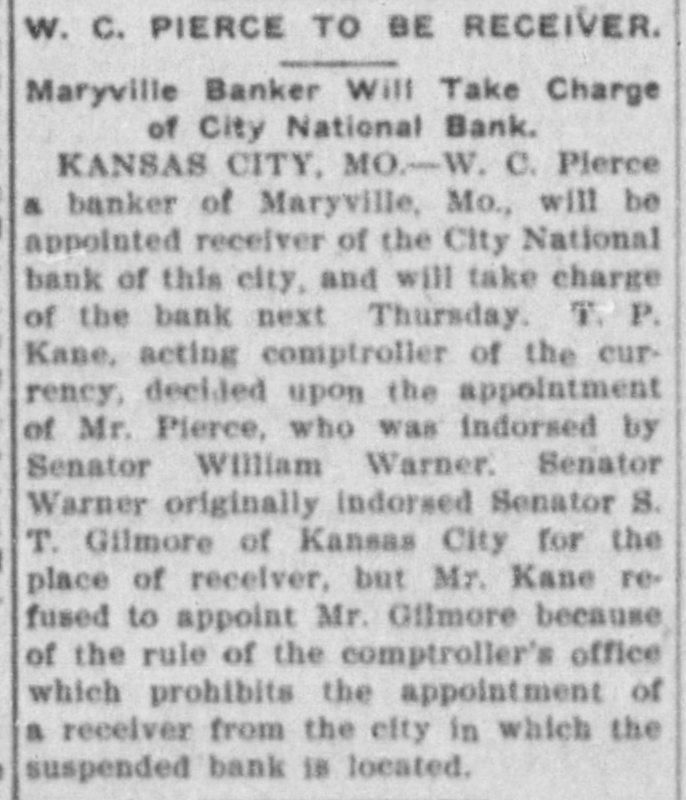
W. c. PIERCE TO BE RECEIVER. Maryville Banker Will Take Charge of City National Bank. KANSAS CITY, MO.-W. C. Pierce a banker of Maryville, Mo., will be appointed receiver of the City National bank of this city, and will take charge of the bank next Thursday. T.P. Kane, acting comptroller of the currency, decided upon the appointment of Mr. Pierce, who was indorsed by Senator William Warner. Senator Warner originally indorsed Senator S. T. Gilmore of Kansas City for the place of receiver, but Mr. Kane refused to appoint Mr. Gilmore because of the rule of the comptroller's office which prohibits the appointment of a receiver from the city in which the suspended bank is located.


Article from Omaha Daily Bee, August 10, 1905

Click image to open full size in new tab

Article Text

CITY NATIONAL BANK REPORT Condition of Affairs of Kansas City Institution as Shown by Comptroller. WASHINGTON Aug. 9.-The first report of the receiver of the City National bank of Kansas City, which closed its doors on July 20, 1905, was received today by the comptroller of the currency and shows the following classification of assets: Good, 849,549; doubtful, $551,898; worthless, $71,585. Liabilities to be as follows:


Article from The Topeka State Journal, January 1, 1906

Click image to open full size in new tab

Article Text

Business Failures Jan. 3-First national bank of Faribault, Minn., closed; receiver appointed. 9-Brott cotton mills, Massachusetts, capital $1,200,000. 27-Standard Rope & Twine Co., N. Y., for $12,000,000. 29-Pan-American bank, Chicago; assets $17,200, liabilities $75,900. Mar. 5-Arnold Brewing Co., Saulte St. Marie, Mich.; liabilities $85,000; assets $65,000. 7-Coe Co., Minneapolis; liabilities, $200,000. Apr. 3-Ladoga, Ind., bank; assets $80,000, liabilities $109,000. 24-Canton, O., state bank closes Lexington, Okla., First national bank falls. 26-Barberton, O., First national bank Jun. 2-Ladysmith, Wis., First national bank closed. 19-Fyfe & Munson, Chicago, placed in receiver's hands. 23-Vicksburg, Mich., exchange bank. 26-Knight, Donnelly & Co., Chicago. 28-Terre Haute, Ind., national bank closed doors. Jul. 5-Spring Valley, Ill., and Toluca, III., national banks close. 6-Hagerstown, Ind., Commercial bank; liabilities, $125,000. 19-Spring Valley, O., bank closes. 20-City national bank, Kansas City, Mo. Aug. 3-West Liberty, Ky., bank closes. 21-Western bank, Louisville, Ky.; due to overloans. Sep. 19-Minot, S. D., national bank closes doors. Oct. 6-Peoria (I11.) national bank closes because of Dougherty indictments. Nov. 1-Kingfisher (Okla.) national bank closed by comptroller of currency. Dec. 18-John R. Walsh's three banks in Ch'cago. Chicago National, Home Savingsand Equitable company in liquidation. Local clearing house guarantees payment of $26,000,000. Public and private accounts involved. 27-Merchants Trust company, American Savings bank and Mechanics Savings bank, Memphis, Tenn., close doors; first named in liquidation.


Article from Willmar Tribune, January 10, 1906

Click image to open full size in new tab

Article Text

Business Failcres Jan. 3-First national bank of Faribault, Minn., closed; receiver appointed. 9-Brott cotton mills, Massachusetts, capital $1,200,000. 23-Strauss-Green Co., Toledo, O.; liabilities $115,000, assets $100,000. 27-Standard Rope & Twine Co., N. Y., for $12,000,000. 29-Pan-American bank, Chicago; assets $17,200, liabilities $75,900. Mar. 5-Arnold Brewing Co., Saulte St. Marie, Mich.; liabilities $85,000; assets $65,000. 6-Spartansburg, Pa., bank; capital, $25,000. 7-Coe Co., Minneapolis; liabilities, $200,000. 31-Citizens' bank, Lorain, O., as result of defalcation. Apr. 3-Ladoga, Ind., bank; assets $80,000, liabilities $109,000. 16-Owosso, Mich., private bank closes. 23-Merchants' Trust Co., New York, closed. 24-Canton, O., state bank closes Lexington, Okla., First national bank fails. 26-Barberton, O., First national bank 27-R. H. York & Co.. old Cleveland, O., brokers; liabilities, $40,000. Jun. 2-Ladysmith, Wis., First national bank closed. 19-Fyfe & Munson, Chicago, placed in receiver's hands. 21-City Trust Co., Philadelphia, closes doors. 23-Vicksburg, Mich., exchange bank. 26-Knight, Donnelly & Co., Chicago. 28-Terre Haute, Ind., national bank closed doors. Jul. 5-Spring Valley, Ill., and Toluca, Ill., national banks close. 6-Hagerstown, Ind., Commercial bank; liabilities. $125,000. 13-Citizens' bank, Yellow Springs, O.; liabilities, $50,000. 19-Spring Valley, O., bank closes. 20-City national bank, Kansas City, Mo. Aug. 3-West Liberty, Ky., bank closes. 10-Four Denver, Col., Western bank officials' arrested on fraud charge. 21-Western bank, Louisville, Ky.; due to overloans. Sep. 19-Minot, S. D., national bank closes doors. 27-Johnson & Sloan, Minneapolis, Minn.; liabilities, $200,000 First national bank, Orville, O., closes doors. Oct. 6-Peoria (III.) national bank closes because of Dougherty indictments. Nov. 1-Kingfisher (Okla.) national bank closed by comptroller of currency. Dec. 18-John R. Walsh's three banks in Chicago. Chicago National, Home Savingsand Equitable company in liquidation. Local clearing house guarantees payment of $26,000,000. Public and private accounts involved. 27-Merchants Trust company, American Savings bank and Mechanics Savings bank, Memphis. Tenn., close doors; first named in liquidation.