
First National Bank (Union Bridge, MD)

Episode Information

Episode UID
906601470
Episode Type
Suspension โ†’ Reopening
Bank Type
national
Bank ID
90660 national
Charter Number
9066
Start Date
June 2, 1922
Location
Union Bridge, Maryland (39.569, -77.177)

Metadata

Model
gpt-5-mini (chosen from majority vote of a three-model LLM ensemble)
Short Digest
191b31c87a437229

Response Measures

None

Description

Articles report directors closed the bank and asked the Comptroller to take charge; later efforts sought to recapitalize rather than enter receivership, but final reopening is not documented here.

Events (5)

1. March 14, 1908 Chartered
Source
historical_nic
2. June 2, 1922 Other
Newspaper Excerpt
E. F. Olmstead, cashier of the First National Bank of Union Bridge, confessed to the board of directors that he is a defaulter...the shortage may reach $75,000 (later reported larger).
Source
newspapers
3. June 2, 1922 Suspension
Cause
Government Action
Cause Details
Directors closed the bank pending examination and requested the Comptroller of the Currency to take charge after discovering a large cashier shortage.
Newspaper Excerpt
Friday, the directors closed the bank pending further examination and requested the Comptroller of the Currency to take charge.
Source
newspapers
4. July 6, 1922 Other
Newspaper Excerpt
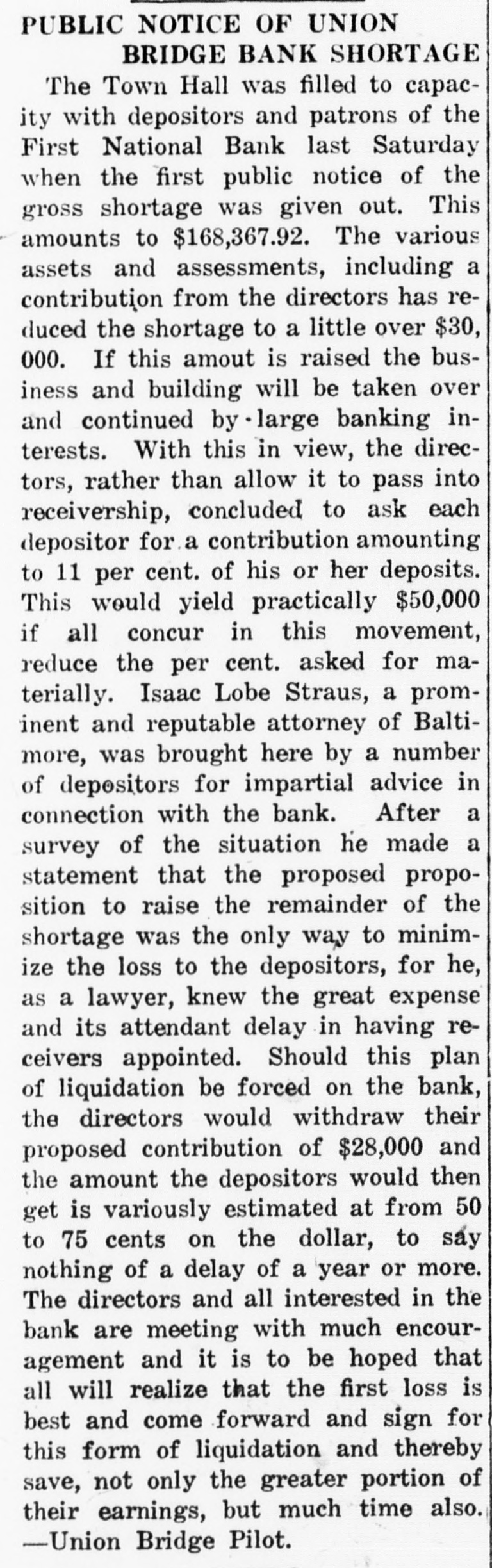
Directors asked each depositor for a contribution amounting to 11 per cent of his or her deposits to raise funds and avoid receivership; proposed directors' contribution and assessments to cover shortage.
Source
newspapers
5. August 28, 1922 Voluntary Liquidation
Source
historical_nic

Newspaper Articles (2)

Article from The Democratic Advocate, June 2, 1922

Click image to open full size in new tab

Article Text

CASHIER A DEFAULTI EDW. F. OLMSTEAD, CONFESSES USING UNION BRIDGE BANK FUI TO SPECULATE-SHORTAGE ABC $50,000. E. F. Olmstead, cashier of the Fi National Bank of Union Bridge, I confessed to the board of direct that he is a defaulter to an unkno amount. He admits that he has us the money in speculation. He is at home under close surveillance. Neither the bank officials nor 1 Federal Treasury officials who : working on the accounts, will appre imate the shortage, which is in 1 savings department, but they say may reach $75,000. E. O. Cash, this city, who is 1 I heaviest stockholder in the bank, came suspicious some time ago tl all was not well with the instituti About three months ago he was ele ed president in place of Jacob Gladhill. who resigned and took 1 place of vice-president, and at or egan to look into the bank's affair Investigation showed that the was something wrong, but the sho age at first seemed to be only abo $4,000. Friday, the directors closed t bank pending further examination a requested the Comptroller of the Ct rency to take charge. Thomas Kane national bank examiner, was sent Union Bridge and is now in char although Mr. Cash and other ba officials are assisting him. It is said that individuals in t community may sustain consideral losses through the disappearance bonds which they had intrusted to I Olmstead. for safekeeping. These we not deposited in the bank and no ceipts were given, and it is said tl in such case there is no liability the part of the bank. It is believed that the bank will reorganized and that the deposito will lose nothing. The bank has a ca ital stock of $25,000, with surplus $22,500 and undivided profits of $ 500. It has been paying annual di dends of 10 per cent. and the last S of the stock was at $197.50 a share Olmstead was a teller in the Nati Bank of Peltimoro .

Article from Catoctin Clarion, July 6, 1922

Click image to open full size in new tab

Article Text

PUBLIC NOTICE OF UNION BRIDGE BANK SHORTAGE The Town Hall was filled to capacity with depositors and patrons of the First National Bank last Saturday when the first public notice of the gross shortage was given out. This amounts to $168,367.92. The various assets and assessments, including a contribution from the directors has reduced the shortage to a little over $30, 000. If this amout is raised the business and building will be taken over and continued by . large banking interests. With this in view, the directors, rather than allow it to pass into receivership, concluded to ask each depositor for a contribution amounting to 11 per cent. of his or her deposits. This would yield practically $50,000 if all concur in this movement, reduce the per cent. asked for materially. Isaac Lobe Straus, a prominent and reputable attorney of Baltimore, was brought here by a number of depositors for impartial advice in connection with the bank. After a survey of the situation he made a statement that the proposed proposition to raise the remainder of the shortage was the only way to minimize the loss to the depositors, for he, as a lawyer, knew the great expense and its attendant delay in having receivers appointed. Should this plan of liquidation be forced on the bank, the directors would withdraw their proposed contribution of $28,000 and the amount the depositors would then get is variously estimated at from 50 to 75 cents on the dollar, to say nothing of a delay of a year or more. The directors and all interested in the bank are meeting with much encouragement and it is to be hoped that all will realize that the first loss is best and come forward and sign for this form of liquidation and thereby save, not only the greater portion of their earnings, but much time also. -Union Bridge Pilot.