Tradesmens National Bank (New York, NY)

Episode Information

Episode UID
90501186
Episode Type
Suspension โ†’ Run โ†’ Closure
Bank Type
national
Bank ID
9050 national
Charter Number
905
Start Date
October 4, 1898
Location
New York, New York (40.714, -74.006)

Metadata

Model
gemini-3-flash-preview (chosen from majority vote of a three-model LLM ensemble)
Short Digest
6a044dc30b49dd16

Response Measures

Partial suspension, Full suspension, Books examined

Other: The bank entered voluntary liquidation. Upon reopening for liquidation, it implemented a payment plan where small depositors (under $100) were paid first, while larger depositors agreed to wait four months for their money.

Clearinghouse involved: Yes (loan, examination, or other measures)

Description

The bank suspended on Oct 4 due to clearing house refusal; subsequent articles describe 'clamoring depositors' at the closed doors, indicating a run/agitation following the suspension.

Events (6)

1. March 17, 1865 Chartered
Source
historical_nic
2. October 4, 1898 Run
Cause
Bank Specific Adverse Info
Cause Details
Depositors gathered and clamored for money following the bank's failure to clear and subsequent suspension.
Measures
The bank posted notices that certain checks would be paid through the Hanover National Bank.
Newspaper Excerpt
Vice President Homer Bates promised the clamoring depositors today that the bank would pay its patrons 100 cents on the dollar.
Source
newspapers
3. October 4, 1898 Suspension
Cause
Bank Specific Adverse Info
Cause Details
Clearing house committee found capital impaired due to bad debts and close identification with the failed Wool Exchange.
Newspaper Excerpt
At the Tradesman's National Bank business is suspended this morning, and considerable excitement prevails about the building.
Source
newspapers
4. November 4, 1898 Receivership
Newspaper Excerpt
Mr. Dawes, controller of the currency, today appointed the bank examines of Pittsburg and New York temporary receivers of... the Tradesmen's National Bank of New York
Source
newspapers
5. December 1, 1898 Other
Newspaper Excerpt
The Tradesmen's National Bank, which suspended business Oct. 4, opened its doors today for liquidation. The depositors to whom $100 or less is due are being paid today.
Source
newspapers
6. January 13, 1899 Voluntary Liquidation
Source
historical_nic

Newspaper Articles (23)

Article from The Evening Times, October 4, 1898

Click image to open full size in new tab

Article Text

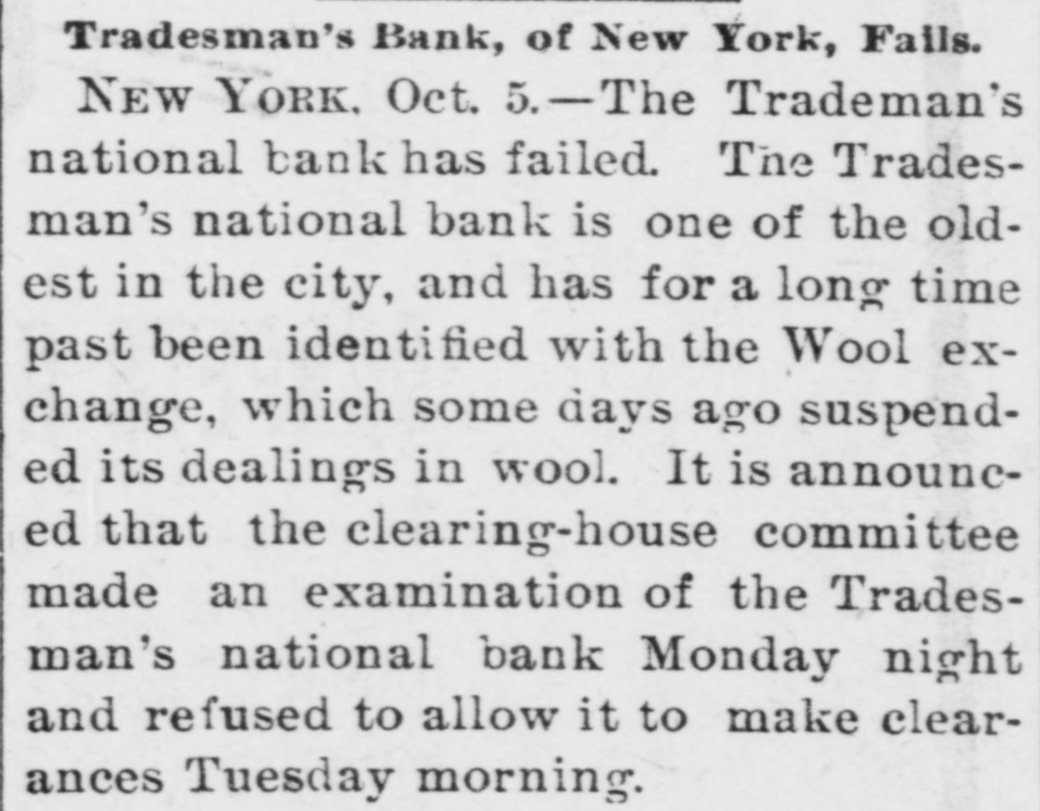
BIG BANK SUSPENSION The Tradesmen's National of New York Closed. AN OLD CITY INSTITUTION Its Failure Said to Be the Result of Its Close Identification With the Wool Exchange, Which Recently Gave Up Operations-An Official Examination Pending. New York, Oct. 4.-It is announced that the clearing house committee made an examination of the Tradesman's National Bank last night and refused to allow it to make clearances this morning. At the Tradesman's National Bank business is suspended this morning, and considerable excitement prevails about the building. President McNaughton says that he has no statement to make for the present. A notice is posted signed W. H. Kimball, national bank examiner, which reads: "This bank is closed pending an official examination.' Bank Examiner Kimball says that he has not yet had time to go deeply into the affairs of the Tradesmen's National Bank. From what he understands so far, however, the bank's trouble arose from certain contracts it had undertaken with the Wool Exchange. The closing down of the Exchange precipitated the suspension. The Tradesmen's National Bank is one of the oldest banks in the city, and has for a been with Wool long Exchange time past which identified days the some ago suspended its dealings in wool. The financial status of the bank was a matter of rumor some time ago, owing to the known adverse trade position of the Wool Exchange. An official of the clearing house said today that at last night's examination of the bank's affairs, bad debts were discovered which it is believed will impair the bank's capital to the extent of $250,000 or $300,000. No evidence of the defalcation or misappropriation of funds, it is stated, was found. No other bank or institution is in any way affected by the suspension and it is hoped that all depositors will be paid in full. It is said the bank is not likely to resume business The following dispatch was sent to the Treasury Department at Washington yesterday by Chairman Tappan, of the Clearing House committee: "The Clearing House committee have this afternoon examined the Tradesmen's National Bank, of this city, and in their opinion the capital of the bank is largely impaired. and it should be placed in liquidation." The capital of the Tradesmen's National Bank was $750,000. Th first intimation the Comptroller of the Currency received of the condition of the Tradesmen's National Bank was this morning, when the clearing house at New York informed the department that they refused to clear the bank. National Bank Examiner W. H. Kimball was at once ordered to take charge. The following is the last statement made by the bank which was on September 20: Capital, $750,000; surplus and profits, $128. 083: due to banks and bankers. $953.870; in dividual deposits, $2,054,611: loans and discounts, $2,091,842 cash on hand and with other banks, $1,089,169. "This statement," said Assistant Comptroller Warner, "may mean a great deal or it may mean nothing The value of the loans and discounts depends entirely upon the class of securities the bank holds. All we know is that the officials of the bank claim their concern is solvent." Until about six weeks ago the Colum bia National Bank, of this city, had a: its correspondent in New York the Tradesmen's National Bank But the president of the Columbia having heard some statements regarding the condition of the New York bank, withdrew the Columbia's account and deposited i with the Phoenix Bank of New York and that institution is now the Colum bia National's correspondent.


Article from The Sun, October 5, 1898

Click image to open full size in new tab

Article Text

1808. 1897. Surplus and undivided profits $115,081 80 $182,984.78 Deposits 8,078,782.16 8,717,458 23 Dividend, & per cent. per annum. JAMES W. CLAWSON, Cashier. Comparine this with the statement of Sept. 20 It will be seen that there was in the intervening time a large falling off of deposits. Cashier Clawson said that this was due to a quarrel between the New York and Boston wool buyers and that during the last month $500,000 of deposits had been withdrawn. The Tradesmen's National Bank was organized as a State bank in 1823 and it was one of the original members of the Clearing House. It has correspondents in Chicago, Boston and Washington. On July 1 its officers and directors were as follows: James Macnaughtan. President: David H. Bates, Vice-President: A. Swan Brown. Jerome EL Bates, Augustus C. Bechstein. Charles R. Flint David Hunt. Julius Kaufmann, Thomas B. Kent, David M. Look. rederick E. Pitkin, James Rowland. John A. Tweedy. Clarence Whitman and William H. Woolverton. Mr. Brown and Mr. Whitman resigned some time ago. At the Clearing House it was said yesterday that the bank would probably not be able to resume business. but that no other bank or institution would be forced to the wall by its failure. During the day notices were posted in the bank that checks and drafts drawn by the following banks on the Tradesmen's National Bank will be paid through the Hanover National Bank: People's National Bank. Salem. N. Y.: First National Bank, Indiana, Pa.: Newport National Bank, Newport, Ky.: Cyrus AlIen. banker, Avon, N. Y.: Lattimer & Winton. bankers, Addison, N. Y. A number of private depositors also posted notices telling where their outstanding drafts and checks on the bank would be paid.
Article from The Anaconda Standard, October 5, 1898

Click image to open full size in new tab

Article Text

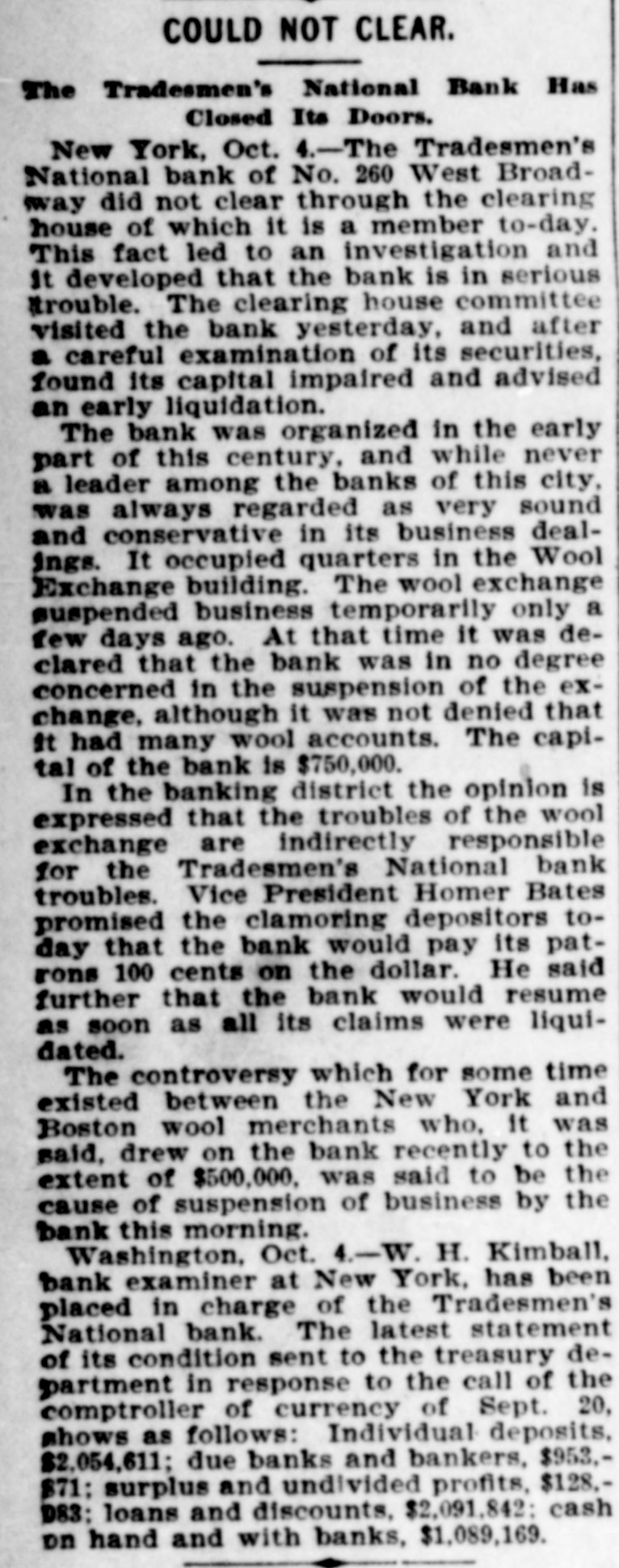
COULD NOT CLEAR. The Tradesmen's National Bank Has Closed Its Doors. New York, Oct. 4.-The Tradesmen's National bank of No. 260 West Broadway did not clear through the clearing house of which it is a member to-day. This fact led to an investigation and It developed that the bank is in serious trouble. The clearing house committee visited the bank yesterday, and after a careful examination of its securities, found its capital impaired and advised an early liquidation. The bank was organized in the early part of this century, and while never a leader among the banks of this city, was always regarded as very sound and conservative in its business dealings. It occupied quarters in the Wool Exchange building. The wool exchange suspended business temporarily only a few days ago. At that time it was declared that the bank was in no degree concerned in the suspension of the exchange, although it was not denied that It had many wool accounts. The capital of the bank is $750,000. In the banking district the opinion is expressed that the troubles of the wool exchange are indirectly responsible for the Tradesmen's National bank troubles. Vice President Homer Bates promised the clamoring depositors today that the bank would pay its patrons 100 cents on the dollar. He said further that the bank would resume as soon as all its claims were liquidated. The controversy which for some time existed between the New York and Boston wool merchants who, it was said, drew on the bank recently to the extent of $500,000. was said to be the cause of suspension of business by the bank this morning. Washington, Oct. 4.-W. H. Kimball, bank examiner at New York, has been placed in charge of the Tradesmen's National bank. The latest statement of its condition sent to the treasury department in response to the call of the comptroller of currency of Sept. 20, shows as follows: Individual deposits, $2,054,611; due banks and bankers, $953.$71; surplus and undivided profits, $128.D83: loans and discounts. $2,091,842: cash on hand and with banks, $1,089,169.


Article from The News & Observer, October 5, 1898

Click image to open full size in new tab

Article Text

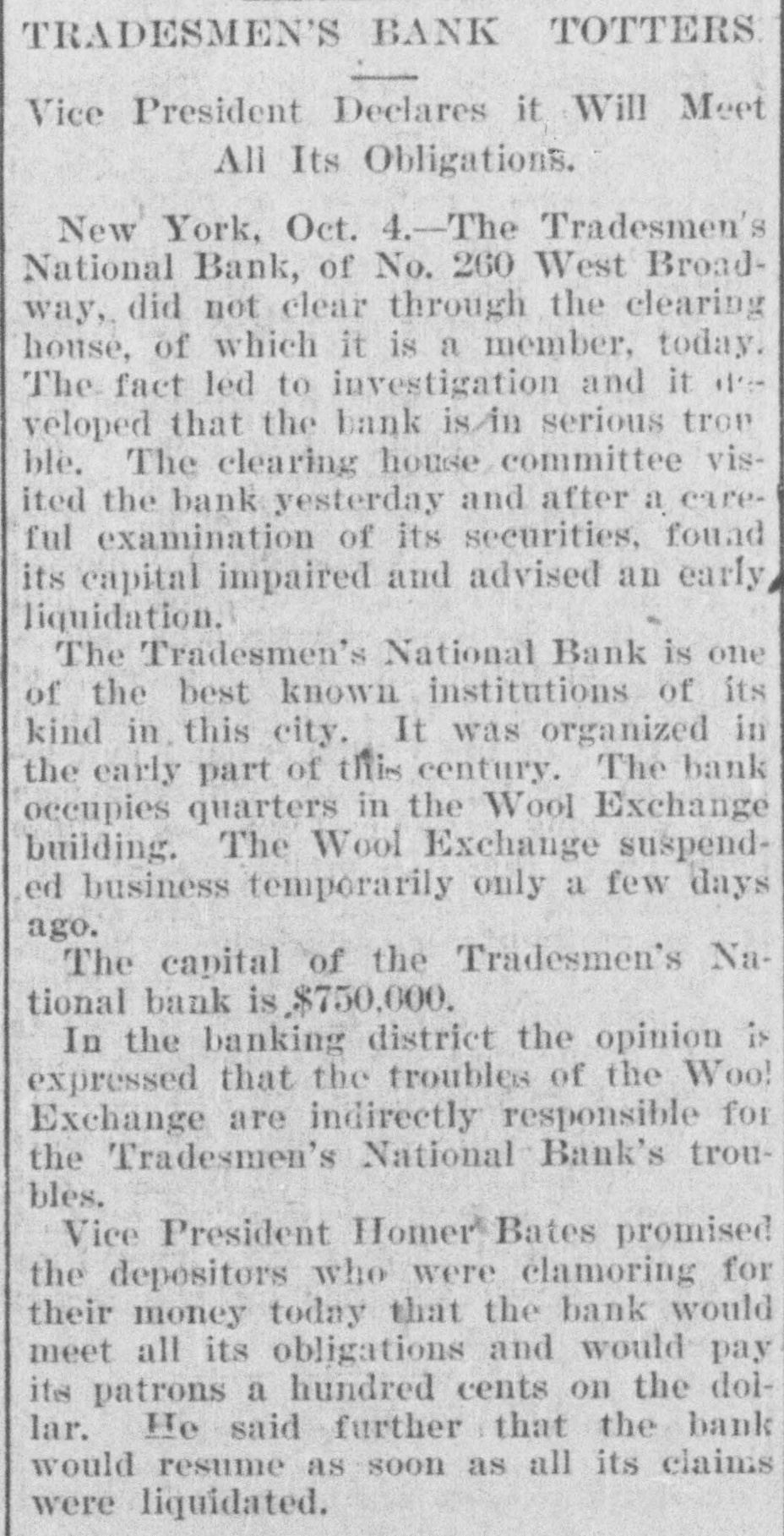
TRADESMEN'S BANK TOTTERS: Vice President Declares it Will Meet All Its Obligations. New York, Oct. 4.-The Tradesmen's National Bank, of No. 260 West Broadway, did not clear through the clearing house, of which it is a member, today. The fact led to investigation and it it's veloped that the bank is in serious tron ble. The clearing house committee visited the bank yesterday and after a careful examination of its securities, found its capital impaired and advised an early liquidation. The Tradesmen's National Bank is one of the best known institutions of its kind in this city. It was organized in the early part of this century. The bank occupies quarters in the Wool Exchange building. The Wool Exchange suspended business temporarily only a few days ago. The capital of the Tradesmen's National bank is $750,000. In the banking district the opinion is expressed that the troubles of the Wool Exchange are indirectly responsible for the Tradesmen's National Bank's troubles. Vice President Homer Bates promised the depositors who were clamoring for their money today that the bank would meet all its obligations and would pay its patrons a hundred cents on the dollar. He said further that the bank would resume as soon as all its claims were liquidated.


Article from The Morning News, October 5, 1898

Click image to open full size in new tab

Article Text

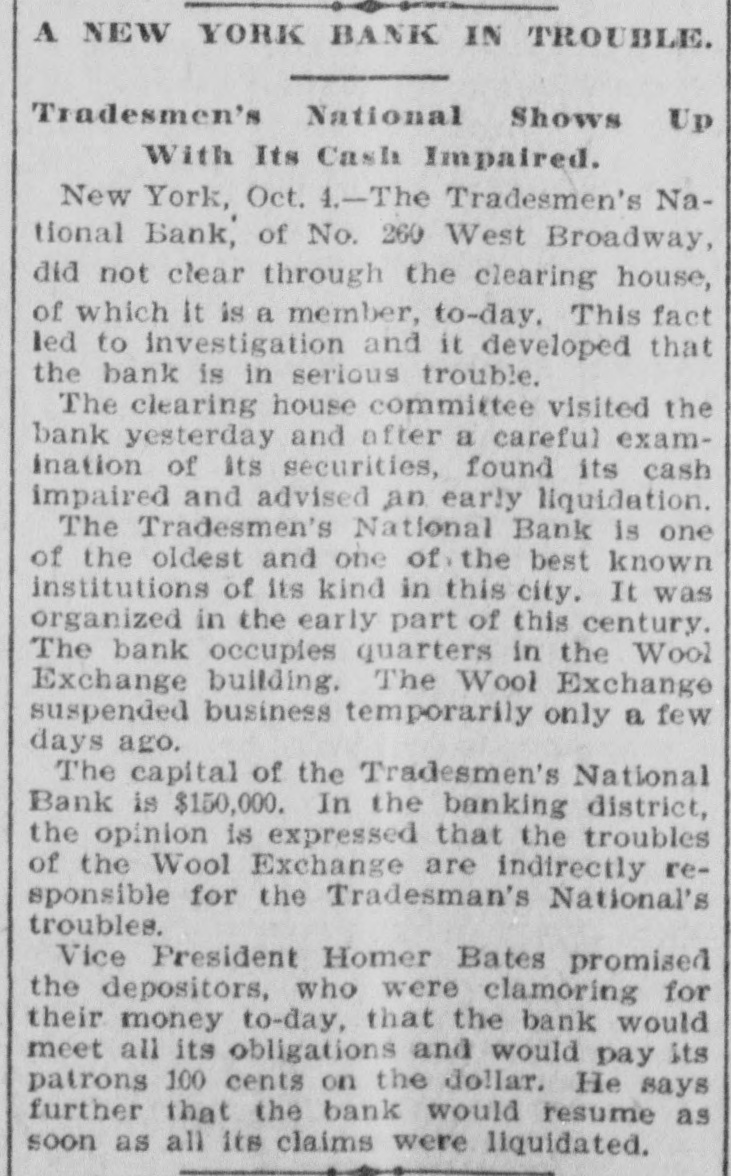
A NEW YORK BANK IN TROUBLE. Tradesmen's National Shows Up With Its Cash Impaired. New York, Oct. 4.-The Tradesmen's National Bank, of No. 260 West Broadway, did not clear through the clearing house, of which It is a member, to-day. This fact led to investigation and it developed that the bank is in serious trouble. The clearing house committee visited the bank yesterday and after a careful examination of its securities, found its cash impaired and advised an early liquidation. The Tradesmen's National Bank is one of the oldest and one of the best known institutions of its kind in this city. It was organized in the early part of this century. The bank occupies quarters in the Wool Exchange building. The Wool Exchange suspended business temporarily only a few days ago. The capital of the Tradesmen's National Bank is $150,000. In the banking district, the opinion is expressed that the troubles of the Wool Exchange are indirectly responsible for the Tradesman's National's troubles. Vice President Homer Bates promised the depositors, who were clamoring for their money to-day, that the bank would meet all its obligations and would pay its patrons 100 cents on the dollar. He says further that the bank would resume as soon as all its claims were liquidated.


Article from Deseret Evening News, October 5, 1898

Click image to open full size in new tab

Article Text

: TRADESMAN'S NATIONAL SUSPENDS : Troubles of the Wool Exchange Cause the ) New York Banks to Close. New York, Oct. 4.-The Tradesmen's National bank of No. 26 West Broad: way did not clear through the Clearing House, of which It is a member, today. i This fact led to investigation, and It 1 developed that the bank is in serious . trouble. I The Clearing House committee vis. , Red the bank yesterday and after a ) careful examination of Its securities. : found Its capital impaired and advised ) an early liquidation. I The bank was organized in the early , part of this century and while never I a leader among the banks of this city, was always regarded as very sound I and conservative in its business deal. Ings. It occupies quarters In the Wool I Exchange building. The Wool Exchange suspended business temporarily only a few days ago. At that time It was declared the bank was in no de) gree concerned In the suspension of the / exchange although It was/not denied that M had many wool accounts. The ) capital of the bank is $750,000. In the banking district, the opinion is expressed that the troubles of the Wool Exchange are directly responsible for the Tradesmen's National bank trou. bles. , , Vice President Homer Bates prom$ Ised the elamoring depositors today that the bank would pay its natrons 100 cents on the dollar. He said further that the bank would resume as soon as all its claims were l'ouidated f The controversy. which for some time existed between the New York and a Boston wool merchants. who, It was said, drew on the bank recently to the 0 extent of $500,000. was said to be the cause of suspension of business by the . bank this morning.


Article from The Herald, October 5, 1898

Click image to open full size in new tab

Article Text

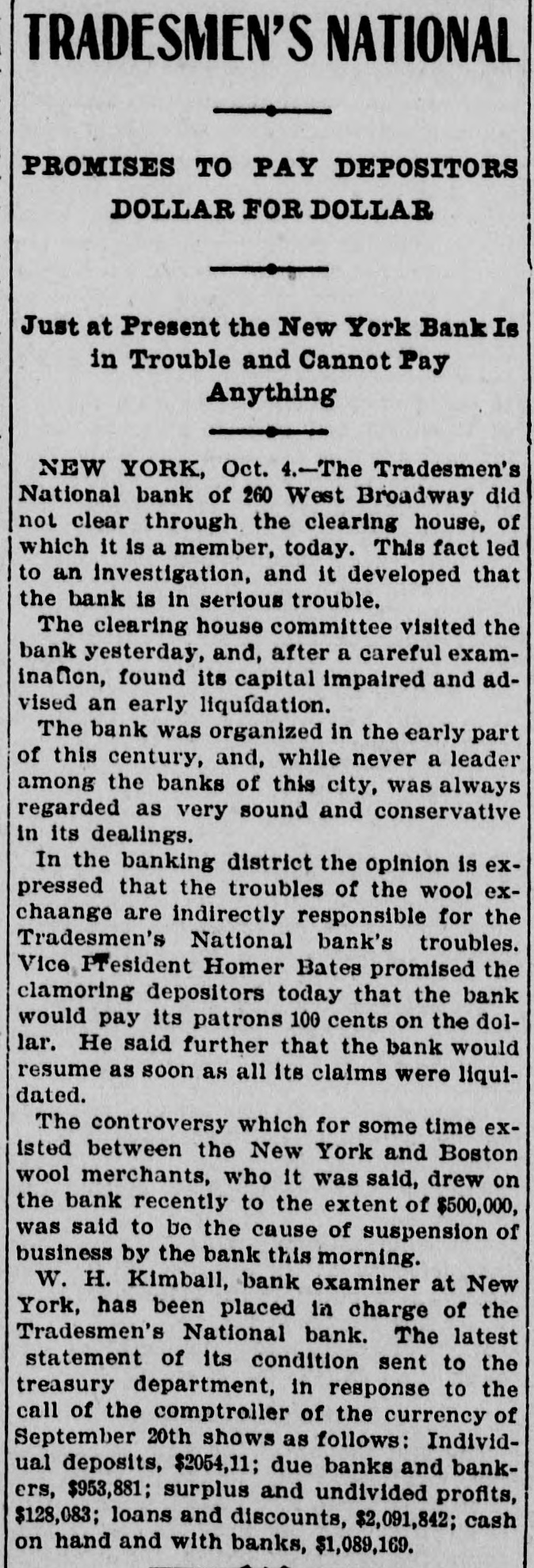
TRADESMEN'S NATIONAL PROMISES TO PAY DEPOSITORS DOLLAR FOR DOLLAR Just at Present the New York Bank Is in Trouble and Cannot Pay Anything NEW YORK, Oct. 4.-The Tradesmen's National bank of 260 West Broadway did not clear through the clearing house, of which it is a member, today. This fact led to an investigation, and it developed that the bank is in serious trouble. The clearing house committee visited the bank yesterday, and, after a careful examinanon, found its capital impaired and advised an early liquidation. The bank was organized in the early part of this century, and, while never a leader among the banks of this city, was always regarded as very sound and conservative in its dealings. In the banking district the opinion is expressed that the troubles of the wool exchaange are indirectly responsible for the Tradesmen's National bank's troubles. Vice President Homer Bates promised the clamoring depositors today that the bank would pay its patrons 100 cents on the dollar. He said further that the bank would resume as soon as all its claims were liquidated. The controversy which for some time exlsted between the New York and Boston wool merchants, who it was said, drew on the bank recently to the extent of $500,000, was said to be the cause of suspension of business by the bank this morning. W. H. Kimball, bank examiner at New York, has been placed in charge of the Tradesmen's National bank. The latest statement of its condition sent to the treasury department, in response to the call of the comptroller of the currency of September 20th shows as follows: Individual deposits, $2054,11; due banks and bankers, $953,881; surplus and undivided profits, $128,083; loans and discounts, $2,091,842; cash on hand and with banks, $1,089,169.


Article from The Topeka State Journal, October 5, 1898

Click image to open full size in new tab

Article Text

IN SERIOUS TROUBLE. Suspension of Tradesmen's National Bank Turns Out to Be a Collapse. New York, Oct. 5.-The Tradesmen's National bank of No. 260 West Broadway, which did not clear through the clearing house, of which it is a member, yesterday, is in serious trouble. The clearing house committee visited the bank yesterday, and after a careful examination of its securities found its capital impaired and advised an early liquidation. The bank was organized In the early part of this century, and while never a leader among the banks of this city, was always regarded as very sound and conservative in its business dealings. It occupies quarters in the Wool Exchange building. The Wool Exchange suspended business temporarily only a few days ago. At that time it was declared the bank was in no degree concerned in the suspension of the exchange, although it was not denied that it had many wool accounts. The capital of the bank is $750,000. In the banking district the opinion is expressed that the troubles of the Wool Exchange are indirectly responsible for the Tradesmen's National bank's troubles. Vice President Homer Bates promised the clamoring depositors that the bank would pay its patrons 100 cents on the dollar. He said further that the bank would resume as soon as all its claims were liquidated. Washington, Oct. 5.-W. H. Kimball, bank examiner at New York, has been placed in charge of the Tradesmen's National bank. The latest statement of its condition sent to the treasury department in response to the call of the comptroller of the currency of September 20, shows as follows: Individual deposits, $2,054,611; due banks and bankers. $953,871; surplus and undivided profits, $128,083; loans and discounts, $2,091,842. and cash on hand and with banks $1,089,169.


Article from The Salt Lake Herald, October 6, 1898

Click image to open full size in new tab

Article Text

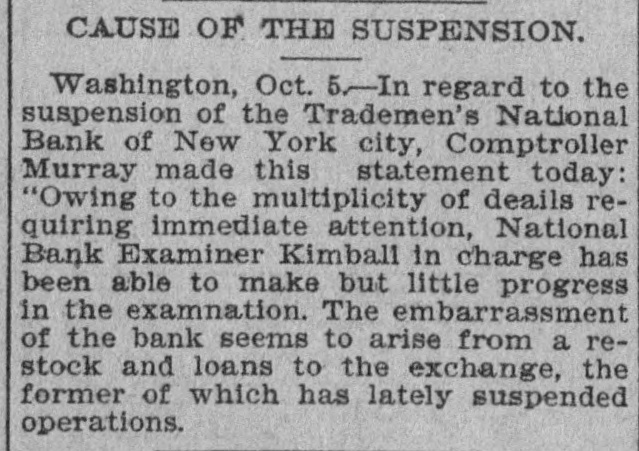
FAILED BANK'S CONDITION. Tradesmen's National Loaned $400,000 to Its President. New York, Oct. 5.-President James McNaughton of the Tradesmen's National bank, which suspended business yesterday, made the statement today that the bank is solvent. National Bank Examiner W. H. Kimball says he has discovered that a loan of $400,000 of the bank's money was made quite recently to President McNaughton, who gave as collateral a number of wool exchange shares. In addition to this sum, Mr. Kimbal says, $85,000 was doled out to two individuals, one a member of the wool exchange, but whose names were not given. President McNaughton asserts that the clearing house committee's investigation into the status of the Tradesmen's National bank was a "farce and a deliberate attempt to throw the bank down." About $600,000 of cash was found by the examiner in the bank's safes.


Article from New-York Tribune, October 7, 1898

Click image to open full size in new tab

Article Text

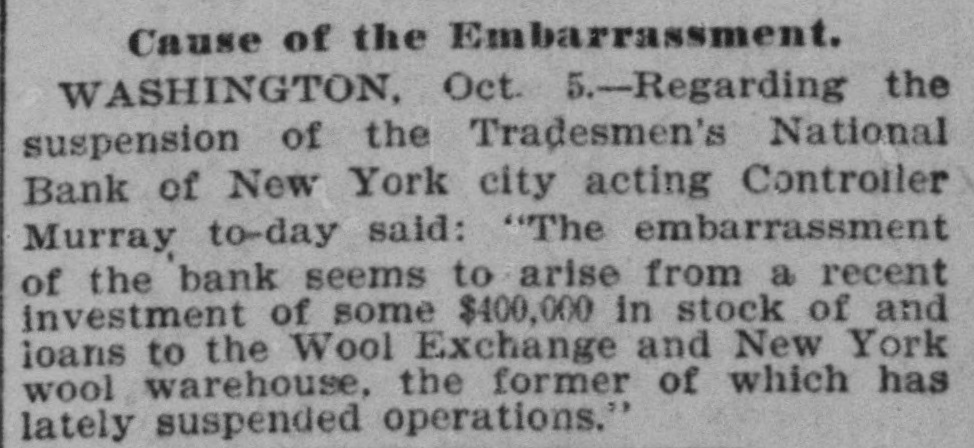
TRADESMEN'S BANK CASE. MR. KIMBALL HOPES TO MAKE A REPORT SOON-MR. WILLIAMS'S LETTER The examination of the affairs of the Tradesmen's National Bank was in progress yesterday under the supervision of W. H. Kimball, the National Bank Examiner. According to unofficial him last evening. there had developments as a statements been no unusual made by result of the of books the day's investigation. The examination has revealed a large number of loans on securities in which James Macnaughtan and his brothers ,have been interested. It appears to be recognized by financial experts that the four thousand shares of the Wool Exchange held by the bank will realize a satisfactory sum. As to the securities of the New-York Wool Warehouse Company there have been many conflicting rumors. It was learned on the best of authority yesterday that the Tradesmen's Bank has $20,000 of the stock of this concern and about $50,000 of its commercial paper. The company is capitalized at $1,000,000, but all the stock has not been issued. It is controlled by the Macnaughtans. Yesterday afternoon a deputysheriff served copies of an attachment for $2,664.58 against the corporation in favor of H. P. Campbell & Co., for rent due for the premises No. 129 Charlton-st., which are occupied by the company for storage purposes. The attachment was obtained in the Supreme Court on the ground that the company is a New-Jersey corporation. It is estimated that the company has stored more than 15,000,000 pounds of wool. On this it has advanced a large sum. It is said by one of the officers of the company that there exists a large margin begreen the money advanced and the value of the wool. Even if there was a decline of 50 per cent in prices, he said, the company would still be safe. According to Mr. Kimball, he has found it a difficult problem to estimate even the approximate value of the securities of the warehouse company. Although the work of making up a statement for the Controller may take two weeks, Mr. Kimball intimated that he might give the directors a rough draft of the bank's condition early next week. in order to post them on the true situation. James Macnaughtan was not at the bank yesterday. David H. Bates said that Mr. Macnaughtan had left word on Wednesday that he was tired out and would remain away until to-day. Mr. Bates. Mr. Kimball and the treasurer of the Wool Exchange reported that they had each talked over the telephone with Mr. Macnaughtan in the course of the day. The cash, amounting to $650,000. which the examiners found in the bank's vaults was transferred to the Clearing House yesterday. The following communication, written by Prestdent George G. Williams of the Chemical National Bank, was addressed yesterday to James Macnaughtan, president of the Tradesmen's National Bank: Dear Sir: Permit me to disabuse your mind of the impression you have conveyed to the public that the examination of the Tradesmen's Bank by the Clearing House Committee took place in consequence of my statements to it that the bank was in trouble. The simple facts are briefly these: A meeting of the Clearing House Committee took place at 1 o'clock on Friday. After the routine business had been gone through with. the question of the Tradesmen's Bank came up before us. and it was stated that rumors affecting its credit were in circulation in Wall Street. I distinctly stated to the committee that the Tradesmen's Bank had not called upon the Chemical Bank for any loans for some years past, and that, having long been neighbors. it was my impression that whenever it wanted to borrow it had to come to this bank. After full discussion it was decided that an examination should take place at 3 o'clock on Monday. After my return to my desk in the Chemical Bank, in about one hour's time. I received your letter asking for a loan of $100,000 to $200,000. which I promptly declined I studiously kept the contents of your letter. private, and only one single person was informed (and he an employee of this bank) of the contents thereof. until after my return from the country Tuesday morning. This brief recital of facts will show you clearly that the Clearing House Committee knew nothing whatever of your request for a loan until after the examination of your bank and its suspension from the Clearing House. Deputy-Sheriff Leavitt received an execution yesterday against the Tradesmen's National Bank for $9.736 in favor of the Continental National Bank on a judgment obtained on October 28. 1897. The Sheriff went to the bank and informed Mr. Kimball of the execution, but could not levy upon anything in the bank, as it is in the hands of the United States authorities.


Article from The L'anse Sentinel, October 15, 1898

Click image to open full size in new tab

Article Text

Rains have quenched the forest fires around Cumberland, Wis. The schooner Sarah E. Palmer was lost off Stone inlet, near Charleston, S. C., and her crew of eight was drowned. The battleship Illinois was launched at Newport News, Va., in the presence of 30,000 people, and was christened by Miss Nancy Leiter, of Chicago. William Ballard, Burt Puvis and John Gatlin were suffocated by gas in a well at Somerset, Kan. With $2,000,000 due to depositors the Tradesmen's national bank closed its doors in New York city. J. B. Connor, of Evansville, Ind., shot and killed his wife and her paramour, Charles Williams. It is announced that Hawaii will become a territory of the United States and will be allowed one representative in congress. Heavy snowstorms prevailed in Minnesota and North Dakota. The unusual warm weather and abundant rains have started a second growth of almost everything in the berry line in southwestern Michigan. An incendiary fire destroyed the larger portion of the business district of Lowell, Ind. Samuel H. Dickerson shot and killed Mrs. Blanche Winship and killed himself in Cleveland, O. Jealousy was the cause. The battleship Wisconsin is to be launched from the Union iron works in San Francisco on November 26. Wright Smith (colored), who attempted to assault the wife of Capt. James Morrison, was taken from jail at Jones Station, Md., by a mob and shot to death. The triennial council of the Protestant Episcopal Church of the United States opened in Washington. The vault of Molson's bank in Winnipeg, Man., was robbed by unknown parties of $60,000. Damage exceeding $500,000 was caused by a fire which started in the Grange tobacco warehouse in Clarksville, Tenn. In a pacing mile race in St. Louis between Joe Patchen and John R. Gentry, Patchen won in two straight heats, the best time being 2:07. The trouble that has been brewing between the Indians and United States officials culminated in a fight at Bog-Ah-Me-Ge-Shirk's point, 30 miles from Walker, Minn., in which four soldiers were killed and nine seriously wounded. Dr. W. F. McLean, aged 65, a prominent physician and mason, fell dead in the masonic lodgeroom in Elyria, O. It is reported that the cotton crop in Georgia has been damaged to the extent of $5,000,000 by the recent storm. An estimate of the amount of provisions on the Yukon river indicates that there will be no need of a government relief expedition this winter. Mayor Jones, of Kansas City, Mo., has declared that the pawnbrokers must go. The utmost demoralization prevails throughout Mississippi on account of the rapid spread of yellow fever. N. L. Weatherby, commodore of the Troy Yacht club; Stephen W. Mallory, Mrs. Nellie Breslin and Miss Lizzie Savage were drowned in the Hudson river at Troy, N. Y., by the capsizing of a yacht. Trains collided at Indianola, Neb., and Sol Brace, engineer; E. J. Walters, fireman, and William McCarl, brakeman, were killed. Essie Jackson, aged 10 years, was stoned to death by boys at Shelbyville, Ind. Maj. Wilkinson, six privates, one Indian policeman and 30 Indians were killed in the fight with the Indians at Bear island, Minn. Fighting was still in progress, and Gov. Clough telegraphed Secretary Alger asking him to authorize the use of the volunteer regiments just about to be disbanded for the protection of the frontier. The Bankers' & Merchants' Mutual Fire Insurance company at Liberty, Mo., has assigned. Senator John T. Morgan, of Alabama, called on the president to inform him of the success of the Hawaiian commission. The Rock River Methodist conference in session in Chicago declared for equal lay representation by a vote of 200 to 6. The liabilities of the Tradesman's bank in New York, that failed recently, are now placed at $3,800,000. In session in Grand Rapids, Mich., the American board of foreign missions, for the first time in the 90 years of its history, elected a woman, Margaret J. Evans, of Minnesota, as a member. # PERSONAL AND POLITICAL. James L. High, one of the leading members of the Chicago bar and a lawyer of national reputation, died in Chicago, aged 54 years. Henry George has declined to accept the nomination for governor of New York on the Chicago platform democrats ticket and Henry McDonald has been named in his place. Mrs. Sobrina Shoemaker celebrated her one hundred and third birthday at her home near Covington, Ind. The Massachusetts democratic state convention at Worcester nominated a ticket headed by Alexander B. Bruce,


Article from Evening Star, November 4, 1898

Click image to open full size in new tab

Article Text

APPOINTED RECEIVERS. Examiners of the Tradesmen's and the Gorman Banks. Owing to the decision of Judge Lacombe of New York that an execution can be levied against the assets of a national bank in the hands of the controller of the currency at any time prior to his formal appointment of a receiver, and to the fact that suits are being prepared by others in New York against the Tradesmen's National Bank and in Pittsburg against the Gorman National Bank for the purpose of levying execution and judgment, which would, if Judge Lacombe's decision is upheld, prefer certain creditors to the damage of other creditors unjustly, Mr. Dawes, controller of the currency. today appointed the bank examines of Pittsburg and New York temporary receivers of the Gorman National Bank of Pitisburg and the Tradesmen's National Bank of New York, respectively. This action on the part of the controller will not interfere in any way with the efforts of the officers of these institutions to put these banks into condition for voluntary liquidation, and the controller announces that he will consent to the voluntary liquidation of these institutions and will discharge the receivers when assured of the ability of the banks to meet their obligations in full, as promised by their committees now making efforts to put the banks into condition justifying the controller in assenting to liquidation.


Article from The Wichita Daily Eagle, November 5, 1898

Click image to open full size in new tab

Article Text

IT WOULD PREFER CREDITORS Comptroller Takes Steps to Neutralize Judge Lacomb's Decision Washington, D. C., Nov. 4.-Owing to the decision of Judge Lacombe, of New York, that an execution can be levied against the assets of a national bank in the hands of the comptroller of the currency at any time prior* to his formal appointment of a receiver, and to the fact that suits are being prepared by others in New York against the Tradesmen's National bank and in Pittsburg against the German National bank for the purpose of levying execution and judgment, which would, if Judge Lacombe's decision is upheld, prefer certain creditors, to the damage of other creditors, unjustly, Charles G. Dawes, comptroller of the currency, has today appointed the bank examiners of Pittsburg and New York to be temporary receivers of the German National bank of Pittsburg and the Tradesmen's National bank of New York, respectively. This action on the part of the comptroller will not interfere in any way with the efforts of the officers of these institutions to put these banks into condition for voluntary liquidation and the comptroller announces that he will consent to the voluntary liquidation of these institutions and will discharge the receivers when assured of the ability of the banks to meet their obligations in full, as promised by their comittees now making efforts to put the bank into condition, jusifying the comptroller in assenting to liquidation.


Article from Wood County Reporter, November 24, 1898

Click image to open full size in new tab

Article Text

captured at Gallup, N. M. Ethel Marlowe, who was playing sudLove in The Christian, died Polly denly behind the scenes of a New York theater. Heart disease is supposed to have been the cause. The United States circuit court has of entered an order directing the sale the Chicago "L" road for $6,000,000. of The bonded and other indebtedness the road amounts to $16,500,000. The second assistant postmastergeneral has been informed of a combination of speculative mail bidders large who are seeking to evade to a extent the use of the war tax stamp. Dr. Samuel C. Bartlett, former and president of Dartmouth College from 1857 to 1876 professor in Chicago HanTheological Seminary, died at over, N. H. He was 71 years old. At Muncie, Ind., Fred Oland, 10 old shot and killed Andy years Modemiller, aged 5. Sam Jackson, becolored, an adult, is suspected of ing an accomplice and may be lynched. At Janesville the Gazette Printing the company was burned out, and whole building destroyed, together The with the plant of the newspaper. total loss will be about $10,000 with insurance. Dr. J. Underwood Hall, a prominent physician, is dead at San Jose, Cal. He was 85 years of age and a native had Kentucky. During the war he of charge of the union hospital at Glasgow, Ky. Congressman Joseph W. Bailey, democratic congressional leader, has entered the race to succeed Horace Chilton in the United States senate from Texas. Mr. Chilton's term expires March 4, 1901. C. Lambe, former Ill., and until a year Carlyle, Robert mayor ago of one the of of the most influential members Clinton county bar, has been arrested under an indictment charging forgery and embezzlement. The W. C. T. U. national convention at St. Paul, unanimously adopted resolutions strongly protesting against the canteen and also decided by a vote of of 285 to 71 to abandon ownership the temple in Chicago. To the committee which waited his on 1 him, President McKinley expressed take purpose, if nothing prevented, to which part in the Masonic ceremonies will mark the centennial of the death of George Washington. T. K. Hanajima of Japan, has been for at Fond du Lac spending $10,000 h blooded stock and investigating the latest dairy devices. In his seven trips to this country Wisconsin has always e been his field for purchases. h The receivers of the Wisconsin Central Lines made application for perto issue a second series of certificates to the S mission receivers' payable amount of $1,000,000 at six per cent., e from March 1, 1899. who was five James years McNaughton, presiof the Tradesmen's National h at New York, which has filed a petition in t, dent failed, bank recently bank- of ruptcy. He schedules liabilities t $1,129,350 and assets $347,921. t At Watertown Mrs. Kate Heubel e attempted suicide twice, once by taking rat poison and once by shooting herself, and in both she failed. She k, was partially insane from family troubles. She will survive. 1 f A severe fire in Dawson, Yukon ter- It is ritory, caused a loss of $500,000. was started by a woman throwing a lamp at another woman. The Daw- same woman started the big fire at d son last winter in the same way. f A war of whisky rates between the trust and the big distillery going up at Terre Haute is imminent. The fight if will surely be on in about a month o Haute concern its purpose to present the Terre antagonize adheres to the trust. It is said that Miss Sarah Bonnell, e an Abilene, Kans., young woman, has received a legacy of half a million v dollars from a friend in New York interested in her musical education. her She will go to Paris soon with youngest sister. n At Mitchell, Ind., Jesse, aged 22, son Burton of Georgia, has by John Flora in a been of Emslie shot case existed of mistaken identity. A feud this between Flora and Ab Jones of a h place, and Flora mistook young Burton for Jones. The new directory of the university of Wisconsin shows that there are i 1,479 pupils attending this year, last is a slight increase over and a gain in every but that of the year, which sophomores, department where there is a falling off. h Fred Olin, aged 12, has been arrested at Municie, Ind., charged with the murder of little Andy Bodemiller, was the 5-year-old child whose body found crammed into a fruit box in a gravel pit near his mother's house in Whitely, a suburb. Another discovery of gold is announced in the Malvern, Ohio, district. The latest find is at Augusta, a few miles north of Malvern, where M. & O. Leyda has discovered on his farm an ore which he claims to be richer than the Malvern product. Another chapter was added to the of famous Barnes-McGowan case Trenton, N. J., when McGowan and his wife, formerly Mrs. Barnes, were arrested at Erie, Pa., for kidnapping the child of Mrs. McGowan's first marriage from a Cleveland school. A popular subscription has been opened at Northfield, Vt., for the erection of a building at Norwich uni


Article from Albuquerque Daily Citizen, December 1, 1898

Click image to open full size in new tab

Article Text

Paying Depositors. New York, Dac. 1.--The Tradesmen's National bank, which suspended business Oct. 4th, opened to-day for liquidation. The bank has to its credit $1,600,000; in addition there is $618,000 due depositors who agreed to wait four months for their money. Fifty per cent of this was to be paid Jan. 1st. Depositors to whom $100 or less is due are being paid to-day.


Article from Evening Star, December 1, 1898

Click image to open full size in new tab

Article Text

TRADESMEN'S DOORS OPENED. Paying Off the Depositors of $100 or Less Today. NEW YORK, December 1.-The Tradesmen's National Bank, which suspended business on October 4, opened its doors today for liquidation. The bank has to its credit $1,600,000. In addition, there is $618,000 due depositors, who have agreed to wait four months for their money. Fifty per cent of this will be paid in January. The depositors to whom $100 or less is due are being paid today.


Article from Deseret Evening News, December 1, 1898

Click image to open full size in new tab

Article Text

Bank Opens Again. New York, Dec. 1.-The Trademen National bank, which suspended business on Oct. 4. opened its doors today for Houldation The bank has to its credit $1,600,000 In addition there is $618 000 due deposit. OT# who have agreed to wait for four monips for their money. Fifty per cent of this will be paid In January. The depositors to whom $100 or less is due, are being paid today.


Article from The Worcester Spy, December 2, 1898

Click image to open full size in new tab

Article Text

OPENS ITS DOORS FOR LIQUIDATION. New York, Dec. 1.-The Tradesmen's National Bank, which suspended business Oct. 4, opened its doors today for liquidation. The bank has to its credit $1,600,000. In addition, there is $618,000 due depositors, who have agreed to wait four months for their money. Fifty per cent of this will be paid in January. The depositors to whom $100 or less is due are being paid today.


Article from The Indianapolis Journal, December 2, 1898

Click image to open full size in new tab

Article Text

Tradesmen's National Bank Reopened NEW YORK, Dec. 1.-The Tradesmen's National Bank, which suspended business on Oct. 4, opened its doors to-day for liquidation. The bank has to its credit $1,600,000. In addition there is $618,000 due depositors who have agreed to wait for months for their money. Fifty per cent. of this will be paid in January. Depositors to whom $100 or less is due are being paid to-day.


Article from Weekly Independent, December 16, 1898

Click image to open full size in new tab

Article Text

"SOUND MONEY.' The New York Sun occasionally shines with its old time lustre, as witness the following: "News comes from Emporia, KanBas, that the president of the First National Bank of that city has committed suicide after wrecking the bank 80 badly that not only are its capital and surplus gone. but the depositors will get little or nothing of the $500,000 owing them. As a consequence of this failure, the neighboring Madison bank has been obliged to close its doors. "Only a few weeks ago the Trades. men's National Bank of this city, which the Controller of the Currency supposed was perfectly sound, was examined by a committee of the Clearing House and found to be in solvent. Its depositors have not yet been paid a cent. and its stockhold. ers will probably lose the greater part of the money they have invested in its stocks. "When the Chestnut Street Nation al Bank of Philadelphia failed, a year ago, the discovery was made that it had been insolvent for over a year, and the Comptroller of the Currency knew it. Still, the bank was permitted to continue doing business and to receive deposits, because, as the Comptroller declared, closing its doors might have caused runa on other Philadelphia banks and lead to a panic. "These are but specimens of occur. rences which happen every few days. The failures of national banks are so frequent that they excite no comment and interest nobody but the sufferers by them. As a protection to bank creditore the Government manage. ment of banks is A delusion, and 80 would be its protection of bank note holders, If the notes were not secured by bonds. "Yet, the bankers and the eo-called currency reformers want the govern. ment to 'go out of the banking busi. ness," by turning over the function of issuing circulating notes exclusively to the banks. and let the people look


Article from Twice-A-Week Plain Dealer, January 3, 1899

Click image to open full size in new tab

Article Text

HAPPENINGS OF 1898. A Chronological Array of the Most Prominent Events. STORY OF SPANISH-AMERICAN WAR. Brief Mention of Financial Failures, Startling Catastrophes and Crimes-Necrology of Year - Politics and Sport. BANK FAILURES. Jan. 17-State, Elmwood, Ill., $60,000. 24-National, Paola, Kan., suspended. 81-First national, Larimore, N. D., $71,754. Feb. 24-Bank of Southern Baltimore, $170,000. Mar. 16-Home savings, Sioux City, Ia., $60,000 Benson savings, Waterford, Pa., $40,000. 24-Bank of Merriam Park, St. Paul, Minn. People's state, Philadelphia, nearly $1,000,000. 25-Guarantors' Finance Co., Philadelphia, $1,047,500. Jun. 7-Delaware national, Delhi, N. Y., $25,000. 29-Thomas J. Kirby, private, Abilene, Kan., $283,000. Jul.20-Commercial state, Marshalltown, Ia. 21-German savings, Doon, Ia., $59,474 Northern, Lexington, Ky. (suspended). 23-Tawas savings, Tawas City, Mich. (suspended). Aug. 11-Bank of Waverly, Ill., $150,000. 27-Fillmore county, Preston, Minn., $150,000. Sep. 14-D. F. Parsons, private, Burr Oak, Mich., $100,000. 15-Jasper, Ala., bank, $65,000. 26-Allegheny, at Clifton Forge, Va., liabilities, $50,000. Oct. 4-Tradesman's national, at New York, $2,000,000 due depositors. Liabilities placed at $3,800,000. 13-Tioga national, of Oswego, N.Y., closed. 19-First national of Neligh, Neb., liabilities $108,000 German national of Pitts burgh, Pa., liabilities, $7,000,000. 21-First national, of Lisbon, O., capital $50,000-closed; resumed on Nov. 15. 29-Second national, of Springfield, O., goes into liquidation. Nov. 5-First national, of Flushing., O., suspends. 16-First national, of Emporia, Kan., closed. President suicides an hour later. 28-Bank of Hornersville, N. Y., closes doors with liabilities of $75,000. 30-Second national, of Toledo, O., goes into voluntary liquidation. Dec. 5-American savings, at Charleston, S. C., placed in hands of receiver. Liabilities, $100,000.


Article from The Cape Girardeau Democrat, January 7, 1899

Click image to open full size in new tab

Article Text

BANK FAILURES. Jan. 17-State, Elmwood, III $60,000. 24-National, Paola, Kan., suspended. 31 - First national, Larimore, N. D., $71,754. Feb. 21-Bank of Southern Baltimore, $170. 000. Mar. 16-Home savings, Sioux City, Ia., $60, 000 Benson savings, Waterford, Pa., $40,000. 24-Bank of Merriam Park, St. Paul, Minn. People's state, Philadelphia, nearly $1,000,000. 25-Guarantors' Finance Co., Philadelphia, $1,047,500. Jun. 7-Delaware national, Delhi, N. Y., $25,000. 29-Thomas J. Kirby, private, Abilene, Kan., $283,000. Jul. 20-Commercial state, Marshalltown, Ia. 21-German savings, Doon, Ia. $59,474 Northern, Lexington, Ky. (suspended). 23-Tawas savings, Tawas City, Mich. (suspended). Aug. -Bank of Waverly, Ill., $150,000. 27-Fillmore county, Preston, Minn., $150, 000. Sep. 14-D. F. Parsons, private, Burr Oak, Mich, $100,000. 15-Jasper, Ala., bank, $65,000. 26-Allegheny, at Clifton Forge, Va., liabilities, $50,000. Oct. 4-Tradesman's national, at New York, $2,000,000 due depositors. Liabilities placed at $3,800,000. 13-Tioga national, of Oswego, N. Y., closed. 19-First national of Neligh, Neb., liabiliGerman national of Pitts ties $108,000 burgh, Pa., liabiliteis, $2,000,000. 21-First national, of Lisbon, O., capital $50,000-closed; resumed on Nov. 15. 29-Second national, of Springfield, O., goes into liquidation. Nov. 5-First national, of Flushing_2., suspends. 16-First national, of Emporia, Kan., closed. 28-Bank of Hornersville, N. Y., closes doors with liabilities of $75,000. 30-Second national, of Teledo O., goesinto voluntary liquidation.


Article from The Holly Chieftain, January 13, 1899

Click image to open full size in new tab

Article Text

BANK FAILURES. Jan. 17-State, Elmwood, III., $60,000. 24 -National, Paola, Kan., suspended. 31 - First national, Larimore, N. D., $71,754. Feb. 24-Bank of Southern Baltimore, $170, 000. Mar. 16-Home savings, Sioux City, Ia., $60, 000 Benson savings, Waterford, Pa., $40,000. 24-Bank of Merriam Park, St. Paul, Minn. People's state, Philadelphia, nearly $1,000,000. 25-Guarantors' Finance Co., Philadelphia, $1,047,500. Jun. 7-Delaware national, Delhi, N. Y., $25,000. 29-Thomas J. Kirby, private, Abilene, Kan., $283,000. Jul. .20-Commercial state, Marshalltown, Ia. 21-German savings, Doon, 1a., $59,474 Northern, Lexington, Ky. (suspended) 23-Tawas savings, Tawas City, Mich. (sus pended) Aug. 11-Bank of Waverly, III., $150,000. 27 -Fillmore county, Preston, Minn., $150,000. Sep. 14-D. F. Parsons, private, Burr Oak, Mich., $100,000. 15-Jasper, Aia., bank, $65,000. 26-Allegheny, at Clifton Forge, Va., lia bilities, $50,000. Oct. 4-Tradesman's national, at New York, $2,000,000 due depositors. Liabilities placed at $3,800,000. 13-Tioga national, of Oswego, N. Y., closed. 19-First national of Neligh, Neb., liabiliGerman national of Pitts ties $108,000 burgh, Pa., liabiliteis, $2,000,000. 21-First national, of Lisbon. O., capital 350,000-closed; resumed on Nov. 15. 29-Second national, of Springfield, 0, goes into liquidation. Nov. 5-First national, of Flushing., O., suy. pends. 16-First national, of Emporia, Kan., closed. 28-Bank of Hornersville, N. Y., closes doora with liabilities of $75,000. 30-Second national, of Toledo, O., goes into voluntary liquidation. Dec. 5-American savings, at Charleston, S. C., placed in hands of receiver. Liabilities, $100,000.