First National Bank (Saratoga Springs, NY)

Episode Information

Episode UID
89301254
Episode Type
Run โ†’ Suspension โ†’ Reopening
Bank Type
national
Bank ID
8930 national
Charter Number
893
Start Date
June 25, 1904
Location
Saratoga Springs, New York (43.083, -73.785)

Metadata

Model
gpt-5-mini (chosen from majority vote of a three-model LLM ensemble)
Short Digest
2adc4b395f4ee69a

Response Measures

Capital injected, Full suspension, Books examined

Description

Former cashier William H. Bockes disappeared around the time of the run; examiner later appointed receiver.

Events (5)

1. March 14, 1865 Chartered
Source
historical_nic
2. June 25, 1904 Run
Cause
Local Banks
Cause Details
Run on nearby Citizens' National bank led depositors to withdraw from First National and fear of a similar run.
Measures
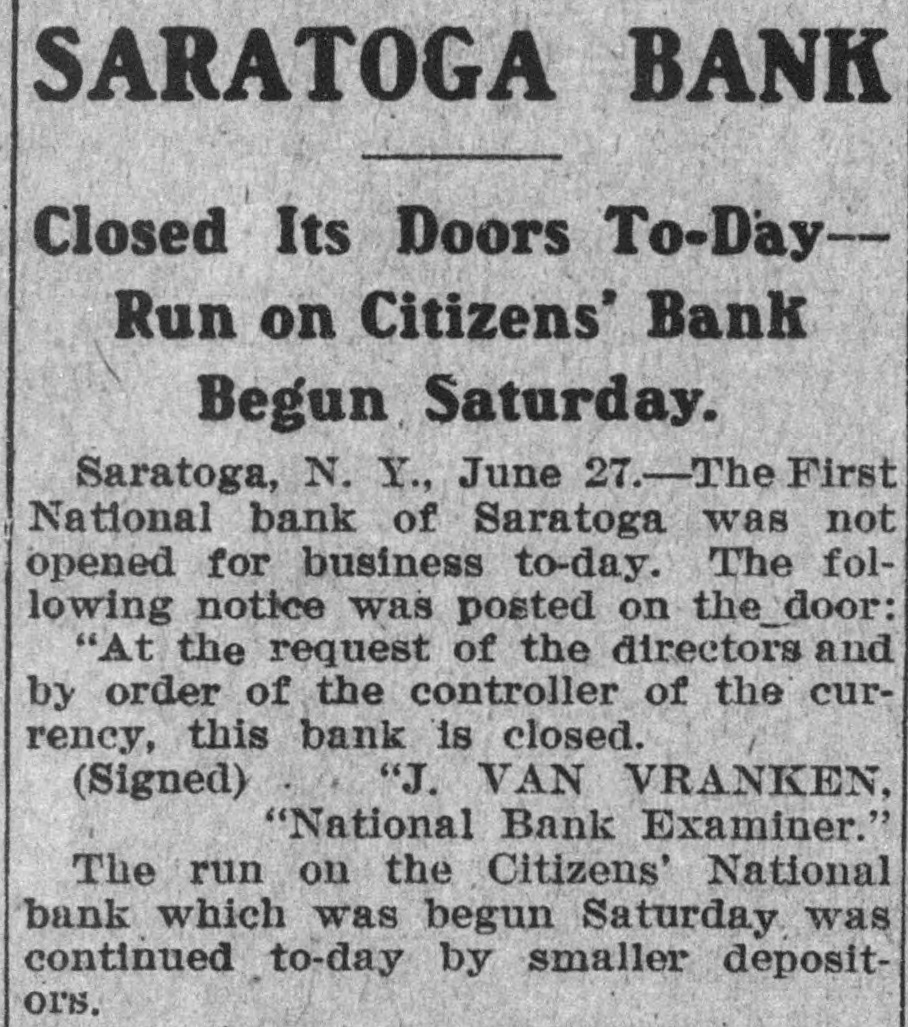
Bank closed by directors to avoid a run; notice posted that bank was closed by order of the Comptroller.
Newspaper Excerpt
A run on the Citizens' National bank begun Saturday and continued today.
Source
newspapers
3. June 27, 1904 Other
Newspaper Excerpt
National Bank Examiner Josiah Van Vranken has been appointed receiver.
Source
newspapers
4. June 27, 1904 Suspension
Cause
Government Action
Cause Details
Closed by order of the Comptroller of the Currency at directors' request and placed in hands of a receiver after being unable to meet withdrawal demands.
Newspaper Excerpt
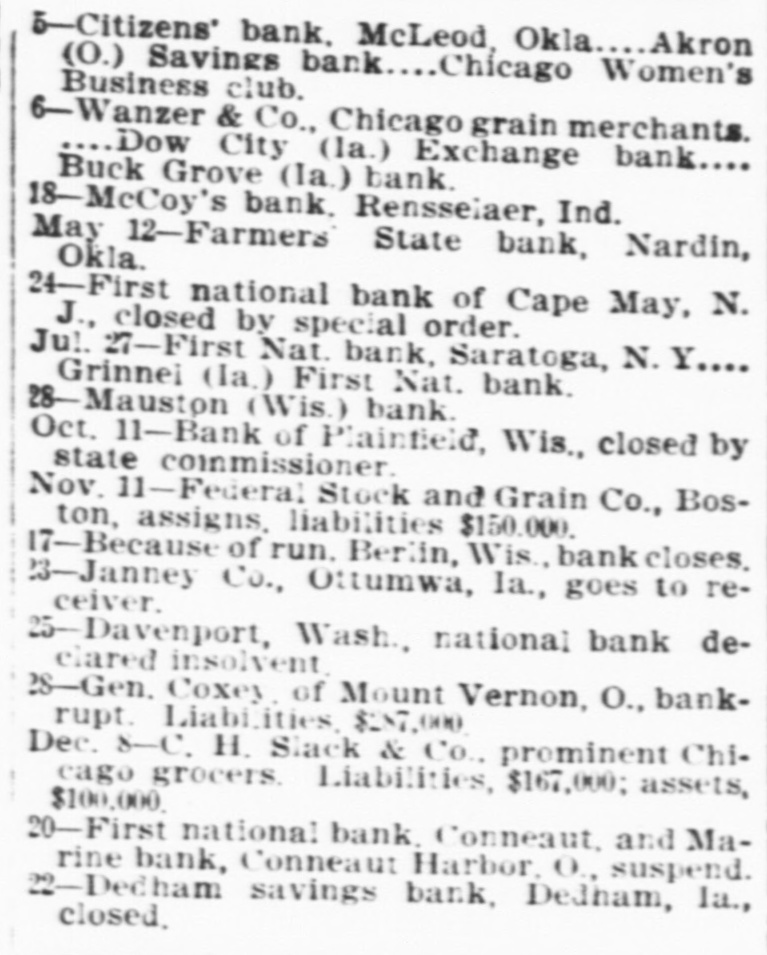
The First National Bank of Saratoga was not opened for business today ... closed by order of the comptroller of currency at the request of the directors.
Source
newspapers
5. August 18, 1904 Reopening
Newspaper Excerpt
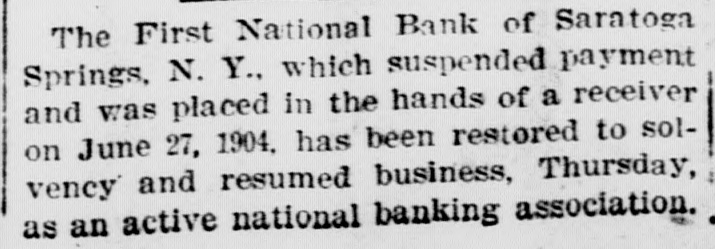
has been restored to solvency and resumed business today as an active national banking association.
Source
newspapers

Newspaper Articles (21)

Article from Santa Fe New Mexican, June 27, 1904

Click image to open full size in new tab

Article Text

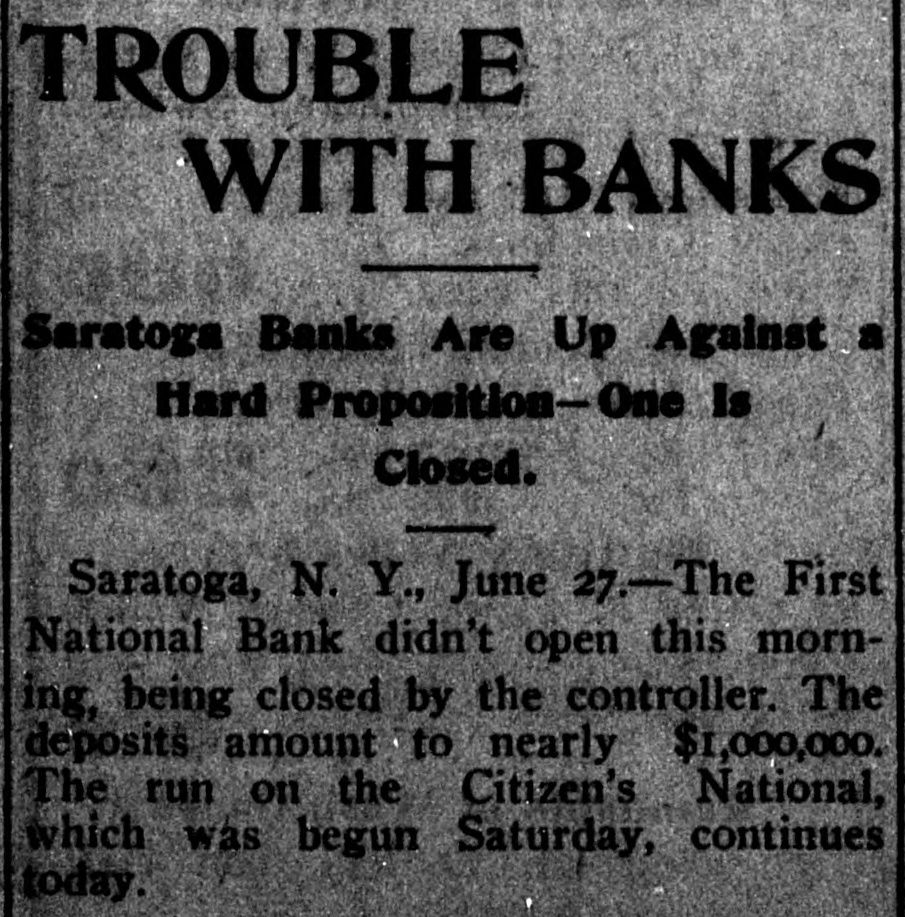
BANK GOES UNDER, First National of Saratoga, Closed By Order of the Comptroller of Currency. Saratoga, N. Y., June 27-The First National Bank of Saratoga, was not opened for business today. It was closed by order of the comptroller of currency at the request of the directors. It owes depositors about $800,000. A run on the Citizens' National Bank begun Saturday and continued today. The run on the Citizens' Bank ended today. The First National Bank suspended in apprehension of a run andon account of lack of funds to meet a run. An officer said he hoped the bank would soon reopen.


Article from Evening Times-Republican, June 27, 1904

Click image to open full size in new tab

Article Text

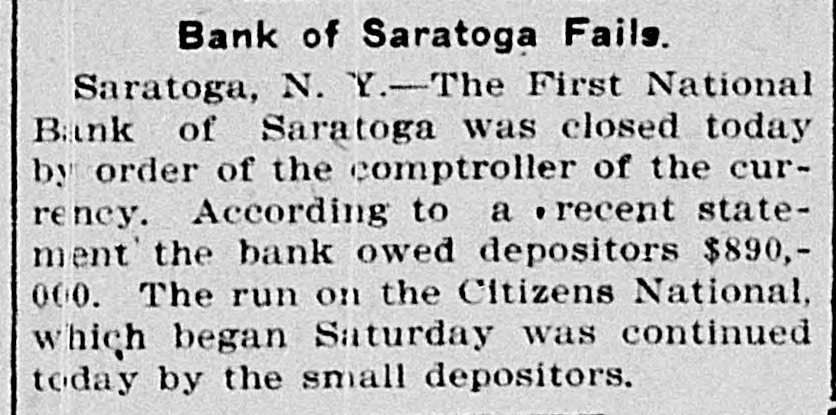
Bank of Saratoga Fails. Saratoga, N. Y.-The First National Bank of Saratoga was closed today by order of the comptroller of the currency. According to a recent statement the bank owed depositors $890,000. The run on the Citizens National, which began Saturday was continued today by the small depositors.


Article from The Daily Telegram, June 27, 1904

Click image to open full size in new tab

Article Text

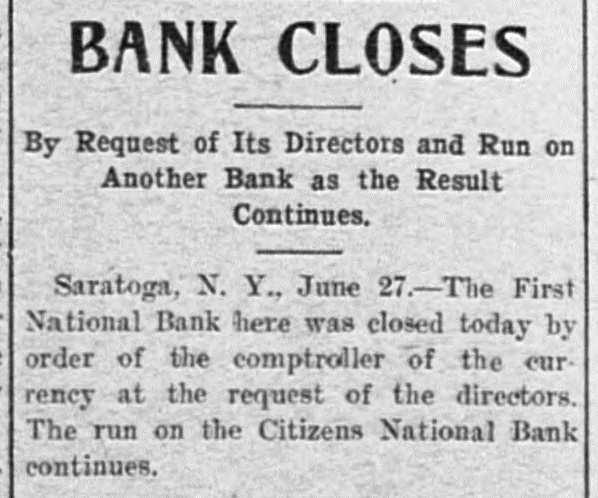
BANK CLOSES By Request of Its Directors and Run on Another Bank as the Result Continues. Saratoga, N. Y., June 27.-The First National Bank here was closed today by order of the comptroller of the currency at the request of the directors. The run on the Citizens National Bank continues.


Article from Alexandria Gazette, June 27, 1904

Click image to open full size in new tab

Article Text

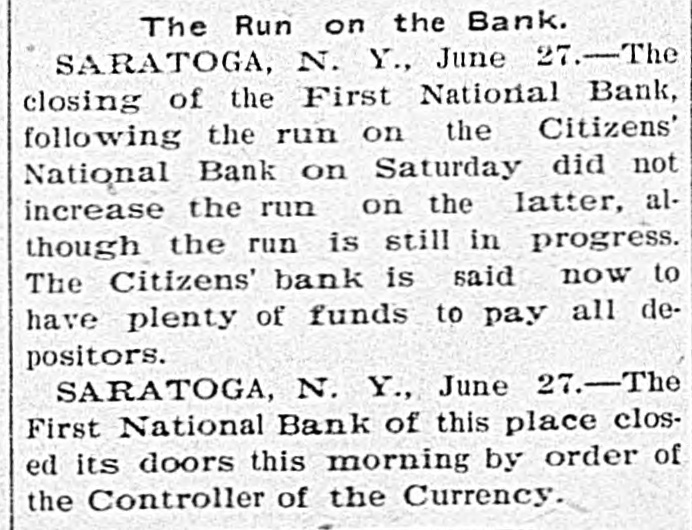
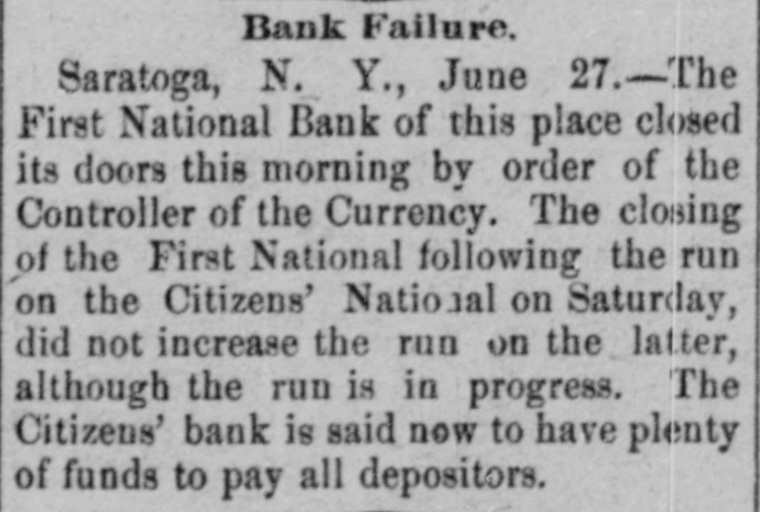
Bank Failure. Saratoga, N. Y., June 27.-The First National Bank of this place closed its doors this morning by order of the Controller of the Currency. The closing of the First National following the run on the Citizens' National on Saturday, did not increase the run on the latter, although the run is in progress. The Citizens' bank is said now to have plenty of funds to pay all depositors.


Article from Deseret Evening News, June 27, 1904

Click image to open full size in new tab

Article Text

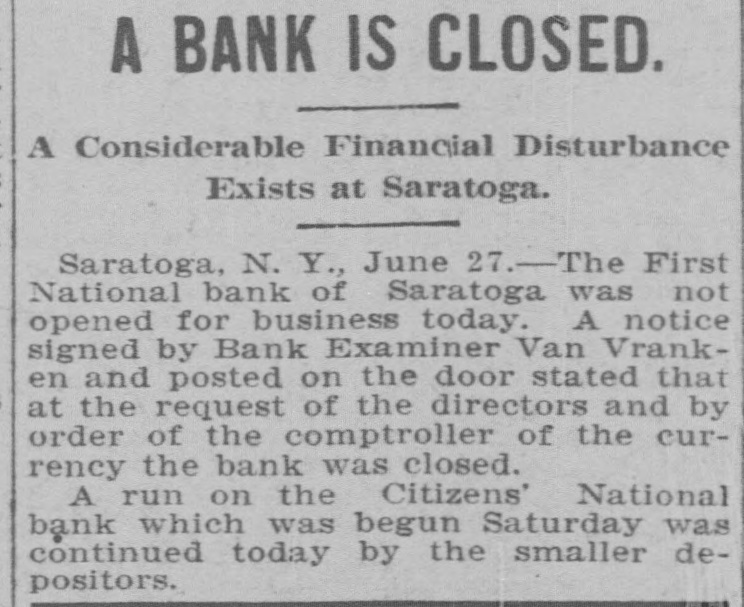
Saratoga Bank Not Opened. Saratoga, N. Y., June 27.-The First National bank of Saratoga was not opened for business today. A notice signed by Bank Examiner Van Vranken and posted on the door, stated that at the request of the directors and by order of the controller of the currency. the bank was closed. A run on the Citizens' National bank which was begun Saturday, was continued today by the smaller depositors. New York, June 27.-The First National bank of Saratoga Springs, according to a recent statement, owed depositors $890,000. Its paid up capital was $125,000. and it had among its assets $1,018,000 in loans, discounts, stocks and securities, and $100,000 in cash and exchanges.


Article from The Daily Palladium, June 27, 1904

Click image to open full size in new tab

Article Text

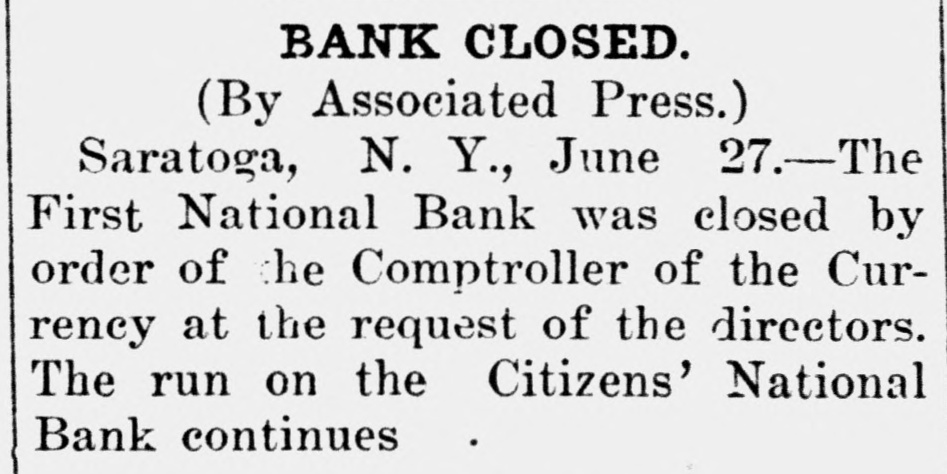
BANK CLOSED. (By Associated Press.) Saratoga, N. Y., June 27.-The First National Bank was closed by order of the Comptroller of the Currency at the request of the directors. The run on the Citizens' National Bank continues


Article from The Savannah Morning News, June 28, 1904

Click image to open full size in new tab

Article Text

SARATOGA BANK HAS SUSPENDED PAYMENTS. Anxiety Is Felt About Former Cashier Bockes. Saratoga, N. Y., June 27.-The First National Bank of Saratoga was not opened for business to-day. A notice, signed by National Bank Examiner VanVranken and posted-on the door, stated that at the request of the directors and by order of the controller of the currency the bank was closed. A run on the Citizens National Bank, which was begun Saturday, was continued to-day by the smaller depositors. It came to an end at 11 o'elo k. The run led many to be apprehensive of a financial raid by small depositors. on the First National Bank. The announcement last Saturday in the local newspapers that William H. Bockes, for many years cashier of the First National Bank, had been superseded as cashier by Robert F. Milligan led to many conjectures that added to the local excitement. One. of the First National Bank directors said the bank was closed to avoid a run and was expected to be temporary. Friends of former Cashier Bockes are much concerned as it is said they have not seen anything of him since last Saturday night. The First National Bank, according to a recent statement, had deposits of $890,000. Its paid up capital was $125,000 and it had among its assets $1,018,000 in loans; discounts, stocks and securities and $100,000 in cash and exchanges.


Article from The Times Dispatch, June 28, 1904

Click image to open full size in new tab

Article Text

Bank Closed. (By Associated Press.) SARATOGA, N. Y.. June 27.-The First National Bank, of Saratoga was not opened for business to-day. A notice signed by National Bank Examiner Van Vranken, and posted on the dpor, stated that at the request of the directors and by order of the Comptroller of the Currency, the bank was closed. A run on the Citizens National Bank, which was begun Saturday, was continued to-day by the smaller depositors. It came to an end at 11 o'clock. One of the First National Bank directors said the bank was closed to avoid a run, and was expected to be temporarily,


Article from Evening Journal, June 28, 1904

Click image to open full size in new tab

Article Text

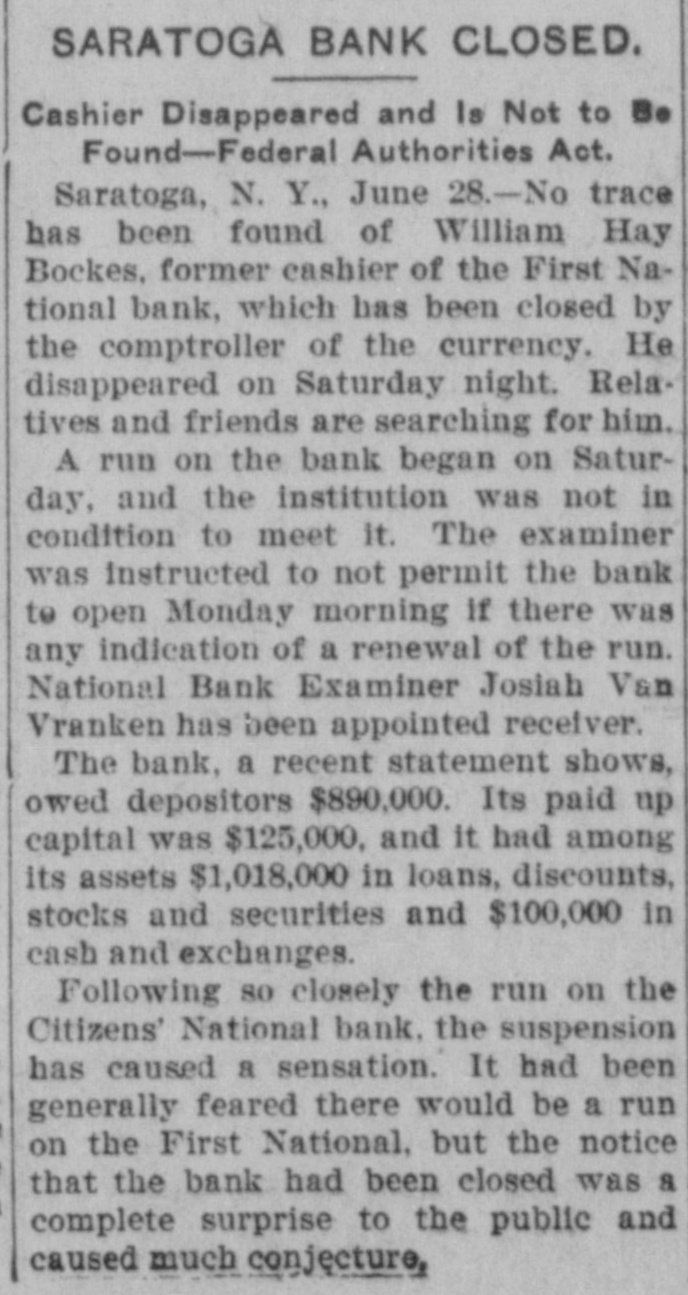
SARATOGA BANK CLOSED. Cashier Disappeared and Is Not to Be Found-Federal Authorities Act. Saratoga, N. Y., June 28.-No trace has been found of William Hay Bockes, former cashier of the First National bank, which has been closed by the comptroller of the currency. He disappeared on Saturday night. Relatives and friends are searching for him. A run on the bank began on Saturday, and the institution was not in condition to meet it. The examiner was instructed to not permit the bank to open Monday morning If there was any indication of a renewal of the run. National Bank Examiner Josiah Van Vranken has been appointed receiver. The bank, a recent statement shows, owed depositors $890,000. Its paid up capital was $125,000, and it had among its assets $1,018,000 in loans, discounts, stocks and securities and $100,000 in cash and exchanges. Following so closely the run on the Citizens' National bank. the suspension has caused a sensation. It had been generally feared there would be a run on the First National, but the notice that the bank had been closed was a complete surprise to the public and caused much conjecture,


Article from Grant County Herald, June 29, 1904

Click image to open full size in new tab

Article Text

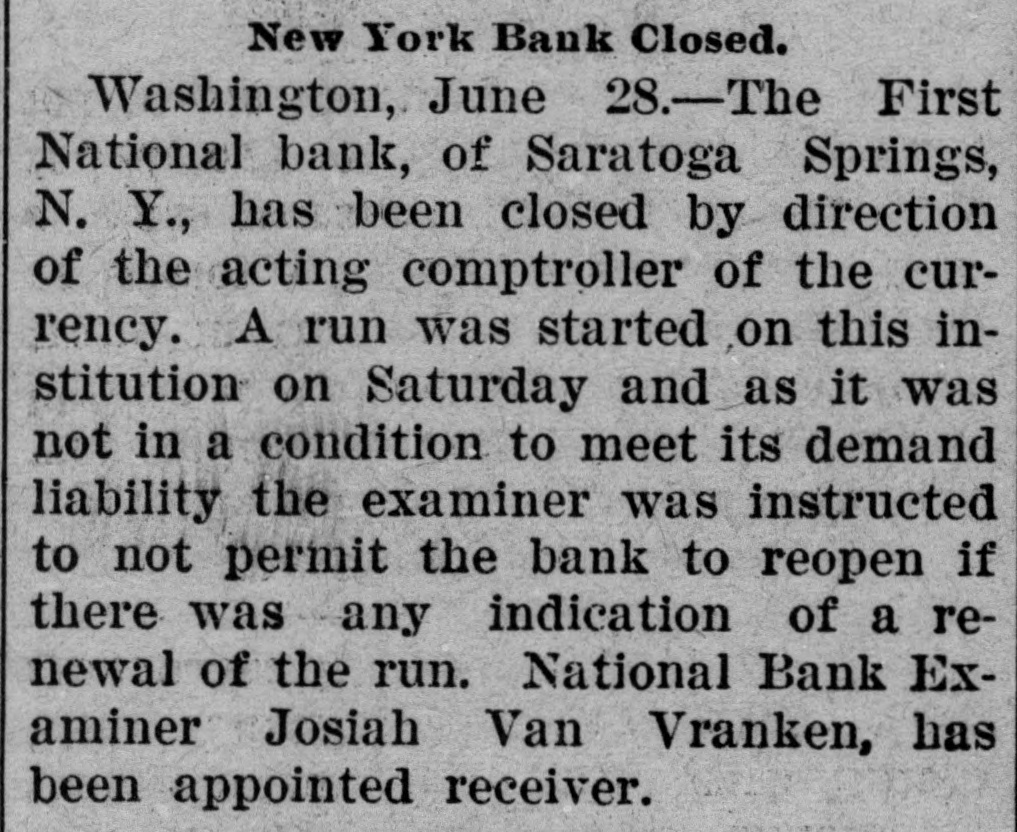
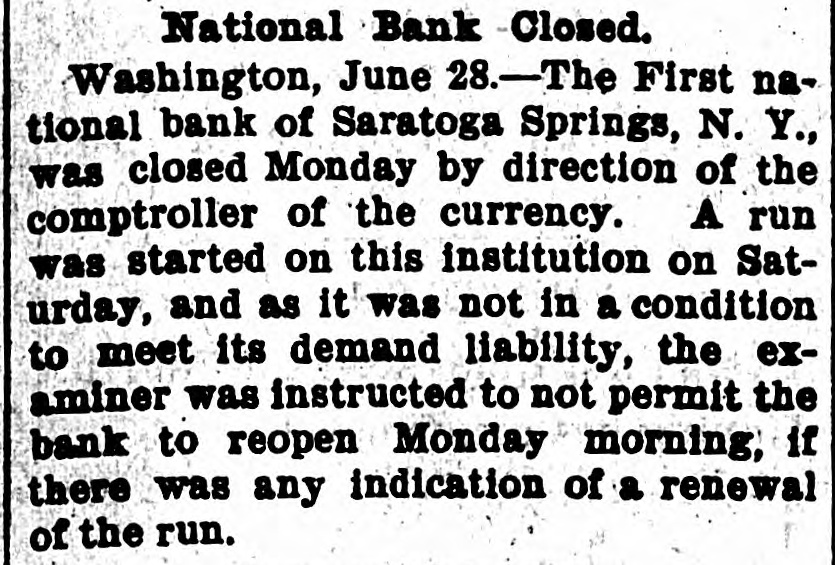
New York Bank Closed. Washington, June 28.-The First National bank, of Saratoga Springs, N. ยฅ., has been closed by direction of the acting comptroller of the currency. A run was started on this institution on Saturday and as it was not in a condition to meet its demand liability the examiner was instructed to not permit the bank to reopen if there was any indication of a renewal of the run. National Bank Examiner Josiah Van Vranken, has been appointed receiver.


Article from The Cooperstown Courier, July 7, 1904

Click image to open full size in new tab

Article Text

THE NEWS IN BRIEF. For the Week Ending July 1. Clement Scott, the dramatic critic. died in London, after a prolonged ill ness. A cablegram from Manila announces the death there of Archbishop Guidi. Heart failure was the cause of death. In a quarrel between John Wainscott and Channely Cardinal at Madison, Ind. Cardinal shot and instantly killed Wainscott. The forty-third annual convention of the National Education association formally convened at the world's fair grounds at St. Louis. The first national bank of Saratoga Springs, N. Y., was closed by direction of the comptroller of the currency. A run on the institution caused the failure the of vicinity An unusually Belton, heavy Mo., hail and storm Manhatton in Kan., has done much damage to crops and orchards and broken hundreds ol winodw panes. Through the accidental explosion of & rocket at Kiel, Germany, on board the cruiser Juno, one of the English vessels escorting the royal yacht, two of the crew were killed. Prof. W. J. Hussey, of the University of de at Lick has partment California astronomical observatory, just announced his discovery of 100 new double stars. James Dewar, a wealthy Scotchman he likes so has a 700-acre says purchased America he farm well in he North to Carolina, on which proposes reside three months in the year. A locomotive boiler exploded on the Pennsylvania railroad while going up the mountain, 50 yards from Ehrenfeld station, Pa., killing three men. injuring two others, one of them fatally. wind seriously the wheat damaged Heavy rain, crop and in hall the central of Kansas. of portion have been Large fields by wheat flattened out the storm. The harvest was about to begin. John B. Stewart, 53 years of age, was almost husband of his shot and step-daughter, instantly killed Samuel by the 24 of at in as the a Peck, Collinwood, years O., age, result their of home family row. Nine millions of acres of government land in Nebraska have been thrown open to homestead entry Tuesday under the provisions of the Kinkaid law. file by which homesteaders may upon 640 acres. Col. Edward Butler, a prominent St. Louis politician, came into court in answer to a bench warrant charging him with bribing a witness. He was released on a bond of $10,000, with John O'Brien as surety. New York Central locomotive, No. 999, the run the State made Empire famous as express, first engine and to which was exhibited at the Chicago world's fair, is now hauling a milk train in New York state. Frederick Field Bullard, a wellknown organist and musical composer, died in Boston of are known compositions pneumonia. Ferrara" "The His Stein best- and Song," "The Sword of "The Nottingham Hunt." The stockholders of the State National bank of the Euclid of and consolidate Park bank the Cleveland, O., voted to The to iaztion two converns. amounts $2,000,000. combined The capital- deposits aggregate $12,000,000. James Cowan, a Mojave, Cal., miner, charged with the murder of James a who was at on March 19, was of Cummings, Mojave negro, conviced lynched The jury the to the mercy manslaughter. prisoner of recommended the court. T. a young his was shot physician, Dr. Seymour Jarrecki, and killed at home Col. Two shots were in Denver, entering his body fired, one bullet near the heart. Apparently he had been called to the door and assassinated. The murderer escaped. bureau at Washington the estimates The pension that "unknown army" of veterans made eligible for pensiona under the new order of President Roosevelt will not exceed 25,000 men, and of these less than 3,000 have applied for pensions. exthat former presses Judge hope George Gray, of Delaware, President will be nominated for Grover presidency Cleveland by the St. Louis the convention. Next to Cleveland he favors Judge


Article from The Ely Miner, July 8, 1904

Click image to open full size in new tab

Article Text

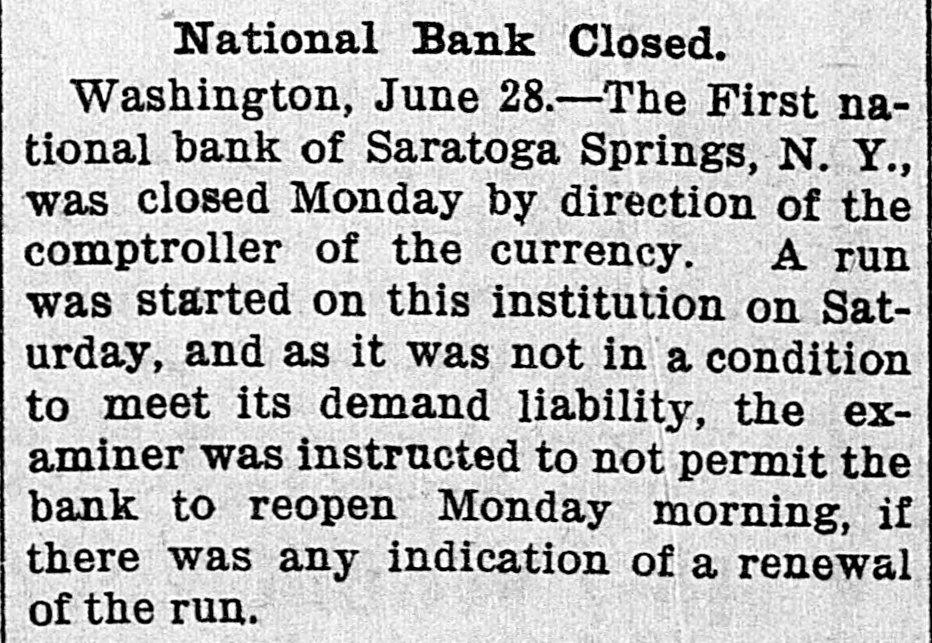
A WEEK'S RECORD All the News of the Past Seven Days Condensed. HOME AND FOREIGN ITEMS News of the Industrial Field, Personal and Political Items, Happenings at Home and Abroad. THE NEWS FROM ALL THE WORLD DOMESTIC. Three persons lost their lives and half dozen others were injured as the result of the explosion of a small bundle of fireworks in the storeroom of the Diamond Fireworks company in Philadelphia .Harry Jacobs, Harry Brooker and John Bloom were drowned by the accidental capsizing of a boat in which they were making a fishing trip on the Illinois river, near Morris, Ill. The First national bank of Saratoga Springs, N. Y., was closed by direction of the comptroller of the currency. A run on the institution caused the failure. New York Central locomotive, No. 999 made famous as the first engine to run the Empire State express, and which was exhibited at the Chicago world's fair, is hauling a milk train in New York. John B. Stewart, 53 years of age, was shot and almost instantly killed by the husband of his step-daughter, Samuel Peck, 24 years of age, at their home in Collinwood, O., as the result of a family row. A small blaze which started in a jewelry store resulted in a general conflagration which destroyed the main portion of the town of Sisson, Cal. Loss, $300,000. George Rice, of Ohio, who for 30 years has been fighting the Standard Oil company, filed a suit in the New Jersey court under the federal anti-trust laws, seeking the dissolution of the combine as an illegal corporation. The decision of the supreme court in the Northern Securities case is relied upon in the prosecution Railroads are preparing to make a campaign for a law legalizing pooling of traffic Western roads are seeking a remedy for the alarming number of claims made for losses and damage on account of overs, shorts and bad orders in freight. Frank L. Stewart is held in New York on the charge of stealing $600 worth of jewelry from Henry B. Kingsley of Rutland, Vt. who disappeared from that city last November Customs officers in New York discovered a false bulkhead on the steamer Indrawadi, behind which was hidden $8,000 worth of smuggled goods. The coroner's jury, after investigation of the General Slocum disaster, returned a verdict declaring the immense loss of life due to misconduct on the part of the directing owners of the vessel, charging the captain and chief equipment officer with criminal responsibility, accusing the mate of cowardly conduct and censuring Government Inspector Lundberg. Warrants for the accused men were issued and several arrests made. Helen Keller, the deaf, dumb and blind young woman, received the degree of bachelor of arts, with high honors, at Radcliffe college. Rumor of finding the body of Assistant Secretary of State Loomis' brother near Cherbourg, France, is declared false, and a witness reiterates he saw Loomis land at Plymouth. Syracuse university won the eightoared race in the intercollegiate regatta at Poughkeepsie, with Cornell in second place. Wisconsin finished sixth and last. Charles A. Gutke, member of St. Louis house of delegates' combine, confessed details of boodle transactions. Casualties in various parts of the country cost 18 lives. A 14-year-old colored boy at Lexington, Ky. received 50 lashes in the public square by order of a police judge. Thousands rushed to enter homesteads on a 9,000,000 acre tract of government land in Nebraska. The National Educational association convened in St. Louis, with 30,000 in attendance. Shippers' associations have been organized to fight the "uniform bill of lading" and other disputes with railroads. The weather bureau has issued a report that the corn crop is practically made in many sections. As the result of a rowboat capsizing in the Allegheny river at Pittsburg, Henry Hillston and Earnest Halbey were drowned, and two companions had a narrow escape from a similar fate. Benjamin Rhodes and Wilson Reed, contractors of Springfield, Ill., were killed Tuesday while engaged in sinking a new shaft. The hook on the bucket in which they were being lowered into the shaft broke, letting them fall 90 feet. A heavy wind and hail storm at La Cross, Wis., wrecked a building at the interstate fair grounds and huge trees were uprooted. The damage to crops was heavy. An attempt was made to lynch Charles L. Allison, a well-known citizen and Sunday school worker of South Haven, Mich. who was arrested on the charge of criminally assaulting four-year-old Edith Secor.


Article from The L'anse Sentinel, July 9, 1904

Click image to open full size in new tab

Article Text

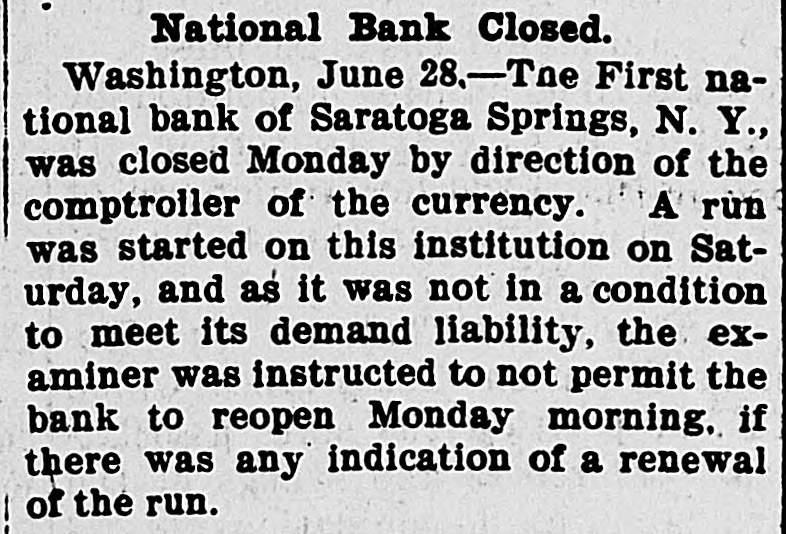
A WEEK'S RECORD All the News of the Past Seven Days Condensed. HOME AND FOREIGN ITEMS News of the Industrial Field, Personal and Political Items, Happenings at Home and Abroad. THE NEWS FROM ALL THE WORLD DOMESTIC. Three personslo their lives and a half dozen others were injured as the result of the explosion of a small bundle of fireworks in the storeroom of the Diamond Fireworks company, in Philadelphia. Harry Jacobs, Harry Brooker and John Bloom were drowned by the accidental capsizing of a boat in which they were making a fishing trip on the Illinois river, near Morris, III. The First national bank of Saratoga Springs, N. Y., was closed by direction of the comptroller of the currency. A run on the institution caused the failure. New York Central locomotive, No. 999. made famous as the first engine to run the Empire State express, and which was exhibited at the Chicago world's fair, is hauling a milk train in New York. John B. Stewart, 53 years of age, was shot and almost instantly killed by the husband of his step-daughter, Samuel Peck, 24 years of age, at their home in Collinwood, O., as the result of a family row. A small blaze which started in a jewelry store resulted in a general conflagration which destroyed the main portion of the town of Sisson, Cal. Loss, $300,000. George Rice, of Ohio, who for 30 years has been fighting the Standard Oil company, filed a suit in the New Jersey court under the federal anti-trust laws, seeking the dissolution of the combine as an illegal corporation. The decision of the supreme court in the Northern Securities case is relied upon in the prosecution. Railroads are preparing to make a campaign for a law legalizing pooling of traffic. Western roads are seeking a remedy for the alarming number of claims made for losses and damage on account of overs, shorts and bad orders in freight. Frank L. Stewart is held in New York on the charge of stealing $600 worth of jewelry from Henry B. Kingsley, of Rutland. Vt., who disappeared from that city last November. Customs officers in New York discovered a false bulkhead on the steamer Indrawadi, behind which was hidden $8,000 worth of smuggled goods. The coroner's jury, after investigation of the General Slocum disaster, returned a verdict declaring the immense loss of life due to misconduct on the part of the directing owners of the vessel, charging the captain and chief equipment officer with criminal responsibility, accusing the mate of cowardly conduct and censuring Government Inspector Lundberg. Warrants for the accused men were issued and several arrests made. Helen Keller, the deaf, dumb and blind young woman, received the degree of bachelor of arts, with high honors, at Radcliffe college. Rumor of finding the body of Assistant Secretary of State Loomis' brother near Cherbourg, France, is declared false, and a witness reiterates he saw Loomis land at Plymouth. Syracuse university won the eightoared race in the intercollegiate regatta at Poughkeepsie, with Cornell in second place. Wisconsin finished sixth and last. Charles A. Gutke, member of St. Louis house of delegates' combine, confessed details of boodle transactions. Casualties in various parts of the country cost 18 lives. A 14-year-old colored boy at Lexington, Ky., received 50 lashes in the public square by order of a police judge. Thousands rushed to enter homesteads on a 9,000,000 acre tract of government land in Nebraska. The National Educational association convened in St. Louis, with 30,000 in attendance. Shippers' associations have been organized to fight the "uniform bill of lading" and other disputes with railroads. The weather bureau has issued a report that the corn crop is practically made in many sections. As the result of a rowboat capsizing in the Allegheny river at Pittsburg, Henry Hillston and Earnest Halbey were drowned, and two companions had a narrow escape from a similar fate. Benjamin Rhodes and Wilson Reed, contractors of Springfield, III., were killed Tuesday while engaged in sinking a new shaft. The hook on the bucket in which they were being lowered into the shaft broke, letting them fall 90 feet. A heavy wind and hall storm at La Cross, Wis., wrecked a building at the interstate fair grounds and huge trees were uprooted. The damage to crops was heavy. An attempt was made to lynch Charles L Allison, a well-known citizen and Sunday school worker of South Haven, Mich, who was arrested on the charge of criminally assaulting four-year-old Mdith Secor.


Article from Evening Journal, August 2, 1904

Click image to open full size in new tab

Article Text

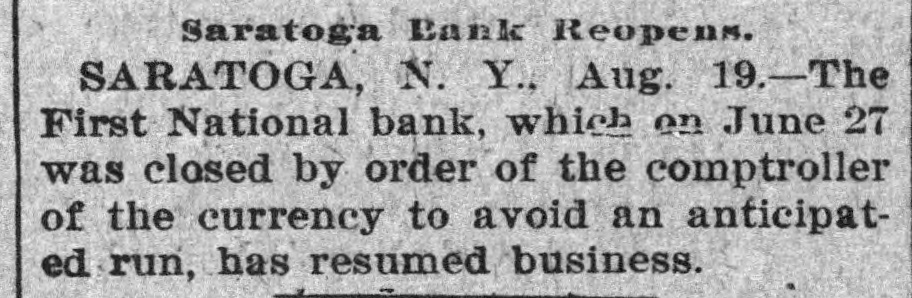
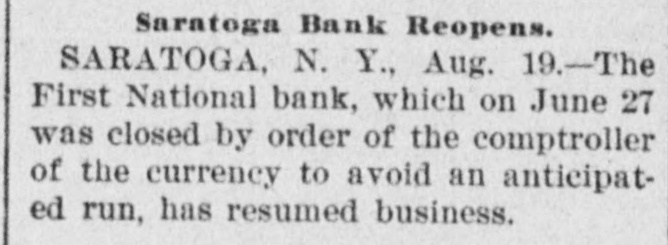
Stockholders to Pay Big Assessment. Saratoga, N. Y., Aug. 2.-The stockholders of the First National bank have consented to a 90 per cent assessment on the par value of the stock, payable Aug. 6. This was required by the comptroller of the currency in order to reopen the bank, which was recently closed to escape a run.


Article from The Barre Daily Times, August 3, 1904

Click image to open full size in new tab

Article Text

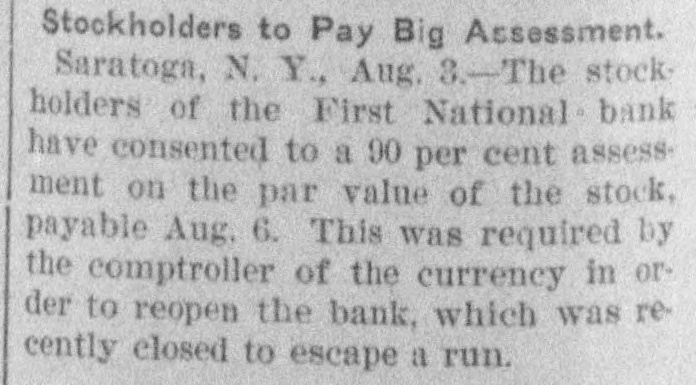
Stockholders to Pay Big Assessment. Saratogn, N. Y., Aug. 3.-The stockholders of the First National bank have consented to a 90 per cent assessment on the par value of the stock, payable Aug, 6. This was required by the comptroller of the currency in order to reopen the bank, which was recently closed to escape a run.


Article from The Providence News, August 18, 1904

Click image to open full size in new tab

Article Text

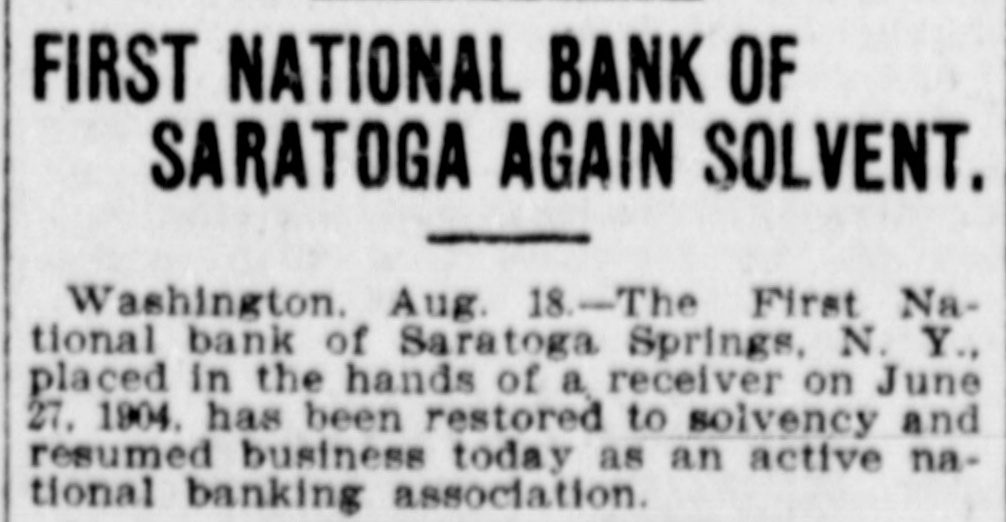
FIRST NATIONAL BANK OF SARATOGA AGAIN SOLVENT. Washington. Aug. 18.-The First National bank of Saratoga Springs, N. Y., placed in the hands of a receiver on June 27, 1904. has been restored to solvency and resumed business today as an active national banking association.


Article from Alexandria Gazette, August 18, 1904

Click image to open full size in new tab

Article Text

From Washington. [Cor:espondence of the Alexandria Gazette.] Washington, D. C., Aug. 18. The First National Bank of Saratoga, New York, which suspended payment and was placed in the hands of a receiver on June 27 has been restored to solvency and resumed business today as an active national banking association. Minister Griscom at Tokio, cables the State Department the official information that the Russian commander yesterday rejected Japanese summons to surrender Port Arthur and also the Japanese offer for the removal of noncombatants. The Panama National Assembly has prepared its diplomatic roll and fixed the salaries of the gentlemen who will carry on negotiations for the new republic with foreign nations. The envoy extraordinary to the United States is to receive $8,000 a year; the minister resident, $6,000; the charge d' affairs, $5,000; secretary of legation, $4,000; and so on down the list to the lowest notch, that of vice consul, who will receive $1,600 a year. Mrs. Mary C. Wise was today appointed postmaster at Springvale, Fairfax county, Va., vice George W. Wise, deceased. Large numbers of people left here today to witness the firemen's parade in Alexandria.


Article from New-York Tribune, August 19, 1904

Click image to open full size in new tab

Article Text

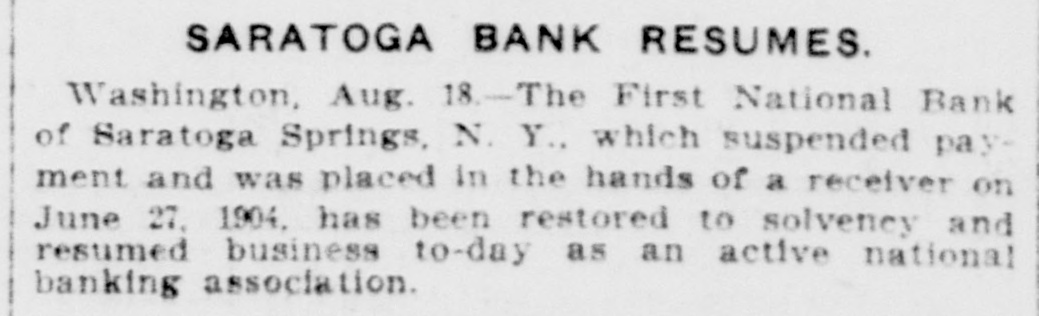
SARATOGA BANK RESUMES. Washington, Aug. 18.-The First National Bank of Saratoga Springs, N. Y., which suspended payment and was placed in the hands of a receiver on June 27. 1904. has been restored to solvency and resumed business to-day as an active national banking association.


Article from Daily Kennebec Journal, August 19, 1904

Click image to open full size in new tab

Article Text

The First National Bank of Saratoga Springs, N. Y., which suspended payment and was placed in the hands of a receiver on June 27, 1904. has been restored to solvency and resumed business, Thursday, as an active national banking association.


Article from The Barre Daily Times, August 19, 1904

Click image to open full size in new tab

Article Text

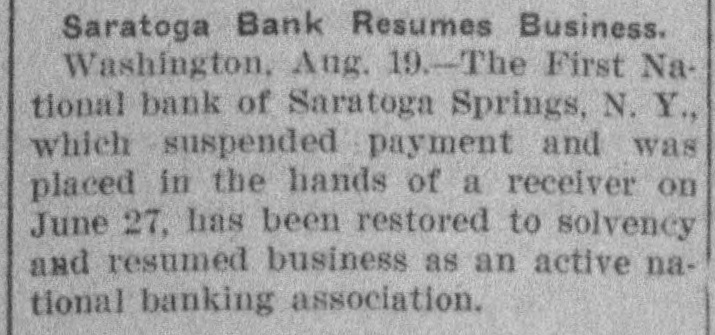
Saratoga Bank Resumes Business. Washington, Aug. 19.-The First National bank of Saratoga Springs, N. Y., which suspended payment and was placed in the hands of a receiver on June 27, has been restored to solvency and resumed business as an active national banking association.


Article from The Birmingham Age-Herald, March 12, 1908

Click image to open full size in new tab

Article Text

FINANCIAL BILL HOTLY DENOUNCED Senator Clarke of Arkansas Hits Several Fierce Blows ALDRICH ATTEMPTS REPLY Investigation of Causes of the Panic Is Demanded by Senator Clarke, Who Also Denounces New York Stock Exchange. Washington, March 11.-Senator Clarke of Arkansas denounced the pending currency bill in a speech in the Senate today, declaring that no currency legislation should be enacted until an investigation is held as to the causes of the panic. "No such legislation is necessary now, said Mr. Clarke. "It is not only not necesI sary, but it may become dangerous. am not disposed to tolerate the idea of giving any support to the committee bill, nor the substitute proposed by the minority members of the Senate." If emergency currency is to be provided, Mr. Clarke said, the benefits should be extended all persons whose legitimate business demands cause them to need it. Mr. Clarke denounced the operations of stock exchanges and said the American people would not be satisfied with the proposed currency legislation without a complete knowledge of causes of the panic. "The time has arrived," he said, "when the affairs of the New .York stock exchange and other stock exchanges must be looked into." Mr. Clarke's reference to the stoppage of the payments by the New York banks called Mr. Aldrich to his feet with the remark that he did not believe the people would permit that course again to be pursued. "I trust the senator from Rhode Island as a historian," retorted Mr. Clarke, "but I do not trust him as a prophet." Mr. Clarke expressed the opinion that the majority would not pass the bill allowing the emergency circulation to be retired without limitation. Mr. Clarke said he would not only require a restriction of reserves, but he would deny to a national bank the right to pay interest on checking accounts. Senator Nelson suggested that the national banks should pay interest on the $250,000,000 of government deposits. Mr. Aldrich said that five years ago he had introduced a bill providing for the payment of interest on such deposits at the rate of 1 1/2 per cent, but, he added, senators had opposed that bill on the ground that it changed the nature of the loan. Former Senator Spooner and the late Senator Morgan, he said, opposed the bill. If that objection could be overcome he declared his willingness to again bring in such a measure. He did not know any reason unless it should be a legal one, of the kind suggested, why interest should not be charged on these deposits. Mr. Culberson, he said, had introduced a bill to require payment of interest on government deposits and it was now before the committee on finance. Mr. Bailey spoke at some length suggesting that the main purpose of his substitute was to favor the principle of government money instead of bank money He explained that he had provided for a distribution of the emergency currency in accordance with population, although he realized that business necessity was a greater measure of the amount they should have. But it was not possible to make sure of the business needs of the several sections and it was a simple matter to ascertain the population. An extended argument was made by Mr. Newlands of Nevada in favor of his view that the sending of a check from one state to another makes the business of banking interstate commerce.