Article Text
The report says:
The Comptroller of the Currency, J. F. T. O'Connor, announced that during the month of April, 1935, the receiverships of 13 insolvent national banks were liquidated and finally closed and 4 receiverships were restored to solvency. During the same month, receivers were appointed for 2 national banks formerly in voluntary liquidation resulting in a net reduction of 15 receiverships for the month and leaving a total of 1524 national bank receiverships as of the close of business April 30, 1935.
The Citizens National Bank of Eureka, Kansas, was placed in receivership on February 23, 1934, and on April 2, 1935, the bank was restored to solvency. The secured and preferred creditors were paid 100 per cent principal and the unsecured depositors were paid 70 per cent of their claims and received participation certificates in certain trusteed assets for the remaining 30 per cent of the claims.
The National Bank of Wyoming, Illinois, was placed in receivership on October 25, 1933, and on April 18, 1935, the bank was restored to solvency. The secured and preferred creditors were paid 100 per cent principal and the unsecured depositors were paid 60 per cent of their claims and received participation certificates in certain trusteed assets for the remaining 40 per cent of the claims.
The Farmers National Bank of Aledo, Illinois, was placed in receivership on October 30, 1933, and on April 4, 1935, the bank was restored to solvency. The secured and preferred creditors were paid 100 per cent principal and the unsecured depositors were paid 50 per cent of their claims and received participation certificates in certain trusteed assets for the remaining 50 per cent of the claims.
The First National Bank of Chickasha, Okla., was placed in receivership on July 5, 1934, and on April 26, 1935, the bank was restored to solvency. All depositors and other creditors received 100 per cent principal payment.
The New Georgia National Bank of Albany, Georgia, was placed in receivership on January 4, 1928, and disbursements, including offsets allowed, to depositors and other creditors aggregated $923,270, which represented 73.9 per cent of total liabilities at date of failure. Unsecured depositors received dividends amounting to 44.48 per cent of their claims.
The First National Bank of Champlain, New York, was placed in receivership on March 19, 1931, and disbursements, including offsets allowed, to depositors and other creditors aggregated $992,529, which represented 78.3 per cent of the total liabilities at date of failure. Unsecured depositors received 77.434 per cent of their claims.
The Reed City National Bank of Reed City, Mich., was placed in receivership on May 2, 1929, and disbursements, including offsets allowed, to depositors and other creditors aggregated $110,339, which represented 46.8 per cent of the total liabilities at date of failure. Unsecured depositors received 33.65 per cent of their claims.
The Globe National Bank of Denver, Colo., was placed in receivership on October 1, 1925, and disbursements, including offsets allowed, to depositors and other creditors aggregated $3,589,582, which represented 76.5 per cent of the total liabilities at date of failure. Unsecured depositors received 62.539 per cent of their claims.
The First National Bank of Langdon, North Dakota, was placed in receivership on April 23, 1931, the liabilities of the institution having theretofore been assumed by another bank. The receiver was appointed for the purpose of collecting an assessment against the stockholders for the benefit of the purchasing bank which was the sole creditor of the receivership and which received dividends amounting to 17.28 per cent of the aggregate sum of $10,003.
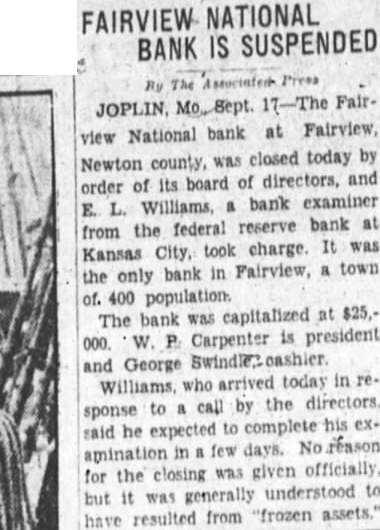
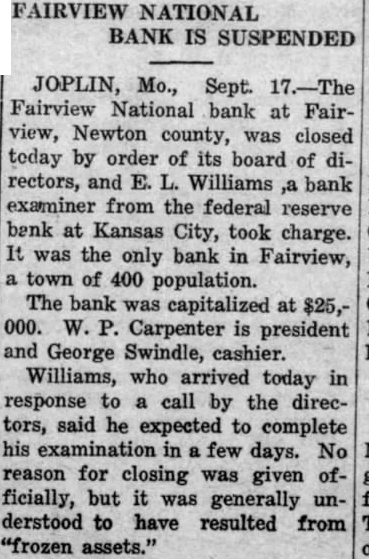
The First National Bank of Fairview, Mo., was placed in receivership on September 7, 1930, and disbursements, including offsets allowed, to depositors and other creditors amounted to $54,665, which represented 71.8 per cent of the total liabilities at date of failure. Unsecured depositors received 51.4 per cent of their claims.