National Park Bank (New York, NY)

Episode Information

Episode UID
89101106
Episode Type
Suspension โ†’ Reopening
Bank Type
national
Bank ID
8910 national
Charter Number
891
Start Date
February 1, 1892*
Location
New York, New York (40.714, -74.006)

Metadata

Model
gemini-3-flash-preview (chosen from majority vote of a three-model LLM ensemble)
Short Digest
459944124b0aba26

Response Measures

None

Description

The bank participated in a city-wide collective suspension of gold/specie payments from February 1892 until November 1896, which was distinct from the 1893 savings bank runs.

Events (4)

1. March 14, 1865 Chartered
Source
historical_nic
2. February 1, 1892* Suspension
Cause
Macro News
Cause Details
Collective action by New York banks to refuse gold payments for export and government dues to protect reserves.
Newspaper Excerpt
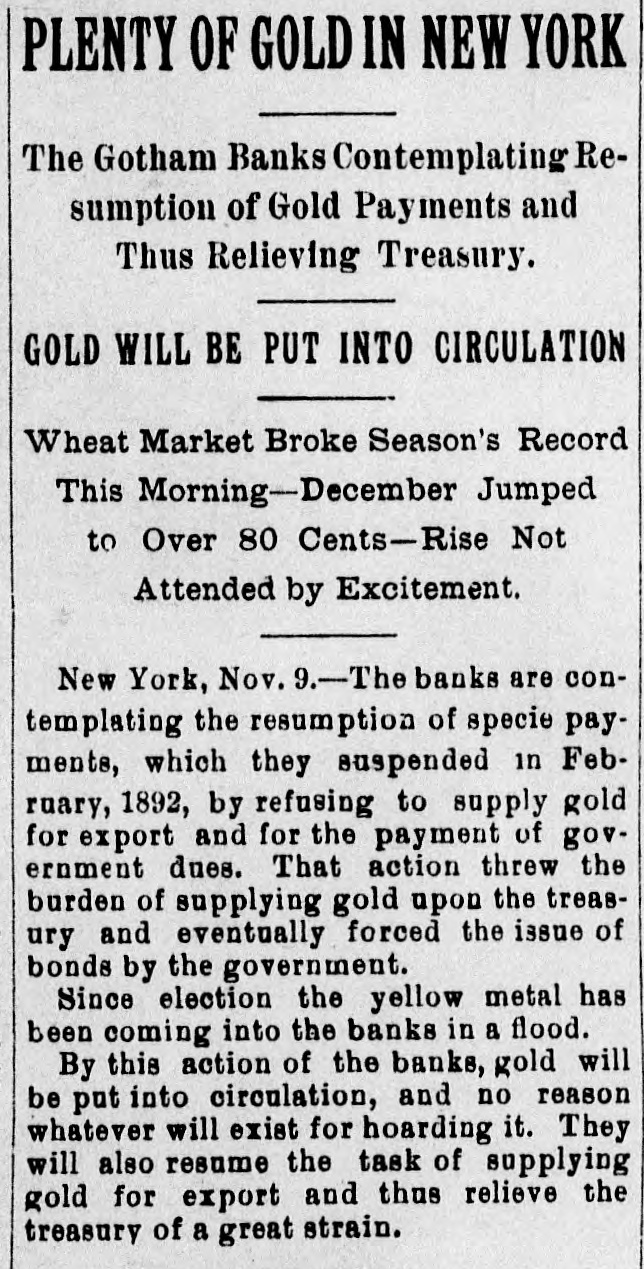
The banks are contemplating the resumption of specie payments, which they suspended in February, 1892, by refusing to supply gold for export and for the payment of government dues.
Source
newspapers
3. June 24, 1893 Other
Newspaper Excerpt
Judge Lacombe... and the Controller of the Currency have assented to the compromise of the suit of Daniel C. Baxter, receiver of the Ninth National Bank, of Dallas, Tex., against the National Park Bank.
Source
newspapers
4. November 9, 1896 Reopening
Newspaper Excerpt
The banks are contemplating the resumption of specie payments, which they suspended in February, 1892... Since election the yellow metal has been coming into the banks in a flood.
Source
newspapers

Newspaper Articles (21)

Article from New-York Tribune, March 23, 1892

Click image to open full size in new tab

Article Text

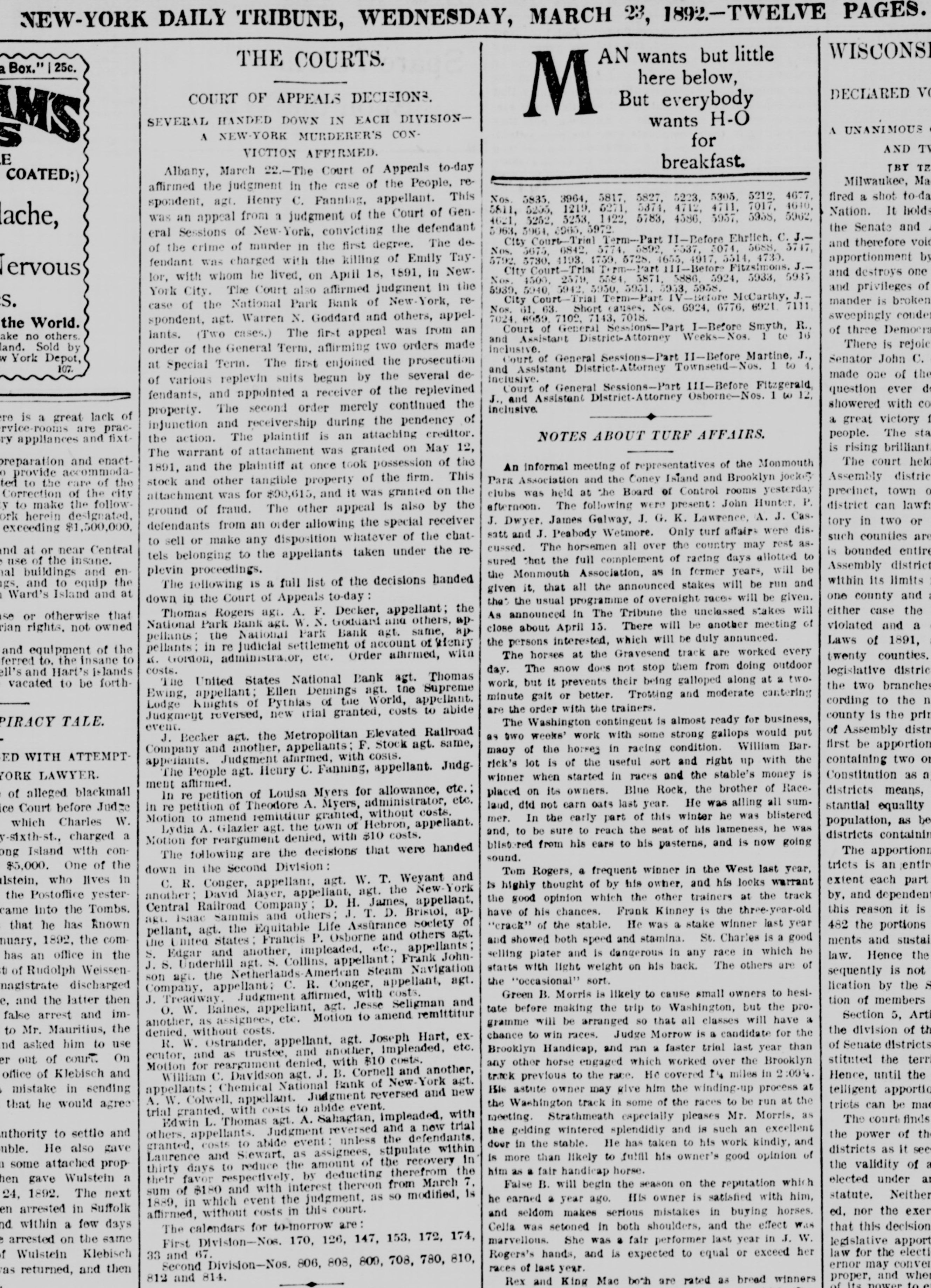
NEW-YORK DAILY TRIBUNE, WEDNESDAY, MARCH 23, 1892.-TWELVE PAGE WISCON AN wants but little THE COURTS. 25c. Box. here below, DECLARED COURT OF APPEALS DECISIONS. But everybody M SEVERAL HANDED DOWN IN EACH DIVISIONwants H-O A UNANIMO A NEW-YORK MURDERER'S CONfor ANI VICTION AFFIRMED. breakfast. TBI Albany, March 22.-The Court of Appeals to-day COATED;) Milwaukee, affirmed the judgment in the case of the People, refired a shot t Nos. 5835, 3964, 5817, 5827, 5223, 5305, 5212, 4677, spondent, agt. Henry C. Fanning, appellant. This 5811, 5205, 1219, 5271, 5374, 4712, 4711, 7017, 4640, Nation. It I was an appeal from a judgment of the Court of Gen4621, 5262, 5253, 1422, 5783, 4586. 5957, 5958, 5962, the Senate a 5963, 5964, 6965, 5972. eral Sessions of New-York, convicting the defendant City Court-Trial Term-Part II-Before Ehrlich, C. J.and therefore of the crime of murder in the first degree. The deNos. 5675, 6842, 5774, 5892, 5537, 5074, 5688, 5747, apportionmen 5792. 5730, 4193, 1759, 5728. 4655, 4917, 5314, 4730. fendant was charged with the killing of Emily Tayervous City Court-Trial Term-Mart 11-Betore Fitzsimons. J.and destroys lor, with whom he lived, on April 18, 1891, in NewNos. 4500, 2579, 5584, 5871. 5886. 5924, 5933, 5935 and privilege 5939. 5940, 5942, 5950. 5951. 5953, 5958. York City. The Court also affirmed judgment in the City Court-Trial Term-Part IV-Before McCarthy, J.mander is bro case of the National Park Bank of New-York, reNos. 61. 63. Short causes, Nos. 6924, 6776, 6921. 7111 sweepingly co 7024, 6959. 7102, 7143, 7018. spondent, agt. Warren N. Goddard and others, appelthe World. Court of General Sessions-Part I-Before Smyth, R., of three Den lants. (Two cases.) The first appeal was from an no others. and Assistant District-Attorney Weeks-Nos. 1 to 16 There is re Sold by order of the General Term. affirming two orders made York inclusive. Court of General Sessions-Part II-Before Martine, J., Depot, Senator John at Special Term. The first enjoined the prosecution 107. and Assistant District-Attorney Townsend-Nos. 1 to 4, made one of of various replevin suits begun by the several deinclusive. Court of General Sessions-Part III-Before Fitzgerald, question eve fendants, and appointed a receiver of the replevined J., and Assistant District-Attorney Osborne-Nos. 1 to 12, showered with inclusive property. The second order merely continued the of is lack a great a great victo injunction and receivership during the pendency of are vice-rooms pracpeople. The NOTES ABOUT TURF AFFAIRS. fixtand the action. The plaintiff is an attaching creditor. appliances is rising brill The warrant of attachment was granted on May 12, enactand The court reparation An informal meeting of representatives of the Monmouth 1891, and the plaintiff at once took possession of the accommodaprovide Assembly di Park Association and the Coney Island and Brooklyn jockey stock and other tangible property of the firm. This care of the to the precinct, tow the clubs was held at the Board of Control rooms yesterday city of Correction attachment was for $90,615, and it was granted on the followthe make to district can ] afternoon. The following were present: John Hunter. P. ground of fraud. The other appeal is also by the herein designated, J. Dwyer. James Galway, J. G. K. Lawrence, A. J. Castory in two defendants from an order allowing the special receiver $1,500,000. exceeding satt and J. Peabody Wetmore. Only turf affairs were dissuch counties to sell or make any disposition whatever of the chatcussed. The horsemen all over the country may rest asor Central near at is bounded e tels belonging to the appellants taken under the reinsane. the of use sured that the full complement of racing days allotted to Assembly dis enand plevin proceedings. buildings the Monmouth Association, as in former years, will be within its Ilm the and to equip The following IS a full list of the decisions handed given it, that all the announced stakes will be run and at Ward's Island and one county a down in the Court of Appeals to-day : the the usual programme of overnight races will be given. either case 1 Thomas Rogers agt. A. F. Decker, appellant; the As announced in The Tribune the unclassed stakes will that otherwise or National Park Bank agt. W. N. Goddard and others, apviolated and owned not rights, close about April 15. There will be another meeting of pellants; the National Park Bank agt. same, ap Laws of 189 the persons interested, which will be duly annunced. the pellants; in re judicial settlement of account of Henry of and equipment The horses at the Gravesend track are worked every twenty count to insane AT. Gordon, administrator, etc. Order attirmed, with the to. day. The snow does not stop them from doing outdoor legislative dis and Hart's islands costs. The United States National Bank agt. Thomas vacated forthbe to work, but it prevents their being galloped along at a twothe two bran Ewing, appellant; Ellen Demings agt. the Supreme minute gait or better. Trotting and moderate cantering cording to th Lodge knights of Pythias of tue World, appellant. are the order with the trainers. county is the Judgment reversed, new trial granted, costs to abide TALE. The Washington contingent is almost ready for business, of Assembly as two weeks' work with some strong gallops would put event. J. Becker agt. the Metropolitan Elevated Railroad first be appoi Company and another, appellants: F. Stock agt. same, many of the horses in racing condition. William BarATTEMPTWITH containing tw appeilants. Judgment athrmed, with costs. rick's lot is of the useful sort and right up with the The People agt. Henry C. Fanning, appellant. JudgConstitution : LAWYER. winner when started in races and the stable's money is ment affirmed. districts mea placed on its owners. Blue Rock, the brother of Raceof alleged blackmail In re petition of Louisa Myers for allowance, etc.; land, did not earn oats last year. He was alling all sumJudge stantial equal before Court in re petition of Theodore A. Myers, administrator, etc. Motion to amend remittitur granted, without costs. mer. In the early part of this winter he was blistered W. Charles population, as which Lydia A. Glazier agt. the town of Hebron, appellant. and, to be sure to reach the seat of his lameness, he was districts conta a charged -sixth-st., Motion for reargument denied, with $10 costs. blistered from his ears to his pasterns, and is now going with conIsland The apport The following are the decisions that were handed sound. the of One tricts is an e $5,000. down in the Second Division: Tom Rogers, a frequent winner in the West last year, in who lives Istein, extent each 1 C. R. Conger, appellant, agt. W. T. Weyant and Is highly thought of by his owner, and his looks warrant Postoffice the yesteranother; David Mayer, appeliant, agt. the New-York by, and depen the good opinion which the other trainers at the track Central Railroad Company; D. H. James, appellant, this reason it Tombs. the into have of his chances. Frank Kinney is the three-year-old age. Isaac Sammis and others; J. T. D. Bristol, apknown has he that "crack" of the stable. He was a stake winner last year 482 the porti pellant, agt. the Equitable Life Assurance Society of comthe ments and st and showed both speed and stamina. St. Charles is a good 1892, the United States: Francis P. Osborne and others agt. in S. Edgar and another, impleaded, etc., appellants; office selling plater and is dangerous in any race in which he has the an law. Hence J. S. Underhill agt. S. Collins, appellant: Frank Johnstarts with light weight on his back. The others are of of WeissenRudolph sequently is son agt. the Netherlands-American Steam Navigation the "occasional" sort. nagistrate lication by tl discharged Company, appellant: C. R. Conger, appellant, agt. Green B. Morris is likely to cause small owners to hesiJ. Treadway. Judgment affirmed, with costs. then and latter the tion of memb tate before making the trip to Washington, but the proO. W. Baines, appellant, agt. Jesse Seligman and imand arrest Section 5, another, as assignees, etc. Motion to amend remittitur gramme will be arranged so that all classes will have a the Mr. the division ( to Mauritius, denied, without costs. chance to win races. Judge Morrow is a candidate for the R. W. Ostrander, appellant, agt. Joseph Hart, exuse to him asked of Senate dist Brooklyn Handicap, and ran a faster trial last year than ecutor, and as trustee, and another, impleaded, etc. On court. of out stituted the any other horse engaged which worked over the Brooklyn Motion for reargument denied, with $10 costs. and Klebisch of Hence, until William C. Davidson agt. J. B. Cornell and another, track previous to the race. He covered I'm miles in 2:094. in mistake sending His astute owner may give him the winding-up process at appellants Chemical National Bank of agt. telligent app A. W. Colwell, appellant. Judgment reversed and new would the Washington track in some of the races to be run at the that he tricts can be agree trial granted. with costs to abide event. meeting. Strathmeath especially pleases Mr. Morris, as The court f Edwin L. Thomas agt. A. Sahagian, impleaded, with the gelding wintered splendidly and is such an excellent and settle to ithority others. appellants. Judgment reversed and a new trial the power of door in the stable. He has taken to his work kindly, and granted, costs to abide event: unless the defendants, also He gave districts as It Laurence and Slewart, as assignees, stipulate within Is more than likely to fulfil his owner's good opinion of attached some propthe validity thirty days to reduce the amount of the recovery In him as fair handicap horse. a Wulstein gave their favor respectively. by deducting therefrom the elected under False B. will begin the season on the reputation which sum of $180 and with interest thereon from March 7. next The 1892. statute. Nei he earned year ago. His owner is satisfied with him, 1889, in which event the judgment, as so modified, is Suffolk in arrested ed, nor the and seldom makes serious mistakes in buying horses. affirmed, without costs in this court. few a within days that this deci Cella was setoned in both shoulders, and the effect was The calendars for to-morrow are: same the on arrested marvellous. She was fair performer last year in J. W. legislative ap First Division-Nos. 170, 126, 147, 153, 172, 174, law for the el Klebisch Wulstein 33 and 67. Rogers's hands, and is expected to equal or exceed her ernor may co Second Division-Nos. 806, 808, 809, 708, 780, 810, then and races of last year. returned, proper, and 812 and 814. Rex and King Mac both are rated as bread winners of Its nower

Article from The Caucasian, February 16, 1893

Click image to open full size in new tab

Article Text

# SUSPENSION OF SPECIE AND LEGAL TENDER PAYMENTS IN NEW YORK AND SUPPRESSION OF THE FACT AT THE PUBLIC PRESS. It is Difficult to Believe it but the Govern- ment has to Make Concessions to the Gold Devils. # REPUBLICANS AND DEMOCRATS COMBINING. (Independent News Ass'n Dispatch) WASHINGTON, D. C., Feb. 15. If the press associations cannot now be convicted of standing in with the Wall Street Gang then the Republic is drunken with folly. In 1862 the nation was plunged headlong into bankruptcy, and chained a captive debtor to the stock Tiger, by the public press, seduced by the purposes of the Bank of England. Today the harlot press rides IN the coach with the yellow monarch; for Specie Payments have been suspended in New York the past week, and legal tender refused! The plutocratic press will deny this, but is the truth! The Independent News Association got it by private (gain) wire N. Y. to Chicago, and to Washington-not sent in Mondays report, not being confirmed. It is now confirmed. And it is urged to belittle the matter, that this refusal of banks to pay out gold "or even legal tenders," had the effect to "once more start agitation!" But it is said to us that this refusal of banks to "part with their gold" really amounts to nothing, inasmuch as the United States treasury is the "actual gold reserve of the nation." Yes, but the total government funds at liberty are but $25,000,000!-and the expenditures the last seven months have been largely in excess of receipts! and the coming year insures a still worse condition! We not only deny that the government has gold to send out, but maintain emphatically that this great Republic is a beggar on its knee bones to New York Banks, making overtures and terms for gold for current use! Charged with this, Foster says he don't want to talk on the subject; that he employed no "unusual" means to obtain gold from the banks! Nor did he explain where next week's export would come from! They are treading on the verge of an abyss. Our desperate informant assures us that "legitimate talk of premium on gold [it is already paid by France in our market] is out of the question unless the government refuses to give gold!" But how can the government "give" without buying, or rescinding its rule permitting imports to be paid in paper. This matter may be but temporary, but it shows the desperate danger of a single-standard, gold-bug policy. The Ind. News Ass'n positively asserts that at this very hour, France. a Silver $50 a-head nation is paying interest-in-transit to draw in gold while the trained idiots across the ocean kill silver, have $10 a-head money, and-lose their gold! The republican party is in rapid process of absorption into the one great Cleveland legion of plutocracy. Harrison even appoints a democrat to the supreme judgeship and Cleveland selects a republican to go into his cabinet. Radical republicans are howling, crazy mad! Papers will not give on-tenth of the sulphurous eruption. Lest it be suppressed we send a copy of J. S. Clarkson's telegram to Houk: HON. JOHN C. HOUK.-Harrison's betrayal of republican principles and abandonment of the helpless republicans of the south by the appointment of Jackson to the supreme bench is an outrage that no self-respecting republican can either endorse or forgive. I have sent protest to Senator Cullom one of the old time republican leaders. Please see it. JAMES S. CLARKSON. Houk, a southern republican responds in even stronger language. But it is of no use to protest. It was fixed up in New York, with the full knowledge of Grover Cleveland and both the military centralization in this country and the silver brick case entered into consideration, and party interests did not. The proof of this will appear before Cleveland's first three months are over. It is plutocracy or the people-and Cleveland is plutocracy. "Siva" published truths in his prophecies of Cleveland and Empire, six years ago. Cleveland and Carlisle talked Jackson before Harrison did, and Wall Street played the game. An amusing episode took place in the House one morning recently, just before the session began. Chief Wolf of the Paloise tribe of Washington Indians in all the glory of a red blanket and red paint, was taking in the sights. After strolling around the hall for a while he walked up to the Speaker's chair and taking a seat therein and calmly surveyed the members who were in their seats reading newspapers or writing letters. While he was sitting there a witty member remarked: "That's the first savage who has occupied the Speaker's chair since Reed vacated it." Reed was sitting near by and heard the remark, and he joined in the laugh which followed. Outrageous falsehoods have been scattered throughout the west about Senator Kyle-stating that he voted against a bill to permit settlers to prove up tree claims as homesteads after a term of years. The absolute fact is that the populist Senator Kyle, of South Dakota, was the father of the bill, and Senator Pettigrew, republican of South Dakota, the man who smothered Kyle's bill. The Ind. News Ass'n has looked the matter up on request of a South Dakota journal, and Pettigrew does not appear well on the record. # GOLD KINGS SNUBBED AGAIN. The bill to repeal the Sherman law received its quietus in the house on Thursday afternoon. The galleries were crowded, and a great debate expected. But it was cut off by a few time speeches and a motion for the previous question-which carried by 153 yeas to 141 nays. It was then promptly voted by two to one to recommit the bill. It is there.


Article from New-York Tribune, June 24, 1893

Click image to open full size in new tab

Article Text

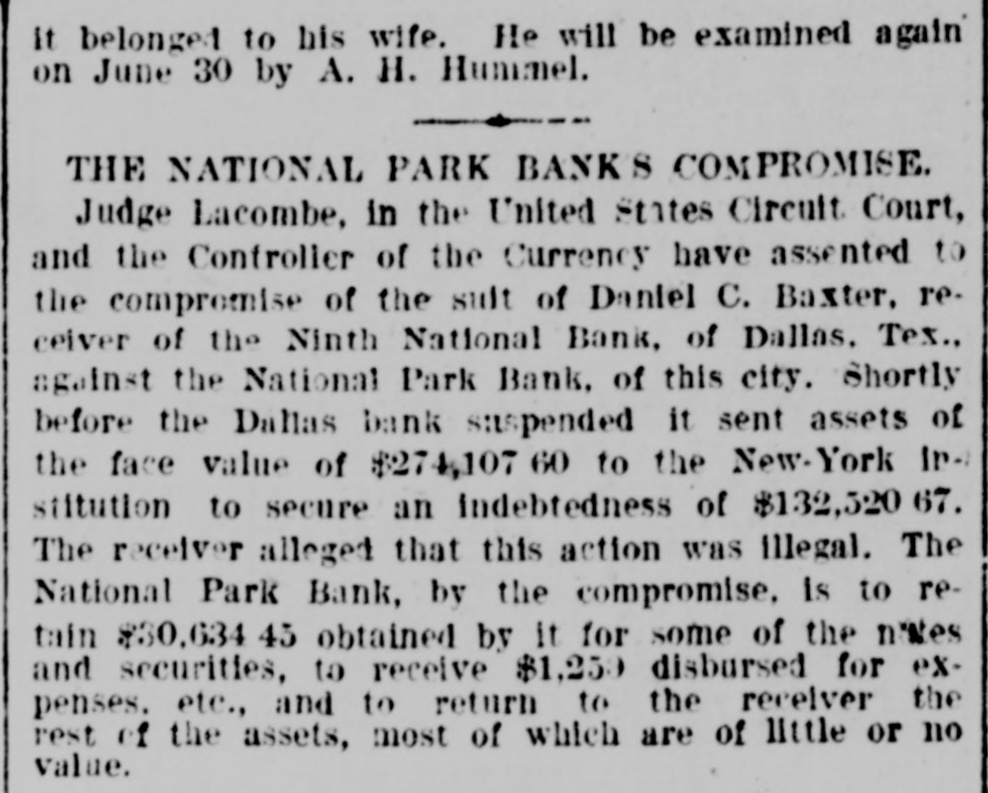
It belonged to his wife. He will be examined again on June 30 by A. H. Hummel. THE NATIONAL PARK BANK S COMPROMISE. Judge Lacombe, in the United States Circuit Court, and the Controller of the Currency have assented to the compremise of the sult of Daniel C. Baxter, receiver of the Ninth National Bank, of Dallas, Tex., against the National Park Bank. of this city. Shortly before the Dallas bank suspended it sent assets of the face value of $274,107 60 to the New-York Ir.: stitution to secure an indebtedness of $132,520 67. The receiver alleged that this action was illegal. The National Park Bank, by the compromise, is to retain $30,634.45 obtained by it for some of the nates and securities, to receive $1,250 disbursed for expenses. etc., and to return to the receiver the rest of the assets, most of which are of little or no value.


Article from The Indianapolis Journal, July 30, 1893

Click image to open full size in new tab

Article Text

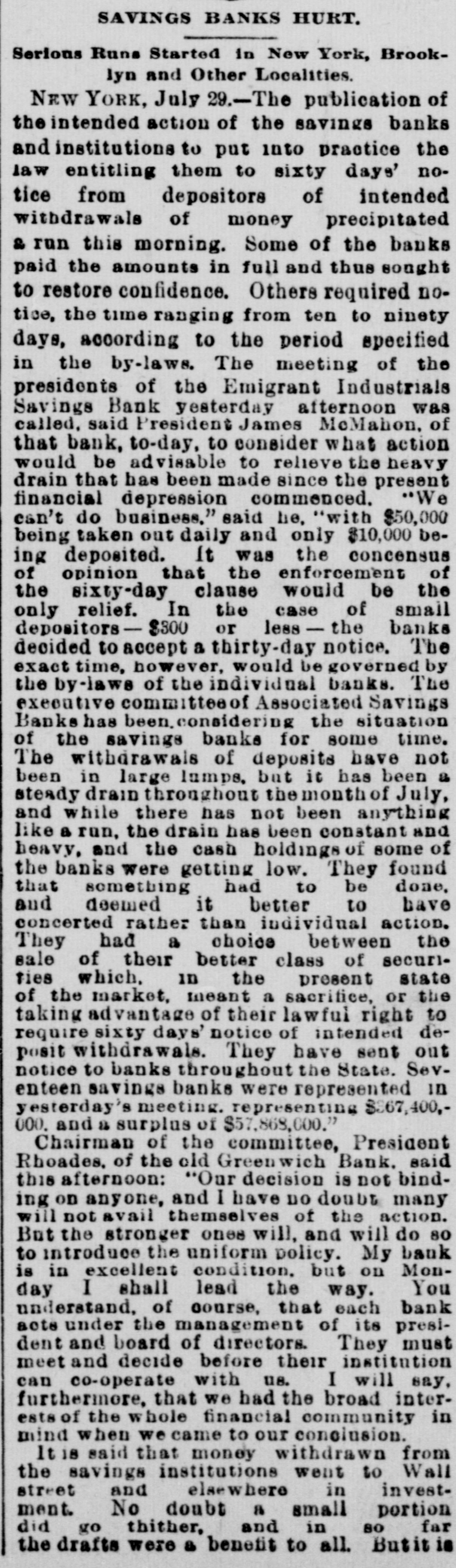
SAVINGS BANKS HURT. Serious Runs Started in New York, Brooklyn and Other Localities. NEW YORK, July 29.-The publication of the intended action of the savings banks and institutions to put into practice the law entitling them to sixty days' notice from depositors of intended withdrawals of money precipitated & run this morning. Some of the banks paid the amounts in full and thus sought to restore confidence. Others required notice, the time ranging from ten to ninety days, according to the period specified in the by-laws. The meeting of the presidents of the Emigrant Industrials Savings Bank yeaterday afternoon was called, said President James McMahon, of that bank, to-day. to consider what action would be advisable to relieve the heavy drain that has been made since the present financial depression commenced. "We can't do business." said he, "with $50,000 being taken out daily and only $10,000 being deposited. It was the concensus of opinion that the enforcement of the sixty-day clause would be the only relief. In the case of small depositors-$300 or less - the banks decided to accept a thirty-day notice. The exact time, however, would be governed by the by-laws of the individual banks. The execative committee of Associated Savings Banks has been. considering the situation of the savings banks for some time. The withdrawais of deposits have not been in large lumps, but it has been a steady drain throughout the month of July, and while there has not been anything like a run, the drain has been constant and heavy, and the cash holdings of some of the banks were getting low. They found that something had to be done, and deemed it better to have concerted rather than individual action. They had a choice between the sale of their better class of securities which, in the present state of the market, meant a sacrifice, or the taking advantage of their lawful right to require sixty days' notice of intended deposit withdrawals. They have sent out notice to banks throughout the State. Seventeen savings banks were represented in yesterday's meeting. representing $367,400,000. and a surplus of $57,868,000." Chairman of the committee, President Rhoades. of the old Greenwich Bank. said this afternoon: "Our decision is not binding on anyone, and I have DO doubt many will not avail themselves of the action. But the stronger ones will, and will do 80 to introduce the uniform policy. My bank is in excellent condition. but on MonYou day I shall lead the way. understand, of course, that each bank acts under the management of its president and board of directors. They must meet and decide before their institution say, can co-operate with us. I will furthermore, that we had the broad interests of the whole financial community in mind when we came to our conclusion. It 18 said that money withdrawn from the savings institutions went to Wall street and elsewhere in investment. No doubt a small portion did go thither, and in so far the drafts were a benefit to all. Butit is


Article from The Portland Daily Press, August 1, 1893

Click image to open full size in new tab

Article Text

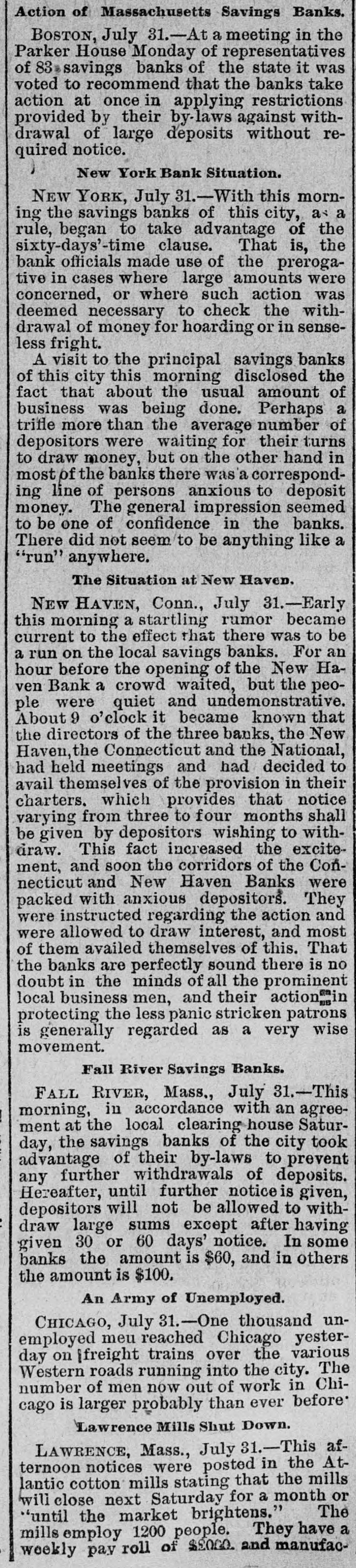
Action of Massachusetts Savings Banks. BOSTON, July 31.-At a meeting in the Parker House Monday of representatives of 83 savings banks of the state it was voted to recommend that the banks take action at once in applying restrictions provided by their by-laws against withdrawal of large deposits without required notice. , New York Bank Situation. NEW YORK, July 31.-With this morning the savings banks of this city, as a rule, began to take advantage of the sixty-days'-time clause. That is, the bank officials made use of the prerogative in cases where large amounts were concerned, or where such action was deemed necessary to check the withdrawal of money for hoarding or in senseless fright. A visit to the principal savings banks of this city this morning disclosed the fact that about the usual amount of business was being done. Perhaps a trifle more than the average number of depositors were waiting for their turns to draw money, but on the other hand in most of the banks there was a corresponding line of persons anxious to deposit money. The general impression seemed to be one of confidence in the banks. There did not seem to be anything like a "run" anywhere. The Situation at New Haven. NEW HAVEN, Conn., July 31.-Early this morning a startling rumor became current to the effect that there was to be a run on the local savings banks. For an hour before the opening of the New Haven Bank a crowd waited, but the people were quiet and undemonstrative. About 9 o'clock it became known that the directors of the three banks, the New Haven, the Connecticut and the National, had held meetings and had decided to avail themselves of the provision in their charters. which provides that notice varying from three to four months shall be given by depositors wishing to withdraw. This fact increased the excitement, and soon the corridors of the Connecticut and New Haven Banks were packed with anxious depositors. They were instructed regarding the action and were allowed to draw interest, and most of them availed themselves of this. That the banks are perfectly sound there is no doubt in the minds of all the prominent local business men, and their actionin protecting the less panic stricken patrons is generally regarded as a very wise movement. Fall River Savings Banks. FALL RIVER, Mass., July 31.-This morning, in accordance with an agreement at the local clearing house Saturday, the savings banks of the city took advantage of their by-laws to prevent any further withdrawals of deposits. Hereafter, until further notice is given, depositors will not be allowed to withdraw large sums except after having given 30 or 60 days' notice. In some banks the amount is $60, and in others the amount is $100. An Army of Unemployed. CHICAGO, July 31.-One thousand unemployed meu reached Chicago yesterday on {freight trains over the various Western roads running into the city. The number of men now out of work in Chicago is larger probably than ever before Lawrence Mills Shut Down. LAWRENCE, Mass., July 31.-This afternoon notices were posted in the Atlantic cotton mills stating that the mills will close next Saturday for a month or The "until the market brightens." mills employ 1200 people. They have a weekly pay roll of $2000. and manufac-


Article from The Indiana State Sentinel, August 2, 1893

Click image to open full size in new tab

Article Text

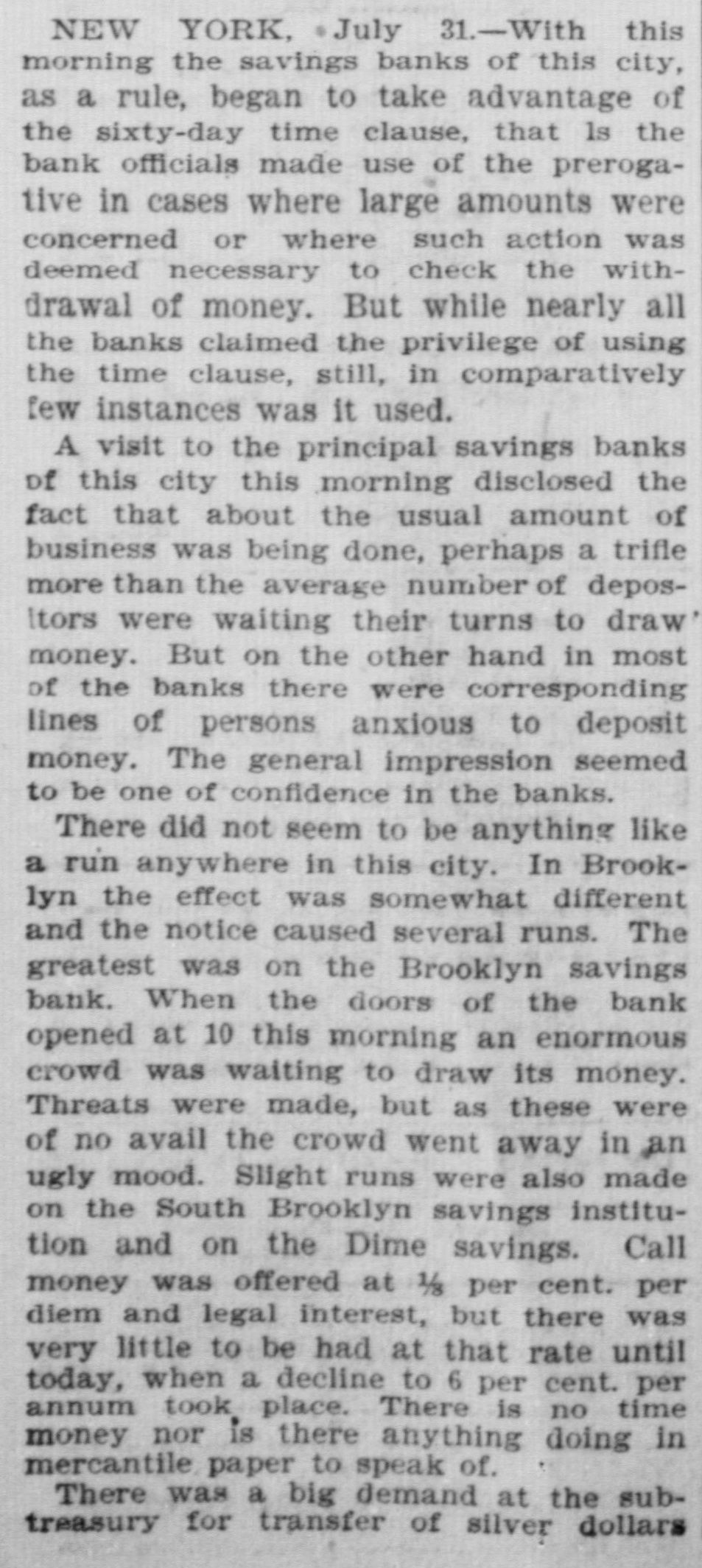
NEW YORK, July 31.-With 1 this morning the savings banks of this city, as a rule, began to take advantage of the sixty-day time clause, that Is the bank officials made use of the prerogative in cases where large amounts were concerned or where such action was deemed necessary to check the withdrawal of money. But while nearly all the banks claimed the privilege of using the time clause, still, in comparatively few instances was it used. A visit to the principal savings banks of this city this morning disclosed the fact that about the usual amount of business was being done, perhaps a trifle more than the average number of deposItors were waiting their turns to draw' money. But on the other hand in most of the banks there were corresponding lines of persons anxious to deposit money. The general impression seemed to be one of confidence in the banks. There did not seem to be anything like a run anywhere in this city. In Brooklyn the effect was somewhat different and the notice caused several runs. The greatest was on the Brooklyn savings bank. When the doors of the bank opened at 10 this morning an enormous crowd was waiting to draw its money. Threats were made, but as these were of no avail the crowd went away in an ugly mood. Slight runs were also made on the South Brooklyn savings institution and on the Dime savings. Call money was offered at 1/3 per cent. per diem and legal interest, but there was very little to be had at that rate until today, when a decline to 6 per cent. per annum took place. There is no time money nor is there anything doing in mercantile paper to speak of. There was a big demand at the subtreasury for transfer of silver dollars


Article from Connecticut Western News, August 3, 1893

Click image to open full size in new tab

Article Text

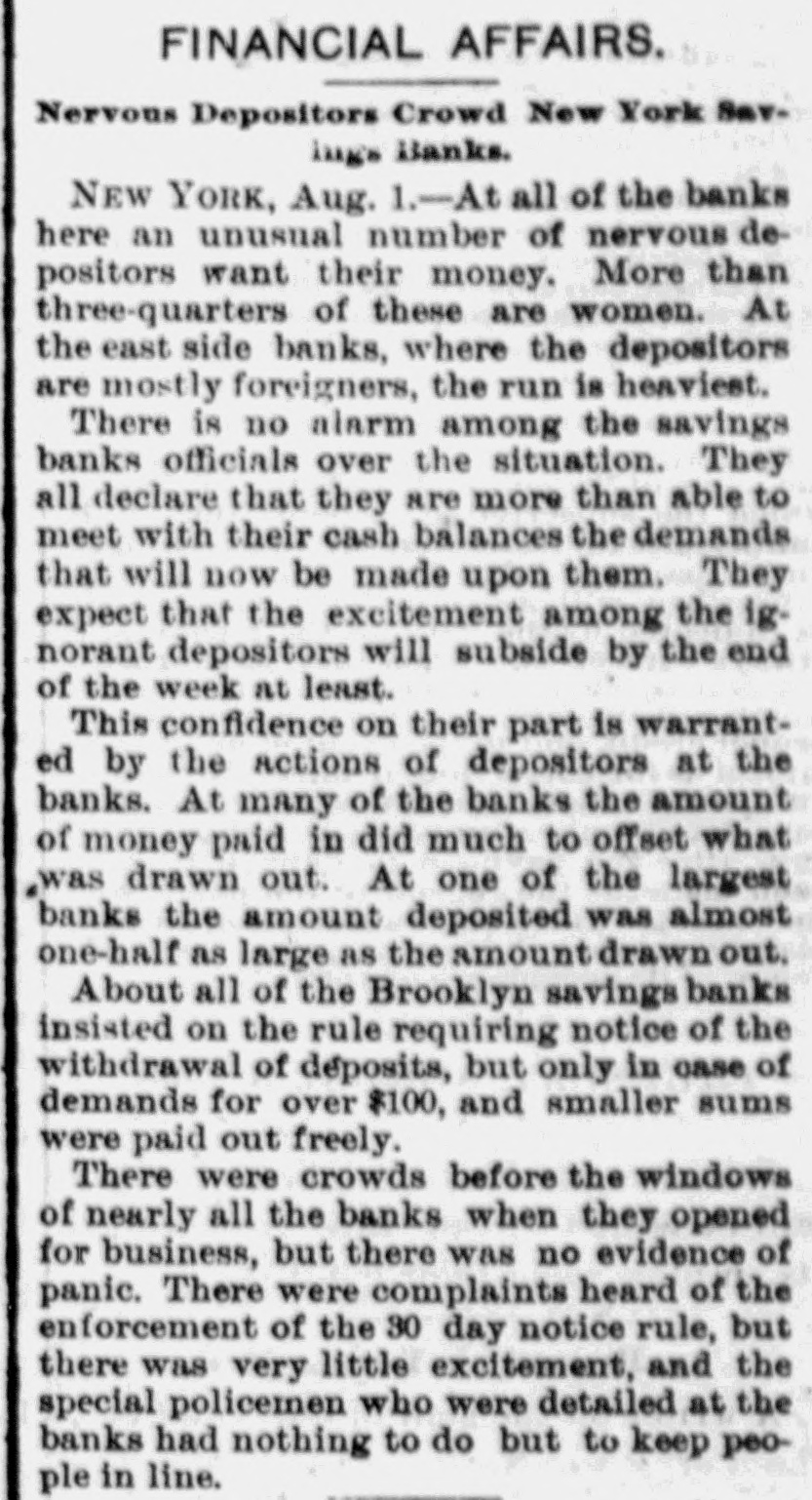
FINANCIAL AFFAIRS. Nervous Depositors Crowd New York Savingo Banks. NEW YORK, Aug. 1.-At all of the banks here an unusual number of nervous depositors want their money. More than three-quarters of these are women. At the east side banks, where the depositors are mostly foreigners, the run is heaviest. There is no alarm among the savings banks officials over the situation. They all declare that they are more than able to meet with their cash balances the demands that will now be made upon them. They expect that the excitement among the ignorant depositors will subside by the end of the week at least. This confidence on their part is warranted by the actions of depositors at the banks. At many of the banks the amount of money paid in did much to offset what was drawn out. At one of the largest banks the amount deposited was almost one-half as large as the amount drawn out. About all of the Brooklyn savings banks insisted on the rule requiring notice of the withdrawal of deposits, but only in case of demands for over $100, and smaller sums were paid out freely. There were crowds before the windows of nearly all the banks when they opened for business, but there was no evidence of panic. There were complaints heard of the enforcement of the 30 day notice rule, but there was very little excitement, and the special policemen who were detailed at the banks had nothing to do but to keep people in line.


Article from The State Herald, August 4, 1893

Click image to open full size in new tab

Article Text

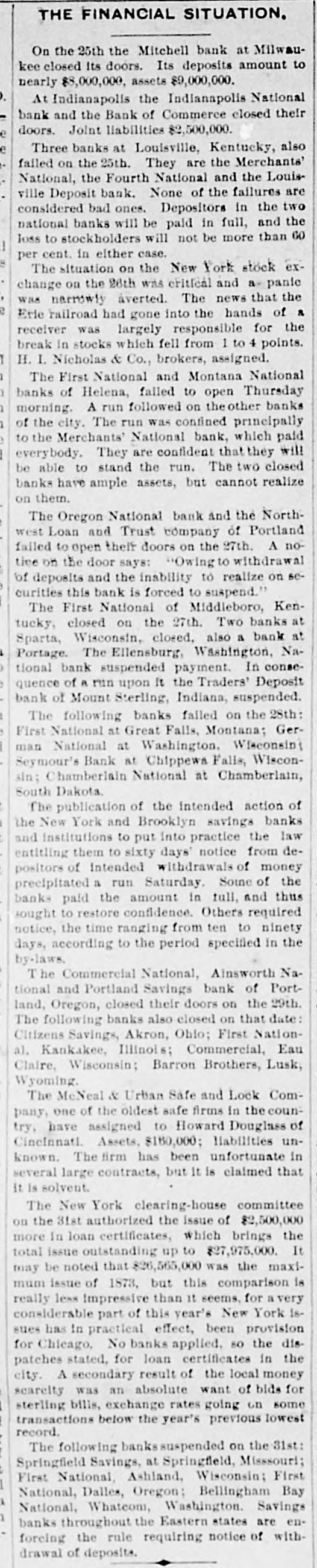
THE FINANCIAL SITUATION. On the 25th the Mitchell bank at Milwaukee closed its doors. Its deposits amount to nearly $8,000,000, assets $9,000,000. At Indianapolis the Indianapolis National bank and the Bank of Commerce closed their doors. Joint liabilities $2,500,000. Three banks at Louisville, Kentucky, also failed on the 25th. They are the Merchants' National, the Fourth National and the Louisville Deposit bank. None of the failures are considered bad ones. Depositors in the two national banks will be paid in full, and the loss to stockholders will not be more than 60 per cent. in either case. The situation on the New York stock exchange on the 28th was critical and a panic was narrowly averted. The news that the Erle railroad had gone into the hands of a receiver was largely responsible for the break in stocks which fell from 1 to 4 points. H. I. Nicholas & Co., brokers, assigned. The First National and Montana National banks of Helena, failed to open Thursday morning. A run followed on theother banks of the city. The run was confined principally to the Merchants' National bank, which paid everybody. They are confident that they will be able to stand the run. The two closed banks have ample assets, but cannot realize on them. The Oregon National bank and the Northwest Loan and Trust company of Portland failed to open their doors on the 27th. A notice on the door says: "Owing to withdrawal of deposits and the Inability to realize on securities this bank is forced to suspend." The First National of Middleboro, Kentucky, closed on the 27th. Two banks at Sparta, Wisconsin, closed, also a bank at Portage. The Ellensburg, Washington, National bank suspended payment. In consequence of a run upon It the Traders' Deposit bank of Mount Sterling, Indiana, suspended. The following banks failed on the 28th: First National at Great Falls, Montana; German National at Washington, Wisconsin; Seymour's Bank at Chippewa Falls, Wisconsin; Chamberlain National at Chamberlain, South Dakota. The publication of the intended action of the New York and Brooklyn savings banks and institutions to put into practice the law entitling them to sixty days' notice from depositors of intended withdrawals of money precipitated a run Saturday. Some of the banks paid the amount In full, and thus sought to restore confidence. Others required notice, the time ranging from ten to ninety days, according to the period specified in the by-laws. The Commercial National, Ainsworth National and Portland Savings bank of Portland, Oregon, closed their doors on the 29th. The following banks also closed on that date: Citizens Savings, Akron, Ohio; First National, Kankakee, Illinois; Commercial, Eau Claire, Wisconsin; Barron Brothers, Lusk, Wyoming. The McNeal & Urban Safe and Lock Company, one of the oldest safe firms in the country, have assigned to Howard Douglass of Cincinnati. Assets, $160,000; liabilities unknown. The firm has been unfortunate in several large contracts, but it Is claimed that it is solvent. The New York clearing-house committee on the 31st authorized the Issue of $2,500,000 more in loan certificates, which brings the total issue outstanding up to $27,975,000. It may be noted that $26,565,000 was the maximum Issue of 1873, but this comparison is really less impressive than it seems, for a very considerable part of this year's New York issues has In practical effect, been provision for Chicago. No banks applied, so the dispatches stated, for loan certificates in the city. A secondary result of the local money scarcity was an absolute want of bids for sterling bills, exchange rates going on some transactions below the year's previous lowest record. The following banks suspended on the 31st: Springfield Savings, at Springfield, Misssouri; First National, Ashland, Wisconsin: First National, Dalles, Oregon: Bellingham Bay National Whatcom lequiring Notice of When drawal of deposits.


Article from The Meeker Herald, August 5, 1893

Click image to open full size in new tab

Article Text

THE FINANCIAL SITUATION, On the 25th the Mitchell bank at Milwaukee closed Its doors. Its deposits amount to nearly $8,000,000, assets $9,000,000. At Indianapolis the Indianapolis National bank and the Bank of Commerce closed their doors. Joint liabilities $2,500,000. Three banks at Louisville, Kentucky, also failed on the 25th. They are the Merchants' National, the Fourth National and the Louisville Deposit bank. None of the failures are considered bad ones. Depositors in the two national banks will be paid in full, and the loss to stockholders will not be more than 60 per cent. in either case. The situation on the New York stock exchange on the 26th was critical and a. panic was narrowly averted. The news that the Erie railroad had gone into the hands of & receiver was largely responsible for the break In stocks which fell from 1 to 4 points. H. I. Nicholas & Co., brokers, assigned. The First National and Montana National banks of Helena, failed to open Thursday morning. A run followed on theother banks of the city. The run was confined principally to the Merchants' National bank, which paid everybody. They are confident that they will be able to stand the run. The two closed banks have ample assets, but cannot realize on them. The Oregon National bank and the Northwest Loan and Trust company of Portland failed to open their doors on the 27th. A notice on the door says: "Owing to withdrawal of deposits and the inability to realize on securities this bank is forced to suspend." The First National of Middleboro, Kentucky, closed on the 27th. Two banks at Sparta, Wisconsin, closed, also a bank at Portage. The Ellensburg, Washington, National bank suspended payment. In consequence of A run upon It the Traders' Deposit bank of Mount Sterling, Indiana, suspended. The following banks failed on the 28th: First National at Great Falls, Montana; German National at Washington, Wisconsin Seymour's Bank at Chippewa Falls, Wisconsin; Chamberlain National at Chamberlain, South Dakota. The publication of the intended action of the New York and Brooklyn savings banks and institutions to put Into practice the law entitling them to sixty days' notice from deithdrawals of money positors of Intended precipitated a run Saturday. Some of the banks paid the amount in full, and thus sought to restore confidence. Others required notice, the time ranging from ten to ninety days, according to the period specified in the by-laws. The Commercial National, Ainsworth National and Portland Savings bank of Portland, Oregon, closed their doors on the 29th. The following banks also closed on that date: Citizens Savings, Akron, Ohio; First National. Kankakee, Illinois; Commercial, Eau Claire, Wisconsin: Barron Brothers, Lusk, Wyoming. The McNeal & Urban Safe and Lock Company, one of the oldest safe firms in the country, have assigned to Howard Douglass of Cincinnati. Assets. $160,000; liabilities unknown. The firm has been unfortunate in several large contracts, but It is claimed that It is solvent. The New York clearing-house committee on the 31st authorized the issue of $2,500,000 more In loan certificates, which brings the total issue outstanding up to $27,975,000. It may be noted that $26,565,000 was the maximum issue of 1878, but this comparison is really less impressive than It seems, for a very considerable part of this year's New York Issues has in practical effect, been provision for Chicago. No banks applied, 50 the dispatches stated, for loan certificates in the city. A secondary result of the local money scareity was an absolute want of bids for sterling bills, exchange rates going on some transactions below the year's previous lowest record. The following banks suspended on the 31st: Springfield Savings, at Springfield, Misssouri; First National, Ashland, Wisconsin: First National, Dalles, Oregon: Bellingham Bay National, Whatcom, Washington. Savings


Article from Santa Fe Daily New Mexican, November 9, 1896

Click image to open full size in new tab

Article Text

PLENTY OF GOLD IN NEW YORK The Gotham Banks Contemplating Resumption of Gold Payments and Thus Relieving Treasury. GOLD WILL BE PUT INTO CIRCULATION Wheat Market Broke Season's Record This Morning-December Jumped to Over 80 Cents-Rise Not Attended by Excitement. New York, Nov. 9. -The banks are contemplating the resumption of specie payments, which they suspended in February, 1892, by refusing to supply gold for export and for the payment of government dues. That action threw the burden of supplying gold upon the treasury and eventually forced the issue of bonds by the government. Since election the yellow metal has been coming into the banks in a flood. By this action of the banks, gold will be put into circulation, and no reason whatever will exist for hoarding it. They will also resume the task of supplying gold for export and thus relieve the treasury of a great strain.


Article from Deseret Evening News, November 9, 1896

Click image to open full size in new tab

Article Text

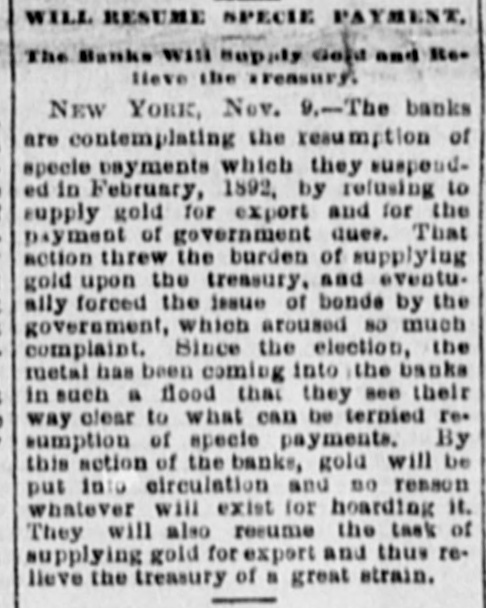
WILL RESUME SPECIE PAYMENT, The Banks will Supaly Gold and ReHeve the areasury, NEW YORK, Nov. 9,-The banks are contemplating the resumption of specie payments which they suspended in February, 1892, by refusing to supply gold for export and for the payment of government dues. That action threw the burden of supplying gold upon the treasury, and eventually forced the issue of bonds by the government, which aroused so much complaint. Since the election, the metal has been coming into the banks in such a flood that they see their way clear to what can be ternied re. sumption of specie payments. By this action of the banks, gold will be put into circulation and no reason whatever will exist for hoarding it. They will also resume the task of supplying gold for export and thus relieve the treasury of a great strain.


Article from The Topeka State Journal, November 9, 1896

Click image to open full size in new tab

Article Text

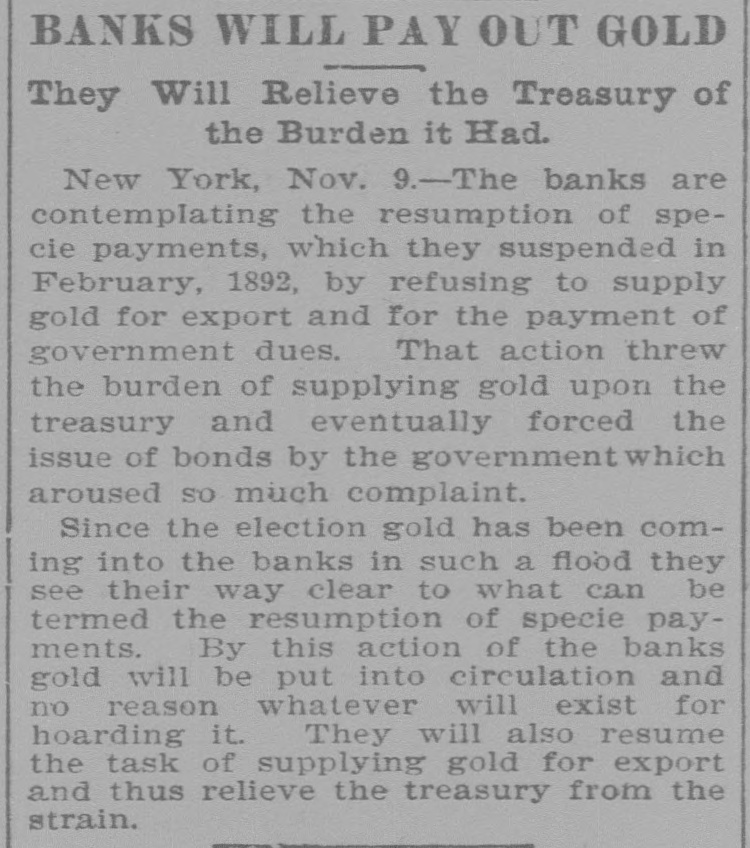
BANKS WILL PAY OUT GOLD They Will Relieve the Treasury of the Burden it Had. New York, Nov. 9.-The banks are contemplating the resumption of specie payments, which they suspended in February, 1892, by refusing to supply gold for export and for the payment of government dues. That action threw the burden of supplying gold upon the treasury and eventually forced the issue of bonds by the government which aroused SO much complaint. Since the election gold has been coming into the banks in such a flood they see their way clear to what can be termed the resumption of specie payments. By this action of the banks gold will be put into circulation and no reason whatever will exist for hoarding it. They will also resume the task of supplying gold for export and thus relieve the treasury from the strain.


Article from The Dalles Daily Chronicle, November 10, 1896

Click image to open full size in new tab

Article Text

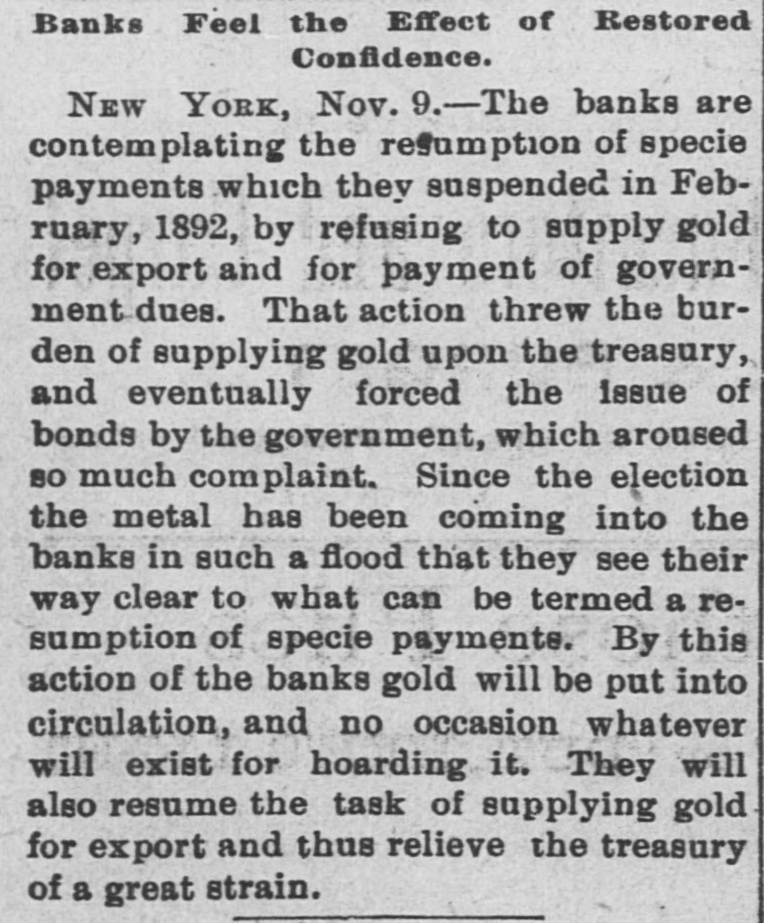
Banks Feel the Effect of Restored Confidence. NEW YORK, Nov. 9.-The banks are contemplating the resumption of specie payments which they suspended in February, 1892, by refusing to supply gold for export and for payment of government dues. That action threw the burden of supplying gold upon the treasury, and eventually forced the issue of bonds by the government, which aroused so much complaint. Since the election the metal has been coming into the banks in such a flood that they see their way clear to what can be termed a resumption of specie payments. By this action of the banks gold will be put into circulation, and no occasion whatever will exist for hoarding it. They will also resume the task of supplying gold for export and thus relieve the treasury of a great strain.


Article from The San Francisco Call, November 10, 1896

Click image to open full size in new tab

Article Text

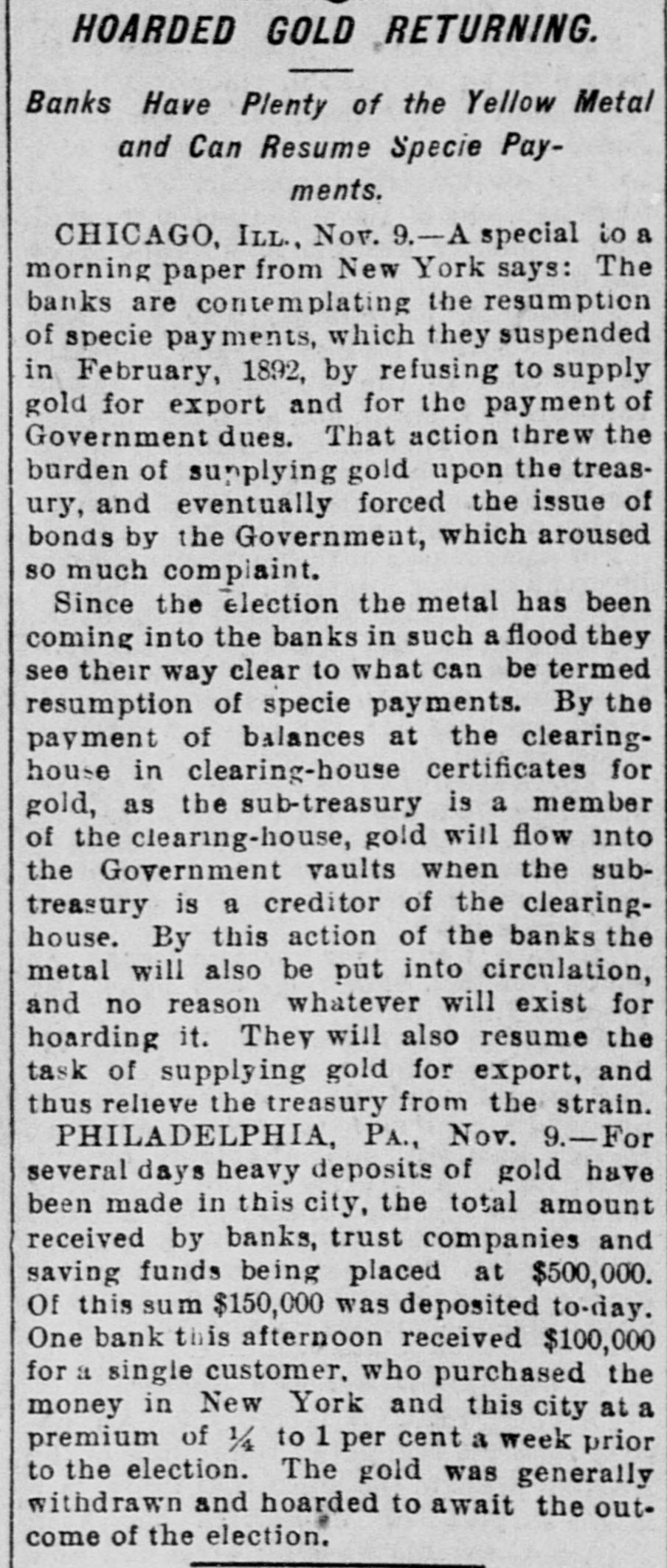
HOARDED GOLD RETURNING. Banks Have Plenty of the Yellow Metal and Can Resume Specie Payments. CHICAGO, ILL., Nov. 9.-A special to a morning paper from New York says: The banks are contemplating the resumption of specie payments, which they suspended in February, 1892, by refusing to supply gold for export and for the payment of Government dues. That action threw the burden of supplying gold upon the treasury, and eventually forced the issue of bonds by the Government, which aroused so much complaint. Since the election the metal has been coming into the banks in such a flood they see their way clear to what can be termed resumption of specie payments. By the payment of balances at the clearinghouse in clearing-house certificates for gold, as the sub-treasury is a member of the clearing-house, gold will flow into the Government vaults when the subtreasury is a creditor of the clearinghouse. By this action of the banks the metal will also be put into circulation, and no reason whatever will exist for hoarding it. They will also resume the task of supplying gold for export, and thus relieve the treasury from the strain. PHILADELPHIA, PA., Nov. 9-For several days heavy deposits of gold have been made in this city, the total amount received by banks, trust companies and saving funds being placed at $500,000. Of this sum $150,000 was deposited to-day. One bank this afternoon received $100,000 for a single customer. who purchased the money in New York and this city at a premium of 1/4 to 1 per cent a week prior to the election. The gold was generally withdrawn and hoarded to await the outcome of the election.


Article from Pine Bluff Daily Graphic, November 10, 1896

Click image to open full size in new tab

Article Text

THEIR WAY CLEAR Coming Into the Banks In a Flood. PTION OF SPECIE PAYMENT York Banks Are Contemplating Move-They - Suspended Such stent In February, 1892, by Reto Supply Gold For Export-Facnd Shops Running Full Time. YORK, Nov. 10.-The banks are W implating the resumption of specie ents, which they suspended in arry, 1892, by refusing to supply for export and for the payment of mment dues. That action threw borden of supplying gold upon the Sary and eventually forced the issue bonds by the government, which red SO much complaint. Since the metal has been coming into the firs in such a flood that they see their clear to what can be termed the reotion of specie payments. By this of the banks gold will be put on circulation and no reasons whatwill exist for hoarding it. They also resume the task of supplying for export and thus relieve the stray from the strain.


Article from Semi=weekly Graphic, November 11, 1896

Click image to open full size in new tab

Article Text

# SEE THEIR WAY CLEAR Gold Coming Into the Banks In a Flood. # RESUMPTION OF SPECIE PAYMENT New York Banks Are Contemplating Such a Move-They Suspended Such Payment In February, 1892, by Refusing to Supply Gold For Export-Factories and Shops Running Full Time. NEW YORK, Nov. 10.-The banks are contemplating the resumption of specie payments, which they suspended in February, 1892, by refusing to supply gold for export and for the payment of government dues. That action threw the burden of supplying gold upon the treasury and eventually forced the issue of bonds by the government, which aroused so much complaint. Since the election metal has been coming into the banks in such a flood that they see their way clear to what can be termed the resumption of specie payments. By this action of the banks gold will be put into circulation and no reasons whatever will exist for hoarding it. They will also resume the task of supplying gold for export and thus relieve the treasury from the strain.


Article from The Topeka State Journal, November 12, 1896

Click image to open full size in new tab

Article Text

RELIEVES THE TREASURY. New York Banks Contemplate an Early Resumption of Specie. New York, Nov. 12.-The banks are contemplating the resumption of specie payments, which they suspended in February, 1892, by refusing to supply gold for export and for the payment of government dues. That action threw the burden of supplying gold upon the treasury, and eventually forced the issues of bonds by the government which aroused so much complaint. Since the election the metal has been coming into the banks in such a flood they see their way clear to what can be termed the resumption of specie payments. By the payment of balances at the clearing house in clearing house certificates for gold, as the sub-treasury is a member of the clearing house, gold will flow into the government vaults when the sub-treasury is a creditor of the clearing house. By this action of the banks the metal will also be put into circulation, and no reason whatever will exist for hoarding it. They will also resume the task of supplying gold for export, and thus relieve the treasury from the strain.


Article from Morning Appeal, November 12, 1896

Click image to open full size in new tab

Article Text

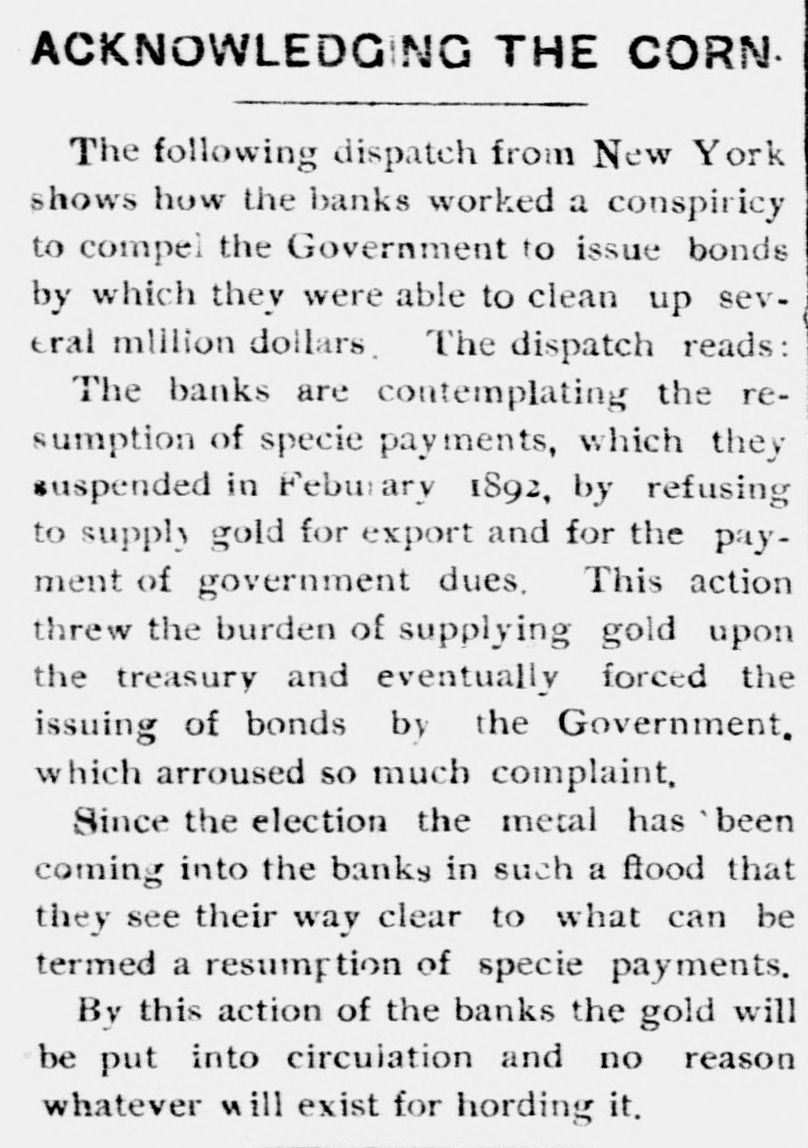
ACKNOWLEDGING THE CORN. The following dispatch from New York shows how the banks worked a conspiricy to compel the Government to issue bonds by which they were able to clean up several million dollars. The dispatch reads: The banks are contemplating the resumption of specie payments, which they suspended in Feburary 1892, by refusing to supply gold for export and for the payment of government dues, This action threw the burden of supplying gold upon the treasury and eventually forced the issuing of bonds by the Government, which arroused so much complaint, Since the election the metal has been coming into the banks in such a flood that they see their way clear to what can be termed a resumption of specie payments. By this action of the banks the gold will be put into circulation and no reason whatever will exist for hording it.


Article from Red Lodge Picket, November 14, 1896

Click image to open full size in new tab

Article Text

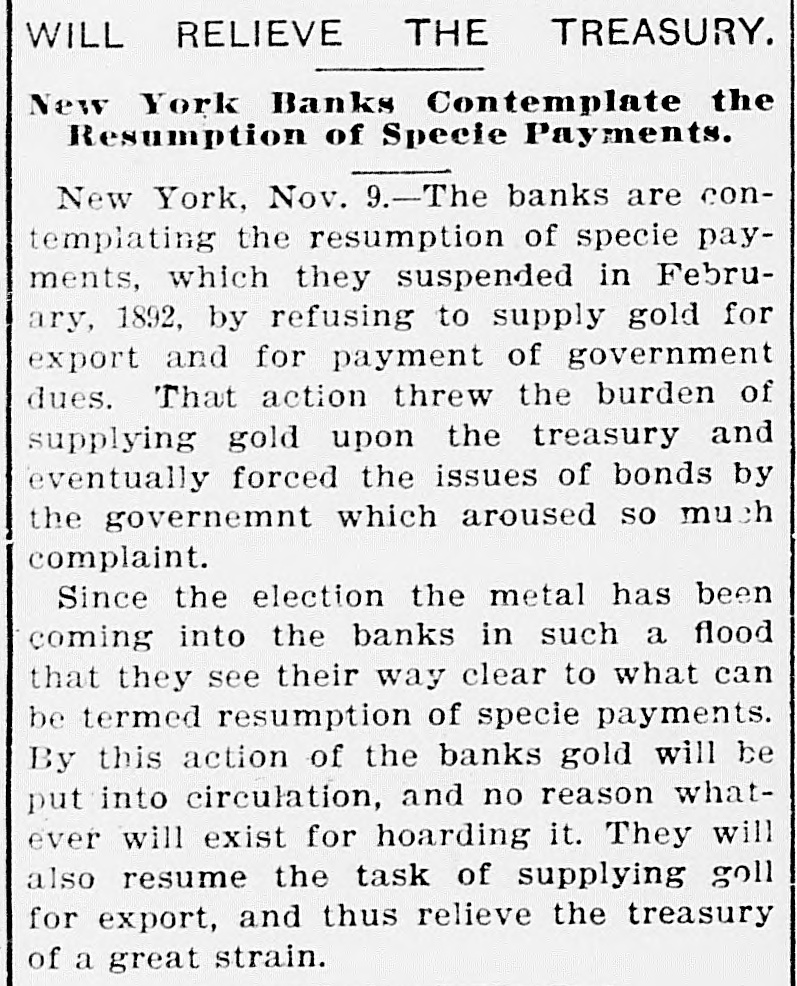
WILL RELIEVE THE TREASURY. New York Banks Contemplate the Resumption of Specie Payments. New York, Nov. 9. -The banks are contemplating the resumption of specie payments, which they suspended in February, 1892, by refusing to supply gold for export and for payment of government dues. That action threw the burden of supplying gold upon the treasury and eventually forced the issues of bonds by the governemnt which aroused so much complaint. Since the election the metal has been coming into the banks in such a flood that they see their way clear to what can be termed resumption of specie payments. By this action of the banks gold will be put into circulation, and no reason whatever will exist for hoarding it. They will also resume the task of supplying goll for export, and thus relieve the treasury of a great strain.


Article from Custer Weekly Chronicle, November 14, 1896

Click image to open full size in new tab

Article Text

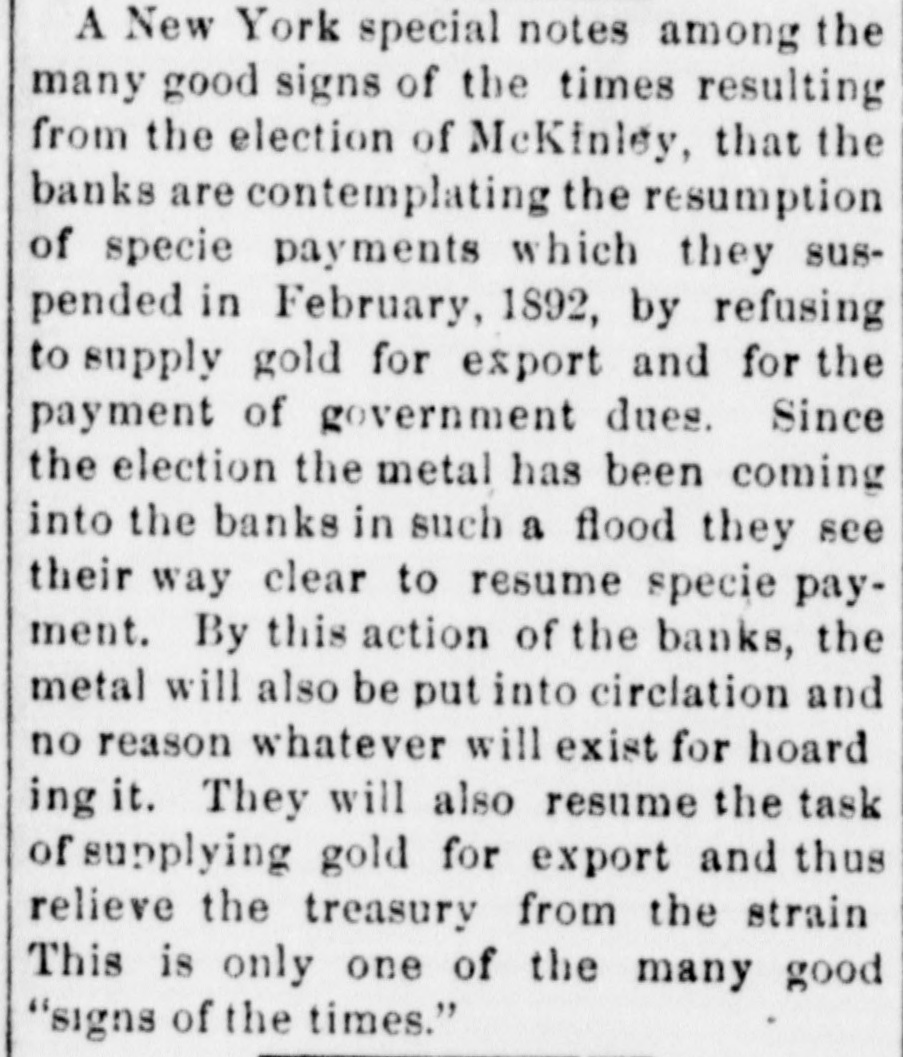
A New York special notes among the many good signs of the times resulting from the election of McKinley, that the banks are contemplating the resumption of specie payments which they suspended in February, 1892, by refusing to supply gold for export and for the payment of government dues. Since the election the metal has been coming into the banks in such a flood they see their way clear to resume specie payment. By this action of the banks, the metal will also be put into circlation and no reason whatever will exist for hoard ing it. They will also resume the task of supplying gold for export and thus relieve the treasury from the strain This is only one of the many good "signs of the times."


Article from New-York Tribune, December 2, 1896

Click image to open full size in new tab

Article Text

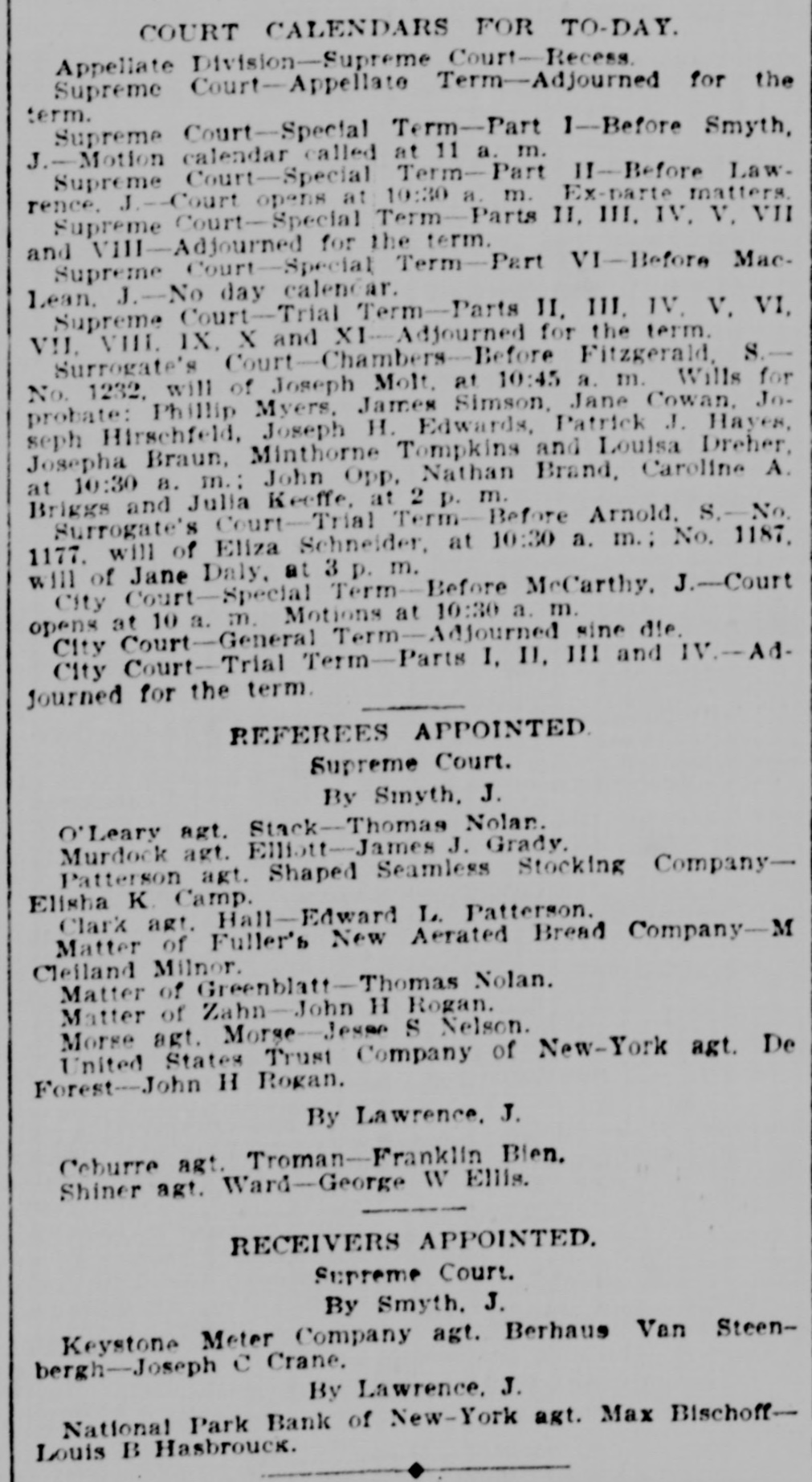
COURT CALENDARS FOR TO-DAY. Appellate Division-Supreme Court-Recess. Supreme Court-Appellate Term-Adjourned for the term. Supreme Court-Special Term-Part I-Before Smyth, J.-Motion calendar called at 11 a. m. Supreme Court-Special Term-Part II-Before Lawrence. J.-Court opens at 10:30 a. m. Ex-parte matters. Supreme Court-Special Term-Parts II, III, IV, V, VII and VIII-Adjourned for the term. Supreme Court-Special Term-Part VI-Before MacLean. J.-No day calendar. Supreme Court-Trial Term-Parts II, III, IV, V. VI, VII, VIII. IX, X and XI-Adjourned for the term. Surrogate's Court-Chambers-Before Fitzgerald, S.No. 1232, will of Joseph Molt, at 10:45 a. m. Wills for probate: Phillip Myers, James Simson, Jane Cowan, Joseph Hirschfeld, Joseph H. Edwards, Patrick J. Hayes, Josepha Braun, Minthorne Tompkins and Louisa Dreher, at 10:30 a. m.: John Opp. Nathan Brand, Caroline A. Briggs and Julia Keeffe, at 2 D. m. Surrogate's Court-Trial Term-Before Arnold. S.-No. 1177. will of Eliza Schneider, at 10:30 a. m.; No. 1187, will of Jane Daly. at 3 p. m. City Court-Special Term-Before McCarthy. J.-Court opens at 10 a. m. Motions at 10:30 a. m. City Court-General Term-Adjourned sine die. City Court-Trial Term-Parts I, II, III and IV.-Adjourned for the term. REFEREES APPOINTED Supreme Court. By Smyth, J. O'Leary agt. Stack-Thomas Nolan. Murdock agt. Elliott-James J. Grady. Patterson agt. Shaped Seamless Stocking CompanyElisha K. Camp. Clark agt. Hall-Edward L. Patterson. Matter of Fuller's New Aerated Bread Company-M Cleiland Milnor. Matter of Greenblatt-Thomas Nolan. Matter of Zahn-John H Rogan. Morse agt. Morge-Jesse S Nelson. United States Trust Company of New-York agt. De Forest-John H Rogan. By Lawrence. J. Ceburre agt. Troman-Franklin Bien. Shiner agt. Ward-George W Ellis. RECEIVERS APPOINTED. Supreme Court. By Smyth. J. Keystone Meter Company agt. Berhaus Van Steenbergh-Joseph C Crane. By Lawrence. J. National Park Bank of New-York agt. Max BischoffLouis B Hasbrouck.