gpt-5-mini (chosen from majority vote of a three-model LLM ensemble)
Short Digest
c6c5092a7fb9b7d9
Response Measures
None
Description
Initial April rumor was explicitly described as false; suspension announced Nov 24 and receivers appointed by Jan 1903.
Events (4)
1.April 12, 1902Run
Cause
Rumor Or Misinformation
Cause Details
A malicious falsehood/rumor linking the bank with a building association suit circulated and alarmed depositors; later denied by directors.
Random Run
Yes
Random Run Snippet
malicious falsehood circulated linking bank with suit; denied by directors
Measures
Directors issued authoritative statement; every demand met and checks honored
Newspaper Excerpt
The malicious falsehood that was circulated this week that the Capital Savings Bank had a suit to defend ... If there was a run on the bank after the suit had been filed, every demand has been met and every check honored
Source
newspapers
2.November 1, 1902*Run
Cause
Rumor Or Misinformation
Cause Details
A prolonged quiet withdrawal of deposits by customers (loss of confidence), leading directors to require 60 days' notice.
Measures
Announced requirement of sixty days' notice for withdrawals; ceased taking new deposits
Newspaper Excerpt
This fall ... there has been a quiet run on the bank, and the directors felt it expedient to announce that sixty days' notice would be required
Source
newspapers
3.November 24, 1902Suspension
Cause
Bank Specific Adverse Info
Cause Details
Large withdrawals depleted reserves; later receivers' reports show heavy overdrafts and indebtedness of officers indicating insolvency.
Newspaper Excerpt
It is insolvent, declares Mr. Warfield, having suspended payment November 24 last.
Source
newspapers
4.January 24, 1903Receivership
Newspaper Excerpt
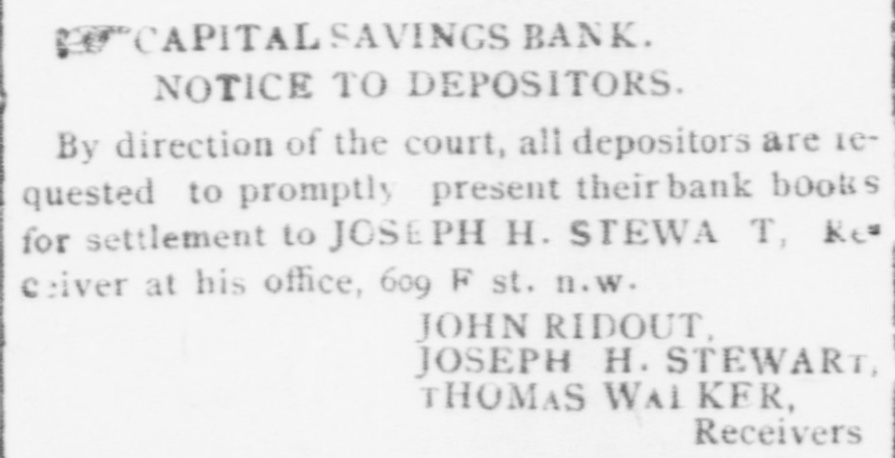
By direction of the court, all depositors are requested to promptly present their bank books for settlement to JOSEPH H. STEWART, Receiver ... JOHN RIDOUT JOSEPH H. STEWART, THOMAS WALKER, Receivers
Source
newspapers
Newspaper Articles (23)
1.April 12, 1902The Washington BeeWashington, DC
Click image to open full size in new tab
Article Text
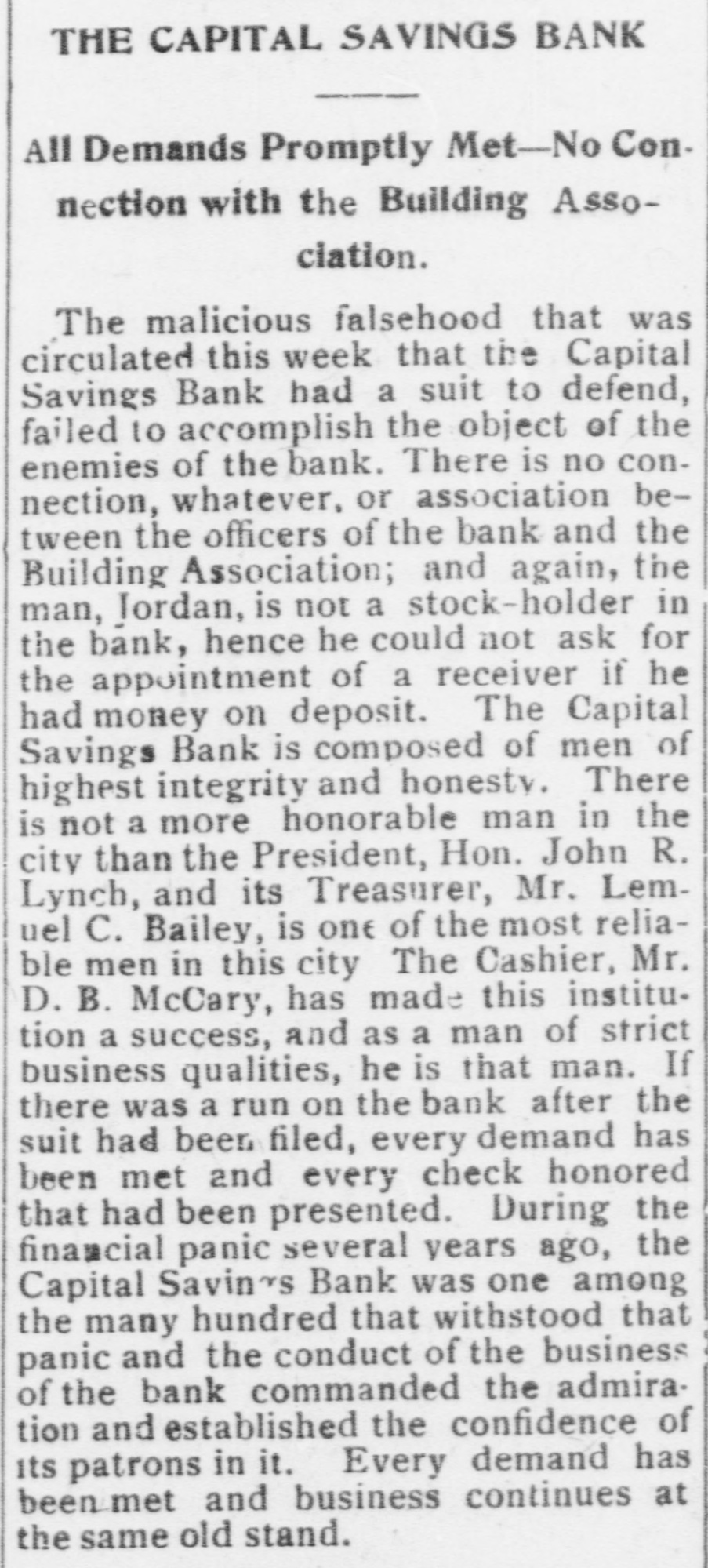
THE CAPITAL SAVINGS BANK All Demands Promptly Met-No Connection with the Building Association. The malicious falsehood that was circulated this week that the Capital Savings Bank had a suit to defend, failed to accomplish the object of the enemies of the bank. There is no connection, whatever, or association between the officers of the bank and the Building Association; and again, the man, Jordan, is not a stock-holder in the bank, hence he could not ask for the appointment of a receiver if he had money on deposit. The Capital Savings Bank is composed of men of highest integrity and honesty. There is not a more honorable man in the city than the President, Hon. John R. Lynch, and its Treasurer, Mr. Lemuel C. Bailey, is one of the most reliable men in this city The Cashier, Mr. D.B. McCary, has made this institution a success, and as a man of strict business qualities, he is that man. If there was a run on the bank after the suit had been filed, every demand has been met and every check honored that had been presented. During the financial panic several years ago, the Capital Savings Bank was one among the many hundred that withstood that panic and the conduct of the business of the bank commanded the admiration and established the confidence of its patrons in it. Every demand has been.met and business continues at the same old stand.
2.April 12, 1902The Colored AmericanWashington, DC
Click image to open full size in new tab
Article Text
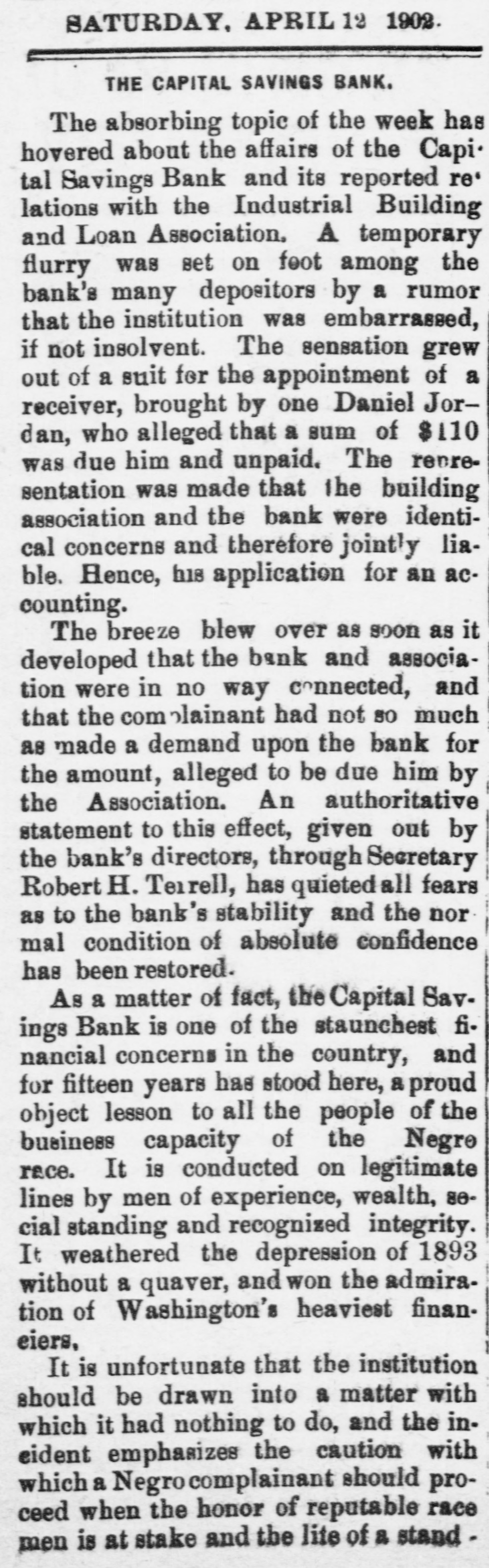
SATURDAY, APRIL 12 1902. THE CAPITAL SAVINGS BANK. The absorbing topic of the week has hovered about the affairs of the Capi tal Savings Bank and its reported re' lations with the Industrial Building and Loan Association. A temporary flurry was set on foot among the bank's many depositors by a rumor that the institution was embarrassed, if not insolvent. The sensation grew out of a suit for the appointment of a receiver, brought by one Daniel Jordan, who alleged that a sum of $110 was due him and unpaid. The renresentation was made that the building association and the bank were identical concerns and therefore jointly liable. Hence, his application for an accounting. The breeze blew over as soon as it developed that the bank and association were in no way connected, and that the com plainant had not so much as made a demand upon the bank for the amount, alleged to be due him by the Association. An authoritative statement to this effect, given out by the bank's directors, through Secretary Robert H. Terrell, has quieted all fears as to the bank's stability and the nor mal condition of absolute confidence has been restored. As a matter of fact, the Capital Savings Bank is one of the staunchest financial concerns in the country, and for fitteen years has stood here, a proud object lesson to all the people of the business capacity of the Negro race. It is conducted on legitimate lines by men of experience, wealth, 80cial standing and recognized integrity. It weathered the depression of 1893 without a quaver, and won the admiration of Washington's heaviest finaneiers, It is unfortunate that the institution should be drawn into a matter with which it had nothing to do, and the ineident emphasizes the caution with which a Negrocomplainant should proceed when the honor of reputable race men is at stake and the lite of a stand -
3.November 26, 1902Evening StarWashington, DC
Click image to open full size in new tab
Article Text
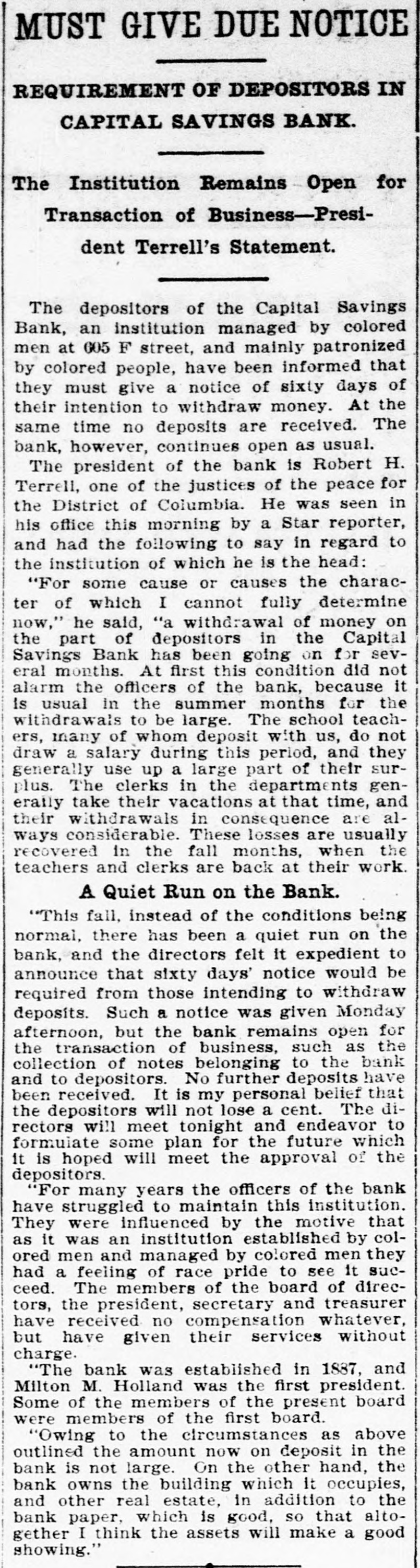
MUST GIVE DUE NOTICE REQUIREMENT OF DEPOSITORS IN CAPITAL SAVINGS BANK. The Institution Remains Open for Transaction of Business-President Terrell's Statement. The depositors of the Capital Savings Bank, an institution managed by colored men at 605 F street, and mainly patronized by colored people, have been informed that they must give a notice of sixty days of their intention to withdraw money. At the same time no deposits are received. The bank, however, continues open as usual. The president of the bank is Robert H. Terrell, one of the justices of the peace for the District of Columbia. He was seen in his office this morning by a Star reporter, and had the following to say in regard to the institution of which he is the head: "For some cause or causes the character of which I cannot fully determine now," he said, "a withdrawal of money on the part of depositors in the Capital Savings Bank has been going on for several months. At first this condition did not alarm the officers of the bank, because it is usual in the summer months for the withdrawals to be large. The school teachers, many of whom deposit with us, do not draw a salary during this period, and they generally use up a large part of their surplus. The clerks in the departments generaily take their vacations at that time, and their withdrawals in consequence are always considerable. These losses are usually recovered in the fall months, when the teachers and clerks are back at their work. A Quiet Run on the Bank. "This fall, instead of the conditions being normal, there has been a quiet run on the bank, and the directors felt It expedient to announce that sixty days' notice would be required from those intending to withdraw deposits. Such a notice was given Monday afternoon, but the bank remains open for the transaction of business, such as the collection of notes belonging to the bank and to depositors. No further deposits have been received. It is my personal belief that the depositors will not lose a cent. The directors will meet tonight and endeavor to formulate some plan for the future which it is hoped will meet the approval of the depositors. "For many years the officers of the bank have struggled to maintain this institution. They were influenced by the motive that as it was an institution established by colored men and managed by colored men they had a feeling of race pride to see it succeed. The members of the board of directors, the president, secretary and treasurer have received no compensation whatever, but have given their services without charge. "The bank was established in 1887, and Milton M. Holland was the first president. Some of the members of the present board were members of the first board. "Owing to the circumstances as above outlined the amount now on deposit in the bank is not large. On the other hand, the bank owns the building which It occupies, and other real estate, in addition to the bank paper, which is good, SO that altogether I think the assets will make a good showing."
4.November 29, 1902The Washington BeeWashington, DC
Click image to open full size in new tab
Article Text
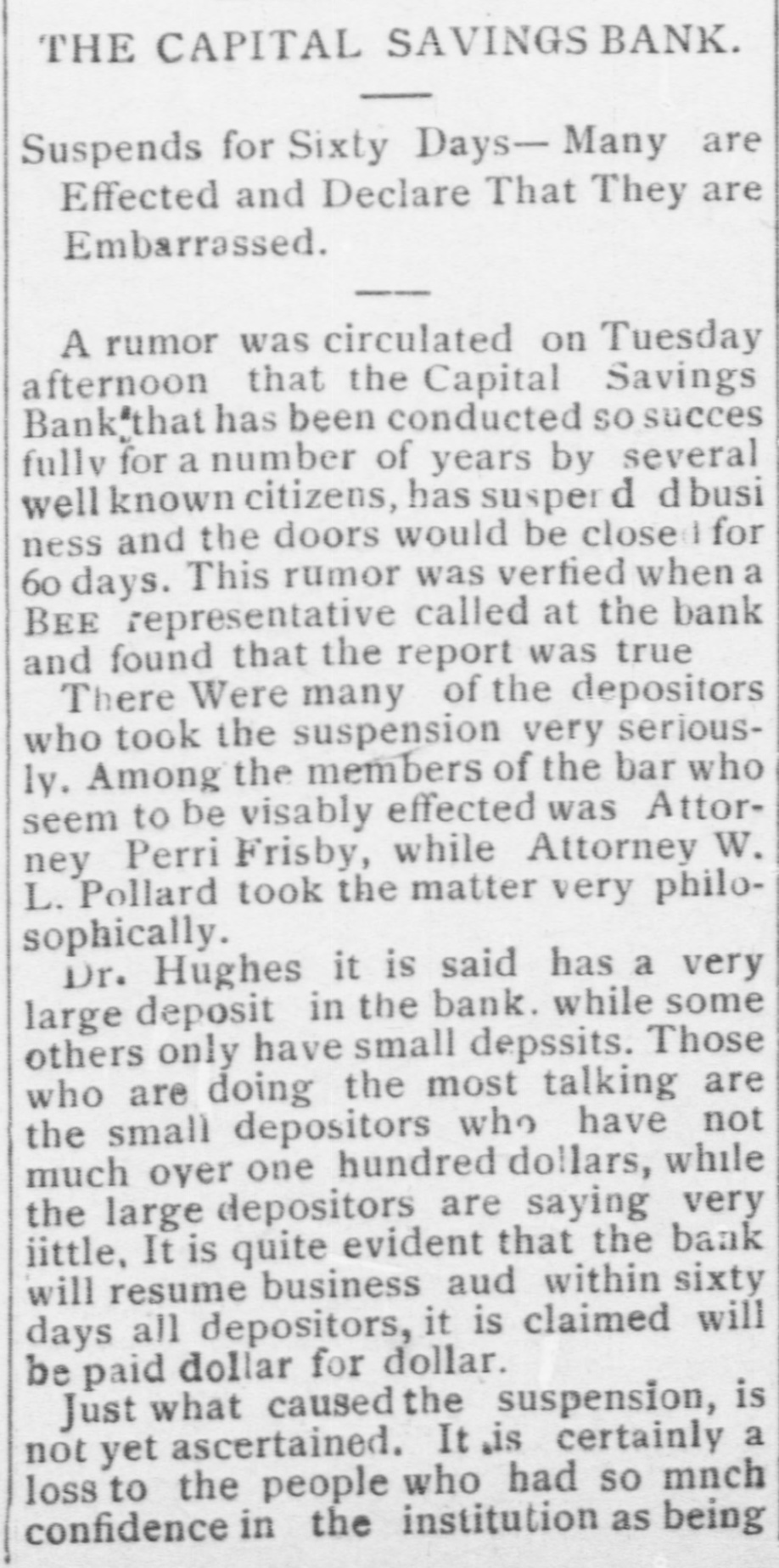
THE CAPITAL SAVINGS BANK. Suspends for Sixty Days- Many are Effected and Declare That They are Embarrassed. A rumor was circulated on Tuesday afternoon that the Capital Savings Bank that has been conducted so succes fully for a number of years by several well known citizens, has suspend Ibusi ness and the doors would be close I for 60 days. This rumor was verfied when a BEE representative called at the bank and found that the report was true There Were many of the depositors who took the suspension very seriously. Among the members of the bar who seem to be visably effected was Attorney Perri Frisby, while Attorney W. L. Pollard took the matter very philosophically. Dr. Hughes it is said has a very large deposit in the bank. while some others only have small depssits. Those who are doing the most talking are the small depositors who have not much over one hundred dollars, while the large depositors are saying very little, It is quite evident that the bank will resume business aud within sixty days all depositors, it is claimed will be paid dollar for dollar. Just what caused the suspension, is not yet ascertained. It is certainly a loss to the people who had so mnch confidence in the institution as being
5.November 29, 1902The Colored AmericanWashington, DC
Click image to open full size in new tab
Article Text
THE CAPITAL SAVINGS BANK. The temporary embarrassment of the Capital Savings bank comes as a surprise and shock to the friends of Negro enterprise everywhere. That a financial corporation which had successfully weathered the panic of 1893 should fail in the high tide of prosperity makes the situation all th more difficult to understand. It appears, however, that for some time there has been a quiet drain upon the resources of the bank and the reserve had become so low that rather than run further risk of the funds of the depositors or the company, it was decided best to close the doors of the institution for at least sixty days, at which time it is hoped that business can be safely resumed. The managers of the Capital Savings bank are among the best citizens and are gentlement of unimpeachable integrity. They have ample means to pay all obligations ten times over and the people who have intrusted funds to their keeping may rest assured that they will receive dollar for dollar. Confidence is everything to the success of a business and we trust that important element can be resorted in time to guarantee a future for this corporation. Its destruction cannot fail to inact injury upon every other concern operated by colored people.
6.December 4, 1902Gloucester County DemocratWoodbury, NJ
Click image to open full size in new tab
Article Text
In Washington, D. c., the Capitol Savings Bank, managed by Negroes for Negro depositors has been forced to suspend. In the world of finance as well as in politities it is not always wise to draw the color line.
7.December 12, 1902The Seattle RepublicanSeattle, WA
Click image to open full size in new tab
Article Text
Had No Race Pride. The suspension of payment by the Capital Savings Bank of for Washington sixty days, because of large withdrawals of deposits, is much to be regretted. Captain John R. Lynch is president of the bank. If it were properly supported by the Afro-Americans of Washington it would easily be one of the strongest banks in the country. We hope that it will soon resume business.-N. Y. Age.
8.December 22, 1902Evening StarWashington, DC
Click image to open full size in new tab
Article Text
ASKS FOR RECEIVER. William A. Warfield Brings Capital Savings Bank's Affairs Into Court. Steps to wind up the affairs of the Capital Savings Bank were taken this afternoon when William A. Warfield filed suit for dissolution of partnership, the appointment of receivers and an injunction, certain officers and directors of the bank being named defendants as follows: John R. Lynch, the president; Jerome A. Johnson, the vice president; Robert H. Terrell, the secretary; Lorenzo C. Bailey, the treasurer; Douglass B. McCary, the cashier, and Wyatt Archer, James T. Bradford, William S. Lofton, Whitefield McKinlay, Arthur W. Tancil and Robert Williams, directors and stockholders. The complainant sets forth that he is a stockholder of the bank, the institution, he explains, being organized as a partnership. It is insolvent, declares Mr. Warfield, having suspended payment November 24 last. The complainant, among other things, charges that overdrafts have been made by certain directors. there being one overdraft amounting to $30,000 by one director alone, while the capital stock of the bank is only $50,000. Mr. Warfield, who is represented by Attorneys A. A. Birney and J. H. Stewart, asks that the defendants be enjoined from disposing of any of the assets of the bank, that receivers be appointed to take charge of the same, and that the partnership be dissolved. Justice Hagner issued a rule to show cause returnable January 5.
9.January 24, 1903The Washington BeeWashington, DC
Click image to open full size in new tab
Article Text
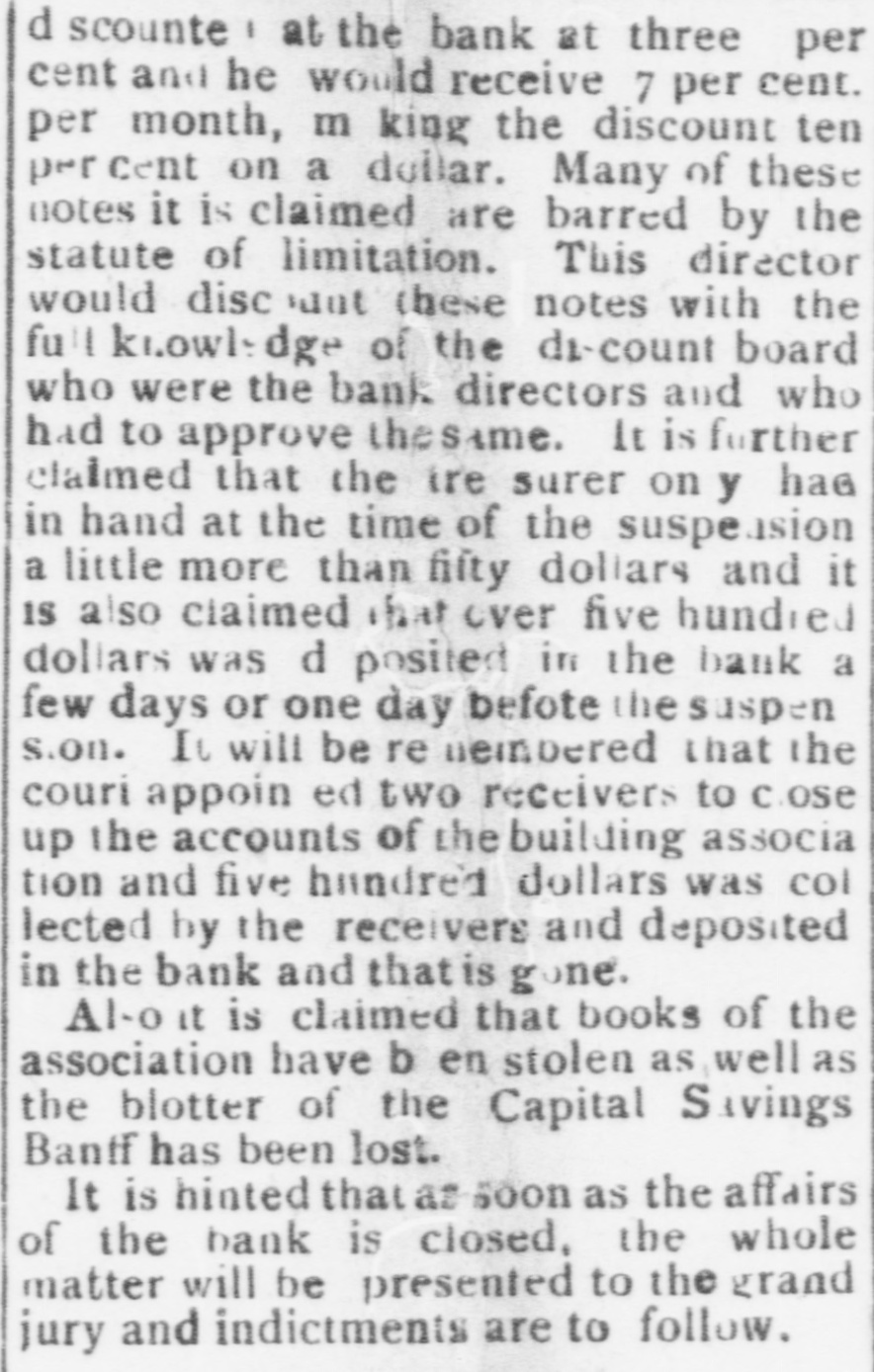
d scounte I at the bank at three per cent and he would receive 7 per cent. per month, m king the discount ten percent on a dollar. Many of these notes it is claimed are barred by the statute of limitation. This director would disc dut these notes with the full knowl-dge of the di-count board who were the bank directors and who had to approve the same. It is further claimed that the ire surer on y hag in hand at the time of the suspension a little more than fifty dollars and it IS also claimed that over five hundred dollars was d posited in the bank a few days or one day befote the suspen s.on. It will be re membered that the couri appoint ed two receivers to cose up the accounts of the building associa tion and five hundred dollars was col lected by the receivers and deposited in the bank and thati is gone. Al-o it is claimed that books of the association have b en stolen as well as the blotter of the Capital Savings Bantf has been lost. It is hinted that as soon as the affairs of the bank is closed, the whole matter will be presented to the grand jury and indictments are to follow.
# The receivers of the defunct Capital Savings Bank of Washington, D. C.,
11.January 24, 1903The Washington BeeWashington, DC
Click image to open full size in new tab
Article Text
CAPITAL SAVINGS BANK. NOTICE TO DEPOSITORS. By direction of the court, all depositors are ICquested to promptly present theirbank books for settlement to JOSEPH H. STEWA T, Re: ceiver at his office, 609 F st. n. W. JOHN RIDOUT JOSEPH H. STEWART, THOMAS WAL KFR, Receivers
12.February 3, 1903Evening StarWashington, DC
Click image to open full size in new tab
Article Text
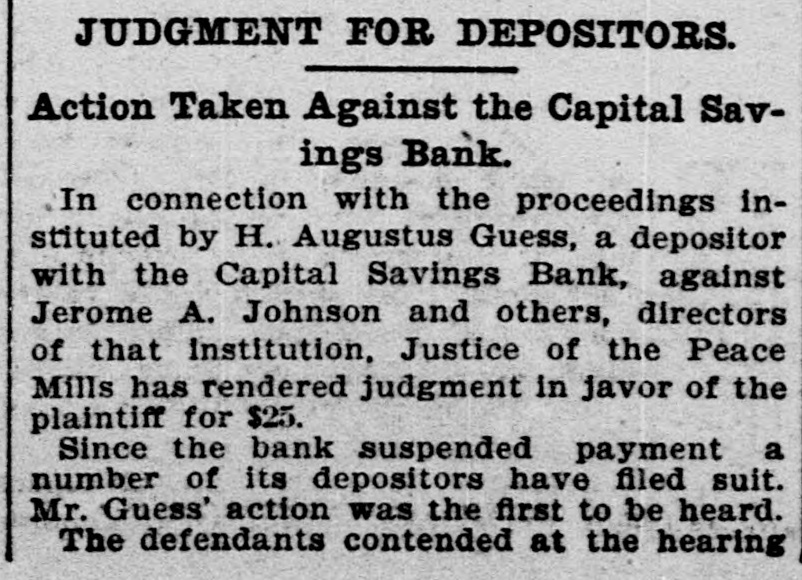
# JUDGMENT FOR DEPOSITORS.
Action Taken Against the Capital Savings Bank.
In connection with the proceedings instituted by H. Augustus Guess, a depositor with the Capital Savings Bank, against Jerome A. Johnson and others, directors of that institution, Justice of the Peace Mills has rendered judgment in javor of the plaintiff for $25.
Since the bank suspended payment a number of its depositors have filed suit. Mr. Guess' action was the first to be heard. The defendants contended at the hearing
13.March 6, 1903The Washington TimesWashington, DC
Click image to open full size in new tab
Article Text
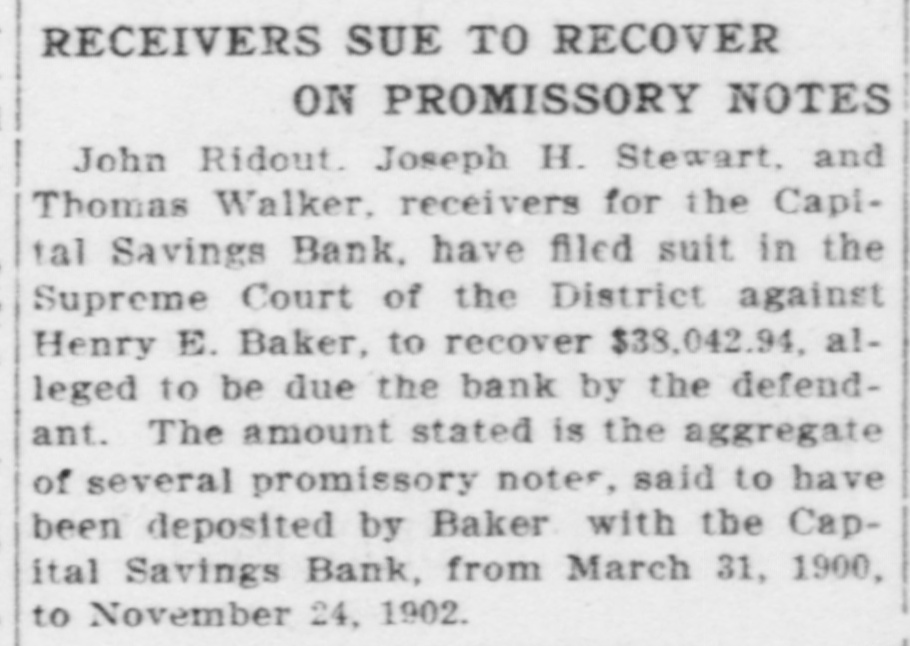
RECEIVERS SUE TO RECOVER ON PROMISSORY NOTES John Ridout. Joseph H. Stewart, and Thomas Walker, receivers for the Capital Savings Bank. have filed suit in the Supreme Court of the District against Henry E. Baker, to recover $38,042.94, alleged to be due the bank by the defendant. The amount stated is the aggregate of several promissory notes, said to have been deposited by Baker with the Capital Savings Bank, from March 31, 1900, to November 24, 1902.
14.March 7, 1903Evening StarWashington, DC
Click image to open full size in new tab
Article Text
Get a Copy of The Record for Complete report of the receivers of Capital Savings Bank, office, 12th and Vt. ave. 1t*
15.March 7, 1903The Colored AmericanWashington, DC
Click image to open full size in new tab
Article Text
There is going to be some sensational doings in the defunct Capital Savings Bank matter. It has got beyond the point where depositors are looking for any money, what they are hankering after now is gore. Directors are still running to cover by doing a real estate business with their wives. If many of these sales were bona fide, how badly buncoed many a wife would be.
16.March 25, 1903Evening StarWashington, DC
Click image to open full size in new tab
Article Text
Court Authorizes Sale. Justice Hagner, in Equity Court No. 1, has authorized the receivers of the Capital Savings Bank to sell at public auction, after proper notice, the interest of the bank in all its real estate.
17.April 1, 1903Evening StarWashington, DC
Click image to open full size in new tab
Article Text
# List of Debtors Filed.
The receivers of the Capital Savings Bank have filed in court a detailed list of the debtors to the Bank and the overdrafts.
Most of the debts are characterized by the receivers as worthless. The overdrafts amount to $95.00 considered good, $1,543.49 considered doubtful and $2,364.18 considered worthless.
18.April 1, 1903The Washington TimesWashington, DC
Click image to open full size in new tab
Article Text
RECEIVERS OF CAPITAL SAVINGS BANK REPORT Indebtedness of the Officers and Others in Detail. A report of the receivers of the Capital Savings Bank, filed yesterday, in the Supreme Court of the District, shows that the officers in charge of its affairs were indebted to the institution in the sum of $47,398.04 when payment was suspended last November. The amounts charged against the officers are: John R. Lynch, president, as maker of notes, $1,734.15; as indorser, $176.74, and overdrafts, $431.07. Leonard C. Bailey, treasurer, in his official capacity, $265; maker of notes, $1,450: overdrafts, $1,011.53. Henry E. Baker, director, as maker of notes, $38,468.55; as indorser, $1,217.37. A. W. Tancil, director, as maker of notes, $301.75; indorsed, $613. Douglas B. McCary, cashier, as maker of notes, $475.73. Robert T. Douglas, teller, as maker of notes, $1.68. Robert H. Terrell and John R. Lynch, notes, $1,068. It is stated that Leonard C. Bailey has conveyed to the trustees of the bank real estate valued at $750, on Stoddard Street, as partial security for his indebtedness. A complete list of other debtors to the Capital Savings Bank is also filed as part of the report of the receivers. These vary in amount from $5 to about $500. A letter by Mr. Bailey to the receivers says: "I have acted as treasurer of the bank since 1889, and as superintendent of the building since 1891, to November 24, 1902, and have never received any compensation. At $25 a month the amount due me now is $3,926."
19.April 4, 1903Evening StarWashington, DC
Click image to open full size in new tab
Article Text
Get a Copy of the Record for complete report of the receivers of Capital Savings Bank. Office, 12th st. and Vermont ave. ap4-3t*
20.April 6, 1903Evening StarWashington, DC
Click image to open full size in new tab
Article Text
Get a Copy of the Record for complete report of the receivers of Capital Savings Bank. Office, 12th st. and Vermont ave. ap4-3t*
21.April 7, 1903Evening StarWashington, DC
Click image to open full size in new tab
Article Text
# Get a Copy of the Record
for complete report of the receivers of Capital Savings Bank. Office, 12th st. and Vermont ave. ap4-3t*
22.July 24, 1903The Washington TimesWashington, DC
Click image to open full size in new tab
Article Text
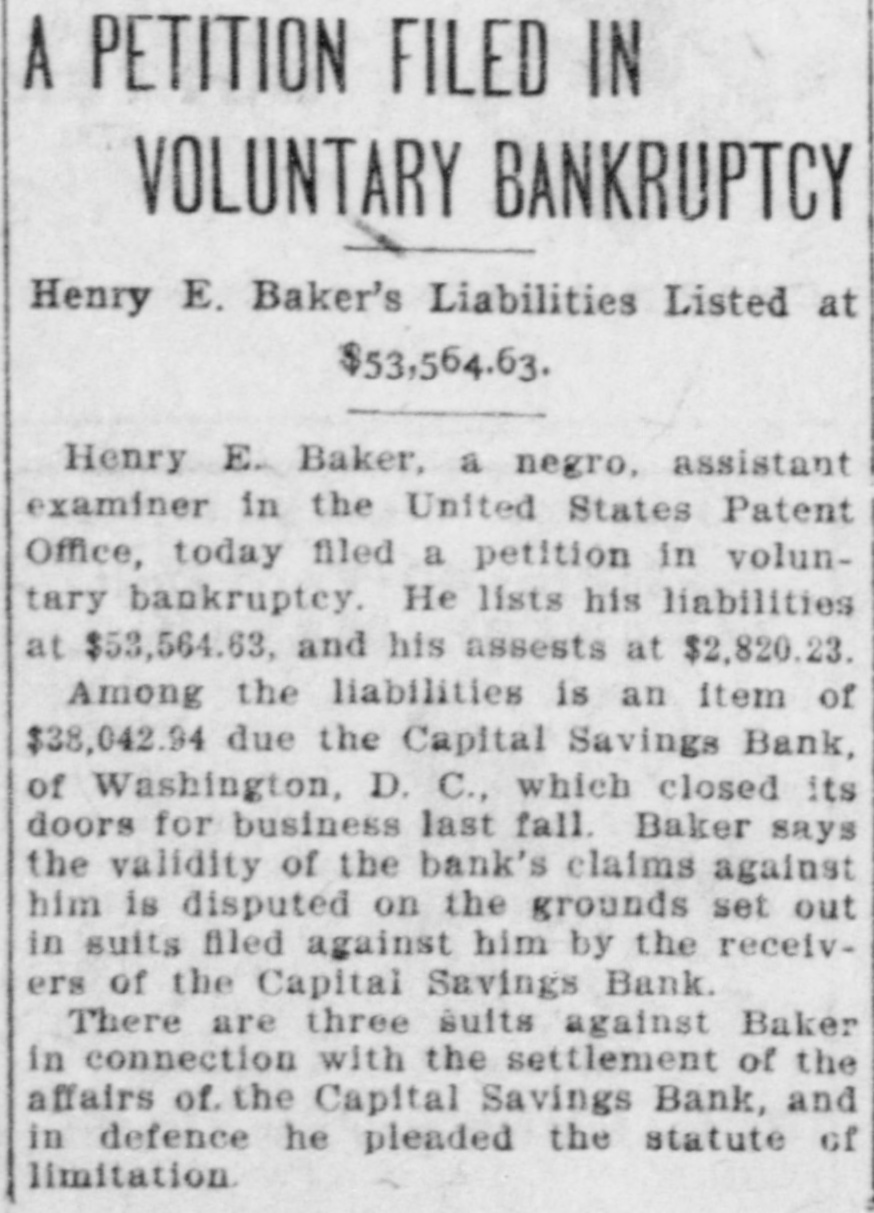
A PETITION FILED IN VOLUNTARY BANKRUPTCY Henry E. Baker's Liabilities Listed at $53,564.63. Henry E. Baker, a negro, assistant examiner in the United States Patent Office, today filed a petition in voluntary bankruptcy. He lists his liabilities at $53,564.63, and his assests at $2,820.23. Among the liabilities is an item of $38,042.94 due the Capital Savings Bank, of Washington, D. C., which closed its doors for business last fall. Baker says the validity of the bank's claims against him is disputed on the grounds set out in suits filed against him by the receivers of the Capital Savings Bank. There are three suits against Baker in connection with the settlement of the affairs of. the Capital Savings Bank, and in defence he pleaded the statute of limitation.
23.March 14, 1904Evening StarWashington, DC
Click image to open full size in new tab
Article Text
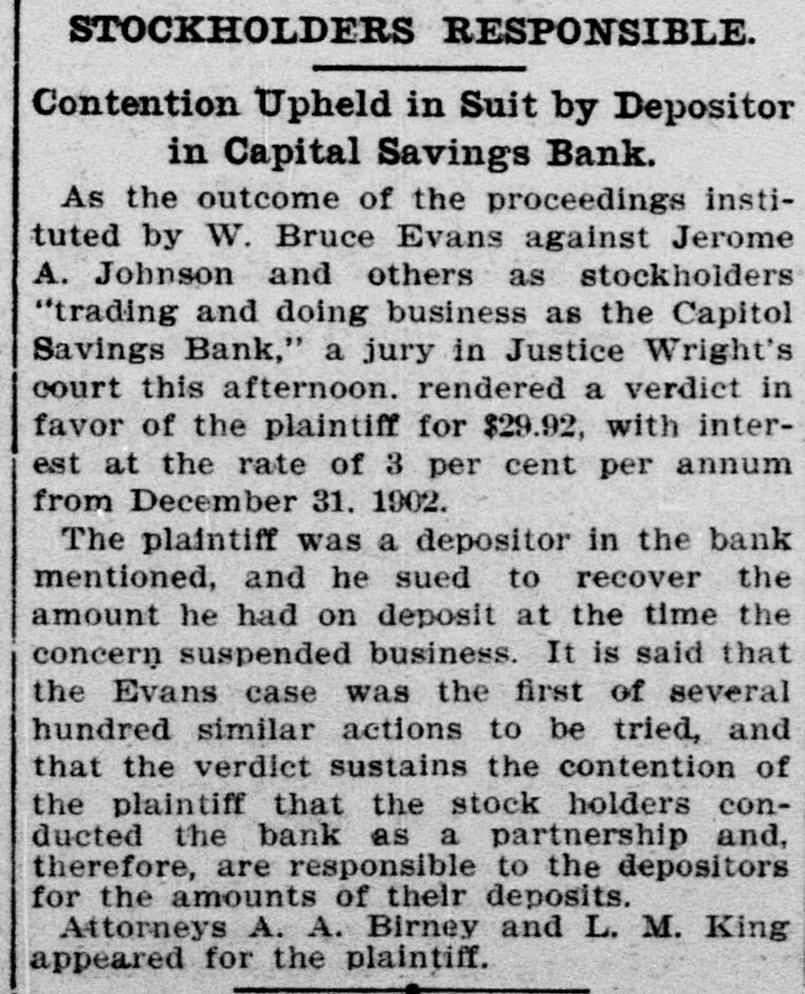
STOCKHOLDERS RESPONSIBLE. Contention Upheld in Suit by Depositor in Capital Savings Bank. As the outcome of the proceedings instituted by W. Bruce Evans against Jerome A. Johnson and others as stockholders "trading and doing business as the Capitol Savings Bank," a jury in Justice Wright's court this afternoon. rendered a verdict in favor of the plaintiff for $29.92, with interest at the rate of 3 per cent per annum from December 31. 1902. The plaintiff was a depositor in the bank mentioned, and he sued to recover the amount he had on deposit at the time the concern suspended business. It is said that the Evans case was the first of several hundred similar actions to be tried, and that the verdict sustains the contention of the plaintiff that the stock holders conducted the bank as a partnership and, therefore, are responsible to the depositors for the amounts of their deposits. Attorneys A. A. Birney and L. M. King appeared for the plaintiff.
Bank runs are almost always and everywhere a deterioration of bank fundamentals.
But not for you.
You are the measure-zero exception: great fundamentals, solid bank, and yet the Diamond Dybvig fairy spread its rumor. Depositors woke up. Your collateral was not prepositioned. The Clearinghouse had it for you.
Do not pass Go. Do not collect $200. Go directly to jail… or worse.