Article Text
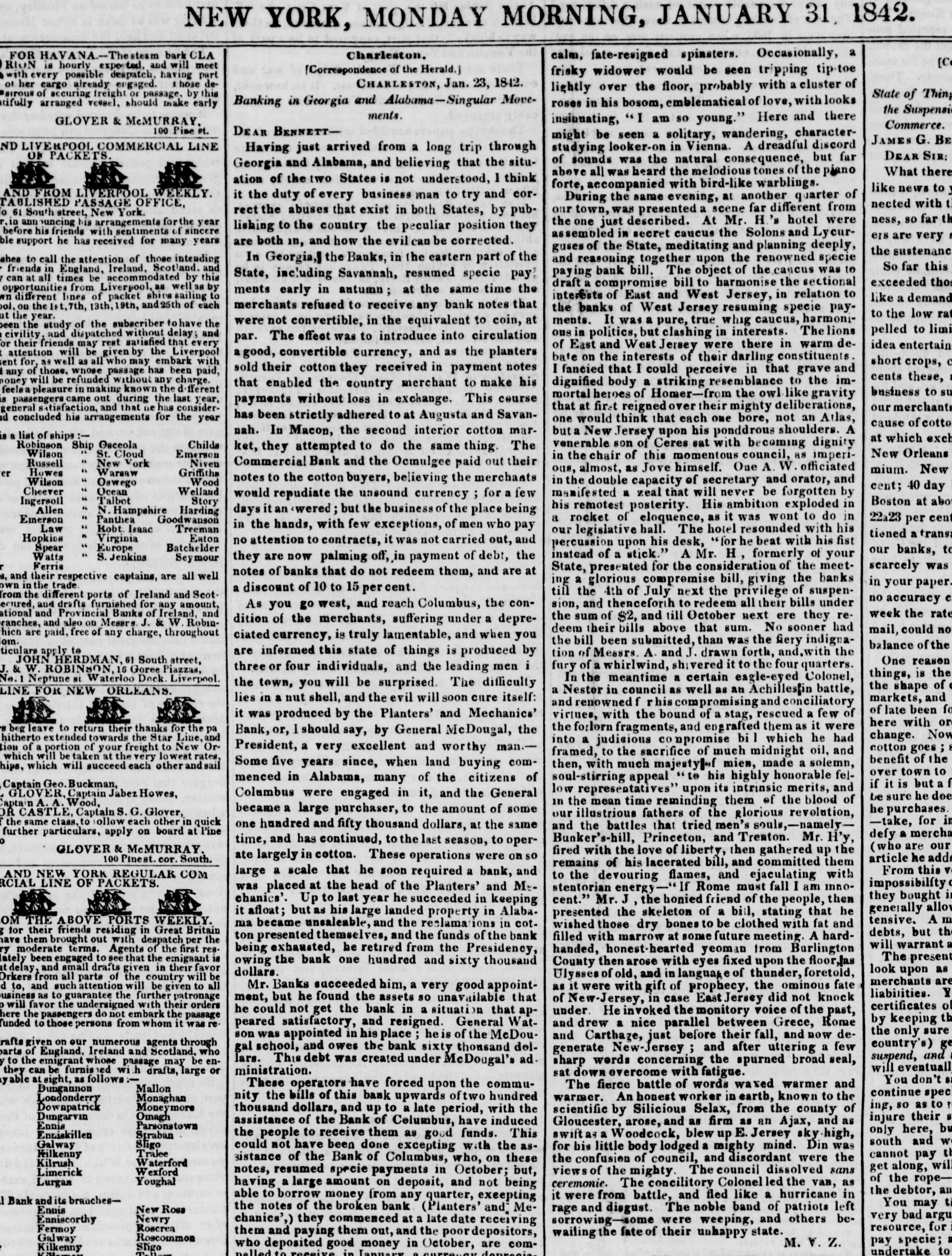
NEW YORK, MONDAY MORNING, JANUARY 31, 1842.
Charleston. [Correspondence of the Herald.]
CHARLESTON, Jan. 23, 1842. Banking in Georgia and Alabama-Singular Move- ments.
DEAR BENNETT-
Having just arrived from a long trip through Georgia and Alabama, and believing that the situ- ation of the two States is not understood, I think it the duty of every business man to try and cor- rect the abuses that exist in both States, by pub- lishing to the country the peculiar position they are both in, and how the evil can be corrected.
In Georgia, the Banks, in the eastern part of the State, including Savannah, resumed specie pay- ments early in autumn; at the same time the merchants refused to receive any bank notes that were not convertible, in the equivalent to coin, at par. The effect was to introduce into circulation a good, convertible currency, and as the planters sold their cotton they received in payment notes that enabled the country merchant to make his payments without loss in exchange. This course has been strictly adhered to at Augusta and Savan- nah. In Macon, the second interior cotton mar- ket, they attempted to do the same thing. The Commercial Bank and the Ocmulgee paid out their notes to the cotton buyers, believing the merchants would repudiate the unsound currency; for a few days it answered; but the business of the place being in the hands, with few exceptions, of men who pay no attention to contracts, it was not carried out, and they are now palming off, in payment of debt, the notes of banks that do not redeem them, and are at a discount of 10 to 15 per cent.
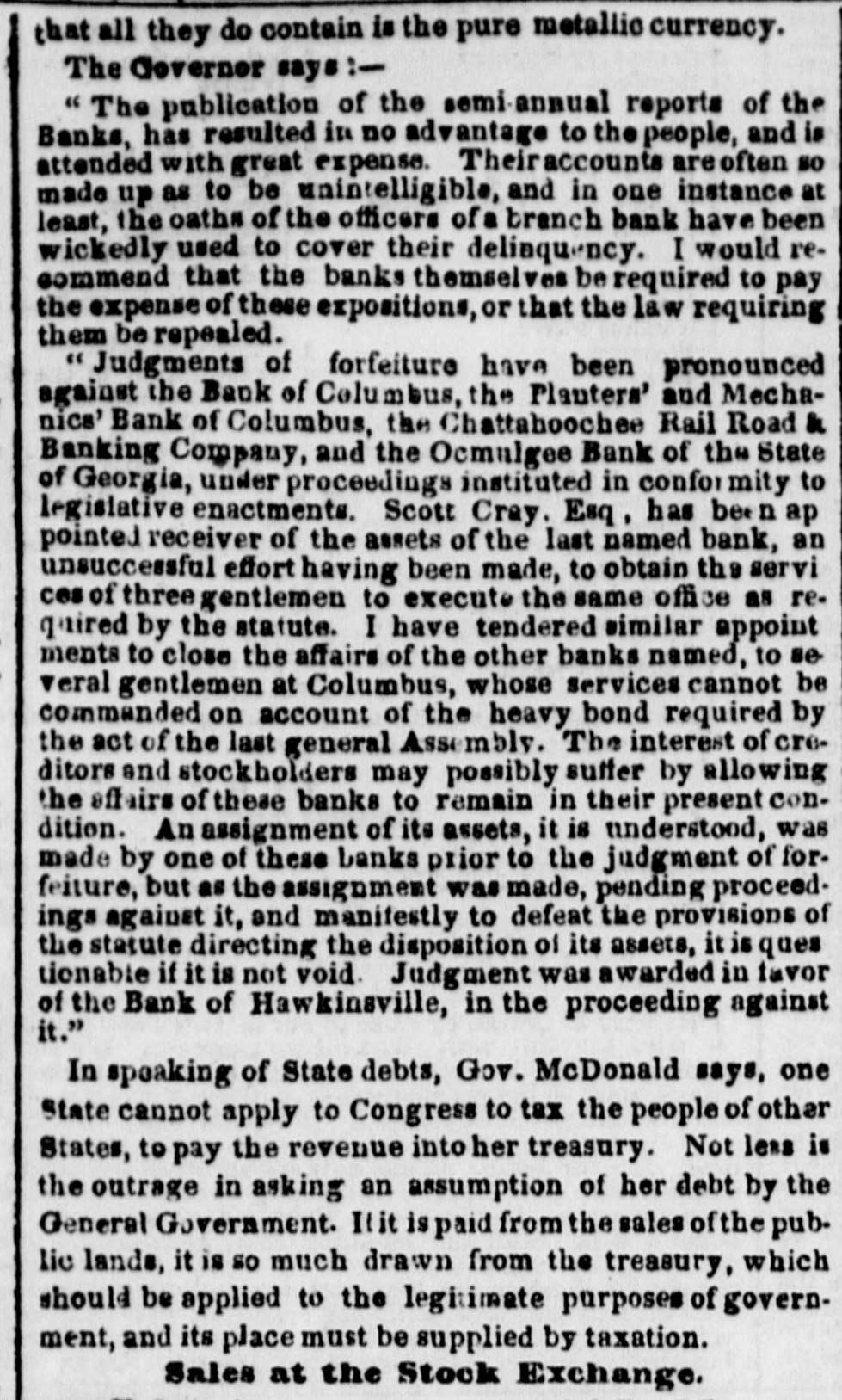
As you go west, and reach Columbus, the con- dition of the merchants, suffering under a depre- ciated currency, is truly lamentable, and when you are informed this state of things is produced by three or four individuals, and the leading men i the town, you will be surprised. The difficulty lies in a nut shell, and the evil will soon cure itself: it was produced by the Planters' and Mechanics' Bank, or, I should say, by General McDougal, the President, a very excellent and worthy man.- Some five years since, when land buying com- menced in Alabama, many of the citizens of Columbus were engaged in it, and the General became a large purchaser, to the amount of some one hundred and fifty thousand dollars, at the same time, and has continued, to the last season, to oper- ate largely in cotton. These operations were on so large a scale that he soon required a bank, and was placed at the head of the Planters' and Me- chanics'. Up to last year he succeeded in keeping it afloat; but as his large landed property in Alaba- ma became unsaleable, and the reclamations in cot- ton presented themselves, and the funds of the bank being exhausted, he retired from the Presidency, owing the bank one hundred and sixty thousand dollars.
Mr. Banks succeeded him, a very good appoint- ment, but he found the assets so unavailable that he could not get the bank in a situation that ap- peared satisfactory, and resigned. General Wat- son was appointed in his place; he is of the McDou- gal school, and owes the bank sixty thousand dol- lars. This debt was created under McDougal's ad- ministration.
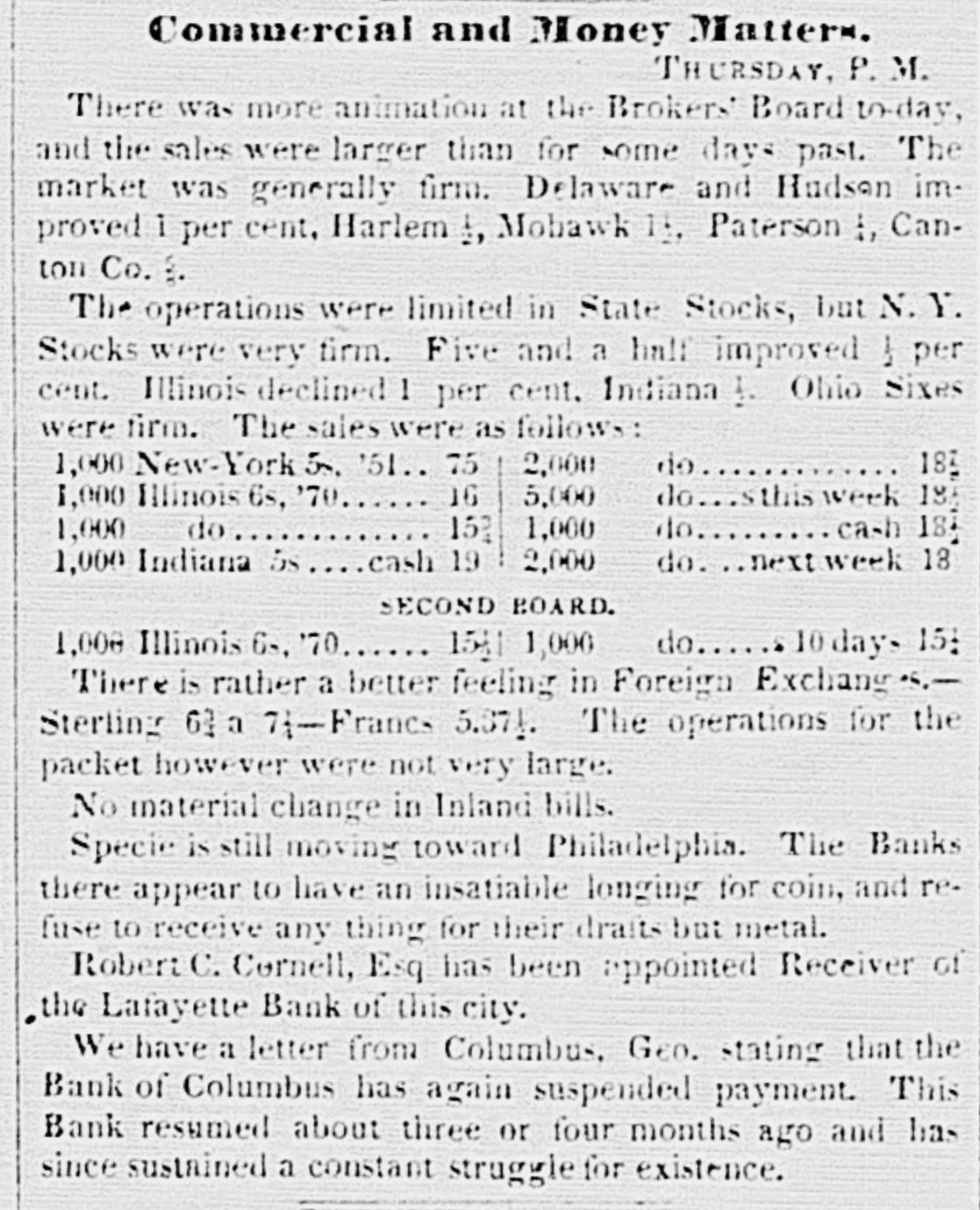
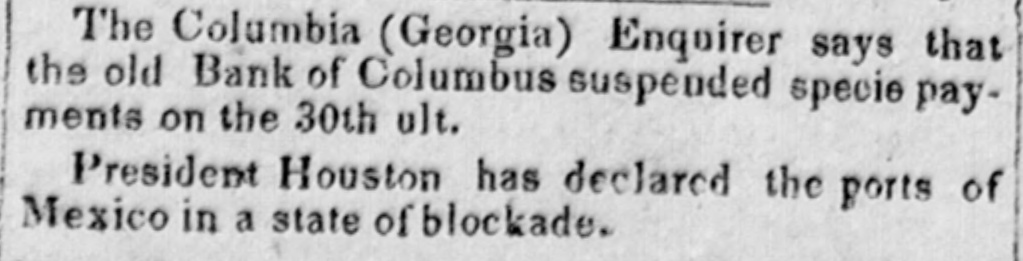
These operators have forced upon the commu- nity the bills of this bank upwards of two hundred thousand dollars, and up to a late period, with the assistance of the Bank of Columbus, have induced the people to receive them as good funds. This could not have been done excepting with the as- sistance of the Bank of Columbus, who, on these notes, resumed specie payments in October; but, having a large amount on deposit, and not being able to borrow money from any quarter, exeepting the notes of the broken bank (Planters' and Me- chanics',) they commenced at a late date receiving them and paying them out, and the poor depositors, who deposited good money in October, are com- pelled to receive in Jannary a currency deprecia-
[Correspondence.] State of Things in New Jersey- the Suspension of Specie Payments- Commerce.
JAMES G. BENNETT, DEAR SIR:
What there is like news to you, connected with the business, so far that the subscrib- ers are very seriously affected by the sustenance.
So far this year the demand has exceeded those of last year, like a demand to the low rate of exchange, pelled to limit the idea entertained of short crops, cents these, and business to support our merchants cause of cotton at which exchange. New Orleans mium. New cent; 40 day Boston at about 22a23 per cent. tioned a transa our banks, to scarcely was in your paper- no accuracy week the rate mail, could not balance of the
calm, fate-resigned spinsters. Occasionally, a frisky widower would be seen tripping tip-toe lightly over the floor, probably with a cluster of roses in his bosom, emblematical of love, with looks insinuating, "I am so young." Here and there might be seen a solitary, wandering, character- studying looker-on in Vienna. A dreadful discord of sounds was the natural consequence, but far above all was heard the melodious tones of the piano forte, accompanied with bird-like warblings.
During the same evening, at another quarter of our town, was presented a scene far different from the one just described. At Mr. H.'s hotel were assembled in secret caucus the Solons and Lycur- guses of the State, meditating and planning deeply, and reasoning together upon the renowned specie paying bank bill. The object of the caucus was to draft a compromise bill to harmonise the sectional interests of East and West Jersey, in relation to the banks of West Jersey resuming specie pay- ments. It was a pure, true whig caucus, harmoni- ous in politics, but clashing in interests. The lions of East and West Jersey were there in warm de- bate on the interests of their darling constituents. I fancied that I could perceive in that grave and dignified body a striking resemblance to the im- mortal heroes of Homer-from the owl like gravity that at first reigned over their mighty deliberations, one would think that each one bore, not an Atlas, but a New Jersey upon his ponddrous shoulders. A venerable son of Ceres sat with becoming dignity in the chair of this momentous council, as imperi- ous, almost, as Jove himself. One A. W. officiated in the double capacity of secretary and orator, and manifested a zeal that will never be forgotten by his remotest posterity. His ambition exploded in a rocket of eloquence, as it was wont to do in our legislative hall. The hotel resounded with his percussion upon his desk, "for he beat with his fist instead of a stick." A Mr. H, formerly of your State, presented for the consideration of the meet- ing a glorious compromise bill, giving the banks till the 4th of July next the privilege of suspen- sion, and thenceforth to redeem all their bills under the sum of $2, and till October next ere they re- deem their bills above that sum. No sooner had the bill been submitted, than was the fiery indigna- tion of Messrs. A. and J. drawn forth, and, with the fury of a whirlwind, shivered it to the four quarters. In the meantime a certain eagle-eyed Colonel, a Nestor in council as well as an Achillesțin battle, and renownedf rhis compromising and conciliatory virtues, with the bound of a stag, rescued a few of the forlorn fragments, and engrafted them as it were into a judicious compromise bil which he had framed, to the sacrifice of much midnight oil, and then, with much majesty of mien, made a solemn, soul-stirring appeal "te his highly honorable fel- low representatives" upon its intrinsic merits, and in the mean time reminding them of the blood of our illustrious fathers of the glorious revolution, and the battles that tried men's souls, namely-- Bunker's-hill, Princeton, and Trenton. Mr. H'y, fired with the love of liberty, then gathered up the remains of his lacerated bill, and committed them to the devouring flames, and ejaculating with stentorian energy-" If Rome must fall I am inno- cent." Mr. J, the honied friend of the people, then presented the skeleton of a bill, stating that he wished those dry bones to be clothed with fat and filled with marrow at some future meeting. A hard- handed, honest-hearted yeoman trom Burlington County then arose with eyes fixed upon the floor, las Ulysses of old, and in language of thunder, foretold, as it were with gift of prophecy, the ominous fate of New-Jersey, in case East Jersey did not knock under. He invoked the monitory voice of the past, and drew a nice parallel between Grece, Rome and Carthage, just before their fall, and now de- generate New-Jersey; and after uttering a few sharp words concerning the spurned broad seal, sat down overcome with fatigue.
One reason things, is the the shape of markets, and of late been fo here with or change. Now cotton goes;= benefit of the over town to if it is but a f be sure he doe he purchases. -take, for in defy a mercha (who are our article he adde From this v impossibility c they bought in generally allow tensive. Am debts, but the will warrant a The present look upon as merchants are liabilities. Y certificates of by keeping th the only sure country's) ge suspend, and will eventuall You don't sa continue spec ing, so as to r injure their s only here, bu south and w cannot pay th get along, will of the rope- the debtor, an You may ti very bad argu resource, for pay specie; undertake to
The fierce battle of words waxed warmer and warmer. An honest worker in earth, known to the scientific by Silicious Selax, from the county of Gloucester, arose, and as firm as an Ajax, and as swift as a Woodcock, blew up E. Jersey sky high, for bis little body lodged a mighty mind. Din was the confusion of council, and discordant were the views of the mighty. The council dissolved sans ceremonie. The concilitory Colonel led the van, as it were from battle, and fled like a hurricane in rage and disgust. The noble band of patriots left sorrowing-some were weeping, and others be- wailing the fate of their unhappy state.
M. V. Z.