John J. Cisco & Son (New York, NY)

Episode Information

Episode Type
Run → Suspension → Closure
Start Date
January 15, 1885
Location
New York, New York (40.714, -74.006)
Bank Type
private

Metadata

Notes

Assignment made to an assignee for gradual liquidation; depositors expected to be paid when securities realized.

Events (2)

1. January 15, 1885 Run
Cause
Rumor Or Misinformation
Cause Details
Widespread rumors (telegraphed domestically and to Europe) alleging embarrassment triggered heavy withdrawals; the firm also held depreciated Houston & Texas Central bonds which worsened position.
Newspaper Excerpt
The rumors started ten days since about this house ... have caused a very severe run upon them by depositors.
Source
newspapers
2. January 15, 1885 Suspension
Cause
Voluntary Liquidation
Cause Details
Firm made an assignment without preferences to an assignee for the purpose of gradual liquidation after the run and depreciation of railroad securities.
Newspaper Excerpt
John J. Cisco & Son ... filed an assignment this afternoon ... made an assignment to Lewis May.
Source
newspapers

Newspaper Articles (18)

Article from Daily Kennebec Journal, January 16, 1885

Click image to open full size in new tab

Article Text

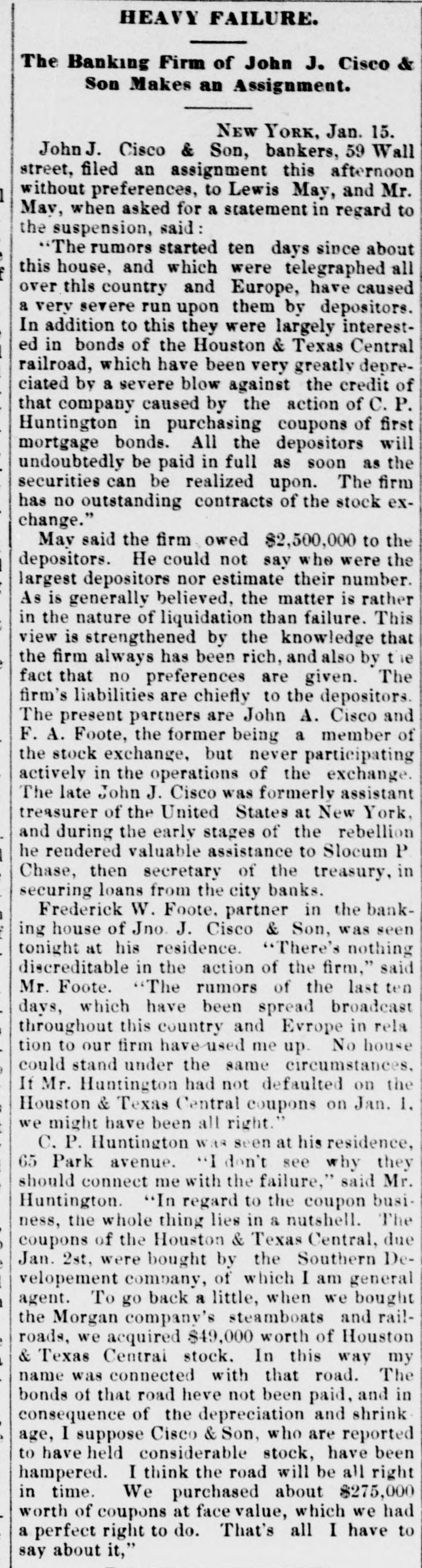
HEAVY FAILURE

The Banking Firm of John J. Cisco & Son Makes an Assignment. NEW YORK, Jan. 15. John J. Cisco & Son, bankers, 59 Wall street, filed an assignment this afternoon without preferences, to Lewis May, and Mr. 1 May, when asked for a statement in regard to the suspension, said: "The rumors started ten days since about this house, and which were telegraphed all over this country and Europe, have caused a very severe run upon them by depositors. In addition to this they were largely interested in bonds of the Houston & Texas Central railroad, which have been very greatly depreciated by a severe blow against the credit of that company caused by the action of C.P Huntington in purchasing coupons of first mortgage bonds. All the depositors will undoubtedly be paid in full as soon as the securities can be realized upon. The firm has no outstanding contracts of the stock exchange." May said the firm owed $2,500,000 to the depositors. He could not say who were the largest depositors nor estimate their number. As is generally believed, the matter is rather in the nature of liquidation than failure. This view is strengthened by the knowledge that the firm always has been rich, and also by e fact that no preferences are given. The firm's liabilities are chiefly to the depositors. The present partners are John A. Cisco and F. A. Foote, the former being a member of the stock exchange, but never participating actively in the operations of the exchange. The late John J. Cisco was formerly assistant treasurer of the United States at New York, and during the early stages of the rebellion he rendered valuable assistance to Slocum P Chase, then secretary of the treasury, in securing loans from the city banks. Frederick W. Foote, partner in the banking house of Jno. J. Cisco & Son, was seen tonight at his residence. "There's nothing discreditable in the action of the firm," said Mr. Foote. "The rumors of the last ten days, which have been spread broadcast throughout this country and Evrope in rela tion to our firm have-used me up. No house could stand under the same circumstances. If Mr. Huntington had not defaulted on the Houston & Texas Central coupons on Jan. 1. we might have been all right." C. P. Huntington was seen at his residence, 65 Park avenue. "I don't see why they should connect me with the failure," said Mr. Huntington. "In regard to the coupon business, the whole thing lies in a nutshell. The coupons of the Houston & Texas Central, due Jan. 2st, were bought by the Southern Developement company, of which I am general agent. To go back a little, when we bought the Morgan company's steamboats and railroads, we acquired $49,000 worth of Houston & Texas Central stock. In this way my name was connected with that road. The bonds of that road heve not been paid, and in consequence of the depreciation and shrink age, I suppose Cisco & Son, who are reported to have held considerable stock, have been hampered. I think the road will be all right in time. We purchased about $275,000 worth of coupons at face value, which we had a perfect right to do. That's all I have to say about it,"
Article from The Indianapolis Journal, January 16, 1885

Click image to open full size in new tab

Article Text

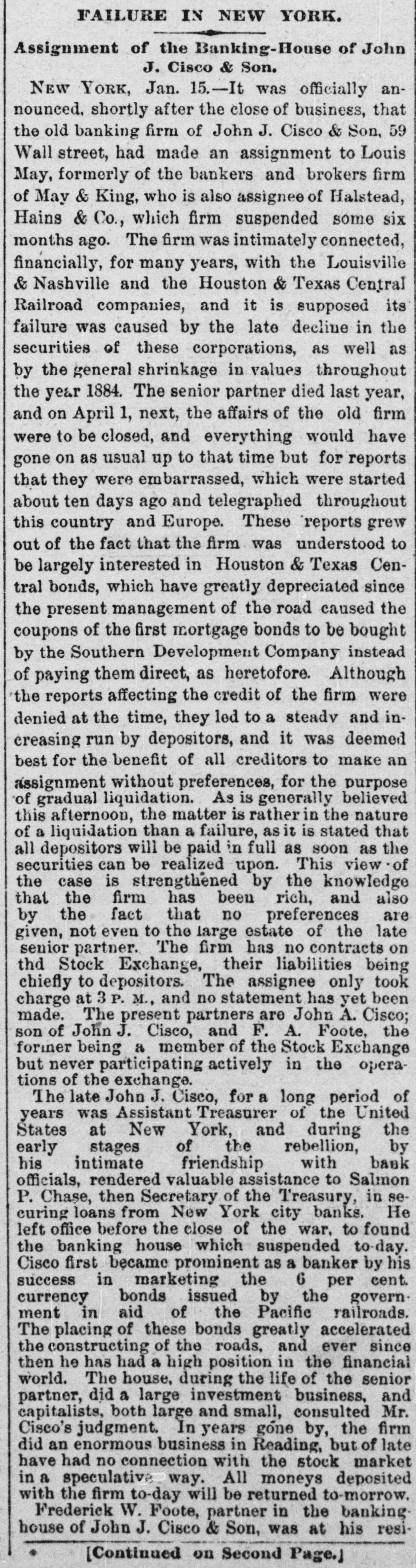
FAILURE IN NEW YORK

Assignment of the Banking-House of John J. Cisco & Son. NEW YORK, Jan. 15.-It was officially announced, shortly after the close of business, that the old banking firm of John J. Cisco & Son, 59 Wall street, had made an assignment to Louis May, formerly of the bankers and brokers firm of May & King, who is also assignee of Halstead, Hains & Co., which firm suspended some six months ago. The firm was intimately connected, financially, for many years, with the Louisville & Nashville and the Houston & Texas Central Railroad companies, and it is supposed its failure was caused by the late decline in the securities of these corporations, as well as by the general shrinkage in values throughout the year 1884. The senior partner died last year, and on April 1, next, the affairs of the old firm were to be closed, and everything would have gone on as usual up to that time but for reports that they were embarrassed, which were started about ten days ago and telegraphed throughout this country and Europe. These reports grew out of the fact that the firm was understood to be largely interested in Houston & Texas Central bonds, which have greatly depreciated since the present management of the road caused the coupons of the first mortgage bonds to be bought by the Southern Development Company instead of paying them direct, as heretofore. Although the reports affecting the credit of the firm were denied at the time, they led to a steadv and increasing run by depositors, and it was deemed best for the benefit of all creditors to make an assignment without preferences, for the purpose of gradual liquidation. As is generally believed this afternoon, the matter is rather in the nature of a liquidation than a failure, as it is stated that all depositors will be paid in full as soon as the securities can be realized upon. This view of the case is strengthened by the knowledge that the firm has been rich, and also by the fact that no preferences are given, not even to the large estate of the late senior partner. The firm has no contracts on thd Stock Exchange, their liabilities being chiefly to depositors. The assignee only took charge at 3 P. M., and no statement has yet been made. The present partners are John A. Cisco; son of John J. Cisco, and F. A. Foote, the former being a member of the Stock Exchange but never participating actively in the operations of the exchange. The late John J. Cisco, for a long period of years was Assistant Treasurer of the United States at New York, and during the early stages of the rebellion, by his intimate friendship with bank officials, rendered valuable assistance to Salmon P. Chase, then Secretary of the Treasury, in securing loans from New York city banks. He left office before the close of the war. to found the banking house which suspended to-day. Cisco first became prominent as a banker by his success in marketing the 6 per cent. currency bonds issued by the government in aid of the Pacific railroads. The placing of these bonds greatly accelerated the constructing of the roads, and ever since then he has had a high position in the financial world. The house, during the life of the senior partner, did a large investment business, and capitalists, both large and small, consulted Mr. Cisco's judgment. In years gone by, the firm did an enormous business in Reading, but of late have had no connection with the stock market in a speculative way. All moneys deposited with the firm to-day will be returned to-morrow. Frederick W. Foote, partner in the bankinghouse of John J. Cisco & Son, was at his resi[Continued on Second Page.)


Article from The Wheeling Daily Intelligencer, January 16, 1885

Click image to open full size in new tab

Article Text

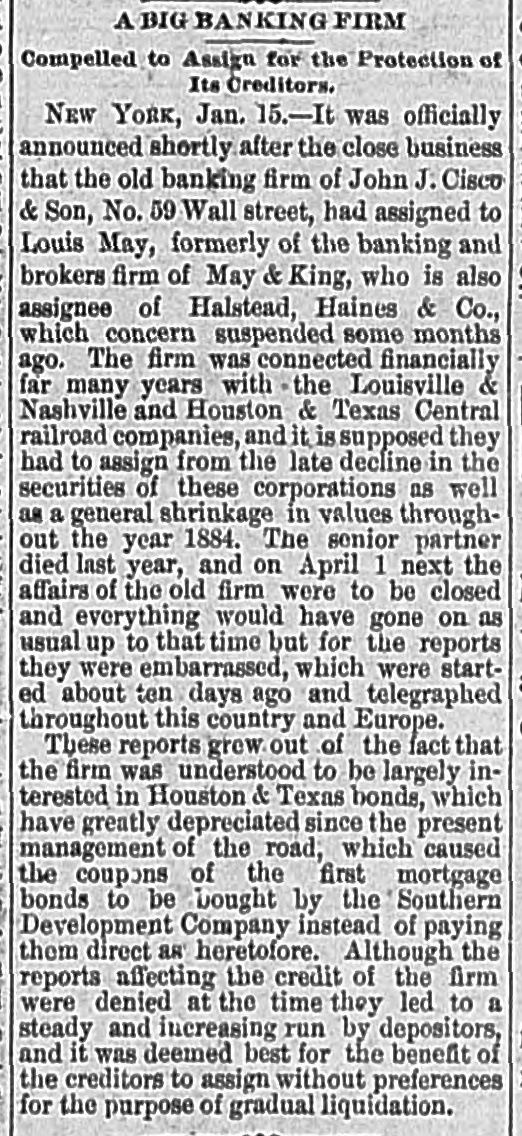
A BIG BANKING Compelled to Assign for the Protection of Its Creditors. NEW YORK, Jan. 15.-It was officially announced shortly after the close business that the old banking firm of John J. Cisco & Son, No. 59 Wall street, had assigned to Louis May, formerly of the banking and brokers firm of May & King, who is also assignee of Halstead, Haines & Co., which concern suspended some months ago. The firm was connected financially far many years with . the Louisville & Nashville and Houston & Texas Central railroad companies, and it is supposed they had to assign from the late decline in the securities of these corporations as well as a general shrinkage in values throughout the year 1884. The senior partner died last year, and on April 1 next the affairs of the old firm were to be closed and everything would have gone on as usual up to that time but for the reports they were embarrassed, which were started about ten days ago and telegraphed throughout this country and Europe. These reports grew out of the fact that the firm was understood to be largely interested in Houston & Texas bonds, which have greatly depreciated since the present management of the road, which caused the coupons of the first mortgage bonds to be bought by the Southern Development Company instead of paying them direct as heretofore. Although the reports affecting the credit of the firm were denied at the time they led to a steady and increasing run by depositors, and it was deemed best for the benefit of the creditors to assign without preferences for the purpose of gradual liquidation.


Article from Bismarck Weekly Tribune, January 16, 1885

Click image to open full size in new tab

Article Text

Rnmored Assignment

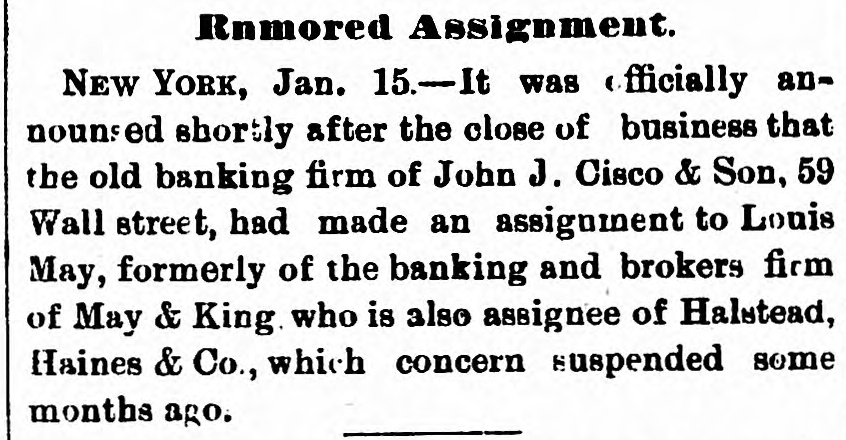
NEW YORK, Jan. 15.-It was officially announsed shortly after the close of business that the old banking firm of John J. Cisco & Son, 59 Wall street, had made an assignment to Louis May, formerly of the banking and brokers firm of May & King who is also assignee of Halstead, Haines & Co., which concern suspended some months ago.


Article from The Democratic Leader, January 16, 1885

Click image to open full size in new tab

Article Text

Banking Firm Failed

NEW YORK, Jan. 15.-It was officially announced shortly after the close of business that the old banking firm of John J. Cisco & Son had made an assignment to Louis May, formerly of the firm of May & King, bankers, who is also the assignee of Halstead, Haines & Co., which concern suspended some month ago, The firm was intimately connected financially for many years with the Louisville & Nashville and Houston & Texas Central Railroad cempanies. Owing to the shrinkage of value of the above securities reports were started several days ago that the firm was embartassed. Although reports affecting credit were denied at the time they led to a steady and increasing run by depositors and it was deemed best for the benefit of all creditors to make an assignment without preferences for the purpose of gradual liquidation. As generally believed this afternoon the matter is rather in the nature of a liquidation than a failure, as it is stated that all depositors will be paid in full as soon as the securities can be realized upon. No statement has yet been made up. The present partners are John J. Cisco, son of John J. Cisco and F. A. Foote. The late John J. Cisco was for a long period treasurer of the United States at New York. All moneys deposited with the firm to-day will be returned to-morrow.


Article from St. Paul Daily Globe, January 16, 1885

Click image to open full size in new tab

Article Text

FAILURE OF CISCO & SON

NEW YORK, Jan. 15.-It was officially announced shortly after the close of business that the old banking firm of John J. Cisco & Son, 59 Wall street, had made an assignment to Louis May, formerly of the banking and brokers firm of May & King, who is also the assignee of Holstead, Haines & Co., which concern suspended some months ago. The firm was intimately connected financially for many years with the Louisville & Nashville and Houston & Texas Central Rail road companies, and it is supposed from the late decline in the secureties of these corporations as well as a general shrinkage in value throughout 1884, the assignment was caused. The senior partner died last year and on April 1 next, the affairs of the old firm were to be closed, and everything would have gone on as usual up to that time but for the reports that they were embarrassed, which were started about ten days ago and telegraphed throughout this country and Europe. These reports grew out of the fact that the firm was understood to be largely intérested in Houston & Texas central bonds which have greatly depreciated since the present management of the road caused coupons of the first mort gage bonds to be bought by the Southein Development company instead of paying them direct as heretofore. Although the reports affecting the credit of the firm were denied at the time, they led to a steady and increasing run by depositors, and it was deemed best for the benefit of all creditors to make an assignment without preference, for the purpose of a gradual liquidation. As generally believed this afternoon the matter is rather in the nature of a liquidation than a failure, as it is stated all the depositors will be paid in full, as soon as securities can be realized upon.


Article from The Salt Lake Herald, January 16, 1885

Click image to open full size in new tab

Article Text

The Cisco Failure

NEW YORK, January 15.-It was officially announced, shortly after the close of business, that the old banking firm of John J. Cisco & Son had made an assignment to Louis May, formerly of the, firm of May & King, bankers, who is also assignee of Halstead, Harnes & Co., who suspended some months ago. The firm was intimately connected financially for many years with the Louisville & Nashville and Houston & Texas Central Railway companies. Owing to shrinkage of values of the above securities, reports were started several days ago that the firm was embarrassed, although the report affecting its credit were denied at the time. They led to a steady and increasing run by depositors, and it was deemed best for the benefit of all creditors to make an assignment without preferences, "for the purpose of gradual liquidation. As generally believed this afternoon the matter is rather in the nature of a liquidation than a failure, as it is stated that all the depositors will be paid in full, as soon as the securities can be realized upon. No statement has been made up. The present partners are John A. Cisco, son of John Cisco, and F. A. Foote. The late John Cisco was for a long period Treasurer of the United States at New York. All the moneys deposited with the firm to-day will be returned to-morrow.


Article from Richmond Dispatch, January 16, 1885

Click image to open full size in new tab

Article Text

HEAVY FAILURES.
LARGE FIRMS EMBARRASSED.

A Pittsburgh Iron Firm Goes Under for Millions-An Old New York Banking-House Make an Assignment.

[By telegraph to the Dispatch.] PITTSBURGH, PA., January 15.- This afternoon Oliver Brothers & Phillips and the Oliver & Roberts Wire Company (limited) issued the following card to their creditors: "We are to-day compelled to suspend payment, and propose calling immediately a meeting of those interested, to whom, we believe, we can show assets amply sufficient, with some indulgence, to pay every dollar of our liabilities."

Reports of the embarrassment of Oliver Brothers & Phillips, the greatest iron firm in the city when its connections are considered, flew like wildfire and set the town agog with excitement. Such an event was recognized as a catastrophe unequalled by any previous failure, and the great popularity of the individual members of the firm made it all the more to be deplored. The truth of the matter seemed to be that dull times, an immense pay-roll, and other necessary expenses have compelled the firm to ask for an extension somewhat similar to that given to Graff, Bennett & Co., who failed two years ago.

There are many stories afloat as to the immediate cause of the trouble, but in the banks and on all sides it seemed to be the general feeling that an extension would be asked for and granted by the creditors. It is impossible to guess at the liabilities of the firm. They are reported from $3,000,000 to $5,000,000. Local bankers say that there is about $1,000,000 or $1,500,000 of paper held here, with good collateral for almost all of it. Large blocks of paper are held in the eastern States as far east as Massachusetts, while very large sums are carried in New York and Philadelphia. The firm has made large investments in real estate, and has an immense amount of collateral of various kinds. It is thought that there is not the slightest doubt that an extension will be granted, and that the firm will pay. The banks have the greatest confidence in the management of the heads of the firm, and will be as liberal as possible in their arrangements.

Harry W. Oliver, senior member of the firm, was seen by an Associated Press representative this afternoon. He said the whole affair was so sudden that they hadn't time to collect their thoughts. He was unable to give the figures to-day, but just as soon as it was possible a full and complete statement would be given to the public. Every dollar they had belonged to their creditors, and he felt confident that the assets would largely exceed the liabilities.

Regarding the cause of the embarrassment there are numerous sensational stories afloat, but most of them have been denied. One of the stories was to the effect that paper to the amount of $80,000 had been protested in New York among bankers. It is said that the banks were willing to continue to carry the paper of the firm, but owing to the hard times and scarcity of money the firm were unable to raise money to meet the interest and pay their employés. Their pay-roll is said to have amounted to from $200,000 to $250,000 a month, and it is said this was too much for them to meet any longer.

An Old Banking Firm in New York Falls.

NEW YORK, January 15.-It was officially announced shortly after the close of business that the old banking firm of John J. Cisco & Son, at 59 Wall street, had made an assignment to Lewis May, formerly of the banker and brokers' firm of May & King, who is also assignee of Halsted, Haines & Co., which concern suspended some months since. The firm was intimately connected financially for many years with the Louisville and Nashville and Houston and Texas Central Railroad Companies, and have suffered from the late decline in securities of these corporations, as well as a general shrinkage in values throughout the year 1884. The senior partner died last year, and on April 1st next the affairs of the old firm were to be closed up, and everything would have gone on as usual up to that time but for reports that they were embarrassed, which were started about ten days ago and telegraphed throughout this country and Europe. These reports grew out of the fact that the firm was understood to be largely interested in Houston and Texas Central bonds, which have greatly depreciated since the present management of the road caused coupons of the first mortgage bonds to be bought by the Southern Development Company instead of paying them direct, as heretofore. Although the reports affecting the credit of the firm were denied at the time, they led to a steady and increasing run by depositors, and it was deemed best for the benefit of all their creditors to make an assignment without preferences for the purpose of gradual liquidation of their affairs. As is generally believed this afternoon, the matter is rather in the nature of a liquidation than a failure, as it is stated that all depositors will be paid in full as soon as the securities can be realized upon. This view of the case is strengthened by the knowledge that the firm always has been rich, and also by the fact that no preferences are given, not even the large estate of the senior partner. The firm has no contracts on the Stock Exchange, their liabilities being chiefly to depositors. The consignee only took charge at 3 P. M., and no statement has yet been made up to the present. The partners are John A. Cisco, son of John J. Cisco, and F. A. Foote, the former being a member of the Stock Exchange, but never participating actively in the operations of the Exchange.


Article from The Rock Island Argus, January 17, 1885

Click image to open full size in new tab

Article Text

THEY PROMISE TO PAY

JOHN J. CISCO & SON, NEW YORK BANKERS, SUSPEND. Three Million Required to Make Their Books Balance, Which They Think Will Be Forthcoming- onver Bros. & Phillips. NEW YORK, Jan. 17-The widely-known banking firm of John J. Cisco & Son made an assignment Thursday afternoon to Mr. Lewis May. The news was not published properly on Wall street until shortly before 4 o'clock. The announcement created general surprise, for, though rumors affecting the standing of the tirm have been current since about Jan. 1, the statements of the members of the firm. together with a knowledge of its resources, have been regarded as sufficiently good evidence that the rumors were groundless. The liabilities will reach in the aggregate, it is believed, An $3,000,000. ssignment was made to Lewis May, the banker. The latter said: "The rumors started some days since about the old-established banking-house of John J. Cisco & Son, and which were telegraphed all over the country and Europe, have caused a very severe run upon them on the part of their depositors. In addition to this, they were largely interested in the bonds of the Houston & Texan Central railroad, which have been very greatly depreciated by the severe blow against the credit of the company caused by the action of Mr. C. P. Huntington in purchasing the coupons of the first mortgage bonds. These matters, with the general depression of all securities, compelled them, for the benefit of all their creditors, to make an assignment without preferences for the purpose of a gradual liquidation of their affairs. All depositors will undoubtedly be paid in full as soon as the securities can be realized upon. The firm has no outstanding contracts on the stock exchange." Russell Sage is said to have felt the shock first. He sold a number of 500-share sprea Is 20 points apart-at 44 and 64-in Union Pacific. The broker who negotiated them heard of the failure. He came back with a smile on his face. and said: "Mr. Sage, will you sell any more spreads it the same figures?" "All you want," said Mr. Sage, very cheerfully. "All right: I'll take spreads on 2,000 shares more of Union Pacific." The clerks were filling out the contracts when a broker came in and said: "Cisco's sons have failed." "What!" shouted Mr. Sage. "Get out of here, everybody! I don't want you around." "But I want my spreads," said a broker. "You can't have 'em. Tear 'em up, John. Here [to the broker], you get back those I sold you. Run! I want 'em all back. I wouldn't sell a put for anything. Oh, dear! I didn't think they'd fail. I never heard of such a thing." Official notification of the suspension was made to the members of the stock exchange Friday by Chairman Mitchell. President Simmons, of the stock exchange, said that his opinion the failure will have no serious effect in Wall street. The failure of an old house like that of Cisco & Son, which has stood so well for so many years, and with such wide ramifications, will naturally for the time being produce a feeling of distrust, but he believed the effect would be only temporary. Cisco & Son were large holders of Houston & Texas Central railroad bonds. There has been no market for these securities for some e time past, and the default in the payment of n the coupons had a further unfavorable r effect.


Article from Wheeling Register, January 20, 1885

Click image to open full size in new tab

Article Text

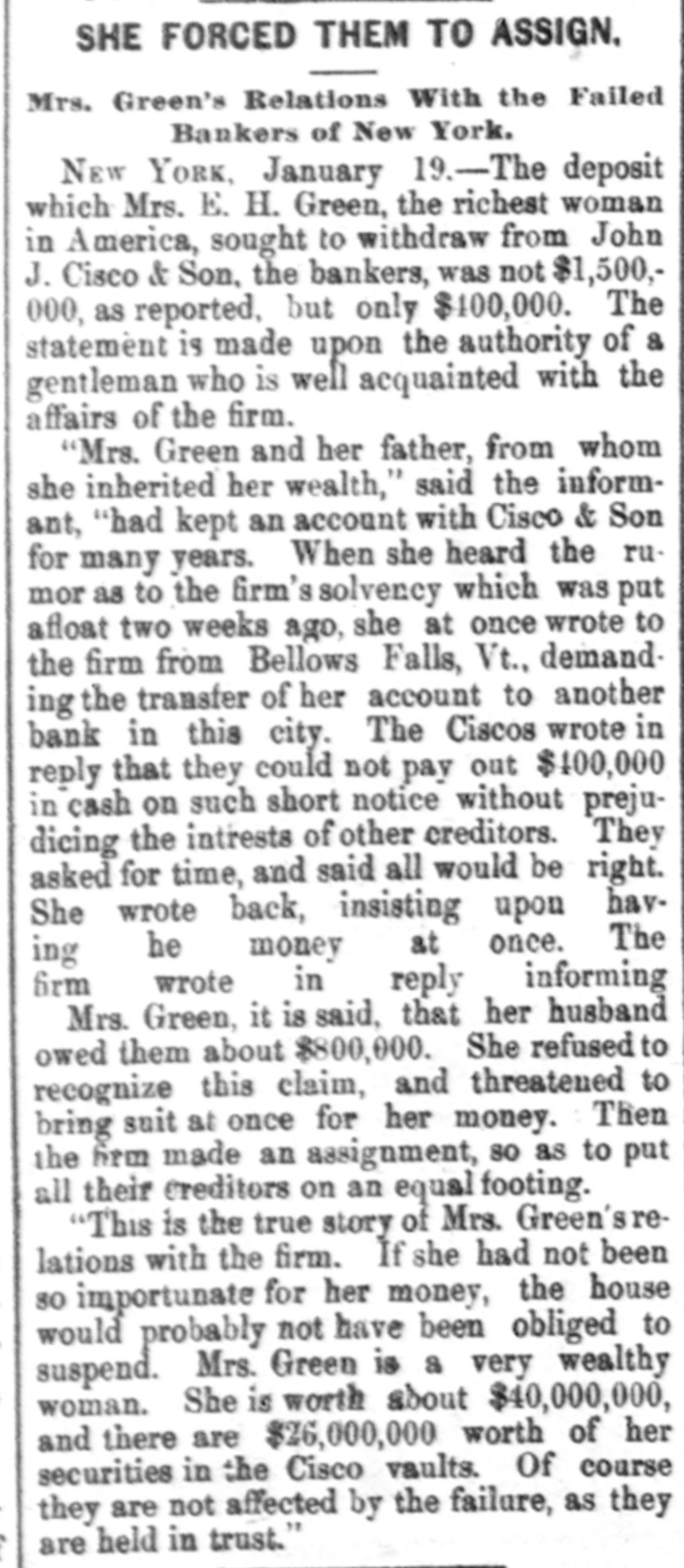
SHE FORCED THEM TO ASSIGN

Mrs. Green's Relations With the Failed Bankers of New York. NEW YORK, January 19.-The deposit which Mrs. E. H. Green, the richest woman in America, sought to withdraw from John J. Cisco & Son, the bankers, was not $1,500,000, as reported, but only $100,000. The statement is made upon the authority of a gentleman who is well acquainted with the affairs of the firm. "Mrs. Green and her father, from whom she inherited her wealth," said the informant, "had kept an account with Cisco & Son for many years. When she heard the rumor as to the firm's solvency which was put afloat two weeks ago, she at once wrote to the firm from Bellows Falls, Vt., demanding the transfer of her account to another bank in this city. The Ciscos wrote in reply that they could not pay out $400,000 in cash on such short notice without prejudicing the intrests of other creditors. They asked for time, and said all would be right. She wrote back, insisting upon having he money at once. The firm wrote in reply informing Mrs. Green, it is said, that her husband owed them about $800,000. She refused to recognize this claim, and threatened to bring suit at once for her money. Then the firm made an assignment, so as to put all their creditors on an equal footing. "This is the true story of Mrs. Green's relations with the firm. If she had not been so importunate for her money, the house would probably not have been obliged to suspend. Mrs. Green is a very wealthy woman. She is worth about $40,000,000, and there are $26,000,000 worth of her securities in the Cisco vaults. Of course they are not affected by the failure, as they are held in trust."


Article from Savannah Morning News, January 20, 1885

Click image to open full size in new tab

Article Text

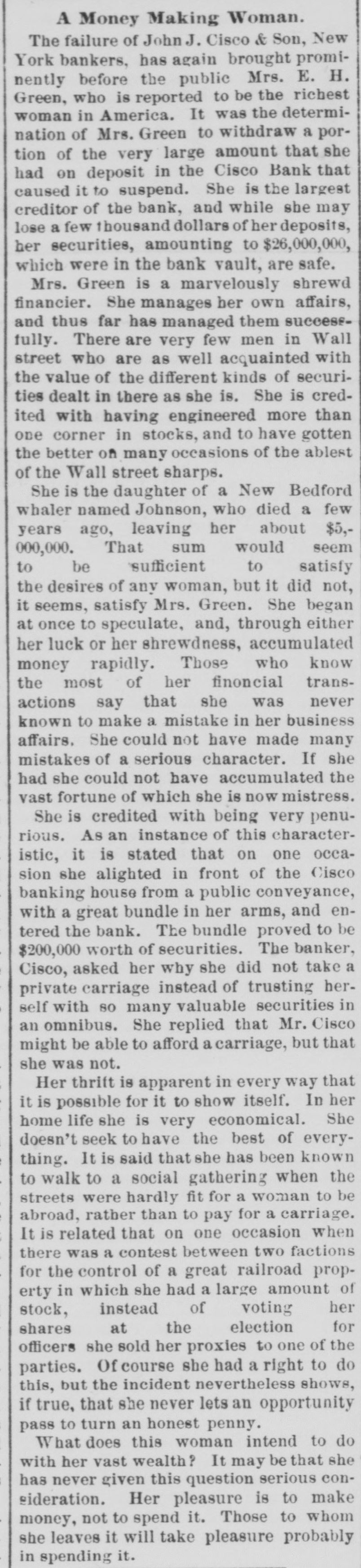
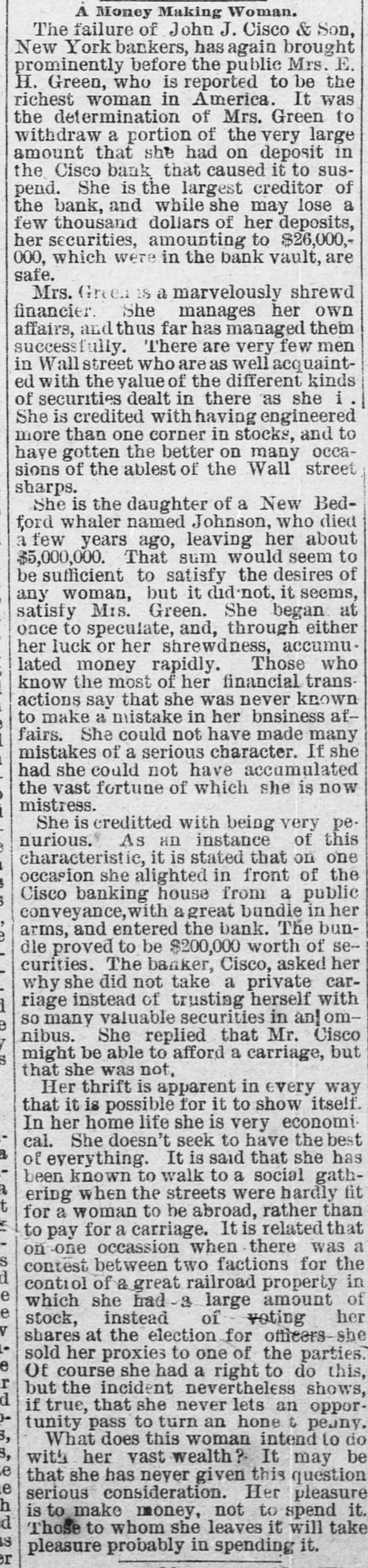
A Money Making Woman.

The failure of John J. Cisco & Son, New York bankers, has again brought prominently before the public Mrs. E. H. Green, who is reported to be the richest woman in America. It was the determination of Mrs. Green to withdraw a portion of the very large amount that she had on deposit in the Cisco Bank that caused it to suspend. She is the largest creditor of the bank, and while she may lose a few thousand dollars of her deposits, her securities, amounting to $26,000,000, which were in the bank vault, are safe. Mrs. Green is a marvelously shrewd financier. She manages her own affairs, and thus far has managed them successfully. There are very few men in Wall street who are as well acquainted with the value of the different kinds of securities dealt in there as she is. She is credited with having engineered more than one corner in stocks, and to have gotten the better on many occasions of the ablest of the Wall street sharps.

She is the daughter of a New Bedford whaler named Johnson, who died a few years ago, leaving her about $5,000,000. That sum would seem to be sufficient to satisfy the desires of any woman, but it did not, it seems, satisfy Mrs. Green. She began at once to speculate, and, through either her luck or her shrewdness, accumulated money rapidly. Those who know the most of her finoncial transactions say that she was never known to make a mistake in her business affairs. She could not have made many mistakes of a serious character. If she had she could not have accumulated the vast fortune of which she is now mistress. She is credited with being very penurious. As an instance of this characteristic, it is stated that on one occasion she alighted in front of the Cisco banking house from a public conveyance, with a great bundle in her arms, and entered the bank. The bundle proved to be $200,000 worth of securities. The banker, Cisco, asked her why she did not take a private carriage instead of trusting herself with so many valuable securities in an omnibus. She replied that Mr. Cisco might be able to afford a carriage, but that she was not.

Her thrift is apparent in every way that it is possible for it to show itself. In her home life she is very economical. She doesn't seek to have the best of everything. It is said that she has been known to walk to a social gathering when the streets were hardly fit for a woman to be abroad, rather than to pay for a carriage. It is related that on one occasion when there was a contest between two factions for the control of a great railroad property in which she had a large amount of stock, instead of voting her shares at the election for officers she sold her proxies to one of the parties. Of course she had a right to do this, but the incident nevertheless shows, if true, that she never lets an opportunity pass to turn an honest penny.

What does this woman intend to do with her vast wealth? It may be that she has never given this question serious consideration. Her pleasure is to make money, not to spend it. Those to whom she leaves it will take pleasure probably in spending it.


Article from The Dallas Weekly Herald, January 22, 1885

Click image to open full size in new tab

Article Text

A BEACE OF FAILURES

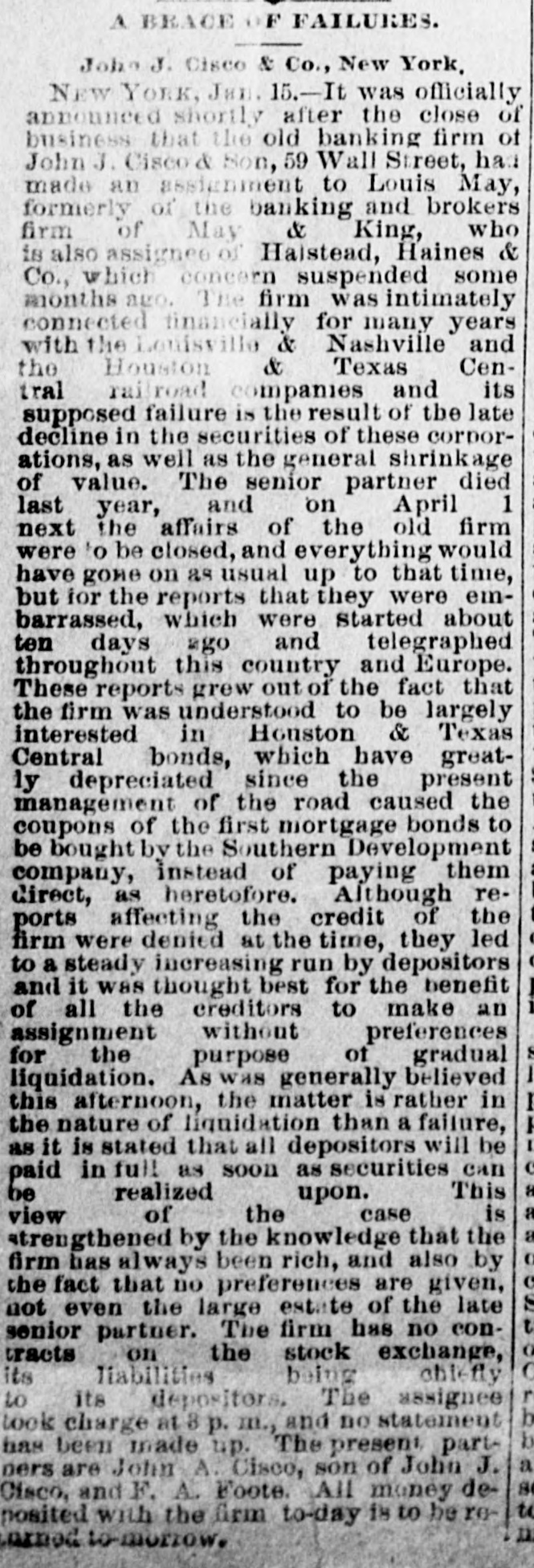
John J. Cisco & Co., New York, NEW YORK, Jan. 15.-It was officially announced shortly after the close of business that the old banking firm of John J. Cisco d Son, 59 Wall Street, has made an assignment to Louis May, formerly of the banking and brokers firm of May & King, who is also assignee of Haistead, Haines & Co., which concern suspended some months ago. The firm was intimately connected financially for many years with the Louisville & Nashville and the Houston & Texas Central railroad companies and its supposed failure is the result of the late decline in the securities of these corporations, as well as the general shrinkage of value. The senior partner died last year, and on April 1 next the affairs of the old firm were to be closed, and everything would have gone on as usual up to that time, but for the reports that they were embarrassed, which were started about ten days ago and telegraphed throughout this country and Europe. These reports grew out of the fact that the firm was understood to be largely interested in Houston & Texas Central bonds, which have greatly depreciated since the present management of the road caused the coupons of the first mortgage bonds to be bought by the Southern Development company, instead of paying them direct, as heretofore. Although reports affecting the credit of the firm were denied at the time, they led to a steady increasing run by depositors and it was thought best for the benefit of all the creditors to make an assignment without preferences for the purpose of gradual liquidation. As was generally believed this afternoon, the matter is rather in the nature of liquidation than a failure, as it is stated that all depositors will be paid in full as soon as securities This can realized be upon. case is of the view strengthened by the knowledge that the firm has always been rich, and also by the fact that no preferences are given, not even the large estate of the late senior partner. The firm has no contracts on the stock exchange, being its chiefly liabilities to its depositors. The assignee look charge at 8 p. m., and no statement has been made up. The present, partpers are John A. Cisco, son of John J. Cisco, and F. A. Foote. All money deposited with the firm to-day is to be rearned to-morrow.


Article from The Iola Register, January 23, 1885

Click image to open full size in new tab

Article Text

THE EAST

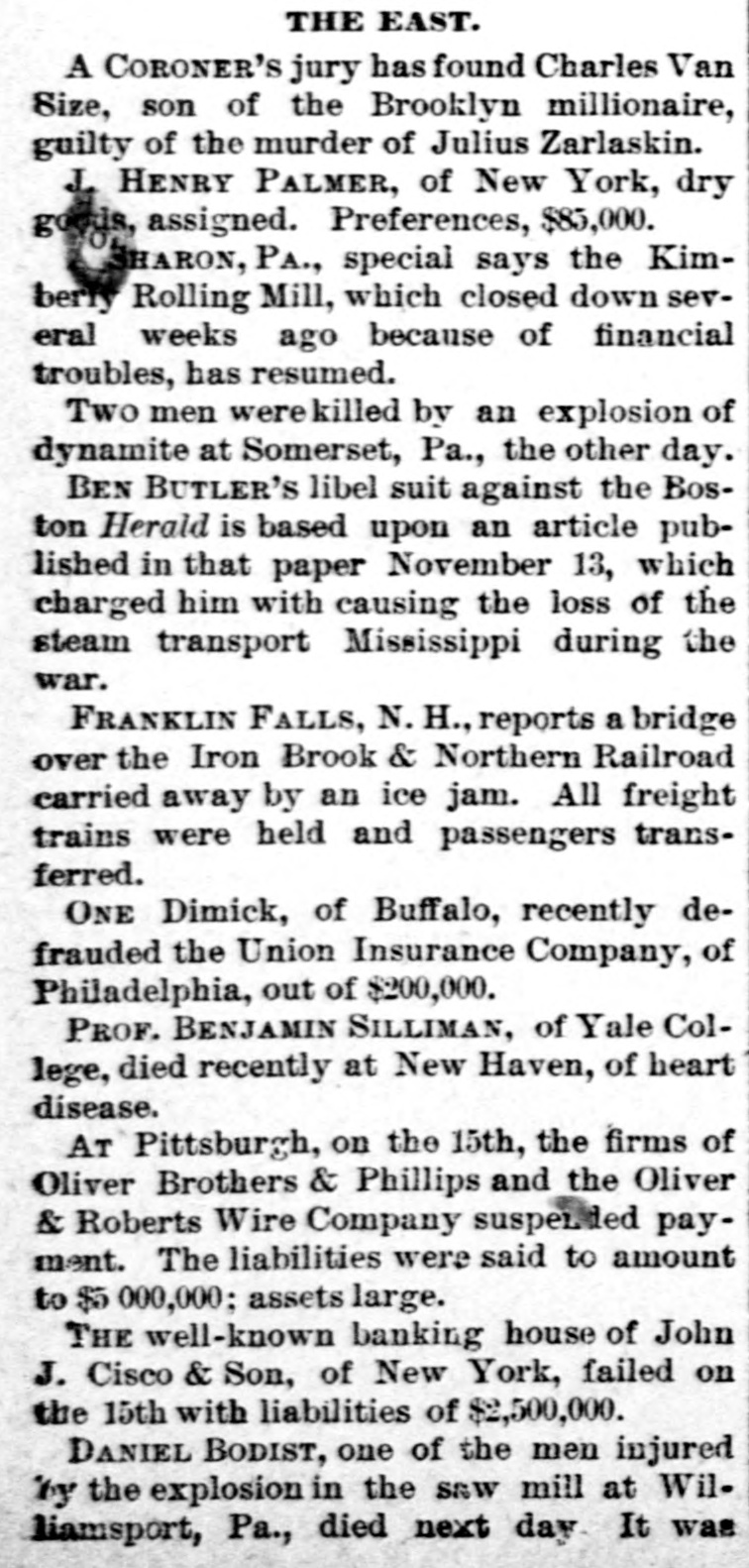
A CORONER'S jury has found Charles Van Size, son of the Brooklyn millionaire, guilty of the murder of Julius Zarlaskin. J. HENRY PALMER, of New York, dry goods, assigned. Preferences, $85,000. SHARON, PA., special says the Kimberry Rolling Mill, which closed down several weeks ago because of financial troubles, has resumed. Two men were killed by an explosion of dynamite at Somerset, Pa., the other day. BEN BUTLER'S libel suit against the Boston Herald is based upon an article published in that paper November 13, which charged him with causing the loss of the steam transport Mississippi during the war. FRANKLIN FALLS, N. H., reports a bridge over the Iron Brook & Northern Railroad carried away by an ice jam. All freight trains were held and passengers transferred. ONE Dimick, of Buffalo, recently defrauded the Union Insurance Company, of Philadelphia, out of $200,000. PROF. BENJAMIN SILLIMAN, of Yale College, died recently at New Haven, of heart disease. AT Pittsburgh, on the 15th, the firms of Oliver Brothers & Phillips and the Oliver & Roberts Wire Company suspended payment. The liabilities were said to amount to $ 000,000; assets large. THE well-known banking house of John J. Cisco & Son, of New York, failed on the 15th with liabilities of $2,500,000. DANIEL BODIST, one of the men injured by the explosion in the S&W mill at Williamsport, Pa., died next day It was


Article from The Middlebury Register and Addison County Journal, January 23, 1885

Click image to open full size in new tab

Article Text

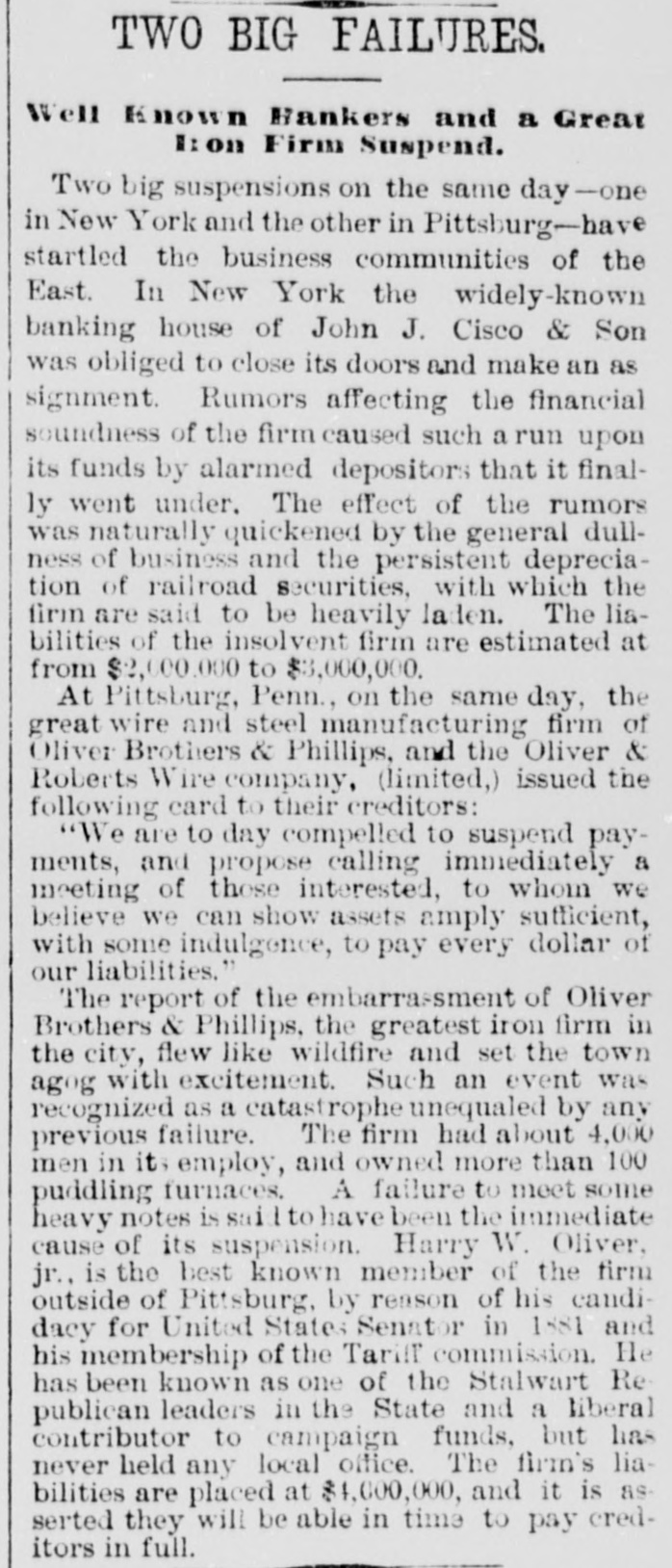
TWO BIG FAILURES

Well Known Hankers and a Great I:on Firm Suspend. Two big suspensions on the same day-one in New York and the other in Pittsburg-have startled the business communities of the East. In New York the widely-known banking house of John J. Cisco & Son was obliged to close its doors and make an as signment. Rumors affecting the financial soundness of the firm caused such a run upon its funds by alarmed depositors that it finally went under. The effect of the rumors was naturally quickened by the general dullness of business and the persistent depreciation of railroad securities, with which the firm are said to be heavily laden. The liabilities of the insolvent firm are estimated at from $2,000.000 to $3,000,000. At Pittsburg, Penn., on the same day, the great wire and steel manufacturing firm of Oliver Brothers & Phillips, and the Oliver & Roberts Wire company, (limited,) issued the following card to their creditors: "We are to day compelled to suspend payments, and propose calling immediately a meeting of those interested, to whom we believe we can show assets amply sufficient, with some indulgence, to pay every dollar of our liabilities." The report of the embarrassment of Oliver Brothers & Phillips, the greatest iron firm in the city, flew like wildfire and set the town agog with excitement. Such an event was recognized as a catastrophe unequaled by any previous failure. The firm had about 4,000 men in its employ, and owned more than 100 puddling furnaces. A failure to meet some heavy notes is sai to have been the immediate cause of its suspension. Harry W. Oliver, jr., is the best known member of the firm outside of Pittsburg, by reason of his candidacy for United States Senator in 1881 and his membership of the Tariff commission. He has been known as one of the Stalwart Republican leaders in the State and a liberal contributor to campaign funds, but has never held any local office. The firm's liabilities are placed at $4,000,000, and it is asserted they will be able in time to pay creditors in full.


Article from Sacramento Daily Record-Union, February 3, 1885

Click image to open full size in new tab

Article Text

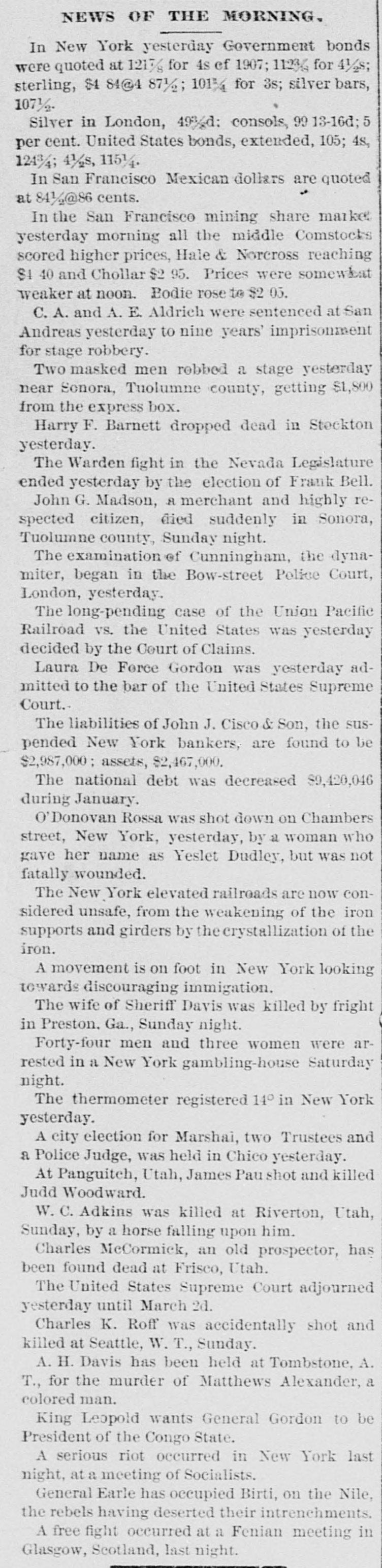
NEWS OF THE MORNING

In New York yesterday Government bonds were quoted at 1217/g for 4s of 1907; 1123/2 for 41/28; sterling, $4 S4@4 87½; 10134 for 3s; silver bars, 107½. Silver in London, 49%d: consols, 99 13-16d; 5 per cent. United States bonds, extended, 105; 4s, 1243/4; 41/28, 1151/4. In San Francisco Mexican dollars are quoted at 84½/2@86 cents. In the San Francisco mining share market yesterday morning all the middle Comstocks scored higher prices, Hale & Norcross reaching $1 40 and Chollar $2 95. Prices were somewkat weaker at noon. Bodie rose to $2 05. C. A. and A. E. Aldrich were sentenced at San Andreas yesterday to nine years' imprisonment for stage robbery. Two masked men robbed a stage yesterday near Sonora, Tuolumne county, getting $1,800 from the express box. Harry F. Barnett dropped dead in Steckton yesterday. The Warden fight in the Nevada Legislature ended yesterday by the election of Frank Bell. John G. Madson, a merchant and highly respected citizen, died suddenly in Sonora, Tuolumne county, Sunday night. The examination of Cunningham, the dynamiter, began in the Bow-street Police Court, London, yesterday. The long-pending case of the Union Pacific Railroad VS. the United States was yesterday decided by the Court of Claims. Laura De Force Gordon was yesterday admitted to the bar of the United States Supreme Court.The liabilities of John J. Cisco & Son, the suspended New York bankers, are found to be $2,987,000 ; assets, $2,467,000. The national debt was decreased $9,420,046 during January. Donovan Rossa was shot down on Chambers street, New York, yesterday, by a woman who gave her name as Yeslet Dudley, but was not fatally wounded. The New York elevated railroads are now considered unsafe, from the weakening of the iron supports and girders by the crystallization of the iron. A movement is on foot in New York looking towards discouraging immigation. The wife of Sheriff Davis was killed by fright in Preston. Ga., Sunday night. Forty-four men and three women were arrested in a New York gambling-house Saturday night. The thermometer registered 14° in New York yesterday. A city election for Marshai, two Trustees and a Police Judge, was held in Chico yesterday. At Panguitch, Utah, James Pau shot and killed Judd Woodward. W. C. Adkins was killed at Riverton, Utah, Sunday, by a horse falling upon him. Charles McCormick, an old prospector, has been found dead at Frisco, Utah. The United States Supreme Court adjourned yesterday until March 2d. Charles K. Roff was accidentally shot and killed at Seattle, W. T., Sunday. A. H. Davis has been held at Tombstone, A. T., for the murder of Matthews Alexander, a colored man. King Leopold wants General Gordon to be President of the Congo State. A serious riot occurred in New York last night, at a meeting of Socialists. General Earle has occupied Birti, on the Nile, the rebels having deserted their intrenchments. A free fight occurred at a Fenian meeting in Glasgow, Scotland, last night.


Article from The Marietta Journal, February 5, 1885

Click image to open full size in new tab

Article Text

A MONEY MAKING WOMAN.

The failure of John J. Cisco & Son, New York bankers, has again brought prominently before the public Mrs. E. H. Green, who is reported to be the richest woman in America. It was the determination of Mrs. Green to withdraw a portion of the very large amount that she had on deposit in the Cisco Bank that caused it to suspend. She is the largest creditor of the bank, and while she may lose a few thousand dollars of her deposits, her securities, amounting to $26,000,000, which were in the bank vault, are safe.

Mrs. Green is a marvelously shrewd financier. She manages her own affairs, and thus far has managed them successfully. There are very few men in Wall street who are as well acquainted with the value of the different kinds of securities dealt in there as she is. She is credited with having engineered more than one corner in stocks, and to have gotten the better on many occasions of the ablest of the Wall street chaps.

She is the daughter of a New Bedford whaler named Johnson, who died a few years ago, leaving her about $5,000,000. That sum would seem to be sufficient to satisfy the desires of any woman, but it did not, it seems, satisfy Mrs. Green. She began at once to speculate, and, through either her luck or shrewdness, accumulated money rapidly. Those who know the most of her financial transactions say that she was never known to make a mistake in her business affairs. She could not have made many mistakes of a serious character. If she had she could not have accumulated the vast fortune of which she is now mistress.

She is credited with being very penurious. As an instance of this characteristic, it is stated that on one occasion she alighted in front of the Cisco banking house from a public conveyance, with a great bundle in her arms, and entered the bank. The bundle proved to be $200,000 worth of securities. The banker, Cisco, asked why she did not take a private carriage instead of trusting herself with so mary valuable securities in an omnibus. She replied that Mr. Cisco might be able to afford a carriage, but that she was not.

Her thrift is apparent in every way that it is possible for it to show itself. In her home life she is very economical. She doesn't seek to have the best of everything. It is said that she has been known to walk to a social gathering when the streets were hardly fit for a woman to be abroad, rather than to pay for a carriage. It is related that on one occasion when there was a contest between two factions for the control of a great railroad property in which she had a large amount of stock, instead of voting her shares at the election for officers, she sold her proxies to one of the parties. Of course she had a right to do this, but the incident nevertheless, shows, if true, that she never lets an opportunity pass to turn an honest penny.

What does this woman intend to do with her vast wealth? It may be that she has never given this question serious consideration. Her pleasure is to make money, not to spend it. Those to whom she leaves it will take pleasure probably in spending it.


Article from The Austin Weekly Statesman, February 5, 1885

Click image to open full size in new tab

Article Text

A Money Making Woman

The failure of John J. Cisco & Son, New York bankers, has again brought prominently before the public Mrs. E. H. Green, who is reported to be the richest woman in America. It was the determination of Mrs. Green to withdraw a portion of the very large amount that she had on deposit in the Cisco bank that caused it to suspend. She is the largest creditor of the bank, and while she may lose a few thousand dollars of her deposits, her securities, amounting to $26,000,000, which were in the bank vault, are safe. Mrs. Green is a marvelously shrewd financier. She manages her own affairs, and thus far has managed them success fully. There are very few men in Wall street who are as well acquainted with the value of the different kinds of securities dealt in there as she i. She is credited with having engineered more than one corner in stocks, and to have gotten the better on many occasions of the ablest of the Wall street sharps. She is the daughter of a New Bedford whaler named Johnson, who died a few years ago, leaving her about $5,000,000. That sum would seem to be sufficient to satisfy the desires of any woman, but it did'not, it seems, satisfy Mrs. Green. She began at once to speculate, and, through either her luck or her shrewdness, accumulated money rapidly. Those who know the most of her financial transactions say that she was never known to make a mistake in her bnsiness affairs. She could not have made many mistakes of a serious character. If she had she could not have accumulated the vast fortune of which she is now mistress. She is creditted with being very penurious. As an instance of this characteristic, it is stated that on one occasion she alighted in front of the Cisco banking house from a public conveyance, with a great bundle in her arms, and entered the bank. The bundle proved to be $200,000 worth of securities. The banker, Cisco, asked her why she did not take a private carriage instead of trusting herself with SO many valuable securities in an| omnibus. She replied that Mr. Cisco might be able to afford a carriage, but w that she was not, Her thrift is apparent in every way that it is possible for it to show itself. In her home life she is very economical. She doesn't seek to have the best of everything. It is said that she has been known to walk to a social gathering when the streets were hardly fit for a woman to be abroad, rather than to pay for a carriage. It is related that on one occassion when there was a S contest between two factions for the contiol of a great railroad property in e which she had 3 large amount of e stock, instead of voting her V shares at the election for officers-she sold her proxies to one of the parties. e Of course she had a right to do this, r but the incident nevertheless shows, d if true, that she never lets an opportunity pass to turn an hone t peany. What does this woman intend to do with her vast wealth? It may be e that she has neyer given this question e serious consideration. Her pleasure is to make money, not to spend it. d Those to whom she leaves it will take S1 pleasure probably in spending it. r


Article from Wheeling Sunday Register, February 8, 1885

Click image to open full size in new tab

Article Text

adopted resolutions denouncing the recent dynamite outrages.

The wife of Rev. C. H. Snell and a 11-year-old son were murdered by George Miller, a hired man, near Inkster, D. T., for purposes of robbery.

Geo. F. Thomas' fine house on Staten Island, a wedding present from Commodore Vanderbilt to his oldest daughter, burned yesterday. Loss, $65,000.

Papers in the Swaim court martial are in the hands of Secretary Lincoln. The accused, it is understood, is found guilty of all the charges, and his dismissal is recommended.

The will of Robert A. Wallace, carriage manufacturer of Buffalo, who died eight years ago, was lately found on his dead body, his coffin being opened for that purpose.

William Garlick, cashier of the suspended Island Savings Bank, of Galveston, Texas, died two months after its failure. The calamity, for which he was not to blame, killed him.

At Fort Smith, sentence of death was passed in the United States Court upon Fred Ray, Wm. Meadows, Wm. Phillips, Mason Holcom, white men, and William Nixon, a negro, for murders committed in the Indian Territory.

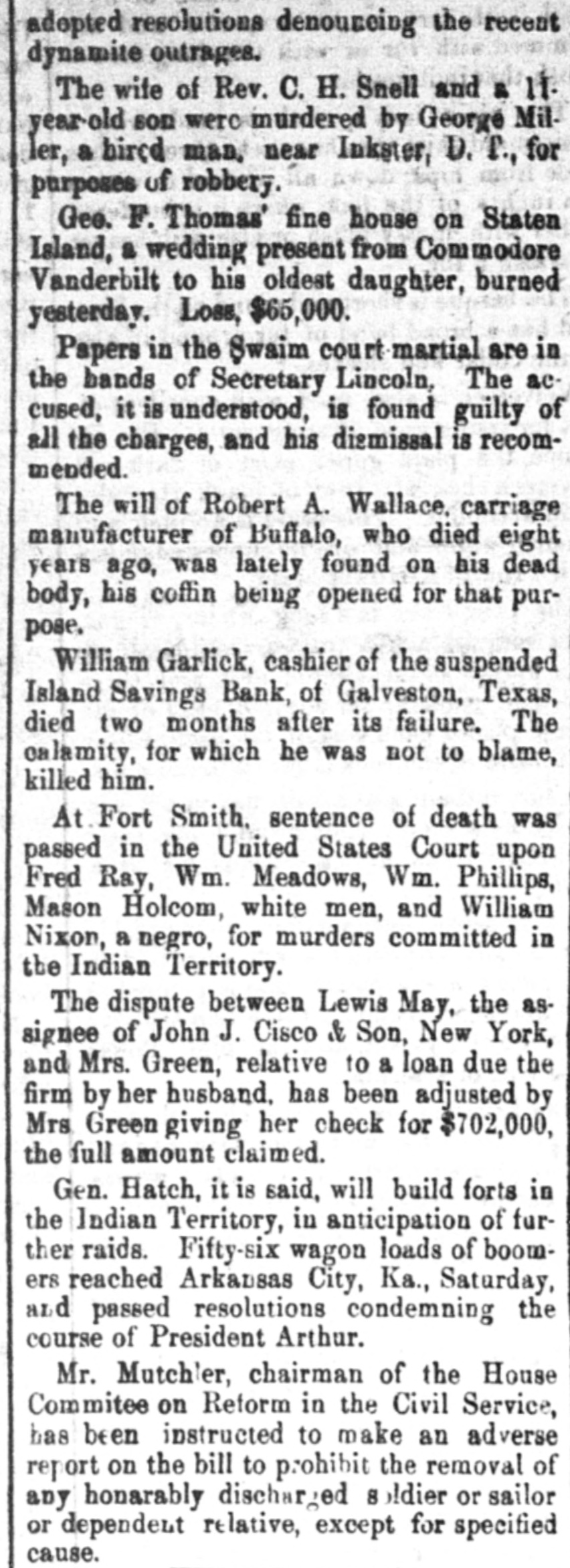
The dispute between Lewis May, the assignee of John J. Cisco & Son, New York, and Mrs. Green, relative to a loan due the firm by her husband, has been adjusted by Mrs Green giving her check for $702,000, the full amount claimed.

Gen. Hatch, it is said, will build forts in the Indian Territory, in anticipation of further raids. Fifty-six wagon loads of boomers reached Arkansas City, Ka., Saturday, and passed resolutions condemning the course of President Arthur.

Mr. Mutchler, chairman of the House Commitee on Reform in the Civil Service, has been instructed to make an adverse report on the bill to prohibit the removal of any honorably discharged soldier or sailor or dependent relative, except for specified cause.