Sheffield & Norton (Napoleon, OH)

Episode Information

Episode UID
8834706891006
Episode Type
Suspension โ†’ Closure
Bank Type
trust
Bank ID
883470689 hash
Start Date
October 3, 1883
Location
Napoleon, Ohio (41.392, -84.125)

Metadata

Model
gpt-5-mini (chosen from majority vote of a three-model LLM ensemble)
Short Digest
12bfb62bf5206dea

Response Measures

None

Events (2)

1. October 3, 1883 Other
Newspaper Excerpt
William Sheffield committed suicide at his residence in Napoleon on the 3d day of October, 1883.
Source
newspapers
2. October 16, 1883 Suspension
Cause
Government Action
Cause Details
Probate Court appointed a receiver to settle up the bank after the death of a partner and determination to close the firm.
Newspaper Excerpt
a Receiver of the Bank having been determined upon ... the Hon. J.N. High was appointed to that position.
Source
newspapers

Newspaper Articles (2)

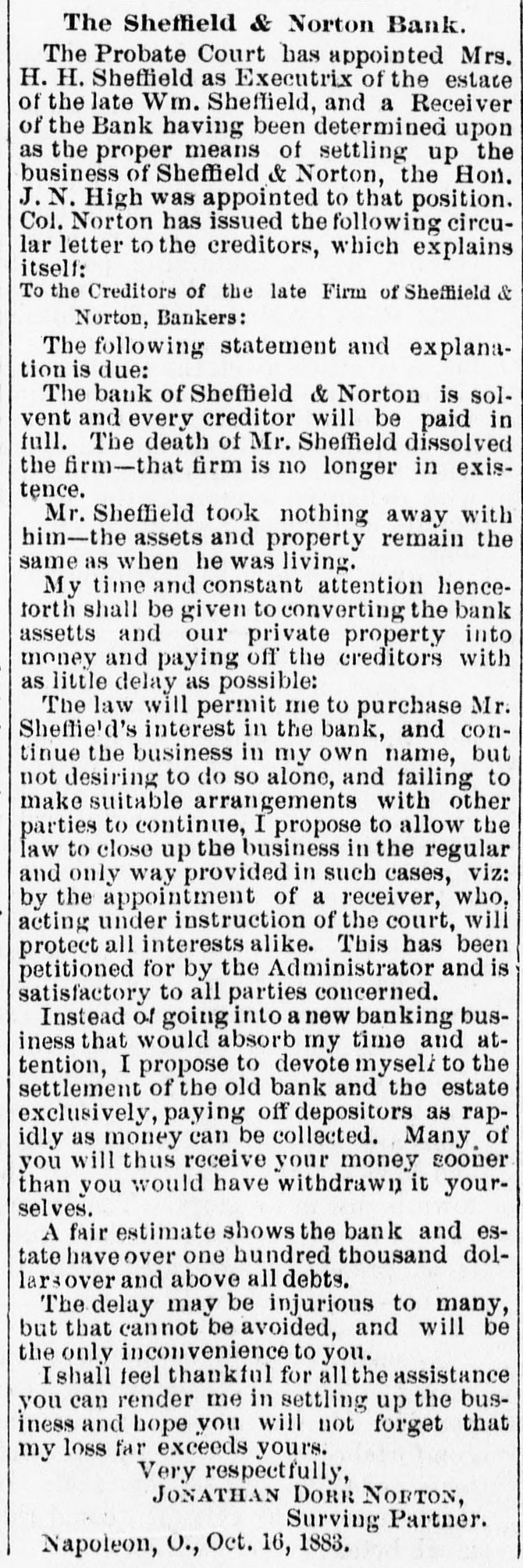
Article from Democratic Northwest, October 18, 1883

Click image to open full size in new tab

Article Text

The Sheffield & Norton Bank. The Probate Court has appointed Mrs. H. H. Sheffield as Executrix of the estate of the late Wm. Sheffield, and a Receiver of the Bank having been determined upon as the proper means of settling up the business of Sheffield & Norton, the Hon. J.N. High was appointed to that position. Col. Norton has issued the following circular letter to the creditors, which explains itself: To the Creditors of the late Firm of Sheffield & Norton, Bankers: The following statement and explanation is due: The bank of Sheffield & Norton is solvent and every creditor will be paid in full. The death of Mr. Sheffield dissolved the firm-that firm is no longer in existence. Mr. Sheffield took nothing away with him-the assets and property remain the same as when he was living. My time and constant attention hencetorth shall be given to converting the bank assetts and our private property into money and paying off the creditors with as little delay as possible: The law will permit me to purchase Mr. Sheffield's interest in the bank, and continue the business in my own name, but not desiring to do so alone, and failing to make suitable arrangements with other parties to continue, I propose to allow the law to close up the business in the regular and only way provided in such cases, viz: by the appointment of a receiver, who, acting under instruction of the court, will protect all interests alike. This has been petitioned for by the Administrator and is satisfactory to all parties concerned. Instead of going into a new banking business that would absorb my time and attention, I propose to devote mysell to the settlement of the old bank and the estate exclusively, paying off depositors as rapidly as money can be collected. Many of you will thus receive your money sooner than you would have withdrawn it yourselves. A fair estimate shows the bank and estate haveover one hundred thousand dolover and above all debts. The delay may be injurious to many, but that cannot be avoided, and will be the only inconvenience to you. Ishall feel thankful for all the assistance you can render me in settling up the business and hope you will not forget that my loss far exceeds yours. Very respectfully, JONATHAN DORR NORTON, Surving Partner. Napoleon, o., Oct. 16, 1883.


Article from Democratic Northwest, September 9, 1886

Click image to open full size in new tab

Article Text

Disgusted Creditor. NAPOLEON, o., Sept. 7th, 1886. ED. NOBTHWEST:-William Sheffield committed suicide at his residence in Napoleon on the 3d day of October, 1883. He was the senior member of the firm of Sheffield & Norton, bankers in Napoleon. These men had carried on the business of private banking for a number of years and had obtained, whether honestly or not, the confidence of a great many of our citizens, including a number of the township treasurers of the county, who were induced to deposit their money and the moneys of the township treasurers in their bank. This had been going on for some years. They had been made to believe, by the assurances and smiles of J. D. Norton, the junior member of the firm, that their money was safe and the bank was sound. And these representations extended to all classes, including laboring men and women, guardians and orphan children. While the people could know but little or nothing about the inside management of the bank, they had to depend entirely upon the assurances of Sheffield & Norton as to its solvency; they # were assured, and indeed it was known by all that Sheffield owned in his own right a large amount of real estate in Henry county as appeared on record, and it was upon the strength and knowledge of this large amount of real estate in his name that induced the people to deposit their money in the bank. The cause of Sheffield's death is now a matter of no concern; it does not keep the poor men, women and children who have been swindled. Many women in this neighborhood, a number of them widows, are now at work washing for a living; others are unable to send their children to school for want of clothing and school books. These are facts well known to the people of Henry county. In the statements herein made "I shall not extenuate, or ought set down in malice," but shall state the simple truth. Immediately after the death of Sheffield, and for some ten or twelve days thereafter, Mr. Norton was profuse in his statements as to the solvency of the bank and its ability to pay the creditors every cent due them and have a large surplus left, and this too, without calling upon the real estate of Mr. Sheffield for any portion of it; while in truth and in fact, the bank was wholly insolvent and Mr. Norton must have known, if he knew anything about the bank (he having always been the business partner and cashier,) that it was wholly insolvent, and that including the money and all the assets good and bad, could not possibly pay its debtors. He must have known and did know, from a schedule recently made, at the request of a portion of the creditors, that many of the debts due the bank were worthless; that a large number of notes and accounts on hand were for money lavishly and recklessly handed out by him when he was a candidate for State Senator, and afterwards when he attempted to be a candidate for Congress, but I will let many things in this connection pass for the present. While these false and fraudulent represenbe tations of Mr. Norton were being made to induce the creditors and the public to believe the bank was solvent, he, on or about the 15th day of October and within ten or twelve S days after Sheffield's death, induced Hulda H. Sheffield, his mother-in-law, who had been appointed administratrix of the estate of n William Sheffield, to file a petition in court asking for the appointment of a receiver for the bank of Sheffield & Norton. Simultaneously with the filing of this petition, requestis ing Norton as the surviving partner, to ada ministrater the effects of the bank, he (Norn ton) filed his answer saying that he would not. This was all done on the same day and by the same attorney-the object being, as is or seen to lay some sort of a foundation for the appointment of a receiver, which was acd complished on the same day from our Proe. bate Judge. This was done and accomplished in a back room in the Probate Judge's office in the Court House, without any knowledge whatever to one of 507 creditors of that bank. No