Article Text
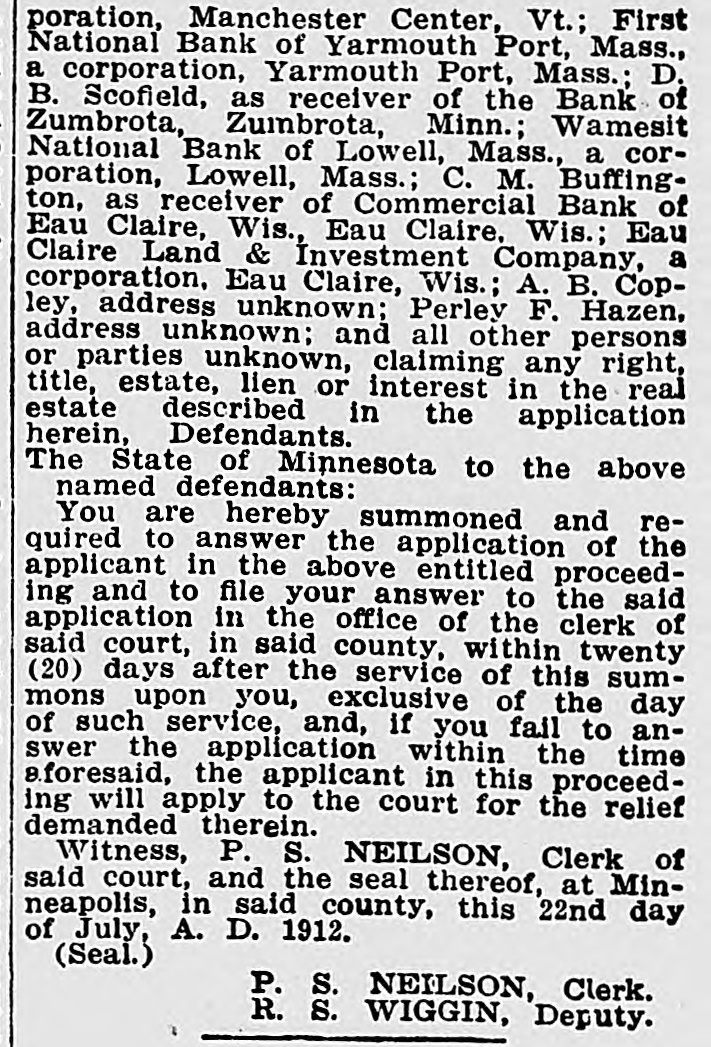
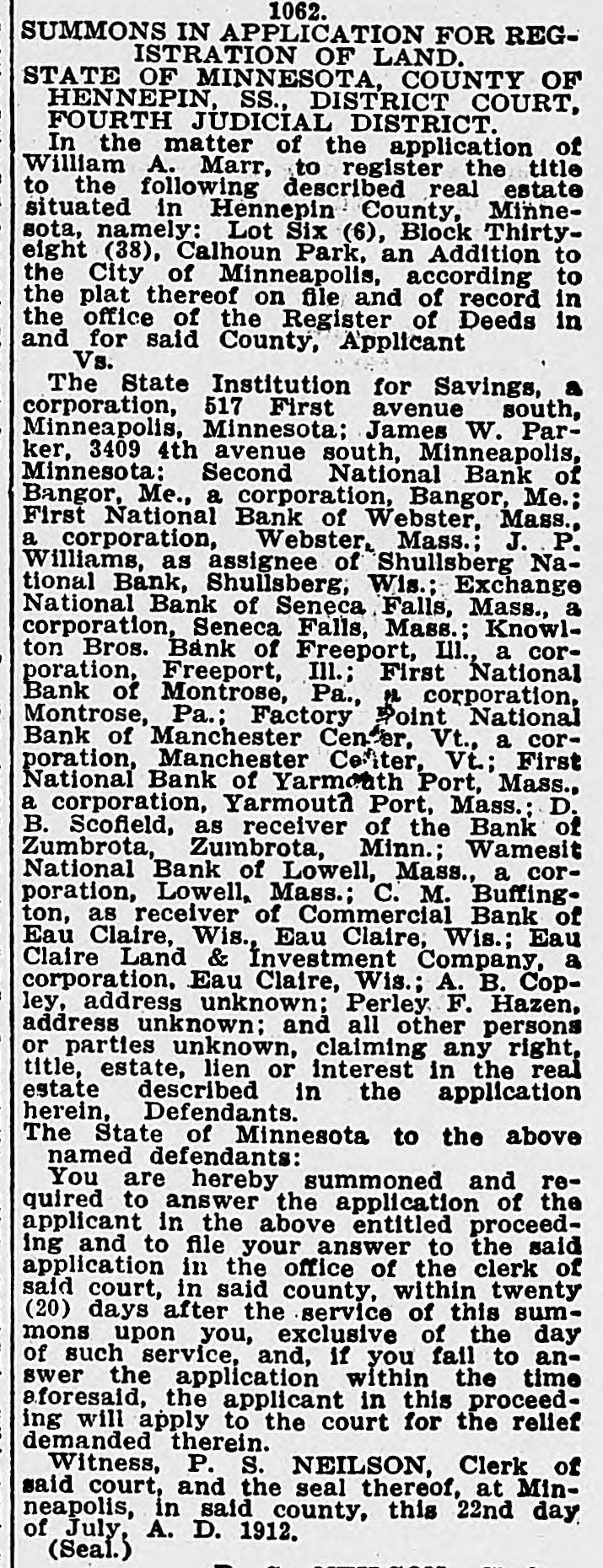
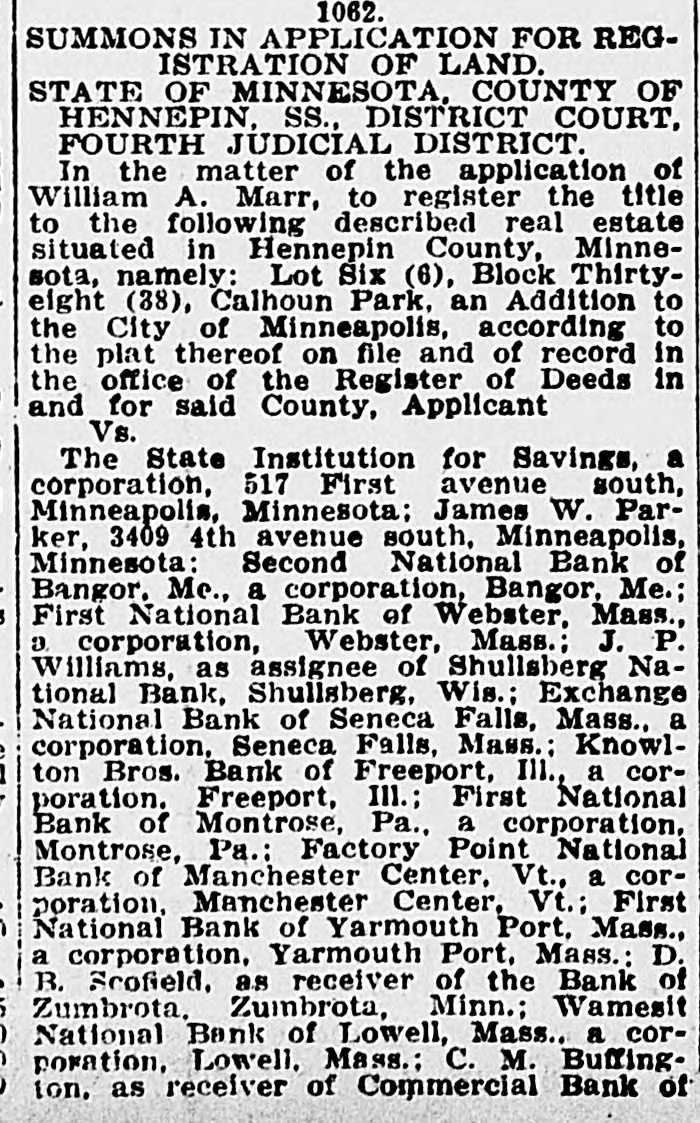
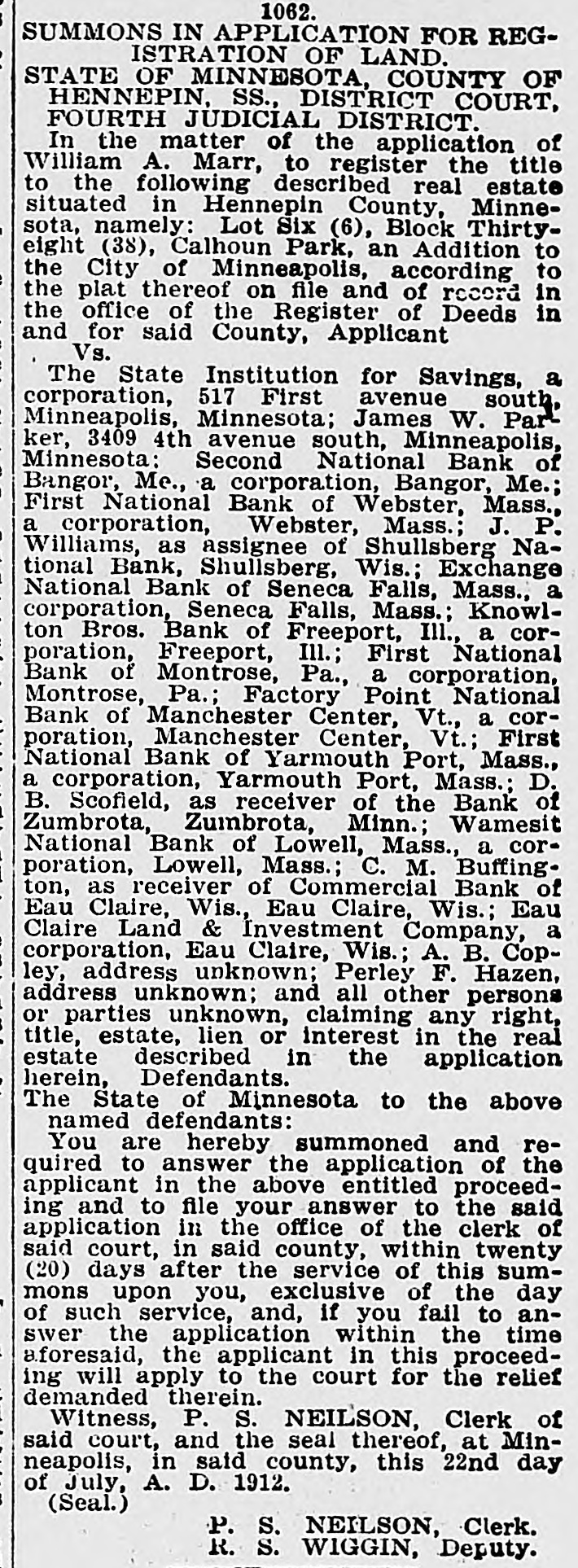
1062. SUMMONS IN APPLICATION FOR REGISTRATION OF LAND. STATE OF MINNESOTA, COUNTY OF HENNEPIN, SS., DISTRICT COURT, FOURTH JUDICIAL DISTRICT. In the matter of the application of William A. Marr, to register the title to the following described real estate situated in Hennepin County, Minnesota, namely: Lot Six (6), Block Thirtyeight (38), Calhoun Park, an Addition to the City of Minneapolis, according to the plat thereof on file and of record in the office of the Register of Deeds in and for said County, Applicant Vs. The State Institution for Savings, a corporation, 517 First avenue south, Minneapolis, Minnesota; James W. Parker, 3409 4th avenue south, Minneapolis, Minnesota: Second National Bank of Bangor, Me., a corporation, Bangor, Me.; First National Bank of Webster, Mass., a corporation, Webster, Mass.; J. P. Williams, as assignee of Shullsberg National Bank, Shullsberg, Wis.; Exchange National Bank of Seneca Falls, Mass., a corporation, Seneca Falls, Mass.; Knowlton Bros. Bank of Freeport, Ill., a corporation, Freeport, Ill.; First National Bank of Montrose, Pa., a corporation, Montrose, Pa.; Factory Point National Bank of Manchester Center, Vt., a corporation, Manchester Center, Vt.; First National Bank of Yarmouth Port, Mass., a corporation, Yarmouth Port, Mass.; D. B. Scofield, as receiver of the Bank of Zumbrota, Zumbrota, Minn.; Wamesit National Bank of Lowell, Mass., a corporation, Lowell, Mass.; C. M. Buffington, as receiver of Commercial Bank of Eau Claire, Wis., Eau Claire, Wis.; Eau Claire Land & Investment Company, a corporation, Eau Claire, Wis.; A. B. Copley, address unknown; Perley F. Hazen, address unknown; and all other persons or parties unknown, claiming any right, title, estate, lien or interest in the real estate described in the application herein, Defendants. The State of Minnesota to the above named defendants: You are hereby summoned and required to answer the application of the applicant in the above entitled proceeding and to file your answer to the said application in the office of the clerk of said court, in said county, within twenty (20) days after the service of this summons upon you, exclusive of the day of such service, and, if you fail to answer the application within the time aforesaid, the applicant in this proceeding will apply to the court for the relief demanded therein. Witness, P. S. NEILSON, Clerk of said court, and the seal thereof, at Minneapolis, in said county, this 22nd day of July, A. D. 1912. (Seal.) P. S. NEILSON, Clerk. R. S. WIGGIN, Deputy.