Click image to open full size in new tab
Article Text
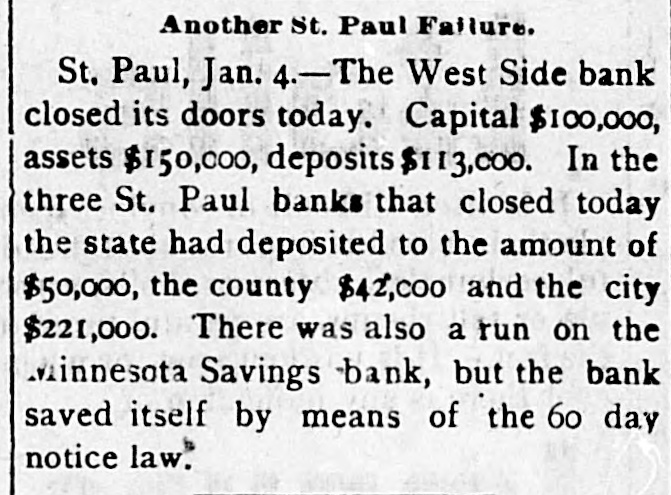
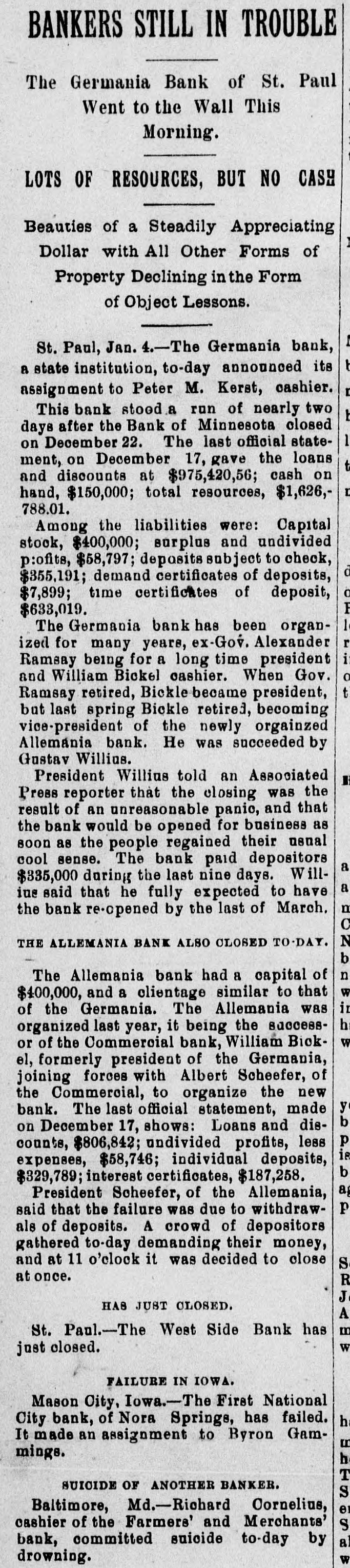
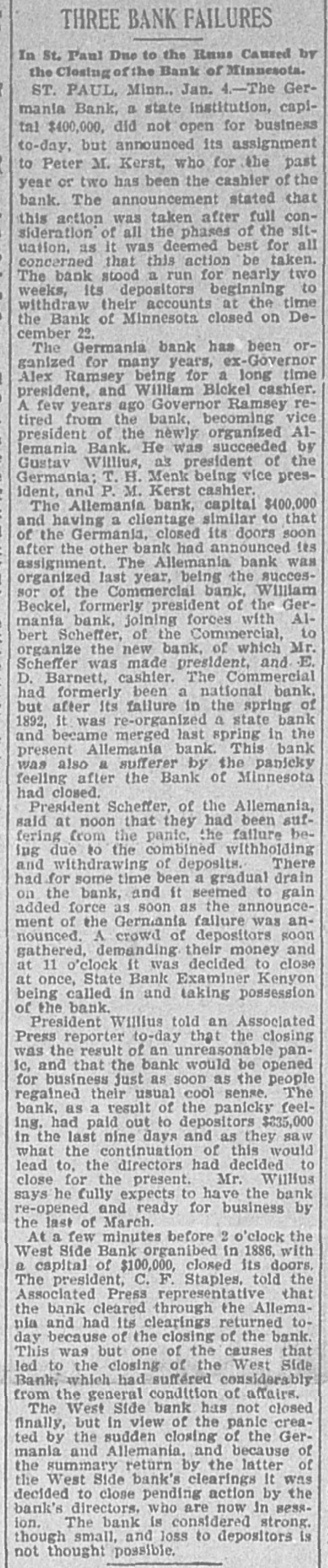
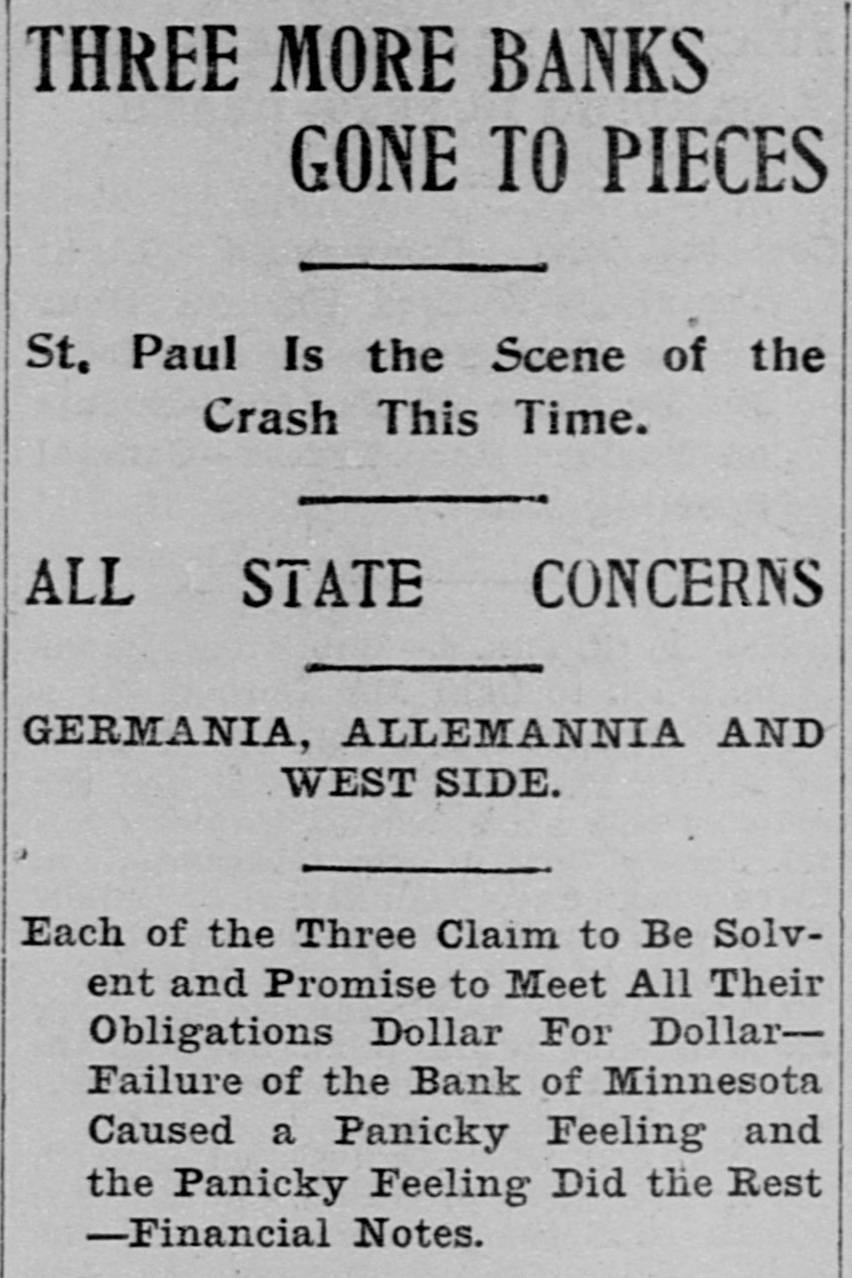
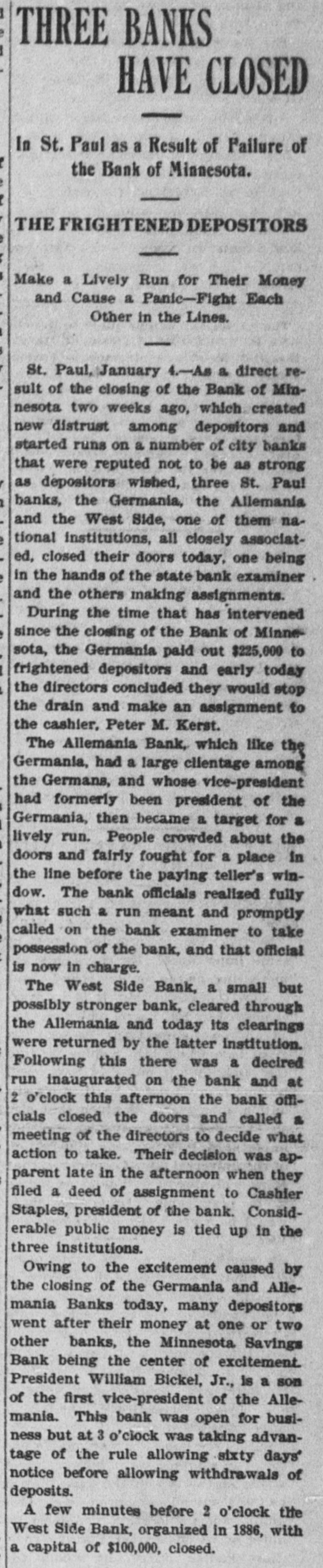
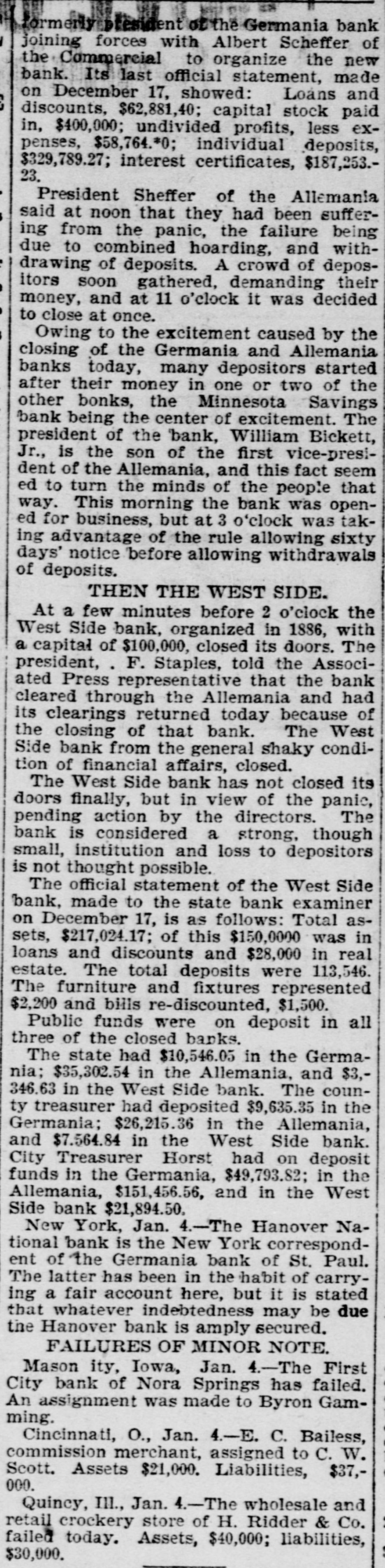
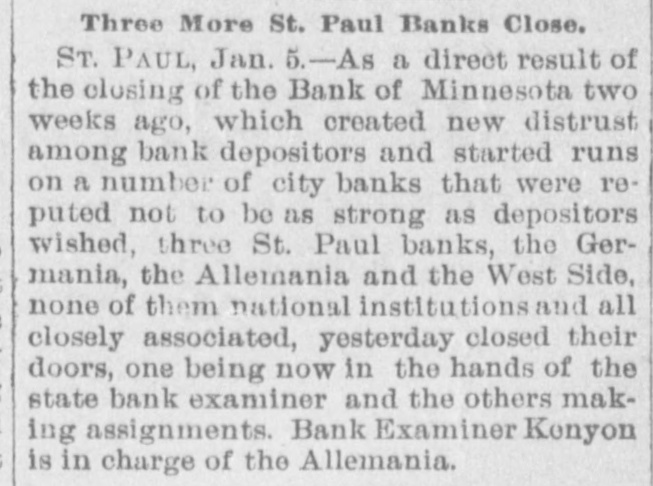
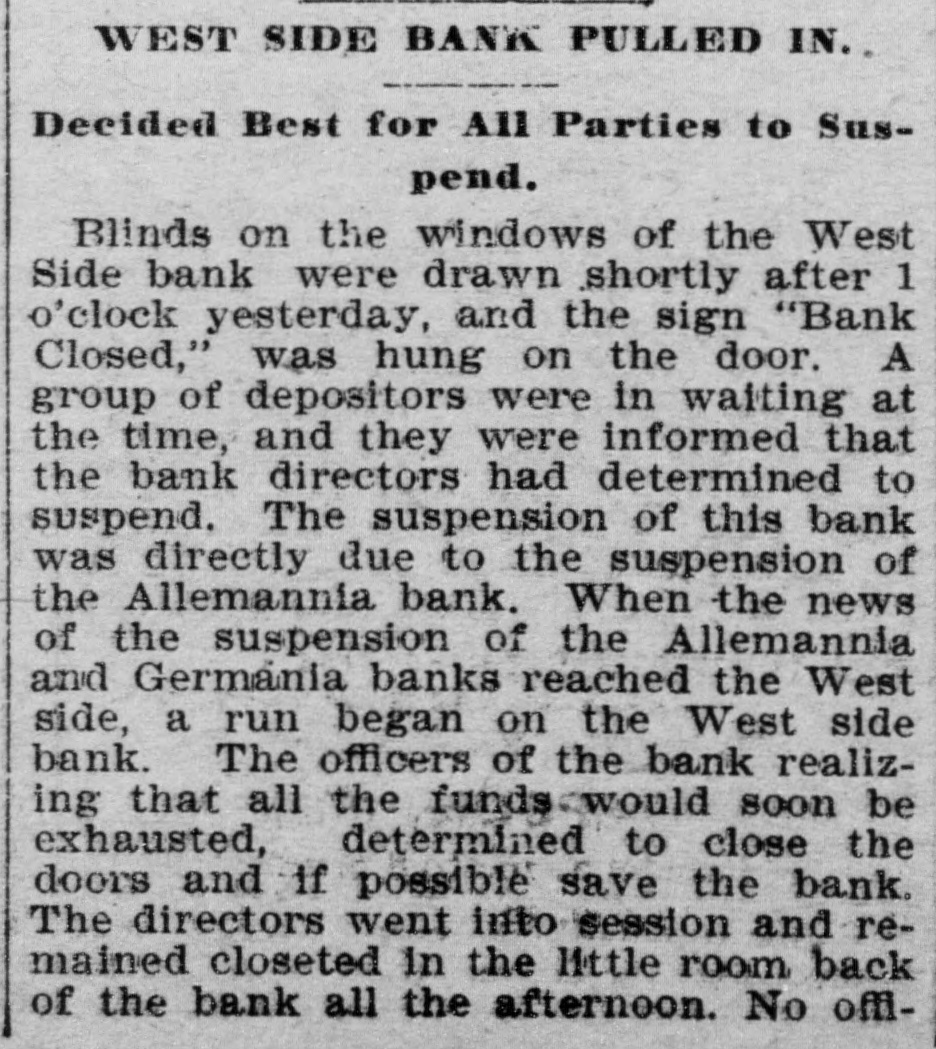
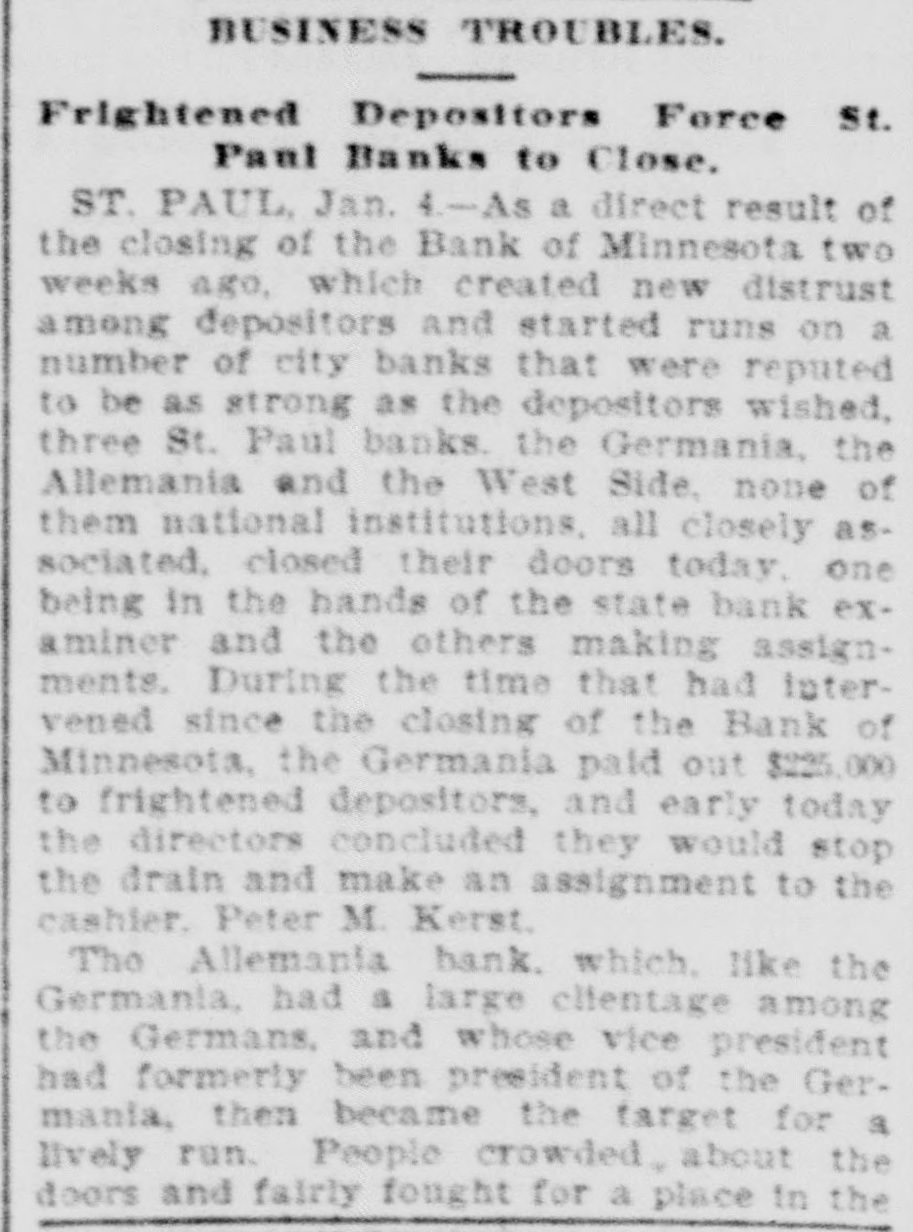
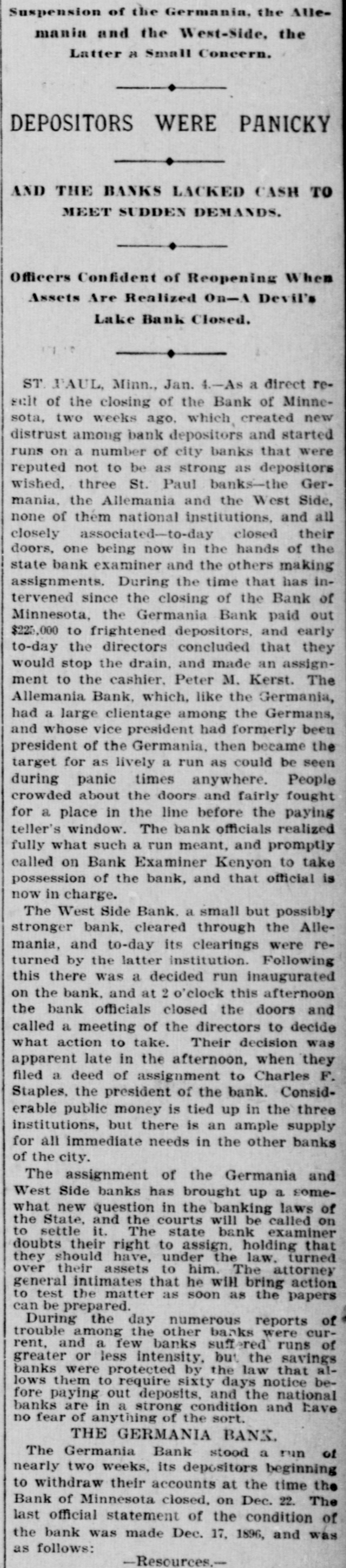
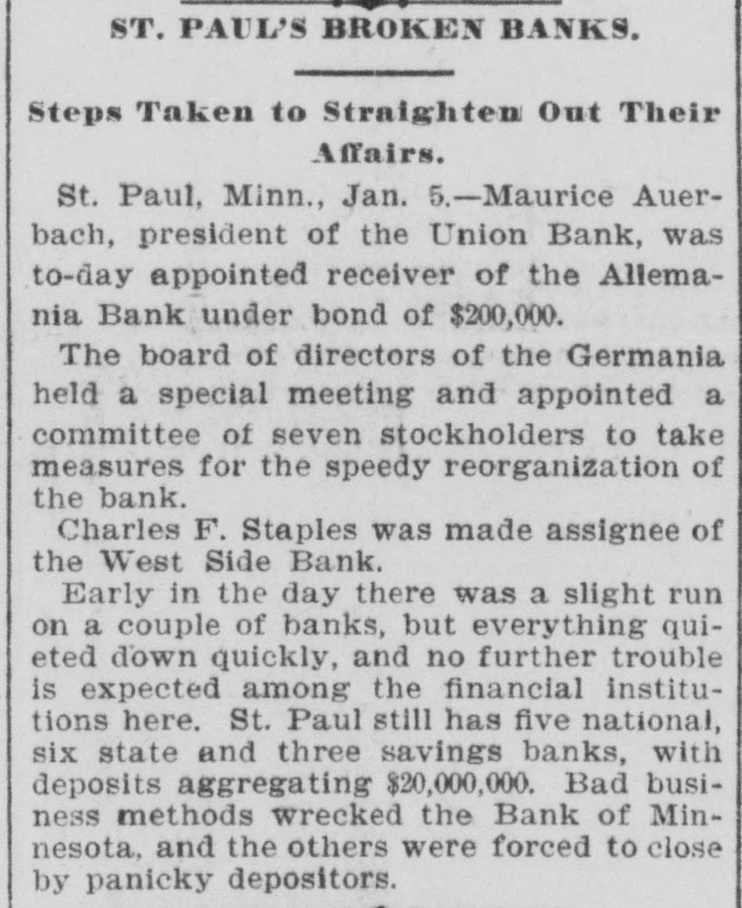
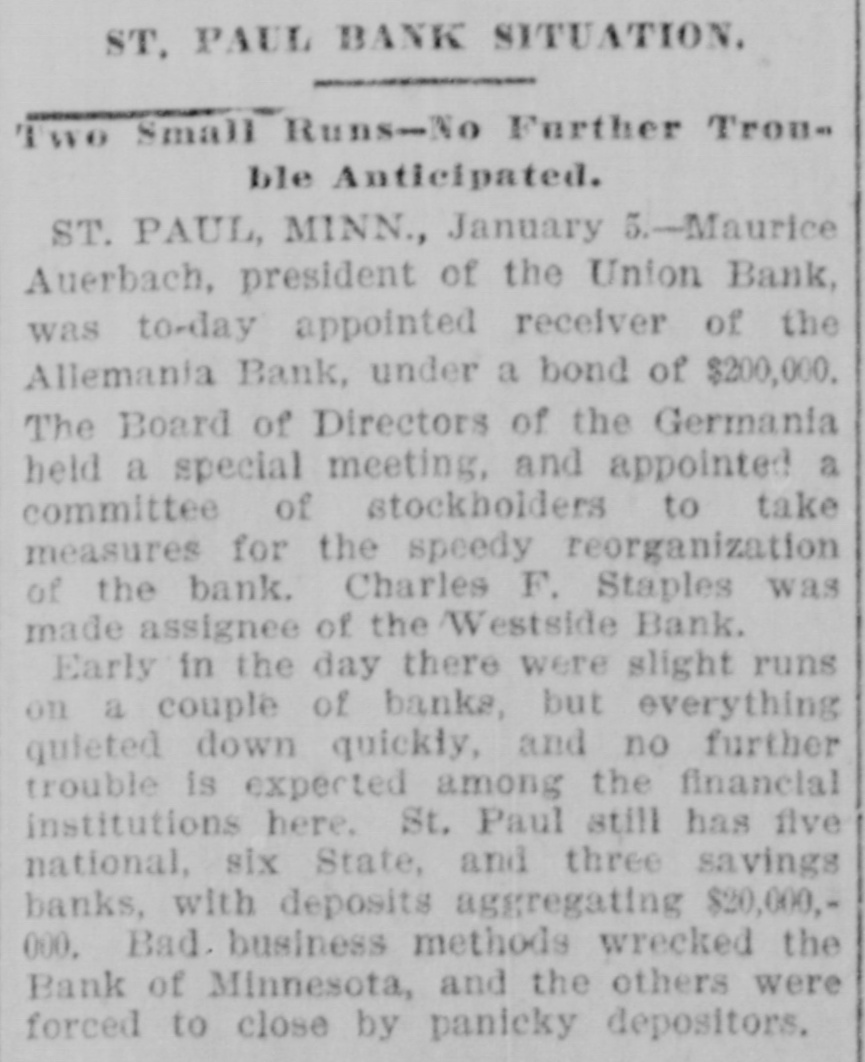
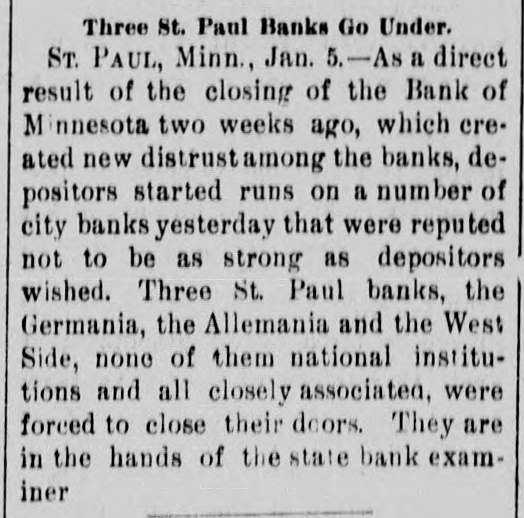
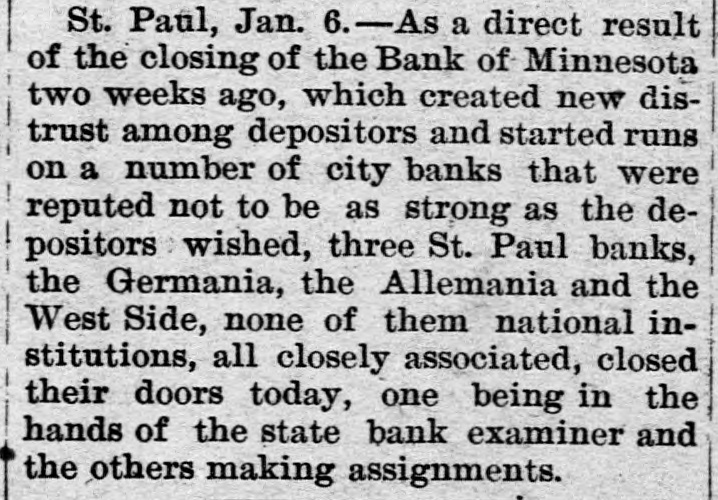
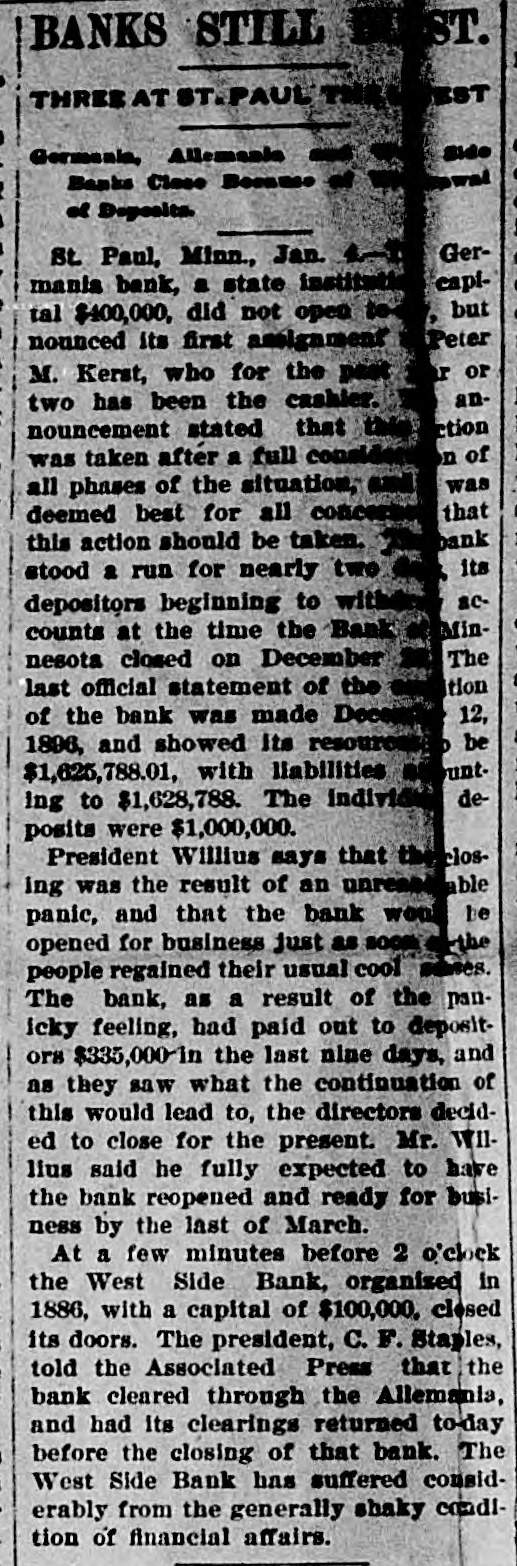
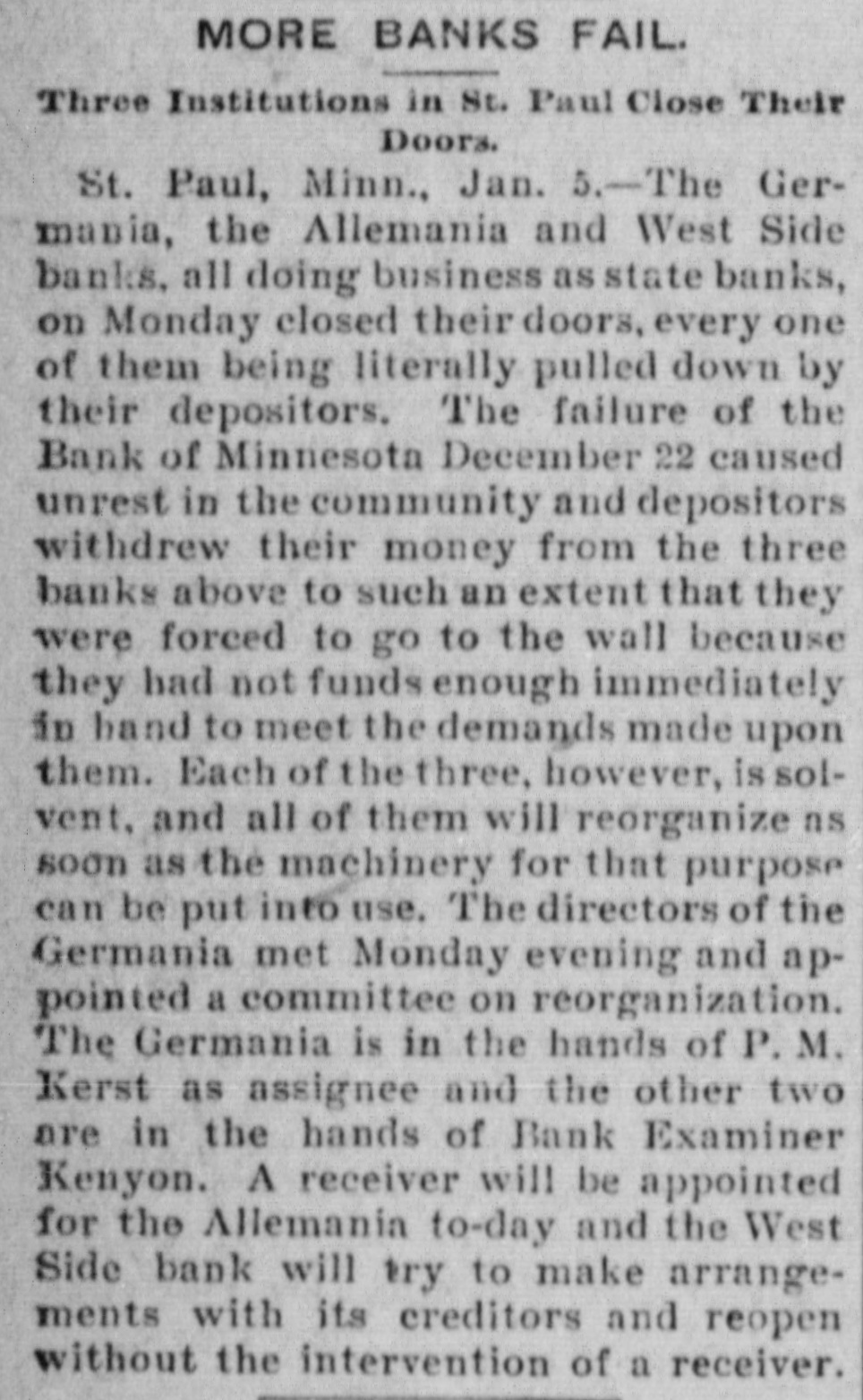
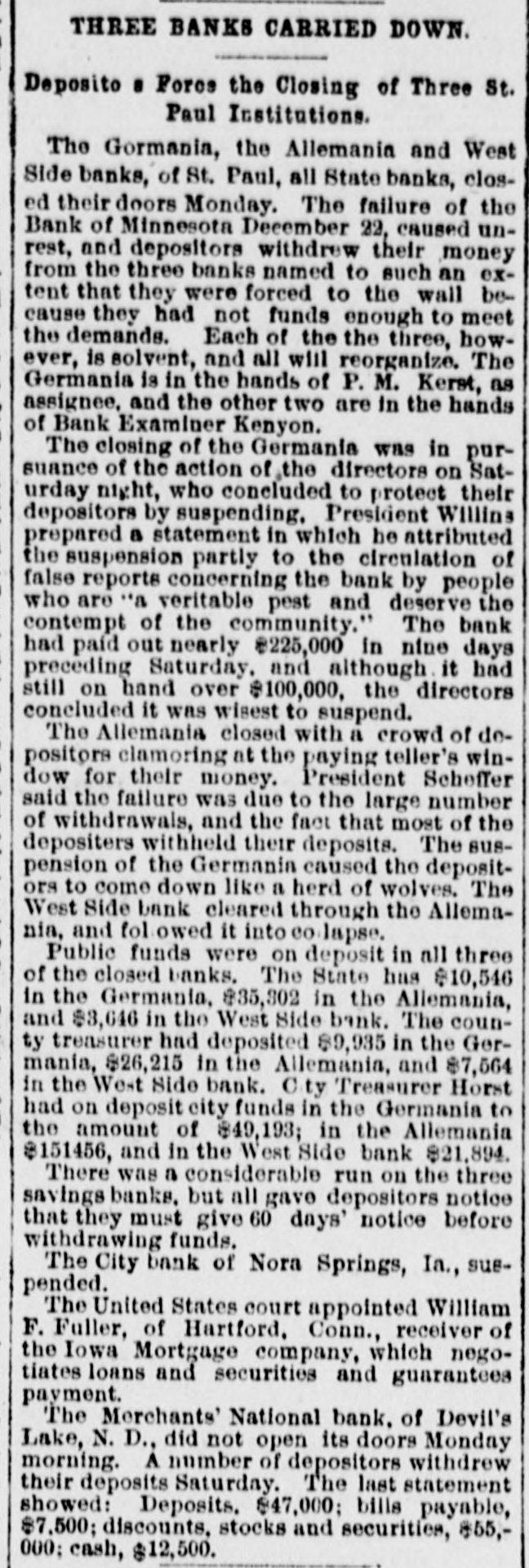
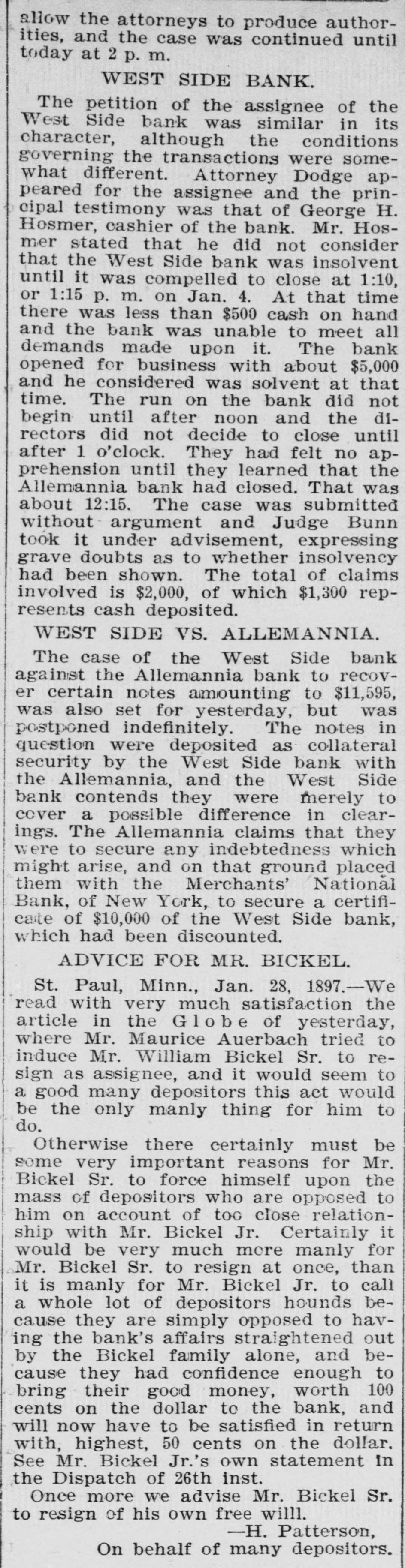
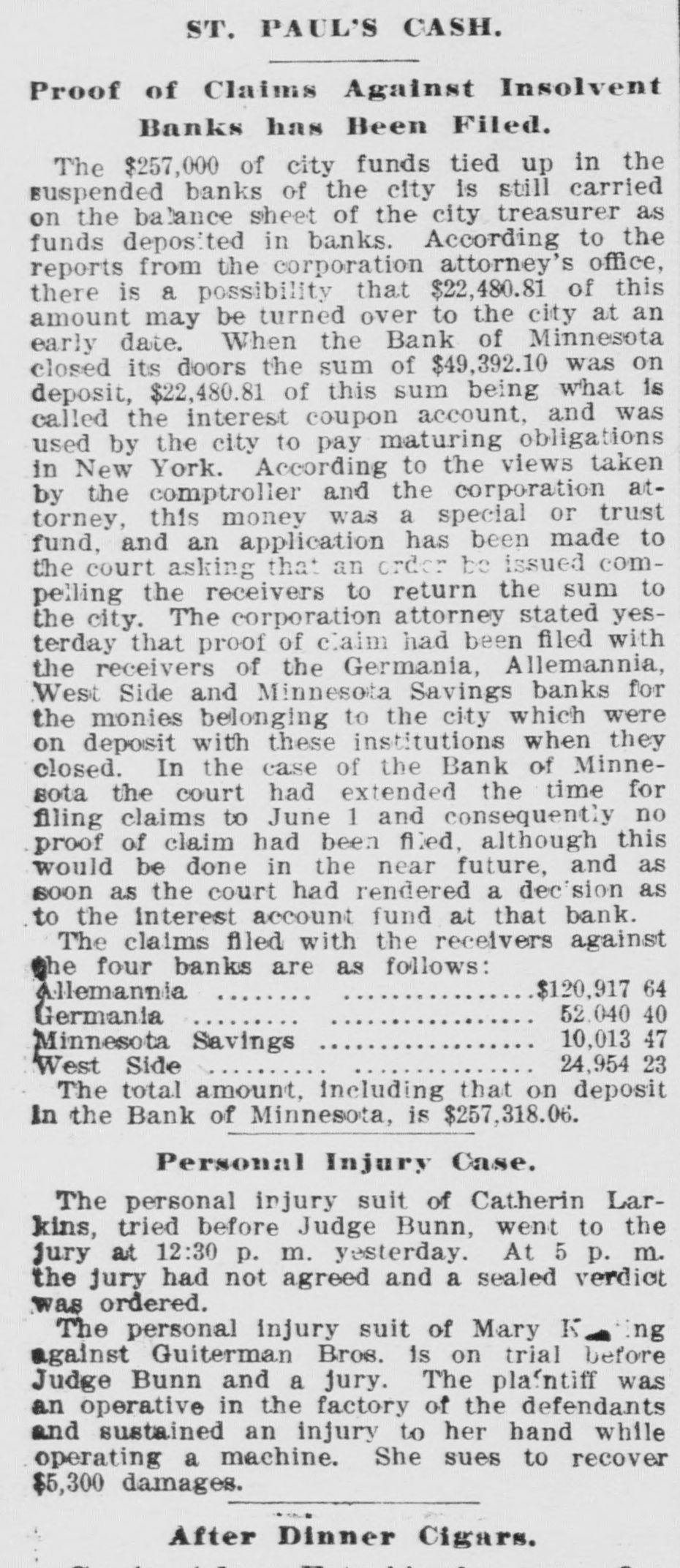
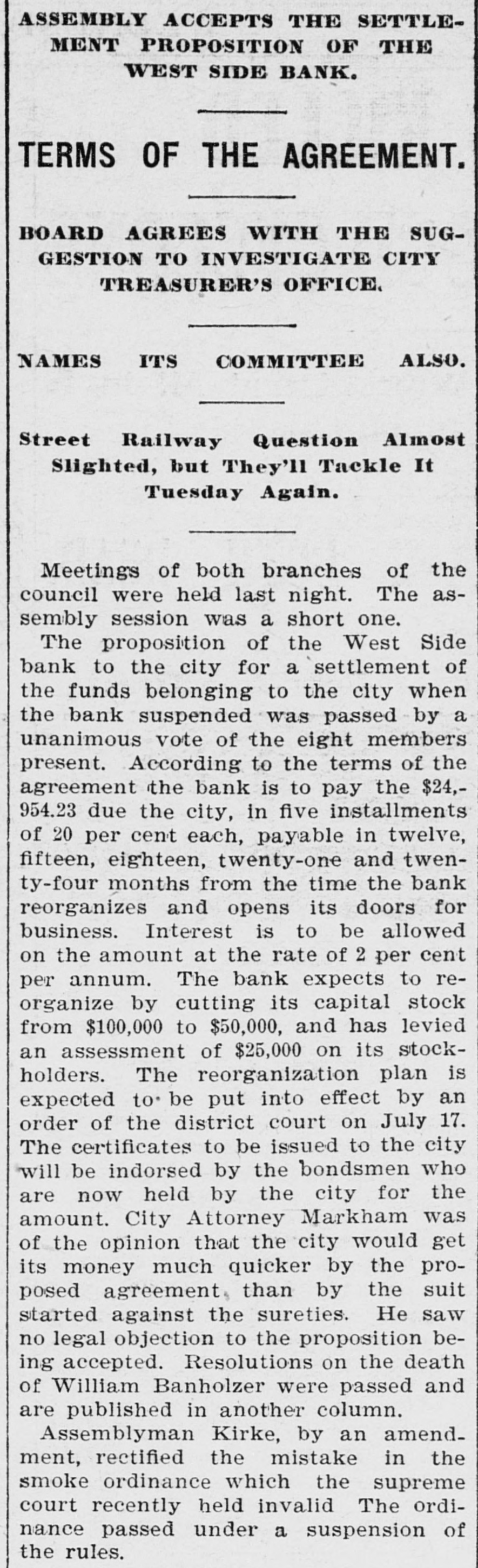
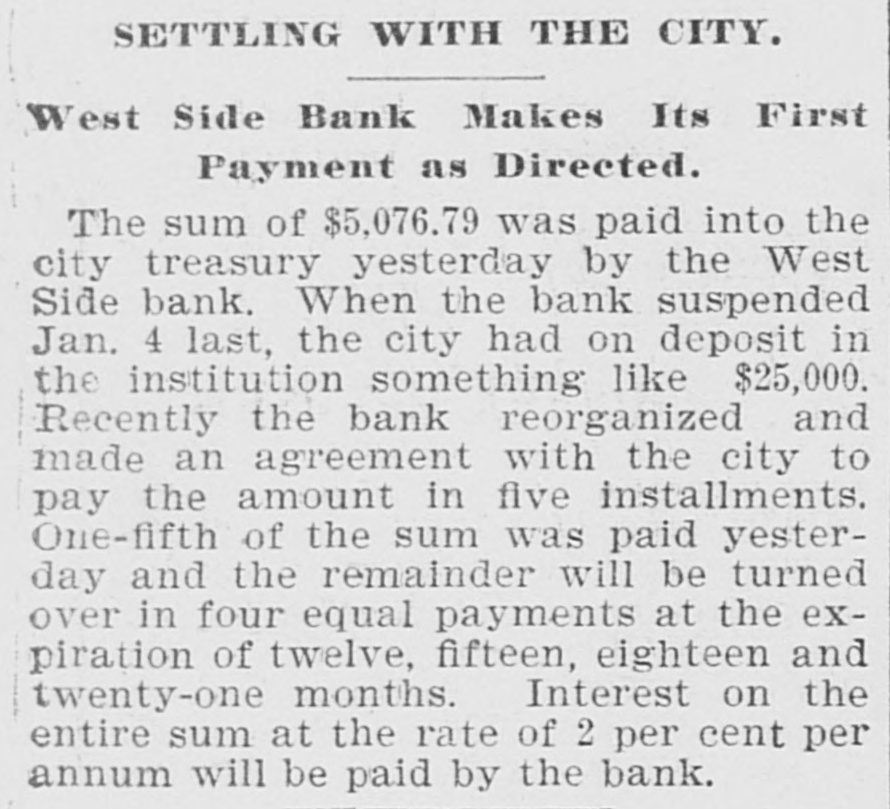
THREE MORE ST. PAUL BANKS. Two Were Large Institutions, the Other Was Small. St. Paul, Minn., Jan. 4.-As a direct result of the closing of the Bank of Minnesota, two weeks ago, which created new distrust among depositors and started runs on a number of city banks that were reputed not to be as strong as the depositors wished, three St. Paul banks-the Germania, the Allemania and the Vest Side, none of them national institutions, all closely associated-closed their doors today, one being in the hands of the state bank examiner and the others making assignments. During the time that had intervened since the closing of the Bank of Minnesota, the Germania paid out $225,000 to frightened depositors, and early today the directors concluded they would stop the drain and make an assignment to the cashier, Peter M. Keerst. The Allemania bank, which, like the Germania, had a large clientage among the Germans, and whose vice president had formerly been vice president of the Germania, then became the target for a lively run. Crowds gathered about the doors and fairly fought for a place in the line before the paying teller's window. The bank officials realized fully what such a run meant, and promptly called on Bank Examiner Kenyon to take poss sion of the bank, and that official is now in charge. The West Side bank, a small but possibly stronger bank, cleared through the Allemania, and today its clearings were returned by the latter institution. Follows ing this there was a decided run inaugurated on the bank, and at 2 o'clock this afternoon the bank officials closed the doors and called a meeting of the directors to decide what action to take. Their decision was apparent late in the afternoon, when they filed a deed of assignment to S. H. Staples, president of the bank. Considerable public money is tied up in the three institutions, but there is an mple supply for all immodiate needs in the other banks of the city. The assignment of the Germania and West Side banks has brought up a somewhat new question in the banking laws of the state, and the courts will be called upon to settle it. The state bank examiner doubts their right to assign, holding that they should have, under the law, turned over their assets to him. The attorney general intimates that he will bring an action to test the matter as soon as papers can be issued. During the day numerous reports of trouble among the other banks were current, and a few banks suffered runs of greater or lesser intensity, but the savings banks were protected by the law that allows them to require 60 days' notice before paying out deposits; and the national banks are in strong condition, and have no fear of anything of the sort. The Germania Bank. The Germania bank was a state institution and had a capital of $400,000. The last official statement of the condition of the bank, December 21, gave loans and discounts as $975,420.53; total resources, $1,625,788. Among the liabilities were cap, ital stock, $400,000; surplus and undivided profits, $58,797; individual deposits subject to check, $345,191; demand certificates of deposit, $7899; time certificates of deposit, $633,019. The Germania bank has been organize. many years, ex-Governor Alexander Ram. say being a long time president, and William Bickell, cashier. When the governor retired, Mr. Bickell became president, but last spring Bickell retired, becoming vice president of the newly organized Alle, mania bank. He was succeeded by Gustav Willius. President Willius told an Associated Press representative that the closing was the result of an unreasonable panic, and the bank would be opened for business as soon as the people regained their usual cool sense. The bank, as a result of the panicky feeling, had paid the depositors $335,000 in the last nine days. Willius said he fully expected to have the bank reopened by the last of March. The Allemania. The Allemania bank has a capital of $400,000, and a clientage similar to that of the Germania. The Allemania was organized last year, as a successor of the Commercial, William Bickell, formerly pres. ident of the Germania, joining forces with Albert Scheffer, of the Commercial, to organize a new bank. The last official statement made, December 17, showed loans and discounts, $706,842; undivided profits, less expenses, $508,764; individual deposits, $329,789; interest certificates, $187,253. President Scheffer, of the Allemania, said the failure was due to combined withdrawal of deposits. A crowd of depositors gathered today demanding their money, and at 11 o'clock it was decided to close. f Runs on Other Banks. Owing to the excitement caused by the closing of the Germania and the Allemania banks, many depositors went after their money in one or two other banks.