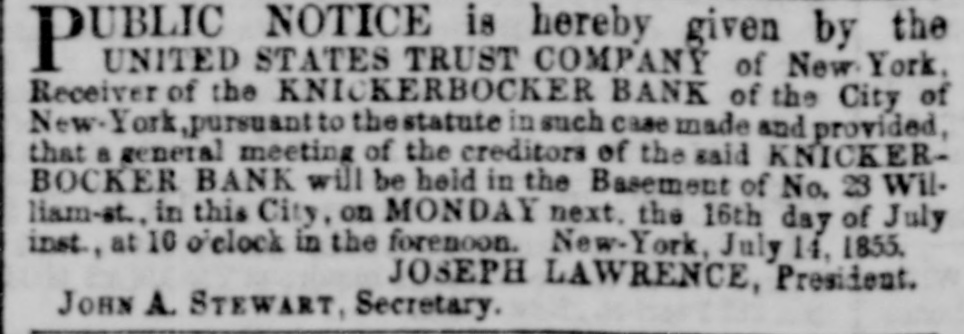
Knickerbocker Bank (New York, NY)

Episode Information

Episode UID
8773049490658
Episode Type
Suspension β†’ Closure
Bank Type
state
Bank ID
877304949 hash
Start Date
October 11, 1854
Location
New York, New York (40.714, -74.006)

Metadata

Model
gemini-3-flash-preview (chosen from majority vote of a three-model LLM ensemble)
Short Digest
f1c0c7997dbdf9d7

Response Measures

None

Description

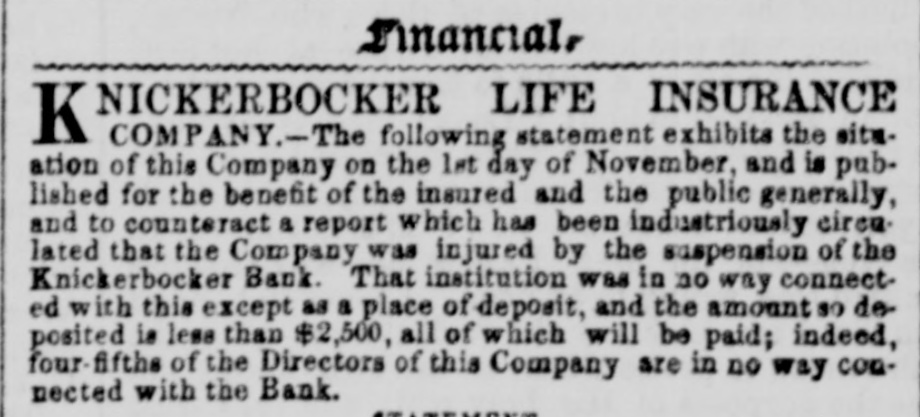
The bank suspended on October 11, 1854, and was subsequently placed in receivership; while other local banks faced runs, the Knickerbocker's failure is attributed to internal mismanagement and defalcations.

Events (3)

1. October 11, 1854 Suspension
Cause
Bank Specific Adverse Info
Cause Details
Internal mismanagement and defalcations by directors, including a reported deficiency of $142,000.
Newspaper Excerpt
The Knickerbocker Bank has temporalily suspended the redemption of its bills.
Source
newspapers
2. January 17, 1855 Receivership
Newspaper Excerpt
In the Supreme Court to day an application was made by the stockholders of the Knickerbocker Bank, for the appointment of a receiver.
Source
newspapers
3. July 17, 1855 Other
Newspaper Excerpt
The President of the United States Trust Company, as receiver, has declared a first dividend of 37 P cent, payable to the creditors of the Knickerbocker Bank
Source
newspapers

Newspaper Articles (24)

Article from The New York Herald, October 13, 1854

Click image to open full size in new tab

Article Text

FINANCIAL AND COMMERCIAL. MONEY MARKET. THURSDAY, Oct. 12-6 P. M There was a very active and a very buoyant market this merning, and the street was all alive with excite. ment. At the first board Illinois Central bonds advanced Β½ per cent; Canton Company, Β½; Nicaragua Transit, %; Cumberland Coal, 3/2; New York Central Railroad, 1/2; Harlem, Β½; Stonington, 3/2; Reading Railroad, 1. Up wards of three thousand shares of Erie stock were sold, opening at the closing prices of yesterday, and closing at a slight decline. The shorts were heavy buyers yes. terday afternoon, which was the principal cause of the improvement. Having provided for a large quantity of contracts, the probability is that they will become sellers again, and continue their bearing operations. The market has taken a step forward and is daily becoming stronger. Sellers have put out contracts at higher prices, and there is a feeling of confidence gradually ex. tending itself among holders of stocks generally. It will be seen that Erie was not the only stock that advanced to-day. Cumberland, Nicaragua, Reading, Central, all the leading speculative securities improved a fraction. It should be borne in mind that there are only about five stocks now on the market, in which there is any movement of consequence, and these we have named above. Most of the capital employed in speculations at the stock exchange is distributed among these securities. These stocks, with one exception, have been dividend paying investments, and they will be again very soon. The policy pursued by the railroad companies, in suspending the payment of dividends, is a wise one, and calculated to place them in a better condition in the shortest possible time. It is very seldom that the leading speculative stocks on any market possess so many elements of real value as those we allude to, and buyers for a rise have not, as in times past, an interest account running against them that offsets any moderate p:ofit The stocks principally used for speculation this market, a few years ago, possessed no actual value, and they were, therefore, a dead weight in the hands of holders. Since that time, some of them have improved and become productive concerns, while others have entirely disappeared. When Erie was selling at 80 a 90 per cent, New York Central at 120 a 125, Nicaragua Transit at 40 a 45, Cumberland Coal at 60 a 70, Reading at 90 a 95, and Harlem at 70 a 75, there was great danger in buying them, either for permanent investment or for speculation, for the chances were decidedly in favor of a great depreciation but when these stocks are selling at prices, in some instances, less than one-half of the above named value, the risk in purchasing, either for permanent or temporary possession, cannot be very great, while the probability of a profit at such prices is daily becoming greater. Nicaregue Transit at 23 per cent, Cumberland Coal at 30, Harlem at 31 a 32, Erie at 46 a 47, Reading Railroad at 74 a 75, cannot be considered bad purchases, even under the existing condition of money matters. Three out of the five will pay dividends within four months, and the appropriation of the net earnings of the other two to the removal of certain financial embarrassments will be of more service to the stockholders than half a dozen dividends. This is the position occupied by the leading speculative stocks in this market; and, as the speculative capital of this city and all connected with It is concentrated upon these securities, the effect must soon be visible in an appreciation of market value. We do not look for any important speculative movement in this or any other market at present. The season is not propitious, and the times are a little out of joint-but the stocks we have named must steadily, but very gradually, advance so long as they continue to show such evidences of returning prosperity and productiveness. It is out of the power of any clique of bears to depress to a much greater extent this class of securities. They may cause occasional fluctuations, but most of them are at this moment so far below their intrinsic value that there is no margia for further deprecistion. After the adjournment of the board the following sales of bonds and stocks were made at auotion by Albert H. Nicolay:97% ,000 Virginia coupon 6's, 1887. int. added 1,075 1 certificate Breckenridge Cannel C3., ($7,000) 87% 50 shares Chatham Bank do 40 do 86% 65 20 Mechanics' Bank, of Williamsburg 55 20 Farmers' and Citizens' Bank, of Long Island 70 44 Phoenix Fire Ins. Co, of Brooklyn 77 50 Rutgers Fire Ins. Co. 20 Commercial Fire Ins Co 90% 3 150 Lycoming Coal and Iron Co., of Penn S. Draper's semi-weekly sale of stocks will take place at the Merchants' Exchange, to-morrow, Friday, a: half past 12 o'clock. At the second board the market was a little lower There was not so much doing. Eri. Railroad fell off Β½ per cent; Reading Railroad, X; Cumberland Coal, 1/4. The Kmickerbocker Bank has temporalily suspended


Article from The New York Herald, October 13, 1854

Click image to open full size in new tab

Article Text

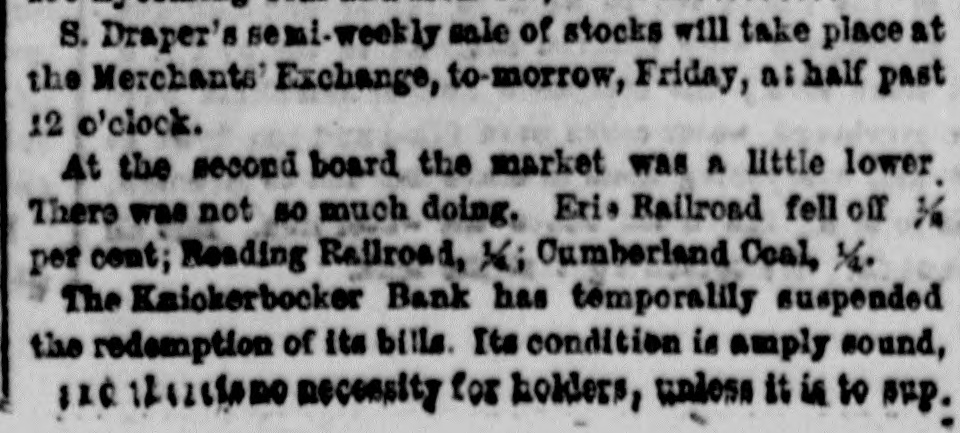
S. Draper's semi-weekly sale of stocks will take place at the Merchants' Exchange, to-morrow, Friday, a: half past 12 o'clock. At the second board the market was A little lower There was not so much doing. Erio Railroad fell off Β½ per cent; Reading Railroad, X; Cumberland Coal, 1/4. The Kmiokerbocker Bank has temporalily suspended the redemption of its bills. Its condition is amply sound, 110 necessity for holders, unless it in to sup.


Article from New-York Daily Tribune, October 13, 1854

Click image to open full size in new tab

Article Text

Thursday, Oct. 12-P. M. There was a much larger activity in the Stock market to-day and prices generally were buoyant, mainly through sympsthy with the rise in Erie. At the Secend Board there was less buoyancy and the market closed heavy. Erie was 45% about the closing price of yesterday. Reading has been stimulated by the large profits of its business and closed at 74, a further improvement of 1 P cent. Central improved to 91; Nicaragua 23, with good demand; Hudson River, 44. Cumberland closed at 30, showing a firm market. The Western Railroads are dull and generally heavy. In Railroad Bonds the business is $85,000, including New-York Central, 86%; Illinois Central, 681; Panama, 88; Erie, 1862, 73; 1871, 701; Incomes, 86; Saratoga and Sacketts Harbor, 88, &e. In Government Stocks there was nothing done; but a sale of North Carolinas was made at 102, and Californias at 85. The business in Exchangeis limited and the rates have a downward tendency. Sterling is 9@94, with some leading bankers' bills at9f P cent. in large bills. Francs, 5.13}@5.114. The supply of Commercial bills is quite light. From South there have been some France received, but we hear of but few remittances of Sterling. Freights arequiet. To Liverpool we hear of 50,000 bushels Grain at 3}@4d. in bulk; Cotton, d.; Dead-weight, 12/6. A charter was made for Malaga, but the terms did not transpire. To London, 350 bales Hops, 4d. The receipts at the Sub-Treasury are $92,334; paid, $60,485; balance, $5,876,174. The aggregate deposits at the Assay Office have been about $700,000 or $800,000. The first deposit was made by Mr. C. W. Thomas. From some unexplained delay at Philadelphia no bars have yet been received, but a pareel are expected to-night. The Exchanges at the Clearing House were large-$19,531,000. The shipments of gold by the Atlantic on Saturday promise to be nearly a million of dollars, of which $150,000 or more will be in Mexican silver. There is yet about a million of the Mexican fund remaining in Bank. The remainder of the seven millions, 88 far as can be ascertained, has been remitted to Europe. The money market continues without important change. The demand from merchants is large, and they pay high rates, but the stock houses are quite easy, and get what loans they want with facility at 7 P cent. The offerings at Bank are large, and increasing. The street rates for first-class paper are 10@12 P cent. The continuance of the large payments of the month, without important defalcations, is increasing the confidence of capitalists in commercial paper, and the demand for first-class paper is nearly equal to the supply. The multiplication of small banks with capital mainly paid up in notes renewable continually, and managed by parties having but little knowledge of banking, is producing its natural result. To the Eighth-av. and Knickerbocker Banks, already ebronicled as suspended, must now be added the Suffolk. The Suffolk has been in poor credit for some time past, having no arrangement for settlements through the Clearing-House. The capital is $250,000. The circulation is reduced to some $50,000, and will be redeemed by the Metropolitan Bank being secured amply by stocks in the Bank Department The deposits have been drawn down to about $40,000. It is thought the assets of the bank will yield enough very soon to pay their deposits. The dividend to the stockholders will not probably be a large one. There was rather a serious run on the Empire City Bank this morning, but the bank paid up to 3 o'clock. The circulation of this Bank is about $100,000, well secured by Stocks and the deposits about $240,000. There is a Sixpenny Savings Bank conrected with this institution, upon which there was also some run Nearly all the small up-town Banks suffered by the tongue of rumer to day. Most of the depositors in Savings Banks being of the uneducated classes, it is very easy to get up a panic in regard to them with very little distinction between the old established charter institutions and the new bogusdescription such 88 that connected with the Eighth-av. Bank. The depositsin all the Savings Banks will probably run down for awhile, but the excitement will gradually die away and they will run up again. There was some considerable demand for deposites at the Greenwich Saving *Bank to-day, but this institution having a million of dollars invested in Government and State Stocks, which are at any time available can stand any run. The Knickerbocker Bank made a strong attempt today to get aid to the extent of $100,000 with which to resume payment, but did not succeed. The securities in the Savings Bank connected with it are not, we hear, of the most reliable description. The Eighthav. Bank are endeavoring to negotiate their bonds and mortgages in the Bank Department, when they will commence redeeming their notes. There appears to be a determination upon the part of the managers of the Clearing House to purge the City banking system of all Banks the condition of which does not entitle them to full commission. Some half dozen banks outside the Clearing House have been living on from day to day by making their exchanges through some member of the House. Such Banks are to be discredited and forced into liquidation. Atleast such we understand is to be the future policy. No Banks are to be tolerated but such as have a bona fide paid up capital, and such as are prudently and skilfully conducted according to the rules of the Clearing House. The Banks at present members of the Clearing House are: Irving Bank, American Exchange Bank, Atlantic Bank Leather Manufacturers' Bank, Bank of New-York, Manhattan Company, Merchants' Bank. Bank of America, Butchers' & Drovers' Bank, Mechanics' Bank, Bank State of New York, Merchants' Exchange Bank, Bank of Commerce, Mechanics' & Traders' Bank


Article from New-York Daily Tribune, October 18, 1854

Click image to open full size in new tab

Article Text

pabneation of the report, proves that the public find its affairs in more promising shape than was anticipated. The loan made by Messrs. Brown, it is understood, has been nearly all reimbursed. There will probably be, within fifteen or twenty days, proposals issued for a new mortgage loan, with a sinking fund, on such terms as will attract the attention of capitalists-the proceeds to be used in the payment of the floating debt and of the income bonds and interest. The statement of the affairs of the Dauphin and Susquehanna Coal Company shows that e expenditures have been $2,969,754, of which $563,905 have been raised from 43,807 shares stock, $1,529,930 from $2,960,000 of bonds, $333,091 from railroad receipts, sales of coal &c., and $541,992 from loans not funded. The debt is $3,501,992, for which only $2,071,992 has been realized. The Bondholders of the Dauphin and Susquehanna Coal Company, held a meeting last evening at the St. Nicholas Hotel. Mr. Marvin, President of the Brokers' Board was chosen Chairman, and Mr. Elias Smith, Secretary. The first question that came up was as to what manner the Bondholders could protect their intereste in the Bonds? A number of propositions were presented for the consideration of the meeting, on which there was considerable discussion, and an adjournment finally took place without coming to any definite conclusion. The steamer to-morrow has about $600,000 in goli engaged, to which will be added probably 200,000 Mexican dollars received to-day by the Cahawba in transitu from Vera Cruz to London. The Cahawba has altogether 258,000 dollars. There is no renewal of the bank excitement and the Clearing-House settlements are made with unusual promptitude. The late troubles will no doubt have a beneficial effect upon the smaller banks, teaching them caution and an avoidance of any dangerous expansion. At a meeting of the Board of Directors of the Knickerbocker Bank last evening the President and Cashier resigned. An effort is making to enable the Bank to resume business. The foreign orders by the Baltic are not large for our Securities. The letters generally are hopeful, although they speak of an active demand for Money. The temporary suspension of Mr. Edward Oliver of Liverpool, is spoken of, and the belief expressed that after paying all his liabilities he will still have a very large surplus. Mr. Oliver is one of the largest ship-owners in the world, having three million dollars invested in ships. We understand that this temporary suspension will not at all embarrass Mr. Oliver's agent in this City. We annex an extract from the circular of Messrs. Marie & Kaur, prepared for the steamer: Two of our small banks of the third class, located at a distance from the business part of the town, almost without influence, and for some time past of doubtful credit, have been compelled lately to go into liquidation; and the old banks, for the sake of guarding against too great loss of specie, as well as against the possibility of increasing suspensions on the part of the public, have greatly curtailed their ordinary loans. Beside the exportation of specie to Europe, there is a temporary demand from the West, arising from the new law of the State of Ohio, in regard to bank-notes. This law prohibits the circulation of any note under $10, issued by the banks of other States. In consequence of this law, the banks of Indiana have been obliged to cancel a part of their circulation, and to offer for sale about $500 000 Indiana Five P Cents, as well as other State funds, which they had deposited as the basis of their circulation in the hands of the Controller. Hence the great decline for some time back in Indiana, Virginia, and other securities. These different causes have increased the demand for money here, and stocks have generally been falling until the publication of the report of the Erie Railroad, produced a decided rise in most of our speculative stocks, Erie securities in particular. Other securities, except Illinois Central, are tranquil. Among the new Directors of the Erie Railroad elected on the 10th inst., are Mr. Charles Moran (of Moran Brothers) and Louis Von Hoffman (of L. Von Hoffman & Co.) The presence of these gentlemen cannot but inspire confidence in the holders of Erie securities in Europe. The business of the Cumberland Coal Company for the week was 3,858 tuns. At Philadelphia the money market is unchanged. ### AT BOSTON THE POST SAYS: The money market exhibited a decided improvement last week. Rates on strictly first-class paper fell from 12 to 10 ct., and on every sort of loan there was a marked reduction in price, with a less active and feverish demand. Our leading domestic houses are refusing money at above 9 ct.; and with a considerable increase of specie in our banks, and the large contraction heretofore noticed, it is probable that these same houses will soon be fairly supplied at 8 ct. The banks generally have increased their discounts for some days. The October receipts and payments are heavy, but, thus far the market has improved in the face of them. New-York funds continue abundant, and considerable coin is arriving here daily. $100,000 came on Saturday morning. Sterling exchange rules lower. The bankers have purchased very good bills for 9 1/4, and 9 1/2 is now the best they will pay. As far as Boston is concerned, it will be perceived that money matters look favorably for the future. But, in view of all the circumstances, it is not probable that money can average much lower, until the cotton bills pour in upon us. The Directors of the Vermont Central Railroad Company have elected J. Francis Tuckerman, Esq., as Treasurer and Transfer Officer of the corporation. A vote has been passed to open the transfer books in mediately, but the President and Treasurer were instructed to transfer no shares unless they shall be considered genuine by these two officers, under the advice of J. P. Putnam, Esq., the attorney of the corporation. The whole funded debt of the city of St. Louis is $3,553,096, on which there is an annual interest accruing of $214,483; $1,250,000 of this indebtedness is caused by subscriptions to railroads, and on this amount the companies pay the interest into the city treasury equal to a deduction from the aggregate interest account of $75,000. The debt proper is $2,123,096. The quantity of Flour, Wheat, Corn and Barley left at tide water during the 2d week in Oct., in the year 1853 and 1854, is as follows: Flour, bbis. Wheat, bush. Corn, bush. Barley, bush. 1853118,825 528,208 196,124 212,980 1854... 52,126 69,810 475,002 181,694 Dec... 61,697 Dec. 458,398 Ine. 287,273 Dec. 31,286 The aggregate quantity of the same articles left at tide water from the commencement of navigation to the 14th of October, inclusive, during the years 1853 and 1854, is as follows: Flour, bbls, Wheat, bush. Corn, bush. Barley, bush. 18531,953,571 5,209,862 2,339,531 1,112,629

Article from The New York Herald, October 20, 1854

Click image to open full size in new tab

Article Text

FINANCIAL AND COMMERCIAL. MONEY MARKET. THURSDAY, Oct. 19-6 P. M. The stock market opened this morning dull and depressed. A very moderate amount of business was transacted, generally at lower prices. At the arst board Illinois Central bonds fell off 1/4 per cent; Erleincome bonds, 1; Cumberiand'Coal, Β½; Reading Railrcad, Β½; Nicaragua Transit, 3/8. Harlem advanced Β½ per cent; New York Central bonds, Β½. Railroad bonds were freely offered and freely taken. The advance in Illinois Central has been pretty well maintained, and the demand is more active than for any other on the list. The steadiness of prices for all the leading speculative securities is a very extraordinary feature in the market at this moment. When we look at the severity of the money pressure, and all the causes which are bearing, with more or less force, upon prices for every description of property, holders of stocks must feel encouraged, and convineed that any permanent let up in the existing stringency will give a great impetus to operations, and an important inflation to the market value of all c'asses of securities. Erie appears to be now as firm at 46 per cent and was at 43 a few days since. Oumberland, Niearagua, Harlem and Central do not vary from day to day, any more than the best class of funded bonds on the market. It must be poor business for the commission brokers just now, and in fact for speculations either fo: a rise or fall. Purchasers on time, buyer's option, say sixty or ninety days, need have no apprehensions of any depreciation in the market value, and the time cannot be very far distant when every leading fancy stock 01 the list will rule at much higher prices. It takes but about half the money to carry these stocks, that it did six months since, and every one of them is at this mo ment actually worth much more than it ever was before. This is a fact no one can centrovert. Several failures among dry goods importers and jobbers in this and neighboring cities have been announced, within the past day or two, some of them involving lia. bilities to a heavy amount. These things are not unexpeeted, and are necessary to bring matters down to a proper level. We look for many more of the same sort; and they will continue until only those who have com. fined their operations to proper limits an to legitimate principles will be left. Those who have traded upon borrowed capital, or rather u pon no capital at all, ought to break and will break, whether it is banks, rail. reads or individuals. At the second board a further decline was realized. Illinois Central Bonds fell off Β½ per cent; Nicaragua Transit, %; Cumberland Coal, Β½; Reading Railroad, 1; New York Central Railroad, 1/4; Erie Railroad, Β½. We cannot satisfactorily account for the heavy decline in Reading. The determination on the part of the miners in the Schuylkill coal region, not to get out any more coal at present, could not alone have been of sufficient importance to depress prices so suddenly to such an ex. tent. At the close, Erie was firm at our quotations. Another defalcation was reported to-day. This time a down town bank is the victim. We understand that the Ocean Bank is a loser to the extent of about ninety thousand dollars by overdrawn accounts, through certi. fied checks. The discovery of these frauds must shake public confidence very seriously, and tend materially 0 postpone the return of beiter times. We take it for granted that the parties who have so largely overdrawn their accounts at the Ocean Bank not in & condition to refund. The money has either been lately lost in speeulations, or it has been drawn by parties desperately embarrassed, who were favored with facilities in this way for obtaining temporary relief. Yesterday we re. ported a defalcation in the Knickerbocker Bank of $142,000; to day we have one to report in the Ocean Bank of $90,000. A little later than this last year, we reported half a dozen defalcations of different kinds among the banks in andout of Wall street, amounting in the aggregate to several hundred thousand dollars, and we have no doubt but that at this moment there are half a dozen more at least, which may or may not be discovered. They will be kept quiet if possible. The stockholders in these institutions are entirely ignorant of what is going on in their Internal affairs So long as they get dividends no questions are asked. There have been enormous losses by the depreciation of fancy stocks and property of all kinds, and they must fall somewhere. Somebody must pay for all the extravagance which has surrounded as during the past four or five years. It has cast a great deal of money, and those who have it must pay, whether they have participated or not Sometimes those who do not dance have to pay the fiddler. Since the above was written we have reseived the fol lowing eard:OCEAN BANK OF THE CITY OF NEW YORK, , October 19, 1854. In order to correct an exaggerated rumor, I deem It proper to state that the late paying teller of this bink is deficient in his funds to an outside amount of seventyfive thousand dollars The bank has a surplus of fortyfive thousand dollars. Its espita' of one million will be but little impaired, and there will be no interrupti on of its business. Yours respectfully. J. S. GIBBONS, Cashiar. After the adjoursment of the board, the following sales of bonds and stocks were made at auction by A. H. Nicolay int. added 95 1/2 $5,000 Virginia coupon 6's, 1887 91 do 12,000 N. Jersey Central RR 1st mort, 86 do 5,000 Newcastle & Richmond RR do 75 25 shares Bank of Owego 24 do do 65 50 do do 50 90 10 do Central Bank of Brooklyn 20 do Island City Bank 79 40 do Chatham Bank 90 Enisterb


Article from New-York Daily Tribune, October 25, 1854

Click image to open full size in new tab

Article Text

SECOND BOARD R R Erie 74g $8,000 Frie Con. Bds. 71 46 #80 do 50 694 500 ILL Cen R.R. Bds b8 46 do 50 .860 294 100 Cumberland Coal b80 46 500 do 299 do 100 40g al5 50 do 68 do 100 aGO 45g do b60 29 100 do 200 see 452 do 100 Rg 500 Penn & Lehigh Zinc b8 403 do 100 b8 728 200 Reading R. R 08 80 N. Y. Central R. R #8 72 do 100 bao 881 300 do 14 do 100 15 Clave C & Cip. R. R 101 b5-72 do 100 5 Chic & Rook Lald. R.R. 78 95 15 Mich So. R. * TUESDAY, Oct. 24-P. M. There was & better feeling prevailing at the Morning Board to-day, but at the Second Board the quotations were not sustained. The closing prices, however, show generally an improvement on yesterday. losed at 45%, an advance of Erie which touched 461 V cent.; Reading was I P cent. better; Hudson I River improved 1: Central was active but fell off I # cent.: a bear sale of 100 shares was made at 871, seller 6 months; Harlem, Canton, Cumberland, &sc., were steady; Delawaresold at 116; Lebigh Zinc sold at 21, a further advance; Nicaragua was firm at 23. In Railroad Bonds the market is rather firm. The loading bear made a sale of $25,000 Erie's, 1883, at 821, seller 12 months, and offered the new unissued loan at 80 on the same terms. Illinois Central sold at 691 Erie Incomes 92, which is an improvement of 1 . cent. There is some inquiry for the m from parties who propose to bid for the new loan, for which they are taken in payment. Convertibles sold at 741; New-York Centrals 872, and the Real Estate Bonds 80. Virginia 6a sold at 95 which was the only transaction in State Stocks. Governments were held strongly and there were no transactions. The market for Exchange has been heavy for this steamer, and as some concession in rates was made there have been some large transactions. Sterling ranges from 9 to 22 et., but first-class bills other than bankers have been sold at 9j@9f. A considerot. able lot of Canadian bank bills sold at 91 Francs have been plenty at 5.15@5.121. The market generally has been very irregular Freights continue dull. To Liverpool about 10,000 bush. Corn, 4@4jd.; 200 or 300 bales Cotton, jd.; Resin, 10@12d.; 350 bbls. Oil, and 50 tuns Bacon, 15/. To London, 700 bble. Oil, 17/6. To Ireland, a direct port, B charter was made at 7jd. To Bremon, 5,000 gale. and 1,000 bble. Oil were taken on private terms. To Havre, small engagements Cotton, 4c.; Ashes, $6@$8. A charter was made to Attakapas and back at 87, for Sagar and Molasses. The receipts at the Sub-Treasury were $327,088; paid, $14,616; balance, $6,551,343. Of the receipts, $200,000 were from the Bank of America on a transfer draft to New-Orleans, and was 6 portion of the balance of the Mexican fund. The Bank of Commerce also paid out $500,000 of the Mexican fund remaining in that bank, of which $100,000 was in coin. The whole remaining balance of the Mexican fund will probably be drawn from the banks in a few days. There are some small amounts of coin coming in from the West, but there are also remittances to the West of about the same amount. About $200,000 will go over to Boston for the steamer to-morrow. The Knickerbocker Savings Institution advertises that that institution will probably not meet with any loss through the suspension of the Knickerbocker Bank. The bulk of the deposits, it is stated, is secured by bonds and mortgages, and the managers counsel patience upon the part of the depositors The National Exchange Bank project, and the Empire City Bank, have been merged. Mr. A. M. Binninger, who was President of the former institution, has been elected to fill the vacancy of President of the Empire City, and the latter Bank will be removed to the building intended for the occupancy of the National Exchange. The new Board consists of A. M. Binninger, Elijah F. Pardy, William Adams, Leonard H. Church, Jonathan Purdy, William J. Staples, Isaac 0. Barker, Samuel Leggett, Jasper W. Hughes, George F. Nesbitt, Dennis Harris, Robert L. Mabey, and Joseph 0. Dorr. Mr. Barker, Vice-President, who has been acting President, has resigned, and the Cashier, Mr. L. H. Charch. fills the vacancy. Mr. R. T. Creamer has been elected Cashier. Thenew banking-house is on the corner of Greenwich and Duane-streets. Mr. Thompson furnishes the annexed information in relation to Indiana Banks: The following Indians Free Banks are 2 $ cent. discount, vis: Bank of Auburn, Aabura;" Bank of Bridgeport, Bridgeport; IndianaStock Bank, Laporte; Kalamazoo Bank, Albion; Merchants Bank, Springfield: New-York and Virginia State Stock Bank, Evansville; Plymouth Bank Plymouth Southern Indiana Bank, Terra Haute; Wabash Valley Bank, Logansport. All other Free Banks in Indiana except the Bank of Connersville, Eikhart County Bank and Northern Indiana Bank will be taken antilfurther notice at 15 cent. discount. The three above named Banks supposed to have failed, and are selling at 50 to 60 cents on the dollar. Any changes that may take place from day to day I will communicate to THE TRIBUNE


Article from New-York Daily Tribune, October 26, 1854

Click image to open full size in new tab

Article Text

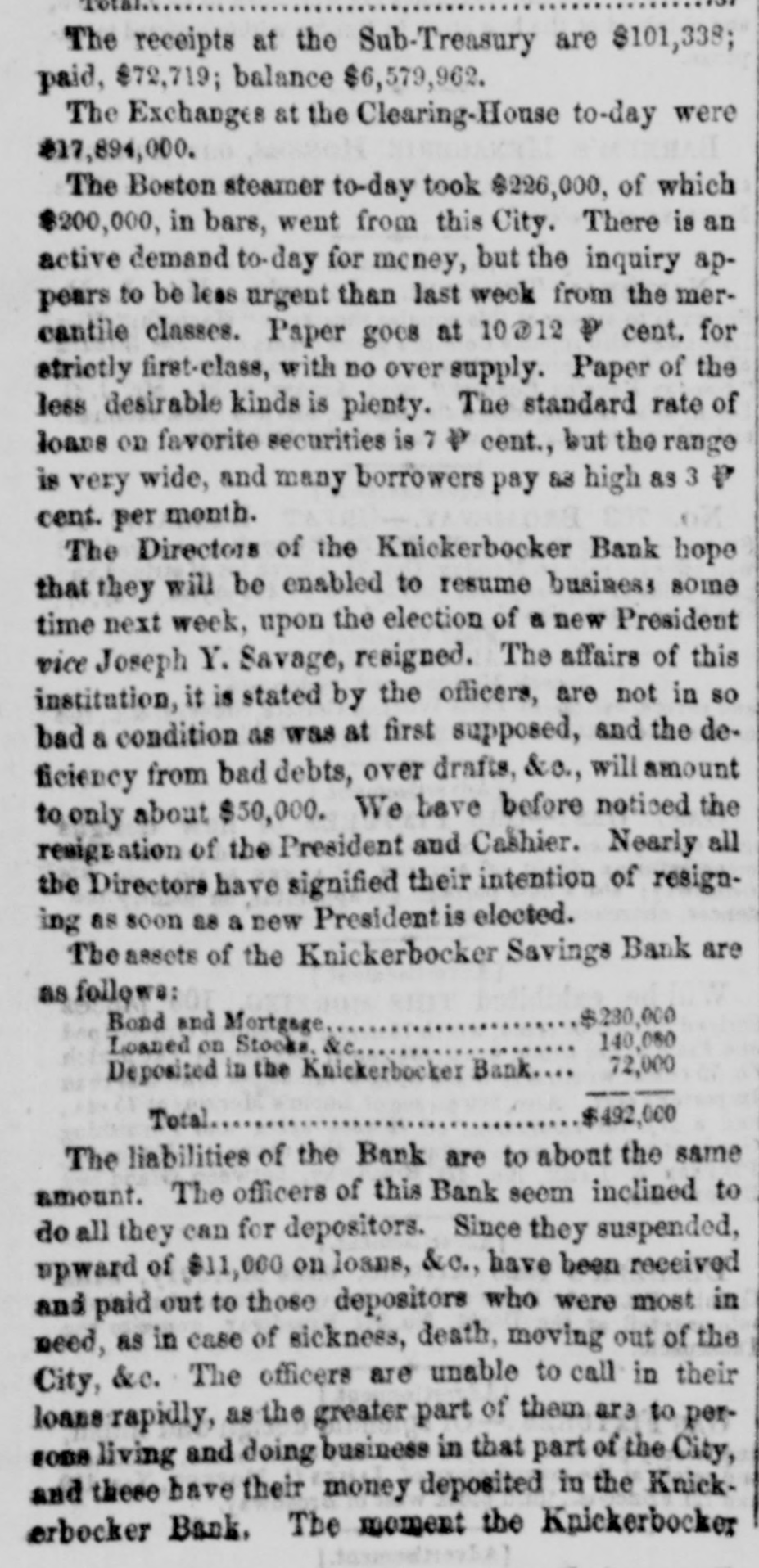
The receipts at the Sub-Treasury are $101,338; paid, $72,719; balance $6,579,962. The Exchanges at the Clearing-House to-day were $17,894,000. The Boston steamer to-day took $226,000, of which $200,000, in bars, went from this City. There is an active demand to-day for money, but the inquiry appears to be less urgent than last week from the mercantile classes. Paper goes at 10@12 P cent. for strictly first-class, with no over supply. Paper of the less desirable kinds is plenty. The standard rate of loans on favorite securities is 7 P cent., but the range is very wide, and many borrowers pay as high 83 3 P cent. per month. The Directors of the Knickerbocker Bank hope that they will be enabled to resume business some time next week, upon the election of a new President vice Joseph Y. Savage, resigned. The affairs of this institution, it is stated by the officers, are not in so bad & condition as was at first supposed, and the deficiency from bad debts, over drafts, &o., will amount to only about $50,000. We have before noticed the resignation of the President and Cashier. Nearly all the Directors have signified their intention of resigning as soon as & new President is elected. The assets of the Knickerbocker Savings Bank are as follows: $230,000 Bond and Mortgage 140,080 Loaned on Stocks. &c 72,000 Deposited in the Knickerbocker Bank $492,000 Total The liabilities of the Bank are to about the same amount. The officers of this Bank seem inclined to do all they can for depositors. Since they suspended, upward of $11,000 on loans, &c., have been received and paid out to those depositors who were most in need, as in case of sickness, death, moving out of the City, &c. The officers are unable to call in their loans rapidly, as the greater part of them are to per#ODB living and doing business in that part of the City, and these have their money deposited in the Knickerbocker Bank, The moment the Knickerbocker


Article from The Daily Minnesota Pioneer, November 3, 1854

Click image to open full size in new tab

Article Text

candidates, factions, and political axe engaged in the struggle, renders the canvass a most exciting game a purposes to a disinterested spectator melee. criminal record of the current weel to tival that of the preceding one.Vednesday evening last John Shaver, : stabbed his wife with a shoe-knife places; a man named Archibald Irvin from the effects of wounds inflicted on the night, by a youth named Darron Eberle was committed for trial on : of murdering John Gilfoy, with a pis Ninth Avenue, on Friday night ; John was convicted of manslaughter in the degree; and a policeman was arraigne charge of manslaughter in causing the of a prisoner by violence. Rather a for catalogue for one day. But there i to add. On Tuesday, John Smith, a boy renteen, was placed at the bar on a charge and convicted of manslaughter it degree and yesterday Patrick Mc a laborer, was put on trial for th of his wife; and John D. King, a mer appearance, was a' raigned for homicide weapons used in all the cases I have men save three, were the dastards-th the immediate carse in each instane other of those little episodes in the his of Banking mildly termed defalcations, brought to light in this city a few day It yesterday furnished a new topic fo ossips in Wall street. The first teller o Decan Bank, one McGuckix, is the unfor victim of circumstances." The thing in the simplest way in the world. McGuckin merely certified checks in al way on his own hook, and finally th was minus $100,000 by the operation.apital, however, is a million of dollars, si the odds." After Schayler's giganti a swindle of a cool hundred thousan almost like an act of exemplary forbear and we only say, after drawing a long "a mere trifle, it might have bee It is understoad that the teller's so are good for $50,000. There is also loose in the Knickerbocker Bank. On directors is said to owe the institutio ! The bank is in a bad condition heavy loss will fall somewhere -- on th probably. Tbe Empire Bank ha tried by a pretty persevering run, bu the test, and is in as good order as ever have been some failures among the Ken and Indiana banks, and every body look shy at Western money. Walker divorce case, which afforde delightful food for prurient imagination its progress, has been settled by a de of the referee. Mrs. Walker obtains : with leave to marry again, and ha astody of the children, he being permitted them once a week. The public ver the decree is served him right." able legal opinions in favor of the aption of the Schuyler Scrip by the N.Y II. Railroad were published here yes and another appears in the Tribune 0 They emanate from C. P. Kirkland O'Connor, Greene C. Brouson, and Lord, of whom the three former have by the members of the stock ex The proposed evasion of New-Haver doss not find favor in financial circles beautiful humbug, the Crystal P.. lace to collapse. It is advertised to the 1st proximo. What disposition will of the building I de not know. Some


Article from New-York Daily Tribune, November 4, 1854

Click image to open full size in new tab

Article Text

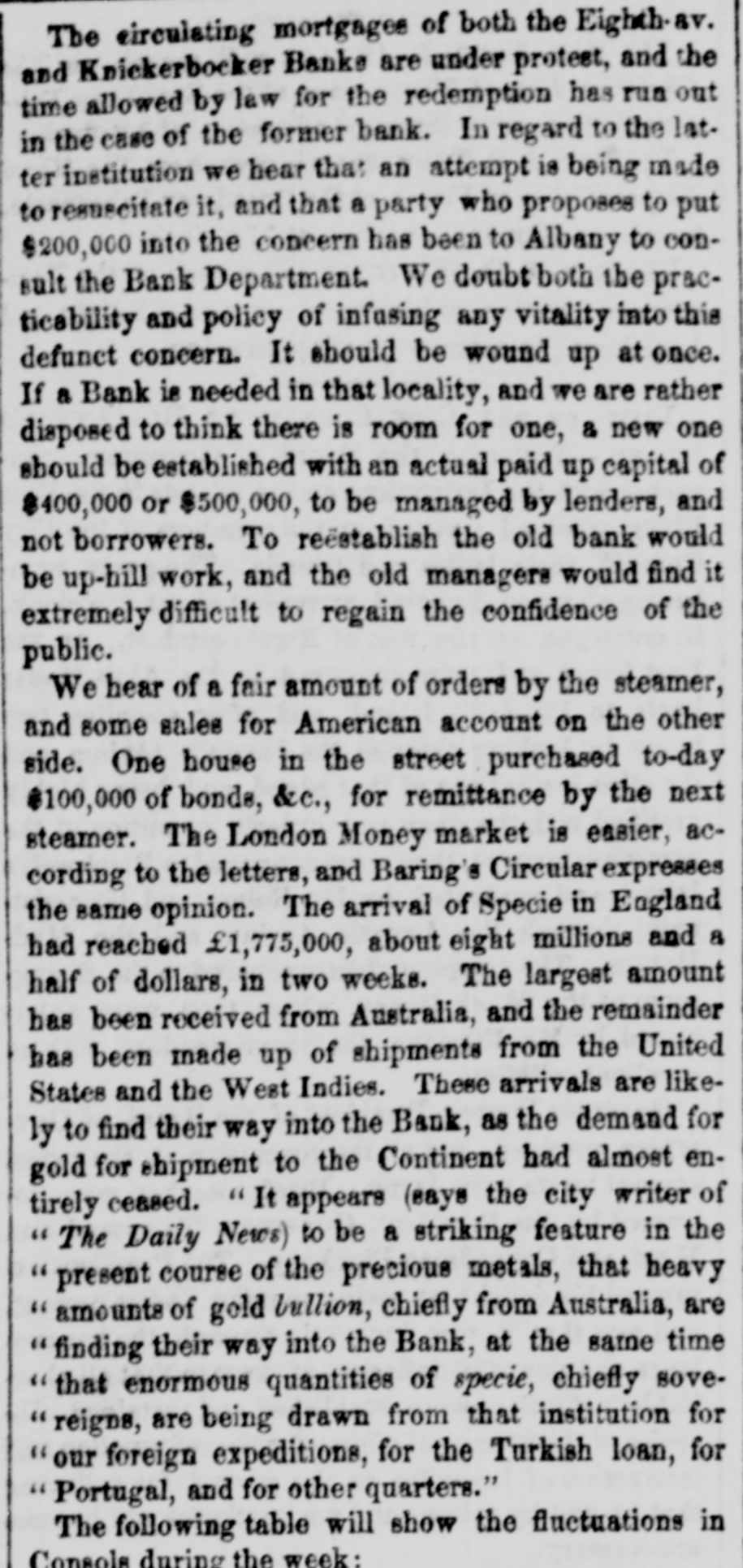
The circulating mortgages of both the Eighth-av. and Knickerbocker Banks are under protest, and the time allowed by law for the redemption has run out in the case of the former bank. In regard to the latter institution we hear that an attempt is being made to resuscitate it, and that a party who proposes to put $200,000 into the concern has been to Albany to consult the Bank Department. We doubt both the practicability and policy of infusing any vitality into this defunct concern. It should be wound up at once. If a Bank is needed in that locality, and we are rather disposed to think there is room for one, & new one should be established with an actual paid up capital of $400,000 or $500,000, to be managed by lenders, and not borrowers. To reestablish the old bank would be up-hill work, and the old managers would find it extremely difficult to regain the confidence of the public. We hear of a fair amount of orders by the steamer, and some sales for American account on the other side. One house in the street purchased to-day $100,000 of bonds, &c., for remittance by the next steamer. The London Money market is easier, according to the letters, and Baring's Circular expresses the same opinion. The arrival of Specie in England had reached Β£1,775,000, about eight millions and a half of dollars, in two weeks. The largest amount has been received from Australia, and the remainder has been made up of shipments from the United States and the West Indies. These arrivals are likely to find their way into the Bank, as the demand for gold for shipment to the Continent had almost entirely ceased. It appears (says the city writer of " The Daily News) to be a striking feature in the " present course of the precious metals, that heavy " amounts of gold bullion, chiefly from Australia, are " finding their way into the Bank, at the same time " that enormous quantities of specie, chiefly sove" reigns, are being drawn from that institution for " our foreign expeditions, for the Turkish loan, for " Portugal, and for other quarters." The following table will show the fluctuations in Consols during the week:


Article from The National Era, November 9, 1854

Click image to open full size in new tab

Article Text

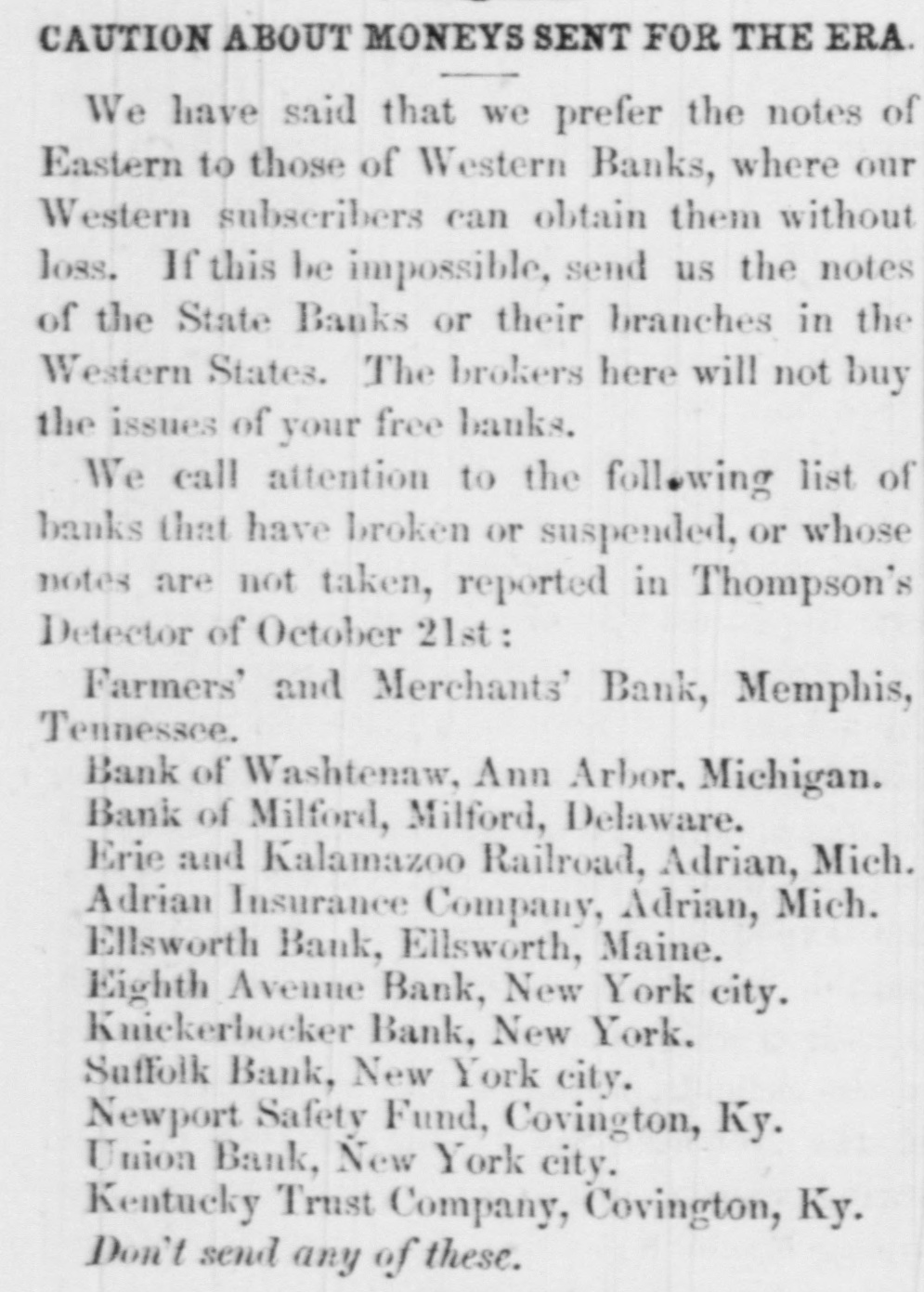
CAUTION ABOUT MONEYS SENT FOR THE ERA. We have said that we prefer the notes of Eastern to those of Western Banks, where our Western subscribers can obtain them without loss. If this be impossible, send us the notes of the State Banks or their branches in the Western States. The brokers here will not buy the issues of your free banks. We call attention to the following list of banks that have broken or suspended, or whose notes are not taken, reported in Thompson's Detector of October 21st: Farmers' and Merchants' Bank, Memphis, Tennessee. Bank of Washtenaw, Aun Arbor, Michigan. Bank of Milford, Milford, Delaware. Erie and Kalamazoo Railroad, Adrian, Mich. Adrian Insurance Company, Adrian, Mich. Ellsworth Bank, Ellsworth, Maine. Eighth Avenue Bank, New York city. Knickerbocker Bank, New York. Suffolk Bank, New York city. Newport Safety Fund, Covington, Ky. Union Bank, New York city. Kentucky Trust Company, Covington, Ky. Don't send any of these.


Article from The National Era, November 16, 1854

Click image to open full size in new tab

Article Text

CAUTION ABOUT MONEYS SENT FOR THE ERA. We have said that we prefer the notes of Eastern to those of Western Banks, where our Western subscribers can obtain them without loss. If this be impossible, send us the notes of the State Banks or their branches in the Western States. The brokers here will not buy the issues of your free banks. We call attention to the following list of banks that have broken or suspended, or whose notes are not taken, reported in Thompson's Detector of October 21st: Farmers' and Merchants' Bank, Memphis, Tennessee. Bank of Washtenaw, Ann Arbor. Michigan. Bank of Milford, Milford, Delaware. Erie and Kalamazoo Railroad, Adrian, Mich. Adrian Insurance Company, Adrian, Mich. Ellsworth Bank, Ellsworth, Maine. Eighth Avenue Bank, New York city. Knickerbocker Bank, New York. Suffolk Bank, New York city. Newport Safety Fund, Covington, Ky. Union Bank, New York city. Kentucky Trust Company, Covington, Ky. Don't send any of these.


Article from The Belmont Chronicle, and Farmers, Mechanics and Manufacturers Advocate, November 24, 1854

Click image to open full size in new tab

Article Text

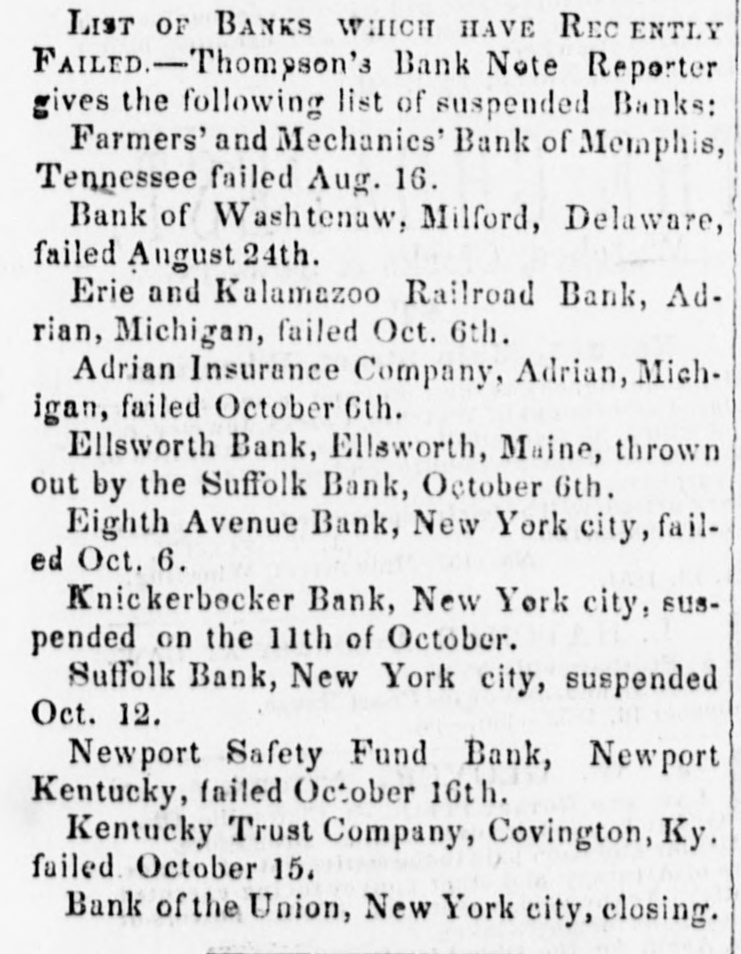
LIST OF BANKS WHICH HAVE REC ENTLY FAILED.-Thompson's Bank Note Reporter gives the following list of suspended Banks: Farmers' and Mechanics' Bank of Memphis, Tennessee failed Aug. 16. Bank of Washtenaw, Milford, Delaware, failed August 24th. Erie and Kalamazoo Railroad Bank, Adrian, Michigan, failed Oct. 6th. Adrian Insurance Company, Adrian, Michigan, failed October 6th. Ellsworth Bank, Ellsworth, Maine, thrown out by the Suffolk Bank, October 6th. Eighth Avenue Bank, New York city, failed Oct. 6. Knickerbocker Bank, New York city, suspended on the 11th of October. Suffolk Bank, New York city, suspended Oct. 12. Newport Safety Fund Bank, Newport Kentucky, failed October 16th. Kentucky Trust Company, Covington, Ky. failed October 15. Bank of the Union, New York city, closing.


Article from Carroll Free Press, December 7, 1854

Click image to open full size in new tab

Article Text

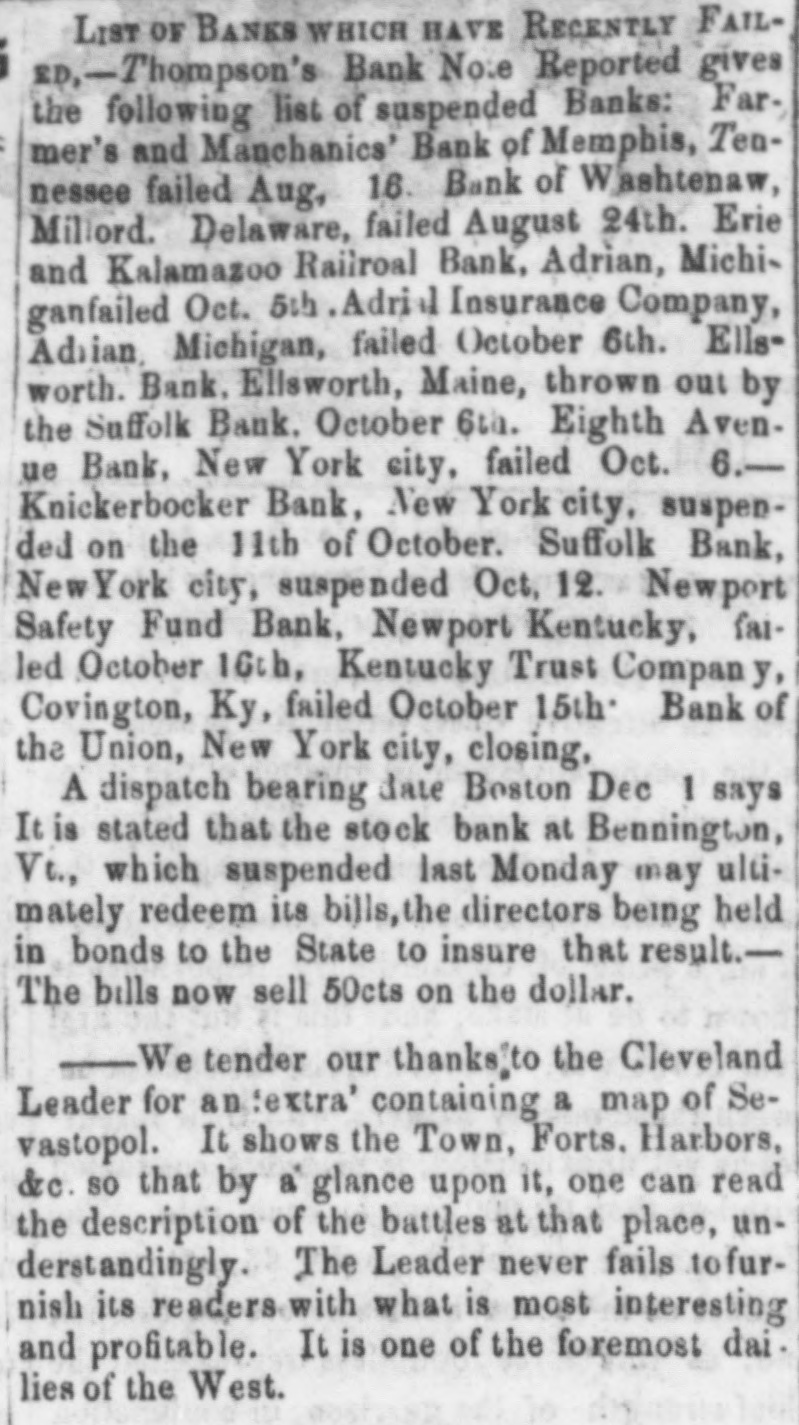
LIST OF Banks WHICH HAVE RECENTLY FAILED,-Thompson's Bank Note Reported gives the following list of suspended Banks: Farmer's and Manchanics' Bank of Memphis, Tennessee failed Aug, 16. Bank of Washtenaw, Millord. Delaware, failed August 24th. Erie and Kalamazoo Railroal Bank, Adrian, Michiganfailed Oct. 5th. Adrial Insurance Company, Advian, Michigan, failed October 6th. Ellsworth. Bank, Ellsworth, Maine, thrown out by the Suffolk Bank. October 6th. Eighth Avenue Bank, New York city, failed Oct. 6.Knickerbocker Bank, New York city, suspended on the 11th of October. Suffolk Bank, New York city, suspended Oct, 12. Newport Safety Fund Bank, Newport Kentucky, failed October 16th, Kentucky Trust Compan Covington, Ky, failed October 15th Bank of the Union, New York city, closing, A dispatch bearing date Boston Dec I says It is stated that the stock bank at Bennington, Vt., which suspended last Monday may ultimately redeem its bills, the directors being held in bonds to the State to insure that result.The bills now sell 50cts on the dollar. We tender our thanksito the Cleveland Leader for an 'extra' containing a map of Sevastopol. It shows the Town, Forts. Harbors, &c. so that by a glance upon it, one can read the description of the battles at that place, understandingly. The Leader never fails tofurnish its readers with what is most interesting and profitable. It is one of the foremost dailies of the West.


Article from Worcester Daily Spy, January 11, 1855

Click image to open full size in new tab

Article Text

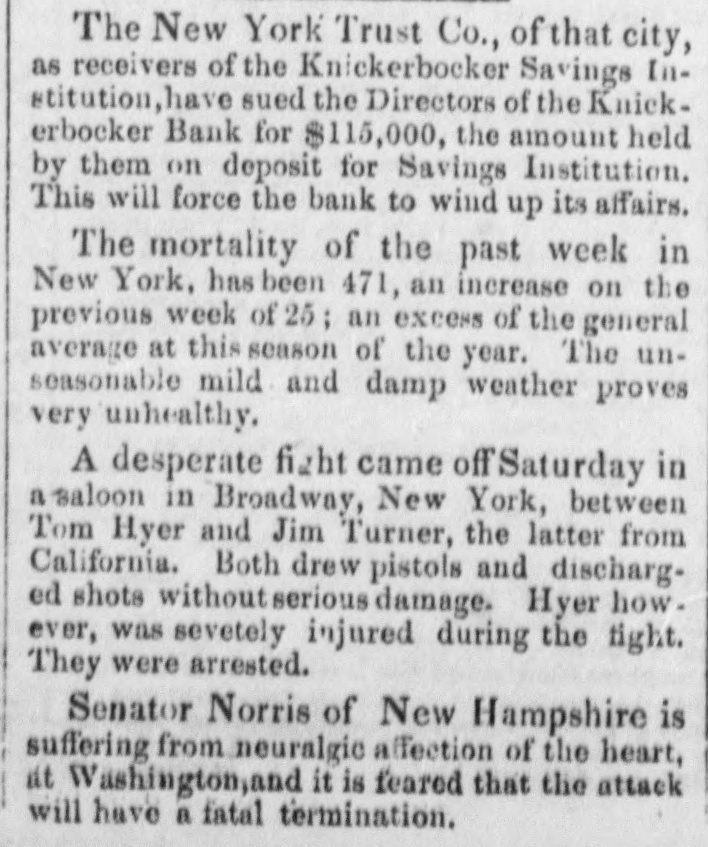
The New York Trust Co., ofthat city, as receivers of the Knickerbocker Savings Institution, have sued the Directors of the Knickerbocker Bank for $115,000, the amount held by them on deposit for Savings Institution. This will force the bank to wind up its affairs. The mortality of the past week in New York, has been 471, an increase on the previous week of 25; an excess of the general average at this season of the year. The unseasonable mild and damp weather proves very unhealthy. A desperate fight came off Saturday in a saloon in Broadway, New York, between Tom Hyer and Jim Turner, the latter from California. Both drew pistols and discharged shots without serious damage. Hyer how. ever, was sevetely injured during the fight. They were arrested. Senator Norris of New Hampshire is suffering from neuralgic affection of the heart, at Washington,and it is feared that the attack will have a fatal termination.


Article from The New York Herald, January 13, 1855

Click image to open full size in new tab

Article Text

FINANCIAL AND COMMERCIAL. # MONEY MARKET. FRIDAY, Jan. 12-6 Р. М. A further improvement was realized in quotations for stocks to-day. At the first board Panama bonds advanced per cent; Illinois Central bonds, 14; N. Y. Central bonds, ; Canton Company, 1; Nicaragua Transit, 1; Cumberland Coal, 1; N. Y. Central Rail- road, 1; Illinois Central Railroad, Panama, 2; Erie Railroad, ; Harlem, ; Hudson Railroad, 2; Northern Indiana Railroad, 4; Reading Railroad sold at 70 a 71, stock dividend of ten per cent off. Erie Railroad closed at 444, buyer's option; Nicaragua Transit since yesterday morning has advanced 2 per cent; Harlem prefered sold to-day at 70 per cent, the first sales we have noticed for some time. Illi- nois Central bonds sold largely to-day at the im- provement. An offer of 80 per cent was made this morning for a small lot of the new issue of Erie bonds. This was probably made for effect. Many of the bidders for the new loan have put their bonds in the market for sale. If they can realize a profit, they will make their bids good; if not, they will be wanting when called upon. N. Y. Central Railroad was quite active to-day, and there were sellers ali ways buyer's and seller's option. After the adjournment of the board the following sales of bonds and stocks were made at auction:- $2,000 Cleveland and Toledo Railroad incomes.. 66% 3,000 Columbus, Piqua and Ind. R. R. 1st mort. 72% 80 shares Excelsior Fire Insurance Co62 a 64 70 do. Parker Vein Cumpany.. 15 20 do. Union Iron Company.. 50 1,000 do. Union Gold Mining Co. of N.C... 118 At the second board the market was not as buoy- ant. Hudson River Railroad fell off per cent; Cumberland Coal, Galena and Chicago, New York Central Railroad, . Erie bonds, 1875, sold at 814 per cent. The sale of but one was reported at that price, and it was probably a mask, to fix, if possible, an advance on the rates at which the loan was taken. The failure of a large banking house, doing busi- ness in this city, at the West and in California, was reported this afternoon in Wall street, just after the departure of the steamship Star of the West for Nicaragus. The amount involved is very heavy, and railroad entanglements at the West is said to be the cause of the suspension. The report was not generally believed at all events, it did not disturb bull stook speculators much, or create much excite- ment in financial circles. The transactions at the Assistant Treasurer's office to-day, were as follows:- Received... $102,234 01 Payments. 34,881 33 Paid for Assay Office. 356,681 47 Balance 2,178,752 91 At a meeting of the stockholders of the Knicker- bocker Bark, held a few days since, it was desided to raise the amount of money necessary to make the capital good, and to resume business under a new name. The deficiency in the capital, amounting to about $200,000, was nearly raised by subscription on the spot. The old directors have resigned, and a new board wil be made up. It is to be hoped that experienced men will be found to manage the affairs of the new institution, and that the system pursued by the old management will be avoided. A bank is much wanted in that locality, and, if pro- perly conducted, would pay good dividends. The New Amsterdam Fire Insurance Company has declared a semi-annual dividend of four per cent; the Delaware and Raritan Canal, and Camden and Amboy Railroad Company, a dividend of six per dent. The Bank for Savings, Chambers street, will pay interest on its deposits, on the 15tir'inst., at the rate of five per cent per annum on all sums under five hundred dollars, and at the rate of four per cent on larger sume. The Greenwich Savings Bank will pay on the 15th inst., interest at the rate of mix per cent per annum on all sums of five hundred dollars and under, and at the rate five per cent on larger sunjs. The net profits of the Michigan Central Railroad Company for the past six months, were $367,873 64, which leaves a surplus of $27,013 64, after the pay- ment of the six per cent oividend. The capital upon which the dividend is pald is, in round num- bers, $5,681,000: The gross receipt of the last six months were about $1,168,837 29, with $800,963 65 of expenses and interest account. The money earned has been used in construction, assisting con- necting roads, &c. There was a disposizion in toe board at its recent meeting to pass the dividend en- tirely, but it was at last decided to make a stock dividend. The Superintendent of the Banking Department bas declared a final dividend of eleven per cent on the outstanding certificates for redemotion of the notes of the Atias Bank, Clymer, if presented within six months from January 10. The warrants entered at the Treasury Depart- ment, Washington, on the 10th inst. were:-- For the redemption of stock.... $2,203 64 For supplying the deficiency in the revenue of the Post Office Department for the year ending June 30, 1856, and for paying for mail service for the two houses of Con- gress and Departments.. 711,116 00 For paying Treasury debts.. 1,117 23 For the Customs 29,398 11 Covered into the Treasury from lands. 6,441 95 For the War Department.. 38,255 64 For repaying in the War Department. 27,082 25 For the Interior Department... 17,257 81 The Texas Treasury exhibit is exceedingly inter- esting to her poor creditors, who have been waiting the payment of their claims for the last ten yeare. The balance of the general fund in the treasury con- siste of $166 062 in specie, and $4,575,000 of Uaited States government stock. This is exclusive of $5,000,000 United States government stocks at Washington, which neither Texas nor her creditors can get witaont an act of Congress, which ought ong since to have been passed. The Bank Commissioners of New Jersey report that twenty-four banks have been established under the general law; ten are in operation, eleven have given notice of winding up, two have been stopped by injunctions, and one is being proceeded against. The banks still in operation are the Hudson Co. Bank, Jersey City; Newark City Bank; Central


Article from The New York Herald, January 17, 1855

Click image to open full size in new tab

Article Text

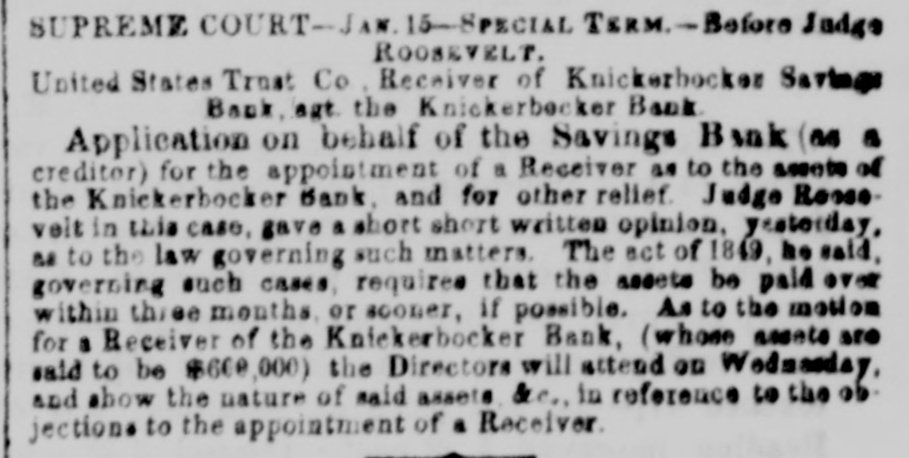
Supreme Court-Special Term. Before Hon. Judge Roosevelt. IN THE MATTER OF THE KNICKERBOCKER BANK-INJUNCTION AND RECEIVER-IMPORTANT DECISION ON BANKING AND FINANCIAL AFFAIRS. ROOSEVELT, J.-It is now about three months, accord. ing to one of the petitions presented, since this institution stopped payment. Its creditors aver-and a large body of its stockholders join in the averment-that it is insolvent; and the directors-those who now manage its affairs-admit that "if the assets pass into the hands of a receiver, and are disposed of according to the sta. tute, there will be a deficiency, and the creditors will not receive all that is due them." True, the "nominal amount" of the assets is supposed to be about $600,000, while the indebtedness is but little over $200,000. But of what avail are such figurative statements in opposition to the substantial admission already referred to made in the same affidavit? How perfectly "nominal," too, must be a large portion of that $600,000, when we find it alleged in the leading petition of the stockholders themselves, and not denied by the officers, that "$250,000 and upwards" consists of indebtedness by the late Directors-and that, moreover, on a capital of only $400,000. Nor is this all-the present directors, anxious as they may be to retain the control of affairs, and able as they may be to manage them well, do not pretend that with all the nursing they propose to bestow"ressonable indulgence" to debtors is the expressionthey will be able to realize more than "some little surplus to the stockholders' The law provides (act of 5th April, 1849,) that upon a hearing of the parties, on such short notice as the Judge shall appoint, he shall determine whether such corporation or association be clearly solvent or otherwise; and that he may require the officers thereof to exhibit any and all of its books, papers, accounts, assets and effects, and to be examined on oath touching the same before him, or a reference to be appointed by him. And to obviate the nice and difficult distinctions sometimes raised as to what constitutes insolvency; whether it be absolute and permanent inability to pay, or only immediate and temporary inconvenience. The Legislature have further enacted that if the Judge determine that such corporation or as. sociation "is not clearly solvent, he shall make an order declaring the same insolvent, and shall immediately appoint a receiver." On the facts then presented in the papers as they stand, can there be any doubt that this institution, if not clearly insolvent, is not clearly solvent? Judged by ordinary rules, there would seem to be none. As the present directors, however, and some of the stockholders, apprehend serious injury from a sudden judicial declaration to that effect, and the consequent immediate appointment of a receiver, I have concluded to make an order, as the act provides, that a list of the assets and of the stockholders, with the respective values and amounts, be produced, and that the principal officers of the present and of the late board attend before me, on Wednesday next, at 10 o'clock, at the chambers of the court, to be examined on oath concerning the state of the bank, and that the appointment of a receiver be, in the meanwhile, suspended, and the injunction continued. It is proper I should add that the statute in these cases contemplates rapid and summary measures. Billholders, depositors, and other bank creditors, are to be promptly paid. And for that purpose the assets, if necessary. no matter what their character, if so ordered by the Judge, are to be sold at auction, a dividend, if possible, declared within ninety days, and the deficiency, if any, apportioned among, and levied on, the individual stockhoiders; and the entire winding up, it is further declared. shall, "in no case," be delayed beyond one year. All idea of increasing the assets for the benefit of the stockholders, to the injury --and delay is not unfrequently the most ruinous of all injuries-to the injury, I say, of the billholders and depositors, is repudiated by the whole policy of the act, and is at variance with the entire spirit of the judicial decisions of the highest court of the State in the analogous cases of assignment made by insolvent individuals.


Article from The New York Herald, January 17, 1855

Click image to open full size in new tab

Article Text

Supreme Court-Special Term. Before Hon. Judge Roosevelt. IN THE MATTER OF THE KNICKERBOCKER BANK-INJUNCTION AND RECEIVER-IMPORTANT DECISION ON BANKING AND FINANCIAL AFFAIRS. ROOSEVELT, J.-It is now about three months, according to one of the petitions presented, since this institution stopped payment. Its creditors aver-and a large body of its stockholders join in the averment-that it is insolvent; and the directorsβ€”those who now manage its affairs-admit that "if the assets pass into the hands of a receiver, and are disposed of according to the sta. tute, there will be a deficiency, and the creditors will not receive all that is due them." True, the "nominal amount" of the assets is supposed to be about $600,000, while the indebtedness is but little over $200,000. But of what avail are such figurative statements in opposition to the substantial admission already referred to made in the same affidevit? How perfectly "nominal," too, must be a large portion of that $600,000, when we find it alleged in the leading petition of the stockholders themselves, and not denied by the officers, that "$250,000 and upwards" consists of indebtedness by the late Directors-and that, moreover, on a capital of only $400,000. Nor is this all-the present directors, anxious as they may be to retain the control of affairs, and able as they may be to manage them well, do not pretend that with all the nursing they propose to bestow"ressonable indulgence" to debtors is the expressionthey will be able to realize more than "some little surplus to the stockholders The law provides (act of 5th April, 1849,) that upon a hearing of the parties, on such short notice as the Judge shall appoint, he shall determine whether such corporation or association be clearly solvent or otherwise; and that he may require the officers thereof to exhibit any and all of its books, papers, accounts, assets and effects, and to be examined on oath touching the same before him, or a reference to be appointed by him. And to obviate the nice and difficult distinctions sometimes raised as to what constitutes insolvency; whether it be absolute and permanent inability to pay, or only immediate and temporary inconvenience. The Legislature have further enacted that if the Judge determine that such cor poration or as. sociation "is not clearly solvent, he shall make an order declaring the same insolvent, and shall immediately appoint receiver." On the facts then presented in the papers as they stand, can there be any doubt that this institution, if not clearly insolvent, is not clearly solvent? Judged by ordinary rules, there would seem to be none. As the present directors, however, and some of the stockholders, apprehend serious injury from a sudden judicial declaration to that effect, and the consequent immediate appointment of a receiver, I have concluded to make an order, as the act provides, that a list of the assets and of the stockholders, with the respective values and amounts, be produced, and that the principal officers of the present and of the late board attend before me, on Wednesday next, at 10 o'clock, at the chambers of the court, to be examined on oath concerning the state of the bank, and that the appointment of a receiver be, in the meanwhile, suspended, and the injunction continued. It is proper I should add that the statute in these cases contemplates rapid and summary measures. Billholders, depositors, and other bank creditors, are to be promptly paid. And for that purpose the assets, if necessary, no matter what their character, if so ordered by the Judge, are to be sold at auction, a dividend, if possible, declared within ninety days, and the deficiency, if any, apportioned among. and levied on, the individual stockhoiders; and the entire winding up, it is further declared, shall, "in no case," be delayed beyond one year. All idea of increasing the assets for the benefit of the stockholders, to the injury -and delay is not unfrequently the most ruinous of all injuries-to the injury, I say, of the biliholders and depositors, is repudiated by the whole policy of the act, and is at variance with the entire spirit of the judicial decisions of the highest court of the State in the analogous cases of assignment made by insolvent individuals.


Article from The New York Herald, January 18, 1855

Click image to open full size in new tab

Article Text

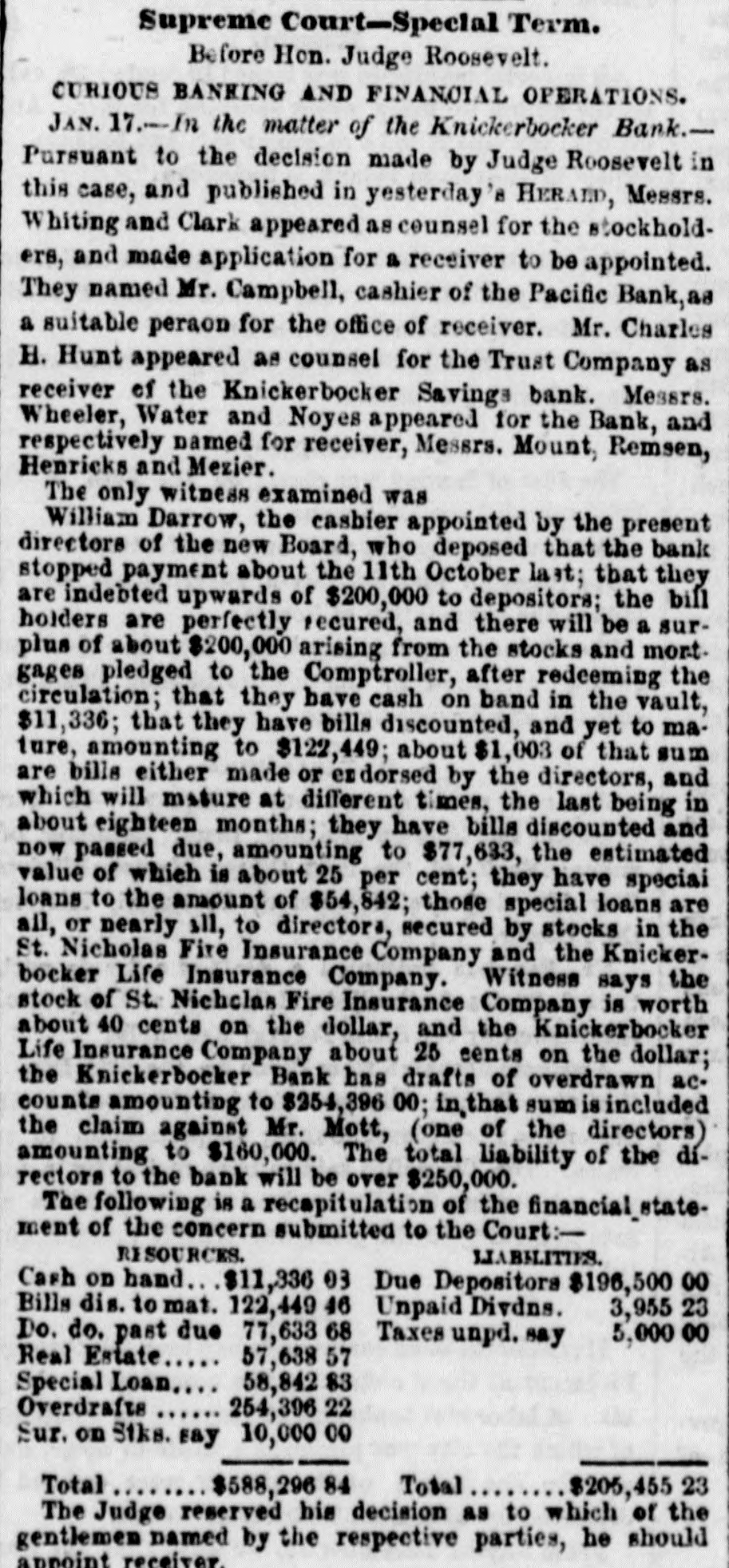
Supreme Court-Special Term. Before Hon. Judge Roosevelt. CURIOUS BANEING AND FINANCIAL OPERATIONS. JAN. 17.-In the matter of the Knickerbocker Bank.Pursuant to the decision made by Judge Roosevelt in this case, and published in yesterday's HERAED, Messrs. Whiting and Clark appeared as counsel for the stockholders, and made application for a receiver to be appointed. They named Mr. Campbell, cashier of the Pacific Bank, as a suitable peraon for the office of receiver. Mr. Charles H. Hunt appeared as counsel for the Trust Company as receiver of the Knickerbocker Savings bank. Messrs. Wheeler, Water and Noyes appeared for the Bank, and respectively named for receiver, Messrs. Mount, Remsen, Henricks and Mezier. The only witness examined was William Darrow, the cashier appointed by the present directors of the new Board, who deposed that the bank stopped payment about the 11th October last; that they are indebted upwards of $200,000 to depositors; the bill holders are perfectly secured, and there will be a surplus of about $200,000 arising from the stocks and mort. gages pledged to the Comptroller, after redeeming the circulation; that they have cash on band in the vault, $11,336; that they have bills discounted, and yet to mature, amounting to $122,449; about $1,003 of that sum are bills either made or erdorsed by the directors, and which will mature at different times, the last being in about eighteen months; they have bills discounted and now passed due, amounting to $77,633, the estimated value of which is about 25 per cent; they have special loans to the amount of $54,842; those special loans are all, or nearly 311, to directors, secured by stocks in the St. Nicholas Fire Insurance Company and the Knickerbocker Life Insurance Company. Witness says the stock of St. Nichclas Fire Insurance Company is worth about 40 cents on the dollar, and the Knickerbocker Life Insurance Company about 25 sents on the dollar; the Knickerbocker Bank has drafts of overdrawn accounts amounting to $254,396 00; inthat sum is included the claim against Mr. Mott, (one of the directors) amounting to $160,000. The total liability of the dΓ­rectors to the bank will be over $250,000. The following is a recapitulation of the financial statement of the concern submitted to the Court:RISOURCES. LIABILITIES. Cash on hand $11,336 03 Due Depositors $196,500 Bills dis. to mat. 122,449 Unpaid Divdns. 3,955 Do. do. past due 77,633 6 5,000 00 Taxes unpd. say Real Estate 57,638 57 Special Loan 58,842 $3 Overdrafts 254,396 2 Sur. on Stks. say 10,000 00 Total Total $588,296.84 $205,455 The Judge reserved his decision as to which of the gentlemen named by the respective parties, he should appoint receiver.


Article from The New York Herald, January 18, 1855

Click image to open full size in new tab

Article Text

Railroad, 1; Hudson River Railroad, 1; Michigan Central Railroad, 1. The transactions at the Assistant Treasuier's office to-day were as follow Received $221,032 59 Payments 86,720 57 1,708 02 Paid for Assay Office Balance 2,591,299 61 There will be a meeting of the Chamber of Com. merce to-morrow, (Thursday), at 1 o'clock, to prepare a memorial to the Legislature for a repeal of the usury laws of this State. It is time somestrong, decided movement was made in this matter, and we hope that time has come. The Nicaragua Transit Company have incurred no responsibility in delivering to Mr. Bacon the let. ters from his house in San Francisco, addressed to Duncan, Sherman & Co. The Transit Company carry in their steamers a private letter bag, over which the government has no control, and its contents are delivered to parties to whom they are addressed, unless a better claim is presented. Mr. Bason had a perfect right to intercept the correspondence between his house in San Francisco and his agents here. Duncan, Sherman & Co., were the hired ser van's of Page, Bacon & Co. They received payment for the performance of certain services, and Mr. Baeon, under the advice of counsel, took the responsibility of seizing all letters and bi Is of lading as bis own property. It would have been very comfortable for Duncan, Sherman & Co. to have got possession of the remittance of gold by the Northern Light, and then to have had an attachment put upon it. By so doing, and by giving tk necessary security, they would have retained possession and used it in their financial operations. In these tight times it would have been of great service to them. Before the news of the suspension of Page & Bacon, of St. Louis, reaches San Francisco, full five million of dollars in gold will have been shipped by Page, Bacon & Co., of San Francisco, to their agents here, Duncan, Sherman & Co. In the event of that enormous sum going into the hands of Duncan, Sherman & Co., it could be retained then by attachment, upon giving the necessary security, and the parties to whom it really belonged would be compelled to go without it for a time. Such an accession of capital at the present time to the only "American banking house" in the country, would be particularly comfortable, and be much more available than Providence Plantations or cotton manufa turing stocks. The probability is, that Duncan, Sherman & Co. will not get possession of much of the gold now on the way from California, belonging to Page, Bacon & Co., and it will go into the hands of Daniel Hoadley, Esq for the liquidation of all drafts drawn against it. The business of Page, Bacon & Co. will not be interrupted in the least. That of Page & Bacon will be closed up as soon as possible, and there is no doubt but that they will show a surpluslarge enough to bu up all the American banking houses" in this city. Henry D. Bacon and Wm. H. Aspinwal! are a match for provincial financiers, beyond a doubt, and we have only referred to the correspondence which bas already passed on this subject, to show the mental calibre of the parties engaged. In the Supreme Court to day an application was made by the stockholders of the Knickerbocker Bank, for the appointment of a receiver. The bank appearsto be in a very bad condition, and If something is not done at once the remaining good an sets will disappear. The directors fairly gutted the concern. It will have to be wound up and wiped out. If placed in the hands of a careful receiver, the depositors may get a good part of their claims. A statement of the assets and liabilities is given in the report of the proceedings in the Supreme Court. The number of banks established and doing business under the general banking law of Wisconsin is twenty-four, with an aggregate capital of $1,450,000. The amount of securities, consisting entirely of State stocks, deposited with the Comptroller, is $1,033,000; upon which the issue of circulating notes amounted on the first day of the present year to $937,592-yielding a revenue to the State, by tax, for the year 1854, of $18,165 63. One hundred shares of the Tradesmen's Bank were sold at auction to-day at 105 per cent. The warrants entered at the Treasury Department, Washington, on the 15th inst., were: $1,100 32 For paying Treasury debts 13,004


Article from New-York Daily Tribune, February 17, 1855

Click image to open full size in new tab

Article Text

E. C. HALLIDAY, Auctioneer. UNITED STATES TRUST COMPOSITIVE SALE POSITIVE SALE of VALUABLE REAL ESPANY of NEW-YORK, RECEIVER, &c.-E. C. HALLIDAY will sell at Auction. on MONDAY. Feb. 26, 165, at 12 o'clock, at the Merchants' Exchange, the valuable property on the north-west corner of 14th-st. and the 8th-av., lately known as the Knickerbocker Bank. The lot is 25 feet 91 inches wide, front and rear, and 75 feet deep. The building covers the entire lot, with front of brown stone on the avenue and street; is four stories in hight, with an elevated basement; is built of the best materials in the most substantial manner, and conveniently divided into suites of rooms, well suited for Insurance and other Offices. The main floor is well adapted for a Banking House, for which it has been hitherto occupied. Also, fall that certain Block of Ground in the Twelfth Ward of the City of New-York, bounded and containing as follows, viz: northerly by the southerly line of 106th-st., 619 feet 7 inches; easterly by the westerly line of the 10th-av, 201 feet 10 inches; southerly by the northerly line of 105th-st., 518 feet 11 inches and westerly by the easterly line of Bloomingdaleroad. 225 feet 6 inches This property will be sold in separate lots with privilege. Maps will be ready on the 20th inst, and can be had on application to the Auctioneer. Terms at sale. JOSEPH LAWRENCE. Pres't. [Signed] JOHN A. STEWART, Sec'y. (205)


Article from The New York Herald, May 9, 1855

Click image to open full size in new tab

Article Text

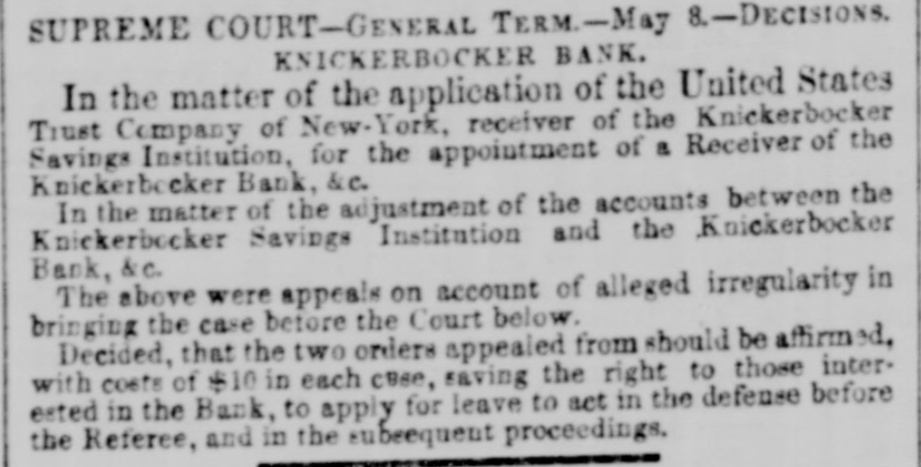
Supreme Court. SPECIAL TERM. By Hon. Judge Roosevelt. MAY 8.-John Warnick vs. Miner C. Storey, the Mayor, Aldermen, dc., of New York, the Commissiouers of the Sinking Fund.-This suit is another of the numerous litigations which have originated with the alleged irregular action of different branches of the late city government of 1852. The complaint charges the other commissioners of the sinking fund and other officers and members of the corporation with fraud, corruption and illegality in the matter of a certain water grant in which the plaintiff says he was interested both individually and as a taxpayer, and which he prays therefore may be cancelled. After going over the particulars of the case, the Judge concluded by saying-It follows that the proper judgment to be entered on the demurrer is, that the complaint be dismissed with costs, unless the plaintiff within ten days after notice shall strike out his iudividual demand (confining himself to the one single cause of action as a taxpayer) and pay the costs occasioned by the misjoinder. GENERAL TERM. Before Hon. Judges Mitchell, Clerke and Cowies. In the Matter of the Knickerbocker Savings Institution and the Knickerbocker Bank-This wasan application of the United States Trust Company of New York, receiver of the Knickerbocker Savings Institution, for the appointment of a receiver of the Knickerbocker Bank, and for the adjustment of the accounts between the Knickerbocker Savings Institution and the Knickerbocker Bank. The Court ordered that the two orders appealed from should be affirmed with costs of $10 in each, sav. ing the right to those interested in the bank to apply for leave to aid in the defence before the referee and in the subsequent proceedings.


Article from New-York Daily Tribune, June 28, 1855

Click image to open full size in new tab

Article Text

LA W INTELLIGENCE. SUPREME COURT-SPECIAL TERM-June 27-Before Judge ROOSEVELT. LARGE CLAIM. United States Trust Company, Receiver of the Knickerbocker Bank agt. Winifred Mott, Hopper Mott and others. The Bank claims that defendants (mostly, we believe, by or on account of Mr. Hopper Mott) are indebted to the Bank $142,000, and in security for which they gave to the Bank & bond and mortgage on & block in the neighborhood of Fiftysecond-st. and Eighth-av. for nearly $143,000. Mr. Mott alleges that he is indebted to the Bank but $119,000, and that Mr. Row. land owes the balance. The mortgage, which is for three years, and entered into by the mother and others of the family of Mr. M., was given, we believe, subject to adjustment in this respect. An arrangement was made by which the question in relation to said difference should be submitted to two referees, and in the event of their disagreeing they were to call in an umpire. Mr. Thomas Brown, of the firm of Averill & Brown, brokers, Wall-st., was appointed referee on the part of the Bank, and Mr. A. W. Metcalf was chosen by Mr. Mott. The referees were unable to agree, and the referee for Mr. M. declined to call in an umpire. Matters were in this situation when the Bank passed into the hands of the Receiver. Application was then made by latter, on a bill filed, that the Court should appoint a referee to take testimony and report as to the amount actually due upon the bond and mortgage. The application was opposed. Judge Roosevelt this forenoon rendered & decision granting the motion, and Mr. Joshua Coit was appointed Ref. eree. For plaintiff, Measrs. Charles H. Hunt and Jona. Nathan; for defendants, Measrs. Sandford, Porter & Stryker, and Charles O'Conor.


Article from New-York Daily Tribune, July 17, 1855

Click image to open full size in new tab

Article Text

MONDAY, July 16-P. M. The amount of business transacted to-day was unusually small. The general tone was downward, but in most instances the fluctuations are trifling. After large sales were made in State Stocks by a leading operator, among which $50,000 Virginias at 97 deliverable, seller's option, in 90 days. Illinois Internal Improvement of 1847 remained in demand at 103, $4,000 being sold at that. For the Interest Stock 71 was bid; Tennessee 6s sold at 97% cash, and at 97 seller 60 days; Virginias sold at 98 to 97%; Georgias were in demand at 98; Missouris opened at 95, and closed with sales at 951 firm; North Carolina sold at Second Board at 971; New-York State 58, due 1858, sold in a small lot at 1041; California 78 steady at 86. The amount of sales of State Stocks was about $130,000. Illinois Central Bonds sold to the extent of $44,000 at 861 cash, but at the Second Board they were rather heavy without sales. A small lot of Pennsylvania Coal Company was sold at 1101; Erie remains steady, opening at 52, advancing 1, and closing dull at the morning price; Central rather firmer, with sales at 1011; Harlem advanced about 1 P cent, selling at 29; Reading sold to the extent of 1,650 shares, at 94% in the morning, and 95 in the afternoon. Nothing further had transpired about the dividend at the adjournment of the Board. Western Railroads were again dull with a downward tendency; Chicago and Rock Island down to 95, with small sales; and Cleveland and Toledo opening at 901, and closing at 891, the number of shares sold exceeding 900-a large amount for SO dull a day; Michigan Southern opened at 1041, and advanced to 105; Canton was steady at 27, with more activity than for some days past; Nicaragua inactive at 17%; Cumberland quiet, opening at 292, seller 30 days, and closing weak at 297. The Second Board was net affected by the favorable Bank return, as the account at the ClearingHouse was not made known until after the members of the Stock Exchangehad adjourned. In Freights the engagements include to Liverpool 22,000 bushels Corn at 31d. in ship's bags; 700 bales Cotton, 3-16d. 7-32d. A ship was chartered from St. Stephen to Liverpool. Deals at Β£3 10/. A bark from Richibucto to Hull, Β£4 5/; one from St. Stephen to Liverpool on privateterms. A brig, 200 tuns, from Wilmington to Honduras, Lumber, $10, and back to New-York, Mabogany. The Foreign Exchange market is without much activity. Sterling is held at 1091 1101, and francs 2.15 @5.124. After the adjournment of the Board the follwing sales of Stocks and Bonds were made at auction by Albert H. Nicolay: 70 $3,060 Flushing Railroad 1st mortgage 7s and Int $6,000 Virginia 6a and Int 967 $75,000 Louisiana 6s and Int. 96 @ 95 854 $2,000 Chicago and Missssippi 10 per cent Inc. bonds 100 shares Little Miami Railroad 95 20 shares Commonwealth Insurance Co. 921 5 shares Park Insurance Co. 89 100 shares Hampshire Coal and Iron Co $10 140 shares Hampshire Coal and Iron Co. $9 shares Union India Rubber Co. 974 .6c. 2,000 shares Fair Grove Copper and Gold Mining Co 25 shares Francis' Metalic Life Boat Corporation hypothe. cated 49 The New-York State Bank has declared & semi-annual dividend at the rate of 8 P cent P annum on the full and part paid stock of this Bank, payable on the 21st inst. The Sixth-av. Railroad Company have declared a dividend of 31 P cent for the past six months, payable on the 1st August. The Brooklyn and Jamaica Railroad Company 41 $ cent payable on the 15th of August. The New-Jersey Railroad Transportation Company, a semi-annual dividend of 5 P cent payable on the 1st of August. The Pennsylvania Railroad Company 8 semi-annual dividend of 41 P cent on the 24th of July. The President of the United States Trust Company, as receiver, has declared a first dividend of 37 P cent, payable to the creditors of the Knickerbocker Bank, payable on the 17th inst. The Pepperell Manufacturing Company have declared a dividend of $16 P share, payable Aug. 1. The Republic Fire Insurance Company semi-annual dividend of 31 P cent, payable on demand. The sale of $239,000 of State Bonds, running ten years, are advertised by the Treasurer of North Carolina, viz: $90,000 dated Jan. 1, 1855, running thirty years; $15,000 dated July 1, 1855, running thirty years; $5,000 dated July 1, 1855, running twenty years; and $129,000 dated July 1, 1855, The Boston steamer to sail for Liverpool on Wednesday, will take about $600,000 or $700,000 in specie. By the arrival of the steamship Arage we have advices from London to July 4, Another advance in


Article from The New York Herald, January 22, 1856

Click image to open full size in new tab

Article Text

interest the principal sum seould, at plaintiff, become immediately due. He-therefore prays that the defendants be restrained from mortgaging or the until the balance of his claim The answer of Mr. Rintoal is transferring satisfied. property The that other he par- declassed part of be property in good faith. lendants also deay fraud. Argument was heard. IN THE MATTER OF THE KNICKERBOCKER BANK-CASTA Pending the above cause, the report of the referee is the Knickerbucker Bank case was brought before the court:To THE JUSTICES OF THE SUPREME Country The supplemental report of the referee in this sase respectfully shows:-That in apportioning the debts of the said bank among the stock Froiders, the referee found that several of the stockhold upon whom he had apportioned some of the it Faid debts had valid cigims against the bank, which seemed to him ought in- Justice to be against the amounts the apportioned to them, but which it was not competent for him to setoff. He has, theretore, prepared two schedules which be annexes hereunto, and which show the amount of such set off or counter claim. Schedule A shows the several amounts of unpaid dividends, duly declared by the bank at different times, but which have not been drawn by the several stockholders therein named, but which are stlil owing to them. The bank declared five dividends-three of four per cent each in July, 1852, and in January and July, 1853; and two of three and a half per cent each in January and July, 1854. Echedule B shows the amount of debts proved before the receiver, and which aro wwing to stock holders upon whom the debtsare apportioned. In both chedules are shown the amounts apportioned to each, and the sums respectively due to each from the bank. All of whichis respectfully submitted. J. W. EDMONDS. Referee. After some conversation the Court entered an order that the objectors file their exceptions within two days. THE CASE OF THE CENTRAL PARK. Mr. Dillon, late Corporation Counsel, said that the motion for the confirmation of the report in the matrer of the Central Park was to have been heard before Judge Cowles this morning. but he supposed that in consequence of the decision of the Court of Appeals Juige Cowles would not hear the case until his disputed claim WEB finally settled. Judge Roosevelt said: By the Revised Statutes it is provided that no Judge cau sit, as such, in any cause in which he would be excluded from-being a juror by reason of consauguinity or aflinity to either of the parties. On further inquiry in respect of the relationships of the numerous persons named in the Commissioners' reportdocument consisting of some thousand pages-it appears that OBB of the parties was the step-daughter of a lady now deceased, who in her life time was the daughter of an aunt of the presiding Judge's mother. Whether this within the ninth degree-the limit of perhaps, in the minds some, of some doubt. If jurons-may question be a relationship well of founded, supposed, be the to a same or a similar difficulty applied, it was other Judges in the district, except it might be Cowles. Taking these and also the importance of all account, Mr. the Justise finishing, consi before ierations him, if practi- Judge into ble, the regular calendar now pending R. had prepared a communication requesting Mr. Justise Cowies to bit for him, as he had been requested to sit for Mr. Justice ditchell in this ease. On Saturday evening, however, intelligence was received that the Court of Ap made Fome decision in regard to Mr. Justice in of whish be Cowles, peals had consequence would decline these circum- acting in the matter until further advised. Under cumstances the question is: What action should now be taken in the premises? By the Code, the Governor is authorized whenever there is an undue pressure of business upon the Judges of any particular district. or whenever in his judgment the public good requires it. to ap. point extraordinary terms, and to assign other Judges, whose duty in such cases it is declared to be to "hold the court accordingly." It any person, therefore, deems this one in which the public good requires the inthe Executive, it is competent ion to that effect. and make tervention case to a be epresenta of to law request to has him given the to Governor to exercise the power which the him. Mr. Dilion moved a postponexent of the case until Monday next. Mr. Mott objecte to this court making any order in the matter at all. Mr Tillon said it was competent for the Judge to do 80. The words of the statute were that is Judge interested by COD auguinity, &c. cannot sit to "bear and determine. The Court then adjourned the case to Monday next.