Article Text
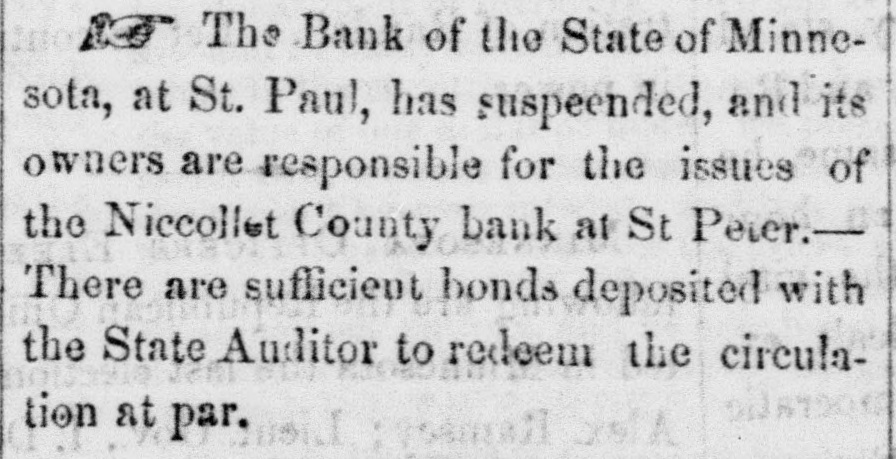
# The Controversy Between the Banks. [The following article was called forth by an editorial item in the Times of Wednesday stating that bills of the Bank of the State of Minnesota, presented by Messrs. BORUP & OAKES for redemption, had been redeemed in small coin, terming it a "trick" &c. Wegive the reply of the President of the Bank and also appended a statement from Messrs. BORUP & OAKES.-Ed.] ST. PAUL, March 16, 1859. To the Editors of the Times. SIB: Judging by the article in your paper of this morning, headed "Something of a Run," you have been misinformed in relation to the matter of redemptions by the Bank of Messrs. Borup & Oakes. The following is a true history of the matter which I think you should give to the public in your columns, in answer to the article above alluded to. This Bank has been subject to a run from Messrs. Borup & Oakes, which commenced on the first day it opened its doors for business. Mr. Oakes presented for redemption on the second day after opening $100 dollars of the notes of this Bank, demanding gold for them, which he was paid. They continued to present and demand gold from time to time, until they had received some $2,500 gold for the said notes. This Bank has always been ready to draw on New York at a quarter less than current rates for its notes, thus making them worth to the holder per cent. more than Illinois and Wisconsin currency, and always convertible. Messrs. B. & O., agreed with the officers of this Bank to become the footmen and Runners of Messrs. B. & O., in a matter relating to endorsed currency, the said B. & O., forgot the agreement they had previousiy made. Messrs. B. &.O., by means of such representations as they made to a respectable notary, persuaded him to present for them, notes of this Bank for redemption. Said notary on presenting said notes, and learning the truth of the matter, refused to have anything further to do with the business. Messrs. B. & O., then procured the services of one S. S. Eaton, a notary who presented notes for redemption, on the 12th inst., and was paid legal coin of the United States, which he left on the counter. He soon returned, and pocketing his previous payment, presented more notes, for which he was tendered legal coin. The fourth time he called, he presented eight dollars and demanded gold for them. The cashier made him a legal tender for them, which he refused, and asked the cashier if he refused to pay gold. The cashier replied he did not. Said notary left, and on Monday evening this Bank received notice from the Auditor of the State, that he had received a formal notice of protest of the notes of this Bank, to the amount of eight dollars. The said notary certified in his protest of said notes, that he demanded lawful money of the United States, which was refused. The Bank of the State of Minnesota is ready, at all times, to redeem its issues in specie, and will do so, in gold, to the entire satisfaction of the public, when bills are presented in the usual course of business; but when extraordinary means to withdraw our bills from the channels of business, for the purpose of wantonly annoying and injuring us, we feel justified in paying such coin as the laws clearly uphold us in paying, without consulting the convenience of the harpies who seek not alone to injure us, but who, by discouraging Banks of issue, prevent the increase of many facilities, and strike a blow at the commercial interest of the community. Not a dollar would be invested in banks anywhere, if their issues were to be systematically run home for gold; more especially would this be true in this State, where the circulating medium is currency, at not less than one per cent. discount for gold. A moment's regard to the operations of business will render this obvious: A bank loans its bills at a moderate discount to business men, and is repaid in the ordinary mixed currency, worth one per cent. less than gold; if the bills so loaned out, are immediately gathered up, and returned to the bank for gold, the bank sustains a loss that would compel it to retire its notes, and close business; and to the extent of its capital, the business community would lose many facilities. We apprehend the public will not be slow in appreciating its interests in this question. P. WHITNEY, President, # TO THE PUBLIC. The issue between the Bank of the State of Minnesota and ourselves, is simply this: 1. We claim the privilege to demand the redemption of their own bills at their own counter, in regular business hours, just as it suits us, without giving any reason to the bank for so doing, and without paying any premium for such redemption. At the same time, we disclaim all intention of "running" this or any other bank, but we have daily to make remittances to New York and elsewhere, and can only do it by converting currency into something available for that purpose. The bank has always offered to give us exchange at 1¼, but for reasons of our own we have preferred to take no risks, and paying in addition for doing so, 2. The Bank has repeatedly insisted upon its right to redeem one bill at the time. 3. The Cashier has taken upon himself to take the bills away from our messenger, offer such redemption as he saw fit, and when this was declined, he refused even to return the bills. 4. The Bank claims the privilege of redeeming a certain amount in one cent pieces. To all of this we object. In our opinion there