8708. Bank of Minnesota (St Paul, MN)

Bank Information

Episode Type
Suspension โ†’ Reopening
Bank Type
state
Start Date
December 22, 1896
Location
St Paul, Minnesota (44.944, -93.093)

Metadata

Model
gpt-5-mini
Short Digest
be9a03465e751846

Response Measures

None

Description

The Bank of Minnesota was taken into possession by the State Bank Examiner and formally suspended on Dec. 22, 1896. Contemporary reports describe a planned reorganization and expectation that receivers would be discharged and the bank returned to its officers by mid-January 1897. The coverage does not clearly describe a discrete depositor 'run' triggered by misinformation; instead the bank was closed by official action and then reorganized and reopened, so classify as a suspension with reopening. Receiver activity and later litigation are documented in subsequent years.

Events (4)

1. December 22, 1896 Receivership
Newspaper Excerpt
State Bank-Examiner Kenyon this morning took official possession of the books and assets of the Bank of Minnesota, closing its doors pending a thorough investigation of its affairs.
Source
newspapers
2. December 22, 1896 Suspension
Cause
Government Action
Cause Details
State Bank Examiner took official possession and Clearing-House formally suspended the bank; closure was by official action due to inability to meet cash demands.
Newspaper Excerpt
At a meeting of the Clearing-House at noon the bank was formally suspended, upon the report of the Banking Committee.
Source
newspapers
3. December 28, 1896 Other
Newspaper Excerpt
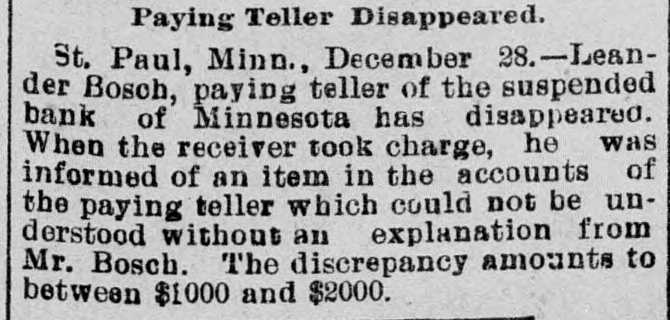
Leander Bosch, paying teller of the suspended bank of Minnesota has disappeared. When the receiver took charge, he was informed of an item in the accounts of the paying teller which could not be understood... discrepancy amounts to between $1000 and $2000.
Source
newspapers
4. January 15, 1897 Reopening
Newspaper Excerpt
It is now expected that the receivers can be discharged and the bank be put in the hands of its officers again by the middle of January.
Source
newspapers

Newspaper Articles (24)

Article from Richmond Dispatch, December 23, 1896

Click image to open full size in new tab

Article Text

ST.PAUL BANK CRAS A LEADING STATE INSTITUTION CLOSES ITS DOORS. NEED OF READY CASH THE TROUBLE. As Soon as Securities Can Be Realixed On. the Bank Will Be All Right Again-A Small Allied Bank Also Closes. ST. PAUL, MINN., December 22.-StateBank-Examiner Kenyon this morning took official possession of the books and assets of the Bank of Minnesota, closing its doors pending a thorough investigation of its affairs. The bank has been in need of ready cash for some time. At a meeting of the Clearing-House at noon. the bank was formally suspended, upon the report of the Banking Committee. A special committee has. also been appointed by the Clearing-House Committee to prepare a statement for the public. This committee, in advance of its statement. informed a representative of the Southern Associated Press that the bank would undoubtedly resume business in a short time, and protect all of its creditors in full. The directors are all men of wealth and property interests, and they have already signified a willingness to meet the requirements of the occasion. The Bank of Minnesota was established in 1852, and was capitalized at $600,000. Its stated surplus was $300,000. and it is the general belief that as soon as cash can be realized upon its many securities the institution will be all right. The officers of the bank are: William Dawson, president; Robert A. Smith, viceand William The directorate men of the city. cashier. president, The comprises Dawson, bank has Jr., the of the St. and at leading surer been the of depository Paul, present City carries Treaof the city's is also a large the State $25,000 public depositor funds. and in The is bank, covered by heavy bonds, fully protected. The City Treasurer drew out a large sum on last Monday, and about $15,000 would have been required shortly after January 1st. A constant stream of curious people has been to the scene of the trouble all the morning, and the subject is the talk of the commercial centres of St. Paul. The bank was not a national one, but was organized under the State-banking of act. It 'has always been rated as one the strongest financial institutions in the Northwest, with many country correspondents. and a direct line of exbanks in the leading States. Its deposits run change United cities into of the the millions yearly. Dawson, Jr., cashier of the "The cause of our suspenbank, William said: situsion was inability to meet a severe ation. on account of the depressed times for the past year, especially of the past months. We applied to the BankExaminer few to close, and he is now in The State of Minnesota was the charge. heaviest depositor, and intended to make draft on us for $25,000 next Monday. a The State has $104,000 in the bank." SMALLER BANK CLOSES. result of the failure of the Bank As Minnesota, a the Stock-Yards Union its of at South St. Paul, also closed bank Bank, The average deposits of this the doors. $95,000. the capital $25,000. and The are loans and discounts $90,000. presiaverage senior and junior, are StockDawsons, dent and vice-president of the Union Bank also. Yards Bank of Minnesota was the deposiThe for the county, and until recently city tory the main bank through which Smith, was was transacted. R. A. spring business postmaster, and until last viceMayor present of St. Paul, was for The years Dawsons president of the bank. ranked high Jr., among was one financiers. of the owners William became of Dawson, Paul Globe, in which he The the St. months ago. the bank was as a interested of eighteen great the gene- surprise closing to the officers as it was to ral public. ank-Examiner Kenyon was early bank's on and took charge of the any the would not scene, He give in out position affairs. in fact. was not a comstatement; do so. inasmuch as he He had did not state to his examination pleted would go into court made to-mor- for that the when case application would be row. appointment of a receiver. the to the last report of the deAccording Minnesota, the deposits to on $855.Bank of certificates amounted banks the mand for was due to other due 000. There $235,000. but there was also corresum of banks $319,400. The from other banks in the country, shown and in sponding the last report. are number small forty-five, banks in the many of towns. these whose fate may Bank depend e upon country the final resumption of the Minnesota. Seymour, cashier of this the evening MerFrank National Bank, was of Minnesota. chants' named as receiver of the Bank
Article from The Salt Lake Herald, December 26, 1896

Click image to open full size in new tab

Article Text

BANK OF MINNESOTA. Work Will Commence Today Looking to Its Reorganization. St. Paul, Minn., Dec. 25.-John D. O'Brien, attorney for the Bank of Minnesota, announces that action will commence tomorrow looking to the reorganization of the bank. Both the stockholders and the depositors are in favor of putting the institution on its feet again, and the depositors are especially lenient in their demands. They are willing that their money shall be paid to them in four payments, in six, twelve, eighteen and twenty-four months. The stockholders will be asked to advance $600,000. This, with the good loans, will considerably more than pay every depositor dollar for dollar. It is now expected that the receivers can be discharged and the bank be put in the hands of its officers again by the middle of January. As the stockholders' bank has been a feeder of the older institution is will be reorganized on the same basis.


Article from The San Francisco Call, December 26, 1896

Click image to open full size in new tab

Article Text

TO BE REORGANIZED. Stockholders and Depositors Desire the Bank of Minnesota to Resume. ST. PAUL, MINN., Dec. 25.-John D. O'Brien, attorney for the Bank of Minnesota, announces that action will commence to-morrow looking to the reorganization of the bank. Both the stockholders and the depositors are enthusiastically in favor of putting the institution on its feet again, and the depositors are especially lenient in their demands. They are willing that their money shall be paid to them in four payments in six, twelve, eighteen and twenty-fo r months. The stockholders will be asked to advance $600,000. This, with the good loans, will considerably more than pay every depositor dollar for dollar. It is now expected that the receivers can be discharged and the bank put in the hands of its officers again by the middle of January. As the Stock Yards bank is a feeder of the older institution, it will be reorganized on the same basis.


Article from The Indianapolis Journal, December 28, 1896

Click image to open full size in new tab

Article Text

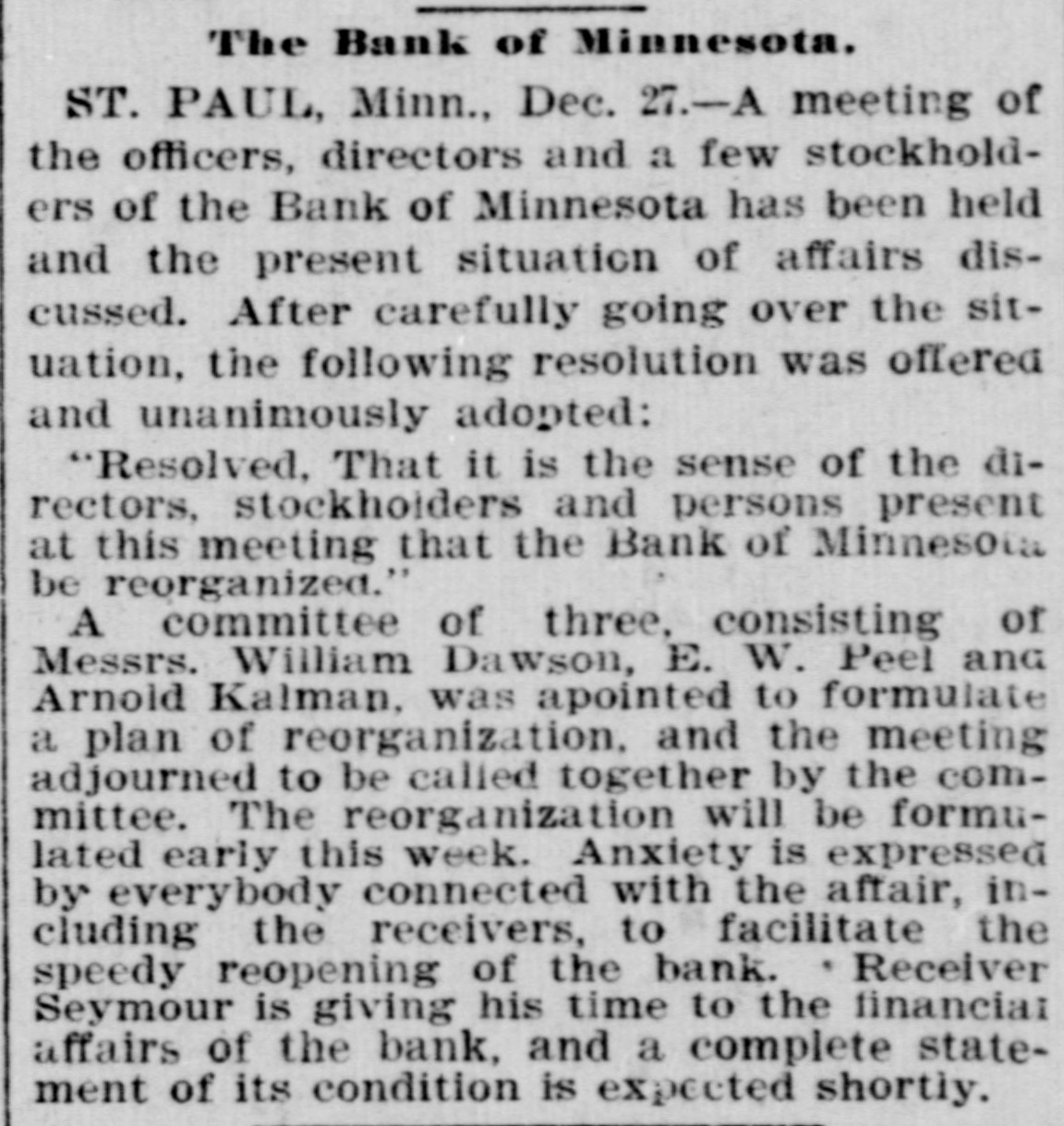
The Bank of Minnesota. ST. PAUL, Minn., Dec. 27.-A meeting of the officers, directors and a few stockholders of the Bank of Minnesota has been held and the present situation of affairs discussed. After carefully going over the situation, the following resolution was offered and unanimously adopted: "Resolved, That it is the sense of the directors, stockholders and persons present at this meeting that the Bank of Minnesota be reorganized." A committee of three. consisting of Messrs. William Dawson, E. W. Peel and Arnold Kalman, was apointed to formulate a plan of reorganization, and the meeting adjourned to be called together by the committee. The reorganization will be formulated early this week. Anxiety is expressed by everybody connected with the affair, including the receivers, to facilitate the speedy reopening of the bank. Receiver Seymour is giving his time to the financial affairs of the bank, and a complete statement of its condition is expected shortly.


Article from The Wheeling Daily Intelligencer, December 28, 1896

Click image to open full size in new tab

Article Text

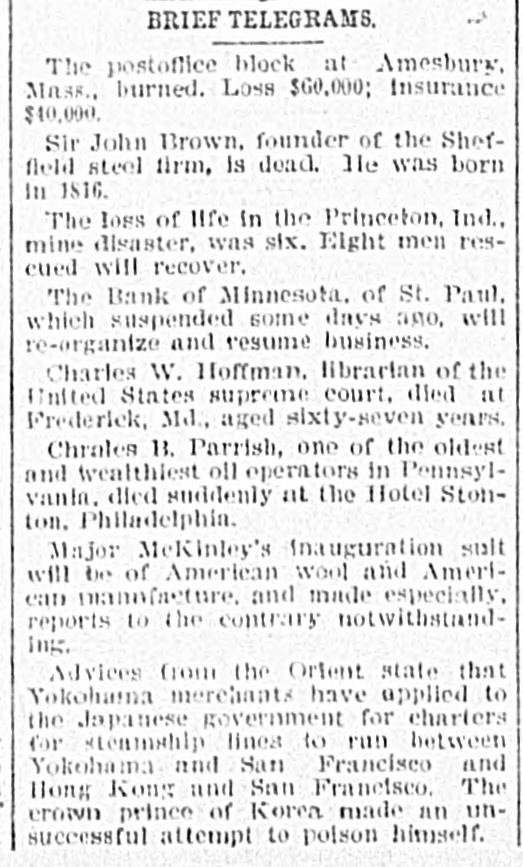
BRIEF TELEGRAMS The postoffice block at Amesbury, Mass. burned. Loss $60,000; Insurance $40,000. Sir John Brown. founder of the Sheffield steel firm, Is dead. He was born in 1816. The loss of life in the Princeton, Ind., mine disaster, was six. Eight men rescued will recover. The Bank of Minnesota. of St. Paul. which suspended some days ago, will re-organtze and resume business. Charles W. Hoffman. librarian of the United States supreme court. died at Frederick, Md. aged sixty-seven years. Chrates B. Parrish, one of the oldest and wealthiest oll operators in Pennsylvania. died suddenly at the Hotel Stonton. Philadelphia. Major McKinley's inauguration sult will be of American wool and American mannfacture. and made especially, reports to the contrary notwithstanding. Advices from the Orient state that Yokohama merchants have applied to the Japanese government for charters for steamship lines to run between Yokohama and San Francisco and Hong Kong and San Francisco. The crown prince of Korea made an unsuccessful attempt to polson himself.


Article from The Portland Daily Press, December 29, 1896

Click image to open full size in new tab

Article Text

Paying Teller Disappeared. St. Paul, Minn., December 28.-Leander Bosch, paying teller of the suspended bank of Minnesota has disappeared. When the receiver took charge, he was informed of an item in the accounts of the paying teller which could not be understood without an explanation from Mr. Bosch. The discrepancy amounts to between $1000 and $2000.


Article from The Topeka State Journal, January 5, 1897

Click image to open full size in new tab

Article Text

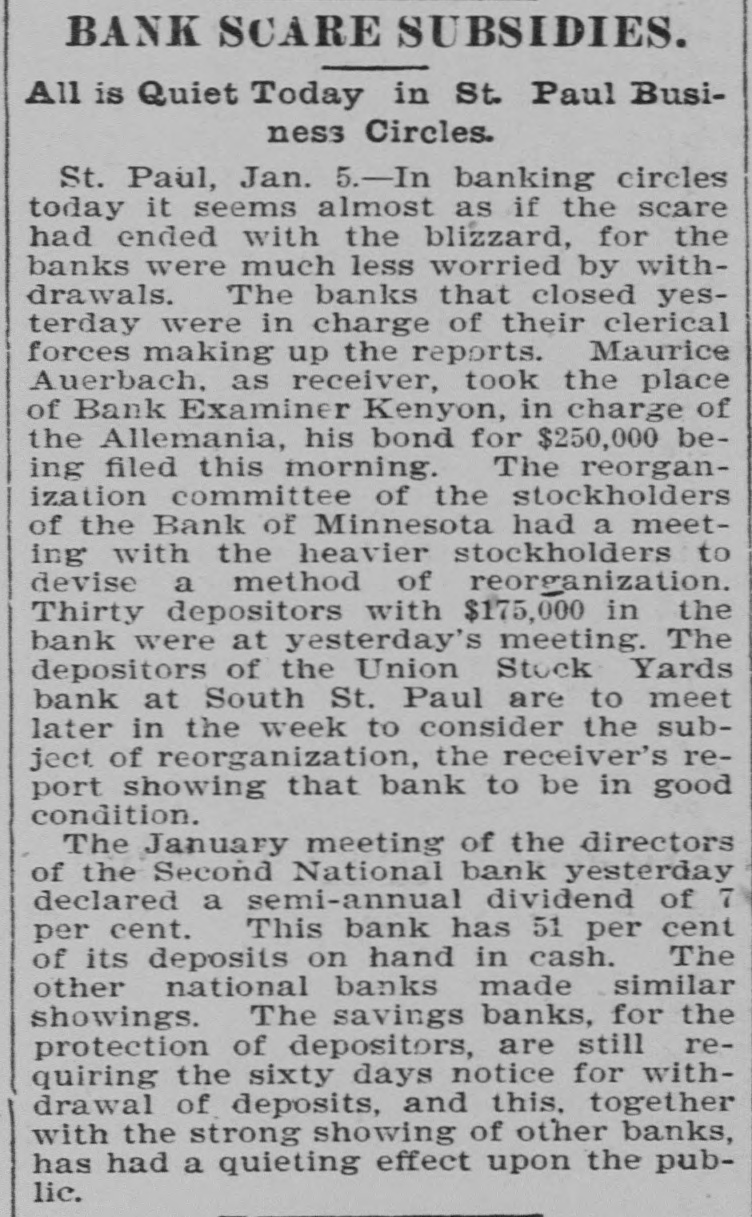
BANK SCARE SUBSIDIES. All is Quiet Today in St. Paul Business Circles. St. Paul, Jan. 5.-In banking circles today it seems almost as if the scare had ended with the blizzard, for the banks were much less worried by withdrawals. The banks that closed yesterday were in charge of their clerical forces making up the reports. Maurice Auerbach, as receiver, took the place of Bank Examiner Kenyon, in charge of the Allemania, his bond for $250,000 being filed this morning. The reorganization committee of the stockholders of the Bank of Minnesota had a meeting with the heavier stockholders to devise a method of reorganization. Thirty depositors with $175,000 in the bank were at yesterday's meeting. The depositors of the Union Stock Yards bank at South St. Paul are to meet later in the week to consider the subject of reorganization, the receiver's report showing that bank to be in good condition. The January meeting of the directors of the Second National bank yesterday declared a semi-annual dividend of 7 per cent. This bank has 51 per cent of its deposits on hand in cash. The other national banks made similar showings. The savings banks, for the protection of depositors, are still requiring the sixty days notice for withdrawal of deposits, and this, together with the strong showing of other banks, has had a quieting effect upon the public.


Article from Wheeling Register, January 6, 1897

Click image to open full size in new tab

Article Text

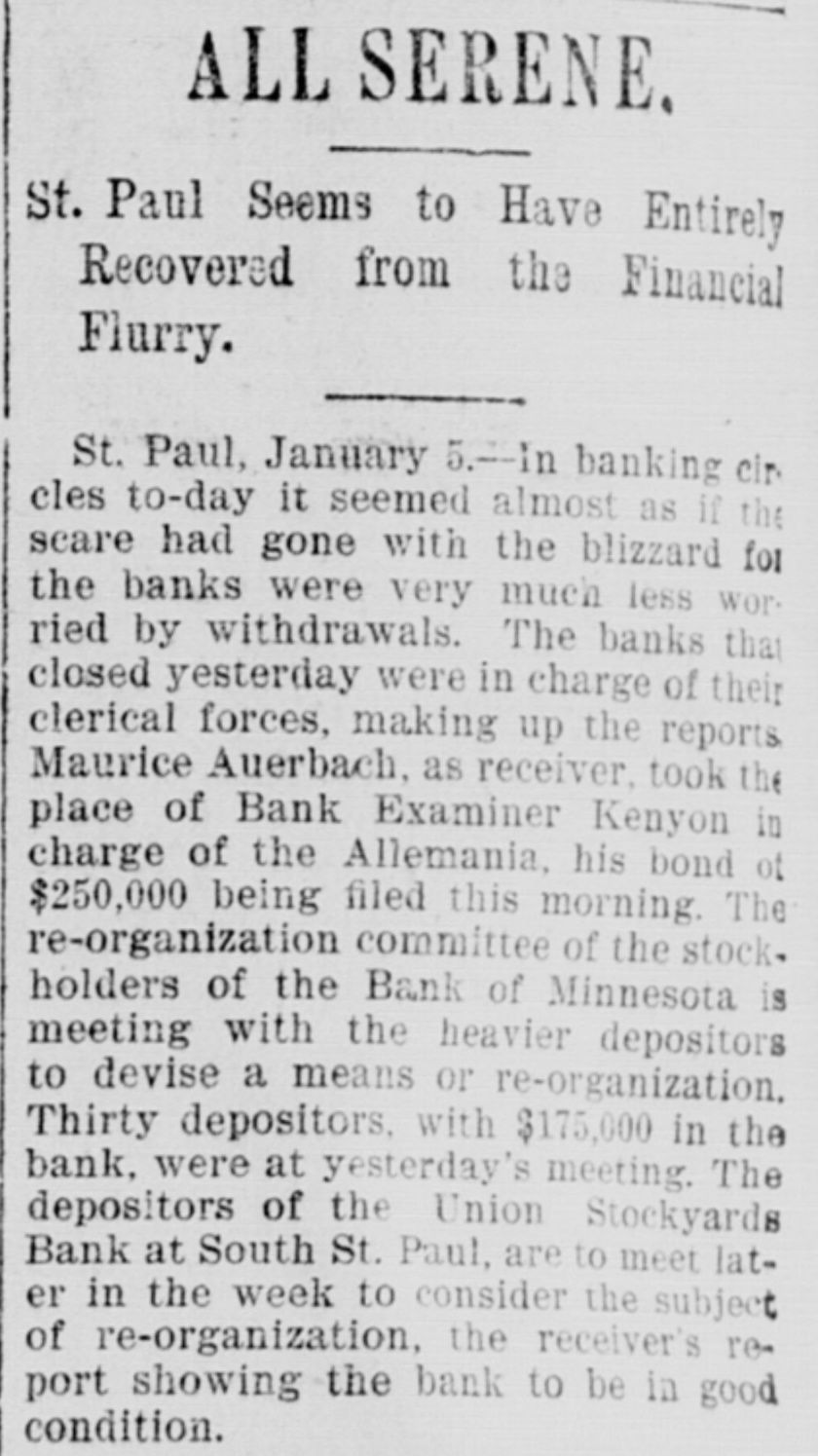
ALL SERENE. St. Paul Seems to Have Entirely Recovered from the Financial Flurry. St. Paul, January 5.-In banking cir. cles to-day it seemed almost as if the scare had gone with the blizzard for the banks were very much less wor. ried by withdrawals. The banks that closed yesterday were in charge of their clerical forces, making up the reports Maurice Auerbach, as receiver, took the place of Bank Examiner Kenyon in charge of the Allemania, his bond of $250,000 being filed this morning. The re-organization committee of the stock. holders of the Bank of Minnesota is meeting with the heavier depositors to devise a means or re-organization. Thirty depositors, with $175,000 in the bank, were at yesterday's meeting. The depositors of the Union Stockyards Bank at South St. Paul, are to meet later in the week to consider the subject of re-organization, the receiver's report showing the bank to be in good condition.


Article from Democratic Northwest and Henry County News, January 7, 1897

Click image to open full size in new tab

Article Text

PERSONS AND THINGS. Current Events of the Week Systematically Collected From Day to Day In the Briefest Form and Reserved Especially For This Column. Tuesday. ls Thirty-five stores and dwellings were W burned in East Radford, Va. Eight anarchist bombthrowers have been sentenced to death in Barcelona. h Twenty-seven people were killed by a firedamp explosion in a mine In Hungary. II The Masonic hall at Brunswick, N. J., was burned in some mysterious manner. In a railroad wreck near Sodus, Fla., three men were killed and seven injured. Governor Bradley says he will fix the S execution of Jackson and Walling for the same day. to The National Bank of Illinois closed its doors, causing two smaller Chicago banks ia to suspend. In his annual report Secretary Carlisle S strongly recommends the retirement of the treasury notes. 1 Spain has become very insolent since learning the attitude of President Cleveland on the Cuban situation. I Senator Sherman says a law passed over the president's veto must be respected and d obeyed even by the president. Mrs. Reinold Abraham Lewenhaupt, 11 daughter of Ambassador Bayard, is to marry Mauritz Hogren, an architect of Paris. Another reduction of 1/2 cent per pound has been made in coffee as the outcome of the war between the Arbuckles and the sugar trust. Wednesday. Many families in Union county, Ark., are destitute. Four men were killed by a boller explosion near Farmersville, Ia. Lum Bates suicided at Monticello, Ky., after shooting at his father. The Chickamanga park commission has purchased Lookout mountain. Railroad miners of the Pittsburg district have accepted the 60-cent rate. Professor Woolsey of Yale thinks the Cubans should be recognized as beiligerents first. A deluge of petitions pours in upon the ways and means committee with reference to the tariff. An attempt is being made to have beet sugar machinery admitted to the United States free. The United States court of appeals of New York is called upon to decide whether natural gas is a mineral. Attempts are being made to raise the steamer Ailsa, which was sunk by the La Bourgogne, near Fort Hamilton, nearly a year ago. Thursday. Fire in New York destroyed several large buildings. John Kinkennon shot his wife at Omaha and then killed himself. Joe Martin fell from a tree at Perkins, Ky., and broke his neck. Peter Maher knocked out Steve O'Donnell in New York in 27 seconds. A Cincinnati policeman was killed while trying to stop a runaway horse. Ira Marlett, the prison demon, attended the Christmas services Sunday. The Emperor of Japan in opening parliament said the relations with foreign states was cordial. The first naval battle of the Cuban war took place between a Spanish gunboat and the filibuster Three Friends, the latter winning. Friday. The printing plant of Francis Valentine & Company of San Francisco was burned. It is denied that the fillbuster Three Friends had a fight with a Spanish gunboat. Cecil Rhodes of Cape Colony says he will not voluntarily give up his seat in parliament. John Drake Townsend, lawyer, died at the Christmas dinner table at his home in New York. George E. Demark, 7, was killed by a motor car in Chicago, and the motorman had to be locked up to prevent lynching. An engine on the Wheeling and Lake Erie jumped the track at Martin's Ferry, O., and the engineer and fireman were killed. Chester Faulkner, private secretary of Senator Voorhees of Indiana is dead in Washington as the result of a street car accident. Saturday . Abe Henson, a colored outlaw, was killed at Lancaster, Pa. Alfred Le Ghait, the Bulgarian minister, 1 has been recalled. The European powers will not aid the Spaniards in Cuba. The schooner Robert Carter went ashore on the Pacific coast. Alderman Thomas J. O'Malley has been indicted for murder. Senator John P. Jones of Nevada has opposition for re-election. The London Chronicle had an article criticising Minister Bayard. Alfred Hall, colored, was lynched at Owensboro, Ky., for killing a patrolman. The Venezuelan minister who has charge of the arbitration has arrived at Washington. The remains of Pasteur, the bacteriologist of Paris, have been placed in the Pasteur institute. Monday. A gang of counterfeiters were arrested in Canton, China. Charles B. Parrish, wealthy coal operator, died in Philadelphia. Final obsequies over the remains of Kate Field were held in San Francisco. The Pennsylvania Railroad company's t ferryboat was burned'at New York. Mrs. Henry Ward Beecher, 84, fell at Stamford, Conn., and broke her hip. Seven miners were killed In the Princeton (Ind.) shaft by a gas explosion. E The Bank of Minnesota at St. Paul is to be reorganized and business resumed. C The sultan remains deflant and sneers at the advice given him by the Russian ambassador. Razal, the agitator in the Philippine islands, has been condemned to death by the F Spaniards.


Article from The Times, January 9, 1897

Click image to open full size in new tab

Article Text

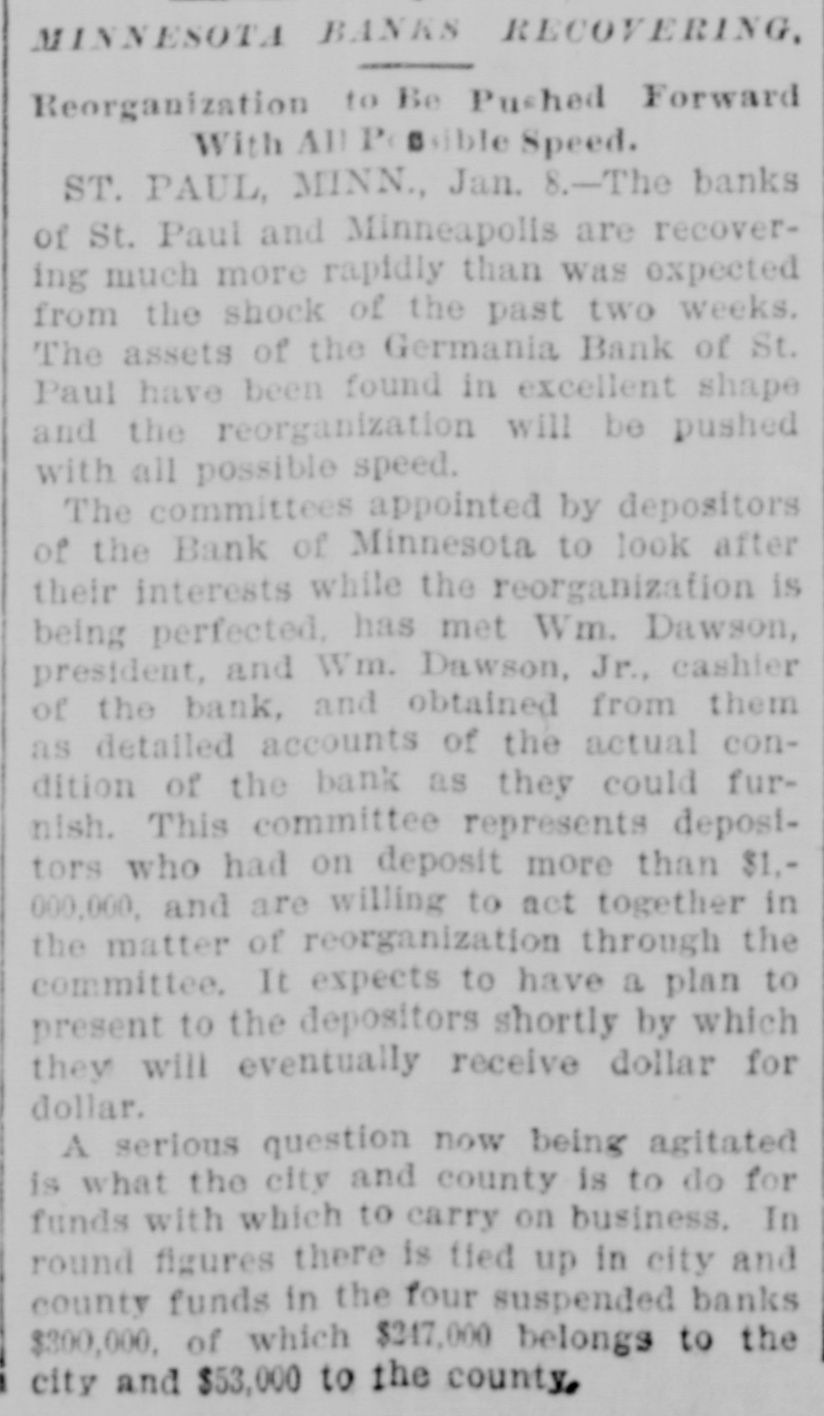
MINNESOTA BANKS RECOVERING, Reorganization to Be Pushed Forward Speed. ST. PAUL, MINN., Jan. 8.-The banks of St. Paul and Minneapolis are recovering much more rapidly than was expected from the shock of the past two weeks. The assets of the Germania Bank of St. Paul have been found in excellent shape and the reorganization will be pushed with all possible speed. The committees appointed by depositors of the Bank of Minnesota to look after their interests while the reorganization is being perfected, has met Wm. Dawson, president, and Wm. Dawson, Jr., cashier of the bank, and obtained from them as detailed accounts of the actual condition of the bank as they could furnish. This committee represents depositors who had on deposit more than $1.000,000, and are willing to act together in the matter of reorganization through the committee. It expects to have a plan to present to the depositors shortly by which they will eventually receive dollar for dollar. A serious question now being agitated is what the city and county is to do for funds with which to carry on business. In round figures there is fied up in city and county funds in the four suspended banks $300,000. of which $247,000 belongs to the city and $53,000 to the county


Article from Richmond Dispatch, January 9, 1897

Click image to open full size in new tab

Article Text

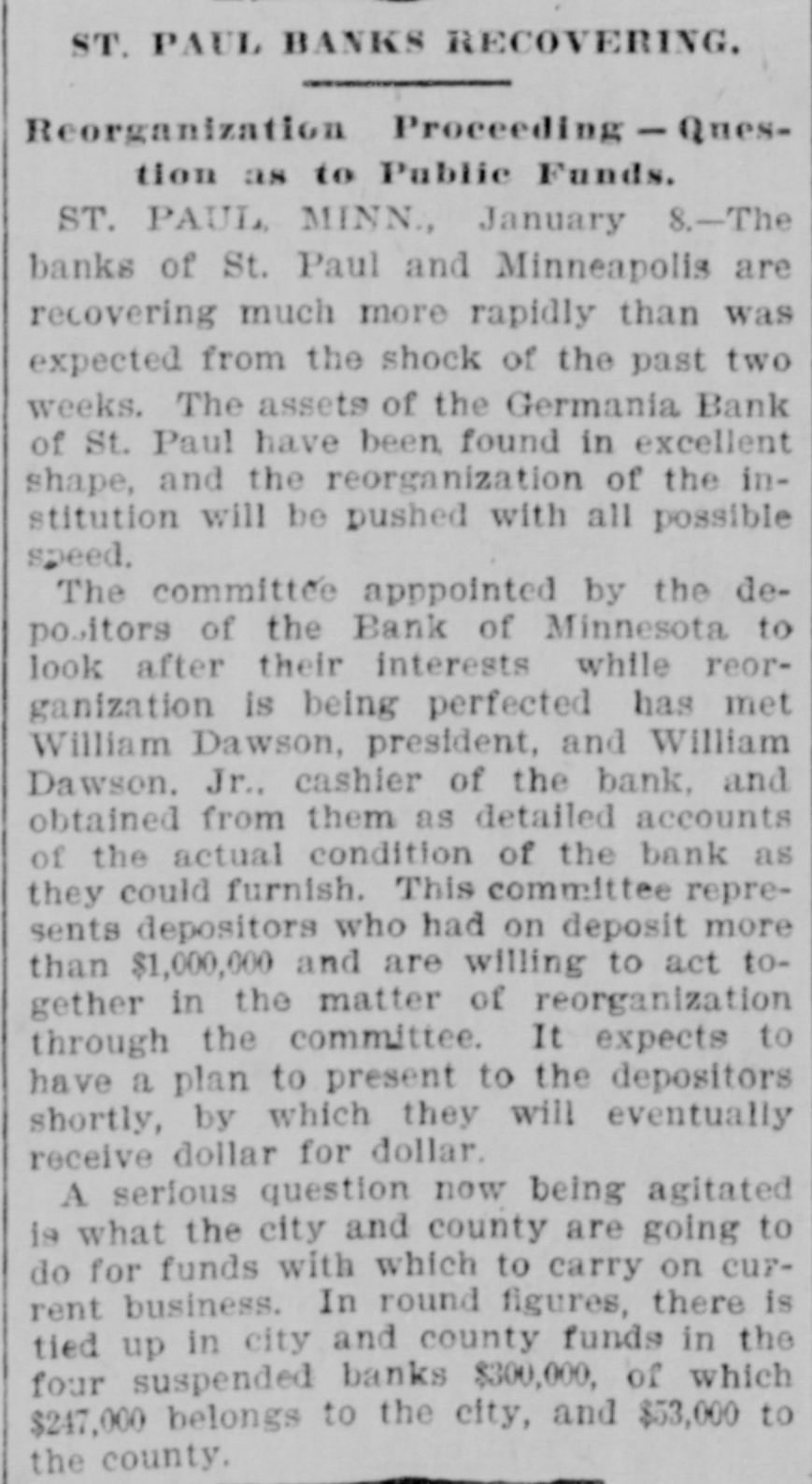
ST. PAUL BANKS RECOVERING. Reorganization Proceeding - Question as to Public Funds. ST. PAUL, MINN., January 8.-The banks of St. Paul and Minneapolis are recovering much more rapidly than was expected from the shock of the past two weeks. The assets of the Germania Bank of St. Paul have been found in excellent shape, and the reorganization of the institution will be pushed with all possible speed. The committee apppointed by the depositors of the Bank of Minnesota to look after their interests while reorganization is being perfected has met William Dawson, president, and William Dawson. Jr., cashier of the bank, and obtained from them as detailed accounts of the actual condition of the bank as they could furnish. This committee represents depositors who had on deposit more than $1,000,000 and are willing to act together in the matter of reorganization through the committee. It expects to have a plan to present to the depositors shortly, by which they will eventually receive dollar for dollar. A serious question now being agitated is what the city and county are going to do for funds with which to carry on current business. In round figures, there is tied up in city and county funds in the four suspended banks $300,000, of which $247,000 belongs to the city, and $53,000 to the county.


Article from Birmingham State Herald, January 9, 1897

Click image to open full size in new tab

Article Text

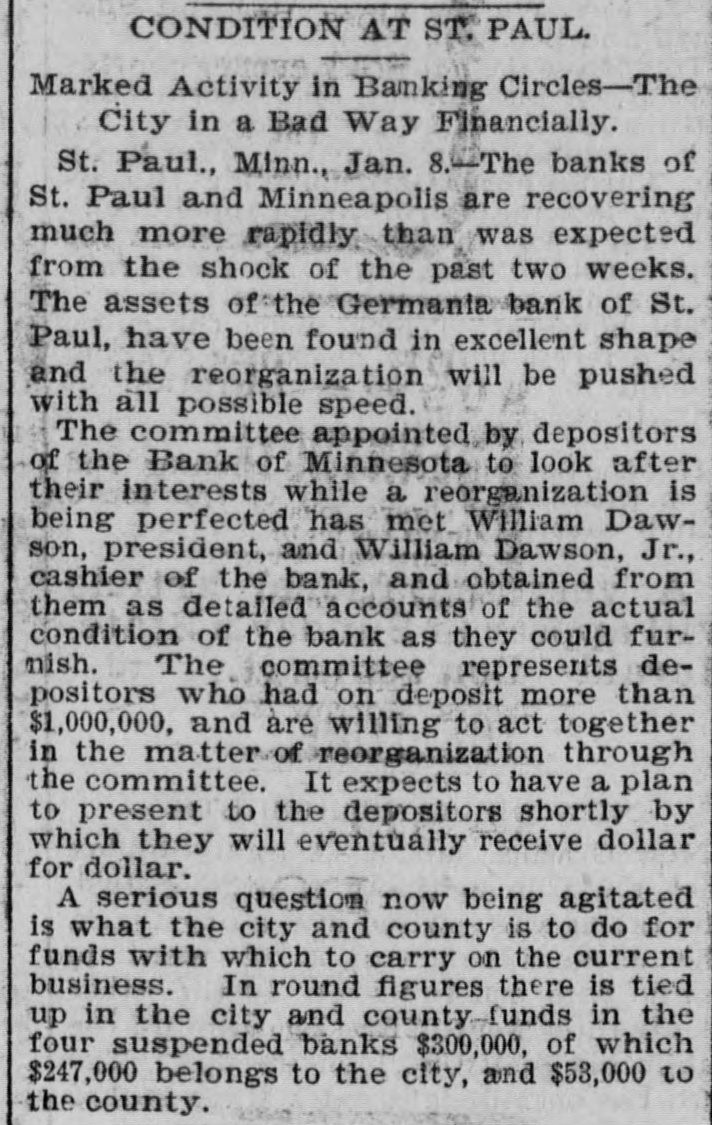
CONDITION AT ST. PAUL. Marked Activity in Banking Circles-The City in a Bad Way Financially. St. Paul., Minn., Jan. 8.-The banks of St. Paul and Minneapolis are recovering much more rapidly than was expected from the shock of the past two weeks. The assets of the Germania bank of St. Paul, have been found in excellent shape and the reorganization will be pushed with all possible speed. The committee appointed by depositors of the Bank of Minnesota to look after their interests while a reorganization is being perfected has met William Dawson, president, and William Dawson, Jr., cashier of the bank, and obtained from them as detailed accounts of the actual condition of the bank as they could furmish. The committee represents depositors who had on deposit more than $1,000,000, and are willing to act together in the matter of reorganization through the committee. It expects to have a plan to present to the depositors shortly by which they will eventually receive dollar for dollar. A serious question now being agitated is what the city and county is to do for funds with which to carry on the current business. In round figures there is tied up in the city and county-funds in the four suspended banks $300,000, of which $247,000 belongs to the city, and $53,000 to the county.


Article from The Saint Paul Globe, March 9, 1897

Click image to open full size in new tab

Article Text

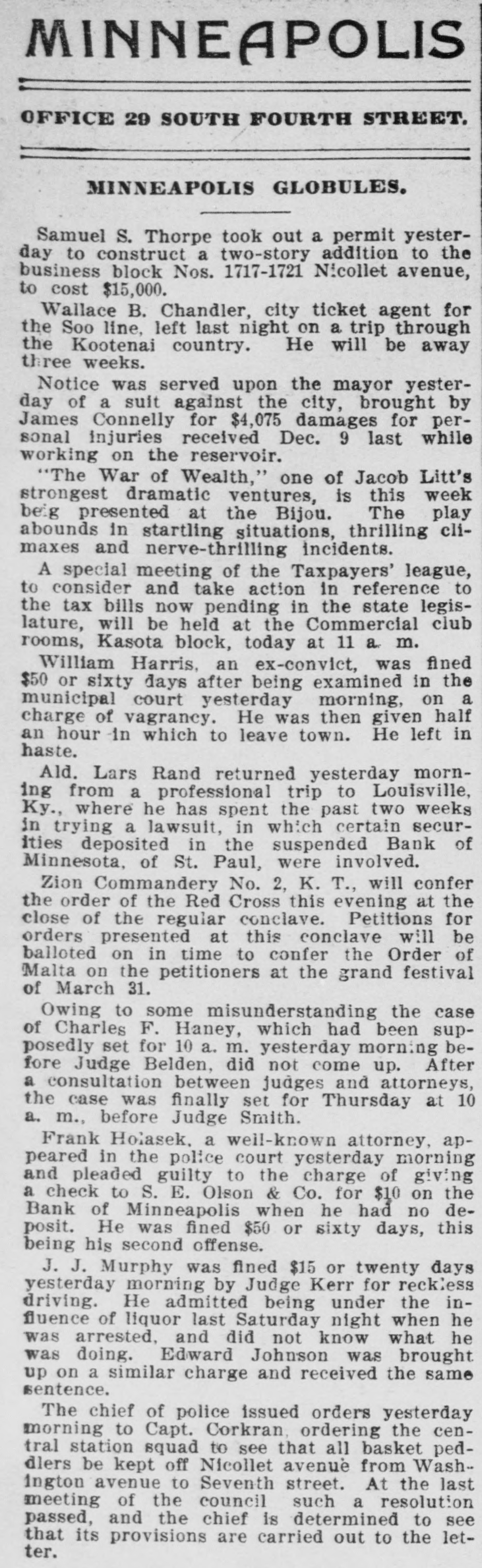
MINNEAPOLIS OFFICE 29 SOUTH FOURTH STREET. MINNEAPOLIS GLOBULES. Samuel S. Thorpe took out a permit yesterday to construct a two-story addition to the business block Nos. 1717-1721 Nicollet avenue, to cost $15,000. Wallace B. Chandler, city ticket agent for the Soo line, left last night on a trip through the Kootenai country. He will be away three weeks. Notice was served upon the mayor yesterday of a suit against the city, brought by James Connelly for $4,075 damages for personal injuries received Dec. 9 last while working on the reservoir. "The War of Wealth," one of Jacob Litt's strongest dramatic ventures, is this week beig presented at the Bijou. The play abounds in startling situations, thrilling climaxes and nerve-thrilling incidents. A special meeting of the Taxpayers' league, to consider and take action in reference to the tax bills now pending in the state legislature, will be held at the Commercial club rooms, Kasota block, today at 11 a. m. William Harris, an ex-convict, was fined $50 or sixty days after being examined in the municipal court yesterday morning, on a charge of vagrancy. He was then given half an hour in which to leave town. He left in haste. Ald. Lars Rand returned yesterday morning from a professional trip to Louisville, Ky., where he has spent the past two weeks in trying a lawsuit, in which certain securities deposited in the suspended Bank of Minnesota, of St. Paul, were involved. Zion Commandery No. 2, K. T., will confer the order of the Red Cross this evening at the close of the regular conclave. Petitions for orders presented at this conclave will be balloted on in time to confer the Order of Malta on the petitioners at the grand festival of March 31. Owing to some misunderstanding the case of Charles F. Haney, which had been supposedly set for 10 a. m. yesterday morning before Judge Belden, did not come up. After a consultation between judges and attorneys, the case was finally set for Thursday at 10 a. m., before Judge Smith. Frank Holasek, a well-known attorney, appeared in the police court yesterday morning and pleaded guilty to the charge of giving a check to S. E. Olson & Co. for $10 on the Bank of Minneapolis when he had no deposit. He was fined $50 or sixty days, this being his second offense. J. J. Murphy was fined $15 or twenty days yesterday morning by Judge Kerr for reckless driving. He admitted being under the influence of liquor last Saturday night when he was arrested, and did not know what he was doing. Edward Johnson was brought up on a similar charge and received the same sentence. The chief of police issued orders yesterday morning to Capt. Corkran, ordering the central station squad to see that all basket peddlers be kept off Nicollet avenue from Washington avenue to Seventh street. At the last meeting of the council such a resolution passed, and the chief is determined to see that its provisions are carried out to the letter.


Article from The Democratic Advocate, March 20, 1897

Click image to open full size in new tab

Article Text

The following are from the Baltimore American of Sunday : I he administration is only ten days old, but the improvement in business has been more than in ten months under the old regime. The Republican party is the business men's party, and it brings good times. This steady business growth is just what the country wants. It has had enough of booms. There may be a few clouds left in the sky, but the sun of prosperity will soon clear them all away. It is hard not to believe in the coming of prosperity when basking in the beauty of such days as yesterday. The Holston Building and Loan Association has gone into the hands of a receiver. SCRANTON, PA., March 14.-The South Mills of the Lackawanna Iron and Steel Company were closed down last night. General Manager Wehrum today stated that the stoppage was due to a lack of orders. He could not tell when work would be resumed. The company's north works, which have about 25 per cent. of the plant's capacity, are still running, but Mr. Wehrum will not say how long this will continue. The National Building and Loan Association of Milwaukee is in the hands of a receiver. The association was unable to make loans, and is "land poor," possessing realty that is unproductive, expensive to hold, and for which there is no market at the present time. The Association was incorporated in 1887, with a capital stock of $5,000,000. In St. Paul, William Dawson and Wm. Dawson, Jr., made personal assignments, resulting from the failure of the Bank of Minnesota, of which they were president and cashier respectively. A personal statement, made several weeks ago by the elder Dawson, gave his liabilities as $1,of which $765,992 was his personal indebtedness. The California Mortgage, Loan and Trust Company, of San Diego, has assigned; liabilities, $200,000, and assets, $280,000. Upon the petition of Frank Hume, one of the stockholders in the National Life Maturity Insurance Company, a West Virginia corporation, having its principal place of business in Washington, Judge Cox has placed the company in the hands of a receiver. The company's capital stock is $20,000. The St. Paul (Minnesota) Plow Company has made an assignment. The assets are estimated at $100,000. The liabilities, it is believed, will be large. The failure was caused by the assignment of William Dawson, the principal stock holder of the company. A receiver has been appointed for the Dallas (Texas) City Street Railway Company on the petition of the Mercantile Trust Company, of Baltimore, Md., who hold $250,000 worth of the company's bonds on which default of interest had been made. The road has 27 miles of electric tracks and equipment.


Article from The Saint Paul Globe, April 11, 1897

Click image to open full size in new tab

Article Text

PAY OF RECEIVERS OPPOSITION TO THE REQUEST OF FRANK SEYMOUR AND W. H. LIGHTNER. OTIS MAKES A STATEMENT. TELLS HOW HE HAPPENED TO MAKE THE SELECTIONS HE DID. CREDITORS WATCHING THE CASE. & Some of Them Think Mr. Seymour Should Work Without Drawing Any Compensation, When the receivers of an insolvent bank apply to the court for compensation for their services, the depositors of the bank keep close tab on the date of the hearing. At least Judge Otis was impressed to that effect at special term yesterday forenoon when the applications of Receivers Seymour and Lightner, of the Bank of Minnesota came on for a hearing. Thinking that the application was to be heard by Judge Kelly, the depositors at first swarmed in and about the little court room on the second floor of the court house, where Judge Kelly is trying court cases this term. Apprised that the hearing was to take place before Judge Otis in court room No. 4, the crowd rushed upstairs and quickly occupied every seat. The later arrivals stood up. During the proceedings one of the interested spectators, T.J. O' 'Brien, addressed the court and objected to the allowance of any compensation to Receiver Seymour, because of Mr. Seymour's indebtedness to the bank. Judge Otis admonished Mr. O'Brien and the other spectators, that the ordinary procedure of the court required that those interested should speak to the court through their attorneys. The applications of Receivers Seymour and Lightner, for a monthly compensation were heard. but the entire matter was continued until next Saturday. Mr. Lightner did not ask for any specific amount, but Mr. Seymour asked for a monthly allowance of $250. Strenuous objection to the allowance was manifested by the depositors present, inasmuch as Mr. Seymour admits that he is indebted to the Bank of Minnesota in the sum of $23,000. Counselor McDermott. representing certain depositors, suggested to the court that the matter be continued for one week. in order that the securities for Mr. Seymour's indebtedness might be looked into. Attorneys for other depositors favored a continuance of the matter. It was also objected that the amount of compensation which Mr. Seymour expected to receive was in definitely stated. He asked for a monthly allowance of $250. How much more did he expect? At this stage of the proceedings Judge Otis made the following statement: I am glad to see so many persons present here, those who I suppose are creditors of the bank and interested in these proceedings. Mr. Seymour was recommended by the attorney general of the state. by the president and cashier of the bank. and his appointment seemed satisfactory to all concerned. He was acknowledged to be a man thoroughly competent for the trust, and it was stated that his whole time should be given to the work of the receivership. The appointment of Mr. Seymour strongly commended itself to me as a proper one. I did not know at the time that Mr. Seymour was indebted to the bank: I did not see him until the appointment had been made. I believe that everyone would have said that his secured paper was as good as gold. Had I known that he was a debtor of the bank. some further examination might have becn made at the time. I have been advised that he has devoted his entire time to the work and that his services have been valuable and necessary. I understand that he has taken measures to make his debt good with security. He owes the bank $23,000. secured as well as he can secure it. His services are very valuable. and the creditor is yet to be found who desires his removal. He is entitled to compensation so that he may be enabled to live. If he is compelled to turn over all his earnings, he must retire from the receivership of the bank. As to Mr. Lightner, his appointment was asked for by no one. He was not aware that he was to be appointed and did not know of the appointment until after it


Article from The Saint Paul Globe, October 20, 1897

Click image to open full size in new tab

Article Text

MOVEMENT TO REORGANIZE THE BANK OF MINNESOTA PROGRESSES FAVORABLY. TO DELAY THE DIVIDEND. PROMOTERS WILL TODAY ASK THE COURT TO DEFER ITS ACTION. BELIEVED THAT ALL WILL SIGN As Soon as They Are Solicited by the Lenders in the New Movement. A petition will be presented to Judge Otis today, asking him to defer action in reference to declaring a 10 per cent dividend to the depositors in the Bank of Minnesota, for a period of thirty days. This will enable the movement now on foot to reorganize the bank to assume definite shape. This petition is signed by nearly 100 of the depositors, representing claims aggregating upwards of $325,000. At a meeting of a few of these creditors a committee was appointed to make a canvass with this petition, and the above figures show the result of the work for the past two days. The total indebtedness is about $1,700,000, which is held by 2,000 persons. Said a member of this committee: "In our canvass we met with uniform and gratifying success, and did not have a refusal. I think if we had a little more time we could get nearly all the depositors on the list, and time is what we are asking for. "I think by a reerganization all the depositors would receive. nearly, if not quite 100 cents on the dollar for their claims, and, aside from this, would be the equally important matter of showing to the world that the St. Paul banks which were forced to close during the panic are reopening. It would be a feather in our cap and a great thing for the credit of the city. "Several plans have been proposed for reorganization, among which are several which contemplate turning a small percentage of the claims into stock of the new bank. If the extension of time is granted, and I feel sure that it will be, a mass meeting of the creditors will be called to talk these matters over and adopt some plan. One thing is sure, though; if the bank is reopened, it will be under a new management."


Article from The Saint Paul Globe, January 7, 1898

Click image to open full size in new tab

Article Text

VICTORY FOR RECEIVERS. Bank of Minnesota Relieved of Liability on a Note. The receivers of the Bank of Minnesota won a marked victory in the supreme court yesterday when Justice Mitchell handed down a decision against the Fort Dearborn National Bank of Chicago, who sued on a cashier's note for $25,000. The syllabus of the decision recites the facts and findings in the case as follows: Fort Dearborn National Bank of Chicago, re- spondent, vs. Frank A. Seymour and Will- iam H. Lightner, as receivers of the Bank of Minnesota, appelants. A bank in Chicago was the correspondent of a bank in St. Paul in which the latter kept funds on deposit. The cashier of the St. Paul bank was secretary and a large stckholder in a land company. The president and two of the di- rectors of the St. Paul bank were also inter- ested in and stockholders of the land com- pany. The land company was indebted to certain parties in the sum of $25,000, which had to be met and paid. The cashier of the St. Paul bank, in his individual name, wrote to the cashier of the Chicago bank that he had been unexpectedly called on to take up $15,000 for a company in which he was interested and did not want to borrow the money from his own bank and asking if the Chicago bank would place an enclosed note of the land company for $25,- 000 to the account of the St. Paul bank, ad- ding that the latter bank would not draw against it. To this the cashier of the Chi- cago bank replied that he had placed the proceeds of the land company note to the credit of the St. Paul bank with the under- standing that none of it was to be paid out and that they reserved the privilege of charg- ing the land company note to the St. Paul bank at their option. The cashier of the St. Paul bank replied consenting to and ac- cepting these conditions. The Chicago bank then discounted the land company note and placed the proceeds to the credit of the St. Paul bank and the latter then paid the amount ($25,000) to the land company. The St. Paul bank was not a party to the note of the land company and had no interest in it. None of the officers of the St. Paul bank except those who were stockholders in the land company and interested in the transac- tion in their own behalf adversely to the interests of the bank, ever authorized, knew of or ratified the agreement between their cashier and the Chicago bank, and had no notice that the credit of $25,000 by that bank to the St. Paul bank was not an actual and unconditional credit for cash deposited. Held, that the agreement of the cashier of the St. Paul bank that the Chicago bank might charge up the note of the land com- pany to the St. Paul bank was wholly with- out the scope of his authority that it amount- ed to an attempt to pledge the responsibility of the St. Paul bank for the payment of the note of the land company in order to enable that company to raise money to pay its own debts; that this was in law and fact a fraud on the St. Paul bank of all which facts the Chicago bank was chargeable with notice. That the knowledge of the transaction by the cashier of the St., Paul bank or by those officers who were interested with him in the land company and were acting for them- selves and adversely to the interests of the bank, did not constitute notice to the bank. That after having thus credited the St. Paul bank with the proceeds of the land company note and after that bank had paid over the amount to the land company as it expected and knew would be done the Chi- cago bank had no right to charge up the land company note to the account of the St. Paul bank. The rule that a principal must either repudiate or ratify the unauthorized act of his agent as an entirety; that he cannot ac- cept the benefits and repudiate the conditions or liabilities attached has no application to the facis. Judgment reversed. Mitchell, J.


Article from The Saint Paul Globe, April 29, 1899

Click image to open full size in new tab

Article Text

TO ENFORCE LIABILITY. Receivers of the Bank of Minnesota Take Up the Case. Judge Otis listened to testimony yesterday in the action brought by F. A. Seymour and W. H. Lightner, as receivers of the Bank of Minnesota, against the Bank of Minnesota and the stockholders of that institution. The action is to enforce the liability law as to the one hundren and odd stockholders who owned stock valued at $600,000. The receivers state that although demand has been made on the stockholders, but thirty have paid since the last demand was made in December, 1897. Of the thirty stockholders fifteen paid dollar for dollar to the amount of $64.30 and the others surrendered dividends aggregating $14,128.76, which has been applied on the stock. The receivers were represented in court by Young & Leightner and the defendants by Kellogg & Severance, with a dozen or more of counsel. After hearing the testimony of William Dawson, F. A. Seymour, C. W. Copley, P. T. Streit, Adam Beyer, Lawrence Brennan, R. J. Wood, John G. Stine and W. H. Gardner, the case was continued to one week from today, when arrangements will be made and the case submitted. The question of the double liability of the stockholders will be considered by the court in the case.


Article from Wheeling Register, May 4, 1899

Click image to open full size in new tab

Article Text

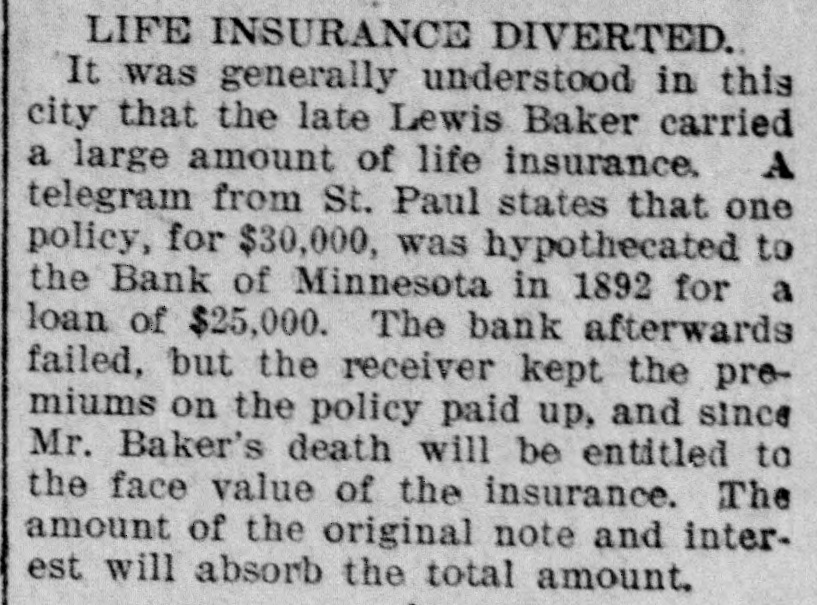
# LIFE INSURANCE DIVERTED. It was generally understood in this city that the late Lewis Baker carried a large amount of life insurance. A telegram from St. Paul states that one policy, for $30,000, was hypothecated to the Bank of Minnesota in 1892 for a loan of $25,000. The bank afterwards failed, but the receiver kept the premiums on the policy paid up, and since Mr. Baker's death will be entitled to the face value of the insurance. The amount of the original note and interest will absorb the total amount.


Article from The Saint Paul Globe, November 15, 1899

Click image to open full size in new tab

Article Text

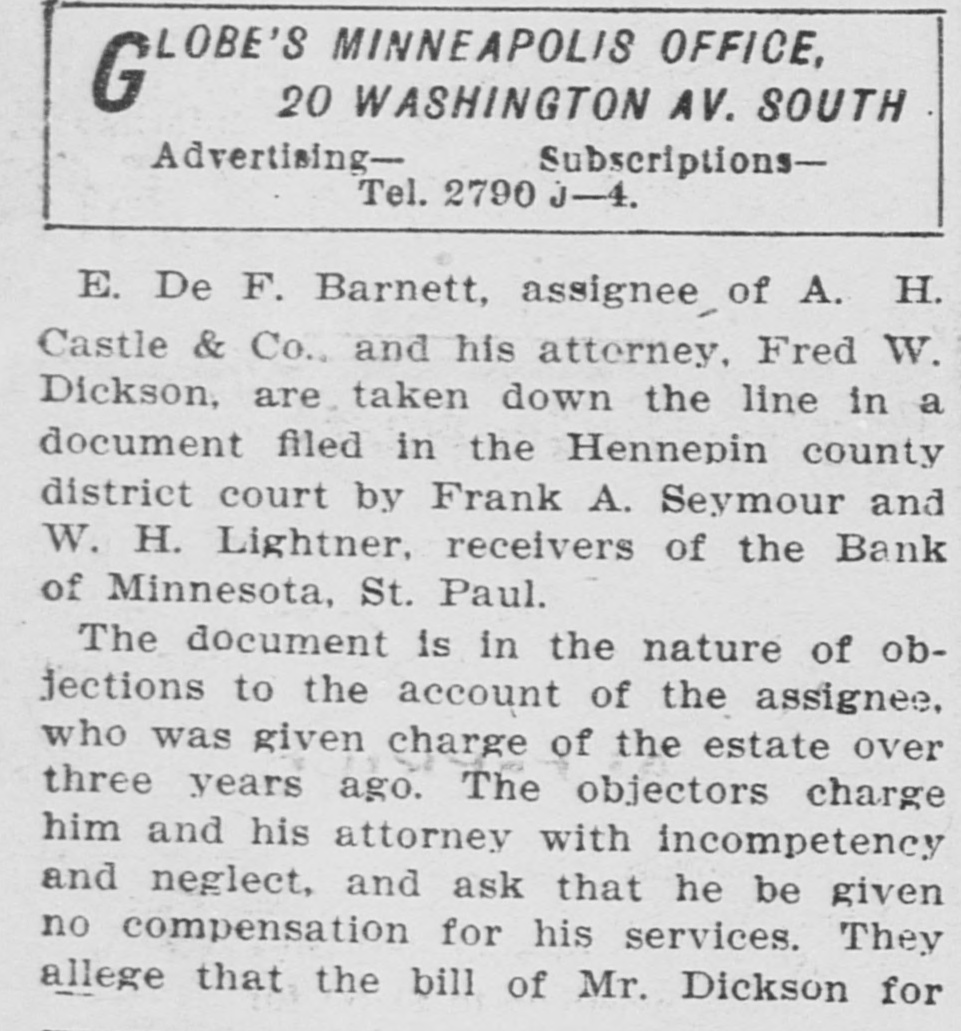
E. De F. Barnett, assignee of A. H. Castle & Co., and his attorney, Fred W. Dickson, are taken down the line in a document filed in the Hennepin county district court by Frank A. Seymour and W. H. Lightner, receivers of the Bank of Minnesota, St. Paul. The document is in the nature of objections to the account of the assignee, who was given charge of the estate over three years ago. The objectors charge him and his attorney with incompetency and neglect, and ask that he be given no compensation for his services. They allege that the bill of Mr. Dickson for


Article from The Princeton Union, February 21, 1901

Click image to open full size in new tab

Article Text

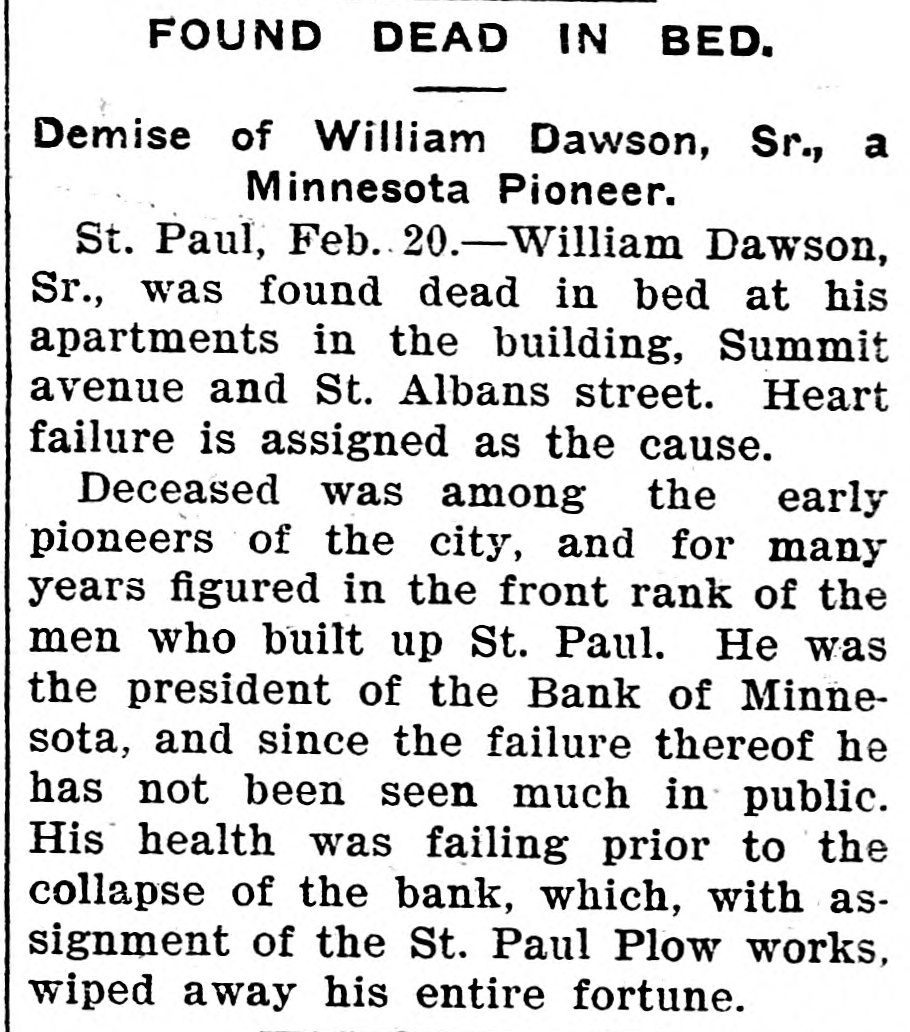
# FOUND DEAD IN BED. Demise of William Dawson, Sr., a Minnesota Pioneer. St. Paul, Feb. 20.-William Dawson, Sr., was found dead in bed at his apartments in the building, Summit avenue and St. Albans street. Heart failure is assigned as the cause. Deceased was among the early pioneers of the city, and for many years figured in the front rank of the men who built up St. Paul. He was the president of the Bank of Minnesota, and since the failure thereof he has not been seen much in public. His health was failing prior to the collapse of the bank, which, with assignment of the St. Paul Plow works, wiped away his entire fortune.


Article from Washington Standard, January 24, 1902

Click image to open full size in new tab

Article Text

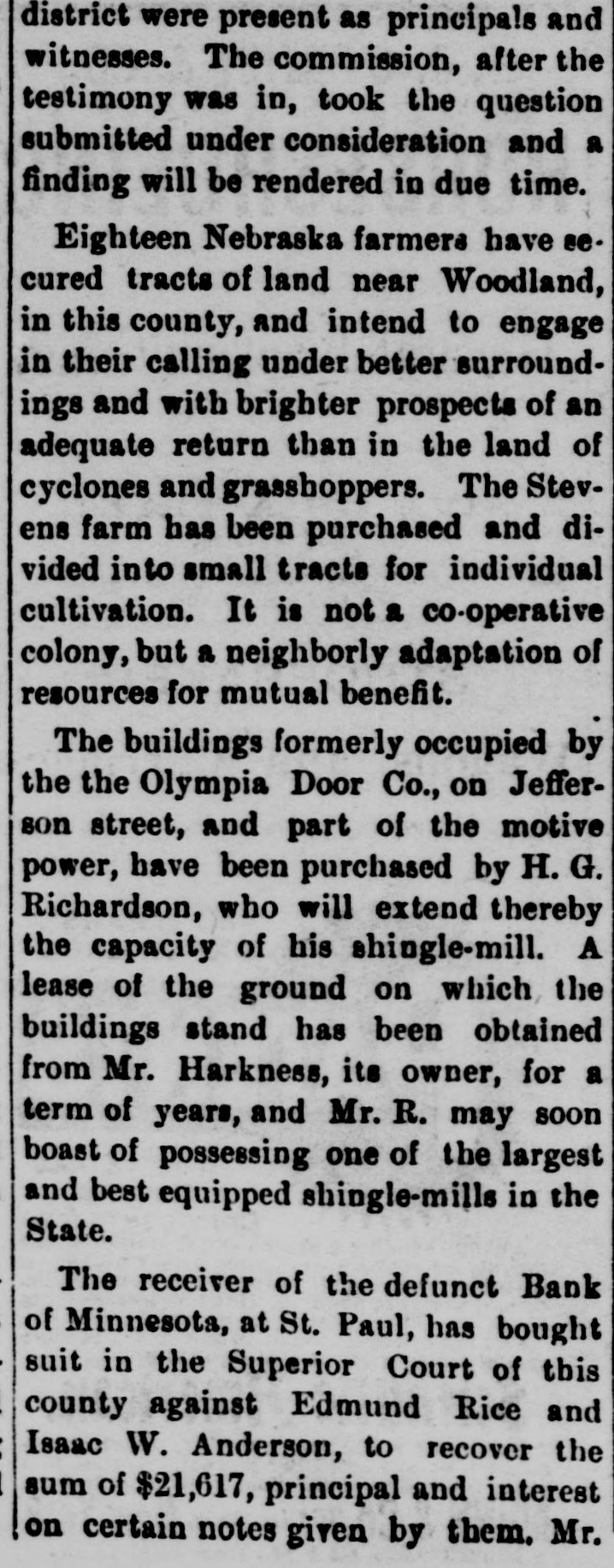
district were present as principals and witnesses. The commission, after the testimony was in, took the question submitted under consideration and a finding will be rendered in due time. Eighteen Nebraska farmers have secured tracts of land near Woodland, in this county, and intend to engage in their calling under better surroundings and with brighter prospects of an adequate return than in the land of cyclones and grasshoppers. The Stevens farm has been purchased and divided into small tracts for individual cultivation. It is not a co-operative colony, but a neighborly adaptation of resources for mutual benefit. The buildings formerly occupied by the Olympia Door Co., on Jefferson street, and part of the motive power, have been purchased by H. G. Richardson, who will extend thereby the capacity of his shingle-mill. A lease of the ground on which the buildings stand has been obtained from Mr. Harkness, its owner, for a term of years, and Mr. R. may soon boast of possessing one of the largest and best equipped shingle-mills in the State. The receiver of the defunct Bank of Minnesota, at St. Paul, has bought suit in the Superior Court of this county against Edmund Rice and Isaac W. Anderson, to recover the sum of $21,617, principal and interest on certain notes given by them. Mr.


Article from Evening Times-Republican, February 6, 1908

Click image to open full size in new tab

Article Text

IN OFFICE 45 YEARS. Veteran Mayor of St. Paul to Quit Public Life a Poor Man. St. Poul, Minn., Feb. 6.-Robert A. Smith, the venerable mayor of St. Paul who has held public office for fortyfive years, and who has occupied the mayor's chair for seven different terms and an unexpired half term, fifteen years in all, is down and out and at the age of 80 years leaves politics without a cent. His action follows the determination of his party boss to run a different man for mayor during the pending city campaign, which involved brusque notice to the aged mayor that his years of political usefulness are at an end. "Bob" Smith, as he is affectionately known to both political parties, has had a political career equalled by but few men in the United States. Of the fifty-nine years since he became of age, forty-five have been spent in office. As a democrat he was for years practically invincible in his campaigns for municipal honors, and thruout his lifetime of public service he has successively won and held the friendship of a substantial factor of the opposing party, a fact which largely accounts for his exceptional record in public life. To once a man of much wealth, he is now penniless thru unsuccessful business ventures and misfortunes, and now with his wonderful vigor partially impaired, lacks even the modest competence which might mean the difference between comparative comfort and poverty. Nineteen different campaigns attest his political sagacity and success. During his life in Saint Paul he has paid the city $140,000 in taxes, but of what he has received from the city there is nothing left. In the gloom of the Bank of Minnesota failure, a memorable financial disaster, "Bob" Smith loomed up as a heroic figure and his entire personal fortune to the last dollar went to pay the claims of depositors. The bank finally paid 70 cents on the dollar, but he was financially ruined. Since that time his business ventures have been unsuccessful and he has never succeeded in regaining the lot ground. "Too old-we need a younger man" is the grim comment of his political managers. And with this curt verdict, altho hundreds of voters feel that the venerable politician could again win at the polls, he is reluctantly content. "De Bob" as he has often been satirically named, lacks the strength to take up the fight of the under dog, and has not for a singlehanded cammen power no one paign the resources against whose knows better than he. "I won't run again," he said, in commenting upon his long public life. "What there is left I shall need for my own support and it would not be wise to risk the money in an uncertain political fight. I shall go to California now, but I'm coming back and I'm going to vote at the next election too." The aged mayor will visit in Pasadena and spend a few weeks with his old time political associates.


Article from The Washington Times, May 17, 1908

Click image to open full size in new tab

Article Text

his political sagacity and success. During his life in St. Paul he has paid the city $140,000 in taxes, but of what he has received from the city there is nothing left. In the gloom of the Bank of Minnesota failure, a memorable financial disaster, "Bob" Smith loomed up as a heroic figure and his entire personal fortune to the last dollar went to pay the claims of depositors. The bank finally paid 70 cents on the dollar, but he was financially ruined. Since that time his business ventures have been unsuccessful and he has never succeeded in regaining the lost ground. "Too old-we need a younger man," is the grim comment of his political managers. And with this curt verdict he is reluctantly content. "I won't run again," he said, in commenting upon his long public life.